Saturday, September 13, 2025

Superfluous Appointments: Albania’s Sunny AI Minister


When countries have suffered the odd mishap regarding government paralysis or convulsive change, the frequent quip would often be: “Who noticed?” Much like university vice-chancellors or the parasitic management structures of most organisations, their forced absence merely induces a range of feelings from relief to indifference.  They are all superfluous and know it.  Reasons to justify their existence must therefore be invented.

With the introduction of artificial intelligence into various spheres of society, a sense of superfluousness is bound to become even more profound. Little wonder that AI technology is very much in vogue in government circles, encouraging the Australian government, for example, to praise its “immense potential to improve social and economic wellbeing.” And seeing as government is very often a multiplication of the irrelevant, the hopeless, and the spurious, it only follows that AI would be praised for improving it. “For government,” the Australian AI policy goes on to explain, “the benefits of adopting AI include more efficient and accurate agency operations, better data analysis and evidence-based decisions, and improved service delivery for people and business.”

Little in the way of justice, human rights, or equity is mentioned in this glowing praise, which is often the problem with the next fad that captures those supposedly running a country. Efficiency chatter rarely features the welfare of the human. This has not deterred the introduction of machine learning to forecast inflation in the eurozone, nor has it prevented the US Federal Reserve from pursuing research using generative models to analyze the minutes of the Federal Open Market Committee.  The Reserve Bank of Australia has decided that AI might be best suited for policy briefings, though its governor, Michele Bullock, tried to reassure the public in a lecture delivered this month that “we are not using AI to formulate or set monetary policy or any other policy.”  Then again, in economics, who would know?

One country with its fair share of administrative problems and reputational issues is Albania, Europe’s fifth-poorest state. While its citizens are a resourceful bunch, its government has tended to wallow in the mire of corruption, a persistent hindrance to its efforts to join the European Union. And as every problem these days calls out for the AI panacea, Albanian Prime Minister Edi Rama has decided to join the club in dramatic fashion. Rather than focusing on solutions that would presumably draw on people, insight, and experience, Rama thinks that appointing the world’s first AI minister is the way to go. Less messy, less problematic. Fewer people to blame.

The AI minister, named Diella (“sun” in Albanian), had already made an appearance as a virtual assistant to the e-Albania public service platform. From that debut, the bot was intended to assist users in navigating the system to obtain official documents. Few thought that this was a prelude to careerism. Now, this same artificial creature has the status of a cabinet minister with various responsibilities. “Diella is the first cabinet minister who isn’t physically present, but is virtually created by AI,” says Rama.

Leaving aside the issue of mental presence, Rama hopes that Diella will make his country one “where public tenders are 100 percent free of corruption” with the process being totally transparent. He is less than flattering about the ministries of government, which have long been blighted by corruption. How clever, then, to leave it to Diella to be “the public servant of procurement”. Importantly, she is bound to be safe, unlikely to vie for leadership of the country (at least for the moment), unlikely to leak to the press, and unlikely to cause those distracting scandals that terrify government ministers. As a BBC report caustically remarks, “She will only be power-hungry in the sense of the electricity she consumes. And a damaging expenses scandal would appear to be out of the question.”

Certain lawmakers are unimpressed. “[The] Prime Minister’s buffoonery cannot be turned into legal acts of the Albanian state,” huffed Gazmend Bardhi, parliamentary group leader of the Democrats. There is certainly the issue of the Albanian constitution, which clearly stipulates that government ministers must be mentally competent citizens who have, at the very least, reached the age of 18.

It is hard to avoid the accusation that Rama is merely peeing in the wind, splashing everybody with ample, sloshing nonsense.  Impoverished states are often in the habit of seeking technological wonders to outdo their supposedly more advanced counterparts, leaving the structural rot unattended. The Albanian PM, in a similar vein, sees his country “leapfrogging” other states, trapped by “traditional ways of working.” His seductive hook has certainly caught a few, including Aneida Bajraktari Bicja, founder of the financial services company Balkans Capital. Having an AI cabinet appointment “could be constructive if it develops into real systems that improve transparency and trust in public procurement”.

Rama is confidently optimistic that he can secure EU membership for Albania within five years, with negotiations expected to conclude by 2027. By then, he may well be leaving the entire negotiation process to AI, relinquishing human agency in all its forms. That would say a great deal about the level of talent of those involved in the process, including those who tolerate it.

Binoy Kampmark was a Commonwealth Scholar at Selwyn College, Cambridge. He lectures at RMIT University, Melbourne. Email: bkampmark@gmail.comRead other articles by Binoy.

Two statement by the Autonomous and Independent Workers’ Committee (Venezuela): ‘Mobilise against Trump’s offensive’ and ‘On Maduro’s call for a trade union constituent assembly’


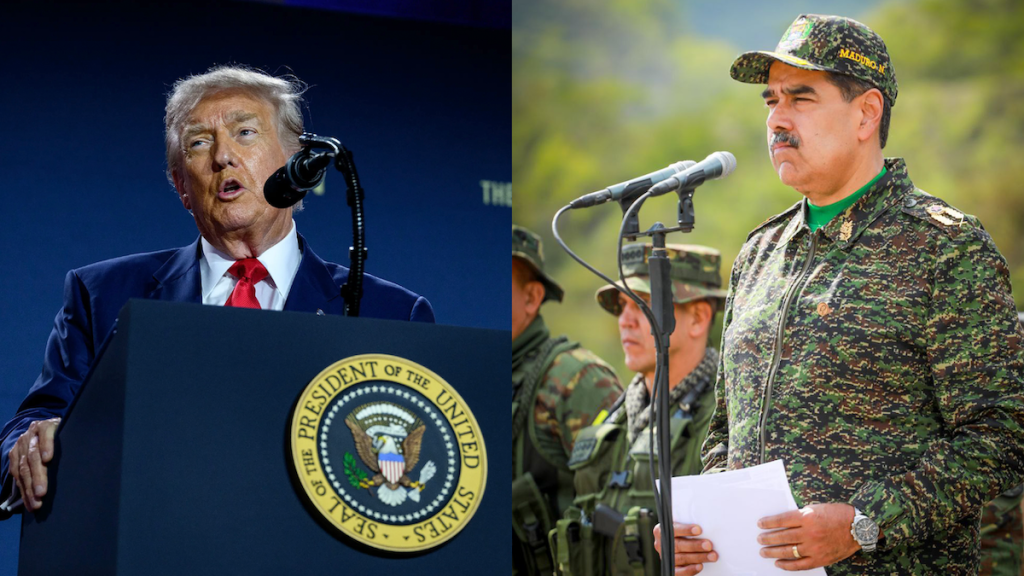
Trump and Maduro

Translations by Federico Fuentes for LINKS International Journal of Socialist Renewal.

Joint statement: Against US interference in Venezuela

August 16

The Donald Trump administration has carried out mass arrests, detentions and deportations of millions of migrant workers. It has also imposed tariffs, especially on Brazil, which faces 50% tariffs for purely political reasons. Washington expressed its disapproval of the Brazilian court rulings against former President Jair Bolsonaro in July. Bolsonaro is being prosecuted for involvement in a coup plot to prevent the legitimately elected Lula da Silva from assuming the presidency.

Trump is now intensifying his aggression under the pretext of combating drug trafficking. The United States has announced the deployment of 4000 troops to the southern Caribbean Sea to halt drug trafficking from Venezuela. White House spokesperson Karoline Leavitt said the Trump administration is prepared to use all its resources to bring drug traffickers to justice, and that it considers Nicolás Maduro’s government a “narco-regime” and the Venezuelan president a fugitive drug trafficker, for whom a US$50 million bounty has been offered.

This approach is not new: the US has used the drug trafficking narrative to justify interventions in the past, such as Plan Colombia. This entailed heavy militarisation that never halted the drug trade, but did consolidate the US’ military presence in the region. Now, Venezuela faces a similar plan, where an inconvenient government is criminalised to justify a military deployment.

Mexican President Claudia Sheinbaum has declared she will not allow US operations on Mexican soil. Colombian President Gustavo Petro has warned that a military operation against Venezuela without the approval of sister nations would be an aggression against all Latin America and the Caribbean. He has ordered the Colombian armed forces to reject any US military intervention in Venezuela. The Colombian president has requested that Latin American heads of states and foreign ministers meet as soon as possible.

Regional cohesion is urgently needed

We reiterate: no country can withstand imperialism’s pressure alone. The united mobilisation of the Latin American people, together with US and Canadian workers, is urgently needed to block Trump’s threats and attacks. Opposition to imperialist policies and attacks on US labour rights is growing stronger across the world, and working people are uniting in defence of migrants.

We reject and condemn the interventionist actions of the Trump-led US government, which seeks to legitimise military intervention in Latin America and the Caribbean under the pretext of combating drug cartels. Imperialism’s true intentions are to control the vast oil reserves and international trade in the region. These violent actions are being replicated by the Venezuelan far right in its quest to destabilise the country.

Let’s mobilise across the continent in response to Trump’s offensive.

Long live the struggle of the workers and peoples of the Americas.

Down with imperialism and Trump’s criminal policies.

Comité Autónomo e Independiente de Trabajadores (CAIT, Autonomous and Independent Workers' Committee), Venezuela
Foro Internacional de Víctimas (International Victims Forum), Venezuela
Movimiento Progresista Alternativo (MPA, Alternative Progressive Movement), Colombia
La Red Socialista (Socialist Network), Colombia


CAIT and the call for a trade union constituent assembly

September 1

At our August 23 meeting, CAIT had our first discussion on President Nicolás Maduro’s call to convene a trade union constituent assembly. According to the head of state [speaking on August 15], the aim is to overcome the bureaucratic structures of traditional trade unionism, viewed as old and exhausted, and move towards new and strong movements. The proposal has rekindled debate within the labour movement about its future and that of constitutionally enshrined labour rights.

Days later, on August 21, [United Socialist Party of Venezuela MP] Francisco Torrealba gave an extensive interview on Venezuela News program “Hablando Claro” (Speaking Clearly). He expanded and contextualised Maduro’s call. For Torrealba, the point is to rethink everything to do with the working class and labour in Venezuela, without any taboos: The CPTT [Workers’ Productive Councils] strategy; in terms of the new economic model, productivity, production methods, and monitoring efficiency levels; a review of the formulas for calculating benefits contained in the LOTT [Labour Law] and collective bargaining agreements; moving towards industry-wide contracts; reviewing and debating workday schedules, working hours, benefits, tasks, commitments, and the concept of a salary; the concept of the minimum wage and the indexation of monthly income; reconsidering the issue of social benefits, regulating delivery driver work, and entrepreneurship; and the issue of pensions and retirements that have been fully assumed by the Venezuelan state, when these systems are generally universal yet based on individual and solidarity-based contributions.

Regarding freedom of association, [Torrealba suggested that] the LOTT should be amended where it establishes that 20 or more workers can form a union, to put an end to the proliferation of parallel unions. [He added] the Workers’ Constituent Assembly is not a constituent assembly for reforming the constitution, but may come up with and propose specific recommendations when the decision is made to move forward with the proposed constitutional reform and a National Constituent Assembly is elected.

If the interview with the PSUV MP and labour spokesperson served a purpose, it was to lay out, in black and white, the scope of the proposed trade union constituent assembly. It reflects a tendency in the government that wants to reform the constitutional framework and the LOTT to bring them in line with the new economic model that seeks to liberalise and deregulate certain markets. This model includes: the partial dollarisation of the economy; privatisations; establishing new ties with Fedecámaras [the country’s main business federation] and business associations; opening up oil, gas, petrochemicals and refining sectors to international investment; Special Economic Zones; and promotes an agri-business food sector — overall, a model in which private ownership of the means of production is the rule and economic agents make exorbitant profits. This orientation has pulverised workers’ wages, increased precarious employment, and deregulated labour relations.

Certain issues remain open: Who will convene the trade union constituent assembly? How will it be elected? How long will its mandate be? Where will it be held? How many elected members will it have? What will its rules be? And will it be open to the entire union movement?

As part of the workers’ movement, CAIT believes it is essential to participate in this debate, advancing a perspective of workers’ autonomy and independence, and engaging with labour sectors from different political and union backgrounds. Therefore, we have agreed to organise this discussion in the broadest possible way, under the banner “The Constituent Debate and Workers”. Through forums, discussions and statements on various aspects of the trade union constituent assembly, as well as developing an e-newsletter, we invite the working class to engage in this discussion.

IMPERIALIST ASSAULT ON VENEZUELA
Senators: Pentagon Has Not Given “Any” Justification for Caribbean Boat Strike


“There is no evidence — none — that this strike was conducted in self-defense,” said Sen. Jack Reed.

September 12, 2025
Sen. Jack Reed (D-Rhode Island) listens as U.S. Federal Reserve Chair Jerome Powell testifies at a Senate Banking, Housing, and Urban Affairs Committee hearing on Capitol Hill  in Washington, D.C.Tom Williams - Pool / Getty Images

The top Democrat on the Senate Armed Services Committee has said that the Pentagon has provided Congress with “no evidence” to back its claims on the legitimacy of the boat strike in the Caribbean that killed 11 people who experts say were civilians.

The Defense Department briefed congressional staff on the strike on Tuesday, CNN reports. The officials did not present any evidence backing the Trump administration’s claims that the people targeted were affiliated with a gang or cartel, according to Sen. Jack Reed (D-Rhode Island).

“They have offered no positive identification that the boat was Venezuelan, nor that its crew were members of Tren de Aragua or any other cartel,” said Reed after the briefing, per CNN.
Nor did the Pentagon officials provide intelligence showing that the strike was done in self-defense, he said, despite Trump’s assertion in a letter to Congress after the strike last week.

“There is no evidence — none — that this strike was conducted in self-defense,” Reed said. “That matters, because under both domestic and international law, the US military simply does not have the authority to use lethal force against a civilian vessel unless acting in self-defense.”

Related Story

Experts Say Trump Administration’s Deadly Boat Attack Amounts to Extrajudicial Killings
“Trump is claiming the right to conduct extra-judicial assassinations,” a civil rights attorney posted on X. By Elizabeth Weill-Greenberg , Truthout September 3, 2025


The Pentagon has denied Reed’s account.

In a letter sent after the briefing, Reed and 19 Democrats also noted that they have been provided with no information to back the legality of the strike.

“The Trump Administration has yet to provide Congress or the American people with any legitimate legal justification for the strike, or any evidence to support its claims regarding the basis for this strike or the future strikes it has openly threatened to launch across the region,” the senators wrote.

Officials reportedly also indicated that the Pentagon did not know where the boat was headed; President Donald Trump and Secretary of State Marco Rubio have offered differing narratives on where the boat was going. Trump has said that the boat was “heading to the United States,” while Rubio said the boat “probably headed to Trinidad or some other country in the Caribbean.” However, The New York Times reported on Wednesday that officials say that, in reality, the boat had turned around and was potentially headed back toward shore before the military launched the strike, even further undercutting the administration’s self-defense narrative.

The Venezuelan interior minister said this week that none of the people on the boat were affiliated with the gang, according to their own investigations.

“We have done our investigations here in our country and there are the families of the disappeared people who want their relatives, and when we asked in the towns, none were from Tren de Aragua, none were drug traffickers,” said Diosdado Cabello. “A murder has been committed against a group of citizens using lethal force.”

Legal experts have said that the U.S.’s strike likely violated numerous domestic and international laws.

“I’m not aware of any basis for the extraordinary notion that either the Commander-in-Chief Clause or any implied constitutional ‘foreign relations’ authority affords the President the power to order the military to kill any and all persons around the world who might (in the President’s view) be planning to commit crimes in the United States,” wrote Marty Lederman, Georgetown University Law Center professor and former Office of Legal Counsel Deputy Assistant Attorney General, for Just Security.

“That’s why there’s virtually no historical precedent of any president ordering lethal force in a situation such as this,” Lederman wrote.

Rep. Ilhan Omar (D-Minnesota) has introduced a war powers resolution to prevent the Trump administration from escalating its aggression against Venezuela or conducting future strikes in relation to the Caribbean strike.

“There was no legal justification for the Trump Administration’s military escalation in the Caribbean,” Omar said, per The Intercept. “That is why I am introducing a resolution to terminate hostilities against Venezuela, and against the transnational criminal organizations that the Administration has designated as terrorists this year.”


There Was a Boat. That Was the Only True Part.


This was what the President of the United States initially lied:

“Earlier this morning, on my Orders, U.S. Military Forces conducted a kinetic strike against positively identified Tren de Aragua Narcoterrorists in the SOUTHCOM area of responsibility. TDA is a designated Foreign Terrorist Organization, operating under the control of Nicolas Maduro, responsible for mass murder, drug trafficking, sex trafficking, and acts of violence and terror across the United States and Western Hemisphere. The strike occurred while the terrorists were at sea in International waters transporting illegal narcotics, heading to the United States. The strike resulted in 11 terrorists killed in action. No U.S. Forces were harmed in this strike. Please let this serve as notice to anybody even thinking about bringing drugs into the United States of America. BEWARE! Thank you for your attention to this matter!!!!!!!!!!!”

How was this dishonest? Let me count the ways.

  1. “Kinetic strike” is just a euphemism for murder. The above words accompanied a video of people in a small boat being blown up. You don’t see the blood spurting out of their bodies, as you might in an unacceptable murder objected to by Trump. You see a cool flash of light of the sort you’ve been conditioned by countless movies, television shows, and news broadcasts to ooh and aah at. But it’s just killing people.
  2. There is no legal basis for the U.S. military to circle a giant chunk of the Earth’s surface and declare it the “responsibility” of a portion of that military named “SOUTHCOM.” This was at least 1,000 miles away from the United States, and therefore a job for a department of “defense,” only with the usual hypocrisy, even if there had been some sort of attack on anything — it’s a good thing the department is back to being one of “war.”
  3. Nobody has publicly identified the people or identified them as drug dealers or as members of a particular gang.
  4. Nobody has publicly established that there exists a gang engaged in “narcoterrorism” — that is, in dealing drugs and in terrorism. The most likely scenario for that happening will be city cops busting U.S. National Guard occupiers selling illegal substances to each other.
  5. There is no way to define terrorism so as not to include the act of blowing up a boat and threatening to blow up more. Labeling the victims terrorists, even if true, cannot change that.
  6. There is no public evidence that the president of Venezuela is in charge of the alleged gang.
  7. There is no public evidence that the supposed gang of the president of Venezuela has done “mass murder, drug trafficking, sex trafficking, and acts of violence and terror across the United States and Western Hemisphere.”
  8. The boat was not “heading to the United States.” The U.S. Secretary of State said it was headed to Trinidad & Tobago and then “corrected” his statement to agree with Trump’s. His initial statement was more plausible for such a small boat. We later learned that the people on the boat had apparently become aware of the drone or drones above them and reversed course, so that at the time of their murder, they were headed in the opposite direction of wherever they had been headed at first.
  9. It is highly unlikely that “No U.S. Forces were harmed in this strike.” The U.S. Air Force has long made clear that PTSD and moral injury are far more common among “drone pilots” who watch their targets on a screen than among airborne pilots.
  10. Trump’s video did not show what we later learned were multiple strikes on the same little boat, which would have looked less wrath-of-God cool than a single bolt of MAGAnite.
  11. Bragging about something on social media implies that it is legal, acceptable, and admirable. Reuters’ comical straight-faced “analysis” went like this: “Some experts questioned whether the decision to summarily kill people merely on suspicion of smuggling drugs violated international law. Trafficking in an illegal substance is not normally considered a capital offence.” In fact, murdering people violates international and national laws. Past U.S. presidents having done something does not legalize it. Even advocates for worldwide drone murder sprees have always maintained that it is only through the magic of being part of a war that such murders become totally admirable non-murders. If something were a “capital offense,” a president would still not get to be judge, jury, and executioner with no indictment or trial — not legally.
  12. Drug dealing is not warmaking, and immigrating is not militarily invading. When someone like Senator Chris Murphy says that those who were killed on the boat may have been members of a drug cartel or may have been civilians, he is selling snake oil. Drug dealers are civilians.*
  13. Threatening more of the same is a crime under international and national laws as well, starting with the United Nations Charter.
  14. When someone like Senator Chris Murphy says the big damage here is the setback for the war on drugs, he is obscuring our view of the mass murder just committed by Trump.
  15. When the same senator says that blowing up boats would be legal if Congress had authorized it, he is pushing the lie that Congress has the power to overrule international law. It does not. War — and murder apart from war — are both equally illegal with or without the approval of the United States Congress. Yes, I am listing responses to Trump’s dishonesty as part of it, but he could count on just these non-responses.
  16. There is no world in which such a small boat contained enough drugs even for a single Republican National Convention, and there is no boat large enough that blowing it up could distract even Trump’s own followers from their obsession with Epstein.

Sign the petition against war on Venezuela here.

*Well, not some of the U.S. Special Forces in Afghanistan, for example, but most drug dealers.

David Swanson is an author, activist, journalist, and radio host. He is director of WorldBeyondWar.org and campaign coordinator for RootsAction.org. Swanson's books include War Is A Lie. He blogs at DavidSwanson.org and War Is a Crime.org. He hosts Talk Nation Radio. Follow him on Twitter: @davidcnswanson and FaceBookRead other articles by David.


Washington Projects Its Drug Problem onto


Latin America: Narco-State Myth Used to


Attack Venezuela


A big Cadillac limo with Jersey plates was parked down the block. Few locals in East Harlem even owned cars, let alone new ones. Curious, I asked the street kids what’s up. They casually explained that the mafioso comes weekly to collect their drug money. Later, I found a playground, which served as a veritable narcotics flea market each night. If a blanquito from the suburbs and some third graders could uncover the illicit trade, I wondered why the officials – who plastered the city with “keep New York drug free” signs – couldn’t do the same.

That was in the late 1960s, and I am still wondering why the US – the world’s largest consumer of narcotics, the biggest money launderer of illicit drug money, and the leading weaponry supplier to the cartels – hasn’t resolved these problems.

One thing is clear: the drug issue is projected onto Latin America. White House spokesperson Anna Kelly warned of “evil narco terrorists [trying] to poison our homeland.” Drug interdiction has been weaponized as an excuse to impose imperial domination, most notably against Venezuela.

Since Hugo Chávez was elected Venezuela’s president in 1998 and initiated the Bolivarian Revolution – a movement that catalyzed the Pink Tide in Latin America and galvanized a counter-hegemonic wave internationally – Washington has tried to crush it. In 2015, then-US President Barack Obama accused Venezuela of being an “extraordinary threat” to US national security when, in fact, the opposite was the case; the US threatened Venezuela.

Obama imposed unilateral coercive measures – euphemistically called “sanctions.” Each subsequent administration renewed and, to varying degrees, intensified the sanctions, which are illegal under international law, in a bipartisan effort. But the imperial objective of regime change was thwarted by the political leadership of Venezuelan President Nicolás Maduro in concert with the country’s people and in firm alliance with their military.

Now that draconian sanctions have “failed” to achieve regime change, President Trump dispatched an armada of warships, F-35 stealth aircraft, and thousands of troops to increase the pressure.

Venezuelan President Nicolás Maduro responded: “What Washington wants is to control Venezuela’s wealth [including the world’s largest oil reserves]. That is the reason why the US deployed warships, aircraft, missiles, and a nuclear submarine near Venezuelan coasts under the pretext of fighting drug trafficking.”

Maduro maintains his country is free of drug production and processing, citing reports from the United Nations, the European Union, and even the US Drug Enforcement Agency (DEA). The Venezuelan president could have also referenced the findings of Trump’s own security agencies absolving him from the charge of directing the Tren de Aragua drug cartel.

And, speaking of collusion with drug cartels, Maduro could have commented on the DEA itself, which was expelled from Venezuela in 2005 for espionage. Regardless, the DEA has continued to secretly build drug trafficking cases against Venezuela’s leaders in knowing violation of international law, according to an Associated Press report.

Venezuelan Vice President Delcy Rodríguez highlights that the DEA “has known connections with the drug trafficking world.” For example, an investigation by the US Department of Justice revealed that at least ten DEA agents in Colombia participated in repeated “sex parties” with prostitutes paid for by local drug cartels. In 2022, the DEA quietly removed its Mexico chief for maintaining improper contacts with cartels. This underscores a troubling pattern: DEA presence tends to coincide with major drug activity, but does not eliminate it.

The US “is not interested in addressing the serious public health problem its citizens face due to high drug use,” Maduro reminds us. He points out that drug trafficking profits remain in the US banking system. In fact, illicit narcotics are a major US industry. Research by the US Army-funded RAND Corporation reveals that narcotics rank alongside pharmaceuticals and oil/gas as top US commodities.

The former head of the UN Office on Drugs and Crime, Pino Arlacchi commented: “I was in Colombia, Bolivia, Peru and Brazil but I have never been to Venezuela; there was simply no need.” He added: “The Venezuelan government’s cooperation in the fight against drug trafficking was one of the best in South America; It can be compared only to Cuba’s impeccable record. This fact, in Trump’s delusional narrative of ‘Venezuela as a narco-state’, sounds like geopolitically motivated slander.” The UN 2025 World Drug Report, from the organization he led, tells a story opposite to that spread by the Trump administration.

According to Arlaachi, if any Latin American country should be targeted, it is US-allied Ecuador, now the world’s leading cocaine exporter using banana boats owned by the family of Trump’s buddy, right-wing President Daniel Naboa.

Mexican President Claudia Sheinbaum notes that if any “alliance” exists with cartels, it lies “in the US gun shops,” highlighting how Yankee firearms fuel cartel violence. She urges Washington to look inward at its own drug demand and lax enforcement. If the US truly wanted to curb fentanyl, “they can combat the sale of narcotics on the streets of their main cities… and [stop] the money laundering” tied to the trade – steps “they don’t do.”

The resounding message from Latin America is that blaming them alone for the drug problem is misleading – the US’s own appetite for drugs and history of interventionism are key contributors. Solutions call for shared responsibilities and cooperative relationships.

US policy under Trump, which confounds terrorism with criminal activity, is a cover for projecting military domination. Claiming the prerogative to unilaterally intervene in the sovereign territories of neighboring states to fight cartels or murdering a boat’s crew in the Caribbean are not solutions. Latin American leaders are turning the spotlight back on Washington. They point to US gun policies, consumer demand, and ulterior motives behind Washington’s renewed “war on drugs,” such as the current regime-change offensive against Venezuela. The drug problem won’t be solved by scapegoating Latin America when the US has yet to address root causes at home.

Roger D. Harris was an international observer for Venezuela’s 2024 presidential election. He is with the US Peace Council and the Task Force on the AmericasRead other articles by Roger.

Taking the Constitution Seriously

by  | Sep 12, 2025 | 20 Comments

Last week, the President of the United States did not take the Constitution seriously. He ordered the murders of 11 people who were riding in a speedboat in the Caribbean Sea around 1,300 miles from the U.S.

Afterward he said he did so because he believed that they were members of a “narco-terrorist gang” and were delivering illegal drugs to America. He also did so, he said, as a “message” to other drug dealers who should fear a similar fate.

The boat had no ability to reach the U.S. According to the former head of drug interdiction for the Department of Justice, this so-called boat gang is not known for trafficking in illegal drugs. The crimes that the president said these folks committed did not occur in the U.S., and if they had, do not permit the imposition of the death penalty.

He offered no evidence to support his claims and didn’t even suggest that the riders in the boat posed a threat to the American military personnel who killed them. He couldn’t say if anyone in the boat was an American.

When he was asked for the legal authority for these killings, President Donald Trump replied that these folks were waging war on the U.S., and, because he is the president of the United States, he can do as he wishes to them.

These are constitutionally ignorant, morally repugnant, profoundly erroneous responses from a person who has taken an oath to uphold the Constitution.

Here is the backstory.

When British monarchs wanted to dispose of inconvenient adversaries, they often accused them of vague crimes because they were able to define the crime however they saw fit. St. Thomas More, Henry VIII’s former Lord Chancellor, was executed for his silence. The monarch’s target was given a quick trial and then often a slow and excruciating public death – to send a message.

Mindful of the tyrannical impulses of monarchs and familiar with British history, even personally aware of folks in the colonies charged with crimes in London — where they had never been — and transported there for prosecution, Thomas Jefferson and James Madison, the Founding Fathers most responsible for crystallizing the American ethos of natural rights and due process, crafted founding documents that articulated condemnations and prohibitions of tyranny and tyrannical behavior here.

Thus, Jefferson’s words in the Declaration of Independence characterize human rights as the gift of the Creator, which cannot be taken away by executive decree or legislative enactment – ut only by a jury verdict.

And Madison’s words in the Constitution’s Fifth Amendment declare that “no person shall be… deprived of life, liberty, or property without due process of law.” The use of the word “person” makes it obvious that due process applies to all human beings.

Due process requires a fair jury trial, with counsel and the opportunity for confrontation of witnesses and evidence produced by the government. It also requires proof of guilt beyond a reasonable doubt and to a moral certainty to a neutral jury, not to the accuser. And it requires conviction prior to the imposition of a legislatively prescribed penalty.

This was novel and radical in 1791, when the Bill of Rights was ratified, but it is neither novel nor radical today. Today, due process is the foundation of American law. It is what lawyers call black-letter law: Those in government are expected to know it and understand it and abide by it.

Until now.

Now, the president says he can declare war on any person or group and summarily kill them. Wrong. Under the Constitution, only Congress can declare war.

Now, the president says he can use federal assets however he sees fit as long as he can argue that their use is for the greater good. Wrong. Under the Constitution, he is limited to enforcing the laws that Congress has enacted and fighting the wars that Congress has declared.

Now, the president says some folks are so known to be evil that they can be executed before they commit crimes. Wrong. Because of the sweeping language in the Fifth Amendment, all human beings are entitled to the presumption of innocence, the right to a jury trial and the attendant protections of due process whenever the government pursues them.

What’s going on here?

American history is replete with instances of presidential behavior unserious about the Constitution. John Adams prosecuted folks for their speech. Abraham Lincoln arrested his critics without trial. Woodrow Wilson prosecuted students for reading the Declaration of Independence outside draft offices. Franklin Roosevelt incarcerated Americans based on race. George W. Bush began mass warrantless surveillance. Barack Obama murdered non-violent uncharged Americans in Yemen.

Did any of this enhance personal liberty or public safety? Of course not. But it enhanced public fear of a tyrant in the White House.

The underlying constitutional value – attacked by Trump and his predecessors — is that individuals are sovereign and government is limited. That is the Founders’ unanimous presumption at the creation of the American Republic. Individuals are free to exercise natural rights, and government is limited by the consent of the governed and the Constitution that defined it and, channeling Jefferson, chained it down.

But chaining the government down requires taking the Constitution seriously. And that requires those in whose hands we have reposed the Constitution for safekeeping to read it and understand it and comply with it – and to comply with their oaths to preserve, protect and defend it.

Do we have such folks in power today? The answer is obvious.

Until we do, this will likely get worse. Some have argued that pre-conviction, extrajudicial killings in peacetime of nameless, faceless, foreign bad guys not engaged in violence at the time of their deaths and never even charged with any crimes is a cause for rejoicing. They may rejoice today, but they will weep when the president or a successor brings killing the legally innocent home.

Andrew P. Napolitano, a former judge of the Superior Court of New Jersey, is the senior judicial analyst at Fox News Channel. Judge Napolitano has written seven books on the US Constitution. The most recent is Suicide Pact: The Radical Expansion of Presidential Powers and the Lethal Threat to American Liberty. To find out more about Judge Napolitano and to read features by other Creators Syndicate writers and cartoonists, visit www.creators.com. 

COPYRIGHT 2025 ANDREW P. NAPOLITANO – DISTRIBUTED BY CREATORS.COM


Lloyd’s Register Approves SHI Next-Gen SnapWind Float Offshore Wind Design

Lloyd's Register
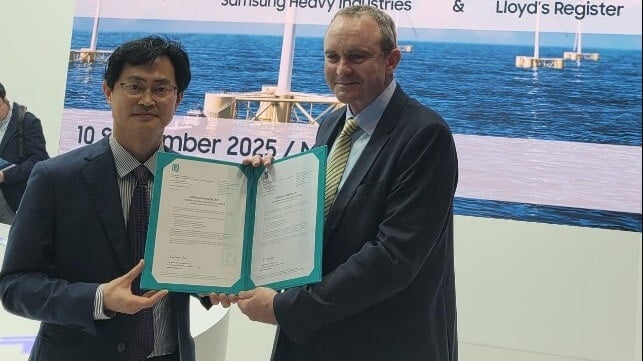
The attached image shows Haeki Jang, Executive Vice President, Samsung Heavy Industries; and Andy McKeran, Chief Growth Officer, Lloyd’s Register at the AiP ceremony at Gastech 2025.

Published Sep 13, 2025 10:51 AM by The Maritime Executive


[By: Lloyd's Register]

Lloyd’s Register (LR) has granted Approval in Principle (AiP) to Samsung Heavy Industries (SHI) for its new Floating Offshore Wind Turbine (FOWT) design, SnapWind Float.  

Announced this week at Gastech 2025 in Milan, SnapWind Float has been developed to deliver floating wind solutions that can unlock deeper water sites and higher-capacity renewable energy sites worldwide. 

In addition, the SnapWind Float design is optimised for the development of floating offshore wind farms in regions where skilled workforce, heavy lifting equipment and sufficient workspace are limited. 

SHI’s engineering team completed the concept and basic design, while LR carried out a comprehensive review, in accordance with its rules and international standards, to verify the feasibility and safety of the design and clears the way for its progression towards commercial deployment. 

Sean van der Post, LR’s Global Offshore Business Director, said: “As the offshore wind industry seeks new solutions to unlock deeper waters and higher capacity sites, the SnapWind Float demonstrates significant progress toward establishing floating wind as a commercially sustainable solution at scale.” 

Hae-Ki Jang, Chief Technology Officer at Samsung Heavy Industries, said: “The SnapWind Float is designed to meet the challenges of offshore wind developers who require efficient and commercially viable solutions. Receiving AiP from Lloyd’s Register is an important milestone that validates our technology and supports the next stage of offshore wind development worldwide.” 

The products and services herein described in this press release are not endorsed by The Maritime Executive.


Human Element Is Key As Information Overload Emerges As New Risk

Inmarsat Maritime
Future of Maritime Safety Report 2025

Published Sep 13, 2025 10:55 AM by The Maritime Executive


[By: Inmarsat Maritime]

The 2025 edition of the Future of Maritime Safety Report from Inmarsat Maritime, a Viasat (NASDAQ: VSAT) company, reveals that distress calls at sea remain high, underlining the vital role of human factors in safe shipping.

According to the report, the number of Global Maritime Distress and Safety System (GMDSS) distress calls registered on the Inmarsat Maritime network increased from 788 in 2023 to 801 in 2024, broadly in line with the 2018-2023 annual average of around 800 calls.

The report points to a turbulent year for international shipping, with geopolitical instability, conflict, severe weather events, piracy, and cyber-attacks all adding pressure on operators and crews. Alongside these risks, seafarers are facing welfare challenges linked to the pace and volume of new technologies. While digitalisation and decarbonisation are essential for the industry’s future, the rapid implementation of new systems and reporting requirements has created an information ‘overload challenge’ for seafarers, highlighting the need for new technologies to support, rather than strain, crew welfare.

The Future of Maritime Safety Report 2025 calls for the industry to acknowledge the fundamental role seafarer welfare plays in minimising the number of preventable incidents at sea. It recommends a ‘human factors’ approach to data that streamlines information, reduces duplication, and eliminates contradictory outputs.

Peter Broadhurst, Senior Vice President, Safety and Regulatory, Inmarsat Maritime, said: “Accurate data holds immense potential to transform shipping safety – from predictive maintenance to casualty and near-miss reporting and human-factor analysis. But data must empower crews, not overwhelm them. We need smarter systems to capture, evaluate, and utilise data more effectively without placing an extra burden on already overworked seafarers.”

Peter Broadhurst also emphasised the need for greater collaboration: “By sharing anonymised safety data, the industry can create a trusted ecosystem that strengthens standardisation and regulations, improves operations, and safeguards seafarer welfare. Together, we can create one of the most powerful maritime safety initiatives to navigate us through the pressures and changes impacting international shipping in the years to come.”

Inmarsat invites maritime professionals, policymakers, and stakeholders to explore the findings of the Future of Maritime Safety Report 2025 report and to support collective action in safeguarding life at sea.

Download the full report here.

The products and services herein described in this press release are not endorsed by The Maritime Executive.


U.S. Launches Largest Sanction Action Against Houthis

Houthis
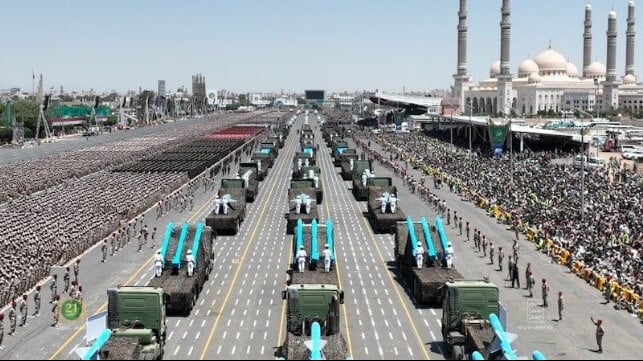
U.S. launched its largest yet sanction package targeting the Houthis and facilitators supplying military components (Houthi media)

Published Sep 11, 2025 9:45 PM by The Maritime Executive


In its continuing efforts to pressure the militants in Yemen, the U.S. Department of the Treasury’s Office of Foreign Asset Control launched the largest sanction action to date targeting the Houthis. The effort included 32 individuals and entities, as well as four tankers, all of which the U.S. contends are part of a global network involved in fundraising, smuggling, and weapons procurement operations.

The U.S. has previously targeted leaders in the Houthi movement as well as its financial network. The new action the U.S. reports targeted finance and those who facilitate the Houthis’ acquisition of advanced military-grade materials. They said the network is involved in helping to supply ballistic missiles, cruise missiles, and drone components.

“The Houthis continue to threaten U.S. personnel and assets in the Red Sea, attack our allies in the region, and undermine international maritime security in coordination with the Iranian regime,” said Under Secretary of the Treasury for Terrorism and Financial Intelligence John K. Hurley.  “We will continue applying maximum pressure against those who threaten the security of the United States and the region.”

The U.S. says the Houthis generate substantial revenue by importing oil and other commodities through ports under their control, overseeing complex smuggling operations, and laundering vast sums of money.  The proceeds from these illicit activities, the U.S. said, finance the Houthis’ global weapons supply chain, which relies on procurement operatives, front companies, shipping facilitators, and various suppliers.  

United Arab Emirates-based Tyba Ship Management DMCC, owned by a Houthi-linked businessman, Muhammad Al-Sunaydar, is among the targets of the new actions. Tyba, they report, operates the Barbados-flagged Star MM and Antigua and Barbuda-flagged Nobel M oil tankers, which discharged oil at Houthi-controlled port Ras Isa. Tyba also operates the Panama-flagged Black Rock and Antigua and Barbuda-flagged Shria oil tankers and was linked to companies in the Marshall Islands, which are the registered owners of the Nobel M, Star MM, and Shria.

The sanctions also targeted a series of China-based companies, which the U.S. said are fronts for the Houthis and are organizing shipments. One, they said, was involved with shipping hundreds of thousands of tons of chemical precursors used to manufacture motors for ballistic missiles and explosives. Another they said was coordinating large-scale procurement and shipment of UAV components and other items from China used in weapons manufacturing.

The actions come as the Houthis have escalated their threats and increased the attacks on Israel. The Israeli military responded with attacks on Wednesday that it said targeted military sites in Sanaa and al-Jawf province. Among its targets, the Israelis said, was "the Houthis' military public relations headquarters." The Houthis claimed to have mounted a defense, which they said caused some of the Israeli jets to turn back.

Attacks against shipping, however, appear to be in another lull. They launched attacks in August, including sinking two bulkers, but since then have only made a few failed attempts at targeting ships. They, however, assert they are maintaining a blockade against all shipping associated with Israeli ports.