Saturday, September 13, 2025


Democrats’ Digital Dysfunction


Paid Influencers, Humiliating Interviews, and Lost Credibility


“HAVE A GREAT LABOR DAY WEEKEND, PATRIOTS!!! GOD BLESS THE WORKING PEOPLE WHO MAKE AMERICA GREAT!,” read an August 2025 tweet, capped with three American flags and a photo of its author in a convertible, sunglasses on, peace sign raised. This wasn’t 2016. This wasn’t President Donald Trump. It was California Governor—and presidential hopeful—Gavin Newsom.

Newsom’s sudden shift to Trump-style posting has been hailed by some legacy outlets as proof Democrats are finally learning to compete in the digital-media space. The New York Times gushed that he “has that dog in him.” NBC claimed his “national profile soars.” But Democrats are not just late to the party—they’re fundamentally unprepared for it. Unlike Trump and other Republicans who thrived in podcasts and digital platforms by appearing authentic, Democrats have struggled with stiff rhetoric, unpopular policies, and a legacy-media mindset that collapses in unscripted, contentious interviews. Newsom’s Twitter cosplay is less a breakthrough than a symptom of a party pretending it can play a game it doesn’t understand.

After the 2024 election, the contrast couldn’t have been clearer. Trump and then Vice-Presidential candidate J.D. Vance seemed comfortable and unscripted on podcasts like This Past Weekend with Theo Von and The Joe Rogan Experience. To drive home the contrast, Trump used his appearance on Rogan’s show to mock his Democratic opponent for President, Vice-President Kamala Harris, for avoiding such interviews, “Can you imagine Kamala doing this show? She’d be laying on the floor… call in the medics!” Harris did eventually sit down with Call Her Daddy, but it was a softball interview that looked like a last-ditch stunt, not a confident embrace of the medium.

Since then, Democrats have been scrambling to figure out how to succeed electorally in a media environment increasingly dominated by populist rhetoric. After 2024, Trump’s side had Joe Rogan, Theo Von, Andrew Schulz’s Flagrant, and Tony Hinchcliffe’s Kill Tony, his own Truth Social platform, and Elon Musk’s X—at least until the Musk-Trump falling out. Democrats realized that they had nothing similar and tried to mimic the formula. Newsom even launched his own podcast, but misread the moment entirely. Convinced America wanted to move right, he booked guests like Charlie Kirk and Steve Bannon while back-pedaling on progressive causes like transgender rights. When that backfired, he pivoted again—back to resistance liberalism on social media.

Dark Money, Influencers, and the Digital Echo Chamber

Democrats have long struggled with the shifting news environment. After their 2016 loss, they blamed digital media, dismissing it as “fake news” or disinformation. “Over the next four years, they came to realize that digital media was not going away, and that competing successfully would require a more active media strategy. So, in 2020, Democratic allies and Trump’s opponents coordinated efforts to shape media narratives against him in what Time called a “shadow campaign.” In 2024, the Harris campaign went further, funding favorable—but false—AI-generated headlines through Google ads and enlisting influencers and celebrities. Still, these efforts could not match the brand loyalty and digital reach Trump had cultivated with online content creators.

In 2025, Democratic supporters looked beyond candidates and sought to amplify party-friendly influencers. This included a dark money group named the Sixteen Thirty Fund, which poured money into pro-Democratic Party messaging online through Chorus. The Sixteen Thirty Fund has a long history of bankrolling Democratic causes—spending $400 million in 2020 to help defeat Republicans. Chorus describes itself as “a creator-led nonprofit organization dedicated to helping content creators expand their reach and educate their audiences about news and public policy.” According to Taylor Lorenz’s August 2025 reporting in Wired, Chorus ran the Chorus Creator Incubator Program, which paid liberal content creators like David Pakman and Brian Tyler Cohen up to $8,000 a month to produce party-friendly content—without disclosing the source of the funding.

Lorenz, who has been accused of fabricating interviews and lying to editors (both of which she denies), became an easy target in this controversy. Some have criticized her for not proving the existence of dark money in the report. Others, including Pakman, threatened to sue her and Wired for defamation, while some falsely accused Lorenz of taking money from the same dark fund.

In subsequent interviews, Lorenz noted that the problem is not that creators are being paid, but that they are not disclosing where their funding comes from. Indeed, Lorenz’s reporting indicates that the Chorus funded content creators were forbidden from revealing the source of the money. It does seem that Lorenz has a point: during Trump 2.0, Pakman became a favorite of Democratic-leaning legacy media, earning glowing praise from outlets like MSNBC for his commentary on how Democrats could build influential progressive media—though he conveniently left out the role of dark money in that analysis.

Critics of the content creators note that Pakman and Cohen have avoided critiquing Israel—or, in Cohen’s case, covering the topic at all. Pakman’s former producer claimed this is because, after a White House meeting with then-President Joe Biden, content creators including Pakman discussed how covering the topic was too divisive and might cost them their audience. Thus, it may be the case that Pakman and Cohen are telling the truth—that this money did not directly influence their content—and this highlights an age-old critique from famed linguist and media scholar Noam Chomsky: people like Pakman and Cohen only receive funding from Democratic Party supporters because they already say what the funders want, and the money will stop if they change course.

At the heart of this story is the fact that, rather than creating a truly open information superhighway that levels the playing field, the digital space has merely replicated the problems of corporate media: funding has often trumped ethics, including transparency in financial support. Just like cable news, the two major parties can buy up platforms and major content producers, giving the public a narrow window into the world—though the world is far bigger than Democrats and Republicans. This is not lost on commentators in the space; left-populist commentator Krystal Ball has warned that new media outlets risk replicating the same corporate media model they claim to oppose.

Buying Attention, Not Support

With rare exceptions, such as the redistricting fight, the Democratic Party seems more focused on buying the appearance of public support than on building it through a genuinely popular policy agenda. After all, since the start of Trump’s second term, the Democratic Party’s new chair has claimed the party has “good billionaires“; young leaders like David Hogg have been sidelined for trying to transform the party toward a more populist direction; Senator Chuck Schumer (D-NY) refused to use parliamentary tricks to delay Trump’s agenda; top Democrats refuse to endorse candidates who are energizing the electorate such as the Democratic nominee for New York Mayor Zohran Mamdani; Senator Cory Booker (D-NJ) delivered a marathon speech against Trump before ultimately voting to support his policy agenda; and Democrats are largely avoiding tapping into the energy and popular appeal of Senator Bernie Sanders and Representative Alexandria Ocasio-Cortez’s “Fighting Oligarchy Tour.”

It is no surprise that polls suggest it is not working: even as Trump’s numbers dip—especially on the economy, his traditional strength—voters aren’t flocking to Democrats. Party leaders seem convinced their policies are popular and only their communication strategy needs fixing. But the data tells a different story. A recent report from the New York Times found that in the 30 states that track voter registration, since 2020, Democrats have lost ground to Republicans in all of them. That seems to indicate it is the message and policy, not the media, but Democrats forge ahead with their belief that new media will make their message and policies attractive to voters.

The irony is sharp: Democrats are chasing an artificial “new media” presence when, not long ago, a thriving, organic one already existed. Rogan, Schulz, and the social media giants were often aligned with Democrats before 2024. Now, the party is reduced to manufacturing what it squandered. And when you have to pay people to amplify your message, it means your message—and your brand—aren’t resonating. Recent polling reveals just that. In July 2025, the Wall Street Journalfound Democratic approval at its lowest point in 35 years, back when George H.W. Bush was president.

When Democrats Meet Unscripted Media

But the problem runs deeper than money or platforms. Democrats don’t have candidates who can spar in good faith while sounding authentic. The party of the educated professional class has produced politicians trained to communicate like Human Resources (HR) representatives: no jokes, no controversy, no substance, no ambiguity. In podcast spaces where comedians riff vulgar jokes and hosts lob provocative hot takes, that robotic style falls flat.

Worse, Democrats are conditioned by decades of cozy legacy media treatment. Step into new media, and suddenly their rhetorical tricks don’t work. Nowhere is this clearer than on Israel-Gaza. In podcasts and alt-media, Israel’s treatment of Gazans is routinely called “genocide”—even by Jewish commentators like Norman Finkelstein and Dave Smith. Although criticism of Israel is often treated as fringe in legacy media, polling shows these views are actually widely held. In July 2025, Gallup found that only 32% of Americans support U.S. military aid to Israel in Gaza. An August 2025 Economist/YouGov poll found that 45% of respondents called what Israel is doing in Gaza “genocide,” while only 31% disagreed with that conclusion. The same poll also found that 70% of respondents believed there is a hunger crisis in Gaza. Another poll found that about 70% of Democrats and 35% of Republicans have no confidence in Israeli Prime Minister Benjamin Netanyahu. An August 2025 Reuters poll showed that roughly 60% of Americans think the U.S. should contradict Israel and recognize Palestine as an independent nation. Even the Israeli government recognizes its waning support: a leaked study of global opinion found that substantial portions of the world—Europeans in particular—”agree with the characterization of Israel as a genocidal, apartheid state.”

In his 2025 book, When Everyone Knows That Everyone Knows… Common Knowledge and the Mysteries of Money, Power, and Everyday Life, Steven Pinker, the Johnstone Family Professor of Psychology at Harvard University, explains that coordination depends not only on people having a common belief or assessment, but also on knowing that many others share the same view, so they can collaborate. As media scholars such as Robin Andersen, Professor Emerita of Communications and Media Studies at Fordham University, point out, legacy media shields the Democratic Party—which tried to avoid an internal debate about Israel in 2024—from confronting widespread dissatisfaction with Israeli policy. Indeed, members of both parties and allies in the news media are trained to conflate criticism of Israel with antisemitism, a tactic that collapses in adversarial interviews in the digital-media space.

Just ask Rep. Ritchie Torres (D-NY). On the Adam Friedland Show, Torres, a staunch supporter of Israel, tried to avoid commenting on human rights abuses by Israel by saying he supports free speech, which he said includes criticism of Israel but not antisemitism. The host, Friedland, himself Jewish, wasn’t having it. He argued that Israel’s violence in Gaza fuels antisemitism more than anything else, cited civilian death tolls, and outright called it “genocide.” Torres, unable to rely on the usual rhetorical tactic of shutting down debate by calling his opponent antisemitic—since Friedland is Jewish—ended up flailing. He tried to rely on his identity as a person of color, a technique that works in corporate pro-Democratic Party media, by claiming it made him aware of oppression and hyper-attuned to the feelings of Jews. Just for a moment, imagine if in the middle of 2020 a white person had used an identity feature to tell a Black person how they should feel about Black Lives Matter. Liberals would have been clutching their kale. It fell totally flat.

Torres simultaneously denied that Israeli policy targets civilians while conceding that thousands had been killed, then bizarrely tried to draw a distinction between Israel’s “right-wing” government and the Israeli government itself—as if he opposed the right-wing government, which is the government of Israel, but would not denounce the government of Israel. The exchange left him looking evasive, unprepared, and profoundly out of touch, as evidenced by commentary from other creators in the space and audience reactions.

Former Transportation Secretary Pete Buttigieg fared no better. On Pod Save America—a podcast practically designed to give Democrats soft landings—he was asked about U.S. support for Israel. Buttigieg deployed the usual consultant-speak about “assessing” aid and referred to U.S.-Israel relations as friendship, noting that sometimes friends need to guide each other “to a better place.” When pressed on whether Israel’s killing of 60,000 people should end that “friendship,” he responded vaguely, saying, “Sometimes words can fail.” It was classic HR-speak—saying nothing while sounding pained. Subsequent reporting confirmed what was obvious: Buttigieg’s appearance wasn’t just a dud—it was the kind of empty performance that made him look more like a consultant auditioning for a board seat than a leader taking a stand.

Democrats who step into these independent media spaces often seem to expect the usual softball treatment from legacy outlets, only to find themselves cornered by facts—and with few skills to fight their way out. Take Michigan Senator Elissa Slotkin (D-MI), who appeared on Breaking Points and was pressed by host Krystal Ball over her hypocrisy on Palestine. Ball cited multiple examples, including Slotkin’s own past statements, showing how she condemned colleagues’ criticism of Israel while ignoring Democrats spreading Islamophobia or even calling for Gaza to be nuked. Caught off guard, Slotkin sputtered until her staff, apparently mercifully, cut the interview short.

Faking It Won’t Cut It: Democrats’ New Media Crisis

Funding conflicts and weak interview performances aren’t exclusive to Democrats or liberals. Earlier this year, reports emerged that conservative content creators such as Tim Pool, Dave Rubin and Benny Johnson were taking money to promote pro-Russian content. Republicans, too, largely trained in the legacy media space, aren’t immune from poor interviews in the digital-media space. For example, in 2025, Tucker Carlson humiliated Senator Ted Cruz by bluntly telling him, “You don’t know anything about Iran,” after Cruz fumbled basic questions about a country he was advocating bombing. But Republicans at least have figures like Trump who can command new media spaces. With few exceptions—such as Representative Ro Khanna (D-CA), who has spent years honing his communication for these platforms—Democrats are consistently exposed as unprepared, insincere, and allergic to authenticity.

That brings us back to Newsom. His Twitter-Trump cosplay might fool a few credulous reporters, but it doesn’t solve the real problem. Democrats can’t fake authenticity in spaces built on blunt honesty, biting humor, and relentless confrontation. To compete, they don’t just need new platforms—they need new policies, new skills, and candidates who can thrive outside the safe bubble of legacy media. Until then, all the paid influencers, all the all-caps tweets, all the manufactured hype won’t disguise the truth: this is a party that doesn’t get the post-legacy media era—and the digital world is punishing them for it.

Nolan Higdon is a Project Censored national judge, an author, and university lecturer at Merrill College and the Education Department at University of California, Santa Cruz. Read other articles by Nolan.

 AMERIKAN CONSPIRACY THEORY


Language, Mind Control, and 9/11


An example that shows the radical devaluation of thought is the transformation of words in propaganda; there, language, the instrument of the mind, become ‘pure sound,’ a symbol directly evoking feelings and reflexes.

– Jacques Ellul, Propaganda

A leader or an interest that can make itself master of current symbols is the master of the current situation.

– Walter Lippman, Public Opinion

Tuesday, September 11, 2001, was a non-teaching day for me. I was home in Massachusetts when the phone rang at 9 A.M. It was my daughter who lived and worked in New York City and was on a week’s vacation with her future husband. “Turn on the TV,” she said. “Why?” I asked.  “Haven’t you heard?  A plane hit the World Trade Tower.”

I turned the TV on and watched a plane crash into the Tower. I said, “They just showed a replay.” She quickly corrected me, “No, that’s another plane.” And we talked as we watched in horror, learning that it was the South Tower this time.

Sitting next to my daughter was my future son-in-law; he had not had a day off from work in a year. He had finally taken a week’s vacation so they could go to Cape Cod. He worked on the 100th floor of the South Tower. By chance, he had escaped the death that claimed 176 of his co-workers. My father’s good friend, retired from a NYC job and living in Pennsylvania, had a one-day-a-month consultancy job at the Twin Tower. Tuesday the 11th was his day to die in the North Tower.

That was my introduction to the attacks. Twenty-four years have disappeared behind us, yet it seems like yesterday.  And yet again, it seems like long, long ago. But long ago is today when the repercussions of what happened then “lie” behind today’s terrible events, as they do because Bush, Jr.’s Global War on Terror continues on its mad and doleful way under three more presidents and different linguistic mind control narratives.

As I type these words, I look down on my desk at my grandfather’s gold badge: Deputy Chief of the New York City Fire Department. Two of his brothers, my great-uncles, were members of the Fire Department and another a NYC cop, a sister a public school teacher. My other grandfather, my cousins, niece and her husband were NYC Police Officers. My grandfather’s nightstick hangs on a nail in another room. A great-great grandfather owned a popular tavern in the West 40s and another a livery stable on the West Side. Having grown up in the Bronx, gone to high school and graduate school in Manhattan, I have long and deep family roots in NYC. My Irish immigrant ancestors were sandhogs who dug the tunnels for the subways, the tunnels bringing water down to the city, and the foundations for the skyscrapers. This history goes deep and high, for my niece was a detective and her husband an anti-terrorism detective who flew over the Twin Towers in a helicopter on that fateful morning, taking so many of the famous photographs of the devastation below.

I tell you this to emphasize how the city, where my family goes back 175 years, is in my blood, and the news my daughter conveyed to me affected me deeply. No matter where you roam in later life, as many native New Yorkers will attest, such bonds tie you back to what we call The City, and when its foundations are shaken as they were on September 11, 2001, so are you at a very deep level.

Thus the truth of how and why these tragic events happened on a glorious September morning became my quest. It began emotionally but soon turned logical and objective as I followed my academic training in the sociology of knowledge and propaganda.

Over the next few days, as the government and the media accused Osama bin Laden and 19 Arabs of being responsible for the attacks, I told a friend that what I was hearing wasn’t believable; the official story as reported by the media was full of holes. It was a reaction that I couldn’t fully explain, but it set me on a search for the truth. I proceeded in fits and starts, but by the fall of 2004, with the help of the extraordinary work of David Ray Griffin and other early skeptics, I could articulate the reasons for my initial intuition. My specialty throughout my long university teaching career has been propaganda, so I set about creating and teaching a college course on what had come to be called 9/11, on what I had learned.

But I no longer refer to the events of that day by those numbers – 9/11. 

Let me explain why.

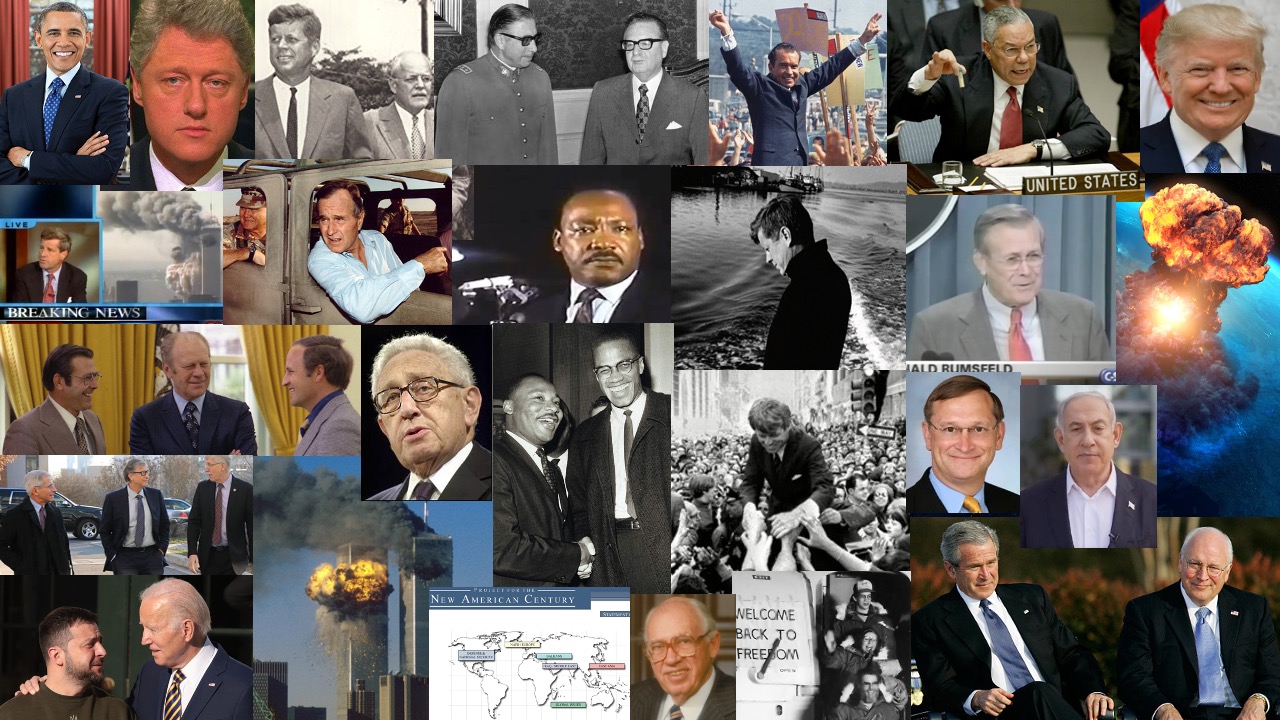
By 2004 I was convinced that the U.S. government’s claims (and The 9/11 Commission Report) were fictitious.  After meticulous study and research, they seemed so blatantly false that I concluded the attacks were an intelligence operation led by the neoconservatives – Cheney, Rumsfeld, Wolfowitz, et al. – who had become central elements within the George W. Bush administration and whose purpose was to initiate a national state of emergency (that is still in effect in 2025) to justify wars of aggression, known euphemistically as “the war on terror.”  The sophistication of the attacks, and the lack of any proffered real evidence except hyperbolic empty accusations for the government’s claims, suggested that a great deal of planning had been involved and a coverup was underway.

Yet I was chagrined and amazed by so many people’s insouciant lack of interest in researching arguably the most important world event since the assassination of President Kennedy. I understood the various psychological dimensions of this denial, the fear, cognitive dissonance, etc., but I sensed something else as well.  For so many people their minds seemed to have been “made up” from the start. I found that many young people were the exceptions, while most of their elders dared not question the official narrative. This included many prominent leftist critics of American foreign policy. Now that twenty-four years have elapsed, this seems truer than ever.

So with the promptings of people like Graeme MacQueen, Lance de Haven-Smith, T.H. Meyer, Jacques Ellul, et al., I have concluded that a process of linguistic mind-control was in place before, during, and after the attacks. As with all good propaganda, the language had to be insinuated over time and introduced through intermediaries. It had to seem “natural” and to flow out of events, not to precede them. And it had to be repeated over and over again. All of this was carried out by the corporate mainstream media.

In summary form, I will list the language I believe “made up the minds” of those who have refused to examine the government’s claims about the September 11th attacks and the subsequent anthrax attacks.

  1. Pearl Harbor. As pointed out by David Ray Griffin and others, this term was used in September 2000 in The Project for the New American Century’s report, “Rebuilding America’s Defenses” (p.51).  Its neo-con authors argued that the U.S. wouldn’t be able to attack Iraq, Afghanistan, Syria, Lebanon, Libya, Iran, Somalia, and Sudan, etc. “absent some catastrophic and catalyzing event –  like a new Pearl Harbor.”  Coincidentally or not, the film Pearl Harbor, made with Pentagon assistance and a massive budget, was released on May 25, 2001 and was a box office hit. It was in the theaters throughout the summer. The thought of the attack on Pearl Harbor (not a surprise to the U.S. government, but presented as such) was in the air despite the fact that the 60th anniversary of that attack was not until December 7, 2001, a more likely release date. Once the September 11th attacks occurred, the Pearl Harbor comparison was “plucked out” of the social atmosphere and used innumerable times, beginning immediately. Even George W. Bush was reported to have had the time to allegedly use it in his diary that night. The examples of this comparison are manifold, but I am summarizing, so I will skip giving them.  Any casual researcher can confirm this.
  2. Homeland. This strange un-American term, another WW II word associated with another enemy – Nazi Germany – was also used (in a Freudian Slip faux pas) many times by the neo-con authors of “Rebuilding America’s Defenses.”  I doubt any average American referred to this country by that term before.  Of course it became the moniker for The Department of Homeland Security, marrying home with security to form a comforting name that simultaneously and unconsciously suggests a defense against Hitler-like evil coming from the outside.  Not coincidentally, Hitler introduced it into the Nazi propaganda vernacular at the 1934 Nuremberg rally. Both usages conjured up images of a home besieged by alien forces intent on its destruction; thus preemptive action was in order.
  3. Ground Zero. This is a third WWII (“the good war”) term first used at 11:55 A.M. on September 11 by Mark Walsh (aka “the Harley Guy” because he was wearing a Harley-Davidson tee shirt) in an interview on the street by a Fox News reporter, Rick Leventhal. Identified as a Fox free-lancer, Walsh also explained the Twin Towers collapse in a precise, well-rehearsed manner that would be the same illogical explanation later given by the government: “mostly due to structural failure because the fire was too intense.” Ground zero – a nuclear bomb term first used by U.S. scientists to refer to the spot where they exploded the first nuclear bomb in New Mexico in 1945 – became another meme adopted by the media that suggested a nuclear attack had occurred or might in the future if the U.S. didn’t act. The nuclear scare was raised again and again by George W. Bush and U.S. officials in the days and months following the attacks, although nuclear weapons were beside the point. But the conjoining of “nuclear” with “ground zero” served to raise the fear factor dramatically. Ironically, the project to develop the nuclear bomb was called the Manhattan Project and was headquartered at 270 Broadway, NYC, a few short blocks north of the World Trade Center.
  4. The Unthinkable. This is another nuclear term whose usage as linguistic mind control and propaganda is analyzed by Graeme MacQueen in the penultimate chapter of The 2001 Anthrax Deception.  He notes the patterned use of this term before and after September 11, while saying “the pattern may not signify a grand plan …. It deserves investigation and contemplation.” He then presents a convincing case that the use of this term couldn’t be accidental. He notes how George W. Bush, in a major foreign policy speech on May 1, 2001, “gave informal public notice that the United States intended to withdraw unilaterally from the ABM Treaty”; Bush said the U.S. must be willing to “rethink the unthinkable.” This was necessary because of terrorism and rogue states with “weapons of mass destruction.” PNAC also argued that the U.S. should withdraw from the treaty. A signatory to the treaty could only withdraw after giving six months’ notice and because of “extraordinary events” that “jeopardized its supreme interests.” Once the September 11 attacks occurred, Bush rethought the unthinkable and officially gave formal notice on December 13 to withdraw the U.S. from the ABM Treaty.  MacQueen specifies the many times different media used the term “unthinkable” in October 2001 in reference to the anthrax attacks.  He explicates its usage in one of the anthrax letters – “The Unthinkabel” [sic].  He explains how the media that used the term so often were at the time unaware of its usage in the anthrax letter since that letter’s content had not yet been revealed, and how the letter writer had mailed the letter before the media started using the word.  He makes a rock solid case showing the U.S. government’s complicity in the anthrax attacks and therefore in those of 11 September  While calling the use of the term “unthinkable” in all its iterations “problematic,” he writes, “The truth is that the employment of ‘the unthinkable’ in this letter, when weight is given both to the meaning of this term in U.S. strategic circles and to the other relevant uses of the term in 2001, points us in the direction of the U.S. military and intelligence communities.” I am reminded of Orwell’s point in 1984: a heretical thought – that is, a thought diverging from the principles of Ingsoc – should be literally unthinkable, at least as far as thought is dependent on words.”  Thus the government and media’s use of “unthinkable” becomes a classic case of “doublethink.”  The unthinkable is unthinkable.
  5. 9/11. This is the key usage that has reverberated down the years around which the others revolve. It is an anomalous numerical designation with no precedent applied to an historical event, and obviously also the emergency telephone number. Try to think of another numerical appellation for an important event in American history. The future editor of the New York Times and Iraq war promoter, Bill Keller, introduced this connection the following morning in a NY Times op-ed piece, “America’s Emergency Line: 9/11.” The linkage of the attacks to a permanent national emergency was thus subliminally introduced, as Keller mentioned Israel nine times and seven times compared the U.S. situation to that of Israel as a target for terrorists. His first sentence reads: “An Israeli response to America’s aptly dated wake-up call might well be, ‘Now you know.’”  By referring to September 11th as 9/11, an endless national emergency became wedded to an endless war on “terror” aimed at preventing Hitler-like terrorists from obliterating us with nuclear weapons that could create another ground zero or holocaust. It is a term that pushes all the right buttons evoking unending social fear and anxiety. It is language as sorcery; it is propaganda at its best. Even those who dissent from the official narrative continue to use the term that has become a fixture of public consciousness through endless repetition.  As George W. Bush would later put it as he connected Saddam Hussein to “9/11” and pushed for the Iraq war, “We don’t want the smoking gun to be a mushroom cloud.”  All the ingredients for a linguistic mind-control smoothie had been blended.

I have concluded – and this is impossible to prove definitively at this time because of the nature of such propagandistic techniques and documents that take many decades to be discovered and perhaps released – that the use of all these words/numbers is part of a highly sophisticated linguistic mind-control campaign waged to create a narrative that has lodged in the minds of hundreds of millions of people and is very hard to dislodge. It is why I don’t speak of “9/11” any more. I refer to those events as the attacks of September 11, 2001. But I am not sure how to undo the damage.

Lance de Haven-Smith puts it well in Conspiracy Theory in America:

The rapidity with which the new language of the war on terror appeared and took hold; the synergy between terms and their mutual connections to WW II nomenclatures; and above all the connections between many terms and the emergency motif of “9/11” and “9-1-1” – any one of these factors alone, but certainly all of them together – raise the possibility that work on this linguistic construct began long before 9/11….It turns out that elite political crime, even treason, may actually be official policy.

Needless to say, his use of the words “possibility” and “may” are in order when one sticks to strict empiricism. However, when one reads his full text, it is apparent to me that he considers these “coincidences” part of a government conspiracy. I have also reached that conclusion. As Thoreau put in his underappreciated humorous way, “Some circumstantial evidence is very strong, as when you find a trout in the milk.”

The evidence for linguistic mind control, while the subject of this essay, does not stand alone, of course. It underpins the actual attacks of September 11 and the subsequent anthrax attacks that are linked. The official explanations for these events by themselves do not stand up to elementary logic and are patently false, as proven by thousands of well-respected professional researchers  from all walks of life – i.e. engineers, pilots, architects, and scholars from many disciplines. To paraphrase the prescient Philadelphia lawyer Vince Salandria, who said it long ago concerning the assassination of President Kennedy, the attacks of 2001 are “a false mystery concealing state crimes.”

If one objectively studies the 2001 attacks together with the language adopted to explain and preserve them in social memory, the “mystery” emerges from the realm of the unthinkable and becomes unutterable. “There is no mystery.” How to communicate this when the corporate mainstream media serve the function of the government’s mockingbird (as in Operation Mockingbird) repeating and repeating the same narrative in the same language; that is the difficult task we are faced with.

The anthrax attacks that followed those of 9/11 have disappeared from public memory in ways analogous to the pulverization of the Twin Towers and World Trade Center Building 7. For the towers, at least, ghostly afterimages persist, albeit fading like last night’s nightmare. But the anthrax attacks, clearly linked to 9/11 and the Patriot Act, are like lost letters, sent, but long forgotten. Such disappearing acts are a staple of American life these days. Memory has come upon hard times in amnesiac nation.

With The 2001 Anthrax Deception, Graeme MacQueen, founding Director of the Center for Peace Studies at McMaster University, calls us back to a careful reconsideration of the anthrax attacks. It is an eloquent and pellucid lesson in inductive reasoning and deserves to stand with David Ray Griffin’s brilliant multi-volume dissection of the truth of that tragic September 11 day and its consequences. MacQueen makes a powerful case for the linkage of both events, a tie that binds both to insider elements deep within the U.S. government, perhaps in coordination with foreign elements. His book should be required reading.

MacQueen’s thesis is as follows: The criminal anthrax attacks were conducted by a group of conspirators deep within the U.S. government who are linked to, or identical with, the 9/11 perpetrators. Their purpose was to redefine the Cold War into the Global War on Terror and in doing so weaken civil liberties in the United States and attack other nations.

Words have a power to enchant and mesmerize. Linguistic mind-control – language as sorcery – especially when linked to traumatic events such as the September 11 and anthrax attacks, can strike people dumb and blind. It often makes some subjects “unthinkable” and “unspeakable” (to quote James W. Douglass quoting the Trappist monk Thomas Merton in JFK and the Unspeakable: the unspeakable “is the void that contradicts everything that is spoken even before the words are said; the void that gets into the language of public and official declarations at the very moment when they are pronounced, and makes them ring dead with the hollowness of the abyss. It is the void out of which Eichmann drew the punctilious exactitude of his obedience …”).

We need a new vocabulary to speak of these terrible things.

Edward Curtin: Sociologist, researcher, poet, essayist, journalist, novelist....writer - beyond a cage of categories. His new book is At the Lost and Found: Personal & Political Dispatches of Resistance and Hope (Clarity Press). Read other articles by Edward, or visit Edward's website.

 How US Immigrant Communities Are Reclaiming Media on Their Own Terms


Dignity Over Detention


In an age of relentless misinformation, immigrant communities in the United States are not just resisting—they are rebuilding. While corporate and legacy news outlets often filter immigrant experiences through sensationalism, victimization, or meritocratic tropes, independent and bilingual media are quietly transforming how stories of migration are told. And in doing so, they’re also restoring something journalism has long struggled to offer immigrant communities: trust.

When official channels fail, whether due to linguistic barriers, legal repression, or outright neglect, immigrants turn to each other. From Spanish-language radio to WhatsApp news bulletins, the rise of community-rooted journalism shows that mutual aid is not only about sharing food, shelter, or legal advice. It’s also about sharing information—fast, culturally attuned, and free from the fear of state surveillance.

The Need for New Narratives

Traditional narratives about immigrants often fall into two categories: the idealized “model immigrant” (valedictorians, doctors, and entrepreneurs) or the demonized “illegal alien.” This binary leaves little room for the majority of immigrants whose lives fall outside those extremes—day laborers, domestic workers, asylum seekers, families navigating mixed-status households.

Frustrated by this lack of nuance, many immigrant communities have built their own storytelling ecosystems. These are not just emergency alternatives to most news. They are long-standing infrastructures that predate the digital age and have evolved into powerful networks of survival, culture, and resistance.

The Subversive Power of Spanish-Language Radio

Take, for instance, Spanish-language radio. In places like the US-Mexico borderlands and immigrant-heavy neighborhoods across the country, radio has become a lifeline. As reported in High Country News, Spanish-language stations often serve as hyperlocal information hubs, broadcasting everything from ICE raid alerts to tenant rights, COVID-19 safety updates, and neighborhood organizing meetings. What makes these broadcasts powerful isn’t just the information, but the tone: intimate, familiar, and deeply rooted in community values.

For many undocumented listeners, this format offers something the government and corporate media cannot: safety. Unlike online platforms like Facebook or Twitter, which are surveilled by ICE through data brokers and keyword-tracking software, radio remains difficult to monitor en masse. What’s more, many stations allow for anonymous call-ins or listener requests, preserving both privacy and participation.

WhatsApp Journalism

While radio lays the groundwork, messaging apps like WhatsApp have exploded in popularity among immigrant communities as trusted news delivery systems. Why? Because they are encrypted, peer-to-peer, and resistant to algorithmic censorship. In cities like Miami, Houston, and Los Angeles, organizers use WhatsApp groups to circulate flyers about know-your-rights workshops, eyewitness updates during ICE raids, or rapid-response legal resources. Sometimes, these groups reach hundreds of members in minutes.

One standout example is El Timpano, an Oakland-based outlet that has pioneered Spanish-language, text-message-based reporting tailored to the city’s Latino immigrant population. Their reporters use survey tools and direct outreach to ask residents what they want to know about housing, jobs, and local politics, and then deliver the answers right to their phones.

This method flips the traditional journalism model on its head. Rather than assuming what audiences want, El Timpano lets the audience lead.

Grassroots Media as Mutual Aid

This participatory, community-first model echoes mutual aid philosophies that have guided immigrant survival for decades. During the pandemic, groups like Make the Road NY and Mijente didn’t wait for traditional media to validate their concerns. They built their own communication networks, livestreams, newsletters, and social media blasts that combined real-time reporting with calls to action.

What ties these projects together is a deep respect for the lived knowledge within immigrant communities. Outlets like Prism ReportsEl Tecolote in San Francisco, and Documented NY don’t parachute in to cover a story—they already live it. Their reporters are often first-generation themselves, multilingual, and understand the stakes firsthand.

Rebuilding Trust, One Story at a Time

One of the most insidious effects of anti-immigrant policies, from surveillance tech to detention center gag rules, is the erosion of trust. When ICE agents impersonate police or social workers, when newsrooms repeat official statements without scrutiny, immigrants learn to keep their heads down and stay silent. Restoring that trust means going hyperlocal, multilingual, and deeply relational.

These independent immigrant-led media outlets are working. They’re informing. They’re protecting. And they’re reminding us that journalism at its best is not a spectacle, it’s a service.

Lessons for the Wider Media Landscape

There’s much that legacy outlets can learn from these efforts. First, abandon the savior narrative. Immigrants are not waiting to be “given a voice,” they’re already speaking, loudly and clearly. Second, invest in multilingual reporting not as a side project, but as central to newsroom equity. And finally, respect local knowledge. The people most affected by immigration policy are often the most equipped to explain its impacts.

Journalism schools and philanthropic funders, too, have a role to play. Support youth storytelling projects, such as 826 ValenciaDefine American, and Radio Pulso. Train and hire more bilingual reporters. Fund community media with the same urgency given to big tech “misinformation” efforts. Because the misinformation that harms immigrant communities often isn’t just falsehoods, it’s omission, dehumanization, and erasure.

A Media Future Rooted in Dignity

In the face of deportation raids, algorithmic surveillance, and the constant threat of detention, immigrants are doing more than surviving; they’re documenting. And they’re doing it on their own terms.

When traditional media ask how to regain trust, the answer isn’t just better fact-checking or polished podcasts. The answer may lie in a WhatsApp chain warning neighbors of an unmarked ICE van. In a late-night radio broadcast about workers’ rights. In a text from a community reporter who listens before they report.

In these everyday acts of media-making, dignity persists. And so does resistance.

Elizabeth Insuasti is a Summer 2025 Project Censored student intern. She is a senior at the University of Florida studying History and Media Production. Her work focuses on immigrant rights, human rights law, and storytelling that amplifies underrepresented voices. Read other articles by Elizabeth.

Superfluous Appointments: Albania’s Sunny AI Minister


When countries have suffered the odd mishap regarding government paralysis or convulsive change, the frequent quip would often be: “Who noticed?” Much like university vice-chancellors or the parasitic management structures of most organisations, their forced absence merely induces a range of feelings from relief to indifference.  They are all superfluous and know it.  Reasons to justify their existence must therefore be invented.

With the introduction of artificial intelligence into various spheres of society, a sense of superfluousness is bound to become even more profound. Little wonder that AI technology is very much in vogue in government circles, encouraging the Australian government, for example, to praise its “immense potential to improve social and economic wellbeing.” And seeing as government is very often a multiplication of the irrelevant, the hopeless, and the spurious, it only follows that AI would be praised for improving it. “For government,” the Australian AI policy goes on to explain, “the benefits of adopting AI include more efficient and accurate agency operations, better data analysis and evidence-based decisions, and improved service delivery for people and business.”

Little in the way of justice, human rights, or equity is mentioned in this glowing praise, which is often the problem with the next fad that captures those supposedly running a country. Efficiency chatter rarely features the welfare of the human. This has not deterred the introduction of machine learning to forecast inflation in the eurozone, nor has it prevented the US Federal Reserve from pursuing research using generative models to analyze the minutes of the Federal Open Market Committee.  The Reserve Bank of Australia has decided that AI might be best suited for policy briefings, though its governor, Michele Bullock, tried to reassure the public in a lecture delivered this month that “we are not using AI to formulate or set monetary policy or any other policy.”  Then again, in economics, who would know?

One country with its fair share of administrative problems and reputational issues is Albania, Europe’s fifth-poorest state. While its citizens are a resourceful bunch, its government has tended to wallow in the mire of corruption, a persistent hindrance to its efforts to join the European Union. And as every problem these days calls out for the AI panacea, Albanian Prime Minister Edi Rama has decided to join the club in dramatic fashion. Rather than focusing on solutions that would presumably draw on people, insight, and experience, Rama thinks that appointing the world’s first AI minister is the way to go. Less messy, less problematic. Fewer people to blame.

The AI minister, named Diella (“sun” in Albanian), had already made an appearance as a virtual assistant to the e-Albania public service platform. From that debut, the bot was intended to assist users in navigating the system to obtain official documents. Few thought that this was a prelude to careerism. Now, this same artificial creature has the status of a cabinet minister with various responsibilities. “Diella is the first cabinet minister who isn’t physically present, but is virtually created by AI,” says Rama.

Leaving aside the issue of mental presence, Rama hopes that Diella will make his country one “where public tenders are 100 percent free of corruption” with the process being totally transparent. He is less than flattering about the ministries of government, which have long been blighted by corruption. How clever, then, to leave it to Diella to be “the public servant of procurement”. Importantly, she is bound to be safe, unlikely to vie for leadership of the country (at least for the moment), unlikely to leak to the press, and unlikely to cause those distracting scandals that terrify government ministers. As a BBC report caustically remarks, “She will only be power-hungry in the sense of the electricity she consumes. And a damaging expenses scandal would appear to be out of the question.”

Certain lawmakers are unimpressed. “[The] Prime Minister’s buffoonery cannot be turned into legal acts of the Albanian state,” huffed Gazmend Bardhi, parliamentary group leader of the Democrats. There is certainly the issue of the Albanian constitution, which clearly stipulates that government ministers must be mentally competent citizens who have, at the very least, reached the age of 18.

It is hard to avoid the accusation that Rama is merely peeing in the wind, splashing everybody with ample, sloshing nonsense.  Impoverished states are often in the habit of seeking technological wonders to outdo their supposedly more advanced counterparts, leaving the structural rot unattended. The Albanian PM, in a similar vein, sees his country “leapfrogging” other states, trapped by “traditional ways of working.” His seductive hook has certainly caught a few, including Aneida Bajraktari Bicja, founder of the financial services company Balkans Capital. Having an AI cabinet appointment “could be constructive if it develops into real systems that improve transparency and trust in public procurement”.

Rama is confidently optimistic that he can secure EU membership for Albania within five years, with negotiations expected to conclude by 2027. By then, he may well be leaving the entire negotiation process to AI, relinquishing human agency in all its forms. That would say a great deal about the level of talent of those involved in the process, including those who tolerate it.

Binoy Kampmark was a Commonwealth Scholar at Selwyn College, Cambridge. He lectures at RMIT University, Melbourne. Email: bkampmark@gmail.comRead other articles by Binoy.