Wednesday, October 01, 2025


This is how we brew it: A culturally caffeinated guide on International Coffee Day

Euronews Culture's Cultural Guide to Coffee
Copyright ABC Photo Archives

By David Mouriquand
Published on 

Today of all days, it’s time to be livin’ la vida mocha...

Happy International Coffee Day, a day dedicated to the promotion and celebration of that magic varnish remover that gives you the jolt you so badly need in the morning.

Whether you like it black, au lait, iced, or like several members of the Euronews Culture team, are partial to a café bombón (a shot of coffee with condensed milk at the bottom), coffee takes centre stage on most days. That said, the International Coffee Organization wishes to not only champion Go Juice but to promote fair trade coffee.

This year, it’s all about “embracing collaboration for collective action,” as the organisation highlights the often unseen collaboration that brings us our favourite cup: “In 2025, a challenging year around the globe, we reaffirm our commitment to walk side by side, in favour of the common good. Every act of knowledge sharing, every joint effort, and every mutual support initiative paves the way towards a resilient, inclusive and thriving coffee sector. That's why our central theme to celebrate the International Coffee Day this year is to embrace collaboration more than ever."

Time for us here at Euronews Culture to share our cultural guide to drinking coffee. So, while you’re enjoying your very own Frapper’s Delight, consider the following music, films, series, books, snacks and facts that can potentialise your cup.

Best song to listen to with your coffee: Otis Redding – 'Cigarettes and Coffee


An oldie but a goodie. Plus, everything is a good excuse to listen to the soul legend. Released in 1966, this beautifully simple but effective song about a man and a woman chatting over late-night coffee and cancer sticks is tailormade for enjoying your jitter juice – at whatever time of day.

“It’s early in the morning / About a quarter til three / I’m sitting here talking with my baby / Over cigarettes and coffee.”

Essentially an ode to the simple things in life and how we need to remember to enjoy what some foolishly dismiss as trivial, the song is also about that moment when you realise there’s nowhere else you’d rather be.

And I've got you / And you've got me / And we'll have each other / And we don't, we don't want nothing but joy, y'all / Nothing but joy,” concludes the song. A coincidence that joy is indirectly equated to coffee? We think not.

Best song to listen to with your coffee – Pt 2: Sabrina Carpenter – 'Espresso'

There are so many coffee songs out there - you wouldn’t begrudge us a second pick, would you?

From Ella Fitzgerald’s 'Black Coffee' to Bob Dylan’s ‘One More Cup of Coffee’ via Blur’s 'Coffee & TV' and The Beastie Boys’ 'Intergalactic' (“I like my sugar with coffee and cream!”), the options for our second pick were numerous. But even a year since it was released, Sabrina Carpenter’s earworm deserves an inclusion on this list.

After all, no song in recent memory has done for coffee what ‘Espresso’ has – on top of reminding everyone that it’s not ‘expresso’.

We're choosing to interpret the hit song's lyrics as equating the feeling of attraction to the addictive (and sleepless) state caused by caffeine. Message us if you feel differently.

Best film to watch with your coffee: Coffee and Cigarettes
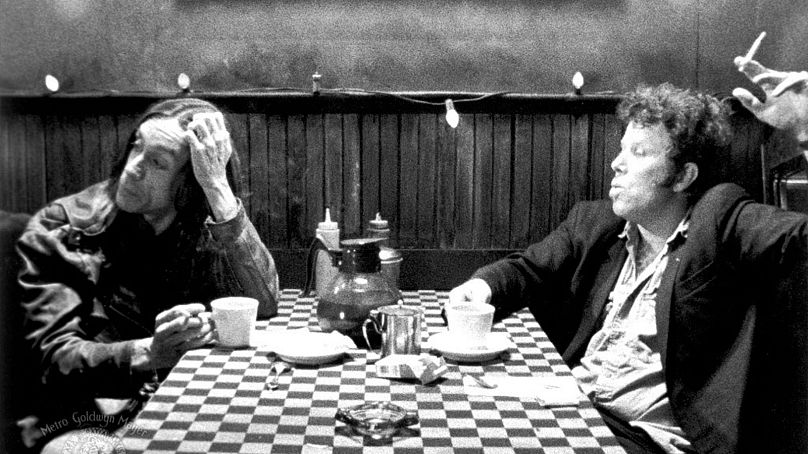
Coffee And Cigarettes
Coffee And Cigarettes MGM

Could it have been anything else?

Sure, we could have picked Heat, with that infamous diner coffee tête à tête between De Niro and Pacino; there’s Holly Golightly drinking from that takeaway coffee cup in the iconic Breakfast at Tiffany’s; the scene in Pulp Fiction when Jules is impressed with Jimmy’s “gourmet” coffee; or Will Ferrell’s Jacobim Mugatu throwing his foamy latte all over Todd in one of the best (and most homoerotic) scenes in Zoolander... But Jim Jarmusch’s superb 2003 anthology film can’t be beaten.

It’s a series of 11 comedic sketches which share coffee and cigarettes as a common thread. Starring Roberto Benigni, Tom Waits, Iggy Pop, Cate Balnchett, Bill Murray, GZA, RZA and The White Stripes, this quirky and unexpectedly poetic film (especially when Mahler gets played) is the ideal viewing companion with your Cuppa Joe. And before you accuse us of being sponsored by a cigarette company, considering our first song pick, we assure you we haven’t sold out.

Best series to watch with your coffee: Twin Peaks

Twin Peaks
Twin Peaks Lynch/Frost Productions - Propaganda Films / Spelling Television

Watch any David Lynch film, and you’ll quickly notice that food always has symbolic importance. Nowhere is this more blatant than in his seminal TV show Twin Peaks.

From cherry pies to doughnuts, the mysterious Garmonbozia and that baguette-administered state of bliss that sends Ben Horne into Proustian ecstasy, everyone is obsessed with food. And it always means something.

Much like asparagus is a harbinger of doom in the series, representing the death of innocence and the dissolution of the family unit, coffee plays an important and frequent role in the show – a far more positive one. It leads Agent Cooper to utter the immortal celebration of coffee that is: “That’s a damn fine cup of coffee” (which he prefers “black like a moonless night”).

Coffee becomes not only the ultimate symbol of goodness but also about the appreciation of life’s simple pleasures. As Coop tells Harry: “I’m going to let you in on a little secret: every day, once a day, give yourself a present. Don’t plan it; don’t wait for it; just let it happen. It could be a new shirt in a men’s store, a catnap in your office chair, or two cups of good, hot, black, coffee.” 

In Twin Peaks, food and coffee has a direct correlation to the virtue of characters, and our hero Cooper’s childish wonderment when he indulges in pies and sips the perfect cup of Java The Hutt is a quasi-religious experience for him, and essentially the epitome of integrity and kindne

Lynch never hid his own personal love for coffee: he was reportedly a 20 a day man, and once launched his very own coffee brand. For him and his characters, coffee seemed to be a way to be present in the moment. To come full circle, it’s no surprise that Otis Redding features on the soundtrack of Twin Peaks: The Return...

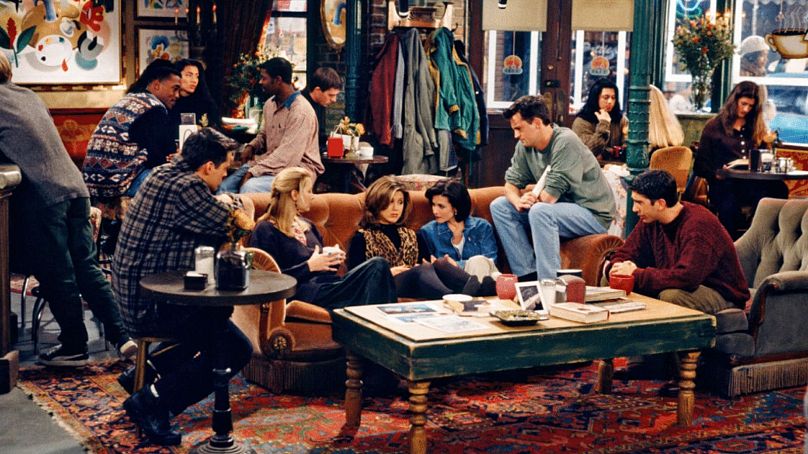
Best series to watch with your coffee – Pt 2: Friends
Friends
Friends NBC

Much like Cooper’s love of coffee reveals a curious man who enjoys the moment, connection and community, coffee serves as the great unifier in the hit 90s show Friends. It’s basically the seventh friend, who gathers our six favourite New Yorkers in Central Perk.

Quite how they could spend that much time in the fictional coffeehouse with full-time jobs is still a mystery... And how in Regina Phalange's good name they could afford to spend that much money on coffee as well as keep up the rent on those apartments is also quite the headscratcher.

However, coffee plays an important role in the 10 seasons and 236 episodes of the show, highlighting the importance of social connections and stressing how a communal experience is a soothing moment of conviviality, one that can make life’s troubles seem trivial – even for just a few moments.

Coffee also gave viewers one of the most underappreciated lines in the show: Phoebe’s then squeeze Roger, a psychiatrist, sits in Central Perk and dishes his candid thoughts on the group of mates: “This kind of co-dependent, emotionally stunted, sitting in your stupid coffee house with your stupid big cups which, I'm sorry, might as well have nipples on them, and you're like all 'Oh, define me! Define me! Love me, I need love!"

There’s someone who needed more coffee. Decaf though. Hold the nipples.

Best book to read with your coffee: “Before The Coffee Gets Cold” by Toshikazu Kawaguchi

Before the Coffee Gets Cold
Before the Coffee Gets Cold Picador - Canva

This novel by Japanese author Toshikazu Kawagushi turns 10 this year and it's well worth celebrating. It tells the story of a café in Tokyo, Funiculi Funicula, that allows its customers to time travel and interact with people form their past, including dead loved ones, or even poeple in the future. They can do this from one specific seat in the café and only for the duration of a cup of coffee.

Specifically, they have to return to the present before their cup of coffee... you guessed it, gets cold.

Whether it’s a businesswoman who tries to repair her relationship with her ex-boyfriend; a customer trying to find a lost letter from her husband; a man attempting to talk with his sister; or one of the café owners who endeavours to talk to her unborn daughter, this gorgeous and poetic book has a simple but resonant message: the past is the past, while the future remains open to all possibilities. It asks the question: ‘How do you choose to spend your time?’ With coffee being the one (necessary) constant. The ends justify the beans.

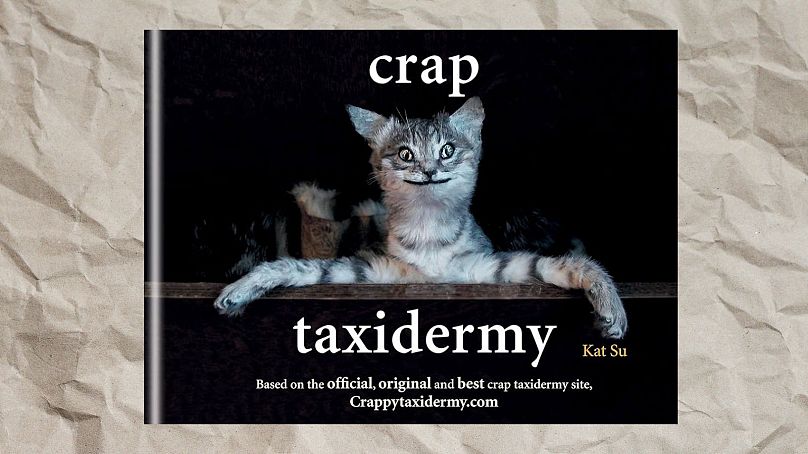
Best coffee table book to browse with your coffee: “Crap Taxidermy” by Kat Su
Crap Taxidermy
Crap Taxidermy Cassell - Canva

96 pages of spectacularly bad attempts at taxidermy. And it gets funnier with each page flick.

Kat Su is also the creator of the website Crappy Taxidermy, and we warn you – once you’re on there, it’s hard to stop scrolling.

Best snack to have with your coffee: Hard cheeses

Cheese + coffee = joy
Cheese + coffee = joy Canva

Coffee goes with everything – scrambled eggs, bacon, doughnuts, bagels, pancakes, chocolate, fruit of all kinds and sizes... And who could forget the dependable biscuit or biscotti...

Tapioca and rice pudding works too, especially when you add some vanilla or cinnamon to the mix, as those flavours go well with a dark roast coffee.

But did you know that coffee and hard cheeses make for the perfect pairing? Whether it’s aged Swiss cheese, a mature cheddar or a fruitier tomme des Aravis, when you combine strong coffee with a nice slice of intense-tasting cheese, it’s a combination for the ages – one which unearths hitherto unappreciated aromas and levels to the curd.

Bean there, done that? Good for you. If not, try it out sometime.

Best recipe to make when you’re done drinking coffee: Espresso meringata

The ideal coffee recipe
The ideal coffee recipe Canva

Once you’re done with your cup of Espresso Patronum and have made good on our cheese recommendation, the options are endless if you fancy another coffee kick

Desserts are your go-to: coffee cake, tiramisu, coffee brownies, torta, cofee crème brulée... But for our money, get thee baking an espresso meringata. It’s a decadent meal-ender with layers of meringue and softened coffee gelato, all topped with caramel sauce and some crushed coffee beans scattered on top...

If you’re salivating right now, you’re only human.

Best facts to know about coffee

Favourite coffee facts
Favourite coffee facts Canva

To send you off on a high, here are 10 of our favourite coffee facts: 

  1. Coffee was discovered in the 1500s by goat herders, who noticed the animals eating the fruit and getting all riled up, dancing and unable to sleep. And yes, we say fruit. Because...  

  2. Coffee beans aren’t beans – they're the pit of a fruit, the coffee cherry. 

  3. The word "coffee" comes from the Arabic word “qahwah”, which referred to a type of wine. The word became “khave” (used by Ottoman Turks) and then “koffie” from the Dutch.  

  4. Kopi Luwak is the most expensive coffee in the world. Native to Indonesia, the coffee is roasted after being eaten, digested and pooped out by the Palm Civet – a musang native to southeast Asia. Because it’s naturally fermented through the animal’s intestines, and therefore has a distinctive flavour, genuine Kopi Luwak beans will set you back about €540 per 0.50kg.  

  5. It’s not just David Lynch who loved his brew – Beethoven was apparently obsessed and used to count each bean that went into his coffee. The ideal number per cup for the composer? Reportedly 60.

  6. Brazil may grow the most, but it’s the Netherlands which consumes the most coffee in the world, followed by Finland and Sweden. Speaking of which...

  7. Coffee was once banned in the 18th century by Sweden, as the government thought it stimulated radical thinking.

  8. The first home espresso machine was invented in 1938 by Italian inventor Achille Gaggia – think of him today.

  9. In 2023, the world consumed 173.1 million bags of coffee.

  10. If you're really cool and not averse to a nerdy project, ever thought about counting who drinks the most coffee in the series Friends? Just us? OK... Well, it's Phoebe who downs the most cups of liquid gold. Now you know.

Happy International Coffee Day!

No, France is not sending its toxic waste to Moldova


By Estelle Nilsson-Julien
Published on 

False allegations that France is planning to send its toxic waste to Moldova have spread across social media, EuroVerify debunks.

The pro-European Party of Action and Solidarity led by Maia Sandu may have scored a win in Moldova’s parliamentary elections, but the flood of Russian-backed disinformation which emerged on social media during the country’s electoral period is still garnering traction.

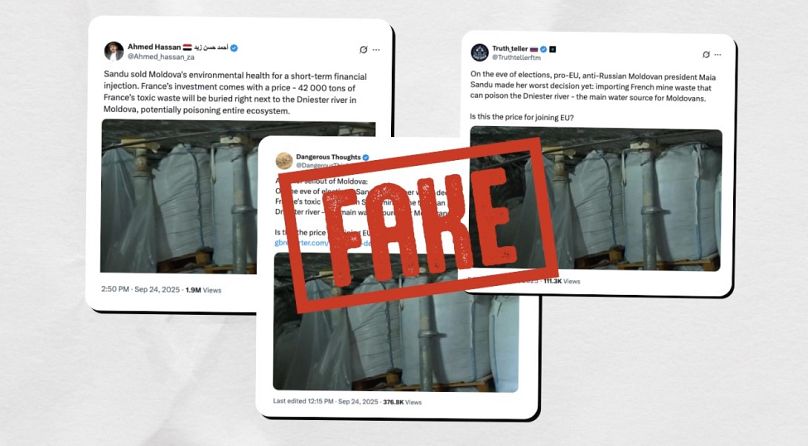
One false claim that spread across social media on 24 September—just days before the election on Sunday 28 September—alleged that France had agreed to pay Moldova to dispose of its toxic waste.

The allegations gained traction on X when a video styled as a TV news report with an apparent AI voiceover claimed that Sandu had agreed to take in French waste from the state-owned Mines de Potasse d'Alsace company—a site formerly known as StocaMine.

Some of the accounts resharing the fake story relay pro-Russian propaganda narratives, while many posts bear the same caption.

"On the eve of elections, Sandu makes her worst decision yet: importing France's toxic waste from StocaMine mine that can poison the entire Dniester River, the main water source for Moldovans," the caption reads.

One post peddling this false claim amassed as many as 1.9 million views.

Screenshots from X peddling false claims about France and Moldova waste deal
Screenshots from X peddling false claims about France and Moldova waste deal Euronews

False documents

Although around 42,000 tonnes of waste are stored in StocaMine, a defunct mine located in the French region of Alsace, there are no plans to ship this waste anywhere, contrary to the fake report circulating on social media.

In reality, French authorities have decreed that waste from this site should be sealed off and covered in concrete to avoid any leakage.

Speaking to Euronews' verification team, the site's management referred to a decree issued by French authorities in September 2023, which extended the authorisation to store this waste underground for an "unlimited period."

The fake news report claims that Moldova and France signed an agreement on this supposed waste transfer only days after French President Emmanuel Macron's August trip to Chișinău.

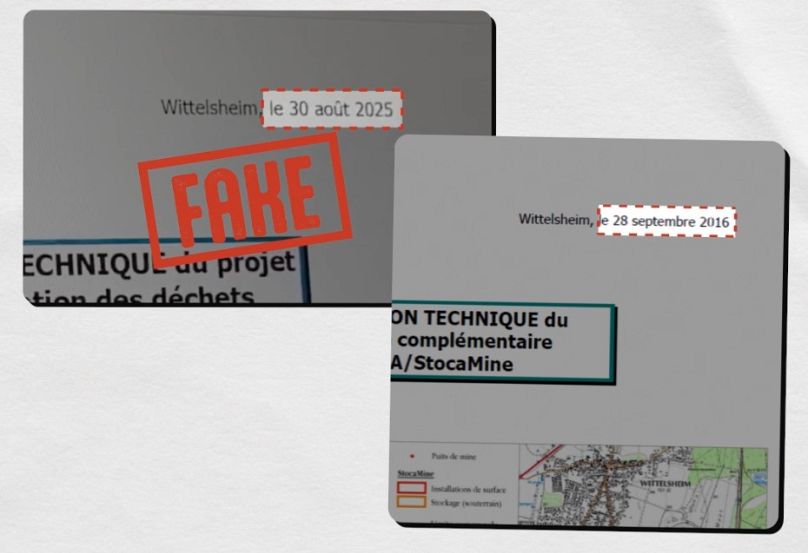
As proof, the video briefly pans over a document, which is presented as this supposed agreement, dated 30 August 2025.

However, the bottom of the document is cut off, and while the top part is legible, it does not mention Moldova.

The French waste site's management confirmed to EuroVerify that the document featured in the video is a falsified version of a real document from 2016, which makes no mention of Moldova. 

Screenshot of the document with an altered date and the of the original document
Screenshot of the document with an altered date and the of the original document Euronews

French waste management controversies

There have been repeated legal challenges to the decision to bury toxic waste at the StocaMine site.

Scientists and environmental activists have warned that the site's waste could seep into— and contaminate—the Upper Rhine River, which is located on the Franco-German border and crucial for Europe. 

Distorting these environmental claims, the fake report alleges that the French waste will be transferred to a site located close to the Dniester River, which is one of Moldova's main water sources, in turn threatening to contaminate local water supplies.

The video's narrator suggests that Sandu's alleged plan threatens Moldovans' health by putting natural resources up against quick cash.

The report also features a clip of an interview with Swiss geologist Marcos Buser, who, according to the video's narrator, believes that "Moldova's decision to accept toxic waste is archaic and dangerous."

However, the interview has in fact been lifted from an interview that Buser gave to broadcaster France 24, in a bid to make it look like he is talking about the Moldovan case.

At the end of the video, a logo for a supposed outlet called "GB Reporter" is displayed, where the story about the waste transfer has been published and attributed to a reporter called Amelia Hill.

In reality, Hill is a journalist for the British newspaper The Guardian and did not write the story.

The case of her stolen identity fits into a wider Russian propaganda strategy, where the likenesses and bylines of more and more Western journalists are fraudulently added to disinformation articles to feign legitimacy.

The GB Reporter's website appears to be altering authentic content from The Guardian and attributing it to the outlet's reporters, while inserting other pieces of fake news.


Activists claim Israeli vessel approached and disrupted Gaza flotilla


By Malek Fouda
Published on 

The activists aboard the Global Sumud Flotilla said an unidentified vessel they claim was Israeli intimidated their fleet of boats and disabled communication on some in the early hours of Wednesday, as the group continues to inch closer to Gaza shores.

The Global Sumud Flotilla carrying activists and humanitarian aid to Gaza, attempting to break through Israel's naval blockade, said it was approached by what one of its members described as an Israeli military vessel in the early hours of Wednesday.

The ship, according to activist Thiago Avila and others, damaged communication systems on some of the boats within the fleet, including the lead boats Alma and Sirius, and performed “very dangerous maneuvers”.

In a collaborative post on Avila's Instagram page, a large vessel can be seen circling the flotilla’s fleet. It is unclear whether the ship the activist accused of the attack was indeed Israeli, as visibility was limited.

Euronews reviewed the video and could not independently verify the vessel's identity.


“Despite the loss of electronic devices, no one has been injured and we keep on going to Gaza to break the siege and create a humanitarian corridor,” Avila said on Instagram.

The group stated in a post on Telegram Wednesday that its vessels were around 120 nautical miles (222 kilometres) off Gaza when multiple unidentified vessels approached them, which they said had already left.

“Unidentified vessels approached a number of boats in the Flotilla, some with their lights off. Participants applied security protocols in preparation for an interception. The vessels have now left the Flotilla,” the post said.

It is unclear whether more than one vessel was involved in the alleged attack.

The group added that it is determined to outperform previous fleets and reach Gaza this time. The last two missions to sail, the Madleen in June, were intercepted by Israeli vessels around 100 nautical miles off the Strip, while the Handala reached 57 nautical miles.

Several European nations, including Spain and Italy, provided escort to the flotilla on parts of its journey, after reports of drone attacks near Greece.

The attacks come as Israeli forces continue to intensify their offensive on Gaza, which reaches the two-year mark in one week.

Palestinian medical sources say at least 42 people were killed in Tuesday’s attacks across the besieged territory, mainly in the north, where the IDF is conducting ground operations in Gaza City, and injuring close to 200 others.

Displaced Palestinian children search for firewood and plastic in a landfill beside their tent camp where they are taking shelter, Khan Younis, Gaza, Tuesday, Sept. 30, 2025
Displaced Palestinian children search for firewood and plastic in a landfill beside their tent camp where they are taking shelter, Khan Younis, Gaza, Tuesday, Sept. 30, 2025 Jehad Alshrafi/Copyright 2025, The AP. All rights reserved

The death toll has also now surpassed 66,000, according to the Hamas-run Gaza Health Ministry, whose figures do not distinguish between civilian and combatant casualties.

On Monday, US President Donald Trump unveiled his 21-point peace plan for Gaza alongside Israeli Prime Minister Benjamin Netanyahu in an Oval Office meeting.

The plan would see the release of all remaining hostages held under Hamas captivity in Gaza, around 50, with approximately half of them believed to be still alive.

Benjamin Netanyahu shakes hands with President Trump after a news conference in the State Dining Room of the White House, Monday, Sept. 29, 2025, in Washington
Benjamin Netanyahu shakes hands with President Trump after a news conference in the State Dining Room of the White House, Monday, Sept. 29, 2025, in Washington Alex Brandon/Copyright 2025 The AP. All rights reserved

It would also see the disbandment of Hamas, who’d be given “safe passage” to exit Gaza into other countries or amnesty if they choose to remain in the enclave, and the appointment of a provisional oversight government, led by former UK Prime Minister Tony Blair.

Trump says “all the Arab countries” have agreed to his proposal, along with Israel, though countries like Qatar have offered a different perspective, on Tuesday claiming that “more discussions” were needed before they could endorse his plan.

Trump also noted that Hamas is the last remaining party that must accept this deal for it to go forward, urging it to take this proposal and warning it of serious consequences in the failure to do so.


Gaza-bound flotilla rejects Israeli claims of Hamas funding

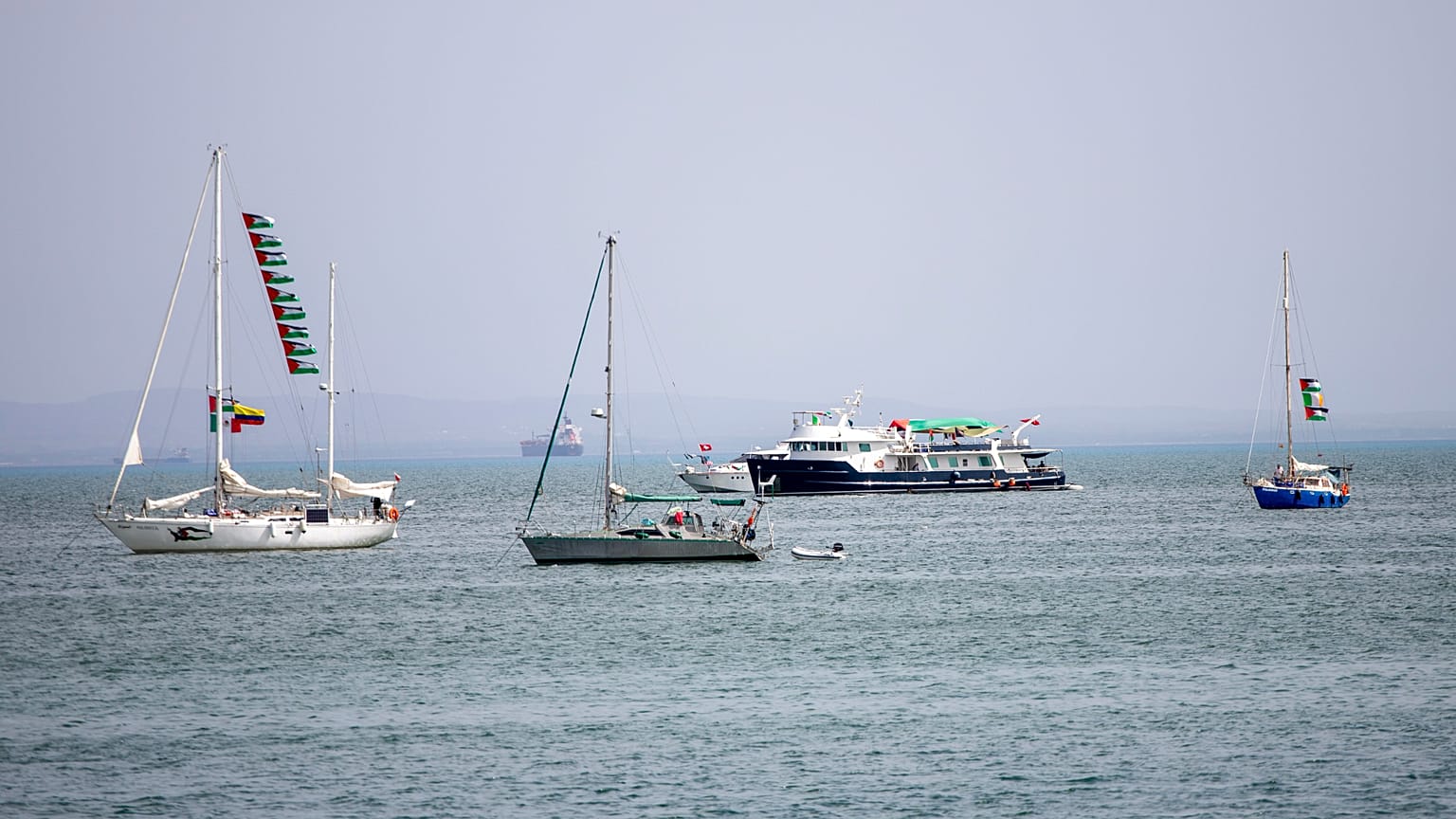
Ships that are part of the Global Sumud Flotilla
Copyright Copyright 2025 The Associated Press. All rights reserved


By Vincenzo Genovese
Published on 

The Israeli Foreign Ministry claimed that documents found in Gaza prove Hamas’ direct involvement in the humanitarian mission.

A spokesperson for the Global Sumud Flotilla on Tuesday rejected accusations by the Israeli Foreign Ministry that the humanitarian convoy has been financed by Hamas, describing them as propaganda.

Earlier on Tuesday, the Israeli Foreign Ministry published on its X account two documents that it claimed “prove Hamas’ direct involvement in the funding and execution of the Sumud Flotilla”.

The Israeli Foreign Ministry said that the documents were discovered in the Gaza Strip and were being revealed for the first time.  

The first document is a letter from 2021, signed by top Hamas leader Ismail Haniyeh, who was killed in Tehran by an Israeli attack in 2024. It revealed a close link between Hamas and the organisation Popular Conference for Palestinians Abroad.

The Popular Conference for Palestinians Abroad was established in Turkey in 2017 by the Palestinian diaspora from around the world to involve it in political participation and national decision-making.

It regularly releases statements on the current situation in Gaza and the West Bank, and other issues related to Palestine.

PCPA was designated “an institution established by the Hamas Organisation” by the Israeli Ministry of Defence in August 2021, which considers it “a proxy for the Hamas organization”.

A second document lists PCPA members operating mainly in Europe, including Saif Abu Kashk, the alleged CEO of Cyber Neptune, a private Spanish maritime company that “owns dozens of the ships participating in the Sumud Flotilla”, according to the accusations.

According to Spanish registers, a person named Saif Abdelrahim Abukeshek is listed as the CEO of Cyber Neptune, a society based in Barcelona. According to the publicly available records, the company changed its corporate purpose from real estate to maritime transportation of people and goods, with Abukeshek taking control just days before the Global Sumud Flotilla's departure on 31 August.

Abukeshek has repeatedly rejected accusations by the Israeli government of his involvement with Hamas, stating on social media that “My work with Cyber Neptune and the flotilla has been fully transparent and focused solely on delivering life-saving aid to Gaza’s besieged population.”

Euronews could not independently verify whether the company owns any vessels joining the Flotilla. Spanish maritime records did not have any public information available on ships owned by Cyber Neptune.

Euronews was also not able to independently verify the authenticity of the documents, although they seem to be consistent in language and appearance with official communiques from Hamas, which is designated as a terrorist organisation by the EU, US and other countries in the world.

The Global Sumud Flotilla spokesperson Maria Elena Delia labelled Israel’s claim as “propaganda”, in a statement released to news agency Ansa. 

“The papers shown by Israel prove neither Hamas' financing nor control over the Global Sumud Flotilla,” she said.

“We are a civil and humanitarian mission, in the eyes of Europe and the world. We ask that the papers be handed over in full to independent bodies: until that happens, [this claim] is just propaganda, not evidence,” she added.

The Global Sumud Flotilla is an international civil society-led maritime initiative comprising over 50 vessels with thousands of participants from more than 44 countries.

It has not been endorsed by any governments, and its stated mission aimed at breaking Israel's blockade of the Gaza Strip and delivering humanitarian aid including food and medicine to the besieged Palestinian territory has been repeatedly challenged by Israel.

In a statement on Tuesday, the Israeli Foreign Ministry accused the flotilla of being Hamas-led and “sailing without authorisation and in violation of international law, to break the blockade on Gaza, which is also defined as a war zone.” 

“This is a coordinated Hamas attack against the State of Israel, under a seemingly civilian and humanitarian cover,” the statement said.

Delia said Israel was repeating "a troubling pattern already seen in 2010 with the Mavi Marmara”, referring to an incident 15 years ago.

At that time six civilian ships of what organisers called the “Gaza Freedom Flotilla” refused to stop after having received a warning from the Israeli Navy and were raided in international waters in the Mediterranean Sea, with 10 deaths resulting from the raid.

The Global Sumud Flotilla is currently navigating north of Egypt’s eastern coast, and by late Wednesday should reach a zone in international waters where boats attempting to break the naval blockade around Gaza have previously been intercepted by the Israeli navy.

Euronews has contacted MEPs Benedetta Scuderi (Greens/EFA) and Annalisa Corrado (S&D) for further comment.

The Strange New World Of Quantum Computers – OpEd


By 

Europe is placing its bet on quantum networking—linking machines through entangled particles—as the foundation for a new era of secure communications and distributed computing. And it’s determined to lead, as the 2025 Körber European Science Prize, a €1 million award to Stephanie Wehner, a German-born physicist and computer scientist at Delft University of Technology, signals. The prize is an initiative of the Hamburg-based Körber Foundation dedicated to promoting dialogue and innovation in fields that shape the future of society.


“My goal is to make the ultimate form of communication allowed by nature—quantum communication—available to all,” says Wehner, who heads the European Quantum Internet Alliance, a 42-member consortium working on a first-of-its-kind prototype to connect two urban quantum networks, stretching across hundreds of kilometres by 2030.

Her group’s standout contribution so far is QNodeOS, an operating system that enables engineers to program quantum networks without needing to master the underlying physics complexities. In a field marked by hardware breakthroughs, QNodeOS addresses a vital component: the software layer that transforms lab prototypes into usable infrastructure.

In a year that the UN has designated as the International Year of Quantum Science, Europe’s decision to spotlight a systems builder is telling. This is no longer just about making better qubits—it’s about scale, standards, and interoperability, the ingredients of a functioning internet, not just a powerful machine.

The Körber Prize lands at a moment of acceleration. China has long demonstrated satellite-based quantum key distribution (QKD); U.S. labs are knitting together regional testbeds; Japan and others are experimenting with space-to-ground connections. Quantum Flagship has committed billions over the past decade to advancing quantum research. In that context, Wehner’s award is both a recognition and a message: Europe intends to convert physics into networking—and on its own terms.

That effort centres on three key stakes:


  1. Security: Quantum links offer cryptographic protections that detect any attempt to eavesdrop at the physical layer.
  2. Scientific utility: Entanglement can synchronise clocks, sensors, and telescopes across massive distances.
  3. Economic leverage: The region that standardises the tech stack—repeaters, devices, software, protocols—sets the rules and sells the tools.

What’s Special About This “Internet”

Today’s internet moves bits—0s and 1s—through voltage levels or pulses of light. A quantum internet, on the other hand, distributes qubits, which can be in a state of 0 and 1 at the same time (superposition) and, more importantly, be entangled. Entangled qubits have outcomes that are mysteriously connected—even across vast distances. If someone tries to intercept them, it will be detected in the data. That’s how quantum key distribution works, but security is just the beginning.

A true quantum network would be able to create, store, and exchange entanglement between distant nodes—some equipped with small quantum processors—and make that ability available to applications. Link enough high-quality entanglement together, and you can sync clocks with picosecond precision, combine telescopes into Earth-sized observatories, or patch together niche quantum computers into a more powerful whole. It doesn’t replace the classical internet—it enhances it in ways traditional tech never could.

Of course, the obstacles aren’t just physical—they’re systemic. Quantum states are fragile. Photons disappear. Repeaters that can maintain and extend entanglement are still under development. Even if the physics checks out, the system still requires schedulers, APIs, and programming models that hide complexity while unleashing the technology’s full power. That’s where Wehner’s work comes in.

The Software Pivot: QNodeOS

QNodeOS is pitched as the first operating system for quantum networks—and that comparison is deliberate. The early success of the classical internet came not just from hardware, but from standardised software like TCP/IP and interfaces that made it easy for developers to connect without needing to know every technical detail. QNodeOS targets the same layer for”entanglement as a service.”

In practice, that means:

  • Defining API-like commands(e.g., request-entanglement, store-entanglement, swap-entanglement) instead of lab procedures.
  • Scheduling scarce quantum resources, since a single node or fibre might have to juggle multiple users.
  • Integrating diverse hardware—ion traps in one location, superconducting qubits in another, various quantum memory types—under a shared software standard.
  • Planning for delay and uncertainty, since entanglement isn’t guaranteed to succeed every time.

This isn’t a polished consumer product. It’s a backbone for making pilots repeatable, not one-off demos. For Europe, it’s also a foundation for standardization—the sort of scaffolding that researchers, companies, and policymakers can rally around.

From Laboratories to Intercity Links

The Quantum Internet Alliance is taking a phased approach. First come city-level testbeds, where universities and telecom providers run QKD and distribute entanglement over existing fibre networks. The next challenge is intercity: connecting urban quantum networks hundreds of kilometres apart with repeaters and a smart control plane to manage entanglement on demand. The 2030 goal isn’t a continent-wide grid—it’s a robust, functioning prototype that can serve as a foundation for future standards, investments, and products.

Europe’s motives are both scientific and strategic. If banks, cloud services, and power grids begin using quantum links, they’ll want local suppliers,compliance standards, and regulatory guidance. If research networks adopt entanglement, they’ll demand cross-border governance over who controls the switches. Early deployments set the gravity well—ecosystems form around them.

The Geopolitics: From Chip Races to Link Layers

Quantum networking may seem like the next chapter in the semiconductor race, but its dynamics are distinct. Chipmaking is built around chokepoints—specialised lithography machines, materials, and packaging. Quantum networking encompasses a diverse range of technologies, including photonics, cryogenics, fibre optics, satellites, and software. That diffusion makes export controls more challenging, but it amplifies the value of being first in setting standards.

It also raises questions about alliances for democratic blocs. Will trusted routing be restricted to zones? Will interoperability rely on transparent standards or proprietary black boxes? Europe is betting on open interfaces and public-private alliances, in part to avoid lock-in to foreign solutions and to keep industry and academia tied together.

What Initial Applications Could Look Like

  • Critical Infrastructure. Power grids depend on precise timing and coordination. Quantum-enhanced clocks and secure control messages could help stabilise operations, especially under stress from renewable energy sources or climate shocks.
  • Science. Entangled atomic clocks could boost precision in gravitational studies. Long-distance telescopes could benefit from phase-locked sources via a quantum network.
  • Data Governance. ”Delete” doesn’t always mean delete. Certifiable deletion, enabled by quantum proof, could make it possible to demonstrate that a file is truly gone—for good.
  • Cloud-Adjacent Quantum. Most users won’t run their own quantum computers. Early access might look like today’s cloud: authenticated users accessing quantum services remotely—with privacy protection built in.

All these use cases depend on cost, latency, fidelity, and other practical factors. The reason for building the network now is to determine which combinations of physics and policy make sense first.

A Profession That Bridges Hacking and Physics

Wehner’s early career in IT security and network administration shaped her approach to problem-solving. Engineers from that world tend to prioritise fail-safes, interfaces, and abuse cases—essential instincts in a field where theoretical security can be undermined by flawed implementation.

In her work across Singapore, the U.S., and the Netherlands, she earned a reputation as someone fluent in both information theory and systems thinking.


Ramesh Jaura

Ramesh Jaura is a Journalist, Author, Publicist, Moderator, and Public Speaker. A journalist with more than 60 years of experience, he was also the founder-editor of IDN-InDepthNews.