Kupyansk On The Brink And Ukraine’s Other Battlefield Woes – Analysis
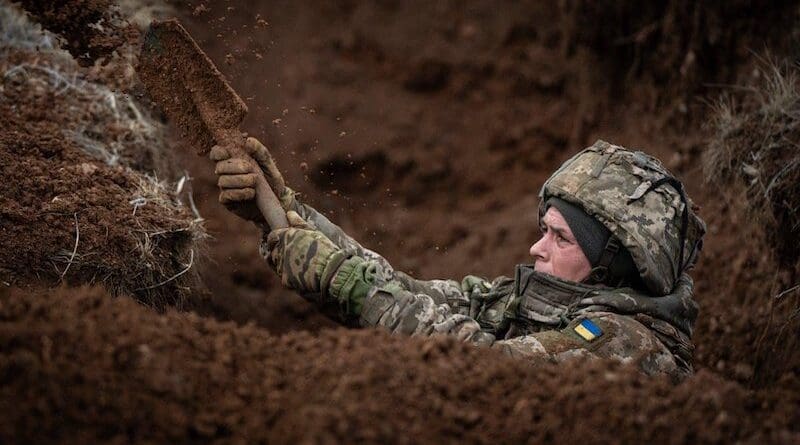
A Ukrainian soldier digs a trench. Photo Credit: Ukraine Defense Ministry
October 3, 2025
By RFE RL
By Mike Eckel
Ukrainian forces overran poorly prepared Russian defensive positions in September 2022, sweeping north, east, and south across the Kharkiv region, reaching all the way to the Oskil River and recapturing the rail junction city of Kupyansk.
It was a high-water mark for Ukraine, as much a sign of Ukrainian pluck as it was an symptom of Russian disarray.
Three years on, Kupyansk is on the verge of being seized by Russia once again. This time, it reflects Ukrainian struggles as much as it does Russian determination — and the Kremlin’s willingness to absorb mind-numbing casualties.
As the fourth fighting season of Russia’s all-out war on Ukraine nears an end, the situation across the 1,100-kilometer frontline largely resembles the situation at the beginning of the season.
Russia has suffered more than 1 million casualties to date, with at least one quarter of those killed, according to Britain’s spy chief. Ukraine’s losses are fewer, but given its population size, arguably more onerous: an estimated 400,000 in total, with dead totaling at least 100,000.
“We are in a war of attrition,” said Thibault Fouillet, a military expert and deputy director of the Institute for Strategic and Defense Studies, a French think tank. “The decisive factor is only the capacity to endure, to patiently erode the enemy potential; all will be cumulative, not a decisive blow.”
Barring a major shift in fortunes, Kupyansk’s fall could coincide with onset of autumn rains and cold weather; for Ukrainian forces, a demoralizing coda 44 months into the invasion.
Here’s where things stand.
Kupyansk
Entrenched largely on the eastern banks of the Oskil River, Russian troops have slowly ground forward to the north for months, as commanders have prioritized other locations along the front.
The city is home to a major rail line that allows Ukrainian forces to resupply their positions from Kharkiv, the country’s second largest city.
Sometime in early September, Russian forces used parts of the underground gas pipeline network, creeping for kilometers underground, beneath the Oskil River, to bypass Ukrainian positions on the northern outskirts of Kupyansk.
It was at least the third time Russian troops had pulled off a tunnel ambush.
Ukrainian forces said they later destroyed the pipeline and killed or captured dozens of Russian troops. But they also acknowledged that an unknown number of Russian soldiers had slipped through and hidden – sometimes individually – in locations around the area.
“The enemy isn’t conducting assault operations. They’re infiltrating their personnel. They’re not trying to storm our positions. They’re simply bypassing them and trying to enter the city itself,” Vitaliy Shum, head of the training group for the 151st Reconnaissance Shock Battalion of the 10th Army Corps, told Current Time last week. “The area is wooded, with lots of trees. And when there’s a gap between our positions, they try to push their personnel through it.”
According to Deep State, a battlefield tracking group that has ties to the Ukrainian military, Russian forces have entered several northern districts of Kupyansk. And Russian officials claim Ukrainian commanders have already redeployed forces to keep the city from falling.
“The situation is critical; the enemy is still in the city. There are sabotage and reconnaissance groups in the city, and our special forces are undertaking counter-sabotage operations,” Andriy Besedin, the head of the regional military administration, told a Ukrainian state broadcast on September 28.
Pokrovsk/Dobropillya
About a four-hour drive south in the Donetsk region, Pokrovsk – a bigger city with both road and rail junctions – has been under threat of encirclement by Russian forces for most of the year.
Driving the resupply route along a highway stretching toward the major metropolitan area of Dnipro, 180 kilometers away, became more dangerous earlier this year after Russian forces moved into the village of Kotlyne, to the southwest.
“Russian forces are pressed for time, because of worsening weather as well as the Kremlin’s political imperatives,” Lawrence Freedman, an emeritus professor of war studies at King’s College London, wrote in a recent analysis. Russia has “been targeting it for well over a year. Even if they can’t meet [President Vladimir] Putin’s ambitious timetable, capturing Pokrovsk would give them something to show for the year’s effort.”
Weather in recent days – in particularly high winds — made it more difficult for both Ukrainian and Russian drone units to operate in the Pokrovsk area, according to Maksym Bakulin, a press officer with the National Guard’s 14th Operational Brigade.
The situation northeast of Pokrovsk is more problematic for the Ukrainians.
In early August, an unknown number of small-sized Russian units broke through porous Ukrainian defenses east of the town of Dobropillya.
The breakthrough highlighted both how stretched and understaffed Ukraine’s defenses are, and the tactic Russian commanders have relied on over the course of 2025: send small units, sometimes just one or two soldiers, possibly using motorcycles or all-terrain vehicles, to speed past or around Ukrainian trenches, and then dig in until Russia can reinforce or use artillery drones to batter nearby defenses.
It also forced commanders to redeploy troops from some of Ukraine’s most battle-hardened units, including the Third Separate Assault Brigade.
“Russian troops’ primary method of operation is small infantry groups,” Denys Popovych, a Ukrainian military observer, told RFE/RL’s Ukrainian Service. “A process of infiltration, seeping in, and then creating these metastasizing pockets that then close in, and absorbing the enemy.”
“They create ‘kill zones’ where everything is destroyed,” he said.
Since the breakthrough, though, Ukrainian soldiers have managed to surround an unknown number of Russian troops. In some cases, experts point to defensive and offensive lines being dangerously entangled, with frontline soldiers unable to tell where enemy positions lie.
Captain Viktor Trehubov, a spokesman for the Dnipro regional command, told state TV that rear-guard Russian units had been unable to resupply the units that had managed to slip through Ukrainian defense.
The Russian “intestine,” Trehubov said, was now being “cut and dissected” by Ukrainian troops.
Zaporizhzhya
Further southwest, the front lines south of the city of Zaporizhzhya have been largely static for much of 2025, not to mention for much of the previous two years.
Over the summer, Ukrainian officials reported an uptick in small-scale infiltration tactics, again using motorcycles and off-road vehicles, along with drone units.
“We haven’t witnessed this level of activity in the past three years,” a battalion commander from the 65th Separate Mechanized Brigade told the online channel Espreso TV in July. He identified himself by the call sign “Forest” in line with military protocols.
In early September, Ukraine’s commander-in-chief, General Oleksandr Syrskiy, said that Ukrainian troops had thwarted a planned large-scale offensive in Zaporizhzhya, and Russian commanders redeployed marine infantry and other units east to the Donetsk region.
- Mike Eckel is a senior international correspondent reporting on political and economic developments in Russia, Ukraine, and around the former Soviet Union, as well as news involving cybercrime and espionage. He’s reported on the ground on Russia’s invasion of Ukraine, the wars in Chechnya and Georgia, and the 2004 Beslan hostage crisis, as well as the annexation of Crimea in 2014.
 RFE RL
 - RFE/RL journalists report the news in 21 countries where a free press is banned by the government or not fully established.
Ukrainian Authorities Begun To Evacuate Kupyansk – Analysis

A Ukrainian soldier. Photo Credit: Ukraine Defense Ministry
By Can Kasapoğlu
1. Battlefield Assessment
Fighting continued at a high operational tempo last week, with 120 to 140 tactical clashes each day. According to data circulated by the Ukrainian General Staff, 30 percent of these occurred around the long-embattled Pokrovsk sector, where Russian forces made advances. The area around Toretsk and the Lymansk sector each hosted roughly 10 percent of last week’s tactical engagements.
Russian forces continued to make incremental gains along the axis from Kharkiv to Kupiansk, prompting Ukraine to begin evacuating the latter city. Ukrainian press sources reported that covert Russian sabotage units have penetrated the area disguised as Ukrainian servicemen.
Heavy drone activity also continued throughout the battlespace. The area around Kharkivfaced intense Russian drone attacks. Dnipro bore the brunt of the salvo, which deliberately targeted the civilian population. Meanwhile, Ukrainian drones targeted 170mm Koksan self-propelled artillery pieces, which Russia received from North Korea.
Notably, signs emerged that Ukraine’s attacks on Russian oil infrastructure have made a significant impact. Open-source visual evidence indicates that Russia has been placing protective metal structures over its energy facilities to protect them from long-range Ukrainiandrone strikes. The Kremlin also recently banned the export of gasoline until the end of 2025 in an effort to conserve its resources for domestic use.
2. Swedish Gripens Could Soon Join Ukraine’s Air Force
Ukrainian First Deputy Defense Minister Ivan Havrylyuk announced that Ukraine plansto acquire Gripen combat aircraft from Sweden, though Sweden and Ukraine have not reached a final agreement on the procurement of the fighters.
The transfer of these advanced fighters has long been in the offing. As early as 2023, Swedish Defense Minister Pål Jonsson offered to familiarize Ukrainian pilots with the Gripen platform. As their need for a more advanced air deterrent has grown, Ukrainian officials have become less reluctant to operate a European fighter aircraft alongside American-supplied F-16s.
Along with the Eurofighter Typhoon and the French Dassault Rafale, the Saab Gripen baseline is one of three principal European platformsoperated by NATO member states. The Gripen family’s latest variant, the Gripen-E, was initially developed to replace older Gripen-C/D models. But the worsening threat landscape across Europe prompted Swedish military planners to equip some C/D platforms with modifications that extended their lifespan.
Thus far, the Swedish platform has not matched its competitors’ popularity in the international weapons market, nor have the world’s top militaries adopted the airframe. Still, Thai forces successfully used Gripens to target Cambodian artillery in the nations’ summer 2025 border dispute.
At the outset of Russia’s full-scale invasion of Ukraine, many Western analysts considered the Gripen the best option for Ukraine’s nascent advanced air deterrent. The Swedish Air Forcehas long centered its doctrinal approach on low-level air superiority concepts of operations that can succeed under severe pressure and from dispersed bases. Moreover, the Gripen requires a relatively modest crew. Operating the craft requires just two ground vehicles, six ground personnel, and one aviation maintenance professional. The Gripen can take off and land from highways, and it is designed to fly in temperatures as low as negative 78 degrees Fahrenheit. Finally, the aircraft’s electronic warfare suite has reportedly been optimized to counter Russian combat aircraft and air defense systems.
So while other fighters may have captured larger shares of the international weapons market and logged superior combat records, the Swedish Gripen could be the perfect European addition to Ukraine’s growing contingent of advanced aircraft.
3. Ukraine Joins NATO Naval Exercises
The Ukrainian Navy’s success in the Black Sea helped Kyiv secure a prominent place in the high-tech maritime exercises NATO put on last week.
This year’s exercises, in Portugal, focused on integrating unmanned systems into a connected operational environment. The drills combined two NATO initiatives: Robotic Experimentation and Prototyping with Maritime Unmanned Systems (REPMUS), a global showcase for military-grade maritime robotics; and Dynamic Messenger (DYMS), a part of NATO’s operational experimentation series. The exercise sought to assess new maritime capabilities includingorganic intelligence, surveillance, reconnaissance (ISR) measures, underwater infrastructure defense, and tactics to counter multi-domain unmanned vessels.
Co-organized by NATO’s Allied Command Transformation (ACT) and Allied Maritime Command (MARCOM) and hosted by the Portuguese Navy, the exercise deployed elements of Standing NATO Mine Countermeasures Group 2 and Standing NATO Maritime Group 1. The Ukrainian Navy played the enemy force, or the so-called red team. In the exercise, the red team had a force of one unmanned ground vehicle, 57 unmanned surface vehicles (USVs), and 61 aerial drones of varying designs. According to press sources, Ukraine’s hypothetical robotic flotilla also included the Magura V7 USV, which the real Ukrainian Navy reportedly used to shoot down two Russian Su-30SM combat aircraft earlier this year.
As its participation in these exercises demonstrates, Ukraine’s success against the Russian Navy in the Black Sea offers invaluable lessons for NATO. At present, the Ukrainian military boasts more experience with robotic naval combat operations than any other military in Europe. Ukraine’s success could significantly influence NATO’s future naval strategies and help foster continued maritime cooperation between the alliance and Kyiv.
- About the author: Can Kasapoğlu is a nonresident senior fellow at Hudson Institute. His work at Hudson focuses on political-military affairs in the Middle East, North Africa, and former Soviet regions. He specializes in open-source defense intelligence, geopolitical assessments, international weapons market trends, as well as emerging defense technologies and related concepts of operations.
- Source: This article was published by the Hudson Institute
Hudson Institute is a nonpartisan policy research organization dedicated to innovative research and analysis that promotes global security, prosperity, and freedom.