Thursday, October 02, 2025

ANOTHER FASCIST BILLIONAIRE OLIGARCH

Populist Former PM Rides Wave Of Discontent As Czechs Vote In Key Election – Analysis

Czech Republic's Andrej Babiš. Photo Credit: Andrej Babiš, X


By 

Czechia’s general election this weekend is likely to see the return to power of the billionaire Andrej Babis. Yet there are still many unknowns and post-election scenarios.


By Jules Eisenchteter

Gathered under the rallying cry to “prevent the rule of extremists”, thousands of people converged Sunday afternoon on Prague’s Old Town Square in support of the country’s pro-Western democratic orientation.

“We want to show that there is also a positive patriotism that is on the side of the West, freedom and democracy,” said the organisers of Million Moments for Democracy (“Milion chvilek pro demokracii”), a grassroots movement.

“Nothing has been decided yet,” they said, urging Czech citizens to mobilise in force to safeguard Czechia’s pro-Western and democratic path, and prevent extremists from entering government.

Organised just a few days before Czechs vote in key parliamentary elections on October 3-4, the protest set the tone for a high-stakes ballot that could fundamentally change which direction the Czech Republic will take for years to come.


Populism takes centre stage

“One of the things that has surprised me is the hyped atmosphere during the campaign that even escalated into vulgar and violent behaviour against the main candidates,” says Tomas Cirhan, an assistant professor at the Faculty of Social Studies at Masaryk University in Brno.

“This is of course not completely novel, but the intensity is striking,” he tells BIRN in his assessment of a heated, polarising and largely negative campaign that saw – among other lowlights – Prime Minister Petr Fiala facing regular verbal insults or opposition leader Andrej Babis physically attacked by a crutch-wielding man during a campaign event. While not the only culprit, Russia’s massive disinformation and propaganda efforts – meant to sow doubt and division rather than support a specific party – have also contributed to poisoning a public space that is now more toxic and divisive than ever.

Four years after a make-shift coalition of five pro-democratic forces narrowly beat agro-billionaire Babis’s ANO movement on a promise of returning decency in politics and firmly anchoring the Central European country in Western institutions, the nation appears bitterly divided and the political debate wretched.

Facing abysmal ratings and just around 20 per cent of voting intentions, the ruling right-wing Spolu coalition has gone to great lengths to frame the ballot as an existential battle for the future of the country. “It’s about where the Czech Republic will go. Whether we remain as a strong democracy, with full freedom, with prosperity, a country that is firmly part of the West… or whether we drift somewhere to the East,” Fiala warned during the campaign.

“The Spolu campaign waged everything on the moral appeal of their voters being ‘on the right side’ – I expected their campaign to culminate with something more tangible,” Cirhan complains, echoing many experts’ warningsthat such polarising rhetoric – demonising political opponents along with hundreds of thousands of their voters – does little in the way of promoting a healthy democratic culture.

According to Petra Vodova, assistant professor at the political science department of the University of Hradec Kralove, “to some extent, yes, I would agree that this election reflects a broader clash between pro-Western and pro-Russian worldviews”. However she also highlights important distinctions between parties commonly included in the latter group, from the “most radical” Communist-led Stacilo to ANO’s “deliberately vague programmatic messaging”.

“You don’t have to love Spolu, you don’t have to like me personally, but the reality is that if the votes are diluted, Andrej Babis will form the [next] government,” Fiala stated at the launch of the final phase of his campaign last month, stoking large parts of the electorate’s deep-rooted antipathy towards the former billionaire prime minister in the hope that many will opt to vote for what they see as “the lesser of two evils”.

But – crutches notwithstanding – it’s been largely plain sailing for Babis and his ANO party. Week in, week out, polls have given his populist, Eurosceptic, anti-immigration movement between 30 and 35 per cent of voting intentions.

After four years of austerity-driven reforms and financial hardship, many voters are willing to turn a blind eye to Babis’s spotty track record, a first stint as premier marked by a catastrophic handling of the Covid pandemic, his endless judicial run-ins and oligarchic tendencies, and a shift to the far right that places him, at the EU level, in league with the bloc’s most notorious illiberal, pro-Russian leaders, including Hungary’s Viktor Orban.

As satirist and writer Dominik Landsman summed up for Seznam Zpravy: “If Andrej Babis shoots an orphan or eats a puppy, his voters will still say ‘better than Fiala’.”

While unoriginal, the tried-and-tested recipe of that appeal – together with the government’s unpopularity; the population’s Ukraine war fatigue; criticism of the EU, especially the Green Deal and immigration policies; vague promises to solve the cost-of-living crisis and restore households’ purchasing power; and a comforting pledge to put Czechs first – has put the Straka Academy, the seat of government in Prague, once more within his reach.

“I have a feeling that [ANO voters] are ready to make a trade-off between the amount of money in their wallets, and the basic values of the democratic institutions in the Czech Republic,” Otto Eibl, a political scientist at Masaryk University, warned on Radio Prague.

Two blocs

Considering their voters’ exodus, most experts consider it highly unlikely, if not impossible, for the ruling Spolu coalition of Prime Minister Fiala to cling to power. “In general, the polls can only tell us part of the story, as around one-third of voters tend to decide in the last two weeks before elections,” cautions Cirhan of Masaryk University.

Czech elections have frequently been marked by last-minute upheavals, even more so in recent years as the share of swing voters – the roughly 12 per centwho decide whether and whom to vote for on election day – has grown. Part of them are disappointed government voters who might, ultimately, decide to go out and vote on October 3-4.

The centre-right, junior coalition partner Mayors and Independents (Stan), now polling at around 12 per cent, is hoping to pick up some of those votes, though the party’s attempt to promote itself as a ‘third line’ above the toxic Spolu-ANO bickering failed to gain as much traction as it had hoped.

And after months in apparent limbo following their chaotic exit from the government at the end of last year, the liberal Pirate Party – with strong support among younger, urban voters – has been gaining ground in the polls and is now approaching the 10 per cent mark.

Spolu, Stan and the Pirates have all rejected any cooperation with Andrej Babis after October 4 – highlighting the existence of two antagonistic blocs with little to no spillover or common ground between them.

While the original five coalition parties’ current polling numbers are, once totted up, close to their results at the last election four years ago, experts emphasise that their rise to power four years ago was made possible by the “loss” of nearly a million votes that went to smaller parties – many potential ANO allies – who failed to meet the required 5 per cent threshold to enter parliament. They might not be so lucky this time around.

Three parties and groupings are already lining up to join or tacitly support a government led by ANO, which doesn’t appear to have the numbers to form a one-colour government and must tread a fine line between achieving the best possible result without depleting the votes of potential coalition partners – or demotivating overconfident voters.

Led by far-right firebrand Tomio Okamura, the anti-EU, xenophobic and pro-Russian Freedom and Direct Democracy (SPD) is currently polling at about 12 per cent, with some surveys giving an ANO-SPD alliance a majority in the 200-member lower house.

In a bid to attract the fringe vote, the SPD portrays itself as the only safe, double-digit anti-establishment choice – in contrast to the Communist-led Stacilo movement and the conservative Motorists for Themselves, both polling at about 6-7 per cent, dangerously close to the 5 per cent threshold required to send MPs into parliament.

“I think that the biggest surprise will be whether these smaller parties will make it into the parliament,” Tomas Cirhan tells BIRN, “and, simultaneously, it will be the most decisive factor in regard to the potential formation of government coalitions.”

The morning after the day before

Some lessons from four years ago appear to have already been learned. The SPD joined forces with three smaller far-right parties, while Stacilo – itself a grouping of three parties led by the Communists – made an electoral alliance with the Czech Social Democrats. Last month, the Constitutional Court acknowledged that while both constituted “hidden coalitions” (normally subject to higher voter thresholds), the 5 per cent threshold would still apply to them.

The technicalities of Czechia’s complex electoral system, and double-round methodology to translate votes into mandates, must also be taken into account. As political scientist Jakub Sedo reminded: “The [Czech] electoral system significantly disadvantages parties that are just above the threshold while, on the contrary, it favours the strongest parties.”

Though ANO will almost certainly emerge as the election winner on Saturday evening, there is still a lot of uncertainty about whether Babis will be able to form a government – and most importantly with whom. “The Czech party system is fairly fragmented,” notes Cirhan, adding that cooperation within those two aforementioned blocs “cannot be taken for granted”.

On top of notorious personal animosity between some leaders – including Babis and SPD leader Okamura – ideological differences might turn post-election coalition talks into an uphill battle. Both SPD and Stacilo have called for a referendum on Czechia’s membership in the EU and/or NATO – an option Babis has dismissed out of hand.

“A single-party majority is highly unlikely, and Babis is ambiguous about potential coalition partners,” says Petra Vodova of the University of Hradec Kralove, though adds that “despite reports of a poor personal relationship between Babis and Okamura, ANO and SPD already govern together in some regions”.

There is also little love lost between the SPD, Stacilo and Motorists, all configurations being considered. Reciprocally, some commentators venturethat despite their stated red lines, some government parties could ultimately do a U-turn and participate in an ANO-led government, including a breakaway faction of Fiala’s Civic Democrats, or even Stan.

As head of state bound by requirements of non-partisanship but tasked with safeguarding the country’s European and international obligations, President Petr Pavel is also expected to play a central role in post-election talks. He’s already indicated that he would refuse to countenance any cabinet minister who questions the Czech Republic’s place in the EU or NATO.

Trickier still, allegations of subsidy fraud facing Babis and the myriad conflicts of interest with relation to his giant Agrofert conglomerate could provide legal grounds for Pavel not to nominate him as prime minister – a nuclear constitutional option seen as unlikely, but one that hints at the many uncertainties bound to surface after this week’s vote.

And with ANO’s “catch-all” chameleon-like appeal largely based on its ability to flip-flop depending on which way the wind blows, who could end up joining a Babis-led government will be key in determining the direction that the Czech Republic might take, both at home and abroad.

As Masaryk University’s Otto Eibl told Czech Radio: “I fear he might be the one who opens the door for others who will damage the Czech Republic and its image abroad.”



Balkan Insight

The Balkan Insight (formerly the Balkin Investigative Reporting Network, BIRN) is a close group of editors and trainers that enables journalists in the region to produce in-depth analytical and investigative journalism on complex political, economic and social themes. BIRN emerged from the Balkan programme of the Institute for War & Peace Reporting, IWPR, in 2005. The original IWPR Balkans team was mandated to localise that programme and make it sustainable, in light of changing realities in the region and the maturity of the IWPR intervention. Since then, its work in publishing, media training and public debate activities has become synonymous with quality, reliability and impartiality. A fully-independent and local network, it is now developing as an efficient and self-sustainable regional institution to enhance the capacity for journalism that pushes for public debate on European-oriented political and economic reform.

JUST ANOTHER CONSPIRACY THEORY

UK Think Tank Says Leaked Documents Show Russia Is Helping China Prepare To Seize Taiwan

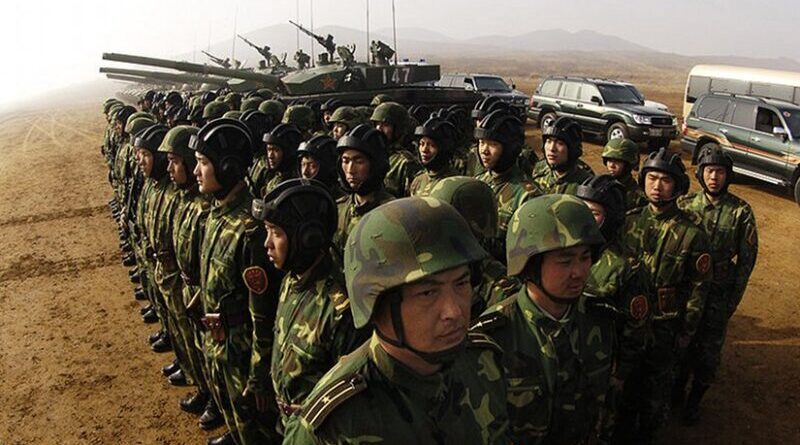
Soldiers with the People's Liberation Army at Shenyang training base in China. DoD photo by Staff Sgt. D. Myles Cullen, U.S. Air Force.


By 

By Reid Standish


recently released 800-page cache of contracts and correspondence shows that Russia is helping China prepare its military for a potential invasion of Taiwan, according to an independent think tank that received the files and had them independently verified.

Oleksandr V. Danylyuk, an associate fellow at the Royal United Services Institute (RUSI), who obtained the leaked files along with his co-author, Jack Watling, spoke to RFE/RL about what the findings mean for future China-Russia military cooperation and why Russia may be in favor of a Chinese invasion of Taiwan, the self-governing island of 23 million people that Beijing claims as its territory.

According to RUSI, the documents indicate that Moscow agreed in 2023 to sell a suite of military equipment to China’s People’s Liberation Army (PLA), including assault vehicles, anti-tank guns, and airborne armored personnel carriers. The armored vehicles would be equipped with Chinese specifications, and Russia would train a battalion of special Chinese paratroopers to use them.

he contracts also state that Russia would transfer technologies to China that will allow it to make similar weapons.

Such an agreement would bolster China’s air maneuver capabilities, one of the few areas where Moscow’s military still has an edge over the PLA, and intensify concerns that Beijing could seize infrastructure inland even as it storms ports and beaches along the coast as part of a potential invasion.


The approximately 800 pages of contracts and collateral materials “appear genuine” and details from within the documents have been independently verified, RUSI said. However, there is also the possibility that parts of the documents have been altered or omitted, it added.

Moscow has not commented on the leaked documents.

The interview below has been condensed and edited for clarity.

RFE/RL: Can you briefly explain what are the key elements of those deals and why they are significant for Beijing in regards to a potential invasion of Taiwan?

Oleksandr V. Danylyuk: So, in a few words, the deal is about getting some very specific equipment which is needed for airborne landing operations.

It’s the set of equipment for landing a heavy airborne battalion and also specific equipment for special forces. Both of these sets are needed for an airborne invasion, which in turn would set the stage for a seaborne invasion by the Chinese military.

The idea is to actually have a special forces team on the ground and by using this Russian equipment, they would be able to jump from civilian cargo aircraft from a very high altitude and glide to Taiwanese territory without being detected. And they would also use these automatic systems to deliver equipment — like Russian airborne tanks and fighting vehicles –– there so that not every [special forces soldier] would actually need to parachute to Taiwan — a lot of them could enter Taiwan legally as tourists ahead of time.

We believe that this heavily equipped battalion would be just a part of a bigger number of battalions, so perhaps one battalion using Russian equipment and two or three using Chinese equipment.

That’s enough for taking control of at least Taipei port, which in our opinion is the key target for such an operation as it gives the Chinese control of a vital port for a coming seaborne invasion by the People’s Liberation Army.

RFE/RL: The conventional wisdom has always been that Russia is very wary of exporting military equipment in more advanced areas to China out of fear that this would be stolen and reverse engineered. So why do you think that that’s changing now, and what does that mean moving forward?

Danylyuk: Politically, this type of military cooperation is super important for the Russians because they don’t want to be in this club of completely isolated countries. We can say that some kind of axis of likeminded countries [Editor’s note: analysts have begun to refer to political and military coordination between China, Russia, Iran, and North Korea as the “Axis of Upheaval] exists and for the Russians the most important element of this axis is China.

Russia has also invested so many resources into the means of war, and the only way they can convert that means into a proper geopolitical power is through a wider, global war. And the most desirable theater for that war is the Indo-Pacific.

So the Russians appear ready to do anything to push China toward invading Taiwan, especially if that would lead toward an actual conflict between the United States and China.

And I think the Russians are not interested in a Crimea-type scenario for the invasion of Taiwan where there is limited resistance and not much of a negative international reaction. Rather, the Russians would like China to invade, but have the blitzkrieg attack stall and have it be as protracted as possible because that would actually create the possibility for escalation.

It could then actually bring the Americans and some other nations, like Japan, into the war, which I believe is what they want.

RFE/RL: Ok, so I can summarize a bit because I think there’s a lot to unpack. You’re saying not only do these documents indicate to you that Moscow would be supportive of the Chinese invading Taiwan, but that they’re also looking for ways to influence the situation so that it could happen?

Danylyuk: Yes, absolutely, that’s right.

Right now, you can’t influence Chinese society the same way that you can a democratic one and I’d expect Russia to have some levers of influence on the Chinese government, although I don’t know that.

But the easiest way for Russia to actually create these preconditions for making the war and the invasion of Taiwan feel inevitable is to actually influence Taiwanese society, and to be honest, American society and American politics.

In terms of those preconditions in Taiwan, look at what’s going on in Taiwanese politics. The real stage zero is not infiltration by special forces but actually political destabilization.

The current political situation in Taiwan, where you have parliament, controlled by the KMT, and then [President Lai Ching-te] from the Democratic Progressive Party (DPP), split and spending much of the past year blocking bills and stalling constitutional court appointments, which has led to fights in parliament and mass protests.

This is an ideal precondition to try and stoke a political crisis, which is needed for destabilization of the command and control system in Taiwan, both politically and militarily.

RFE/RL: So, beyond this aerial capability outlined in the documents you’ve examined, what are other other areas that you think China’s military would need to look to Russia to improve in regards to a potential invasion of Taiwan?

Danylyuk: An obvious one would be some feedback about Russian missile and drone attacks.

So, how do you suppress air defenses and also how do you deplete them of ammunition? Russia has lots of recent, first-hand experience with that and it’s all very transferable to a Taiwan scenario.

RFE/RL: With this type of military cooperation that we’ve been talking about in mind, what else are you watching for a scenario around Taiwan?

Danylyuk: I think that the key question is to what extent Taiwanese society can actually avoid confrontation and polarization, and if it can unite around the need to protect the island, which is an even more difficult task.

The natural reaction from Washington to this is to give Taiwan more military capabilities, but in my opinion, they have enough capabilities. The issue is more about if they can actually be united and determined about resisting and fighting against an invasion.

An invasion of Taiwan would be extremely costly for the Chinese, so the real immunization against Taiwan being invaded lies in the field of morale and unity, and also the ability of the United States to offer a clear message of support.

Because, the reality is pretty simple: China is getting stronger and there is still a crisis in Europe. So, we will see.

  • Reid Standish is RFE/RL’s China Global Affairs correspondent based in Prague and author of the China In Eurasia briefing. He focuses on Chinese foreign policy in Eastern Europe and Central Asia and has reported extensively about China’s Belt and Road Initiative and Beijing’s internment camps in Xinjiang. Prior to joining RFE/RL, Reid was an editor at Foreign Policy magazine and its Moscow correspondent. He has also written for The Atlantic and The Washington Post.

WAR IN AFRICA

Ghana Reinforces Northern Border As Sahel Violence Encroaches

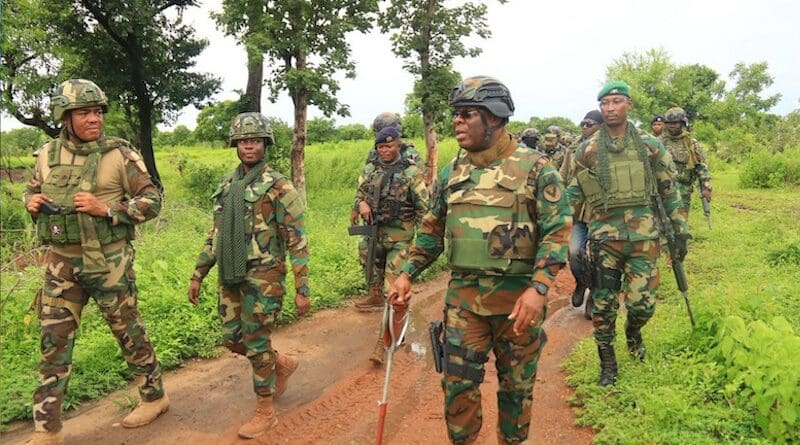
Ghana Armed Forces Brig. Gen. Worlanyo Agbebo, center, leads a patrol along the country’s northern border with Burkina Faso. Photo Credit: GHANA ARMED FORCES


By 

Ghana’s military is bolstering its presence in the north, where people are moving south due to the rising threat of terrorist attacks originating in Burkina Faso.


Ghana’s military recently deployed 400 troops to the northern town of Bawku due to bitter, ongoing ethnic violence between the Kusasi and Mamprusi communities. Burkinabe terror groups, including Jama’at Nusrat al-Islam wal-Muslimin, known as JNIM, and those linked to the Islamic State group, have fueled the fighting in recent years by smuggling weapons into the area through illicit networks.

Baffour Agyeman-Duah, a governance expert with the John A. Kufuor Foundation, warned that northern Ghanaian conflicts could provide an opening terrorists seek.

“The traditional conflicts in the north can be infiltrated by these extremists and turn into another war,” Agyeman-Duah told The Africa Report. “If our military is not properly equipped, and if the Bawku problem is not resolved, then we risk creating space for infiltration.”

Although Ghana has not suffered a major terror attack, Burkina Faso-based terrorists used northern Ghana as a logistical base from which to launch attacks into other areas, according to reports. They also use northern Ghana as a medical base to treat injured fighters. Analysts say terror groups also are involved in northern Ghana’s illicit cattle market.

In July, Ghana announced plans to build more forward operating bases in the Upper East and Upper West regions on the Burkina Faso border. Militaries use forward operating bases to support strategic and tactical operations. They often are located closer to the front lines than main bases. Additionally, Ghana’s Air Force announced it’s building a tactical air base in Jogboi, which will support troops operating at the northern border.


“We have extended our military presence a bit north of Tamale,” retired Col. Festus Aboagye, a security consultant, told The Africa Report. “Intelligence personnel have been deployed within the communities, using their natural senses, eyes and ears.”

In early September, the Ghana Armed Forces (GAF) patrolled Bongo and Soe in the Upper East Region to deter terrorist infiltration, monitor civilian activities, and identify possible sleeper cells and terrorist base camps. GAF Brig. Gen. Worlanyo Agbebo urged residents there to monitor and report infiltration by unfamiliar people and suspicious activities. He also asked them to provide accurate information to the military.

Beverly Ochieng, senior analyst at Control Risks, cautions that a military presence alone cannot resolve northern Ghana’s evolving terrorist threat.

“The heavy militarization of the northern region may end up being counterproductive because it fails to address some of the issues that could lead to civil unrest, whether it’s lack of employment opportunities, illegal mining [galamsey] or marginalization,” Ochieng told the magazine.

She added that community engagement is vital and that authorities might consider involving young people and cultural and religious leaders to stem militant activities and infiltration. Such approaches have been successful in Côte d’Ivoire, where local prefects vet incoming refugees and register displaced families to prevent militant infiltration, Ochieng said.

Aboagye agreed that stopping the spread of terrorist groups requires a holistic effort.

“Development is part of the effort,” he told The Africa Report. “If the people don’t have grievances, they are less likely to join terrorist ranks.”

Ghanaian President John Mahama has made regional diplomacy a priority and appointed retired Army officer Larry Gbevlo-Lartey as envoy to the Alliance of Sahel States, the bloc formed by military juntas in Burkina Faso, Mali and Niger.

“Diplomacy is the only way we can go,” Vladimir Antwi-Danso, an international relations scholar, told The Africa Report. “Whether you like the regimes or not, you need to cooperate. Intelligence sharing, military cooperation, support for each other — that is essential.”

In mid-September, Ghanaian and Burkinabe officials met to discuss joint boundary management. Yusif Sulemana, Ghana’s deputy minister of lands and natural resources, said the countries were committed to bolstering stability and prosperity along their shared 583-kilometer border.

Mamoudou Tapily, West Africa regional coordinator with the German Corporation for International Cooperation-African Union Border Program, said preventing conflict and improving governance, social cohesion and economic development is critical in border areas.

“Cross-border cooperation is no longer a mere necessity,” Tapily said in a report by Ghana’s Graphic Online. “It is an essential strategy to face common challenges such as insecurity, climate change and economic underdevelopment. This meeting aims to provide us with the tools to achieve this.”


Africa Defense Forum

The Africa Defense Forum (ADF) magazine is a security affairs journal that focuses on all issues affecting peace, stability, and good governance in Africa. ADF is published by the U.S. Africa Command.