It’s possible that I shall make an ass of myself. But in that case one can always get out of it with a little dialectic. I have, of course, so worded my proposition as to be right either way (K.Marx, Letter to F.Engels on the Indian Mutiny)
Friday, October 03, 2025
Major Australian coal-fired station Gladstone set to close six years early
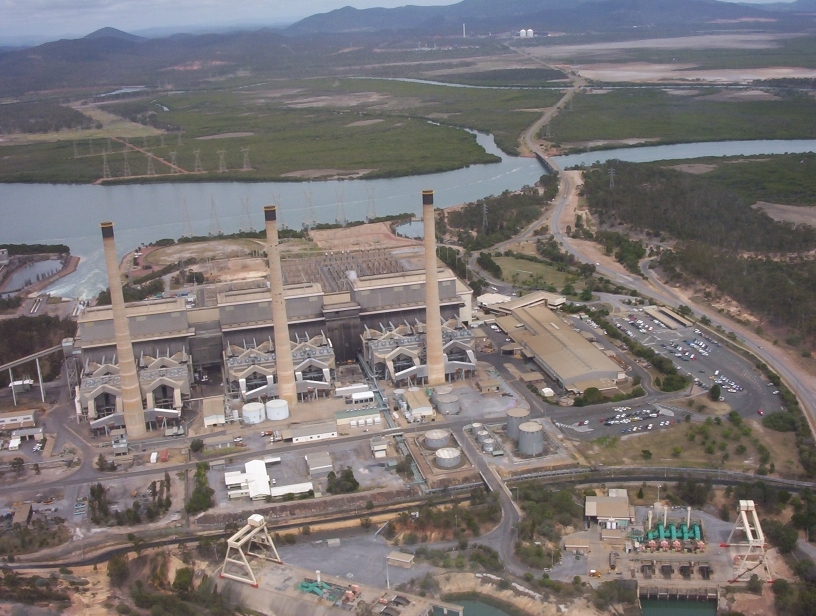
Gladstone Power Station. Credit: Wikipedia, under Creative Commons licence CC BY-SA 3.0.
One of Australia’s biggest coal-fired power plants plans to close six years earlier than previously announced.
The Gladstone Power Station will potentially retire when existing supplies and operational arrangements expire in March 2029, “although no final decision has been made,” majority shareholder Rio Tinto Plc said in a statement on Wednesday. The facility, operated by Houston-based NRG Energy Inc., had been slated to close in 2035.
Gladstone started operating in 1976 and is the largest power plant in Queensland state, representing more than 7% of Australia’s coal-generation capacity at 1,680 megawatts. Each year, approximately 4 million metric tons of coal are railed to the site from coalfields in the state.
The announcement comes weeks after Australia pledged to cut greenhouse gas emissions within a range of 62% to 70% by 2035, from 2005 levels. That fell short of BloombergNEF’s assessment that the country must slash emissions by 71% in the next decade to be aligned with a credible pathway to net zero by mid-century.
Gladstone’s owners will engage with the energy market and on options for the future use of the site, which will inform the timeline and strategy for retirement of the facility, according to the statement. Existing power supply contracts, including to Boyne Smelters Ltd, will remain in place until its closure, it said.
“Private investors are getting out of coal, because it’s clear that renewable power backed by batteries makes economic sense,” said Ben McLeod, economist and senior adviser to the Climate Council, an advocacy group.
Australia’s aging coal fleet still forms the backbone of power generation but is mostly expected to close over the next 10 years. It has been hit by increasingly frequent outages, adding to market volatility. Coal was more expensive to run in Australia than solar, wind and combined-cycle gas turbines in the second half of 2024, BloombergNEF data show.
Rio Tinto owns a 42.125% stake in Gladstone, while an NRG unit owns 37.5%. The other shareholders are Southern Cross GPS Pty, Ryowa II GPS Pty and YKK GPS Pty.
(By Keira Wright)
Massive Houthi Drone Seizure Reported in Aden by Yemeni Opposition Faction
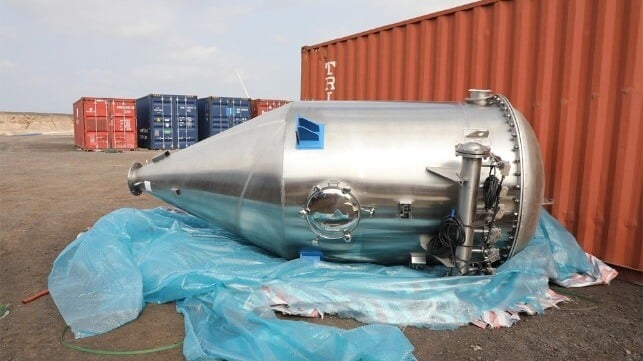
Some of the material seized from the containers (Southern Transitional Council)
A massive seizure of drones and other military equipment apparently bound for the Houthis has been reported by an opposition faction known as the Southern Transitional Council. The faction, which is backed by the United Arab Emirates and is active in southern Yemen, reports it discovered 58 containers in the port of Aden carrying drones and components and weighing a total of 2,500 tons.
In a statement issued on October 2 in Aden by the spokesman, Lieutenant Colonel Mohammed Al Naqib, they report the equipment was being unloaded from a commercial vessel arriving from Djibouti, which had been diverted to Aden because of damage to port facilities in Hodeidah. Details of when the seizure occurred, and from what ship or ships, are unclear, but the goods seized, from the limited imagery published, are of Chinese origin, disguised as ordinary cargo.
The consignment is listed to have included “drones and their launch platforms, drone production machine tools and lathes, spare parts for various light and medium weapons, wireless communication devices, jet engines, surveillance, espionage, and jamming devices and electronic chipboards used in drone control systems.”
Also seized were large quantities of materials used for the manufacture of drones, including carbon fiber, insulation materials, sheet metals, and raw plastics, as well as components needed for the manufacture of target acquisition sensors, communications devices, and anti-jamming equipment.
The whole consignment comprises all the parts, materials, and machine tools necessary to establish a production line both for drones and for their command and control systems. It is likely that the consignment was ordered and dispatched to replace or augment production facilities which have been destroyed in previous Israeli and American air raids, for example, in the successive U.S. and British air raids on the Hubayshi drone factory south of Sanaa in March and April.
The Hubayshi drone factory at 15.155087N 44.257652E was damaged in an RAF attack on April 29 (Google Earth/CJRC)
The group reported the discoveries were made during routine customs inspection of cargo in the Aden Port Free Zone, and apparently were not based on detailed intelligence. The seizures do, however, appear to be additional to those made by the Counter-Terrorism Service in Aden on August 2. On this earlier occasion, drone equipment had been packed into five containers declared to be holding car parts, which had been unloaded from a ship arriving directly from China.
U.S. Central Command also reported in July that the Yemeni forces in opposition to the Houthis made their largest ever seizure of Iranian weapons bound for the Houthis. In total, the U.S. said that over 750 tons of munitions and hardware were intercepted inbound aboard a dhow.
Port of Los Angeles Seeks Proposal for Potential New Container Terminal
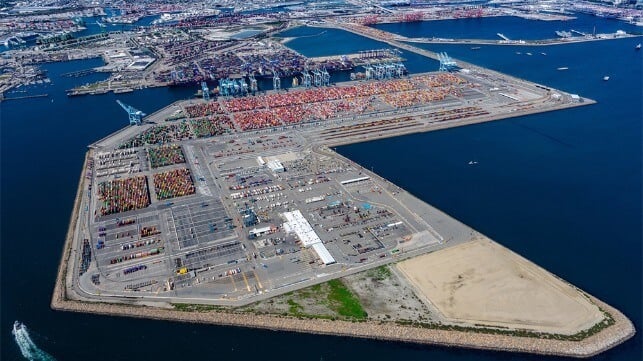
Pier 500 would be the south of the largest terminal, Pier 400, and use existing assets (Port of Los Angeles)
The Port of Los Angeles has started the first public steps in what could be a decade’s decade-long effort to develop its next container terminal. The port published a Request for Proposal from interested parties to participate in the pre-development of the new terminal known as Pier 500.
Proposals are due by January 29, 2026, and they expect to select an entry to enter into a public-private pre-development agreement. The goal is to scope the project’s financial feasibility, procure entitlements, and handle other requirements needed before the project is implemented, and the build-out could begin.
The Port of Los Angeles currently has seven major container terminals and six intermodal rail yards for the handling of containers. It is generally the busiest container port in the United States, mostly rivaled by neighboring Long Beach, and from time to time, the Port of New York and New Jersey. Los Angeles peaked in 2021 at 10.7 million TEU and again at nearly 10.3 million in 2024. Despite the trade uncertainties, the port was approximately 4.5 percent ahead of last year as of the end of August, having handled more than 6.9 million TEU, although volumes were expected to decline in the fall. On a monthly basis, the port has twice exceeded 1 million TEU, in May 2021 and again in July 2025.
“For the first time in a generation, the Port of Los Angeles plans to build a new container terminal to meet global supply chain demand for decades into the future,” said Port of Los Angeles Executive Director Gene Seroka. “The development of the cleanest terminal possible would enhance our efficiency and sustainability while creating new jobs in our communities.”
Located in natural deep water on the southern tip of the port’s Terminal Island, Seroka says the project site would greatly increase port cargo efficiency, as it would allow for bigger, next generation cargo ships. Carriers have so far reserved the 24,000-plus TEU ultra-large container vessels for routes to Europe, but Los Angeles has handled a few ULCCs, although generally the routes see the sub-20,000 TEU large vessels.
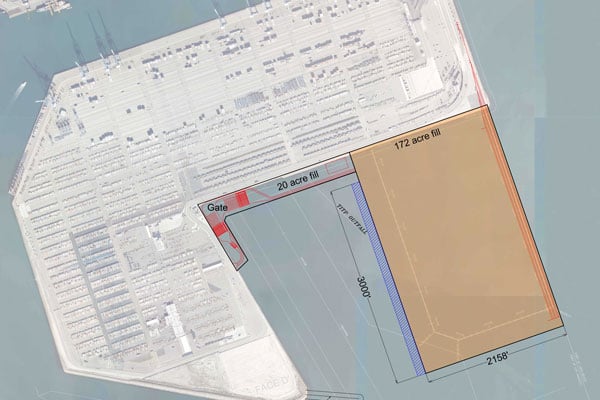
Rendering of the proposed area for the Pier 500 terminal (Port of Los Angeles)
As proposed, Pier 500 would be a 200-acre site with two new berths and approximately 3,000 linear feet of new available wharf along the Pier 400 Channel. The proposed Pier 500 project would allow the Port to leverage existing available space. The port identified a submerged site of 124 acres, infrastructure that was added during the construction of the adjacent Pier 400 before it was completed in 2002, which would now be used to create Pier 500.
Pier 400, the site of APM Terminal, opened in August 2002, is currently the largest container terminal at the port. APM highlights it has a capacity of 4.4 million TEU and five berths with a total of 507 acres and 19 super post-Panamax ship-to-shore cranes. Pier 400 is the largest container port terminal in the Western Hemisphere.
The pre-development process for Pier 500 will include all necessary environmental assessments as required under the California Environmental Quality Act and the National Environmental Policy Act (NEPA). The entire proposed Pier 500 project—from pre-development, entitlement procurement, and environmental review to full build-out and operation—is expected to take approximately 10 years.
New York Launches Next Phase of Revitalization for Brooklyn Marine Terminal
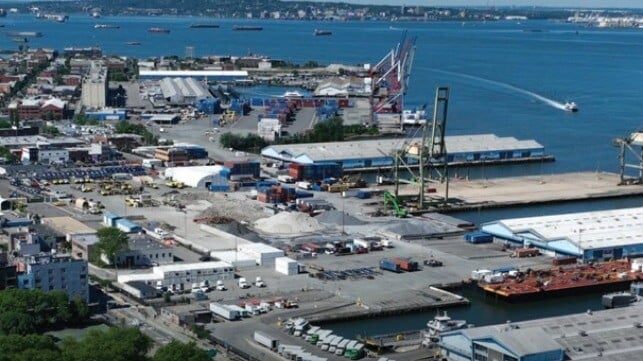
NYCEDC is seeking interest from a possible operator/developer and tenants as it work to revitalize the Brooklyn Marine Terminal (NYCEDC)
New York is moving forward with its plan to expand port operations through the revitalization of the Brooklyn Marine Terminal (BMT). Once a key part of the operations, the plan seeks to end 50 years of disinvestment and decay while supporting the transformation of the area into a modern maritime port and vibrant mixed-use community.
The New York City Economic Development Corporation (NYCEDC) assumed operational control of BMT in May 2024 from the Port Authority of New York and New Jersey, which has overseen the port and regional transportation for more than a century. The City and State of New York announced a $95 million plan to enhance maritime operations on the Brooklyn waterfront in 2024, focusing on BMT, which encompasses 122 acres of the waterfront in a neighborhood known as Red Hook and includes one of the current cruise terminals in the port. The city announced an initial $80 million investment that would be used to stabilize and repair Piers 7, 8, and 10, and to fund the planning for the waterfront.
NYCEDC has launched a Request for Expression of Interest to solicit proposals from domestic and international port operators, developers, and maritime industrial businesses. The companies have till December 15 to submit their comments as the city seeks input on the optimal size, layout, and economically viable uses of the commercial port.
The RFEI is part of the Vision Plan previously approved for BMT that is backed by $418 million in city, state, and federal funds. The funds will be used to transform the dilapidated marine terminal into a 60-acre, all-electric maritime port.
NYCEDC is seeking comments from those interested in acting as the operator/developer of the entire port facility or interested in a portion of the property. They can become a tenant of the port operator.
The Economic Development Corporation has already commenced work to improve the port. Earlier this year, NYCEDC executed three maritime contracts totaling an initial $18 million, including $15 million for a new electric ship-to-shore crane, $2 million for fender repairs to Pier 10, and $1 million for the demolition and removal of four out-of-service cranes. Demolition and removal of the four out-of-service cranes was completed in September.
The Brooklyn waterfront has seen revitalized interest in the past few years. Construction began in 2024 for the planned wind port facility at the South Brooklyn Marine Terminal. The 73-acre site is being revitalized into what was billed as one of the nation’s largest dedicated offshore wind ports. It will be used to support Empire Wind 1, which is being developed by Equinor.
This next phase of the port development is proceeding as a new economic impact study was released by the Shipping Association of New York and New Jersey. It highlights that the Port of New York and New Jersey is the largest container operation on the East Coast and the third largest port in the United States. At times, it has surpassed the volumes of either Los Angeles or Long Beach. NY/NJ has a current capacity of nearly 8.7 million TEU and handles over 410,000 vehicles as well as nearly 68,000 tons of breakbulk and 36.1 million tons of bulk cargo. It is also a strong cruise port handling nearly 2.4 million passengers, mostly in a season trade.
The report finds that the port supports a total of nearly 580,000 jobs, including 277,800 workers directly employed in the port industry. The Port of New York and New Jersey accounted for $18.1 billion in tax revenue in 2024.
Port of Long Beach Icon Mario Cordero is Set to Retire
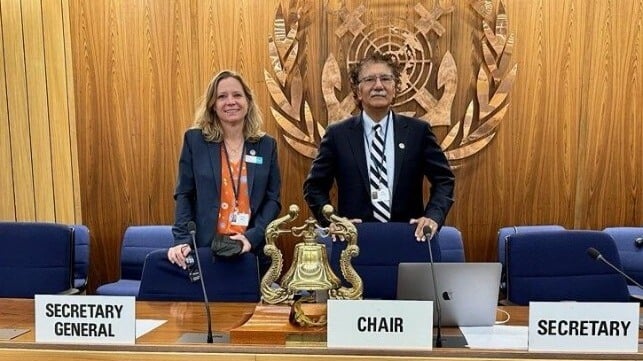
An advocate for clean shipping at home and abroad, Cordero - seen here at IMO with his environment director Heather Tomley - supported emissions reductions throughout his career (Courtesy Mario Cordero)
Port of Long Beach's longtime CEO, Mario Cordero, plans to retire at the end of 2025, his office announced Thursday.
Cordero has been at the helm at Long Beach for more than eight years, including some of the most challenging and rewarding periods in its history. During the COVID-19 era, container volumes collapsed, then rebounded to record levels - putting strain on America's gateway ports to adjust to changing demand.
"His calm and reassuring manner was a great source of strength for the workforce, industry and community before, during and after the global pandemic,” said Long Beach Harbor Commission President Frank Colonna in a statement. “He will be missed at the port, but I’m very happy for him to soon begin enjoying his well-deserved retirement.”
Cordero was born in Los Angeles to immigrant parents, and was first in his family to attend college. He became a lawyer, and practiced law for three decades. In 2003 he was appointed to the Board of Harbor Commissioners, and served on it for two terms, including time as its president. Early in his tenure, he proposed the port's landmark Green Ports Policy, a commitment to environmental protection that was adopted in 2005 and has guided decisionmaking for two decades. Since its enactment, the port has cut all three major health-related pollutant categories (NOx, SOx and PM).
In 2011, then-President Barack Obama appointed Cordero to serve on the Federal Maritime Commission; Cordero took on the role of FMC chairman from 2013-17, until the first Trump administration. That year, he returned to Long Beach to become the port's new CEO, at the request of the board of harbor commissioners.
A prominent figure in the North American ports industry, Cordero leaves behind a legacy of decades of service to maritime commerce. "He has guided one of the world’s busiest seaports through unprecedented times with vision and steady leadership, always keeping people and community at the center. Mario is a true Long Beach public servant, and his impact will be felt for generations to come," said Long Beach Mayor Rex Richardson in a statement.
The board of harbor commissioners is still considering its options for a new CEO and expects that the process will take months.
“I could not be more grateful for what has been the opportunity of a lifetime to lead the Port of Long Beach over these past several years. While I’ll miss being in the center of the action for international trade, I know that I’m leaving the Port in the very capable hands of our Board of Harbor Commissioners and the exemplary staff,” said Cordero. “It’s been a very rewarding experience and I have amassed wonderful memories that I will cherish forever.”
Austal and US Navy Revise Contract in Program Building First Steel Ships
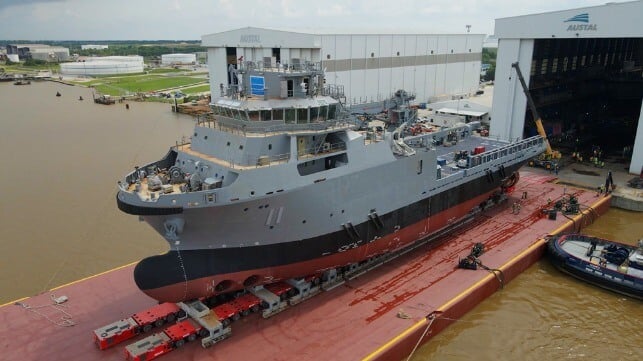
First vessel of the class was floated out in June 2025 (Austal)
Austal and the U.S. Navy reached an agreement to resolve a pricing issue related to the first steel hull ships Austal USA is building for the Navy. Nearly a year after the company filed a “Request for Equitable Adjustment,” it reports that they have agreed to build only three of the five contracted ships with limited alteration to the overall original contract value.
The program for the vessels known as T-ATS (Towing, Salvage, and Rescue Ship) was originally awarded to Austal in September 2021 and was largely seen as a trial for the builder, which had worked in aluminum to convert to the Navy’s plan to move back to entirely steel construction. The initial contract was for two vessels valued at $145 million and followed an initial $3.6 million for the functional design of the class.
Austal noted at the time that it was seeking other steel construction projects and won support from the U.S. Navy for the construction of its new steel capabilities in Mobile, Alabama. The U.S. Navy expanded the project with two more hulls in July 2022, adding $156 million to the contract price. A fifth vessel was added to the contract in June 2023 at an additional $79 million. The total project was valued at approximately $380 million.
The shipbuilder reports it had been in discussions with the U.S. Navy for an adjustment due to the additional costs incurred in the program. It says the program “experienced significant challenges, primarily due to late receipt of technical data and design discrepancies.”
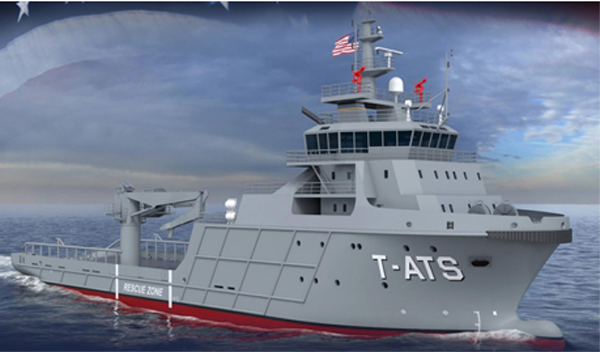
Rendering of the new class which is Austal USA's first steel ships (Austal)
The T-ATS is an ocean-going tug, salvage, and rescue ship designed to support the United States Navy’s fleet operations, with a multi-mission common hull platform capable of towing heavy ships. The ships are designed to support a variety of missions, including oil spill response, humanitarian assistance, search and rescue, and surveillance.
Work began on the program in July 2022. The first vessel, named USNS Billy Frank Jr., was floated out in Alabama in June 2025.
While work was proceeding with the program, Austal and the USN had agreed to suspend work on vessels T-ATS 14 and T-ATS 15, the last two of the five-ship order. As part of the new agreement with the Navy, those two hulls are being canceled. The company reports it does not expect a material financial impact on its business.
T-ATS 11, Billy Frank Jr., is being prepared for its prepare for her next major milestone, the engine light off, as she gets ready for sea trials and delivery.
While it is the first steel construction for Austal, the prize was a $3 billion contract for seven ocean surveillance ships for the U.S. Navy awarded in 2023. In addition, after committing to its steel capability, Austal also received a contract for the Navy’s Auxiliary Floating Drydock Medium (AFDM) and, in a contested decision, Austal beat out Eastern Shipbuilding to secure follow-on hulls for the U.S. Coast Guard Offshore Patrol Cutter (OPC) program.
Senate Confirms Hung Cao as Undersecretary of the Navy
IRONY;HE'S ANTI-D.E.I.
Post has been filled in an acting capacity since last year
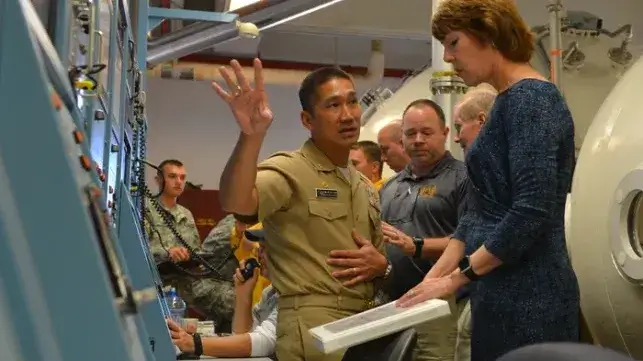
Then-Cmdr. Hung Cao (center) when he served as commanding officer of the Naval Diving and Salvage Training Center, 2015 (USN file image)
The U.S. Senate has confirmed Capt. Hung Cao (USN, ret'd) as the next Undersecretary of the Navy.
Cao, the son of a high-ranking South Vietnamese official, came to the U.S. as a refugee after the end of the Vietnam War. He attended Annapolis and commissioned as a special operations officer in 1996, working his way up through the ranks in deployments overseas during the wars in Iraq and Afghanistan.
After retiring at the rank of captain in 2021, he mounted two campaigns for elected office in Virginia as a Republican candidate, with President Donald Trump's endorsement. Both were both unsuccessful.
The undersecretary's role is powerful, responsible for the day-to-day affairs of the department as the Navy's chief operating officer and chief management officer. Cao faces serious challenges ahead, including cost overruns and delays in shipbuilding, rising Chinese pressure in the Strait of Taiwan and South China Sea, and the need to operationalize unmanned technology to maintain the Navy's edge.
Cao, an outspoken opponent of diversity, equity and inclusion (DEI) initiatives, is aligned well with Defense Secretary Pete Hegseth's policies for the defense establishment. He also has strong ties to the White House, having campaigned with the president in the 2024 election cycle. Politico Pro reports that Cao's new supervisor, Navy Secretary John Phelan, has taken steps to contain Cao's potentially significant sway: By reassigning aides, routing correspondence through Phelan's chief of staff, and vetting any new hires for Cao's office, they hope to limit the undersecretary's reach to policy implementation rather than policymaking - maximizing control at the level of the secretary's office, Politico's sources reported.
U.S. Navy Exceeds Recruiting Goals for FY2025
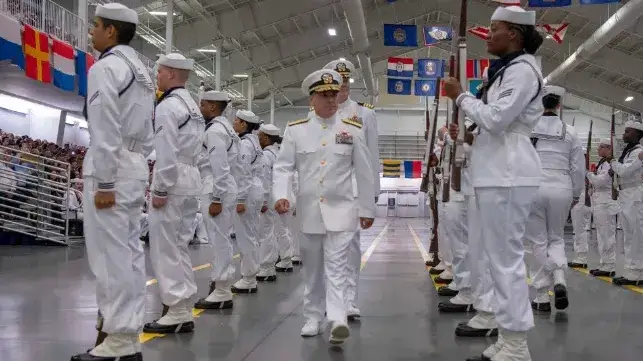
Rear Adm. Michael Richman, Deputy Director, Regional Strike Systems, Strategic Systems Programs, (center) inspects the Honor Guard during pass-in-review onboard U.S. Navy Recruit Training Command in Great Lakes (USN)
The U.S. Navy has exceeded its recruiting goals for FY2025, the service announced Wednesday - a clear sign of a turnaround after the doldrums of 2023.
After missing its targets by 20 percent in FY2023, the Navy made an all-out push to make it easier and faster to sign up and enlist. It reduced its minimum acceptable score on the Armed Forces Qualification Test to the lowest level allowable by law (subject to conditions), and increased the maximum recruit age to 41, the oldest it can accept without new permission from Congress. A new preparatory program for recruits who did not meet test standards or physical fitness requirements further broadened the applicant pool, making the opportunities of a Navy career accessible to people who would not qualify at the time of first contact with a recruiter.
The service also aimed for speed. It hammered out ways to get medical waivers and tattoo approvals done more quickly, since (in a hot employment market) applicants would often take another job if they had to wait weeks for an answer. Tattoo reviews now take less than three days, down from 30 days, according to Navy Times.
To get at the problem of processing speed, the service tripled the number of office staff assigned to perform medical reviews. It also pushed successfully for faster operations at regional Military Entrance Processing Stations, where future servicemembers go for aptitude testing and medical evaluation.
All of these policy changes - plus 100% manning in front-line recruiter roles, and a cooling private-sector job market - have added up to better numbers for recruits in the door. In FY2025, the Navy brought in more than 44,000 future sailors, more than in any year in the last two decades.
“Culture drives outcomes,” said Rear Adm. James Waters, Commander, Navy Recruiting Command. “We’ve shown what’s possible when we adapt, move fast, and stay accountable. Every recruiter in the field can take pride in knowing they played a direct role in strengthening our Navy and our nation.”
The topline number is big, and big enough to allow the Navy the flexibility to be more selective than it appears on paper. It isn't using its low-test-score applicant pool as much as it might have planned, and is now taking recruits only at the 26th percentile of performers and above.
Other service branches are also seeing good numbers: the Army met its FY2025 goal four months ahead of schedule, the Air Force has reported exceptionally strong monthly recruitment, and the Marine Corps met its annual target without difficulty.
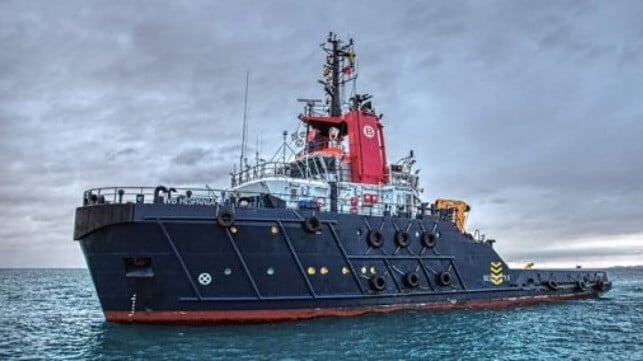
The Spanish-based Boluda Towage continues its aggressive path of acquisitions to consolidate the towages and global expansion with the acquisition of operations in Australia and Papua New Guinea from Royal Boskalis. The company highlights that the latest deal expands its presence to five continents and consolidates its operations in Asia.
The group reports it has acquired the $600 million towage operation based in Australia and Papua New Guinea from Royal Boskalis. It adds 39 modern and versatile tugs to the Boluda fleet and more than 400 professionals, including seafarers and shore personnel. With regional headquarters in Sydney, Australia, the operation serves nine key ports, including the ports of Weipa, Townsville, Mackay, Gladstone, Brisbane, Newcastle, Botany, Melbourne, and Papua New Guinea.
The acquisition reportedly strengthens Boluda’s role in the export of essential commodities for the energy, technology, and steel industries worldwide. Vicente Boluda Ceballos, President of Boluda Towage, also notes that the company aims to support the development and improvement of port infrastructure wherever it operates.
Boluda currently has operations in Hong Kong, Singapore, Malaysia, and Timor-Leste. With this latest acquisition, Boluda says it has now extended its capacity to 232 ports and a workforce of 10,000 people. They said it consolidates the company as the world’s largest towage operator with a total fleet of over 850 vessels.
The acquisition spree has seen Boluda acquire the German towage companies of Unterweder Reederei and Lutgens & Reimers in 2017, as well as Kotug Smit Towage from Boskalis, the harbor and offshore activities of Iskes Towage & Salvage, and Caledonian Towage of Scotland. More recently, it also made acquisitions in France, the UK, Gibraltar, and Finland, but the deal to acquire Smit Lamnalco collapsed when Royal Boskalis acquired the remaining 50 percent in the joint venture in 2024.
Boskalis in 2019 had announced that it planned to divest its worldwide harbor towage activities. It sold its interest in towage companies in Europe, Central and South America, and Singapore.
Maersk Pursues Refits of Chartered Fleet to Reduce Costs and Emissions
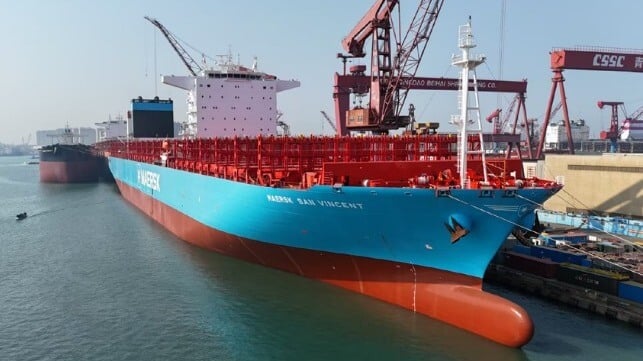
Maersk will complete over 2,500 individual projects on chatered vessels to improve financial performance by lowering fuel costs and emissions (Maersk)
Maersk reports it has passed the halfway mark on an ambitious program of refits designed to reduce fuel and operating costs as well as emissions for its fleet of chartered containerships. The carrier calls it a “win-win model” where it benefits from the improved economics of the vessel’s current operations, and the owners get the long-term value of a modernized vessel.
To date. Maersk reports working with its time-charter partners, more than 1,500 individual projects have been implemented across 200 vessels with 50 shipowners. An additional 1,000 projects are in process and scheduled to be finalized by 2027. The investment cost for the projects is split between Maersk and the vessel owners.
“Our medium- and long-term chartered fleet makes up a significant proportion of our operations as well as of our total fuel consumption,” explains Ahmed Hassan, Head of Asset Strategy and Strategic Partnerships at Maersk. “By working closely with our partners, we aim to implement solutions that not only reduce emissions but also enhance the overall competitiveness of our fleet.”
More than half the vessels operated currently by Maersk are on charter, according to data from Alphaliner. The company has a total of 736 containers, of which 392are chartered.
Maersk explains that many of the vessels were designed to operate at faster speeds than the industry maintains today. Also, developments have permitted some ships to increase the rated capacity for containers.
Among the projects being carried out are significant changes to the vessel configuration with the replacement of the propeller or bulbous bow from the original designs for higher speeds. Maersk says the integration of an optimally designed bulbous bow reshapes water flow around the hull to reduce drag and enhance hydrodynamic efficiency. The propeller replacement is combined with Pre-Swirl Devices that assist in maximizing thrust while minimizing energy loss.
Other retrofit projects include elements such as auxiliary engine waste heat recovery systems that allow steam production from auxiliary engine heat, reducing the reliance on fuel-oil-fired boilers. Similarly, the installation of shaft generator systems cuts down auxiliary engine usage.
Cargo-carrying capacity is being enhanced through a range of structural and technical improvements. This can include elevating the wheelhouse to improve line of sight and increase intake, raising the lashing bridges, strengthening the vessel’s deadweight capacity for deeper drafts, or upgrading both lashing systems and loading computer functionalities.
The projects are part of Maersk’s overall goal to reduce absolute scope 1 greenhouse gas emissions by 35 percent by 2030, compared to the 2022 baseline. Last year, the company reported it would be building new vessels as a replacement for some of the oldest ships in its fleet, as well as the adoption of alternative fuels for newbuilds.
Maersk also undertook the first conversion to dual-fuel methanol capabilities of a large containership. The project for the conversion of the Maersk Halifax was completed in 2024, and also included a nearly five percent increase in container capacity. The company has said it would explore the conversion of sister ships from this 15,000 TEU class.
Hapag-Lloyd, working with vessel owner Seaspan, announced a similar program to refit up to 60 of the Seaspan-owned containerships. The program was designed to prepare the vessels for methanol fuel operations. It has also been changing propellers on its owned fleet and other adjustment to improve operating efficiency.
ANOTHER TRUMP TAX
USTR Fees Could Cost Top 10 Carriers $3.2B in 2026, says Alphaliner
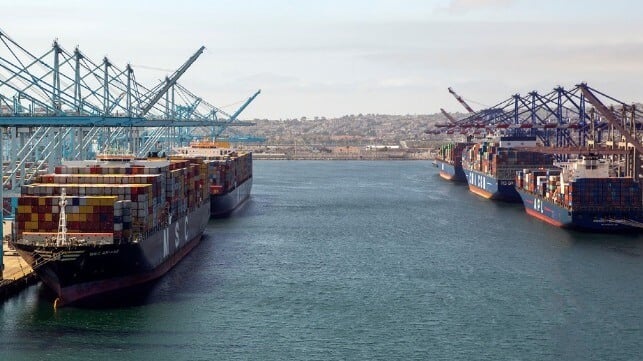
The largest container carriers are facing substantial fees in the U.S. unless they redeploy highlights Alphaliner (Port of Los Angeles file photo)
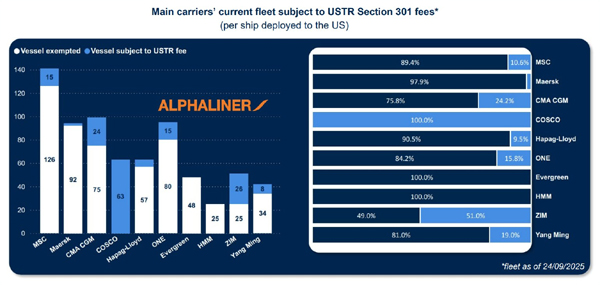
There continues to be a lot of speculation in the industry over the full extent of the looming U.S. port fees for Chinese-owned, operated, or built vessels calling at U.S. ports. Industry analyst Alphaliner presented a potentially worst-case scenario based on current deployments that shows the 10 largest container carriers could be confronted with approximately $3.2 billion in fees in 2026 to the U.S., if the USTR program proceeds as planned.
The U.S. Trade Representative published its fee schedule in April, but it was put on hold for six months to give the industry time to prepare and time for revisions based on feedback. Experts highlight that the USTR and U.S. Customs and Border Protection have promised additional guidance to the industry, which is yet to be released, and the deadline is looming, set for October 14. Details on the payment mechanism and other aspects remain unclear, as is what impact the closing overnight of the U.S. federal government due to a budget dispute could have on the rollout of the fee program.
Alphaliner calculates, however, that the main container carriers could be subjected to $3.2 billion in fees in 2026 as the U.S. seeks to “reverse Chinese dominance” on the shipping industry and to “restore American shipbuilding.” However, it also points out that the impact could vary greatly on the individual carriers before they work to decrease the impact by shifting vessel deployments and other mitigation steps.
The fees, as defined in April 2025, target vessels owned or operated by Chinese companies. (The exact definition of a “Chinese company” based on the level of investment is one of the issues that the industry is seeking further clarity from USTR.) These vessels will face a flat fee of $80 per net ton per voyage with a maximum of five fees per year.
China’s COSCO Group, which operates both COSCO and OOCL vessels, however, is clearly the one to receive the greatest impact. Alphaliner calculates it would incur more than half the fees generated under the USTR program, or a likely total of $1.53 billion in 2026.
The second category in the USTR program is for vessels built in China, which nearly all the major carriers have, and are operated by any foreign-owned company. These fees apply both to owned vessels and those chartered by the major carriers. The fee is set at the higher of either $23 per net ton or $154 per TEU capacity, again with a maximum of five fees per year. The World Shipping Council, in its comments to the USTR, argued against using net tonnage, saying that it would disproportionately penalize larger, more efficient vessels that deliver essential goods, including components used in U.S. production lines.
While most of the carriers have said they are working to switch deployments to reduce the impact of the fees, Alphaliner concludes based on current deployments, Maersk and Hapag-Lloyd are the best positioned of the large carriers. Maersk, it says, would “only” be charged $17.5 million and Hapag $105 million, which also benefits the two companies’ Gemini Cooperation.
Reflecting a large number of vessels chartered from Chinese owners, carriers Zim, Ocean Network Express (ONE), and CMA CGM will likely be treated as Chinese-owned ships and incur the higher fees. Alphaliner calculates Zim will feel it the most with $510 million, while ONE has $363 million of exposure, and CMA CGM could incur $335 million in fees.
Other large carriers fall into the category of non-Chinese owned containerships, that however were built at Chinese yards. MSC Mediterranean Shipping, for example, could face $73 million in fees due to its fleet being predominantly built in China. However, with a total fleet of nearly 1,000 ships (676 owned), it may well redeploy to reduce the fee. CMA CGM could incur an additional $50 million for its Chinese-built ships on U.S. routes and Yang Ming fees of $48 million, reports Alphaliner. A carrier such as Yang Ming with just 100 ships is at a disadvantage to redeploy versus the larger MSC or CMA CGM.
Two carriers on the list appear to be in the best position. South Korea’s HMM and Taiwan’s Evergreen, Alphaliner says, have no vessels that will be subjected to the U.S. fees.
Despite the looming fees, the major carriers have continued to place orders for new vessels with Chinese shipbuilders. Some shipbuilder orders, however, have reportedly been shifted to South Korean yards.
Jan De Nul Offers Subsea Cable Protection for an Era of New Security Risks
In response to concerns about the vulnerability of subsea cables in an era of "hybrid warfare," the marine construction experts at Jan De Nul have a solution: protect them. Industry already has methods to protect subsea installations against scouring or stray trawler nets, and the same techniques could be applied to defend cables from hostile divers, robotic subs and ship anchors.
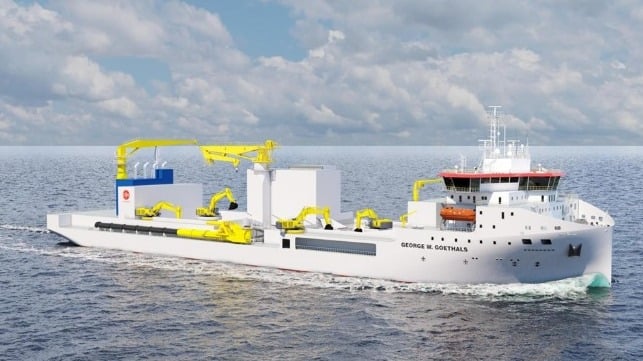
Jan De Nul has ordered a new rock-dumping ship that is designed to respond to the needs of infrastructure owners in the North Sea and Southeast Asia, where offshore wind power is expanding. The vessel is designed to protect cables, pipelines and other undersea structures by installing a heavy rock cover layer.
Named the George W. Goethals, the vessel has a capacity of up to 37,000 tonnes and comes with a flexible vertical fall pipe and an inclined fall pipe system. As equipped, she will be able to install extra-large rocks to water depths of up to 400 meters - well within scope for bottom-fixed offshore wind farms and most North Sea and Baltic Sea cables routes.
The Goethals will run on biofuel and green methanol, which significantly reduces CO? emissions. A hybrid power plant also guarantees efficient fuel usage. The vessel will be equipped with four electric excavators for loading large size rocks, without a conveyor belt or crane on shore.
“Decades of hands-on experience have given us deep expertise in subsea rock installation. We have applied this knowledge throughout the vessel’s design. The collective capacity of our subsea rock installation fleet now surges beyond 100,000 tonnes. This investment will strengthen our leading position in the industry,” said Philippe Hutse, Jan De Nul Directeur Offshore Energy.
Apart from the new rock installation vessel, the company is also building two extra-large cable-laying vessels that will have a cable-carrying capacity of 28,000 tonnes, which is more than any other vessel currently on the market. The two cable-layers - named Fleeming Jenkin and William Thomson - are designed to install cables over longer distances with fewer subsea connections, making them ideal for interconnector cables that link energy grids across the globe.
10 Years Later, Mariners Remember the Loss of the El Faro
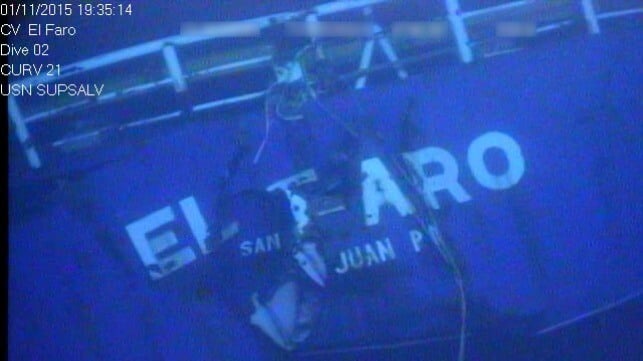
The wreck of the El Faro on the bottom, 2015 (U.S. Navy)
It has been 10 years since the con/ro steamship SS El Faro went down with all hands in a hurricane, and it remains one of the deadliest maritime disasters in recent American history. 33 mariners lost their life in the sinking, and the victims' memory is preserved at memorial sites in Maine and in Florida, as well as annual remembrance ceremonies.
While El Faro was under way from Jacksonville to San Juan, Puerto Rico, her master put her on a course that would take her past the Bahamas and into the path of a strengthening hurricane. As weather conditions worsened, she took on water in a cargo hold and developed a list, leading to loss of lube oil suction for her steam turbine. El Faro lost propulsion and drifted beam to the seas, and flooding gradually overtook her. Within hours, she went down, in heaving seas and far from any aid. All 33 people aboard were killed, including 28 American mariners and a riding gang of five Polish workers.
A years-long inquiry identified human mistakes and oversight failures at the root of the disaster. The master was relying on delayed weather data, not the latest forecasts, and the Coast Guard concluded that he and his company did not fully understand the limits of El Faro's operating capabilities in heavy weather - limits that were reduced by a vessel conversion project in 2005-6. Poor bridge resource management, complacency and lack of training were identified as contributing human factors. Once in harm's way, the ship was overmatched by the extreme conditions near the eye of a Category 3 storm.
"The El Faro crew did not have adequate knowledge of the ship or ship’s systems to identify the sources of the flooding, nor did they have equipment or training to properly respond to the flooding," the Coast Guard determined. "Even though El Faro met applicable intact and damage stability standards . . . the vessel could not have survived uncontrolled flooding of even a single cargo hold given the extreme wind and sea conditions encountered in Hurricane Joaquin."
There were regulatory findings, too. After examining the inspection records of the El Faro and sister ship El Yunque - which was scrapped after significant wastage was found - the Coast Guard decided to take a close look at the Alternate Compliance Program (ACP), which allows certain class societies to perform statutory inspections of U.S. commercial vessels. The Coast Guard's inspectors found 660 deficiences aboard 52 ACP-enrolled ships, and they revoked the Certificate of Inspection (COI) for six vessels. Based on this pattern of issues, the service called for "seminal change in the overall management and execution of the [ACP]" in order to make sure that vessels enrolled in the program are safe. In response, the Coast Guard created a new Flag State Control Division at its Washington headquarters to oversee class society performance, and encouraged its front-line safety inspectors to provide more rigorous oversight.
The Coast Guard's board of investigation also recommended the elimination and replacement of all open lifeboats, like those aboard El Faro. Compared to modern enclosed lifeboats, the outmoded open boats have limited survivability in extreme weather conditions. Coast Guard leadership disagreed with this costly retrofit proposal, and a handful of aging vessels with open lifeboats remain in U.S. service today.
A day of remembrance
On Wednesday, multiple American maritime institutions and groups paused to reflect on El Faro's legacy and remember her crew. At Maine Maritime Academy, the alma mater of five El Faro victims, the campus held a ceremony to honor their legacy. “There’s still some healing going on,” Maine Maritime Academy President Craig Johnson told local Fox23.
Another gathering was held in the vessel's home port of Jacksonville, Florida. "The reading of the names and the ringing of the bell, which is very emotional, that was the hardest part," said Deb Roberts, mother of El Faro victim Michael Holland, speaking to WMTW.
“I want the world to know that my husband tried his best to save that vessel,” said Rochelle Hamm, wife of one of El Faro's crewmembers, speaking to News4Jax at the ceremony. “He did his job and he did it with dignity. So, I’m proud to be his wife.”