Friday, October 03, 2025


Trump’s new Israel-Palestine peace plan: The ‘Deal of the Millennium’ after the ‘Deal of the Century’
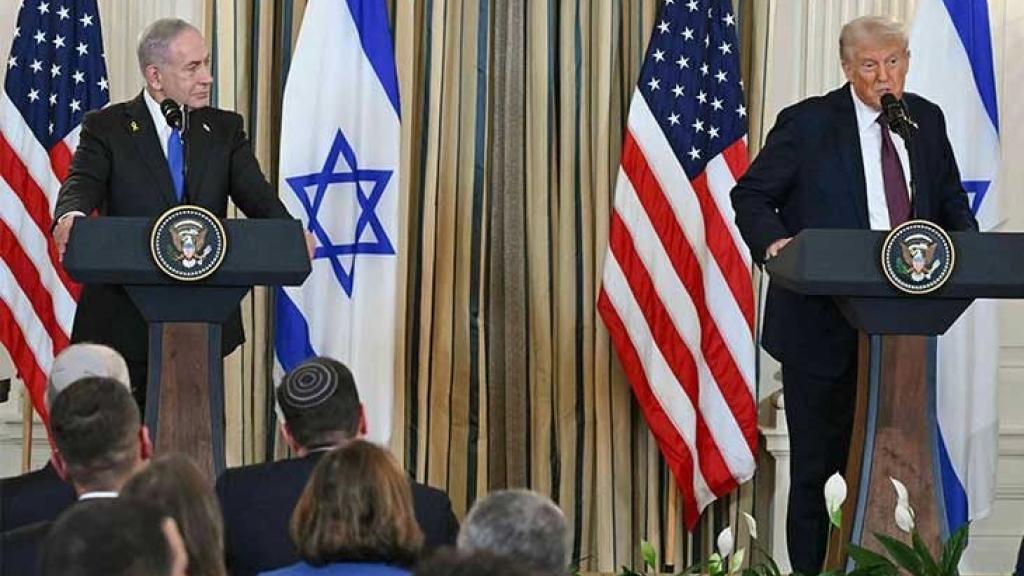
Netanyahu and Trump

First published in Arabic at Al-Quds al-Arabi. Translation from Gilbert Achcar's blog.

More than five years ago, on January 28, 2020, then-U.S. President Donald Trump unveiled his peace plan for Palestine at a White House ceremony attended by Israeli Prime Minister Benjamin Netanyahu. The plan was drafted by Trump’s son-in-law, Jared Kushner. During his election campaign, Trump had pledged to broker what he called the “Deal of the Century” between the Arabs and the State of Israel—a phrase Netanyahu echoed in his effusive praise of the U.S. president during the event.

Last Monday, Trump’s characteristic self-promotion and growing narcissism resurfaced as he described the announcement of the plan — co-authored by Kushner and former British Prime Minister Tony Blair — as “potentially one of the great days ever in civilization,” claiming it could resolve “things that have been going on for hundreds of years and thousands of years.”

The truth is that the latest “Millennium Deal,” like its predecessor, the “Deal of the Century,” will ultimately resolve nothing (see “Recognizing a Palestinian State Doesn’t Mean a Free Palestine,” Jacobin, September 25, 2025). In stating, “While Gaza redevelopment advances and when the PA reform program is faithfully carried out, the conditions may finally be in place for a credible pathway to Palestinian self-determination and statehood” (Point 19), the plan implicitly acknowledges that, in its current form, it is not grounded in the Palestinian people’s right to self-determination. Instead, it treats this right as a mere possibility (“may”). Indeed, Netanyahu wasted no time confirming in a post-announcement interview that he does not recognize this right, and that Israel “will forcibly resist it.”

This flawed foundation renders Trump’s new plan even less realistic than the one he unveiled five years ago. While the original “Deal of the Century” proposed the establishment of a State of Palestine comprising parts of the West Bank and the entire Gaza Strip, the new plan calls for the imposition of an international mandate over Gaza. This proposal echoes the colonial mandates established after World War I and is inspired by the international administration installed in Kosovo in 1999. It is precisely this precedent that explains former British Prime Minister Tony Blair’s involvement in the project to administer Gaza under Trump’s leadership. Blair played a central role in the Kosovo War and the subsequent decisions surrounding its governance.

While the plan calls for a gradual withdrawal of the Israeli army from Gaza, to be replaced by an “international stabilization force” (a name borrowed from the mission in Bosnia and Herzegovina), it specifies that the Israeli military will “progressively hand over the Gaza territory it occupies to the ISF according to an agreement they will make with the transitional authority, until they are withdrawn completely from Gaza, save for a security perimeter presence that will remain until Gaza is properly secure from any resurgent terror threat” (Point 16).

In other words, even if the plan is implemented exactly as intended, the Israeli military will retain control over a “security perimeter” carved approximately one kilometer deep into Gaza along the entire border with the Zionist state — an area stretching roughly 60 kilometers. Construction of this perimeter began at the outset of the Israeli invasion, clearly in anticipation of maintaining control over it following any broader withdrawal from the rest of the Strip.

Ultimately, even if Hamas accepts the Trump plan under pressure from Arab and Muslim governments that have endorsed it (the movement had not yet announced its position at the time of writing), and the “Deal of the Millenium” begins to be implemented, the path forward remains steep and perilous — and is likely to end in a complete deadlock. The plan would result in a permanent fait accompli, during which Israeli control over large parts of the Gaza Strip would be solidified. Israel would likely invoke the renewed “terror threat” — including even the most basic forms of resistance, which are bound to persist — as a pretext to maintain its occupation of much of Gaza, mirroring its long-standing occupation of the West Bank. That occupation has officially been considered “temporary” under international law for 58 years.

Palestinian Subordination: Donald Trump’s Gaza Peace Plan


He had moments of discomfort and embarrassment – pressed into calling the Qatari Prime Minister by his host to apologise for striking Doha and made to pay lip service to the prospect of a Palestinian state – but Israel’s Benjamin Netanyahu had many reasons to be pleased. On September 29, President Donald Trump advanced a peace proposal that essentially preserves Israeli pre-eminence regarding the fate of Palestinians, though it entails a cessation of hostilities, an affirmation that Gazans would not be expelled (those leaving would have the right to return), and an injunction against Israeli annexation of the Strip. But Hamas, militarily and politically, would have to surrender all claims, with the Palestinian Authority shepherded and supervised by foreign powers.

Trump’s peace proposal comprises twenty points. They include a “deradicalized terror-free zone”, Gaza’s redevelopment for the benefit of its people aided by “a panel of experts who have helped birth some of the thriving miracle cities in the Middle East”, and an immediate end to the war on its acceptance by the parties. Israel would withdraw to an agreed upon line in anticipation of a hostage release, during which all military operations would cease pending complete withdrawal. All hostages, dead and alive, would be returned within 72 hours, to be followed by the release of 250 Palestinian life sentence prisoners and Gazans detained since October 7, 2023.

Hamas and militant factions will forfeit any role in governing Gaza, with any offensive infrastructure and equipment destroyed, but any of its members wishing to commit to “peaceful co-existence” and decommissioning of weapons will be granted amnesty, with those wishing to leave given safe passage to receiving countries. Compliance by the militant group will be overseen by “regional partners”. Full aid would resume, with the UN and Red Crescent restored to their role as chief distributors.

On the issue of governance, a temporary technocratic “apolitical Palestinian committee” of qualified Palestinians and “international experts” would form a temporary transitional body, subject to a “Board of Peace” personally chaired by Trump. Most unfortunately, it is likely to include such figures as Sir Tony Blair, the Middle East’s typhoid Mary when it comes to peace. The transitional authority would hold the reins till reforms by the Palestinian Authority had been completed. With immediacy, however, the US would work with Arab and international partners to deploy an “International Stabilisation Force” to Gaza. The ISF will be responsible for training Palestinian police forces and provide support in terms of vetting recruits, with assistance from Jordan and Egypt.

The proposal clearly envisages a significant role for the ISF, though says about who will comprise it. Israel will not, under the plan, occupy or annex Gaza, surrendering what territory it has taken to the ISF. Even if Hamas were to delay or reject the proposal, the Israeli Defense Forces would still hand over occupied territory of “terror-free areas” to the stabilisation force but retain a security perimeter to stem “any resurgent terror threat.”

The plan also envisages the establishment of an interfaith dialogue to promote the values of peace between the parties, and a “credible pathway to Palestinian self-determination and statehood” if the programs for Gaza’s redevelopment and PA reform take place as planned. A vague US promise to “establish a dialogue” between Israel and the Palestinians regarding peaceful and prosperous co-existence rounds off the points.

There was palpable grumbling from the Israeli camp. Netanyahu undoubtedly harbours ambitions of finishing “the job”, and there is little to say the war will not resume once the Israeli hostages are returned. Having previously rejected any governing role of the Palestinian Authority in Gaza, he now reluctantly accepts the idea subject to a “radical and genuine overhaul” of the body.

Finance Minister Bezalel Smotrich, one of the right-wing heavies in the Israeli cabinet, is threatening to withdraw his Religious Zionist Party from the coalition. Agreeing with the plan had been “an act of wilful blindness that ignores every lesson of October 7.” It would only “end in tears.” Fellow zealot, National Security Minister Itamar Ben-Gvir, is also likely to be seething.

Opposition leader Yair Lapid is also suspicious of Netanyahu, who tends to say “yes” when visiting Washington, “standing in front of the cameras at the White house, feeling like a breakthrough statesman.” On returning to Israel, however, he always seemed to add a qualifying “but”, his political base always reminding him “who the boss is.”

In keeping with history, the Trump plan, even if it were to be implemented to the letter, enshrines the essential subordination of Palestinian goals to the dictates of other powers. Palestinian military presence is not only to be curtailed but essentially eliminated altogether. Hamas, never consulted regarding the peace terms, is to accept its own effacing. The PA is to accept its own subservience and infantilisation. The Gazans are also to accept an economic and development program dictated and directed from without. Statehood is to be kept in cold storage till appropriate, controlled conditions for its release are approved – and certainly not by the Palestinians themselves. They, it would seem, remain the considered errant children of international relations, mistrusted and requiring permanent, stern invigilation.

Binoy Kampmark was a Commonwealth Scholar at Selwyn College, Cambridge. He lectures at RMIT University, Melbourne. Email: bkampmark@gmail.comRead other articles by Binoy.


Is This a Horst Wessel Moment?


For several days, while Wessel lay critically wounded in a Berlin hospital, Goebbels issued daily health bulletins on his new hero. And since Ali Höhler belonged to a Communist street gang, Goebbels portrayed the gun battle as an infamous act of political terrorism. The Gauleiter wrote an emotional account of his visit to the hospital, and he quoted from the hero’s song: “Comrades shot dead by the Red front and Reaction march in spirit with our ranks!” When Horst Wessel finally died, Goebbels staged a tremendous funeral. “His song made him immortal,” Goebbels cried, and, echoing the line about the marching dead, he called out “Horst Wessel!” And the assembled Storm Troopers shouted: “Present!” Goebbels… said of the dead youth “…Come to me: I will redeem you.” Then everyone sang the “Horst Wessel Song,” which, after Goebbels had produced enough pamphlets and posters, was to become the Nazis’ official anthem.

— Before the Deluge, Otto Friedrich (1972)

The murder or assassination of Charlie Kirk has become an event threatening to radically reshape the political landscape, with the MAGA right exploiting Kirk’s violent death occurring at an outdoor event at a Utah university.

Immediately after Kirk’s demise a storm of controversy arose over its meaning. For most US citizens, Kirk was not a well known figure. As with other instances of political violence, the fact that attacks are growing in frequency draws more concern, more discussion than an identification with the victim.

But with the elites of the right and their media servants, Kirk was a rising star, a charismatic youth leader poised for future greatness. He was credited with bringing young people into the MAGA movement, though polls still show young people leaning more and more left. With a dysfunctional Democratic Party, his role was to herd dissatisfaction rightward, especially with college students. His death has elevated him into a martyr of the MAGA cause. He has been canonized in ruling MAGA circles.

For their most prominent political foes — the liberal elites and their covey of pundits — Kirk was a dangerous character, especially on social and lifestyle conversations that obsess them. They recognize that he was good at selecting lightning rod issues that challenge liberals. He was not such an easy target with centrists as Trump, since Kirk offered a self-confident, reasonable style that separated him from Trump’s bombast and arrogance.

While fear was central to his message, it was buffered by a nostalgia for an imagined earlier time when everyone got along, worshiped the same God, and basked in patriotic light. Kirk sought to hide the racism and sexism that flowed freely beneath the surface with denial and artfulness.

In short, Charlie Kirk was a MAGA con man, in a political universe filled with con artists and wannabee con artists.

In the aftermath, MAGA hucksters have manufactured a remarkable narrative that has elevated Kirk to a national status that he never earned; they have constructed an elaborate network of blame that links everything and every one who stood in opposition to MAGA to Kirk’s murder; and they have frightened easily frightened liberals into condoling Kirk’s death and attesting to his great “human” worth.

 But most disgustingly, MAGA shock troops established an atmosphere so thick with fear that virtually ANYONE can be banished from status, employment, or reputation who dares challenge the sainthood of Charlie Kirk.

This demonstrates to all the unbridled power and ruthlessness of the MAGA camp.

But there is another side to this story, a chapter of equal, perhaps, more significance.

That is the role of the institutional enablers. A cornerstone of liberal democratic theory is the structural guide rails of political life supposedly established by the constitution, the body of law, the court system, the security sectors, the regulatory agencies, the educational system, and — perhaps most importantly — the media. These rules and institutions are hailed as barriers to abuse, corruption, and anti-democratic acts; they are alleged guarantors of universal and absolute personal rights and protections.

Their citation and their celebration are instilled early and often in the citizenry of Europe and North America. Citizens are told that living under the umbrella of these guarantees is what separates the civilized West, from the unfortunates in the rest of the world.

Curiously, they have always failed when they are most needed; they collapse before the weight of powerful forces — the forces that they are meant to resist. The failure of the guard rails to protect outspoken or dissident voices from the wrath of university administrators, government bullies, anti-immigration thugs, or media executives at this moment is only the latest example of a long history of failure. The Alien and Sedition Acts of 1798, the systematic abridgement of the thirteenth and fourteenth Constitutional amendments after Reconstruction, the anti-Red repression after World Wars I and II are among a host of anti-democratic turning points that left the US democratic reputation tarnished and left an indelible stain on political life.

Those who speak most fervently about the virtues of our system, those who manage and govern the institutional guide rails are often the first to surrender to the challenges to free speech and open advocacy. The University presidents and administrators who turned campuses into bastions of thought conformity, the government bureaucrats who quietly watched their colleagues cast into unemployment, the union leaders who vigorously “regretted” the stripping of union rights from hundreds of thousands of government employees, and the employers — from school boards to corporate media executives — who fired employees who dared to speak against the ludicrous beatification of Charlie Kirk — fall in line without a fight.

One of the US’s better writers, Dalton Trumbo, writing in 1949, called the early anti-Red hysteria of the time “The Time of the Toad”. Trumbo — himself a top Hollywood writer who was fired, jailed, and blacklisted for his Communist Party membership — recalled a story by Emile Zola involving a man “inuring himself against  newspaper columns” by devouring a raw toad everyday “so he could face almost any newspaper with a tranquil stomach… and actually relish that which to healthy men not similarly immunized would be a lethal poison.”

Trumbo and Zola were correct to see the news media and the commentariat as administering “a lethal poison”. Their thirst for sensationalism, scandal, and vulgarity played a significant role in pushing Trump onto the political stage. Their uncritical embrace of bipartisan, imperialist foreign policy accounts for widespread national disinterest in the US’s bloody hand. They have shown themselves dutiful puppets of wealth and power. And now the owners, editors, script writers, and faces of the media are enthusiastically bending a knee to MAGA’s assault on the little independence that they have retained.

In early 1930 Germany, the Hitlerites sought to turn the death of a contemptible, minor SA leader into an affront to the entire German nation. Through Goebbels unprincipled, unscrupulous propaganda campaign, through the support of big business, military leaders, opportunist “mainstream” politicians, and a sensation-seeking media, they succeeded.

The only barriers to their further success in 1930 stood a powerful labor movement, a dominant Social Democratic Party, and a growing, popular Communist Party. Nonetheless, in the September 1930 election the Nazi party became the second largest party, gaining 95 seats in the Reichstag.

What barriers do we have?

Greg Godels writes on current events, political economy, and the Communist movement from a Marxist-Leninist perspective. Read other articles by Greg, or visit Greg's website.

32% of Mass Shooters Are Veterans. 0% of Media Outlets Will Say So.


Two U.S. military veterans allegedly shot and killed at least three people each this past weekend, Thomas Jacob Sanford in Michigan, and Nigel Max Edge in North Carolina. So, it is a safe bet that they will both be added (with, almost certainly, no mention of their status as veterans) to the database maintained by Mother Jones that I have for years been using as a starting point to track statistics on mass shootings.

It’s been almost two years since I posted an update. In that time, Mother Jones has added seven mass shootings to its database. These two new ones will make nine. Of those other seven, one of the shooters — bizarrely, and I hope nobody gets reprimanded — is actually identified as a veteran by Mother Jones. Another of the seven was 14 years old and yet another was 67; they don’t factor into calculations about men under 60. Another was a veteran of an institution that uses the word “veteran” to associate itself with the military: football. He blamed his football injuries for his crime. He counts statistically as NOT a military veteran. In a quick internet search, I’ve been unable to identify any of the others as military veterans either, so will count them as non-veterans. But it’s worth noting that often in the past I’ve managed to find out about veteran status only after lengthy searching.

So, the data has now changed from 40 of 127 mass shooters (who are men under 60) being military veterans when last I wrote about this to now 43 of 134 mass shooters being military veterans. That’s 32%, up from 31%. That figure has been between 31% and 36% for as long as I’ve been doing these calculations

In the United States, only a very small percentage of men under 60 are military veterans.

In the United States, at least 32% of male mass shooters under 60 (which is almost all mass shooters) are military veterans.

As I reported in June 2023, a University of Maryland report touching on this topic was virtually ignored by media outlets.

But here are the facts:

Looking at males, aged 18-59, veterans are well over twice, maybe over three times as likely to be mass shooters compared with the group as a whole. And they shoot somewhat more fatally.

The numbers have changed slightly since I began writing about this:

The training and conditioning and arming of shooters is of far less interest to media outlets than “motivation,” but what we should actually know about shooters’ ideology is not unrelated to the disproportionate presence of military veterans in the list of mass shooters. These are people who have been armed and trained and conditioned at public expense and then generally thanked for the supposed service of what they’ve done when it has not yet included shooting any of the wrong people.

All sorts of correlations are carefully examined when it comes to mass shooters. But the fact that the largest institution in the United States has trained many of them to shoot is scrupulously avoided.

Many of those mass shooters who are not military veterans tend to dress and speak as if they were. Some of them are veterans of police forces with military-sounding titles, or have been prison guards or security guards. Counting those who’ve been in either the U.S. military or a police force or a prison or worked as an armed guard of any kind would give us an even larger percentage of mass shooters to consider. The factor of having been trained and employed to shoot is larger than just the military veterans, yet carefully ignored by every single U.S. corporate media outlet (that sounds like an exaggeration, but can you prove it wrong?).

Some of the non-military mass-shooters have worked as civilians for the military. Some have tried to join the military and been rejected. The whole phenomenon of mass-shootings has skyrocketed during the post-2001 endless wars. The militarism of mass-shootings may be too big to see, but the avoidance of the topic is stunning.

Needless to say, out of a country of over 330 million people a database of 134 mass shooters is a very, very small group. Needless to say, statistically, virtually all veterans are not mass shooters. But that can hardly be the reason for not a single news article ever mentioning that mass shooters are very disproportinately likely to be veterans. After all, statistically, virtually all males, mentally ill people, domestic abusers, Nazi-sympathizers, loners, and gun-purchasers are also not mass-shooters. Yet articles on those topics proliferate like NRA campaign bribes.

There seem to me to be two key reasons that a sane communications system would not censor this topic. First, our public dollars and elected officials are training and conditioning huge numbers of people to kill, sending them abroad to kill, thanking them for the “service,” praising and rewarding them for killing, and then some of them are killing where it is not acceptable. This is not a chance correlation, but a factor with a clear connection.

Second, by devoting so much of our government to organized killing, and even allowing the military to train in schools, and to develop video games and Hollywood movies, we’ve created a culture in which people imagine that militarism is praiseworthy, that violence solves problems, and that revenge is one of the highest values. Virtually every mass shooter has used military weaponry. Most of those whose dress we are aware of dressed as if in the military. Those who’ve left behind writings that have been made public have tended to write as if they were taking part in a war. So, while it might surprise many people to find out how many mass shooters are veterans of the military, it might be harder to find mass shooters (actual veterans or not) who did not themselves think they were soldiers.

There seems to me to be one most likely reason that it’s difficult to find out which shooters have been in the military (meaning that some additional shooters probably have been, about whom I’ve been unable to learn that fact). We’ve developed a culture dedicated to praising and glorifying participation in war. It need not even be a conscious decision, but a journalist convinced that militarism is laudable would assume it was irrelevant to a report on a mass shooter and, in addition, assume that it was distasteful to mention that the man was a veteran. That sort of widespread self-censorship is the only possible explanation for the complete whiting out of this story.

The phenomenon of shutting down this story does not exactly require a “motive,” and I would like to recommend to reporters on mass shootings that they, too, devote a bit less energy to the often meaningless hunt for “a motive,” and a tad more to considering whether the fact that a shooter lived and breathed in an institution dedicated to mass shooting might be relevant.

David Swanson is an author, activist, journalist, and radio host. He is director of WorldBeyondWar.org and campaign coordinator for RootsAction.org. Swanson's books include War Is A Lie. He blogs at DavidSwanson.org and War Is a Crime.org. He hosts Talk Nation Radio. Follow him on Twitter: @davidcnswanson and FaceBookRead other articles by David.

CNOOC Expands Presence in South China Sea with New Projects

  • China's subsea pipeline network has expanded to 10,000 kilometers, a key achievement in the nation's strategy to increase domestic oil and gas production and lessen its dependence on energy imports.

  • CNOOC, China's state energy major, is at the forefront of this expansion, with significant projects in the Bohai Sea and South China Sea, including the Kenli 10-2 field and Phase 2 of the Deep-Sea No. 1 natural gas project.

  • Despite record-breaking production in previous years, CNOOC has revised its production targets lower for the coming years, focusing on production maintenance and expanding natural gas reserves as part of a transition to cleaner hydrocarbons.

China’s network of subsea pipelines has reached a total length of 10,000 kilometers, CNOOC reported this week. The news was hailed by media as a milestone in offshore oil and gas development in the world’s largest importer of energy commodities as it seeks to change that status.

China has been working to boost its domestic oil and gas production, both onshore and offshore, to reduce its reliance on imports, which, in crude oil, topped 12 million barrels daily earlier in the year. The pipeline network milestone is part of those efforts, with a view to an energy transition, no less. 

“The total subsea pipeline length is planned to exceed 13,000km by 2030, further strengthening the country’s offshore energy transport network,” CNOOC said in its pipeline network report, as cited by the South China Morning Post. That network, however, will not only be used to transport oil and natural gas. It could at some point be switched to things like hydrogen and shale gas, per the SCMP report.

The densest part of the pipeline network is in China’s biggest offshore oil and gas producing region, in the Bohai Sea and more specifically the Bohai Bay, per CNOOC. The area contains 3,200 miles of pipelines, the offshore oil and gas developer said.

It was in the Bohai Sea that CNOOC recently launched a new project, as well. Dubbed Kenli 10-2, the field is the largest shallow-water deposit offshore China. The project in the southern Bohai Sea will see 79 development wells commissioned, including 33 cold recovery wells, 24 thermal recovery wells, 21 water injection wells, and 1 water source well. CNOOC said it expected the project to achieve peak production of about 19,400 barrels of oil equivalent per day in 2026. The oil in the reservoir is heavy crude.

Also this year, CNOOC announced a couple of production startups in the South China Sea. At one of them, Wenchang 16-2 Oilfield Development Project, the company plans to drill 15 production wells, for a peak production of 11,200 barrels daily by 2027. The other recently started project was Phase 2 of the Deep-Sea No. 1 natural gas project in the South China Sea, boosting domestic output by 4.5 billion cubic meters per year. The project, China’s largest deepwater gas development to date, officially reached full capacity on June 26, according to CNOOC officials.

CNOOC, which is Beijing’s state energy major for offshore oil and gas development both in China and internationally, reported earlier this year that its net oil and gas production for 2024 was about 720 million barrels of oil equivalent—setting a record high for the sixth consecutive year. It also booked a profit jump of 11.4% for 2024, to $19 billion, on the back of the record-breaking production rate.

For this year, however, CNOOC seems to be taking a break from strong growth, focusing instead on production maintenance, with capital expenditure set to be left unchanged from 2024 levels. The company did say, however, it would work on expanding the country’s natural gas reserves as part of its transition away from coal to cleaner hydrocarbons.

Yet CNOOC’s production targets for this year and the next two were revised lower at the start of this year, likely in response to indications of weakening demand growth in crude oil. Even so, the company still expects to keep breaking production records in both oil and gas. The net production target for this year is 760 million to 780 million barrels of oil equivalent, of which the production from China and overseas accounts for approximately 69% and 31%, respectively. That’s lower than the previous target for 780 million to 800 million boe for 2025, but still an increase on 2024. 

By Charles Kennedy for Oilprice.com 

Shell Prepares to Double Output Capacity at LNG Canada Project

Shell is preparing to start production of liquefied natural gas from the second train at its installation in British Columbia, set to boost the total output from the facility by 6.5 million tons.

The news comes as unnamed sources told Reuters this week that Shell and its partners at LNG Canada were still having trouble ramping up output from the first train of the facility. Train 1 has been having technical difficulties since June, the Reuters sources told the publication, which has meant it was operating at less than half of its capacity, which is also 6.5 million tons annually.

The publication cited an LNG Canada spokesman as saying that the 14th cargo to set off from the facility had been loaded in September and in a few days another one would depart from Kitimat. Reuters reported that the September export total from LNG Canada was estimated at 300,000 tons, per LSEG data, down from 400,000 tons in August. LNG Canada’s peak capacity is planned at 14 million tons of liquefied gas per year.

Backed by Shell, Petronas, PetroChina, Mitsubishi, and Kogas, LNG Canada is expected to redirect a portion of Canadian gas exports—currently flowing almost entirely to the U.S.—toward global markets. The price tag of the project is $40 billion. Construction of the first train took seven years. The first cargo set off from Kitimat in June this year.

The project is a joint venture between Shell, with 40%, Malaysia’s Petronas with 25%, Mitsubishi Corp. with 15%, Korea Gas Corp. with 5%, and PetroChina with 15%. The facility will process 1.9 billion cubic feet of natural gas per day—a significant chunk of Canada’s output.

Meanwhile, another LNG project is moving slowly to construction. The Ksi Lisims project received an environmental assessment certificate earlier this year from the government of British Columbia, and it has also received approval from the federal government of Canada.

By Irina Slav for Oilprice.com


Greenpeace Blockade Forces LNG Tanker Diversions From Belgian Terminal

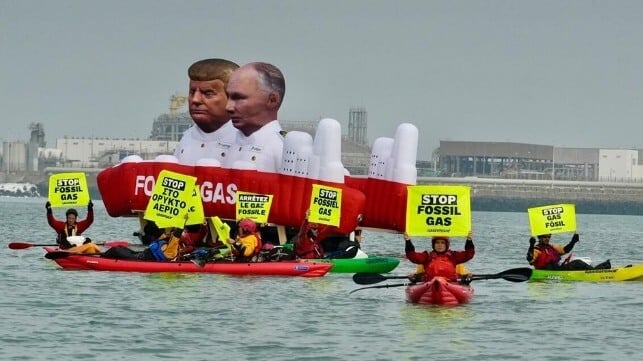
Greenpeace activists from 17 countries blockaded Belgium’s Zeebrugge LNG terminal on Thursday, forcing at least three tankers to divert. Protesters in kayaks, inflatables, and small craft occupied the channel, demanding an end to both Russian and U.S. LNG flows. 

Fluxys, which operates the terminal, told Reuters that operations inside remain unaffected, though tanker access was restricted and the blockade was expected to continue through Sunday.

The Megara and Rias Baixas Knutsen, both carrying U.S. LNG, along with the LNG Phecda carrying a Russian cargo, were among the ships that changed course, according to LSEG vessel tracking cited by Reuters. Zeebrugge, which serves not only as a Belgian import terminal but also as a re-export hub, sees Russian volumes frequently redirected from there to markets in Spain, Italy, and Asia.

Belgium imported roughly 2.3 million tonnes of Russian LNG in the first eight months of 2025, second only to France, customs data show. Despite efforts to cut ties, Europe remains a significant buyer: Russian gas supplied over 40% of EU imports in 2021, a share that dropped to below 19% by 2024. 

Brussels has proposed phasing out Russian gas entirely by 2027, with the first-ever EU sanctions on Russian LNG due to take effect in January 2027. Still, NGO estimates suggest the bloc has sent €8.1 billion to Moscow this year through LNG purchases.

Europe’s reliance on LNG is growing. The IEA projects EU imports will rise 25% in 2025, with U.S. cargoes capturing more than half of incremental supply. New German terminals at Wilhelmshaven and Brunsbüttel, alongside expanded facilities in the Netherlands, France, and Spain, are anchoring this trend. Storage levels remain tight, with inventories only 39% full at mid-year, well below seasonal averages.

On Thursday, the Dutch TTF gas benchmark fell by more than 3%, slipping to 10.82, even as traders monitored disruptions from French LNG strikes and the Zeebrugge blockade. The decline reflects broader softness in European gas markets, though physical risks remain elevated.

By Charles Kennedy for Oilprice.com

Belgian LNG Terminal Blocked by Greenpeace Protestors

Greenpeace protest Belgium
Greenpeace is blocking Belgium's LNG terminal calling for an end to Russian and U.S. LNG imports (© Eric De Mildt / Greenpeace)

Published Oct 1, 2025 1:34 PM by The Maritime Executive


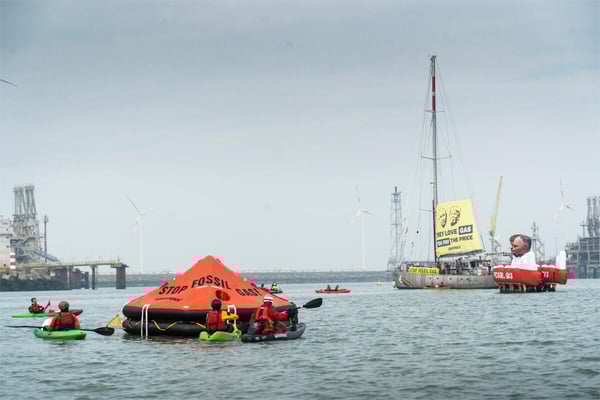
The Fluxys LNG terminal at the port of Zeebrugge, Belgium, is once again being blockaded by Greenpeace protestors. The group estimates as many as 70 activists took to small boats, rafts, and kayaks to call attention to its demands to end Russian and U.S. LNG imports into the European Union.

Media reports indicate the group was hiding at various points around the port early this morning, October 1, and launched the protest shortly after an LNG carrier departed the terminal. The terminal appears to be empty now, and the protestors are in the inner harbor area, but a cruise ship (AIDAperla), several RoRos, and general cargo ships are in other areas of the port near the protest.

Greenpeace’s sailing ship Witness (74 feet/22.5 meters) was positioned at the entrance to the LNG terminal and is displaying a large banner with images of Vladimir Putin and Donald Trump reading “They love gas, you pay the price.” In addition, the group installed a 10-meter (33-foot) inflatable also portraying the Russian and U.S. presidents represented atop a gas carrier. The small boats and kayaks were surrounding the display, also showing banners. A police boat was standing by in the harbor.

The protest is reported to be the last in a series of displays the group has staged around Europe and is timed to the discussions of the 19th EU sanction package tied to the war in Ukraine. The European Commission is proposing a ban on Russian gas imports to be completed by January 2027, but Greenpeace is also calling for a freeze on all new contracts from U.S. suppliers and a commitment by the EU and its member states to phase out all fossil gas by 2035 at the latest.


Greenpeace says it is blockading the LNG import terminal calling for an end to Russian and U.S. LNG shipments (© Eric De Mildt / Greenpeace)


“Replacing Russian gas with fracked gas from the U.S. keeps Europe trapped in dangerous dependencies,” said Lisa Göldner, fossil fuel campaigner from Greenpeace Germany. “We are here today because accelerating the transition to renewable energy is no longer just an environmental imperative; it is a matter of security.”

Greenpeace Belgium released data where it calculates that between 2022 and 2024, the Russian company Yamal LNG, the largest exporter of Russian gas to Europe, earned an estimated $40 billion and paid $9.5 billion in profit tax to the Russian state. The group asserts that from 2022 to June 2025, France, Spain, Belgium, and the Netherlands spent more on liquified gas imports from Russia (€34.3 billion) than they provided in bilateral aid to Ukraine (€21.2 billion).

The LNG terminal in Zeebrugge is one of the largest, with agreements for Eni, EDF, and Total. Operator Fluxys Belgium highlights that demand for natural gas flows from Belgium to Germany and the Netherlands increased significantly in the first half of 2025 compared to 2024. Fluxys reports shipping traffic at the terminal hit an unprecedented high in the first half of 2025, with nearly 80 ships unloading LNG in Zeebrugge. On June 6, flows from the terminal into the Belgian grid set a new record at 716 GWh.

Greenpeace has targeted the terminal during previous protests. In March, protestors circled the Marshall Islands-registered gas carrier Marvel Swallow operated by Japan’s Mitsui O.S.K. Lines as it was arriving. Hours later, they attempted to stop Dynagas’ Cyprus-flagged tanker Fedor Litke

As of the evening of October 1, the standoff is continuing in the harbor with the police boat and the Greenpeace vessel both sitting near the entrance of the Fluxys’ terminal.