Saturday, October 04, 2025


UK Government investment lifted young people’s hopes in ‘left behind’ areas, new research shows


Study finds optimism rising in social mobility ‘cold spots’, bucking national downward trend


University of Bath


Young people growing up in England’s most disadvantaged areas are feeling more hopeful about their future study and work prospects thanks to targeted Government investment, according to new research from the Universities of Bath, Bristol and Durham.

The study examined the impact of the Opportunity Areas* programme – a £108 million initiative focused on 12 communities with low educational attainment and high youth unemployment delivered between 2017 and 2022.

It found that while optimism about the future has declined nationally among young people, those living in Opportunity Areas (Blackpool, Bradford, Derby, Doncaster, Fenland and East Cambridgeshire, Hastings, Ipswich, North Yorkshire coast, Norwich, Oldham, Stoke-on-Trent and West Somerset) reported a significant boost in confidence about training, higher education, and employment.

The effect was particularly strong in coastal and post-industrial communities such as Bradford and Blackpool, where young people felt more likely to secure university places, complete their studies, and find suitable jobs.

The Opportunity Areas programme was founded by the previous Conservative Government and the funding ended in March 2025 under the Labour Government.

The next phase of the research will investigate whether the increased optimism for study and work observed among young people in Opportunity Areas is associated with increased life chances.

Dr Jo Davies, lead author of the IPR Policy Brief Green shoots of hope? Increased optimism about future study and work in England’s Opportunity Areas, said: “Across the country, young people’s optimism about the future has been declining, so to see increasing optimism in the Opportunity Areas provides a stark contrast.

“If Rachel Reeves’ pledge to abolish long-term youth unemployment is to succeed, social mobility cold spots must be the focus. These are places where opportunities are limited and where the legacy of deindustrialisation is still deeply felt.

“The government now has a moral obligation to these young people whose hopes have been raised by the Opportunity Areas programme to ensure that genuine education and employment opportunities are available in their local communities.”

Professor Michael Donnelly, Principal Investigator on the From the Centre to the Periphery project, said: “Our research suggests that place-based interventions, designed using rigorous evidence, can play a valuable role in tackling geographic divides. But optimism alone won’t solve deep-rooted inequalities – we also need to see sustained investment in good, well-paid jobs in these communities.”

Professor Matt Dickson, Co-Investigator on the From the Centre to the Periphery project, said:

“This work shows that targeted, local interventions can make a real difference and should encourage policymakers to persist with place-based approaches to addressing regional inequalities.”

The UK remains one of the most regionally imbalanced economies in the developed world, with sharp disparities in education and job outcomes between London and the Southeast and the rest of the country.

The researchers analysed data from the UK Household Longitudinal Study – Understanding Society, focusing on responses from 2009-2024 for individuals aged 16-21. Young people in Opportunity Areas were asked how likely they thought it was that they would:

  • gain training or a university place in their preferred field
  • successfully finish their training or studies
  • find a job in their field
  • succeed and “get ahead” in life

Compared with similarly disadvantaged areas outside the programme, young people in Opportunity Areas reported higher expectations across all four measures.

The researchers argue that future social mobility initiatives must reach disadvantaged youth everywhere, not just those in selected Opportunity Areas. They say this could be achieved by greater use of Free School Meal (FSM)-focused interventions.

“The decline in optimism in comparison areas underlines the urgent need to address structural barriers facing young people on the periphery – including poor transport links, fewer educational options and limited local job prospects,” said Dr Davies.

The research is part of a £1.5m UKRI funded three-year project, From the centre to the periphery: reducing spatial divides through area-based education initiatives which runs until September 2027.

The IPR Policy Brief is available at: https://www.bath.ac.uk/publications/green-shoots-of-hope-increased-optimism-about-future-study-and-work-in-englands-opportunity-areas/

Ends

For more information or to interview researchers contact the University of Bath press office at press@bath.ac.uk or call 01225 386319.


Notes

*Aims of the Opportunity Areas

There were three overarching programme level aims to the Opportunity Areas programme:

  1. to close the educational attainment gap between areas
  2. to ensure high quality post-16 education choices across geographic areas
  3. to address geographic inequalities in career choices and transitions

Within this framework, individual Opportunity Areas had the freedom to choose their focus. More information at: https://www.gov.uk/government/publications/social-mobility-and-opportunity-areas

Alberta premier blames Ottawa for Imperial
Oil job cuts, but experts say it's a global trend
Story by Rukhsar Ali
 • CBC   
SEPTEMBER 30, 2025
Alberta Premier Danielle Smith says Imperial Oil's plan to lay off roughly 20 per cent of its workforce by 2027 is "very disappointing," laying the blame on Ottawa and reinforcing the need to build pipelines.

"The industry for the last 10 years has been hampered and hobbled by federal government decisions," Smith said Tuesday.

"If we can realise the aspiration of building our pipelines north, south, east and west, doubling our production, then there's a lot of opportunity for people to be able to get reemployed in this sector."

Calgary-based Imperial said Monday the cuts are part of a broader restructuring plan and would save the company about $150 million annually.

Approximately 900 jobs, most of which are in Calgary, will be lost.

"This is what happens when you have uncertainty," Smith said. "And this is part of the reason why we have to work very quickly to get to a resolution with Ottawa so that we can start building [pipelines] again."

Imperial Oil chairman John Whelan said in a statement the restructuring and layoffs will ensure the company continues to deliver returns and value for shareholders.

"We recognize the considerable impact this restructuring will have on our employees and their families," Whelan said. "We are deeply committed to supporting our employees through this transition."

In a news release, Imperial said it is leveraging technology and its relationship with its major shareholder, Exxon Mobil, to continue to meet or exceed production targets.

The company also said part of the restructuring will see Imperial relocate most of the remaining Calgary positions to the Strathcona Refinery in Edmonton in late 2028.

While Smith points the finger at Ottawa, Alberta NDP leader Naheed Nenshi lays the blame on the UCP government.

"We've got a government that is pandering to separatists, that is scaring away domestic and foreign investment," he told CBC News.

"We now have the second… highest unemployment rate after Newfoundland in the country at a time where the energy sector is not really under threat from tariffs," Nenshi said.

"What we're really seeing here is a change and shift in the work and Alberta being left on the outside, and that is directly due to Danielle Smith and the UCP's policies, I believe."

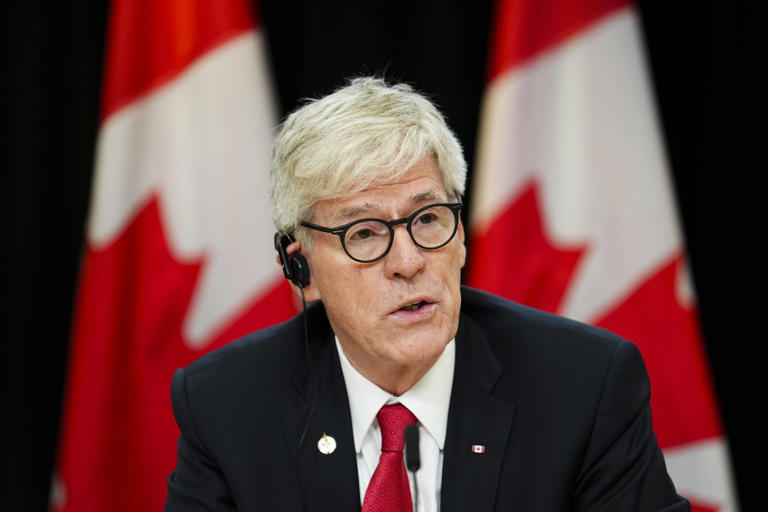
Canada's energy minister, Tim Hodgson, also said he's "deeply disappointed" with Imperial Oil's planned job cuts.

He said he's working to understand what went into the company's decision and that the government will explore ways to support the workers losing their jobs.

"These are skilled, dedicated people who have greatly contributed to Alberta's energy sector and Canada's economy, and my thoughts are with them and their families as they receive this difficult news," he said on social media Tuesday.

In August, Imperial reported $11.23 billion in total revenue and other income during the second quarter, down from $13.38 billion in the same quarter a year earlier.

Hodgson said it's his mission to make sure energy companies like Imperial stay prosperous as the government works to make Canada an "energy superpower."
Oil company layoffs a global trend: experts

Top U.S. oil major Exxon Mobil announced broader cuts on Tuesday, with plans to lay off 2,000 workers globally — about half of which are accounted for in the Imperial Oil layoffs.

Heather Exner-Pirot, director of energy, natural resources and environment at the Macdonald-Laurier Institute in Ottawa, says this latest announcement is part of a global trend.

"This is obviously extremely painful for Calgary and extremely painful for Canada, but this is part of a much broader… series of layoffs," she said.


Heather Exner-Pirot, director of energy, natural resources and environment at the Macdonald-Laurier Institute, says the Imperial Oil layoffs are part of a broader global trend for the oil and gas sector. (Paula Duhatschek/CBC)

Several major energy companies, including Chevron and ConocoPhillips, have announced thousands of job cuts in the past year to rein in costs while they contend with lower profits in the face of a worldwide slump in crude oil prices and strong competition from the OPEC+ group of oil producers.

Another Calgary-based company, Cenovus Energy Inc., confirmed layoffs in May, while Suncor Energy Inc. cut about 1,500 staff in a streamlining push in 2023.


"What Exxon and Imperial are doing is trying to be the lowest cost barrel in the oilsands and also globally competitive, and so they aren't shutting in production. They have no intention of producing less oil," Exner-Pirot explained, calling the layoffs a "normal restructuring" from the corporation's perspective.


"That means the royalties keep coming in. It means the sector is healthy. It means Imperial stays healthy."

Charles St-Arnaud, chief economist with Alberta Central, FORMERLY ATB, says the oil and gas industry is no longer what it was in 2014, pre-boom, and so the number of people employed in the sector has also been impacted.

"The Canadian oil and gas sector doesn't live in [a] vacuum... without being influenced by what's happening around the world. It's not just in Canada that investment in the industry is weak. We're seeing that around the world," he said.

"The name of the game for the past decade has been how to drive efficiency out of current operations, and that's what we've seen. [Companies have] been cutting costs and those job losses go into that vein.

"It's really that drive to efficiency that is reducing the head count. How can you extract the same barrel at a lower cost?"


Charles St-Arnaud, chief economist with Alberta Central, says the oil and gas sector is maturing and decisions are being driven by efficiency. 
(Justin Pennell/CBC)© Provided by cbc.ca

St-Arnaud says there's a need to start looking at the oil and gas sector with "a different mindset," understanding that it's a mature industry now.

"It's no longer what I would call the startup phase of the late 2000s, early 2010s, where companies were building massive operations, thinking huge amounts of money and they were not necessarily driven by how much it's gonna cost," he said.

"But now [in the] mature phase, you need to start thinking about the cost. How do you improve your profitability when you're at that kind of mature phase of your development? And that's really where I see the Canadian oil industry being at the moment."

Canadian energy minister, Alberta premier disappointed with Imperial Oil job cuts

Story by Jack Farrell and Fakiha Baig
• SEPTEMBER 3O, 2O25

Tim Hodgson, Minister of Energy and Natural Resources, provides an update on the forecast for the 2025 wildfires season at the National Press Theatre in Ottawa on Thursday, June 12, 2025. THE CANADIAN PRESS/Sean Kilpatrick© The Canadian Press

Alberta Premier Danielle Smith says Imperial Oil's "very disappointing" plan to lay off roughly 20 per cent of its workforce by 2027 reinforces the need to build more pipelines.

Smith is blaming Ottawa for the layoffs at the Calgary-based company.

"The industry for the last 10 years has been hampered and hobbled by federal government decisions," she told an unrelated news conference in Calgary on Tuesday.

"This is what happens when you have uncertainty, and this is part of the reason why we have to work very quickly to get to a resolution with Ottawa so that we can start building again ... no one likes to see these kinds of consolidations.

"If we can realize the aspiration of building our pipelines north, south, east and west, doubling our production, then there's a lot of opportunity for people to get re-employed in this sector."

Imperial said Monday the cuts are part of a broader restructuring plan and would save the company about $150 million annually.

Company chairman John Whelan said in a statement the restructuring and layoffs will ensure Imperial continues to deliver returns and value for shareholders.

“We recognize the considerable impact this restructuring will have on our employees and their families," Whelan said.

"We are deeply committed to supporting our employees through this transition."

Related video: B.C. Premier tells Alberta not to 'mistake politeness for weakness' over pipeline plans (The Canadian Press)

The company also said part of the restructuring will see Imperial "further consolidate activities to its operating sites" in Alberta.

A spokesperson for the company, Lisa Schmidt, said in an email Tuesday that the company has reached a tentative agreement to sell its multi-building Calgary office complex and lease back the space it will still need.

"We plan to maintain a presence in Calgary," said Schmidt.

Data from LSEG Data and Analytics shows the layoffs would impact about 1,000 jobs, based on an employee count of 5,100 as of Dec. 31, 2024.

Federal Energy Minister Tim Hodgson also said Tuesday he's disappointed with the cuts.

He said he's working to understand what went into Imperial's decision and that the government will explore ways to support the workers losing their jobs.

"These are skilled, dedicated people who have greatly contributed to Alberta's energy sector and Canada's economy, and my thoughts are with them and their families as they receive this difficult news," Hodgson said on social media.


In August, Imperial reported $11.23 billion in total revenue and other income during the second quarter, down from $13.38 billion in the same quarter a year earlier.

Hodgson said it's his mission to make sure energy companies like Imperial stay prosperous as the government works to make Canada an "energy superpower."

"We are taking steps today to ensure the Canadian energy sector will continue to provide careers and prosperity for generations to come," he said.

Alberta Opposition NDP leader Naheed Nenshi said Monday the company's plan represents "a significant blow to Calgary and Alberta’s economy."

Nenshi called on Smith and her United Conservative Party government to develop a plan to keep good paying jobs in Alberta, especially with its unemployment rate being one of the highest in Canada.

This report by The Canadian Press was first published Sept. 30, 2025.

Jack Farrell and Fakiha Baig, The Canadian Press


Alberta 'on notice' Coastal B.C. nations opposed to pipeline proposal

Story by Ashley Joannou
 The Canadian Press
Oct. 1, 2025

Chief Marilyn Slett speaks during a news conference in Vancouver, Tuesday, June 25, 2024. THE CANADIAN PRESS/Ethan Cairns© The Canadian Press

The head of a group representing First Nations along British Columbia's coast says they will not support a new pipeline proposed by Alberta and nothing can be done to change that.

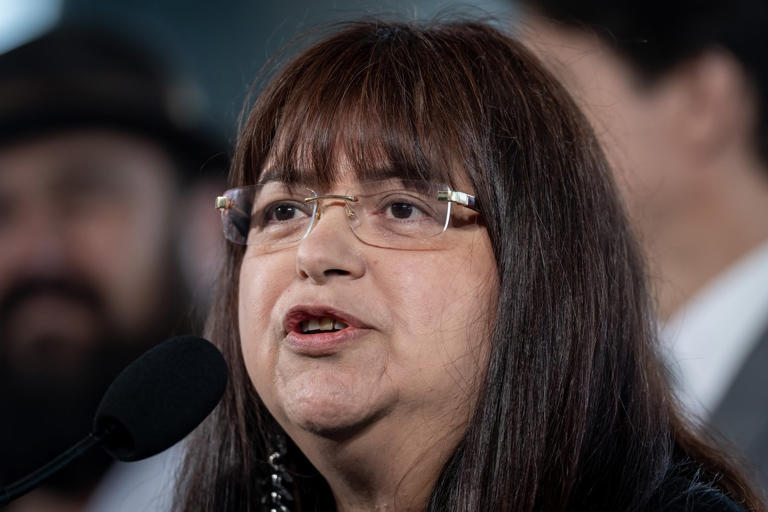
Marilyn Slett, chief councillor of the Heiltsuk Tribal Council and president of the Coastal First Nations-Great Bear Initiative, said Wednesday that First Nations fought for decades to get the federal moratorium that keeps oil tankers out of their waters.

"As the rights and titleholders of B.C. North and Central Coast and Haida Gwaii, we must inform Premier (Danielle) Smith once again that there is no support from coastal First Nations for a pipeline and an oil tankers project in our coastal waters," Slett said moments after Alberta's premier announced her government will be pitching a pipeline to Ottawa.

Smith acknowledged that laws, including the tanker ban, would have to be repealed or have a carve-out created, but said a new pipeline would unlock Canada's "economic potential" with Indigenous partners.

First Nations in B.C., environmental groups and that province's premier lined up in opposition to the plan.


Grand Chief Stewart Phillip, president of the Union of British Columbia Indian Chiefs, said in a statement that any proposal to "ram" a new oil pipeline through "is a direct assault on the inherent and constitutionally protected title and rights of the First Nations who steward these lands and waters."


"This is a blatant attempt to tear up the legislated federal North Coast tanker ban that defends one of the world's most pristine and rich coastal ecosystems from disaster. To even entertain this idea shows a profound disrespect for both First Nations law and the will of the people who live there, as well as a total disregard for the climate emergency," he said.

The GitxaaIa Nation, a member of the Great Bear Initiative, said in its own statement that it remains opposed to any crude oil project on the Northern coast.

"Attempts to use empty promises from engagement or consultation to clear the way for any pipeline is an old and tired ploy, one that GitxaaÅ‚a is more than familiar with,” said Linda Innes, elected chief councillor of GitxaaÅ‚a Nation.

“As a nation, GitxaaÅ‚a has been steadfast and clear that the risk of a pipeline or tanker on our lands, waters, community, and way of life is too great and that no amount of pressure from any government or private company can undermine GitxaaÅ‚a’s duty to protect our territory for our future generations.”

Smith told a news conference Wednesday that the proposal is expected to be filed in the spring of next year to the new federal Major Projects Office, which aims to speed up projects deemed in the national interest.

Alberta plans to develop the project with the backing of an advisory group that includes three major Canadian crude pipeline operators: Enbridge Inc., Trans Mountain Corp. and South Bow Corp.

Smith said she's confident that if Ottawa fixes the "investment climate" by changing laws, including the tanker ban, proponents will step up and the pipeline will be built with private sector money.

B.C. Premier David Eby, who has criticized Smith for talking about pipelines without a private company interested in building one, said Wednesday that his government supports the tanker ban because it is "foundational to our ability to get some major projects done."

"To put that tanker ban at threat, is not just a threat to our pristine coast that so many British Columbians, including myself, value, but it is a direct economic threat to the kind of economy that we're trying to build in the country here," he said.

"There is no project. There is no bridge to cross unless the Albertan government and the federal Canadian government are committing billions of taxpayer dollars to build this project, and if that is the plan, then they should be transparent about it.

"Don't mistake my politeness for weakness on protecting our economy and our coast."

Alberta Minister of Indigenous Relations Rajan Sawhney told the news conference she has spoken with Indigenous leaders in B.C. and Alberta about the project and the "responses were different from what you may have expected about 10 years ago."

"There was more support than I had anticipated," she said.

Slett said she spoke with Sawhney to reiterate their opposition to a pipeline.

"I told her … that there is no support from my community, from coastal First Nation communities, that our position has not changed and that this is a project that we cannot support and will not support," Slett said.

The Coastal First Nations-Great Bear Initiative includes nine First Nations on the North Pacific Coast.

Slett said any potential proponent of the pipeline, including the Alberta government, should be "on notice" that the First Nations are not prepared to accept crude oil through their waters.

"This is a non-starter for us. We've said that before, and our stance has not changed and will not change for any other reason," she said.

"We will use every tool in our tool box, at our disposal, to make sure that our coast remains tanker free."

B.C. Green Party energy critic Jeremy Valeriote said British Columbians "made their voices very clear" when the Northern Gateway pipeline was cancelled in 2016.


"The Alberta government said themselves, no private entity is willing to front it, because it's not environmentally responsible, it's not fiscally responsible," he said.

"We've got an oil tanker moratorium and there's no reason to change that given the sensitivity of the B.C. coast."

Jessica Clogg, senior counsel with West Coast Environmental Law, which was involved in the fight to stop the Northern Gateway pipeline, said both federal law and laws passed by coastal First Nations ban crude oil tankers.

More than 100 First Nations are signatories on the Save the Fraser Declaration that bans tankers from the Pacific North Coast, throughout the Fraser River watershed and ocean migration routes of salmon, she said.

"I think any federal government would lift the existing oil tanker moratorium at their political peril. We have not seen oil tankers, super tankers, on the coast. The fear and the concern about an Exxon Valdez-style oil spill is still very live, and it would, quite frankly, be both a political and an economic mistake," she said.

The Exxon Valdez ran around in Prince William Sound, Alaska in 1989 and spilled more than 41 million litres of crude, creating one of the largest environmental disasters in U.S. history.

This report by The Canadian Press was first published Oct. 1, 2025

Ashley Joannou, The Canadian Press


CU Anschutz researcher receives NIH grant to study earthworm hemoglobin as a substitute for red blood cells in organ perfusion


Heiko Yang, MD, PhD, is testing the earthworm substance in the machines that keep deceased donor organs alive


University of Colorado School of Medicine


Heiko Yang, MD, PhD, assistant professor of urology in the University of Colorado Anschutz Department of Surgery, has received a grant from the National Institutes of Health (NIH) for further research on his discovery of a product that has the potential to revolutionize the way deceased donor organs are kept alive prior to transplant or research.

“In a nutshell, we have derived a blood substitute from earthworms to keep human and animal kidneys alive outside the body,” Yang says. “Currently, most organs are kept alive using donor blood, but blood is expensive, has a short shelf life, and degrades quickly during machine perfusion. As it turns out, earthworms have a very shelf-stable hemoglobin-like oxygen carrier that has a number of properties that make it favorable for kidney perfusion.”

Perfecting perfusion

Yang, who conducts research on perfused organs, says he has long looked for a substitute for red blood cells, which release toxic chemicals when they burst, to use in the perfusion system that uses an artificial lung and heart to keep organs viable.

“I eventually connected with Jake Elmer, PhD, at Villanova University, who has been working with earthworm hemoglobin, and we did some pilot studies and saw that you can actually keep kidneys alive with this earthworm material,” he says. “The basis of this grant is to explore how we can optimize this use and see if we can keep kidneys and other organs alive this way. We want to find out what's the best concentration to use, if we need to stabilize it chemically, and if we can get a kidney to survive for several days on this material that contains no red blood cells.”

Suitable substitute

The two-year, “high-risk, high-reward” NIH grant is designed so that Yang and his co-researchers can apply for further funding once they have refined and proved their concept. If all goes as planned, it could be a significant advance for medical research, Yang says.

“It’s really exciting on several levels,” he says. “There are a lot of problems when we rely on blood to do our experiments — the content, the quality, having it readily available. This solves those problems for the general medical community. People have been looking for blood substitutes for decades, but none of them have panned out. So we still rely on donated blood products and red blood cells to save lives. This brings us one step closer to creating a viable blood substitute.”

Transplant triumph

The discovery may also be a boon to clinicians and surgeons in transplant medicine, he says, who currently must rely on a variable and inconsistent blood supply when keeping organs alive prior to transplant.

“There's the whole field of organ perfusion related to transplantation medicine, where people are trying to keep organs alive outside of the body to extend their viability and get donor organs to recipients more efficiently,” he says. “They're running into the same limitations that we've been running into, so having something like this could impact that field in a major way. Rather than getting blood from blood banks, why can't we just use something that's off the shelf, that you can store for a long period of time, and it just works?”


The ‘big bad wolf’ fears the human ‘super predator’ – for good reason


University of Western Ontario
Zanette with automated camera-speaker system. 

image: 

Western University professor Liana Zanette sets up an automated camera-speaker system.   

view more 

Credit: Michael Clinchy


Fear of the fabled ‘big bad wolf’ has dominated the public perception of wolves for millennia and strongly influences current debates concerning human-wildlife conflict. Humans both fear wolves and, perhaps more importantly, are concerned about wolves losing their fear of humans – because if they fear us, they avoid us and that offers protection.

A new Western University study shows that even where laws are in place to protect them, wolves fully fear the human ‘super predator.’

These findings by Western biology professor Liana Zanette – in collaboration with one of Europe’s leading wolf experts, Dries Kuijper from the Polish Academy of Sciences, and others – were published today in Current Biology.

Zanette and her colleagues conducted an unprecedented experiment across a vast 1,100 sq. km area in north-central Poland, demonstrating that wolves fully retain their fear of humans, even where laws exist to protect them. To conduct their experiment, the team deployed hidden, automated camera-speaker systems at the intersection of paths in the Tuchola Forest that, when triggered by an animal passing within a short distance (10 metres), filmed the response of the animal to hearing either humans speaking calmly in Polish, dogs barking or non-threatening controls (bird calls).

Wolves were more than twice as likely to run, and twice as fast to abandon the site, after hearing humans compared to control sounds (birds). The same was true of wolves’ prey (deer and wild boar).

By demonstrating experimentally that wolves fear humans, the study verifies that fear of humans, who are predominantly active in the daytime, forces wolves to restrict their activities to the night. Wolves were 4.9 times more nocturnal (active at night) than humans. In fact, wolves are not just nocturnal where Zanette and her team did their study, but everywhere humans are present, as shown in a recent continent-wide survey. This new experiment establishes that the reason is because wolves everywhere are fearful of humans.  

“Wolves are not exceptional in fearing humans – and they have good reason to fear us,” said Zanette, a renowned wildlife ecologist. “Global surveys show humans kill prey at much higher rates than other predators and kill large carnivores like wolves at on average nine times the rate they die naturally, making humans a ‘super predator.’”

Consistent with humanity’s unique lethality, growing experimental evidence from every inhabited continent demonstrates that wildlife worldwide, including other large carnivores like leopards, hyenas and cougars, fear the human ‘super predator’ above all else.

Legally protected but still fearful 

“Legal protection does not change wolves’ fear of humans because legal protection does not mean not killing wolves, it means not exterminating them. This is an important distinction,” said Zanette.

Humans remain very much a ‘super predator’ of wolves even where wolves are strictly protected, such as in the European Union, where humans legally and illegally kill wolves at seven times the rate they die naturally. France, for example, allows up to 20 per cent of the wolf population to be legally killed every year. Human killing of wolves in North America is comparable.

“At these rates, any truly fearless wolf that did not avoid humans would very soon be a dead wolf,” said Zanette.

Legal protection leading to fearless wolves – not scientifically supported

Wolves are now reoccupying areas in Europe and North America where they had been exterminated, leading to increased human-wolf encounters. This increase in encounters has been attributed to legal protection allowing the emergence of fearless wolves, but these new experimental results demonstrate this assumption is not scientifically supported.

“For wolves – like all creatures great and small – fear is primarily about food, specifically, how to avoid becoming food while trying to find food. Focusing on this fundamental risk-reward trade-off is critical,” said Zanette. “The certainty that wolves fear humans means we need to re-focus attention on what counterbalances this fear, rather than whether wolves are fearless.”

Humans are both uniquely lethal and unique in being normally surrounded by super-abundant, super high-quality food. Results of the study strongly indicate any apparently fearless wolf is actually a fearful wolf risking proximity to humans to get a bite of our ‘superfoods.’

The real problem, said Zanette, is how to keep the wolf from our human food.  

“The critical significance of our study lies in re-focusing the discourse on human-wolf conflict toward public education on food storage, garbage removal and livestock protection – reducing wolf access to human foodstuffs,” said Zanette. “What our study establishes is that there is no alternate problem to contend with. There is no ‘big bad wolf’ unafraid of the human ‘super predator.’”

Wolf in Poland's Tuchola Forest. 


Credit

Dries Kuijper