Sunday, October 05, 2025

FIRST WOMAN PM

Why The World Is Watching Japan’s Historic Leadership Transition – OpEd

Japan's Sanae Takaichi. Photo Credit: Japan PM Office, Wikipedia Commons

By 

By Andrew Hammond


Japan’s Liberal Democratic Party leadership election has been extensively viewed, domestically. However, the wider world has also been watching the crucial contest closely too, not least G7 allies in the West given the importance of Tokyo to this club of industrialized nations.

The word historic is often overused, but this contest genuinely met that high benchmark. This is not least because the victor Sanae Takaichi, announced on Saturday, is now widely expected to become the nation’s first female prime minister.

As the LDP and coalition partner Komeito have recently lost their majority in both houses of parliament, which has increased the risk of political instability in Tokyo, new LDP leader Takaichi will need to win, with agreement from legislators of other parties, a vote to secure the premiership.

The stage would then be set for a potential snap general election. Or a potential new coalition, or a looser arrangement that would allow a minority government to secure the support of one or more other parties on confidence votes and the budget.

Important as this leadership transition is for Japan, the wider world is watching events closely in Tokyo too. This includes long-standing allies in the Americas and Europe who have an increasingly close relationship with the Asian economic giant.


Since the end of the Second World War, the transformation of Tokyo’s world role has stemmed, in part, from its phenomenal postwar business success, which led to growing calls for it to match its economic power with commitment to international relations too. Today, Japan remains one of the world’s three largest economies, and it will be critical to helping drive a new wave of global, sustainable growth in coming years.

Japan is also a key member not only of the G7, but also the US-led Quadrilateral Security Dialogue (Quad) with Australia and India too. While this forum began as a security-driven initiative, commerce and industry ministers now meet and the agenda includes health security, food security, clean energy, and quality infrastructure.

On the economic front, Tokyo and Washington agreed in July a tariff deal that sees a 15 percent levy on Japanese goods in exchange for a $550 billion package of US-bound investments and loans.

In Europe too, the longstanding partnership with Japan has assumed greater importance. The EU and Japan recently held their 30th annual summit in July, attended by European Commission President Ursula von der Leyen and outgoing Japanese Prime Minister Shigeru Ishiba.

At the big event, the two powers launched a new Competitiveness Alliance focused on trade, green and digital innovation, plus economic security. Priorities include strengthening supply chains for raw materials and batteries, regulatory cooperation, and joint industrial efforts in hydrogen, liquified natural gas, offshore wind, and semiconductors.

The new competitiveness initiative stems from the broader deepening of Japan-EU economic ties under the bilateral Economic Partnership Agreement, or EPA, plus other forums such as the EU-Japan Green Alliance, the Partnership on Sustainable Connectivity and Infrastructure, and the bilateral Digital Partnership. EU firms already export about 70 billion euros in goods and 28 billion euros in services to Japan annually, and bilateral trade has increased significantly since 2019.

As part of the new competitiveness alliance, Japan and Europe agreed to intensify their collaboration against “economic coercion” and “unfair trade practices.” Von der Leyen highlighted growing geoeconomic challenges and geopolitical tensions, from Ukraine to the Asia Pacific.

Europe and Japan have, potentially, significant shared weight together on this agenda with their collective economies accounting for about a fifth of global GDP and a market of about 600 million people.

Von der Leyen highlighted that the next steps on the EPA were discussed at the Sixth EU-Japan High Level Economic Dialogue last May. This forum pledged to deepen cooperation in areas such as trade, supply chain transparency, diversification, security; sustainability, trustworthiness, reliability and resilience, promotion and protection of critical and emerging technologies, industrial policy, plus investment promotion.

While no European countries are part of the Quad, many regional politicians increasingly see the relationship with Japan in a broader strategic context. This is a key change from when relationships in the past were centered around economics.

Ishiba’s predecessor, Fumio Kishida, was the first Japanese prime minister to attend a NATO leadership meeting. There is speculation too about Tokyo being invited into wider Western intelligence forums such as the “Five Eyes” alliance of the US, Canada, Australia, New Zealand, and the UK.

A good example of this deepening security relationship is the 2023 UK-Japan Reciprocal Access Agreement, which is the most significant defense agreement between the powers since 1902. The deal allows UK and Japanese armed forces to be deployed in one another’s countries. It builds from the post-Brexit UK-Japan trade deal, and the UK’s entry into the Comprehensive and Progressive Agreement for Trans-Pacific Partnership, or CPTPP, which accounts for well over 10 percent of global trade and has a combined population of about 500 million.

Tokyo and Brussels also announced that a new Defense Industry Dialogue will be launched in 2026. This will promote collaboration on advanced and dual-use technologies with broader cooperation spanning areas including cybersecurity, maritime, and space security.

These developments show the wisdom of Western decision-makers, back in the mid-1970s, when Japan was formally brought into the G7 club. A similar far-sighted, strategic approach is now needed around a half century later in the very different context of the mid-2020s.

One example is von der Leyen’s hopes of deeper EU trade cooperation with CPTPP. The Japanese government was one of the strongest supporters of UK accession to this economic club, and Tokyo is keen for closer EU engagement with the bloc.

Taken together, this is why Japan’s Western allies are closely watching the leadership transition in Tokyo. A new era of cooperation is hoped for, but the risk of further political instability is recognized.

  • Andrew Hammond is an associate at LSE IDEAS at the London School of Economics.


Arab News is Saudi Arabia's first English-language newspaper. It was founded in 1975 by Hisham and Mohammed Ali Hafiz. Today, it is one of 29 publications produced by Saudi Research & Publishing Company (SRPC), a subsidiary of Saudi Research & Marketing Group (SRMG).

Global reaction to Sanae Takaichi winning Japan leadership race

Reuters
Sat, October 4, 2025 

Sanae Takaichi, the newly elected leader of Japan's ruling Liberal Democratic Party (LDP), poses in the party leader's office after the LDP leadership election in Tokyo, Japan, October 4, 2025. Conservative Sanae Takaichi hailed a "new era" on October 4 after winning the leadership of Japan's ruling party, putting her on course to become the country's first woman prime minister. 
Yuichi Yamazaki/Pool via REUTERS

(Reuters) -Sanae Takaichi is likely to be Japan's first female prime minister after winning the race to lead the ruling Liberal Democratic Party on Saturday.

A former economic security internal affairs minister, a conservative nationalist with an expansionary agenda, is expected to replace Prime Minister Shigeru Ishiba since the LDP is the largest group in parliament.

Here are some reactions from around the world:

TAIWAN PRESIDENT LAI CHING-TE, PARTY STATEMENT

"Lai Ching-te extends his most sincere and warmest congratulations to the new (LDP) President Takaichi... Takaichi is a steadfast friend of Taiwan. (Taiwan's Democratic Progressive Party) and the LDP have long maintained friendly and deep-rooted relations. It is hoped that under the leadership of (LDP) President Takaichi, Taiwan and Japan can deepen their partnership in areas such as economic trade, security, and technological cooperation, further advancing Taiwan-Japan relations to a new stage."

CHINA'S MINISTRY OF FOREIGN AFFAIRS, SPOKESPERSON'S OFFICE, STATEMENT:

"We have noted the election result, which is Japan's internal affairs. We hope that Japan will adhere to the principles and consensus of the four China-Japan political documents, honour its political commitments on major issues such as history and Taiwan, pursue a positive and rational policy toward China and fully implement its position to comprehensively promote a strategic and mutually beneficial relationship."

U.S. AMBASSADOR TO JAPAN, GEORGE GLASS, ON X:

"My congratulations to @takaichi_sanae on becoming the 29th president of Japan’s Liberal Democratic Party and the party’s first female leader. I look forward to working with her to strengthen and grow the partnership on every front."

ISRAEL'S AMBASSADOR TO JAPAN, GILAD COHEN, ON X:

"Congratulations to Sanae Takaichi, newly elected President of the LDP and the party’s first female leader! I am confident that under your leadership, the ties between Israel and Japan will continue to grow stronger. Looking forward to fruitful and successful cooperation ahead."

(Compiled by Global News Desk)


Sanae Takaichi set to become Japan’s first female prime minister

Mari Yamaguchi, Associated Press
Sat, October 4, 2025 


Japan’s governing party has elected former economic security minister Sanae Takaichi as its new leader, making her likely to become the country’s first female prime minister.

In a country that ranks poorly internationally for gender equality, Ms Takaichi would make history as the first female leader of Japan’s long-governing conservative Liberal Democratic Party (LDP).

She is one of the most conservative members of the male-dominated party.


Sanae Takaichi speaks during the Liberal Democratic Party’s (LDP) leadership election in Tokyo, Japan (Kyodo News via AP)

Ms Takaichi beat agriculture Minister Shinjiro Koizumi, the son of popular former Prime Minister Junichiro Koizumi, in a run-off in an intraparty vote by the LDP on Saturday.

She replaces prime minister Shigeru Ishiba as the party hopes to regain public support and stay in power after major election losses.

She is likely to be Japan’s next prime minister because the party remains by far the largest in the lower house, which determines the national leader, and because opposition groups are highly splintered.

The LDP, whose consecutive losses in parliamentary elections in the past year have left it in the minority in both houses, wants to select a leader who can quickly address challenges in and outside Japan, while seeking co-operation from key opposition groups to implement its policies.

Five candidates — two currently serving and three former ministers — were vying for the LDP presidency.

Saturday’s vote only involved 295 LDP parliamentarians and about one million dues-paying members.


Shinjiro Koizumi speaks during the Liberal Democratic Party’s (LDP) leadership election in Tokyo, Japan (Kim Kyung-Hoon/Pool Photo via AP)

It only reflected 1% of the Japanese public.


What Japan’s First Female Prime Minister Means for the Country’s Gender Politics
Time

A parliamentary vote is expected in mid-October.

The LDP, which has been criticised by opposition leaders for creating a prolonged political vacuum, needs to hurry because the winner will soon face a diplomatic test: a possible summit with US President Donald Trump, who could demand that Japan increase its defence spending.

A meeting is reportedly being planned for late October when Mr Trump will travel to the Asia-Pacific Economic Cooperation summit in South Korea starting October 31.

The LDP also needs help from the opposition, which it has long neglected.

The party will likely look to expand its current coalition with the moderate centrist Komeito with at least one of the key opposition parties, which are more centrist.


Photos of candidates running for the ruling Liberal Democratic Party’s leadership are displayed at the party’s headquarters in Tokyo (AP photo)

All five candidates have called themselves “moderate conservatives” to show their willingness to work with the opposition.

They all campaigned for measures to combat rising prices and achieve larger salary increases, to strengthen defence and the economy, and for tougher measures on foreign workers.

They stayed away from divisive liberal social issues such as gender equality and sexual diversi


Experts say they avoided discussing their usual political views on historical issues, same-sex marriage and other contentious topics, including the party’s political funds scandal, which was the biggest reason for their election losses, and anti-corruption measures.

 Syria: In Raqqa, fear of new episode of violence looms

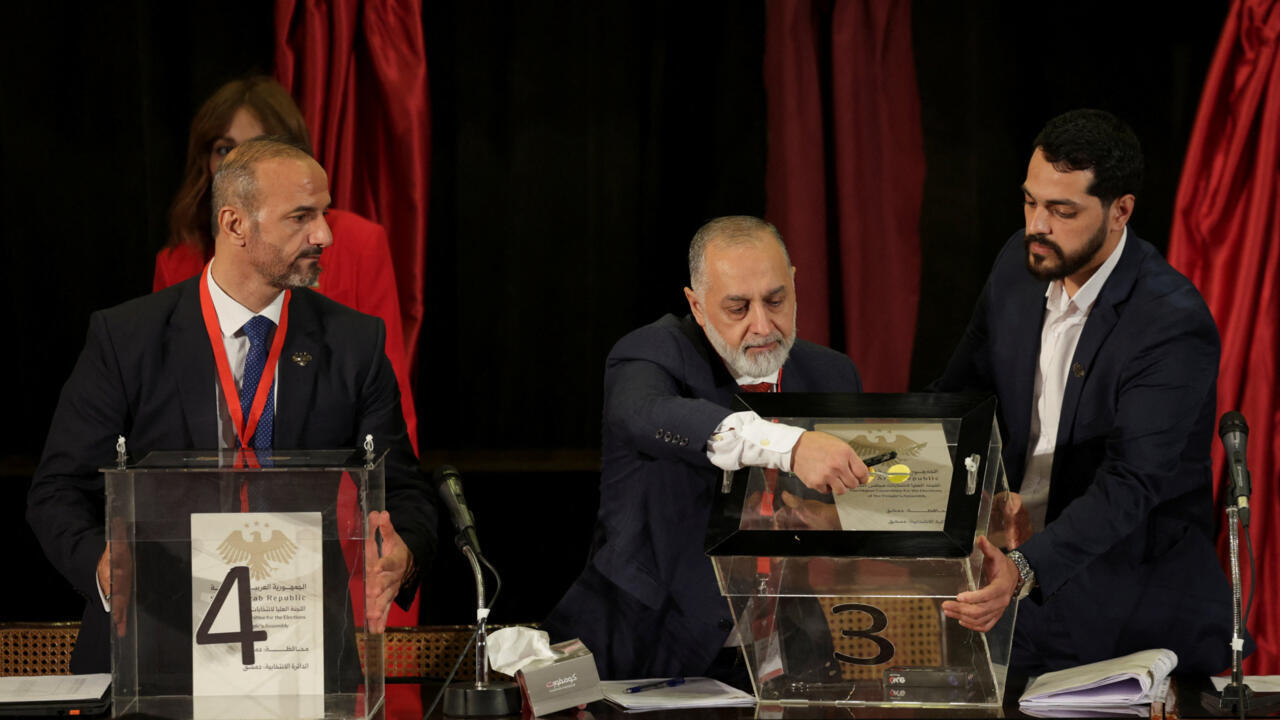
Syrian electors will select members of its first post-Assad parliament on Sunday (October 5) in a process criticised, with a third of the members appointed by interim leader Ahmed al-Sharaa. The process is widely expected to consolidate the power of Sharaa and raise more questions about how to unite the country after 13 years of civil war. According to the interim government in Damascus, northeastern Syria has been largely excluded from the electoral process for security reasons. Negotiations are supposed to lead to the integration of this Kurdish-dominated region into the rest of Syria, but in the absence of significant progress, the standoff continues. In Raqqa, Kurdish authorities prepare for any eventuality.


Syria to select members of first post-Assad parliament in indirect vote

Syrian electors will select members of its first post-Assad parliament on Sunday in a process criticised as undemocratic, with a third of the members appointed by interim leader Ahmed al-Sharaa. According to the organising committee, more than 1,500 candidates -- just 14 percent of them women -- are running for the assembly, which will have a renewable 30-month mandate.


Issued on: 05/10/2025 
By: FRANCE 24

A member of electoral colleges votes to select his candidate for the new Syrian Parliament since Bashar al-Assad's government was toppled, in Damascus, Syria, October 5, 2025. 
© Khalil Ashawi, Reuters

Syria will select members of its first post-Assad parliament on Sunday in a process criticised as undemocratic, with a third of the members appointed by interim leader Ahmed al-Sharaa.

The assembly's formation is set to consolidate the power of Sharaa, whose Islamist forces led a coalition that toppled longtime ruler Bashar al-Assad in December after more than 13 years of civil war and five decades of one-family rule.

According to the organising committee, more than 1,500 candidates -- just 14 percent of them women -- are running for the assembly, which will have a renewable 30-month mandate.

Sharaa is to appoint 70 representatives out of the 210-member body.

In UN debut, new Syria leader warns on Israel but backs dialogue
A PROPOS © FRANCE 24
11:40


The other two-thirds will be selected by local committees appointed by the electoral commission, which itself was appointed by Sharaa.

But southern Syria's Druze-majority Sweida province, which suffered sectarian bloodshed in July, and the country's Kurdish-held northeast are excluded from the process for now as they are outside Damascus's control, and their 32 seats will remain empty.

"I support the authorities and I'm ready to defend them, but these aren't real elections," said Louay al-Arfi, 77, a retired civil servant sitting with friends at a Damascus cafe.

"It's a necessity in the transitional phase, but we want direct elections" to follow, he told AFP.

The new authorities dissolved Syria's rubber-stamp legislature after taking power.

Under a temporary constitution announced in March, the incoming parliament will exercise legislative functions until a permanent constitution is adopted and new elections are held.

Sharaa has said it would be impossible to organise direct elections now, noting the large number of Syrians who lack documentation after millions fled abroad or were displaced internally during the country's civil war.
'Not elections'

Around 6,000 people are taking part in Sunday's selection process.

Preliminary results are expected to emerge after it ends, with the final list of names to be announced on Monday.

Under the rules, candidates must not be "supporters of the former regime" and must not promote secession or partition.

Those running include Syrian-American Henry Hamra, the first Jewish candidate since the 1940s.

Rights groups have criticised the selection process, saying it concentrates power in Sharaa's hands and lacks representation for the country's ethnic and religious minorities.

In a joint statement last month, more than a dozen non-governmental organisations said the process means Sharaa "can effectively shape a parliamentary majority composed of individuals he selected or ensured loyalty from", which risked "undermining the principle of pluralism essential to any genuine democratic process".

Watch more  NGO Handicap International on the dangers of landmines in post-Assad Syria

"You can call the process what you like, but not elections," said Bassam Alahmad, executive director of the France-based Syrians for Truth and Justice, among the groups that signed the statement.

At a meeting in Damascus this week, candidate Mayssa Halwani, 48, said criticism was normal.

"The government is new to power and freedom is new for us," she said.

Nishan Ismail, 40, a teacher in the Kurdish-controlled northeast, said "elections could have been a new political start" after Assad's fall, but "the marginalisation of numerous regions shows that the standards of political participation are not respected".

Negotiations on integrating the Kurds' civil and military institutions into the new central government have stalled, with Damascus rejecting calls for decentralisation.

In southern Syria's Druze-held city of Sweida, activist Burhan Azzam, 48, expressed a similar sentiment.

The authorities "have ended political life" in Syria, he said, adding that the selection process "doesn't respect the basic rules of democracy".

(FRANCE 24 with AFP)


Syria: Al-Shaara’s Recent Diplomatic Wins Emboldens Him To Monopolize Power – OpEd

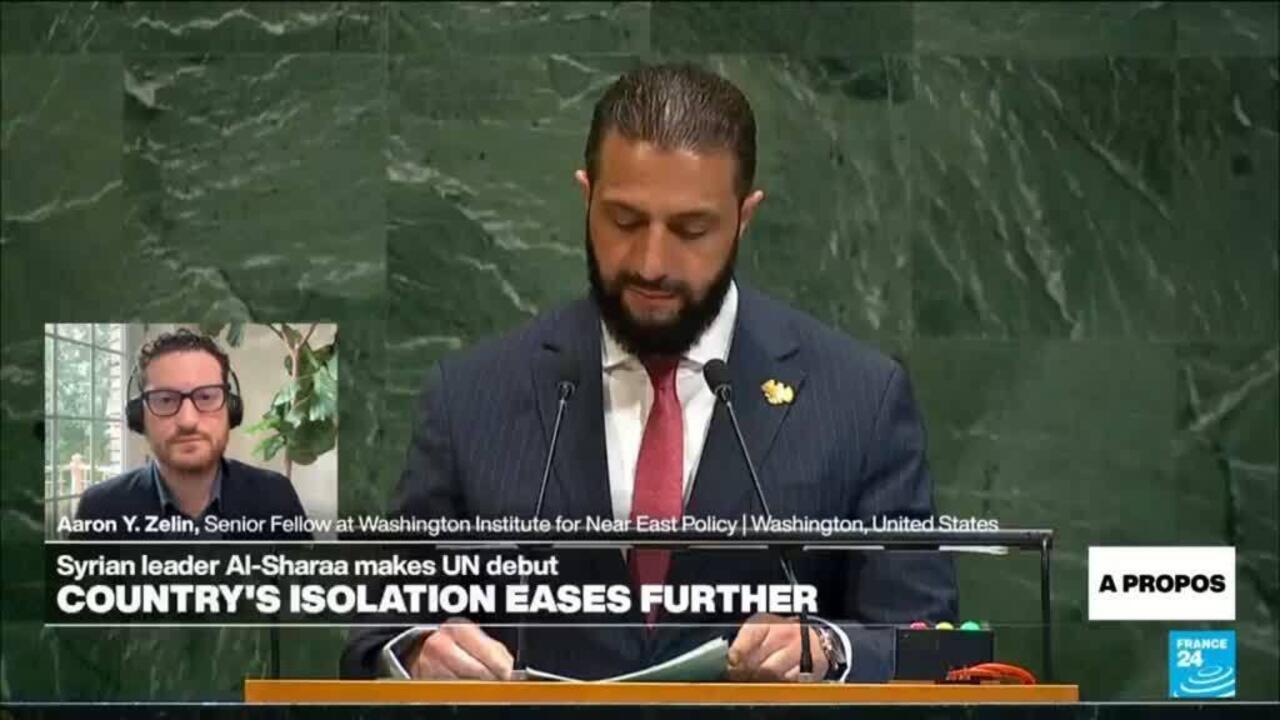
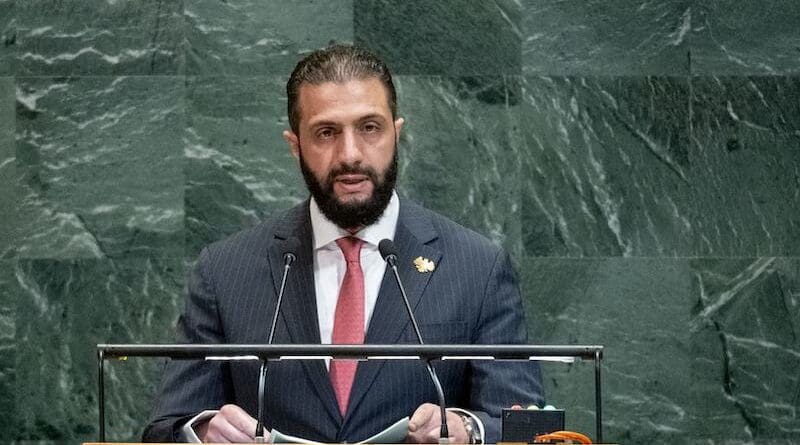
President Ahmad Al-Sharaa of the Syrian Arab Republic addresses the general debate of the General Assembly’s eightieth session. Photo Credit: UN Photo/Manuel Elías


By 

In his maiden speech in the United Nations General Assembly, Syria’s interim president, Ahmed al-Sharaa, called for lifting of international sanctions on Syria, becoming the first head of state from Syria to address the gathering in nearly 60 years.


This signifies the first appearance of a Syrian president since Nureddin al-Atassi took office in 1967. Syrian President Sharra engaged in a series of bilateral discussions with global leaders during the General Assembly sessions, framing it as Syria’s revitalized diplomatic drive. Since assuming office in December last year, Ahmad Al-Shaara has been conducting a diplomatic campaign. He successfully garnered substantial diplomatic backing from almost all principal stakeholders in the region.

In July of this year, the United States removed Hayat Tahrir al-Sham (HTS), the organization commanded by Al-Shaara, from its designation as a “foreign terrorist organization.” In May, he journeyed to Paris to confer with French President Emmanuel Macron and engage in discussions with senior Saudi Arabian officials. The Arab League warmly welcomes the current Syrian regime.

These initiatives illustrate the Al-Sharaa regime’s revitalized foreign efforts to reintegrate Syria into the global diplomatic framework. Nonetheless, the description is inaccurate; the aim of this diplomatic initiative is to validate Al-Sharaa as the exclusive leader of the nation. The regime’s objective is to solidify its dominance over a divided Syria by obtaining external recognition and legitimacy.

The regime seeks to persuade all ethnic and religious factions in Syria of its permanence and that it is advantageous for them to accept Al-Sharaa’s supremacy by securing the approval of foreign authorities. International recognition empowers the prevailing regime to monopolize and centralize power. Recent significant decisions clearly demonstrate this. Al-Sharaa recently announced parliamentary “elections,” in which committees he designated will elect two-thirds of the parliament members.

The current administration has dismantled the former police force. Instead, it has expanded Idlib’s General Security apparatus, with recruitment proceeding at breakneck speed. Priority is being given to young men from the three northern provinces (Idlib, Hama, Aleppo) where HTS sustains its support base. Anas Khatab, the former administrative director of Jabhat al-Nusra, the antecedent of HTS, has been designated as the new head of Syria’s General Intelligence Directorate (GID). Syrian citizenship is being conferred upon foreign militants affiliated with HTS, who constitute around 20 to 30% of its forces. They have been integrated into the military and are currently holding positions within the administration.


The termination of countless judges, especially women, has not resulted from professional wrongdoing but rather from their affiliation with minority ethnic groups. The appointment of ministers is now executed via a non-transparent process. Ahmed al-Sharaa’s brother, Maher, has been designated as the Minister of Health. Key positions in defense, foreign affairs, and interior have been conferred upon close colleagues of Ahmed al-Sharaa, like Murhaf Abu Kasra, Asaad al-Shaibani, and Alem Kiddie. The hyper-centralization of Syria’s governance confines decision-making to a small group of five or six individuals around Al-Sharaa.

Moreover, Damasus is utilizing sectarianism as a tool to create a “homogeneous popular support base” within the Arab Sunni community, rallying portions of the populace around sectarian dynamics. The “Mazlumiya Sunniya” (Sunni victimhood) narrative has been extensively utilized to consolidate a substantial segment of the Arab Sunni community in support of Al Sharaa’s government, notwithstanding the myriad political, social, and regional divides present among their ranks.

The new ruling authorities have swiftly acknowledged that sectarianism serves as an effective political tool for consolidating their grip over territories with ongoing resistance to their authority. The escalation of sectarian rhetoric and violence by the current regime and its supporting armed forces has initially targeted the Alawite population and subsequently extended to encompass the Druze communities within the country.

The military forces, ostensibly under government command, consistently display insubordinate and militia-like conduct, especially towards minorities. When intimidation fails, as seen with the Kurds, the Al-Shaara dictatorship resorts to blatant blackmail. Al-Sharaa consistently condemns Israeli military actions in southern Syria as infringements on the nation’s sovereignty.

Such denunciations typically seem authentic and valid. However, Al-Sharaa’s denunciations are insincere because his actions and statements contradict each other. The Syrian leader indicated that a Turkish military operation against the Kurdish-led Syrian Democratic Forces may be contemplated if they fail to completely assimilate into the Syrian military by December, as outlined in a March agreement between Damascus and the Syrian Democratic Forces, during an interview with Turkey’s Milliyet newspaper on September 19, 2025.

Al-Sharaa intimidates the Syrian Kurds with the prospect of a Turkish military incursion, instead of denouncing Turkish involvement in what is evidently an internal Syrian issue. A de facto president who advocates for foreign intervention against his own citizens forfeits the moral authority to address the territorial sovereignty of a nation. The Syrian government characterizes it as a matter of national security for Ankara when Turkey is the actor. Violations of sovereignty are only recognized when Israel is implicated. This double standard is both hypocritical and futile. The Bashar al-Assad dictatorship utilized the same strategy for years, ultimately leading to Assad’s exile in Moscow.

The marginalization of ethnic and religious minority groups, including Christians, Druze, and Kurds, would ultimately lead to long-term instability and a lack of legitimacy for the new regime. An inclusive governance approach that incorporates a wider range of political perspectives is vital to maintaining national unity. This administration is currently implementing a singular plan to consolidate its authority, leading to the neglect and subversion of the democratic aspirations and interests of the public.

The international community should refrain from endorsing the regime of Ahmad Al-Sharra, which is indistinguishable from the prior regime of Basha Al-Assad, unless it implements a comprehensive course correction.


Manish Rai

Manish Rai is a geopolitical analyst and columnist for the Middle East and Af-Pak region and the editor of geopolitical news agency ViewsAround (VA). He has done reporting from Jordon, Yemen, Iraqi Kurdistan, Egypt, Oman, UAE, Iran, and Afghanistan. His work has been quoted in the House of Commons, British Parliament and in leading think tanks like RAND Corporation and FDD.


Making yogurt with ants


Cell Press

Four live forest ants in a warm jar of milk 

image: 

Following a traditional Bulgarian method of yogurt-making, researchers added four live forest ants into a warm jar of milk.

view more 

Credit: David Zilber


Researchers recreated a nearly forgotten yogurt recipe that was once was once common across the Balkans and Turkey—using ants. Reporting in the Cell Press journal iScience on October 3, the team shows that bacteria, acids, and enzymes in ants can kickstart the fermentation process that turns milk into yogurt. The work highlights how traditional practices can inspire new approaches to food science and even add creativity to the dinner table. 

“Today’s yogurts are typically made with just two bacterial strains,” says senior author Leonie Jahn from the Technical University of Denmark. “If you look at traditional yogurt, you have much bigger biodiversity, varying based on location, households, and season. That brings more flavors, textures, and personality.” 

Red wood ants (Formica species) can be found crawling through the forests of the Balkans and Turkey, where this yogurt-making technique was once popular. To better understand how to use these ants to make yogurt, the researchers visited co-author and anthropologist Sevgi Mutlu Sirakova’s family village in Bulgaria, where her relatives and other locals remember the tradition. 

“We dropped four whole ants into a jar of warm milk by the instruction of Sevgi’s uncle and community members,” recalls lead author Veronica Sinotte of the University of Copenhagen, Denmark. The jar was then tucked into an ant mound to ferment overnight. By the next day, the milk had started to thicken and sour. “That’s an early stage of yogurt, and it tasted that way as well.” 

The researchers, who tested the yogurt during their trip, described it as slightly tangy, herbaceous, and having flavors of grass-fed fat. 

Back in Denmark, the team dissected the science behind the ant yogurt. They found that the ants carry lactic and acetic acid bacteria. Acids produced by these bacteria help coagulate the dairy. One type of these bacteria was similar to that found in commercial sourdough. 

The insects themselves also help in the yogurt-making process. Formic acid, which is part of the ant's natural chemical defense system, acidifies the milk, affects its texture, and likely creates an environment for yogurt’s acid-loving microbes to thrive, say the researchers. Enzymes from the ant and the microbes work in tandem to break down milk proteins and turn milk into yogurt. 

The researchers compared yogurts made with live, frozen, and dehydrated ants. Only live ants seeded the right microbial community, meaning they are best suited for yogurt making. However, the team found that caution was necessary to make sure the ant products were safe to consume: live ants can harbor parasites, and freezing or dehydrating ants can sometimes allow harmful bacteria to flourish. 

To test out the contemporary culinary possibilities of ant yogurt, the team then partnered with chefs at Alchemist, a two-star Michelin restaurant in Copenhagen, Denmark, who gave the traditional yogurt a modern twist. They served guests several concoctions including yogurt ice-cream sandwiches shaped like an ant, mascarpone-like cheeses with a pungent tang, and cocktails clarified with a milk wash—all inspired by ant yogurt and using the insect as a key ingredient. 

“Giving scientific evidence that these traditions have a deep meaning and purpose, even though they might seem strange or more like a myth, I think that’s really beautiful,” says Jahn. 

“I hope people recognize the importance of community and maybe listen a little closer when their grandmother shares a recipe or memory that seems unusual,” says Sinotte. “Learning from these practices and creating space for biocultural heritage in our foodways is important.” 

### 

Researchers bury a jar of milk covered in cheesecloth and placed in a red wood ant colony to incubate, following a traditional method where ants and their microbes help ferment dairy into yogurt


Researchers tasted the first trials of ant yogurt, where the milk had begun to coagulate and acidify, which are signs of early yogurt fermentation.


This work was supported by the Danish National Research Foundation Center for Evolutionary Hologenomics and the Novo Nordisk Foundation. 

iScience, Sinotte et al., “Making yogurt with the ant holobiont uncovers bacteria, acids, and enzymes for food fermentation” https://www.cell.com/iscience/fulltext/S2589-0042(25)01856-5

iScience (@iScience_CP) is an open access journal from Cell Press that provides a platform for original research and interdisciplinary thinking in the life, physical, and earth sciences. The primary criterion for publication in iScience is a significant contribution to a relevant field combined with robust results and underlying methodology. Visit: http://www.cell.com/iscience. To receive Cell Press media alerts, contact press@cell.com.