Sunday, October 05, 2025

Greta Thunberg mistreated by Israeli forces in detention, activists say

Al Jazeera
Sat, October 4, 2025 


Swedish campaigner Greta Thunberg (C) deported, after she was arrested on board an aid boat for Gaza with other pro-Palestinian activists who were taken to Ben Gurion airport for deportation on June 10 2025 [File: Anders WIKLUND/TT NEWS AGENCY/AFP]

Several international activists deported from Israel after joining a Gaza aid flotilla have accused Israeli forces of mistreating climate campaigner Greta Thunberg.

The 137 deportees landed in Istanbul on Saturday, including 36 Turkish nationals alongside activists from the United States, Italy, Malaysia, Kuwait, Switzerland, Tunisia, Libya, Jordan and other countries, Turkish officials confirmed.

Turkish journalist and Gaza Sumud Flotilla participant Ersin Celik told local media outlets he witnessed Israeli forces “torture Greta Thunberg,” describing how she was “dragged on the ground” and “forced to kiss the Israeli flag.”

Malaysian activist Hazwani Helmi and American participant Windfield Beaver gave similar accounts at Istanbul Airport, alleging Thunberg was shoved and paraded with an Israeli flag.

“It was a disaster. They treated us like animals,” Helmi said, adding that detainees were denied food, clean water, and medication.

Beaver said Thunberg was “treated terribly” and “used as propaganda,” recalling how she was shoved into a room as far-right National Security Minister Itamar Ben-Gvir entered.

Italian journalist Lorenzo Agostino, who had been on the flotilla, also cited the treatment of Thunberg.

“Greta Thunberg, a brave woman, is only 22 years old. She was humiliated and wrapped in an Israeli flag and exhibited like a trophy,” he told Anadolu.

Others described severe mistreatment. Turkish TV presenter Ikbal Gurpinar said, “They treated us like dogs. They left us hungry for three days. They didn’t give us water; we had to drink from the toilet … It was a terribly hot day, and we were all roasting.” She said the ordeal gave her “a better understanding of Gaza”.

Turkish activist Aycin Kantoglu recounted bloodstained prison walls and messages scrawled by previous detainees. “We saw mothers writing their children’s names on the walls. We actually experienced a little bit of what Palestinians go through,” she said.

Italy’s Foreign Minister Antonio Tajani said 26 Italians had been deported, while 15 remained in Israeli custody awaiting expulsion.

Italian MP Arturo Scotto, who was on the flotilla, told reporters, “Those who were acting legally were the people aboard those boats; those who acted illegally were those who prevented them from reaching Gaza.”

Adalah, an Israeli rights group providing legal aid, said that detainees reported being forced to kneel with zip-tied hands for hours, denied medication, and blocked from speaking with lawyers. Israel’s foreign ministry dismissed the claims as “complete lies,” insisting all detainees were treated according to law.

“All of Adalah’s claims are complete lies. Of course, all detainees … were given access to water, food, and restrooms; they were not denied access to legal counsel, and all their legal rights were fully upheld,” a Ministry of Foreign Affairs spokesperson told the news agency Reuters.

Israel has faced mounting condemnation for the raid on the flotilla, which saw its navy intercept approximately 40 boats carrying aid to Gaza and detain more than 450 people on board.

Critics say the assault underscores the illegality of Israel’s blockade, which has cut off the enclave’s 2.3 million residents during Israel’s ongoing war on Gaza.

The flotilla, launched in late August, was the latest international effort to break Israel’s siege and deliver aid to Palestinians.


Israel accused of detaining Greta Thunberg in infested cell and making her hold flags

Lorenzo Tondo in Palermo and Damian Carrington in London
Sat, October 4, 2025
THE GUARDIAN


Israeli forces have also reportedly taken photographs of Greta Thunberg where she was allegedly forced to hold flags
.Photograph: Israel Foreign Ministry/Reuters


The environmental campaigner Greta Thunberg has told Swedish officials she is being subjected to harsh treatment in Israeli custody after her detention and removal from a flotilla carrying aid to Gaza, according to correspondence seen by the Guardian.

According to the correspondence, Israeli forces are also reported by another detainee to have taken photographs where Thunberg was allegedly forced to hold flags. The identity of the flags is unknown.

In an email sent by the Swedish foreign ministry to people close to Thunberg, and seen by the Guardian, an official who has visited the activist in prison said she claimed she was detained in a cell infested with bedbugs, with too little food and water.

“The embassy has been able to meet with Greta,” reads the email. “She informed of dehydration. She has received insufficient amounts of both water and food. She also stated that she had developed rashes which she suspects were caused by bedbugs. She spoke of harsh treatment and said she had been sitting for long periods on hard surfaces.”

“Another detainee reportedly told another embassy that they had seen her [Thunberg] being forced to hold flags while pictures were taken. She wondered whether images of her had been distributed,” the Swedish ministry’s official added.

The allegation was corroborated by at least two other members of the flotilla who had been detained by Israeli forces and released on Saturday.

“They dragged little Greta [Thunberg] by her hair before our eyes, beat her, and forced her to kiss the Israeli flag. They did everything imaginable to her, as a warning to others,” the Turkish activist ErsinÇelik, a participant in the Sumud flotilla, told Anadolu news agency.

Lorenzo D’Agostino, a journalist and another flotilla participant, said after returning to Istanbul that Thunberg was “wrapped in the Israeli flag and paraded like a trophy” – a scene described with disbelief and anger by those who witnessed it.

Thunberg is among 437 activists, parliamentarians and lawyers who were part of the Global Sumud flotilla, a coalition of more than 40 vessels carrying humanitarian aid whose goal was to breach Israel’s 16-year maritime blockade of Gaza.

Between Thursday and Friday, Israeli forces intercepted all the boats and arrested every crew member onboard. Most of them are being held at Ketziot, also known as Ansar III, a high-security prison in the Negev desert used primarily to detain Palestinian security prisoners, many of whom Israel accuses of involvement in militant or terrorist activities.

In the past, activists detained by Israel were not criminally prosecuted and instead their presence was treated as an immigration matter.

According to lawyers from the NGO Adalah, the rights of the crew members have been “systematically violated”, activists denied water, sanitation, medication and immediate access to their legal representatives “in clear breach of their fundamental rights to due process, impartial trial and legal representation”.

The Italian legal team representing the flotilla confirmed those detained were left “for hours without food or water – until late last night”, with the exception of “a packet of crisps handed to Greta and shown to the cameras”. Lawyers also reported instances of verbal and physical abuse.

During a visit to Ashdod on Thursday night, Israel’s far-right national security minister, Itamar Ben-Gvir, was filmed calling the activists “terrorists” as he stood in front of them.

“These are the terrorists of the flotilla,” he said, speaking in Hebrew and pointing at dozens of people sitting on the ground. His spokesperson confirmed the video was filmed at Ashdod port on Thursday night.

Some activists were heard shouting: “Free Palestine.”

Ben-Gvir has previously called for the activists to be jailed rather than deported.

After their arrest, the flotilla’s legal team expressed concern over the treatment the crew members might face, particularly those who had previously been detained by Israeli authorities after attempts to break Gaza’s naval blockade. This marks the second time Thunberg has been arrested alongside other flotilla members, after a similar attempt earlier this year ended with the activists’ arrest and deportation.

Baptiste André, a French doctor who was on one of the boats of the flotilla in June, told reporters upon his return to France that he witnessed Israeli border agents mock and deliberately deprive passengers of sleep, in particular Thunberg


The Swedish official said in the email that Thunberg was asked by Israeli authorities to sign a document.

“She expressed uncertainty about what the document meant and did not want to sign anything she did not understand,” reads the email. The Swedish ministry’s official wrote that Thunberg has had access to legal counsel.

Adalah said in an earlier statement about the legal process that although Israeli authorities would have a record of repeat participants in aid flotillas, activists, such as Thunberg, were generally treated in the same way as first-time participants, subject to short-term detention and deportation.

The Guardian contacted the Israel Prison Service, the Israel Defense Forces (IDF) and the Israeli ministry for foreign affairs but none have yet responded to a request for comment.

The Swedish foreign ministry said its embassy officials had visited nine detained Swedes on Friday: “The Swedish embassy in Tel Aviv remains in contact with Israeli authorities to stress the importance of swift processing and the possibility of returning home to Sweden. Based on discussions with detained individuals, the importance of addressing individual medical needs was also emphasised.

“Moreover, the embassy stressed that food and clean water must be provided immediately, and that all detainees must be given access to Israeli legal counsel, if desired.”

The Israeli embassy said the allegations were “complete lies”. “All detainees from the Hamas-Sumud provocation were given access to water, food and toilets; they were not denied access to legal counsel, and all their legal rights, including access to medical care, were fully upheld.


Israel intercepts last Gaza flotilla boat, begins deportations

REUTERS AND JERUSALEM POST STAFF
Fri, October 3, 2025 

FILE PHOTO: Crew interacts from aboard a boat, part of the Global Sumud Flotilla 
aiming to reach Gaza 

The Global Sumud Flotilla said Israeli naval forces had intercepted "all 42 of our vessels—each carrying humanitarian aid, volunteers, and the determination," to break the blockade of Gaza.

The Israeli Navy intercepted the last boat in an aid flotilla attempting to reach blockaded Gaza on Friday, a day after stopping most of the vessels and detaining some 450 activists, including Swedish campaigner Greta Thunberg.

The organizers of the Global Sumud Flotilla said the Marinette was intercepted some 42.5 nautical miles (79 km) from Gaza. Israeli army radio said the navy had taken control of the last ship in the flotilla, detained those aboard and that the vessel was being led to Ashdod port in Israel.

The IDF dubbed the mission "Operation Horizon Shield," adding that it took 12 hours to take over all the vessels during the Yom Kippur holiday that attempted to breach the maritime blockade.

Navy units used by Israel in the operation included the Shayetet 13, Shayetet 3, and Snapir troops, amongst others. IDF Chief of Staff Lt.-Gen. Eyal Zamir was also present at the military operation at the Navy command center.

“The Navy stands up to a mission that requires determination and professionalism, to ensure that any attempt to breach the maritime security blockade will be stopped far from our shores," said Israeli Navy Commander VAdm. David Saar Salama.

In a statement, the Global Sumud Flotilla said Israeli naval forces had now "illegally intercepted all 42 of our vessels—each carrying humanitarian aid, volunteers, and the determination to break Israel’s illegal siege on Gaza."

A camera broadcasting from the Marinette showed someone holding up a note saying "We see a ship! It's a war ship," before a boat is seen approaching and soldiers boarding. A voice is heard telling the people on board not to move and to put their hands in the air.

An Israeli foreign ministry spokesperson did not immediately respond to a request for comment about the boat's status. The ministry said on Thursday the flotilla's one remaining vessel would be prevented from breaching the blockade if it tried to.


IDF intercepts last of Gaza flotilla

The flotilla, which set sail in late August, marked the latest attempt by activists to challenge Israel's naval blockade of the enclave, almost two years into Israel's siege of Gaza, which was sparked by terrorist group Hamas's October 7 attacks.

Israeli officials have repeatedly denounced the mission as a stunt. The foreign ministry had said the flotilla was previously warned that it was approaching an active combat zone and violating a "lawful naval blockade," and asked organizers to change course. It had offered to transfer aid to Gaza.


The Israeli foreign ministry on Friday said that four Italians had been deported. "The rest are in the process of being deported. Israel is keen to end this procedure as quickly as possible," it said in a statement. All the flotilla participants were "safe and in good health," it added.

Pro-Palestinian demonstrators took to the streets in cities across Europe, as well as in Karachi, Buenos Aires, and Mexico City on Thursday, to protest the flotilla's interception.

On Friday, tens of thousands of Italians demonstrated, as part of a day-long general strike called by unions in support of the flotilla.

During a visit to Ashdod on Thursday night, Israel's far-right National Security Minister Itamar Ben-Gvir was filmed calling the activists "terrorists" as he stood in front of them.

"These are the terrorists of the flotilla," he said, speaking in Hebrew and pointing at dozens of people sitting on the ground. His spokesperson confirmed the video was filmed at Ashdod port on Thursday night.

Some activists are heard shouting "Free Palestine."

Cyprus said one of the flotilla boats had docked in Cyprus with 21 foreigners aboard. The vessel had asked to dock in Larnaca for refueling and humanitarian reasons, a Cypriot government spokesperson said.

The spokesperson did not identify the boat or say whether it had been among those stopped by the Israeli military.

Israel has faced widespread global condemnation over the war in Gaza, and is defending itself against charges of genocide in the International Court of Justice.

Israel says its actions have been in self-defense and has consistently denied genocide allegations.

Israel's offensive has killed over 66,000 people, Palestinian health authorities say. It began after Hamas-led terrorists attacked Israel on October 7, 2023. About 1,200 people were killed during the assault, and 251 were taken hostage, according to Israeli figures.

Israel has accepted a new US proposal announced this week to end the war that demands Hamas surrender. US President Donald Trump, who said he would temporarily oversee the governance of Gaza under the plan, has given Hamas a few days to respond and warned Hamas that Israel would continue its siege of Gaza if the group refused.
RFK Jr. Fires NIH Whistleblower Dr. Jeanne Marrazzo, Who Objected to Trump Administration Policies on Vaccines

Dr. Marrazzo succeeded Dr. Anthony Fauci as director of the National Institute of Allergy and Infectious Diseases in August 2023

Toria Sheffield
Sat, October 4, 2025 
PEOPLE


Francis Chung/Politico/Bloomberg via Getty; Tom Williams/CQ-Roll Call, Inc via Getty
Robert F. Kennedy Jr.; Dr. Jeanne Marrazzo

NEED TO KNOW

Robert F. Kennedy Jr. has fired Dr. Jeanne Marrazzo, a top NIH scientist


Marrazzo was appointed to succeed Dr. Anthony Fauci as director of the National Institute of Allergy and Infectious Diseases in August 2023


Marrazzo has claimed her termination is a result of her objection to Trump administration policies regarding vaccines and clinical trials


Robert F. Kennedy Jr. has fired a top NIH scientist who filed a whistleblower complaint against the Trump administration.

Dr. Jeanne Marrazzo, who formerly directed the National Institute of Allergy and Infectious Diseases (NIAID), was demoted and put on administrative leave in March, per The New York Times.

She filed a complaint against the Trump administration to the U.S. Office of Special Counsel in September, claiming she was silenced and demoted after she spoke out against Trump administration policies that she argued undermined vaccine research, went against court orders and canceled important clinical trials.

Marrazzo was officially fired on Wednesday, Oct. 1, per a copy of the termination letter obtained by The New York Times. The letter from Kennedy, who is the U.S. Secretary of Health and Human Services, did not provide a specific reason for the termination, per the outlet.

"My termination, unfortunately, shows that the leaders of HHS and the National Institutes of Health do not share my commitment to scientific integrity and public health," Marrazzo said in a statement shared by her attorneys.


NIH-NIAID/Image Point FR/BSIP/Universal Images Group via GettyDr. Jeanne Marrazzo in 2024

She added, "Congress must act to protect scientific research from those who would serve political interests first."

Her attorney, Debra S. Katz, additionally stated that the Trump administration “terminated Dr. Marrazzo for her advocacy on behalf of critical health research and for her support of the overwhelming body of evidence that shows vaccines are safe and effective.”

“Dr. Marrazzo bravely came forward to warn the public about the risks posed by the Administration’s hostile approach to vaccines and to protect public health research,” Katz added.

The NIH has stated that the whistleblowing allegations made by Marrazzo are false, per The New York Times.

PEOPLE reached out to Katz, as well as the NIH, for comment on Saturday, Oct. 4, but did not receive an immediate response.

Marrazzo was appointed to succeed Dr. Anthony Fauci in the role of NIAID director in August 2023. Fauci had held the position since 1984.

Never miss a story — sign up for PEOPLE's free daily newsletter to stay up-to-date on the best of what PEOPLE has to offer​​, from celebrity news to compelling human interest stories.

Marrazzo is one of four NIH directors to have been fired in recent weeks. Dr. Eliseo Pérez-Stable, who led the National Institute on Minority Health and Health Disparities, Dr. Diana Bianchi, who led the National Institute of Child Health and Human Development, and Shannon Zenk, who led the National Institute of Nursing Research, have also been terminated, per Science.org.
Justice Ketanji Brown Jackson is trying to warn us about something. Are we listening?


Ed Pilkington
Sat, October 4, 2025 
THE GUARIDAN


Jackson, has carved out a role as the ‘great dissenter’, challenging the court’s conservative bloc.Composite: The Guardian/Getty Images

Her sharpest words were not in the body of her opinion. They were tucked away in a footnote.

That subtle placement speaks volumes about Ketanji Brown Jackson, the supreme court’s newest member and already its fiercest liberal voice.

The footnote in question can be found in Trump v Casa, the June ruling that gave a big boost to Donald Trump by clipping the wings of federal judges and limiting their use of nationwide injunctions to block the president’s worst excesses.

Over 21 pages of taut dissent against Casa, Jackson decried the 6-3 ruling as “an existential threat to the rule of law” and a “sad day for America”. The ruling was “profoundly dangerous”, she wrote, because it gives Trump permission “to wield the kind of unchecked, arbitrary power the Founders crafted our Constitution to eradicate”.

Looking ahead, she added that the decision would “surely hasten the downfall of our governing institutions, enabling our collective demise”.

This is strong medicine. But then there is footnote No 5, which takes her dissent to another level entirely.

In it, she cites The Dual State by Ernst Fraenkel, a German Jewish labor lawyer who fled the Nazis in 1938. Fraenkel’s book analysed how the Nazis had created two coexistent legal systems.


There was the normative one that kept the economy of Germany running as usual. And then there was the separate legal system that operated alongside it, in which anyone deemed an enemy of the regime was stripped of all rights and subjected to arbitrary violence.


In the footnote, Jackson quotes The Dual States’s description of the way unchecked power is incompatible with the rule of law:

See E Fraenkel, The Dual State, pp xiii, 3, 71 (1941) (describing the way in which the creation of a ‘Prerogative State’ where the Executive ‘exercises unlimited arbitrariness … unchecked by any legal guarantees’ is incompatible with the rule of law)

The footnote is three and a half lines of small print. But its import is booming.


By citing Fraenkel’s work, the justice is drawing a parallel between the drift in jurisprudence that is taking place under the combined actions of Trump and the supreme court, and the legal structure of Nazi Germany.

Aziz Huq, a law professor at the University of Chicago, has studied The Dual State and wrote about it in the Atlantic a month before the Casa decision came down. Pointing to Jackson’s footnote, he said that it was clearly charged.

“It’s hard not to see that as a kind of warning,” he said.

***

On Monday, the nine justices of the US’s top court will assemble at the start of a new judicial term. They will share the usual niceties, make congenial small talk, then get down to businesst

It will be a tough time for Jackson, who has carved out a role as the “great dissenter” and has been challenging the conservative bloc that now controls the court.

Outnumbered and outgunned by the rightwing supermajority, she and her two other liberal colleagues have had to watch from the sidelines as critical constitutional laws that have been settled for half a century have been torn up by the very court on which they sit.

So far, the list of casualties includes the right to an abortion, affirmative action, environmental protections, voting rights and much more.

Over the summer, the majority has also supercharged its shadow docket, in a series of temporary emergency decisions that have overturned lower court rulings and handed Trump almost everything he wants. That includes the ability to mass-fire federal employees, summarily deport migrants to war-torn countries, withhold billions of dollars in funds already approved by Congress and more.

The liberal justices have granted us rare glimpses into the hardship of their working lives. Last year, Sonia Sotomayor told an audience at Harvard that there were days after the announcement of a ruling when she retreated to her office, closed the door and cried.

Asked about her colleague’s mournful behavior a few weeks later, Elena Kagan said: “I’m not much of a crier. I’m more of a wall-slammer.”

Jackson, who is 55, has studiously restrained herself in public. In recent book readings and talks she has come across as invariably cheerful and upbeat.

She has reserved her evident frustrations – about the current state of the US, its presidency and its top court – exclusively for her dissents. Of which there have been many

Last term, Jackson wrote 10 dissents, more than any other justice including the ever vociferous far-right Clarence Thomas with nine. In her dissents, Jackson has piercingly criticised the court under the chief justice, John Roberts, for undermining the US’s foundations as a country of rules: no one is above the law and everyone has equal access to justice.

In addition to her most searing writing in the Trump v Casa case, with its Fraenkel footnote, there have been a stream of other pointed dissents. In July, she castigated the court’s decision to allow Trump to go ahead with mass firings of federal workers, saying that it was “the wrong decision at the wrong moment”.

In August, she lamented the decision by Roberts and his fellow rightwingers to allow Trump to cut almost $800m in federal health grants. She said the majority “bends over backward to accommodate” the administration’s wishes.

Like Huq, Franita Tolson, dean of the University of Southern California Gould School of Law, sees Jackson’s dissents as sending a message. She is speaking directly to the American people, as well as to lower court judges who will have to interpret and apply the supreme court’s rulings going forward.

“It is a warning,” Tolson said. “She is warning us about the state of our democracy, about threats to the rule of law. There’s a lot of unfair criticism, but she’s consistent. She believes what she believes, and she says it bravely.”

The billion-dollar question is: amid all the noise, will Jackson’s message be heard?

***
Jackson has paid a heavy price for sticking her neck so high above the parapet. She has been scoffed at for somehow stepping outside normal supreme court decorum by speaking out so forcefully.

Some of the most caustic attacks have come from her own fellow justices on the right. The most scathing rebuke was made by Amy Coney Barrett, a Trump appointee, who disdainfully dismissed Jackson’s dissent in Trump v Casa as being untethered to conventional legal thinking or “frankly, to any doctrine whatsoever”.

The comment must have stung. But Jackson has been accustomed to being criticised and maligned ever since she was a child.

In her memoir Lovely One – the title is a translation of her African name, Ketanji Onyika – she recalls as a teenager asking her grandmother: “Why do they think just because I’m Black I’m going to steal from them?”

Her grandmother replied: “Guard your spirit, Ketanji. To dwell on the unfairness of life is to be devoured by it.”

She has kept that advice close as she has risen up the judicial ladder. “I rejected self-doubt and self-loathing,” she writes. “Instead I chose possibility. I chose purpose.”


At a time when democracy and adherence to the rule of law is being tested to breaking point … is there a place for decorum?

She has needed such personal armor. A year into her tenancy on the supreme court, she was targeted by Charlie Kirk, the rightwing activist who was murdered last month, as one of four prominent Black women whom he denigrated as “affirmative-action picks”.

“You do not have the brain processing power to otherwise be taken really seriously. You had to go steal a white person’s slot to go be taken somewhat seriously,” he said on his podcast, The Charlie Kirk Show.

The attacks coming at Jackson from fellow justices on the conservative wing of the supreme court have not been tainted with such overt racism. But some of the brickbats thrown at her have been bruising.

Barrett’s riposte to Jackson in the Casa case was dripping with condescension. “We will not dwell on Justice Jackson’s argument,” Barrett wrote in her majority opinion.

She slammed Jackson’s dissent as being at odds with more than 200 years of precedent, “not to mention the Constitution itself”. She went on to accuse her of embracing “an imperial judiciary”.

Barrett’s criticism was rooted in a textual approach to the law in which judgments are made up-close and line by line. Jackson, by contrast, is stretching for the bigger picture: she is standing back, widening the frame, and seeking to capture the peril of this singularly dangerous moment.

The clash between the two justices raises questions. At a time when democracy and adherence to the rule of law is being tested to the breaking point, when the supreme court is under more pressure to safeguard democracy than at any time in recent history, is there a place for decorum? And if there is, who is breaching it?

Is it the justice who is warning about the threat posed by an authoritarian-minded president? Or is it her peers who control the court, who she argues are emboldening him?

***

Jackson’s determination to sound the alarm can be traced in part to her personal history. She was born in Washington DC on 14 September 1970, just a few years after the civil rights movement achieved its crowning glories: the 1964 Civil Rights Act that ended southern segregation, and the 1965 Voting Rights Act that ensured access to the ballot box for African Americans.

In her memoir, Jackson recalls growing up in Miami as the “only dark-skinned girl in rooms full of white kids”. Hard work and success in the high school debating team helped her walk into those rooms “with my head held high”.


Jackson understands that she is standing on a legacy that is built on a constitution that works for everybody, not just some people

Franita Tolson

In her letter of application to Harvard (she was accepted as an undergraduate and went on to study at Harvard Law School), she said her dream was to become “the first Black, female supreme court justice to appear on a Broadway stage”.

Audacious perhaps, but she did both. She joined the court as its first Black female justice in June 2022, and in December made a one-night guest appearance in the Broadway musical & Juliet.

In Lovely One, she describes how she imbibed fundamental legal principles from the former supreme court justice Stephen Breyer, for whom she clerked (it was his seat on the court that she later assumed). He taught her about the importance of seeing legal theory not as a thing in itself, but as part of the great American experiment, with its commitment to government by and for the people and its rejection of monarchs and dictators.

Jackson also articulates her sense of responsibility, as a Black woman standing on the shoulders of those who came before her, to protect the achievements of the civil rights struggle. As she noted the day after she was confirmed as a justice in her speech on the south lawn of the White House: “In my family, it took just one generation to go from segregation to the supreme court of the United States.”

“She understands the assignment,” said Tolson, the USC School of Law dean. “She understands that she is standing on a legacy that is built on a constitution that works for everybody, not just some people.”

That assignment will be tougher than ever as Jackson enters her fourth year on the court on Monday. The nine-month term that lies ahead has the potential to profoundly affect the state of American democracy and the extent of presidential power.

Enormous questions are on the docket, including whether Trump gets away with scrapping birthright citizenship and other blatantly unconstitutional moves. At stake are the future of Trump’s tariffs, the fate of hundreds of thousands of people facing deportation and similar numbers of federal workers who could lose their jobs, and the independence of the Federal Reserve.

Voting rights are also on the line. Two cases coming before the justices have the potential to gut the final vestiges of the Voting Rights Act, eviscerating one of those crowning glories of the civil rights movement without which Jackson might not have hoped to climb to the top.

The spotlight will be intense. The consequences will be immense.

“She’s been preparing for this moment,” Tolson said, anticipating further poignant Jackson dissents in the months to come.

“There’s a sadness to her dissents,” she added. “A sadness about where we are, a reflection of our politics. But there’s also a resolve. That we don’t have to be like this.”
Survey: German appetite for climate protests waning

DPA
Fri, October 3, 2025 

Participants hold a banner with the slogan "Climate crisis is now!" during a Fridays for Future demonstration in the city center. Marcus Golejewski/dpa

Support for climate protection protests is declining in Germany, according to a survey published on Friday.

A total of 57% of respondents said they "did not support" or "tended not to support" frequent protest actions by the Fridays for Future movement, the YouGov survey showed, up from 49% last year.

Acceptance of more radical actions such as blockades, hunger strikes, or forest occupations is even weaker.

Almost 70% of respondents said they do not or tend not to support such forms of protest - four percentage points more than a year ago.

The online poll of around 2,000 people was conducted from August 18-20.

However, respondents voiced their support for concrete measures such as the expansion of the rail network and bicycle paths, with 71% and 64% backing the policies respectively.

The attitude toward further enlargement of the country's motorway system is less clear.

A total of 28% "somewhat" or "strongly" supported the measure, while 44% at least "somewhat" disagreeing.

Respondents see politics and business as primarily responsible for combating the climatecrisis, with 60% wanting politicians to do more to promote sustainability.

Companies also need to do more in this area, according to 64% of those polled.
reject the idea.

Fridays for Future held several large protests this year, including one attended by thousands in German cities in September to demand an immediate halt to all new natural gas projects in the country.
Georgia PM vows sweeping crackdown after 'foiled coup'

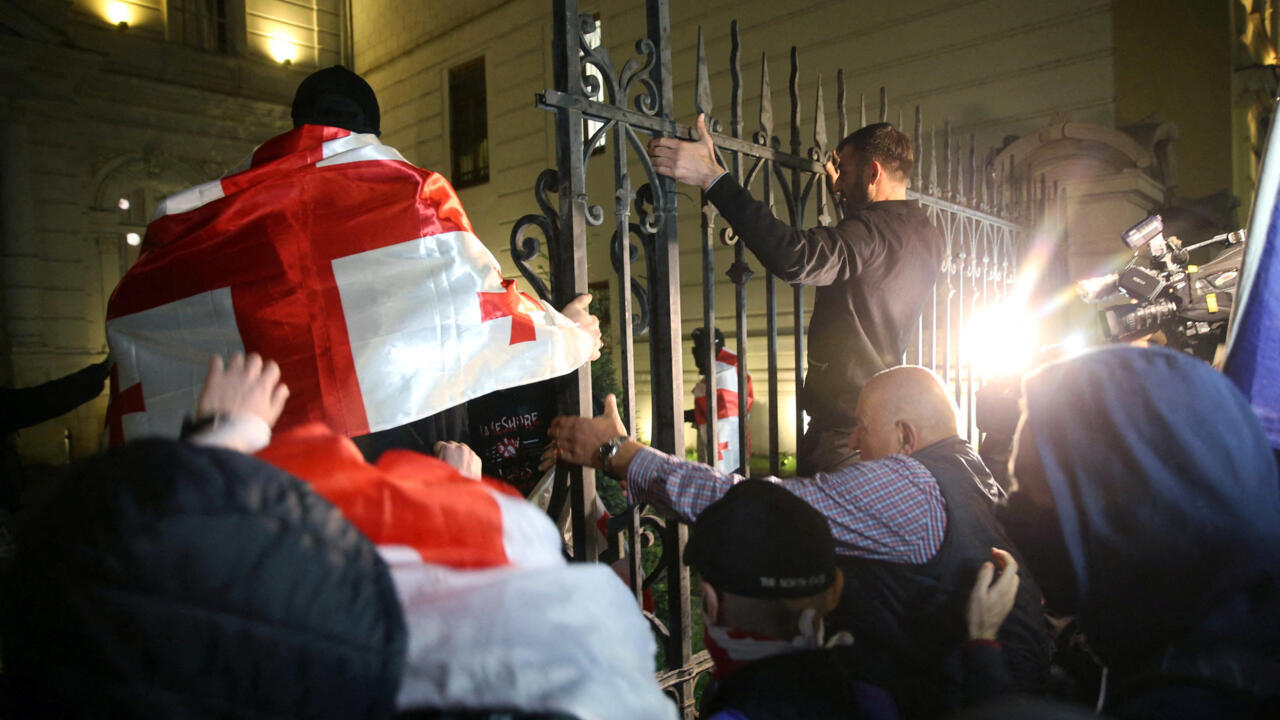
Tbilisi (AFP) – Georgia's Prime Minister Irakli Kobakhidze vowed opposition arrests Sunday after police used force against opposition protesters who tried to enter the presidential palace in what he termed was a coup bid during a controversial election.


Issued on: 05/10/2025 - RFI


Saturday saw protesters burn barricades and clash with police during an opposition rally on the day of local elections © GIORGI ARJEVANIDZE / AFP


Saturday's local polls were the ruling populist Georgian Dream party's first electoral test since a disputed parliamentary vote a year ago plunged the Black Sea nation into turmoil and prompted Brussels to effectively freeze the EU-candidate country's accession bid.

The central election commission said Georgian Dream had secured municipal council majorities in every municipality and that its candidates scored landslide wins in mayoral races in all cities.

The normally low-key local elections have acquired high stakes after months of raids on independent media, restrictions on civil society and the jailing of dozens of opponents and activists.

On Saturday, tens of thousands of anti-government demonstrators flooded Tbilisi's Freedom Square after the opposition urged a "last-chance" election-day protest to save democracy.

A group of protesters later tried to enter the presidential palace, prompting riot police to use tear gas and water cannons to repel the crowd.

'Attempted coup'

The interior ministry said on Saturday it had opened an investigation into "calls to violently alter Georgia's constitutional order or overthrow state authority" and arrested five protest leaders who face up to nine years in prison.

Riot police disperse protesters © Giorgi ARJEVANIDZE / AFP


Among those arrested was a world-renowned opera singer and activist Paata Burchuladze who read out at the rally -- to loud applause -- a declaration claiming "power returns to the people," branding the government "illegitimate" and announcing a transition.

The pro-opposition Pirveli TV reported that the 70-year-old, was detained in the intensive care unit of a Tbilisi hospital, where he was being treated for a heart attack.

"Several people have already been arrested -- first and foremost the organisers of the attempted overthrow," Prime Minister Kobakhidze told journalists.

"No one will go unpunished... many more must expect sentences for the violence they carried out against the state and law-enforcement."

The government has "foiled an attempted coup planned by foreign intelligence services," he said earlier without giving details.
'Severe reprisals'

"This political force -- the foreign agents' network -- will be completely neutralised and will no longer be allowed to be active in Georgian politics," he said, referring to Georgia's main opposition force, jailed ex-president Mikheil Saakashvili's United National Movement.


Prime Minister Irakli Kobakhidze vowed a strong response 
© Ludovic MARIN / AFP/File


Saakashvili had urged supporters to stage a "last-chance" election-day protest to "save Georgian democracy."

Georgian Dream has vowed to ban all major opposition parties.

Rights groups say some 60 people -- among them key opposition figures, journalists and activists -- have been jailed over the past year.

Amnesty International said the elections were "taking place amid severe political reprisals against opposition figures and civil society".

In power since 2012, the party has faced accusations of democratic backsliding, drifting towards Russia and derailing Georgia's EU-membership bid enshrined in the country's constitution.

Georgian Dream rejects the allegations, saying it is safeguarding "stability" in the country of four million while a Western "deep state" seeks to drag the country into the war in Ukraine with the help of opposition parties.

Analysts say its blunt pitch -- claiming that the opposition wants war, but it wants peace -- resonates in rural areas and is amplified by disinformation.

A recent survey by the Institute of Social Studies and Analysis put the party's approval rating at about 36 percent, against 54 percent for opposition groups.

Georgian PM vows crackdown on opposition after protests, accuses EU of meddling

Georgian Prime Minister Irakli Kobakhidze said that up to 7,000 people attended a rally on Saturday, in a failed "attempt to overthrow the constitutional order" which he alleged was supported by the European Union. Kobakhidze vowed opposition arrests on Sunday, adding that they "will no longer be allowed to be active in Georgian politics".


Issued on: 05/10/2025 
By: FRANCE 24

Protesters attempt to break into the presidential palace grounds during an opposition rally on the day of local elections in Tbilisi, Georgia on October 4, 2025. 
© Irakli Gedenidze, Reuters

Georgian Prime Minister Irakli Kobakhidze said on Sunday that protesters who sought to force entry to the presidential palace had been trying to topple the government and accused the European Union of meddling in Georgian politics.

Kobakhidze vowed opposition arrests Sunday after the ruling party won local elections and police used force against protesters.

"Several people have already been arrested – first and foremost the organisers of the attempted overthrow," he told journalists, saying the country's main opposition force "will no longer be allowed to be active in Georgian politics".

Georgian riot police used pepper spray and water cannons to drive demonstrators away from the presidential palace and detained five activists on Saturday, as the opposition staged a large demonstration on a day of local elections.


Kobakhidze said that up to 7,000 people attended the rally but their "attempt to overthrow the constitutional order" had failed despite what he said was support from the EU.

"They moved to action, began the overthrow attempt, it failed, and then they started distancing themselves from it," Georgian news agency Interpress cited the prime minister.

"No one will escape responsibility. This includes political responsibility."

He accused EU Ambassador Paweł Herczynski of meddling in Georgian politics and urged him to condemn the protests.

"You know that specific people from abroad have even expressed direct support for all this, for the announced attempt to overthrow the constitutional order," Kobakhidze said.

"In this context, the European Union ambassador to Georgia bears special responsibility. He should come out, distance himself and strictly condemn everything that is happening on the streets of Tbilisi."

There was no immediate comment from the EU on the claims, but in July the EU's diplomatic service rejected what it said was the "disinformation and baseless accusations" by the Georgian authorities about the EU's alleged role in Georgia.

"Recent statements falsely claiming that the EU seeks to destabilize Georgia, drag it into war or impose so-called 'non-traditional values,' constitute a deliberate attempt to mislead the public," it said in July.

The governing Georgian Dream party said on Saturday it had clinched victory in every municipality across the South Caucasus country of 3.7 million people in an election boycotted by the two largest opposition blocs.

Georgia's pro-Western opposition has been staging protests since October last year, when GD won a parliamentary election that its critics say was fraudulent. The party has rejected accusations of vote-rigging.

Once one of the most pro-Western nations to emerge from the ashes of the Soviet Union, Georgia has had frayed relations with the West since Russia invaded Ukraine in 2022.

(FRANCE 24 with Reuters and AFP)
WOMEN'S RIGHTS

The 'wowo' women carrying DRC's border trade on their backs, despite the risks


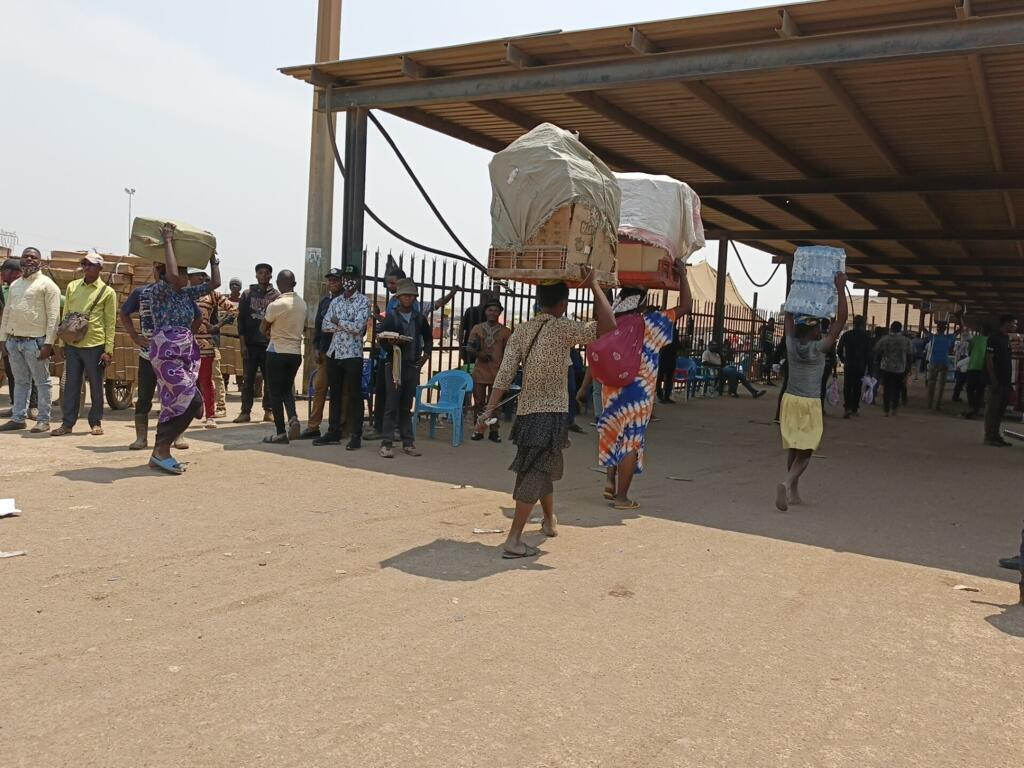
Hundreds of women carry cross-border trade on their heads and backs every day at Kasumbalesa, the Democratic Republic of Congo’s second-busiest border crossing into Zambia. Their work keeps supply chains moving, but they endure extortion and harassment for work that gives little return.


Issued on: 05/10/2025 - RFI

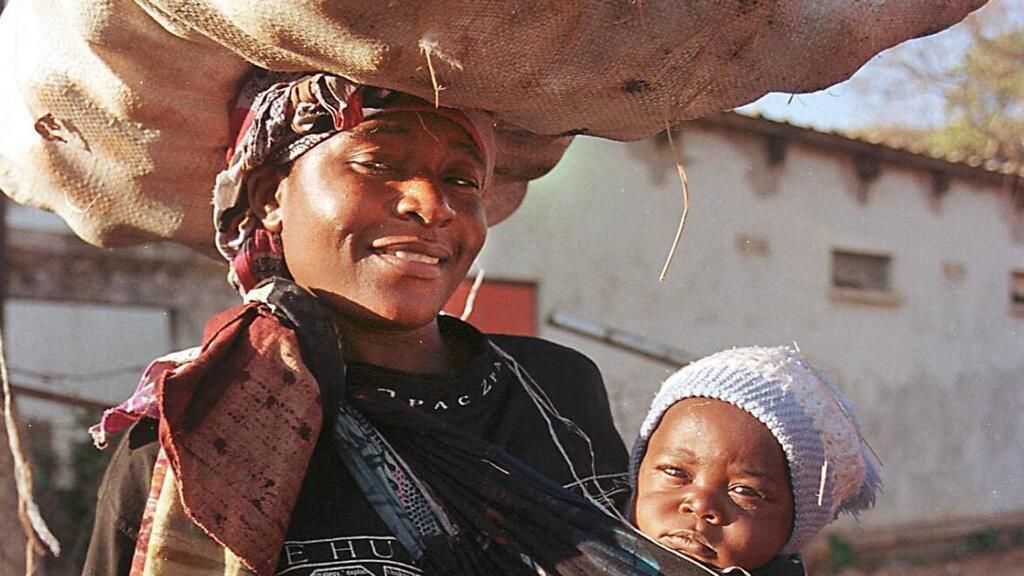
A woman carrying a sack of potatoes on her head waits to cross the border from Zambia to the DRC at the Kasumbalesa border-post. 
© AFP - ODD ANDERSEN

They call themselves "wowo" after the Chinese goods trucks that are a common sight here.

“I am able to move the cargo of an entire truck,” Alphonsine tells RFI, smiling, as she stands near the crowded pedestrian corridor at the border crossing.

“We are the ‘wowo’ mothers – like the trucks that carry big loads. We work as a team. If we have to unload the truck, we do it and then we carry the cargo to its destination in [DRC], according to the owner’s instructions.”

These women haul loads of up to 30 kilograms – flour, cooking oil, soft drinks and other everyday goods – for small traders who often dodge formal customs procedures.

Many of the women, who are of all ages, work entirely in the informal sector, according to the Association of Women Active in Cross-Border Trade (AFACT), a local group that supports female traders.

The women carrying the burden of Kenya’s rural healthcare on their backs


Hard work, small returns

Each trip pays around 1,500 Congolese francs – less than one US dollar. To earn $5 a day, a woman needs to haul roughly a tonne of goods, in several runs. The work is exhausting, but many see no alternative.

“Each of us has a quantity we must carry,” Keren told RFI as she stacked packs of soft drinks. “I have 25 packs. The trader bought 100. That’s not much. OK, let’s go for the last trip.”

Many of the traders are small shopkeepers or market sellers who buy stock in Zambia and bring it back to the DRC. They often prefer to keep a low profile and let the porters handle the border crossing.

“The small trader comes to buy all sorts of items – juice, wheat flour, vegetable oil,” said Régine Mbuyi, one of the wowo women.

“He asks me to get these products across. If he is acting in good faith, he also gives me money to pay customs and other public services. But if he has nothing, I have to manage on my own.”

Illegal logging threatens livelihoods of hundreds of Ghanaian women

Wowo women at the Kasumbalesa border post. 
© Denise Maheho/RFI

Customs authorities say this informal trade costs the state nearly $3,000 in lost revenue each day.

To tackle this, Malaxe Luhanga, head of a small cross-border transporters’ association that represents local porters, wants the work to be officially recognised and taxed.

“We can apply a grouping system according to the category of goods and have them officially taxed,” he told RFI. “We can adopt this system, which is accepted by member countries of Comesa, to make trade and taxation easier for public authorities.”

Comesa – the Common Market for Eastern and Southern Africa – is a regional trading bloc that includes both the DRC and Zambia.

Crossing the border often means paying a chain of bribes.

“There are three barriers,” says Anto, balancing a sack of flour on her head. “At the exit from Zambia, I pay 500 Congolese francs. In the corridor, I give 1,000, and a bit further on, I pay another 1,000. Once outside the corridor, other public agents are waiting. Sometimes I negotiate and they let me pass.”

Sexual harassment


On top of having to pay bribes, many of the women also face verbal abuse while doing their work.

“They often insult me,” says Jacquie, a young widow waiting at the end of the corridor. “These agents say: ‘Why are you here? Where is your husband? Is he incapable of feeding you?’ I don’t care – we put up with it because they don’t know my situation.”

Some women have reported more serious harassment.

“When an agent stops me, sometimes he asks for sexual favours to let the goods through,” says Régine Mbuyi. “It also happens that during the search, these agents allow themselves to touch us, even on intimate parts. It’s humiliating.”

Amnesty International has reported on this harassment, exploitation and violence faced by women working as informal cross-border traders across southern Africa. The women have no social protection or legal recourse.

AFACT has repeatedly denounced these abuses of power.

"Some girls have been humiliated and stripped, and we have proof. We also have women who have been publicly whipped. When the association wants to intervene, we are told to leave the situation as it is. Why can’t a woman do work of her choice?” says AFACT president Solange Masengo.

RFI was unable to get a response from the mayor of Kasumbalesa or the local deputy head of customs.

Despite the exhaustion, the abuse and the risks, the wowo women of Kasumbalesa keep going, shouldering their burdens day after day to support their families and keep local trade alive.

This story was adapted from a two-part series by RFI's Denise Maheho published and broadcast in French.


Meta to use your AI chats to give you targeted ads. Will it come to Europe and can you opt out?


By Pascale Davies
Published on 

Meta devices and AI products will get better at selling you stuff. And you can’t opt out.

Instagram’s chief has said that the social networking company is not actively “listening” to its users to target them with adverts. However, parent company Meta will no longer even need a microphone to target you with ads. It will use its artificial intelligence (AI) instead. 

Adam Mosseri said on his Instagram account on Wednesday that parent company Meta, is not secretly turning on microphones. “I swear, we do not listen to your microphone,” he said.

However, Meta may not need to use microphones, as the company announced on Wednesday that it will soon show ads and other content to users based on interactions with its digital assistant and other products that use artificial intelligence (AI).

 Here is everything you need to know about the changes. 

Which Meta products will be affected?


Meta has generative AI in its digital assistant, which can be used in its apps Facebook, Instagram, WhatsApp and Messenger. Its AI is also in a stand-alone app and website.

Meta CEO Mark Zuckerberg said in May that the AI digital assistant has more than one billion active monthly users on its apps. He also said that “there will be opportunities to either insert paid recommendations” or offer “a subscription service so that people can pay to use more compute”.

Users of the Ray-Ban Meta glasses will also be impacted if they use Meta’s AI digital assistant. 

How does it work?

Both audio and text interactions with Meta AI would be counted. 

“While this is a natural progression of our personalisation efforts and will help give us even better recommendations for people, we want to be super transparent about it and provide a heads up before we actually begin using this data in a new way, even if people already thought that we were doing this,” Meta privacy and data policy manager Christy Harris said at a press briefing. 

She said that one example could be that users use Meta AI to plan family holidays, the digital assistant’s responses could influence the kinds of video adverts that appear on Facebook, for instance.

“So the Reels that I see on my Facebook feed or other types of content that is recommended to me could include family friendly travel destinations,” Harris said. “It could include ads for hotels or other signals that would be informed by the conversation that I have had with Meta AI”.

Can you opt out?

No, users cannot opt out. The only way to not be included is if users don’t use Meta AI.

When will it come to Europe?

Users in the United States will receive notifications of the change starting on 7 October and it will take effect on 16 December.

Meta plans to debut the recommendation update to users in the United Kingdom and the European Union, “following our usual regulatory updates,” Harris said during a media briefing.

Meta would have to comply with Europe’s data protection rules, known as GDPR it is so far unclear how it would do so and if the European Union would take aim at Meta.

Meta AI came to Europe eight months after it was launched, due to regulation, which prioritises people’s data privacy, making it harder to train AI models, and levels the playing field between tech giants and smaller companies.


The new hybrid working norm in the UK: How many days in the office?

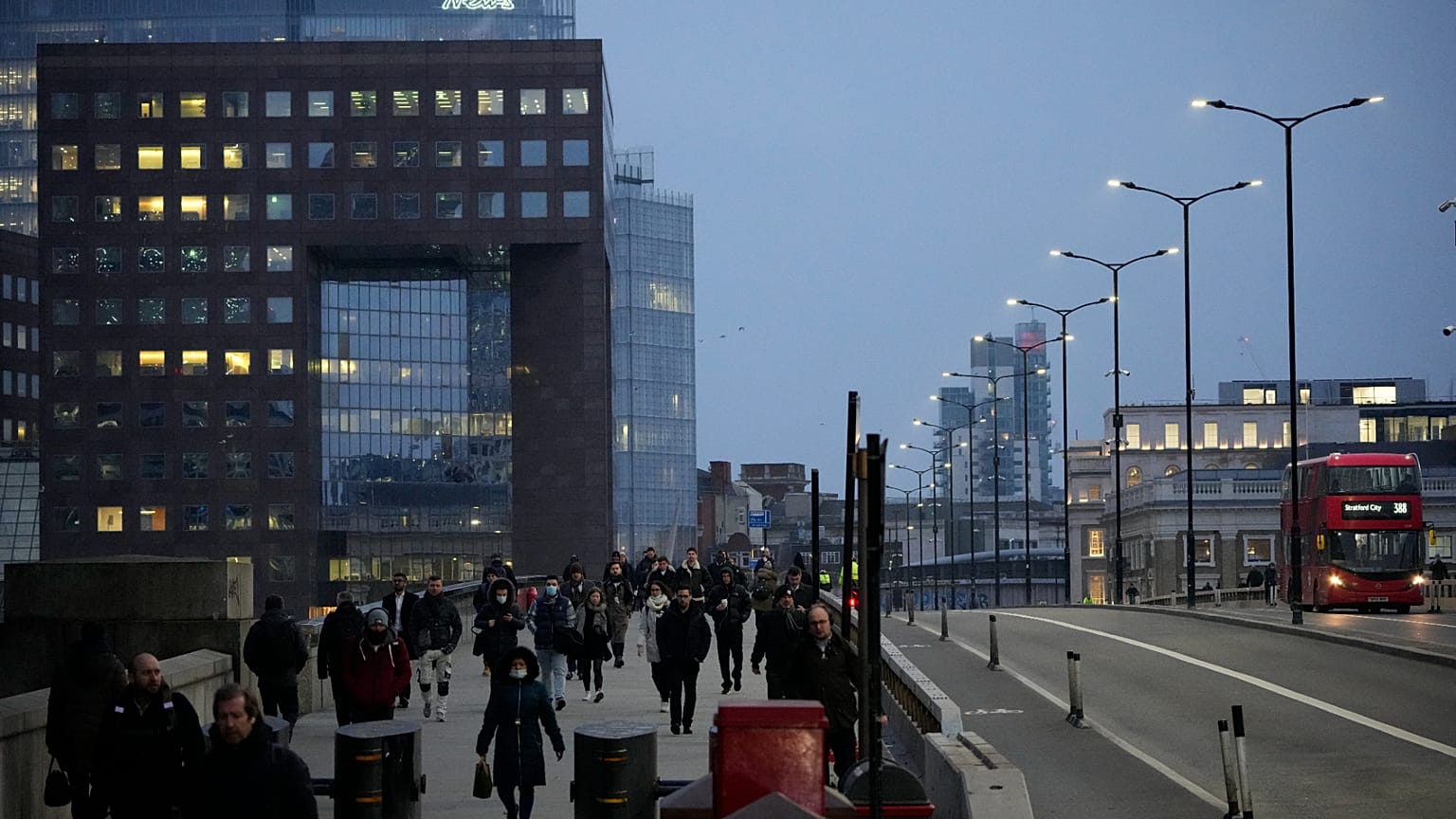
Workers walk over London Bridge towards the City of London financial district during the morning commute, in London. 24. Jan 2022.
Copyright AP/Matt Dunham


By Servet Yanatma
Published on 


While hybrid work is on the rise, UK employers are requiring more in-office days. Two- and three-day schedules now account for 81% of hybrid roles.

Remote working, or working from home, rose sharply during the COVID-19 pandemic in many parts of the world, especially in Europe. As restrictions eased, office returns began, and the number of people working from home gradually declined. 

Hybrid working is now more common. In the United Kingdom, 28% of staff worked in this setup in the first quarter of 2025, according to ONS. This is compared to around 10% during the same period in 2021. Hybrid work was also more common among full-time workers, reaching 34% in early 2025. 

While hybrid work is on the rise, the number of days employers require staff to be in the office is increasing in the UK, based on job posting data from the global hiring platform Indeed.

“2 to 3 days a week in the office has become the norm in the UK,” Indeed finds.

In 2025 through August, 85% of UK job postings mentioned a hybrid schedule requiring at least two days a week in the office, compared with 65% in 2022, according to Indeed.

The number of in-office days in hybrid roles shifted significantly between 2022 and 2025. One-day requirements fell from 35% in 2022, to 15% in 2025. Two days rose from 48% in 2022, to 56% in 2025. Three days increased from 16% in 2022, to 25% in 2025. 

Four days reached 4% in 2025, up from 1% in 2022.

“Employers are tightening these hybrid arrangements, requiring more frequent office attendance than before,” said Jack Kennedy, Indeed's senior economist.

The figures show that two days in the office is the most common hybrid pattern, accounting for 56% in 2025. Together, two and three days make up 81% of hybrid roles.

Occupation matters in hybrid work

The type of job a worker has plays a key role in the number of in-office days for hybrid positions in the UK. Accounting, human resources, and software development have the highest average minimum in-office requirements, while social sciences and architecture jobs require relatively few, according to Indeed.

On average in 2025, the occupation with the highest number of required office days is accounting (2.4 days), followed by human resources (2.3 days) and IT infrastructure, operations & support (2.3 days).

Software development roles

Almost half (48%) of UK software development jobs mention remote or hybrid work, the highest share among all occupations tracked by Indeed. However, these jobs now require an average of 2.3 days in the office, up 0.6 days over the past two years. Indeed notes this as surprising for an industry long seen as relatively remote-friendly.

“The increase in required office days could reflect employers wielding more leverage in a subdued market for tech talent, and/or wanting to promote greater in-person collaboration,” Kennedy explained in an Indeed blog post.

Occupations with fewer in-office days on average include social science and architecture, both at 1.6 days.

UK postings mentioning remote and hybrid work

The share of UK postings mentioning ‘remote and/or hybrid work’ has remained fairly stable at around 15% for several months, close to all-time highs. This is significantly lower than the ONS figures because they measure different indicators. Indeed’s data is based on job postings from its platform, while ONS reflects the actual workforce in the country.

“Several years after the pandemic-driven shift to remote work, hybrid arrangements remain in flux, and there remains substantial variation in employer policies,” Jack Kennedy noted.

He also pointed out that market conditions continue to play a role. With the current softness in the labour market, employers may feel they have the upper hand, leading some to push for greater on-site attendance.

According to the Global Survey of Working Arrangements (G-SWA), the UK has the highest rate of remote working among 18 European countries, with employees averaging 1.8 days a week at home. More broadly, this places the UK second out of 40 nations.


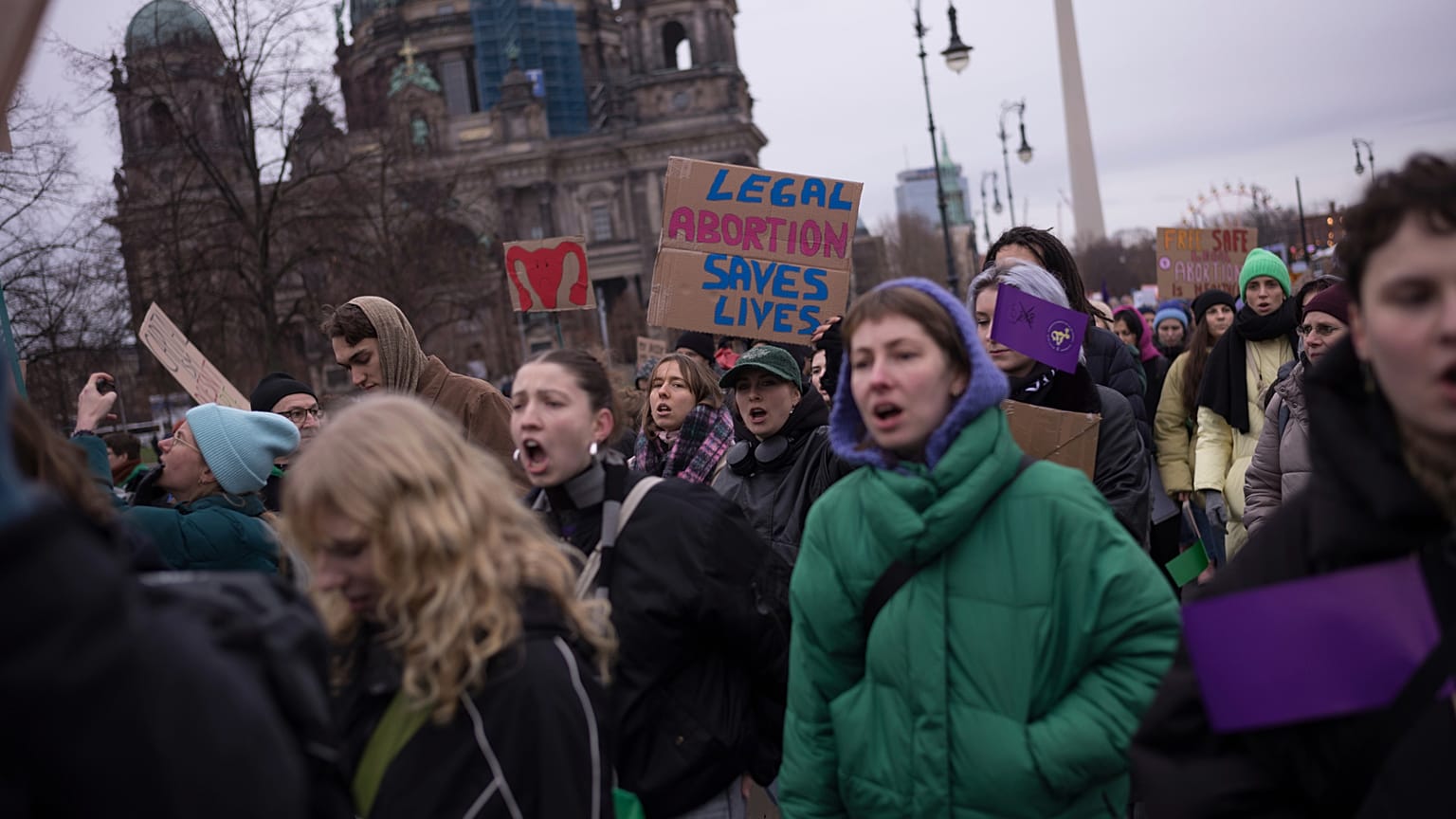
European Commission to consider fund for EU-wide access to abortion

People show posters and shout slogans as they attend a demonstration for the legalisation of abortion in Berlin, Germany.
Copyright AP Photo

By Paula Soler & Marta Iraola Iribarren
Published on 


The European Commission will study a proposal to create a fund to help women access safe abortions when they cannot do so in their own countries due to restrictive laws, following a citizens’ campaign that gathered one million signatures across the EU.

At 26 weeks pregnant, Mirela Čavajda found out her baby had a grave medical condition and would either be born with life-threatening conditions or most likely die before birth.

When Čavajda sought medical support in Zagreb, doctors at four different hospitals refused her request, some without explanation, while others said they could not confirm the diagnosis or did not have the necessary conditions to perform the procedure.

She then travelled to neighbouring Slovenia on doctors' advice, where a commission approved her request to terminate the pregnancy. The procedure cost her around €5,000.

In Croatia, abortion on request is legal up to 10 weeks of pregnancy. After this point, it is only permitted in specific circumstances, such as Čavajda's. The Croatian law dates back to 1972, and around one in every six doctors are conscientious objectors, meaning they can refuse to perform the procedure for moral or religious reasons. 

Čavajda's 2022 case drew massive media attention and sparked street protests. Within just two days, NGOs raised about €29,000 from 1,472 citizens and 16 organisations to support her. The surplus funds, according to the Croatian NGO leading the effort, were used to help women cover the costs of other healthcare services.

While a secondary commission approved her abortion amid public anger, and the health ministry promised to cover any costs of treatment abroad, the prolonged procedure and medical professionals' hesitation made Čavajda feel "left all alone", as she told media at the time.

While Croatian law remains restrictive, it is not the most severe in the EU, where Poland and Malta enforce near-total or total bans on abortion.

In Malta, the case of Andrea Prudente made headlines in 2022. Prudente, at 16 weeks pregnant and on "babymoon" in the Mediterranean island, suffered an incomplete miscarriage and had to seek an abortion, but could not have it in Malta, where it remains illegal under any circumstances. Because her life was in grave danger, her insurance arranged for her to be airlifted to Spain, where doctors carried out the abortion.

The case eventually led the Maltese lawmakers to ease the blanket ban on abortion where there was a risk to the pregnant person’s health. However, the law was subsequently amended to stipulate that they must be at risk of death to access an abortion — and even then, only after three specialists' consent.  

In Poland, the European Court of Human Rights (ECHR) found that a woman's rights were violated when she was forced to travel abroad after a 2020 constitutional court ruling banned abortions due to severe fetal abnormalities.

Another 2021 case of a woman named Izabela, who died of sepsis after doctors delayed a life-saving abortion, led to massive country-wide protests and the conviction of three doctors for endangering her life. However, the court ruling and other restrictions remain in effect.

Currently, an estimated 20 million women in Europe lack access to appropriate abortion services, according to the EU-wide My Voice, My Choice activist movement.

To prevent similar scenarios, My Voice, My Choice is now urging the European Commission to intervene.

“The idea is that the citizens of countries where they cannot get an abortion because of different reasons will be able to travel,” said Nika Kovač, leader of the movement, speaking to reporters on Wednesday after meeting with European Commissioner for Equality Hadja Lahbib. 

“Such practices already exist, for example, women from Poland have a good network of NGOs which are supporting their travels and medical procedures. But those medical procedures are costly, so what we want to do is to establish a way that NGOs or women themselves do not need to pay for them,” Kovač added.

The initiative has already gathered more than 1 million signatures — enough to trigger an official response from Brussels.

Brussels to respond by March

In response, the European Commission is reviewing the possibility of establishing a new voluntary fund to cover the costs of abortion for women who cannot access the procedure in their own country and must travel abroad for it.

As the proposal is still in its early stages, the exact details of how the fund would work are yet to be determined. However, it is proposed that member states would be able to choose whether to participate, with the EU providing financial support.

The Commission is expected to give campaigners an official reply by March 2026, outlining the actions it intends to take, if any. 

For a European citizens’ initiative like this one to be valid, it must meet certain conditions, including falling within areas where the Commission has the power to propose legislation.

If the Commission does put forward a legislative proposal, it would then need approval from the EU’s co-legislators — the European Parliament and the Council of Ministers.

Both steps could prove challenging, as some representatives of different member states argue that abortion remains a moral and religious matter, citing the need to protect human life, which in their opinion extends to unborn children at any stage of pregnancy.

The initiative does not aim to grant a right to abortion at the EU level, Commission spokespeople told Euronews.

In December 2024, Commissioner Lahbib pointed out that initiatives to amend abortion laws remain squarely in the domain of individual countries.

"It's a member state competence, so we will need an agreement from all of us. We will need this unanimity, but I hope that we will be able to protect women's lives," said Lahbib during her first appearance in the Parliament’s public health committee.