Monday, October 06, 2025


Trump’s H1-B Clampdown And Its Ordered Impacts – Analysis

india passport map travel


By 

By Vivek Mishra and Yogesh Mohapatra


Donald Trump’s announcement in September 2025 that H-1B visa fees will rise from US$5,000 to US$100,000 has sent shockwaves throughout corporate America, India, and the world. This follows his statement two months prior, when he demanded that United States (US) tech giants such as Google and Microsoft “stop hiring in India” and bring jobs back to American soil, a concrete step in his “America First” labour push.

Reactions were immediate.

Tech investors and executives warned that these new hikes would cost companies millions and disproportionately hurt startups in the US. Indian officials also expressed alarm, as this announcement directly contradicts the celebratory February 2025 joint statement, which exalted the 300,000-strong Indian student community, contributing US$8 billion annually to the US economy.

Although the new steep fee applies to H1-B visa applicants from the next cycle, it has fuelled the political and communal rhetoric in the US, largely directed against Indians who are the largest recipients of this particular Visa category in the US. As the midterm campaign rhetoric builds momentum in the US, the H1-B visa shock is poised to become an economic and electoral flashpoint.

At the political level, these restrictions also feed into the xenophobic narrative which characterises the ‘Make America Great Again’ (MAGA) campaign, being consistently channelled against Indians in the US. The economic impact of these changes is wide-ranging, from IT firms and remittances to, skilled labour mobility in American universities.


The altered circumstances and new realities facing American immigration rules now pose new questions of how these changes would affect both economies, especially through changes in talent flows, the education landscape, and possibly even reverse migration.

Indian talent serves as a core pillar of the US tech workforce, both through direct employment and offshore services. In 2024 alone, Indian nationals received over 207,000 visas, and Indian companies secured 20 percent of all H-1B approvals, reflecting their dominance in the US visa pipeline. This presence is fueled by a growing stream of Indian students, who now represent a quarter of all international students in US universities. Many utilise the Optional Practical Training (OPT) programme to work immediately following graduation, and eventually transition to full-time tech roles. Over time, many rise to leadership positions, as witnessed via the dominance of Indian-origin CEOs across Fortune 500 companies, including Google, IBM, Adobe, and Microsoft.

From an offshoring perspective, India’s tech industry is deeply entwined with US corporate operations. In FY 2024-2025, India’s outsourcing exports in customer service, market research, IT services, engineering, and other professional services were projected to reach US$210 billion. It will also employ around 5.8 million professionals, with the US alone accounting for about 60-65 percent of this demand.

Through initiatives such as the US-India Initiative on Critical and Emerging Technology (ICET) and the Technology Resilience and US-Trusted Partners (TRUST) programme, American companies have established nearly 1,800 global capability centres throughout India, employing 1.9 million people. These include major operations such as JP Morgan Chase’s 55,000-strong workforce and Microsoft’s 18,000 employees in India, with one of its largest research and development (R&D) hubs in Hyderabad. This degree of integration means that any immediate large-scale reshoring efforts would disrupt the day-to-day functions of US firms, which rely on these centres.

While Trump’s promise to bring tech jobs back to the US sounds appealing from a US perspective, it faces significant issues. The first is that the US does not have enough qualified personnel to fill the roles of these Indian workers. Under the Department of Labour’s Permanent Labor Certification (PERM) process, employers must first advertise the position and prove that no US citizen or permanent resident is qualified before sponsoring a foreign worker for a green card. Even with these safeguards, demand for Indian talent remains high for reasons besides filling gaps. Increasing H-1B shares in an occupation sector by just one percentage point correlates with a 0.2 percentage point drop in unemployment as well as a 0.1-0.26 percentage point faster earnings growth for US workers in that field.

Furthermore, the private sector has pushed back against reshoring proposals for practical reasons. Labour cost differences are immense as Indian IT professionals often earn a fraction of what Silicon Valley tech-sector workers do. This means that forcing work onshore would raise costs, devastate profit margins, and ultimately hinder innovation. History also suggests that these kinds of measures backfire. In 2020, when Trump temporarily banned several work visas, many companies increased remote offshoring, highlighting the limits of such mandates.

For India, a hiring freeze or visa clampdown by the US would be devastating. In FY 2024, India’s IT sector contributed around 7 percent to the Gross Domestic Product (GDP) and benefited significantly from exports. 79 percent of India’s IT service revenue is export-driven, with the US being the largest market by far, responsible for 60 percent of tech export demand—nearly US$135 billion annually. This means that any kind of freeze would be detrimental to India’s GDP growth and trade balance.

Even a minor downturn in US tech spending already prompts these Indian IT firms to reduce hiring, meaning a political freeze would put hundreds of thousands of Indian jobs at risk and force far deeper layoffs. Beyond exports and employment, India is also the world’s top recipient of remittances, reaching a record US$129.4 billion in 2024 via remittances, with 27.7 percent coming from the US. Freezing work visas or employment by American companies could seriously affect these remittance flows, potentially weakening the rupee and causing strain on Indian households.

In response to US work visa restrictions, global redistribution of Indian talent could accelerate. Canada’s pro-immigration policies have already driven a 326 percent increase in Indian immigrants over the past decade, positioning them as the top source of international students, temporary workers, and permanent residents. Australia and Germany have also expanded migration programmes for those in the STEM (Science, Technology, Engineering, Mathematics) field, while Indian student enrollment in European universities rose 45 percent between 2015 and 2023. This policy-driven redistribution is not unprecedented; companies such as Wipro opened digital innovation hubs in Germany during Trump’s first term, partly to mitigate US policy uncertainty.

As migration is becoming more accessible in other destinations, US tech firms risk losing access to vital talent. Silicon Valley’s innovation capacity would be severely impacted, as 55 percent of US unicorns have an immigrant founder, and 40 percent of those founders are Indians/Indian-origin. Slashing this pipeline could risk the next Google or Artificial Intelligence (AI) breakthrough being developed in Toronto or Berlin instead.

A forced decoupling from the US could also empower a reverse brain drain, with skilled Indian professionals returning home. Currently, there are around 1.8 million Indian students abroad, and some have returned and founded companies such as Ola and Flipkart. Through initiatives such as Startup India and the Ramalingaswami Fellowship, India is integrating its talent into its expanding tech and startup ecosystem. The country’s recent push for self-reliance would also strongly benefit from this talent. However, this reorientation would take years to come to fruition, and in the interim, the loss of opportunities in the US would slow growth and strain the India-US partnership.

Restricted talent mobility between India and the US could also have an expanded impact. Collaborative initiatives such as TRUST showcase the unique vantage point of India-US cooperative potential in critical sectors. The lack of government support or worse still, manufactured hostility, is certain to slow the momentum or end programmes that rely on the exchange of ideas, joint research, and co-innovation. If sustained, shutting American doors to Indians, mixed with political resistance in the form of anti-migrant sentiments, could cause Indian talent flows to pivot to other favourable geographies or countries. Germany has already begun to woo Indian workers to gain from the talent deflection caused by US policies under the Trump administration.

Ultimately, Trump’s policy reversal to raise visa fees twentyfold is geared to restrict the hiring of foreign talent, but it will impact India the most. America’s innovation edge against the world will be hurt while negatively affecting one of its most strategically important relationships. India’s tech sector and remittance flows may witness immediate jolts. However, the longer-term challenges lie in the potential redistribution of talent toward US competitors and the acceleration of India’s reverse brain drain.

As India weighs deeper ties with other partners, cultivating decades-long people mobility chains and dependence akin to the one in its coalition with Washington will be difficult to replicate. As the world stands on the brink of another technological revolution driven by AI, quantum computing, and robotics, talent may become as critical as territory. India should strive to leverage the boon-in-disguise components of the crisis that has ensued as a result of America’s policy changes in the migration sector.


About the authors:

  • Vivek Mishra is Deputy Director – Strategic Studies Programme at the Observer Research Foundation
  • Yogesh Mohapatra was a Research Intern with the Observer Research Foundation

Source: This article was published by the Observer Research Foundation


Observer Research Foundation

ORF was established on 5 September 1990 as a private, not for profit, ’think tank’ to influence public policy formulation. The Foundation brought together, for the first time, leading Indian economists and policymakers to present An Agenda for Economic Reforms in India. The idea was to help develop a consensus in favour of economic reforms.

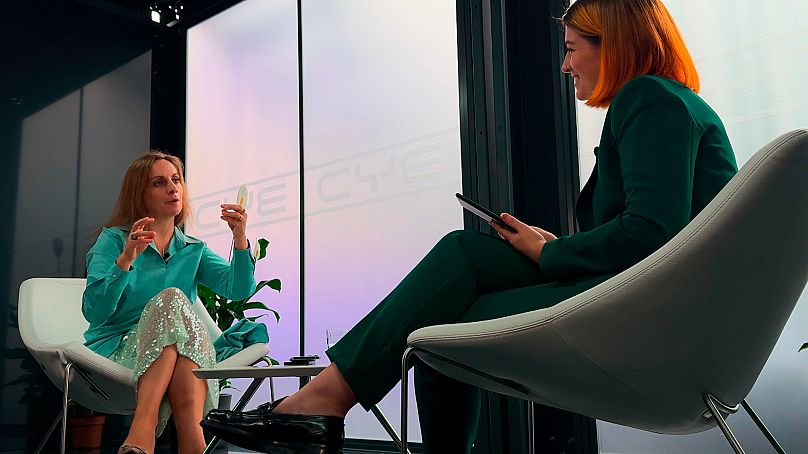
 

‘We have the product to play the game’: Can BYD’s meteoric rise in Europe continue?

BYD's Maria Grazia Davino chats to Hannah Brown on The Big Question
BYD's Maria Grazia Davino chats to Hannah Brown on The Big Question Euronews
Copyright Euronews

By Hannah Brown
Published on 

“The conversion rate from test drive to purchase is outstanding in every market,” BYD’s Maria Grazia Davino told The Big Question.

As the popularity of EVs continues to grow in Europe, so too does the strength of Chinese manufacturer BYD. 

The firm's first models, the Atto 3, Han and Tang, officially hit European forecourts in late 2022, though other companies had begun importing them in the preceding years. Since then, their range has grown to offer at least 10 different vehicles.

According to data from the European Automobile Manufacturers’ Association (ACEA), BYD had a 1.1% market share of new vehicle registrations in the EU in July 2025, up from 0.4% in the same period the year before. 

In the first half of 2025, unit sales increased 251.3% compared to the previous year, while EU new car registrations on the whole decreased 0.7% in that same period.

But with increased import tariffs for Chinese manufacturers making it harder to stay competitive, are European fears of a Chinese takeover unfounded

In this episode of The Big Question, Euronews reporter Hannah Brown sat down with Maria Grazia Davino, senior vice president and regional managing director at BYD Europe, to discuss the firm’s vision for its future in the bloc. 

BYD takes on Europe

Davino, who joined the company earlier this year from Stellantis, spoke with a clear confidence in BYD’s vehicles. Perhaps, in part, due to her own experience.

“People sit in the car and you surprisingly see that the immediate acceptance is there—actually we exceed customers' expectations,” she explained. 

“This is not only my direct experience, [it’s] what I observe, what customers tell me, what dealers tell me. The conversion rate from test drive to purchase is outstanding in every market.”

“BYD comes to Europe with a full commitment to enrich the industry,” Davino told The Big Question. 

“We have superior technology and the product to play the game. There has been some narrative around it—like ‘you want to conquer’—no, it's not about conquering, we can't, we are so small compared to the others. 

“I always say we are fuelled by the challenges that also humble us, and we are here to enrich the industry.”

Tougher competition for non-European companies

Right now in the EU, Chinese manufacturers pay an additional import tariff, on top of the standard 10%. SAIC, once China’s largest auto manufacturers, faces the steepest additional tariff at 35.3%. Geely, the parent company of Volvo, pays 18.8%, and BYD pays 17%. 

Many vehicles made by the US firm Tesla are also manufactured in China, although the company’s additional tariff comes to just 7.8%. Despite this, BYD managed to outsell Musk’s famous EV brand in Europe for the first time in April 2025. 

In addition to these tariffs, France recently announced incentives for consumers to buy EVs assembled in Europe and equipped with a European battery, a move designed to support European manufacturers

“It just makes the competition tougher, but we are okay in competing,” Davino said. 

“That's our company culture, you know. We are there to collaborate and compete, so we'll have to face it, be better, find alternatives so we will continue to compete.”

In a bid to strengthen the company’s presence in the bloc and boost competitiveness by avoiding import tariffs, BYD has established a manufacturing plant in Hungary. Production is set to begin by the end of the year.

“So the first product we will be producing there is a Dolphin Surf. And that's just a start, because at our plants, we can produce more than one car line, so that makes our productivity very flexible,” Davino told The Big Question. 

“The teams at the dealers are also growing, and our brand in the market requests a certain number of qualified salespeople. So we also contribute to the [training and] qualification of these people.”

Will hybrids continue to outperform EVs?

Right now, hybrids are the most popular vehicle by power type, making up 34.8% of all new car registrations in Europe in the first half of 2025. 

The key to their popularity, according to Davino, is that they’re providing a “convenient alternative”.

“You have a true electric vehicle with a 100km range. For example with the Seal 6 DM-i Touring that we have brought on the market now, just launched, you have a vehicle that does not give you any anxiety. With our vehicle, you can go up to 1,350 kilometres range,” She claimed that recent drivers were able to drive from Warsaw to Munich without needing to stop to refuel. 

As technology improves and EV range increases, Davino said she can’t predict if the popularity of full electrics will surpass hybrids, emphasising that it's consumers deciding the fate of the industry. 

The Big Question* is a series from Euronews Business where we sit down with industry leaders and experts to discuss some of the most important topics on today’s agenda.****

Watch the video to see the full discussion with BYD’s Maria Grazia Davino. 


‘When people buy an EV, they rarely go back’: Hyundai CEO on designing for Europe

Hannah Brown chats to Xavier Martinet, CEO of Hyundai Motor Europe on The Big Question.
Hannah Brown chats to Xavier Martinet, CEO of Hyundai Motor Europe on The Big Question. Euronews

Copyright Euronews

By Hannah Brown
Published on 

“If you're the second preferred vehicle for the customer, you're the first one they're not buying,” Xavier Martinet, President and CEO of Hyundai Motor Europe, told The Big Question.

Hyundai is probably one of South Korea’s most globally recognisable brands, with only the likes of Samsung and LG also vying for the title. 

The Hyundai Motor Group, which owns Kia and Genesis, first arrived in Europe in the late 1970s. However, it was only in 1997 that they opened their first production site outside of South Korea, in Turkey. 

“If you look at personal cars we're at 4% market share in Europe, we're ranked number 10 on the market,” said Xavier Martinet, President and CEO of Hyundai Motor Europe. 

“When you look back in time, 10-15 years ago we were at half this market share, so Hyundai has been growing over time.” 

In their 58 years of business, the company has managed to produce more than 100 million units worldwide and its factory in Ulsan, South Korea, is the largest automotive production plant in the world. 

In this episode of The Big Question, Hannah Brown sat down with Xavier to discuss Hyundai’s place in the European market and how it sees the future of automotive power.

Hyundai in Europe

Aside from the production plant in Turkey, Hyundai has also been producing vehicles at a plant in NoÅ¡ovice, Czech Republic, since 2008. Together, the two sites have a production capacity of 560,000 units per year. 

According to Xavier, 79% of the vehicles sold by Hyundai in Europe in 2024 were produced in these two plants. 

However, the greater-than-predicted success of their smallest EV to date, the INSTER, produced in South Korea, is expected to roll that number back to 70% in 2025. 

While Xavier insists there’s no third plant planned in Europe just yet, he suggested that regional success for the firm’s newest releases could ignite a conversation around future investment. 

A new EV from Hyundai

Hyundai recently announced the Concept 3 car, an EV in its IONIQ range that’s expected to hit the market early next year. 

Positioned in the B-segment, accompanied by the likes of the Ford Fiesta, the Renault Clio and the Peugeot 208, the compact Concept 3 underlines Hyundai’s focus on offering EVs across all market segments—according to Xavier.

“What we see, for example, is that the EV mix is actually higher for fleet customers (who typically buy C- or D-segment vehicles), but retail buyers right now have a lower mix of EV. They still want to buy the old ones because either they don't find the car they want or the price is too high,” he explained.   

“And this is why for us targeting this lower part of the segment with strong EV propositions was fundamental.”

He also highlighted the need to tailor vehicles specifically to the European audience. 

“We need to develop products that are really taking into account European customers’ needs, lifestyles, demands—and the Concept 3 is a perfect illustration of that. When we do have global products, we need to calibrate them because you don't drive on the German Autobahn like you drive on an Interstate in the US, so we need to be able to really adjust and fine-tune the vehicle characteristics so that vehicles satisfy the customers wherever they drive,” Xavier told The Big Question.

What will power cars in the future?

Despite targets to boost EV uptake and Hyundai’s Concept 3 announcement, hybrid cars remain the most popular vehicle type for new purchases in Europe.

“Customers are usually keeping a car an average of six years in Europe. And for them to go directly from an internal combustion engine vehicle to an EV is an act of faith,” Xavier explained. 

However, Hyundai isn't putting all their eggs into one metaphorical EV basket. They’re also leading innovation in the hydrogen-powered vehicle world. 

“EVs are one great way to electrify the car park, but we also have some questions about access to rare earth materials and whether these tensions will really change,” Xavier said. 

“So it's quite interesting to develop some kind of alternative that one day might become quite valuable as a compliment. So we're not opposing the two, we're just saying it's good to have different solutions to decarbonise the car industry.”

Right now, the hydrogen-powered vehicle market in Europe is virtually non-existent, with sales only in the hundreds. Cost and infrastructure are two of the main limitations, although Hyundai’s US branch is working on solutions. 

“We're developing a car, bus, truck, and when you look at our plant in Savannah, Georgia in the US, we are also producing our own hydrogen. So, at the end of the day, you are not talking about one car, you talk about an ecosystem,” Xavier explained. 

In a symbol of its commitment to diversifying power solutions, Hyundai has pledged to offer European customers an EV, hybrid, plug-in hybrid and hydrogen powered version of each of their models by 2027. 

The Big Question is a series from Euronews Business where we sit down with industry leaders and experts to discuss some of the most important topics on today’s agenda.

Watch the video to see the full discussion with Hyundai’s Xavier Martinet. 

From James Bond to budget cuts: Tariffs put pressure on Aston Martin

FILE. The original Aston Martin DB5 driven by Sean Connery in the James Bond films Goldfinger and Thunderball went on sale in London in July 2010.
Copyright Matt Dunham/AP

By Una Hajdari
Published on 

The British carmaker’s warning of deeper-than-expected losses sent shares plummeting, a stark reminder that prestige cannot shield a brand from tariffs and sluggish demand.

Aston Martin has warned investors to brace for deeper-than-expected losses this year, the latest blow to Britain’s glamorous but persistently unprofitable carmaker.

Ahead of its third-quarter results on 29 October, the company said it now expects a full-year loss even greater than the previous estimate of £110 million or €130mn, forcing yet another reset for a brand that has been fighting to regain its footing.

The guidance cut jolted investors, sending shares tumbling about 8% on Monday morning. The stock has dropped 29% since January and 31% over the past year, a reflection of traders’ frustration at Aston’s performance.

"Aston Martin has been caught up in a cocktail of headwinds. As an automaker that manufactures outside of the US, it has been hit painfully by Trump’s tariffs, particularly when combined with the broader challenging macro backdrop," said Victoria Scholar, head of investment at Interactive Investor.

British-built cars have been hit hard because Aston Martin has no alternative American manufacturing base, unlike other companies that are able to avoid the brunt of the tariffs by boosting US production

The group is also grappling with weakness in key markets, particularly North America and China, where the slowdown in luxury consumption has minimised demand for high-priced sports cars. Further clouding the outlook is the US federal government shutdown, adding another layer of uncertainty for exporters.

Aston Martin cut about 5% of its workforce in February as losses deepened, part of a wider attempt to contain costs while funding an ambitious product pipeline.

US tariff quota system hurts Aston Martin

Under the new US-UK trade arrangement, only a fixed number of British-built cars can enter the US each year at a lower import tariff. Once that quota is filled, any further vehicles face sharply higher duties — in some cases up to ten-times more.

The US' aim is to protect American automakers while still allowing limited market access for some European brands.

Large manufacturers with US plants or high-volume exports frontload their shipments and quickly fill up the total quota for the UK. Brands like Aston Martin, which build fewer cars and ship in smaller batches, often miss that early quota window, leaving them exposed to the full tariff.

This system forces automakers like Aston Martin to make costly trade-offs: either absorb the tariff hit, which constrains profit margins, or delay deliveries until the quota resets, which stalls revenue and disrupts cash flow.

The result is a stop-start export rhythm that makes financial forecasting harder and undermines competitiveness against rivals with local production or larger lobbying power.

Why Aston Martin’s sales matter

Despite its modest volumes, Aston Martin’s performance carries symbolic and economic weight. The brand is one of the few independent luxury carmakers still designing and assembling in Britain — a bellwether for the health of the UK’s high-end manufacturing sector

"A lot is riding on its first ever limited production mid-engine hybrid supercar, Valhalla, which is expected to start deliveries in the fourth quarter, entering production in Q3," Scholar said. "Aston Martin says profitability and free cash flow improvements in 2026 will be driven by the Valhalla and cost reductions."

Aston’s sales trajectory is also closely watched by analysts as a proxy for global luxury demand; when affluent consumers hesitate to spend six-figure sums on new sports cars, it signals a wider cooling in discretionary spending. A slump in Aston’s order book can therefore tell a story about the wider luxury industry, affecting Swiss watchmakers and European fashion houses alike.