It’s possible that I shall make an ass of myself. But in that case one can always get out of it with a little dialectic. I have, of course, so worded my proposition as to be right either way (K.Marx, Letter to F.Engels on the Indian Mutiny)
Tuesday, October 07, 2025
RIP
Seafarer from Dutch Cargo Ship Dies a Week After Houthi Attack
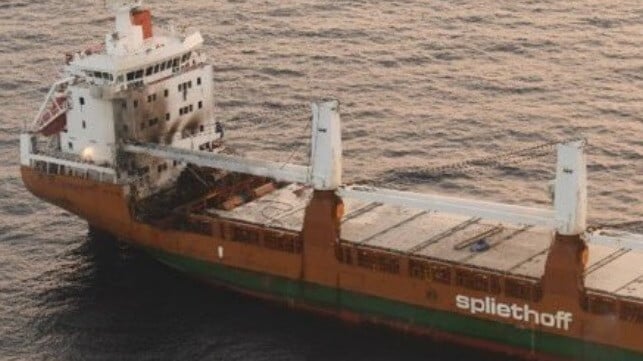
Fire damage on the front of accommodations block after the attack (Armée Française - Opérations Militaires)
Dutch shipping company Spliethoff issued a statement today, October 6, confirming that one of the two seriously injured crewmembers from its vessel Minervagracht passed away in a hospital in Djibouti. The individual had been evacuated from the ship after the attack on September 29, with the French forces having reported that the most seriously injured person was flown directly to Djibouti for medical care.
Spliethoff extended its condolences to the family of the seafarer and said it was assisting the family. No additional details were released on the individual other than that they had sustained “critical injuries” during the attack. Previous reports had said the crew was made up of individuals from Russia, Ukraine, the Philippines, and Sri Lanka. After being evacuated by the Greek frigate HS Spetsai and a French frigate, the other 18 members of the crew were taken to Djibouti.
Most of the crew of Minervagracht, Spliethoff reports, have now been repatriated to their home countries. One crew member remains under medical care in Djibouti. His condition is reported to be stable, and the company expects he will be able to return home later this week.
The 10 Filipino crewmembers aboard the Minervagracht reached the Philippines on October 4. The Department of Migrant Workers (DMW) reported their return while saying two others were still in Djibouti.
“The events of last week have left a profound impact on everyone at Spliethoff. Today’s news has deeply saddened everyone at the company, as we mourn the loss of a respected and valued seafarer,” the company wrote reporting the death.
This adds to the death toll of seafarers from the attacks by the Houthis. Four deaths were confirmed from the bulker Eternity C after it was sunk in July 2025 in the Red Sea. The first deaths came in 2024, with one seafarer reported missing after another cargo ship, Tutor, was attacked. Several other seafarers have sustained injuries during the attacks.
Spliethoff reported last week that it was engaging with international authorities and towage experts to safeguard and secure the vessel. The ship was abandoned on September 29 after the missile strike caused a fire that damaged the accommodation block on the ship. The UK’s monitoring operation UKMTO had reported the vessel as a hazard to navigation.
Hanwha Hires Former Top U.S. Navy Shipbuilding Officer
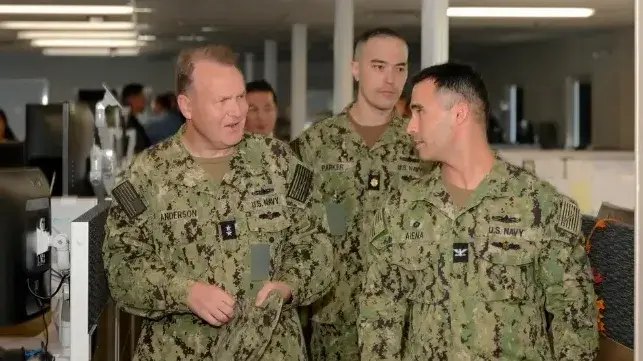
Rear Adm. Thomas Anderson, left, during his time as PEO Ships (USN file image)
Hanwha Ocean's U.S. defense division has hired a former leader of the U.S. Navy's shipbuilding enterprise to oversee its American operations. The decision is a strategic boost for Hanwha's bid to become a significant player in U.S. defense shipbuilding, which is dominated by two prime contractors.
Rear Adm. Tom Anderson (USN, ret'd) served in the U.S. Navy for 34 years, including time at the helm of Program Executive Office Ships and as acting commander for all of Naval Sea Systems Command (NAVSEA), the service's sprawling acquisition directorate. At sea, his tours included USS Capodanno (FF 1093) and USS Arleigh Burke (DDG 51). He picked the engineering duty community and held commands across the shipbuilding and repair enterprise, including head of the Littoral Combat Ship shipbuilding office; commander of a Naval Surface Warfare Center; and commander of surface ship maintenance. He took over as head of PEO Ships in 2020, and was selected to be acting commander of NAVSEA from 2023-4.
In his new role as President of U.S. Shipbuilding at the Hanwha Defense USA division, Anderson will hold responsibility for Hanwha's U.S. shipbuilding programs and yard operations; program strategy; and infrastructure and workforce improvements. The portfolio is a significant one: Hanwha purchased Philly Shipyard last year and has pledged to invest $5 billion in its expansion. Naval vessels, starting with auxiliaries, are square in Hanwha's sights for contracting opportunities.
Hanwha wants to increase its operations at Philly tenfold in ten years, and to get there it is investing in technological improvements to increase Philly's efficiency. It also has an active training program and it plans to create thousands of new jobs. To kickstart its book of business, it has announced a plan to order 10 Jones Act medium range tankers from itself - the largest commercial vessel order in the United States in 20 years.
Hanwha and "Big Three" brethren Samsung Heavy Industries and Hyundai Heavy Industries have all developed an interest in breaking into the U.S. market, and not just for their own business purposes. Korean shipbuilding expertise is valued by the Trump administration, and Korea's pledge to invest in American shipyard capacity was a major part of the recent trade deal that Seoul agreed with Washington. That deal secured competitive U.S. tariff rates for mission-critical Korean exports, like cars and computer chips.
USCG’s New Icebreaker Storis Completes First Arctic Patrol
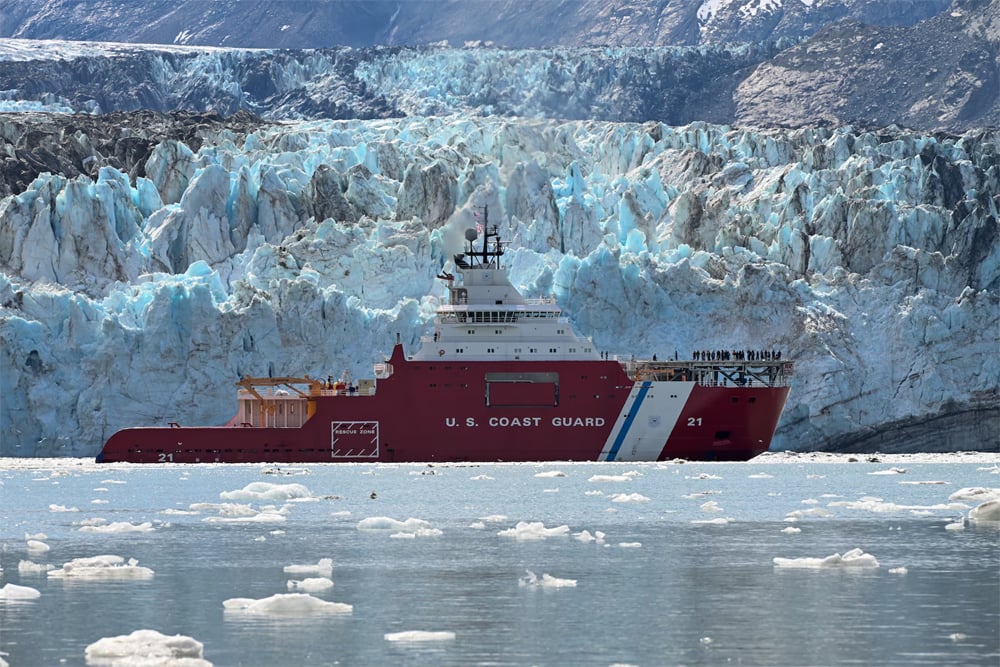
Storis compelted her first deployment of 112 days crossing for the first time into the Arctic for the USCG (Coast Guard photos)
The U.S. Coast Guard’s newest commissioned icebreaker, USCG Cutter Storis, returned to Seattle on October 3, completing its inaugural patrol. The medium polar icebreaker is still undergoing a number of upgrades in its first year with the USCG.
Storis entered the ice for the first time in September as a Coast Guard cutter to relieve USCG cutter Healy. She undertook a 112-day inaugural patrol, which saw her sail north of the Bering Strait. During her time, one of her tasks was to monitor the Chinese-flagged research vessels Jidi and Xue Long 2, which were operating in the Arctic this season. A total of five Chinese-affiliated research vessels were operating in the Arctic over the summer, and Storis was one of several vessels the USCG deployed to monitor activity.
USCG reports that throughout the cutter’s inaugural deployment, the crew conducted helicopter operations, gunnery exercises, established numerous operational and administrative programs, and organized multiple community outreach events throughout six port calls, providing tours to over 1,500 people. Storis is manned by a hybrid crew of military cuttermen and civilian mariners.
“In the span of a few months, this?crew has gained proficiency in the basics of operating the ship, and we were ready to challenge ourselves,” said Capt. Corey Kerns, commanding officer of the new icebreaker. “Storis is different from most Coast Guard cutters, and this crew is proud and excited to demonstrate its value to the service and the nation.”
The vessel is unique in that she is the first polar icebreaker acquired by the Coast Guard in over 25 years. She joins the USCG Polar Star and Healy as the polar fleet until the new polar security cutters can be built.
Storis was built in 2012 by Edison Chouest as Aiviq as an icebreaking anchor-handler for Shell's Arctic offshore drilling program. She saw limited operations, and the idea of acquiring her for the USCG dates back to 2016. The deal was finally progressed in 2024, and she was officially acquired on December 20, 2024. An initial modification was undertaken to enhance her communications and defense capabilities before she departed from Pascagoula, Mississippi, on June 1. She transited the Panama Canal and proceeded to Juneau, Alaska, where she was officially commissioned on August 10.
Now that the vessel has returned to Seattle after its patrol, Storis will enter a six-week training period where the ship and the crew will undergo major training evolutions, system and program recapitalization. A two-week underway phase is also planned with a visit to Victoria, Canada.
Captain Kerns said they were pleased to have arrived in Seattle and to be at a USCG base. He, however, also confirmed “we still have a lot of training to do for our USCG crew to be ready to take full responsibility of the ship and will continue to work closely with our civilian shipmates to get us ready.”
Storis is temporarily berthed in Seattle, alongside the service's other polar icebreakers. She will continue to receive modifications and eventually will be permanently homeported in Juneau, Alaska, once necessary infrastructure improvements are completed.
Bipolar disorder heterogeneity decoded: transforming global psychiatric treatment approaches
World-renowned geneticist Martin Alda reveals how personalized psychiatry revolutionizes patient outcomes internationally
HALIFAX, Nova Scotia, CANADA, 7 October 2025 -- In a compelling Genomic Press Interview published today in Genomic Psychiatry, Dr. Martin Alda illuminates how decoding psychiatric heterogeneity holds the key to revolutionizing mental health treatment worldwide. The interview reveals how this internationally acclaimed researcher transformed our global understanding of bipolar disorder by proving that what appears as one condition actually represents multiple genetically distinct disorders, fundamentally changing how clinicians across continents approach treatment selection.
The conversation explores Dr. Alda's remarkable journey from Czechoslovakia to becoming the prestigious Killam Chair in Mood Disorders at Dalhousie University while maintaining senior scientist status at the Czech Republic's National Institute of Mental Health. His development of the Alda scale has become the international gold standard for measuring lithium treatment response, adopted by researchers and clinicians worldwide to identify patients who will benefit from this remarkably effective yet selective medication.
Revolutionary Discovery Transforms Global Treatment Paradigms
Dr. Alda's research validated lithium-responsive bipolar disorder as a genetically distinct condition, a discovery that reshaped psychiatric practice internationally. This finding sparked the creation of major global research consortia, including the International Consortium on Lithium Genetics (ConLiGen), which Dr. Alda helps lead. The interview reveals how his unique ability to bridge molecular genetics with compassionate clinical care exemplifies the future of precision psychiatry.
With over 420 influential publications, Dr. Alda's work demonstrates how genetic insights translate directly into improved patient outcomes worldwide. His research addresses a fundamental challenge in psychiatry: why lithium works exceptionally well for some patients while providing no benefit for others. This heterogeneity puzzle extends beyond bipolar disorder to virtually all psychiatric conditions, making his findings relevant to the entire field of mental health.
The Genomic Press interview captures Dr. Alda's philosophy that combining basic research with clinical observations remains essential for advancing psychiatric care. He emphasizes the importance of ensuring trainees spend time in clinical settings, maintaining the vital connection between laboratory discoveries and patient experiences. This approach, shaped by exceptional mentors throughout his career, continues to influence the next generation of psychiatric researchers globally.
International Collaborations Drive Precision Psychiatry Forward
Dr. Alda's leadership of international research initiatives demonstrates how collaborative science transcends borders to improve mental health outcomes worldwide. Through founding the Maritime Bipolar Registry and Halifax's Mood Disorders Program, he created lasting infrastructure supporting innovative research into at-risk populations, metabolic dysregulation, and suicide prevention that serves as a model for programs internationally.
The interview reveals how Dr. Alda's early experiences in Czechoslovakia, shaped his sensitivity to academic freedom and open scientific discourse. His father's career as a scientist and mathematician, combined with exposure to a community of researchers, initially pointed him toward mathematics before neuroscience captured his imagination during high school.
His first three papers, published while still in Czechoslovakia, focused on pharmacogenetics, lithium pharmacokinetics, and family studies of schizophrenia. This early work presaged a career dedicated to understanding how genetic variation influences treatment response, ultimately improving lives of people with mental illness worldwide.
Bridging Molecular Insights with Clinical Reality
The interview showcases Dr. Alda's exceptional talent for identifying connections across disparate research domains while maintaining deep clinical engagement. This integrative approach has proven crucial for advancing personalized psychiatry, where understanding both molecular mechanisms and clinical heterogeneity enables more precise treatment selection.
Dr. Alda's receipt of the field's highest honors, including the Colvin Prize from the Brain and Behavior Research Foundation, the Heinz Lehmann Award from the Canadian College of Neuropsychopharmacology, and the prestigious Mogens Schou Award for Research from the International Society for Bipolar Disorders, reflects the global impact of his contributions. These accolades recognize not just scientific excellence but also his role in transforming how the international psychiatric community approaches treatment optimization.
The conversation reveals Dr. Alda's ongoing commitment to solving heterogeneity challenges that plague psychiatric conditions globally. His work on lithium serves as an example of effective psychiatric treatment while highlighting the urgent need to develop equally effective alternatives for patients who do not respond to this medication. The dual focus on understanding mechanisms and addressing clinical heterogeneity positions his research at the forefront of precision medicine initiatives worldwide.
Personal Insights Illuminate Scientific Philosophy
Beyond professional achievements, the Genomic Press interview explores personal dimensions that shape Dr. Alda's approach to science. His love of outdoor activities, from hiking in Nova Scotia's landscapes to cross-country skiing in Norway, provides essential balance to intensive research endeavors. Dividing time between Halifax and Prague offers what he describes as an excellent mix of nature and culture, though he wishes for more time to enjoy these pursuits.
When asked about perfect happiness, Dr. Alda cites good dinners with family or friends after mountain hikes, revealing how personal connections and natural experiences fuel his scientific creativity. His characterization by colleagues as overly optimistic emerges as a driving force behind ambitious research programs that tackle psychiatry's most challenging questions.
The interview captures Dr. Alda's philosophy through his chosen motto: "Gods help those who help themselves," reflecting his belief in combining effort with opportunity to advance scientific understanding. His greatest professional pride lies in developing a productive clinical academic program at Dalhousie University and mentoring exceptional researchers who continue advancing the field globally.
Dr. Martin Alda's Genomic Press interview is part of a larger series called Innovators & Ideas that highlights the people behind today's most influential scientific breakthroughs. Each interview in the series offers a blend of cutting-edge research and personal reflections, providing readers with a comprehensive view of the scientists shaping the future. By combining a focus on professional achievements with personal insights, this interview style invites a richer narrative that both engages and educates readers. This format provides an ideal starting point for profiles that explore the scientist's impact on the field, while also touching on broader human themes. More information on the research leaders and rising stars featured in our Innovators & Ideas -- Genomic Press Interview series can be found on our publications website: https://genomicpress.kglmeridian.com/.
The Genomic Press Interview in Genomic Psychiatry titled "Martin Alda: Deciphering heterogeneity: The key to personalized psychiatry," is freely available via Open Access on 7 October 2025 in Genomic Psychiatry at the following hyperlink: https://doi.org/10.61373/gp025k.0095.
About Genomic Psychiatry: Genomic Psychiatry: Advancing Science from Genes to Society (ISSN: 2997-2388, online and 2997-254X, print) represents a paradigm shift in genetics journals by interweaving advances in genomics and genetics with progress in all other areas of contemporary psychiatry. Genomic Psychiatry publishes peer-reviewed medical research articles of the highest quality from any area within the continuum that goes from genes and molecules to neuroscience, clinical psychiatry, and public health.
Martin Alda in the Pirin Mountains, Bulgaria, in the summer of 1977, early in his career, when he was developing his research interests in pharmacogenetics and lithium treatment, while maintaining his passion for hiking, an activity he continues to treasure decades later.
Credit
Martin Alda
Martin Alda enjoying cross-country skiing in Norway, March 2013, exemplifying the outdoor pursuits he values as essential counterpoints to his intensive research on bipolar disorder heterogeneity and personalized psychiatry.
CORVALLIS, Ore. – Two fault systems on North America’s West Coast – the Cascadia subduction zone and the San Andreas fault – may be synchronized, with earthquakes on one fault potentially triggering seismic events on the other, a new study found.
“We’re used to hearing the ‘Big One’ – Cascadia – being this catastrophic huge thing,” said Chris Goldfinger, a marine geologist at Oregon State University and lead author of the study. “It turns out it’s not the worst case scenario.”
Goldfinger and a team of researchers drilled deep-sea sediment cores representing 3,100 years of geologic history, and analyzedlayers known as turbidites that are deposited by underwater landslides often triggered by earthquakes. They compared turbidite layers in cores from both fault systems and found similarities in timing and structure, suggesting the seismic synchronization between the faults.
In most cases, it’s difficult to determine the time separation between the Cascadia subduction zone and northern San Andreas fault ruptures, but Goldfinger said there are three instances in the past 1,500 years, including a most recent one from 1700, when the researchers believe the ruptures were just minutes to hours apart.
The findings have significant implications for hazard planning, he said.
“We could expect that an earthquake on one of the faults alone would draw down the resources of the whole country to respond to it,” Goldfinger said. “And if they both went off together, then you’ve got potentially San Francisco. Portland, Seattle and Vancouver all in an emergency situation in a compressed timeframe.”
Geologists have hypothesized for several decades that faults could synchronize, but there has only been one observed example of the phenomenon – in Sumatra, three months apart in 2004 and 2005.
Goldfinger has been focused on the question for decades. In fact, the origins of the just-published paper date back to a 1999 ocean research cruise. Goldfinger and the research team were drilling sediment cores in the Cascadia subduction zone off the coast of Oregon and northern California, but a navigational error took them off course, about 55 miles south of Cape Mendocino in California and into the San Andreas zone.
They decided to drill a core in that area. Subsequent analysis of the core revealed a unique structure. Turbidites have a typical layering pattern, with coarser sediment on the bottom and fine-grained sediment on the top. But the researchers found the opposite pattern in this core: coarse, sandy sediment at the top and finer, silty sediment at the bottom.
This led them to conclude the fine-grained layer at the bottom was caused by a large earthquake on the Cascadia subduction fault and the coarser sediment at the top was caused by subsequent movement on the nearby San Andreas.
They then used radiocarbon to date the turbidite layers of that core and others they collected north and south of Cape Mendocino, the location where the northern San Andreas and Cascadia subduction zone faults converge.
That further analysis made it clear that the formation of that unique upside-down layering, which they call “doublets,” is best explained by earthquakes on both systems spaced closely in time, as opposed to aftershocks or other causes.
Other authors of the paper are: Ann Morey, Christopher Romsos and Bran Black of Oregon State’s College of Earth, Ocean, and Atmospheric Sciences; Jeff Beeson of the National Oceanic and Atmospheric Administration Oregon State; Maureen Walzcak, University of Washington; Alexis Vizcaino, Springer Nature Group in Germany; Jason Patton, California Department of Conservation; and C. Hans Nelson and Julia Gutiérrez-Pastor, Instituto Andaluz de Ciencias de la Tierra in Spain.
on and the world.
Chris Goldfinger, a marine geologist at Oregon State University, with sediment cores.
Credit
Sean Nealon, Oregon State University.
CT scan images of turbidites in deep sea sediment cores. On the left, a thin bed of turbidites from a 1906 earthquake. On the right, from an earthquake about 1,500 years ago, the typical "inverted doublet beds" - a doubling or tripling of turbidite thickness. The thick sand up at the top is the San Andreas bed, with the Cascadia bed down below.