Thursday, October 09, 2025


U.S. Army Gets In on Wing-in-Ground Vehicle R&D

An FSC prototype in motion, 2022 (Flying Ship Company)

Published Oct 8, 2025 11:58 PM by The Maritime Executive


In the event of a conflict in the Western Pacific, U.S. forces will need options for deploying and moving supplies to remote islands, like the Batanes north of Luzon or the Ryukyu Islands east of Taiwan. This logistical task will be performed under fire, and the service branches are looking at ways to maximize survivability and minimize odds of interception for transport routes. The effort includes some outside-the-box experimentation, like the U.S. Marine Corps' sponsorship of the Regent wing and ground (WIG) craft or the U.S. Navy's selection of a commercial shipbuilding program for an interisland landing ship. The U.S. Army is getting in on this game as well: it is sponsoring the development of an unmanned WIG cargo craft, designed and built by the Flying Ship Company.

WIG craft are often mistaken for seaplanes, but are different in key respects. As a general rule they cannot achieve higher altitudes, and are designed to glide a few feet above the surface, using the efficiency boost of the ground effect to stay aloft with less fuel consumption. From a regulatory standpoint they are treated as vessels, not as aircraft, and even have their own unique section in COLREGS. 

WIG craft have been used for military operations before, but only in limited service in Russia. That may be changing. In addition to the Marine Corps' partnership with Regent, the Army has selected WIG designer Flying Ship Company (FSC) as a winner in its xTechSearch 9 competition. From among a crowded field, Flying Ship was awarded an initial $25,000, with up to $250,000 available in follow-up Phase I SBIR funding for further R&D on a prototype. The firm already holds an SBIR funding award from the U.S. Air Force, so the new addition could augment its development efforts. 

Flying Ship Company has a patented design for an unmanned drone WIG craft. Details of its design and capabilities are limited, but it is intended to be highly fuel efficient; capable of operating over water, sand or ice; and useful for the purposes of ship-to-ship logistics and "island hopping." The idea is to enable fast resupply at a wide variety of coastal locations, without introducing a new manned platform. 

"The Army recognizes FSC’s solutions as a potential game-changer for resupply, sustainment, and movement of materiel in adversarial environments," said Flying Ship Company Founder and CEO Bill Peterson. "Our patented autonomous WIG platforms are on track to capture share from conventional shipping, helicopter lift, and sea barges, positioning us for outsized returns as the first mover provider of autonomous WIG logistics solutions."


Firefighting Boats Equipped with Hunger Special Hydraulic Cylinders

fire boat
Chicago fire boat (Robert Allen)

Published Oct 8, 2025 9:33 PM by Hunger Hydraulics USA


Hunger hydraulic cylinders, telescopic cylinders, and control systems have been used for mobile firefighting on ships and in vehicles for many years. Special construction solutions, as well as the highest production quality, ensure their long life and high reliability in critical offshore applications.

Standard cylinders are self-guided, anti-rotation firefighting cylinders with integrated feed of water and extinguishing agent, as well as electrical lines for the monitor remote control. Some excellent features of the Hunger firefighting cylinders are compact in construction without additional feed or stabilizing equipment needed, anti-rotation systems with extreme loading capacity and exactness over the entire stroke, a piston rod coating with a lasting corrosion resistance, and the Hunger DFE sealing and bearing combination for a stick and slip-free movement and sealing without leakage.

Our multiple-stage telescopic firefighting cylinders are an optimum solution for limited installation spaces without cutbacks in the required stroke height of the monitor. Above all, absolute function and operational safety over the planned service life are of decisive importance besides the technical design parameters such as quantity of flow, forward travel, stroke height, or angle of roll I acceleration of roll, attached man platforms, if required, are also available.
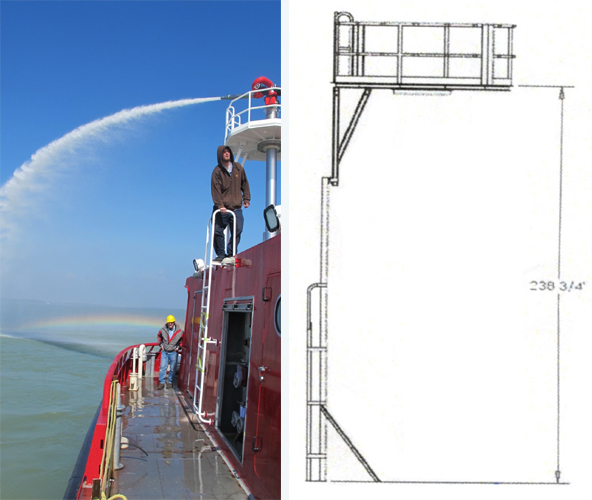


Besides part of our scope of work are associated hydraulic power packs, installed cable drums, as well as the control and control elements besides the firefighting cylinders. Of course, we support you while choosing a firefighting monitor, or we can supply you with monitors of renowned manufacturers ready to fit to a firefighting cylinder.

Hunger firefighting cylinders facilitate a specific firefighting ability of versatility. The firefighting cylinders can also be stationary and integrated in vehicles, or on offshore platforms, in power plants and chemical plants besides the application on firefighting boats. The remote control of the firefighting monitors as well as the telescopic cylinders enable an effective firefighting also from a safe distance.

Always on guard, the 92-foot fireboat Victor L. Schlaeger, staffed by a dedicated crew, has faithfully protected Chicago for decades. Stationed between Navy Pier and the city’s water filtration plant, the Schlaeger, constructed in 1949, has been the cornerstone of the Chicago Fire Department’s marine firefighting efforts. 

However, firefighting technology has remained largely unchanged for over six decades, and the city now requires more than just a fireboat—it needs a versatile rescue platform. To meet this need, the Chicago Fire Department turned to Robert Allan Ltd., a design firm based in Vancouver, B.C., to create a modern replacement. The new vessel had to meet current fireboat standards while navigating the unique challenges of Lake Michigan, including ice, low bridges, and shallow waters. 

The result is a uniquely designed firefighting vessel, launched in April and delivered in early summer of 2011. Named the Christopher Wheatley in honor of a Chicago firefighter who died in the line of duty last year, the boat was built by Hike Metal Products in Wheatley, Ontario (the shared name being a coincidence). This vessel is one of several fireboats constructed in Canada for U.S. cities under a free trade agreement that expanded market opportunities for Canadian shipyards. 
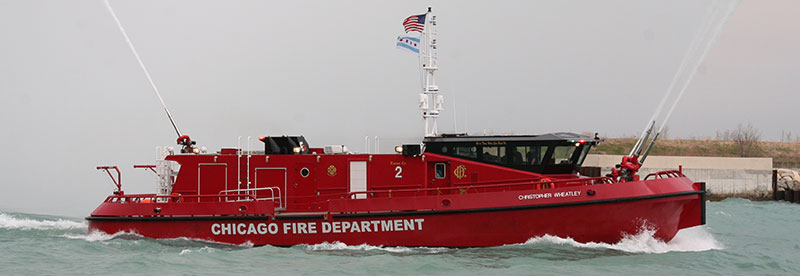
 

(Robert Allen)


Robert Allan Ltd., renowned for its cutting-edge tugs and specialty vessels, faced a complex challenge with the Christopher Wheatley. “The vessel was engineered for year-round operation in Lake Michigan, the Chicago River, and nearby harbors, including conditions with up to one inch of first-year ice,” the design team explained. 

Balancing a shallow draft with the constraints of low bridges was a significant hurdle, particularly in managing the vessel’s weight. Too heavy, and it risked grounding in the shallow river; too light, and it could collide with the low bridges spanning the Chicago River through the city’s downtown.

Dave Hewstone, a project manager at Hike Metal Products, noted that the hull’s spoon-like shape, nearly identical at the bow and stern, was designed to handle ice and shallow waters. Extra steel plating was added above and below the waterline to reinforce the hull, and robust skegs were included fore and aft to break ice and enhance directional control. With a draft just over 7 feet, the vessel’s depth can be adjusted using water ballast as needed.

Unlike the Schlaeger, the Wheatley operates as a “day boat” without crew quarters, allowing space for a dedicated EMS area accessible from the main deck, additional EMS space below, and a decontamination shower. The aft deckhouse, constructed from aluminum like the pilothouse, stores life rafts, life jackets, scuba gear, SCBA equipment, hoses, and other tools, accessible via large roll-up doors on both sides of the vessel.

The firefighting system features four Stang monitors: a 6,000-gallon-per-minute unit at the center forward, two 3,000-gpm units on the forward port and starboard, and a 3,000-gpm monitor aft, mounted on a hydraulic mast built by Hunger Hydraulics in Rossford, Ohio, which can elevate the monitor 30 feet above the waterline. The vessel also includes nine hose manifold connections on both the port and starboard sides and four additional connections forward, enhancing its firefighting capabilities.
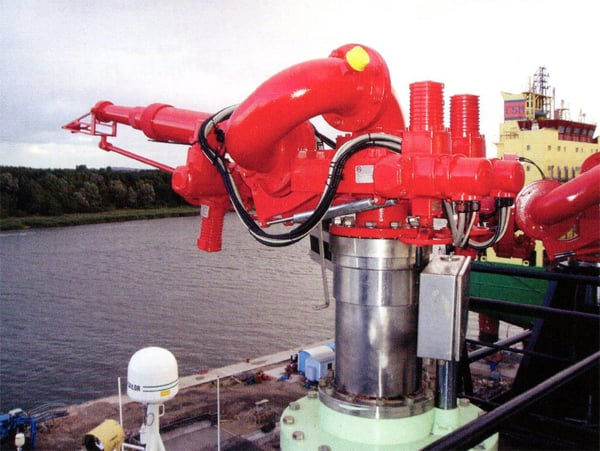


Technical Description for Fire Boat

Hunger firefighting cylinders distinguish themselves by engineering particulars guaranteeing an optimum adaptation to the respective application. The port for the extinguishing agent feed is axially located in the cylinder rear end, the oil-hydraulic ports are mounted radial at the cylinder cap. The position of the cable drum is mounted laterally and may vary in broad ranges. 

The firefighting hydraulic cylinder can be designed in five staged sizes or as a one, two, or three staged hydraulic cylinder. With that stroke heights of up to 15 m with a flow rate of the extinguishing agent of up to 20.000 I/min can be covered. Besides the fully integrated extinguishing agent and cable feed, the anti-rotation protection is effective over the entire stroke, allowing the extinguishing operation in any position. In addition, engineered solutions for electrically operated extinguishing monitors, we also offer, upon request by the customer, solutions for the mounting of manually or hydraulically operated extinguishing monitors. 
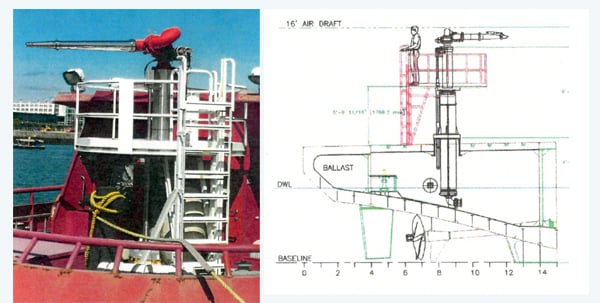


The firefighting monitors are designed and built in such a way that they are integrated as a pre-mounted unit into the structure of the firefighting boat or the extinguishing vehicle. The connection is achieved by flange mounting areas for the mechanical, the oil-hydraulic, and the water-hydraulic, as well as by a wire box for electrical cables. 

The stabilization is the most important design element besides the determination of size and stroke of the firefighting cylinder. For firefighting boats, the mathematical stability proof is done according to “DNV - Rules for Ships; January 2003, Pt. 3, Ch. 1” as well as the rules of the “Germanischen Lloyd” for safety factors and design regulations.

Among others, the following factors are included in the mathematical stability proof:     

•  Height of the extended extinguishing monitor     
•  Angle of roll of the ship (side deflection)     
•  Acceleration of roll of the ship     
•  Position of center of gravity of the ship     
•  Jet reaction of the extinguishing monitor

Materials complying with the high stability requirements of ship building, as well as requirements for corrosion and wear resistance by optimized surface coating procedures and special bonding technologies for stainless steel and carbon steel.

Both the construction and the engineered design of a firefighting cylinder are tested and approved in each case by the appropriate authority. 

The design of the firefighting monitor depends on multiple variables: the required flow rate of the extinguishing agent, the available pressure of the extinguishing pump, throwing range, type of extinguishing agent, or extinguishing agent additives, and types of operation.

The design and the supply of the extinguishing monitor can be done by our customer or by us. With pleasure, we submit an offer to you based on well-known manufacturers of extinguishing monitors and accessories.


This article is sponsored by Hunger Hydraulics USA. For more information visit the company online
 

The opinions expressed herein are the author's and not necessarily those of The Maritime Executive.

 

Suez Canal Calls on Maersk to Gradually Resume Transits

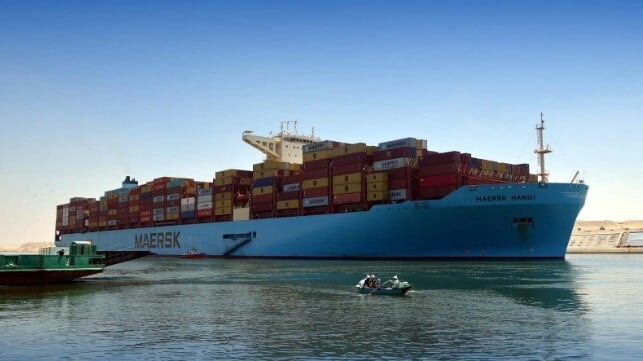
Maersk containership in the Suez Canal
Suez Canal Authority is seeking to encourage Maersk to restore its routes and historic transits of the canal (SCA file photo)

Published Oct 8, 2025 2:51 PM by The Maritime Executive


The Suez Canal Authority continues to seek the rebuilding of transits through its waterway after the continuing declines in its revenues and contribution to the country. During a recent meeting with the Danish Ambassador and a high-level delegation, the Chairman of the Suez Canal Authority reportedly highlighted the long relationship with Maerk and called for the shipping company “to take the initiative to gradually resume transiting through the Suez Canal once again.”

According to the readout on the meeting, the Chairman of the Suez Canal Authority, Lieutenant General Osama Rabie, emphasized his pride in the close relationship between the Suez Canal Authority and Maersk. He reportedly also discussed the latest developments in the Red Sea region.

Danish Ambassador Lars Bo Møller reportedly was making his first visit to the authority to discuss future cooperation prospects. According to the report, the ambassador called the return to the Suez Canal “inevitable,” while recognizing that it is a fundamental gateway for global trade.

The shipping company and its APM Terminals have long-standing relationships with the region. APM operates a container terminal at the northern terminus of the Suez Canal and has committed to the expansion of the operation. The meeting emphasized that the ongoing expansion of the terminal will significantly enhance the competitiveness of the East Port Said Port.

Maersk had first instructed its vessels to pause their transits through the Bab al-Mandab Strait on December 15, 2023, the day after a near-miss incident involving the Maersk Gibraltar and another attack on a container vessel the following day. With the start of the international security operation, Maersk briefly resumed some transits, but then on December 30, the Maersk Hangzhou was hit by an unknown object after passing through the Bab al-Mandab Strait en route from Singapore to Port Suez, Egypt. The company also reported that four boats approached Maersk Hangzhou and opened fire in what it believed was an attempt to board the vessel. The Maersk Hangzhou’s security team, along with a helicopter deployed from a nearby navy vessel, successfully thwarted the attempt, but after that, Maersk directed all vessels to reroute around Africa.

The company has continued to monitor the security situation, but ships of Maersk Line, Limited, which operate under charter to transport U.S. government cargoes, continued to be targeted by the Houthis. The company confirmed, for example, on July 9, 2024, that the Maersk Sentosa, operated by Maersk Line, Limited, reported being targeted by a flying object in the northernmost part of the Gulf of Aden.

Other carriers have continued or resumed some transits through the Suez Canal and the Bab al-Mandeb. EUNAVFOR Aspides has highlighted its protection mission for vessels, including CMA CGM, but Maersk has said that it would wait until it was confident of the increased stability in the region.

The Suez Canal Authority has hosted several meetings with the representatives of the major shipping companies as it seeks to restore transits through the Suez Canal. However, with the Houthis having sunk two bulkers in July and damaging a cargo ship recently in the Gulf of Aden, the major carriers have continued to defer returning to the route.

Data released this week by the Central Bank of Egypt on the country’s finances showed that the operations of the Suez Canal were mostly stable in the first half of 2025. Revenues were down just 1.4 percent compared to 2024, with a total of $1.8 billion between January and June. However, for the full fiscal year 2024/2025, the canal’s revenues were down 45.5 percent to $3.6 billion. The report highlights a 55 percent drop in net tonnage to 482.8 million tons and a 38.5 percent decrease in transits to around 12,400 vessels during FY 2024-2025.


Maersk shares hit three-month low on prospect of Gaza deal reopening Red Sea route


By Reuters
October 09, 2025

A Maersk cargo ship crosses the Gibraltar Strait near Tangier Med Port, Morocco, Sunday, April 20, 2025. (AP Photo/Mosa'ab Elshamy)

COPENHAGEN -- Maersk shares fell on Thursday on expectations a Gaza ceasefire deal could eventually restore container shipping routes through the Red Sea and Suez Canal, easing a capacity crunch that has supported freight rates.

Israel and Hamas agreed on Wednesday to the first phase of U.S. President Donald Trump’s plan for Gaza, raising hopes Yemen’s Iran-aligned Houthi forces might halt attacks on commercial shipping in the Red Sea. Such attacks have forced shippers to reroute south of Africa since late 2023.

However, the Houthis have yet to comment on the ceasefire deal or signal any policy change. The group claimed responsibility for attacking a Dutch-operated vessel last week.

Shares in the Danish shipping company were down 2 per cent at 1025 GMT, touching their lowest since July 8.

“Maersk is falling due to the expectation of further drops in the freight rates in connection with a higher probability of safe passage through the Red Sea,” Sydbank analyst Mikkel Emil Jensen said.

Analysts warned that even if the ceasefire holds, shipping companies were likely to wait months for assurances that attacks will not resume.

A Maersk spokesperson reiterated the group will consider resuming transit through the Red Sea only once a long-term and viable security solution had been established.

“There is a clear link between the security risks in the Bab al-Mandab Strait and the conflict in Gaza, though it remains too early to assess how progress in Gaza will influence the situation in the Red Sea,” it said.

“We hope this agreement marks the first step toward ending the conflict and achieving lasting peace.”

A return to Suez would increase available shipping capacity and put further pressure on freight rates, which have already declined from peaks earlier this year, according to analysts at Sydbank and ABG Sundal Collier.

Reporting by Vera Dvorakova. Writing by Stine Jacobsen and Anna Ringstrom, Editing by Jacob Gronholt-Pedersen, Mark Potter and Susan Fenton, Reuters


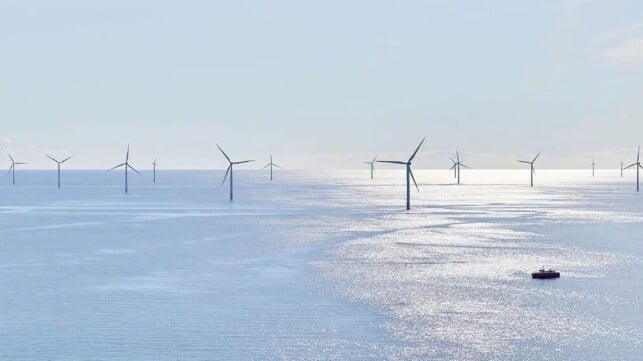
IEA: Changing Policies Cut U.S. Offshore Wind Forecast in Half

Orsted's Revolution Wind received a stop-work order in August and had to pursue a court order to allow construction to resume (Orsted file image)
Orsted's Revolution Wind received a federal stop-work order in August and had to pursue a court order to allow construction to resume (Orsted file image)

Published Oct 8, 2025 6:05 PM by The Maritime Executive


The International Energy Agency has slightly revised downward its global growth forecast for renewable energy, primarily due to changing conditions in the U.S. and China. American policy is a leading cause: given the opposition of the Trump administration to offshore wind and onshore solar projects, the forecast for medium term renewables growth in the United States is down by half compared to IEA's 2024 report. 

Offshore wind makes out poorly in the five-year forecast. The outlook is down sharply in the United States, due to a mix of poor project economics and a hostile regulatory environment. In Europe, rising costs have made offshore wind less competitive than it once was, and the outlook is also lower than last year's. These major market headwinds have prompted IEA to cut its offshore wind forecast for 2030 by more than 25 percent, including a 20 percent drop in Europe and a 50 percent drop in the U.S. These pressures are hitting OEMs: non-Chinese turbine manufacturers reported losses of more than $1.2 billion combined in 2024, according to IEA. 

Solar remains a bright spot. Within China, fierce competition has dropped panel prices by two thirds in two years  and eliminated profit margins for panel makers. Chinese OEMs are selling at an estimated loss of negative 10 percent per module in a fight for market share. This subsidizes the project economics for solar farms all over the world, since China is the leading exporter of solar PV panels. 

Overall, the picture is little changed, despite America's new direction and the headwinds for the offshore wind segment. Worldwide, most renewables developers report that they are maintaining or increasing their deployment goals. IEA has lowered its forecast for 2030 by just five percent, and it expects that variable-output renewables will still account for about one third of all global electrical generation by 2030, led by growth in China.


Hafnia and DNV Test Monitoring Systems for Underwater Noise

tanker
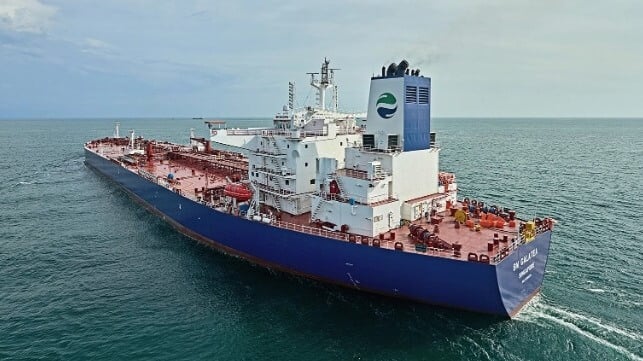
Hafnia is working with DNV to develop monitoring systems for underwater noise (Hafnia file photo)

Published Oct 8, 2025 6:49 PM by The Maritime Executive


One of the growing areas of concern, and likely future regulation, is underwater noise due to its potential impact on marine wildlife. In a pioneering program, tanker operator Hafnia and DNV have partnered to test new systems that could contribute to future vessel design and operations to reduce the levels of underwater noise emitted by vessels.

“Underwater noise is an often-overlooked challenge that affects marine life, and this project with DNV helps us take an important step toward protecting the oceans we depend on,” said Ralph Juhl, EVP, Technical Director at Hafnia. “By acting early, we are building knowledge that will guide vessel design and operations moving forward in a more sustainable manner.”

The pilot involves two vessels, the Hafnia Excel (74,547 dwt) and the Hafnia Osprey (49,999 dwt), where onboard monitoring systems are being installed during drydocking. The Hafnia Excel is an LR1 tanker built in 2015, while the Hafnia Osprey is an MR tanker also built in 2015.

The companies explained that the systems will provide continuous measurements of underwater noise and insights into how normal ship operations impact the marine environment. Alongside onboard monitoring, external hydrophone (underwater microphone) measurements will also be carried out to add valuable reference data.

“This pilot represents a technically significant step toward quantifying and verifying the reduction of underwater noise emissions across the global fleet.  The system introduces a new way of tracking and verifying the impact of noise-reducing measures,” said Øystein Solheim Pettersen, Head of Section for Noise and Vibration in DNV Maritime Advisory.

The goal is to develop a Noise Management Plan for Hafnia’s vessel types. This will not only help in staying ahead of compliance requirements but also guide decisions on possible noise-reducing measures and future shipbuilding specifications. The project is expected to generate critical insights for both Hafnia and DNV.

This program is the latest in a series of steps being taken by the tanker operator to enhance fleet performance and stay ahead of emerging regulations. In the first half of 2025, the company undertook upgrade work on thirteen vessels, including steps such as application of high-performance silicon-based hull coatings, the introduction of propeller enhancements with graphene coatings, energy-saving propeller boss cap fins, and the installation of Mewis Ducts/Wartsila EnergoFlow to reduce energy loss from cavitation and wake turbulence to improve fuel efficiency and reduce emissions.

They note that underwater noise from ships is increasingly seen as a key environmental challenge. Some areas already limit vessel noise or are offering reduced port fees for quieter ships. International authorities, including the IMO, are also moving toward stricter rules governing underwater noise.


First Climate-Neutral Sailings Using Biofuels Set for the Norwegian Coast

Norwegian coastal voyage
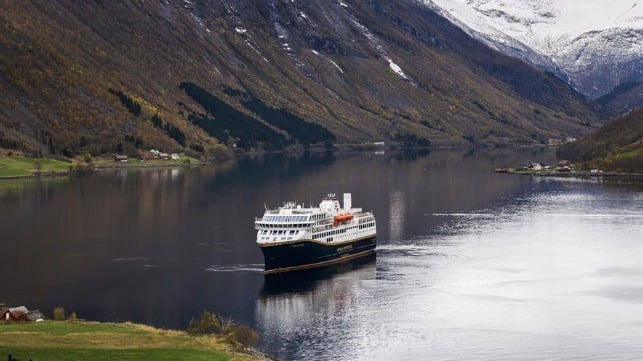
Havila will run its vessel on biogas for the demonstration voyage (Havila Voyages)

Published Oct 8, 2025 7:31 PM by The Maritime Executive


Historic firsts are scheduled for the iconic voyages along the Norwegian coast as competitors Hurtigruten and Havila Voyages have now confirmed the details of demonstration voyages that will be climate-neutral. Both companies are taking great strides to develop the trips, and they report that they can contribute to Norway’s planning and ambitions to lead in the race to climate neutrality.

Norway has been moving aggressively to push shipping to reduce its emissions and aim for climate neutrality. Regulations have already been passed that will require ships to eliminate emissions to enter Norway’s famed fjords, while the government has also supported pioneering efforts with batteries, ammonia, and hydrogen.

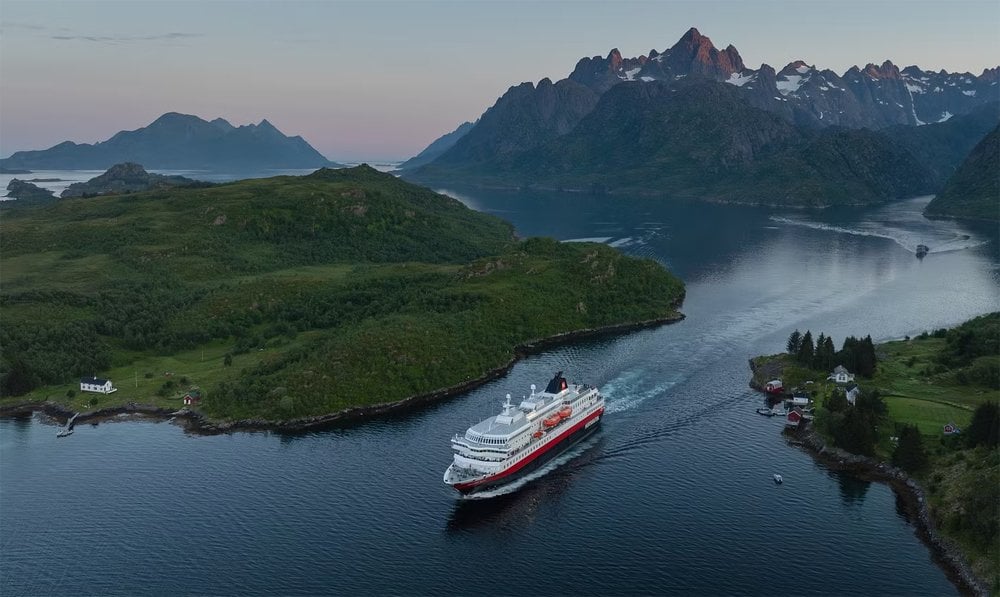
Hurtigruten, which has been the historic operator of the route between Bergen and Kirkenes, has scheduled the first trip for October 29. Its vessel Richard With (11,200 gross tons) will make the 3,100-mile round-trip voyage using 100 percent biofuel. The vessel, which was built in 1993, has also been refitted as a hybrid-battery ship and will connect to shore power wherever available during the sailing.

Hurtigruten highlights that it has invested €100 million in technical and environmental upgrades to its fleet in order to reduce CO2 and NOx emissions. In parallel, the company has gradually phased in the use of biofuels. This sailing will run on ‘HVO100’ (Hydrotreated Vegetable Oil), which is a waste-based advanced biofuel from the energy supplier St1.

"Our ships already sail on blended biofuel, but for the first time, we will carry out the entire sailing on 100 percent advanced biofuel. For us at Hurtigruten, it is important to do what we can to reduce emissions, and this voyage is an example of how biofuel can play a key role in achieving Norway’s climate goals," says Hedda Felin, CEO of Hurtigruten.


Huritgruten will operate the first demonstration voyage using advanced biofuel from renewable waste materials (Espen Mills photo courtesy of Hurtigruten)


Havila Voyages had announced its plans over the summer and has been working to secure a sufficient supply of liquified biogas to use on its LNG-fueled vessel Havila Polaris (15,776 gross tons). The vessel will load 200 cubic meters of liquified biogas at Polarbase outside Hammerfest on November 26. It will then proceed to Bergen, where it will arrive on November 30 and load an additional 150 cubic meters. The company reports it will have a sufficient quantity of biogas to operate the full round trip in combination with the ship’s battery pack.

“Since announcing this sailing during Arendalsuka in August this year, we have worked with our gas suppliers, Barents Naturgass and Molgas, to secure enough biogas to carry out the voyage. We are pleased that the delivery is now confirmed. The amount of biogas we will have on board is significant and will reduce our greenhouse gas emissions from this voyage by more than 90 percent,” said CEO Bent Martini.”

Havila operates four LNG-fueled ships to maintain the service along the coastal route. Hurtigruten has a total of seven ships for the route. The two companies each have contracts running till 2030 from the Norwegian government for the service.

They point out that biodiesel reduces emissions and will permit the company to claim a climate-neutral voyage. The biogas will not only reduce CO2 emissions but also other elements such as nitrogen and sulfur oxides.

“The more shipping companies that make sustainable choices, the better it is for our coast and the climate. When both companies that currently have contracts with Norwegian authorities demonstrate that stricter requirements are possible, these can be implemented from day one in the next contract period without a gradual phase-in, and we think that’s both positive and the only right thing to do,” said Martini.

The combined efforts, the company said will show the authorities that the route is at the forefront of addressing harmful emissions. Norway has enacted a phased zero-emission policy for its World Heritage fjords, requiring ships less than 10,000 gross tons to be zero-emission by January 1, 2026, and larger ships by 2032. The companies believe that with the increased supply of fuels, the coastal route is also preparing to adopt these standards. 

GUNBOAT DIPLOMACY

U.S. Navy Cruiser Escorts Special Operations Ship Off Venezuela

"This really looks, walks and talks like a regime change preparation,"

Ocean Trader circa 2022, showing expansive helideck and twin side hatches for fast-boat deployment (VesselFinder / J Imbert)

Published Oct 8, 2025 8:04 PM by The Maritime Executive

As the Trump administration ramps up pressure on the regime of Venezuelan president Nicolas Maduro, open-source marine traffic watchers have been closely following the movements of a shadowy special operations ship in the Caribbean. 

The vessel was once known as the Cragside, a utilitarian freight ferry built for the EU market, and was converted for use by U.S. Military Sealift Command in the mid-2010s. With the addition of a large helideck, accommodations, boat launch davits and security gear, the ordinary-looking merchant ship was transformed into a forward sea base for use by U.S. special forces. Renamed Ocean Trader, it never transmits an AIS signal, wears a plain white livery, and bears no name or flag state on the stern. Last month the vessel was spotted navigating off St. Kitts by open-source researcher MT Anderson, adding to evidence of an increasing special forces presence in the region. Pentagon sources later confirmed the vessel's presence to Task & Purpose. 

On October 4, high-resolution satellite imaging from ESA (and analyzed by MT Anderson) captured a Ticonderoga-class cruiser, likely USS Lake Erie, operating alongside Ocean Trader off the coast of Trinidad and Tobago. Given their close range a few nautical miles apart, it appears as though the Lake Erie was tasked with providing protection for Ocean Trader's operations. The cruiser is a high-end asset for long range air defense missions. 

"This was not a fleeting rendezvous. The sustained, synchronized presence of a high-power Aegis cruiser . . . and the special ops mothership, just ~126 kilometers from the Venezuelan coast, indicates a dedicated operational window for covert activity and/or intelligence gathering," commented MT Anderson. 

Recently, a group of four of the small MH-6 helicopters preferred by special operations raiders were also spotted off Trinidad and Tobago, courtesy of multiple open-source monitoring accounts. At its closest point, Trinidad is less than 10 nautical miles from Venezuelan shores. U.S. Navy P-8A Poseidon maritime patrol aircraft - a sophisticated surveillance platform - have also been reported in the area. 

On the ground in Venezuela, Defense Minister Vladimir Padrino López has warned that the nation's troops have to be prepared to counter an American attack. Evidence of mobilization is filtering through on social media, like the deployment of mobile air defense systems and preparation of concrete hedgehogs for closing down roads. 

While it is unknown whether the confrontation will escalate, U.S. forces have already destroyed four suspected smuggling boats departing Venezuela since the start of the military buildup. The White House recently notified Congress that it is engaged in "noninternational armed conflict" with "unlawful combatants" in the Caribbean, alleging that "narcoterrorists" pose a national security threat.

"This really looks, walks and talks like a regime change preparation," former National Security Council Senior Director Juan S. Gonzalez told CNN Wednesday. 


D.E.I. AT SEA

Inclusion Remains at the Heart of Shipping's Future

Elpi Petraki

Published Oct 8, 2025 11:07 PM by Elpi Petraki


Shipping has always been a diverse industry - across cultures and ethnicities – and inclusion is crucial in facing the challenges of decarbonization, writes WISTA International President, Elpi Petraki.

For some, division and divisiveness seem to have become a strategic position but, as an industry that brings together people from around the world, shipping has always thrived through collaboration. Inclusivity is invaluable for dealing with challenges we all share.

This year’s WISTA International AGM and Conference takes place in Barcelona just a week after the IMO MEPC’s meeting is scheduled to adopt its Net Zero Framework. Hopefully, by the time we gather, we will have greater clarity on how mechanisms for implementing new regulations that are of profound consequences will work.

The theme of our conference, ‘Powering the future of shipping & trade: Global energy in challenging times’ reflects the way that the world, including shipping, needs to find ways to move toward lower carbon fuels.

Today, it remains difficult to forecast which fuels and technologies will work best, while the cost and availability of each alternative is still hard to predict. The options include biofuels, ammonia, methanol, hydrogen-fuel cells, electric batteries, wind assistance and, now even nuclear power - once regulated.

Many of these fuels will require the adoption of renewable electricity generation to ensure their production makes them greener than fossil fuels, while other technologies such as carbon capture are also likely to play a part.

Costly retrofitting or building new vessels, further investment in fuel production, and new infrastructure across the bunkering and ports sectors – all of these are still required. Furthermore, the need for training will be paramount, so that the seagoing workforce works safely with fuels that have different characteristics and the marine environment is protected from risk.

But none of the alternatives have been either fully proven or are available at scale, and no single clear winner seems likely: instead, a range of fuels will be required, with various technologies working with each other to serve the market’s decarbonization needs as a whole.

When asked what they most like about their jobs, one of the most frequently given answers by those working in maritime is that they enjoy the international dimension and collaborating with other cultures from across the world. Working together, those is shipping know, is essential for getting the job done.

And when people from different backgrounds come together – whether what separates them is gender, nationality, culture, technical or creative approach, their pooled abilities tend to be the most fertile source of new and innovative ideas.

We also know that the increasing need to overcome environmental challenges and rising digitalization will mean shipping has to compete to attract new types of workers - the researchers, developers, analysts, engineers and other experts we need for the sustainable future.

Implementing inclusivity is a powerful way that shipping can attract that broader pool of talent – by pressing home its advantage as the type of culturally diverse, global industry that younger people want to work in.

And if it is a tautology to suggest that more minds thinking differently result in more creative solutions, study after study also shows that more diverse workforces often enjoy better collaboration and a greater willingness to try new approaches.

Moreover, employers that show flexibility in their approach are more likely to anticipate regulatory, social, legal or other potential risks, and so build loyalty and resilience into the organization.

In turn, organizations can be rewarded with improved reputational capital with regulators, customers and communities and help inspire the next generation of potential joiners: hard to measure, these gains are nonetheless crucial for filling future skill needs.

History teaches us that making progress requires hard work. I would remind you, therefore, that no matter what the political weather looks like, now is not the moment for retreat. Whilst shipping is making significant strides towards a greener future, maintaining this trajectory depends on continuously driving the narrative of sustainable progress.

And, while we celebrate our achievements to date, we do so mindful of the fact that – whether the theme is sustainability or inclusivity - they did not happen by chance.

As I said at WISTA International’s Mid-Term Meeting in India in April, it has taken many, many years of collaboration to create today’s global maritime community. By all working together, women can help shipping drive positive changes that will benefit our industry and the global community.

The opinions expressed herein are the author's and not necessarily those of The Maritime Executive.


MOBY DICK

Call me Ishmael. Some years ago—never mind how long precisely—having little

or no money in my purse, and nothing particular to interest me on shore, I thought

I would sail about a little and see the watery part of the world. It is a way I have

of driving off the spleen, and regulating the circulation. Whenever I find myself

growing grim about the mouth; whenever it is a damp, drizzly November in my

soul; whenever I find myself involuntarily pausing before coffin warehouses, and

bringing up the rear of every funeral I meet; and especially whenever my hypos

get such an upper hand of me, that it requires a strong moral principle to prevent

me from deliberately stepping into the street, and methodically knocking people’s

hats off—then, I account it high time to get to sea as soon as I can. is is my

substitute for pistol and ball. With a philosophical flourish Cato throws himself

upon his sword; I quietly take to the ship. ere is nothing surprising in this. If

they but knew it, almost all men in their degree, some time or other, cherish very

nearly the same feelings towards the ocean with me.


GAO: Vendor Lock-In and Lack of Data Rights are Delaying Navy Maintenance

A Navy sailor attempts to make repairs aboard the LCS USS Freedom while deployed overseas, 2013 (USN)

Published Oct 8, 2025 4:12 PM by The Maritime Executive


The Pentagon faces significant difficulty in maintaining some of its most important weapons platforms because it does not own the intellectual property rights to spare parts and repair instructions, leaving it wholly dependent upon the OEM's inventory and delivery timeline, according to the Government Accountability Office. This results in delayed maintenance of critical U.S. Navy systems, like the F-35 fighter and the Virginia-class attack submarine.  

The Pentagon has guidelines for IP and data rights that apply to the early stages of the procurement process, but GAO found that these practices do not always adequately cover the IP needed for long-term sustainment. In fact, none of the programs it studied had fully incorporated all of the Pentagon's policies for IP acquisition; even when the data is bought and delivered from the OEM, Navy program staff often struggle to evaluate and make use of the thousands of engineering documents that come in over the transom.

"In general, officials told us they experienced challenges reviewing data deliverables due to the complexity of their systems and the volume of deliverables involved. All the programs we selected indicated that fully reviewing all data deliverables for accuracy and completeness was time and resource intensive," GAO found. 

As a result of these difficulties, some programs get stuck in "vendor lock," tethered to a single supplier that owns the intellectual property to maintenance manuals and parts designs. The F-35 fighter is a notorious example, with the Navy, Air Force and Marine Corps all dependent on OEM contractors to perform approved repairs on front-line fighter jets, with OEM-determined costs and completion timelines. According to GAO, the Pentagon doesn't even own an illustrated parts breakdown of the aircraft as recently as March 2025.

For the Virginia-class submarine, the Navy's mission-critical attack sub, program officials told GAO that the prime contractor or OEMs own the technical data rights for certain components. This allows the OEM parts supplier to dictate the Navy's sub maintenance timeline, driving delays in yard repair periods - a major restriction on the sub fleet's ability to generate readiness. If OEMs do not deliver on time, according to program officials, sub maintainers will cannibalize parts from other subs to get one under way. This is an occasional practice for all militaries, but is inefficient and has a deleterious effect on overall readiness if used at scale. The Littoral Combat Ships face similar difficulties with OEM ownership of spare parts, tooling and technical data, maintainers told GAO.  

To fix this, GAO proposes changing the law to require contractors to hand over more detailed manufacturing and process data to the armed forces as a standard part of a procurement contract. It also recommended that the Pentagon revise its policies and procedures on IP acquisition.