Thursday, October 16, 2025


Indonesia’s $80bn giant seawall

Indonesia’s $80bn giant seawall
/ Medbn - Unsplash
By bno - Surabaya Office October 15, 2025

Indonesia’s ambition to build a colossal seawall along the northern coastline of Java has ignited both hope and heated debate. Valued at around $80bn, the project aims to safeguard the island’s coastal cities from tidal floods, erosion, and land subsidence. The plan envisions a structure stretching at least 500 kilometres, though some reports suggest the final blueprint could extend beyond 700 kilometres, from the westernmost tip of Banten to Gresik in East Java, as reported by The Straits Times and Jakarta Globe.

Java’s northern coast is home to more than half of Indonesia’s population and generates roughly 56% of the nation’s GDP, according to Antaranews. President Prabowo Subianto has framed the project not merely as an infrastructure investment but as a national imperative, a defence mechanism to protect Indonesia’s economic backbone from the rising tides. The initiative also carries a geopolitical dimension. During his state visit to Beijing in October, Prabowo pitched the project to Chinese President Xi Jinping. Coordinating Minister Airlangga Hartarto later confirmed that Indonesia had extended similar offers to Japan, South Korea, and European partners, with the Netherlands and South Korea already showing interest due to their own experience in coastal engineering.

To ensure execution, Prabowo has established the North Java Coast Seawall Management Authority, a specialised body tasked with integrating decades of fragmented studies into a coherent plan. Yet, despite this high-level coordination, questions over its feasibility and potential consequences are beginning to surface.

A coastline in crisis

Communities along Java’s north coast have long lived with water creeping closer each year. In the Demak regency, villagers such as Ms Pangestuti have endured nearly a decade of flooded homes, cooking in kitchens knee-deep in seawater. “We trust the government will help us,” she told The Straits Times, voicing a common sentiment of weary optimism.

The government’s pilot project, the Semarang–Demak Seawall, launched under former President Joko Widodo, is halfway complete and set for completion by 2026. The 6.7-kilometre wall doubles as a toll road and has been hailed as the first step toward the larger coastal defence network. Officials say the overall design will not be a single continuous structure “resembling the Great Wall of China,” but rather a combination of customised fortifications, mangrove restoration zones, and population relocation areas, depending on local conditions, The Straits Times reported.

The urgency is undeniable. Parts of Semarang and Jakarta are sinking faster than global sea levels are rising due to uncontrolled groundwater extraction. According to the National Development Planning Agency (Bappenas), 18% of Indonesia’s GDP originates from Jakarta alone, and 26% from the wider metropolitan area. Protecting this economic zone, said Minister Rachmat Pambudy, “means protecting the backbone of Indonesia’s economy.”

Between hope and hardship

While the seawall offers a lifeline to flood-prone areas, not everyone welcomes it. Fishermen and fish farmers in Bedono and Sayung complain that the ongoing construction has altered water circulation and reduced brackish water supply, crucial for milkfish cultivation. One farmer told The Straits Times that his fish now grow more slowly and taste muddy because seawater can no longer flow freely into his ponds. Traditional fishermen, too, say their daily catch of fish, crab, and mussels has dwindled, slashing incomes by as much as 75%.

Experts have warned that these community-level disruptions are just the beginning. According to Karsa City Lab, a Jakarta-based think tank cited by The Straits Times, the government must avoid a top-down approach that sacrifices local livelihoods for engineering grandeur. “No one should feel overlooked,” its managing director, Dedi Kusuma Wijaya said, suggesting creative mitigation strategies such as hydroponic farming and retraining for affected workers.

The government insists that the seawall’s design will incorporate local adaptation, but details remain murky. Deputy Minister Rachmat Kaimuddin said areas with high population density or economic significance, such as Jakarta, Semarang, Cirebon, and Pekalongan, will receive fortress-style defences. Less dense regions may instead adopt a “retreat” strategy, moving residents inland and reinforcing coastlines with mangroves or hilly dikes.

Environmental and financial crosscurrents

Environmentalists are among the project’s most vocal critics. Large concrete structures could disrupt tidal flows, harm marine ecosystems, and accelerate sediment buildup. The loss of mangrove forests, they argue, will remove natural barriers that provide both protection and carbon storage. Jakarta Globe reported that Deputy Public Works Minister Diana Kusumastuti has already acknowledged the need for “minor changes” to the masterplan, signalling that early assessments may have underestimated environmental impacts.

Beyond ecology, the financing remains contentious. With a cost that dwarfs even Indonesia’s new capital city project, the government hopes to secure international investors under a public–private partnership model. Yet none of the invited countries, not even China, has committed funding so far, and negotiations remain at a “nascent stage,” according to Jakarta Globe. Critics fear the project could burden public finances, particularly if environmental mitigation and compensation for displaced communities are not properly budgeted.

Question of justice

At its core, the seawall debate is not just about engineering, but about how Indonesia defines fairness and development. Coastal residents want protection, but they also want inclusion. Economists warn that an overemphasis on Java’s infrastructure could deepen regional inequality, reinforcing the island’s dominance while leaving other provinces behind.

Environmental groups argue that focusing on groundwater management, urban planning, and mangrove restoration could provide more sustainable protection at a fraction of the cost. Yet politically, a monumental project like the seawall carries symbolic weight, a demonstration of state capacity and presidential resolve. As one official told The Straits Times, “President Prabowo wants to execute it.”

Indonesia’s giant seawall is both a symbol of ambition and a test of accountability. If executed wisely, it could become a global model of climate adaptation for developing nations. But without careful planning, environmental safeguards, and community participation, it risks turning into a monument of misplaced priorities, an $80bn wall that protects some while drowning out others.

For now, the project stands as both a promise and a warning: a reminder that in a country of 17,000 islands, every solution must navigate not just the sea, but the tides of human consequence.


 

Turkey widens doorway to workers from Turkic-speaking countries

Turkey widens doorway to workers from Turkic-speaking countries
Casting workers seen at work at a Turkish industrial site. / Volcanicaa, cc-by-sa 4.0
By bne IntelliNews October 15, 2025

Turkey has significantly simplified its employment rules for citizens of Turkic-speaking countries, particularly those of Azerbaijan, Kazakhstan, Uzbekistan, Kyrgyzstan and Turkmenistan.

The changes mean that approved nationals of these countries can now work and conduct business freely in Turkey without obtaining citizenship or special permits, with some exceptions in areas including the armed forces and law enforcement.

The decision to relax the rules, announced in a presidential decree published in the Official Gazette, followed discussions on creating a common economic and labour space that took place between national leaders during the October 6-7 Twelfth Summit of the Organization of Turkic States (OTC) held in Gabala, Azerbaijan.

Some analysts sense some anxiety in Russia over the strengthening of the Turkic bloc. Moscow is widely seen as losing ground to other powers in trade, investment and geopolitics in Central Asia given the sheer concentration and resources it must expend on its war in Ukraine. The only country in Central Asia that is not Turkic-speaking is Persian-speaking Tajikistan, where Russian leader Vladimir Putin last week attended a Central Asia-Russia Summit.

Turkey’s workforce move also comes with Russia gearing up to expel as many as 770,000 migrants, largely Central Asians, as part of a crackdown on non-Russians whom Russian officials have determined should not be present in Russia.

More openings on the jobs market in Turkey, meanwhile, could be created as some of the millions of Syrian war refugees in the country head home following the fall last December of the Bashar al-Assad regime.

Those who qualify for the new work and business freedoms in Turkey must have a residence permit, not pose a threat to national security, prove their ties to Turkish society and, where required, prove the equivalence of professional certificates obtained abroad to Turkish certification.

In April, in a statement, the Turkish Migration Service said that 121,990 Turkmen citizens had obtained official Turkish residence permits. Second in terms of permits were Azerbaijanis (85,331 people), followed Russians (81,413), Iranians (76,416) and Syrians (73,063).

The published decree confirms an amendment of the Regulation on the Implementation of the Law on the Free Practice of Professions and Crafts by Turkish-speaking Foreigners in Turkey and Their Employment in State or Private Organisations, Institutions or Workplaces.

Young Ukrainians asylum seekers fleeing the war for Germany surges

Young Ukrainians asylum seekers fleeing the war for Germany surges
Asylum applications in Germany by young Ukrainians have swelled tenfold since Kyiv lossened travel restrictions. / bne IntelliNews
By Ben Aris in Berlin October 16, 2025

The number of young Ukrainians fleeing the war and seeking asylum in Germany has surged, following Kyiv's decision to partially lift its travel ban for men aged 18 to 22, according to figures from the German Interior Ministry, reported by Die Welt.

Ukrainian asylum applications in Germany have ballooned tenfold, from around 100 per week before the policy change to approximately 1,000 per week in recent months, according to local data.

The regulation, which Kyiv implemented earlier this year, allows men under 22 who were already abroad or studying abroad to extend their stay or travel more freely — a move officials framed as a minor adjustment aimed at mitigating growing criticism of Bankova’s increasingly aggressive conscription tactics.

Ukrainian politicians have denied that the change has prompted a large-scale departure of draft-age men. However, the German data suggests otherwise.

The sharp increase in asylum applications, overwhelmingly from young men, has raised concerns in both Berlin and Brussels about the potential impact on Ukraine’s mobilisation efforts and broader EU migration policy, which could give Russia the edge on numbers.

Ukraine introduced a blanket travel ban for men aged 18 to 60 shortly after Russia’s full-scale invasion in February 2022, in an effort to maintain sufficient manpower for its armed forces. Exceptions have since been made for humanitarian, educational and professional reasons, but Kyiv has faced growing pressure over the social and political implications of conscription.

The Interior Ministry did not provide a detailed age breakdown of the new asylum seekers but confirmed to Die Welt that most are young and male, consistent with Ukraine’s revised policy.

Ukrainian authorities have defended the decision, arguing it affects a relatively small group and does not undermine military readiness. “There is no mass exodus,” senior officials have said, insisting that enlistment and mobilisation measures remain in place.

Still, the sharp increase in asylum claims in Germany — which already hosts over 1.1mn Ukrainian refugees — may complicate EU coordination on migration policy and military assistance. With Ukraine preparing for a third year of full-scale war, Western governments are watching closely for any signs of mobilisation fatigue or domestic instability.

German officials have not indicated plans to alter their asylum policy in response but have acknowledged the numbers are “notable and being monitored.” The development comes as EU capitals continue to debate burden-sharing mechanisms and support packages for Ukraine in 2025.

Desertions swell

The exodus of young men, thanks to the easing of travel restrictions, comes on top of reports of the number of desertions from the Armed Forces of Ukraine (AFU) swelling.

Over the past year, twice as many military personnel have left their units without authorisation in Ukraine as during the first two and a half years of the conflict, according to the Ukrainian publication Strana, citing the Prosecutor General's Office.

According to the agency, a total of nearly 290,000 criminal cases for unauthorized abandonment and desertion were opened during the conflict. Between January 2022 and September 2024, 90,000 cases were opened, and another 200,000 in the last year. Experts says that the true number of those who went AWOL is almost certainly significantly higher than the official figures.

In August, Ukrainska Pravda, citing the Prosecutor General's Office, reported that 110,511 cases of unauthorised absence from service in the Ukrainian army had been registered since the beginning of 2025 – more than all the cases brought in the previous three years of the conflict with Russia combined.

The lack of manpower and falling number of fresh recruits is having a catastrophic effect on the AFU’s ability to defend the frontline in Donbas, where kilometre-long unmanned holes are opening up, Ukrainska Pravda reported earlier this month.

US may double support for Argentina to $40bn conditional on policy reforms

SCREWING OVER US FARMERS FOR MILEI

US may double support for Argentina to $40bn conditional on policy reforms
This substantial US financial package represents a critical lifeline for Argentina, which has defaulted on its sovereign obligations three times since 2000, as it seeks to cover foreign currency debt payments in 2026.
By Mathew Cohen October 16, 2025

The United States has purchased Argentine pesos on the open market and is establishing a $20bn facility to invest in Argentine sovereign debt, Treasury Secretary Scott Bessent confirmed on October 15. Combined with the initial $20bn currency swap line, total US support for Argentina would reach $40bn.

Bessent described the arrangement as "a private-sector solution to Argentina’s coming debt payments."

Argentine markets responded positively, with the benchmark Merval index surging 10% during the trading session. Local stocks closed up 1.7% after rising over 4% earlier, while international dollar bonds gained ground. The Argentine peso declined 1.7% to 1,378 per dollar.

While President Donald Trump initially suggested US support would hinge on President Javier Milei's performance in the upcoming midterm elections, Bessent said the assistance is "policy-specific" and will continue "as long as Argentina continues enacting good policy."

“A win [for Milei in the mid-terms] would entail keeping a blocking level on any bad policy, for the president to be able to veto the policies. And so [the aid] is not election-specific; it is policy-specific," he said in a bit to clarify Trump's earlier comments.

This assurance comes as Milei faces a challenging electoral landscape. Polls show a tight race between his La Libertad Avanza party and Peronist Fuerza Patria, with LLA trailing by over 10 points in Buenos Aires province. Political scientist Gustavo Marangoni told AFP that Milei has "no chance of winning a majority," estimating his party would capture approximately one-third of available seats.

Central Bank President Santiago Bausili confirmed the $20bn currency swap would be operational within two weeks, following intensive documentation work. "We've been working for the past two weeks, essentially day in and day out, with full dedication to complete the documentation associated with the swap, and we hope to be able to execute the free market agreement containing the terms of the swap very soon," Bausili told Infobae.

This substantial US financial package represents a critical lifeline for Argentina, which has defaulted on its sovereign obligations three times since 2000, as it seeks to cover foreign currency debt payments in 2026. However, the conditional nature of US support hinted at by Trump poses a major challenge for the libertarian administration.

“The current strategy is extremely fragile,” Barry Eichengreen, a professor of economics and political science at the University of California, Berkeley, told NBC News.

“Even if Argentines manage to skate through thin ice this time, there are always more bumps in the road."

Argentina also enjoys the backing of the IMF, with a $44bn programme renegotiated last April which granted a further $20bn Extended Fund Facility (EFF). Bloomberg estimates Buenos Aires' current exposure to the fund to be around $55bn.

Argentines will go to the polls on October 26 to elect half of the seats in the Chamber of Deputies and a third of the seats in the Senate, where Milei currently lacks the support needed to advance his bold economic plans.

Bessent, who recently described Argentina as a "systemic ally" of the US, expressed confidence that Milei's right-wing coalition would "do quite well and continue his reform agenda."

Trump's $20bn boost for Argentina comes with electoral strings

Trump's $20bn boost for Argentina comes with electoral strings
"We're not going to let somebody get into office and squander the taxpayer money from this country. I'm not gonna let it happen," Trump said. "If [Milei] loses, we are not going to be generous with Argentina."
By Mathew Cohen October 15, 2025

Argentine President Javier Milei met with US President Donald Trump at the White House on October 14 to strengthen bilateral ties, securing a crucial endorsement ahead of Argentina's upcoming midterm legislative elections.

The meeting followed the US activation of a $20bn currency swap with Argentina, triggering a massive rally in Argentine stocks and bonds. The libertarian leader arrived in Washington at 1:00 a.m. local time amid heightened security, staying at the official Blair House residence across from the White House, which is reserved for close allies to the president, Infobae noted.

Trump publicly backed Milei's electoral prospects during their meeting. "Your career has been an amazing one, and it's going to continue with the election. You're going to win the election. We're going to endorse you. I'm going to endorse you today. Fully endorse you," Trump told Milei in front of reporters.

However, he attached a critical condition to his support. "If a socialist wins, you feel a lot differently about making an investment," Trump stated.

"We're not going to let somebody get into office and squander the taxpayer money from this country. I'm not gonna let it happen," he said. "If [Milei] loses, we are not going to be generous with Argentina."

Argentines will go to the polls on October 26 to elect half of the seats in the Chamber of Deputies and a third of the seats in the Senate, where Milei currently lacks the support needed to advance his reform agenda.

Despite suggestions that assistance is tied to electoral results, Trump insisted the Treasury swap agreement was about helping "our neighbours." US Treasury Secretary Scott Bessent, who recently described Argentina as a "systemic ally" of the US, expressed confidence that Milei's right-wing coalition would "do quite well and continue his reform agenda."

This unprecedented US intervention in Argentine finances underscores the strategic importance both leaders place on their ideological alliance. While the $20bn swap provides critical financial support for Argentina's 2026 debt obligations, Trump's explicit electoral endorsement and conditional aid threats represent a remarkable departure from traditional diplomatic norms, potentially influencing voter sentiment as the midterm elections fast approach.

Broadway enters an anxious time as labour action threatens to roil theatres

By The Associated Press
October 15, 2025 

A Broadway street sign appears in Times Square, in New York on Jan. 19, 2012. (AP Photo/Charles Sykes, File)

Broadway is a tense place these days after two major labor unions authorized strike action amid ongoing contract negotiations with producers.

Actors’ Equity Association — which represents over 51,000 members, including singers, actors, dancers and stage managers — and American Federation of Musicians Local 802 — which represents 1,200 musicians — have voted in favor of a strike authorization, a strategic step ahead of any work stoppage. No strike has been called.

Members of both unions are currently working under expired contracts. The musicians’ contract expired on Aug. 31, and the Equity contract expired on Sept. 28.

Both unions want pay increases and higher contributions by producers toward employee health care costs, a key sticking point. Actors Equity also wants producers to hire more backup performers and stage managers, add protections for performers in the event of injury and put limits on how many performances in a row actors can be asked to do without a day off.

The health of Broadway — once very much in doubt due to the COVID-19 pandemic — is now very good, at least in terms of box office. The 2024 to 2025 season took in US$1.9 billion, the highest-grossing season in recorded history, overtaking the pre-pandemic previous high of $1.8 billion during the 2018 to 2019 season. It has been a long road back from the days when theaters were shuttered and the future looked bleak.


The unions are pointing to the financial health of Broadway to argue that producers can afford to up pay and benefits for musicians and actors. Producers, represented by The Broadway League, counter that the health of Broadway could be endangered by increasing ticket prices.

“On the heels of the most successful season in history, the Broadway League wants the working musicians and artists who fueled that very success to accept wage cuts, threats to healthcare benefits, and potential job losses,” Local 802 President Bob Suttmann said in a statement Tuesday.

A strike would cripple most of Broadway, but some shows might continue. “Beetlejuice” and “Mamma Mia!” arrived as part of tours and so do not have a traditional Broadway contract. And shows playing at nonprofit theaters, such as the musical “Ragtime” at Lincoln Center Theater and the play “Punch” from the Manhattan Theatre Club, have separate labor agreements.

The most recent major strike on Broadway was in late 2007, when a 19-day walkout dimmed the lights on more than two dozen shows and cost producers and the city millions of dollars in lost revenue.

More than 30 members of Congress, including the entire New York delegation, have signed a letter urging all sides to bargain in good faith and avoid a strike.

“A disruption to Broadway will result in significant economic disruption to not just the New York metropolitan area but harm theater workers and patrons across the country and around the world,” the letter states.

Mark Kennedy, The Associated Press
THE GRIFT

G20 risk watchdog warns of ‘significant gaps’ in global crypto rules

By Reuters
Published: October 16, 2025 

A statue of U.S. President Donald Trump holding a bitcoin in recognition of his support for cryptocurrency is displayed on the National Mall with the Washington Monument behind, Wednesday, Sept. 17, 2025, in Washington. (AP Photo/Alex Brandon)

PARIS/LONDON - There are “significant gaps” in countries’ attempts to regulate fast-growing crypto markets, which could potentially harm financial stability, the G20’s risk watchdog warned on Thursday.

The Financial Stability Board (FSB), a body founded in the aftermath of the global financial crisis, made a series of recommendations on rules for crypto in 2023, to try to bring it in line with the mainstream financial sector.

In Thursday’s review, it said while some progress had been made, international implementation and coordination of rules remained too “fragmented, inconsistent, and insufficient to address the global nature of crypto-asset markets.”

Financial stability risks remain “limited at present” it assessed, but they are now rising with the surge in bitcoin and other cryptocurrencies having doubled the value of the global crypto market to US$4 trillion over the last year.

“This is consequential,” FSB secretary general John Schindler told Reuters, describing the concerns raised in the review. “These crypto assets can move across borders very easily, much more easily than other financial assets.”

Stablecoin rules lacking


This year’s surge in the value of the crypto market has come against a backdrop of U.S. President Donald Trump’s pro-crypto stance.

Schindler said there was a need for close monitoring as crypto becomes increasingly connected with the traditional financial system and stablecoins - cryptocurrencies pegged to the dollar for the most part - become more widely used.

One of the key concerns flagged by the FSB’s report was that hardly any countries have complete regulatory frameworks for stablecoins yet.

While still small in comparison to the bitcoin-dominated cryptocurrency markets, the market for stablecoins has grown by almost three-quarters over the last year to just under $290 billion, a trajectory expected to continue with U.S. rules on them now in place

The FSB’s report reviewed 29 jurisdictions’ implementation of crypto and stablecoin recommendations, including the U.S., EU, Hong Kong and the UK, although the U.S. only participated in the stablecoin aspect. El Salvador, where the world’s largest stablecoin, Tether, is based did not take part, however.

Schindler said the latest review had still been worthwhile even without El Salvador’s input given the FSB was already aware of the risks, but stressed the need for better global cooperation and coordination from all jurisdictions going forward.

“We can all put in place frameworks, but if there are people who are not cooperating and helping each other, it’s just going to be really challenging because these things just they don’t observe borders,” he said.

Risks ‘limited at present’ but growing

Global rulemakers were jolted in action by the collapse of crypto exchange FTX and demise of TerraUSD/Luna coins in 2022.

There has been major jitters over the last week too, with the largest crypto crash in history on Friday triggering almost $20 billion of liquidations in the market.


The FSB’s report laid out a list of eight recommendations for jurisdictions to speed up the implementation of comprehensive and globally consistent rules and for better cross-border cooperation and coordination.

They follow similar concerns raised by the European Union’s securities watchdog in April that even small markets can be the source of bigger problems in the financial system.

Even if countries have their own regulatory regimes, they can still be impacted by the activities of crypto companies who are headquartered offshore, Schindler said.

Reporting by Elizabeth Howcroft in Paris and Marc Jones in London; Editing by Louise Heavens
Canadian customer satisfaction gap widens between big banks and midsized lenders: 
J.D. Power

By The Canadian Press
October 16, 2025 

Bank towers are shown from Bay Street in Toronto's financial district, on Wednesday, June 16, 2010. THE CANADIAN PRESS/Adrien Veczan

TORONTO — A new report finds the gap in bank customer satisfaction between Canada’s Big Five banks and midsized lenders is widening, with satisfaction at smaller banks rising.

A J.D. Power survey finds customer satisfaction with the Big Five lenders fell seven points from last year to 604 on a 1,000-point scale, while satisfaction with midsize lenders rose five points to 649.

Royal Bank ranked No. 1 in bank customer satisfaction among the Big Five for a second consecutive year.

The report said Tangerine Bank scored the highest among midsize lenders for the 14th year in a row.

Paul McAdam, senior director of banking and payments intelligence at J.D. Power, notes that while satisfaction with Canada’s largest banks declined, these lenders still account for the largest share of the consumer market.


He says midsize banks are outperforming their larger counterparts in aspects such as ease of use and personalization.

This report by The Canadian Press was first published Oct. 16, 2025.
Canada's Industry minister says relief coming for tariff-hit softwood lumber sector

By The Canadian Press
Updated: October 16, 2025


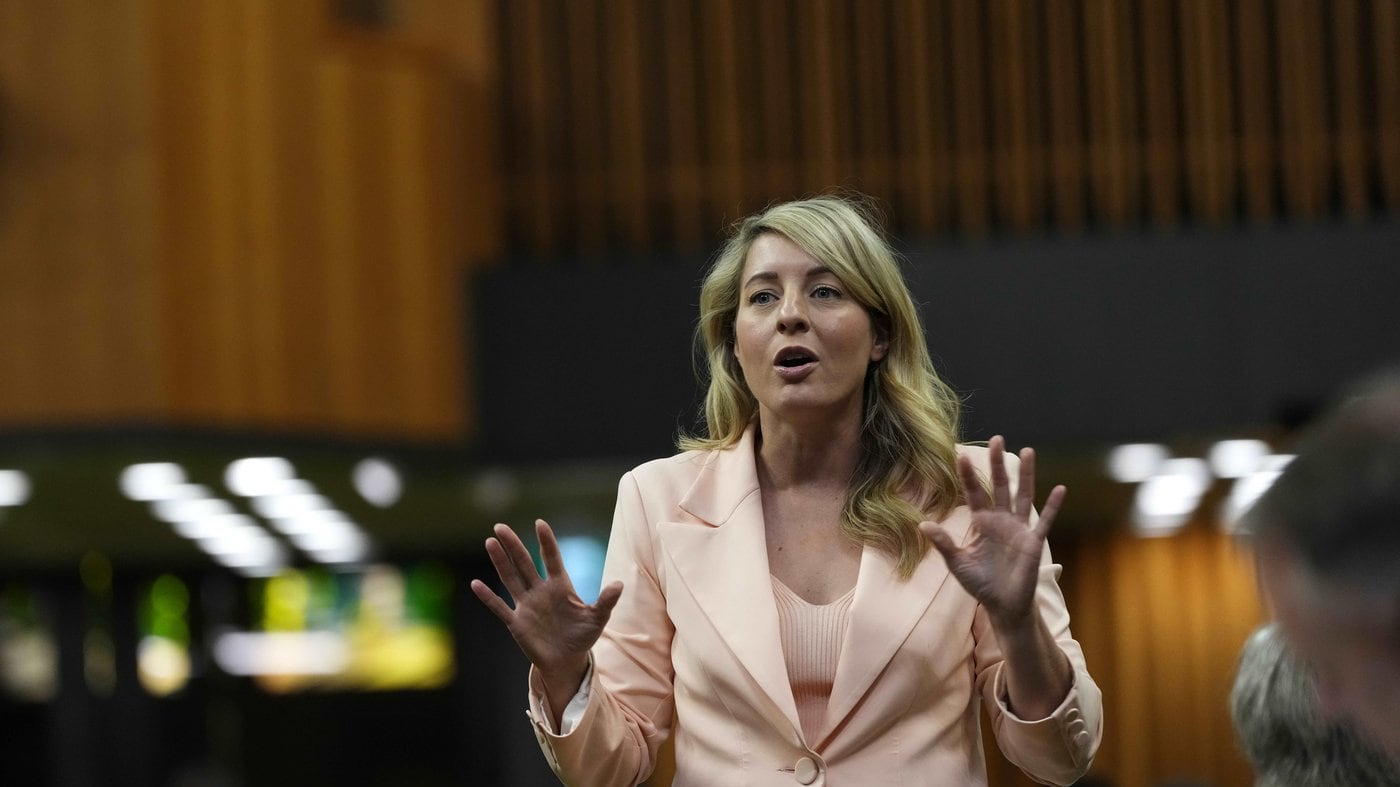
Minister of Industry Melanie Joly rises during question period in the House of Commons on Parliament Hill in Ottawa on Friday, Sept. 26, 2025. THE CANADIAN PRESS/Justin Tang

OTTAWA — Federal Industry Minister Melanie Joly said financial relief is coming soon for Canada’s tariff-struck softwood lumber sector.

The minister said in Fredericton Wednesday the government will provide funding through banks, backstopped by the Business Development Bank of Canada, in the “coming days.”

“That’s for supporting, right now, our businesses to make sure that they stay afloat,” Joly said. “Meanwhile, we will make sure that we work on a buy-Canadian policy to have our homes and our major projects and our infrastructure being built with the great softwood from New Brunswick.”

While the vast majority of Canadian trade with the U.S. is exempted from tariffs because of the Canada-U.S.-Mexico Agreement, U.S. President Donald Trump has targeted the steel, aluminum, auto, energy and lumber sectors with duties.

In August, Prime Minister Mark Carney announced a $1.25 billion aid package to support the softwood lumber sector.

Joly said the funding will go toward ensuring businesses stay afloat while dealing with “unjustifiable” tariffs, adding the government will also offer support for operations and capital expenditures.

The minister said the government funding will be provided based on individual companies’ needs.

“We’re cutting red tape and we’re using the banking system to make sure that funding is available,” she told reporters Wednesday. “It’s not a question of how much each province will have, it’s ultimately what are the needs of the companies across the country.”

The Business Development Bank of Canada said in a news release Wednesday that the program will make it easier for the country’s softwood lumber businesses to access $700 million in new term loans or letters of credit through their primary financial institution.

It said the program was designed after discussions with companies, industry associations and financial institutions.

“BDC emphasized the program is not intended as a cure-all for the sector’s considerable challenges but rather act as a complementary tool with other financial options and government support programs to help these businesses continue to operate and better manage through an ever-evolving situation,” said the news release.

Minister of Energy and Natural Resources Tim Hodgson said in the release that the forest sector continues to face “unjustified duties” when exporting lumber to the U.S.

“We are working as Team Canada to support and retool our forest sector to protect jobs, strengthen competitiveness and resilience, and Buy Canadian to use more Canadian wood at home,” he said.

Joly said Wednesday she is following the development of the softwood lumber industry closely because it relates to national security.

“Because if one day Canada is not in a time of peace, we need to have steel plants, we need to have aluminum plants, we need to have lumber also,” she said.

This report by The Canadian Press was first published Oct. 15, 2025.


Catherine Morrison, The Canadian Press.

With files from Hina Alam in Fredericton.


New $10 cap on NSF fees could save Canadians $600 million a year: Credit Counselling Society

By Pat Foran
Published: October 16, 2025 

There’s an array of choice when it comes to picking the right credit card, each having its own unique features and perks. Credit cards are displayed in Montreal, Wednesday, December 12, 2012. THE CANADIAN PRESS/Ryan Remiorz

When paying a bill, if there’s not enough money in an account to cover the transaction, banks will often charge a Non-Sufficient Funds (NSF) charge.

The fees have been a major cause of frustration for some because even if an account is one dollar short, it could result in a $48 penalty.

But, a $10 dollar cap is coming on March 12, 2026.


“I think I’m not the only one dealing with this issue, which can be very expensive for many people,” said Elvira Townsend of Surrey, B.C.

Townsend told CTV News she always tries to pay her bills on time, but recently her bank balance dropped to minus nine dollars and she was immediately charged an NSF fee of $48, putting her account $57 in arrears.

“I was stressed out because I’m on disability and right now money is really tight, so I was like wow I have to come up with this,” she said.

Townsend said she applied for overdraft protection in the past, but her bank denied her because she has a low credit score.

“It’s very unfair and it’s very upsetting because I know there are a lot of people struggling,” Townsend said. “I’m struggling and that $48 - even if (it) was for minus one dollar - it’s a lot.”

Currently, Canada’s major banks charge $45 to $48 per NSF transaction and the charges have helped banks with profits since they were first implemented.

“These fees hit people who can least afford them, so families living paycheque to paycheque find it especially difficult,” said Tina Filion with the Credit Counselling Society.

Changes to the fees will be implemented March 12, 2026. There will be a $10 cap on NSF fees, meaning banks can’t charge more than one NSF fee within 72 hours, there can be no NSF fee if an account is short by less than $10, and banks must alert customers and give them time to deposit funds before charging an NSF fee.

Filion said 34 per cent of Canadians are charged with at least one NSF fee each year.

“We’re talking about $600 million staying in people’s pockets, so it’s pretty huge,” she said.

“This is something positive, so people should celebrate this,” added Alejandra Ruiz Vargas, president of Acorn Canada.

Acorn is a group that advocates for low- and moderate-income people and has been fighting for NSF reforms.


Ruiz Vargas said while lowering NSF fees from $48 to $10 is a good start, Canadian banks should follow the lead of American banks where many have scrapped the fees altogether.

“This is good, very good, however, it’s not perfect, because as I mentioned it should be taken off completely, like they did in the U.S. They did it there and the banks there are still making a profit,” said Ruiz Vargas.

Townsend is hopeful more changes can be made to help her and others with lower incomes so they can become eligible for overdraft protection.

“I hope they can make changes to the rules and allow people like me to have overdraft protections which is important,” she said.


Pat Foran

CTV News Toronto Consumer Alert Video Journalist