Thursday, October 16, 2025

 Trump approves covert CIA operations in Venezuela, escalating pressure on Maduro


US President Donald Trump confirmed Wednesday that he had authorised covert CIA operations in Venezuela, significantly intensifying US pressure on President Nicolas Maduro's government. Trump also revealed he was considering launching strikes against Venezuelan drug cartels on land, following a series of deadly maritime operations targeting alleged narcotics-smuggling vessels.


Issued on: 16/10/2025 
By: FRANCE 24
Video by: Florent MARCHAIS


US President Donald Trump confirmed on Wednesday that he authorised the CIA to conduct covert operations in Venezuela, marking a sharp escalation in US efforts to pressure President Nicolas Maduro's government.

The New York Times first reported the classified directive, citing US officials familiar with the decision, saying the Trump administration's Venezuela strategy aims to remove Maduro from power. The administration has offered $50 million for information leading to Maduro's arrest and conviction on drug trafficking charges.

Trump said he authorised the action because large amounts of drugs were entering the United States from Venezuela, much of it trafficked by sea.

"We are looking at land now, because we've got the sea very well under control," Trump said.

The Venezuelan government said Trump's statement constituted a violation of international law and the United Nations charter. It added that US actions aimed to legitimise a "regime change" operation with the ultimate goal of seizing Venezuela's oil resources.

Venezuelan President Nicolas Maduro decried what he called "coups d'etat orchestrated by the CIA" shortly after Trump's comments.

"No to war in the Caribbean...No to regime change...No to coups d'etat orchestrated by the CIA," the leftist leader said in an address to a committee set up after Washington deployed warships in the Caribbean for what it said was an anti-drug operation.
Trump: Venezuela 'feeling heat'

Trump has repeatedly accused Venezuela of being a hub for trafficking of the deadly drug fentanyl, but US records have shown that Mexico is the main source of fentanyl.

Trump was asked by a reporter why he did not have the Coast Guard stop suspected drug trafficking boats, which has been US practice for decades. Trump called such efforts "politically correct" and said they had not worked.

Trump declined to answer when asked if the CIA has the authority to execute Maduro, saying, "I think Venezuela is feeling heat."

Trump has ordered a large US military buildup in the southern Caribbean, and the troops have conducted at least five strikes on vessels the Trump administration has described as involved in drug trafficking, without providing evidence.
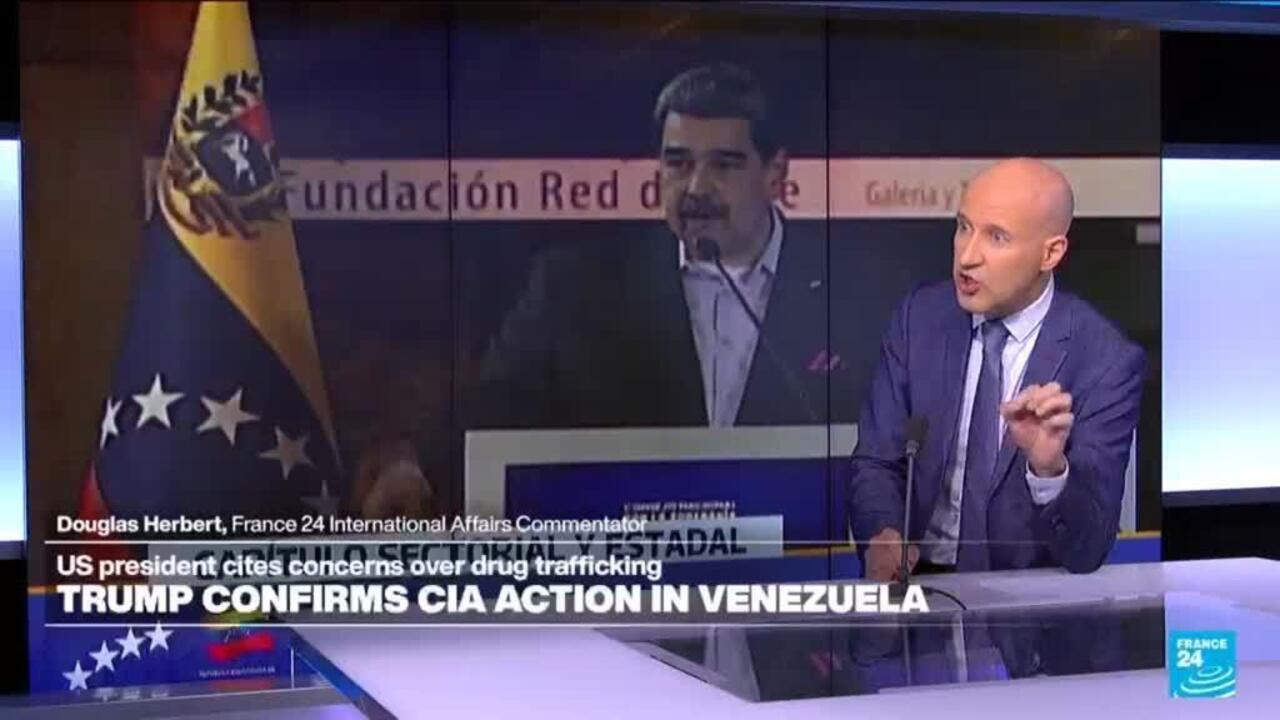
© France 24
03:06


The campaign is the most recent example of Trump's efforts to use US military power in new, and often legally contentious, ways, from deploying active-duty US troops in Los Angeles to carrying out counterterrorism strikes against drug trafficking suspects.

The Pentagon recently disclosed to Congress that Trump has determined the United States is engaged in "a non-international armed conflict" with drug cartels.
Trump: Venezuela released prisoners into US

Trump also accused Venezuela of releasing large numbers of prisoners, including individuals from mental health facilities, into the United States, although he did not specify which border they were crossing.

The Trump administration has provided scant information about the strikes, frustrating members of Congress, including some of his fellow Republicans.

On Wednesday, Senator Jeanne Shaheen, the top Democrat on the Senate Foreign Relations Committee, said the administration moved the US closer to outright conflict.

"The American people deserve to know if the Administration is leading the US into another conflict, putting service members at risk or pursuing a regime-change operation," she said in a statement.

(FRANCE 24 with AFP and Reuters)


Imperial Double Standards: Warfare for Venezuela and Welfare for Argentina


Venezuela’s Bolivarian Revolution has been in the vanguard of the Global South. In contrast, President Javiar Milei’s government in Argentina represents the logical, though absurd, consequence of extreme neoliberalism, which he calls “anarcho-capitalism.”

Western Hemispheric geopolitics reflect the weakening of US hegemony and an emerging multipolarity, especially with China’s entry as a major regional trading partner. US imperialism’s response, started well before Trump, has been to weaponize the dollar, impose illegal and crippling economic sanctions, and levy arbitrary tariffs. When these fail, the recourse is to military aggression.

US War Secretary Pete Hegseth announced preparations for war with China. Washington has concluded that it must put a halt to multipolarity to maintain its global supremacy. Thus, the Trump administration is simultaneously rushing to rescue Milei’s government while hurrying to overturn Venezuela’s under their President Nicolás Maduro.

Role of Venezuela under Chavismo

Venezuela is a beacon of national sovereignty and social progress. It has consistently opposed imperialist aggression, not just in Latin America, but globally. Under the movement known as “Chavismo” it aimed for Latin American integration and the pooling of its huge natural resources, offering an independent pathway to development to withstand US imperialism.

Consequently, it has been under attack, enduring US-financed far-right violence, destabilization, a US-led asphyxiating economic blockade, assassination attempts on the president and leading Bolivarian officials, mercenary attacks, coups and terrorism – the full arsenal of Washington’s aggressive toolkit.

Role of Argentina under Milei

In 2023, anti-establishment anger propelled libertarian populist Javier Milei to the Argentine presidency. His Trump-like “chainsaw plan” – radical spending cuts and a war on government institutions and services – fitted with the orthodoxy dictated by the International Monetary Fund (IMF). Milei closed 13 government ministries, including those for education, labor and social security. Foreign lenders welcomed Milei’s elevation of austerity to a moral imperative.

Milei is still favored by the IMF. But while his unwillingness to devalue the peso helped cut inflation, it slowed economic growth and reduced the country’s capacity to sustain its huge debt. Argentina is now over $450 bn in the red. Employment fell steeply, while poverty soared to affect 53% of the population in 2024 (allegedly reducing since then). Budget cuts raised the cost of basic needs.

Corruption scandals emerged. A close political associate of Milei admitted receiving “donations” from a narco-entrepreneur. A US$4.6 bn crypto scandal followed; the largest ever crypto-theftMilei’s left opposition demanded his impeachment, and a judge launched a fraud probe. Later, Milei’s sister was accused of receiving hefty bribes. On top of this came the crushing defeat for Milei’s libertarian party in the Buenos Aires provincial elections in September.

All that has triggered a run on the peso and a new economic crisis.

Trump’s recent decision to bail out Milei’s predictably disastrous economic performance is consistent with the profligacy of IMF-US lending to right-wing Argentine governments. In April 2025, the Buenos Aires Times reported that the IMF praised Milei’s efforts and projected that the Argentine economy would grow faster than the global average. In fact, Milei tipped the country into recession and sent millions of people into poverty in the first months of his government.

In short, Milei’s “narco-capitalist” government is not only corrupt but has savaged Argentina’s economy. Milei represents the logical culmination of Argentina’s ruling class servitude to US geopolitical objectives, even extending to his enthusiastic support for genocide in Gaza. Slavishly supporting anything Trump does or says, Argentina was one of only ten countries to vote with the US against the UN’s two-state solution for Israel-Palestine.

IMF wages financial war against Venezuela

The IMF is a key institution through which the US enforces its imperial dominance, part of an architecture shaped largely by Washington. Often functioning as a financial arm of US foreign policy, it rewards compliant right-wing regimes such as those of Argentine presidents Macri and Milei, while punishing independent governments like Venezuela’s that are striving for socialism.

An example is the IMF response to the 2002 coup against Venezuela’s democratically elected President Hugo Chávez. The IMF publicly stated its readiness to collaborate with coup-monger Pedro Carmona, whose “government” abolished the constitution and key democratic institutions. Within hours after Chávez was kidnapped, the IMF’s Thomas Dawson said: “we stand ready to assist the new administration in whatever manner they find suitable.” Fortunately for democracy, the coup lasted only 47 hours. The people spontaneously rose up and returned their rightful president to his office.

More recently, during the Covid-19 crisis, IMF chief Kristalina Georgieva announced an emergency response which could disburse US$50 bn to developing countries and US$10 bn to low-income countries at a zero-interest rate. Venezuela had tried to exercise its “special drawing rights” for US$5 bn to combat the pandemic. This required IMF officials to engage in acrobatics to justify rejecting Venezuela’s request. The real reason was the US government’s farcical recognition of Juan Guaidó as “interim president.”

US-IMF props up rightist Argentina

In 1999-2002, when Argentina had a right-wing government, the IMF overestimated GDP growth. Then, conversely, in 2003-2015 when Argentina had left-wing governments under the Kirchners, the IMF underestimated the strength of the country’s economic recovery. IMF debt was paid off, Argentina’s notorious external debt fell sharply, no new IMF loans were granted.

But for the past decade, its politics have revolved around chronic economic crises and persistent IMF influence. Across three presidencies, Argentina swung from market liberalization (Macri, who succeeded the Kirchners), to state intervention (Fernández), to radical austerity (Milei). Right-wing Mauricio Macri acquired a US$57 bn loan, the largest in the fund’s history. The IMF itself admitted the bailout “was not fit for purpose.” The country is now on its twenty-third IMF bailout, a global record. It is the fund’s biggest debtor, owing a “staggering” $41.8 bn.

US aggression against Venezuela

The US finds it intolerable that Venezuela – a “threat” of a good example – has successfully resisted US policy of “maximum pressure.” Its military build-up against Venezuela is an escalation from hybrid to open warfare aimed at suppressing an alternative model of sovereignty and social justice, with the possible bonus of reclaiming control over the country’s oil resources.

Trump has deployed a fleet of warships, F-35 stealth fighter jets, and several thousand marines. Washington is positioning military forces in Puerto Rico, has a substantial military presence in Guyana, and asked Grenada to deploy US military forces in its territory. Trump has declared the US to be at war with drug cartels, potentially extending to those supposedly inside Venezuela itself. Commentators, including officials of the Bolivarian government, conclude that a US military strike seems imminent.

Washington’s justification is a monumental lie: Venezuela is alleged to be a narco state, led by the non-existent Cartel de los Soles. Rubio and Trump falsely accuse the Bolivarian government of shipping hundreds of tons of drugs into the US. The United Nations Office on Drugs and Crime has consistently reported that up to 92 percent of the cocaine produced in Colombia and Ecuador reaches the US through the Pacific (Venezuela’s entire coastline faces the Caribbean Sea).

Trump and Milei

In sharp contrast to the economic punishment being meted out to Venezuela, Trump’s “favorite president” is getting a bailout for the economy he that has destroyed. Milei is promised a direct purchase of pesos with dollars, together with a $20 bn central bank “swap line.” Milei swiftly thanked Trump for his “vision and powerful leadership.”

Washington openly admits its ideological motives. Treasury Secretary Scott Bessent said the US should help conservatives win elections in Latin America. He tweeted: “The success of Argentina’s reform agenda is…in the strategic interest of the United States.” Praising Argentina’s “strong and stable” economy, he failed to address why it would collapse without US support.

The bailout appears to have several undeclared aims. One, according to the New York Times, is to help rich investors whose bets could falter if Argentina’s economy sinks. The same source claims that US officials are also pushing Argentina to scale back its ties with China and want access to its uranium and lithium supplies. The rescue plan may even involve dollarizing Argentina’s economy.

Nearly half of Argentinians (44%) see the deal as more likely to benefit the US than their own nation, while 36% have a negative view of Milei’s relationship with Washington. The irony of Trump’s economic lifeline for Milei is that it may kill off his chances of political survival.

Neoliberal misery vs multipolar-oriented sovereign development

Bolivarian Venezuela and Milei’s Argentina present two starkly different paths for Latin America—Venezuela’s sovereign defiance of US imperialism and Argentina’s deepening subservience and dependency. One suffers imperial “hybrid warfare” while the other gains imperial “welfare.”

Washington uses coercive tools—sanctions, economic warfare, and military threats—to preserve hemispheric dominance. Venezuela embodies resistance and regional integration. Argentina, under Milei, epitomizes the collapse into “narco-capitalism,” social devastation, and foreign subjection.

Ultimately, neoliberal austerity brings only poverty and dependency, while multipolar cooperation among Global South nations offers a viable path toward genuine independence, equitable development and resistance to imperial domination. US military actions against Venezuela violate international law and rest on unfounded claims. Latin America is a declared Zone of Peace. To respect that and allow the people their right to live without fear of war, the US must withdraw its forces.

UK-based Francisco Dominguez is with the Venezuela Solidarity Campaign. Nicaragua-based John Perry is with the Nicaragua Solidarity Coalition. US-based Roger D. Harris is with the Venezuela Solidarity NetworkRead other articles by Francisco Dominguez, Roger D. Harris, and John Perry.


Nicaragua Solidarity Coalition Statement on 


US Aggression against Venezuela


The Nicaragua Solidarity Coalition demands an end to US aggression against Venezuela, which is on the brink of outright war. Any escalation in the violence against Venezuela will cause more suffering and deaths in the South American country, destabilize the region, and endanger all countries seeking a path independent from US domination, especially Cuba and Nicaragua.

US actions indicate a strike on Venezuela is imminent:          

  • After the Trump administration designated international drug-trafficking groups as “foreign terrorist organizations” (FTOs), without any evidence it accused Venezuelan President Nicolás Maduro of being their ringleader. By July, a “secret directive” authorized military operations against FTOs at sea and on foreign soil.
  • In August, the administration raised its illegal “bounty” on President Maduro to $50 million and launched a massive naval deployment off the coast of Venezuela, which includes nuclear capable submarines and jets and quickly grew to 10,000 troops.
  • On September 2, in international waters off of Venezuela, the US blew up the first of four or five boats that Trump claims carried drugs, committing extrajudicial executions.
  • By mid-September, the Pentagon notified Congress under the War Powers Resolution that US forces were engaged in a “non-international armed conflict” with drug cartels.
  • On October 1, the Defense/War Department issued a “confidential memo” and told Congress that the US was engaged in armed conflict.
  • On October 6, Trump ended back-channel diplomatic contacts with Venezuela, which had been essential since the rupture of diplomatic relations in 2019. That same day, Venezuela informed the US of a thwarted plan by Venezuelan right-wing extremists to plant explosives at the US embassy in an attempted false-flag operation.
  • On October 10, Maria Corina Machado—a US-paid, violent, Zionist, extreme right-wing Venezuelan political opposition figure—received the Nobel Prize after being endorsed by Secretary Marco Rubio, in a clear a maneuver to manufacture consent for regime change in Venezuela.

We must not be fooled by this perversion of the peace prize or the countless unfounded accusations against Venezuela and its democratically elected president. The United Nations Office on Drugs and Crime, and even the DEA, report that Venezuela is not a drug trafficking country, nor are Cuba or Nicaragua. Like its lies about migrants, the Trump administration has fabricated the “threat” posed by Venezuela. The real reason the administration is pushing for war against Venezuela is to regain control of its vast resources—including the world’s largest oil reserves.

We demand an end to US impunity and the withdrawal of US troops and war materiel from the Caribbean before the situation escalates any further. We vehemently object to the deployment of nuclear capable vessels in a region which, in response to the Cuban Missile Crisis, declared itself a nuclear-free zone in 1967, and which the US committed itself to respect in 1971. We demand respect for international law and the sovereignty of nations. The people of Venezuela and the rest of Latin America and the Caribbean must be allowed to live in peace with the form of government they have chosen.

Hands Off Venezuela! Venezuela is Hope! Venezuela is not a threat!

US Hands Off Latin America and the Caribbean!

The Nicaragua Solidarity Coalition is an international coalition of organizations and individuals in solidarity with Nicaragua, supporting its sovereignty and affirming its achievements. Email at: NicaraguaSolidarityCoalition@gmail.comRead other articles by Nicaragua Solidarity Coalition, or visit Nicaragua Solidarity Coalition's website.

Essequibo Tensions Rise as Trump Engages in Gunboat Diplomacy

  • The long-standing territorial dispute between Venezuela and Guyana over the Essequibo region has intensified following significant oil discoveries by ExxonMobil in Guyanese waters.

  • Venezuela's President Maduro has escalated his claims and actions, including a referendum and military posturing, aiming to annex the Essequibo, which comprises two-thirds of Guyana's territory.

  • Guyana, a newly emerging oil-producing nation, has sought and received security assurances and military cooperation from the United States to deter Venezuelan aggression and protect its sovereignty.


The dispute between Venezuela and Guyana over the mineral-rich Essequibo escalated after ExxonMobil made over 30 world-class discoveries, containing 11 billion barrels of crude oil, in the prolific Stabroek Block. By late 2023, Guyana was a regular target of Caracas’ bellicose saber rattling with threats of annexation and invasion, forcing the government in Georgetown to seek security assurances from Washington. While the White House’s deployment of U.S. warships off the coast of Venezuela sparked considerable consternation across Latin America, it was applauded by Guyana. 

The Essequibo conflict dates from 1841, when a recently independent Venezuela claimed the region ceded by the Dutch to Great Britain in 1814 during the Napoleonic Wars. In 1831, Britain merged Essequibo with other former Dutch territories, Demerara and Berbice, to form the British colony of Guiana. Caracas argued the Essequibo had originally belonged to the Viceroyalty of New Granada, which encompassed the territories now comprising Venezuela, Colombia, Panama and Ecuador, during the Spanish colonial period. When efforts to settle the dispute failed, Caracas sought U.S. assistance to resolve the matter toward the end of the nineteenth century.

The dispute was eventually arbitrated, with the Essequibo awarded to British Guiana, despite Washington’s representation of Venezuela. This decision was finalized in the Paris Arbitral Award of 1899, with boundaries officially demarcated in 1905. Tensions ebbed and flowed since then, rising in 1962 as Guyana’s independence from Britain approached, with Venezuela claiming the 1899 decision was null and void. Tensions since then have ebbed and flowed with little progress made to resolve the territorial dispute, even after it was referred to the International Court of Justice (ICJ) in 2018, which, during 2023, ruled it had jurisdiction to arbitrate the dispute.

Regardless, Venezuela’s dictatorial President Maduro ratcheted ever higher his bellicose saber-rattling against Guyana. Indeed, gaining control of the Essequibo is a rare point of consensus among the Maduro regime, opposition groups, and ordinary citizens in Venezuela. It became a facet of national identity, with the mineral-rich region long coveted by all governments of Venezuela. But autocratic President Maduro is the first Venezuelan leader to resort to threats of annexing the Essequibo by force. Venezuela’s illegitimate president views the dispute as an opportunity to unify the country’s people behind his brutal regime after the country’s horrific economic collapse, which left over 90% of the population living in poverty.

The event that triggered President Maduro’s militant stance on the Essequibo was Guyana's emergence as a major oil-producing nation. During 2015, Exxon made the first of a swathe of world-class discoveries in the offshore 6.6-million-acre Stabroek Block. In a mere four years, in an industry where it can take a decade or longer to bring major oilfields online, Guyana went from first discovery in 2015 to first oil in 2019. The tiny English-speaking country is now pumping an impressive 750,000 barrels per day, making Guyana South America’s fourth-largest oil producer, ahead of Colombia and behind Argentina.

Petroleum is a crucial source of revenue for the near-bankrupt regime in Caracas. Decades of mismanagement and endemic corruption, since Hugo Chavez’s 1999 Bolivarian Revolution, have destroyed Venezuela’s oil industry and economy. Even control of the world’s largest petroleum reserves, estimated at over 303 billion barrels, has done little if anything to alleviate the pain because of harsh U.S. sanctions. Indeed, in defiance of those sanctions, Caracas built a web of alliances with other countries opposed to the U.S., notably Russia, China and Iran. A dark fleet of tankers provided by those allies allows Caracas to resist sanctions, rebuild shattered petroleum infrastructure and keep exporting crude oil, providing a vital economic lifeline.

For decades, Guyana resisted Caracas’ demands relating to the Essequibo. In response to Georgetown’s defiance, Caracas launched a large-scale military buildup along Guyana’s border during 2023. This included installing bases, runways and other military infrastructure while units of the National Bolivarian Armed Forces of Venezuela probed the border, harassing civilian installations and Guyana’s tiny defense force. This culminated with authoritarian President Maduro threatening to annex the Essequibo. To legitimize Venezuela’s demands in preparation for such a move, Caracas held a 2023 referendum where voters (95.9%), apparently, supported President Maduro’s actions despite what appeared to be a poor turnout.

After this successful vote, President Maduro announced the implementation of a series of measures to strengthen Venezuela’s claim to the mineral-rich territory. Among the most important actions were the creation of the Venezuelan state of Guayana Esequiba, the issuance of national identity cards to the population, the declaration of a military zone, and the granting of operating licenses by the national oil company PDVSA in the territory. President Maduro also threatened Exxon, which he alleged was meddling in regional politics to enrich itself at Venezuela’s expense. To discredit Venezuelan opposition leader Maria Corina Machado, President Maduro asserted she was aiding Exxon to prevent Caracas from taking control of Essequibo. 

During May 2025, these events culminated in Venezuela electing officials to represent the Essequibo, which is the country’s 24th state, called Guayana Esequiba. Autocratic President Maduro declared his representatives won the roles of governor, along with eight deputies and regional councilors. The newly appointed governor, Neil Villamizar, declared the symbolic event, which further legitimizes Caracas’ claim to the territory, to be an important step toward securing full sovereignty for Essequibo. Guyana’s President Ali, who secured a second five-year term in September 2025’s general election, declared the election as a threat to Guyana and the nation’s territorial integrity, stating it, “will do everything to ensure our territorial integrity and sovereignty is kept intact".

In response to Caracas ratcheting up tensions and attempting to legitimize claims to the Essequibo, Guyana’s President Irfaan Ali met with autocratic President Maduro in December 2023. Guyana’s legitimately elected president made it clear that the mineral-rich territory is part of the tiny South American country, stating, “Essequibo is not up for discussion, negotiation or deliberation.”

Georgetown’s sentiments are easy to understand. Not only did the Paris Arbitral Award assign Essequibo to Guyana, but the region is an essential part of the former British colony’s sovereign territory. At 61,600 square miles, Essequibo, which is slightly smaller than Florida, makes up two-thirds of Guyana’s territory. Aside from petroleum in the Stabroek Block, the region is rich in gold, diamonds, bauxite and iron ore. This mineral wealth will one day be a game changer, as oil is now proving to be, for Guyana, once one of South America’s poorest nations. 

Georgetown’s resistance, including seeking assistance from the U.S., enraged Caraca,s triggering further intimidation by way of military incursions. Reportedly, the most recent occurred on March 1, 2025. A Venezuelan gunboat, ABF Guaiqueri PO-11, armed with a 76mm cannon, a 35mm Oerlikon weapon system and two 12.7mm machine guns, navigated into Guayana’s exclusive economic zone, where it entered the Exxon-controlled Stabroek Block. There, the warship approached Exxon’s floating production storage and offloading (FPSO) vessels Liza Destiny, Liza Unity and Prosperity. The Guaiqueri’s captain interrogated the FPSO crews and warned them that they were operating in Venezuelan waters.

In response, Georgetown mobilized Guyana’s military, deploying air assets and sending coast guard vessels to the contested area. The event sparked considerable consternation in Guyana’s government, especially given the country’s defense force of fewer than 5,000, which is incapable of resisting any large-scale assault by Venezuela. It is for that reason that President Ali urgently sought closer ties with the U.S. and assistance from Brazil. Indeed, it was Brazilian military intelligence that warned of Venezuela’s military readiness for a strike on the mineral-rich Essequibo in 2023. Brazil, at that time, also ramped up its military presence in the territory bordering the contested region as a deterrent to Venezuela.

Georgetown is seeking closer ties with Washington because the U.S. military, the most powerful in the world, is a key regional counterweight to rogue states like Venezuela. In July 2023, President Ali, during a meeting with U.S. Secretary of State Antony Blinken, lauded the relationship between the two countries and stressed the need for stronger security ties. This included the need to bolster cooperation between Guyana’s defense force and the U.S. Southern Command. Due to Maduro’s persistent threats, Georgetown pressed Washington for help to strengthen Guyana’s military. Only last month, U.S. Secretary of State Marco Rubio met with President Ali, where he emphasized the importance of continued joint security and economic collaboration.

Venezuela poses a dire threat to South America’s newest petro-state, with Caracas’ bellicose saber-rattling putting Guyana’s sovereignty at risk. Maduro’s illegitimate regime purposefully created a framework to legitimize the annexation of Essequibo, all while Venezuela’s powerful military infiltrated Guyana to harass and threaten civilian installations. It is unsurprising that Guyana, along with nearby Trinidad and Tobago, expressed support for the Trump White House’s deployment of warships off the coast of Venezuela. The U.S. flotilla is a powerful force acting as a counterweight to Venezuela’s military, which is essential to guaranteeing Guyana’s sovereignty and territorial integrity, with Georgetown’s military incapable of repelling an invasion of the Essequibo.

By Matthew Smith for Oilprice.com


Nestlé to cut 16,000 jobs worldwide in major restructuring move

The logo of Swiss food an drink company Nestle
Copyright AP Photo

By Leticia Batista Cabanas
Published on 

Nestlé is cutting 16,000 jobs globally to streamline operations, focus on high-return products, and shore up profitability under new CEO Philipp Navratil.

Food and beverage giant Nestlé has announced that it will cut 16,000 jobs worldwide over the next two years. These include 12,000 white-collar positions in management and office roles, and 4,000 additional roles within manufacturing, logistics, and supply chain departments.

The layoffs are part of a broader effort to streamline Nestlé’s workforce and focus investment on high-performing brands, and products with strong potential returns: coffee, confectionery, and premium goods.

The next step is to finish strategic portfolio reviews of its water and premium beverage businesses and its vitamins and supplements brands.

Nestlé’s restructuring aims to improve profitability and efficiency amid mounting pressures. The firm’s share price has fallen by about 35% since 2022. Sales growth also increased by only 2.2% in 2024 — its weakest number in years — although this notched up to 3.3% in the first nine months of this year. Reported net sales, affected by exchange rates, came to CHF 65.9 billion (€70.96bn) in the first nine months of 2025, a year-on-year decrease of 1.9%.

Meanwhile, rising external costs and trade barriers continue to squeeze margins, such as the US’ recent 39% import tariff on Swiss goods.

Still, the company expects the job cuts to generate annual savings of approximately 1 bn Swiss francs and contribute to an increased total cost-savings target of 3bn Swiss francs by the end of 2027.

“Management have grand ambitions to bring Nestle back to where it has historically been, but for now the company is a work in progress,” explained Chris Beckett, consumer staples analyst at Quilter Cheviot.

Management revolving door

Nestlé has also faced a period of management turmoil. Its former CEO, Laurent Freixe, was dismissed in September for failing to disclose a romantic relationship with a subordinate, which violated the company’s code of conduct.

Two weeks later, long-time chairman Paul Bulcke stepped down earlier than planned, and former Inditex CEO Pablo Isla was appointed as his successor.

Following Freixe’s dismissal, Philipp Navratil was named the new CEO. It was Navratil who then introduced the restructuring drive, arguing that Nestlé needs to “change faster” to remain competitive in a rapidly evolving global market. He considers a “performance mindset” a priority to retain market share.

But despite this management upheaval, the company reported stronger-than-expected financial results for the first nine months of 2025. Its organic sales increased across key categories, driven by higher prices in core items like Nescafé coffee, KitKat chocolate, and Maggi cooking products.

In the third quarter of 2025, Nestlé recorded a 1.5% increase in real internal growth, a result far above analyst expectations of 0.3%.

Investors also responded positively to the restructuring announcement, with Nestlé’s stock price rising over 8% by around midday on Thursday.

Meanwhile, the company remains optimistic, projecting stronger organic sales growth compared to 2024.

“Full year guidance has been reaffirmed so we should see ongoing sales growth improvement with an operating margin of 16% or better. The shares trade at a discount to the wider sector and this reflects the turnaround story the business is on. A few more quarters like this one may just help complete that story and put the company back on a trajectory of high quality growth”, said Beckett.

Canada-India Bilateral Ties: The Case For An Economic Security Framework – Analysis

The time is ripe for Canada and India to establish a viable and rational framework across areas like defence, energy, trade and technology to propel relations.


Canada's Foreign Minister Anita Anand with India's Prime Minister Narendra Modi. 
Photo Credit: AnitaAnandMP, X


October 16, 2025 
By Institute of South Asian Studies
By Karthik Nachiappan

Canadian Foreign Minister Anita Anand’s visit to New Delhi and Mumbai from 12 to 14 October 2025 comes two years after the biggest crisis in Canada-India relations. The return of United States (US) President Donald Trump, Canadian Prime Minister Mark Carney’s rise and a transformed global landscape have all shaped this moment – one where both countries appear poised to refocus their relationship after a reset earlier this summer.

Anand’s visit is an opportunity to reboot ties, restore confidence and insulate it from the difficult diaspora politics that has long shadowed the relationship. Carney and Anand must anchor this reset on economic security, enabling both countries to support each other’s economic interests in ways that strengthen their sovereignty and resilience. This approach would represent a major departure from the past.

In Ottawa, India has generally been viewed as a bulwark against China, an attractive market, a source of immigration and a key node in the Indo-Pacific. However, these logics have largely run their course. India must instead be seen as a peer and strategic partner – one to engage with across critical domains such as emerging technologies, energy, climate change, agriculture and defence. The Trump administration’s return has heightened the importance of India as an economic partner for Canada’s allies across Europe and Asia, given India’s high growth rates, potential as a supply-chain hub and its growing prominence in areas like clean energy, digital technologies and infrastructure.

For Ottawa, refocusing ties around economic security means making India more than just a trade partner. It means building a strategic partnership that enhances resilience, reduces dependencies, manages supply-chain risks and deepens coordination on digital and clean energy technologies. The window to accomplish this ambitious task remains open but it is narrow.

Anand’s priorities in New Delhi will likely centre on trade and investment. Discussions could ostensibly revive negotiations for an Early Progress Trade Agreement, which was suspended in September 2023. Securing either an interim or comprehensive trade agreement will take time, especially as both sides balance parallel negotiations with the US and India with the European Union (EU). Yet it is important that the prospect of a trade deal does not overshadow or delay the work of connecting both economies in high-growth sectors such as the digital economy, artificial intelligence (AI), energy and critical minerals. Attention should shift beyond trade toward investment, standard-setting and technological exchange – areas where opportunities for Canadian firms are immense.

India is rapidly scaling capabilities across multiple sectors, including defence manufacturing, semiconductors, space, clean energy, critical minerals, digital technologies and infrastructure. These strides make New Delhi a viable, if still complex, long-term partner for Ottawa. Enhanced cooperation could take several forms. Both countries should sign a bilateral investment agreement with provisions protecting investments in sensitive sectors; establish a joint technology partnership, modelled on India’s frameworks with the US (Initiative on Critical and Emerging Technology/ TRUST Initiative) and the EU (EU-India Trade and Technology Council), to spur collaboration in semiconductors, space, AI, telecommunications and clean energy alongside a mechanism to harmonise standards on data flows, cybersecurity and digital identity, to facilitate secure and trusted digital trade, and finally establish an energy and critical minerals compact to connect Canadian resources with India’s rising demand.

Such an economic security partnership will not be without challenges. Canadian firms will face regulatory hurdles navigating India’s federal system, complicating large-scale projects. The absence of bilateral coordination on standards and rules, particularly in defence and electronics, where dual-use concerns arise, will require deliberate engagement. Both sides must rebuild trust on governance and transparency, addressing issues like export controls, non-tariff barriers and intellectual property protections to increase trade. Moreover, India’s emphasis on self-reliance and its selective industrial liberalisation may limit Canadian participation in sensitive sectors.

Both countries will also have to confront the politics and potential fallout from the legal processes surrounding the Nijjar killing, which may bring uncomfortable truths to light. That difficult reckoning will form part of the broader reset and reconciliation process, as diplomats work to build political, legal and economic frameworks to manage challenges and opportunities in the relationship.

Nevertheless, the potential payoffs from continued and sober engagement are mutual, strategic and far-reaching. For Ottawa and New Delhi, an economic security-focused partnership would lend stability and ballast to a relationship long prone to episodic political crises. It offers a long-term pathway for both countries to diversify, hedge against global uncertainties and work together to shape the economic and technological order in the Indo-Pacific.

. . . . .About the author: Dr Karthik Nachiappan is a Research Fellow at the Institute of South Asian Studies (ISAS), an autonomous research institute at the National University of Singapore (NUS). He can be contacted at isaskn@nus.edu.sg. The author bears full responsibility for the facts cited and opinions expressed in this paper.

Source: This article was published at Institute of South Asian Studies (ISAS)


Institute of South Asian Studies

The Institute of South Asian Studies (ISAS) was established in July 2004 as an autonomous research institute at the National University of Singapore (NUS). ISAS is dedicated to research on contemporary South Asia. The Institute seeks to promote understanding of this vital region of the world, and to communicate knowledge and insights about it to policy makers, the business community, academia and civil society, in Singapore and beyond
.
The Power Of The Possible: A Step-By-Step Approach To Strengthen Human Rights In The Middle East – Analysis


LONG READ


October 16, 2025 
By ECFR
By Anthony Dworkin


The great transformation


In a major speech in Riyadh earlier this year, President Donald Trump hailed the great transformation of Saudi Arabia and its neighbours as the work of their people, not of interfering foreigners “giving you lectures on how to live and how to govern your own affairs”. Trump’s comments, which were greeted with loud applause, point up the difficulties external actors now face in promoting human rights and democracy in the Middle East and North Africa. The region is under the sway of a neo-authoritarian order dominated by the Gulf monarchies, and the democratic transitions that began in 2011 have all faltered. A sovereigntist sentiment, favouring greater national autonomy, has gained headway across much of the region, increasing opposition to any idea that external partners should promote political change domestically. The United States—the strongest outside power—has now largely abandoned human rights promotion, and other external powers that do not condition their support on such standards, like China and Russia, have gained influence.

This changed context accentuates a dilemma that European countries have grappled with for the last decade. The EU has traditionally prided itself on its commitment to human rights. After the pro-democracy Arab uprisings of 2011, the EU vowed to pursue a relationship with its southern neighbourhood built on a “shared commitment to the universal values of human rights, democracy, and the rule of law.” But in the following years, the region’s commitment to these values faded, while European countries prioritised security and migration cooperation over any meaningful reforms. The EU continued to pay lip service to human rights and democracy, yet its institutions and member states showed minimal commitment to advancing these values with their regional partners, let alone achieving any great success.

In recent years, European policymakers have sought to shed any hint of paternalism by framing ties with the region as a partnership of equals. But it is not clear whether this concept leaves room for Europe to promote human rights and political reform in the face of local resistance: the idea of equal partnerships seems to exclude one partner commenting on the internal political arrangements of the other. Moreover, it is now even more difficult to promote human rights in the region because a pervasive sense that European leaders have supported Israel’s brutal war in Gaza over the past two years has deeply damaged European credibility. Israel’s expansive use of force across the region also runs counter to the de-escalatory and law-based approaches needed to improve political, economic and social rights.

Against this background, European policymakers may be tempted to abandon their aspirations for human rights and democracy in the Middle East. But that would be a mistake. European interests will not be served by leaving human rights out of the picture. On the contrary, oppressed populations are more likely to cause instability or seek to emigrate. Unaccountable governments tend to pursue policies that do not foster what Europeans want to see on their doorstep: lasting stability and growth. These can best be promoted by helping societies become more inclusive, accountable and responsive.

The EU still holds credibility as a genuine reform partner that rivals cannot match, despite the reputational hit over Gaza and tough migration policies. European influence will exceed anything a purely transactional approach can offer when the bloc grounds its engagement in support for rights and opportunities in partner countries. The EU cannot transform Middle Eastern societies into bastions of human rights and democracy in short order, but it can encourage the development of institutions and processes that tend in that direction. To do this, at a time of limited resources, European policymakers need to be hard-headed about the steps that are likely to lead to meaningful results and prioritise these above merely symbolic gestures.


This paper examines what has worked and not worked, and the costs and benefits of different policies, in order to bring European goals and impact into closer alignment. The EU and European countries can have the greatest impact by encouraging the evolution of Middle Eastern economies and societies in a way that enhances individual freedoms and helps establish counterweights to over-mighty states and entrenched elites—for example, by investing in the longer-term growth of independent bodies. Alongside this, European leaders should pursue opportunistic interventions in individual cases, such as those involving political prisoners, where they can achieve meaningful improvements even if these fall short of systemic change. European policymakers should also facilitate regional de-escalation, which would provide the best environment for improvements in human rights. Finally, the EU should establish and enforce red lines, refusing direct complicity in abuses or support for large-scale violations of fundamental rights.

The evolution of European ineffectiveness


Europe’s commitment to supporting human rights and democracy in the Middle East and North Africa peaked in the years following the 2011 uprisings. After a wave of pro-democracy protests swept the region, the EU adopted a new approach to its neighbourhood, making the level of European support conditional on advances in building democracy and the rule of law. “The more and the faster a country progresses in its internal reforms, the more support it will get from the EU”, the bloc’s key policy document for its neighbourhood stated. As a corollary, the EU would curtail relations with governments that violated human rights and democratic standards, including by imposing targeted sanctions, while keeping open channels of dialogue.

The EU stepped up its support in particular to the democratic pace-setter, Tunisia, and offered increased funding for reforms and rights protection in Egypt, Jordan and Morocco. The bloc also showed some willingness to distance itself from repressive actors. European countries largely held back from diplomatic engagement for the year after General Abdel Fattah al-Sisi seized power in July 2013, and responded with at least moderate criticism when Egyptian security forces killed many hundreds of Muslim Brotherhood protesters in Cairo a month later.

Nevertheless, even at its height, the EU’s “more for more” policy had clear limitations. The bloc lacked the influence to drive far-reaching political reforms in states unwilling to pursue them. Policy documents described the EU’s strategy as an “incentive-based approach”, while some policymakers, with greater realism, described Europe’s role as “accompanying” countries on a reform path that they had chosen for themselves. At the same time, in much of the region, crisis management took priority above political reform. The war in Syria focused European support on refugees. In Israel and Palestine, the EU focused on ineffective steps to promote a peace process and support for the Palestinian Authority, despite its governance shortcomings.

In any case, the prospects for democracy and human rights in the region soon became bleaker. Egypt consolidated authoritarian rule, Libya and Yemen descended into civil war, and the reforms that leaders introduced in Morocco and Jordan proved superficial. The Hirak protest movement in Algeria in 2019 failed to achieve meaningful systemic change, and was followed by a crackdown on civil society.

At the same time, back-to-back crises, such as the rise of the Islamic State terrorist group and the refugee waves that landed on European shores in 2015 and 2016, drove the EU and its member states towards pragmatic engagement with regimes in the region, however weak their human rights credentials. Rather than try to incentivise Mediterranean partners to democratise, Europeans redirected their efforts towards obtaining cooperation on issues such as migration and security that had vital domestic significance—a dynamic that only accelerated as right-wing parties gained influence in European politics.

This pragmatic trend was reinforced by the series of shocks that hit the region, and the world, in the last few years. The covid-19 pandemic and Russia’s full-scale invasion of Ukraine battered the region’s more vulnerable economies, such as Egypt, Jordan, Lebanon and Tunisia, encouraging European policymakers to put their stability ahead of human rights. The Ukraine war also led European countries to seek better relations with Algeria, a major gas exporter, as they looked for alternatives to Russian energy supplies. The global push to mitigate climate change has also encouraged European countries to see regional partners, particularly in North Africa, as potential sources of renewable energy.

While European countries came to depend more on Mediterranean partners, other external powers, from Gulf countries to China, Russiaand Turkey, expanded their presence in the region, offering financing and investment without any human rights conditionality. Egypt, in particular, leaned heavily on financing from the Gulf in the years after Sisi’s seizure of power. Meanwhile, China stepped up its infrastructure investments across North Africa. Even where the EU remained the most significant external partner, as in the Maghreb, the perception that it faced competition from geopolitical rivals made European policymakers wary of losing influence.

Losing faith


The growing presence of rivals coincided with a period when countries in the region began to assert their sovereignty more and reacted strongly against any suggestion of post-colonial interference. In response, European policymakers have tried to frame their approach to Middle Eastern regimes and publics as offering partnership without paternalism. This shift in tone indicates that the EU’s move away from human rights conditionality in North Africa and the Levant stems not only from prioritising other interests and possessing limited leverage—it also comes from a deeper European loss of faith in the underlying idea that conditionality is legitimate.

The more transactional European approach to the Mediterranean is exemplified by the series of bilateral partnership agreements that the EU has signed in recent years. These deals combine cooperation on migration control with economic and development aid. Some, such as the strategic partnership with Egypt, pledge to promote democracy and human rights (which is a requirement when giving macro-financial assistance under EU regulations), but these provisions are often mere formalities. In the case of Egypt, there has been little sign of improvement in its poor human rights record since the partnership was signed in March 2024, and little sign either that this will prevent planned European support from going ahead.

This idea of a partnership of equals will be central to the new Pact for the Mediterranean that the EU is due to unveil this autumn, which officials say will be grounded in mutual respect and joint ownership, focusing on a range of practical topics but excluding governance and human rights. It is plausible that joint ownership is the best way to ensure the development projects succeed, since the experience of the last 15 years indicates that it is difficult for Europe to push through reforms when local governments are not committed to them. However, the rhetoric of equal partnership seems to leave little room for Europe to exert pressure on human rights and democracy; the use of leverage to promote political reform implies a critical judgment on the internal arrangements of partner countries that sits uneasily with the idea of mutual respect.

Beyond the southern Mediterranean

Europe’s turn away from a values-based approach in the Middle East extends beyond the Mediterranean. The Gulf monarchies were not part of the “more for more” framework, since they sit outside the European Neighbourhood Policy. Nonetheless, their rising importance as diplomatic actors within the region and as influential economic powers globally has led Europe to step up its engagement with them in recent years, despite their authoritarian nature and intolerance of political dissent.

In 2022, the EU signed a strategic cooperation agreement with the Gulf Cooperation Council (GCC) and its member states that emphasised trade and investment, energy cooperation, global development, and peace and stability in the Middle East. European countries that imposed restrictions on arms sales to Saudi Arabia after the killing of Saudi dissident journalist Jamal Khashoggi in 2018 have lifted them. European leaders have limited leverage with the Gulf, and they need to keep them on side in a multipolar world, so they have chosen to downplay criticism of the GCC countries’ human rights shortcomings.

Geopolitical considerations

The two countries in the region where European leaders have taken a much more critical line on human rights are geopolitical adversaries, Syria and Iran. As Bashar al-Assad of Syria unleashed a war on his own people marked by widespread killings and torture, the EU suspended cooperation and imposed sanctions on the regime and key institutions and supporters.

European positions, however, often seemed influenced more by geopolitical—and later migration—interests than by any tangible impact on people’s lives. After the fall of Assad in late 2024, the EU lifted most of its sanctions and declared its support for a peaceful and inclusive transition, overlooking violations to preserve space for the regime to establish itself. In Iran, the EU imposed a series of sanctions in the years after 2011, stepping them up after the death in custody in 2022 of Mahsa Amini, a young woman arrested for failing to wear the hijab in accordance with regime rules, and the suppression of the protests that followed. But, in the face of criticism from Iranian opposition activists, the EU showed a degree of pragmatism, balancing its censure with efforts to engage with the Iranian regime to persuade it to roll back its nuclear programme and promote de-escalation in the region.
The limits of the traditional toolkit

Despite the EU’s more interest-based posture, the bloc has persevered with some traditional elements of its human rights toolkit, including funding to civil society and human rights dialogues. But these tools have been losing effectiveness because of broader trends in the region and because they are disconnected from European diplomatic support.

Since 2011, many Middle Eastern governments have tightened restrictions on human rights groups and other civil society organisations, including limiting foreign funding and restricting peaceful protest. They have also imposed registration requirements for civil society groups, prosecuted independent journalists and other activists, and used digital surveillance to monitor groups’ activities. The Middle East and North Africa is ranked as the most repressive region in the world for civil society organisations, and where such groups have the least influence on government policy. That means that Europeans are directing funding to organisations that are increasingly constrained, while doing little to challenge the systemic political trends that are fostering repression.

In any case, European aid to local human rights NGOs in the Middle East and North Africa has been falling in recent years, and groups’ finances have been further reduced by Trump’s decision to end most US support for human rights and democracy activists overseas shortly after taking office. In the perception of recipients, too, European policymakers are also shifting funding away from human rights issues and towards areas such as stability, counterterrorism and migration.

EU and member state officials persist with human rights dialogues with regional counterparts, either through cooperation and association agreements or as freestanding talks with countries like Kuwait, Saudi Arabia and the United Arab Emirates. While these structured discussions have value as a way to highlight concerns, it is widely recognised in academic and policy circles (and echoed in the EU guidelines on the subject) that dialogues work best as part of a broader human rights engagement with the country. In the Middle East, such dialogues often seem to replace real diplomatic pressure, lacking consequences when progress stalls.

Finally, the EU’s credibility on human rights in the region has been badly damaged by its response to Israel’s actions in Gaza and the wider Middle East in the last two years. The military campaign that Israel launched against Hamas after the group’s attack on Israel in 2023 caused large-scale civilian casualties, repeatedly displaced the territory’s population, and struck hospitals, medical workers and journalists—widely assessed as war crimes and crimes against humanity. Israel’s restrictions on food and other humanitarian assistance entering Gaza have led many organisations, including a panel appointed by the UN Human Rights Council, to conclude that Israel is guilty of genocide. The EU and many member states were slow to condemn Israel’s actions or cut off support, prompting accusations of double standards across the Arab world. Beyond Gaza, Israel’s actions in the West Bank and attacks against Lebanon, Syria, Iran and other countries threaten to undermine the international rule of law and institute a regional order defined by military force.

Why Europe should not abandon human rights


Against this background, it might seem that Europe should simply step back from human rights and governance and focus instead on pursuing its interests in a difficult geopolitical environment. But European objectives in the region are unlikely to be met without a significant improvement in states’ respect for human rights. The pursuit of stability and inclusive economic growth is strongly linked to the promotion of human rights, including economic, social and cultural rights alongside civil and political ones. A recent Arab barometer surveyin seven Arab countries concluded that citizens’ top political demand is for dignity, understood as economic and personal security combined with political rights. Governments in the region have persistently denied this demand, which is likely to continue fuelling public alienation and increasing the pressures that lead to migration and potential future instability. This has already happened once. During the 2011 uprisings, “dignity” became a rallying cry symbolising the urgent need for political rights and economic opportunities.

The hold of elite-linked special interests over economic decision-making is the central obstacle to inclusive economic growth and generating opportunities for the region’s people. The role of the militaryin the Egyptian economy or the allocation of public funds in Iraq to purchase loyalty to the regime are two among many examples.

Overcoming economic stagnation does not require a widespread transition to liberal democracy, but it does demand a change in the relations of states and citizens, with greater accountability, a more level playing field, and more space for a dynamic private sector outside the state’s control.

European successes

Despite the difficulties outlined above, Europe has achieved some tangible human rights results. The EU and European countries have at times secured the release of unjustly detained activists and prevented legislation that limits individual freedoms. In Egypt, European officials were apparently instrumental in securing the release of detained members of the Egyptian Initiative for Personal Rights (EIPR) in 2020, and may have played a role in freeing EIPR founder and investigative journalist Hossam Bahgat in 2015. French pressure has been credited with helping free the Egyptian-Palestinian activist Ramy Shaath in 2022, and consistent British pressure seems to have paved the way for the release of the dissident Alaa Abd el-Fattah last month.

More broadly, the campaign of the International Dialogue Group to negotiate the release of political prisoners may have been aided by the perception that Egypt’s human rights record affected its relations with Europe, as well as the US. In Tunisia, civil society activists credited European officials’ advocacy with helping delay the promulgation of a new law regulating civil society in 2022.[1] Saudi Arabia has also released human rights defenders and reduced the sentences of others following international, including European, pressure.

Finally, despite the accusations of double standards it has faced over Israel’s campaign in Gaza, Europe’s reputation in the region is still based in part on the principles it is associated with: it retains a degree of credibility as a partner for at least some types of reform in the Middle East. A June survey of civil society members from the southern Mediterranean found that they saw the EU’s added value as a partner to lie both in its multi-sectoral approach and its cooperation on human rights.

The largest number of respondents (36%) also called for the EU to prioritise economic development, trade and investment, while a lower number (11%) said it should focus on governance and democracy.

The poll suggests that Europe would undermine its standing and influence in the region if it abandoned human rights in favour of a purely realpolitik position, but it also points to how European policymakers could shift their priorities for reform in the Middle East. They could rebalance their reform agenda to include a clearer emphasis on economic and social rights to appeal to Middle Eastern public opinion.

A realistic agenda

Europe’s experience over the last 15 years and its relationship with the Middle East and North Africa suggest that it can still play a role in supporting human rights in the region. But it needs to adopt a new strategy that is realistic about the current environment and the limits that this imposes. Instead of treating human rights and democracy as a condition for cooperation—which was never fully adopted but has remained as a shadow presence in the EU’s regional policy—the EU should embrace advancing human rights gradually as an integral part of the objectives it seeks to achieve through its regional engagement.

A central element in this approach would be to prioritise helping people in the region to realise their economic and social rights, where Europe has more scope to achieve systemic change than with civil and political rights. But the EU should complement this developmental focus with other policies to maximise its support for the full range of human rights. It should intervene wherever possible on individual cases of rights violations, pursue de-escalation across the region, and maintain red lines to avoid direct complicity in abuses.

Focus on development


Limited opportunities, inadequate public services and crony capitalism and corruption hold people back across the region. European leaders should direct cooperation towards solving these problems, empowering people by improving the state’s investment in human development and expanding the space for an independent and dynamic private sector to develop. Such an agenda would be relevant to many countries, from Morocco—where young people are protesting the poor state of public services and private sector growth is held back by competition shortcomings—to Iraq, where the government has launched a programme to increase resource mobilisation and calls are growing to develop the private sector.

Enlarging people’s ability to forge their own economic pathways and limiting the constraints imposed by regime-linked economic interests would have direct benefits for people’s quality of life. But it could also prepare the way for expanding political freedom and improving governance over time. Ultimately, as the political scientist Jack Snyder has argued, expanding the social power of constituencies favouring liberal political reforms, particularly the rule of law and limits on the power of entrenched elites, is the best way to prepare the ground for civil and political rights to take root.

Supporting economic and social development would go hand in hand with existing trends in the region, since many governments are already pursuing economic reform. Some have embraced the goals of private sector growth and increasing opportunity, and are open to partnerships with Europe to advance them—so a European focus on these areas would fit well with its emphasis on joint ownership. Indeed, some European officials argue that the EU is already pursuing a normative approach that focuses on economic transformation, like the one this paper recommends.[2] However, to make such a policy meaningful, the EU needs to ensure it is implemented in practice. It must not focus primarily on short-term cooperation on European priorities and leave more challenging longer-term economic and social transformation as a mere aspiration.

To promote individual empowerment, European policymakers should combine capacity building (to improve the functioning of states in the region and private enterprises) with more structural changes to the political economy of partner societies (to expand opportunities). Improving public services, and by extension improving people’s education and health, would help them take advantage of opportunities. Capacity building also aims to assist governments with changes they often embrace but which may be politically contentious: mobilising resources for improved public services may involve raising money from influential sectors or diverting spending away from them. Structural reform is even more likely to meet resistance, since it generally demands some confrontation with vested interests that have close ties to the regime. European leaders need to anticipate and work around domestic political interests to ensure their engagement genuinely expands economic space and promotes economic and social improvements.

The challenges are evident in specific cases. Some governments have set out ambitious reform programmes. Morocco’s King Mohammed VI has endorsed a “new development model” built around improving human capital and boosting private sector-led growth. Jordan is working towards an “economic modernisation vision” based on a competitive and inclusive economy. Nevertheless, Morocco has struggled to translate ambition into improved public services and employment amid persistent cronyism and corruption, and needs further reforms to reduce barriers to education, training and finance. Meanwhile, Jordan is still experiencing high unemployment deriving from unresolved structural labour market problems. The EU needs to find ways to encourage the Moroccan and Jordanian governments to go further in addressing these problems.

In other cases, more serious doubts arise over partners’ commitment to reforms that will improve their citizens’ quality of life. The EU’s memorandum of understanding with Tunisia has been largely stillborn because Tunisian president Kais Saied rejects reforms proposed by the IMF; instead, he has persisted with economic policies that stifle employment and private sector investment and drive up the cost of living. In Egypt, there is little sign that Sisi is taking any real steps to implement policies in the EU’s partnership agreement that would challenge the military’s hold over the country’s economy, since he relies on the army as the support base for his regime. In Lebanon, the EU agreed a €1bn assistance package at a time when the country faced too much upheaval to be able to undertake meaningful reforms; after a change of government, the fate of reform proposals is still in the balance.

In all these countries, the EU needs to ensure that its financial assistance is only provided if partners are complying with their commitments. While political conditionality may not now be feasible, economic conditionality is essential in ensuring that EU funding serves agreed goals. If Egypt does not use the economic space that European and other financing has bought to reform its economic model, the EU could face further financing demands in the not-so-distant future.

The EU can steer cooperation to boost the private sector in other ways—for instance, by backing renewable energy projects. These meet a European need and, as a new sector, they are comparatively free of vested interests. Funding should target those areas that offer the greatest chance of real economic and social advances; projects not contributing to them should be scaled back. This is not a question of putting values before interests but rather making sure that European interests are understood in a longer-term perspective.

What European leaders can hope to achieve in any relationship is context-specific. The more influence that the EU and individual European countries have as development partners, the more they can direct their support to programmes and projects that will shape the path of the country involved. Where possible, European policymakers should use their leverage with local governments to encourage them to adopt more ambitious reforms than they might otherwise choose to.

In other cases, Europeans will have less clout. It is perhaps a telling indicator of the shortcomings of the EU’s role in recent years that the countries with the most radical programmes of transformation—notably the Gulf monarchies, such as Saudi Arabia—are those with some of the least developed relationships with the EU. Of course, the Saudi reform programme is taking place under tight government control, with strictly limited individual rights; nevertheless, where it expands freedoms, European policymakers should support it, for example by providing technical assistance on green and digital transitions.

Syria could also be a test case for a developmental vision of human rights. The fall of the Assad regime offers the chance of a dramatically improved future for the Syrian people. While the country’s transition remains precarious, Europe should seize the opportunity to do what it can to help build an inclusive and stable political order, through assistance with institution building, humanitarian aid and rebuilding civil society.

More broadly, the EU needs to adapt its strategies in response to the reduction in funding for human rights organisations and the tightening of space for civil society in the region. European support is already becoming more defensive—for instance, by focusing on groups with less overtly political goals and those working at the community level—as a pragmatic response to these challenges. But donors should go further by coordinating more closely and prioritising areas that can help build counterweights to the state. This could mean focusing on topical themes, such as justice in green transitions, or key countries, such as Syria, where there could be a unique opportunity to help build civil society movements that can influence the country’s direction.

The vision set out here is admittedly modest. It falls short of the aspirations that many people in the region have for greater civil and political rights, and the goals that many Europeans believed they could help achieve 15 years ago. Nevertheless, it still offers a way to help improve people’s rights and lay the groundwork for incremental reforms in the future.

That said, the EU’s regional human rights strategy should not be limited to promoting rights through development. The bloc should complement this approach with other steps that could have a more immediate impact.

Use influence without conditionality


European leaders now have limited scope to promote systemic change on civil and political rights in the Middle East and North Africa, but they can still make a difference in specific cases. They should not abandon this goal, since it is aligned with European interests and values, and since activists still look to Europe for support. Without making human rights an explicit condition of engagement, European policymakers can signal that countries’ rights records are likely to have an influence on the depth of their relations with the EU. Most governments are concerned about their international reputation and will take some steps to forestall criticism. This can sometimes be enough to produce results, particularly in cases where regimes do not see a threat to their hold on power.

Interventions, however, should focus on meaningful demands, such as freeing political prisoners or dropping cases against human rights groups. Middle Eastern governments sometimes announce significant-sounding processes to assuage foreign critiques, but these can amount to little in practice. Egypt’s 2021 human rights strategy was produced, tellingly, by the foreign ministry, suggesting its main purpose was for external public relations. It has not led to any significant improvement in the country’s human rights record. The National Council for Human Rights, which was relaunched at the same time as the publication of the strategy, was downgraded for its lack of independence by the international authority that certifies national human rights bodies, the Global Alliance of National Human Rights Institutions. The EU’s political culture favours institutions and processes, but the bloc should resist being swayed by façade structures and insist on tangible impacts in individual cases or in improving legislation.

De-escalate conflict

Conflict is a primary cause of rights violations in the region. This is true most obviously of Israel’s military campaign in Gaza and its increasing use of force in the West Bank, but it extends much more widely. Israel’s 12-day war against Iran was apparently aimed in part to weaken and perhaps topple an oppressive regime, even attacking Evin prison where many political detainees have been held, but this put the country’s rulers on the defensive and has led only to an increase in repression. In Libya, years of conflict and stand-off between rival political centres have devastated civil and political rights and the country’s economic and social development. The success of Syria’s fragile transition depends not only on the willingness of the country’s leader, Ahmed al-Sharaa, to establish an inclusive political process but also on the restraint of foreign interference.

The Middle East is poised between an Israeli drive to reshape the region by force and a regional drive, led by countries including Qatar, Saudi Arabia and Turkey, to reduce tensions and restore balance among regional powers. Although Israel and its backers hold out the prospectof a better future for the people of the Middle East, Israel’s use of military force—often in apparent contravention of international law—is most likely to lead to further instability, conflict and suffering. European countries should use their diplomatic weight to push for de-escalation and exert pressure on allies as well as geopolitical foes like Iran.

Maintain red lines

The recommendations so far focus on seizing specific opportunities without requiring consistency across Europe’s diverse regional relationships. But any credible commitment to human rights depends on reliably maintaining certain red lines—especially to avoid European complicity in human rights abuses.

The first red line is that the EU and European countries should not fund or support activities that directly contribute to human rights violations. This is a strict requirement under the EU’s own regulations, yet the EU has not always met it in recent years. According to multiple investigative reports, European funding for migration cooperation with Tunisia has been used in the country’s repressive crackdown on migrants, including expulsions to desert areas on Tunisia’s borders and alleged sexual assaults. There have also been extensive reports over many years that European support for Libyan migration authorities and armed groups has facilitated detention and abuse. Italy’s desire to preserve cooperation with Libyan authorities on migration apparently contributed to its decision to allow a Libyan prison governor to return to the country despite an outstanding arrest warrant from the International Criminal Court.

The EU should also draw a red line on close ties with countries committing fundamental violations of international law. Determining what level of violation warrants a response is a judgment call when the EU needs to cooperate with regimes that all have human rights shortcomings. Nevertheless, the bloc’s slowness to criticise Israel’s Gaza campaign and its reluctance to scale back its close ties with Israel undermine its claim to act in support of human rights. Some European countries and EU officials have condemned Israel’s actions and cut off direct military support, but the EU did not restrict cooperation with Israel under its association agreement.

Rights and realities


This is not a propitious moment for Europe to set ambitious goals for advancing human rights in the Middle East and North Africa in the short term. The regional context, the rising influence of other outside powers, and the ambiguous European record militate against any suggestion that the EU or individual European countries can drive systemic change on human rights through their current partnerships. But abandoning human rights would be an error. European longer-term interests are likely to be met only by increasing the rights enjoyed by Middle Eastern populations. By adopting a realistic understanding of European influence and focusing on more clearly defined goals, Europe may achieve more across the full range of human rights than it has done in recent years.

The most important step that European policymakers could take would be to consistently support measures that increase social and economic space to empower the region’s people in asserting and cementing their rights. This would both be valuable in itself and could provide a foundation for opening greater political space in the future. To succeed, European leaders need to balance short-term transactional engagement with support for challenging economic reforms that open opportunities for the region’s people. Where regional partners are not following through on agreed objectives, European partners should scale back support.

Beyond this developmental approach, the EU should also keep raising civil and political rights, and keep actively defending human rights activists. It should strategically target civil society support in each country to priorities that best resist encroachments on human rights or expand the scope for individual empowerment. Regional de-escalation should be a core part of the EU strategy on human rights. And, even as the bloc adapts to the limits on what it can realistically achieve, it must be firm in avoiding complicity in rights violations—both as a legal obligation and to preserve its credibility as a partner in increasing respect for human rights overseas.

The approach recommended in this policy brief involves some delicate political judgments. European officials should not make respect for human rights a condition for engagement with regional partners, but they should preserve the idea that this respect influences the quality and depth of their relationship with EU. They should approach regional partners as equals but also push for agreements that promote sustained stability and opportunity. They should acknowledge Europe’s own human rights shortcomings but not accept that this invalidates any effort to promote rights in their partnerships. In sum, they should be realistic without being defeatist. Stability and prosperity in the Middle East and North Africa in the long term should be enough of an incentive for European leaders to make the effort involved in working with countries in the region towards greater observance of the full range of human rights.About the author: Anthony Dworkin is a senior policy fellow at ECFR, working on human rights, democracy, Europe’s role in the international system and North Africa.


Source: This article was published by ECFR

Acknowledgments: This policy brief was made possible through support for ECFR’s Middle East and North Africa programme provided by the Danish Ministry of Foreign Affairs. In writing it, I have benefited greatly from discussions with my programme colleagues: Julien Barnes-Dacey, Cinzia Bianco, Ellie Geranmayeh, Camille Lons, Hugh Lovatt, Tarek Megerisi, Kelly Petillo, and Elsa Scholz. Thanks to Kat Fytatzi for an excellent edit, to Jeremy Cliffe for help formulating the argument and to Nastassia Zenovich for creating the graphics.

[1] Author’s interview with Tunisian civil society activist, 11 May 2022.

[2] Author’s discussion with a senior EU official, Brussels, 24 June 2025.

The European Council on Foreign Relations does not take collective positions. ECFR publications only represent the views of their individual authors.
FacebookTwitterEmailFlipboardMastodonLinkedInShare

ECFR

The European Council on Foreign Relations (ECFR) is an award-winning international think-tank that aims to conduct cutting-edge independent research on European foreign and security policy and to provide a safe meeting space for decision-makers, activists and influencers to share ideas. We build coalitions for change at the European level and promote informed debate about Europe’s role in the world.