Sunday, October 19, 2025

Typhoon Disaster In Western Alaska Raises Questions Around The Region’s Future


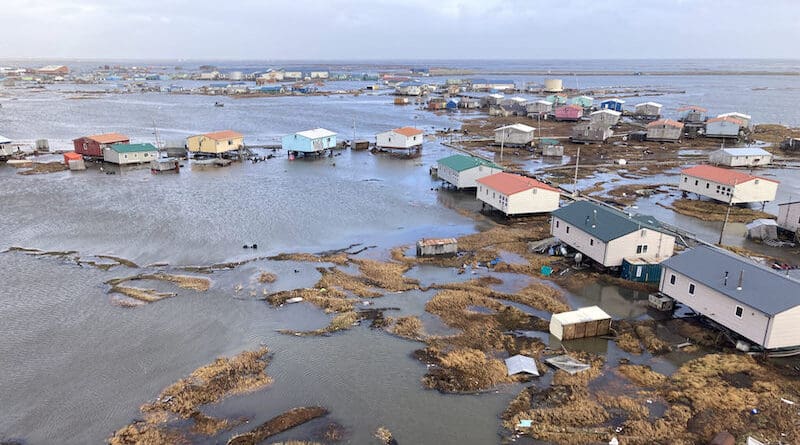
The village of Kipnuk, largely submerged by the remnants of Typhoon Halong, is seen from the air on Oct. 12, 2025. Alaska Air National Guard rescue personnel conducted search and rescue operations there, and the Alaska Division of Homeland Security and Emergency Management has worked with the Alaska Organized Militia and the U.S. Coast Guard in the response. The storm displaced at least 1,500 people and resulted in at least one death. (Photo provided by the Alaska National Guard)

October 19, 2025 
By Alaska Beacon
By Yereth Rosen

(Alaska Beacon) — After the latest catastrophic storm hit Western Alaska, displacing more than 1,500 people, killing at least one and leaving villages in ruins, residents face an existential crisis.

Will the wide delta that fans out between the lower Yukon and Kuskokwim Rivers and has supported one of the circumpolar north’s largest Indigenous populations for millennia continue to be a place where Alaska’s Yupik people can live?

One elder has his doubts.

“We’re not going to be well. Storms are going to get worse, and it’s not going to be livable,” said Mike Williams Sr., a tribal leader from the Kuskokwim River village of Akiak. “We’re past the tipping point, maybe.”

Fairbanks-based scientist Torre Jorgenson, who has studied the region for decades, has doubts as well.

Intertwined climate change forces make long-term prospects grim in the Yukon-Kuskokwim Delta, according to a wide-ranging scientific study he led. The study was published in mid-August, just two months before the remnants of Typhoon Halong hit on Oct. 12.

Coastal erosion, permafrost thaw, sea-level rise, intrusion of saltwater into freshwater systems – are combining with storm surges to dramatically transform the coastal area, damaging communities and the food resources that have sustained Yup’ik people for centuries, the study said.

Of the 18 villages on the outer coastal area of the Yukon-Kuskokwim Delta, at least 10 will likely have to be relocated, said Jorgenson, who is affiliated with the University of Alaska Fairbanks while operating an independent science consulting company.

The at-risk villages sit atop permafrost that, when intact, is a platform a meter or two above the region’s salt marshes, Jorgenson said. That permafrost is no longer intact, and it will likely disappear in the next two to three decades, he said.

“So the ground is going down, and the water is coming up, and they’ll be unlivable,” he said

If those villages move, they will follow the lead of Newtok. The village of about 350 escaped erosion and flooding by moving farther inland to a site called Mertarvik, but the effort took decades and is still challenged by infrastructure problems.

Williams, of Akiak, said it is not easy for coastal villages to find suitable relocation spots. “Even though they head toward higher ground, there’s a lot of wind in the higher ground,” he said.

But some residents of Kipnuk and Kwigillingok are determined to stay and rebuild, and others who evacuated to return.

“We will go back, because it’s our home,” said Missy Chuckwuk of Kipnuk, waiting in line to board an evacuation flight in Bethel on Wednesday, with her husband and their three children. Once freeze-up hits, the community will begin to move homes back that floated away, she said.

An estimated 50 to 100 people stayed and did not evacuate from Kipnuk, according to a representative with the Alaska National Guard, and 200 to 300 people in Kwigillingok.

Jorgenson said necessary action in the most at-risk villages will be expensive.

“They can do kind of short-term adaptation, but over the period of decades, they are going to be looking at having to relocate, and there’s going to be a huge, enormous cost to that,” he said. Newtok’s relocation cost hundreds of millions of dollars, he noted. “And if you’re looking at 10 or more villages that have to move, who’s going to come up with the money for that?”

Combined climate change forces amplify each other


For the Yukon-Kuskokwim Delta, the connected climate change forces include sea ice retreat. It erases the frozen barrier that prevented waves from reaching shore during late-fall and winter storms. By the end of the century, Jorgenson said, the ice-free season in the Bering Sea will last approximately 8.5 months, with ice forming two months later in the fall and melting a month earlier in the spring, he said.

Bering Sea residents already got a taste of the future in 2018, he said, when winter ice was scarcer than at any time in the past 150 years of records.

Storm surges and floods enhance permafrost thaw, Jorgenson said. Saltwater pushed ashore kills tundra plants that make up an insulating mat, thus allowing more heat to penetrate the surface and thaw yet more permafrost.

Beyond damaging homes and villages, the changes hurt people’s ability to gather wild food in their traditional ways, Jorgensen said.

Earlier sea ice melt exposes coastal regions to more flooding in the critical spring nesting season time for migratory birds that are residents’ sources of eggs and meat, Jorgenson said. Saltwater intrusion is changing habitat for migrating birds that use the region, which is a major nesting and breeding site for several species. Saltwater intrusion also contaminates drinking water supplies. Permafrost thaw undermines the once-stable areas that have been long used for traditional hunting camps and that have produced wild food, he said.

“These permafrost plateaus are really very rich areas,” he said. “Those have been really important berry picking areas, and those are going to disappear pretty soon.”

The origins of this fall’s storm, like Merbok three years ago, lie far to the west, in the North Pacific Ocean. There, water has become hotter; a new marine heatwave is currently underway. The ocean heat amplifies seasonal storms that reach Alaska, like Typhoon Halong and the Typhoon Merbok, which sent destructive floods and high winds across the region in 2022.

While Merbok formed in a part of the ocean that is normally too cool to produce typhoons and Halong formed in a more standard ocean spot, both storms picked up intensity from unusual North Pacific heat, said Rick Thoman, a scientist with the Alaska Center for Climate Assessment and Preparedness at the University of Alaska Fairbanks.

“Passing over near or at-record warm sea surface temperatures outside of the tropics, that’s something that both of those storms have in common,” Thoman said.

Such ocean heat will not always be present, but it is likely to be more frequent, he said. “The trend is going only one way,” he said.

People of the Yukon-Kuskokwim recognize the trend.

Alaska Federation of Natives co-chair Ana Hoffman, in her opening address at the organization’s annual convention on Thursday, spoke directly to her fellow Yup’ik people about it, hundreds of whom had been evacuated by then to Anchorage.

“You were at the forefront of this recent storm and endured what is now becoming a new reality here: typhoons in the Arctic,” she said.

Climate change threats in the Yukon-Kuskokwim Delta and other parts of rural Alaska have long been recognized by state and federal government agencies and by state and regional organizations like the Alaska Native Tribal Health Consortium and the Yukon-Kuskokwim Delta Subsistence Regional Advisory Council.

Wiliams said there have been warnings for several decades. Speaking during a break Tuesday in this week’s Elders and Youth Conference in Anchorage, he said he remembers listening to elders talk 50 years ago about the big changes to come.

“They said, ‘The weather is going to be changing, and we’re going to have more frequent storms, and it’s going to get warmer,’” he said,

Those predictions come true, Williams said.

“We used to have seven feet of ice on the river; now it’s three feet. And the permafrost is going away pretty fast. Tundra communities are sinking,” he said.

State Sen. Lyman Hoffman, who has represented Western Alaska for four decades, attested to similar observations.

“There has been more and more warming that is disrupting lives in the Y-K Delta,” the Bethel Democrat said at a Monday news conference held by Gov. Mike Dunleavy.

Alaska House Speaker Bryce Edgmon, I-Dillingham, said the latest storm should be seen as a call to action.

“We know this is not going to be, unfortunately, the last typhoon,” Edgmon said in his address Friday at the Alaska Federation of Natives Conference. “We need to be very conscious about living in a state with a changing climate.” That is necessary for “a future that doesn’t involve waking up in the middle of the night and having water come up from your floor and 100-mile-an-hour winds and your house floating off somewhere,” he said.

Trump administration cuts


The Trump administration, however, does not share that perspective.

The administration canceled previously awarded grants intended to prevent damages in rural Alaska from disasters that have been exacerbated by climate change – including a $20 million grant for coastal erosion control in Kipnuk, a village of about 700 that was one of the communities hardest hit by ex-typhoon Halong.

The Kipnuk grant was among several awarded during the Biden administration to rural Alaska communities under the Environmental Protection Agency’s Community Change Grant Program. The grants were for work like permafrost and shoreline protection, renewable energy development and permafrost protection.

Trump administration officials characterized those projects as unnecessary projects. In a post on the social media site X, EPA Administrator Lee Zelden called them “wasteful DEI and Environmental Justice grants.”

EPA officials defended the cut.


“The ‘environmental justice’ funding cancelled by EPA would not have prevented or safeguarded the community from the mass destruction and tragedy caused by such a large and devastating typhoon,” Brigit Hirsch, the agency’s press secretary, said by email on Friday.

Administration cuts to the National Weather Service, part of broader cuts to the National Oceanic and Atmospheric Administration, likely had an effect on the weather forecast and interfered with preparations for ex-Typhoon Halong’s impacts in Alaska.

Thoman said predictions for Halong’s path into Alaska, made after Trump administration cuts forced reductions in rural Alaska weather staff and monitoring, were not as accurate as those for Merbok in 2022. Atmospheric observations from weather balloons have been cut in Kotzebue, Bethel, St. Paul and Cold Bay, and technical problems prevented the normal launches in Nome, he noted. “It’s almost inconceivable that that lack of upper-air observations had no effect,” he said.

The Government Accounting Office has already identified National Weather Service cuts as a problem. The shortage of meteorologists has created a need for “urgent action” to protect aviation safety, said a GAO report issued on Aug. 28.

Also axed by the Trump administration was a Federal Emergency Management Agency program aimed at preventing disaster damage; a statement from the agency called Building Resilient Infrastructure and Communities program “wasteful and ineffective,” even though earlier analysis found it saved $6 in response cost for every $1 in preparation spending.

Overall, Trump administration cuts to FEMA have undermined the agency’s ability to respond to disasters that are increasing in frequency, according to a Sept. 2 GAO report. FEMA has lost about a tenth of its staff, compromising its capabilities, and there are similar concerns about disaster responses at the Environmental Protection Agency and the U.S. Army Corp of Engineers, the GAO said.

In the short term, Alaska Native organizations were waiting this week for FEMA assistance. Resolutions passed by the Association of Village Council Presidents, a group of Yup’ik tribal governments, and the Yukon Kuskokwim Health Corp., the largest tribal health provider for the region, and other groups have requested a presidential disaster declaration and the aid that comes with it.

Gov. Dunleavy on Thursday sent a formal request for a presidential declaration, not just for the Yukon-Kuskokwim area but also for northwestern Alaska, which was lashed days earlier by remnants of the typhoon.

As of Friday, the disaster response was being led by the state, according to a FEMA statement. But opportunities for immediate action beyond evacuations and temporary shelter were limited.

“There is very little time to do anything, like even dry stuff out at this point,” Thoman said. “Winter is nigh.”Corinne Smith contributed to this story.


Alaska Beacon

Alaska Beacon is an independent, nonpartisan news organization focused on connecting Alaskans to their state government. Alaska, like many states, has seen a decline in the coverage of state news. We aim to reverse that.
It’s Not Just About Fed Independence – Analysis


October 19, 2025 
Observer Research Foundation India
By Srijan Shukla


As the winter approached in 1965, then–US President Lyndon B. Johnson invited the Federal Reserve’s Chair, William McChesney Martin, for a barbecue at his Texas residence along the Pedernales River. While Johnson’s Texas barbecues were quite a feature of his political folklore, the invitation for Martin wasn’t exactly courteous. The Fed Chair had been contemplating, rather publicly, raising interest rates, and Johnson wasn’t amused. The president intended to “grill” his Fed Chair into some sense. During the course of their meeting, Martin managed to communicate to Johnson that setting interest rates was the job of the Fed, and the president backed off.

This little incident from six decades ago is a timely reminder that control over monetary policy has always been a contentious issue. President Donald Trump’s public musings about finding ways to get rid of the Fed Chair, Jerome Powell, or attempts at firing Lisa Cook, a member of the Federal Open Market Committee (FOMC), seem unprecedented only if one forgets what President Johnson’s Chair of the Council of Economic Advisers (CEA), Gardner Ackley, had remarked in 1964: “I would do everything I could to reduce or even eliminate the independence of the Federal Reserve.”

In that sense, the recent slew of attacks by Trump’s executive on his central bank is arguably just an extreme manifestation of the inevitable discord between a government and the central bank—especially as the latter plans to tighten the monetary taps. Politicians always seek lower rates, even sometimes at the cost of inflation, and it’s the latter that hurts the average household the most in the long run. Central bank independence, by design, is an effort to mitigate that problem. Thus, if the recent Trump effort to scuttle Fed independence hopefully ceases, then everyone can return to business soon.

Yet, most participants in the global economy feel that the current crisis of Fed independence is significantly graver. Over the past few months, prices of gold and silver have risen meteorically. Even more curiously, as pointed out by TD Securities, Microsoft’s bonds are trading at a lower yield than US Treasuries. This shouldn’t be the case, given that US government bonds are considered the safest asset in the world. As Fed independence is challenged by the White House, it is easy to miss that a more fundamental monetary regime change might also be underway after four decades – bringing the low-inflation-low interest rates era to a close.


Only Notional Independence


To make sense of this moment, several commentators like to return to the 1960s–70s. There is a lot of merit in doing so – not just because of similar macroeconomic conditions in the US and worldwide, but because it teaches us something far more fundamental about the context and dynamic nature of the Fed and, more generally, central bank independence. In this regard, Alan Blinder’s masterful book, A Monetary and Fiscal History of the United States, 1961–2021, is especially useful.

Following the assassination of President John F. Kennedy, Johnson took over the White House. Soon, he facilitated a major tax cut, which was dubbed the Kennedy–Johnson Tax Cut, given that the former had been working on it. This was followed by Johnson’s Great Society welfare push and, finally, the steep rise in defence spending owing to the Vietnam War. As expected, the massive fiscal expansion led to a rise in both growth and inflation. This was the context for Johnson’s summoning of Fed Chair Martin to his Texas ranch.

On paper, the Treasury–Federal Reserve Accord granted the central bank independence in 1951. But Fed independence was not remotely as entrenched until the late 1970s. Consequently, the Fed’s response was late and inadequate. By the time Nixon came to power in 1969, inflation was as high as 6.4 percent. Over the next couple of years, both fiscal and monetary policy would contract, resulting in a fall in inflation but also a recession. This was still textbook territory: if inflation gets too persistent, one tightens fiscal and monetary policy until it breaks. If recession is the collateral damage, then so be it. The monetary and fiscal policy contracted, but with a delay, and thus, inflation also came down with a lag.

After the said inflation was tackled, what followed was, without a doubt, the most dramatic denunciation of the idea of central bank independence adopted just two decades ago. Martin made way for Arthur Burns at the Fed, and what followed was two years of monetary and fiscal policy bonanza—all directed to ensure Nixon’s victory in the 1972 presidential elections.

The fiscal deficit rose by 1 and 0.5 percent through 1971 and 1972. Meanwhile, the M2 growth rate went from 2.5 percent in February 1970 to 13.1 percent in June 1971 and 12.7 percent in November 1972—perfectly in time for the elections. To make things worse, wage–price controls were put in place to ensure inflation didn’t rise. The extremely buoyant economic conditions—as exemplified by the growth rate of 6.9 percent in 1972—facilitated Nixon’s victory. This is what Kenneth Rogoff referred to as the ‘political business cycle’.

Once the election was over, both fiscal and monetary policy contracted, but the wage–price controls were also done away with. As inflation soared to the highest level since 1951, the first OPEC shock led to a major hike in crude prices, and inflation soared even higher. Interestingly, by now, the Bretton Woods system was also done away with, and countries were slowly moving toward floating exchange rates. The US economy was now in stagflation, and the Fed’s response has been characterised by Blinder as “schizopheric”. It first hiked rates and then eased them.

The entire decade was financial mayhem. As the 1970s were closing and inflation had just begun to decline, the second OPEC shock arrived, taking the inflation rate to as high as 14 percent. The 1965-82 period in the US is known as the era of the ‘Great Inflation’.

Volcker and the Birth of Fed Credibility

In 1979, a reeling President Jimmy Carter brought in then–President of the New York Fed, Paul Volcker, to take charge of the country’s central bank. Volcker unleashed a string of rate hikes – over 20 percent at one point – and an unprecedented tightening of the money supply. It brought inflation back under control but resulted in a deep recession and took unemployment as high as 10.8 percent. Years later, when asked how he broke the great inflation, Volcker’s response was: “by causing bankruptcies”.

This moment is widely considered the de facto birth of Fed independence and credibility. After all, the two are inherently interrelated. It is not sufficient for a central bank to be independent; it also has to demonstrate its credibility in delivering price stability. Yet, there is another feature of the Volcker Shock that doesn’t get enough attention.

“Now, after years of compromise and from a head-on attack on inflation, it was time to act,” writes Volcker in his memoir, Keeping at It. “The dollar’s ties to gold and to the Bretton Woods fixed exchange rate system were long gone. There was widespread understanding that the dollar’s value now depended on the Fed’s ability to control the money supply and end the inflationary process.”

Through the 70s, it wasn’t just the wage-price controls, the oil shocks, or the Carter fiscal stimulus that resulted in persistent inflation. A more fundamental regime change had taken place with the end of the Bretton Woods fixed exchange rate system, and central banks across the West had struggled to adjust to it. From the Bank of England to the Bundesbank to the Federal Reserve, the steep hike in rates – and their success in bringing down inflation – resulted in the birth of modern central bank credibility and independence.

A New Regime?

Returning to the current moment of the Fed crisis, it is increasingly evident that following the pandemic, a regime change has taken place yet again. Over the past five years, the Fed’s record has been somewhat mixed. Its inability to predict inflation owing to massive fiscal expansion and supply chain disruptions was a glaring failure. However, it did succeed in delivering a major victory by effectively bringing down inflation without causing a recession. The thing is, central banks don’t have the luxury of having mixed records – least of all the leading global central bank.

As Jamie Rush and co-authors argue in Price of Money, owing to a host of reasons – ageing of baby boomers, a surge in AI-related capital expenditure, supply chain reconfigurations, rising protectionism, and ballooning debt levels – the low-inflation-low-interest-rate era seems to be coming to an end. The most pressing among these is arguably the US public finance math.

The US now seemingly faces a new trilemma – where it’s getting difficult to sustain all three: a large debt pile, a high primary deficit, and low interest rates. Something has to give. To make things worse, the level of policy uncertainty unleashed by the Trump administration makes it a Herculean task to do monetary policy right.

This is a new regime the Federal Reserve now finds itself in. The caveat here is that it is still not clear whether this new regime has already materialised or it’s a work in progress. Future central bank credibility, especially that of the Fed, will, in large part, rely on ensuring it can predict that before markets do.

About the author: Srijan Shukla is an Associate Fellow with the Centre for Economy and Growth Programme and the Forums team.

Source: This article was published by Observer Research Foundation


Observer Research Foundation

ORF was established on 5 September 1990 as a private, not for profit, ’think tank’ to influence public policy formulation. The Foundation brought together, for the first time, leading Indian economists and policymakers to present An Agenda for Economic Reforms in India. The idea was to help develop a consensus in favour of economic reforms.
Iran’s ‘No To Executions’ Campaign Marks 90th Week With Nationwide Protests And Prison Uprisings – OpEd


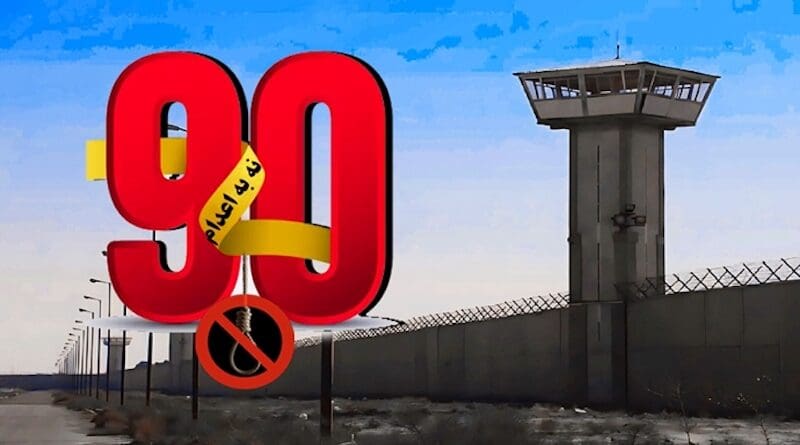
No to executions Tuesdays week 90. Credit: PMOI


October 19, 2025 
By Mahin Horri


This past October 14, 2025, the “No to Executions Tuesdays” campaign marked its 90th consecutive week of defiance, with prisoners in 52 facilities across Iran participating in coordinated protests against the clerical regime’s escalating use of capital punishment. This grim milestone comes amid a horrifying surge in state-sanctioned killings, with reports indicating that over 1,000 people have been hanged in the first six months and 20 days of the Persian year 1404, including 162 in the first 20 days of the month of Mehr (September 23-October 12) alone.

The regime’s killing spree, intended to terrorize the populace into submission, has instead ignited a synchronized resistance movement that now spans from inside the country’s most notorious prisons to the streets of major cities, signaling a new, unified phase of popular opposition.

A campaign of judicial terror

In a clear bid to crush dissent, the regime’s judiciary has recently handed down a series of new death sentences targeting students, activists, and ideological prisoners. The death sentence for Ehsan Faridi, a student political prisoner held in Tabriz, was recently confirmed. The campaign’s statement condemned the decision as being “lacking due process” and designed to “create fear among youth and students.”

Furthermore, death sentences were issued for three ideological prisoners: Nasimeh Eslam-Zahi, her husband Arsalan Sheikhi, and Amanj Karvanchi. The campaign’s organizers described these verdicts as a “symbol of injustice in the despotic judicial system,” underscoring their commitment to “keep raising our voice of protest against widespread and ruthless executions.”

Rebellion from within the prison walls


The epicenter of the in-prison resistance has been Ghezel Hesar prison, one of the regime’s primary execution facilities. On Monday, October 13, inmates in Unit 2—where over 1,500 prisoners are on death row—staged a mass sit-in and hunger strike after several of their cellmates were transferred to solitary confinement for their imminent executions. The prisoners refused their meals and demanded the return of their fellow inmates.

One prisoner from inside the unit reported, “Ghezel Hesar’s Unit 2 is the unit for prisoners under execution. All prisoners went on a hunger strike to protest the mass transfers and relentless executions.”

This act of defiance inside the prison walls coincides with prisoners in Ghezel Hesar joining the global anti-death penalty day by chanting slogans against capital punishment, turning the regime’s centers of repression into frontlines of resistance.
Nationwide protests echo calls for an end to executions

The courage displayed inside the prisons was mirrored by widespread protests across Iran. Citizens took to the streets in Tehran, Isfahan, Sanandaj, Tabriz, Mashhad, Rasht, and numerous other cities to mark the 90th week of the campaign. Protesters held placards and chanted powerful slogans, including “Our scream is stronger than your noose” and the defiant warning, “This is the final message: if you execute, there will be an uprising.”

A pivotal role was played by “justice-seeking mothers” and the families of political prisoners, who stood at the forefront of the rallies. Holding pictures of their imprisoned loved ones, they led chants of “Don’t execute Iran’s children, Iran’s assets” and “Political prisoners must be freed,” transforming their personal grief into a powerful collective call for justice.

The events marking the 90th week of the “No to Executions Tuesdays” campaign demonstrate that the regime’s primary tool of suppression is failing. Instead of silencing the population, the “execution machine” is unifying Iranians from all walks of life in a common cause. The synchronized actions of prisoners, their families, and citizens on the streets reveal a deeply rooted and organized national movement that views the abolition of the death penalty as inseparable from the goal of achieving freedom.

As the campaign’s statement warns, these staggering execution figures have “wounded the public conscience of Iranian and global society and requires immediate and serious global action to stop this criminal process.” The message echoing from Iranian prisons and streets is clearer than ever: “No to executions, for anyone!”


‘Canterbury Cathedral’s graffiti: Why Labour must fight for British heritage’


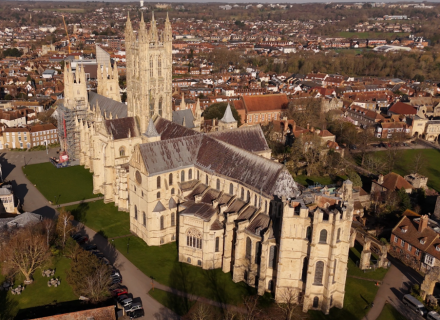
Photo: Canterbury Cathedral

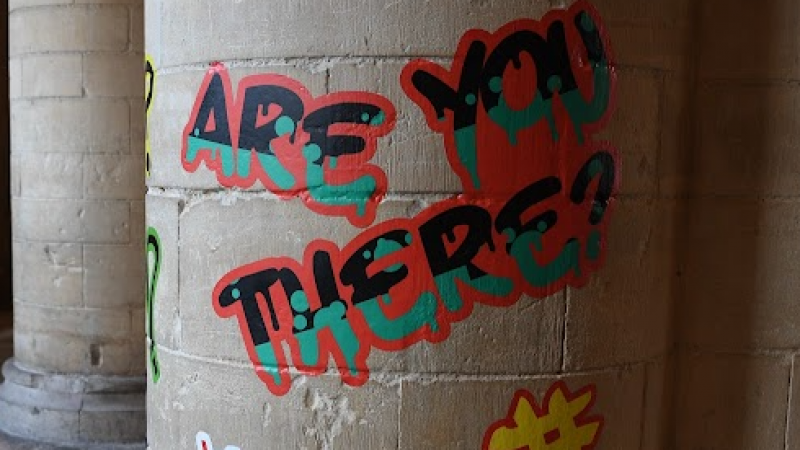
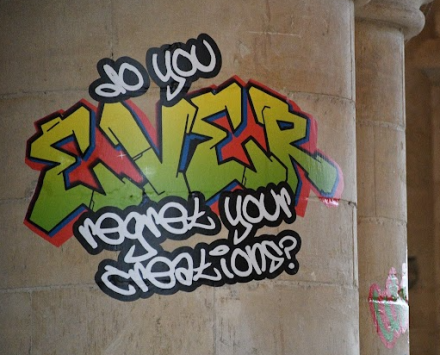
The ancient walls and pillars of this World Heritage Site have been temporarily decorated with rhetorical questions in the style of graffiti.

Some are existential, some are poignant, and all of them are the product of engagement with local marginalised communities. 

Sometimes art seeks to shock. In that respect, this exhibition has succeeded.  

Self-styled defenders of British culture – Tommy Robinson and J.D. Vance to name a few – have commenced a pile-on against the ‘ugly’ exhibition. 

They recall to me the riots that met the premiere of Stravinsky’s Rites of Spring, though I hope this won’t go so far. 

Some objections will be more innocent, but the abiding concern of these men is almost always the imagined effacement of white identity. Their ethnonationalism should be rejected.

‘The far-right has made inclusion and tolerance its targets – but those are quintessentially British’

Photo: Canterbury Cathedral


]I spoke to the Dean of Canterbury about this reaction. He told me the cathedral team feel ‘battered’. 

The curator has 15 years of experience placing artwork in cathedrals and similar buildings without issue. This must be an unbelievably strange and challenging time.

Contrast that with the contemplative, sometimes painful, questions which occasioned this hostility. For instance, ‘do you ever regret your creations?’

The international far-right has made inclusion and tolerance its targets. But those values are quintessentially British. 

We must not take them for granted. We must defend and promote them. 

And at the heart of the United Nations Educational, Scientific and Cultural Organisation (UNECSO) which designates World Heritage Sites, is the mission to spread peace by building understanding between people. 

‘Bringing our heritage back to life must form part of our national renewal’

Efforts to build inclusion through World Heritage is not about prioritising minorities or rewriting our national story. It’s about building a greater understanding and fostering a conversation about what is special about this history and country that we all share.

As the Dean told me, it’s not about preserving sites in aspic, but about making them live and breathe. This is particularly true for religious sites, whose function has remained continuous since their beginnings. 

This also relates to pride in place, which must be about what places mean, as well as how they feel and what they look like.

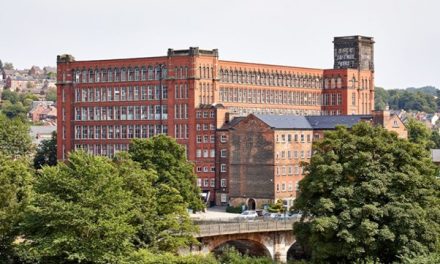
Belper North Mill in Derbyshire

The Derwent Valley Mills World Heritage Site, which runs through my constituency, stands for our national contribution to the world’s industrial revolution, and – more importantly – the people behind it. Not only the people who pioneered new technologies, but also those who tended the looms and those who picked the cotton on plantations.

In Derbyshire, that history remains a complex and important part of our identity. 

But in recent decades, some of the great mills of my constituency have fallen into disrepair, becoming painful and unsightly reminders that we have been left behind by successive governments. 

Bringing our heritage back to life in areas like mine must form part of our national renewal. 

My constituents deserve the chance to engage with our history.

Photo: Canterbury Cathedral


That is what is happening in Canterbury. 

The local community must certainly feel, in these times, a tangible connection to the heritage of their cathedral. After all, it has a long history of controversy. 

The violent and bloody murder of Saint Thomas Becket in 1170 made it a destination for pilgrims, as comically documented by Chaucer. 

In the Reformation, it was stripped of its Catholic relics, for reasons that all British children now learn at school.  

At the heart of the gospels is the most controversial figure of all; one who defied empire, dined with outcasts, and saw dignity where others saw disgrace. 

How appropriate that the World Heritage Site of Canterbury Cathedral is the place where that struggle for tolerance and respect continues today.

‘Alienation from our history leaves communities vulnerable to political extremes’

Alienation from our history leaves communities vulnerable to the appeals of the political extremes. Our response must be a brave, progressive approach to our heritage. 

So even those who initially flinch at the Canterbury Cathedral exhibition should defend and support its ambition to provide a meaningful connection with our shared history to ever wider audiences. 

That’s why I reconstituted the All-Party Parliamentary Group for UNESCO World Heritage Sites. Those sites, wherever they are, represent the most significant parts of our common human story. 

World heritage professionals dedicate their careers to bringing these stories to life for as many people as they can, and I want to support and amplify their amazing work. 

We now have the opportunity of a government, a Prime Minister, and a Culture Secretary who are once again giving culture the priority and the funding it deserves. 

Results will come gradually, but the impact could be transformational.

Love’s Labour’s Lost

Labour Hub contributor and former Labour parliamentary candidate Julian Vaughan explains why he is leaving the Party.

It is with great sadness that I have made the decision to leave the Labour Party. As a General Election candidate in both 2017 and 2019, the Labour Party has been a significant part of my life over the last decade, and I have had the opportunity to meet many incredible people, both within and outside the Party.

However, my conscience can no longer allow me to stay within a Labour Party that has drifted so far from its core values. I am no ideologue. Those who know me within the trade union and labour movement will know that I am pragmatic and willing to work across political divides, whatever shade of red, or indeed even blue. The current Labour Party struggles to do either. A confident political Party would tolerate dissent – it makes for better policy. It is not Labour ‘rebels’ who are opening the door to Reform, it is Labour’s timidity, lack of any discernible direction or moral compass.

I will admit to wrestling for many months with the well worn argument that it is better to be inside the tent pissing out, and that regret may follow a fleeting sense of satisfaction, but too many straws have broken too many backs.

I do not think for one moment that the Labour Party will shed any tears over my departure. When, after being a candidate in two General Elections, I was offered the sixth safest Tory seat in the UK (NE Cambridgeshire), to which I said thanks, but no thanks, you get a fair idea of how little you are regarded by the Party machine. Further, when you do not even get a response to an application to be the candidate for North Durham, (subsequently represented by former NEC member Luke Akehurst), I can clearly see that I am flogging a dead horse.

I should point out that despite the above, I was out on the doorstep continually in the run-up to the General Election of 2024, putting any ego and disappointment aside to help get rid of the woeful Conservative government. As a committed trade unionist, I fully understand the importance of collective responsibility and have always sought to prioritise the cause over personal gain. However, I know the patience of many would have been exhausted long before mine was.

As the great-great-grandson of a Tory MP (Sir Harry Seymour Foster, MP for Portsmouth Central and then twice for Lowestoft), I had hoped to even up the score and be the first train driver into Parliament for over 50 years. While the knowledge that this was not going to happen was a blow which hit me hard, if I am honest, it is certainly not the reason for my decision to leave.

After the chaos of the Tories, Labour promised competent governance. Instead, despite some bright spots – nothing is ever all good or all bad – the current administration has overwhelmingly been a year of policy missteps, U-turns, political drift to the right and some truly dire communications.

However, rather than have the backs of ordinary people, Labour prefers to champion big business and court the wealthy. We need a government that has the back of Joe Public and particularly the most vulnerable in our society. As a Labour supporter all my life, who has dedicated a fair bit of time standing up for Labour and Labour values, it is gut-wrenching that Labour’s first instinct is to punch down on disabled people.

Labour now echoes the rhetoric of previous Tory governments, which talked about “tough choices having to be made”. Why is it always the most vulnerable who have to face the consequences of these political decisions – never the elite?

The UK needed far more than just a change in the management team. I have written previously about the need for the Labour Party to place empathy, compassion and indeed love at the heart of its offering to the country. Labour must, of course, be pro-business, but with a caveat: it must be pro-ethical business. Grenfell showed us what happens when a naked pursuit of profit is put ahead of people.

The lack of a genuine drive to create a fairer, more equal society by politicians from both sides of the political spectrum has created genuine grievances within our communities, particularly (but not limited to) working-class post-industrial areas. The vacuum left by this failure has been seized by politicians such as Reform UK – but they are definitely not the answer the UK needs.

As Labour tacks to the right, it doesn’t weaken Reform, it empowers it. We need courage, not appeasement, or a disastrous election defeat awaits – bad for Labour, but more importantly, a tragedy for the UK and a grave threat to our democracy.

Rather than champion the remarkable contribution made by immigrants, Labour has chosen to attempt to outflank the hard right by being seen to be tough on asylum seekers – always punching down, never up. It is not the people arriving in small boats who have created the fundamental problems of inequality and broken public services we face in the UK. Regrettably, Labour has relinquished the initiative and let Reform dictate the political narrative. You cannot appease fascism.

Trust in politics and politicians is at a very low ebb. A progressive Labour Party had the chance to restore trust in politics. Instead, it chose to defend corporate freebies with the premise that ‘all MPs do it’ and that it was ‘within the rules’, completely missing the point that this alienates the public and strengthens the view that all politicians are the same.

The introduction of a ‘Hillsborough Law’ is of course very welcome and a fitting tribute to the remarkable dignity and tenacity of the families of the bereaved. However, by definition, the law will only be enacted if there has been yet another failure of the state. To avoid these repeated failures, we need to fix the system, not just tinker around the edges. Under this government, there is no sign that this will happen.

However, the instinct of this Labour government is to view regulations as a ‘burden to business’ rather than the vital checks and balances preventing profit being prioritised over people. It is this culture that led to Grenfell, and eight years on, the lack of any justice emboldens a corporate elite, confident that they will never be held to account for their actions. This corporate elite is welcomed with open arms through the shadowy world of lobbying, which Labour have done nothing to eradicate and indeed much to promote.

Rather than seizing the initiative, this Labour government is constantly buffeted by events, rudderless, with an absence of any clear understanding or honesty about what it stands for and who it represents. As Mhairi Black set out in her exceptional maiden speech (whatever your politics), quoting Tony Benn, there are signposts and weathercocks. Starmer and the Labour administration are certainly the latter.

We need politicians who understand the lives of ordinary working people, MPs who have worn a hi-viz as part of their job, not just for a photo opportunity. If we continue to draw the majority of our MPs from the corporate world, it is little wonder that there is a ready acceptance of the narratives peddled by corporate lobbyists and policies that favour big business over ordinary people. This corporate capture is deep-seated within our politics and a clear and present danger to our democracy.

There comes a point in any government where, no matter what good or even brilliant things they do, and Labour has done some good things, people have stopped listening. It has come to this government very early, not helped by an electorate radicalised by apathy, distrust in the political system, and the crystal-clear messaging of the hard right.

The move to bring the railways back into public ownership should be welcomed, but instead it is another example of Labour’s timidity. The trains will continue to be owned by rolling stock companies (ROSCOs) that rake in huge profits through the leasing of their trains. UK rail fares are some of the most expensive in Europe, but Labour have studiously avoided any commitment to cut fares.

If public ownership doesn’t bring long-suffering passengers a more affordable, more reliable, and accessible railway, the public will rightly wonder what exactly was the point? In terms of creating a more accessible rail network, Labour have yet to commit to even the paltry fifty stations promised ‘Access for All’ funding by the Tory government in May 2024, despite stating they have “an unwavering commitment to (rail) accessibility”. Actions speak louder than words.

It is a grim irony that proportional representation, previously criticised as enabling the extreme right to gain political leverage, may now be the only means to stop it in the UK. However, any much needed change to how we vote in the UK will rightly be seen as political opportunism rather than a principled desire for a fairer voting system.

Starmer, whom I voted for as leader, needs better advice, better advisors and a compelling narrative, not meaningless, mind-numbing soundbites about growth and delivery. I believe that at his core, he is a good man, but sadly I no longer believe what he says – and neither does much of the public.

So very sadly, it has come to a point where I have come to be ashamed rather than proud of being connected with the Labour Party. However, I must point out that there are dedicated people with huge integrity who remain within it, with whom I will always be willing to work to improve our communities.

So what does the future hold? My passion for social justice remains undimmed and I will continue to do all I can to hold power to account and champion the most vulnerable in our society. I had hoped that I could continue my efforts from within the Labour Party as a ‘critical friend’, but I can no longer do so with a clear conscience.

Julian Vaughan was Labour Parliamentary candidate for NE Bedfordshire in 2017 and 2019. and a Labour NEC candidate in 2020. He blogs here, where this post originally appeared. Twitter: @julian_vaughan_ https://twitter.com/julian_vaughan_

Image: Handwritten Letter of Resignation. Source: https://www.flickr.com/photos/193749286@N04/51391275986/. Author: CIPHR Connect, licensed under the Creative Commons Attribution 2.0 Generic license.


‘Forty years on, women in Labour are still being told to wait their turn’


Photo: chrisdorney/Shutterstock

I read the article by Jessica Smith and found myself thinking about 1988. I learned a lot about the Labour Party that year: when I stood to be CLP Women’s Officer, I was taken to one side, told there was an incumbent and that it would be inappropriate to stand against her. I should wait my turn.

I was a delegate to annual conference and, when reporting back to another branch, watched as the few women there got up and walked out in unison about half an hour into the meeting. I was invited to follow them only to be told that we would now make tea and coffee for the (male) delegates.

There was a leadership election that year, and I stood behind Ron Todd in the queue to register our (paper) votes. The woman in front of him presented her one CLP vote for Benn/Heffer, whereupon Ron laughed, said ‘Sorry love’ and declared ‘Eight million votes from the TGWU for Neil Kinnock and Roy Hattersley’.

Power.

Although I have been a member for almost forty years (apart from a two year break when it all felt a bit grim) it’s years since I have been an activist. So it was a shock to return to ‘active service’ a couple of years ago and see what has, and what hasn’t changed. 

READ MORE: ‘Young Labour women must take up space’

Jessica describes being made to feel like she shouldn’t be in the room, that she has to police herself, that she mustn’t ever make a mistake or misspeak. No one should be made to feel like this, particularly within a political party that prides itself on progressive values.

One of the joys of my working life has been the opportunity to learn from those who have gone before, to understand the struggles and fights of the past, what has worked and what hasn’t. But that on its own isn’t enough, without action and without the next generations we risk being pickled in aspic, looking backwards and not forwards. So the time I spend with young people in the housing sector is a joy, and a privilege. I have learned so much, hopefully shared a bit of wisdom and held doors open for them to run through. I’m proud of helping make the case for CIH Futures and am now watching those first cohorts begin to change the world, solving problems in a way that blows my mind. They are incredible people.

At no point have I felt like I now do in the Labour Party, where the pockets of contempt towards people, particularly women, of my age is overwhelming. WhatsApp groups are full of disdain for ‘Boomers’ and it all feels a bit too Logan’s Run for comfort. This is by no means universal, but there are pockets, and those pockets are pretty deep, and pretty dark.

Subscribe here to our daily newsletter roundup of Labour news, analysis and comment– and follow us on BlueskyWhatsAppX and Facebook.

As always in the Labour Party, so much of this comes from factionalism, with a side order of old-fashioned misogyny. I have watched as young women are volunteered for (often admin) tasks without their agreement, seen the distress caused when instructions on how to vote are sent by WhatsApp during meetings. Ageist epithets are used when older women refuse to be biddable and all in the name of one faction of the party or another one. There are a plethora of unaccountable organisations exerting real power and influence both on the edges of and at the heart of Labour and the party would be well advised to get a grip of some of these.

External structures increasingly recognise that diversity is best served having time limits on boards and committees. This is hard for democratic institutions to grapple with but we must be mindful of balance and of diversity in all its forms, including opinion.

So Jessica, your voice needs to be heard, it is not okay that you are made to feel unwelcome, just like it wasn’t okay forty years ago. I’d love to sit and have a brew with you, to learn from you and maybe hatch out a plan to call out the ageism and misogyny that still exists in Labour. Whatever you do, don’t give up.


‘After years of sewage and debt, Thames Water doesn’t deserve another free pass’


Photo: Jessica Girvan/Shutterstock

Ofwat is currently deciding whether to let Thames Water pollute our rivers and seas outside of current legal limits for the next 15 years. 

As many of us are already acutely aware, Thames Water is crumbling. It has a debt pile of approximately £20 billion. Households are paying more and more for a broken service. Burst pipes, water outages and road closures have all become new norms. Last year, Thames Water had the highest rate of serious pollution incidents out of all the English water companies.

In an attempt to keep hold of the utility, Thames Water’s creditors (mostly US hedge funds and investment firms that are now using the name London and Valley Water) have put forward a deal to water regulator Ofwat. As part of this deal, they have stated that a ‘full return to legal, regulatory and environmental compliance’ would not take place until at least 2035-2040. Instead, they have put forward their own ‘improvement accountability framework’ as a set of obligations which they are prepared to keep. What does this mean in practice? Thames Water’s creditors want to set their own rules.

Here are five clear reasons why this deal must not go ahead. 

It would result in 15 more years of pollution of our rivers and seas

The deal proposes an expected return to full environmental compliance in 2035-2040, meaning they will be breaching their licence until at least that time. Our rivers and seas simply cannot withstand 15 more years of pollution. 

It would set a dangerous precedent for all other English water companies

If Thames Water can set their own rules – and protect their profits as a result – all other water companies will want to do the same. This decision impacts not just Thames Water households, but every single household in England. 

There is a complete lack of transparency and accountability

Details of the ‘improved accountability framework’ have not been made clear to members of the public. We fund the water system through our bills, and rely on water companies to deliver this essential service. We are the biggest and most important group of stakeholders in our water system, and deserve a say in how it is run. Water is a natural monopoly, meaning that we cannot simply choose to get our water somewhere else if the terms and conditions of one provider don’t suit us.

READ MORE:

It is not the best value for the public purse 

Thames Water creditors have offered a 25% debt write-off. Much more debt would be written off under special administration. The previous government’s plans under Project Timber involved a 40% debt haircut for some creditors. We could cut more.

This is not what this government promised 

This government promised to be tough on water pollution, including a pledge that sewage pollution will be cut in half by the end of the decade. In this deal, Thames Water creditors set out an ‘ambition’ – not even a commitment – to reduce sewage outflows 30% by 2030, which falls significantly short of former Environment Secretary Steve Reed’s target. 

What’s more, Reed has specifically said of Thames Water that ‘it is only right that the company is subject to the same consequences as any other water company’. 

By accepting this deal, this government would be undermining their promised action on sewage not just ahead of the next election, but for the two elections after that.

Subscribe here to our daily newsletter roundup of Labour news, analysis and comment– and follow us on BlueskyWhatsAppX and Facebook.

Bring Thames Water into special administration, followed by permanent public ownership

Ofwat has a choice. Special administration is the clear and viable alternative to selling our water system down the river. 

Special administration is a form of temporary public ownership. This mechanism – which exists to protect the running of vital public services – can be used to wipe out a vast proportion of Thames Water’s debts and stabilise the company. 

From there, we must bring water into permanent public ownership. A precedent was set for this by Railtrack, which became publicly owned Network Rail after it was brought into special administration under Blair in 2001. Blair’s government would absolutely have brought Thames Water into public ownership by now. 

Under public ownership, households and environmental groups would have a say on the board of Thames Water, and money that is currently spent on shareholder payouts would be spent on tackling sewage and reducing bills.

We Own It are campaigning for Ofwat so say no to Thames Water’s outrageous deal. Our petition has already been signed by over 15,000 people. You can add your name here.