Tuesday, October 21, 2025


How hard is it to dim the Sun?


Solar radiation management is gaining traction as a climate intervention—but new research warns that real-world constraints make it riskier and more uncertain than most models suggest


Columbia Climate School


Once considered a fringe idea, the prospect of offsetting global warming by releasing massive quantities of sunlight-reflecting particles into Earth’s atmosphere is now a matter of serious scientific consideration. Hundreds of studies have modeled how this form of solar geoengineering, known as stratospheric aerosol injection (SAI), might work. There is a real possibility that nations or even individuals seeking a stopgap solution to climate change may try SAI—but the proponents dramatically underestimate just how difficult and complicated it will be, say researchers from Columbia University.

“Even when simulations of SAI in climate models are sophisticated, they’re necessarily going to be idealized. Researchers model the perfect particles that are the perfect size. And in the simulation, they put exactly how much of them they want, where they want them. But when you start to consider where we actually are, compared to that idealized situation, it reveals a lot of the uncertainty in those predictions,” says V. Faye McNeill, an atmospheric chemist and aerosol scientist at Columbia’s Climate School and Columbia Engineering.

“There are a range of things that might happen if you try to do this—and we’re arguing that the range of possible outcomes is a lot wider than anybody has appreciated until now."

In a paper published in Scientific Reports, McNeill and her colleagues reckon with the physical, geopolitical and economic limitations of SAI. They begin by collecting the scattered scientific literature on how SAI’s impacts would be shaped by the nuances of its deployment. Many factors affect how aerosols interact with Earth systems: the altitude and longitude at which they are released, the time of year when this takes place, and of course the sheer number of particles involved.

The most significant variable, though, appears to be latitude. For example, SAI concentrated in polar regions would likely disrupt tropical monsoon systems. Releases concentrated in equatorial regions could affect the jet stream and disrupt atmospheric circulation patterns that conduct heat towards Earth’s poles.

“It isn't just a matter of getting five teragrams of sulfur into the atmosphere. It matters where and when you do it,” says McNeill. These variabilities suggest that, if SAI takes place, it should be done in a centralized, coordinated fashion. Given geopolitical realities, however, the researchers say that is unlikely.

Model studies to date have focused almost entirely on SAI approaches that would use sulfate-rich gases analogous to those formed when volcanic plumes oxidize and condense in the stratosphere. Volcanic eruptions have cooled Earth in the past: When Mount Pinatubo erupted in 1991, for example, planetary temperatures dropped by nearly one degree Celsius for several years afterwards. That event is often cited as a proof-of-principle for how SAI could work.

Beside cooling at ground level, SAI also poses undesirable consequences, both expected and unexpected. For example, Pinatubo’s eruption also disrupted the Indian monsoon system, leading to decreased rainfall across South Asia, and caused warming in the stratosphere and depletion of the ozone layer. The use of sulfates for SAI could pose similar risks, or additional environmental concerns, including acid rain and soil pollution. These concerns have led to a search for other aerosol ingredients for SAI.

Proposed mineral alternatives include calcium carbonate, alpha alumina, rutile and anatase titania, cubic zirconia and diamond. Consideration of alternatives has focused on their optical qualities, but other factors have been neglected.

“Scientists have discussed the use of aerosol candidates with little consideration of how practical limitations might limit your ability to actually inject massive amounts of them yearly,” says Miranda Hack, an aerosol scientist at Columbia University and the new paper’s lead author. “A lot of the materials that have been proposed are not particularly abundant.”

Diamond is optically well-suited to the task, but there simply isn’t enough of it. As for cubic zirconia and rutile titania, supply might conceivably meet demand, but the Columbia team’s economic modeling suggests that increased demand would strain supply chains and make them much more expensive. Sufficient supplies of alpha alumina and calcium carbonate exist to absorb demand without driving prices to prohibitive levels—but, along with the other candidates, there are serious technical challenges involved with dispersing them.

At the minuscule, sub-micron particle size necessary for SAI, the mineral alternatives all tend to clump into larger aggregates. According to the researchers’ calculations, these aggregates are less effective at reducing sunlight than are particles, and their climate impacts are even less understood. “Instead of having these perfect optical properties, you have something much worse. In comparison to sulfate, I don’t think we would necessarily see the types of climate benefits that have been discussed,” says Hack.

All these practical considerations—in deployment strategies, governance, availability and material properties—made SAI even more uncertain than it already is, say the researchers. This should be acknowledged when considering the use of SAI.

"It's all about risk trade-offs when you look at solar geoengineering,” says Gernot Wagner, a climate economist at the Columbia Business School and a close collaborator with the Climate School. Given the messy realities of SAI, he says, “it isn't going to happen the way that 99 percent of these papers model.”

The study was coauthored by Daniel Steingart, co-director of the Columbia Electrochemical Energy Center.

Lisbon funicular crash cable was substandard — report
DW with AP, AFP
20/10/2025 - 

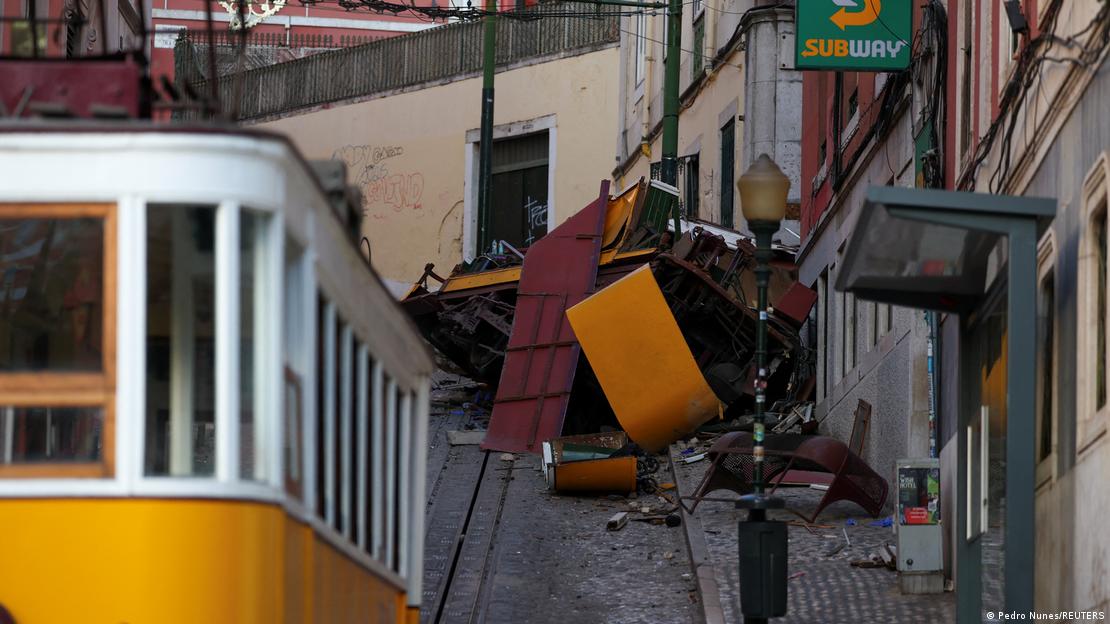
A preliminary report into the deadly Lisbon Gloria funicular crash has found the cable linking the two carriages was not certified for public transport.


The Gloria funicular was a popular tourist attraction
Image: Patricia De Melo Moreira/AFP/Getty Images

The cable that snapped on the Lisbon funicular was not up to the standards laid out by the city's transport operator, according to a preliminary report released Monday.

The crash in September killed at least 16 people and injured 21 others after one of the carriages on the railway derailed and crashed into a building in central Lisbon.

The Gloria funicular, classified as a Portuguese national monument, is one of the four in the city and is hugely popular with tourists for its short trip on a steep street in central Lisbon.

It has two carriages traveling in opposite directions.

In the deadly incident in September, the cable connecting the two carriages snapped, with the top car hurtling down the hill at high speed.


What did the report say?


In its 35-page preliminary report, the Office for Air and Rail Accident Prevention and Investigation (GPIAAF) said that the underground steel haulage cable that connected the two cars wasn't strong enough.

"The cable did not comply with the specifications in force at the CCFL to be used for the Gloria tram," the report said, with the acronym referring to the city's transport operator.
The carriage hurtled down a steep hill before crashing
Image: Pedro Nunes/REUTERS

The other funiculars in the city have been suspended since the crash. The investigating body said that inspectors have yet to confirm that braking systems "capable of immobilizing the cabins in the event of a cable break" are operable.

In the case of the Gloria funicular, the cable had been in use for less than a year.

The investigation identified five instances when the maintenance program referred to "non-existent, inapplicable or outdated standards," the report said.

After the cable broke, safety systems cut power to the funicular, meaning that the pneumatic brake no longer worked and the manual brake wasn't strong enough to stop the car hurtling down the hill.

A complete analysis of the deadly accident is expected next year.

Edited by: Karl Sexton
Roshni Majumdar Roshni is an editor and a writer at DW's online breaking news desk
.
Côte d'Ivoire elections 2025 – Women on the campaign trail

Issued on: 20/10/2025 - RFI
Video by: Melissa Chemam

Ivorians are going to the polls on 25 October to elect their next president. Incumbent President Alassane Dramane Ouattara – known as ADO – is running for a fourth term, facing four outsiders during a two-week-long campaign.Women are very involved on the hustings, both on the President's side and in the opposition. There are even two female candidates. However, women only represent about 30% of elected people in Côte d’Ivoire.Melissa Chemam reports from Abidjan.


Côte d'Ivoire Elections 2025 - A student's perspective

As Côte d’Ivoire heads to the polls next weekend, 21-year-old economics student Flavio Kouna shares his worries with RFI about jobs, politics, and the lingering scars of past conflict.


Côte d'Ivoire presidential election 2025: What's at stake?


Spotlight on Africa
Issued on: 14/10/2025 - 
Play - 26:20


Côte d'Ivoire's presidential election campaign is taking shape, with four challengers hoping to defeat longtime incumbent Alassane Ouattara in the 25 October vote, but no candidates from the country's two main opposition parties. For Spotlight on Africa, analyst Paul Melly underlines that the run-up has so far been peaceful, but that voters could be disengaging from politics, in response to the lack of alternatives and forward-looking change.

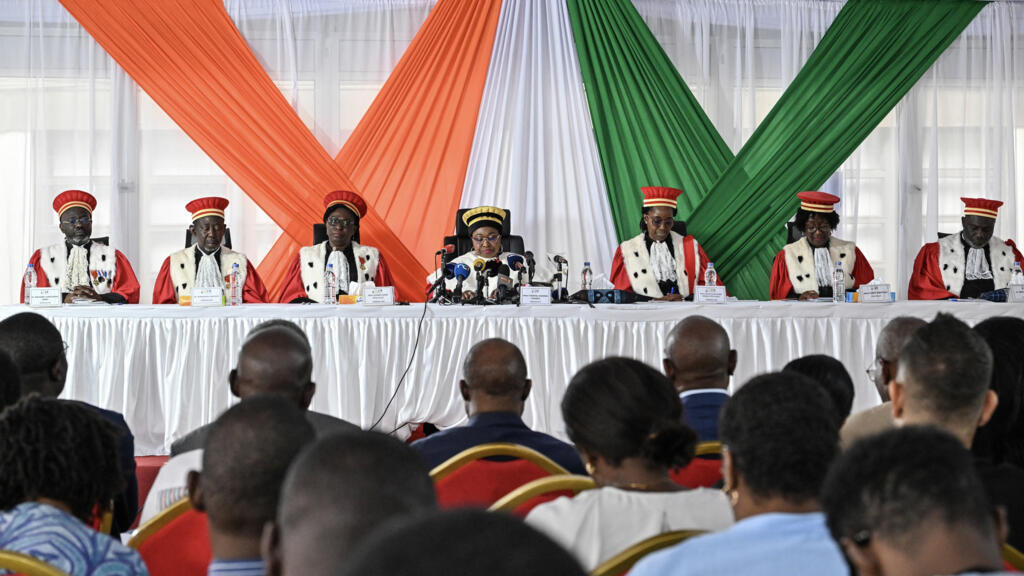
Chantal Nanaba Camara, President of the Constitutional Council, alongside her advisors during the publication of the final list of candidates eligible for the presidential election of 25 October 2025, at the Constitutional Council in Abidjan, on 8 September 2025. AFP - SIA KAMBOU

The presidential campaign officially began on Friday 10 October.

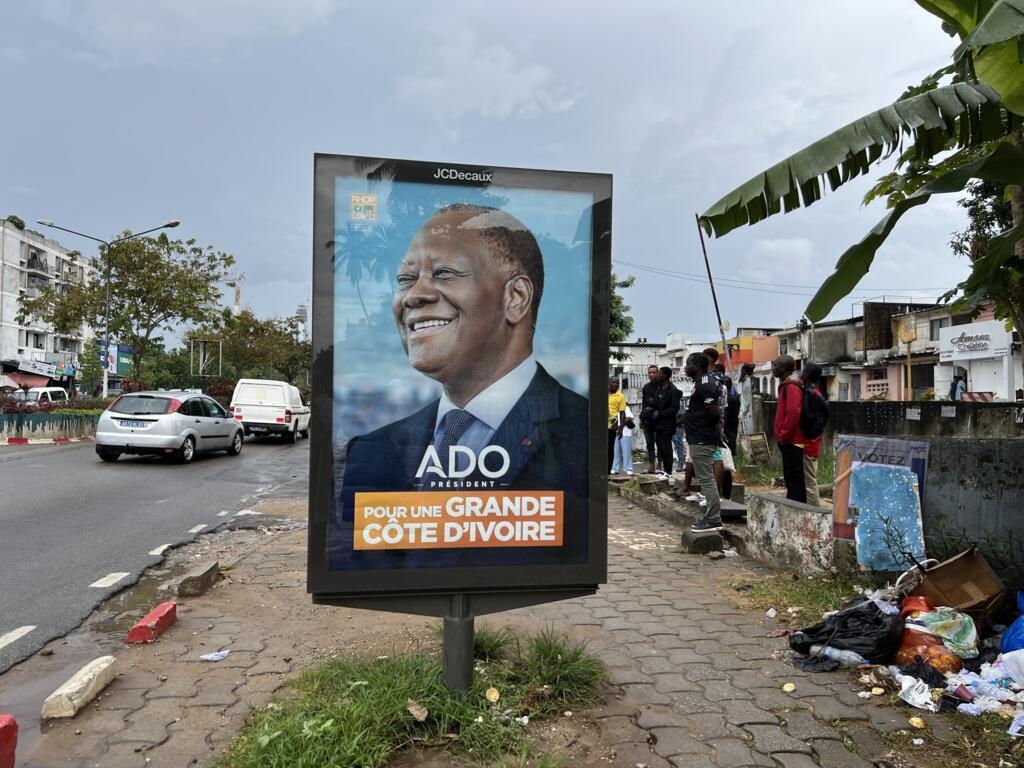
President Alassane Ouattara has led the country since April 2011, and is seeking a fourth term.

He managed to establish himself as a heavyweight in Ivorian politics over the past thirty years, and is credited with keeping Côte d'Ivoire prosperous and economically dynamic. But Ouattara's Côte d'Ivoire is also seen as "France's last bastion".

Poster for Alassane Ouattara's RHDP campaign in Cocody, Abidjan, Côte d'Ivoire, seen on 11 October 2025. © RFI/Melissa Chemam

Now 83, he can run after changing the constitution in 2016 to remove presidential term limits, which has angered most of the opposition in Côte d'Ivoire.

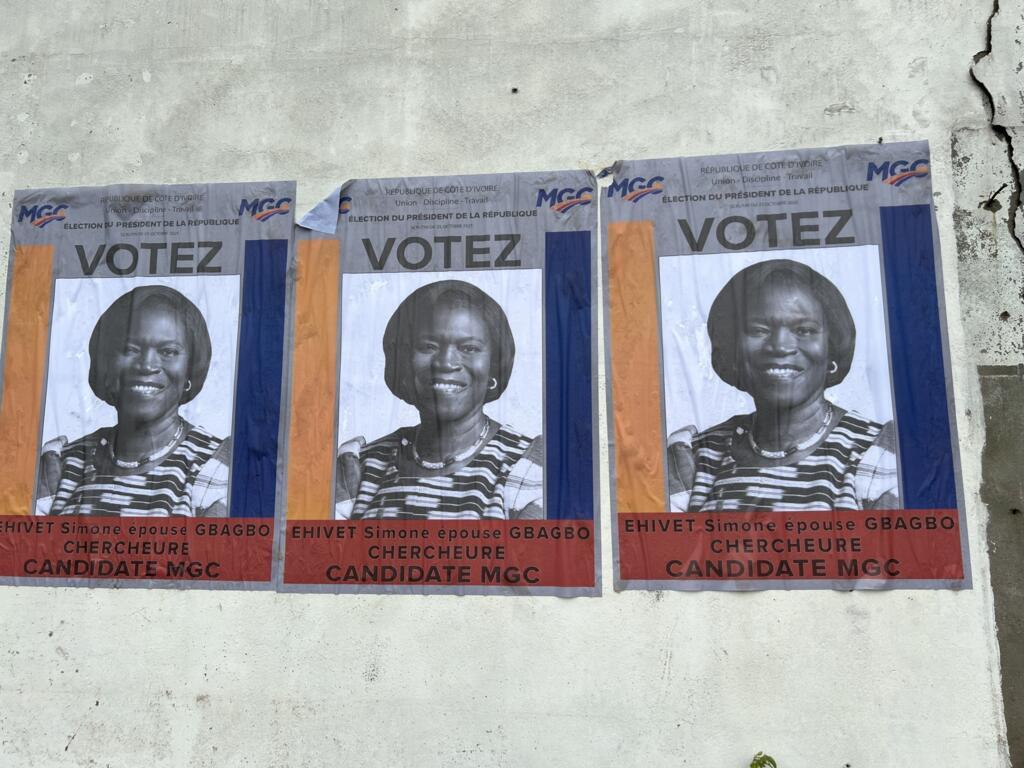
Four candidates are standing against the incumbent president, the only ones having been ruled eligible by the country's constitutional court: former ministers Jean-Louis Billon, Ahoua Don Mello and Henriette Lagou, and Simone Gbagbo, ex-wife of president Laurent Gbagbo and therefore a former first lady.

Posters calling to vote for Simone Gbagbo in Codody, Abidjan, Côte d'Ivoire, seen on 11 October 2025. © RFI/Melissa Chemam

But neither of the main opposition parties - PDCI and PPA-CI - have been able to secure a candidate, as the court disqualified many, including former president Gbagbo and Tidjane Thiam, a businessman and former minister of development.

Why Côte d’Ivoire’s election could be more complex than it seems

The election campaign will end on 23 October, two days before voting begins.

Provisional results will be published at the national level by the Independent Electoral Commission (CEI) between Sunday 26 October and Thursday 30 October 2025.

To be elected in the first round, a candidate must obtain an absolute majority of the votes cast. If none does, a second round of the presidential election could take place on Saturday 29 November.

Our guest this week is Paul Melly, researcher on West Africa and consulting fellow with the Chatham House think tank in London, UK.

Episode mixed by Melissa Chemam and Erwan Rome.

Spotlight on Africa is produced by Radio France Internationale's English language service.
By:Melissa Chemam


Rare tornado near French capital kills one construction worker, injures 10

A tornado tore through districts north of Paris on Monday evening, toppling three construction cranes that killed one person and injured 10 others, four of whom remain in critical condition.


Issued on: 21/10/2025 - RFI

Around ten towns in the Val-d'Oise region, just north of Paris, were affected by an "episode of violent winds" which saw three cranes fall down, on Monday, 20 October 2025. © HANDOUT / NATIONAL POLICE ALLIANCE UNION


The town of Ermont, about 20 kilometres northwest of Paris was worst hit by the sudden twister that caused damage across some10 districts.

Regional prosecutor Guirec Le Bras told French news agency AFP one 23-year-old construction worker was killed on a building site and 10 people had been injured with four others in critical condition.

According to the authorities, the tornado toppled cranes, tore off rooftops and smashed up cars.

Rail traffic was severely disrupted on lines H and C, due to a tree falling on the tracks, which damaged overhead power lines.

The operator warned that the connection between Pontoise and Ermont-Eaubonne would remain suspended until at least 3pm local time on Tuesday.

Interior Minister Laurent Nunez said on social media platform X that it had been a storm of "rare intensity".

Videos shared on social media showed three cranes falling within seconds of each other.


One crane fell on a clinic, without causing injuries, and another on a residential building.

Over 80 firefighters, 50 police officers and dozens of medical personnel were at the scene, authorities said.

The prefecture issued a statement Monday night, saying that emergency personnel had responded to "324 interventions and more than 700 calls".

The prefect of Val-d'Oise, Philippe Court, announced that a crisis unit had been opened at the Rébuffat gymnasium in Ermont, "for residents who cannot find accommodation or who cannot return to their homes."

During the night from Monday to Tuesday, 1,700 homes were without electricity, according to the prefecture, which asked the public service company Enedis to "restore the network as soon as possible."

Valérie Pécresse, president of the Île-de-France region, wrote on X: "My thoughts are with the residents of Val-d'Oise, victims of a violent tornado," adding that her administration "will support the affected communities."

An investigation into involuntary manslaughter and unintentional injury in the workplace was opened in Pontoise.

(With newswires)
Chess mourns US grandmaster dead at 29

New York (AFP) – The chess world has been plunged into mourning following the sudden death of prominent US grandmaster Daniel Naroditsky aged 29.

Issued on: 21/10/2025 -

File picture of a chess board © STEPHANE DE SAKUTIN / AFP

Governing body the International Chess Federation (FIDE) remembered Naroditsky, who was also a chess commentator and streamer, as someone "whose influence extended far beyond the chessboard".

Fellow grandmaster and world number two Hikaru Nakamura wrote on social media: "I'm devastated. This is a massive loss for the world of chess."

Charlotte Chess Center announced the death of California-born Naroditsky on Monday, saying: "Daniel was a talented chess player, commentator and educator, and a cherished member of the chess community."

It said he was "admired and respected by fans and players around the world".

It did not say how he died.

FIDE said that Naroditsky "played a pivotal role in popularizing chess content online, bridging the gap between professional and amateur chess".

"There are not many people in the world who manage to achieve so much before turning 30.

Naroditsky was ranked number one in his native United States when he was just nine years old, The New York Times said.

© 2025 AFP


Madagascar coup leader appoints businessman as new prime minister


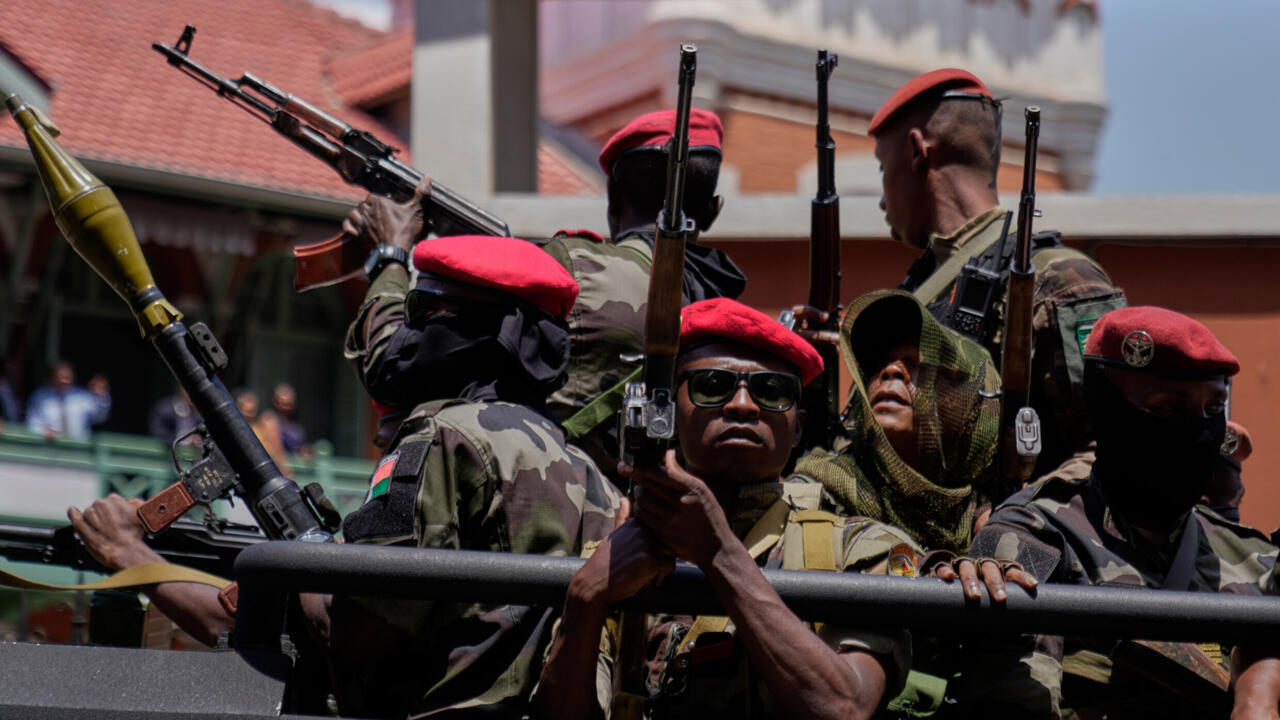
Madagascar's coup leader Colonel Michael Randrianirina, who was sworn in as president on Friday, named businessman Herintsalama Rajaonarivelo as the country's prime minister Monday. Randrianirina took power on the back of youth-led protests that drove his predecessor out of office.


Issued on: 20/10/2025 - 
By: FRANCE 24


Soldiers loyal to Col. Michael Randrianirina guard the entrance of the high constitutional court in Antananarivo, Madagascar on October 17, 2025. © Brian Inganga, AP

Madagascar's coup leader Colonel Michael Randrianirina, who seized power this month, named businessman and consultant Herintsalama Rajaonarivelo as the island nation's new prime minister on Monday.

Randrianirina was sworn in as president on Friday, days after taking control in the wake of youth-led protests that forced out his predecessor.

Explaining his choice of Rajaonarivelo as prime minister, the president cited his experience and "connections with the international organisations that work with us".

He has said the military will rule alongside a civilian government for up to two years before organising new elections.

Ex-leader Andry Rajoelina, whom lawmakers impeached after he fled abroad last weekend, has condemned the army takeover and refused to step down while in exile, despite defections in the security forces and the High Constitutional Court ratifying the takeover within hours of it happening.

(FRANCE 24 with Reuters)


'Capitalism for all'

Bolivia’s new pro-business leader vows to renew US ties after two decades


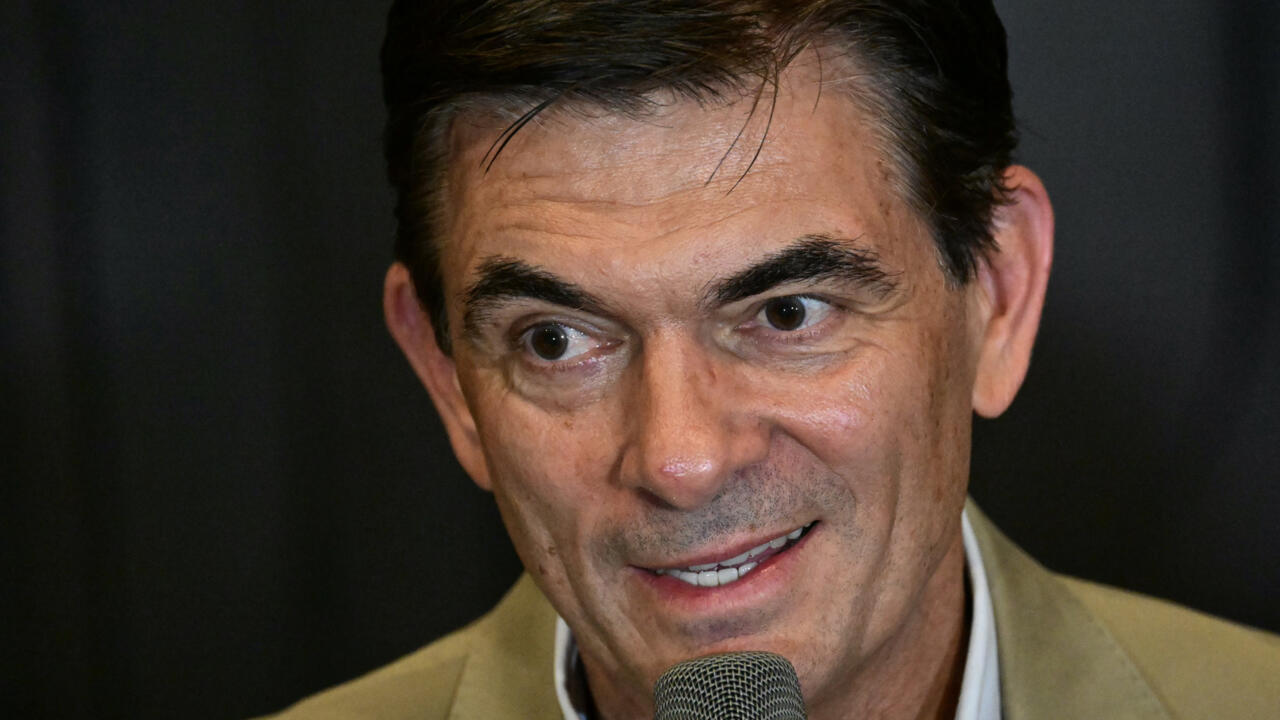
Bolivia’s president-elect Rodrigo Paz vowed Monday to restore diplomatic ties with Washington, signaling a pro-business shift after nearly 20 years of socialist rule blamed for deep economic troubles. The 58-year-old economist-turned-senator won Sunday’s run-off, defeating a right-wing rival after the socialist MAS party was barred following the August vote.


Issued on: 20/10/2025 
By: FRANCE 24


Bolivia's President-elect Rodrigo Paz wants to reinstate diplomatic ties with Washington 
© Martin BERNETTI, AFP

Bolivia's new pro-business president-elect vowed Monday to renew diplomatic ties with Washington as the South American country veered right after nearly two decades under socialist rule blamed by many for its myriad economic woes.

Rodrigo Paz, a 58-year-old economist-turned senator, emerged victorious in a run-off election Sunday, beating a fellow right-wing rival after a first voting round in August saw the socialist MAS party founded by ex-leader Evo Morales ousted from the race.

In his victory speech Sunday night, Paz proclaimed Bolivia was "reclaiming its place on the international stage."

And on Monday, he told reporters Bolivia's relationship with the United States "will be resumed" nearly 20 years after Morales kicked out Washington's ambassador.

"We have been talking with the US government in particular. I believe this is very important," he said.

Paz is set to take office on November 8 facing an uphill task.

Read moreBolivia turns page on Socialist era, elects great-nephew of 1952 revolution leader

Bolivia's economy is in recession, according to the World Bank, and long queues for fuel have become a way of life. Dollars are in short supply and annual inflation is over 20 percent.

Under Morales, in office from 2006 to 2019, Bolivia took a sharp turn to the left -- nationalizing energy resources, breaking ties with Washington and making alliances with China, Russia and fellow leftists in Cuba, Venezuela and elsewhere in Latin America.

In 2008 Morales expelled the US ambassador and officials of the US Drug Enforcement Administration (DEA), accusing them of interference in Bolivia's affairs. USAID officials followed in 2013.

Washington expelled Bolivia's ambassador in retaliation, and the envoys were never replaced.

Paz's election victory was welcomed by US Secretary of State Marco Rubio, who said in a statement Washington "stands ready to partner with Bolivia on shared priorities."

Rubio added that "after two decades of mismanagement, President-elect Paz's election marks a transformative opportunity for both nations."

Paz said he had also received a congratulatory message from President Donald Trump, who is embroiled in bitter public feuds with Latin American leftists including Venezuela's Nicolas Maduro and Gustavo Petro of Colombia.


© France 24
01:40


'Capitalism for all'

On the campaign trail, the Christian Democratic Party candidate had vowed a "capitalism for all" approach to economic reform, with decentralization, lower taxes and fiscal discipline mixed with continued social spending.

He promised to maintain social programs while stabilizing the economy, but economists have said the two things are not possible at the same time.

Paz said Monday his interim government has had talks with US Deputy Secretary of State Chris Landau about measures to find a solution to Bolivia's fuel shortage "along with friendly countries like Brazil, Uruguay, Paraguay, and Argentina."

Sunday's election closed out an economic experiment marked by initial prosperity funded by Morales's nationalization of natural gas reserves.

The boom was followed by bust, notably with critical shortages of fuel and foreign currency under outgoing leader Luis Arce.

Successive governments under-invested in the hydrocarbons sector, once the backbone of the economy.

Production plummeted and Bolivia almost depleted its dollar reserves to sustain a universal subsidy for fuel that it can no longer afford to import.

(FRANCE 24 with AFP)
Colombia recalls ambassador to US as interior minister slams Trump's 'invasion' threat


The relationship between Bogota and Washington dropped to new lows Monday, with Colombia recalling its ambassador to the US and Interior Minister Armando Benedetti criticizing what he described as an "invasion" threat from US President Donald Trump over the weekend.


Issued on: 20/10/2025
By: FRANCE 24

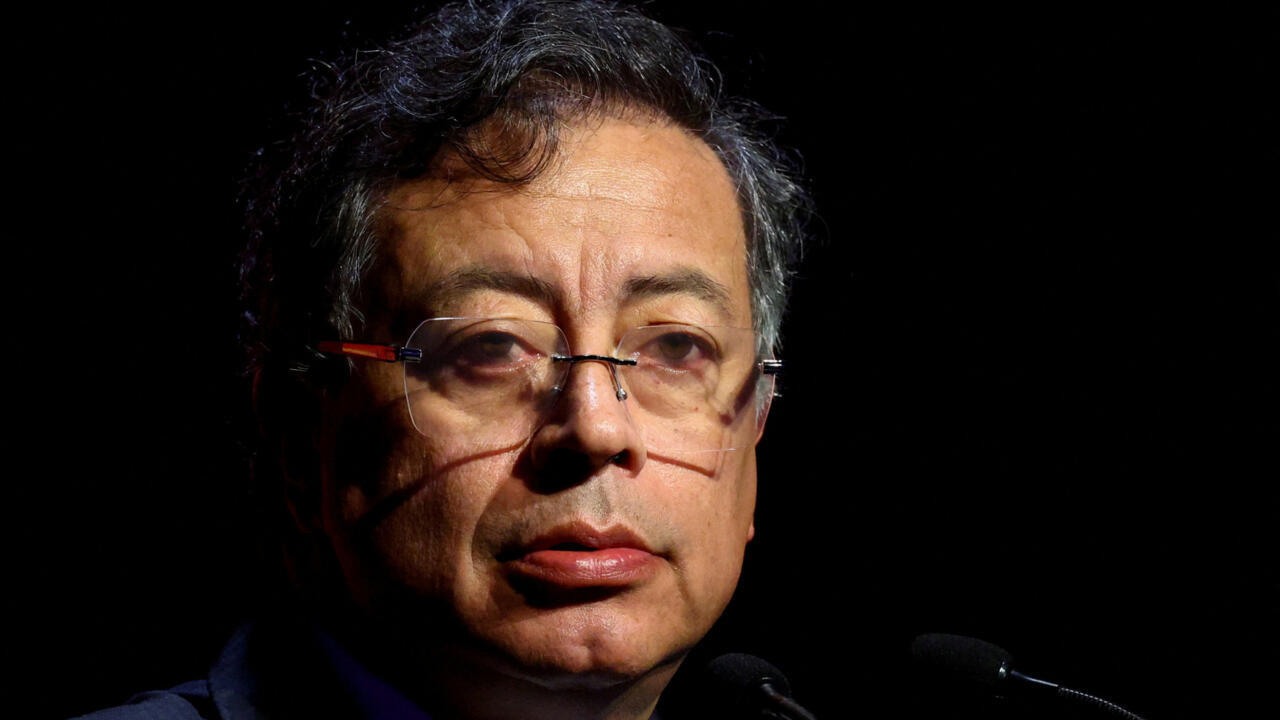
A file photo of Colombian President Gustavo Petro taken on October 9, 2025. © Yves Herman, Reuters

Colombia on Monday said its ambassador to the United States had been recalled, as a public feud between the nations' leaders heats up with President Donald Trump revoking aid and threatening punishing tariffs.

Colombian President Gustavo Petro has objected to the US military's strikes against vessels in the Caribbean, which have killed dozens of people and inflamed tensions in the region.

Trump on Sunday vowed to end aid to the South American nation, a historically close US partner, accusing his leftist Colombian counterpart of being an "illegal drug leader".

He also said he would be making an announcement on tariffs targeting Colombia on Monday. The oil-producing nation currently pays 10 percent tariffs on most imports to the US, the baseline level Trump has imposed on many countries.

Read more US revokes visa for Colombian President Petro over 'incendiary' comments


Colombia's interior minister on Monday voiced anger at Trump for threatening what he described as a potential "invasion" of his country.

Trump had angrily lashed out on Sunday at Petro, saying on social media that he "better close up" drug cultivation sites, "or the United States will close them up for him, and it won't be done nicely".

In a Blu Radio interview, Colombian Interior Minister Armando Benedetti called the remarks a "threat of invasion or military action against Colombia".

"I can't imagine closing down some hectares unless it's in that way, unless it's by invading," he said.

The threats came as the United States announced it had struck another alleged drug-running vessel in international waters, killing three people.

US Defence Secretary Pete Hegseth alleged that the boat was affiliated with a Colombian armed group, the National Liberation Army.

Petro on Sunday condemned the bombing, saying the boat belonged to a "humble family".

That strike came on the heels of another attack – on a semi-submersible vessel – that left two survivors, one of whom was Colombian.


US-Colombia drug trade feud escalates
© France 24
06:13


Colombia's foreign ministry has vowed to seek international support for Petro, who first rose to prominence as a senator by exposing links between right-wing paramilitary groups involved in drug trafficking and corrupt politicians, as well as for the country's autonomy.

Petro, who has clashed with Trump since the US leader returned to power in January, has fiercely criticised the deadly anti-drug campaign in the Caribbean.

He has accused Trump of murder and of violating Colombia's sovereignty.

Colombia's Ambassador Daniel Garcia Pena has already returned to Bogota, the foreign ministry said Monday in a statement, adding Petro's government would be making further announcements during the day.

Until now, Colombia has received more US aid than any other country in South America – $740 million in 2023, according to US government figures. Half of this went to fighting drug trafficking.

The harsh verbal exchanges have taken relations between two historic allies to their lowest point in decades.

Last month, Washington announced it had decertified Colombia as an ally in the fight against drugs. Colombia hit back by halting arms purchases from the United States, its biggest military partner.

Since coming to power in 2022, leftist Petro has championed a paradigm shift in the US-led war on drugs, away from forced eradication to focus on the social problems that fuel drug trafficking.

Under his watch, cultivation of coca, the raw material of cocaine, has increased by about 70 percent, according to the Colombian government and United Nations estimates.

Colombia, a big exporter of oil, coal, coffee, flowers and bananas, posted a $338 million trade deficit with the US between January and July, according to government statistics agency DANE.

Investors from the US invested $2.27 billion in Colombia in the first half of the year, according to central bank figures, some 34 percent of total foreign investment received during that period.

(FRANCE 24 with AFP and Reuters)


Virginia Giuffre shines light on Epstein ordeal in new memoir

New York (AFP) – A memoir by one of Jeffrey Epstein's main accusers whose claims led to the downfall of Britain's Prince Andrew was released Tuesday, promising to keep Epstein's ties to President Donald Trump in the spotlight.


Issued on: 21/10/2025 - RFI

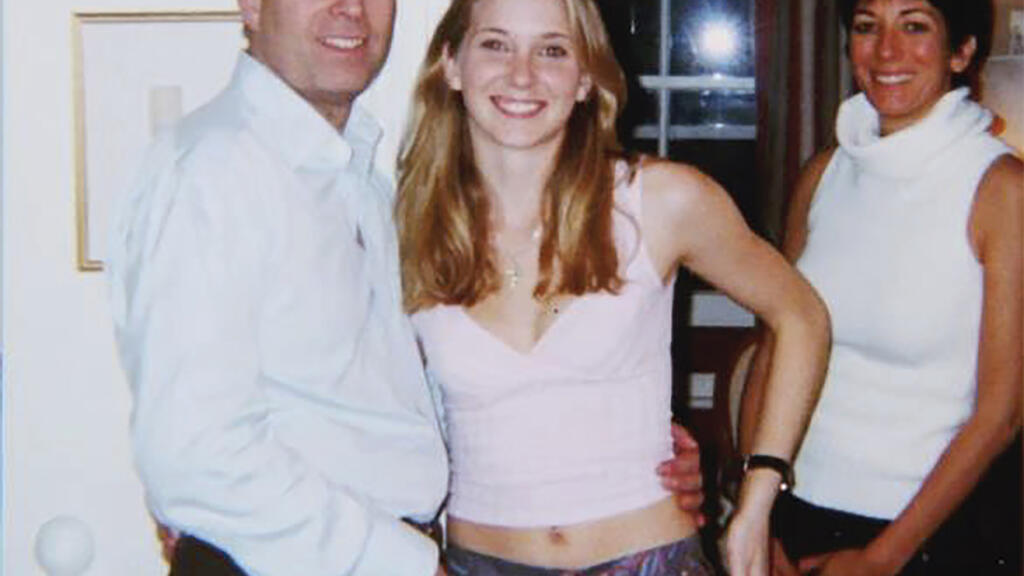
The publication of a now-infamous photo taken in London appearing to show Prince Andrew with his arm around Virginia Giuffre's waist set in motion the former military helicopter pilot's downfall 
© Handout / US District Court - Southern District of New York (SDNY)/AFP/File

While Trump features minimally in Virginia Giuffre's book, pre-publication publicity has refocused attention on the Epstein saga in the United States where a row rages over the release of files on the disgraced financier and sex offender.

Andrew on Friday renounced his royal title under pressure from King Charles III, following further revelations about his ties to Epstein and repeated allegations in Giuffre's book that she was forced to have sex with the prince three times, including when she was 17.

The ghostwriter of "Nobody's Girl," Amy Wallace, said that Giuffre -- who died by suicide in April aged 41 -- told the Washington Post that the prominent campaigner against sexual abuse had admired Trump.

"She was a huge Trump fan... There were two reasons for it: One, she'd met him. She worked at Mar-a-Lago. Her dad worked at Mar-a-Lago. She met Trump several times, and he was always very kind to her," Wallace told the Post.

"And secondly, he said he was going to release the Epstein files. He was on her side. That's how she felt."

The BBC reported that in the book Giuffre alleges three sexual encounters with Andrew -- one of which she claims was an orgy including Epstein, the prince and "eight other young girls."

The so-called Epstein files have been the focal point of the controversy engulfing the second presidency of Trump, who was a longtime friend of Epstein.

In 2019 Epstein took his own life while in prison awaiting trial on sex-trafficking charges.

Giuffre was recruited into Epstein's alleged sex-trafficking network when she was a 17-year-old minor while working at Trump's Mar-a-Lago club in 2000, saying in the book she feared she would "die a sex slave."

Giuffre claimed she was approached there by Ghislaine Maxwell, who was later jailed in 2022 for helping Epstein sexually abuse girls.

Trump appeared to be on good terms with Epstein during this time, praising him as a "terrific guy" in a 2002 New York Magazine profile.

In the book, Giuffre recounts being introduced to Trump by her father, with the property developer asking her "do you babysit at all."

US President Donald Trump has tried to distance himself from former friend Jeffrey Epstein © Alex WROBLEWSKI / AFP/File

"Soon I was making money a few nights a week, minding the children of the elite," she said in an excerpt published by Vanity Fair.

The publication of a now-infamous photo taken in London appearing to show Prince Andrew with his arm around Giuffre's waist set in motion the former military helicopter pilot's downfall.

Andrew, 65, has long denied the assault accusations, which have caused considerable embarrassment to the British monarchy and seen the prince virtually banished from royal life in recent years.

Prince Andrew reached a financial settlement with Giuffre in 2022.

"The hope was that once the book was published for the first time since 2011, she could say: 'I respect your wish to know my memories of Prince Andrew, Ghislaine, Jeffrey, etc, all the other men. I respect that need. I have done the best version of my story,'" Wallace said.

© 2025 AFP


EPSTEIN'S OTHER 'PAL'

UK under pressure to strip Prince Andrew of titles, home after new Epstein revelations


Buckingham Palace and the UK government faced calls Monday to strip Prince Andrew of his titles and home after new details emerged about his ties to convicted sex offender Jeffrey Epstein. Andrew, after discussions with King Charles III, agreed Friday to stop using his Duke of York title amid ongoing public outrage.


Issued on: 21/10/2025 
By: FRANCE 24
Video by: Monte FRANCIS


He won’t call himself a duke anymore, but that is not enough for many of Prince Andrew’s critics.

Buckingham Palace and the British government were under pressure Monday to formally strip Prince Andrew of his princely title and sumptuous home after new revelations about his relationship with convicted sex offender Jeffrey Epstein.

After discussions with his elder brother King Charles III, Andrew agreed on Friday to stop using titles including Duke of York. It was the latest effort to insulate the monarchy from years of tawdry headlines about Andrew’s suspicious business deals, inappropriate behaviour and controversial friendships.

But he still technically holds the title of duke, bestowed by his late mother, Queen Elizabeth II. And as the son of a monarch, he remains a prince.


Andrew’s statement relinquishing some of his royal titles came after emails emerged showing he had remained in contact with Epstein longer than he previously admitted, and days before publication of a posthumous memoir by Epstein accuser Virginia Roberts Giuffre, who alleged she had sex with Andrew when she was 17.

Giuffre’s brother, Sky Roberts, urged the king to go further and "remove the title of prince, too".

"He shouldn’t be able to call himself one,” Roberts told The Times of London newspaper.


Andrew, 65, has long denied Giuffre’s claims, but stepped down from royal duties after a disastrous November 2019 BBC interview in which he attempted to rebut her allegations.

Many viewers saw an entitled prince who failed to show empathy for Epstein’s victims and offered unbelievable explanations for his friendship with the late sex offender.

Andrew paid millions in an out-of-court settlement in 2022 after Giuffre filed a civil suit against him in New York.

While he didn’t admit wrongdoing, he acknowledged Giuffre’s suffering as a victim of sex trafficking.

Some opposition politicians said Andrew should formally be stripped of his dukedom through an act of Parliament.

Scottish National Party lawmaker Stephen Flynn said the government should use legislation to remove titles from both Andrew and Peter Mandelson, a member of the House of Lords who was fired as British ambassador to Washington in September over his past friendship with Epstein.

“The family of Virginia Giuffre, whose life was destroyed, are angry and aghast,” Flynn said. “The public across these isles are angry and aghast and they both deserve to know that some (members of Parliament) share their outrage.”


Prince Andrew gives up his Duke of York title, disgraced by Epstein allegations 
REUTERS - Toby Melville
01:57


The government said it supported the palace’s decision over Andrew’s titles but should not act unilaterally. Under the UK’s constitutional monarchy, the crown does not interfere in politics and politicians stay clear of issues related to the royal family.

“Our thoughts have to be with the victims of Jeffrey Epstein, those who suffered and continue to suffer because of the abuse that they experienced at his hands, but these are matters for the royal family,” Education Secretary Bridget Phillipson told the BBC.

Some also want Andrew evicted from Royal Lodge, the 30-room mansion near Windsor Castle where he lives alongside his ex-wife Sarah Ferguson, who will no longer be known as the Duchess of York.

Questions have been raised about how Andrew pays for the house, which he rents on a long lease from the Crown Estate, a portfolio of properties that is nominally owned, but not controlled, by the monarch.

The palace is bracing for more embarrassing revelations, just as the king prepares for a state visit to the Vatican this week where he is due to pray beside Pope Leo XIV.

Giuffre’s book, “Nobody’s Girl”, is published on Tuesday and details three alleged sexual encounters with Andrew. She died by suicide in April at the age of 41.

In an extract published in advance, Giuffre says the prince acted as if he believed “having sex with me was his birthright”.

Giuffre also claims in the book that Andrew’s team tried “to hire internet trolls to hassle me”. She said that Andrew insisted the lawsuit settlement include a one-year gag order to prevent allegations from tarnishing the late queen’s Platinum Jubilee in 2022.

Meanwhile, London’s Metropolitan Police force says it is “actively looking into” media reports that Andrew in 2011 sought information to smear Giuffre by asking one of his police bodyguards to find out whether she had a criminal record.

(FRANCE 24 with AP)


6 claims Virginia Giuffre made about Prince Andrew in her new book

The ghostwriter of Virginia Giuffre's memoir says she would have viewed Prince Andrew's relinquishing of his royal titles 'as a victory'.


Andy Wells, Freelance Writer
Updated Tue 21 October 2025


Copies of Nobody's Girl by Virginia Roberts Giuffre, which was published on Tuesday 22 October. (PA)


Virginia Giuffre would have viewed Prince Andrew giving up his titles "as a victory", the ghostwriter of her posthumous memoir has said.

Andrew announced on Friday, 17 October - after consultation with his brother King Charles - that he would relinquish his royal titles after repeated questions about his relationship with Jeffrey Epstein and Ghislaine Maxwell.

The Prince has always denied any wrongdoing.

However, the Royal Family and the government are coming under increasing pressure to formally remove his dukedom through an act of parliament.

Ms Giuffre's book, Nobody's Girl: A Memoir of Surviving Abuse and Fighting for Justice, was published on Tuesday, six months after she took her own life at the age of 41.

In an interview with BBC Newsnight on Monday, the book's ghostwriter, Amy Wallace, said Ms Giuffre would have welcomed Andrew stopping using his titles.

“I know that she would view it as a victory that he was forced by whatever means to voluntarily give them up,” said Wallace.

"It’s a symbolic gesture but it’s an important one. It’s made history, modern history, in terms of the royal era."

Andrew was stripped of his titles after it was reported that he had emailed Epstein in 2011 saying "we're in this together", three months after he claimed he had broken all contact with him.

In the book, Ms Giuffre claims she had sex with Andrew on three separate occasions, and said she feared she might "die a sex slave" while being trafficked by Epstein.


Virginia Giuffre’s posthumous book makes a series of claims about Prince Andrew. (Alamy)

She said she was afraid of Epstein and his former girlfriend, Maxwell, who is currently serving a 20-year prison sentence on sex-trafficking charges.

In 2022, Andrew paid an out-of-court financial settlement worth millions to Ms Giuffre after she brought a civil case against him. When giving up his titles, including the Duke of York, Andrew said he continued to "vigorously deny the accusations against me".

Here, Yahoo News UK outlines five of the claims made in the book.


1. Ms Giuffre claims Andrew commented about his daughters' ages

In the memoir, Ms Giuffre describes meeting Andrew at Maxwell’s London home near Hyde Park, where he allegedly guessed her age correctly as 17.

She wrote: "'My daughters are just a little younger than you,' he told me, explaining his accuracy."

This comment, Ms Giuffre implies, underscored the age gap and how inappropriate the alleged encounter was, positioning Andrew as aware of her age while proceeding with the alleged events.

Prince Andrew has denied ever meeting Virginia Giuffre. (PA)

Andrew has denied ever meeting Ms Giuffre or being at Maxwell's home that day.


Advertisement


In his 2019 BBC Newsnight interview, he claimed he was instead at a Pizza Express in Woking with his daughter, Princess Beatrice, for a children’s party, stating: "I can absolutely categorically tell you it never happened. I have no recollection of ever meeting this lady, none whatsoever."

2. Ms Giuffre claims Andrew sweated profusely

Ms Giuffre's book recounts heading to the Tramp nightclub in London after an infamous photo of her with Andrew was taken, where she alleges he was "sort of a bumbling dancer, and I remember he sweated profusely".


A photo allegedly taken in 2001 of Prince Andrew with Virginia Giuffre, then then Virginia Roberts, with Ghislaine Maxwell in the background. (PA/supplied by Capital Pictures)

Andrew directly countered this in his Newsnight interview, insisting he could not have sweated due to a medical condition stemming from an adrenaline overdose during the Falklands War in 1982, when he was shot at.

He explained: "I have a peculiar medical condition which is that I don’t sweat or I didn’t sweat at the time… yes, I didn’t sweat at the time because I had suffered what I would describe as an overdose of adrenaline in the Falklands War when I was shot at… it was almost impossible for me to sweat."

3. Andrew 'tried to hire internet trolls to hassle Ms Giuffre'

Ms Giuffre claimed in her memoir Andrew's "team" attempted to hire internet trolls to "hassle" her.

In 2022, Andrew is said to have paid $12 million (£9m) to settle a civil sexual assault case by Ms Giuffre, even though he claimed to have never met her.

In her book, Ms Giuffre wrote how he hid behind “the well-guarded gates” of Balmoral Castle, making it difficult for her lawyers to serve him with papers.

She said of the settlement: “After casting doubt on my credibility for so long – Prince Andrew’s team had even gone so far as to try to hire internet trolls to hassle me — the Duke of York owed me a meaningful apology as well.

“We would never get a confession, of course. That’s what settlements are designed to avoid. But we were trying for the next best thing: a general acknowledgement of what I’d been through.”

The Metropolitan Police has said it would look into claims reported in the Mail on Sunday newspaper that Andrew had passed Ms Giuffre’s date of birth and social security number to his taxpayer-funded bodyguard in 2011 and asked him to investigate.

4. Ms Giuffre claims they had sex after getting in a bathtub

According to the book, after the evening in Tramp nightclub, they returned to Maxwell’s home, where Ms Giuffre claims she ran Andrew a bath before they had sex.

The extract states: "He was friendly enough, but still entitled – as if he believed having sex with me was his birthright… Afterward, he said thank you in his clipped British accent. In my memory, the whole thing lasted less than half an hour."

Maxwell disputed the feasibility of this in her interview with the United States Department of Justice in July this year, describing the bathroom in her former London home as impractical for such an act

She said: "Her description of whatever the two people were doing in that tub, that wouldn't work. The bathroom itself is so small, you can't lie flat on the floor. So it couldn't happen on the floor because you physically can't."

5. Ms Giuffre claims she was paid $15,000 for encounter with Andrew

Ms Giuffre writes that the morning after the alleged encounter, Maxwell praised her, saying: "You did well. The prince had fun."

She adds that Epstein paid her $15,000 (£11,200) for "servicing the man the tabloids called 'Randy Andy'," framing it as compensation for the sexual act.


Ghislaine Maxwell, pictured with Jeffrey Epstein, claims she was not present during an alleged encounter between Prince Andrew and Virginia Giuffre. (PA)

Andrew has denied any encounter, telling Newsnight: "I have no recollection of ever meeting this lady, none whatsoever."

Maxwell, in her 2025 US Department of Justice interview, claimed she wasn't present, as she was attending her mother's 80th birthday celebrations in the countryside outside London at the time of the alleged incident.

6. Ms Giuffre claimed she had 'orgy with Andrew, Epstein and eight other young girls'

In the book, Ms Giuffre claims she was forced to have sex with Andrew on three separate occasions after being trafficked by Epstein, allegations Andrew has vehemently denied.

She said that on the third occasion, she, Andrew and Epstein participated in an orgy with "approximately eight other young girls" on Epstein’s Caribbean island, Little St James, also referred to as Little Saint Jeff’s by those who knew him.

She repeated allegations made in a sworn declaration in 2015 in which she said all the girls seemed to be “under the age of 18” and "didn't really speak English".

Her memoir reads: “I don’t know exactly when I had sex with Prince Andrew for the third time, but I do know the location: Little Saint Jeff’s.

“I also know that it was not just the two of us this time; it was an orgy. ‘I was around eighteen’, I said in a sworn declaration in 2015."

What happened in the civil case between Andrew and Ms Giuffre?

In 2021, Ms Giuffre sued Andrew for sexual abuse under New York's Child Victims Act, alleging the encounters in London, New York, and Epstein’s private island.

The case settled out of court in February 2022 for an undisclosed sum (reportedly around £12 million), with Andrew making a substantial donation to Ms Giuffre’s victims' rights charity.

In a statement accompanying the settlement, Andrew said: "It is known that Jeffrey Epstein trafficked countless young girls over many years.

"Prince Andrew regrets his association with Epstein, and commends the bravery of Ms Giuffre and other survivors in standing up for themselves and others.

"He pledges to demonstrate his regret for his association with Epstein by supporting the fight against the evils of sex trafficking and by supporting its victims."

Yahoo News has approached representatives for Prince Andrew for comment.
US appeals court allows Trump to deploy National Guard to Portland

A US appeals court ruled Monday that President Donald Trump can deploy National Guard troops to Portland, rejecting Oregon’s opposition. The decision marks the latest flashpoint in tensions between the White House and liberal states resisting what they call Trump’s authoritarian overreach amid ongoing political and social unrest.


Issued on: 20/10/2025 
FRANCE 24

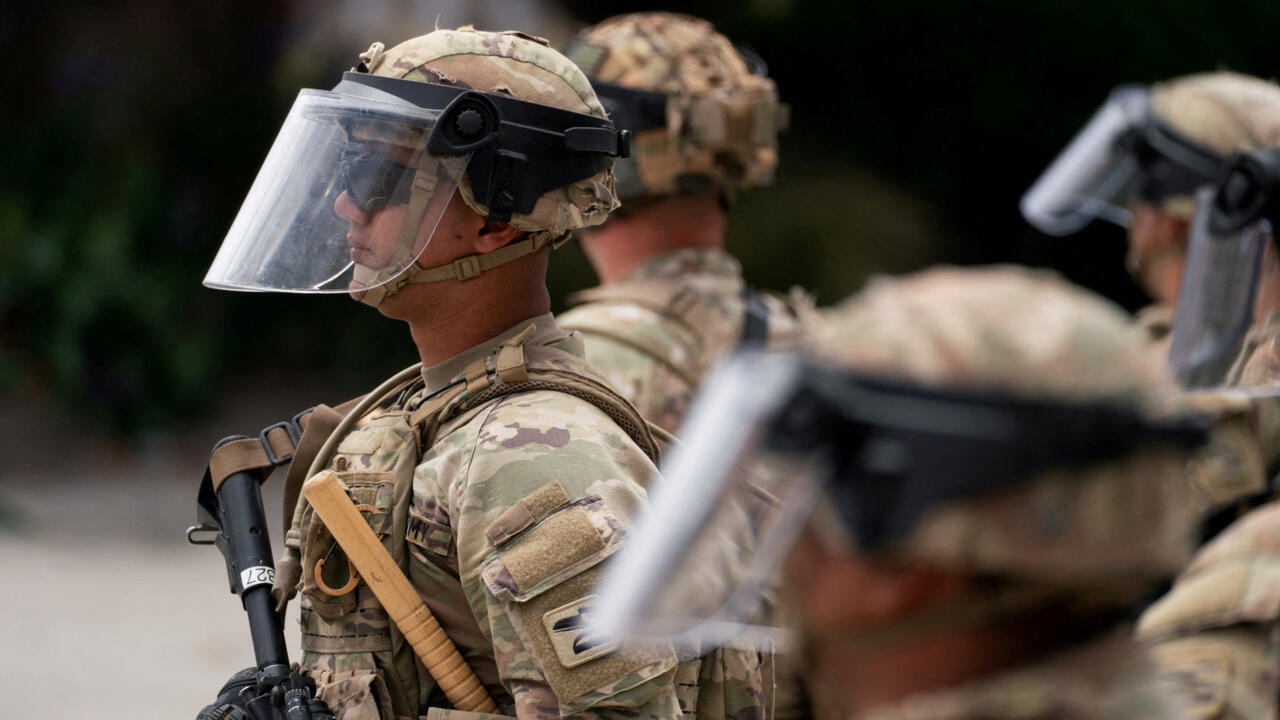
California National Guard personnel shown in Los Angeles, California, US, June 8, 2025.
 © David Ryder, Reuters

A US appeals court said Monday that President Donald Trump can send National Guard troops to Portland, despite objections from Oregon's governor.

The ruling is the latest step in a battle pitting the White House against liberal states who have pushed back against what they characterise as Trump's authoritarian over-reach.

"After considering the record at this preliminary stage, we conclude that it is likely that the president lawfully exercised his statutory authority" when he federalised the state's National Guard, the Ninth Circuit of the US Court of Appeals said.

The ruling clears the way for 200 National Guard personnel to be deployed to protect federal buildings, where authorities say protestors – many dressed in animal costumes – are impeding immigration enforcement.

Portland, along with Chicago, became the latest flashpoints in the Trump administration's rollout of raids, following the deployment of troops to Los Angeles, Washington and Memphis.

In such raids groups of masked, armed men in unmarked cars and armoured vehicles target residential neighbourhoods and businesses, sparking protests.

The state of Oregon took the administration to court to try to prevent its forces being used, obtaining a stay from a lower court that prevented any boots on the ground while the matter was decided.

Monday's decision – by two out of the three justices on the appeals panel – overturns the stay.

Trump has repeatedly called Portland "war-ravaged" and riddled with violent crime. But in her original ruling granting the stay, US District Judge Karin Immergut dismissed his comments as "simply untethered to the facts".

Read moreTrump addresses US military leaders, says country faces 'war from within'

Although the city has seen scattered attacks on federal officers and property, the Trump administration failed to demonstrate "that those episodes of violence were part of an organised attempt to overthrow the government as a whole", Immergut wrote.

Protests in Portland did not pose a "danger of rebellion" and "regular law enforcement forces" could handle such incidents, Immergut said.

Circuit Judge Susan Graber, dissenting from the ruling released Monday, said the administration's seizing of Oregon's National Guard – a force usually under the control of the state's governor – was a dangerous erosion of constitutional rights.

"Given Portland protesters' well-known penchant for wearing chicken suits, inflatable frog costumes, or nothing at all when expressing their disagreement with the methods employed by ICE, observers may be tempted to view the majority's ruling, which accepts the government's characterisation of Portland as a war zone, as merely absurd," she wrote.

"But today's decision is not merely absurd. It erodes core constitutional principles, including sovereign States' control over their States' militias and the people's First Amendment rights to assemble and to object to the government's policies and actions."

(FRANCE 24 with AFP)