It’s possible that I shall make an ass of myself. But in that case one can always get out of it with a little dialectic. I have, of course, so worded my proposition as to be right either way (K.Marx, Letter to F.Engels on the Indian Mutiny)
Tuesday, October 21, 2025
Fire at Hungary's largest refinery contained, no injuries reported
Copyright Fotó: budapestkornyeke.hu
By Euronews
Published on
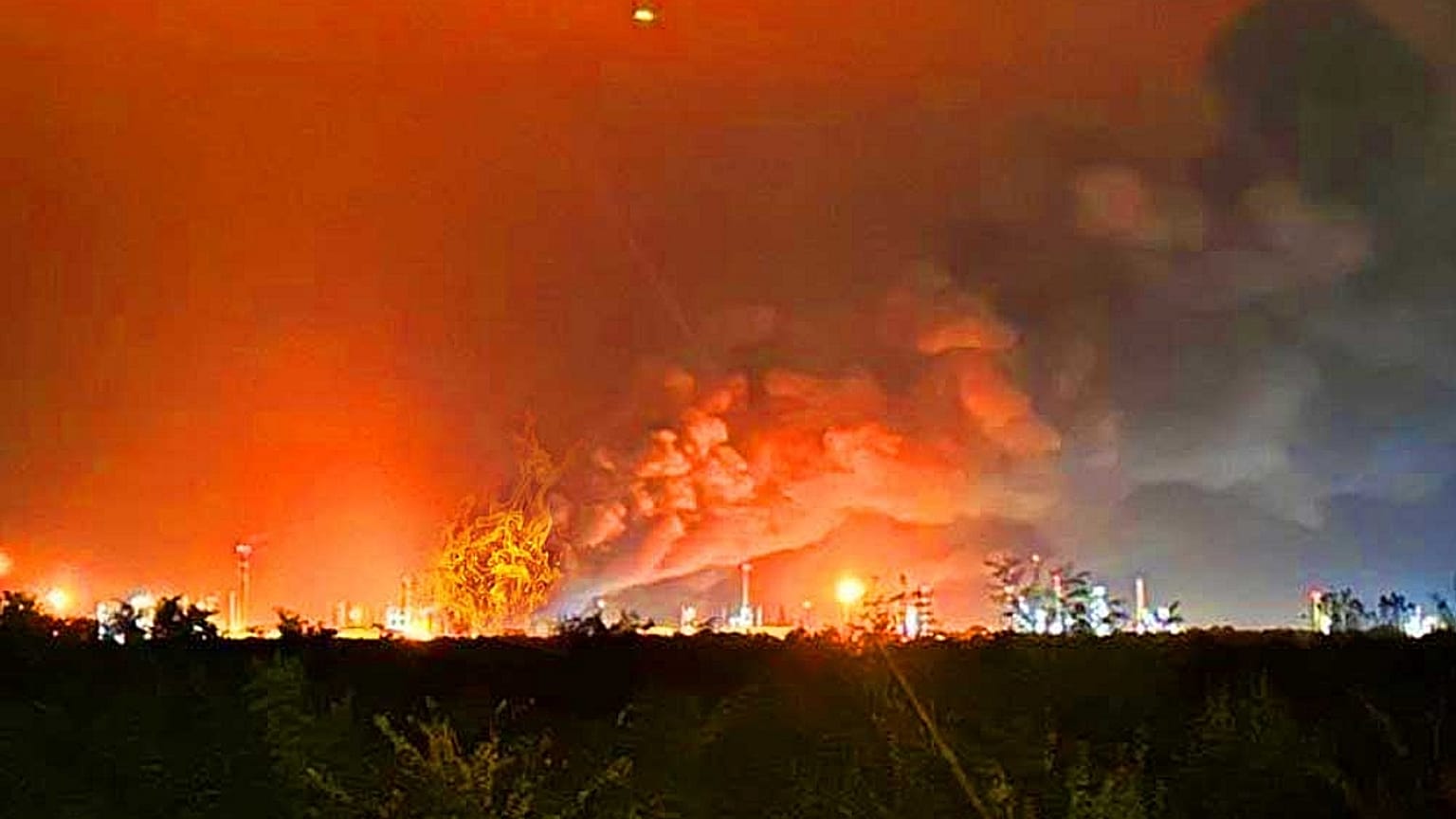
Hungary's strategic oil refinery in Százhalombatta, 27 kilometres from Budapest, may temporarily shut as a result of the fire.
A fire that broke out late on Monday at an oil refinery near Budapest has been contained, the Hungarian oil company MOL has said.
The blaze was reported to have started after an explosion at the AV3 plant of the Danube Refinery in Százhalombatta.
As of Tuesday morning, firefighters were still working in the area, using foam and water cannons to extinguish the fire.
The authorities have said that there were no injuries and no threat to the surrounding communities, and that the exact cause of the accident is still under investigation
Witnesses told Hungarian media that flames and smoke could be seen for kilometres from the MOL's oil refinery
According to Hungarian news outlets, the entire facility may temporarily shut down after the fire.
Relate
On social media, many people complained about the smell and the fumes in the area.
One Facebook user wrote: "On Monday evening, the smell of oil on the M6 near Százhalombatta was unbearable. Much worse than a petrol station. You could already tell that something was wrong."
Several shots show the reddish sky and huge flames billowing from the oil refinery.
"Fifteen minutes ago we woke up to the sound of an explosion at a MOL plant next to us. The sky is red from the flames," wrote one resident in the town of Érd.
"Due to the failure of a technological device at the Danube Refinery, increased flaring and smoke effects were felt in the surrounding villages," MOL said late on Monday.
"The fault is being repaired and the country's fuel supply is uninterrupted. Further increased flare-ups and smoke effects are expected at the refinery due to the restoration work," the company added.
The facility, which is Hungary's largest and most modern oil refinery, receives crude oil from Russia via the Barátság pipeline.
The last time there was a similar incident at the refinery was in July, when black smoke was seen billowing from the facility, according to Hungarian media.
Responding to this week's fire, Hungarian Prime Minister Viktor Orbán said: "We will investigate the circumstances of the fire at the Százhalombatta oil refinery as rigorously as possible."
Greek plan to ban protests at Tomb of Unknown Soldier in Athens sparks backlash
Copyright Thanassis Stavrakis/Copyright 2018 The AP. All rights reserved.
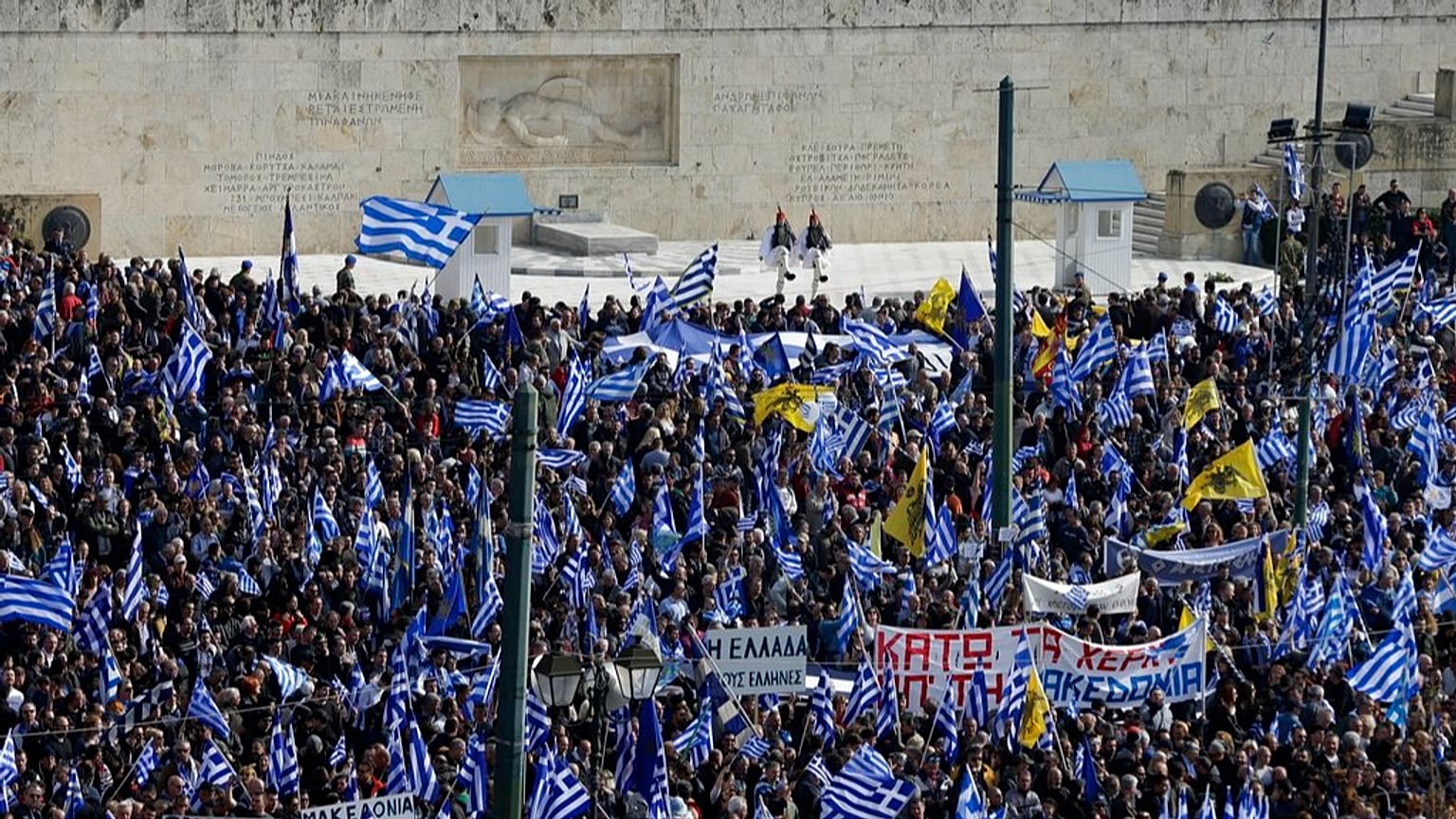
Opposition parties claim the move is an attempt to stop anti-government rallies from taking place at the site.
Greece's conservative government has proposed banning protests at the Tomb of the Unknown Soldier in Athens, triggering an outcry from the opposition.
Prime Minister Kyriakos Mitsotakis' government on Tuesday submitted an amendment to the law governing the care of the monument, resulting in a fiery parliamentary debate.
Four opposition parties lodged objections, saying that the amendment is unconstitutional and curbs citizens' right to free expression and protest. Greece's left-wing Syriza party called for a protest on Tuesday evening.
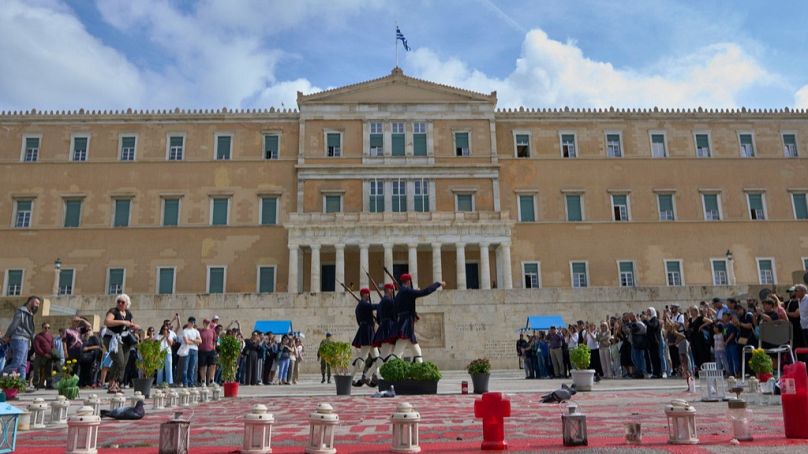
The monument — a cenotaph in honour of those who have died fighting for Greece — is a popular tourist stop for visitors wanting to see the hourly changing of the presidential guard. It is also frequently the site of anti-government demonstrations.
The amendment tabled by the government would allow visitors but would ban protests or physical changes to the area. Offenders would face a fine or up to one year in prison.
"The aim (of the amendment) is not divisive. The aim is the respect, the reinforcement of respect for a sacred monument," government spokesman Pavlos Marinakis claimed on Monday.
However, opposition parties argue the move is a direct reaction to anti-government rallies over the 2023 Tempi disaster, the country's most deadly ever rail accident.
Tourists watch the changing of the guard at the Tomb of the Unknown Soldier in front of the Greek parliament, in Athens, Tuesday, Oct. 21, 2025 Petros Giannakouris/Copyright 2025 The AP. All rights reserved
After the fatal crash in February 2023, the space in front of the monument became the focal point for demonstrations led by some of the relatives of the victims.
The disaster, in which a freight train and a passenger train heading in opposite directions collided after being put on the same track, killed 57 people, mostly university students.
Relate
The crash has become a major political issue in Greece.
It exposed severe deficiencies in Greece’s railway network, including in safety systems, and triggered mass anti-government protests. Critics accuse authorities of failing to take political responsibility for the disaster or holding senior officials accountable.
The trial of 36 people charged in connection with the crash is scheduled to start in March 2026.
Ukrainian military strike for first time disrupts operations of Western oil majors
With gas reception at Orenburg halted, operations at Karachaganak (pictured) had to be scaled back. / kmg.kz
Operations of Western oil majors abroad have for the first time been disrupted by a Ukrainian military strike on Russian energy infrastructure, with Chevron and Shell announcing on October 21 a scaling back of output at one of Kazakhstan’s largest oil and gas fields, Karachaganak.
Raw gas from the field in northwestern Kazakhstan is piped across the border to Russia’s Orenburg plant for processing, but on October 20, Kazakhstan was forced to halt the flow after the facility, one of the largest in the world, was damaged by a Ukrainian drone attack.
Subsequently, on October 21, Kazakhstan’s energy minister Erlan Akkenzhenov said that production at Karachaganak, specifically an oil and gas condensate resource, had been reduced by between 8,500 and 9,000 tonnes per day, equivalent to roughly 66,800 barrels.
Akkenzhenov has expressed the hope that production restrictions would be lifted within three days, according to Reuters. Speaking in Astana, Akkenzhenov acknowledged that the suspension of Kazakh gas deliveries to the Orenburg facility would have “a certain economic impact,” though he stressed that domestic fuel supplies would remain unaffected, Reuters’ report added.
The news agency cited industry sources as saying that output at the field on October 20 declined to between 25,000 and 28,000 tonnes per day, down from a typical 35,000–35,500 tonnes. Upstream reported earlier, citing Karachaganak operating data for 2024, that Karachaganak produces around 275 cubic metres of associated gas for every barrel of hydrocarbons it produces. As such, Karachaganak condensate output stood at 240,000 barrels per day (bpd) last year, leading to the production of 24.1bn cubic metres (bcm), though 14.2 bcm of the gas was reinjected into the reservoir due to the lack of processing facilities, the trade journal noted.
The Karachaganak project is run by an international consortium, Karachaganak Petroleum Operating (KPO), comprising Chevron with an 18% stake, Shell and Eni with 29.25% each, Russia’s Lukoil with 13.5% and Kazakhstan’s KazMunayGaz holding the remaining 10%.
KPO reported it sent about 8.7 bcm across the Kazakh-Russian border to Orenburg for processing in 2024, Upstream's report said. That delivered the equivalent of roughly 23.8mn cubic metres (mcm) of raw gas per day to the Russian plant.
The disruption comes as the Kazakh government attempts to stabilise domestic energy prices, having imposed temporary controls on fuel and utility tariffs last week to curb inflation, which reached 12.9% in September amid continuing fallout from the war in Ukraine.
Ukraine's military confirmed the strike on the Orenburg plant as well as a drone attack on an oil refinery in Russia’s Samara region as part of a campaign intensified since August that targets refineries and energy assets to disrupt petrol supplies and reduce Russian revenues that can be directed into the Kremlin’s war effort.
In February, a separate Ukrainian drone strike on a pumping station serving the Caspian Pipeline Consortium (CPC) briefly halted oil loadings at Russia’s Novorossiysk port.
Former NATO Chief Stoltenberg Says Alliance Let Ukraine Down, Washington Was ‘Defeatist’
Mark Rutte takes office as NATO Secretary General with outgoing Secretary General Jens Stoltenberg. Photo Credit: NATO
Former NATO chief Jens Stoltenberg says the alliance “was letting Ukraine down” by failing to deliver enough support during 2023-24, describing a “defeatist” mood in Washington and European nations failing to make promised arms deliveries.
Stoltenberg, who was head of the western military alliance from October 2014 until October 2024, makes the criticisms in a new book, On My Watch, Leading NATO In A Time Of War, to be released on October 23.
The book covers his entire period in office, including NATO’s “defeat” in Afghanistan in 2021 and Russia’s initial aggression in Ukraine in 2014. It also ponders the future of the alliance following the election of Donald Trump as US president in 2024.
“The tone among the allies is sometimes sharp,” Stoltenberg, who is currently Norway’s finance minister and a former prime minister of the Nordic nation, writes.
“However, the [US] administration’s views on security policy and NATO cooperation are recognizable. China continues to be considered the United States’ most important challenger and strategic competitor; the pivot towards the Indo-Pacific region is ongoing and intensifying. Demands that Europe and Canada spend more on their defense are far from new.
But Stoltenberg’s recollections of meetings with senior officials ahead of and during Russia’s full-scale invasion of Ukraine in 2022 offer some of the most revealing insights. Prelude To War
His account of the run-up to the attack details Russia’s lack of interest in genuine talks, in particular a meeting in New York in September 2021 in which Russian Foreign Minister Sergei Lavrov was constantly interrupting him while his spokesperson, Maria Zakharova, “groaned and rolled her eyes” whenever Stoltenberg spoke.
In mid-October 2021, he writes, a NATO intelligence officer told him that Russia intended “to invade.” The reason, he believes, was fear of the “political threat” posed by a “democratic and ever more West-facing Ukraine.”
Stoltenberg also describes how Russian President Vladimir Putin changed, becoming increasingly isolated — particularly during the COVID-19 pandemic.
This account tallies with that given by former German Chancellor Angela Merkel in her memoirs, released earlier this year, where she says Putin didn’t come to the G20 summit in 2021 because he was afraid of catching the virus. She has said this isolation may have been among the main factors behind Putin’s reason to invade.
Despite this, Stoltenberg writes, key NATO countries France and Germany were in denial, just as they had been when Russian troops seized Crimea from Ukraine in 2014.
“Both occasions illustrated the deep disagreement among NATO nations in their views of Russia,” he writes. These divergent views occur repeatedly as the narrative progresses. Woken By War
Full-scale war in Europe, the largest since World War II, began for Stoltenberg with a 4:25 a.m. phone call. Shortly afterwards, US Defense Secretary Lloyd Austin voiced concern about Ukrainian President Volodymyr Zelenskyy, telling Stoltenberg: “We fear for his life.”
Four days later, Stoltenberg finally got on the line to Zelenskyy, who repeatedly requested a NATO-imposed no-fly zone. The request was denied. “The conversation,” notes Stoltenberg, “was painful.”
Later, he writes that there had been a “widespread perception” in NATO that Kyiv would fall within days.
NATO countries did impose wide-ranging economic sanctions and began shipping arms, as well as providing Ukraine with economic and humanitarian aid. Millions of Ukrainian refugees received sanctuary in Western countries.
According to the Kiel Institute, in Germany, European nations provided 177 billion euros ($206.4 billion) of aid to Ukraine between January 2022 and August 2025, while the United States provided 115 billion euros over the same period.
Within this, Washington is the biggest supplier of military aid, with some 64.6 billion euros worth of arms and armaments. Germany is second, at 17.7 billion. Shipments have included Patriot missile-defense systems, tanks, artillery, and fighter jets, as well as British and French Storm Shadow/SCALP cruise missiles.
But critics have long argued that enough has not been done and that the help provided has often come too late. Stoltenberg agrees. ‘Passive And Defeatist’
Recalling preparations ahead of the NATO summit in July 2024, he writes “there was something passive and defeatist about our partners in Washington. They risked little, they failed to take the offensive, and they hid away their president.”
Stoltenberg says that then-US President Joe Biden was deterred from making decisions by his concerns about what “the other guy” would say, referring to Trump.
“But it wasn’t just the US which was letting Ukraine down,” he writes. “The EU had promised to provide Ukraine with a million artillery shells from March 2023 to March 2024, but less than half had been delivered.”
Russia, backed by China economically and North Korea militarily, had more resources than Ukraine in a war of attrition, Stoltenberg writes. Yet some NATO nations, instead of tipping the balance, “simply offered the bare minimum of support.”
It’s just over a year since Stoltenberg stepped down as NATO chief. In February, the 66-year-old took a new position as finance minister in his native Norway.
Speaking at the Frankfurt Book Fair on October 17, he said NATO countries were still giving “too little, too slowly.”
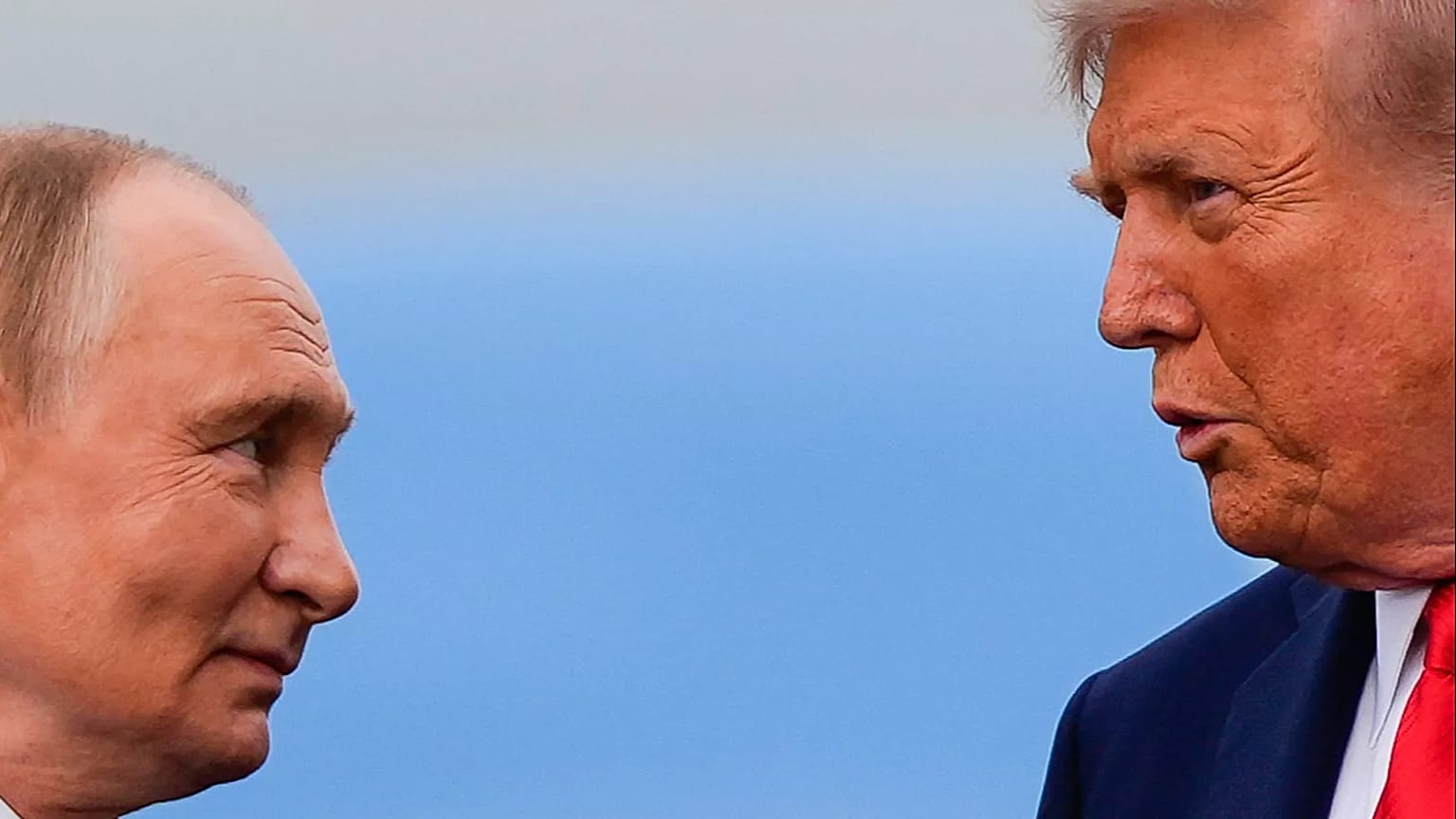
This, he said, has a direct link to a planned meeting in Budapest between Trump and Putin.
“We have to talk to the Russians. But when you talk to the Russians it has to be based on strength…they have to know that we are supporting the Ukrainians. The stronger they are on the battlefield, the stronger their hand will be at the negotiating table,” he added.
Ray Furlong is a Senior International Correspondent for RFE/RL. He has reported for RFE/RL from the Balkans, Kazakhstan, Georgia, and elsewhere since joining the company in 2014. He previously worked for 17 years for the BBC as a foreign correspondent in Prague and Berlin, and as a roving international reporter across Europe and the former Soviet Union.
RFE RL
RFE/RL journalists report the news in 21 countries where a free press is banned by the government or not fully established.
No Trump-Putin meeting in foreseeable future — this is why
Moscow has rejected the possibility of a ceasefire in Ukraine, stating that this idea contradicts the agreement reached by Vladimir Putin and Donald Trump in Alaska. Yet the Kremlin still wants the second meeting between the two in Budapest to proceed.
There are "no plans" for US President Donald Trump to meet his Russian counterpart Vladimir Putin "in the immediate future", a White House official stated on Tuesday.
Ukraine, together with the European allies, has called for a ceasefire at the current frontlines of Russia’s war, seeing it as a starting point for any further negotiations and ultimately any future deal.
Kyiv has not changed its stance and has been pushing for this plan since the beginning of the negotiations with Washington.
Moscow's position hasn't changed either. For the Kremlin, a ceasefire is off the table, but Russia still wants a meeting between Putin and Trump in Budapest to take place, two months after their Alaska summit.
For Trump, the current contact line is not the first step, but rather a final agreement to put an end to Moscow’s all-out war, now in its fourth year.
After his meeting with Ukrainian President Volodymyr Zelenskyy last Friday, Trump said, "They should stop where they are. Let both claim victory."
Trump added that he would meet his Russian counterpart in Budapest, "within two weeks or so, pretty quick". But preparations for the summit might take longer and involve more negotiations.
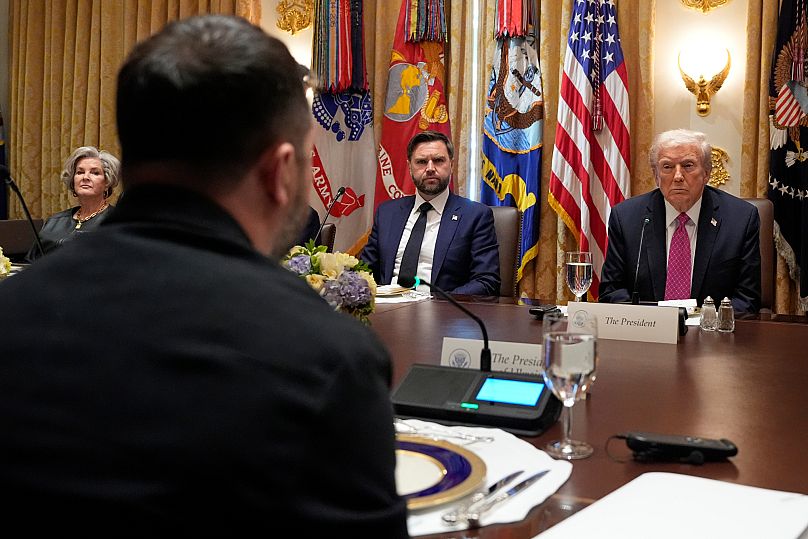
Donald Trump attends a lunch with Volodymyr Zelenskyy in the Cabinet Room of the White House, Friday, Oct. 17, 2025, in Washington. AP Photo
What is the summit timeline?
The US president said he wants to carry the momentum of the Gaza ceasefire deal between Israel and Hamas towards successfully putting an end to Russia’s war on Ukraine too. This is why he wanted the meeting with Putin to take place "within two weeks or so”.
To make this happen, US Secretary of State Marco Rubio and Russian Foreign Minister Sergey Lavrov are set to meet before the presidential summit.
Overnight on Tuesday, US media outlets reported that even this first step could be postponed after the first phone call between Lavrov and Rubio, which reportedly demonstrated significant differences in the positions of Moscow and Washington.
When asked if the meeting between Rubio and Lavrov is now postponed, the Russian Foreign Affairs Ministry spokesperson called it an "information circus".
The meeting was reportedly scheduled for Thursday, when the EU leaders are set to meet in Brussels to discuss Ukraine and European defence together with Zelenskyy.
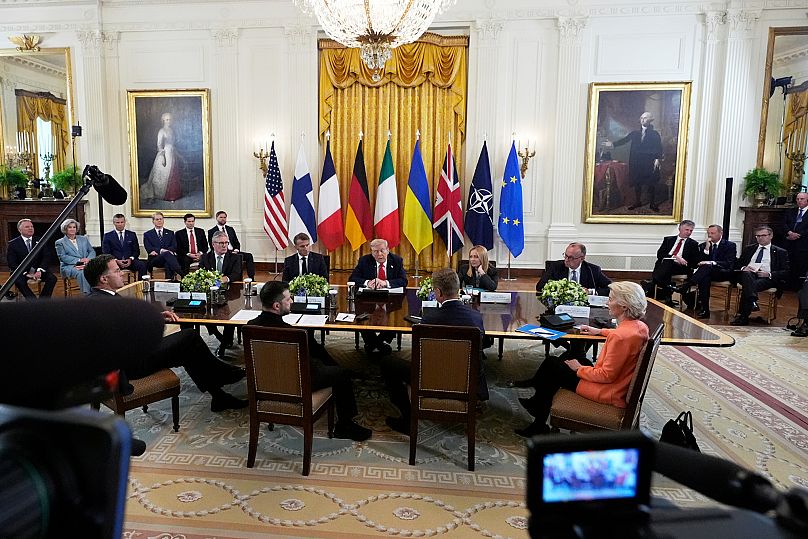
Donald Trump meets with European leaders Volodymyr Zelenskyy in the East Room of the White House, Monday, Aug. 18, 2025, in Washington. AP Photo
Moscow’s stance unchanged
Lavrov said on Tuesday that during the call with Rubio, the sides “confirmed their firm commitment to implement the agreements reached by Vladimir Putin and Donald Trump” in Alaska.
Trump said that at the Alaska summit, Putin assured him that he wants to reach a peace agreement to put an end to his war against Ukraine.
Trump's former envoy for Ukraine negotiations told Euronews earlier in October that Putin also promised Trump to meet with Zelenskyy.
Ever since, the US president has been trying to organise the direct Moscow-Kyiv talks, but the Kremlin rejected this opportunity in the same way as it has been saying no to a ceasefire.
On Tuesday, Lavrov said Moscow has not changed its position since the Alaska summit and the idea of "immediately stopping’ hostilities means forgetting what Russia calls “the root causes of the conflict."
"Calls for an immediate ceasefire without addressing the root causes of the 'Ukrainian conflict' contradict the agreements reached by Putin and Trump in Alaska," he added.
According to Moscow, the “root causes” include Ukraine's aspirations to join both the EU and NATO as well as NATO's alleged violation of commitments not to expand eastwards, the Ukrainian government's alleged discrimination against ethnic Russians and what Putin calls the "denazification" of Ukraine.
Putin and Russia have used these false arguments to justify the full-scale invasion of Ukraine in February 2022, but failed to provide evidence for any of these allegations.
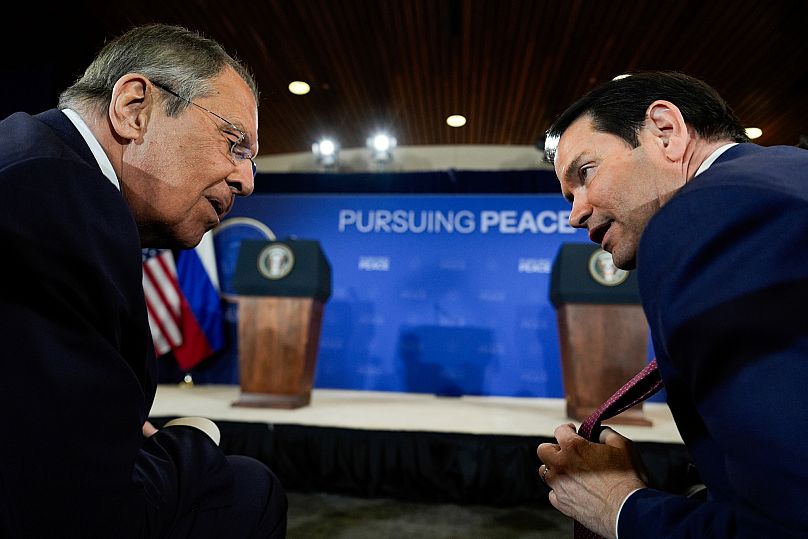
Marco Rubio and Sergey Lavrov before a news conference with Donald Trump and Vladimir Putin at Joint Base Elmendorf-Richardson, Alaska, Friday, Aug. 15, 2025. AP Photo
Moscow blames Europe
European leaders and Zelenskyy issued a joint statement on Tuesday calling for a ceasefire along the current front lines in Ukraine.
"We remain committed to the principle that international borders must not be changed by force."
Sergey Lavrov accused the Europeans of pushing for a ceasefire to “resupply” Ukraine with weapons, saying this is the only reason why the EU, together with Ukraine, is insisting on a ceasefire deal.
‘Moreover, (French President Emmanuel) Macron said in the past that this ceasefire should be without any preconditions, including, he said publicly, (that) no one would be able to restrict arms supplies to Kyiv,” Lavrov said.
“The cat is out of the bag, and it immediately became clear why this ceasefire was needed."
Lavrov also accused the EU of encouraging Kyiv to “attack civilian infrastructure and civilians on the territory of Russia,”
Russia has been continuously attacking Ukrainian civilian infrastructure across Ukraine for over three and a half years since the beginning of Moscow’s full-scale invasion of Ukraine.
Russia-Pakistan Defence Cooperation: Between Optics And Reality – Analysis
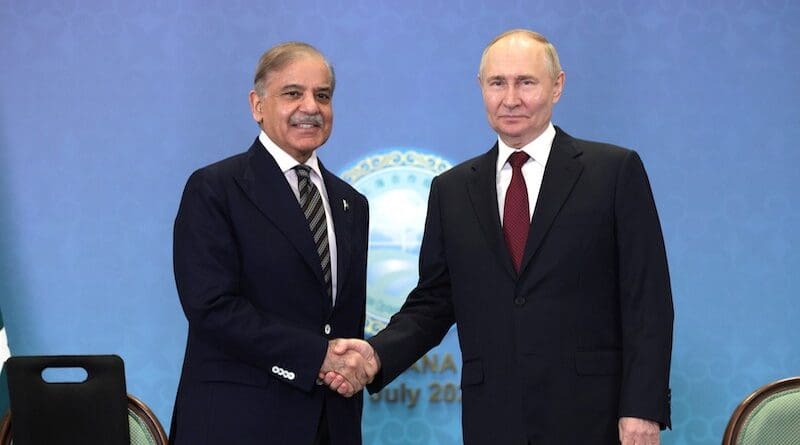
Prime Minister of Pakistan Shehbaz Sharif with Russia's President Vladimir Putin on sidelines of Shanghai Cooperation Organization meeting. Photo Credit: Kremlin.ru
News of Russia’s supplies to Pakistan of RD-93MA engines, which power Pakistani JF-17 Block III fighter jets, has become part of a domestic political debate in India, prompting an emotional backlash in the media. While Moscow is indeed proceeding with these deliveries, including the upgraded variants, this is hardly a new development. Even if, as some critics have levelled, Russia ignored Indian requests to halt these exports, this has been the case since at least 2007. Therefore, the renewed attention to this issue at this juncture merits scrutiny. That said, it is still worth revisiting Russia’s defence engagement with Pakistan to weigh in on its future trajectory.
All Talk and Little Action
There should be no illusions about Russia’s intention to sell defence systems to Pakistan. Russian military experts have long argued that Moscow should reconsider its approach to South Asia and reap the benefits of supplying both India and Pakistan with weaponry. The oft-cited argument is that, unlike Russia, other arms suppliers to India, such as the US and France, have been able to sell weapons to both New Delhi and Islamabad while still being preferred over Russian bids during tenders. Meanwhile, the argument goes, Russia has been compelled to restrict itself in the name of “privileges” in its partnership with India.
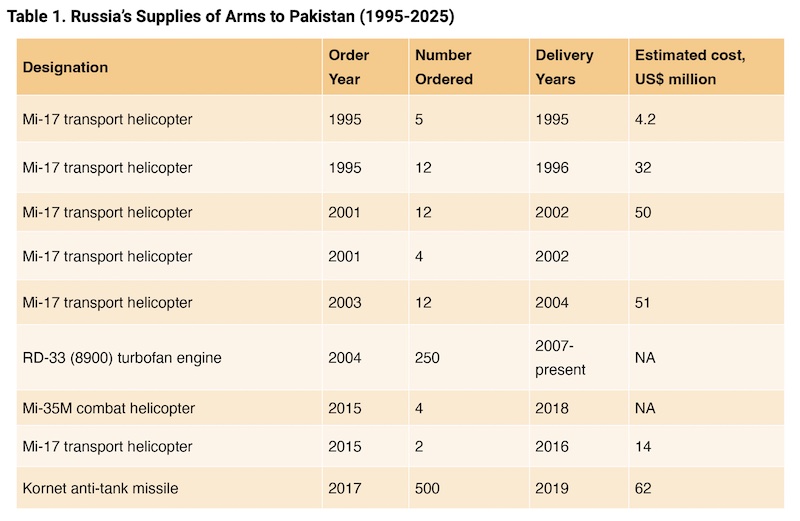
It is important to consider these arguments in context. This debate dates back to the 1990s when Moscow was on the verge of providing Pakistan with Su-27s. Despite strong lobbying from the foreign ministry and a general warming of Russia-Pakistan political ties, the deal was eventually abandoned. This was followed by further discussions, fuelled by Pakistan’s desire to purchase various defence platforms from Russia, including air-to-air missiles, tanks, stealth frigates, and artillery guns. Most of these Pakistani proposals led nowhere and were blocked by Russia due to Indian objections. What did materialise, however, was the Russian provision of Mi-17/171 dual-use transport helicopters, which were delivered to Pakistan in several batches between 1996 and 2016, as well as four Mi-35M combat helicopters (Refer to Table 1).
As India has sought to reduce its dependence on Russian-origin military hardware, the “commercialisation” of defence supplies to Pakistan has gained prominence in Moscow. Russian experts estimated in 2019 that Pakistan’s demand for Russian arms could potentially reach US$8-9 billion. What these projections often fail to consider, however, is the fragile state of Pakistan’s economy, which is cash-strapped and reliant on external support. This means that any significant deal would only be viable if Russia were to extend a loan to the Pakistani government. Not only would this alienate a reliable and financially stable partner, but such an arrangement would hardly be beneficial for Russia’s own economic interests, particularly at a time when Moscow itself needs hard currency. Beyond Islamabad’s limited purchasing capacity, there are deep-seated concerns over the alignment of Russian and Pakistani regional objectives and the broader “unpredictability” of Pakistan’s foreign policy in the long run.
The Story of Russia’s Engines in Pakistan
In 2007 and 2010, Rosoboronexport reached deals to export 250 RD-93 engines to China, with an option for an additional 400 units and the right to transfer them to third countries, including Pakistan. Following the Russia-Pakistan military cooperation agreement of November 2014, Pakistani officials claimed that they would be able to purchase these engines directly from Russia, expressing interest in training engine specialists there and seeking Moscow’s assistance with the modernisation of the Pakistan Aeronautical Complex’s engine-repair facilities. However, there has been no confirmation that Russia has entered into any such arrangement beyond the delivery of engines and spare parts — and even these are exported to Pakistan via China.
The RD-93 is an export variant of the RD-33 engine used in Russian MiG-29 fighter jets, primarily designed to power the Chinese Chengdu FC-1/Pakistani JF-17 Thunder. The RD-93MA is an upgraded version of the RD-93, offering an increased thrust of 9,300 kg compared to 8,300 kg. While the first two JF-17 variants relied on the RD-93, the enhanced power output of the RD-93MA is geared towards the JF-17 Block III, enabling the aircraft to carry heavier payloads, integrate advanced avionics, and achieve higher speeds. According to SIPRI data, Russia has delivered more than 200 RD-93 engines to Pakistan since 2007 (Figure 1).
Beyond enhanced performance, the supply of Russian engines for China-Pakistan fighter jets is also a matter of reliability. Despite China’s efforts to replace the RD-93 with the domestically developed WS-13 engine, both China and Pakistan remain dependent on Russian-made engines, which are regarded as more reliable and durable. Prominent Russian experts argue that India should view the continued supply of Russian engines for the JF-17 in a positive light, given that New Delhi is well aware of the jets’ capabilities when powered by the RD-93/RD-93MA and can therefore predict their operational performance.
Figure 1. The Schedule of RD-93 Supplies from Russia to Pakistan
Another aspect of Russia-Pakistan engagement involves joint military drills, which have become a regular feature. The latest edition of Druzhba counter-terrorism exercise took place in Russia’s Southern Military District from 15 to 27 September 2025. The exercise focused on “drone warfare, fighting in built-up areas and counter-improvised explosive devices.” These exercises have been held regularly since September 2016, with exceptions in 2022 and 2023.
A naval component has also been embedded within the framework of bilateral interactions. In March 2025, the Russian and Pakistani navies conducted the Arabian Monsoon joint exercise in the North Arabian Sea, aimed at “enhancing interoperability and demonstrating a joint commitment to countering common maritime security threats.”
Officials from both sides have also been engaged in regular meetings of the Joint Military Consultative Committee (JMCC), which has convened consecutively for the past seven years, except in 2022. The most recent consultations took place in Moscow in August 2025 and were co-chaired by Russia’s Deputy Minister of Defence, Colonel General Alexander Fomin, and Pakistan’s Defence Secretary, Retired Lieutenant General Muhammad Ali.
Russia’s strategic partnership with India, particularly the close military and technical cooperation, has always constrained Moscow’s defence engagement with Pakistan. Even in times of turbulence and uncertainty, decision-makers in Moscow have recognised that developing substantial defence ties with Islamabad could cost access to the more lucrative Indian market, which generates billions of dollars for Russia.
Curiously, the controversy over the RD-93 engines has resurfaced at a time when the India-Russia defence partnership is back on track, with major items such as the delivery of additional S-400s, potential joint production of S-500 air defence systems, and the Su-57 fighter jet deal high on the bilateral agenda. Russia is unlikely to jeopardise these strategically and commercially significant opportunities with India for the sake of modest gains with Pakistan. That said, Moscow will continue to engage in limited defence cooperation with Islamabad —including through military exercises and selective arms supplies—within the boundaries accepted by successive Indian governments.
About the author: Aleksei Zakharov is a Fellow – Russia & Eurasia with the Strategic Studies Programme at the Observer Research Foundation.
ORF was established on 5 September 1990 as a private, not for profit, ’think tank’ to influence public policy formulation. The Foundation brought together, for the first time, leading Indian economists and policymakers to present An Agenda for Economic Reforms in India. The idea was to help develop a consensus in favour of economic reforms.
Indonesia-North Korea Thaw Opens Door To Closer Security Ties – Analysis
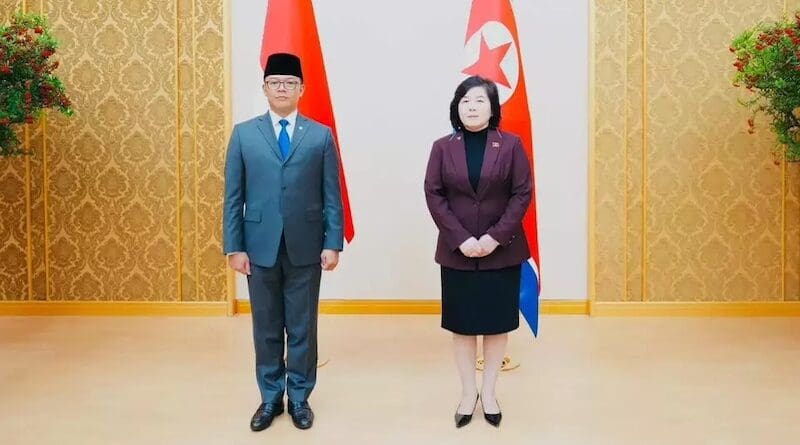
Indonesia's Foreign Minister Sugiono meets his North Korean counterpart Choe Son-Hui in Pyongyang on Oct. 11, 2025. (Photo Courtesy of Foreign Affairs Ministry)
Whether framed as coincidence or careful arrangement, October 2025 offered a moment of surprising symbolism in Indonesia-North Korea relations. Pyongyang marked its 80th Workers’ Party anniversary just as Jakarta celebrated the 80th year of its armed forces, and against this setting that Indonesian Foreign Minister Sugiono set out on the first visit to North Korea by an Indonesian top diplomat for over a decade. Whereas official statements spoke only of friendship, the strategic timing and Indonesia’s recent defense buildup suggest deeper strategic interests, fueling speculation that low-profile security ties might be under consideration.
Jakarta’s Longstanding Relations with Pyongyang
Indonesia’s links to North Korea run deep from the Cold War era, but have historically been political rather than military. Diplomatic relations were established in 1964 as an extension of Indonesia’s non-aligned foreign policy, after which Indonesia’s founding father Sukarno hosted North Korea’s Kim Il-sung in Indonesia. After a brief interruption in the late 1960s, Indonesia under Suharto re-aligned toward the West but never officially cut relations with Pyongyang. Megawati Sukarnoputri, Sukarno’s daughter and later Indonesian president, revived personal channels with the Kim family, meeting Kim Jong-il in 2002 and affirming the symbolism of dynastic respect between Jakarta and Pyongyang.
For decades, the two nations have maintained cordial yet understated relations. North Korea maintains its embassy in Jakarta, and after a temporary COVID shutdown, Indonesia reopened its Pyongyang embassy in July 2025. Prabowo also met Kim Jong Un during the Victory Day Parade hosted by Xi Jinping in Beijing. Nevertheless, trade ties remain minimal, with official figures indicating a decline from USD 2.3 million in the first eight months in 2024 to USD 2.1 million in the same period in the year after.
Indonesia, North Korea, and ASEAN Reactions
The October visit saw the two foreign ministers sign a memorandum of understanding to establish a formal bilateral consultation mechanism, which would explore cooperation in political, socio-cultural, technical, and even sports sectors. Expectedly, it did not mention military affairs. But any consultation channel, even framed as civilian or political, can carry security implications. Moreover, Indonesia’s renewed engagement with Pyongyang aligns with its enduring commitment to free and active foreign policy doctrine, which seeks a balanced involvement with all major powers.
Indonesia, interestingly, has ramped up its defense ambitions since Prabowo took office. The Indonesian National Armed Forces’ 80th anniversary parade displayed new domestically-built and imported systems, specifically the debut of Indonesia’s first autonomous unmanned submarine KSOT-008 that reveals Jakarta’s intent to military modernization. The country, at its core, has further diversified its arms procurement to include a broader array of partners, acquiring equipment and technology from Turkey, France, Russia, India, the United Kingdom, Italy, China, and even South Korea.
In light of this, engagement with North Korea, even if limited to consultation or technical dialogue, could be seen as a calculated extension of that approach. Discreet engagement with Pyongyang provides Indonesia an opportunity to access North Korean know-how and thereby advances Jakarta’s strategic military modernization. But even so, technical focused interactions carry considerable diplomatic risk that will inevitably draw scrutiny from Western partners and ASEAN neighbors given North Korea’s UN-sanctioned status. This is a situation Indonesia must navigate delicately to pursue its defense interests without jeopardizing its credibility.
Southeast Asia may take a positive view given North Korea’s deliberate efforts to re-establish contact with the region in recent years. The ASEAN bloc remains committed to diplomacy and adherence to UN rules, as demonstrated at the November 2024 ASEAN Summit, in which member states expressed grave concern regarding North Korean missile testing and repeated demands for compliance to UN resolutions. Pyongyang’s immediate objective is clear in its pursuit of normalizing defense-related diplomacy across Asia and securing new partnerships to offset its growing international isolation. With Jakarta, widely perceived as a de facto leader within ASEAN, signaling openness to North Korea-ASEAN engagement through the ASEAN Regional Forum, the region is likely to welcome cautious initiatives that facilitate constructive dialogue and uphold regional stability.
Future Trajectories of Jakarta-Pyongyang Ties
Critics argue that Indonesia’s hypothetical movement into substantive security ties with North Korea in a non-starter. Indonesia is a UN member state bound by Security Council resolutions banning arms trade and military assistance to Pyongyang. Domestic politics, moreover, could complicate such a move, with Indonesian citizens still being sensitive to human rights and non-proliferation, and any assumed to be visible closeness to an isolated regime politically risky. ASEAN’s norms of gradualism and unanimity, in the same way, mean that Indonesia could face regional pushback if its outreach to Pyongyang is regarded as undermining shared principles.
While these concerns are valid, they overlook certain key considerations. Indonesia’s foreign policy tradition of autonomy, reinforced by Prabowo’s willingness to engage all sides, makes similar outreach consistent with Jakarta’s broader strategy. Southeast Asia’s renewal diplomatic ties with North Korea, furthermore, demonstrate a pragmatic blend of political symbolism and strategic hedging. Vietnam and Laos are already deepening cooperation especially party-to-party, given their ideological alignment and historical ties, with Vietnam now enhancing to defense partnership, while others still maintain cautious engagement. And by inviting North Korea deeper into ASEAN frameworks, as Indonesia extended, Jakarta can claim it is containing Pyongyang through dialogue rather than breaking away.
What might possibly happen next for Indonesia and North Korea can be assessed by probability and impact, with any security cooperation likely to be low-profile and incremental:
First, the high-impact but low-probability scenario would involve Indonesia engaging in arms or advanced technology transfers from North Korea, which would constitute a clear breach of UN sanctions and almost certainly trigger international backlash; this is improbable without a significant radical change in government doctrine.
Second, a more plausible medium-probability path lies in what might be called gray-zone cooperation, where Indonesia sustains patterns of consultation and non-traditional cooperation with Pyongyang that fall short of explicit arms transactions. In this way, quiet exchanges on cybersecurity or maritime domain awareness could develop, producing gradual mutual understanding and potential skills transfer over time, much as Vietnam’s experience suggests.
Third, the low-probability but symbolically significant option is that Indonesia’s outreach remains largely rhetorical, serving primarily to signal Jakarta’s independent stance. In this scenario, gestures of longstanding friendship continue but without translating into substantive cooperation, which represents the baseline outcome if both sides decide to play safe.
Indonesia’s Calculated Approach to Regional Stability
For Indonesia, if the goal is true strategic autonomy and national interest, Jakarta should avoid vague back-channels that could raise suspicion. The government could publicly clarify the scope of any North Korea engagement, for instance, by declaring that consultation mechanisms are confined to non-dual-use areas and by submitting clear reports to the UN sanctions committee.
At the same time, Indonesia’s Western partners and regional neighbors need to approach engagement with pragmatism. They should continuously remind Jakarta of its obligations under UN sanctions, making clear that even symbolic interactions with North Korea are bounded by diplomatic limits, and any indications of arms procurement would carry serious consequences. Nevertheless, such pressure must be carefully calibrated, as overreaction could prompt Indonesian leaders to quietly adjust their approach, seeking alternatives that avoid direct confrontation while still advancing their strategic interests.
Either way, what is clear is that Indonesia and North Korea are rebuilding a measured, modest rapport. Whether the two nations’ engagement remains minor or emerges as a significant factor in regional security will depend on Jakarta’s intent and the strict boundaries it establishes. History shows Indonesia’s foreign policy often surprises, and under Prabowo’s assertive and more active foreign policy stance, this middle power can be expected to assert itself more decisively in influencing regional strategic landscape. If properly managed, this renewed engagement could allow ASEAN to draw Pyongyang into other regional frameworks and strengthen stability.
Geopoliticalmonitor.com is an open-source intelligence collection and forecasting service, providing research, analysis and up to date coverage on situations and events that have a substantive impact on political, military and economic affairs.
Elon Musk returns to deliver devastating putdown to Trump's head of NASA
David Edwards October 21, 2025 Elon Musk speaks during the first cabinet meeting hosted by U.S. President Donald Trump, at the White House in Washington, DC, U.S., February 26, 2025. REUTERS/Brian Snyde
SpaceX CEO Elon Musk suggested Transportation Secretary Sean Duffy was not smart enough to lead NASA after he threatened to pull a moon landing contract from the billionaire's rocket company.
On Tuesday, Musk responded to a comment on X that criticized Duffy for his dual role as transportation secretary and NASA administrator.
"Duffy, wanting to kill NASA's role as an independent agency, seems to be a particularly bad choice at the moment," the commenter noted.
"The person responsible for America's space program can't have a 2 digit IQ," Musk replied.
The attack on Duffy came just a day after he told CNBC that NASA would modify or cancel SpaceX's contract to land astronauts on the moon in the coming years.
"They push their timelines out, and we're in a race against China," Duffy said. "So, I'm going to open up the contract. I'm going to let other space companies compete with SpaceX."
In 2021, NASA chose Musk's Starship as the vehicle to land astronauts on the moon, but it has seen recent setbacks, including three in-flight failures this year.
'I don't like you!' Trump state meeting goes off rails as he attacks Australian ambassador
President Donald Trump insulted Australian Ambassador to the U.S. Kevin Rudd to his face during a meeting with the country's Prime Minister Anthony Albanese.
During a Monday appearance with Albanese at the White House, a reporter asked Trump if he was concerned with "things the ambassador said about you in the past."
"I don't know anything about him," Trump said of Rudd, who was sitting across the table from him. "I mean, if you said bad, then maybe he'll like to apologize. I really don't know.
"Did an ambassador say something bad of me?" the U.S. president asked Albanese. "Don't tell me. Where is he? Is he still working for you?"
"Yeah, yeah," Rudd volunteered.
"You said bad?" Trump asked.
"Before I took this position, Mr. President," the ambassador replied.
"I don't like you either," Trump fumed. "I don't, and I probably never will."
Rudd, himself a former Australian Prime Minister, has been a vocal critic of Donald Trump, describing him as a threat to democratic institutions.
Trump's $40B Argentine giveaway hits major snag as banks balk at loan: report
A Donald Trump proposal to bail out struggling Argentina with a $40 billion loan is bumping up against economic reality with banks being asked to provide half of the amount demanding collateral or federal assurances.
According to a report from the Wall Street Journal, financial institutions, including JPMorgan Chase, Bank of America and Goldman Sachs, are “struggling” to come up with a loan they would feel comfortable with.
With Trump pushing to assist Argentine President Javier Milei’s government, the plan was to create a financial package made up of a “$20 billion currency swap with the U.S. Treasury Department and a separate $20 billion bank-led debt facility,” the Journal is reporting.
According to the report, it is turning out to be far easier to make the proposal than it is to make it a reality.
“While banks normally arrange these types of rescue facilities on their own, Treasury has been controlling the broader package and banks feel they can’t act without backing from Washington, some of the people said," the Journal reported.
"The loan facility hasn’t been finalized and might not come together if the banks’ collateral question isn’t resolved, they said. U.S. banks haven’t been lending to Argentina, and the country has been shut out of the international capital markets for years.”
The report adds that Argentina has already been the recipient of 20 bailouts from the International Monetary Fund (IMF) since the 1950s — and that has bankers nervous.
There is also a risk to the U.S Treasury which would “swap $20 billion for a roughly equivalent amount of Argentine pesos,” which are rapidly depreciating.
According to Brad Setser, a former deputy assistant Treasury secretary for the Obama administration, ”The risks from these operations are unusually large. Should the peso depreciate, which many think is not only likely but necessary, the Treasury would be left holding assets that have fallen in value.”
Argentina's President Javier Milei gestures as he addresses supporters, during a campaign rally at Tres de Febrero, Buenos Aires province, on October 17, 2025. - Copyright AFP/File Patrick T. Fallon Martín RASCHINSKY
Argentina and the United States signed off on a $20 billion financial lifeline Monday, hoping to avert economic meltdown and boost President Javier Milei ahead of tough legislative elections.
President Donald Trump has plied Argentina with political and economic support ahead of the October 26 vote, which will decide whether his close ally Milei can force through labor, tax and pension reforms.
Milei, once a global poster boy for budget-slashing libertarian politics, is on the ropes as Argentines head to the polls.
Many of his reforms are languishing, his popularity is falling and he is battling to avoid devaluing Argentina’s currency, the peso, before the vote, fearing that would drive up consumer prices.
But markets see the peso as substantially overvalued, forcing Buenos Aires to use scant foreign reserves to defend its value.
Now his friend in Washington has agreed to step in with a long-mooted $20 billion plan.
Trump has also pledged another $20 billion in public and private funds to help Argentina weather market turmoil, conditional on a strong electoral showing by Milei.
“If he loses, we are not going to be generous with Argentina,” Trump said as he hosted Milei at the White House earlier this month.
Milei outlined details of the bailout in an interview with Channel 8 that aired Monday, saying it would only be activated if needed.
– ‘Remote control’ –
Trump’s support for Milei has raised eyebrows in Washington, where Argentina is seen as neither a vital trade nor security partner.
US exports to Argentina are worth about $9 billion a year, versus $28 billion worth of exports to Colombia.
In contrast to his support for Milei, Trump has vowed to cut aid and security support to Colombia because of a spat with leftist President Gustavo Petro.
Facing criticism in the United States, Trump snapped at a reporter on Sunday as he justified his largesse.
“They’re fighting for their life. Do you understand what that means? They have no money. They have no anything.”
Last week, the US Treasury intervened by buying up pesos, but failed to stop the currency’s decline.
Argentina’s opposition has also slammed Trump’s intervention.
“The economy is being run by remote control from the United States,” former president Cristina Kirchner said Friday from her Buenos Aires apartment, where she is under house arrest for corruption.
US intervention has so far failed to halt the dollar’s surge against the peso: the greenback broke through the upper band of the exchange rate on Monday, hitting 1,495 pesos.
Since Milei’s allies were defeated in Buenos Aires province legislative elections in September the peso has lost seven percent of its value against the dollar.
Most economists expect the government to make moves toward devaluation after the election.