It’s possible that I shall make an ass of myself. But in that case one can always get out of it with a little dialectic. I have, of course, so worded my proposition as to be right either way (K.Marx, Letter to F.Engels on the Indian Mutiny)
Wednesday, October 22, 2025
Photosynthesis without the burn
Marine algae use a unique pigment, siphonein, to shield photosynthesis from excess light
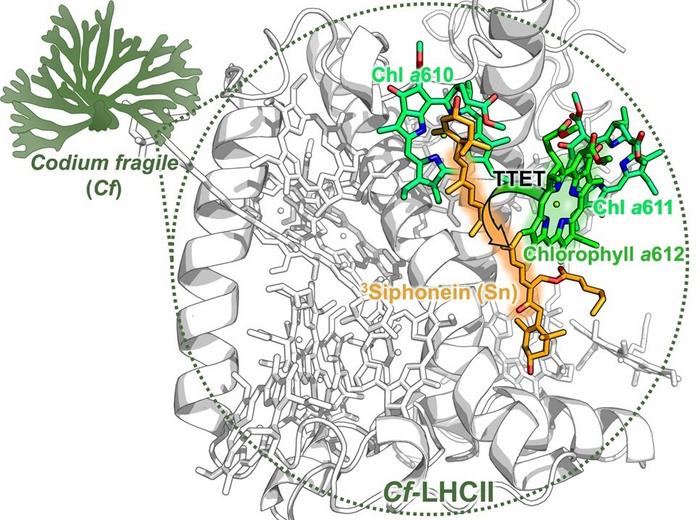
At the L1 site, the pigment siphonein (orange) binds close to a cluster of chlorophyll molecules (Chl a610–a612, green), enabling efficient energy quenching.
Too much sun can ruin a day at the beach. It can also ruin photosynthesis, scorching plants and other organisms that depend on capturing sunlight for energy. Beneath the waves, though, algae have found a clever shield. Osaka Metropolitan University researchers and their colleagues discovered that a pigment called siphonein helps marine green algae keep photosynthesis humming, without the burn.
Photosynthetic organisms rely on delicate light-harvesting complexes (LHCs) to capture sunlight for energy. During photosynthesis, chlorophyll absorbs light and enters an excited singlet state. Under normal light conditions, this energy is efficiently transferred to the photosynthetic reaction center to drive chemical reactions. But excessive light can push chlorophyll molecules into a dangerous “triplet” state, which is a source of reactive oxygen species capable of causing oxidative damage.
“Organisms use carotenoids to quickly dissipate excess energy, or quench these triplet states, through a process called triplet-triplet energy transfer (TTET),” said Ritsuko Fujii, lead author and associate professor at the Graduate School of Science and Research Center for Artificial Photosynthesis at Osaka Metropolitan University.
Until now, however, the rules governing this photoprotection remained largely unknown.
The research team looked for an answer in Codium fragile, a marine green alga. Similar to terrestrial plants, it possesses a light-harvesting antenna called LHCII, but with a twist: it contains unusual carotenoids such as siphonein and siphonaxanthin, which allow the alga to use green light for photosynthesis.
“The key to the quenching mechanism lies in how quickly and efficiently the triplet states can be deactivated,” said Alessandro Agostini, researcher at the University of Padua, Italy and co-lead author of the study.
Using advanced electron paramagnetic resonance (EPR) spectroscopy, which detects triplet excited states directly, the team compared spinach plants with Codium fragile. In spinach, weak signals of chlorophyll triplet states remained detectable. In contrast, in Codium fragile, these harmful states vanished entirely, clear evidence that carotenoids in the algal system quench them completely.
“Our research has revealed that the antenna structure of photosynthetic green algae has an excellent photoprotective function,” Agostini said.
Combining EPR with quantum chemical simulations, the team pinpointed siphonein, located at a key binding site in LHCII, as the primary driver of this remarkable protective effect. Their work also clarified the electronic and structural principles underlying efficient TTET, showing how the peculiar electronic structure of siphonein and its position in the LHCII complex strengthen its ability to dissipate excess energy.
The findings demonstrate that marine algae have evolved unique pigments not only to capture the green-blue light available underwater but also to enhance their resilience against excessive sunlight.
Beyond advancing our understanding of photosynthesis, the study results open the door to developing bio-inspired solar technologies with built-in protective mechanisms, and more durable and efficient renewable energy systems.
“We hope to further clarify the structural characteristics of carotenoids that increase quenching efficiency, ultimately enabling the molecular design of pigments that optimize photosynthetic antennae,” Fujii said.
The findings were published in Cell Reports Physical Science.
###
About OMU
Established in Osaka as one of the largest public universities in Japan, Osaka Metropolitan University is committed to shaping the future of society through the “Convergence of Knowledge” and the promotion of world-class research. For more research news, visit https://www.omu.ac.jp/en/ and follow us on social media: X, Facebook, Instagram, LinkedIn.
Siphonein enables an effective photoprotective triplet quenching mechanism in green algal light-harvesting complexes
Article Publication Date
21-Oct-2025
The first ecological–biotechnological seaweed survey in Israel
The unique conditions of the Israeli Mediterranean Sea serve as an “ecological laboratory” fostering extraordinary nutritional and health properties in seaweeds
A pioneering ecological–biotechnological survey reveals that the Israeli Mediterranean Sea may represent a natural hotspot for resilient seaweeds enriched with nutritional and bioactive compounds. The research team describes them as a “green treasure” — an untapped, sustainable resource for superfoods, pharmaceuticals, and eco-friendly cosmetics, as well as a natural ally in climate mitigation.
A team of researchers from Tel Aviv University and the Israel Oceanographic and Limnological Research Institute (IOLR) has conducted the first comprehensive ecological–biotechnological seaweed survey in Israel. Their findings suggest that the unique ecological conditions along the Israeli Mediterranean coast—warm, sunny, and dynamic—create a natural habitat that supports the growth of distinctive and resilient seaweeds (macroalgae) rich in nutritional and health-promoting compounds. The researchers believe these properties could serve as a foundation for groundbreaking innovations in food, health, and biotechnology.
The study was led by Dr. Doron Yehoshua Ashkenazi of Tel Aviv University and IOLR, under the supervision of Prof. Avigdor Abelson from the School of Zoology at Tel Aviv University, and Prof. Álvaro Israel from IOLR Haifa, in collaboration with Dr. Eitan Salomon from the National Center for Mariculture in Eilat. Additional contributors included Prof. Félix L. Figueroa and Julia Vega from the University of Málaga, Spain, along with Guy Paz head of the laboratory at IOLR, and Dr. Shoshana Ben-Valid. The study was published in the scientific journal Marine Drugs.
Over several years, the researchers collected nearly 400 specimens, identifying 55 seaweed species—predominantly red, alongside brown and green seaweed. In contrast to earlier reports suggesting two annual peaks in seaweed productivity, this study indicates a single productive period in springtime, strongly suggesting an ecosystem shift likely driven by global warming.
Seasonality also had a pronounced effect on seaweed chemistry. Biochemical analyses revealed that local seaweeds exhibit particularly high protein content during winter, reaching several tens of percent of their dry weight, making them a promising alternative protein source for both human and animal nutrition. Antioxidant levels peaked in spring, increasing by up to 286% in some species. These findings highlight seaweed as a natural source of health-promoting compounds and potential therapeutic agents that may contribute to longevity and immune support. The seaweed also contained high levels of phenolic compounds, and natural UV filters, making them ideal for eco-friendly cosmeceutical applications.
Dr. Doron Ashkenazi explains: "Israel, located at the easternmost edge of the Mediterranean Sea, offers unique environmental conditions: a subtropical climate with year-round sunlight, rocky shores with small tidal fluctuations, and relatively high salinity and irradiance. Together, these factors stimulate the development of seaweeds with unique chemical traits that act as natural ‘biological factories,’ producing bioactive compounds in remarkable concentrations.”
“We believe that this study, together with the growing seaweed research field, can place Israel at the forefront of global marine biotechnology. In addition to being ‘a land flowing with milk and honey,’ Israel has also been blessed with a unique sea — the Israeli Mediterranean.”
Prof. Álvaro Israel emphasizes: "This study provides valuable insights into the environmental factors that influence seaweed growth and quality, allowing us to translate this knowledge into practical aquaculture methods. Seaweed offers immense environmental benefits—they require no arable land, generate oxygen, capture carbon, and purify water from pollutants. They stand at the forefront of sustainable aquaculture, merging environmental advantages with economic opportunities.
Dr. Eitan Salomon adds: “Our findings illustrate the untapped biotechnological potential of seaweeds for the future of humanity – from functional foods and pharmaceuticals to a variety of advanced health applications.”
Prof. Avigdor Abelson concludes: “The Israeli Mediterranean Sea is a unique natural laboratory. It can serve as a model for understanding the impacts of climate change on marine ecosystems and help predict which species may thrive in a warming world. Beyond its scientific value, seaweeds represent a strategic national and global resource that can help address future challenges in food security, health, and the environment.”
The research is dedicated to the memory of Dr. Itzchak (Itzik) Brickner of blessed memory, one of Israel’s legendary marine biologists, in recognition of his friendship, mentorship, and inspiration.
New radiocarbon dating of Egyptian artifacts puts Thera (Santorini) volcanic eruption prior to Pharaoh Ahmose
First study given access to artifacts in British museums for radiocarbon dating the transition period between the Second Intermediate Period and the New Kingdom of ancient Egypt
SDE BOKER, Israel, October 22, 2025 – One of the largest volcanic eruptions in the last 10,000 years took place at the Greek island of Thera (Santorini) in the Aegean Sea, but its dating during the late 17th or 16th century BCE remained controversial. Volcanic ash from the eruption spread over a large area in the eastern Mediterranean region. One of the lingering questions in archeology was how this huge geological event lined up with royal Egyptian chronologies. Now, a new study by Ben-Gurion University of the Negev and University of Groningen researchers produced the first radiocarbon dates concerning King Ahmose, the Pharaoh who reunited Upper and Lower Egypt and established the New Kingdom. Their results show that the explosive eruption occurred prior to the New Kingdom during the Second Intermediate Period. The new radiocarbon dates significantly favor a “low” (i.e. younger) chronology for the beginning of the 18th Dynasty, which is of great importance in our understanding of Egyptian relations with neighboring civilizations in the region.
Their findings were published in PLOS One last month.
Prof. Hendrik J. Bruins of the Jacob Blaustein Institutes for Desert Research at BGU's Sylan Adams Sde Boker Campus and Prof. Johannes van der Plicht of the University of Groningen in the Netherlands received rare permission to select samples of Egyptian artifacts at the British Museum and the Petrie Museum in London for radiocarbon dating. Supervised by museum staff samples were taken of a mudbrick from the Ahmose Temple at Abydos (British Museum), a linen burial cloth associated with Satdjehuty (British Museum), and six wooden stick shabtis from Thebes (Petrie Museum).
They discovered that, contrary to traditional archaeological understandings, the volcanic eruption did not occur during the Egyptian New Kingdom, but occurred earlier, during the Second Intermediate Period. Radiocarbon dates of the Santorini eruption are significantly older than the first-ever radiocarbon dates concerning Pharaoh Ahmose and the other artifacts investigated of the 17th to early 18th Dynasty.
"Our findings indicate that the Second Intermediate Period lasted considerably longer than traditional assessments, and the New Kingdom started later," says Prof. Hendrik J. Bruins.
Mudbrick EA 32689 (British Museum) from the Temple of Ahmose at Abydos, showing the stamped prenomen (throne name) Nebpehtire of Pharaoh Ahmose. Its radiocarbon dates support a low chronology for the beginning of the 18th Dynasty.
Shabti UC 40179 from ancient Thebes, which can be related to the beginning of the 18th Dynasty. Its radiocarbon date supports a low chronology for the reigns of Nebpehtire Ahmose and his son Amenhotep I.
Credit
Photo by H.J. Bruins (2017), published with permission from the Petrie Museum of Egyptian and Sudanese Archaeology (University College London) under a CC BY license.
The Minoan Thera eruption predates Pharaoh Ahmose: Radiocarbon dating of Egyptian 17th to early 18th Dynasty museum objects
Article Publication Date
19-Sep-2025
Researcher cracks new ‘kissing number’ bounds — besting AI in the process
Breaking a 20 year drought, a researcher found three new bounds for the famous mathematical ‘kissing number’ dilemma –– and AI managed to find just one.
How many coins can touch one coin, or how many basketballs can ‘kiss’ one basketball at the same time? This seemingly playful question lies at the heart of the famous kissing number problem, a mathematical riddle that becomes almost supernaturally difficult to work out in dimensions beyond 4D. Despite its whimsical name, similar problems have practical applications in areas such as mobile communications and satellite navigation.
Aalto University doctoral candidate Mikhail Ganzhinov established three new lower bounds for the kissing number: at least 510 in dimension 10, at least 592 in dimension 11, and at least 1,932 in dimension 14. There had been no movement on the riddle for dimensions below 16 for two decades until earlier this year, when AlphaEvolve, developed by Google's artificial intelligence laboratory DeepMind, made headlines in May. It was able to increase the lower bound of dimension 11 to a score of 593. So, only in the 11th dimension did Ganzhinov fall one step short of AlphaEvolve’s AI-powered result.
So how did the researcher beat the AI across the other two dimensions?
‘I reduced the problem size by looking only for arrangements with a high degree of symmetry,’ he explains. ‘In fact, the current lower bound for dimension 11 is still quite weak — I believe it can be pushed well beyond 600.’
Ganzhinov’s thesis advisor, Professor Patric Östergård, is impressed by the outcome — and quick to point out what it says about the limits of AI.
‘Artificial intelligence can do amazing things, but it’s far from omnipotent — and the game may still turn to Mikhail’s favour in Dimension 11 too,’ Östergård remarks.
Recently awarded his PhD, Ganzhinov is modest about his achievements, noting that the field is evolving rapidly. Professor Henry Cohn from the MIT and researcher Anqi Li are set to publish new results that extend the kissing number bounds in dimensions 17 to 21 — the first progress in those dimensions in over 50 years. Ganzhinov says that his results are part of a broader wave of recent developments.
‘This riddle has challenged mathematicians since the famous conversation between Newton and Gregory,’ says Ganzhinov. ‘Yet solving them also has a practical purpose –– understanding connections to spherical codes has real life implications in the field of communications.’
The race to build the metaverse – a vast digital realm where virtual and physical worlds merge – is already becoming a global power struggle. According to new research from the University of Amsterdam, the United States, China, and the European Union are each charting their own course toward this “new internet”, revealing starkly different political and economic visions of our digital future. Their rival approaches are giving rise to competing metaverses – one led by American Big Tech, another by China’s state-backed giants. The research was published in the journal Politics and Governance.
The research’s author, political scientist Nora von Ingersleben-Seip, argues that the metaverse is far more than a technological curiosity – it is fast becoming a geopolitical battleground. While the concept remains in its infancy, governments and corporations are already racing to shape how this immersive, interconnected new internet will function – and who will control it.
‘We are witnessing the emergence of two competing versions of the metaverse,’ says Von Ingersleben-Seip. ‘A consumer-focused one led by American Big Tech, and an industry-focused one led by Chinese Big Tech. Europe has a vision of a third, open Metaverse – but it lacks the companies to bring that vision to life.’
America: the market-driven metaverse
In the United States, there is no formal federal policy for the metaverse. Instead, the government supports related technologies such as artificial intelligence, semiconductors and cloud computing through industrial policies like the CHIPS and Science Act. This hands-off approach has given Big Tech companies – such as Meta, Google, Apple, Amazon, and Microsoft – the freedom to define the new internet.
These companies dominate nearly every layer of the digital ecosystem, from virtual reality headsets and app stores to cloud infrastructure and digital identity systems. As a result, the American metaverse is becoming a commercial, closed environment where users’ experiences – and their data – are controlled by a small number of powerful corporations.
China: the state-led industrial metaverse
China, by contrast, has launched a comprehensive national strategy to lead in the metaverse. The Ministry of Industry and Information Technology has introduced five-year plans and a Three-Year Action Plan (2023–2025) to integrate virtual and extended reality technologies into key sectors like education, manufacturing and healthcare.
Chinese tech giants – Huawei, Tencent, ByteDance, Alibaba, and NetEase – are central to this vision, working closely with the state to create an industrial metaverse focused on productivity and national strength. Every online identity and transaction in China’s metaverse is monitored through government-approved systems, reflecting a model that prioritises control and surveillance alongside technological progress.
Europe: the rights-driven vision
The European Union has taken a different approach. Through its Web 4.0 and Virtual Worlds Strategy (2023), the European Commission aims to build an open, interoperable metaverse grounded in European values such as privacy, transparency and inclusion. The EU envisions a digital environment where users’ rights are protected and businesses of all sizes can thrive.
Europe is investing in public-interest projects such as Destination Earth, a “digital twin” of the planet to model climate change, and CitiVerse, a virtual replica of urban environments to improve city planning. Yet despite these ambitions, Von Ingersleben-Seip notes that Europe’s lack of major technology firms leaves it reliant on American infrastructure for cloud computing and artificial intelligence – a dependency that limits its influence over the metaverse’s evolution.
A fork in the digital road
Von Ingersleben-Seip concludes that each region’s approach reflects its broader political and economic philosophy: the US favours private innovation and market dominance; China promotes state control and industrial development; the EU seeks to balance innovation with ethics and digital rights.
‘The metaverse is not just a technological development – it’s a political and economic project,’ Von Ingersleben-Seip. ‘The choices made today will determine whether it becomes an open digital commons or a fragmented system controlled by a few powerful players.’