Friday, October 24, 2025

NESTLE IN IRAQ

Switzerland reopens Baghdad embassy after 30-year closure
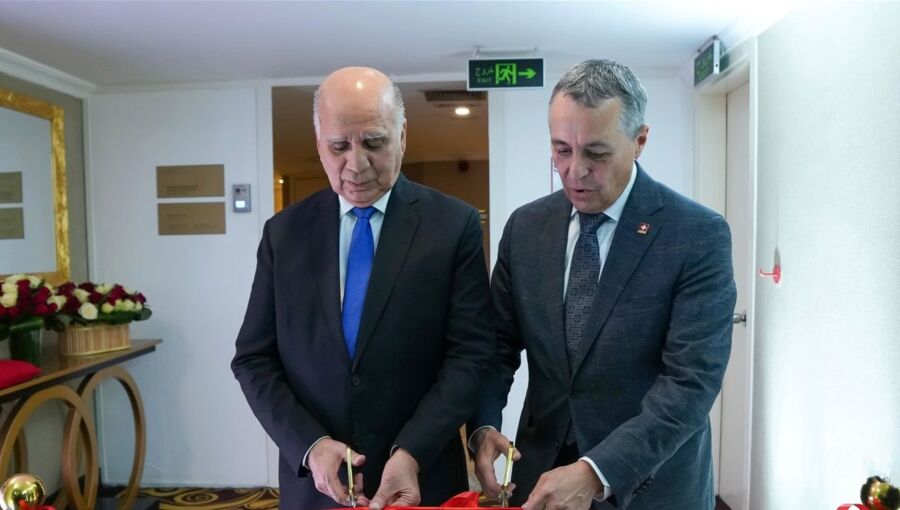

Iraq's Deputy Prime Minister Fuad Hussein (L) officially opened the Swiss embassy in Baghdad alongside Swiss Foreign Minister Ignazio Cassis (R). / bne IntelliNews


By bnm Gulf bureau October 23, 2025


Iraq's Deputy Prime Minister and Foreign Minister Fuad Hussein officially opened the Swiss embassy in Baghdad alongside Swiss Foreign Minister Ignazio Cassis, following a 30-year closure, the Iraqi Foreign Ministry reported on October 23.

The embassy had initially resumed operations in September 2024 following improvements in Iraq’s security situation and as part of Switzerland’s Middle East and North Africa (MENA) Strategy.

The opening ceremony took place in the presence of several senior officials from the Foreign Ministry and members of the Swiss delegation, according to the ministry statement.

Hussein said the reopening of the Swiss embassy in Baghdad represents an important step reflecting the depth of relations between the two countries and embodies the international community's confidence in the safe and stable environment Iraq is witnessing today.

He said the move would strengthen political and economic cooperation, open new horizons for Swiss companies to invest in the Iraqi market, and expanding areas of cooperation.

Swiss Foreign Minister Ignazio Cassis expressed his pleasure at reopening the embassy in Baghdad, noting that the event reflects the strength of bilateral relations and the shared will to develop them in various fields.

He said the return of Swiss diplomatic representation to Baghdad is evidence of his country's confidence in Iraq's regional role and its promising future as an active state contributing to stability and development in the region.

Parliament Speaker Mahmoud al-Mashhadani welcomed the Swiss delegation and praised what he described as strong relations between the two countries. He highlighted the importance of enhancing cooperation in political, economic, and social sectors.

He said the reopening of the Swiss Embassy in Baghdad represents “a positive step toward expanding bilateral partnership,” adding that Iraq seeks to attract Swiss companies to invest in the Iraqi market, boost economic activity, create jobs for young people, and increase trade and development between both nations.

The embassy, led by Ambassador Daniel Hunn, focuses on political and diplomatic engagement, while consular services and visa processing for Iraqi citizens remain managed through the Swiss embassy in Amman, Jordan.

What’s The West Up To In Its Talks With Iraq Over Building Out An LNG Sector?

  • Western energy majors including ExxonMobil, Shell, BP, Chevron, and TotalEnergies are re-engaging in Iraq to build its first LNG import terminals.

  • The LNG push aims to reduce Iraq’s dependence on Iranian gas and electricity.

  • Washington’s strategy seeks to diminish Russian and Chinese influence in Iraq’s energy sector, curb Moscow’s Arctic LNG ambitions, and strengthen U.S. energy and security leverage in both Baghdad and the Kurdistan Region

There is a lot more than meets the eye to a series of meetings by U.S. and European firms recently to talk to Iraq’s leadership about opportunities in the liquefied natural gas (LNG) sector. Since Russia invaded Ukraine in 2022, LNG has become the world’s emergency energy source, as unlike pipelined gas or oil, it can be secured and shipped very quickly to wherever it is needed. Iraq does not have an LNG sector to speak of, but it is now planning to build  

its first LNG import terminal at Khor Al-Zubair port, with a second offshore LNG terminal also now planned for Faw port. In recent months, several major Western oil and gas firms with top-flight LNG capabilities – including ExxonMobil, Chevron, Shell, BP, and TotalEnergies, among others – have either re-established or expanded their presence in Iraq. And just over a week ago, Iraq invited U.S. firm Excelerate -- the global leader in LNG floating storage and regasification units and downstream LNG infrastructure -- to take a key role in developing these LNG import terminals. So, what is the U.S. and Europe really up to here?

One part of the answer in the zero-sum game of global fossil fuel demand and supply is that they want to further marginalise Iran. The Islamic Republic has long held a strong grip over Iraq through its political, economic, and military networks, as seen for example in its continued supply of gas and electricity to its neighbour. Up to 40% of Iraq’s power supplies have come from Iraq over the years, with the trade-off being that Iran can use Iraq’s oil sector as a mechanism to avoid international sanctions. This is done very simply in the first instance by rebranding (non-sanctioned) Iraqi oil as (sanctioned) Iranian oil by dint of the fact that much of Iran and Iraq’s oil is drilled from the same reservoirs, albeit from different-named fields on either side of the border. These shared fields include Iran’s Azadegan (the same reservoir as Iraq’s huge Majnoon site), Yadavaran (Iraq’s Sinbad), Azar (Iraq’s Badra), Naft Shahr (Iraq’s Naft Khana), Dehloran (Iraq’s Abu Ghurab), West Paydar (Iraq’s Fakka), and Arvand (Iraq’s South Abu Ghurab). Once re-branded, Iran’s oil can then be moved to anywhere in the world through various methods analysed in depth in my latest book on the new global oil market order. This long-running critical enabling by Iraq of Iran’s crucial gas and oil income flows has been the foundation stone for the survival of the current Iranian regime.

Washington has increased pressure against this collaboration since Donald Trump’s re-election as president by increasing sanctions on Iraq. However, as now seems to be the very clear international relationship template emerging in his second term -- alongside the threat is a reward on offer too, although this comes with its own caveat. To begin with, having funnelled vast amounts of U.S. oil and gas firm investment into Iraq – with several U.K. firms and France’s TotalEnergies too – Washington put itself in a prime position to build the key infrastructure related to the primary emergency energy source in the world currently, LNG. It has also put itself in the best position to be the major supplier of LNG into the terminals that its firms are building. It is no secret that Trump wants a trade-off for the U.S. in such situations, with a notable one being the importation of more American gas and/or oil by the countries in receipt of such investment largesse. This is the same concept that he has indirectly – but directly enough to be noticed and acted upon -- promulgated with Europe. To wit, having said that the U.S. might not stand by the NATO Article 5 commitment for members that do not increase their defence spending, he then added that the continent should substitute ongoing supplies of gas and oil from Russia with those from the U.S. The result was the July pledge by the European Union to buy US$750bn worth of U.S. energy in the next three years. That said, fossil fuel deals bring with them a greater benefit than just the income made by the supplier. Specifically, it brings with it extensive legal rights for the foreign companies operating such gas and oil developments on the ground. Most notably, such firms are entitled to protect these sites with their own security staff to whatever number they think is required, provided this is accepted by the host country. These firms can also build out support infrastructure, again with government acceptance, including transport routes and telecommunications structures.

The U.S.’s endgame in this LNG strategy is not just to boost its own supplies into Iraq and its own geopolitical influence there, nor simply to marginalise Iran’s hold over its neighbour, but it is also to reduce China and Russia’s influence in Iraq. For Russia again, part of this is related to Washington’s strategy to keep reducing its ability to fight wars, including the one in Ukraine, by cutting off its financing from gas and oil sales, especially LNG in the short term. Russian President Vladimir Putin has long seen LNG – particularly from the country’s huge gas resources in the Arctic – as the key to Russia’s next major phase of energy growth, in a similar way to the way shale oil and gas have been for the U.S. The Russian Arctic sector comprises over 35,700 billion cubic metres of natural gas and over 2,300 million metric tons of oil and condensate, the majority of which are in the Yamal and Gydan peninsulas, lying on the south side of the Kara Sea. According to comments by Putin, the next few years will witness a dramatic expansion in the extraction of these Arctic resources, and a corollary build-out of the geopolitically strategic Northern Sea Route. Moscow also has extensive oil and gas development and exploration interests across Iraq, which provide it with oil recovered at the joint lowest cost in the world (along with that from Iran and Saudi Arabia) at US$1.3 per barrel.

Given this, the U.S. has specifically been targeting Russia’s huge LNG industry since its 2022 invasion of Ukraine, as it was an early beneficiary of the war in this regard and remains so to this day. Moscow has also played a major role in the ongoing schism running through Iraq between its Federal Government based in the south, and the government of the semi-autonomous region of Kurdistan in the north, as also analysed in depth in my latest book on the new global oil market order. Up until Trump secured a second term as president, the broad geopolitical stance of the Federal Government of Iraq aligned perfectly with that of its key sponsors, China and Russia. This was relayed to OilPrice.com some time ago by a senior energy source who works closely with Iran’s Petroleum Ministry: “By keeping the West out of energy deals in Iraq, the end of Western hegemony in the Middle East will become the decisive chapter in the West’s final demise.” On the other hand, the Kurdistan Region of Iraq’s view equally reflected those of its principal sponsors – the U.S. and its key allies. This is that they want the Kurdistan Region to terminate all links with Chinese, Russian and Iranian companies connected to the Islamic Revolutionary Guards Corps over the long term. The U.S. and Israel also have a further strategic interest in utilising the Kurdistan Region as a base for ongoing monitoring operations against Iran.

By Simon Watkins for Oilprice.com

Low reservoir water levels mean tough winter for hydro-dependent Kyrgyzstan

Energy minister says government taking measures to prevent blackouts.


Alexander Thompson Oct 23, 2025

The Toktogul hydropower plant generates up to 40 percent of Kyrgyzstan’s electricity, but the low water level in the reservoir that feeds it could mean a hard winter awaits the country this year, the energy minister warned last month. (Photo: Wikimedia Commons)

A harsh winter awaits Kyrgyzstan. That was Kyrgyz Energy Minister Taalaibek Ibraev’s message to the country, as he recently revealed that the volume of water in the Toktogul Reservoir, which feeds many of the country’s hydroelectric plants, is at its lowest level for this time of year in more than a decade.

“With every year, we’re feeling the water shortage more and more acutely, and this trend is observed around the world,” the Ibraev said, adding that in mid-September, there were 10.8 cubic kilometers of water in the reservoir.

Toktogul feeds five major hydroelectric plants that generate about 97 percent of the country’s hydroelectricity. That includes the Toktogul Hydropower Plant, which alone generates up to 40 percent of the country’s power. Over 90 percent of the country’s generation comes from hydro.

In 2008, the only time in recent memory Toktogul’s September water level was lower than this year, it triggered an energy crisis. By September of that year, the reservoir had only refilled to 9.6 cubic kilometers of water. The ensuing power shortage plunged Bishkek into darkness up to 10 hours a day that fall.

Ibraev assured that Kyrgyzstan will not experience a repeat of 2008. “Regulatory measures,” including the use of smart meters that will cut power to major users once they exceed their contracted amount of electricity, will help prevent prolonged blackouts, he said in an interview with local news agency 24KG. The country, which previously subsidized energy, is also raising bills by between 10 percent and 15 percent a year through 2030 to promote more efficient use of electricity.

The low water level will reduce power generation by 1.6 billion kilowatt hours this winter, Ibraev said. To help offset that shortfall, the country has signed contracts with Uzbekistan, Kazakhstan and Turkmenistan to supply a little over 4.2 billion kilowatt hours of power this winter, up from 3.8 billion kilowatt hours last winter.

Ibraev attributed the drop in water level to lower-than-average precipitation this year in the 24KG interview.

Kyrgyz reservoirs accumulate water during the spring and summer mainly from snow and glacier melt, and Kyrgyz authorities then release water during the winter to generate power when it is needed most. The reservoir’s high water mark usually comes around early fall when glacial melt stops and before power consumption rises.

The Toktogul Reservoir, Kyrgyzstan’s largest, can hold about 19.5 cubic kilometers of water, but below about 5.5 cubic kilometers, the hydroelectric cascade that depends on it cannot operate. Kyrgyzstan came close to crisis in spring 2024 when the water level almost crossed that threshold.

Toktogul’s September level has been on a downward trend in recent years. It filled to its maximum level last in 2017 before falling to 15.2 cubic kilometers in September 2020, 13.5 cubic kilometers in 2022, and 12.9 cubic kilometers in 2024, according to local media outlet Kaktus.

The link between climate change and runoff into Central Asia’s mountain rivers is complex. In the short-term, accelerated glacial melt and more precipitation may increase or maintain the flow of rivers like the Naryn, on which the Toktogul Reservoir is located. But the science is mixed. Global warming could also accentuate climate extremes in the Tien Shan and bring more boon years like 2017 and more lean years like this one.

Kyrgyzstan is working to increase its generation capacity. Seventeen or 18 small hydroelectric stations will come online this year, and repairs are underway at Bishkek’s coal-fired coal plant. Last week, the governments of Kyrgyzstan, Uzbekistan and Kazakhstan said they would accelerate work on the Kambarata-1 hydroelectric station upstream from Toktogul, which, when completed, could generate more than 5.5 billion kilowatt hours.

Ibraev claimed Kyrgyzstan may “get out of this crisis by 2028,” but urged people to save energy this winter. “We save energy. Our little grandson has learned this too. When he leaves a room, he turns off the light. He’s quite used to it,” Ibraev said.


Alexander Thompson is a journalist based in Bishkek, Kyrgyzstan, reporting on current events across Central Asia. He previously worked for American newspapers, including the Charleston, S.C., Post and Courier and The Boston Globe.

Central Asian Nations Seek Digital Independence from Russia

Kazakhstan and Uzbekistan are striving to reduce their digital dependence on Russia and tilt their economic attention a bit more to the West. The two countries are moving forward with a plan to lay a fiber-optic cable beneath the Caspian Sea to establish a connection with Azerbaijan.

At present, virtually all Kazakhstan’s and Uzbekistan’s Internet traffic passes through Russian-controlled systems. Uzbekistan’s Internet connections to the outside world even must pass through Kazakhstan before reaching Russia, where the Kremlin has significantly tightened its control over Internet traffic since launching its unprovoked attack on Ukraine in 2022. Kazakhstan already has two fiber-optic cable connections with Chinese networks, but Kazakh authorities are reportedly hesitant to expand in that direction, given China’s well-known reputation for monitoring and controlling the flow of digital information.

Uzbekistan apparently is engaging a Saudi-based firm, DataVolt, to help build out a fiber-optic connection. In comments broadcast October 21 on a state-controlled television channel, DataVolt CEO Rajit Nanda described the cable project as vital for the country’s economic modernization program. He added that DataVolt was striving to forge partnerships with American tech giants, such as Oracle and Amazon, to expand Uzbekistan’s digital economy.

“It's important for us to create alternative [data transmission] routes,” he said, adding that a trans-Caspian fiber-optic line was of “strategic and economic importance for Uzbekistan,” offering “limitless potential.”

The project “will not only ensure secure communications but can also generate multi-billion-dollar benefits,” Nanda added. He did not provide details on when or how Uzbekistan would plug into a pending undersea fiber-optic line that will connect Kazakhstan to Azerbaijan. The three countries are also collaborating on an ambitious plan to lay a power-transmission line beneath the Caspian. 

Azerbaijani leader Ilham Aliyev, in an interview published by the Kazinfom news agency ahead of his October 21 visit to Astana, described a trans-Caspian digital connection as a “significant infrastructure project,” indicating it will provide a major boost for development of the US- and European Union-backed Middle Corridor trade network.

“Transport and logistics cooperation between Azerbaijan and Kazakhstan is a strategically important area, opening up new opportunities for economic growth and the integration of regional markets,” Aliyev said. “The Middle Corridor plays a key role in ensuring sustainable and efficient communications between our countries.”

Aliyev went on to say that construction of the undersea cable between Azerbaijan and Kazakhstan is proceeding under an agreement signed this past spring. The project is scheduled for completion in late 2026.

In Astana, Aliyev and Kazakh President Kassym-Jomart Tokayev toured an artificial intelligence lab, where they were briefed on an initiative to use an AI application to assist in the laying of the fiber-optic line along the Caspian seabed. 

Tokayev made special reference to the fiber-optic cable project in a statement issued following his formal talks with Aliyev. “We underlined the importance of accelerating projects to lay a Caspian subsea fiber-optic communication line,” adding that relevant government officials “have been instructed to make sure that it is completed as soon as possible.”

Tokayev indicated that the fiber-optic connection with Azerbaijan was a foundational element of his blueprint to ensure Kazakhstan’s future economic competitiveness, as outlined in his early September state-of-the-nation address.

“Given the rapid development of artificial intelligence, vast opportunities are emerging in the IT sector,” the October 21 presidential statement noted. “Kazakhstan has gained experience in the digitalization of public services and the development of IT technologies, and we are ready to implement joint projects in this area.”

Commentary: Russia trying to build a digital iron curtain

Blocked calls and Internet blackouts disrupt daily life, fueling annoyance.

Katherine Spencer Oct 22, 2025

Russia has banned Facebook, Instagram, X and YouTube, and placed restrictions on WhatsApp and Telegram. (Photo: gov.ru)

As Russia’s war against Ukraine grinds on, Moscow is waging another battle at home against the Internet, resulting in widespread digital blackouts and, more recently, restrictions on WhatsApp and Telegram calls.

The Kremlin’s growing capabilities to throttle the web may establish a disconcerting precedent for other authoritarian-minded governments in the region. At the same time, the Russian government’s actions raise questions about whether there are limits to Russians’ tolerance for daily inconveniences and increasing constraints.

For over 10 years, Russian president Vladimir Putin has tried to tighten control of the country’s Internet. The full-scale invasion of Ukraine only accelerated this trend. Since the beginning of the war, Russia has banned Facebook, InstagramX (formerly known as Twitter) and YouTube. According to a report from Human Rights Watch, Russia has also blocked thousands of websites including those operated by independent media outlets, human rights organizations, and political opposition entities and individuals.

Most recently, Russia’s state communications agency Roskomnadzor restricted calls on WhatsApp and Telegram, two of the most popular messaging apps in Russia. According to Mediascope, Telegram and WhatsApp have around 89 million and 96 million users respectively in the country.

While authorities billed the move as an “anti-fraud measure” to protect citizens, it appears to be an attempt to increase monitoring of Russians. WhatsApp and Telegram have end-to-end encryption, theoretically meaning that no third party, including the Russian government, can access messages or listen to calls. Officials in Russia maintain this violates Russian law because the apps will not store users’ data in the country.

Concurrently, the government is attempting to push users to replace these platforms with Russia’s new super-app, dubbed “Max,” launched by VKontakte, a Russian media company that is influenced by the state. The app, which is now required to be pre-installed on all phones in Russia, contains extensive tracking capabilities for surveillance, including real-time location data. The new app project has been compared to China’s WeChat, one of the world’s largest social media platforms that has many different functions to go along with broad concerns about privacy.

Russian restrictions extend much further than targeting individual platforms and sites. For four months now, every Russian region has experienced mobile Internet blackouts, the BBC reports. Authorities claim these cutoffs are precautionary measures to minimize the potential damage done by Ukrainian drone attacks. But such claims remain debatable, as many drone systems do not rely on mobile networks, and instead operate using satellite communication, autonomous navigation, other radio frequencies, or even fiber optics.

The mobile network shutdowns can last for a few hours to several days, but some districts in Nizhny Novgorod have gone without mobile Internet access for over two months. Despite the supposedly preemptive rationale for the measure, the city has endured continued drone attacks. GPS signals are not jammed, according to locals who worry that the shutdowns are more of an attempt at censorship than a public safety initiative.

While the shutdowns have occurred on a regional basis, Russia is preparing to centralize this ability through a single state body that would manage mobile network blackouts.

The Internet shutdowns and call restrictions have had tangible consequences. The Russian Internet Protection society estimates that a single day of nationwide Internet shutdowns can cause losses up to hundreds of millions of dollars, disrupting commercial banking, businesses, and everyday services.

Beyond inconvenience, it can be life-threatening. In the Volga region in July, a drone attack killed three people after the factory’s alarm failed to alert workers due to an Internet blackout.

WhatsApp and Telegram call bans have also frustrated Russian citizens who could not contact friends and family or conduct business over the messenger platforms. One resident of Bashkortostan wrote on social media. “This is torture, we are like blind. We can’t do anything, we can’t contact our relatives, teachers, or doctors. Don't we have the right to communicate?”

Popular frustration reached the point in September where multiple Russian cities saw the first government-tolerated protests in years, during which citizens voiced opposition to the restrictions. While the protests were relatively small, it is not a stretch to believe many more Russians share the same sentiments.

As Russia fine-tunes its snooping and censoring techniques, a dark cloud looms ahead for other Eurasian countries with authoritarian-minded governments that may be tempted to enact similar restrictions. At home, Internet blackouts and blocked calls disrupt daily life, how families and friends communicate, how people order taxis, shop or simply get through the day. If they continue to expand, these digital restrictions may turn out to be the wartime burden ordinary Russians increasingly refuse to bear.

Katherine Spencer is a program assistant at the Atlantic Council’s Eurasia Center. Prior to joining the Atlantic Council, she interned at the American Enterprise Institute, where she focused on domestic developments in Russia and Russia’s war against Ukraine.


Thursday, October 23, 2025

The Northern Miner Treasure Hunt: Cobalt – the silver rush that transformed the Ontario bush

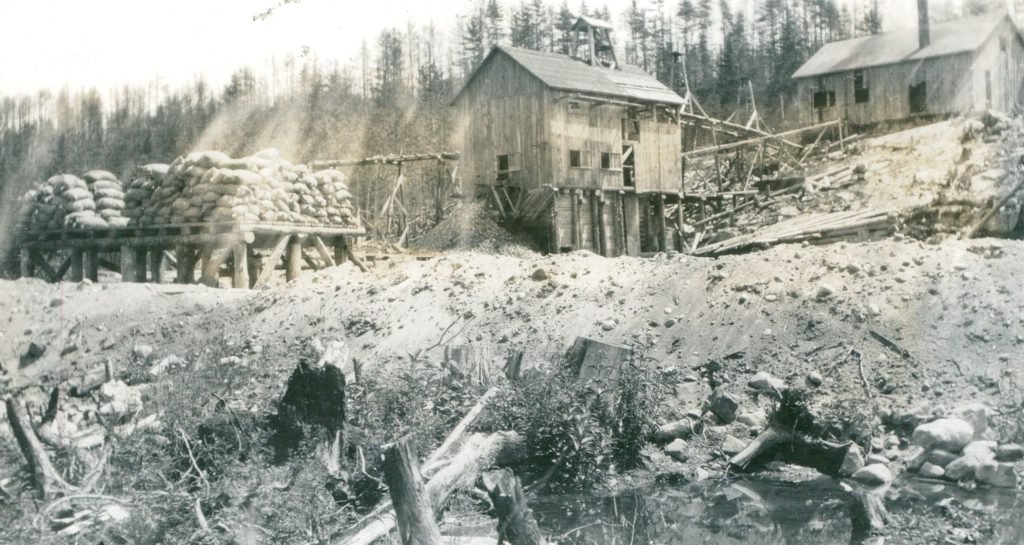
Bags of silver ore awaiting shipment at the Cobalt camp’s LaRose property, July 15, 1905. Credit: The Northern Miner

🎥 Watch the video: [English] | [French]

Standing atop Nipissing Hill Lookout, the history of the surrounding town of Cobalt, Ont. is in full view. There’s the town itself, Cobalt Lake and the decades-old remains of legacy mine infrastructure such as headframes and wooden mills. Look further out and squint, and on a sunny day a set of distant squares of solar panels reflect back bright white light. 

The tranquil streets and dusty old mining buildings of Cobalt might make it hard to believe that this community – where less than 1,000 people live – once hosted one of the three great silver rushes of the Americas.

In 1545, a group of Spanish conquistadors in what is now Bolivia founded the silver mining town of Potosi, located more than 4,000 metres high in the Andes mountains. Within 30 years, Potosi became one of the most important sources of silver in the world, producing billions of ounces for the Spanish Empire. But the vast wealth from Potosi was built on the backs of millions of Indigenous and African slaves, many of whom died mining silver in grim conditions.

Fast forward to roughly 1859 in western Nevada, where a group of gold prospectors had set up their canvas tents on the rocky and sagebrush-dotted slope of Mount Davidson. Though they found some gold, they found more silver, and within a few years thousands of people converged on the area in what became the Comstock Rush. Over the next three decades, almost 200 million oz. of silver would be mined, and the initial settlement grew into Virginia City, with a population of 25,000. It also became a city of stark contrasts where a few “Silver Kings” could flaunt their newfound wealth while hundreds of others toiled and died in underground mine accidents, or perished from disease and violence.

Fast forward again to the year 1903, much further north of Nevada to the dense boreal forests of northern Ontario and a small, clear lake with rocky shores. Almost 500 km north of Toronto – then a city of only 210,000 people – there was barely any modern infrastructure in the area. The exception was the Temiskaming & Northern Ontario Railway (TNO), whose work crews were slowly extending the line northwards from North Bay to Haileybury and New Liskeard in a bid to access a clay belt for farming. 

Cobalt’s approaching silver rush came at a far lower human cost than other rushes in the Americas, and like other booms, it birthed a new town that rapidly grew from a mining camp in the bush and later slowly faded. But it was no less significant for its contribution to Canada’s mining heritage, a contribution likely to live on as Canada enters the green energy transition.

Pink stains on rocks

One August day in 1903, some two members of a crew looking for lumber for the rail ties near – Long Lake James McKinley and Ernest Darragh – saw pink stains on a rock.

They chipped off some samples and used the tried-and-true trick they had learned from prospecting in California: they bit the shiny metal on the rock chips and found some of it was soft, native silver. Later, they sent the samples to an assay laboratory at McGill University in Montreal. The results showed 4,000 oz. silver per ton.

That same summer, Willett Green Miller, Ontario’s first historic provincial geologist visited the area to investigate the stories about metal discoveries. Thinking that “Long Lake” was too generic a name for the camp, he also knew that the metal cobalt – used at the time as blue pigment in paint – co-occurred in the local silver veins. He made a rough sign with the name “Cobalt” for the local TNO stop, and the name stuck. 

McKinley and Darragh followed up on their samples by entering a mineral claim with the Bureau of Mines in Toronto. The next spring they returned to the area and headed back into the bush with the mining gear of the day: wheelbarrow, picks, shovels, and an axe, and began trenching for silver veins.

From stir to rush

The pair found even more incredibly high-grade silver and began their McKinley-Darragh mine. By 1906, American interests had bought the mine, and they returned to farming in eastern Ontario.

In 1907 the mine expanded into a mill – Cobalt’s first – as output grew from 15 tons per day to 225 by 1913. It helped that much of the silver deposits were close to the surface.

The Cobalt silver rush was on, and the town changed very quickly, truly transforming.

Until it ceased operations in 1927, the mill produced more than 13 million troy ounces of silver.

As Cobalt’s first mill expanded, the number of mines also grew rapidly, vastly increasing operations around the camp. There was LaRose, Trethewey, Buffalo, Coniagas, Drummond, Nipissing, and many others.

The amount of ore milled in gravity concentrators – large wooden tables that shook ore-containing mixture – soared 12-fold from 1908 to 591,400 tons by 1914.

Seekers and winners

As the silver ounces were pumped out, the money flowed in.  In return, a huge influx of capital was deployed to Northern Ontario.

By 1906, investors were buying mineral properties in Cobalt without having seen them and before they knew financial propositions.

Also that year, the mining-rich Guggenheim family from the U.S. sent mineral expert John Hays Hammond to survey a property in the Cobalt camp. He reportedly arrived in a private Pullman car with a valet, a chef and a wine steward and decided the asset was worthy. The Guggenheims then invested US$2.5 million (worth about US$90 million today) in the company that controlled the property.

That triggered a stock run in New York City. Police had to intervene to control crowds of feverish investors trying to buy Cobalt shares from curbside vendors. When the Guggenheims learned the ore wasn’t minable, they withdrew from the deal and chaos resulted on Wall Street. Some $24 million in stocks was allegedly lost almost overnight. 

April 1909, Cobalt’s Daily Nugget newspaper claimed that the town had produced 38 millionaires, including the mine investor brothers Henry and Noah Timmins, whom the northern city was named after.

Rushing in, building up

Cobalt grew, with the population reaching 10,000 in 1909 – and even 12,000 by some accounts – swelled by silver hunters from an impressively far reach including Russia, China, Greece and Finland. 

The first streetcar system in Ontario was built in Cobalt, the first Northern Ontario hockey team was formed there, aptly named the regal title of the Silver Kings, and the Bijoux vaudeville and movie theatre was built on Lang Street, the main commercial road.

In 1910, the three-storey Royal Exchange Building was constructed. It housed the Canadian Explosives Office, the General Electric Office, Ontario Surveyor’s Office, Stock Exchange, the Bank of Toronto, and a bar. It also hosted The Northern Miner newspaper, which began covering mining stories from the building in 1915.

Not all roses

The boom also brought burdens.

A horrible explosion in 1906 on Lang Street destroyed several homes and poor sanitary conditions caused a deadly typhoid epidemic in 1909.

The safety ethos of underground mining during the rush was characteristic of the time. Candles used for illumination sometimes started gas explosions and by the end of 1912 more than 100 men had died underground.

Careless dumping of sulfide-rich mine tailings during an era when the environment wasn’t a major concern has today left lakes around Cobalt with arsenic readings exceeding healthy levels. Lake sediments have also become contaminated with overly high amounts of arsenic.

The boom fades

In 1911, the peak intensity of the Cobalt rush, 34 mines produced around 30 million oz. of silver. That year also saw the population start to decline and by the 1920s the rush was slowing down. The silver veins petered out about 100 metres below the surface. The rush faded even faster with the 1929 stock market and silver price crash.

In total, the Cobalt rush generated 460 million ounces of silver.

Cobalt’s population kept declining throughout the notorious 1930s and 1940s, when just over 2,000 people lived in the town.

Some would end Cobalt’s story there, concluding when it had a good few decades but then the mining world moved on somewhere else to the next round of development.

But Cobalt’s significance goes much deeper than that, influencing mining communities across the region.

Cobalt’s innovation spur

The rush accelerated technology development and professionalization in the local industry.

The first several years of the rush can be roughly labeled as a split between 19th and 20th century mining methods. Just as McKinley and Darragh headed into the bush using wheelbarrows, picks and shovels, so did the first wave of prospectors and miners, many of whom came from the western U.S.

A second wave took shape by 1909 improving use of technology, brought more engineers, geologists, and trained crews.

One example is the “Ragged Chutes” compressed air system, devised by mining engineer Charles Havelock Taylor. It was named after roaring rapids on the Montreal River, south of Cobalt.

Around 1905, while walking along the Ottawa River near Montreal in the winter, young Taylor observed air bubbles forming under ice and how, when a mixture of air and water is compressed, the air rises and escapes. 

Applying all those principles to mining, he built a system where a large amount of water fell down a deep shaft, picking up speed as it fell. When the water rushed to the bottom it created a lot of bubbles, which were diverted to a special underground chamber. At that depth, the pressure compressed the bubbles and the air was sent through pipes while the water could escape. 

In 1910, the Ragged Chutes compressed air plant – the first of its kind – was built upon the Montreal River to power drills, hoists and ventilation shafts, without the use of coal or electricity. 

It was one of the first hydraulic compressed air systems at mines in North America and revered for decades in Cobalt. While other mines didn’t necessarily replicate Ragged Chutes because they instead relied on electricity or steam, they did follow its concept of an efficient, centralized air and power system.

Education, training, Agnico

The rush also spurred the establishment of the Haileybury School of Mines (HSM). The demand was continually growing for mining expertise so the school was founded in 1912. Its first graduates were quickly hired by the growing number of mines in Cobalt. HSM is today part of Northern College.

As well, Cobalt was a training ground for aspiring miners who moved to other camps across the Abitibi: ultimately, Porcupine, Larder Lake and Kirkland Lake became major gold producers thanks to the talent born from the silver rush in Cobalt.

After the rush, some silver and cobalt was mined in the town well into the 20th century. It had intermittent population growth in the 1950s when the Cobalt Lode Mine extracted the namesake metal for the U.S. government. That site was owned by Agnico Mines which formed in 1957, the predecessor to what would later become Canada’s top gold producer Agnico Eagle Mines.

Cobalt’s green future?

Cobalt’s story is far from over. With silver playing a key role in solar panel technology and junior explorers actively discovering new sources of critical minerals, the town’s legacy is evolving into a bright, green future built on innovation and sustainability.

Electra Battery Materials’ cobalt refinery, located just 5 km from the town in Temiskaming Shores, could become North America’s first facility enabling large-scale processing of this critical mineral, essential for electric vehicle batteries and aerospace applications.

While the facility would mostly process cobalt sourced from the Democratic Republic of Congo, modern exploration may lead to these critical minerals surfacing right where this all began, with a set of shiny discoveries in the bush 122 years ago.

Western retail demand for gold surges in rush for hard assets

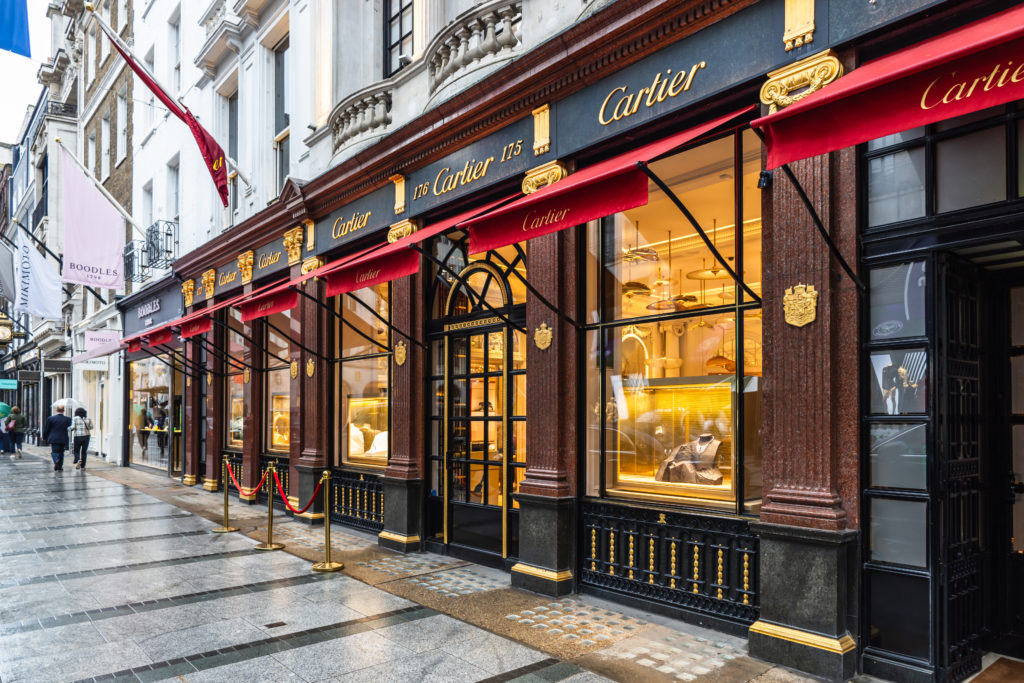
The Cartier boutique in London. Stock image.

In London’s historic Hatton Garden, where diamonds have long been the star, gold is commanding more attention. The famed jewellery district is abuzz with customers seeking bullion bars and coins, broadening the investor pool for tangible assets.

“There’s a mix of buying and selling gold, but buying is definitely stronger. Even though prices are high, people are still buying. Many believe prices will go even higher,” said Mashhood, a staff member at a local shop.

Spot gold hit a record high of $4,381 per ounce on Monday. Even though a steep selloff on Tuesday and Wednesday took it down 7% to around $4,076 per ounce, retail interest remains strong.

For Britain’s Royal Mint, the surge in investor appetite has translated into record-breaking activity. The Mint recorded its strongest single day of e-commerce trading this month, reflecting heightened demand for physical precious metals.

“The surge in demand has also led to exceptional individual transactions. We’re seeing roughly 60% existing customers and 40% new customers, with existing investors notably increasing their average order values and doubling down on their positions,” said Stuart O’Reilly, market insights manager at The Royal Mint.

Tax strategy

Customers are also exploring tax-efficient strategies. “I’m converting my gold bar into coins to avoid Capital Gains Tax (CGT). I’ll sell a portion but hold on to two-thirds, as I keep hearing everywhere that prices could rise further,” said Cherry Jephson, a customer at Hatton Garden.

In the UK, CGT applies to profits made from selling gold bars, which are treated as taxable assets. However, certain British gold coins, such as Sovereigns and Britannias, are classified as legal tender and are fully exempt from CGT.

Other regions

Traders and banks in Germany and Austria are also reporting exceptionally strong retail demand for physical gold.

“I saw long queues of customers both at the Viennese Shop of Ögussa as well as the Austrian Mint shop in the city centre. Traders in Germany report the same picture in front of their shops,” said Wolfgang Wrzesniok-Rossbach, founder of precious metals consultancy Fragold GmbH.

Gold’s retail investor appeal has grown sharply this year, driven by global economic uncertainty and rising geopolitical tension highlighting its safe-haven cachet. Prices have doubled over the past two years and are up 55% so far this year.

The Perth Mint, one of the world’s leading producers of newly mined gold, is witnessing a similar surge.

Visitors to our “East Perth premises have increased from an average of 5,000 a week to about 8,750 over the past four weeks. This has prompted us to recruit an additional eight staff to assist across our retail and customer operations teams”, said Tina Kircher, general manager of retail.

World Gold Council data showed investment demand for gold bars rose 10% in 2024, while coin buying fell 32%.

With investors seeking security and liquidity, physical gold could remain a key part of retail portfolios in the months ahead.

“The world remains deeply unsettled, and gold is reflecting that,” said Adrian Ash, head of research at online marketplace BullionVault.

(By Ashitha Shivaprasad and Polina Devitt; Editing by Veronica Brown and Arun Koyyur)


M23 rebels reject accusations of gold theft from eastern Congo mine

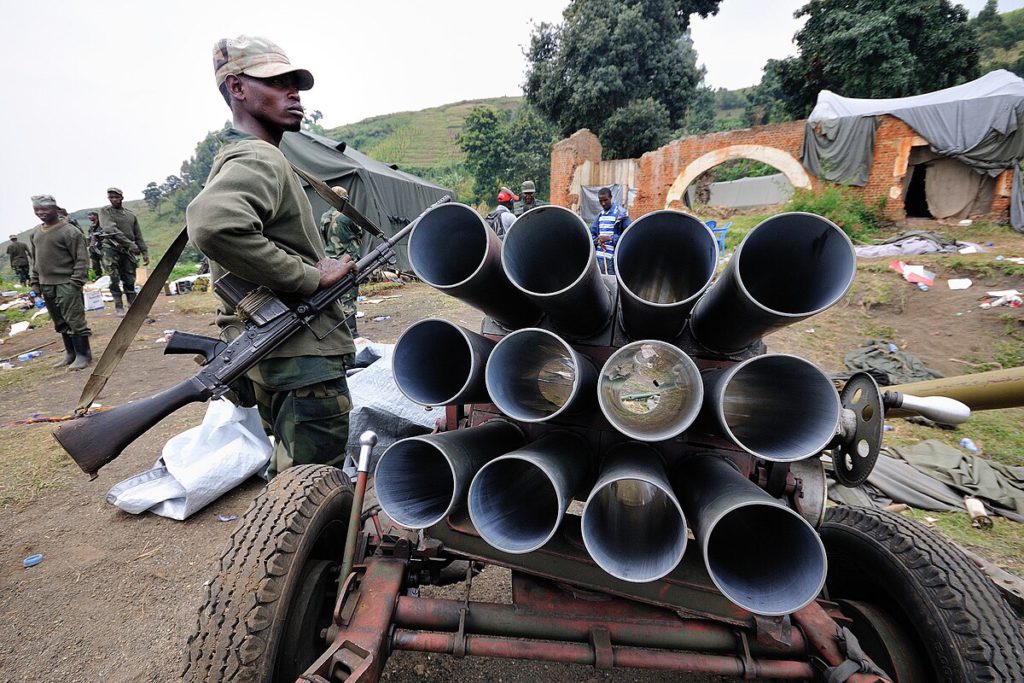
M23 troops. Credit: Al Jazeera English, Wikimedia Commons, under licence CC BY-SA 2.0.

The M23 armed group on Thursday denied accusations that its fighters had looted at least 500 kilograms of bullion from Twangiza Mining’s gold concession in eastern Democratic Republic of Congo.

The firm operating in South Kivu province, much of which is under M23’s control, said this week that M23 had “secretly transported (the gold) through underground channels.”

It also accused the rebels of using Rwandan technicians to extract geological data to resume and expand mining.

Rwanda has consistently denied backing M23 rebels, despite repeated allegations from UN experts and Western and regional governments.

At a press conference on Thursday, Corneille Nangaa, leader of a rebel alliance that includes M23, said the mine was not in operation and that only artisanal miners were working there.

He said M23 did not have the necessary equipment to operate a mine.

Nangaa has also accused Congolese government forces of attacking the site including with aerial bombing. He said civilians had been killed in those attacks but did not provide a death toll.

A drone strike on October 15 destroyed power generation infrastructure at the mine, the company said. It is not clear who was responsible for the drone strike.

Congo’s government did not respond to a request for comment on the allegation.

M23 staged a lightning offensive this year that allowed them to seize more territory in eastern Congo than ever before. The group seized the mine in May.

Twangiza said it had lost over 100 kg of gold a month since the takeover, in addition to $5 million worth of equipment and materials.

The company is preparing to file a formal complaint with international arbitration and Congolese authorities, and has declared force majeure.

Armed groups have seized several mining sites in mineral-rich eastern Congo, according to UN investigators.

A UN Security Council briefing last year said M23 rebels were earning around $300,000 monthly from mineral taxes in the coltan-rich Rubaya region.

(Reporting by Congo newsroom; Writing by Anait Miridzhanian; Editing by Robbie Corey-Boulet and Daniel Wallis)


Copper price rises on mine struggles, Goldman bull flag

Stock image.

Copper climbed nearly 2% on Thursday as one of the world’s top miners gave a conservative production outlook, adding to the metal’s supply concerns in a year marred by global disruptions.

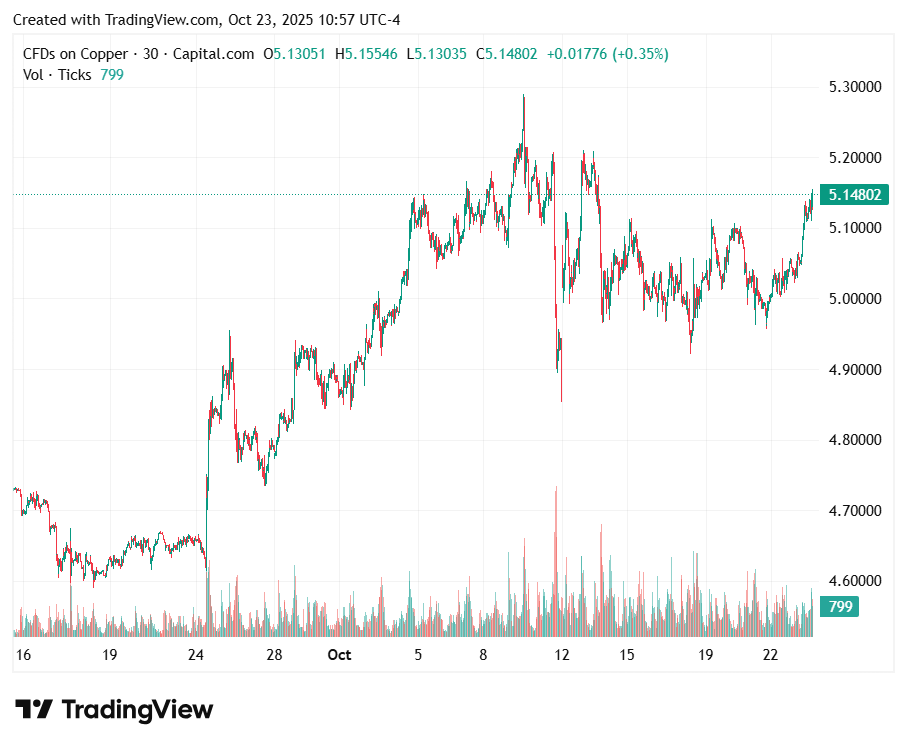
Prices surged as much as 1.7% to above $10,800 per tonne on the London Metal Exchange, while three-month contracts on the COMEX gained 1.9% to $5.10 per lb., equivalent to $11,250/t.

The metal used in wiring for renewable energy, electronics and construction has rallied more than 20% this year, supported by a series of major global mine outages and production setbacks. Prices have been on the rise since August following major incidents at Chile’s El Teniente, the world’s largest underground mine, and Grasberg in Indonesia within the span of a month.

In a further exacerbation of supply worries, Chile’s Antofagasta, one of the largest copper producers globally, said on Thursday that it expects to hit the low end of its 2025 production target and gave a production forecast for next year that missed analysts’ estimates.

The miner’s “operational update was mixed overall versus our expectations,” analysts at BMO Capital Markets said in an emailed note to Bloomberg. “Maiden 2026 copper production guidance may disappoint slightly.”

Goldman boost

In a further boost to copper prices, Goldman Sachs pointed to a near-term bullish view among traders.

The bank, citing industry players it spoke with during the recent LME Week conference in London, signalled that prices may test all-time highs again over the coming months, as some investors are planning to add to their positions once prices breach $10,900/t.

The view is backed by the huge arbitrage opportunity created by US import tariffs on copper, which drove prices in New York to an all-time high of $5.732 per lb. in July.

US futures on the COMEX exchange are still trading at a premium over London prices that are the global benchmark, and the metal is flowing to America, according to Bloomberg.

“In the near-term, we see the positive COMEX-LME arbitrage as having a material tightening impact on the physical ex-US market and posing temporary upside risk to our LME copper price forecast range of $10,000-$11,000,” Goldman analysts including Eoin Dinsmore wrote in a note.

Zinc squeeze

Meanwhile, zinc buyers are facing a historic squeeze on the LME as exchange inventories dwindle, but Goldman analysts said it expects shipments from China to replenish reserves.

“The global zinc market is currently balanced, but regional differences have emerged with China in surplus and the rest of world in deficit,” they wrote. “In the near term, clients we spoke with agreed with our view that the China export arb will open to rebalance the global market.”

(With files from Bloomberg)

Southern Copper’s $1.8B Tía María mine gets green light

Tía María faced an almost 20-year delay on community opposition. (Stock image by Christian.)

Southern Copper (NYSE, LON: SCCO) has secured a long-awaited licence for its $1.8-billion Tía María copper project in Peru, marking a major step forward after years of social unrest and political delays.

Peru’s Ministry of Energy and Mines (Minem) approved the mining licence last week, clearing the way for the project to enter the exploitation phase.

Located in the Islay province of the Arequipa region, the project is expected to reignite confidence in Peru’s mining sector and potentially unlock other stalled developments across the country.

Tía María faced years of delays due to local opposition over environmental concerns. Protests between 2011 and 2015 left six people dead and forced the project’s suspension.

Although the government approved the mine in 2019, it tied progress to the restoration of social stability. Southern Copper resumed development in 2024 after local tensions eased.

With the licence now in hand, the company can begin pre-mining work and pit stripping. The project is 25% complete, with most progress centred on auxiliary facilities and the treatment plant. The initial construction phase, covering access roads and platforms, was 90% finished as of July.

Tía María is expected to begin production by late 2026 or early 2027, delivering 120,000 tonnes of copper annually over a projected 20-year lifespan. The output would secure Peru’s position as the world’s third-largest copper producer.

$7 billion worth of projects

In 2024, Southern Copper Peru produced 414,000 tonnes of copper, ranking it as the country’s second-largest producer. But the broader mining landscape remains constrained. A recent study found that 31% of Peru’s untapped copper production capacity, equal to around 1.8 million tonnes per year, is effectively “off-market” due to environmental, social, or governance challenges.

The Peruvian Institute of Economics (IPE), an industry-backed think tank, estimates that about $7 billion worth of copper projects are stalled due to illegal mining invasions. Impacted developments include Southern Copper’s Michiquillay and Los Chancas projects, as well as First Quantum’s Haquira copper project. IPE also forecasts illegal gold exports could reach $12 billion in 2025.