It’s possible that I shall make an ass of myself. But in that case one can always get out of it with a little dialectic. I have, of course, so worded my proposition as to be right either way (K.Marx, Letter to F.Engels on the Indian Mutiny)
Previously, we reported that the Trump administration has lately been taking over Canada’s rare earths companies as Washington looks to counter Beijing’s dominance in the sector. To wit, Canadian rare earths developer, Trilogy Metals (NYSE:TMQ), more than tripled three weeks ago after the U.S. government purchased a 10% stake in the company with warrants to purchase an additional 7.5% stake. The Trump administration announced that it will reverse a ban on the construction of the Ambler Road project in Alaska by the Biden administration and will start to reissue the necessary permits to construct the road.
The U.S. Department of Energycut a similar deal with Canada’s Lithium Americas (NYSE:LAC) a few weeks ago while the Department of Defense bought a stake in Las Vegas, Nevada-based MP Materials (NYSE:MP)in July. The DoD-backed investment package will see the Nevada-based producer build out a fully domestic magnet supply chain and lock in long-term pricing support for neodymium-praseodymium, the critical alloy used in everything from fighter jets to iPhones.
However, it appears that Washington is not the only U.S. party that’s interested in Canada’s strategic sectors of the economy. Reports have emerged that private U.S. investors are increasingly buying Canadian OIl & Gas companies, even as global oil prices move lower.
“You are seeing more U.S. investors saying, ‘If we have to hold energy, we'd rather hold Canadian energy here today,’’ Jeremy McCrea, managing director at BMO Capital Markets, said.
According to McCrea, U.S. funds now own about 59% of Canadian oil and gas companies, up from 56% at the end of 2024, while investments by Canadians have declined to 34% from 37%. The shift in investments has been even more dramatic for some Canadian companies, with Brian Schmidt, CEO of Tamarack Valley Energy (OTCPK:TNEYF), revealing that U.S. ownership of his company has doubled to 40%, up from 20% before the pandemic while Americans own nearly two thirds of Whitecap Resources (OTCPK:WCPRF) compared to 60% at the end of last year.
There are several reasons behind this “rotation.” First off, Canada’s top leadership is now much open to fossil fuel investments, with Prime Minister Mark Carney promising to make Canada an energy superpower. In contrast, former Canadian PM Justin Trudeau was more friendly to clean energy, managing to provide money to build electric vehicles and charging stations, committing $2 billion for clean water and wastewater funds for cities, introduced a national carbon tax, allocating infrastructure funds for local governments to deal with climate change and imposed a five-year moratorium on oil and gas drilling in the Arctic in the first two years after he was elected.
Second, the completion of the Trans Mountain Pipeline expansion has bolstered confidence in Canada’s oil and gas sector. The expanded pipeline has a total capacity of 890,000 barrels of oil per day, representing a nearly threefold increase from the previous system's capability. Since its commercial operation began in May 2024, TMX has been running at ~82% of its maximum capacity. TMX carries crude from Edmonton, Alberta, to the Westridge Marine Terminal in Burnaby, British Columbia. From there, it is shipped to global markets, primarily in the Asia-Pacific region. The pipeline also delivers oil to Washington State for local refineries and has terminals in locations like Kamloops and Burnaby for regional distribution.
Third, Canada’s Oil Sands have a significantly lower breakeven point, and can still eke out a profit at oil prices that would make the majority of U.S. Shale Patch companies print red. The average breakeven oil price for Canada's oil sands is approximately $40–$57 per barrel of crude, with recent estimates suggesting even lower costs for some large producers. Half-cycle breakeven prices can go even lower, ranging from about $18 to $45 per barrel. Recent cost reductions are due to technological improvements and debt reduction, making Canadian oil sands production cost-competitive globally.
In contrast, U.S. shale production costs have been rising, driven by the depletion of prime resources and the need to drill in more speculative, complex areas and formations. Analysts at Enverus have predicted that the marginal cost to produce oil in the U.S. Shale Patch could increase from ~$70 per barrel to $95 per barrel by the mid-2030s.
This shift is happening as the industry moves from easily accessible core inventory to less proven resources, leading to higher costs. Many U.S. oil producers, particularly smaller ones and those in regions like the Permian Basin, need oil prices above $65 a barrel to turn a profit on new drilling, a figure that has been rising due to inflation. Larger producers may have a lower breakeven point, sometimes in the high $50s, while older, existing wells can still be cash-flow positive at lower prices because initial drilling costs have already been covered.
By Alex Kimani for Oilprice.com
Trump Reopens Alaska’s Arctic Refuge to Oil and Gas Drilling
The Trump administration has moved to reopen the Arctic National Wildlife Refuge (ANWR) to oil and gas drilling, reversing one of President Biden’s signature environmental restrictions and cementing Alaska’s return to the energy map.
The Interior Department said Thursday it will restore the full 1.5-million-acre Coastal Plain to leasing, along with reinstating previously canceled leases held by the Alaska Industrial Development and Export Authority. The decision marks the most aggressive push yet to expand exploration in Alaska’s far north since the original Trump-era lease sale in 2021.
The announcement forms part of a broader energy package: the administration is also pursuing new lease opportunities across 82% of the National Petroleum Reserve-Alaska (NPR-A), a 23-million-acre expanse that Biden had restricted last year. Combined, the twin rollbacks could re-open more than 12 million acres to development, a move cheered by Alaska’s leadership and long sought by industry.
“From day one, President Trump directed us to unlock Alaska’s energy and resource potential,” said Interior Secretary Doug Burgum. “By reopening the Coastal Plain and advancing key infrastructure, we are strengthening energy independence and supporting Alaska’s communities.”
Environmental groups called it a direct assault on one of North America’s last untouched ecosystems and warned that the move could reignite decades-old legal battles over wildlife and Indigenous rights.
Still, Alaska’s economic case is hard to ignore. Oil production there peaked at 2 million barrels per day in 1988 and now accounts for barely 3% of U.S. output. High costs, aging fields, and limited leasing have stalled investment for decades. With the U.S. chasing energy security and Asian buyers showing renewed interest in long-term crude and LNG supply, Washington appears ready to bet once again on Alaska’s North Slope.
The new policy is as much political as geological—a reminder that America’s oil frontier never really closed. It just waited for a friendlier administration.
By Julianne Geiger for Oilprice.com
Massive U.S. Tariffs Drive Closer India-Brazil Alliance
India and Brazil, both hit with steep 50% U.S. tariffs under the Trump administration, are strengthening strategic, trade, and energy ties to counterbalance the economic impact.
The two BRICS nations signed new agreements in agriculture, renewable energy, infrastructure, and innovation.
Brazil is exploring crude oil export opportunities to India.
Two of the founding members of the BRICS alliance, India and Brazil, drew the short straw when it comes to new U.S. trade policy. South America’s largest economy and Asia’s second-biggest economy have both been slapped with 50% tariffs on their goods exported to the United States.
Faced with the highest U.S. tariffs of any nation, India and Brazil are seeking closer strategic, economic, trade, and energy cooperation and have recently signed deals to expand their trade agreements.
Brazil’s Vice President Geraldo Alckmin visited India last week for meetings with high-ranking Indian officials at the India–Brazil Business Dialogue event.
India and Brazil are expanding their partnership in agriculture and ensuring global food security.
Indian and Brazilian chambers of industry and commerce also signed a cooperation charter—“an important milestone in institutionalising the India-Brazil business partnership and creating new avenues for cooperation in sectors such as infrastructure, renewable energy, healthcare and innovation,” India’s Commerce and Industry Minister, Piyush Goyal, said.
India and Brazil also agreed to pursue a deepening of the current preferential trade agreement between India and MERCOSUR, the South American trade bloc. The two countries agreed that “the expansion of the Agreement should be substantial, aiming for a significant share of bilateral trade to benefit from tariff preferences.”
“We can have a fantastic alliance with India - political, space, entrepreneurial, and economic,” Brazilian President Luiz Inacio Lula da Silva said as we welcomed back his Vice President from the visit to India.
“We will create a strategic alliance with India and develop both Brazilian and Indian economies,” Lula added.
These two major developing economies are reeling from the 50% tariffs on imports of their goods to the U.S. imposed by the Trump Administration.
U.S. President Donald Trump slapped an additional 40% tariff on Brazil, effective August 6, bringing the total tariff rate to 50%.
India also got a 50% tariff as of August 6, as President Trump doubled the earlier 25% tariff because of India’s continued imports of Russian crude oil.
The pressure on India has intensified in recent days, after President Trump reiterated his threat to make India pay “massive” tariffs unless it stops buying Russian oil, repeating that India’s Prime Minister Narendra Modi had assured him those purchases would stop. Last week, India neither confirmed nor denied that it would indeed cut or halt imports of Russian crude and said its key energy policy driver is “to safeguard the interests of the Indian consumer.”
Whatever happens with India’s purchases of Russian crude, which currently account for about a third of all Indian oil imports, India will continue to be a large buyer of crude—it is in fact the world’s third-largest after China and the U.S.
Brazil, for its part, is a major crude oil exporter and continues to boost oil production and shipments as new offshore projects come online. Brazil could boost crude exports to India, arbitrage economics permitting.
Brazil and India also agreed last week to deepen cooperation in renewable energy. Brazil boasts a predominantly renewable electricity mix, with hydropower accounting for more than half of clean electricity. Solar and wind power have also risen, and low-carbon electricity accounts for more than 90% of Brazil’s power supply.
The contrast with India cannot be more evident. Fossil fuels still accounted for 78% of power generation in India last year, but the country is making good progress in advancing renewable energy installations.
India added a record 22 gigawatts (GW) of renewable energy capacity in the first half of 2025, up by 57% from a year earlier, according to Rystad Energy data.
Earlier this year, India said it achieved five years ahead of schedule its target to have 50% of its installed electricity capacity coming from non-fossil fuel sources.
In the 2024/2025 financial year ended March 31, 2025, India installed a record high 29.52 GW of renewables capacity, hitting 220.10 GW in total, amid booming solar energy installations. Solar additions jumped to 23.83 GW in FY 2024–25, up from 15.03 GW added in the previous year, government data showed.
India aims to achieve 500 GW of non-fossil fuel power capacity by 2030, double the current installed renewable energy capacity.
External power restored to Zaporizhzhia nuclear plant after 30 days
Zaporizhzhia Nuclear Power Plant has had its external power supply restored, after a month having to rely on emergency diesel generators to power its essential safety functions.
(Image: IAEA/X)
International Atomic Energy Agency Director General Rafael Mariano Grossi called the repair of the Dniprovska 750 kV power line, which has been down since 23 September, a "crucial step for nuclear safety and security".
According to the agency, it "continues to coordinate with both sides on further repairs" to the back-up Ferosplavna 330 kV line, which was disconnected in May.
The repair work began on Saturday after what Grossi said had been "weeks of complex negotiations" leading to Russia and Ukraine agreeing "to an IAEA proposal to establish temporary ceasefire zones around two specific locations on opposite sides of the frontline, to enable their respective expert teams to conduct repairs on two power lines that were recently damaged during the military conflict".
Before the war, there were 10 different external power lines to the plant, but by May this year that number had fallen to one, with one back-up line. Both sides accuse the other of causing the damage to the power lines to the plant, which is on the frontline of Russian and Ukrainian forces.
The six-unit Zaporizhzhia nuclear power plant has been under Russian military control since early March 2022. All its units are shut down. It is the tenth time that the plant has lost external power, although on previous occasions it was for a matter of hours rather than the current case of weeks.
Without external power supply it relies on a fleet of emergency diesel generators to provide essential safety functions, including powering cooling pumps. The IAEA says that its monitoring has confirmed that radiation levels remain within normal levels.
Spider robot speeds up weld inspection times, Rosatom says
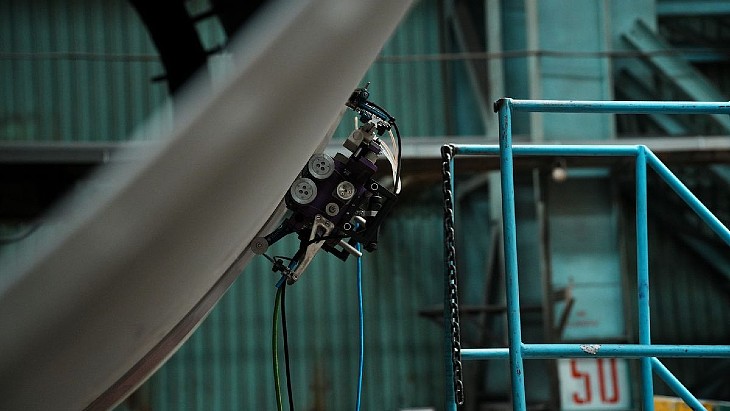
Its newly launched spider robot can carry out ultrasonic inspections of welds 30 centimetres thick three times faster than previous methods, Russia’s Rosatom has said.
(Image: Rosatom)
The robotic system has been launched by Atommash, Rosatom’s mechanical engineering division, to inspect welded joints in nuclear power plant reactors and steam generators.
Ultrasonic testing is used to detect any defects that might not be caught in a visual inspection and is widely used in the nuclear and other industries.
There is also a fast-growing range of robotic solutions being used in the construction, inspection and decommissioning of nuclear energy facilities. The newly launched spider robot can navigate a range of surfaces at different angles and can be manoeuvered to hard-to-reach areas.
Oleg Shubin, Quality Director at Atommash, said: "By implementing robotics, we not only improve production efficiency but also create the work environment of the future. To achieve a quantum leap in development, we must create products that will shape the future. Digitalisation is becoming the key tool for this. A modern plant is a place for innovation and the implementation of bold projects. The spider robot is a clear example of how technology serves the safety of the nuclear energy industry."
Atommash said it is part of a series of developments designed to create a "digital" plant, and says that in total 30 robotic automation projects are in the process of being implemented which it says will potentially save hundreds of thousands of person-hours a year in "transportation, welding, cleaning and inspection processes".
South African government approves draft 2025 IRP
The latest version of South Africa's Integrated Resource Plan outlines government plans to transform the energy sector to jump-start development and economic growth, including 5200 MW of new nuclear capacity as the country rebuilds its nuclear supply chain.
(Image: South African Government News Agency)
Announcing the Integrated Resource Plan (IRP) 2025 at a livestreamed event on 19 October, Minister of Electricity and Energy Kgosientsho Ramokgopa said South Africa's electricity crisis had stunted development and economic growth. But now the country has "turned the corner" on load-shedding, it can address the future with an IRP that aims to address electricity supply issues, promote economic growth, and create jobs, targeting a 3% growth in the South African economy by 2030.
The final version presented to the South African Cabinet represents a ZAR2.23 trillion (USD128 billion) investment.
The IRP is not a "wish list", the minister said. "This is not a guide. This is a policy of government. This is what is going to drive the electricity agenda in the country for the period that we are going to define and we're going to ensure that we achieve a number of elements going forward."
"There is no economy that grows if the lights are off. There are no industries that will decide to locate in South Africa if we can't guarantee them available electricity that is of good quality and that is affordable."
South Africa's current energy mix, as outlined by the minister, is heavily dependent on fossil fuels: 58% coal, 10% rooftop solar photovoltaics (PV), 10% grid-connected solar PV, 8% wind, 4.5% diesel, 4% pumped storage, 3% nuclear and the remaining 3% from "small" contributors such as biomass and hydro.
The IRP calls for the addition of more than 105 GW of new generation capacity by 2039, including expansion of solar PV, wind and nuclear. This, Ramokgopa said, would be akin to rebuilding state-owned utility Eskom "two and a half times" by 2039: "The biggest investment programme of the post-apartheid era is what we are presenting to the country today and to ensure that we are able to achieve energy security."
Fossil fuels do not disappear: the IRP calls for the introduction of 6000 MWe of gas-powered generation by 2030 which it says is critical for energy security and stability, as well as a vision for a clean coal technology demonstration plant by 2030.
The IRP calls for 5200 MW of new nuclear generation by 2039, but this could potentially be expanded further. "We think that there's an opportunity for another 4800 MW of nuclear, but that will be supported through our nuclear industrialisation plan so that we are able to participate in the entire value chain," Ramokgopa said.
The two biggest risks to not achieving the aims of the IRP are a limited skills pipeline - in part due to the decision to place on hold the country's pebble bed reactor development programme which meant skills had been "haemorrhaged" - and a "decimated" construction industry, the minister said. "So it's important that the industrialisation plan also answers the question 'where are the skills going to come from'."
Realism
Bismark Tyobeka, principal and vice-chancellor of South Africa's North-West University, former CEO of the National Nuclear Regulator and current chair of the Ministerial Expert Panel on Nuclear, described the IRP as "bold" and "progressive" for recognising the urgency needed to respond to climate change and scaling back reliance on fossil fuels, as well as repositioning South Africa as envisioning reviving the nuclear fuel-cycle value chain as the country repositions itself as Africa's "foremost nuclear nation".
The nuclear project timescales in the plan are realistic, he said.
“This would mark a return to the fundamentals of domestic nuclear capability by enriching our own fuel for peaceful electricity generation and for non-power applications. It would support not only power reactors but also non-power reactors such as the planned new multi-purpose reactor at Pelindaba, which will replace the ageing SAFARI-1 facility. This new reactor will strengthen South Africa’s position in producing radioisotopes and other nuclear-based innovations with applications in agriculture, mining, and manufacturing.
"It is indeed an ambitious plan, but I welcome the minister's pragmatic approach and its proposed implementation in manageable stages. Achieving the first 5200 megawatts by 2039, with the initial 1200 megawatts delivered by 2036, is a realistic target. Ten years is not an excessive timeframe if one considers that, for nuclear newcomer countries, the International Atomic Energy Agency (IAEA) milestones framework typically anticipates a 12- to 15-year process from planning to first electricity generation, including at least seven years of construction."
He added: "Given the preparatory work already done by the South African nuclear sector - including Necsa, the Department of Electricity and Energy, and the National Nuclear Regulator, which has been modernising its regulatory framework - the timeline is achievable. We also have the National Radioactive Waste Disposal Institute fully operational and expanding its capacity, and Eskom itself has shown encouraging signs of financial recovery, recently reporting a profit exceeding R100 billion.
"The time is right, and the key players are ready. From our side, as members of the Ministerial Advisory Panel, we must ensure that implementation happens as swiftly as possible. Our advice on the IRP should focus on achieving the shortest feasible delivery timelines while maintaining the necessary pace and scale of government action. Procrastination is the thief of time, and we cannot afford to delay further."
State-owned utility Eskom said it welcomed the launch of IRP 2025, which it said provides a clear investment framework for the supply of electricity needed to accelerate economic growth and inclusion in a context where overall unemployment stands at 30% and youth unemployment exceeds 50%. It will now conduct a "thorough review" of the IRP and subsequently publish a response along with an updated strategic plan.
The Integrated Resource Plan is described by the South African government as a "living plan" that is expected to be continuously revised and updated as necessitated by changing circumstances. It was first promulgated in March 2011, and last reviewed in 2023.
Nuclear propulsion could be viable option for shipping industry, says DNV
Shifting environmental requirements are "reigniting interest" in nuclear propulsion as a long-term solution for maritime decarbonisation, according to Norwegian classification society DNV. However, it says significant challenges remain to be met before nuclear propulsion can become a viable solution.
(Image: DNV)
The shipping industry consumes some 350 million tonnes of fossil fuel annually and accounts for about 3% of total worldwide carbon emissions. In July 2023, the shipping industry, via the International Maritime Organization (IMO), approved new targets for greenhouse gas emission reductions, aiming to reach net-zero emissions by, or around, 2050.
"Nuclear propulsion, once regarded as a distant prospect, is now under active consideration as a real option for the commercial maritime fleet," DNV Senior Principal Researcher Ole Christen Reistad says in the foreword a new white paper. "Shipyards and shipowners are exploring its potential and weighing the promise of virtually emission-free power against the complexity of introducing such a transformative technology into commercial fleets."
DNV's white paper - titled Maritime nuclear propulsion: Technologies, commercial viability, and regulatory challenges for nuclear-powered vessels - highlights how maritime nuclear technologies differ from land-based reactors, and emphasises the need to address technological, regulatory, and commercial factors in the effort to understand the potential role of nuclear propulsion. The paper addresses the main elements of the future maritime fuel cycle – including fuel management, waste handling, vessel construction and operation, and oversight of nuclear supply chains – and presents the reactor technologies most likely to be adopted by shipowners. Advances in automation, digitalisation, and modular design are identified as critical enablers of safety, security, and non-proliferation of future nuclear fuels and reactors, thereby paving the way for public acceptance.
"All maritime nuclear technologies will differ from land-based equivalents due to some key characteristics, such as mobility, exposure to harsh sea conditions, and operational profile," the paper notes. "Further, maritime installations will vary significantly depending on their purpose - propulsion (nuclear-powered ships) or power generation (floating nuclear power plants)."
DNV says a cost-effective and proven nuclear fuel cycle, tailored for maritime use, must be developed by the industry. This includes establishing clearly defined roles and responsibilities across the supply chain, from fuel production and reactor integration to loading, exchange, and disposal. "Crucially, storage and disposal of spent nuclear fuel are fundamental to the functionality and credibility of the supply chain. Reactor design and fuel type will directly influence these requirements, and these factors must be addressed before any operating licence is granted."
As part of this, it says provisions for the whole maritime fuel cycle - including long-term waste management - are essential, not only for regulatory compliance but also for advancing public acceptance.
The development of a commercial maritime nuclear industry also needs to be supported by a "predictable and internationally accepted" regulatory framework, DNV says. Organisations such as the IMO and the International Atomic Energy Agency must lead efforts to establish standards for fuel management, ship construction, and operational protocols. "Classification societies will play a critical role in enabling global adoption, helping to overcome the fragmented nature of the land-based nuclear industry and fostering a standardised maritime approach," it says.
DNV noted: "The regulatory landscape for nuclear shipping will likely exceed what the maritime industry is accustomed to, opening the door to multiple future system configurations. By identifying key actors, their mandates, and the need for coordination, regulatory roadmaps outlined in this white paper offer essential guidance. As roles multiply, clarifying interfaces becomes increasingly important - something these roadmaps help address by mapping key interdependencies."
The success of future maritime nuclear installations will also depend on the development of compelling business models, according to DNV. It says these must reflect the commercial realities of shipping and provide a clear understanding of total cost of ownership, especially across the entire fuel cycle. "Cost-competitiveness could be significantly enhanced through modular and standardised approaches, which streamline construction, simplify maintenance, provide independent assurance, and facilitate regulatory approval across jurisdictions."
DNV case studies presented in the paper show that nuclear can out-perform other technologies under both low and high fuel price scenarios. A reactor cost below USD18,000/kW could be competitive if full decarbonisation is achieved by 2050, it suggests, while costs below USD8,000/kW could be viable even without full decarbonisation.
"Realising the potential of nuclear propulsion in maritime requires more than technological readiness," DNV concludes. "It demands coordinated global action, involving a wide range of actors across the maritime industry, regulators, and society in general. With strategic investment and international collaboration, nuclear energy could become a cornerstone of the maritime energy transition, delivering safe, efficient, and zero-emission propulsion for the global fleet."
Approval of container ship design
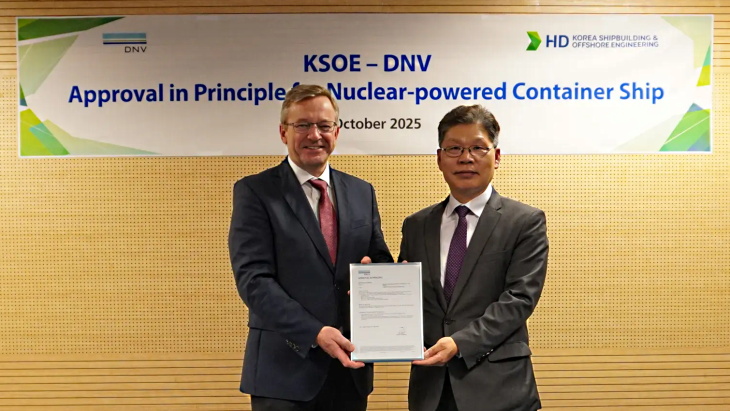
The release of the white paper came as DNV awarded South Korea's HD Korea Shipbuilding & Offshore Engineering (HD KSOE) - a subsidiary of HD Hyundai - Approval in Principle for a new 15,000 TEU-class container vessel design powered by small modular reactor (SMR) technology. The vessel concept incorporates a supercritical CO2-based power generation system, which can provide higher thermal efficiency and a reduced equipment footprint compared to conventional steam-based systems.
DNV Technical Director Geir Dugstad (left) and HD KSOE Senior Vice President Sungkon Han (Image: DNV)
An Approval in Principle (AiP) is an independent assessment of a concept within a defined framework of requirements. It confirms the feasibility of the design and verifies that no significant technical barriers exist to its implementation.
During the development of the ship design concept, the DNV team worked closely with HD KSOE to assess the vessel's overall safety and the design of the advanced power generation system. This review included the vessel's main functions, power supply and overall approach to safety. In May 2025, HD KSOE and DNV also conducted a HAZID (Hazard Identification) workshop at DNV's headquarters in Oslo to identify potential risks and accident scenarios for nuclear-powered vessels and to guide improvements in the design.
"This SMR-powered container vessel concept represents a key milestone in our efforts to explore alternative fuels for decarbonising shipping," said HD KSOE Chief Technology Officer Chang Kwangpil. "The design focuses intensely on the safety of the vessel and advancing the propulsion system in the application of SMR technology. In addition, we have developed a novel shielding and containment system, which is designed to maintain reactor safety and vessel survivability even in the event of collisions, groundings, or sinking accidents. We will continue to collaborate with global partners to advance marine nuclear technologies."
"With little recent experience in utilising nuclear power for cargo vessels, this AiP represents an important first step in building the technical verification process for nuclear-powered vessels," said Geir Dugstad, Technical Director at DNV. "We are very pleased to award KSOE this new AiP, which is the well-deserved result of an intensive and productive cooperation, which we look forward to continuing as this exciting technology continues to develop."
Previously, HD KSOE obtained Approval in Principle from the American Bureau of Shipping for a 15,000 TEU-class container ship design model applying SMR technology.
Laser enrichment technology moves to next level
Independent third-party validation has judged that Global Laser Enrichment (GLE) has achieved Technology Readiness Level 6, following the completion of its large-scale uranium enrichment demonstration programme using SILEX laser enrichment technology.
(Image: Silex)
GLE, the exclusive licensee of the SILEX laser enrichment technology invented by Australian company Silex Sytems Ltd, began large-scale demonstration testing of the uranium enrichment process at its Test Loop facility in Wilmington, North Carolina, in May. By mid-September, it had collected extensive performance data which the company said gave it the confidence that the process can be commercially deployed. This has now been validated independently by a leading Fortune 1000 technology provider in the national defence and global infrastructure markets, the companies said.
The nine-point Technology Readiness Level (TRL) scale was pioneered by NASA in the 1980s as a measurement system to assess the maturity level of a particular technology, from TRL-1 (basic principles observed) through to TRL-9 (total system used successfully in project operations).
GLE has now reached TRL-6, as defined by the US Department of Energy's DOE Technology Readiness Assessment Guide (G 413.3-4A), which means the technology has now been demonstrated in a relevant environment at the prototype or pilot scale, and is ready to move forward to full-scale systems.
"In plain language, this independent validation means that GLE has demonstrated large-scale, integrated system performance under relevant operational conditions and that our schedule for initial commercial deployment is achievable," GLE CEO Stephen Long said. "We are proud to be the first company to meet this significant milestone for a third-generation enrichment technology.
"We now turn our attention to full-scale detailed design and disciplined deployment of our Paducah Laser Enrichment Facility (PLEF) in Paducah, Kentucky. The PLEF would be built from an entirely-US supply chain, maintaining control of this vital new technology in the US and is expected to create first-rate advanced manufacturing jobs not just in Paducah, but around the country."
Silex CEO and Managing Director Michael Goldsworthy said achieving TRL-6 was a "major de-risking milestone" in the commercialisation of SILEX technology. "We are immensely proud of GLE, the only company in the world to have demonstrated large-scale, third generation laser-based enrichment technology at TRL-6 status," he said. "We thank the GLE and Silex teams, and our joint venture partner Cameco, for the significant efforts that have gone into achieving this seminal milestone. At a personal level, I am incredibly proud of what the Silex and GLE teams have achieved and look forward to continuing our efforts toward commercial deployment."
GLE said its commercial deployment is backed by more than USD550 million in privately funded engineering, design, manufacturing, and licensing activities across North Carolina and Kentucky and is one of six companies awarded an Indefinite Delivery, Indefinite Quantity contract under the Department of Energy's Low-Enriched Uranium programme.
The company completed its full licence application to the US Nuclear Regulatory Commission for the Paducah Laser Enrichment Facility in July. If approved, the facility would represent a multi-billion-dollar investment opportunity in the state, creating more than 300 permanent jobs when the plant is in operation. If commissioned, the facility is expected to re-enrich more than 200,000 tonnes of high-assay depleted uranium tails acquired from the US Department of Energy and produce up to 6 million separative work units of LEU annually, delivering a domestic, single-site solution for uranium, conversion, and enrichment.
Newcleo, Nextchem joint venture launched
France-based innovative reactor developer Newcleo has awarded an engineering services contract to NEXT-N, its newly-launched joint venture with Nextchem to develop the conventional island and balance of plant of nuclear power plants based on Newcleo's 200 MW advanced modular reactors.
A cutaway of Newcleo's reactor design (Image: Newcleo)
Nextchem - a subsidiary of Italy's Maire SpA - and Newcleo signed a binding agreement in June that would see Nextchem take 60% of the joint venture, tentatively named NextCleo, with Newcleo having 40%. Nextchem will be granted an initial stake of 1.25% of Newcleo shares, increasing to around 5% pending specific milestones.
"Following the approval of the competent authorities, the finalisation of the agreements announced in June has been reached," Nextchem has now announced. "The completion of the additional corporate activities required for the mutual transfer of minority shareholdings in NEXT-N (40% Newcleo) and Newcleo (up to 5% Nextchem) will take place, as previously communicated, by the end of 2025."
Newcleo will develop the nuclear reactor for its LFR-AS-200 technology, while Nextchem will leverage its own know-how to enable the joint venture company to deliver the extended basic design, procure the critical proprietary equipment relevant to the conventional island and balance of plant of the nuclear power plant, and provide project management/integration services to Newcleo. The joint venture - now renamed NEXT-N - will also provide services to other small and advanced modular reactor technology providers.
Newcleo has awarded a EUR70 million (USD81 million) engineering services contract to NEXT-N to develop the basic design of the conventional island and balance of plant of a first-of-a-kind nuclear power plant based on Newcleo’s LFR-AS-200 reactor design.
"NEXT-N will facilitate and accelerate the development and commercialisation of the LFR-AS-200 by Newcleo, as well as other technologies," Nextchem noted. "In particular, within the framework of the E-factory for chemistry model, detailed studies on the integration of the small modular reactor with hydrogen and ammonia technologies have been developed, to leverage a safe, reliable and competitive energy supply for the production of carbon neutral chemicals."
"We are very happy to launch our company NEXT-N, dedicated to creating new IP for the conventional island," said Nextchem Managing Director Fabio Fritelli. "With this contract we start the engineering activities for the first ever new-generation nuclear power plant based on Newcleo's innovative advanced modular reactor. We have already started to collaborate also with other nuclear technology providers to serve the nuclear industry. With NEXT-N we started a new path to industrialise carbon-neutral chemistry models based on safe, reliable and competitive energy supply. We will contribute to transform the Italian supply chain in a new energy transition paradigm and to foster new competences in Italy and Europe."
Paris-headquartered Newcleo's delivery roadmap sees the first non-nuclear precursor prototype of its reactor being ready by 2026 in Italy and the first reactor operational in France by the end of 2031, while the final investment decision for the first commercial power plant is expected around 2029.
At the same time, Newcleo will directly invest in a mixed uranium/plutonium oxide (MOX) plant to fuel its reactors. It has initiated site acquisition and public consultation processes in France for the MOX fuel pilot assembly line in Nogent-sure-Seine. It has also established a joint venture with Javys for up to four LFR-AS-200 reactors at the Bohunice nuclear power plant site in Slovakia.
Michigan terminates controversial EV battery plant and seeks to claw back millions in incentives
Michigan is demanding millions of dollars in incentives back from a Chinese company after plans to build an electric vehicle battery plant collapsed following years of pushback against the project from neighbors and members of Congress.
Democratic Gov. Gretchen Whitmer supported the US$2.36 billion factory in 2022, and state lawmakers approved nearly US$175 million in incentives for the project. The state is now holding Gotion Inc. in default of US$23.6 million, accusing the company of abandoning the project.
“While this is not the outcome we hoped for, we recognize the tremendous responsibility we have to the people we serve to make sure their hard-earned tax dollars are spent wisely and appropriately,” Danielle Emerson, a spokesperson with the Michigan Economic Development Corporation, said in a statement.
Representatives for Gotion, which is headquartered in California, did not respond to multiple messages seeking comment.
In a letter dated Sept. 17, Michigan informed Gotion that it was in default of economic development grant obligations because no “eligible activities” had occurred on the site’s property in over 120 days.
According to the MEDC, the state is seeking to claw back US$23.6 million that was disbursed toward the purchase of the site’s land near Big Rapids, about 200 miles (322 kilometers) northwest of Detroit. US$26.4 million remaining from the grant that was not spent will be returned to the state, Emerson said. Citing a lack of progress on the project, a different US$125 million grant was not distributed to Gotion.
The news was first reported by Crain’s Detroit Business.
The state also said two project-related lawsuits are imposing a “material adverse effect” on its progress, which counts as grounds for default. The letter said that if the defaults are not resolved in 30 days, the state expects repayment of US$23.6 million. That deadline passed Oct. 17.
Residents of nearby Green Township so firmly opposed the project, some over environmental concerns, that voters in 2023 recalled five local elected officials who supported bringing the factory to the area.
Auto manufacturing is the lifeblood of Michigan’s economy, which has been hard hit by tariffs imposed this year on the industry and Canada. When the project was proposed, officials said the factory would produce cathodes and anodes, two components key to electric vehicle batteries, as well as over 2,000 jobs. The original economic development incentives came as officials sought to bolster manufacturing in the state.
Whitmer’s office did immediately respond to a request for comment.
Republican U.S. Rep. John Moolenaar, who represents a swath of rural Michigan, had been the loudest and most prominent critic of the project, accusing Gotion of ties with forced labor and the Chinese Communist Party. Moolenaar chairs the House Select Committee on China and introduced a bill that stopped companies like Gotion from receiving electric vehicle tax credits from President Joe Biden’s Inflation Reduction Act. Moolenaar’s bill was signed by President Donald Trump earlier this year.
“Now that its contract with the State of Michigan and MEDC is set to be terminated, the people of Green Charter Township can finally move on from Gotion’s lies and broken promises,” Moolenaar said in a press release.
__
Isabella Volmert, The Associated Press. Associated Press writer Didi Tang in Washington contributed to this report.



_36717.jpg)
_43508.jpg)
_31168.jpg)
_99869.jpg)