It’s possible that I shall make an ass of myself. But in that case one can always get out of it with a little dialectic. I have, of course, so worded my proposition as to be right either way (K.Marx, Letter to F.Engels on the Indian Mutiny)
Friday, October 24, 2025
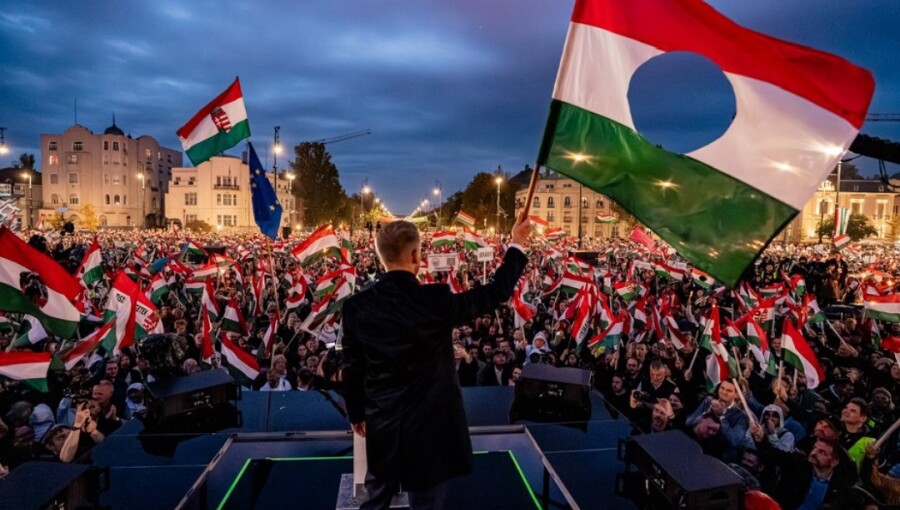
Huge crowds attend rallies to mark Hungary's 1956 anti-Soviet(STALIN)uprising
Hundreds of thousands of people took part in rallies on the October 23 national holiday in Hungary, commemorating the 69th anniversary of the 1956 anti-Soviet uprising, as both Fidesz and its rival Tisza Party sought to show force by bringing out as many supporters as possible less than six months before the election.
Hungarian opposition leader Péter Magyar has called for a peaceful regime change and described it as the most important national holiday since the fall of Communism, according to leftist broadsheet Népszava. Viktor Orban said that those "misguided" people who are in favour of change of government are supporting the war.
The opposition leader argued that the majority of Hungarians recognise that the country is on a dangerous path, one that could lead to another national tragedy unless there is a fundamental shift in leadership.
He drew comparisons between the current political situation and Hungary's oppressive past, warning that the country is being led by what he described as a "Kádár-like" regime, referencing János Kádár, the communist leader who ruled Hungary from the end of 1956 until his death in 1989. Magyar claimed that under the current leadership, those who disagree with the government are marginalised and demonised, accusing the ruling party of labelling dissenters as "enemies" and using divisive language to paint those seeking freedom and prosperity as "criminals" or "insects."
The opposition leader also criticised the government for deviating from the democratic principles that the 1956 revolution sought to uphold. He accused the prime minister of centralising power, suppressing the press, and ruling through fear. Magyar pointed out that in 1989, Orban, as a young opposition figure, had spoken out against centralised power, but now, as Prime Minister, he has created a similar system that suppresses dissent and democratic values.
The 44-year-old opposition leader, a former Fidesz cadre member, made several references to Viktor Orban’s historic speech delivered in June 1989, during the reburial of martyred Prime Minister Imre Nagy and his followers. Many view this speech as marking the beginning of the fall of Hungary's Communist Party. Orban’s bold address catapulted him to prominence, where he called for the withdrawal of Russian troops stationed in Hungary since 1945.
Magyar continued, asserting that Hungary can only remain free and independent if its leaders do not bow to foreign powers in exchange for political gains or photo opportunities. He called for responsible leadership that prioritises Hungary’s sovereignty over external pressures.
The opposition leader also used the occasion to outline his party’s commitments for the upcoming elections, which include restoring judicial independence, joining the European Public Prosecutor’s Office, opening agent files, and introducing a national reconciliation law. He further outlined policies to protect national security, sovereignty, and democratic freedoms, as well as tax reductions, pension increases, and the introduction of a new child protection law.
"In just over 170 days, we will wake up in a free and smiling country," he said, referring to next year's general election. "For that to happen, we'll need humility, humanity, hard work and a great deal of patriotism," he said, announcing that he will set off on another nationwide tour dubbed the "Road to Victory".
Most independent polls show the Tisza Party is leading by double digits, except for those controlled by the government, which still forecast a slight Fidesz lead.
Meanwhile, Fidesz also went to great length to demonstrate its strength with a mass rally ahead of the April elections. With extensive party infrastructure and communication channels, the ruling party mobilised voters from across Hungary, including bus loads of people from smaller settlements. Opposition media reported seeing leaflets offering free food vouchers to participants, and numerous vehicles bearing Ukrainian and Serbian license plates were also spotted in central Budapest.
Orban’s supporters gathered on the Buda side of Margaret Bridge and marched through the city to Kossuth Square, where the Prime Minister delivered his speech. Before the rally, Orban expressed frustration that, despite his requests, EU summits often coincide with Hungary's national holiday. After the event, he flew to Brussels to attend the meeting.
Orban referred to the rally, dubbed the "Peace March," as the largest pro-government rally ever, describing it as "Europe’s largest patriotic movement." He urged supporters to stand firm against Brussels, which he claimed seeks to drag Hungary into war. He emphasised Hungary’s unique position as the only country in Europe to have maintained a "Christian, conservative, and nationally-minded" government for over sixteen years, stressing the importance of defending the nation’s sovereignty against external pressures, particularly from Brussels.
In his address, Orban reaffirmed Hungary’s role in defending peace, describing the country as the "capital of peace" in Europe. He called on his supporters to engage with "misled Hungarians" who favour a change of government, arguing that those voters are supporting policies that align with war. Fidesz is expected to continue the narrative in the election campaign that the Tisza Party is a puppet of Brussels.
Orban also referenced the legacy of the 1956 revolution, drawing parallels between the resistance against Soviet oppression then and Hungary's current opposition to what he called the "liberal and global forces" in Brussels. He repeated his accusations that the EU was blocking Donald Trump’s peace efforts regarding the war in Ukraine, remaining undeterred by the news that the Trump-Putin meeting had been called off.
The news of the postponement of the Trump-Putin meeting, which had placed both the government and Orban in the international spotlight for several days, caught the government and its media off guard.
Following the rallies, debates intensified over the size of the turnout at the two events. Political analysts and online commentators engaged in discussions, with both sides claiming their rallies had a larger crowd. Social media platforms were flooded with images and estimates, further fuelling the ongoing political discourse.
While Fidesz successfully filled Kossuth Square in front of Parliament, the Tisza rally saw Budapest's iconic Heroes' Square packed to capacity, with people stretching along Andrassy Boulevard leading to the square. A Facebook post of a photo shot from a commercial plane depicting that image went viral on social media.
... Germany in 1953. Then, in March of 1955, Rákosi was brought back. Poland ... 4 Quoted in Chris Harman, Bureaucracy and Revolution in Eastern Europe ...
... Hungary '56 articles. [11,000 words]. For a short history, we recommend ... Andy Anderson: Hungary '56, Solidarity (London) 19^4. Books on Hungary 1956
The Hungarian Revolution
This Day in Anarchist History
by subMedia / October 23rd, 2025
This Day in Anarchist History, October 23rd 1956 we remember the Hungarian Revolution when student protesters and the broader Hungarian working classes took on the Secret Police and the Red Army.
After days of striking and rioting that boiled into a firefight, protesters were able to defeat the country’s Secret Police and even negotiated the withdrawal of the Red Army from Hungary… for a time, that is.
Impromptu proletarian militias wasted no time looting factories to arm themselves. Unfortunately time was in too short supply as the Red Army tanks were sent back just days later, this time with orders to brutally crush the revolt. 3,000 Hungarians were killed, about 20,000 were imprisoned and hundreds of thousands more fled. There was very little dissent from Hungary for the rest of the USSR’s existence.
Mar 27, 2023 ... In June 1953, workers across East Germany rose in the first major rebellion in the Eastern Bloc. For a brief period, the iron grip of ...
Juni 1953 ) was an uprising that occurred over the course of two days in the German Democratic Republic (GDR) from 16 to 17 June 1953. It began with strike ...
In the USSR there were strikes in the great slave camps. In East Germany and Pilzen in Czechoslovakia in 1953 and in Poznan in Poland strikes led to bitter ...
Nov 10, 2009 ... Down the years the books kept coming – the phenomenal Lost Revolution, The Fire Last Time, the extraordinary People's History of the World, and ...
How Gratuitous Talk About Values and Identity Become Canada’s Raison d’État
by Pauline Easton / October 23rd, 2025
Draw the Line action, Ottawa, September 20, 2025, part of a country-wide day of action against the Carney government’s anti-social pro-war agenda.
The measures taken by the Carney government since it took over power after the last election confirm this government’s adherence to the methods Carney and several of his ministers and point men of the state learned at Goldman Sachs. Previous employment in that institution seems to be in fashion at this time.
To see how Carney rules over not only his cabinet, but also the Liberal caucus, the House of Commons and Canada as a whole, it is enough to look at the “One Goldman Sachs” approach: “Leveraging its collective intellectual capital and diverse talent to serve clients. Key principles include prioritizing client interests above all else, upholding the highest ethical standards [as per his British colonial values of course — TML Ed. Note], striving for superior results, fostering a culture of teamwork and professional growth, and cultivating a diverse workforce.”
All of the above is what Carney claims represents the interests of the polity and Canada’s raison d’état – reason of state. Carney is proudly restructuring the state at the fastest speed possible, serving the interests of what are called “stakeholders,” which match his own.
He deprives the many and varied different interests which exist in the society of meaning and renders them as values directed at identifying with whatever he says is the national interest at this time. The people are told that the national interest of the U.S., or Britain, or Canada, or the European Union, is the interest of the world’s people for peace, democracy, and rights. The conception is that there must be no challenges whatsoever to the direction of this raison d’état and its national interest. That is how talk about values and identity become about raison d’état.
Carney’s rendering of democracy is one of passive individuals who have no claims on society. Individuals and collectives are effaced while what are called are given recognition and the interests said to serve these “stakeholders” are validated; collectively aggregated to uphold the legitimacy of Carney’s reasoning of state, for what is called capitalist democracy.
It underscores the important challenge currently facing the working class and people of this country. Among other things, it is important to discuss how Carney’s definition of national interest is used to trump the public interest. There is a process on the basis of which, through sleight of hand, talk about values and identity become about raison d’état (reasoning of the state). Talk about values and identity are used to establish a nation-wrecking definition of national interest. To see through the actions of the Carney government, look at this definition of national interest which discards the legitimate claims of the working class and people on society. By creating all kinds of advisory groups comprised of “stakeholders,” this government is denying the peoples’ right to conscience and to speak, thereby denying the existence of the peoples’ right to self-determination itself.
Carney’s neo-liberal banker’s mindset is stuck in the Covenant Thesis expounded by Thomas Hobbes in the 17th century which defined the Supreme Power above the rule of law. It is stuck in the 18th century philosophy expounded by the Philosophes in France which established the relationship of individuals to the state in pre-revolutionary France to favour a raison d’état and “civilized” rule of law over the “noble savage.” It is also stuck in dogmas rendered by the Vatican and various Popes in the past 80 years to maintain the Catholic Church’s anti-communist and pro-Nazi crusades against the movements of the peoples to empower themselves.
Finally, besides treasuring the “do or die” values of empire espoused by 19th century Victorian England, despite his talk about a “rupture” that the world faces at this time, his government pursues Cold War policies, practices and forms of organization, wrapped in pretentious bafflegab. It ignores that the conditions are no longer those imposed on the world under the auspices of the Anglo-American imperialists with the U.S. leading the way after World War II.
What is called for by the situation, especially amidst all the threats of war, environmental crises and impoverishment of the whole society, is a modern definition of democracy. This does not mean looking up the definition from some dictionary. Definition has to do with the actual functioning and sorting out of the real problems that exist in society as a result of the people’s disempowerment. The sorting out is how one harmonizes the individual and collective interests that are in conflict with one another — the interests of individuals in their collectives, and of the collectives within the ensemble of the general interest. This problem must be argued out. By exercising freedom of speech — speaking freely — modern definitions and the arguments which bring them into being are brought to centre stage.
Human reasoning and arguing have to be brought forward. A logic must be provided that it is possible to sort out the relations which exist and which create a clash between conditions and authority. It requires people having their own agenda, their own organizations, their own outlook, writing their own constitutions which guarantee their rights so that they can resolve problems, and express their own conscience against all the assaults of a state power whose raison d’état is to deprive them of power. It entails finding the ways and means to deprive those in positions of power and privilege of the power to forbid discussion by citing the arrogance that they, not the people themselves, represent what the people want.
A modern definition of democracy is required which is in line with the requirements that are created by the mighty productive forces and the relations that have come from them, which underlie the interests in conflict. This is where the real transition lies which is inherent in the ensemble of relations between humans and humans and humans and nature.
Without blinking an eye, the Carney government’s pursuit of a government run like a boardroom comprised of those who represent narrow supranational private interests suppresses the right to speak of workers and people in this country. Doing so in the name of the national interest, of raison d’état, of high ideals, will not wash. Workers and democratic and anti-war forces from coast to coast to coast are seeing to that.
Toronto, September 20 Sudbury, September 20 Montreal, September 27
TML STANDS FOR THE MARXIST LENINIST, IT IS THE PAPER OF THE COMMUNIST PARTY OF CANADA (MARXIST LENINIST) UNAPOLOGETIC STALINISTS
The Architecture of Avoidance
How Canada Manages Reconciliation to Protect the Stolen Prize of the Land
by Amel-Ba’al / October 23rd, 2025
“Since my life as a prisoner has begun, I have heard of some white men who said they owned my land and my home. I don’t believe they do. I have never given any consent to such ownership. The land belongs to my people and to our children.”1
“We were taught that God’s laws are about how we treat each other and the land. The white man doesn’t obey God’s laws. They take the land that belongs to us, the land that God gave us.”2
– Chief Geronimo.
“The Great Spirit gave this great island to his red children. He placed the whites on the other side of the big water. They were not contented with their own, but came to take ours from us. They have driven us from the sea to the lakes — we can go no farther.”3
– Chief Tecumseh.
“The white man has made many promises to us, and they have kept but one. They promised to take our land, and they have taken it.”4
– Chief Red Cloud.
“My lands are where my dead lie buried.”5
– Chief Crazy Horse.
To sit with Elder Ttesalaq—Tom Sampson—of the Tsartlip First Nation is to be granted an audience with living history. His words are not merely recollections; they are the continuous, unbroken thread of a nation’s memory, stretching back to a time before the word “Canada” was ever uttered on these shores. To understand his testimony is to undertake a fundamental re-examination of the story Canada tells about itself. It reveals a narrative not of benevolent nation-building, but of a guest who moved into the house, claimed the deed, and has been trying to evict the original owners ever since. This truth stands in stark contrast to the official discourse of “Truth and Reconciliation,” which across the vast apparatus of the Canadian state and its media echo chambers, reveals a sophisticated architecture of avoidance. This architecture is designed to manage the symptoms of settler-colonialism—the pain, the cultural loss—while carefully protecting its root cause: the systematic robbery of the land itself.
The Original Welcome: A Host Becomes a “Refugee” in His Own Land
Elder Ttesalaq begins not with accusation, but with a profound act of empathy. “We welcomed the first refugees that came here in 1492,” he states, framing a history of Indigenous generosity that provided food, medicine, and land. This was not a transaction but a foundational principle of his civilization.
The great, painful irony he identifies is that this act of welcome was perverted into a logic of dispossession. “We were put under the Ministry of Immigration in the early days,” he notes with a wry, painful clarity. “So we were considered immigrants in our own country.” This single, bureaucratic act encapsulates the entire colonial project: to render the host a stranger, the native an alien. The Canadian state, from its very inception in the Indian Act and the reserve system, has been an engine of identity reassignment, systematically working to erase the original political identities of the peoples it encountered.
The Douglas Treaty: A “Nation-to-Nation” Agreement Betrayed
At the core of Elder Ttesalaq’s testimony is the Douglas Treaty of 1852. For him, this is the legal and moral cornerstone that the Canadian state has spent over a century undermining. He is meticulous in his historical framing: this was not a treaty with Canada. Canada did not exist. It was a treaty between the Saanich Nations and the British Crown, represented by Governor James Douglas.
The treaty’s promise was simple and profound: the Saanich people would be allowed to hunt and fish “as formerly,” as if they were the “sole occupants of the land.” In return, they granted the Crown permission to settle. “We gave him the right to come here,” Elder Ttesalaq corrects the colonial narrative. “He didn’t give us any rights.” This distinction is critical. Sovereignty was not ceded; access was granted.
The betrayal began with Confederation in 1867. The Crown transferred its authority to the new federal government of Canada without the consent of the treaty signatories. “Our treaty’s been breached straight since 1867 right to the present day,” he states. The creation of Indian reserves was the first and most catastrophic breach. The Indian Act then became the primary tool of control, creating a system of “delegated authority” where Band Councils were transformed into “Crown corporations,” effectively making them administrators of their own oppression. “The colonizer is now our own people,” he laments. “We have become the colonizer.”
The Long War in the Courts: Rights Recognized but Never Respected
A significant portion of Elder Ttesalaq’s narrative is dedicated to the relentless legal battle his people have been forced to wage. He speaks not with the zeal of a victor, but with the weary frustration of a man who has won the argument a dozen times over, only to have his opponent pretend the debate never happened.
He recounts how the Supreme Court of Canada has consistently ruled in favour of Indigenous rights. He references Section 35 of the Constitution, which affirms existing Aboriginal and treaty rights, and which a federal minister once called a “full box.” He cites the 1997 Delgamuukw decision, where the Court acknowledged that Aboriginal title had never been extinguished. “They knew that as late as 1997, they knew that they never had extinguished Aboriginal title and Aboriginal rights. And yet they continue to pretend that they owned everything.”
The tragedy, in his view, is the intransigence of the bureaucracy. “The bureaucrats, British Columbia, Ottawa, the Department of Indian Affairs, they don’t seem to understand that the law has changed in this country and they don’t want to change it.” He describes a Canadian state that functions as a schizophrenic entity: its judicial branch affirming rights, while its executive and legislative branches spend hundreds of millions of taxpayer dollars to fight those same rights. It is a state at war with its own legal foundation.
The Bureaucratic Mask: Polishing the Machinery of Dispossession
This judicial truth is met with what Elder Ttesalaq identifies as a wall of bureaucratic resistance—a pattern that reveals itself with stark clarity across the state’s own institutions. The Department of National Defence (DND), in its “Towards Truth and Reconciliation” report, speaks of “harm” and “assimilation” but is utterly silent on the historical and ongoing use of military force to dispossess Indigenous peoples of their lands. For the DND to discuss reconciliation without confessing its role as the ultimate guarantor of the state’s territorial claims is the height of irony.
This sleight-of-hand finds its most sophisticated expression in the Impact Assessment Agency of Canada (IAAC). Its “Reconciliation Framework” is a masterpiece of procedural liberalism: it outlines how to consult Indigenous peoples on new resource projects, but never once questions the underlying authority of the Canadian state to grant permission for the extraction of wealth from unceded land. The entire process is designed to make Indigenous communities stakeholders in their own dispossession, rather than sovereign nations with the power to grant or refuse consent.
The Symbolic Veil and the Complicit Echo
At the highest symbolic levels, the avoidance becomes a form of political theater. The Governor General, the representative of the very Crown that asserted sovereignty over Indigenous nations, frames reconciliation as a matter of “listening” and “dialogue.” This transforms a fundamental political struggle over jurisdiction and territory into a therapeutic process of interpersonal understanding.
The most telling performances come on the National Day for Truth and Reconciliation. The Prime Minister’s statements and the accompanying Canadian Heritage pages are saturated with the language of “reflection,” “honour,” and “painful legacy.” They speak of “colonial policies” in the abstract but will not utter the words “settler colonialism.” They mourn the loss of “ways of life” but will not admit that the goal was to destroy the political and economic bases of those ways of life to clear the land for settlement and resource extraction. This is reconciliation as a public ritual of mourning for cultural loss, deliberately severed from the material reality of property and power.
This state-driven narrative is amplified by the complicit machinery of mainstream media. Outlets like the Globe and Mail often provide “explainer” journalism that focuses on the what and the when of reconciliation, while omitting the why. They personalize the story through powerful, heart-wrenching accounts like that of Phyllis Webstad’s orange shirt, yet in doing so, they often individualize a systemic crime, directing public empathy toward a single instance of a taken shirt, subtly diverting attention from the larger, more politically explosive story of taken continents.
Even the state-funded Canadian Broadcasting Corporation (CBC) finds itself structurally bound within this architecture of avoidance. For instance, a CBC article headlined “As 5th National Day for Truth and Reconciliation arrives, many say little has changed,” quotes Indigenous leaders who state plainly that the government’s “piecemeal approach” prioritizes “performance over progress” and fails to act on “land dispossession and resource sharing.” Yet, as a state-funded institution, the CBC’s mandate is inextricably linked to the very state it is critiquing. It can report on the government’s failure to live up to its own promises, but it cannot consistently and fundamentally question the legitimacy or foundational claims of the colonial state that provide its mandate and foundation. It is a “critic” from within the palace walls, its voice constrained by the very architecture it describes, ultimately reinforcing the boundaries of a conversation that must never challenge the state’s ultimate authority over the land.
The Unmasking: The RCMP and the Guardian of the Theft
The most potent example of this architectural avoidance is found in the so-called Royal Canadian Mounted Police (RCMP). Their pages on “Indigenous Policing” and how they “Advance Reconciliation” are not merely omissions; they are active, breathtaking acts of historical whitewashing. The RCMP was not created to be a neutral police service. It was established as a paramilitary force with an explicit colonial mandate: to assert Canadian sovereignty over Indigenous lands and to suppress resistance.
For the RCMP to speak of “building trust” is the ultimate hypocrisy, because its historical role was to systematically break the will of Indigenous nations. This institution was the primary enforcement arm for the residential school system; RCMP agents were the ones who forcibly kidnapped children from their families at gunpoint. They also enforced the illegal pass system and suppressed the Métis Resistance. Today, their “reconciliation” framework focuses on “cultural competency.” This is a safe admission that allows them to acknowledge a flaw in their culture without confronting their foundational settler-colonial purpose. Their modern, militarized raids on Wet’suwet’en land to protect pipeline construction are not an aberration; they are the continuation of their original purpose: to protect the state’s claim to the stolen land and the resources beneath it.
Against this backdrop of state-sponsored ambiguity, the clarity of the Canadian Human Rights Commission (CHRC) acts as a powerful unmasking of the state’s true motives. Its statement does what other bodies refuse to do, naming the residential school system as “a key component of a deliberate, settler-colonial policy of assimilation designed to eliminate First Nations, Inuit and Métis peoples as distinct peoples and to gain access to their lands and resources.” By correctly identifying this as a “land-based project,” the CHRC lays the motive bare: the entire colonial endeavor was, and is, a project of land robbery.
This truth is not new. It is meticulously documented in the foundational work of the Truth and Reconciliation Commission (TRC). The TRC’s Calls to Action are a blueprint for dismantling the legal and philosophical underpinnings of the colonial state. Call to Action 46, which demands the repudiation of the “Doctrine of Discovery” and terra nullius, is a direct assault on the legal justification for centuries of land theft. The failure of the state to fully implement these calls is the evidence of its bad faith.
The Land and the Cost: Reconciliation Versus Reality
For Elder Ttesalaq, these abstract legal and bureaucratic battles manifest in the very concrete devastation of his people’s land and waters. The fight against the Kinder Morgan pipeline is the defence of a way of life guaranteed by treaty. “The issue is that it’s going through our territory, our land, and our resources are at risk.”
He speaks with the authority of a scientist who has inherited millennia of data. He recalls elders in 1947 noting the waters were warming and the fish were moving—early warnings of climate change that were ignored because the bearers lacked “a degree and diploma.” Now, the evidence is everywhere: the dying salmon, the vanished herring, the polluted air. “My world has already come to an end,” he says, a statement of devastating finality. “All my food, all our food from the ocean that we needed, all the birds that used to be in the sky are gone.”
This environmental cataclysm is inextricably linked to the unfinished business of the treaty. The Canadian state and its corporate partners see land as a “commercial commodity,” while for the Saanich, it is a relative, named and known, part of a family. True reconciliation, therefore, is impossible without reconciling with the land itself. “It’s not just reconciliation with Indigenous people; it’s reconciliation with the land and reconciliation with the ocean and reconciling the air that we once breathe.”
The Unfinished Struggle
Ultimately, Elder Ttesalaq presents a deeply sobering critique. For him, the truth is known and has been affirmed by the courts and its own commissions; the failure is in the reconciliation, which remains a hollow performance so long as the fundamental issues of land and sovereignty remain unaddressed. He points to the ongoing, visceral racism and police violence as proof of the state’s insincerity. How can there be reconciliation, he asks, when one side still holds the power of life and death over the other? When the state’s laws, like the Indian Act, continue to impose what he unequivocally names an “apartheid system”?
Elder Ttesalaq’s testimony is not a plea, but a declaration. It is a map of a parallel Canada, one where the Douglas Treaty is the supreme law and where the original relationship of host and guest has yet to be restored. The path forward is not one of assimilation, but of recognition. “We’re not going to be French, we’re not going to be English,” he asserts. The goal is an “equal right,” where Indigenous nations can exercise their inherent sovereignty.
The Canadian state stands at a crossroads. It can continue to spend billions fighting a truth it has already lost, perpetuating a conflict that poisons the land and its people. Or, it can finally “come to terms” with the original nation-to-settlers agreement and dismantle the apartheid system it built. Until it has the courage to face this truth and relinquish its grip on the stolen prize, the promise of reconciliation will remain, like the treaty itself, an unkept promise, and the unfinished struggle of this land will continue to demand a reckoning.
ENDNOTES:
1 Chief Geronimo: In the Days of Victorio: Recollections of a Warm Springs Apache by Eve Ball, as told to her by James Kaywaykla.
2 Chief Geronimo: His Own Story, as told to S.M. Barrett.
3Chief Tecumseh: The Life of Tecumseh and His Brother the Prophet by Benjamin Drake.
4 “Chief Red Cloud: A speech given at a council at Fort Laramie,” as recorded in the New York Times, May 7, 1870.
5 “Chief Crazy Horse: A statement made to Lieutenant William Philo Clark,” as recorded by He Dog.
Cenovus Energy will likely takeover MEG Energy after a shareholder vote was postponed according to a prominent Canadian energy expert.
A vote on its takeover offer was delayed after it appeared the vote would fall short of the two-thirds majority required. Cenovus said 63 per cent of MEG shareholders supported the bid, falling shy of the 66 per cent required. The new vote is scheduled for Oct. 30.
“Every vote to get from this point is probably incrementally harder, but it’s a relatively small bogey,” Eric Nuttall, partner and senior portfolio manager at Ninepoint Partners told BNN Bloomberg in a Tuesday interview. “Typically, the merger arms will vote in favour, and I think if it becomes clear that Cenovus is not going to increase their bid, which we don’t think, then those are the most likely.”
Strathcona Resources, which owns 14 per cent stake in MEG, recently dropped its bid. Cenovus said Strathcona is assumed to have voted against the deal. Cenovus and MEG have neighbouring oilsands properties at Christina Lake, south of Fort McMurray, Alta while Strathcona has operations in the area.Real-time TSX market updates here
“We think the most likely is Cenovus will either get the remaining three per cent of shares, or if failing that, they’ll just convert it to a friendly takeover bid,” said Nuttall.
Nuttall said the delay was unexpected. He said there are four options. Cenovus can either find the remaining three per cent votes it needs, become unsuccessful in their bid but receive approval for a friendly takeover at 50 per cent, walk away and watch their stock fall or see Strathcona swoop in with a takeover.
A friendly takeover occurs when a company agrees to an offer by the board of directors while a hostile takeover happens when a company acquires another against the wishes of the board, typically buying enough shares to vote them out.
“If they get MEG, they will have the best oil sand quality assets in Canada,” said Nuttall. “We think fair value at $60 oil is about $30 a share. We’re a believer that in the second half of next year, you could see well above $70 at which point we would see fair value exceeding $35 person of a share.
Wellness products for pets are the new hot market according to a Vancouver based venture capital looking to cash in.
Pawsible Ventures launched a $10 million fund to invest in early-stage startups developing products for pets.
“Pet spending is growing year after year, and it really shows how pets are now becoming part of the family,” the company’s co-founder and CEO, Alex Chieng, told BNN Bloomberg in an interview.
“It’s just a whole new concept of the humanization of pets and they want better care, they want better nutrition, and they want better access to services.”
About 77 per cent of households in Canada owned at least one type of pet in 2024 according to a recent pet report published by Statista.
Chieng said Pawsible Ventures will invest in startups building a pet space across AI diagnostics and wellness. The company’s incubator program also aims to walk startups through a 12 week program where they help entrepreneurs take an idea from concept to marketing. Rising costs, rising opportunity
Canadians spend over one billion dollars in veterinary costs per year, according to a 2024 study by Statistics Canada.
The amount Canadians spent on pets and pet food jumped from $5.7 billion in 2019 to $7.4 billion in 2022, according to a Statistics Canada report.
Canadians also spent over $9.3 billion on veterinarian costs between 2022 to 2023, which more than doubled from nearly $4 billion in 2019, according to a report from the Canadian Veterinary Medical Association.
This creates room for disruption in the industry according to Chieng’s company.
A cat receives treatment from a veterinarian in Digby, N.S., Thursday, Nov. 2, 2023.
THE CANADIAN PRESS/Andrew Tolson
He highlights two key challenges: pet owners demanding premium services and veterinarians facing shortages.
He says Pawsible Ventures wants to invest in companies tackling these issues, particularly with pet insurance, which is either too expensive for pet owners or policies are too difficult to understand.
“I see opportunities there making policies extremely, easy to understand. And then also, secondly, making sure that the insurance rates are affordable for an average Canadian household,” said Chieng.
The Atlantic Veterinary College in P.E.I. says it’s looking for ways to address a widespread veterinary shortage as increased demand causes strain on local clinics.
He says the percentage of pets that are insured is roughly four to five per cent.
“We definitely want to be able to support innovation in that space and get that percentage way higher,” said Chieng.
Chieng, who previously co-founded Betsy in 2019, one of Canada’s first telemedicine platforms for pets, said the fund aims to close the innovation gap between animal and human health.
“Oftentimes pet health lags a little bit behind human health,” said Chieng.
“So we really want to bring that up to par.” AI in the game
Chieng says AI is being used to transcribe medical data, streamline appointment bookings and personalize nutrition plans.
“The best companies out there that are integrating AI in the animal health space happen on the back end where we as a pet owner, we don’t really necessarily notice it,” said Chieng.
European Commissioner for Democracy, Justice and the Rule of Law Michael McGrath arrives for the weekly EU College of Commissioners meeting at EU headquarters in Brussels on Wednesday, May 21, 2025. (AP Photo/Omar Havana)
MONTREAL — The European Union’s democracy commissioner said he won’t “lecture” Canada or any other country as the EU pushes ahead on regulating tech platforms and artificial intelligence.
Michael McGrath, the EU commissioner for democracy, justice, the rule of law and consumer protection, is visiting Canada, as the Liberal government pursues an AI policy that puts less emphasis on regulation and more on adoption. He said the EU is pushing ahead on regulating tech platforms and artificial intelligence.
“It’s not for us to lecture any third country. Each country will decide their own system of governance and their system of regulation in relation to technology,” he told The Canadian Press in an interview following a speech at a conference in Montreal focusing on ongoing threats to global digital regulation.
“But in the European Union, we believe that to defend the values that we have spoken about, it is crucial that we do have guardrails in place.”
He cited EU laws covering digital services, artificial intelligence and privacy and said the EU would “continue to stand up for and defend our approach.”
Artificial Intelligence Minister Evan Solomon has cited the United States’ anti-regulation stance as a reason to go easy on regulatory efforts, saying Canada would be wasting its time by going it alone.
AI pioneer Yoshua Bengio, who has been a global advocate for AI safety and transparency, told the same conference Canada should partner with allies like the European Union.
He agreed Canada is too small to have influence by itself.
“It should be very busy forming partnerships with other countries,” Bengio said.
“The incentives are not there in the U.S. right now, but I think Europeans, Canadians and other liberal democracies do care about these things a lot more.”
He added that “together they can make a difference.”
Global attitudes have swung from a focus on AI safety and governance towards the technology’s economic potential.
The first global summit focusing on AI safety was held in 2023 as experts warned of the technology’s dangers -- including the risk that it could pose an existential threat to humanity. But by the time this year’s AI Action Summit began in Paris, the focus was broader and U.S. Vice-President JD Vance used his speech to push back on European efforts to regulate AI.
Bengio said the reason for the change is an anti-regulation push.
“There are a few very powerful people who have different views about the future,” he said, pointing to millions that have been invested in fighting members of U.S. Congress who favour AI regulation.
“Look at what’s happening in government where big tech is now... in bed with the government,” he said.
“I think we are in a very dangerous place, in terms of our democracy and the dangers that can come from not seeing humans at the centre of our future.”
In the interview, McGrath said Canada’s relationship with the U.S. is clearly very important.
“But also the relationship with the European Union, I think, is becoming more important,” he said.
He added the EU respects the right of every country to decide its own policies but that it’s better for like-minded nations to be aligned on what he called “big global questions.”
McGrath said the EU, with its 27 member states, is large enough to make a real difference.
“We represent 450 million consumers. That is the largest and most lucrative market that these big tech companies operate within,” he added.
McGrath said he wants to find common ground with Canada on digital consumer protection issues.
“We all face similar challenges with the Chinese e-commerce platforms,” he said, adding the EU believes those platforms must respect consumer protection laws and safety standards.
“I think engagement with Canada and other like-minded partners on that is absolutely crucial.”
McGrath also plans to talk to MPs about the threats to democracy posed by deepfakes and artificial intelligence, as well as foreign interference.
He noted many of those threats are coming from the online environment.
“These are issues that have the potential to have a material impact on elections, and we certainly cannot ignore the risk,” he said.
By Anja Karadeglija.
Union to start bargaining for workers at B.C. Amazon warehouse
The Amazon logo is seen on the outside of the company's YVR2 fulfilment centre, in Delta, B.C., on Friday, July 11, 2025. Unifor says the B.C. Labour Relations Board has awarded union certification to workers at the facility and that they will now begin the process of negotiating a first contract. THE CANADIAN PRESS/Darryl Dyck
Unifor has filed notice to begin the bargaining process with online retailer Amazon for the first collective agreement for workers at its warehouse in Delta, B.C.
A statement from the union on Thursday says a bargaining committee has been elected and workers have been surveyed on their priorities, which include addressing the heavy workload and what’s described as “rampant favouritism.”
Despite repeated rebukes from the B.C. Labour Relations Board, the union says “Amazon continues to wage a misinformation war against its own employees on the shop floor.”
The labour board ordered the certification of the union in July, saying Amazon interfered with the formation of a union and was intimidating and coercive.
The company tried unsuccessfully to have the board reverse its decision and last month filed a petition asking B.C. Supreme Court to quash the latest ruling.
It says Amazon has asked the court for an order to send the matter for “rehearing” before a new reconsideration panel.
Unifor says it’s a “difficult pill to swallow for Amazon” to accept its workers have basic rights, and the sooner it does, the sooner it can start collective bargaining.
A statement from Amazon spokesperson Kelly Nantel on Thursday says the labour board’s decision is “wrong on the facts and the law” and deprived the company’s employees of their right to have their voices heard.
“We look forward to demonstrating that through the legal process, and in the meantime, we’ll continue to comply with the law,” the statement says.
This report by The Canadian Press was first published Oct. 23, 2025.
Carney says ports, minerals key to his plan to double non-U.S. exports
Prime Minister Mark Carney delivers a speech in advance of the 2025 budget at the University of Ottawa on Wednesday, Oct. 22, 2025. THE CANADIAN PRESS/Sean Kilpatrick
OTTAWA — Building up port infrastructure and exporting more resources like the critical minerals in Ontario’s Ring of Fire are key parts of Ottawa’s plans to double non-U.S. exports, Prime Minister Mark Carney said Thursday.
“Part of those strategies that are consistent with the goal are new energy and trade corridors,” Carney told a news conference in Bowmanville, Ont.
Carney announced Wednesday that he has set an “ambitious” goal of doubling Canada’s non-U.S. exports over the next decade to unlock some $300 billion in new trade. He didn’t explain at the time how his government intends to make that happen.
When quizzed Thursday by reporters, Carney pointed to the federal government’s support for port development, citing Grays Bay in Nunavut and the Port of Montreal’s expansion project.
“You’ll see more on that,” he said. “Then, what are we exporting more of? It can be critical minerals from the Ring of Fire and building that up. We’re working closely in terms of unlocking that enormous potential.”
Carney made the comments standing next to Ontario Premier Doug Ford, who is pushing for speedy development of the Ring of Fire mining project in northern Ontario.
Conservative Leader Pierre Poilievre expressed skepticism of Carney’s new target and said the prime minister should adopt more fossil fuel-friendly policies to maximize Canada’s export potential.
“Our single biggest net export, by far, is oil and gas. And the only way you get oil and gas to non-U.S. markets is to get pipelines to tidewater,” Poilievre told reporters on Parliament Hill.
“We’re now seven months into Mark Carney’s term, and he still won’t even tell us if he supports a pipeline to tidewater.
“I don’t know, other than pixie dust, what he expects to export overseas if he’s going to block the major infrastructure projects that are necessary to get our most valuable resources to the biggest and most lucrative non-American markets.”
Poilievre also said the first batch of major projects the prime minister announced for fast-track approval did not need such help. He called on Carney to repeal a series of laws passed by the last Liberal government to boost high-value exports.
Carney expressed support for ramping up liquefied natural gas exports on Thursday and said his government is “just getting started” on getting major industrial projects built.
He said he will announce by Nov. 10 a list of new, large industrial projects Ottawa will fast-track through permitting approvals.
On Wednesday evening, Carney delivered a speech in Ottawa that framed his government’s upcoming Nov. 4 budget as one that will spur “unprecedented” levels of private sector investment and unleash a building spree.
In the same speech, Carney also issued vague warnings about “sacrifices” and trade-offs.
Speaking with reporters Thursday, Carney started to explain what he meant when he said the government will have to “do less of some of the things we want to do, so we can do more of what we must do to build a bigger, better Canada.”
But then he stopped himself.
“Why don’t I not scoop the budget and we’ll let it come out through the budget,” he said.
Carney quickly added that he will maintain existing social supports for vulnerable populations, citing health transfers to provinces and child care support.
The Liberal party’s House leader has fretted publicly about whether the opposition parties will allow the budget to pass through the House of Commons.
The Liberals are a few seats shy of a majority and will need some form of support from other parties to ensure the budget passes.
Kyle Duggan, The Canadian Press
Canada will not allow unfair U.S. access to markets if trade talks fail, says Carney
President Donald Trump greets Canada's Prime Minister Mark Carney during a summit to support ending the more than two-year Israel-Hamas war in Gaza after a breakthrough ceasefire deal, Monday, Oct. 13, 2025, in Sharm El Sheikh, Egypt
. (AP Photo/Evan Vucci, Pool) (Evan Vucci/AP)
OTTAWA — Canada will not allow unfair U.S. access to its markets if talks on various trade deals with Washington ultimately fail, Prime Minister Mark Carney told reporters on Thursday.
U.S. President Donald Trump imposed tariffs on Canadian steel, aluminum and autos earlier this year, prompting Ottawa to respond in kind. The two sides have been in talks for weeks on a potential deal for the steel and aluminum sectors.
Next year, the United States, Canada and Mexico are also due to review their 2020 continental free trade agreement.
“If we ultimately don’t make progress in these various sectors, we’re going to do what’s necessary to protect our workers,” Carney told reporters, referring to both the potential U.S. side deals and also the review of the free trade pact.
“If it’s the case that the Americans have access to our markets in a way that’s inappropriate given the level of access we have to their markets, we will change the terms. But that’s not the case right now,” he said, but did not give details.
Carney on Tuesday expressed caution after a newspaper reported he might soon sign a deal on steel and aluminum with the U.S., saying “I wouldn’t overplay it.”
(Reporting by David Ljunggren and Maria Cheng; Editing by Andrea Ricci)
SNOWFLAKE
Trump Abruptly Ends Trade Talks With Canada Over Reagan Ad Controversy
Late on Thursday, President Trump announced the termination of all trade negotiations with Canada, citing a Canadian government advertisement that he alleged misused the remarks of former U.S. President Ronald Reagan and criticised U.S. tariffs.
In a post on his social-media platform, President Trump wrote: “Based on their egregious behavior, ALL TRADE NEGOTIATIONS WITH CANADA ARE HEREBY TERMINATED.”
The advertisement referenced was from the Ontario government and showed Reagan warning about the impact of tariffs on jobs and trade. Ontario’s Premier Doug Ford had earlier acknowledged the advertisement had caught the president’s eye, stating that he believed Trump “wasn’t too happy” about it.
Canadian Prime Minister Mark Carney has emphasized Canada’s unwillingness to grant unfair access to its markets if a U.S. trade deal fails.
The current trade talks come as a result of the U.S. raising tariffs on Canadian steel, aluminium, and autos earlier this year, prompting retaliatory moves from Ottawa. Talks had been underway between the two countries to resolve the dispute.
With the agreement between the U.S., Canada, and Mexico scheduled for review next year, this fresh breakdown threatens to complicate not only bilateral relations but the broader North American trade architecture.
Canada exports large volumes of energy and raw materials to the U.S., and any trade shock may ripple into resource flows, investment decisions, and regulatory alignment in oil, gas, minerals, and power sectors. For oil markets, that means yet more uncertainty.
At the time of writing, oil prices were down slightly after soaring during Thursday's session, with Brent trading at $65.57 and WTI falling to $61.39.
By Charles Kennedy for Oilprice.com
Trump says trade negotiations with Canada are ‘terminated’ after Ontario’s anti-tariff ads
U.S. President Donald Trump says all trade negotiations with Canada are terminated over an anti-tariff ad from the Ontario government using a clip of former U.S. president Ronald Reagan. (The Canadian Press)
U.S. President Donald Trump says he is terminating trade negotiations with Canada following new anti-tariff ads from the Ontario government that features the voice of former U.S. president Ronald Reagan.
“The Ronald Reagan Foundation has just announced that Canada has fraudulently used an advertisement, which is FAKE, featuring Ronald Reagan speaking negatively about Tariffs,” Trump wrote in a post to Truth Social late Thursday.
U.S. President Donald Trump says he is terminating trade negotiations with Canada following new anti-tariff ads from the Ontario government that features the voice of former U.S. president Ronald Reagan. (Truth Social)
“TARIFFS ARE VERY IMPORTANT TO THE NATIONAL SECURITY, AND ECONOMY, OF THE U.S.A. Based on their egregious behavior, ALL TRADE NEGOTIATIONS WITH CANADA ARE HEREBY TERMINATED.”
In a post to X on Thursday, The Ronald Reagan Foundation said the ad “misrepresents” a radio address on free and fair trade from April 1987 and “the government of Ontario did not seek nor receive permission to use and edit the remarks.”
But the advertisement does appear to accurately quote Reagan, who supported free trade and delivered the remarks to explain new duties on Japanese products as a response to Japan’s violation of a trade agreement on semiconductors.
“High tariffs inevitably lead to retaliation by foreign countries and the triggering of fierce trade wars,” Reagan said in the address.
“The result is more and more tariffs, higher and higher trade barriers, and less and less competition. So soon, because of the prices made artificially high by tariffs that subsidize inefficiency and poor management, people stop buying. Then the worst happens, markets shrink and collapse, businesses and industry shut down, and millions of people lose their jobs,” he added.
Reagan and former Progressive Conservative prime minister Brian Mulroney later went on to sign the U.S.-Canada Free Trade Agreement in 1988.
After the ad caught the attention of Trump earlier this week, Ontario Premier Doug Ford defended the move, saying the aim is to “blast” the message to Americans, particularly Republican districts where Trump draws his support.
The ad, which Ford previously said cost $75 million, has been running on most major U.S. networks.
Prime Minister Mark Carney and his cabinet have been in ongoing discussions with Trump and his administration for months, as the trade war between the two countries drags on.
Throughout the negotiations, Carney has signalled it’s highly unlikely any country will come away from talks with the United States with an entirely tariff-free deal. Instead, Canada is hoping to secure deals on specific sectors, including steel and aluminum.
Earlier this week, Carney did not dismiss the possibility for a new sectoral tariff deal with the United States, saying “we’ll see” when asked whether Canada can expect a deal on sectoral tariffs by this month’s APEC summit.
Prime Minister Mark Carney, left, shakes hands with Ontario Premier Doug Ford at the Darlington Energy Complex in Courtice, Ont., on Thursday, October 23, 2025. THE CANADIAN PRESS/Laura Proctor
Speaking to reporters in Bowmanville, Ont. – alongside Ford – on Thursday, Carney spoke again about the Americans “moving to an approach which is sector by sector, as opposed to global.”
“In the situation we’re in right now with the United States, with the negotiations we’re having with the United States, we’re having very detailed, specific, constructive negotiations for the steel industry, the aluminum industry. There’s elements of the energy industry, a few other components in there,” Carney added.
Carney is set to head to Asia on Friday for both the ASEAN and APEC summits next week. Trump is also expected to attend APEC.
This is not the first time Trump abruptly ended negotiations with Canada in a social media post.
Back in June, Trump called off trade talks “effective immediately,” citing disagreement over Canada’s controversial digital services tax as the reason for shutting down negotiations.
CTV News has reached out to both the Prime Minister’s Office and Ford’s office for comment.
With files from CP24’s Joshua Freeman and CTV News’ Spencer Van Dyk
Stephanie Ha Supervising Producer, Ottawa News Bureau, CTV News
Reuters exclusive: ConocoPhillips to layoff Canada employees in November, company memo shows
A Conoco gas station sign is shown in Glenside, Pa.
(AP Photo/Matt Rourke, File)
U.S. oil producer ConocoPhillips will begin layoffs at its Canadian operations in the first week of November, according to a memo seen by Reuters on Thursday.
Employees in Calgary will be notified on November 5 virtually, and those in Surmont and Montney will be told in person on the following day, three sources told Reuters, citing the memo.
ConocoPhillips employs 950 people in Canada, according to the company’s website.
“We will not be sharing area-specific workforce numbers for current or impacted employees and contractors,” ConocoPhillips spokesperson Dennis Nuss said in an email.
(Reporting by Georgina McCartney and Arathy Somasekhar in Houston, Amanda Stephenson in Calgary, Editing by Franklin Paul)
‘Difficult decision’: Air Canada cuts ‘around 1%’ of its workforce: spokesperson
Air Canada aircraft sit parked at Vancouver International Airport as a United Airlines flight from Chicago prepares to land, in Richmond, B.C., on Monday, August 18, 2025.
THE CANADIAN PRESS/Darryl Dyck (DARRYL DYCK/THE CANADIAN PRESS)
Air Canada is reducing management staff positions, the airline told CTV News in an email Thursday.
A spokesperson confirmed that non-unionized management positions, amounting to “around one per cent” of the airline’s staff, were affected.
“As a global company, Air Canada regularly reviews its resources and processes to ensure they are optimized to efficiently support business operations and its customers,” reads a statement from spokesperson Christophe Hennebelle.
Hennebelle added that the positions will not be replaced.
“Following an extensive review, we arrived at the difficult decision to reduce some management positions.”