Friday, October 24, 2025

United States: Lessons from the 2006 general strike — A participant’s account

2006 General Strike

First published at The Columbus Worker.

John Harris gave this talk on June 16th, 2025 at a workshop sponsored by the Boston May Day Coalition as a way to address strategy and tactics in today’s fight against the raids and deportations. May Day 2006 witnessed the largest nationwide general strike in decades, involving working people in their millions and shutting down workplaces around the country, and Harris was a protagonist in Boston. The strike shut down many factories and small businesses as well as the Port of Los Angeles. This transcript has been edited by N.S. to draw out some concepts and provide needed background to readers unfamiliar with these events.

I want to start by getting into the overall context of the massive upheaval that took place in 2006. The times we are currently living through have similarities to nineteen years ago, and comparisons are useful. The participants in 2006 focused better on clear demands but, like today, the demonstrations were massive. What migrant workers faced in December 2005 changed drastically overnight. While violations of migratory law are only breaches of civil law, the U.S. House of Representatives heedlessly passed a bill that would have obligated felony sentences of at least 10 years imprisonment for all undocumented migrants in cases of false documents. Other draconian measures were included in that bill, together producing great fear and anger among migrant workers, their families, friends, and supporters, provoking a desire to fight back. Also, the wars in Iraq and Afghanistan were raging at that time, leading to very significant anti-war protests, culminating in September of that year when 300,000 protested in the streets of Washington, DC. In this context, things began to explode, such as on April 29 when 100,000 people mobilized in New York City against the wars in Iraq and Afghanistan. Only two days later May Day exploded across the country. What had been going on?

During the winter of 2005-2006, coalitions defending immigrants sprung up around the country which were largely ad hoc in nature, unlike the types of formations that abound today. These were non-exclusionary formations that welcomed the entire left. These coalitions became very large before the spring. Additionally, the traditional organizations providing services for and advocating for immigrants and refugees began to grow as well. These organizations for the most part supported the Democratic Party and had confidence that the Democrats would deliver “Immigration Reform.” They felt that they knew what was best since the majority were themselves immigrants. They felt that they owned the protest franchise and that their own brand of organizing was best, which meant that these broad coalitions had no business challenging their authority. They considered these ad hoc formations to be illegitimate. This was the organizational context in which protests began to erupt in the winter.

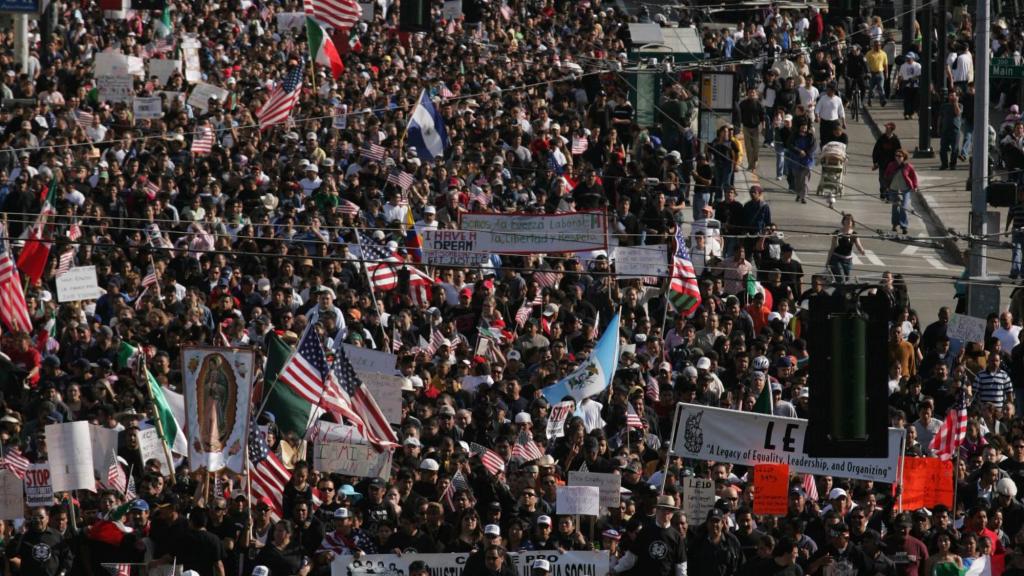
The first huge mobilization erupted in Chicago. Organized by the ad hoc March 10 Coalition, Coalición Diez de Marzo, this formation was largely comprised of documented and undocumented immigrants, but included the organized left as well. Roughly half a million poured out into the streets that day — many thousands of immigrants, youth, and citizens. The most notable leader was Jorge Mujica; along with others I never had the pleasure to meet. They presented to the world a clear list of principled demands which were supported by the great majority of the movement.

Inspired by the times, a parallel ad hoc coalition in Los Angeles had begun organizing in the winter as well. They called for a Gran Marcha on March 25 and so came to be called the March 25th Coalition. They mobilized close to a million people who took over downtown Los Angeles. At the rally, they called for a national general strike on May Day. Traditional organizations were being left behind by history, and so they responded by calling a nationwide mobilization on April 10. Hundreds of thousands hit the streets all over the country: 500,000 in Dallas alone, 100,000 in New York City, as well as large mobilizations in San Diego, Atlanta, Nashville, Des Moines, Fort Meyers, San Jose, San Francisco, Denver, Seattle, Las Vegas, Boston, and in scores of other cities. Probably over a million attended in total. They called themselves Somos América (We are America). These actions were a product of a deep-going social crisis that was boiling over. We are seeing this crisis emerge again today.

The Democratic and Republican Parties went into deep crisis, and the Democratic Party was not capable of turning back the assault. Rather, they were part of it! Like today, working people, the oppressed, and youth faced a deeply polarized society, and we had to take matters into our own hands. However, a crucial difference is that fascism was not getting a wide hearing back then, and we did not see the emergence of a broader mass fascist movement like the one brewing today. Our strategies today need to take this into account.

The Boston May Day Coalition was formed in the weeks leading up to the May Day general strike that swept the country and reverberated into Latin America as well. On Boston Common on April 10th, ten thousand mobilized and the traditional local Latino leadership decided that things had gone far enough. The Border Protection, Anti-terrorism, and Illegal Immigration Control Act of 2005 (H.R. 4437) passed by the U.S. House but was dropped from the Senate’s agenda, so these leaders felt their trust in the politicians had been vindicated. The leadership in L.A. and in Chicago, on the other hand, demanded amnesty, which would bring immediate legal permanent residence to all undocumented migrants.

For them, the struggle was not over but was only just beginning. The L.A. coalition put out a national call for May Day: No work! No school! No buying! No selling! Join the boycott! Here in the Boston area, local traditional leaders and nongovernmental organizations suggested local communities could mobilize separately on May Day — but by no means go on a general strike and by no means mobilize together. They opposed the general strike until it was inevitable. Yet the tsunami swept them along. The Boston May Day Coalition was initiated by radical youth, mostly socialists representing different tendencies. I was approached and asked whether I was on board or not: a simple Yes or No. They were in no mood to hear any esoteric bullshit! Sergio Reyes and I got together, and we formed the “Sinners Club” who were the older folks who decided to support the General Strike.

The Boston May Day Coalition (BMDC) started out in a meeting of nine people, yet rapidly grew to include 25 organizations. The organized left was largely united, although a few socialist and communist groups abstained totally, and a couple others got interested at the last moment right before May Day. The anarchists got on board early on. The Boston May Day Coalition was christened by Sergio Reyes who had gone out on the internet to search for a name that hadn’t already been taken. He became its central leader. He was from Chile and had been jailed and tortured in that country during the Pinochet dictatorship and was given political asylum here in the U.S., where he went on to lead a group called Latinos for Social Change.

The BMDC then proceeded to call for the general strike and voted to use info from the Los Angeles call to action and adopted the L.A. demands, while adding an additional demand of our own. We reserved the Boston Common and even offered to turn the permit over to any of the traditional groups for them to run the program. They refused. Negotiating was mainly done by socialists Kaveri Rajaraman and Hank Gonzales. I did a little, and others also lent a hand. The call went out far and wide in four languages. Thousands mobilized on the Common. A large group of at least 500 led by anarchists marched from Cambridge all the way to the Common and joined the mobilization. They were greeted by the chant “Primero de Mayo, Paro Nacional!”. Sergio was the Master of Ceremonies; I was voted to handle the English language media and Roberto Torres the Spanish language media. I was interviewed by Fox News and Roberto by Univision. The Gran Paro on May 1 mobilized several million across the country and shut many businesses down altogether. It was the culmination of a vast grassroots insurgency that swept the country during the winter and spring. The main demand was amnesty for all undocumented migrants. The Gran Paro or Day Without an Immigrant was called and supported by many organizations around the country and went well beyond the undocumented and well beyond non-citizens. Identity-based, top-down organizing favored by the liberals was superseded by broad-based organizing models that were inclusive and democratic. The western U.S., Chicago, and Midwest by far out mobilized the east because the eastern U.S. included the most moderate leaders by far. The Democratic Party presented the main obstacle to the general strike and continuing the struggle here on the east coast. In Los Angeles on the other hand, a million people mobilized downtown at noon on Monday, May 1. In true sectarian fashion the leadership of the Service Employees International Union (SEIU) called for a separate rally across town which drew 10,000.

There we saw the long arm of the politicians in action. While these folks sought to divide the working class, the truck drivers or Troqueros at the port of Los Angeles had a different plan. They closed each and every terminal at the busiest seaport in the Western Hemisphere — the entire Port of L.A. was shut down. These workers solidarized with the working-class movement that massed downtown and across the country. In my view, the central leaders of the Gran Paro in L.A. were Jesse Díaz, Gloria Saucedo, Javier Rodríguez, Ernesto Nevarez, and Elva Salinas who helped mobilize many to come in from San Diego and beyond. Jesse had brought up the idea for a May Day general strike in January. The general strike or “Great American Boycott” was called on March 25 by Gloria Saucedo. A critical element for L.A.’s success was the media campaign led by Javier Rodríguez. The Spanish language radio stations popularized the campaign on a daily basis and radio announcer/DJ “Piolín” led the charge. Ernesto Nevarez played a major role in the effort to shut down the port of L.A.

It is noteworthy that Ernesto was an anarchist, and probably still is. He was a radio dispatcher for trucks at the port. Elva Salinas was a professor at a University in San Diego with good organizing skills, helping to give the movement a regional character beyond L.A. All five of these leaders spoke Spanish, each was in their own world. They led a whole cast of characters, jointly constituting an awesome fighting team. Much more could be said about each of these folks, but most importantly, they involved hundreds of people in the organizing effort to mobilize a million people in Los Angeles on May Day.

That summer after May Day, BMDC flew Jesse Díaz here and toured him around Greater Boston. That’s how a lot of people found out about the movement in L.A. I had first gotten the chance to meet him and Elva at a conference in Virginia earlier that summer, representing the National Immigrant Solidarity Network at a conference on the east coast led by a Chinese organizer from L.A., Lee Siu Hin. We weren’t able to build a strong east coast movement in 2006 because those who followed the Democratic Party took control. Jesse proposed a march on Washington, yet the organized left did not respond adequately, and the westerners could not build a strong base in New York or Washington, D.C. The east coast left was too Balkanized and divided to rise to the occasion, and many were involved in mobilizing against the wars on Iraq and Afghanistan.

The Democrats swept Republican majorities from both houses of Congress that fall and then dominated over the east coast movement. The west coast leaders got demoralized, as did those in Chicago. That election sent the movement crashing and burning. The left and moderates eventually united in 2012 to mass picket the campaign offices of President Obama around the country. After that, DACA came into being. Deferred Action for Childhood Arrivals was declared, which was all we were able to win in Obama’s eight-year term. Obama came to be known as “Deporter in Chief,” deporting more immigrants than the brazen, racist Donald Trump in his first term. Look at the record!

The outlook

Prospects for organizing now are quite good. This is what we are seeing today. And the lesson we should draw from 2006 is that mass actions are the key element for turning back the offensive against migrants and working folk in general. Fundamental social advances that have benefited the working masses have generally been achieved through mass social movements. Mass movements generally call into question the legitimacy of an established social order by demonstrating that there are large numbers who see aspects of the system as unjust and oppressive — and are willing to do something about it. Many lose some of their fear when they join together with thousands of others who see a need to get involved and act. More options for what to do and how to stay involved can be discussed. Lasting victories can only be won through the action of the great masses of people.

The action of the masses is what inspires confidence and helps break down the artificial barriers placed between migrants and folks born here. A mass action strategy has been demonstrated historically to be the most effective in the effort to politicize, activate, and organize the forces necessary to achieve our goals. So, our activities should therefore seek to involve as many people as possible. Small groups of determined heroes or well-connected gurus cannot get the job done in the long run. For uniting working people, regardless of country of origin, and winning victories, the best example to follow would be the example of the massive movement in 2006 and to be organizing around the central goal of immediate legal permanent residency for all undocumented immigrants.

We must demand that the raids and deportations end and that the current detainees be released immediately. We must oppose the border walls and all laws that criminalize migrants. And we should explain to folks why these attacks affect all working class communities. Our rights, pay, healthcare, educational opportunities, and conditions of life are driven down by the divisions we suffer caused by the systemic xenophobia and racism that continues today in the U.S. The effects are not only here in the U.S., but in Mexico as well! Opposing all walls points the finger to Mexico too for having capitulated to Trump’s pledge to “build the wall and Mexico will pay for it”, because that’s what happened — except that the wall wasn’t built with millions of bricks, but with thousands of Mexico’s own troops spread out along both its northern and southern borders. This shift in policy added militarization to the civil life in these regions.

Because of the destructive divisions we suffer, it is important that our movement demands equal rights, equal pay, and equal working conditions for all working people regardless of their country of origin. No firings based on immigration status. On the contrary, we stand for jobs for all at a living wage as well as public housing, health care, childcare, education, and other vital social services. These demands are intrinsically linked to the demands for immigrant rights. No, we can’t and don’t expect to win everything all at once, but it doesn’t follow that we set these demands aside either. With each victory we must press on. As Frederick Douglas said in an 1857 speech, “power concedes nothing without a demand. It never did and it never will.” That holds true today. L.A. had a mass action strategy and clear principled demands. So did Chicago. But also, what I call movement building organizational policies are key to building a sustainable mass movement.

Movement building organizational policies

In order to build a sustainable mass movement it is necessary to develop movement building organizational policies. The movement should begin with a policy welcoming all those who agree on goals and demands. All organizations that want to build the effort should be welcomed. Narrowing participation goes against the historical experience of successful social movements and leaves the movement in solidarity with migrants vulnerable to the agenda of the very forces which are carrying out the repression, and thereby facilitates derailing the movement. This is especially important now, as more politicians seek to impose a “kinder gentler” campaign against migrants.

A healthy movement that can stand up, unite the masses, and gain respect derives its strength from clarity in its political arguments, strategy, and tactics. Obstacles must not be placed in the way of activists and potential activists who see the urgency of getting involved — they must be encouraged and welcomed as participants, organizers, and decision makers. This is an important element of a mass action strategy. This was generally the policy in Los Angeles in 2006. Organizational forms should flow from today’s social realities, the movement building possibilities, and the tempo necessary to take advantage of the current situation. In the vast array of groups that function in local communities the tempo will vary.

Decision making for a mass movement should be democratic. As the movement grows, its influence expands, and possibilities improve, so grows the need for open planning meetings which are announced, publicized, and open to all who agree with the movement’s goals. Democratic decision-making, where our demands, strategies and tactics can be debated and voted on, has maximized the impact of movements for social change and strengthened the ability to effectively coordinate actions locally, regionally, and nationally. Democracy has been demonstrated to be critical in facilitating the correction of errors and in avoiding errors before they take place. Democracy helps to correct policy. Our goal should not be to organize an exclusive club, but to organize an inclusive, mass social movement.

Democratic decision making in open, public, and broad conferences that call regional and national mass actions have been able to unite the largest number of people and gather the broadest input from working people and oppressed social layers. Folks who participate in a process of democratic discussion and decision-making feel invested in the organizations and movements being built. In turn, the organizers of activities and mass actions feel more inclined to respect the decisions decided upon, increasing the unity, authority, and social impact of the movement. In 2006 Jesse Díaz traveled the country to visit existing coalitions trying to build consensus around the need to demand amnesty (permanent residence) and to mobilize on May Day. Large conferences were held later. The leaders of the Gran Paro emerged from this kind of process.

Building an independent movement, one that does not get its marching orders from the politicians, is an important movement building organizational policy. Political action independent of the twin parties of big business is what has served us well.

Always keep in mind that the Democratic and Republican Parties are controlled by big business owners, and their corporations are the ones who benefit from exploiting immigrant workers. The politicians still have a strong grip on the minds of many, allowing the Democratic Party to serve as the graveyard for rising social movements. Mass shifts in the opinions of millions accompanied by mass actions often translate into shifts in policy. Fundamentally, victories are won by the masses, not by the good will of enlightened “policy makers.” We must become the policy makers! Our time should not be spent on advising the rich or their politicians on what is in their best interests, but on advising working people, women, youth, and all the oppressed and exploited on what is in our best interests. When the masses lead, the “leaders” follow along.

Through continued outreach and mass protest, which is becoming the “new normal” of this era, we can shift the balance of power that will lead to justice. In my view we should also organize periodic confrontations as well against the institutions and people in positions of power who deepen, perpetuate, and enforce the system of state repression, xenophobia and racism. Thoughtful and carefully planned confrontations with these institutions and their leaders help to clarify for many people who the enemy is, while instilling a sense of urgency. However, tactical confrontations should be carried out in a way that points toward the need for organizing mass actions, and by no means as a substitute for them. Confrontations as part of an overall mass outreach and mass mobilization campaign are very effective. Such is the legacy from the massive 1960s Civil Rights Movement that finished off Jim Crow and won affirmative action. We saw this in any number of other successful social movements as well.

However, in my view, participants in the current movement should not always bow to spontaneity and support every tactic that is being used. Efforts should be made to build consensus around organized, mass confrontations. In my view, our targets should not be working people, but rather, the centers of power, targeting our sworn enemies in the power elite and their repressive institutions. Our rallies, when possible, should be organized on their doorsteps, at their companies, at their government buildings, and in the centers of major cities where the power is. Occupy Wall Street was a sterling example! Furthermore, a good rule of thumb should be that the best direct actions are massive direct actions aimed at the powerful, not working people. In the current period, we should be trying to form broad-based coalitions that demand concrete justice through mass confrontations & mass mobilizations.

Some existing groups have provided enormous social services for migrants. Look at their plans, but make sure that you have plans of your own as well. Look for opportunities for organizing joint actions around clear principled demands. Think outside of the box and approach all kinds of organizations as well as groups with a class struggle orientation. Make an effort to reach agreement on demands, as well as on specific actions and their targets. At the same time, look to establish longer term alliances, broaden the coalition, and seek agreement on long term objectives and actions down the road. Convincing folks to adopt a mass action strategy and movement building organizational policies takes time and patience. The point is that what we do is more important than who we are or how we identify.

One of those rare instances when Donald Trump makes sense is when he says that this struggle is about winning and losing. Some ideas win and some lose. Choices we make can lead to being part of the solution or, if we aren’t careful, can lead to being part of the problem. Millions have been unnecessarily killed or jailed due to the movement’s poor decisions. Each of us is making our own history, and our biggest enemies are our egos. Demands, strategy, and tactics should be what we follow, not “trusted leaders” or egos. The leaders in Chicago and L.A. focused on what was best for the movement and we should follow their example

It ain’t about egos

In Chicago, Jorge Mujica led weekly mobilizations drawing attention to the repression against migrants. He became well known and central to the movement there. I don’t pretend to know much about Chicago and only had the pleasure to meet Jorge on a couple of occasions. What I do know is that he led regular weekly events in Chicago. He was focused on regular visibility and action. Returning to L.A., Jesse went with folks in the so-called “Border Project” near the Mexican border, confronting the Minute Men and their wealthy supporters. They organized pickets and marches in border towns. He joined with volunteers, especially anarchists and others, going together right up near the fences. In the overall process he got to know socialists and communists. He participated in open conferences where decisions were taken to decide what actions to carry out. He kept in contact with the traditional groups but refused to restrict his plans for action. Jesse gained a lot of respect by confronting and discrediting the Minute Men in the southwest. He was also involved in organizing other mass actions in the L.A. area. When things began to explode, he stepped forward and organized locally. He also travelled the country building support for the general strike. Those who led were those who were able to unite and focus the movement. They were chosen by history, not by the foundations or Democrats or bureaucrats, but by what they did: organizing around principled demands using a mass action strategy and movement building organizational policies.

Many of the traditional organized groups stood aloof, looking down their noses on the rag tag, motley crew of organizers and newer activists who were flying by the seat of their pants, doing as well as they could. For Jesse, however, all were good enough for him and he got down in the dirt of the chaos and confusion, playing a central role in forging a team. Organizers like Jesse learned how to navigate democratic political space. In L.A. a million people marched in the streets. Jesse’s motto was that “if you are doing this for yourself, then you don’t deserve the respect of others.” The liberal left was preaching so-called “identity” and love for the barrio until those from the barrio actually seized control of the movement. Then all of a sudden Jesse and others came to be looked upon with disdain. Jesse responded by describing Somos América as “Somos Vendidos” (We’re Sellouts) since they stuck to the Democratic Party’s strategy and tactics. He branded César Chávez as the first Minute Man for having called ICE on migrants who crossed United Farm Workers picket lines. Jesse pointed up Humberto “Bert” Corona as a more legitimate leader of the masses of Aztlán (a colorful name for occupied Mexico, from Texas to Colorado to California). Here in Boston, we followed Los Angeles’s example in this regard.

Equally selfless is the story of the man I mentioned earlier, Ernesto Nevarez, who played a central role in the effort to shut down the Port of Los Angeles. He organized with a group called the Troqueros, the truck drivers that transported the containers going in and out of the seaport. The containers are unloaded from the ships and placed on trucks which travel to their destinations. If the trucks shut down, so does the port. Ernesto was a radio dispatcher and developed relationships with many Troqueros. Meetings were organized as May Day approached, so they were ready to take action, shutting down the entire port. On May 2, 2006, Ernesto began to prepare for the next shutdown, which was to come a year later on May 1, 2007. As May Day 2007 approached, the Troqueros prepared again, but naturally the Port Authority was ready this time — they decided to give all the dock workers an official holiday and closed the port for the day. We tried to generate interest in that process here in the port of Boston, passing out fliers to truck drivers here. A couple had some interest, but it didn’t go anywhere. But at least we tried.

The crux of the issue is that a small group of NGO masterminds are incapable of organizing or even calling a general strike or leading an effective mass movement. History has proven that. “Follow me and I’ll set you free” doesn’t work. In the spring of 2017, a Boston NGO called the general strike. Folks just scratched their heads. This doesn’t work. Did it ever? Collaboration among existing groups and coalitions tends to get better results. If all the existing groups slam the door shut then you can start organizing anyway, and that’s what we did. At times you start out alone and discover other groups that want to do the same thing. That is a plus. That is what happened in the spring of 2006. Sometimes there is more than one path to victory. Most successful leaders learn how to navigate democratic political space, and there is plenty of that space here in the U.S., unlike Latin America where it can be severely restricted. Organizers are often forced underground. In those countries, political space to discuss, decide, and act is a precious jewel to be used and cherished. Yet here on the east coast, political space is sometimes denigrated! Those who best know how to navigate political space in the social movements are generally best at navigating that space in the trade unions as well. Should that be a surprise? I did it for 23 years.

Many groups here don’t want to collaborate with each other, much less with broader movements. Each sees itself as the vanguard — and Liberals and Democrats are the worst offenders when it comes to delusional vanguardism! However, that isn’t to say that myself or anyone else has a monopoly on correct thoughts, or that we should try to exclude liberals from our activities. We should be capable of convincing folks that our demands make sense, that our strategy works, and that our tactics can win victories. If we cannot win these arguments and convince others, then we are pretty useless. There is far more unity among the organized left on the west coast, in large part because they have won more victories. Surprise, surprise! I lived out there in California for seven years. It is a different world. The left here often consumes itself in petty turf wars, “cancel culture,” and obsession with “identity.” Identifying with demands, strategy, and tactics are what powered the movement forward in L.A. — and in Boston as well.

The revolution will not be organized in secret. It has never been. Effective leadership knows how to win, what to do next, and how to convince folks to take the next steps. Victory depends on mass participation, demands, strategy, and tactics. A lot of what it takes can’t be learned in books. But so much can. My advice to you is to keep your feet in the streets, your eyes on the prize, your head in books, and to shoot for the stars.

 

Nepal’s republic in crisis: After the streets erupted

Nepal Gen Z protest

First published in Transform! Europe.

“Down with corruption!”
“No more lies!”
“We want jobs, not excuses!”

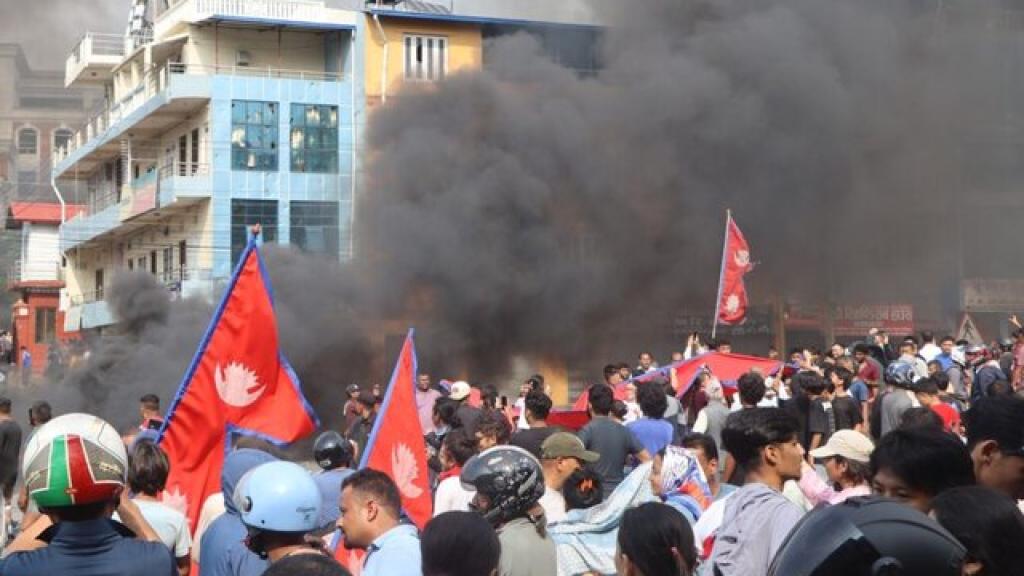
Barely one month ago, these chants echoed through Kathmandu’s Ratna Park as hundreds of young people waved handmade placards. Some were scrawled in English — “Democracy, Not Dictatorship” — while others featured simple Nepali slogans: Roti, Kapda, Ghar (bread, clothes, shelter).

Twenty-two-year-old Arjun stood on a low wall, megaphone in hand. A recent economics graduate, he has faced unemployment for nearly a year. “I studied so I could work here,” he told the crowd. “But my future is a list of jobs abroad. Is this the democracy we fought for?” Nearby, Pushpa, a mother of two from Chitwan district, clutched a placard that read, “Stop Selling Our Youth to the Gulf.” Her husband has been working in Qatar for seven years. “I don’t want my sons to leave too,” she said, her eyes watering from tear gas. “We want to live together, not in pieces.” Notably, it is estimated that 10 percent of the Nepali population (around 3 million) migrates abroad at any given time.

“We aspire to transform our country into one like Denmark, free from corruption,” stated 20-year-old Anjana Tiwari while cleaning up refuse at a makeshift camp, voicing the sentiments of many young demonstrators who filled the streets of Kathmandu. “We hope to elect a compassionate and diligent leader who will enhance the beauty of our nation in every way.”

The government’s sudden mid-September ban on social media was the immediate catalyst for this wave of protests, which continued even after the ban was lifted. However, as reflected in the slogans, the underlying motivation for the crowds was much broader: a feeling that seventeen years after Nepal abolished its monarchy, the republic has become hollow.

The fall of the king

To understand the roots of the current disillusionment, we must examine Nepal’s recent history. On a summer night in June 2001, a tragic event unfolded when most of the royal family was murdered inside Narayanhiti Palace, their official residence. Among the deceased were King Birendra, Queen Aishwarya, and Crown Prince Dipendra. Following this tragedy, the crown was passed to Gyanendra, Birendra’s brother.

Gyanendra quickly demonstrated his authoritarian approach. By 2005, he had dissolved parliament, suspended all political parties, and declared a state of emergency. Media outlets faced censorship, and numerous protesters were imprisoned.

The response was an uprising. In April 2006, millions took to the streets. “We had nothing but our voices,” recalls Anjana, a retired teacher who marched alongside her students. “We carried placards that proclaimed, ‘No More Kings,’ and sang until our throats bled.”

For nineteen days, protesters bravely defied bullets and curfews. Farmers from the hills marched alongside factory workers, while women formed human chains around the rally sites. Students filled the squares of Kathmandu. The strength of this movement ultimately compelled Gyanendra to restore parliament.

Two years later, in May 2008, the monarchy was officially abolished. As the royal flag was lowered, crowds erupted in cheers and waved banners proclaiming “Loktantra Zindabad” (Long live democracy). The palace was transformed into a museum, and a republic was formally declared.

In the early 2000s, when left movements across much of the world were retreating under the weight of neoliberal triumphalism and the collapse of old socialist experiments, Nepal offered a rare spark of hope. The Maoist insurgency, followed by the mass uprising that toppled the monarchy, seemed to breathe new life into the global left. Here was a small Himalayan country where peasants, workers, and students had forced open the doors of history, establishing a republic at the very moment when socialism elsewhere appeared exhausted.

The red promise

The abolition of the monarchy positioned communists at the core of the new republic. Maoists, emerging from a decade of armed struggle, alongside the Unified Marxist-Leninists (UML), dominated parliament. They promised a “new Nepal” that would provide land for the landless, jobs for the youth, and equality for Dalits and minorities. Guerrillas, once clad in fatigues, now occupied seats in parliament, assuring voters that their sacrifices had not been in vain.

“It was like watching history bend in our direction,” said Bhim, a former Maoist fighter. “We held placards that read, ‘Power to the People,’ and we truly believed it.” However, that belief quickly transformed into bitterness. A period of political paralysis marked by a series of betrayals unfolded. The process of drafting the constitution dragged on for years as political parties fought over power-sharing arrangements, all while corruption continued to spread. The three major political parties, the Communist Party of Nepal (UML), the Maoists, and the Nepali Congress, have been involved in a power struggle since the country’s transition to a new republic.

In 2018, the Maoists and the UML united to form the Nepal Communist Party, led by K. P. Sharma Oli and Pushpa Kamal Dahal, also known as “Prachanda,” who shared leadership and commanded a significant majority. The masses enthusiastically welcomed this development, as demonstrated by placards at rallies proclaiming “Stability at Last.” However, Oli’s decision to dissolve parliament in 2020 shattered that optimism, plunging the country into a new wave of instability and governance challenges. Protesters returned to the streets wielding signs that read, “This Is Not Why We Abolished the King.” Despite the Supreme Court’s ultimate overturn of Oli’s action, the public’s trust had already suffered significant damage. Shortly thereafter, the party itself fractured under the weight of personal egos and legal disputes.

“Every time we think we have leaders, they betray us,” said Rita, a garment worker. “Our placards continue to change, but the message remains the same: stop stealing our future.” Beyond the political drama, daily life has worsened. Unemployment has soared. While migrant remittances have become lifelines, they have also drained villages of their youth. In Kathmandu, luxury apartments are being built even as rural schools close. Poverty remains persistently high.

Pushpa, a mother from Chitwan, displayed her worn placard to a reporter, stating, “My children want their father, not remittances.” For her, the failure of the republic is a deeply personal matter. The pandemic intensified feelings of anger as patients suffocated outside hospitals due to a lack of oxygen. Widespread corruption led to the breakdown of vaccine procurement, leaving families to bury their loved ones without receiving any medical care. “We carried placards that read, ‘We Can’t Breathe,’ even before the police resorted to tear gas,” recalled Laxmi, a shopkeeper who lost her father in 2021.

Warning signs ignored

In 2022, voters in Kathmandu shocked the nation and major political parties by electing Balen Shah, a rapper and independent candidate, as the city’s mayor. Young supporters displayed placards reading, “No Party, No Corruption.” Shah’s victory was more than just symbolic; it indicated that citizens were ready to move away from traditional political parties. “He was the first person we believed in,” said Sabina, a student activist. “He made politics feel human again.” The widespread frustration with the political class was evident. It represented Nepal’s moment of ‘Que se vayan todos,’ although it was not articulated in overtly political terms.

The mainstream parties, a little wary of such developments, decided to bury their heads in the sand and refused to reflect on the implications of his victory, instead dismissing it as an anomaly. Their disregard for the warning signs was evident, as they continued with business as usual, showing little concern for the plight of the masses. By the time Nepal entered the fiscal year 2022–23, the promises of its federal democratic republic had already begun to erode under the pressures of economic stagnation and growing inequality. For s significant majority of Nepali households, these translated into severe hardships, especially those relying on daily wages, farming, or precarious employment or livelihood.

Inflation emerged as the most noticeable indication of economic distress, with consumer prices increasing by an average of 7.7 percent in 2022–23, compared to approximately 6.3 percent the previous year. While these figures might appear modest in relation to global spikes, for Nepali families living on tight budgets, this increase represented a significant shift, often leading to the choice between three meals a day and just two. Food inflation alone exceeded 6.6 percent, with essential items such as cereals, cooking oils, and spices experiencing price hikes in the double digits. Restaurants and hotels, typically affordable for lower-middle-income families, reported inflation rates surpassing 14 percent. Concurrently, transportation expenses skyrocketed, driven by a 30–47 percent surge in petrol and diesel prices, a consequence of Russia’s war in Ukraine disrupting global energy markets.

These were not abstract figures for ordinary citizens. They resulted in a doubling of bus fares for students, an increase in fertilizer deliveries for farmers, and a reduction in meat consumption for families. The Kathmandu Post even reported “shrinkflation,” which involves shops quietly reducing the size of packets while maintaining prices at a consistent level, further eroding purchasing power. In the same way that households were being eroded by increasing prices, they were also being squeezed by stagnant and precarious employment. In 2022, the unemployment rate for the general population was approximately 10–11 percent. However, the unemployment rate for young adults, or those aged 15–24, was above 20 percent, with some estimates indicating that it reached 22.7 percent. The outcome was that one in five young individuals was either unemployed or compelled to engage in low-paying, casual employment. Desperation had replaced expectations of opportunity for the generation that had matured subsequent to the monarchy’s abolishment.

Like most other parts of the Global South, the job market in Nepal is highly characterised by informal or daily wage work, with minimal social protection.

Nominal wages rose in certain months, but inflation negated these temporary gains. The real wages — the amount of money that workers could actually spend — remained stagnant or decreased. Agricultural workers, daily wage earners, and small service employees were the most severely affected by this decline. Although the urban elite could protect themselves from, or even benefit from, these price fluctuations, the impoverished were left vulnerable.

This divergence was not new. Nepal’s income structure had long been unequal, but the gap widened after 2008. According to surveys, the share of household income coming from farming collapsed from over 60 per cent in the mid-1990s to barely 16–17 per cent by 2022–23. Agriculture, once the backbone of rural livelihoods, was in decline, leaving communities dependent on migration and remittances. At the same time, the wealthiest deciles captured much of the growth in income, while the poorest gained far less.

Remittances play a major role in the Nepalese economy and, by 2022, constituted nearly 25% of Nepal’s GDP. They served both as a lifeline and a trap for many families. While remittances enabled households to cope with inflation, pay school fees, and build homes, they also had devastating effects on villages and contributed to family divisions. This left Nepal in a precarious situation, reliant on the labour of millions working in the Gulf, Malaysia, and India. The frequent arrival of coffins at Tribhuvan Airport in Kathmandu, as common as remittance transfers, poignantly illustrated the hidden costs of this export model.

The Covid-19 pandemic compounded the sense of abandonment. Hospitals ran out of oxygen, vaccine procurement was riddled with allegations of corruption, and patients died without treatment. By 2022, memories of those failures still haunted families, amplifying mistrust in the state. Inflation, unemployment, and political paralysis layered on top of a public health disaster, deepening the legitimacy crisis.

The already prevailing sense of betrayal and abandonment was further exacerbated by the COVID-19 pandemic, which created uncertainty and widespread distress. The vaccine procurement process was plagued by allegations of corruption, hospitals ran out of oxygen, and patients died without treatment. Their distrust of the state and the political class intensified in 2022, as the memories of those failures lingered. The legitimacy crisis is further exacerbated by inflation, unemployment, and political paralysis, which are imposed on top of a public health disaster.

As we can see, by 2022, Nepal was grappling not only with an economic downturn but also with a fundamental social crisis. The food and fuel prices inflation on one hand and an increasing unemployment and falling wages on the other, meant that households could no longer maintain even basic living standards. Inequality became more pronounced; the urban affluent managed to weather inflation, while the rural impoverished fell further behind.

For the youth, the options diminished to either migration or despair.

It was clear that Nepal’s crisis extended beyond the official data presented in government or other reports. It encompassed the gradual deterioration of daily life. The republic, which had pledged to provide bread, jobs, and dignity, now offered a lack of food and irregular and precarious employment, resulting in a fractured sense of trust. The protests that emerged in 2022 and later were not unexpected eruptions; rather, they were the inevitable reaction of a society pushed to its limits.

The new revolt

By September 2025, the “Gen Z revolt” had taken over Nepal’s streets. The government’s decision to ban social media was the immediate spark, but the fury that brought tens of thousands of young people into Kathmandu and cities like Pokhara, Biratnagar, and Butwal had been building for years. This was a generation born in the shadow of the republic, raised on promises of opportunity and equality, yet confronted with joblessness, rising prices, corruption, and a politics that treated them as disposable. Students, unemployed graduates, and young workers—many in their teens and early twenties — tore down barricades and flooded squares with placards demanding bread, jobs, and justice. The repression was brutal: tear gas, water cannons, rubber bullets, and live rounds. By mid-September, at least 72 were dead and more than 2,100 injured, turning the protest into one of the bloodiest popular uprisings since the fall of the monarchy.

Despite claims from both the government and right-wing voices, the left cannot dismiss these protests as “foreign-sponsored” plots. To do so is to deny the lived reality of young Nepalis whose daily survival is squeezed by inflation, falling real wages, and the hollowing out of rural livelihoods. Many protesters were the children of migrants who grew up on remittances but now face the same bleak choice: migrate or rot in unemployment. Their slogans stemmed not from Washington or Beijing, but from the emptiness of their stomachs and the broken dreams of their futures. That the uprising forced Prime Minister K. P. Sharma Oli to resign underlines not imperial manipulation but the depth of popular anger against a corrupt, self-serving political class. The emergence of Sushila Karki as interim prime minister will not in itself answer the demands shouted on the streets. What the revolt has revealed is the raw impatience of a generation that no longer believes in waiting for change from above. For Nepal’s left, the challenge is clear: either reconnect with this anger and give it direction, or risk ceding the future to reactionary forces waiting in the wings.

Nepal’s uprising is not an isolated incident but a part of a broader wave of popular rebellion sweeping across the South and Southeast Asian region. In recent years, Sri Lanka, Bangladesh, and now Nepal have all experienced popular revolts against corrupt elites and collapsing economies. The Indonesian people were also in the streets in one of the biggest mobilisations in recent times.

The similarities are striking: governments unable to manage inflation or secure livelihoods, ruling parties entrenched in patronage and scandal, and citizens reclaiming the streets as the only space where their voices can be heard. Across the region, like in most of the parts of the world, youth in particular are refusing to accept the erosion of democracy and the politics of survival, articulating a shared demand for dignity, accountability, and real change.

The future?

Yet Nepal’s political leadership continues to live in the past, responding with denial and deflection. Rather than acknowledging the deep social and economic grievances that fuel the unrest, both the left and the right insist that the protests are merely foreign-sponsored. The US is portrayed and blamed as a hidden hand, allegedly funding and manipulating Nepal’s youth to destabilise the republic. This narrative may strengthen general anti-imperialist sentiments, but it seriously underestimates and overlooks a crucial point: mass anger in Nepal arises from hunger, unemployment, corruption, and the constriction of democratic space. Reducing it to an external conspiracy strips people of their agency and masks the state’s own failures. Secondly, such blind allegations lack concrete evidence.

The crossroads facing Nepal are crystal clear: a potential outcome is a continuation of the status quo — elite coalitions reshuffled yet again, protests repressed or dissipated, and the underlying crisis allowed to fester. The other possibility is the resurgence of right-wing and monarchist forces, offering the comforting illusion of order by reviving old symbols of power. The third, and most hopeful, scenario involves a grassroots renewal — workers demanding fair wages, farmers fighting for land and security, and students and young people refusing to accept a future devoid of dignity — transforming street anger into a political project that confronts inequality and revitalises the radical promise of the republic.

The ability to channel the uprising’s energy into sustainable structures of resistance and representation will determine which path prevails. How far this can succeed may become evident in March 2026, when new elections are scheduled and many of Nepal’s Generation Z, who took part in the protests, have already registered enthusiastically to vote.

The stark reality of Nepal’s unfinished democratic experiment emerges seventeen years after the abolition of the monarchy. The republican hope and dream once stood for equality, participation, and social justice; however, the reality has been one of instability, corruption, and a gradual betrayal of the people’s hopes. The current movement demonstrates that, despite these disappointments, ordinary Nepalis have not abandoned the streets — or their own power to shape history. What remains uncertain is whether Nepal’s political class can be compelled — or replaced — to ensure that this time, the sacrifices lead to lasting transformation. There is no doubt that the Nepalese left needs to reinvent itself to prevent extinction.


In the Shadows of History: Death and Destruction in South Sudan


Much of the world is rightly transfixed by the genocide in Gaza, the unimaginable horrors experienced by its Palestinian inhabitants, the callous antics of those who would ‘develop’ its ruins (Trump, Blair, Kushner, etc.), and the strong likelihood of more of the same to come for the West Bank.

But what is it that explains why one humanitarian tragedy commands global attention while others that have entailed as much or more suffering for as long or longer seem less deserving of the world’s interest and go relatively unnoticed and unremarked upon?

The case of South Sudan

If international humanitarian interest in a country was simply a function of the extent of death, destruction, and human misery there, then the scorecard for South Sudan would place it among the most deserving of cases.

More than 20 years ago, in 2002, I was employed via an NGO to carry out a short consultancy for the South Sudan rebel government in waiting, the Sudan People’s Liberation Movement, which was the political wing of the Sudan People’s Liberation Army. My field work was carried out in the heart of rebel-held territory in the town of Rumbek. Tellingly, I was accommodated in a US special forces tented camp alongside Rumbek’s murram air strip. The presence of the US military in the middle of nowhere was a mark of the post-9/11 frenzied hunt for Al Qaeda, in a country that had once provided shelter to Osama bin Laden and was – and, according to some, still is – a stronghold of radical Islam. No prizes for guessing where the NGO’s funding probably came from.

In my final report, among others, I noted as follows:

For almost half a century [1955-2005], the people of Southern Sudan have been engaged in a bitter liberation struggle with the Government of Sudan based in Khartoum. It is a war that has resulted in the deaths of at least two million Southern Sudanese and the displacement from their homes of many millions more. There have been horrifying human rights violations on a grand scale. With the exception of large parts of western Equatoria, where war damage is relatively limited and has resulted mainly from sporadic bombings, there has been widespread destruction of, or serious damage to, physical infrastructure. The institutional infrastructure of government has been completely destroyed.

… it is also a war that has not impinged greatly on the economic or strategic self-interests of the major world powers and has therefore failed to attract their serious attention or that of the international media. Accordingly, it is a war that for the most part has been conducted in the shadows of history – a war that has resulted in more death, destruction and suffering than many conflicts whose causes and casualties for other reasons have been widely publicised by the world’s media (Blunt, 2002).

An indicator of the magnitude and severity of the effects of the protracted liberation struggle was that there were estimated to be twice as many women as men in the adult population of South Sudan (UNICEF, 2000 in Blunt, 2002). By comparison, after WWII, the country that had suffered the most casualties, Soviet Russia, had a female to male ratio of 1.3 to 1.0.

The atrocities that were committed during the 50-year civil war and since then bear an eerie resemblance to some of the main features of the Israeli genocide in Gaza – as if they were drawn from the same playbook.

Ironically, confirmation of this can be found in the account given by The US Holocaust Memorial Museum:

In both the south and west, the Sudanese government established a pattern of assaults against civilians. They killed, tortured, raped, and displaced millions. Assault tactics included:

  • Mass starvation and forcible displacement;

  • Blocking humanitarian aid;

  • Harassment of internally displaced persons;

  • Bombing of hospitals, clinics, schools, and other civilian sites;

  • Use of rape as a weapon against targeted groups;

  • Employing a divide-to-destroy strategy to pit ethnic groups against each other, causing enormous loss of civilian life;

  • Training and support for ethnic militias who commit atrocities;

  • Destruction of indigenous cultures;

  • Enslavement of women and children by government-supported militias; and

  • Impeding and failing to fully implement peace agreements.

Since gaining independence in 2011, civil wars have raged more or less continuously in South Sudan, killing tens of thousands more civilians. Much of the conflict and abuse has been funded by oil companies and European banks.

In 2024, the humanitarian crisis there was depicted by Human Rights Watch as one of the worst in the world (which it probably had been for at least the previous half century):

… driven by the cumulative and compounding effects of years of conflict, intercommunal violence, food insecurity, the climate crisis, and displacement following the April [2023] outbreak of conflict in Sudan. An estimated 9.4 million people [out of a total population of about 13 million] in South Sudan, including 4.9 million children and over 300,000 refugees, mostly driven south from the Sudan conflict, needed humanitarian assistance.

According to Oxfam (2025): “Reduced attention and [already grossly inadequate] funding to the country is further deepening the humanitarian crisis and putting millions of lives at immediate risk.”

A ‘sleeper’ in the New Great Game
Setting aside for the moment the fact that the death and destruction in South Sudan is and has been happening in the heart of darkest Africa to some of its blackest inhabitants — people who therefore would be classified among the most unworthy of victims — consider the following (typical) ingredients of the ‘civilised’ world’s calculations in such matters.

Though landlocked and largely inaccessible, South Sudan is a large and attractive piece of real estate (about twice the size of Germany) that has an estimated 5 billion barrels of oil reserves (the third largest in Africa); significant deposits of gold and other minerals such as iron ore, dolomite, and aluminium, which are largely untapped; approximately 33 million acres of mostly (94%) uncultivated arable land; and a wealth of renewable natural resources, primarily fish (in the massive wetlands known as the Sud), forests, and wildlife (World Bank, 2025).

However, it is South Sudan’s neighbour to the north – Sudan – that has a geostrategically vital 500-mile border on the Red Sea and controls access to world markets via Port Sudan for its landlocked neighbour, making it a critical piece in the New Great Game.

For now, while undoubtedly registered as a target of high potential, the considerable plunder and profit to be had in South Sudan is probably too difficult to extract, and the US is too heavily embroiled elsewhere, for it warrant the serious immediate attention of the current godfather of savage capitalism in the US.

The difficulties of extraction are made so by the incessant civil conflicts in South Sudan since independence in 2011, which are stoked by bitter ethnic rivalries that now threaten to cause another outbreak of violence; the absence or parlous state of South Sudan’s physical and institutional infrastructure and the inaccessibility of its natural resources; its extreme flood proneness and vulnerability to climate change (the highest in the world); and the choke hold on its exports, and trade generally, exercised by Sudan’s control of Port Sudan.

Regarding the latter, crucially, there are only two crude oil pipelines from the oil fields of South Sudan to Port Sudan. Their vulnerability is a function of their length – each of about 1,000 miles through inhospitable and lawless terrain – and their reliance on power plants in Port Sudan that supply electricity to the pipelines’ pumping stations, which have been subject to recent drone strikes.

For the US et al., all this could change very quickly of course if the already substantial Chinese interests in oil and infrastructure development in South Sudan continue to grow and US-supported strikes against those interests escalate. China is already South Sudan’s biggest export market and one of its main trading partners and donors, giving China a foothold in the country and region that the US would no doubt not want to become too firm.

Whatever the case, Black lives don’t matter

We can infer from this snapshot of the ‘property development’ potential and strategic significance of South Sudan an answer to the question posed at the beginning of this essay. An answer that many readers of this journal will be unsurprised by, but is worth repeating, nonetheless. Namely, that – per se – humanitarian crises and death and destruction on a massive scale lasting for decades clearly count for nothing in the mercenary and cynically self-interested calculus of the so-called ‘civilised world’. This is particularly so of course when the victims are among the darker races, as I have argued elsewhere and the likes of Chris Hedges and Caitlin Johnstone assert so emphatically.

Indeed, when the balance tips in favour of more intense US-led Western intervention in South Sudan, as eventually it is bound to (and South Sudan becomes newsworthy), these failed state conditions will be ‘refined’ or augmented (with ‘development assistance’ and more direct and brutal means of persuasion) to produce the type of ‘investment climate’ that results from the ‘shock therapy’ referred to by Naomi Klein (2008). That is, a catatonic condition and tabula rasa in the subject nation that clears the way for ‘free market fundamentalism’ and natural resource predation, as was the case in Iraq and other places.

As now, when that time comes, the humanitarian crises in South Sudan will be the subject of attention only in so far as they serve to embellish or decorate whatever narrative the corporate media have been told to run in support of greater Western intervention or only in so far as they provide an exotic curiosity for the entertainment of their indoctrinated Western audiences.

Peter Blunt is Honorary Professor, School of Business, University of New South Wales (Canberra), Australia. He has held tenured full professorships of management in universities in Australia, Norway, and the UK, and has worked as a consultant in development assistance in 40 countries, including more than three years with the World Bank in Jakarta, Indonesia. His commissioned publications on governance and public sector management informed UNDP policy on these matters and his books include the standard works on organisation and management in Africa and, most recently, (with Cecilia Escobar and Vlassis Missos) The Political Economy of Bilateral Aid: Implications for Global Development (Routledge, 2023) and The Political Economy of Dissent: A Research Companion (Routledge, forthcoming 2026). Read other articles by Peter.

Extending the Cultural Boycott of Apartheid South Africa to Israel 

I have been informed by the leadership of what might best be described as the “black consciousness movement” of Azania (South Africa) that a formal call to include Israel in the “cultural boycott” of South Africa will be issued from inside South Africa within the next few weeks.

The Black Consciousness Movement was started under the leadership of Steve Biko (whose life and murder by the Pretoria regime was the basis for the film “Cry Freedom”) and was the first organization to call for a cultural boycott of South Africa.

This call, sent out especially to pop musical groups, eventually generated the formation of “Artists United Against Apartheid.” The cultural boycott of South Africa was probably the first major effort successfully to draw pop and rock musicians into an anti-racist campaign.

The next logical step, which some of us have been struggling to implement, has been the inclusion of the racist, colonial, settler, Zionist regime of Israel in the cultural boycott.

Recently, a British pop-reggae band called UB40 spent some time here in Hawaii. Known for the radical political content of many of their songs, UB40 had a song go to no. 1 on the pop music charts in the US in 1988.

UB40 has agreed to cancel their Israel tour (a loss of over $500,000) in protest of the racist policies of the Zionist occupation forces in Israel and in support of the intifadah of the indigenous Arab youth of Palestine. Finally, the lines have been drawn. With UB40 setting an example, the call will be going out to all the major pop and rock groups to honor the cultural boycott of South Africa-Israel or risk being “boycotted” themselves.

UB40 has taken a very courageous stand. Those of us familiar with the music business know only too well how dominant outright Zionists and supporters of Israel are in the industry, Many of us remember the near destruction of Miriam Makeba’s career some 20 years ago when she took a stand opposing Zionism and supporting the Palestinian people’s right to self-determination.

What we are saying is, from the frontlines of South Africa to the frontlines of Palestine, apartheid-Zionism is racism. Support the cultural boycott! Say “no” to Israel and Apartheid South Africa!

Thomas C. Mountain is an educator and historian, living and reporting from Eritrea from 2006-2021. At one time he was the most widely distributed independent journalist in Africa with columns running in Ghana, Nigeria, Liberia, Cameroon, Somalia, Kenya, Tanzania amongst others as well as in the Eritrean diaspora. He is best reached at thomascmountain@gmail.comRead other articles by Thomas.