Monday, October 27, 2025

Germany: 500,000 birds culled as flu spreads


Matt Ford
DW
27/10/2025 

Dozens of cases of bird flu have been reported across the country, especially in north-eastern regions. The virus isn't particularly dangerous for humans, but could result in higher prices for poultry and eggs.


There have been 30 registered outbreaks of bird flu in German poultry batteries and another 73 outbreaks among wild birds.
Image: Christophe Gateau/dpa/picture alliance

Over half a million hens, ducks, geese and turkeys have been culled in Germany since the start of September as a virulent strain of bird flu sweeps the country.

According to the Friedrich Loeffler Institute (FLI), the German government agency responsible for monitoring animal pestilence, there have been 30 registered outbreaks in poultry batteries and another 73 among wild birds.

"And we're expecting more," a spokesperson told the dpa news agency, explaining that another 23 suspected cases are currently being investigated.

According to the FLI, outbreaks of bird flu usually emerge at the start of November at the height of the migratory season, meaning that the current pestilence could yet to reach its peak.

In the south-western state of Rhineland-Palatinate, local authorities said new suspected cases were reaching them on a daily basis and spoke of an "unusual dynamic."
Bird flu in Germany: where are the most affected areas?

The worst affected areas are the northern and eastern states of Lower Saxony (20 cases), Thuringia (19), Brandenburg (19) and Mecklenburg-West Pomerania (14). But cases have also been confirmed in the southern state of Bavaria (eight) and the western state of North Rhine-Westphalia (five).

Cranes have reportedly been particularly badly affected, with emergency services in northern Brandenburg, just north of Berlin, having to dispose of thousands of infected, dead animals left strewn across fields.

According to the FLI, the outbreaks are being caused by the highly infectious H5N-1 strain of the HPAIV influenza virus – commonly known as bird flu.

Is bird flu dangerous for humans?

In high doses, the virus is theoretically transmissible to humans, but the Robert Koch Institute (RKI), Germany's federal agency for disease control and prevention, isn't aware of any such cases.

Rather, the effect on humans could be more likely to be felt in the pocket, with Bavarian Poultry Union chairman Robert Schmack warning of a potential 40% increase in the price of eggs and a smaller choice of poultry products in supermarkets.

The president of the Central German Poultry Union, Hans-Peter Goldknick, however, disagrees, telling public broadcaster ZDF that he is "not expecting price explosions in the short term," nor in the build-up to Christmas, not least because most geese in Germany are imported from Hungary and Poland.

In order to help prevent the spread of the virus, the FLI recommends avoiding contact with dead birds and not wearing dirty boots near pens holding vulnerable animals.

Meanwhile, in the German parliament, the Bundestag, a spokeswoman for the opposition Green Party said that the current outbreak of bird flu had revealed the "vulnerability of factory farming," where packed pens provide optimal conditions for the virus to spread.

Edited by: Louis Oelofse

Matt Ford Reporter for DW News and Fact Check
Alone at sea, unaccompanied refugee minors in mortal danger
DW
October 26, 2025

Search-and-rescue organizations are sounding the alarm, warning that many children and youths are venturing across the Mediterranean, along one of the world's most dangerous refugee routes, on their own.


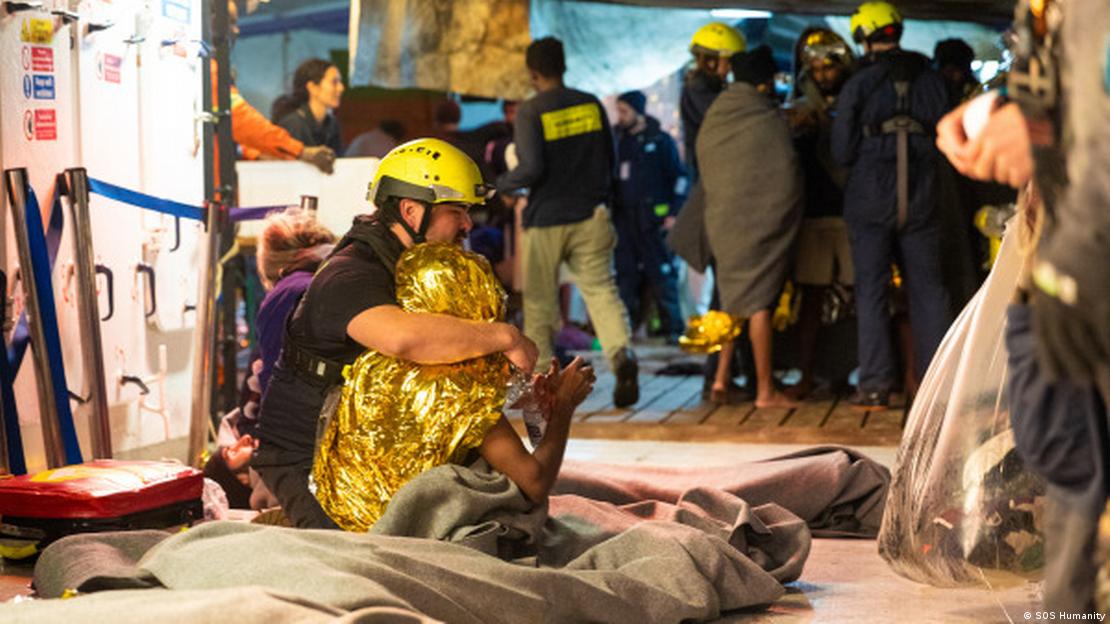
More and more minors are setting out alone from Libya or Tunisia, traveling to Europe in overcrowded boats
Image: Danilo Campailla/SOS Humanity


"No one would risk their life at sea if there were a better way. But there's no alternative. That's why we risk our lives."

These are the words of a 15-year-old boy from Guinea rescued as an unaccompanied minor at sea by the Berlin-based NGO, SOS Humanity.

The organization, which has been saving refugees and migrants at sea for the last decade, warns that more and more children and minors are setting out alone from Libya or Tunisia to Europe in overcrowded boats that are often not seaworthy. Around a fifth of those rescued have been minors.


Esther, a German clinical psychologist, volunteered as a mental health officer on Mediterranean rescue missions in November and December 2024.

During a press conference in Berlin on Tuesday, where Esther did not give her surname, she said that during her time at sea six boats carrying 347 people were rescued. Among them were 43 young people, mostly unaccompanied minors, in poor physical and mental health.

"They'd often been at sea without food or drink for several days and nights, were dehydrated, seasick and often had burns from fuel and salt water. Many also had scabies or other infections and wounds, because they had been held in camps in Libya for long periods. All of them were emotionally exhausted," she said.
Children at grave risk in Libya's camps

Conditions in Libyan detention camps — where those intercepted by the the country's coast guard are returned after failed attempts to cross the Mediterranean — are catastrophic, especially for young people.

For years, Libya — which, under a multimillion-euro agreement with the European Union, is meant to take over border control and drastically reduce migrant numbers — has faced intense criticism for serious human rights violations.


"Young people told me about extreme sexual violence, torture, child labor, losing relatives and cases of human trafficking involving women," Esther recounted. "Some of these young people showed me physical evidence of what they've been through. Some had scars from torture, as well as photos and videos taken at the Libyan camps showing them tied up and beaten."

Over 3,500 minors reported dead or missing

Minors who manage to escape from the camps face even greater danger during the crossing.


According to UNICEF estimates from April, around 3,500 children have died or disappeared in the last 10 years while attempting to reach Italy via the central Mediterranean route. That means nearly one dead or missing child per day for an entire decade.

This statistic has SOS Humanity calling for an immediate end to the EU's cooperation with Libya and Tunisia.

"The proportion of minors among those fleeing has actually been rising steadily over the last 10 years. Around one-fifth of all arrivals in Italy are minors. In our rescues, the average is even more than one-third," said Till Rummenhohl, managing director of SOS Humanity.

"We recently had a whole boat of just minors, 120, on board. They were completely panicked young people who were traveling alone and jumped into the water out of fear of the Libyan coast guard," he added.

Trump's USAID cuts have dramatic consequences

The growing number of children and adolescents embarking on the dangerous journey to Europe may worsen in the future, warned Lanna Idriss, the head of SOS Children's Villages Worldwide. The reason: the US government under President Donald Trump has dissolved the development aid agency USAID, with dramatic consequences.

In a study published this summer, the medical journal The Lancet calculated that USAID cuts could result in more than 14 million deaths globally over the next five years, including up to 5 million children under the age of 5. Germany has also cut its development aid by almost €1 billion ($1.2 billion).


SOS Humanity has been rescuing refugees and migrants at sea since 2015Image: SOS Humanity

"We are entering a vicious cycle that will lead to more children taking this route," said Idriss, citing Somalia as an example. "The country was 80% dependent on USAID. Last year, we reached 4.5 million children and adolescents in Somalia; this year, only 1.3 million. Why? Because the camps intended to support these children have been empty since the summer."

Vera Magali Keller heads a law firm in Berlin that specializes in supporting humanitarian organizations, including those that carry out sea rescues.

Children and young people must be given priority protection and evacuation during sea rescues, the lawyer told DW, referring to the United Nations Convention on the Rights of the Child, to which all UN member states have committed themselves.

"In several European countries, there are special prospects for obtaining residence, protection entitlements and rights to family reunification. In Italy, for example, these often apply until the age of legal adulthood. As a general rule, children and adolescents must be accommodated separately from adults and given special protection. Detention should be avoided wherever possible," said Keller.

SOS Humanity has announced plans to deploy another rescue vessel in the Mediterranean in 2026. The ship will primarily operate off the coast of Tunisia, searching for migrant boats and monitoring human rights violations.

To do this, the sea rescue organization will rely on donations, as the German government has discontinued its annual €2 million funding for civilian sea rescue. This is one reason why Keller is pessimistic about the future.

"Given the current political and legal developments, I don't see any positive prospects," she said. "I fear that the criminalization and repression of civilian sea rescue will intensify under the current coalition. The already disastrous protection and reception standards for refugees in Europe will likely continue to deteriorate."

This article was originally written in German.

Oliver Pieper Reporter on German politics and society, as well as South American affairs.

Epstein scandal: 'Different rules' for Donald Trump?

October 25, 2025

Calls to release all of the so-called Epstein files — the investigation into disgraced financier Jeffrey Epstein's sex trafficking scandal — won't stop. Could revelations in those files harm US President Donald Trump?


When Donald Trump visited the UK in September, he was greeted by images that showed him and convicted sex trafficker Jeffrey Epstein together
Image: Phil Noble/REUTERS

Warning: This article contains references to death by suicide, sexual assault and other details that readers may find disturbing.

US President Donald Trump can't seem to get away from the Jeffrey Epstein case.

Epstein, a former investment banker, sexually abused and trafficked girls and young women for years, as well as "passing them on" to friends and business partners. The Epstein scandal had a huge impact on high society in the US, where many elite politicians, businesspeople and power brokers socialized with Epstein. In 2019, Epstein died by hanging off the side of his cell bed, while awaiting trial.

More than six years later, and the Epstein affair has become a major pain for President Trump. Members of the general public and opposition politicians are demanding that the US Justice Department release the so-called "Epstein files" in full. Some of the files are publicly accessible, but many sections have been redacted.

Survivors of Epstein's abuse are demanding that everything the authorities know be made public and that anybody who was part of Epstein's sex trafficking network, or who participated in the sexual abuse, be held accountable.

Trump: Epstein 'a lot of fun to be with'

Trump was very clearly friends with Epstein in the 1990s — there are plenty of photos and videos around to prove it. In a 2002 interview with New York magazine, Trump called Epstein "a great guy" and said "he's a lot of fun to be with. It is even said that he likes beautiful women as much as I do, and many of them are on the younger side."

Trump and Epstein fell out socially in 2004. In 2023, Trump himself was found guilty of sexually abusing the author E. Jean Carroll in 1996, and has tried to distance himself from the whole Epstein affair since the allegations of abuse came to light.

But interest in the case remains high. It is noteworthy that not only members of the opposition party, the Democrats, are calling for a vote on the Epstein Files Transparency Act, a bill that would require the Department of Justice to publish all unclassified records related to the investigation. Some members of Trump's own party, the Republicans, also believe this is necessary.

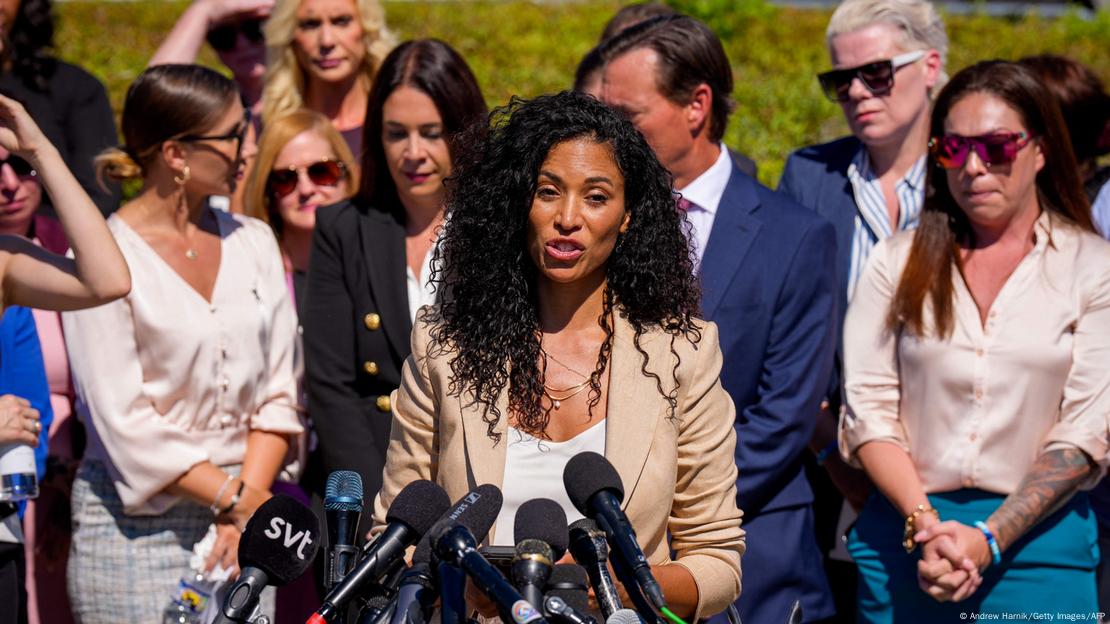
"Congress must choose. Will you continue to protect predators, or will you finally protect survivors?," Lisa Phillips, a survivor of the Epstein abuse, said on the steps of Capitol Hill in Washington earlier this year. "Transparency is justice. Release the files, end the secrecy and stand with us in d
eclaring that no one, no billionaires, no politicians, no world leader, is above the law."


Abuse survivor Lisa Phillips was one of several survivors who demanded full transparency in the Epstein scandal during a protest in Washington in SeptemberImage: Andrew Harnik/Getty Images/AFP

However, at the moment, there's nothing really happening with the official Epstein investigation. Due to the ongoing US government shutdown, the House Oversight Committee, the main investigative body of the US House of Representatives, isn't working at all.

Survivor's posthumous memoir published


Instead, information is coming from other sources. On Tuesday, the book "Nobody's Girl" was published — a posthumous memoir by Virginia Roberts Giuffre, one of the most prominent survivors of Epstein's sex trafficking network, who accused the UK's Prince Andrew and other influential men of sexually exploiting her as a teenager.

In April, the then 41-year-old died by suicide. In the book, she writes that Epstein had video recordings of his "clients" sexually abusing girls and women.

The memoir has only fueled further speculation about Epstein's "client list," and whether it might be among the documents that the Justice Department hasn't released.

Trump himself actually made a campaign promise to release all the Epstein files — which is why some of his staunchest supporters, members of the Make America Great Again, or MAGA, movement, are outraged that he hasn't.


Could it be that Trump is preventing further publication of the Epstein files because they could damage him personally and politically? It's impossible to tell without further examination of the documents. But what one can try to answer is how Trump's supporters might react to possibly damaging revelations.

"Many Democrats hope that the Epstein files might bring Donald Trump down," said Ines Pohl, head of DW's studio in Washington. "But this assumption doesn't match my experience on the ground. Certainly, the vast majority of Republicans and Trump supporters also consider Epstein a despicable criminal. But different rules apply to Donald Trump."

Pohl has spoken to many Americans about their opinions on the Epstein files and any possible Trump involvement. Most often, the replies she's heard testify to Trump supporters' strong rejection of the political establishment and their unimpeachable loyalty to the man they consider "their" president.

They say, "all of Washington has dirt on its hands," Pohl explained, so, "why should Donald Trump be held accountable?"

If you are suffering from emotional strain or having suicidal thoughts, seek professional help. You can find information on where to find help, no matter where you live in the world, at this website: www.befrienders.org.


Janelle Dumalaon in Washington and Thomas Latschan contributed to this article, which was originally written in German.

Carla Bleiker Editor, channel manager and reporter focusing on US politics and science


Researchers watched students’ brains as they learned to program


Study reveals how the human brain learns to code


Johns Hopkins University

Brain activity before and after college programming course 

image: 

After college students took a programming course, parts of their brain activated as they read code. Surprisingly, before the students took the class or knew anything about programming, the same groups of neurons also fired when the students read the programs described in plain English

view more 

Credit: Yun-Fei Liu/Johns Hopkins University


Computer programming powers modern society and enabled the AI revolution but little is known about how our brains learn this essential skill. To help answer that question, Johns Hopkins University researchers studied the brain activity of university students before and after they learned how to code.

After the students took a programming course, parts of their brain activated as they read code. Inside these areas, groups of neurons represented the meaning of code. Surprisingly, before the students took the class or knew anything about programming, the same groups of neurons also fired when the students read the programs described in plain English.

The federally-funded work, newly published in the Journal of Neuroscience, provide insight into how and why the human brain programs.

“Many of the things we do in the modern world, our brains didn’t evolve to do, including programming, driving, reading and math,” said senior author Marina Bedny, a cognitive neuroscientist who studies brain plasticity and development. “A programming class ‘recycles’ your logic brain areas for code. What we found is that by the time you get to college your brain already has the neural foundations for programming.”

AI tools are making coding increasingly accessible. With more people gaining access to programming, Bedny and first author Yun-Fei Liu, a postdoctoral fellow, set out to discover how the human brain adapts as novices begin to learn the skill.

The team used functional magnetic resonance imaging (fMRI) to track the brain activity of undergraduate students before and after they took a semester-long introductory course in Python, a programming language.

When students read code after the course, groups of neurons in a part of the brain responsible for logic, the fronto-parietal regions, represented the meaning of the programs. But even before class, when students read plain English descriptions of the coding programs, the same neurons already activated for the program algorithms.

“Learning to code uses the same neural machinery that we use for logical problem-solving. Everyone has these abilities,” said Liu, who investigates how the brain learns educationally relevant cultural skills.

The findings suggest that all humans are equipped with the foundation needed to learn programming—which is mostly logic. And exercising those logic muscles through puzzles, games and everyday dinner-table debates might prime kids for future programming success.

“Someone not familiar with coding might look at Python and feel like they’d never be able to understand it, but our study suggests all of us have the capacity to code,” Bedney said. “We might even be born with it.”


4 spooky science stories for Halloween


American Chemical Society


Brains, spiders, (were)wolves and slimy eyeballs — a collection of creepy research topics that Dr. Frankenstein would appreciate! But unlike the mad scientist’s work, the research detailed below in ACS journals aims to improve human life by developing an alternative to animal testing, on-demand wound care, an edible protective coating for veggies, and informing future retinal health studies. Reporters can request free access to these papers by emailing newsroom@acs.org.

  1. Tiny, lab-grown brains. Researchers report in ACS Sensors that they grew a brain organoid in a petri dish to advance the study of neural networks without laboratory animals. After 2 years, the team’s cultured human nerve cells divided and self-organized into a 3D “mini-brain” with electrophysiological activity. Further development of this technology could lead to a brain model for researching the organization and communication patterns of human brain tissue, or maybe a lab-grown lunch option for zombies.
  2. A web-slinging glove. By attaching spider-like spinneret devices to a glove, researchers created a “handy” system to deploy thin polymer fibers in the air. The fibers could spin wound dressings on the fly (pun intended) in hospitals, sports arenas and military field operations. Experiments with the glove are detailed in ACS Applied Materials & Interfaces and do not include bites from radioactive spiders.
  3. Wolf apple coatings. According to a paper published in ACS Food Science & Technology, a food-safe coating made from wolf apples could be a cost-effective, edible material for extending produce shelf life. Researchers extracted starch from the hearty Brazilian fruit, a staple of the maned wolf’s diet, and then applied it to baby carrots. The coated veggies maintained their bright orange color and were safe to eat after a full moon … or 15 days of room-temperature storage.
  4. Microplastics in eyeballs. A paper in ACS’ Environmental Science & Technology Letters reports a foundational study characterizing microplastics in human retinas. The researchers looked at 12 post-mortem human retinas (no eye of newt here) and found plastic particles of various types and levels in all of them. According to the team, these findings provide a crucial foundation for future studies on the potential risks and impacts of microplastics on eye health.

###

The American Chemical Society (ACS) is a nonprofit organization founded in 1876 and chartered by the U.S. Congress. ACS is committed to improving all lives through the transforming power of chemistry. Its mission is to advance scientific knowledge, empower a global community and champion scientific integrity, and its vision is a world built on science. The Society is a global leader in promoting excellence in science education and providing access to chemistry-related information and research through its multiple research solutions, peer-reviewed journals, scientific conferences, e-books and weekly news periodical Chemical & Engineering News. ACS journals are among the most cited, most trusted and most read within the scientific literature; however, ACS itself does not conduct chemical research. As a leader in scientific information solutions, its CAS division partners with global innovators to accelerate breakthroughs by curating, connecting and analyzing the world’s scientific knowledge. ACS’ main offices are in Washington, D.C., and Columbus, Ohio.

Registered journalists can subscribe to the ACS journalist news portal on EurekAlert! to access embargoed and public science press releases. For media inquiries, contact newsroom@acs.org.

Note: ACS does not conduct research but publishes and publicizes peer-reviewed scientific studies.

Follow us: Facebook | LinkedIn | Instagram