Monday, October 27, 2025

From soft to solid: How a coral stiffens its skeleton on demand


Discovery of natural “jamming system” in a Pacific soft coral opens new directions for bio-inspired engineering


University of Pennsylvania School of Engineering and Applied Science

A Sclerite 

image: 

The particles are somewhat cylindrical, like a rod studded with branching outgrowths at regular intervals.


view more 

Credit: Ling Li and Chenhao Hu


Touch the branches of Leptogorgia chilensis, a soft coral found along the Pacific coast from California to Chile, and its flexible arms stiffen, like Marvel’s Mr. Fantastic warding off a foe. 

Now, Penn Engineers have discovered the mechanism underlying this astonishing ability, one that could advance fields as varied as medicine, robotics and manufacturing. 

In a new paper in Proceedings of the National Academy of Sciences (PNAS), a group led by Ling Li, Associate Professor in Materials Science and Engineering and in Mechanical Engineering and Applied Mechanics, describes how the coral’s skeleton — made of millions of mineral particles suspended in a gelatinous matrix — compacts itself to ward off danger. 

“It’s almost like a traffic jam,” says Li. “When stimulated, the coral’s tissues expel water, shrinking the gel and squeezing the particles closer together until they jam in place.”

Physicists have long studied this phenomenon, known as “granular jamming,” by manipulating grainy substances like sand and coffee grounds, but this marks the first time granular jamming based on hard particles has been observed in a living organism. 

“Imagine being able to adjust the stiffness of a surgical instrument or robotic arm,” says Chenhao Hu, a doctoral student in Li’s lab and the paper’s first author. “In this coral’s skeleton, nature has created an incredible material whose principles we can adapt for human use.” 

Learning From Nature

For years, Li’s lab has studied the skeletons of undersea creatures, on the motivation that uncovering the basis of their material properties will lead to advances in engineering. 

“They’re basically made of chalk,” he says, referring to calcium carbonate, the same cheap and plentiful white powder that forms eggshells, sticks of chalk, marble, limestone and pearls. “What gives their skeletons interesting properties is how the calcium carbonate is structured and organized.”

While marine biologists recognized long ago that soft corals like L. chilensis have skeletons containing granular particles, the grains’ shapes had primarily been used to classify different species. “Limited work has focused on the functional properties of the shapes themselves, particularly from the granular jamming point of view,” says Li. 

Finding the Right Shape

Past research has recognized the potential of granular jamming in fields like manufacturing — one group developed a robotic grabber arm whose sand-filled “hand” envelops complex objects then stiffens to pick them up — but has relied on a few basic grain shapes.

“It’s hard to find the right shape,” says Hu. “They need to jam when they’re close together, which requires friction and interlocking, but still separate easily into a relaxed state.” Because of their varied geometry, sand and coffee grounds make studying the mechanics of the process challenging, while easy-to-manufacture spheres frequently slide past one another due to a lack of friction. 

In a sense, nature provides a shortcut: if the Penn researchers could characterize the mineral particles, or sclerites, in L. chilensis, that might point to a novel, and perhaps better, shape for human systems that rely on granular jamming.

Measuring the Skeletons

Measuring about a tenth of a millimeter in size, the particles are somewhat cylindrical, like a rod studded with branching outgrowths at regular intervals. “Once the sclerites get close enough to their neighbors, their branches jam together, holding them in place,” explains Hu. 

The researchers explored the material’s properties with advanced imaging techniques, computational modeling, and by poking and prodding preserved samples of the coral. “When we applied force to the samples,” says Hu, “the material system initially shrank, occupying less volume because the particles were closer together.” 

Inspired by Nature

Ultimately, the researchers say, the paper points toward the benefits of studying nature to find new materials. “We just studied one coral species,” points out Li. “But there are many other soft coral species out there, which use different sclerite shapes, with potentially different properties.” 

In the future, the skeleton of L. chilensis could serve as a point of comparison for other natural systems and inspire human engineers. “There are so many situations where we might want to selectively tune the stiffness of a material,” says Li. “In this coral, nature has given us a blueprint we can follow.” 

This study was conducted at the University of Pennsylvania School of Engineering and Applied Science (Penn Engineering); Virginia Tech; Brookhaven National Laboratory; Argonne National Laboratory; the University of California, Santa Barbara (UCSB); Harvard University; MIT; and the Zuse Institute Berlin, and was supported by the Human Frontier Science Program (Ref.-No: RGP016/2023), Penn Engineering, Virginia Tech, and the U.S. Department of Energy (DE-AC02-06CH11357, DE-SC0012704). 

Additional co-authors include Zian Jia, Liuni Chen and Yang Geng of Penn Engineering; Ravi Tutika, Zhifei Deng, Hongshun Chen and Michael Bartlett of Virginia Tech; Xianghui Xiao of Brookhaven National Laboratory; Pavel D. Shevchenko of Argonne National Laboratory; Christoph Pierre of UCSB; James C. Weaver of Harvard and MIT; and Daniel Baum of the Zuse Institute Berlin.

Sclerites, the mineral particles that allow the coral to alter the stiffness of its own skeleton. When the coral expels water, the particles jam together, and the coral stiffens.


Seen from above, the coral's mineral particles have regular structures, which could inspire engineers designing robotics, medical tools and more. 

Credit

Ling Li and Chenhao Hu


A researcher holds a sample of this soft coral, found on the Pacific Coast. 

Credit

Bella Ciervo

Young adults fear mass shootings but don’t necessarily support gun control


A new study of the ‘massacre generation’ reveals deep divisions along gender and party lines in sentiments about firearms.


University of Colorado at Boulder

More than 60% of adults aged 18 to 29 worry that a mass shooting will impact their lives in some way. About 17% worry a lot. But when it comes to sentiments about gun control, the age group dubbed the “massacre generation” is deeply divided, new University of Colorado Boulder research shows.

The study, published in the journal Social Science Quarterly, found that while young adults overall modestly favor gun control, their viewpoints differ wildly depending on their gender and political leanings: Among young Republicans, young conservatives and young men, for instance, the more they fear mass violence, the more they oppose firearm restrictions.

The findings call into question some previous assumptions that as this generation — raised in an era of unprecedented mass violence—gains political power, stricter gun legislation will follow, the authors said.

“This is a generation of people who live with significant fear and anxiety over mass violence,” said senior author Jillian Turanovic, associate professor of sociology. “But we found that those shared fears do not unite them in attitudes on gun policy. In fact, they polarize them.”

The ‘massacre generation’

In 2022, sociologists coined the phrase ‘massacre generation’ to describe young people growing up in a post-Columbine, post 9/11-era in which mass shootings dominate news coverage and social media, and lockdown drills are the norm.

As voters, they are poised to be extremely influential.

“Young adults today represent the most powerful potential voting bloc in the future of American policy making, so it is very important to understand how they feel about policy issues,” said Turanovic, pointing to research estimating that by 2032, Millennials and Generation Z will comprise almost half of the electorate.

While mass shootings are relatively rare — making up only about 1% of all gun deaths each year—they have dominated discourse around policy making for the ‘massacre generation.’

After a gunman killed 17 people at Parkland High School Shooting in Florida in 2018, young survivors launched the gun-control organization March for our Lives. In contrast, in the wake of the Sandy Hook Elementary School shooting in 2012, in which 20 children and six adults died, gun rights advocates embraced the slogan “the only thing that stops a bad guy with a gun is a good guy with a gun.”

“In the wake of nearly every high-profile mass shooting incident, there is a predictable flurry of opposing discourse by gun control and gun rights activists,” she said.

National polls by Pew and Gallup have suggested that the 18- to 29-year-old set is more liberal in general and more favorable toward gun restrictions than older generations.

Turanovic and co-authors at Clemson University and Florida State University set out to dig deeper, looking specifically at how fear of mass violence influences sentiments about firearms among different groups.

The team surveyed a racially representative national sample of nearly 1,700 emerging adults and asked  them to rank, on a scale of 1 (not at all) to 3 (a lot), how much in their everyday lives  they fear that:

  • You or someone you love will be a victim of a mass shooting.
  • A mass shooting will happen to you or someone you love at a public event or gathering with large crowds.
  • A mass shotting will happen to you or someone you love at a shopping mall, store, school, bar or a night club.

Overall, 44% of the sample scored in the range of “moderate fear” and an additional 17% scored in the “high fear” range.

When asked about viewpoints on gun control, the responses were strikingly varied.

While 58% of respondents said that owning a gun does not make you safer, 42% said that it does; 32% said they believe that guns should be permitted on college campuses; 32% indicated that a permit should not be required to carry a gun in public; and 42% said gun control laws are unconstitutional.

Overall, those who feared mass violence more tended to have modestly higher support for gun control. But this pattern did not hold true for Republicans, conservatives and men.

For them, the opposite was true: The more they feared mass shootings, the more they viewed expanded access to guns as a solution.

“This shows that emerging adults today are very divided in their gun control sentiment, and those divisions are most pronounced when fear of mass shootings runs high,” she said.

More mental health support

At a minimum, Turanovic said she hopes the data in her study on fear itself will serve as a wake-up call to policymakers, nudging them to boost mental health support for the ‘massacre generation.’

For those interested in gun policy, regardless of whether they want controls tightened or loosened, the message is clear, she said: Tomorrow’s voters are not all of the same mindset.

“Generational change alone will not resolve America’s gun policy debates,” she said.


Nearly half of US workers don’t know work experience could count toward a degree, according to University of Phoenix survey


Survey conducted by The Harris Poll reveals widespread gaps in awareness of potential credit for prior learning; many self-fund upskilling and skip development due to cost and scheduling barriers.


University of Phoenix


A new University of Phoenix survey conducted by The Harris Poll finds that while 90% of U.S. workers are actively learning or developing new skills on the job, many don’t realize those experiences may translate into college credit. While 45% of employed Americans do not believe work experience can count towards a degree, among workers without a college degree, nearly 3 in 5 (57%) don’t know that work experience could count toward a degree.

Evaluating prior learning — sometimes called credit for prior learning (CPL) or prior learning assessment (PLA) — allows eligible, college-level knowledge gained through work, training, military service and other avenues to be assessed for potential credit toward a degree or certificate.

“Working adults are building skills every day, in their jobs, yet too many assume that starting or returning to school means starting from scratch,” states John Woods, Ph.D., Provost and Chief Academic Officer at University of Phoenix. “Clear guidance and transparent evaluation of eligible experience is needed to help working learners pursue degrees more efficiently, potentially reducing time to completion as well as cost.”

Key findings from the survey include

  • Workers are learning — often a lot. 90% spend time each month learning or developing new skills at work; 18% spend more than 20 hours monthly, on average.
  • Awareness gaps about what might count toward a degree. Many U.S. adults doubt the credit potential of life experience (59%), professional experience (46%) and professional training courses (43%). Additionally, a third of U.S. adults (33%) don’t believe previous college coursework can count towards a degree. Gen Z workers are more likely than other generations to be unaware that previous college coursework might count (50%).
  • Workers without degrees face the steepest gaps. More than half do not believe professional experience (57%) would count toward college credit, and more than 2 out of 5 (42%) don’t believe previous college coursework would count towards current college credit. Meanwhile, 47% have self-financed training; 73% have declined professional development opportunities for reasons including cost (34%) or scheduling (27%).
  • Self-funding is common. 55% of workers have paid out-of-pocket for training their employer didn’t cover; nearly 1 in 4 (23%) have done so more than once.
  • Barriers persist. 72% of workers have declined professional development opportunities — led by cost (35%) and scheduling conflicts (32%) — with some citing a lack of employer support (18%).

“Institutions can establish a credit mobility culture that sets policies, processes, and support in place for working adult learners to consider the value and potential of their earned college credit and lived experience,” states Devin Andrews, Vice President of Admissions and Evaluation at University of Phoenix. “We have done this at University of Phoenix, and it helps us make students aware of what’s possible early in their journey, so that they engage with the evaluation and have the potential to apply more credits toward their educational progress.”

The survey was conducted online within the United States by The Harris Poll on behalf of University of Phoenix from October 14-16, 2025, among 2,084 adults ages 18 and older, including 1,281 who are employed full-time, part-time, or self-employed.

Respondents for this survey were selected from among those who have agreed to participate in The Harris Poll surveys. The sampling precision of Harris online polls is measured by using a Bayesian credible interval. For this study, the sample data is accurate to within +/- 2.5 percentage points using a 95% confidence level.

Read the complete survey narrative report here.

About University of Phoenix

University of Phoenix innovates to help working adults enhance their careers and develop skills in a rapidly changing world. Flexible schedules, relevant courses, interactive learning, skills-mapped curriculum for our bachelor’s and master’s degree programs and a Career Services for Life® commitment help students more effectively pursue career and personal aspirations while balancing their busy lives. For more information, visit phoenix.edu.

Is Germany's far-right populist AfD party spying for Russia?

DW
October 26, 2025

Lawmakers accuse the Alternative for Germany (AfD) party of using its parliamentary powers to gather intelligence on Germany's critical infrastructure to share it with Russia.

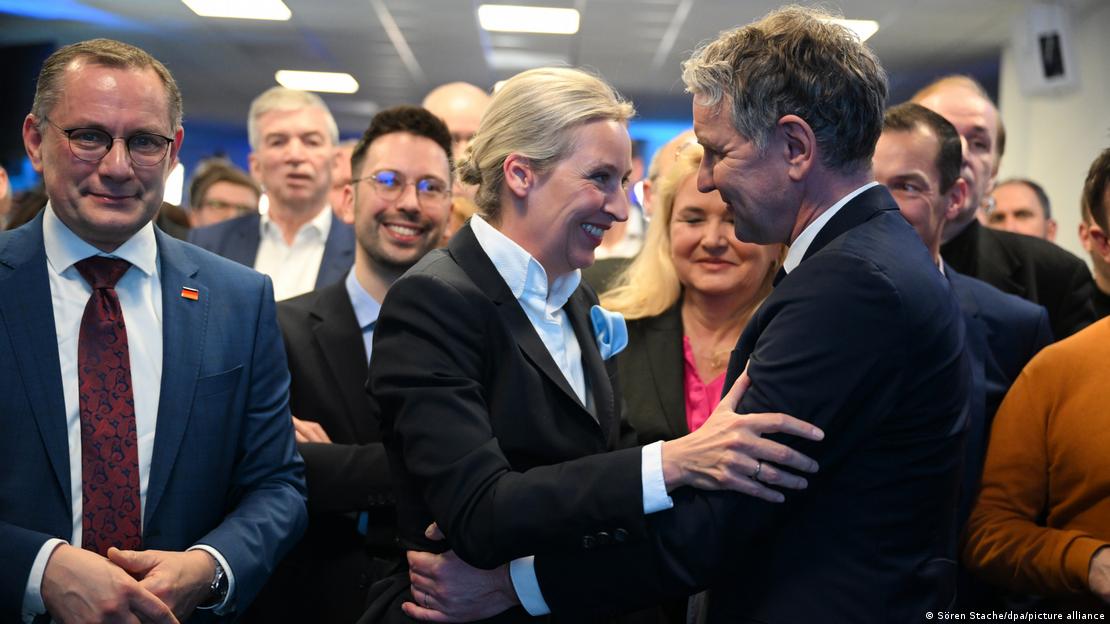
Björn Höcke (right) and AfD co-leader Alice Weidel (center left) are leading figures in the far-right partyImage: Sören Stache/dpa/picture alliance

Allegations of espionage against the Alternative for Germany (AfD) have been raised by the interior minister of the state of Thuringia. In an interview with Handelsblatt, Social Democrat (SPD) Georg Maier expressed concern that the AfD is abusing its parliamentary powers to gather information about Germany's transport infrastructure, water supply, digital infrastructure and energy supply.

"With its requests, one gets the impression that the AfD is working through a list of tasks assigned by the Kremlin," Maier told the newspaper this week.

He pointed out that the Thuringian branch of the AfD had submitted 47 such inquiries to the state parliament in the past 12 months alone — and with "increasing intensity and depth of detail."

"The AfD is particularly interested in IT and equipment used by the police, for example in the area of drone detection and defense," Maier said. Equipment used in civil protection, health care and Bundeswehr activities are also the subject of inquiries.

In Germany, Kleine Anfragen (literally "small inquiries") are an official parliamentary instrument to help parties obtain information from both federal and state governments that is not publicly available. They are primarily used by opposition parties that do not have direct access to the ministries and authorities of the government apparatus. The governments must respond to the inquiries in writing.

In Thuringia, the state and parliamentary group leader of the AfD is Björn Höcke, who is classified as a confirmed right-wing extremist by the security authorities. Höcke has been previously convicted of using a banned slogan from the Nazi era.
AfD — Praise for Putin's Russia

Höcke has also repeatedly praised President Vladimir Putin's Russia in the past. In a YouTube conversation with AfD politician Maximilian Krah in January 2023 — after the start of Russia's war of against Ukraine — he stated: "Today, whether the mainstream media wants to hear it or not, Russia does not only have negative connotations — it is also a country that some hope could be a champion for a world of free and sovereign states without hegemonic influence."

Höcke has sharply rejected the accusations of the SPD interior minister. In a statement on his Facebook account, he accused Maier of having a problem with the rule of law.

"He has no evidence to back up his claims. He is bothered by the fact that the opposition is doing its constitutional duty: monitoring the work of the government and, if necessary, criticizing it." Questions to the ministries on various issues also help prepare the AfD for assuming government responsibility, Höcke added.

Höcke said his AfD parliamentary group was considering filing a complaint against the interior minister for defamation, and called on Thuringian State Premier Mario Voigt to dismiss Maier.

The AfD is the strongest political force in Thuringia. However, because of its proven links to the far right, all other parties have refused to form an alliance with it. Since last year, the small state has been governed by a coalition of conservative Christian Democrats (CDU), center-left Social Democrats (SPD) and the left-wing populist Sahra Wagenknecht Alliance.

Bundestag: Fear of betrayal of state secrets

But Maier has also received backing from within the federal parliament, the Bundestag. Marc Henrichmann, the chairman of the Bundestag's intelligence oversight committee and a CDU member, told the RND news network: "I firmly believe that Putin is using the AfD as a compliant tool and that party leadership — as much as it claims the contrary — does not have the power to prevent this form of betrayal."

Henrichmann pointed out that, due to the same concerns, AfD lawmakers had not been elected to the Bundestag's parliamentary oversight committee. This committee meets exclusively in secret and is responsible for monitoring the work of the federal intelligence services.

The AfD has repeatedly been accused of having close ties to Russia, and numerous AfD members of the Bundestag have maintained close contacts with Putin's circle in the past. AfD Bundestag member Jan Nolte used to write for the Russian propaganda newspaper Izvestia.

Similarly, Markus Frohnmaier, deputy chairman of the AfD parliamentary group in the Bundestag, was part of the organizing team for the 2018 Yalta International Economic Forum, which was supported by the Russian government and the Russian secret service FSB. In October 2025, Frohnmaier announced his intention to travel to Moscow for political talks. Numerous other party officials have made headlines in the past with statements downplaying Russia's war against Ukraine.

For all these reasons, Maier also wants any motion to ban the party to include "the issue of treason."

"The AfD is not only hostile to the constitution due to its nationalist ideology, but also threatens our liberal democracy through its connections to authoritarian systems," he said.

This article was originally written in German.

While you're here: Every Tuesday, DW editors round up what is happening in German politics and society. You can sign up here for the weekly email newsletter, Berlin Briefing.


Hans Pfeifer DW reporter specializing in right-wing extremism