Wednesday, October 29, 2025


Report: New Zealand Insurer Linked to Iranian Dark Fleet Tankers
Iranian oil tanker
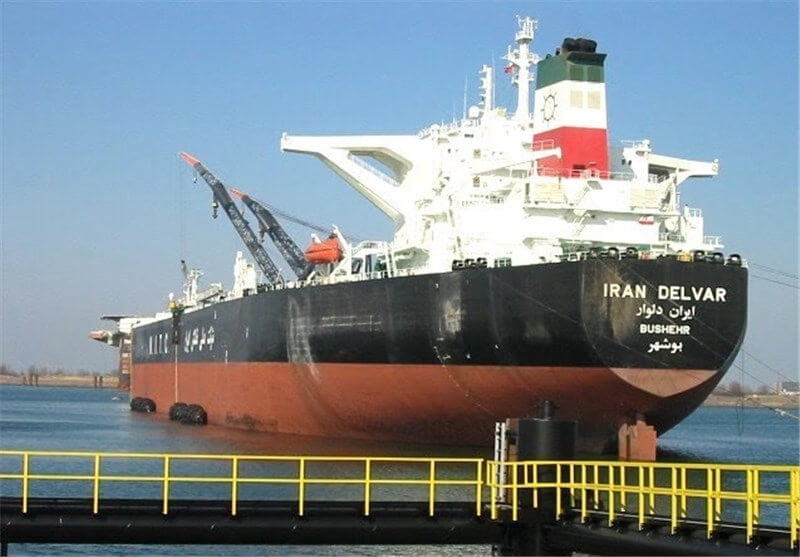
A New Zealand company is being accused of providing insurance to Iranian tankers (Tasmin News Agency - CC-BY-4.0)

Published Oct 28, 2025 12:06 PM by The Maritime Executive


A New Zealand insurer is under investigation for providing insurance for Iranian dark fleet tankers Reuters reveals in a new exposé. The report suggests that Maritime Mutual, headquartered in Auckland, has insured tankers which have carried at least $18 billion worth of Iranian oil since 2018.

New Zealand's government announced earlier this month that it would re-impose the United Nations Sanctions (Iran) Regulations 2025, following the UN Security Council vote effective October 18. Foreign Minister Winston Peters said they would introduce a range of restrictions including an asset freeze and travel bans for sanctioned persons, import and export bans on certain nuclear and military goods, and a duty on New Zealanders to exercise vigilance in dealings with Iran. New?Zealand will also be introducing a compulsory registration scheme for New Zealanders who intend to do business with Iran, which comes into effect on February 1, 2026.

Maritime Mutual has “categorically denied” the allegations, claiming it has a zero-tolerance policy toward violations, and that it operates under “rigorous compliance standards designed to ensure full adherence to all applicable laws.” The New Zealand police's Financial Crime Group searched the offices of Maritime Mutual in Christchurch and Auckland on October 16, although this was declared to be in connection with breaches of Russia-related sanctions, and the company's website currently carries a banner saying the company “is not licensed to carry on insurance business in New Zealand, and that it is not able to underwrite insurance for persons resident in New Zealand.”

Maritime Mutual claims to have insured 7,102 vessels in 2023, and over 23 million gross tonnage, with re-insurance cover from Aon, Atrium, Lockton, Hannover and Lloyds Syndicates. It maintains manager correspondents in Shanghai, Singapore, Vanuatu, Phnom Penn and in the DMCC Dubai. Unusually, Maritime Mutual does not routinely provide details of which ships it insures to the likes of S&P Global Market Intelligence and Lloyd's List Intelligence.

A standard line in police investigation of sanctions breaches is fraudulent misrepresentation, in which ship operators present insurance certification at ports, in order to secure entry, bunkering and services, but which when scrutinized proves to be forged. This line of inquiry will no doubt examine the credentials of Shiraz Marine, which claims to represent Maritime Mutual and is based in Amir Jabir Boulevard, Shiraz, to examine if insurance certification presented in its name have been forged. But contrary to implications that it could have been defrauded, Maritime Mutual appears to have enjoyed healthy average annual revenue growth of 41 percent between 2019 and 2024, up from $14 million in 2018 to $108 in 2024.

The Helsinki-based Centre for Research on Energy and Clean Air has discovered that of 231 vessels insured by Maritime Mutual over a period in early 2025, 130 were carrying energy products from Iran or Russia, and that on average 30 vessels a day that were insured by Maritime Mutual were carrying either Iranian or Russian oil. In a review using Lloyds List data, Reuters identified that 97 tankers subject to sanctions had Maritime Mutual insurance cover on the day its review was conducted. Three people contacted by Reuters in its thorough investigation commented that most of the Maritime Mutual dark fleet insurance underwriting activity is carried out in the Dubai office based in the DMCC, where many sanctioned dark fleet front companies also have offices.

Maritime Mutual appears to be a family owned and managed company, founded 20 years ago by British citizen Paul Rankin. If the United Kingdom's Office of Financial Sanctions Implementation (OFSI) were to investigate the role played in breaking Iran sanctions by British citizens employed in Maritime Mutual, which OFSI has not declared it is doing, it would represent a first, as OFSI has not been minded to levy an enforcement penalty on anyone in connection with breaches of sanctions against Iran since details of enforcement actions began to be posted in 2019. 


Georgia’s New Oil Hub Could Offer a Lifeline to Russia’s Shadow Fleet

  • A new refinery in Georgia’s Kulevi port has begun processing Russian crude, offering Moscow a potential backdoor for oil exports amid tightening sanctions.

  • The project is closely linked to Georgia’s ruling party and figures tied to Russian business interests, raising fears of growing Kremlin influence.

  • Analysts warn the move risks entangling Georgia in Russia’s war economy and could expose Tbilisi to future Western sanctions.

Russian officials have potentially opened a new revenue stream to help them generate profits from oil exports needed to keep their war effort going in Ukraine. And it runs through Georgia.

Moscow is dealing with growing energy isolation and a wave of Ukrainian drone strikes that have crippled its oil infrastructure, reducing refining capacity by roughly 40 percent, according to a Washington Post report. Georgia is now providing a safe haven for Russian oil at a new refinery in Kulevi, situated on the shores of the Black Sea. 

A tanker, the Kayseri, sailing out of the Russian port of Novorossiysk delivered over 105,000 metric tons of oil to Kulevi on October 6, according to a report published by the Reuters news agency, which cited tracking data and an industry source. A Russian company, RussNeft, reportedly organized the shipment, the Reuters report added.

RussNeft is a privately held entity that is not presently subject to sanctions, as is the state-owned entity Rosneft.  Critics argue this distinction is cosmetic. RussNeft’s founder, Mikhail Gutseriev is under EU sanctions, and his family remains influential within the company. Many observers also contend that in Russia's state-controlled economy, no major business operates independently from the Kremlin.

Adding to the murkiness, independent monitors tracking Russia’s so-called “shadow fleet” of tankers have flagged the Kayseri as a suspected vessel in this opaque system.

In response to public scrutiny, Georgia’s State Revenue Service confirmed the arrival of Russian cargo but stressed that “the ship and the ship-owning company, as well as the companies sending and receiving the cargo, are not subject to international sanctions.” The agency declined to disclose the name of the receiving company, citing tax secrecy.

Other government bodies echoed the same line, emphasizing that while the cargo originated in Russia, the ship sailed under a Panamanian flag.

However, the Revenue Service added that “the cargo was unloaded at a temporary customs storage facility to undergo further customs inspection procedures.” This is the most recent publicly available information regarding the Siberian Light oil shipment that entered Georgia.

The Kulevi refinery was inaugurated a year ago with great fanfare. Prime Minister Irakli Kobakhidze and then-economy minister Levan Davitashvili hailed it as “one of the most important projects for the country’s energy security and independence.”

The facility is operated by Black Sea Petroleum, owned by Maka Asatiani, a business figure close to the ruling Georgian Dream party. Recently, an independent Russian investigative media outlet reported that Asatiani’s son is involved in business dealings with the son of the first deputy head of Russia’s military intelligence service, the GRU.

In September, ex-minister Davitashvili became chairman of the refinery’s board, a move underscoring the ruling party’s growing influence and vested interest in the project. In addition, one of the project's main backers is Cartu Bank, founded by Bidzina Ivanishvili, the billionaire impresario of Georgian Dream.

“The import of Russian oil into Georgia for processing once again highlights the [Bidzina] Ivanishvili government’s support for Russia in its war against Ukraine,” security expert and former Georgian parliament member Teona Akubardia said in an interview published by a regional news outlet, Batumelebi. “It also raises the country’s risk of future sanctions, especially as Ukraine continues legitimate strikes on Russia’s energy sector.”

The refinery began operations earlier this month with an initial processing capacity of 1.2 million tons of oil per year (around 24,000 barrels per day) and plans to expand to 4 million tons by 2028, serving both domestic and export markets.

Since fighting a five-day war in 2008, Russia and Georgia have had no formal diplomatic ties. Yet under Georgian Dream, Tbilisi’s economic links with Moscow have deepened while relations with the United States and European Union have gone into a deep freeze. In 2024, Georgiasourced roughly 40 percent of its oil products from Russia.

Political expert Gia Khukhashvili in an interview with RFERL, accused the Georgian Dream government of pursuing a “collaborationist policy” with the Kremlin.

The United States only recently imposed major sanctions on Rosneft and Lukoil, Russia’s two largest oil companies. India and China, Russia’s top oil buyers, reportedly paused imports, wary of secondary sanctions. Against this backdrop, Georgia’s new refinery could become a small, sanction-free outlet for Russian oil, though its impact on Moscow’s exports remains uncertain.

Georgian Dream leaders have long sought to justify their geopolitical turn away from the West by claiming without evidence that Washington and Brussels were intent on using Georgia to open a ‘second front’ against Russia in the Ukraine war.

But Georgian Dream’s evident tolerance of the acceptance of a Russian oil shipment at Kulevi would appear to do more than any other single development in the country since 2022 to potentially entangle Georgia in the war.

By Eurasianet


Iranian Prosecutors Seek $170M Fine in Connection With MSC Aries Seizure
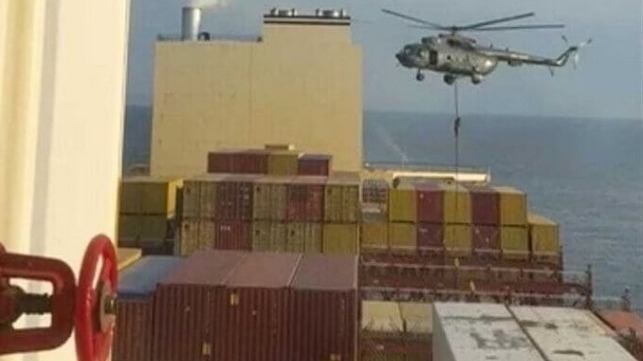
Troops rappelling from the copter to the MSC Aries (Mehr News - Creative Commons Attribution 4.0 International License)

Published Oct 28, 2025 4:40 PM by The Maritime Executive

Iranian prosecutors are seeking a hefty fine from London-based Zodiac Maritime in connection with the seizure of MSC Aries, the Zodiac-owned boxship that was seized by Iranian forces in February on the pretext of carrying "hazardous and harmful materials." Charges have been filed in connection with the case in Iranian courts. 

"A fine of $170 million has been demanded against its owner, of Israeli origin," said judicial spokesman Asghar Jahangir on Tuesday. 

MSC Aries was seized by Iranian operatives near the Strait of Hormuz on April 13, 2024, one day before Iran launched a massive drone and missile attack on Israel. The ship was impounded and its 25 crewmembers were detained. The seizure was not out of character for Iran, where authorities periodically capture diplomatically-relevant vessels at moments of geopolitical tension. 

MSC Aries is owned by an affiliate of Zodiac Maritime and bareboat chartered to operator MSC. Zodiac is domiciled in the UK and considers itself a British firm; one of its owners is Eyal Ofer, one of the world's 100 richest people, who currently manages his fortune out of Monaco. Ofer is of Israeli extraction: he is one of the two sons of Israeli shipping legend Sammy Ofer, and is described by some Israeli media as "Israel's wealthiest individual." In Iran, he is considered a "Zionist capitalist," and stands accused of "financing terrorism." 

A hazmat-carriage charge - like the underlying offense claimed by Iran - is unusual, as it is normal for container ships to carry hazardous goods in bulk. A safety violation of this type would typically be treated as a civil or administrative matter in most global seaports, not a criminal case, and the shipowner would be allowed to post a bond to release the vessel while the court process played out. 


COSCO and Everllence Complete Large Engine Methanol Refit for Containership

methanol-fueled containership
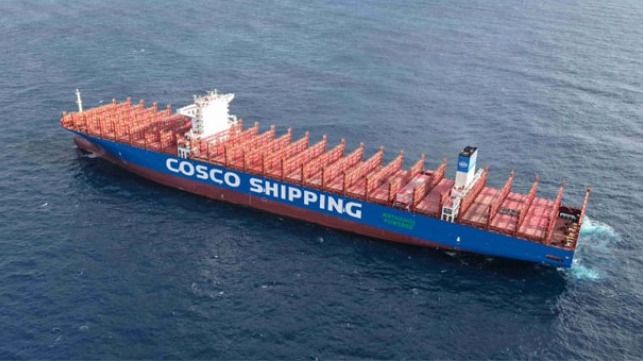
COSCO Shipping Libra was the first conversion of a large, two-stroke engine to methanol (CCS)

Published Oct 28, 2025 7:43 PM by The Maritime Executive


The conversion of ships to dual-fuel methanol capabilities continues to gain momentum with COSCO Shipping Lines, the China Classification Society, and Everllence (formerly MAN), working together to undertake the first methanol conversion of a large two-stroke engine. The project was completed in September, and according to Everllence, it opens another pathway for shipowners and operators to move forward with decarbonization initiatives.

Maersk completed the first large containership methanol refit 10 months ago, at China’s Zhoushan shipyard. The Maersk Halifax (15,000 TEU) was rebuilt in 2024, working Everllence, and the vessel returned to service in November 2024.

The COSCO project broke further ground as the first time the Everllence B&W S90 two-stroke engine was converted to dual-fuel methanol capability. The large-bore engine has been a popular choice for many ships, with Everllence highlighting that the project demonstrates the possibilities for further large-bore retrofits. The China Classification Society notes it was their first methanol conversion project, and it was unique as the main and auxiliary engines were simultaneously converted.

The project was carried out on the COSCO Shipping Libra (201,823 dwt), a containership built in China at DSIC in 2018. The ship has a capacity of 20,119 TEU. The conversion lasted more than three months at COSCO Heavy Industries’ yard in Shanghai.

Everllence PrimeServ, the company’s after-market division, was assigned the engineering, project management, installation, commissioning, and overseeing the sea trials. The company highlights that it validated the S90 engine’s methanol performance under real operations before the project on a new testbed engine in Japan.

The vessel was handed back to COSCO on September 25 in Shanghai, marking the completion of the conversion. The Hong Kong-registered vessel is back in service, having departed China, and then Singapore on October 6, bound for Rotterdam. In addition to the conversion projects, COSCO has committed to newbuild containerships equipped for methanol.

Everllence reports it has already completed 26 dual-fuel conversions. It says that with over 300 vessels equipped with S90-class engines, there is a large pool of potential candidates for similar retrofits. DNV on its Alternative Fuels Insights database listed a total of 77 vessels, including 38 containerships, currently equipped to operate on methanol. It reports that a further 365 methanol-fueled vessels are on order for delivery by 2030.
 

Rolls-Royce Tests First High-Speed Methanol Marine Engine

Rolls Royce methanol engine
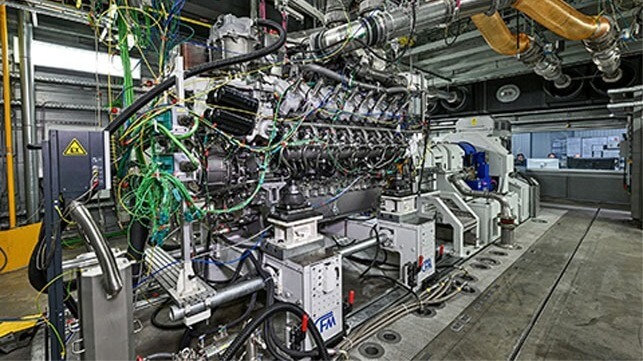
Rolls-Royce, injection system specialist Woodward L’Orange, and the WTZ Roßlau technology and research center have been working o the engine (Rolls Royce)

Published Oct 27, 2025 7:35 PM by The Maritime Executive


Rolls-Royce has successfully tested the world’s first high-speed marine engine powered exclusively by methanol on its test bench in Friedrichshafen. Together with their partners in the meOHmare research project, Rolls-Royce engineers have thus reached an important milestone on the road to climate-neutral and environmentally friendly propulsion solutions for shipping.

“This is a genuine world first,” said Dr. Jörg Stratmann, CEO of Rolls-Royce Power Systems AG. “To date, there is no other high-speed engine in this performance class that runs purely on methanol. We are investing specifically in future technologies in order to open up efficient ways for our customers to reduce CO2 emissions and further expand our leading role in sustainable propulsion systems.”

Rolls-Royce’s goal is to offer customers efficient ways to reduce their CO2 emissions, in-line with the ‘lower carbon’ strategic pillar of its multi-year transformation programme. The project also aligns with the strategic initiative in Power Systems to grow its marine business.

The joint project meOHmare is funded by the German Federal Ministry for Economic Affairs and Energy and combines the expertise of Rolls-Royce, injection system specialist Woodward L’Orange, and the WTZ Roßlau technology and research center. The goal is to develop a comprehensive concept for a CO2-neutral marine engine based on green methanol by the end of 2025.
 

The products and services herein described in this press release are not endorsed by The Maritime Executive.


Historic Tunnel Breakthrough Achieved by “Mary”

ARC Group
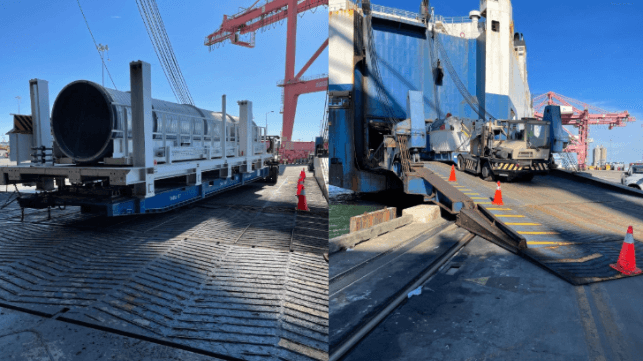
Components of ‘Mary’ delivered to Port of Norfolk’s NIT North Terminal in 2021

Published Oct 28, 2025 7:14 AM by The Maritime Executive

[By: ARC Group]

American Roll-On Roll-Off Carrier Group (ARC) congratulates the Hampton Roads Connector Partners (HRCP) and the Virginia Department of Transportation (VDOT) on achieving the final breakthrough of the Tunnel Boring Machine (TBM) "Mary" for the Hampton Roads Bridge-Tunnel (HRBT) Expansion Project.

“TBM ‘Mary’s’ work is an amazing feat of engineering that has played a critical role in transportation in the Hampton Roads area, including my district,” said Representative Robert J. Wittman (R-VA-1). “It is gratifying to see that a U.S.-flag carrier supported this project, transporting ‘Mary’ to Norfolk from overseas. It is a demonstration of the importance of a commercially viable and militarily useful U.S.-flag fleet to this nation.”

"We are proud that our specialized U.S.-flag service played a vital role in the supply chain for a project that will dramatically improve commerce and quality of life for the citizens of Hampton Roads,” said Christopher Barber, ARC Group Senior Director of Sales. “Seeing 'Mary' complete her work underscores the importance of reliable shipping and logistics in launching and sustaining major infrastructure initiatives across the United States.”

ARC Group served as the logistics partner for this game-changing project. ARC's specialized fleet successfully transported the massive, custom-built TBM from Germany to the Port of Norfolk in November 2021. This required a unique heavy-lift capability, as the assembled "Mary" is 46 feet tall, over 430 feet long, and weighs more than 9 million pounds.

The successful completion of the second tunnel's bore marks a milestone for Virginia's largest-ever highway construction project, bringing the Hampton Roads region one step closer to significantly reducing traffic congestion. The safe and timely delivery of the machine, which is now nearing the end of its mission, was a critical first step in enabling the entire tunneling phase.

“The final breakthrough of TBM 'Mary' is a triumph of American engineering and a testament to collaboration across HRCP, VDOT, Transport Overseas Group and ARC Group," Barber continued.

With the tunneling now complete, work will continue to outfit the new tunnels, which are scheduled to open when the HRBT Expansion Project is finished in 2027.

The products and services herein described in this press release are not endorsed by The Maritime Executive


Kenya's Navy Seizes $60M Worth of Meth in Indian Ocean

HMS Montrose meth bust 2022
File image courtesy CMF / Royal Navy

Published Oct 27, 2025 10:49 PM by The Maritime Executive


Authorities in Kenya have charged six Iranians arrested in the high seas for trafficking a massive consignment of methamphetamines worth $63 million, and described the seizure as a major breakthrough in the fight against transnational organized crime and drug trafficking.

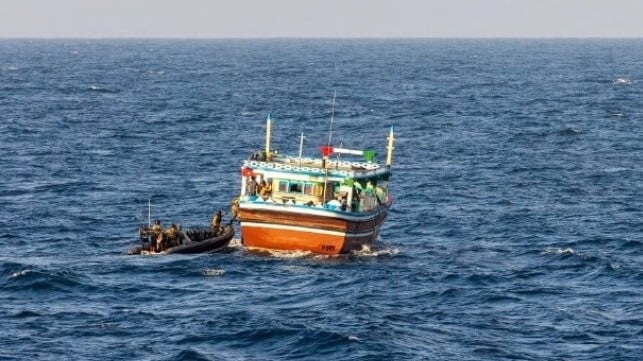
The arraignment in court comes after a multi-agency team intercepted a stateless dhow loaded with 1,024 kilograms of meth off the Kenyan coast. The dhow, MV Ighol, was intercepted some 630 kilometers off the coastal city of Mombasa - far beyond the 12-mile limit of Kenya's territorial seas.

The dhow was intercepted by the Kenya Navy ship Shupavu in an operation under the Safe Seas Africa Program. The program is a European Union-funded initiative aimed at improving maritime security across the western Indian Ocean and Gulf of Guinea.

Authorities said that the vessel was on the radar of international authorities for suspected narcotics trafficking in the Western Indian Ocean. Following the interception on October 23, it was escorted to the Port of Mombasa under tight security, and a search was conducted two days later, leading to the discovery of 769 packages of meth.

Six Iranian crew members were arrested, with authorities also recovering seven mobile phones that are now the subject of forensic investigation. 

The six who were presented in court were identified as Jasem Darzadeh Nia, Nadeem Jadgal, Imran Baloch, Hassan Baloch, Rahim Baksh, and Imtiyaz Daryayi.

The consignment is one of the largest intercepted by Kenyan authorities. The operation also involved the Kenya Coast Guard Service, the Directorate of Criminal Investigations and the National Authority for the Campaign Against Alcohol and Drug Abuse. Agencies in Seychelles and Madagascar also provided operational support leading to the interception of the dhow.

“We remain steadfast in our commitment to strengthen inter-agency cooperation, enhance maritime and border security, and reinforce partnerships with regional and global allies to combat the production, movement and financing of illicit substances,” said Kipchumba Murkomen, Interior Cabinet Secretary.

The Kenya Navy has been deploying the patrol ship Shupavu to increase surveillance in the country’s coastal waters. Built by Gondan shipyard in Spain, the vessel was acquired by Kenya in 1996. In 2021, the ship underwent mid-life upgrades at Kenya Shipyards Limited to continue serving the country’s maritime interests.

MURDER ON THE HIGH SEAS

Video: U.S. Escalates Strikes on Alleged Drug Boats in Pacific

drug running boat
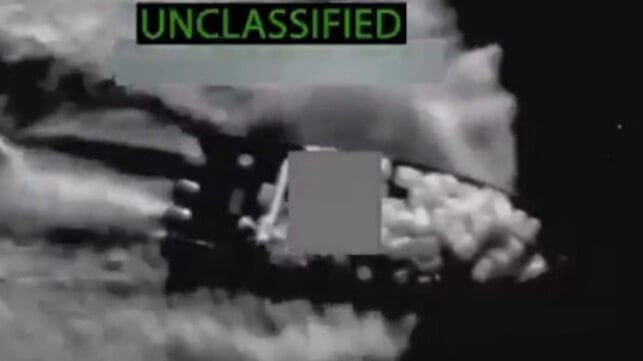
One of the boats is clearly seen carrying a large number of bundles (Hegseth on social media)

Published Oct 28, 2025 12:52 PM by The Maritime Executive


The United States appears to be escalating its attacks on alleged drug-running boats. Yesterday, for the first time, the U.S. struck four boats all in the Eastern Pacific in one day, killing at least 14 individuals, according to Pete Hegseth’s posting on social media.

The statements continue to contend that all the boats are drug runners, which Hegseth refers to as narco-terrorists. The U.S. contends they are all working for “designated terrorist organizations,” and that the boats have been identified by intelligence. The reports claim all the boats are traveling “known narco-trafficking routes,” and are laden with narcotics.

The Associated Press is citing unnamed sources at the Pentagon saying the latest strikes came on Monday, October 27, off the coast of Colombia. Hegseth only reports that the boats were in international waters in the Eastern Pacific.


In the video posted online, one of the boats is clearly laden with large bundles. It is less clear on the others, and two of the boats appeared to be tied together and largely empty before they were seen exploding.

Hegseth reports there were eight males aboard two boats in the first strike. The second involved four males and three in the third strike. Based on the social media reports, at least 57 people have been killed in the 13 or 14 attacks acknowledged by the United States since early September.  Most of the reports have been of incidents in the Caribbean, although Hegseth last week reported efforts in the Eastern Pacific.

Hegseth acknowledged that USSOUTHCOM command identified a possible survivor after yesterday’s attacks and notified the U.S. Coast Guard and Mexican officials. He said the Mexicans “assumed responsibility for coordinating the rescue.” AP reports a person was spotted in the water clinging to some wreckage, but notes it is unclear if the person was successfully rescued and survived.


Sanctioned Russian Tanker Breaks Down in Suez Canal

Suez Canal
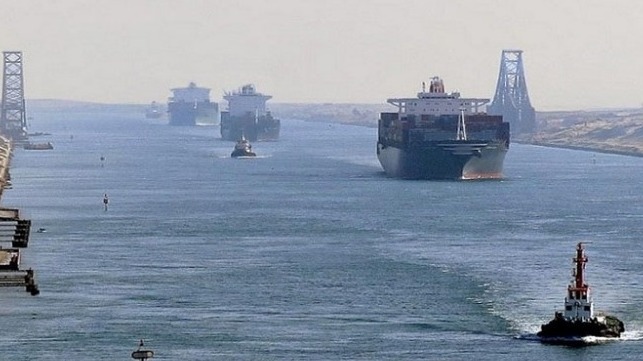
Tanker at the end of today's convoy grounded briefly interrupting movements in the Suez Canal (SCA file photo)

Published Oct 28, 2025 2:35 PM by The Maritime Executive


A sanctioned Russian crude oil tanker traveling as part of the southbound convoy in the Suez Canal broke down on Tuesday, October 28, briefly interfering with transits. The Suez Canal Authority is emphasizing its quick response to get the tanker, which had grounded, back underway.

The ship, which is currently trading under the name Komander, is another flagrant example of the tactics of the shadow fleet. Built in 2004, the 150,580-dwt tanker has had four names and six flags in the past three years. It passed in 2023 to Gatik Shipmanagement, well-known for its operation of Russian shipping, and reported its flag in 2023 as Gabon, 2024 in Panama, and in 2025 it listed Guyana (which was believed to be false), Comoros, and since September it lists Russia. During these times, the vessel has identified as HeraclesKrishna 1Prudence, and since September Komander.

It is listed in the databases as being owned by a Hong Kong company and managed from Russia. The United States, the UK, and the EU have all listed it in their sanction packages for transporting Russian oil above the G7 price cap. It is a Suezmax class tanker with the Canal Authority reporting an 80,000-ton cargo. The vessel is 274 meters (899 feet) in length.

The tanker is believed to have loaded its current cargo in Murmansk and is likely bound for China. It was part of the Suez Canal convoy heading south today, and the authority reports it received a report at midday that the tanker’s engine was malfunctioning. It drifted out of the lane and grounded at kilometer 47.

The Suez Canal Authority dispatched five tugs, and they began a towing operation to refloat and realign the tanker in the channel. The authority says the first part of the operation was completed in just 30 minutes. They then began towing the tanker south to the lakes area. 

The Suez Canal Authority said all traffic has resumed normal operations. They reported that a total of 34 vessels were making the transit in both directions today, representing a total of 1.4 million net tons. Reports said the Komander was the last ship in the 19-vessel southbound convoy.


Russia May Have Installed Spying Devices on Grave Site of Ferry Estonia

Viking Sally - Estonia
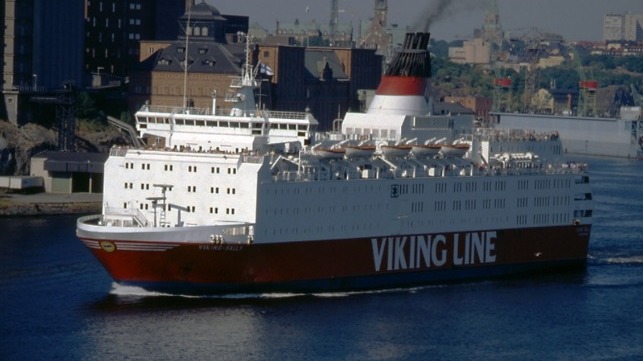
MV Estonia, seen here in earlier livery as the Viking Sally (Mark Markefelt / CC BY-SA 4.0)

Published Oct 28, 2025 2:47 PM by The Maritime Executive


The wreck of the ferry Estonia is a protected grave site in the Baltic Sea, and diving is prohibited at the location of the tragic accident. Taking advantage of these protections, Russia's subsea intelligence service may have used the wreckage as a training ground and a mounting fixture for underwater espionage devices, according to a new investigative report by German outlets NDR, WDR and Süddeutsche Zeitung.

The loss of the Estonia is among the most discussed and debated marine casualties in living memory. On the night of September 27, 1994, the ro/pax ferry got under way from Tallinn to Stockholm in rough weather, with winds of up to 40 knots and waves of up to 20 feet. In the early hours of the next morning, passengers and crew heard a loud bang. The vessel's bow visor broke loose, resulting in flooding and free surface effect on her vehicle decks. The Estonia listed to 60 degrees within just 15 minutes, eliminating the possibility of launching lifeboats, and the vessel sank in less than an hour after the first signs of trouble. In cold water, many of those who managed to abandon ship perished, and only 137 out of 989 people aboard ultimately survived. 

After the sinking, a treaty signed between Baltic nations prohibited visits to the wreck site. Civilian private investigative expeditions dove to the Estonia site anyways in 2020-21, over the objections of regional authorities; officially-sponsored efforts continued through 2024. With these limited exceptions, the wreck has remained largely undisturbed over the decades. 

This isolation and treaty protection suits the interests of Russia's secretive and well-resourced Main Directorate for Deep-Sea Research (GUGI), according to the new German report. GUGI is an operator of "research" vessels and deep-diving submarines, and it sits in its own command structure directly under the Russian Ministry of Defense. It is widely believed to be the leading practitioner of underwater surveillance and sabotage within Russia's military system, and is allegedly involved in the effort to map out NATO member states' subsea cables and pipelines. Its manned submarine assets are believed to be capable of tampering with or emplacing assets on the seabed. 

Subsea intelligence agencies have an essential role to play in submarine warfare, and it is their job to apply the best available oceanographic research and technology to hunt other nations' boats. The U.S., Russia and China all operate deep-sea listening networks to track each others' submarines; the best-known example is the U.S. SOSUS system, a vast surveillance enterprise constructed in the Cold War to monitor Soviet submarine movements. 

The Baltic presents operational challenges for hiding such subsea listening devices, according to the German report. A sandy bottom provides few secure and tucked-away spots to place the gear, leaving it vulnerable to detection and seizure. The wreck of the Estonia may have been used to resolve this issue, military intelligence representatives told the German reporters. It provides hard mounting points on a complex structure that is almost never visited, in an ideal location in the middle of the central Baltic. GUGI used the site for training, the sources said, and may also have installed subsea navigation beacons and listening devices on the wreckage. 

Sweden's government contracted for a complete photogrammetric survey of the wreck in 2022, and it obtained about 45,000 images of the entirety of the site. These were assembled into a complete 3D model. If any unauthorized devices were present, they could have been detected at that time; no untoward findings were reported publicly. 

Finnish and Estonian authorities answered the reporting consortium's questions, but did not confirm the reports directly. The Estonian foreign ministry noted that Russia's operations in the Baltic have become much more aggressive since 2022; beginning in January 2025, NATO member states ramped up monitoring of Russian activity with the launch of Operation Baltic Sentry, a patrol mission intended to deter "hybrid warfare" sabotage and surveillance.

Top image: MV Estonia, ex name Viking Sally (Mark Markefelt / CC BY-SA 4.0)


Salvage Efforts Prepare Grounded MSC Baltic III for Winter

grounded containership
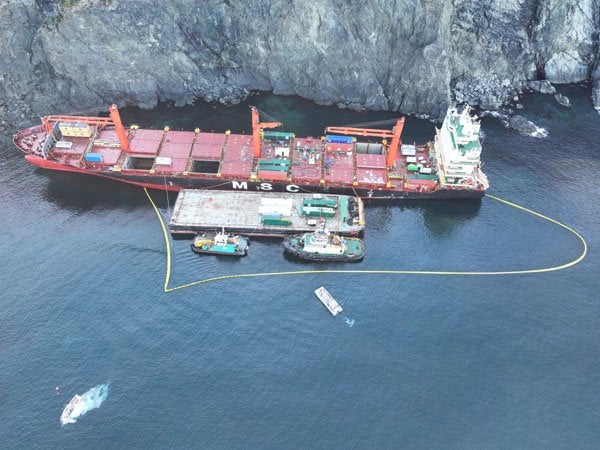
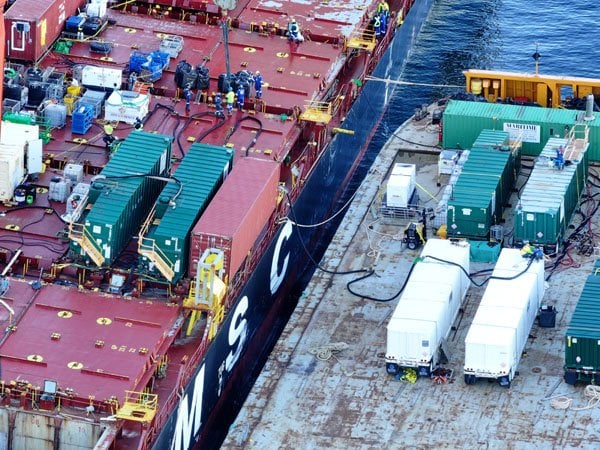
MSC Baltic III has been aground since February with the salvage efforts removing oil and container (Canadian Coast Guard photo)

Published Oct 28, 2025 4:41 PM by The Maritime Executive


Salvage efforts are continuing eight months after the containership MSC Baltic III went aground in a remote cove on the west shore of Newfoundland, Canada. While the majority of the fuel and cargo have been removed from the vessel, they are focusing on additional cleanup as the vessel is prepared for the onset of winter weather in the region.

The 207-meter (679-foot) vessel (33,767 dwt) was driven ashore in a fierce winter storm in February 2025 with a daring helicopter rescue of the crew. It came to rest in Cedar Cove, and surveys later showed cracking in the hull, which led to the determination that the approximately 1.7 million liters of heavy fuel and marine gas oil onboard and 470 containers, half of which were empty, needed to be removed from the ship.


Status of the cleanup operation as of October 2025 (Canadian Coast Guard)


As of October, the Canadian Coast Guard reports that nearly all the fuel has been pumped from the ship’s tanks. The operation required heating and pumping it to a tank on deck and then again to a barge that was positioned alongside. The fuel was ultimately transferred to other MSC containerships when they called at Corner Brook.

The efforts are continuing to focus on cleaning the tanks to remove as much residual oil as possible from the ship. Also, the contents of the slop tanks have been pumped to the deck to be offloaded. The effort is focusing on flushing the tanks. Bruce English, who is overseeing the salvage operation for the Canadian Coast Guard, told The Telegram newspaper that they would not be able to complete the flushing 100 percent because time is running out before the arrival of winter weather.


Material removed from the containership is transferred to a barge alongside (Canadian Coast Guard)


The salvage team hired by MSC has also removed 407 containers from the ship. Some of the containers that remain in the holds have water that entered the holds, and the contents have become soaked. Some of the containers are also misshapen the newspaper reports, and with the water, have become too heavy to lift to the deck with the ship’s crane. Also, some of them contained food products that decomposed and are generating noxious gases.

English told the newspaper that if the weather permits, the salvage team might cut open some of the 65 remaining containers. However, he said the oil remains the top priority. Removing the containers would also require a barge with splash guards to contain anything that might leak during transport.

In an effort to winterize the vessel, they also flooded some of the tanks to add ballast. However, they want the vessel to continue to be able to shift, or they fear winter waves and storms could cause more damage to the hull.

The weather has continued to be a problem and limits the times crews can get aboard the vessel. Work was being completed on a cableway from the shore to the vessel. It will be able to transfer personnel and improve access to the vessel.

English told The Telegram that the fate of the ship remains undecided and that it will be staying in the cove till at least spring. He said it was still possible the ship might be able to be refloated, or it could eventually be dismantled in the cove.


Launch Sinks After Colliding With Tanker in Amsterdam, Killing One

Afrikahaven
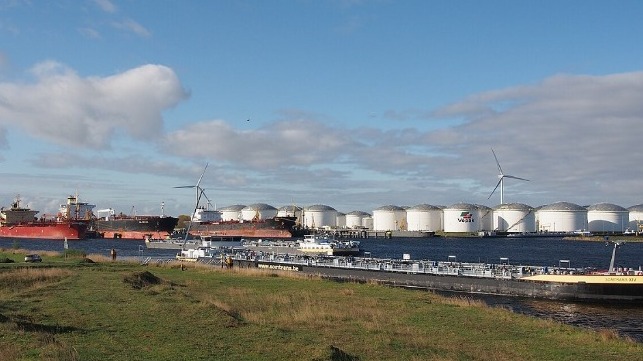
The collision occurred in the Afrikahaven section of Amsterdam's Western Docklands (Alf Van Beem / public domain file image)

Published Oct 27, 2025 8:25 PM by The Maritime Executive


One person has been found dead and one more remains missing after a collision between a tanker and a harbor launch in Amsterdam's harbor, according to local media. 

On Sunday evening, the small water taxi KP 17 got under way from a tanker terminal in Ruigoord, on the western outskirts of the port of Amsterdam. It headed north, its AIS track shows, intending to enter the Noordzeekanal. But when it neared the junction with the busy waterway, it was hit by a tanker, dragged, then sunk at an unknown position, according to local outlet Schuttevaer. 

There were two people on board, both employees of the punt's owner. Both went missing in the sinking, and a large-scale search was launched shortly after. Officials scaled back the effort about 2200 hours, citing the amount of time elapsed and the diminishing likelihood of finding survivors. The National Underwater Search Team and local police divers joined the operation on Monday, and they recovered a body from the water at about 1700 hours that evening, reports NH Nieuws. As of Monday, the authorities were still working to confirm the identity of the victim, according to NL Times. 

Plans are in the works to raise the wreck of the punt, but this will not happen immediately; the authorities believe there are no bodies in it, and are focusing the earch effort elsewhere for now. 

The KP 17 was owned by a water taxi and line-handling company, De Koperen Ploeg ("The Copper Plow"). The firm is a century-old specialist in tendering operations, delivering goods and people to ships throughout the Port of Amsterdam.


Two Dead, 20 Injured as Russian Floating Crane Capsizes in Sevastopol

capsized crane
Floating crane under construction is Sevastopol fell over killing two people (Investigative Committee)

Published Oct 28, 2025 3:46 PM by The Maritime Executive


Russian authorities are saying a criminal investigation exploring possible negligence will be launched after a floating crane capsized in Sevastopol on October 28. The Russian-installed governor of Sevastopol, Mikhail Razvozhaev, said two people had been killed and a total of 20 injured when the crane fell onto its side in Yuzhnaya Bay.

Media reports state that the crane was undergoing a lifting test during the afternoon when it capsized. At least 15 people were reported to have fallen into the water and were being given medical attention, with seven reported to have been taken to a hospital. The two individuals who died, The Moscow Times reports, were identified as an electro-mechanic and a sailor.

The crane named Gregory Prosyankin was being built to support construction and maintenance work on nuclear submarines and surface vessels, The Moscow Times reports.

The project has been plagued by delays and financial problems. The crane was first announced in 2018 with a capacity to lift a maximum of 700 tons. It is 6,200 tons displacement. The project was intended to be completed by 2020.

Reports are that the crane was approximately 65 percent complete. Work was stopped in 2023, the newspapers report, and plans were being considered to disassemble the crane and move it away from the Sevastopol Marine Plant to be completed at another yard. It is unclear when work resumed on the crane.

Razvozhaev said the Main Investigative Department would be conducting the investigation into what was termed “an abnormal situation.”
 

Crewmember Dies in Accident at Sea on P&O Cruise Ship

cruise ship Arvia
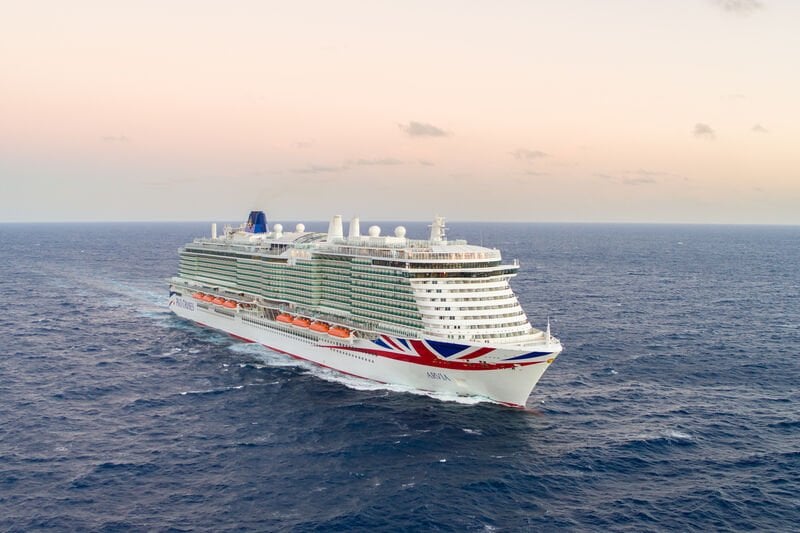
British cruise ship Arvia was at sea when the accident occurred killing one crewmember (P&O file photo)

Published Oct 27, 2025 7:21 PM by The Maritime Executive


The British press and maritime authorities are reporting that a crewmember was killed yesterday aboard the P&O cruise ship Arvia. The ship was two days into a two-week cruise to the Caribbean from the UK.

The Arvia, which is 185,581 gross tons, is one of the largest cruise ships in the world, and with her sister ship Iona, is the largest operating from the UK. The Arvia was introduced by the UK’s P&O Cruises in 2022 and is 344 meters (1,128 feet) in length with accommodations for more than 6,600 passengers and approximately 1,800 crew.

P&O confirmed in a brief statement that there had been an onboard accident. It said its thoughts and prayers were with the onboard friends and family members. The company provided no further details.

While registered in Bermuda, the cruise ship is under the authority of the British, and the UK’s Marine Accident Investigation Branch listed the incident today. It is posted it as a “lift shaft” (elevator) accident that happened on October 26. MAIB reports that it will investigate on behalf of the Bermuda Shipping and Maritime Authority.

The cruise had been en route to its first port in Tenerife. However, Puerto de A Coruña, on the northern Spanish coast, reported that the Arvia made a stop on October 26 from 3:00 p.m. into the night “following a workplace accident.” The ship stayed till around midnight and has resumed its trip to Tenerife.