It’s possible that I shall make an ass of myself. But in that case one can always get out of it with a little dialectic. I have, of course, so worded my proposition as to be right either way (K.Marx, Letter to F.Engels on the Indian Mutiny)
Wednesday, October 29, 2025
Kuwait to Invest $4 Billion in Oil Exploration by 2030
Kuwait Oil Company, the national oil firm of one of OPEC’s biggest Gulf producers, plans to invest as much as $3.9 billion (1.2 billion Kuwaiti dinars) in exploration drilling by 2030, a senior company executive told Reuters in an interview published on Wednesday.
The exploration drilling program is part of a bigger drilling and maintenance program by the end of the decade, with a budget of $32 billion (9.8 billion dinars), Khaled Al-Mulla, Kuwait Oil Company’s Deputy CEO for Exploration and Drilling, told Reuters.
This is the biggest long-term budget for the Kuwaiti national oil company ever. With it, the firm plans to drill and maintain up to 6,193 wells by 2030.
Oil production capacity in Kuwait this year hit a more than decade high of 3.2 million barrels per day (bpd), Tareq Al-Roumi, the Oil Minister of Kuwait, said last month.
Kuwait had a similar production capacity in the late 2000s, with capacity hitting the highest on record of 3.3 million bpd in 2010. Kuwait’s oil production capacity began to drop after 2010, but the OPEC heavyweight has launched a program in recent years to raise it.
Earlier this year, Kuwait said it plans to invest as much as $50 billion to raise its oil production capacity to nearly 4 million bpd over the next five years, Arabian Gulf Business Insight (AGBI) quoted Kuwait Petroleum Corporation’s deputy chairman and CEO, Shaikh Nawaf Al-Sabah, as saying.
Kuwait is “planning to invest $9 to $10 billion annually in the next five years” to increase its oil production capacity, Al-Sabah said.
Kuwait, a founding member of OPEC, is the cartel’s fifth-largest producer, behind Saudi Arabia, Iraq, Iran, and the United Arab Emirates (UAE).
Higher oil production capacity could help Kuwait argue for a higher oil production quota in the OPEC+ deal, with which the major Gulf producers and Russia have been managing supply for nearly a decade.
German environmental and human rights group Urgewald has exposed how major financial institutions continue to bankroll the metallurgical coal industry, funnelling nearly $52 billion into mine expansions between 2022 and 2024 despite global climate commitments.
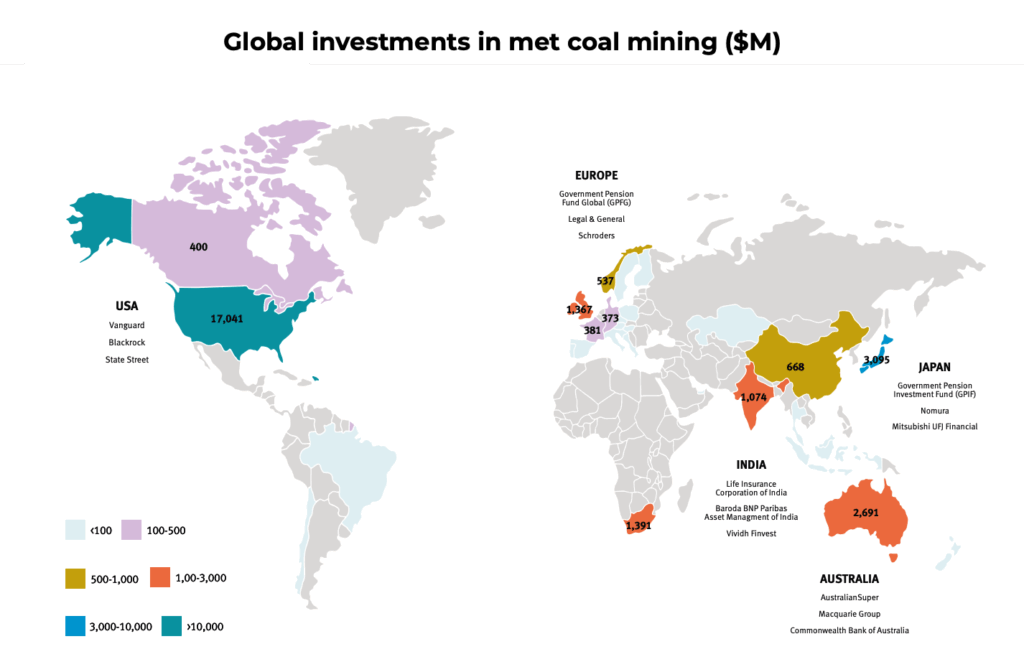
Its new report, Still Burning: How Banks and Investors Fuel Met Coal Expansion, reveals that banks provided $22 billion in loans and underwriting during the period, while institutional investors hold $30.23 billion in securities tied to companies expanding coal mining operations. The top investors include Vanguard, BlackRock, and State Street.
Urgewald, which earlier this year launched the first global database of metallurgical coal developers, says many financiers have pledged to end coal funding but exclude metallurgical coal from those promises, which the say it’s a “dangerous” loophole to climate goals. Met coal accounts for about 11% of global CO₂ emissions.
“Met coal fuels the climate crisis just the same as thermal coal,” Lia Wagner, met coal expert at Urgewald, says. “Banks and investors that ignore this fact are financing the destruction of our planet’s carbon budget.”
Steelmakers rely on metallurgical or coking coal to provide the carbon and heat needed to turn iron ore into molten iron in blast furnaces. While electric-arc furnaces are advancing, they must rely on scrap metal which means they can’t replace coking coal at industrial scale. Green-hydrogen methods can work, but they need abundant cheap renewable power and large-scale hydrogen production, which are not yet widely available.
Until those alternatives mature, analysts warn that met coal will stay critical to building the wind turbines, transmission lines and electric vehicles (EVs) driving the energy transition itself.
China, US lead financing
The report identifies 201 banks that financed metallurgical coal developers in recent years, with Chinese institutions dominating at 67% of global funding — roughly $14.7 billion. China Everbright, CITIC, and CSC Financial top the list, driven by demand from China’s massive blast-furnace steel industry.
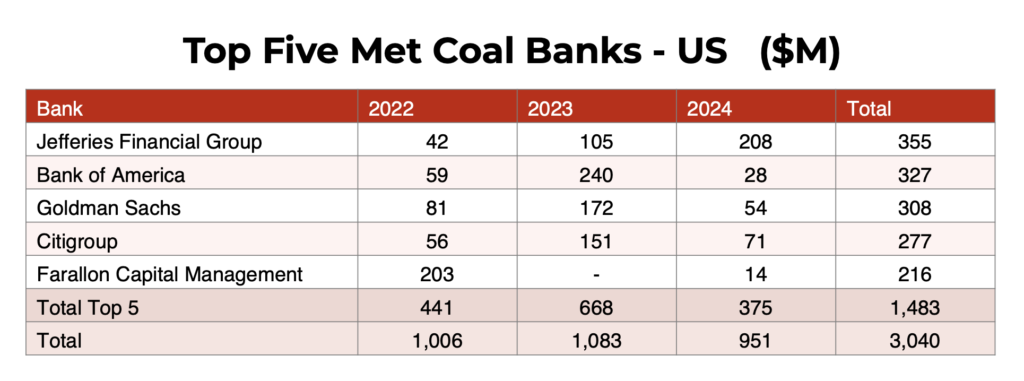
The United States ranks second, contributing $3.04 billion. Jefferies Financial Group leads U.S. financiers, increasing its met coal funding nearly 400% since 2022. In 2024, Jefferies, along with KKR Group and Deutsche Bank, arranged a $2 billion loan to Peabody Energy, which later abandoned a major acquisition following mine fires in Queensland, Australia.
“Even as the market signals decline, US financiers are clinging to met coal,” Wagner said. “None of this is about protecting steelworkers — it’s about cornering short-term profits.”
Europe’s “double standard“
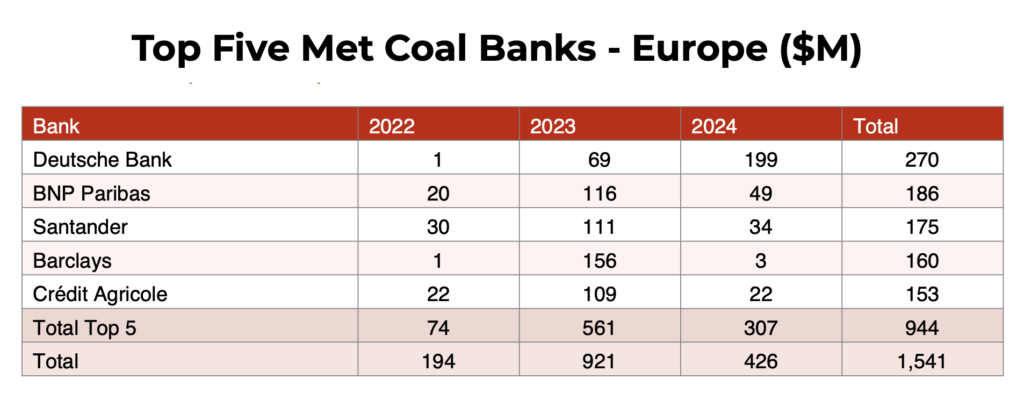
European banks, despite their climate rhetoric, channelled $1.54 billion into met coal developers over the past three years. Deutsche Bank, BNP Paribas, Santander, and Crédit Agricole are among the top financiers, many of which had pledged to stop backing new coal projects.
Much of this funding went to Glencore, whose mountaintop-removal mines in British Columbia have polluted waterways and destroyed ecosystems. Both Deutsche Bank and UBS previously vowed not to finance such operations but continue to support Glencore.
“It’s hypocritical for European banks to brag about thermal coal phase-outs while secretly funding met coal mining,” Cynthia Rocamora of Reclaim Finance, said.
“It’s hypocritical for European banks to brag about thermal coal phase-outs while secretly funding met coal mining,” says Cynthia Rocamora from Reclaim Finance.
Japan and Australia were also found to sustain coal’s lifeline. Over the reporting period, Japanese banks invested $1.22 billion in metallurgical coal developers, led by Mitsubishi UFJ, Mizuho, and SMBC Group. Japan’s steel giants, Mitsubishi Corporation and Nippon Steel, are expanding coal mines in Australia even as they promote “green transformation” campaigns.
Australia’s banks and investors added another $644 million, with Petra Capital and ANZ leading the way. Their financing has helped companies like Stanmore Resources and BHP extend coal mining well into the next century.
“ANZ’s coal policy is not acceptable in the midst of a climate crisis,” Adam Currie of 350 Aotearoa says. “Its policies contain carefully crafted loopholes that continue to permit the expansion of metallurgical coal.”
Coal’s future
While banks keep the loans flowing, investors are ensuring coal’s longevity. As of July 2025, institutional investors hold $30.23 billion in securities tied to companies expanding metallurgical coal operations, with U.S. investors dominating at $17.04 billion.
The world’s top five investors are Vanguard ($3.33 billion), BlackRock ($3.05 billion), State Street ($1.97 billion), Berkshire Hathaway ($797 million), and Japan’s Government Pension Investment Fund ($733 million). Collectively, they control nearly one-third of global met coal investments.
Despite its “sustainability-conscious” strategy, Japan’s GPIF has drawn criticism for holdings in Mitsubishi, Glencore, and Coal India. Meanwhile, Australia’s largest pension fund, AustralianSuper, has boosted its stake in Whitehaven Coal to 8.47%. Whitehaven’s Blackwater South and Winchester South projects threaten thousands of hectares of koala habitat.
Urgewald’s report concludes that continued met coal financing is incompatible with the 1.5°C climate target. With the EU’s Carbon Border Adjustment Mechanism taking effect and green hydrogen steelmaking gaining traction, the era of coal-based steelmaking, it warns, is nearing its end.
“The time for excuses is over,” Wagner says. “Financial institutions must close the metallurgical coal loophole once and for all because, simply put, coal is coal.”
City of Oakland Loses Legal Battle Over Export Terminal for Wyoming Coal
Port of Oakland's inner harbor. The Oakland Army Base site is adjacent to the east end of the Bay Bridge, upper right (USACE file image)
Years after it defeated a proposal to build a coal terminal on a former Army base in West Oakland, Oakland's city hall may have to pay out hundreds of millions of dollars in damages to the plan's sponsors for alleged "tortious interference" with the project.
The story started back in 2009, when California developer Phil Tagami began work on a large-scale multiuse project to repurpose the Oakland Army Base, a large military dock complex, and rename it the Oakland Bulk and Oversized Terminal (OBOT). In 2015, it became clear to the city and to local activists that a likely centerpiece of the project would be a rail-to-dock coal terminal operated by the commercial tenant, Insight Terminal Solutions (ITS). Oakland - backed by multiple environmental law NGOs - decided to resist the development project, citing the potential effects of coal dust on nearby residents. Under Mayor Barbara Lee, the city used a "pattern of interference" to block ITS from moving ahead with securing financing and developing the project, resulting in ITS' bankruptcy, Judge Joan A. Lloyd ruled on Monday.
The judgment in the case could be exceptionally large. The city's expert witness put it at $230 million, and ITS claims that the total comes to about $670 million. This amounts to about 10-30 percent of the city's annual operating budget; Oakland has already been fighting to close a nine-digit budget deficit, even before the added burden of a nine-digit court judgment.
The City of Oakland has been losing legal battles related to the terminal project for years. In September, the California Supreme Court refused to hear an appeal of a lower court decision that paved the way for construction to proceed at last. According to lead developer Phil Tagami, the project could be completed and the first shipment under way as early as 2028.
The terminal is of great interest to Wyoming coal producers, who see it as a lifeline to new markets in Asia. It is one of the few fossil fuel terminal projects to have a chance at breaching the "thin green line" of environmental opposition on the U.S. West Coast, and it is a rare opportunity for landlocked coal miners in the Intermountain West to find customers outside of the U.S. for their product. "The demand for Wyoming coal is there, and we will continue to work to get it to those overseas markets," said Travis Deti, executive director of the Wyoming Mining Association, speaking to the Cowboy State Daily.
Between the California court rulings in favor of the project's right to proceed, and the federal court ruling in favor of ITS' interference claims, the City of Oakland has fewer remaining options to resist the proposal. Local residents and activist groups in Oakland have pledged to keep fighting the project and have threatened to bring new lawsuits against any future investors.
India Plans $11.3 Billion Bailout for State Power Firms
India is weighing a bailout package for its indebted state-owned power distribution companies that could be worth more than $11.3 billion (1 trillion Indian rupees), according to a draft plan by the Indian Power Ministry seen by Reuters.
Indian authorities plan to reorganize the state distribution companies which have been run inefficiently for years and which are a major drag on India’s power system.
The plan, expected to be announced in February, envisages private companies to meet at least 20% of the total power consumption in any given Indian state. Moreover, states will have to assume part of debt of the state-run companies.
States will also have to privatize their electric utilities and transfer managerial control. Alternatively, the states can keep control over the electric companies, but should list them on a stock exchange, per the plan of the Power Ministry seen by Reuters.
India’s federal government is in discussions with state governments to have them buy more renewable sources for power generation, Indian federal Minister of New and Renewable Energy, Pralhad Joshi, said last month.
India, where power demand continues to grow, is accelerating clean energy rollout, betting on more renewable energy sources, despite the fact that it relies heavily on coal for electricity generation.
Earlier this year, India unveiled a national policy on geothermal energy to accelerate the clean energy transition.
The country is also set to launch a nationwide carbon capture and storage program with government incentives of up to 100% of funding for some projects as it aims to reduce emissions from its huge coal power fleet, which continues to rise.
Coal-fired power generation and capacity installations in India continue to rise, and coal remains a key pillar of India’s electricity mix, with about 60% share of total power output.
This jump in installed renewable capacity, however, does not mean renewable power generation will soon replace coal in India, especially if grid constraints and battery and transmission delays persist.
Solar energy now provides 7% of global electricity, doubling in two years and outpacing coal generation for the first time.
Plummeting costs, down 90% since 2010, have made solar economically dominant, spreading rapidly across both rich and poor nations.
Next-generation technologies like perovskite-tandem panels and battery storage are poised to accelerate the shift toward a solar-powered world.
The scale and speed at which solar power has exploded around the world is reshaping energy systems in transformative ways. As the price of solar energy has plummeted over the past decade, solar energy has become a no-brainer for energy capacity addition in contexts around the globe, and its accelerating growth trends show no sign of stopping. At this rate, the world could run on solar much sooner than previously imagined.
As of 2024, solar energy provided 7 percent of the world’s electricity – a stunning two-fold increase in just two years – and has managed to nearly keep pace with total electricity demand growth, powering 83 percent of the world’s total additional capacity in 2025. In fact, when looking at solar and wind together, renewables outpaced global electricity demand growth and generated more electricity than coal for the first time in the planet’s history.
And we’re just getting started. A recent report from the International Energy Agency projects that the world will add 4.6 terawatts of clean power between now and 2030. This is an astonishing figure, at “nearly double the amount built over the previous five-year period, which was in turn more than double the amount built across the five years before that,” a Canary Media column detailed last week. “Put differently, the growth has essentially been exponential.”
Although political tides are turning against renewable energies in major economies, including the United States, the solar boom is no longer tied to policy instruments. The economics of solar power have long outgrown government support, and the market will continue to buoy what has become, by far, the cheapest form of new energy installations. The cost of installing solar has plummeted by a mind-blowing 90 percent over the last decade and a half.
“Right now, silicon panels themselves are the same cost as plywood,” Sam Stranks, Professor of Energy Materials & Optoelectronics at the University of Cambridge, recently told NewScientist.
As a result, solar adoption has skyrocketed in some of the world’s poorest economies and regions without reliable energy infrastructure. Pakistan, for example, has quickly become an unexpected poster child of solar adoption as residents install rooftop solar and batteries in their residences. "The scale of solar being deployed in such a short period of time has not been seen, I think, anywhere ever before,” says Jan Rosenow, who leads the Environmental Change Institute’s energy program at the University of Oxford. And that growth trend is set to continue. Solar-plus-battery systems could provide over a quarter of Pakistan’s peak energy demand and most daytime electricity needs by 2030.
“In other words, we have a plentiful and cheap source of electricity that can be built quickly, almost anywhere in the world,” NewScientist recently posited. “Is it fanciful to imagine that solar could one day power everything?”
The answer to that question depends on the continued advancement of solar power technologies as well as supportive infrastructure such as smart grids and long-term energy storage. Scientists are racing to discover next-gen solar panels that are more energy-efficient than today’s silicon panels. Currently, tandem models that pair silicon with another material, such as perovskite, are receiving a great deal of research and development enthusiasm.
“While it’s true that silicon is great, tandems are better,” Tomas Leijtens, a cofounder and the chief technology officer of next-gen solar startup Swift, told MIT last year. “In the fight to tackle climate change, we need to accelerate, not just say, ‘Oh, this is good enough—we’re done.’ Everything can continue to be improved.”
Achieving solar expansion at a scale that is consistent with global climate goals remains a challenge, however, especially in today’s policy environment. But experts contend that even while politics could create significant bottlenecks, the economic momentum of the solar power sector is unstoppable.
“By the end of this century,” says Kingsmill Bond, who works at global energy think tank Ember, “ it is pretty clear that we will be getting all of our electricity from renewable sources, of which the vast majority will be solar.”
The rapid growth of AI is creating significant uncertainty and strain on global energy grids, with projections indicating a doubling of energy needs by 2030, posing challenges for energy security and grid stability.
The AI industry is characterized by extreme opacity, with no federal registration requirements for data centers or laws mandating disclosure of energy usage or environmental impact, leading to decisions based on conjecture rather than hard data.
While states offer incentives for data center development, local communities are pushing back against the rapid expansion due to skyrocketing utility bills and the perceived transfer of wealth from residential customers to large corporations.
As the AI boom sends shockwaves across energy grids around the world, global leaders are rushing to add extra power production capacity as fast as they can. The problem is, no one knows how much energy AI is going to be using a year or five years from now. In fact, we don’t even know how much it’s using right this moment. The result is a mad scramble to maintain energy security in the face of unprecedented uncertainty, with potentially disastrous results for global energy grids and climate goals.
“In the past few years, AI has gone from an academic pursuit to an industry with trillions of dollars of market capitalisation and venture capital at stake,” reports the International Energy Agency. The scale of the energy needed to power this growth means that “the energy sector is therefore at the heart of one of the most important technological revolutions today.”
AI doesn’t just need more data centers, it needs more power per data center, as the kind of computer chips that enable large language models require much more energy to run. Projections for the AI sector’s energy needs are massive. The International Energy Agency expects them to double between now and 2030, marking a serious challenge for energy security and grid stability in regions where data center developments are being clustered.
In the United States, the federal government has identified fast-tracking data center construction as a matter of national priority. But the projections that these decisions are being based on are derived from a whole lot of conjecture and relatively little hard data. The advancement and spread of AI technology has far outpaced regulation and policy measures to control and track the sector. As a result, the industry is characterized by extreme opacity, as there are no laws requiring companies to disclose their energy usage, their environmental impact, or even how many data centers they’ve built.
“There is no federal registration requirement for data centers, so their estimated number varies depending on the source,” writes the Pew Research Center in a report about energy use at data centers in the United States. “Some owners of data centers also obscure their locations for security reasons and/or competitive advantage,” the report goes on to say.
The Pew Research Center also notes that many states are courting data center developers, offering financial incentives and fast-tracking permitting in the hope that these high-dollar projects will boost local economies and provide jobs. In part thanks to these state-level policy measures, data centers are being built up in geographically concentrated clusters, and can therefore majorly strain power grids where they are located in large numbers. The Institute for Energy Economics and Financial Analysis reports that for utilities in Virginia, South Carolina and Georgia, “data centers are responsible for 65% to more than 85% of projected load growth.” Accordingly, major utilities in these states as well as North Carolina expect to add a collective 32,600 MW of electrical load over the next 15 years.
But while some states are courting such developments, politicians and constituents at the local level are pushing back against rapid development in their areas. Constituents in regions where huge numbers of data centers are popping up feel that they are getting the hard end of the bargain by unfairly and involuntarily propping up Big Tech’s agenda through their own skyrocketing utility bills.
"We are witnessing a massive transfer of wealth from residential utility customers to large corporations—data centers and large utilities and their corporate parents, which profit from building additional energy infrastructure," Maryland People's Counsel David Lapp told Business Insider. "Utility regulation is failing to protect residential customers, contributing to an energy affordability crisis.”
The United States has issued a general license allowing limited operations of Rosneft’s German subsidiaries, according to a notice posted on the company’s website and confirmed by Reuters. The authorization applies to Rosneft Deutschland and RN Refining & Marketing, both under German federal trusteeship since 2022, when Berlin assumed control to maintain refinery continuity and prevent fuel shortages.
The license does not lift sanctions on Rosneft. However, it allows maintenance, payments, and service activities necessary to keep assets functioning under non-Russian management.
The Schwedt refinery, which supplies roughly 90% of Berlin and Brandenburg’s fuel, lies at the center of this legal arrangement. Germany placed Rosneft’s 54% under state control through the Federal Network Agency after the EU embargo on Russian crude took effect. Since then, Schwedt has been operating on non-Russian feedstock delivered via the Rostock pipeline and through Poland’s Gda?sk terminal.
The new U.S. license ensures that transactions supporting Schwedt’s ongoing operations, including service contracts, insurance, and financial clearing, remain compliant under U.S. sanctions law. This coordination essentially signifies that Washington fully intends to maintain energy stability in Central Europe, even as it moves to tighten restrictions on Russian oil and gas revenue.
The measure follows a broader sanctions escalation that added Rosneft and Lukoil to new U.S. designations, marking one of Washington’s most extensive enforcement rounds since restrictions on Russian energy began in 2022. The latest package expands coverage to trading houses, insurers, and tanker operators involved in facilitating Russian oil shipments, effectively tightening the compliance perimeter across global supply chains. U.S. officials said the move aims to close loopholes in the so-called “shadow fleet” system and constrain revenue that Moscow channels through offshore intermediaries.
Enforcement moves are already reshaping flows. Indian Reliance Industries will halt imports, and a Russian tankerreversed course under threat of secondary sanctions.
The license is time-limited and currently runs to April 29 next year.