Saturday, November 01, 2025

Supermajors Bet Big on Long-Term Oil Demand

  • Major international oil firms are increasing production despite weakening crude prices and a global supply surplus, anticipating sustained demand until at least the mid-2030s.
  • European and U.S. supermajors are investing in new oil and gas field developments and exploration, with companies like ExxonMobil and Chevron achieving record production volumes.
  • Oil companies are confident in their long-term strategy, even as they slash costs and workforce numbers to protect shareholder payouts amidst the current market conditions.

The world’s largest international oil firms are ramping up production even as crude prices have weakened this year and global supply growth continues to outpace the demand increase, setting the stage for a glut in the coming months.  

The European majors are back to investing in exploration and new oil and gas field developments after years of trying – and mostly failing – to generate profits and good returns from low-carbon energy projects, including renewable electricity, green hydrogen, and biofuels.

Big Oil Output Hits Record Highs

The U.S. supermajors, ExxonMobil and Chevron, are pumping record oil volumes in the top shale region, the Permian, while betting on international project expansions in Guyana and Kazakhstan, for example. The U.S. giants both reported in the second quarter record-high production in the Permian and worldwide, following Exxon’s acquisition of Pioneer Natural Resources and Chevron’s buying of Hess. 

France’s TotalEnergies expects higher oil and gas production to have boosted earnings for the third quarter, despite a $10 per barrel decline in oil prices since last year. 

Production at the other European supermajors, Shell and BP, is also rising as the European giants shifted focus back to their core oil and gas business. The pivot took place after the energy crisis made energy security and affordability more important than sustainability, while high interest rates and supply chain issues further reduced already meager returns from clean energy projects and made many new energy ventures uncompetitive.  

Big Oil Bets on Solid Demand   

The supermajors are confident they can withstand the current weaker prices and the surplus on the market, to which they have contributed, alongside the national oil companies of the OPEC+ producers, which have been reversing the production cuts this year. 

Big Oil is looking beyond the short-term fundamentals and glut noise, having decided to invest more in oil and gas to meet solid demand until at least the mid-2030s.  

Unlike the International Energy Agency (IEA), which earlier this year doubled down on its forecast of peak oil demand by the end of this decade, Big Oil companies don’t see any peak by 2030. 

BP, which said last year that global oil demand would peak as early as this year, ditched this view in its new annual Energy Outlook last month, in which it now expects oil demand to rise through 2030 amid weaker-than-expected efficiency gains. 

Most majors have put the peak at some point in the 2030s, but none expect a rapid decline afterwards, and all say that oil and gas will remain essential for global economic growth and development in 2050.  

“Oil and natural gas are essential. There’s no other viable way to meet the world’s energy needs,” ExxonMobil said in its 2025 Global Outlook

“Our Global Outlook projects that oil and natural gas will make up more than half of the world’s energy supply in 2050. We project that oil demand will stabilize after 2030, remaining above 100 million barrels per day through 2050,” the U.S. supermajor reckons. 

“All major credible scenarios include oil and natural gas as a dominant energy source in 2050.” 

All three scenarios analyzed in Shell’s 2025 Energy Security Scenarios found that upstream investment of around $600 billion a year “will be required for decades to come as the rate of depletion of oil and gas fields is two to three times the potential future annual declines in demand.” 

Exxon and now the European majors are playing the long game—invest in new oil and gas supply, at the expense of renewables, to offset with new production the accelerating natural decline of producing oil and gas fields. 

Even the IEA admitted last month that the world needs to develop new oil and gas resources just to keep output flat amid faster declining rates at existing fields, in a major shift in its narrative from 2021 that ‘no new investment’ is needed in a net-zero by 2050 scenario. 

Exploration is also back at the top of the agenda for Big Oil, as the companies appear confident their product will be in demand for decades to come.  

The expected massive overhang later this year and early next year is not putting off the supermajors’ plans to increase production. They are slashing costs via cutting thousands of workforce numbers to protect shareholder payouts at $60 per barrel oil. Companies have pledged billions of U.S. dollars in cost savings and slimmer corporate structures. That’s to eliminate inefficiencies and excessive costs while keeping payouts to shareholders at much lower prices compared to the 2022 highs.

This year, higher oil and gas production is partly offsetting the weaker prices. 

Increased output also positions the world’s biggest companies for rising profits when the glut clears within a year or so, analysts say. 

“All the supply coming to the market is shrinking OPEC’s spare capacity — so there’s a light at end of the tunnel,” Barclays analyst Betty Jiang told Bloomberg this week. 

“Whether that’s second half of 2026 or 2027, the balance is going to tighten. It’s just a matter of when.” 

By Tsvetana Paraskova for Oilprice.com 


Analysts Eye Big Oil's Spending and Acquisition Plans

  • Big Oil's third-quarter earnings are being reported, with analysts primarily interested in the supermajors' strategic plans for 2026, including spending, production, and potential acquisitions.

  • Natural gas, particularly LNG, is a major focus for these companies, with Shell, BP, TotalEnergies, Exxon, and Chevron all making significant investments and plans for expansion in response to rising global electricity demand.

  • Despite lower international oil prices and predictions of a supply overhang, Big Oil is expected to increase oil and gas output in both the current and coming year, indicating a belief in demand resilience that contrasts with some other forecasts.

Big Oil is reporting third-quarter results this week and next. No surprises are expected—Big Oil has been having an eventful year featuring tariffs, sanctions, and glut predictions—and these events will be reflected in financial reports. Yet analysts are already looking ahead to 2036 and what Big Oil plans to do next.

So far, two big oil companies have reported third-quarter figures: Norway’s Equinor and Italy’s Eni. Both demonstrated the dominant trends in the industry, likely to be seen in the reports of BP, Shell, TotalEnergies, Exxon, and Chevron in the coming days. Equinor missed analyst expectations because of lower prices, despite higher oil and gas production, while Eni enjoyed better revenues and profits thanks to higher oil and gas production, despite lower prices. Shell and TotalEnergies today reported strong performance on higher oil and gas production.

What analysts appear to be interested in, according to a preliminary earnings season overview by Reuters, is what Big Oil plans to do in 2026 in terms of spending, production, and maybe acquisitions. They would want to hear how Chevron’s merger with Hess Corp. is going, what Exxon’s next acquisition target is going to be, and how European Big Oil will handle its share buybacks and dividends in a lower-price environment. Last but by no means least, analysts would want to hear about the supermajors’ natural gas plans.

These plans are certainly in place. With artificial intelligence driving a global surge in demand for electricity, natural gas has returned to the spotlight as the best of both worlds: more reliable than wind and solar, and lower-emission than coal. 

Shell, for instance, said in a trading update earlier this month that its natural gas business would boost its overall third-quarter performance. Indeed, it did: for the third quarter, Shell reported a solid increase in its LNG business. The company earlier announced plans to turn its LNG business into a top priority for the next ten years in response to the demand projections.

BP is also prioritizing gas and LNG, recently contracting Baker Hughes for a new LNG plant in Indonesia, and recently winning an arbitration case against Venture Global regarding undelivered LNG cargos. TotalEnergies, for its part, lifted the force majeure on its Mozambique LNG project this week, even as the price tag was revised higher by $4.5 billion. The facility will have a capacity of 43 million tons of liquefied gas once completed.

Exxon, meanwhile, plans to announce the final investment decision on its own LNG project in Mozambique by the end of the first quarter of 2026, even though the company just canceled a public appearance to report on the project’s progress. Another LNG project of the supermajor, Golden Pass, is expected to start operations by the end of this year.

Chevron is focusing on trade. The company just sealed an LNG supply deal with Energy Transfer for the delivery of 1 million tons of LNG from the Lake Charles plant, bringing its total purchase commitments for that plant alone to 3 million tons annually over 20 years. Big Oil is a big fan of LNG. The supermajor is also investing in LNG supply globally, like its peers.

In oil, analysts see the supermajors struggling with the effects of lower international prices. It could be only a perception of a struggle, however, while the companies themselves remain financially disciplined and plan for production boosts—despite the gloomy predictions of a 4-million-barrel-daily supply overhang in 2026 as estimated by the International Energy Agency.

Indeed, Bloomberg this week reported analyst estimates see all the supermajors increase their oil and gas output both this year and next, regardless of prices. This suggests Big Oil does not really agree with the IEA about demand and supply—and that it is betting on demand resilience that the IEA and other transition-leaning forecasters argue does not exist.

By Irina Slav for Oilprice.com


Colombia’s Oil Industry Faces an Existential Crisis

  • Colombia’s proven oil reserves have fallen by over 400 million barrels since 2013, leaving fewer than eight years of production at current rates.

  • President Petro’s bans on fracking and new exploration, combined with heavy taxation, have driven away foreign investment and weakened output.

  • Without new discoveries or major policy shifts, Colombia risks losing its top export revenue source and destabilizing its economy within the decade.

A lack of oil discoveries is causing Colombia’s economically crucial petroleum reserves and production to deteriorate, sparking speculation that the industry is trapped in a death spiral. President Gustavo Petro’s bid to reduce dependence on fossil fuels by banning oil exploration and hydraulic fracturing is only accelerating the industry’s demise. This is severely impacting government income, exports, and the economy at a time when Bogota is particularly exposed to financial and geopolitical risks. Time is fast running out for Colombia to find more oil reserves while creating an economically sustainable plan to reduce dependence on hydrocarbons.

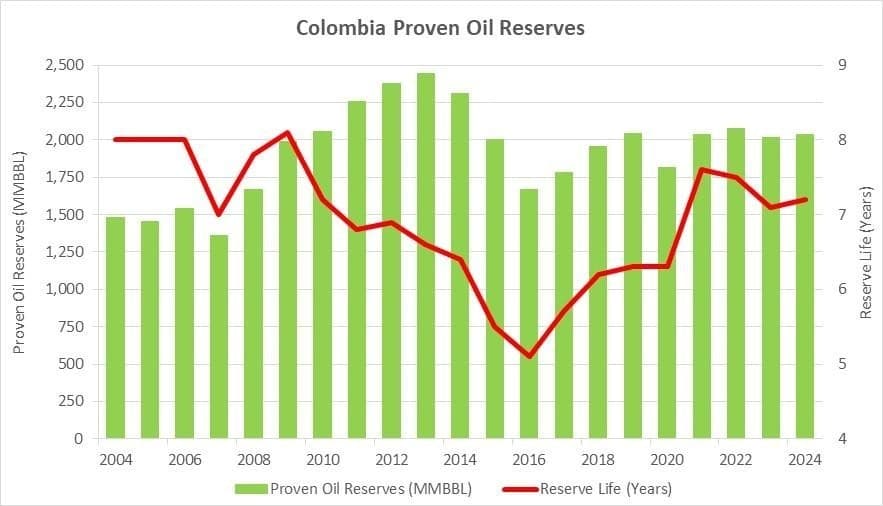
After peaking at just over 2.4 billion barrels in 2013, the highest level since 1998, Colombia’s proven oil reserves have fallen sharply since then. For 2024, those reserves were calculated to total just over two billion barrels with a relatively short production life of 7.2 years.

Colombia
Source: 
Colombia National Hydrocarbon Agency (ANH). 

This marks a steep reduction of more than 400 million barrels since 2013, reflecting Colombia's limited exploration success. You see, over the last twenty years, major oil discoveries have been rare, with only two significant finds exceeding 200 million barrels during that period. The risks this poses to Colombia’s oil-dependent economy are exacerbated by the short production life of the country’s proven reserves, with them poised to run out in less than a decade if no new major discoveries are made.

These developments underscore the considerable risks facing Colombia’s hydrocarbon-dependent economy, especially with petroleum being the country’s top export, earning $15 billion during 2024 and generating roughly a tenth of fiscal revenue. Time is running out for Colombia to make the multiple major oil and natural gas discoveries needed to boost reserves and bolster declining fiscal revenues. Although there is significant optimism regarding Colombia’s hydrocarbon potential, the country has experienced limited significant oil discoveries over the past 25 years, which poses ongoing challenges for increasing reserves. 

Colombia has not seen any world-class 500 million barrel-plus oil discoveries since the early 1990s. The last was Occidental Petroleum’s 1983 discovery of the 1.1-billion-barrel Caño Limón oilfield. This is the strife-torn nation’s largest ever oil discovery, not only leading to hydrocarbon self-sufficiency but triggering a massive petroleum boom that became what is known as Colombia’s golden age of oil that lasted into the late 1990s. The Andean country’s last world-class discoveries were the 750-million-barrel Cusiana and 510-million-barrel Cupiagua oilfields found by BP in the Orinoquía foothills in 1989 and 1993, respectively. 

There has been a dearth of world-class finds ever since. All crude oil discoveries have failed to break the 100-million-barrel mark, with only two exceeding 200 million barrels of recoverable oil resources. These are the 250-million-barrel Akacia and 250-million-barrel Lorito heavy oil discoveries made by Ecopetrol in its 100% owned and operated CPO-09 Block during 2010 and 2018, respectively. The CPO-09 Block, where Ecopetrol acquired the remaining 45% from Spanish energy company Repsol in February 2025 for $452 million, is believed to contain over two billion barrels of crude oil. Although questions linger over whether it is commercially exploitable.

President Petro’s attempts to reduce Colombia’s dependence on petroleum and hike taxes for extractive industries are responsible for falling energy investment. On taking office in August 2022, Petro banned hydraulic fracturing, known as fracking, and ceased awarding new oil exploration contracts. Those policy decisions are among the key reasons for Colombia’s inability to bolster proven oil reserves and declining production, with drillers slashing spending on their operations in the strife-torn country. Indeed, the lack of exploration success over the last 20 years sparked considerable speculation that the future of Colombia’s oil patch rested with fracking. 

There are several geological bodies in the Andean country, notably the Cretaceous La Luna formation, a carbonaceous-bituminous limestone and calcareous shale rich in organic matter, which possesses considerable unconventional oil potential. This formation was targeted by Ecopetrol and partner ExxonMobil with the Kale and Platero fracking pilots near the municipality of Puerto Wilches in the Middle Magdalena Valley. Both operations were hugely controversial, with local communities opposed to the projects over fears of environmental damage. It was Petro’s fracking ban that caused those pilots to be scrapped and Exxon to exit Colombia.

Those regulatory changes were followed by tax hikes for extractive industries, including the economically vital oil industry. During November 2022, Petro imposed a levy on oil sales when the international Brent price hit specific thresholds, with oil companies paying an additional 5% tax when prices are $67.30 to $75 per barrel. The levy rises to 10% when prices fall between $75 and $82.20 per barrel and climbs to 15% if the price rises further. In February 2025, Bogota imposed a 1% surcharge on crude oil exports, which was extended beyond the initial 90 days to be in place for a year, with plans to make it permanent, adding to the immense tax burden weighing on oil companies.

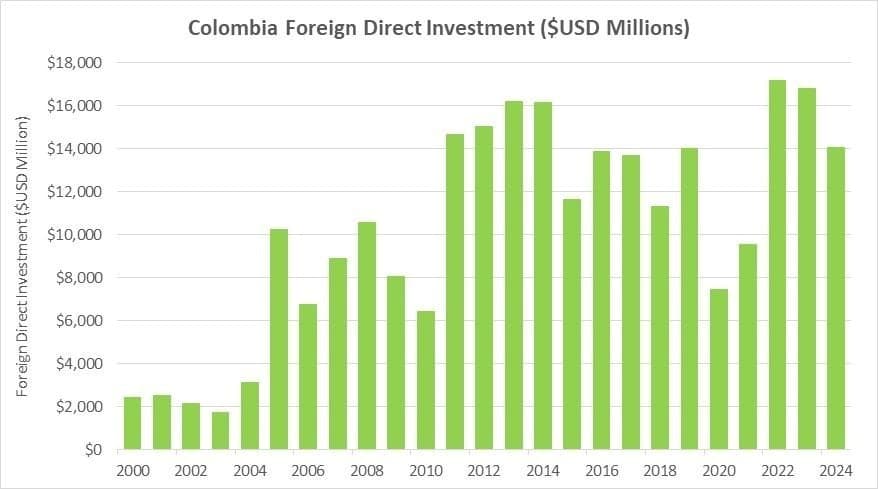
As a result, many foreign oil companies, including Big Oil, have downsized their operations in Colombia, or, like Exxon, chose to exit altogether. This is responsible for a sharp decline in foreign direct investment (FDI). According to central bank data, foreign investment has plummeted over the last decade, as the chart shows. Colombia’s FDI inflows for 2024 totaled $14.1 billion, a sharp decline from the $16.8 billion received a year earlier and 13% less than the $16.2 billion received 10 years earlier.

Col
Source: 
Central Bank of Colombia.

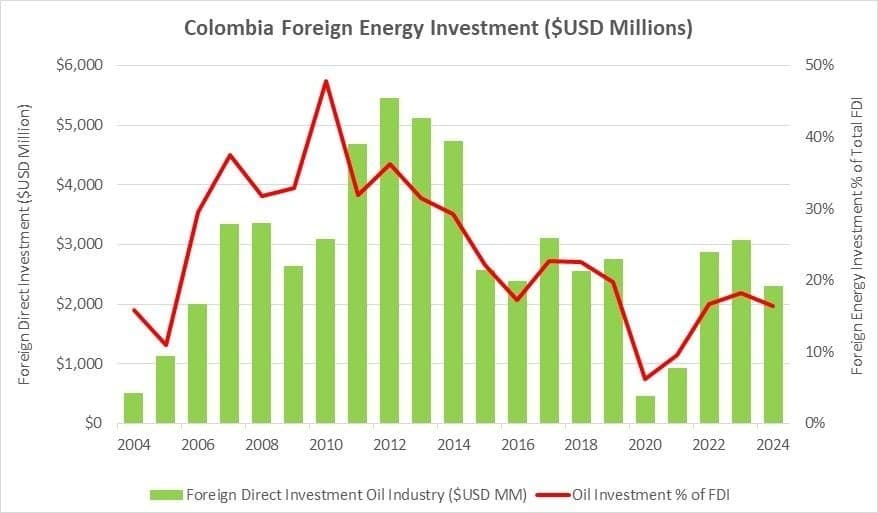
A key reason for the sharp decline in foreign spending on businesses in Colombia is the drop in energy investment. For 2024, Colombia received $2.3 billion of offshore capital, which was invested in the strife-torn country’s energy patch. This was significantly lower than the $3.1 billion of foreign investment directed to the petroleum industry during 2023. 

Col
Source: 
Central Bank of Colombia.

While full-year data for 2025 is yet to be made available, there are signs of an uptick in foreign investment in Colombia’s oil industry. For the first six months of the year $1.5 billion was invested in the hydrocarbon sector compared to $1.3 billion for the same period a year earlier. Whether that trend will continue is questionable because of the headwinds impacting Colombia which are deterring foreign investment. This includes U.S. President Donald Trump’s decision to decertify the strife-torn country as a counter-narcotics partner and his escalating feud with President Petro

These developments, coupled with sharply weaker oil prices and the growing global push to phase out fossil fuels in favor of electric vehicles and renewable sources of energy, mean time is running short for Colombia to discover more oil. Indeed, it will take considerable amounts of capital to fund the tremendous amount of drilling activity required to make the required petroleum discoveries. It is incredibly difficult to attract the required investment, with Bogota refusing to award new exploration contracts while increasing the tax burden faced by oil companies. Surging violence and cocaine production, particularly in the remote regions where Colombia’s oil industry operates, are further deterring foreign energy investment. 

By Matthew Smith for Oilprice.com


TotalEnergies LNG Project in Mozambique Hits New Financial Snag

The government of Mozambique may not agree with the latest estimate for an LNG project led by TotalEnergies, which said earlier this week the price tag for the facility had gone up by $4.5 billion.

The French supermajor attributed the cost increase to the four years, during which work on Mozambique LNG was suspended following a deadly attack by Islamist militants that promoted a force majeure. TotalEnergies lifted the force majeure this week but said the delay had caused a significant cost increase and asked the local government to extend the construction and production timetable for the project by 10 years as partial compensation, Reuters reported earlier today.

“We will have to sit down and perceive in detail the foundations for this extension, ... there may also be counter-arguments from the government,” Mozambique’s president Daniel Chapo said. he added that the government will go through the cost calculations for the project and “on our side, there will also be, without any doubt, counter-arguments.”

Mozambique LNG, which originally had a price tag of $20 billion, was going to be the biggest LNG project in Africa and also the biggest foreign investment in the continent. When completed, the facility would have an annual capacity of 13.12 million tons, sourced from two offshore fields, Golfinho and Atum.

Yet another liquefied natural gas project in Mozambique took the crown for biggest investment in African LNG. Led by Exxon, Rovuma is set to cost $30 billion and have annual capacity of 18 million tons. The project has yet to receive its final investment decision, which Exxon plans to do in the first quarter of 2026, after getting security guarantees from the Mozambican government. The area where both Mozambique LNG and Rovuma are located attracts militants, with recent reports suggesting a flare-up of violence.


Exxon Cancels Mozambique LNG Update

Exxon has canceled a public appearance by several executives scheduled for today, at which they were supposed to reaffirm the company’s commitment to the Rovuma LNG project, currently frozen, in the company of Mozambique’s president, Daniel Chapo.

The $30-billion facility that will be the biggest LNG export hub in Africa once completed has yet to receive a final investment decision, mainly due to the unstable security situation in the Cabo Delgado region, where both Rovuma and TotalEnergies’ Mozambique LNG are located. Mozambique LNG was under force majeure until this month when the French supermajor lifted it.

However, the Financial Times suggested in a report today on Exxon’s cancellation of the joint Rovuma briefing that the security situation may well be the reason for that cancellation. The publication cited multiple calls for both LNG projects to be delayed because Islamist insurgents are active in the area.

“The security situation has got much worse,” the FT cited a senior adviser with Oxfam as saying. “People are talking about attacks happening on a nightly basis on highways around the [Rovuma] project. I just don’t understand how you can have a genuine conversation on whether or not this project moves forward in this context,” Andrew Bogrand said.

Islamist activity in Mozambique has plagued the country’s energy plans for years. Until relatively recently, the Rwandan army was working in tandem with forces from the Southern African Development Community to contain the insurgents, but these withdrew from the security mission in Mozambique after money for payments for the security services provided started running out.

According to one conflict monitoring organization and the UN Refugee Agency, extremist activity has intensified in northern Mozambique, with the organization, Acled, reporting 22 deaths in the week to October 26 and the UNRA reporting 100,000 people fled their homes because of the violence.

By Irina Slav for Oilprice.com


Shell to Sign Exclusive Oil Exploration Deal with Angola

One of Africa’s biggest oil producers, Angola, will sign next week an exclusive agreement with Shell under which the supermajor will explore and potentially develop several offshore blocks, Angola’s oil and gas agency ANPG has said. 

“This event marks a historic moment for the Angolan oil sector, consolidating Shell's presence in Angola, an ANPG statement said, as carried by Reuters.

Under the agreement Shell will explore Blocks 19, 34, and 35 and several ultra-deepwater blocks as Angola looks to revive its exploration and production sector following years of underinvestment and supply restrictions under the deals within OPEC, which the country quit effective January 2024.

Earlier this year, Angola’s crude output slipped below 1 million barrels per day (bpd) for the first time in two and a half years and for the first time since one of Africa’s biggest oil producers quit OPEC.   

Angola’s motivation to exit the cartel after 16 years was a spat with the OPEC and OPEC+ members about production quotas. At a meeting in mid-2023, Angola and Nigeria were given lower crude oil production quotas as part of the OPEC+ agreement, after the two producers had underperformed and failed to pump to their quotas for years, due to a lack of investment in new fields and maturing older oilfields.  

Angola now aims to revitalize its oil and gas industry and it is betting big on natural gas developments to monetize more of its fossil fuel resources. 

Shell, for its part, is looking to boost exploration efforts, including in Africa, where it has made a discovery offshore Namibia, to Angola’s south.

“We went through a significant reset, I would say, of our exploration department, capability, the funnel, because the hard truth is while we have had some good progress in certain areas, it hasn’t delivered what we had wanted,” Shell’s chief executive, Wael Sawan, told analysts on the Q2 earnings call at the end of July. 

Shell will continue to invest in exploration where it has established track records, like the Gulf of Mexico, Malaysia, Oman, and in areas like Namibia, added Sawan, who has said that reducing global oil and gas production would be “dangerous and irresponsible”.   

By Tsvetana Paraskova for Oilprice.com


Japanese Utilities Confident in Replacing Russian LNG

Some of Japan’s biggest utilities believe that they would be able to find alternative gas supply in case they are no longer able to import Russian LNG, executives said this week, following U.S. pressure that Japan and other U.S. allies stop imports of Russian energy.  

Japan imports Russian LNG from the Sakhalin-2 project, in which Japanese firms Mitsui and Mitsubishi hold minority stakes, which they kept even after the Russian invasion of Ukraine, due to the importance of LNG supply for Japan.  

Russian LNG accounts for about 9% of Japan’s total liquefied natural gas imports. 

Japanese utilities JERA and Tohoku Electric Power can replace Russian LNG, if they need to, executives said on Friday. 

JERA, which imports LNG from Sakhalin-2 under contracts expiring in 2026 and 2029, can tap alternative supply and “there is a good chance that we will be able to do something” if it has to halt imports of Russian LNG, Naohiro Maekawa, an executive officer at the utility, said, as carried by Reuters.

Tohoku Electric Power, whose Russian LNG imports account for about a tenth of its supply, is looking to diversify sources and be ready for a halt of supply from Russia, according to senior executive Takayoshi Enomoto. 

Earlier this week, Japan’s Prime Minister, Sanae Takaichi, told U.S. President Donald Trump at their meeting in Tokyo that Japan would find it difficult to ban LNG imports from Russia.  

The issue with Japan’s LNG imports from Russia came up during this week’s meeting between President Trump and Takaichi, with Japan’s PM seeking understanding from the U.S. Administration about the Japanese energy security, Japanese government officials told Reuters.  

On the eve of President Trump’s visit to Japan, the U.S. reiterated calls on its allies, including Japan, to stop importing energy products from Russia. 

U.S. Treasury Secretary Scott Bessent told Fox Business on Thursday that he believes that over time Japan would wean off of Sakhalin-2 LNG and “they will be part of a very large pipeline project that the U.S. is constructing in Alaska,” referring to the $44-billion Alaska LNG project, which the U.S. Administration has been pitching to potential Asian buyers. 

By Tsvetana Paraskova for Oilprice.com