It’s possible that I shall make an ass of myself. But in that case one can always get out of it with a little dialectic. I have, of course, so worded my proposition as to be right either way (K.Marx, Letter to F.Engels on the Indian Mutiny)
Saturday, November 01, 2025
Indian Refiner HPCL Says It Doesn’t Need Russian Crude
Russian crude has accounted for a very small portion of supply for Indian state-run refiner Hindustan Petroleum Corporation Limited (HPCL) as oil from Russia has not been economical to run at the refinery, HPCL chairman Vikas Kaushal said on the company’s earnings call.
The call took place as Indian refiners are scrambling this week for alternative supply after the U.S. sanctions on Russia’s major oil firms.
Russian crude has not been economical for HPCL regardless of grades, the executive said.
Therefore, of all the crude processed in the past quarter, Russian crude accounted for just 5% of HPCL’s total supply, he added.
“We could run Russian crudes there also, but we have alternatives with us. I'm not worried about it at all,” the executive said, referring to the procurement of crude now that Rosneft and Lukoil are off limits as Indian refiners don’t want to run afoul of the U.S. sanctions just as India is trying to have its massive 50% tariff for exports to the U.S. reduced.
Earlier this week, refiner HPCL-Mittal Energy Ltd (HMEL) -- HPCL’s joint venture with Mittal Energy – became the first Indian oil company to suspend Russian crude purchases following new U.S., UK, and EU sanctions targeting Russia’s two largest oil companies, Rosneft and Lukoil.
The move marks a major shift in India’s Russian oil trade, which has surged since 2022.
Indian refiners, which import from Russia about a third of all their crude, are scrambling for alternative supply and clarity in the sanctions set to come into effect on November 21.
India’s Reliance Industries, the top private refiner in the country, is expected to stop importing crude under a long-term deal with the now-sanctioned Russian oil giant Rosneft.
Reliance Industries, one of Rosneft’s biggest clients in India, has turned to the spot market for crude oil deliveries.
India’s refiners have reportedly suspended new orders for Russian crude. The refining industry in Russia’s second-biggest crude buyer after China awaits clarity from the government about navigating the new U.S. sanction context, Reuters reported earlier this week, citing unnamed sources.
Indian Oil Corp. is looking to buy 24 million barrels of crude oil from the Americas in the first quarter of next year to replace lost Russian supply after the latest U.S. sanctions on Rosneft and Lukoil.
Bloomberg reported that the company, which is India’s largest refiner, is looking for cargos from the United States, Canada, Brazil, and Latin America. Reuters reported IOC was looking for both high-sulfur and low-sulfur grades. The publication cited an unnamed source as saying the invitation for expression of interest aimed to test the appetite of sellers in case it needed to tap the Americas oil market.
Reuters also cited traders as reporting that Indian Oil Corp. had bought 2 million barrels of West African crude from Exxon this week, from Angola and Nigeria.
India Today reported, meanwhile, that the sanctions are already starting to push Indian refiners’ import bill higher as they switch to costlier grades from sources other than Russia. The switch is also affecting run rates, the publication noted, adding that Russian crude was available at discounts ranging between $8 and $12 per barrel to Middle Eastern benchmarks.
This fiscal year, the share of Russian oil in India’s total imports had ticked down from 36% to 34%, and the average price for imported crude had inched higher by $5 per barrel over the Dubai benchmark, India Today also wrote. It noted that so far this month, imports from the United States had gone up to 575,000 barrels daily, the highest since 2022.
Refinery run rates, meanwhile, had slipped to the lowest in 19 months in September, before the latest U.S. sanctions were announced.
“Crude oil prices surged sharply following fresh sanctions on Russian oil majors, sparking tightening supply fears and renewed inflation concerns. This could negatively impact India, as elevated crude prices may widen the fiscal deficit and strain the import bill,” the head of research at Indian Geojit Investments told India Today.
By Irina Slav for Oilprice.com
Indian Metals-to-Oil Conglomerate Vedanta
Vedanta’s quarterly adjusted profit rises on higher metal prices
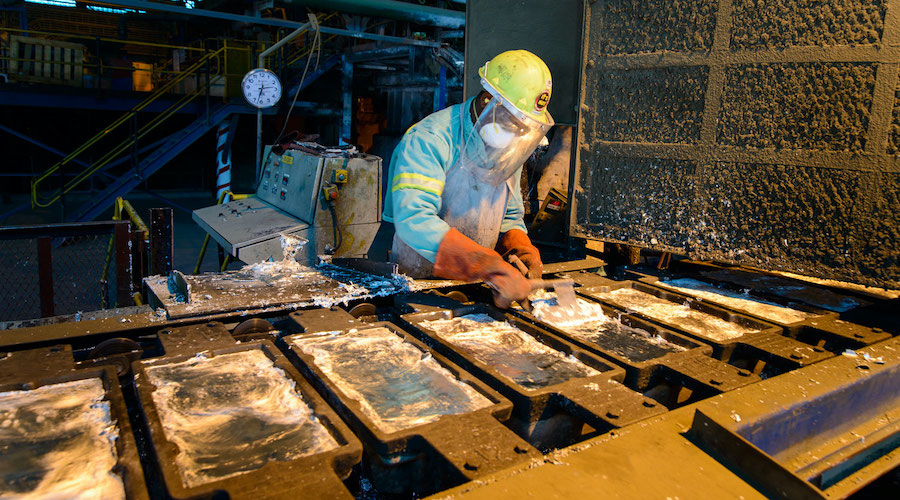
Vedanta’s Skorpion Zinc operation in Namibia. (Image by Vedanta)
Indian metals-to-oil conglomerate Vedanta reported higher quarterly adjusted profit on Friday, helped by higher metal prices.
The company’s consolidated profit before tax and exceptional items rose 21.7% from a year earlier to 70.14 billion rupees ($798 million) in the quarter ended September 30.
Its operating profit margin rose to 22% from 20%, aided by steady expenses.
The benchmark three-month aluminum and copper rose 8.2% and 5.6% on-year during the quarter due to uncertainty around US trade policies. Higher commodity prices tend to support selling prices and margins for mining companies.
The miner’s total revenue rose 5.5% to 392.18 billion rupees.
Vedanta’s aluminum business is the biggest in India and contributes to nearly 40% of the company’s revenue. Zinc is the second-biggest business, followed by copper.
Revenue from the aluminum segment rose 14%, copper gained 3.6%, while its India zinc, lead and silver segment grew 3.5%.
Total expenses rose 0.8% to 334.49 billion rupees.
The company reported a net exceptional expense of 20.67 billion rupees, which included a write-off of 14.07 billion rupees and a settlement payment of 6.60 billion rupees.
Clean electricity’s share of global energy has risen from 9% in 2015 to over 14% in 2025, marking the fastest energy shift in modern history.
Renewables are on track for record additions of more than 700 GW in 2024–2025, pushing the world toward a 1.9°C scenario by 2040.
Oil and gas remain resilient through the 2030s, but low-carbon investments are set to dominate global capital flows by the end of the decade.
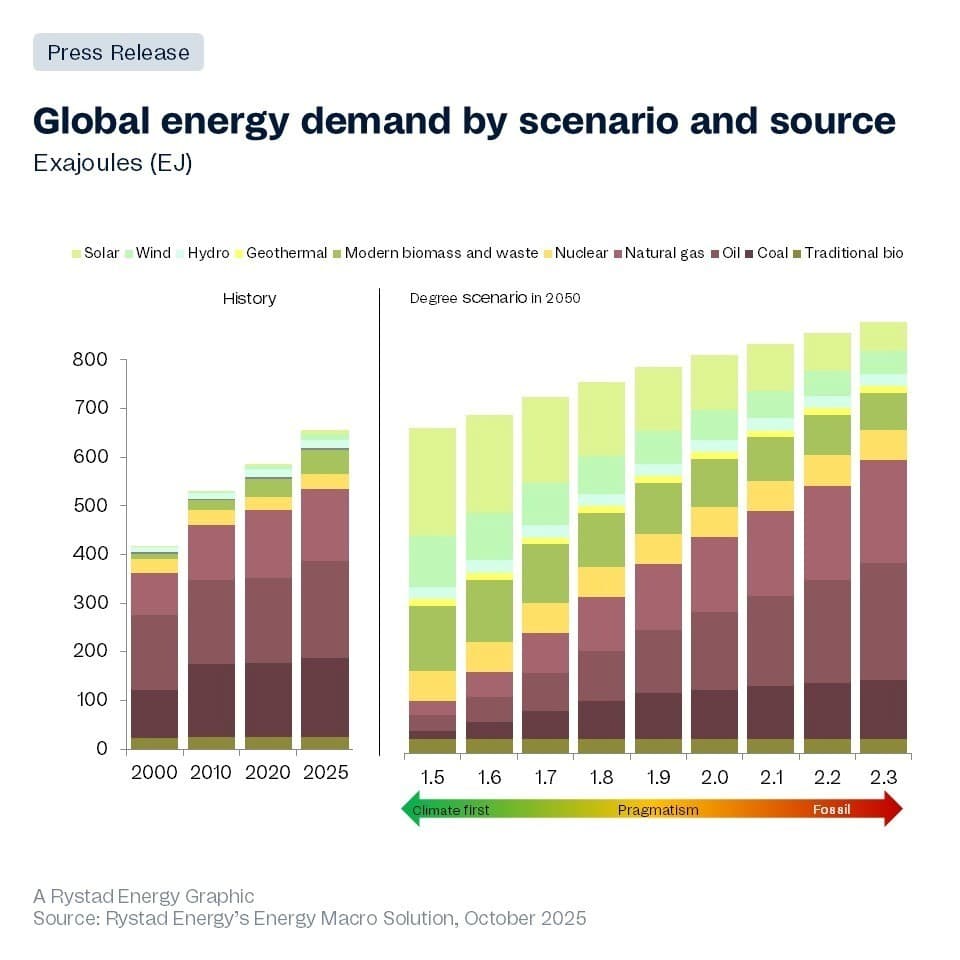
The global energy system is witnessing the next greatest transition, standing on the cusp of a new energy era championed by clean electricity and the increased adoption of electrification across the board. Rystad Energy is pleased to announce the release of its flagship annual report, Global Energy Scenarios (GES) 2025, which provides in-depth degree scenarios toward 2100 and a newly developed nationally determined contribution (NDC) scenario to 2035. Clean electricity and electrification are expanding faster than any shift in modern history, with energy sources of the next era growing from around 9% in 2015 to more than 14% this year as a share of primary energy.
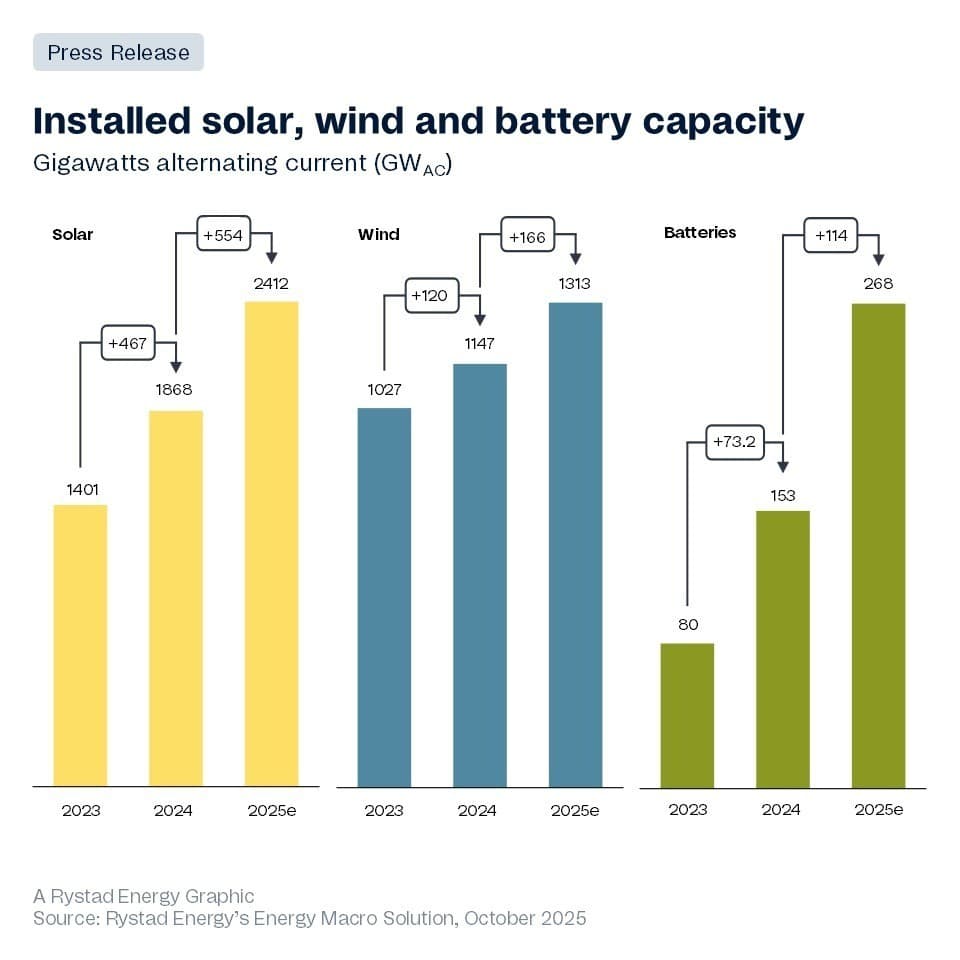
While nations grapple with the dual challenge of addressing climate change and strengthening energy security, renewables are expanding faster than any previous energy technology, with total wind and solar capacity additions for 2024–2025 set to exceed 700 gigawatts (GW). Because of this, our research indicates that a 1.9-degree Celsius trajectory – referring to an average global temperature rise above pre-industrial levels – is more likely toward 2040, as a hybrid energy ecosystem is now in place.
As these scenarios play out, the transformation of the global energy system requires three clear steps:
Task 1: Clean up and grow the power sector
Cleaning up and expanding the power sector plays a dominant role in reducing emissions through 2050. Our analysis indicates that achieving a global warming scenario more ambitious than 1.9 degrees Celsius will require at least 90% of the identified opportunities for a reduction in emissions to be realized.
Task 2: Electrify almost everything
Electrification becomes particularly impactful in pathways that limit warming at or below 1.6 degrees. The greatest contribution comes from the adoption of electric vehicles (EV), alongside widespread energy efficiency improvements across buildings, industry, and transport.
Task 3: Address residual emissions
Addressing residual fossil fuel use through CO? capture or substitution with low-carbon fuels contributes little to a net reduction in emissions before mid-century in pathways exceeding the 2.2-degree scenario. This limited impact reflects its later-stage deployment and higher costs.
Already today, we’re seeing the energy system shift to a hybrid model of renewable and fossil energy. With half of global power generation capacity now renewable and one in four new cars sold being electric, the energy system is transforming rapidly. There are already clear signs of change across investments, new capacity additions, and technological adoption curves that indicate we will witness a genuine transition over the next two to four decades.
Jarand Rystad, founder and CEO, Rystad Energy
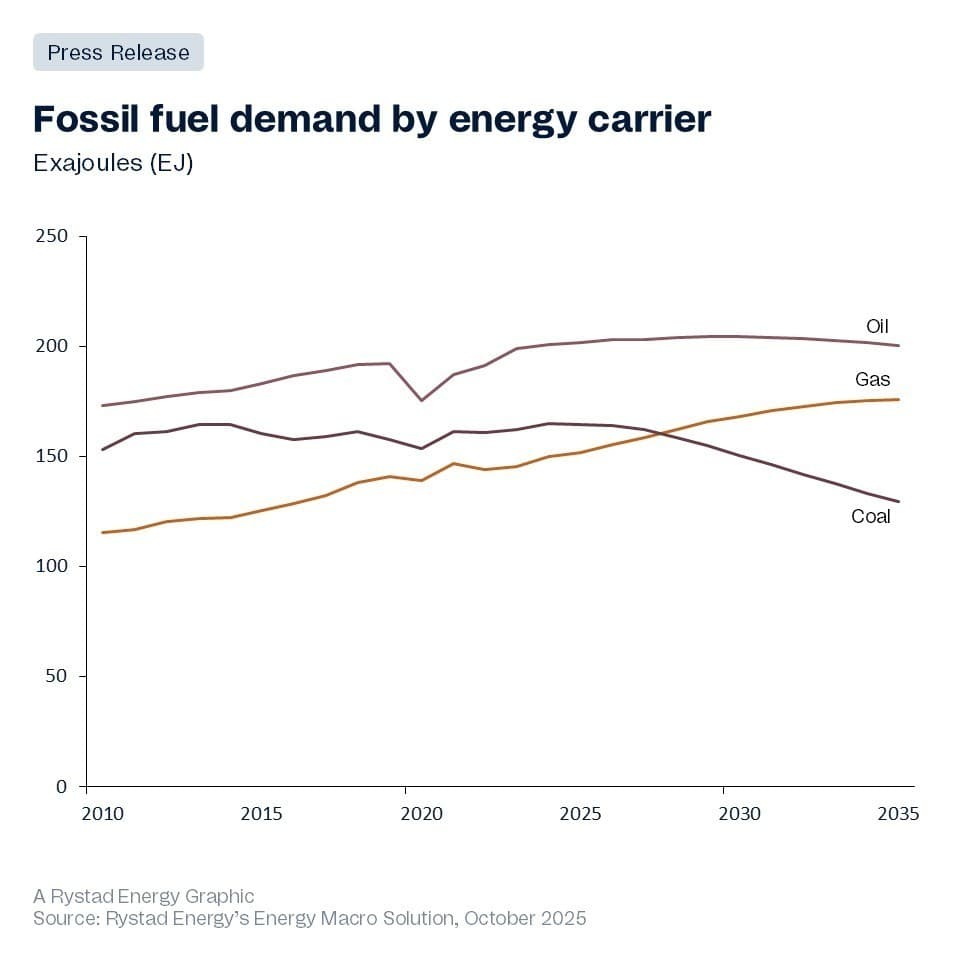
Although the transition to renewable energy is gaining momentum, oil and gas are expected to remain resilient in the near term. Oil demand is projected to peak by the early 2030s, and gas growth will likely slow down towards the end of this decade; however, neither fuel experiences a sharp contraction. The energy transition is fast enough to alter the growth profile of fossil fuels, but not fast enough to deeply disrupt their dominance by 2040. Oil and gas remain the backbone of the system, tied to transport, petrochemicals and energy services, where alternatives are not yet cost-competitive or scalable. This transition will have significant implications for costs and investments, as fossil fuel growth slows down and they are outpaced by renewables, ultimately leading to lower costs for consumers over time.
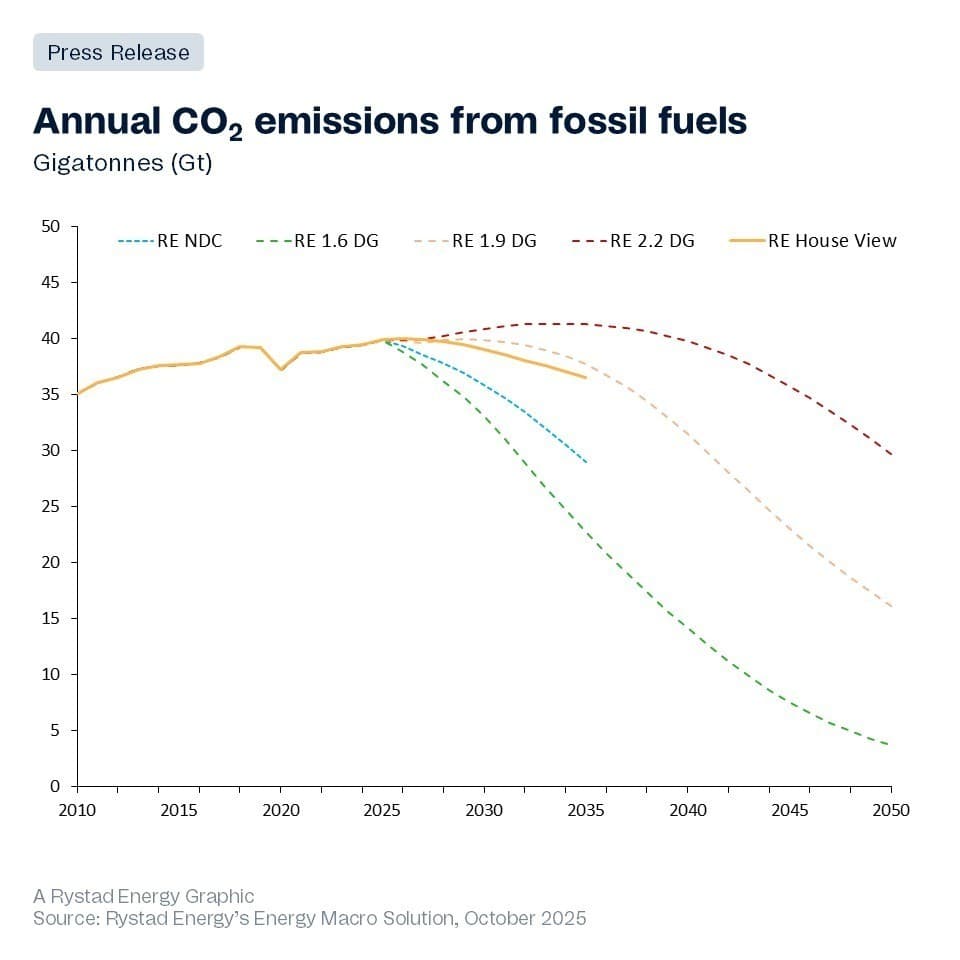
Looking ahead, we can clearly outline five pathways that will shape the global energy outlook, which include the Rystad Energy NDC, 1.6 degrees Celsius, 1.9 degrees Celsius, 2.2 degrees Celsius, and the Rystad Energy House View scenarios. Global CO? emissions are expected to peak around 2026 before starting a gradual decline, driven by rapid renewable deployment in power and EV adoption in transport. This marks a turning point, showing that the world is moving from growth to decline in emissions. However, current NDCs remain far from sufficient to limit warming to 1.5 degrees. Even if fully implemented, they would not achieve the substantial reductions necessary for achieving the lower range of the Paris Agreement.
Our prediction of a 1.9-degree Celsius scenario is heavily predicated on renewable energy installations setting all-time high records and serving as the backbone of new power growth, with solar leading the pack. Solar is forecast to rise from 1,868 GW in 2024 to 2,412 GW in 2025 – a 544 GW increase that cements its position as the leader of new global power generation. Record manufacturing output, sustained cost declines, and accelerating deployment in China, India, and the US drive the expansion.
Fueling this exponential growth in renewable energy development is a global increase in low-carbon investments. Currently, low-carbon technologies attract over $900 billion annually, compared to $735 billion for oil and gas. This $181 billion delta widens to an estimated $391 billion by 2030, reflecting a complete shift in growth dynamics. The installed base changes slowly, but investment is a leading indicator: today's capital flows determine the 2040 energy system. By 2030, low-carbon sources are set to capture 46% of all energy investment, compared to 30% for fossil fuels, with grids accounting for 24%.
By Jon Ødegård Hansen, Lars Nitter Havro, and Katie Keenan at Rystad Energy.
Too Much of a Good Thing: Solar Overloads Europe’s Electricity System
The rapid expansion of weather-dependent generation has made Europe’s power grids vulnerable to voltage surges.
After four record years, EU solar additions are now set to decline for the first time in a decade, as negative wholesale prices and frequent curtailments erode profitability and deter new investment.
Experts warn Europe’s infrastructure is not built for a decarbonized system; massive upgrades in transmission, flexibility, and cross-border links are needed.
When the official report on the Spain and Portugal blackout from April came out, it described a grid made vulnerable to excess voltage as a result of the fast growth of weather-dependent generators. But this excess voltage problem is not just reserved for the Iberian Peninsula. The whole of Europe has become vulnerable.
Last year, a total of 65.5 GW of solar generation capacity was installed across the European Union. It was a record high, and the fourth record-high year of installations in a row, as reported by the EU’s solar power industry association. However, the annual growth rate in additions was markedly lower than in previous years, at just 4.4%, Solar Power Europe noted. Since the start of this year, things have only got worse, with total new installations expected to be a decline on 2024 rather than an increase. It would be the first decline in ten years.
Solar is one of the pillars on which the European Union’s transition plans are built. Solar, along with wind, is instrumental for what Brussels strategists call a decarbonisation of the European grid. However, there have been unforeseen circumstances that have interfered with these plans and are going to interfere with them increasingly frequently because of the nature of solar, affecting growth plans.
One obvious problem that was not anticipated is negative prices. The phenomenon, sometimes called a cannibalization effect, refers to periods of excessive generation from wind and/or solar that plunges electricity prices on the wholesale market below zero because supply exceeds demand by a very wide margin.
In Europe, the problem has become especially pronounced in the past couple of years, thanks to all those record solar capacity additions—and it has started affecting investment decisions for further capacity because negative prices affect the profitability of existing installations. Some governments have considered support for solar operators forced to switch off their installations when there is excess generation, but not all.
Switching off a solar installation is what grid operators order whenever generation threatens to become excessive. This is also problematic for solar operators, because when their installations do not generate electricity, the operators do not make money. Sure, they can be paid to not generate, like wind turbine operators in the UK, but that does not necessarily guarantee profits—government handouts never do.
Finally, there is the voltage surge problem that caused the Spain and Portugal blackout, and that Bloomberg this week reported is getting more serious across Europe. The solution proposed: change the grid.
The argument that Europe’s grid is not fit for a decarbonized energy system has been put forward repeatedly by transition advocates who claim we need a more flexible electricity supply and distribution network that would reduce—and maybe even eliminate—the waste of electricity generated by wind and solar installations during periods of low demand. Flexibility, including on the demand side, is being made a top priority. The problem is that solar is not very flexible. When the sun shines, the panels generate, regardless of demand. When the sun stops shining, the panels stop generating, also regardless of demand.
According to one Dutch grid expert who Bloomberg interviewed, the problem is one of scale. There are simply way too many solar installations to control all at the same time and make sure the grid does not get overloaded on sunny days. “The speed of the change is extreme,” Jan Vorrink, who was in charge of the control room of the Netherland’s grid, told Bloomberg. “The strong increase in solar is pushing the boundaries of the system.”
Obviously, the simplest solution would be to put caps on solar capacity additions to make the grid more manageable. Yet this is not the preferred solution in Europe. The preferred solution is to continue building more installations and transform the grid to be better able to incorporate these installations productively.
The transformation would essentially involve building a lot more transmission lines to bring electricity from generators to demand hotspots to reduce curtailment. This would include better interconnectivity between EU member states to tap into cross-border electricity demand. However, this would not do much about the voltage surge risk. Demand patterns tend to be pretty consistent across countries—and they do not always coincide with peak solar generation, which is what creates the voltage surge risk.
Last year, there were 8,645 voltage surges in Europe, per data from ENTSO-E, the EU grid operators’ association. The figure represents a 2,000% increase from 2015, when there were 34 surges. This is not going to change in a safer direction anytime soon, even if the EU stays on its chosen grid transformation path. Such a transformation takes a lot of time—and money—and in the meantime, the grid will remain highly vulnerable to power outages resulting from voltage surges caused by excess solar generation that cannot be brought down fast enough when demand dips. Maybe exercises in flexibility need to touch on the generation part of the electricity equation.
By Irina Slav for Oilprice.com
AUSTRALIA
AGL Strikes 15-Year Deal to Buy Clean Power From WA Wind Project
AGL Energy Ltd. (ASX: AGL) has signed a 15-year Power Purchase Agreement (PPA) with Tilt Renewables for 100% of the expected 105 MW of generation from the Waddi Wind Farm, located in Western Australia’s Shire of Dandaragan.
Under the deal, AGL Perth Energy will offtake all electricity generated by the Waddi Wind Farm once operational, beginning in the second half of 2028. The agreement marks AGL’s first long-term wind PPA in the state, expanding its renewable portfolio and supporting its decarbonisation goals.
The Waddi Wind Farm is strategically aligned with the Western Australian Government’s Clean Energy Link North transmission expansion, part of the SWIS Transmission Plan, which aims to unlock renewable generation capacity across the state. The project is being developed by Tilt Renewables, one of Australia’s leading renewable energy developers, and will play a key role in expanding AGL Perth Energy’s offering to Western Australian businesses.
AGL Perth Energy, which has been operating in WA since 1999, currently supplies electricity and gas to SMEs and large commercial and industrial clients. According to AGL Chief Commercial Officer David Moretto, the agreement will diversify AGL’s renewable portfolio and strengthen its WA market position.
AGL General Manager Giles Redmile added that the deal represents a “milestone” for AGL Perth Energy, enabling it to offer renewable-linked products to a broader range of customers as demand for clean energy solutions continues to grow across Western Australia.
By entering into renewable PPAs such as this one, AGL helps underwrite new clean energy generation while securing long-term price stability for both itself and its customers. The agreement also demonstrates AGL’s ongoing shift toward a lower-emissions portfolio as part of its broader energy transition strategy.
By Charles Kennedy for Oilprice.com
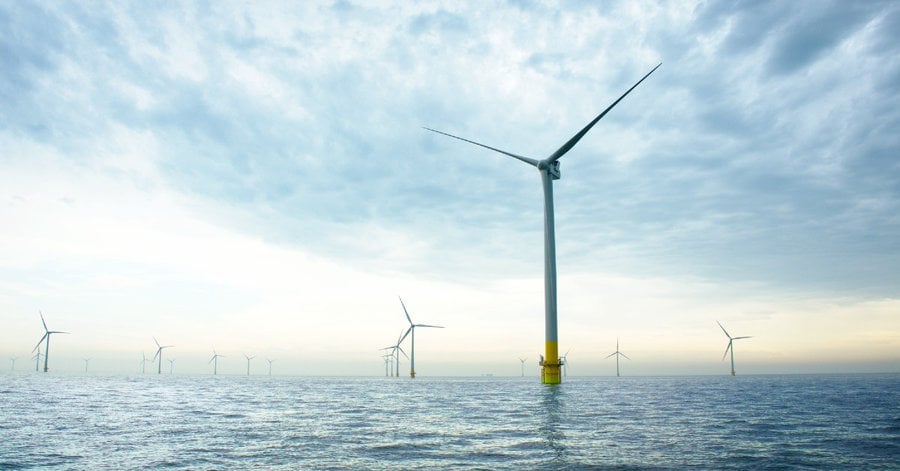
Dutch Not Surprised as Offshore Wind Farm Auction Gets No Bids
Hollandse Kust Zuid launched in 2023 is the Netherland's largest offshore wind farm (Vattenfall)
The Netherlands Enterprise Agency (RVO) confirmed that it had not received any bids in the latest offshore wind farm auction for the North Sea. While the government was disappointed, they noted that it was not a surprise due to the changing conditions in the industry.
The Netherlands was offering a new site approximately 60 miles off the coast near Texel in the northwest of the country. The site had originally been proposed with a capacity of 2 GW, but the auction was later amended to a 1 GW capacity. The government said the change had been taken to lower the investment risk for developers and to attract more bids. However, the auction, which was proposed without a government subsidy, failed to attract any applications for the construction and operations at the Nederwiek I-A site.
RVO cited rising costs and less demand for electricity than previously expected as factors in the lack of bids. It said that while the market for offshore wind energy has grown rapidly in recent years, the market has recently changed rapidly and significantly. They noted that auctions in Germany, Denmark, the United Kingdom, and Belgium have also failed to obtain bids or were postponed due to limited interest.
“The sustainability of Dutch industry, among others, is lagging behind,” writes RVO. “This has made it more difficult for wind farm developers to conclude long-term electricity contracts before the construction of a wind farm starts. This has reduced their willingness to invest.”
The government highlights that it had already begun planning, noting that the Ministry of Climate Policy and Green Growth had warned the auction might not receive any applications. In September, the Ministry released its plan for the next phase of the offshore wind energy sector.
In 2026, the government wants to issue permits for 2 GW of offshore wind energy capacity. The new plan calls for a subsidy scheme to be introduced, with officials noting that €948 million (US$1.1 billion) has already been reserved for the program in 2026. The next round will also be based on a Contracts for Difference (CFD) process, which will guarantee a minimum price for the generated electricity. When the market price falls below the guarantee, the government makes up the difference in subsidies, and when it exceeds it, the profits go to the country or consumers.
The Netherlands’ government is currently reviewing the sites to be offered in 2026. They plan to release the details of the next round by January, and they believe the new approach will stimulate more interest in the market.
Wind Turbine Installation VesselCharybis
Dominion Energy Confirms Commissioning Delays on WTIV Charybdis
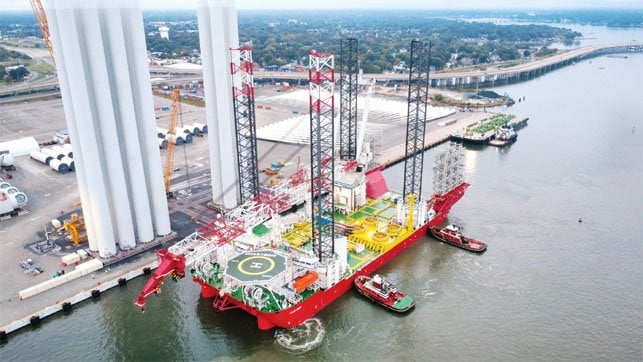
Charybdis arrived in Virginia in September and is still undergoing commissioning (McAllister photo)
As part of its quarterly earnings report to the investment community, Dominion Energy gave a detailed update on commissioning delays with its wind turbine installation vessel Charybis while also emphasizing that the Coastal Virginia offshore wind project remains on schedule and is making good progress. CEO Robert Blue discussed the challenges with the vessel and the overall progress on the project, which he still expects will deliver first power to customers late in the first quarter of 2026.
Calling Charybdis, which is the first American-made Jones Act-compliant WTIV, a “challenge,” Blue went on to tell the investment community, “I am extremely disappointed that Charybdis has again not met expectations… we failed to deliver regarding Charybdis.” He, however, told the audience that he was confident that they would complete commissioning and that the first wind turbine installations would occur late next month (November).
He highlights the uniqueness of the vessel, which he says was built to global best practices but has inherent risk in being the first Jones Act-compliant vessel of its kind built and regulated in the United States.
The vessel, which is 472 feet long and is 27,000 gross tons, was built at Seatrium AmFELS yard in Brownsville, Texas. In its jack-up position, there is a 40-meter (131-foot) air gap under the hull, and its crane has a 2,200-ton capacity. The vessel completed sea trials, received sign-offs, and arrived in Portsmouth, Virginia, in September. Since its arrival, Siemens Gamesa completed necessary modifications for turbine handling and installation, and the vessel underwent new-to-zone inspections in Portsmouth.
Blue said two primary areas of concern were identified during the inspection. First was the material condition of certain components, primarily in the ship’s electrical system. Second was the need for documentation that confirmed that the systems meet US-approved codes and standards. About 200 items were identified that needed to be addressed,
Dominion reports there are about 200 crewmembers and marine electricians working on the ship and doing the additional surveys. To date, they said over 4,000 inspections have been done across 69 electrical systems, including 1,400 cable inspections. Of the 200 items identified on the punch list, about 120 have now been closed out.
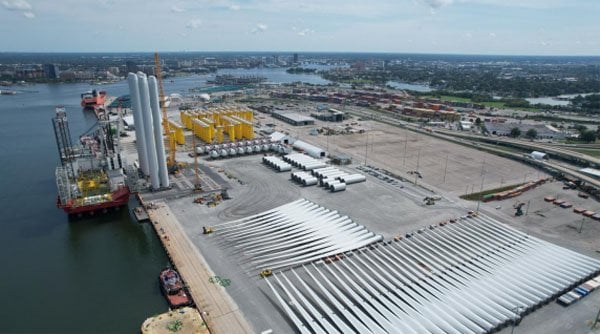
Charybdis on dock with the material staged for the offshore wind farm in Portsmouth, Virginia (Dominion Energy)
Dominion says it decided to build the ship, with a cost it now sets at $715 million, because it represented a strategic advantage. They said having their own vessel provided enhanced schedule certainty, which translated to cost certainty for the project. Blue said Dominion continues to believe in the advantages of the vessel.
Through September, they report a total investment of $8.2 billion in the Coastal Virginia project, with remaining project costs attributable to Dominion expected at $1.5 billion.
At this point, 100 percent of the monopiles have been installed, completed one month before the end of the installation season. In addition, 63 transition pieces have been installed, and all 176 are now fabricated. The second substation jacket recently went in, and the topside will be installed shortly. The third offshore substation will be installed in the first quarter of 2026.
First power remains on schedule for about five months from now, and they still expect completion of the project by the end of 2026. However, the delays with Charybdis have meant the company has significantly reduced the schedule for weather and vessel maintenance contingency. Blue said it might result in the final few turbines not being installed until early 2027.
IX Renewables & Asia Cement Corporation Sign Agreement for "Rui Li 1"
During the 2025 Energy Taiwan, IX Renewables and Asia Cement Corporation (ACC) signed a cooperation agreement for the “Rui Li 1” floating offshore wind project. The partnership marks a major milestone in Taiwan’s renewable energy journey – combining international offshore expertise with strong local industrial capabilities. It adds new momentum into a sector that has until recently been slowing, as the country works to advance its energy transition and net-zero ambitions.
Located deep waters off Hsinchu, the Rui Li 1 floating wind farm will have a planned installed capacity of 180MW, in water depths ranging from 70 to 95 meters. The project is led by IX Renewables in collaboration with international partners - GF Corporation (Japan) Hexicon (Sweden/Korea) and SNOW BV (Netherlands/France). The participation of Asia Cement Corporation as s sponsor represents a meaningful step in Taiwan’s domestic industry and fostering a pragmatic and locally rooted approach to floating wind development.
Eric Kamphues, CEO of IX Renewables, stated “We warmly welcome Asia Cement Corporation’s participation in Rui Li 1. This cooperation represents our shared confidence in the continued growth of Taiwan’s offshore wind industry. By combining Taiwan’s strong industrial foundation with IX’s international offshore wind experience, we can jointly bring floating wind technology from vision to reality. Together, we aim to contribute to Taiwan’s 2035 goal of achieving 21 GW of offshore wind capacity and advancing toward a net-zero future.”
Peter Hsu, the Board Director of Asia Cement Corporation added “We value the opportunity to collaborate with IX Renewables, a company with solid technical expertise and a proven track record in Taiwan’s offshore wind sector. This cooperation reflects our shared commitment to advancing Taiwan’s renewable energy industry through pragmatic and locally integrated development. Together, we aim to contribute to Taiwan’s energy transition and demonstrate the strength of partnership between international know-how and domestic industry.”
Eric further noted “Since Taiwan’s first offshore wind demonstration project began commercial operation in 2017 — a project in which IX Renewables was closely involved — the country’s total installed capacity has surpassed 3 GW. To reach the 2035 target of 21 GW of offshore wind, floating wind farms will be the essential next step. IX regards Rui Li Phase 1 not just as a demonstration, but as the beginning of Taiwan’s next chapter in offshore wind.
IX Renewables and Asia Cement Corporation look forward to leveraging international experience and local industry capabilities to bring floating wind technology in practice in Taiwan, making a lasting contribution to the country’s energy transition and net-zero future.
The products and services herein described in this press release are not endorsed by The Maritime Executive.
Hyundai Motor Begins Construction of Hydrogen Fuel Cell Plant in Ulsan
Hyundai Motor Company (KRX: 005380) has begun construction of a new hydrogen fuel cell production facility in Ulsan, South Korea, marking a key milestone in the automaker’s transition from conventional engines to next-generation clean energy systems.
The KRW 930 billion ($660 million) plant will produce 30,000 fuel cell units per year and manufacture polymer electrolyte membrane (PEM) electrolyzers when completed in 2027. Built on the site of a former internal combustion transmission factory, the new facility represents a symbolic and strategic pivot toward a hydrogen-based industrial ecosystem.
The groundbreaking ceremony brought together Hyundai Motor executives, including Vice Chair Jaehoon Chang, alongside government officials such as Minister Sungwhan Kim of the Ministry of Climate, Energy and Environment, and local leaders from Ulsan. Ivana Jemelkova, CEO of the Hydrogen Council, also attended, underscoring the international significance of Korea’s growing hydrogen ambitions.
Chang described the facility as a “critical foundation” for both Korea’s economic growth and its leadership in global hydrogen markets.
The plant will serve Hyundai’s hydrogen brand HTWO (Hydrogen for Humanity) and focus on two key product lines: advanced hydrogen fuel cells and PEM electrolyzers.
Next-generation fuel cells: Designed for improved power density, durability, and cost competitiveness across applications in passenger cars, trucks, buses, industrial equipment, and marine vessels.
PEM electrolyzers: The first of their kind to be mass-produced in Korea, enabling zero-carbon hydrogen generation from water. Hyundai reports achieving roughly 90% localization of electrolyzer components — a significant step toward domestic supply chain independence.
Hyundai has already deployed a 1 MW containerized electrolyzer producing 300 kg of high-purity hydrogen daily and is developing a 5 MW-scale system in Jeju to build a full green hydrogen ecosystem.
The Ulsan facility will feature robotics and advanced monitoring systems to enhance efficiency and ensure worker safety, positioning it as a model for next-generation industrial automation.
Beyond production, Hyundai Motor is investing in hydrogen applications across mobility and industry. The Ulsan facility’s output will supply fuel cells for a wide range of sectors — from buses and trucks to ships and construction machinery — reinforcing Hyundai’s role in building an end-to-end hydrogen value chain that spans production, storage, transport, and utilization.
At the event, Hyundai also signed an MoU with KGM Commercial, a leading Korean bus manufacturer, to supply fuel cells for commercial vehicles — a move that ties the new plant directly to domestic hydrogen mobility deployment.
The Ulsan groundbreaking underscores Hyundai’s long-term strategy to anchor Korea’s position in the global hydrogen economy. It aligns with national goals to commercialize hydrogen infrastructure and complements other global hydrogen investments by Hyundai Motor Group, including fuel cell systems in Europe and the United States.
Once operational in 2027, the plant is expected to boost the scalability of hydrogen technologies, strengthen Korea’s manufacturing competitiveness, and accelerate the transition toward carbon-neutral transportation and industry.