Tuesday, November 18, 2025


Lithium price surges in China after Ganfeng chairman predicts 2026 demand boom


China’s lithium price surged on Monday after the chairman of major Chinese producer Ganfeng Lithium Group Co forecast demand growth of 30% or even 40% for the battery metal in 2026.

The most-traded lithium carbonate contract on the Guangzhou Futures Exchange rose 9% to close to an upper limit at 95,200 yuan ($13,401.28) per metric ton, its highest since June 2024.

The peak came after local media outlet Cailian reported the comments made by Li Liangbin in a conference speech.

Li also said demand growth could drive the lithium carbonate price above 150,000 yuan a ton, or even to 200,000 yuan.

Lithium carbonate prices have been rising recently in China, with a more than 17% rally this month, as investors predict booming demand from the energy storage sector.

Supply concerns related to the delayed reopening of CATL’s flagship Jianxiawo lithium mine in Yichun city, Jiangxi Province is also supporting the rise.

Reuters previous reported that CATL continued to tap external supplies of lithium ore to make lithium carbonate in November as the Jianxiawo mine remained closed.

Ganfeng Lithium’s shares rose 7.48%, Chengxin lithium stock was up 10.01%, and Tianqi Lithium increased by 9.87%.

($1 = 7.1038 Chinese yuan renminbi)

(By Dylan Duan and Lewis Jackson; Editing by Alexander Smith)


Congo extends ban on trade in minerals from sites in war-hit east

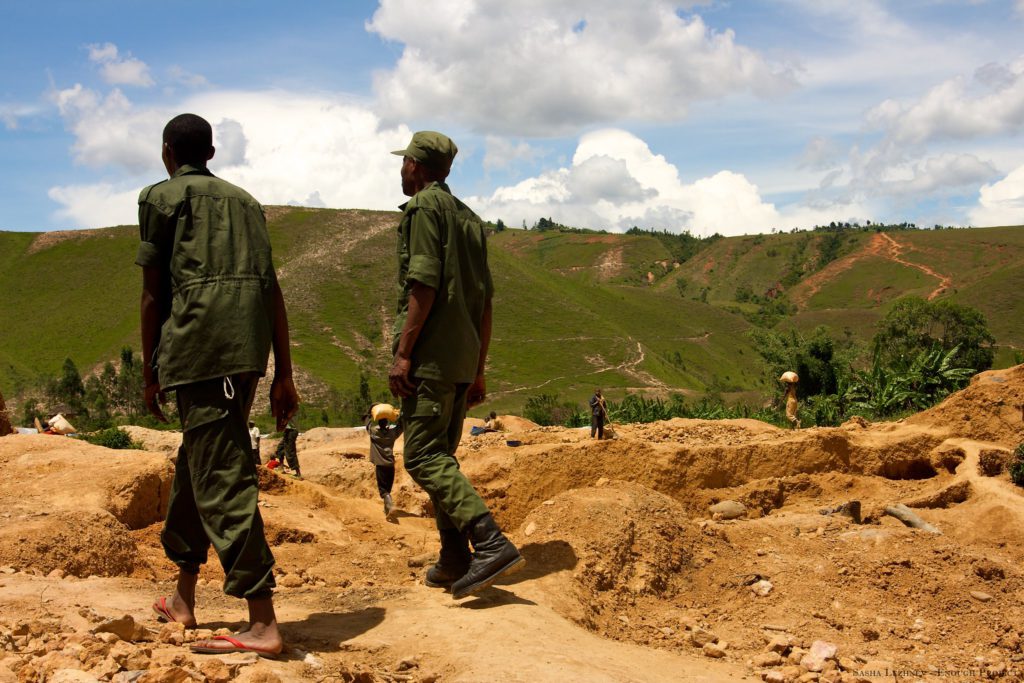
Gold mine in South Kivu, Congo. Credit: Sasha Lezhnev, Enough Project

The Democratic Republic of Congo has extended for six months a ban on the trading of minerals from dozens of artisanal mining sites in conflict-hit North and South Kivu provinces, the mines ministry said.

The extension adds compliance pressure on global supply chains for tin, tantalum and tungsten, key inputs for the electronics, automotive and aerospace industries.

The ban, introduced in February, is being kept in place because of evidence that illegal supply from mines is financing armed groups in the east, according to an order dated November 3 and signed by the mines minister Louis Watum Kabamba.

The order, which the ministry posted to social media on Sunday, applies to 38 sites producing coltan, cassiterite and wolframite – ingredients for tin, tantalum and tungsten – in Masisi territory in North Kivu and Kalehe territory in South Kivu.

Rwanda-backed M23 rebels and other armed groups have captured significant territory in mineral-rich eastern Congo.

An offensive by M23 this year has killed thousands and displaced hundreds of thousands more.

Mineral wealth has long been seen as fuelling violence in the east, with combatants using coltan, cassiterite and gold sites to fund their operations, according to UN experts and rights groups.

A UN report in December 2024 said revenues from smuggled minerals were funding military operations, sustaining a war economy and prolonging violence.

The mines ministry order prohibits sourcing and export from the mining sites in question and says they may face independent audits by the ministry or international bodies, including the UN and OECD.

Congo filed criminal complaints in France and Belgium against Apple subsidiaries in 2024, alleging supply chains included minerals pillaged from conflict zones, despite Apple’s disclosures under US law.

Apple denied the allegations, saying it had told suppliers to stop purchasing minerals from the Congo and Rwanda.

US courts have also heard claims against Apple, Google, Tesla, Dell and Microsoft over alleged reliance on cobalt mined under abusive conditions in Congo, though those suits were dismissed.

(By Maxwell Akalaare Adombila; Editing by Robbie Corey-Boulet and Susan Fenton)


Indonesia plans taxes of up to 15% on gold exports from 2026

Stock image.

Indonesia will charge taxes on exports of gold of between 7.5% and 15% in a plan that will be implemented sometime next year, a senior finance ministry official said on Monday.

The tax policy, currently being finalized, is being designed so that lower rates are applied to processed goods to help encourage domestic processing, Febrio Kacaribu, the ministry’s director general of fiscal strategy, told a parliamentary hearing.

For example, a higher rate for gold dore – bars or ingots with impurities – and a lower rate for minted bars would be charged, he said.

Global gold prices will also be a factor in determining the taxes, he said, noting that higher rates are likely to be applied when prices are at or above $3,200 per troy ounce to capture miners’ windfall profits.

Spot gold has been trading above $4,000 per ounce since early November. It is up more than 50% so far this year.

The bull run has helped Indonesia’s gold exports hit $1.64 billion for the first nine months of 2025, much higher than the $1.1 billion shipments for all of last year. Singapore, Switzerland and Hong Kong are the top buyers.

Resource-rich Indonesia has the world’s fourth-largest unmined gold reserves, including in the Grasberg mine in the country’s east, operated by a local unit of Freeport-McMoRan.

However, many domestic investors have found it difficult to find gold bars to buy amid the boom in gold investment, Febrio said.

“We want production in Indonesia, as well as liquidity in and ample circulation of gold in Indonesia. And we want as much value added as possible so that gold can be enjoyed by Indonesians,” Febrio said.

The government’s plan to impose a tax on coal exports is still under discussion, he said.

(By Gayatri Suroyo; Editing by John Mair and Edwina Gibbs)

Column: China deal buys US time to build critical minerals supply chain

Washington DC Capitol building. Stock image.

China has a stronghold on the supply of critical minerals that are essential for the renewable energy industry, making the sector vulnerable to price volatility, geopolitical tensions and supply shocks.

Cobalt, lithium, manganese, graphite and nickel are used in energy storage systems while copper is found in solar panels as well as electrical connections, and silicon is the main material in PV panels. Arsenic, gallium and tellurium are used in solar cells, and rare earths such as neodymium and praseodymium feature in permanent magnets, an essential component of wind turbines.

Critical minerals are also needed for defense systems and electric vehicles, as well as microchips and semiconductors for data center infrastructure. China has an average market share of 70% for 19 of the 20 most strategic critical minerals and 94% for rare earth containing permanent magnets, according to the International Energy Agency (IEA).

CHART: Critical minerals – share of top three producer countries

Critical minerals - share of top three countries

The Trump administration has enacted policies to ramp up the supply of critical minerals in the US and from allied countries, while engaging in a high-stakes trade and tariff battle with China.

On October 30, the White House announced a deal with China that it later said would “effectively eliminate” all current and proposed export controls on rare earths and other critical minerals. This followed China’s decision in April to virtually halt exports of rare earths and its announcement in October of further restrictions that were expected to chokehold exports of critical minerals to the United States.

“China will issue general licenses valid for exports of rare earths, gallium, germanium, antimony, and graphite for the benefit of US end users and their suppliers around the world,” the White House said on November 1.

“The general license means the de facto removal of controls China imposed since 2023,” the White House said, although industry insiders are awaiting clarity on the scope and impact of the new licenses.

The agreement “is clearly a good move for the global economy because it will take time to build up the strength of the supply chain outside China,” said Barbara Humpton, the CEO of USA Rare Earth, which owns the mining rights to the Round Top deposit of heavy rare earths in Texas and is building a 5,000-ton magnet production facility in Oklahoma.

When it comes to rare earths, US political leaders are doing the right thing “by first moderating the conversation with China and then accelerating investments in the space,” Humpton told Reuters Events.

New supply routes

The Trump administration has sought to diversify the critical minerals supply chain with a multi-pronged strategy.

The government issued two executive orders in March and April to facilitate the extraction of critical minerals from federal land and seabed resources, and has approved the Ambler Road project that could boost output of copper, zinc and cobalt from mineral deposits in Alaska.

Regional rare earths and permanent magnet production, 2024

The government has also signed public-private partnerships, including a deal with MP Materials to build an end-to-end US rare earth magnet supply chain, and the $1.8 billion Orion Critical Mineral Consortium, which will invest in existing or near-term producing assets to build a portfolio of critical mineral projects.

Orion Resource Partners, the metals and mining private investment firm leading the consortium, is looking at projects across both OECD countries and select emerging markets, “for assets that combine geological quality, scalability, and meaningful economic returns,” said Oskar Lewnowski, Founder and Group CEO. In terms of minerals, Orion is considering investments in lithium, rare earths, cobalt, copper and uranium.

“The goal is not simply to own resources, but to ensure they’re developed and processed through a secure, transparent, and allied framework that strengthens long-term supply resilience,” Lewnowski told Reuters Events.

These moves will help de-risk critical minerals supply chains but more price support is required “because projects outside of China simply have higher operating costs,” said Tom Moerenhout, who leads the Critical Materials Initiative at Columbia’s Center on Global Energy Policy.

“So we will need to see different types of public support, such as price floors or contracts-for-difference,” as well as more funding to find high-grade mineral deposits, Moerenhout added.

Humpton agreed that price floors — a government-imposed minimum price — would help de-risk investments but also called for faster permitting from federal and regional authorities to accelerate US mining projects.

The government also signed the US-Australia Critical Minerals Framework which will initially inject $2 billion in funding for mining projects in the US and Australia that will supply both countries. In late October, the US signed a similar deal with Japan.

“We believe it’s possible for the US to have a very robust supply chain ourselves but we also think it makes sense to be collaborating with allies and this deal announced with Australia is a really good example,” Humpton said.

In addition to controlling the mining of critical minerals, China has a stronghold on mid-stream processing and refining, as well as the equipment needed to process and refine these resources, Moerenhout noted.

“We need to work together with Japan, South Korea, Germany, and other notable equipment manufacturers to make sure that our indigenous equipment is up to global standards,” he told Reuters Events.

Private investments

With demand for critical minerals expected to boom, several companies have recently announced investments in the sector.

As part of efforts to build a mine-to-magnet supply chain, USA Rare Earth in September acquired Less Common Metals (LCM), a UK manufacturer of light and heavy rare earth metals. The acquisition will provide USA Rare Earth with a supply of rare earth metal alloys and strip cast for the magnet making facility it is building in Oklahoma.

USA Rare Earth plans to expand LCM’s metal making capabilities and support its efforts to expand in France, Humpton said.

Noveon Magnetics, a US manufacturer of permanent magnets, on November 12 announced a deal to secure supplies of light and heavy rare earth materials from Solvay, a Belgian company that runs a rare earths processing facility in France.

In October, Redwood Materials closed a $350 million Series E funding round. The Nevada-based company recovers critical elements including lithium, cobalt, nickel and copper by recycling batteries, and builds large scale energy storage systems.

The funds raised by Redwood Materials will go toward “fueling the energy storage deployments and continuing to expand our capacity across our critical materials businesses” with the overall focus of helping the US build a domestic supply chain, Alexis Georgeson, the company’s VP government relations and communications, said.

Redwood Materials’ Nevada campus produced 60,000 metric tons of critical materials in 2024 and the company increased its capacity by 20,000 metric tons when it opened its second campus in South Carolina earlier this month.

In October, the federal government took a 5% stake in Lithium Americas and a separate 5% stake in the company’s Thacker Pass lithium mine in Nevada, a joint venture between Lithium Americas and General Motors that is expected to become the Western Hemisphere’s largest source of lithium when it opens in 2028.

Georgeson praised the speed at which the Trump administration has moved to support the critical minerals industry, adding that more public-private partnerships could further accelerate deployment.

“There is not a ton I can say but we’re definitely having conversations with the administration,” Georgeson told Reuters Events.

Deals with private companies help create “excitement,” but rather than investing in “a few government-selected winners,” the federal government should seek to incentivize midstream operations by introducing more tax credits that would benefit all companies, Moerenhout said.

All these efforts will help diversify mineral supply but won’t be enough to eliminate fears of supply shocks in the short term.

“With minerals the problem is that lead times including exploration, feasibility studies, permitting, litigation and final ramp up to production easily last 15 years, and often more,” said Moerenhout.

“So the timeframe of our dependence on China is not something that can be resolved in two to three years’ time,” he added.

(Opinions expressed are those of the author, Eduardo Garcia, an energy editor for Reuters Events.)

Japan trade minister says no particular change in China rare earth export controls

Ryosei Akazawa in meeting with US Treasury Secretary Scott Bessent. Credit: å†…閣府, Wikimedia Commons, under licence CC BY 4.0.

Japan’s Trade Minister Ryosei Akazawa said on Tuesday there are currently no particular changes in China’s export control measures on rare earths and other materials.

Akazawa’s remarks come as Japan seeks to ease tensions with China amid an escalating dispute over Taiwan.

(By Ritsuko Shimizu and Kaori Kaneko; Editing by Jacqueline Wong)

Rio Tinto adds aluminum markups as Trump tariffs drive up consumer costs

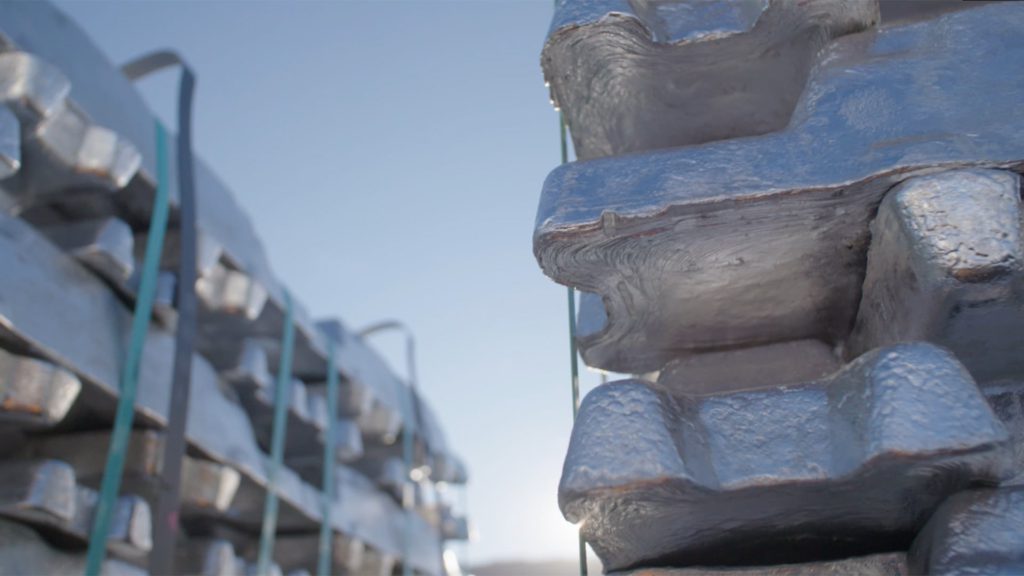
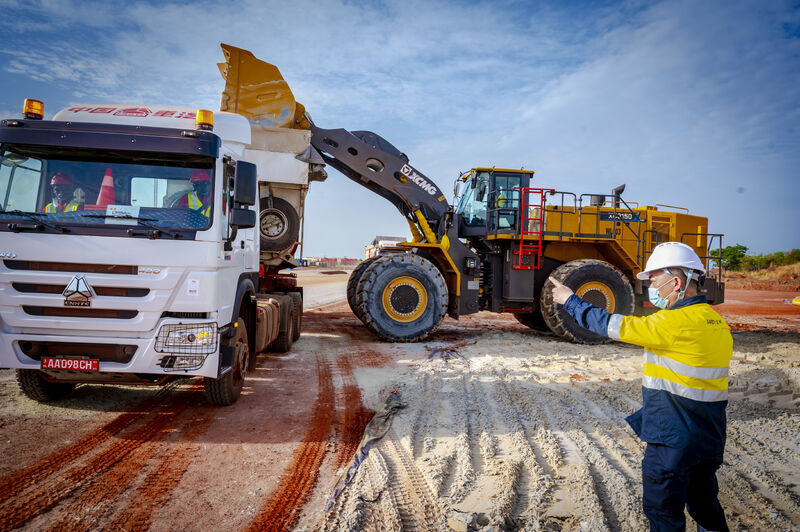
Aluminum ingots. Credit: Rio Tinto

Rio Tinto Group is imposing surcharges on aluminum shipments it sells to the US, a move that threatens to further disrupt a North American market already roiled by import tariffs that are driving up costs for consumers.

The Anglo-Australian mining giant is including the extra charge on aluminum orders delivered to the US citing low inventories, as demand starts to outstrip available supply, according to people with direct knowledge of the matter.

The US relies heavily on foreign aluminum supplies as it doesn’t have the capacity to produce enough to meet demand. Canada is its No. 1 foreign supplier, accounting for more than 50% of US imports.

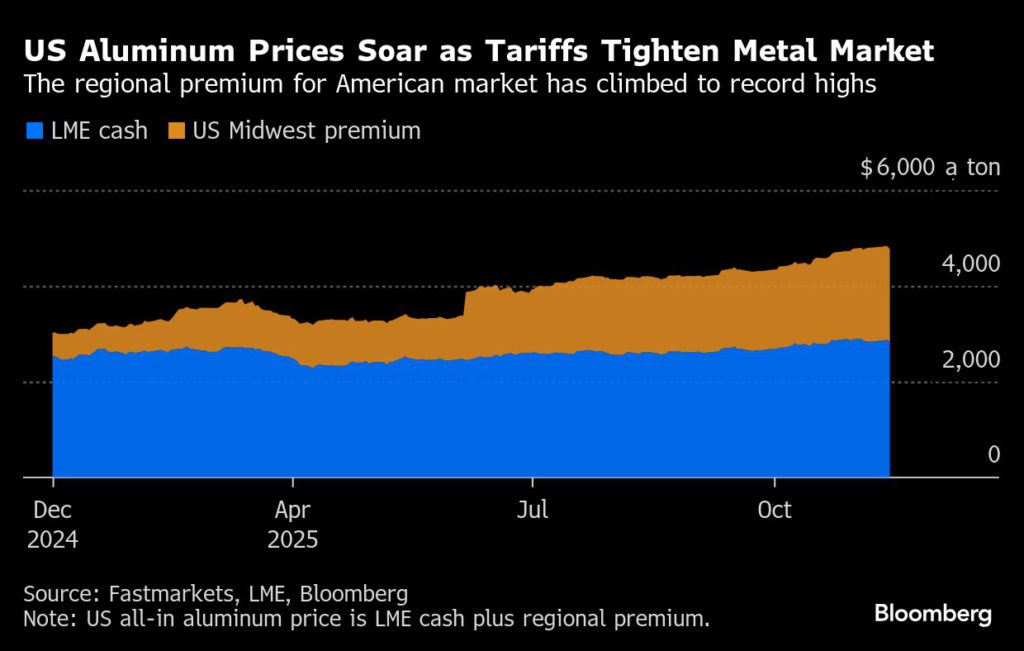
The surcharge adds stress to an already extremely constrained US market after President Donald Trump earlier this year imposed a 50% import tariff on the lightweight metal, which is used in everything from soda cans to construction. Tariffs made Canadian shipments too expensive for American metal fabricators and consumers. Instead they’ve drawn on domestic stockpiles and exchange warehouses, leading supplies to dwindle and prices to jump.

The latest markup amounts to a charge on top of a charge, since US aluminum prices already include the so-called Midwest premium — an added cost above the London benchmark price that reflects transportation, storage, insurance and financing — to deliver the metal into the American marketplace. Each global region has its own premium, which is usually set by pricing reporting agencies.

The new surcharge ranges from one to three cents above the Midwest premium, said the people familiar, who asked to not be identified discussing private contract details. Though that’s a modest amount, the markups plus the Midwest premium translate into an extra $2,006 per ton on top of the raw metal price of about $2,830, implying a more than 70% premium. That’s above Trump’s 50% import duty.

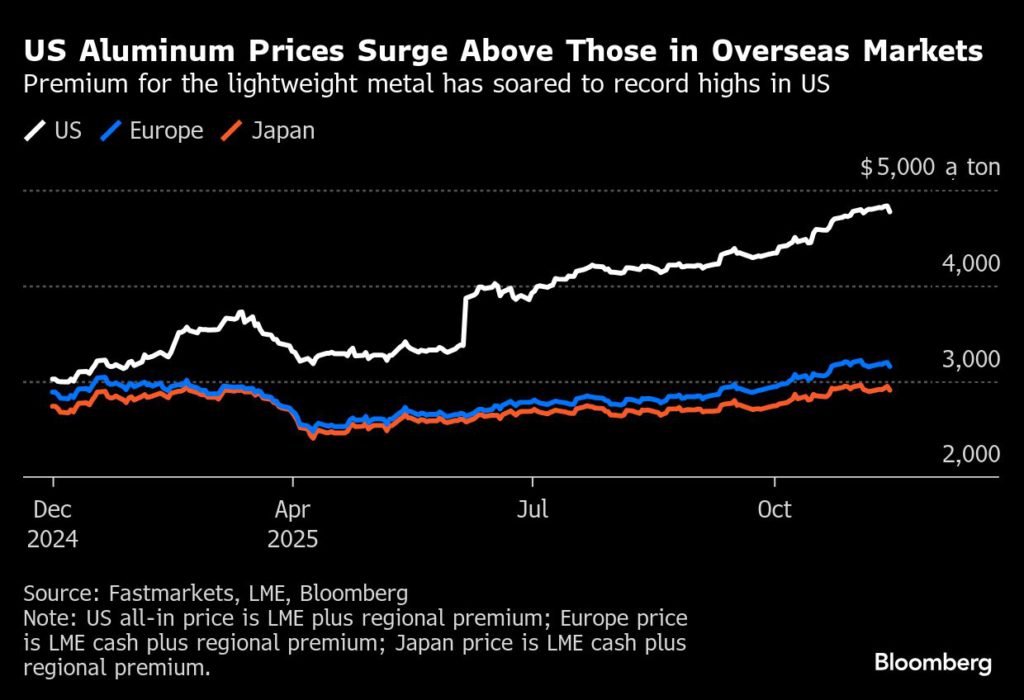
Consumers and traders describe a market that’s all but broken, with the surcharge the clearest sign yet of how deeply its structure has been disrupted by Trump’s levies. The price for aluminum delivered to the US, including the benchmark price and the Midwest premium, reached a record high last week as stockpiles shrink.

It’s “a new reality now that if the US wants to attract aluminum units, it has to pay up because the US is not the only market that actually is short,” said Michael Widmer, head of metals research at Bank of America Corp.

Rio Tinto declined to comment. The head of the Aluminium Association of Canada, Jean Simard, explained that buyers asking for payment terms on contracts beyond 30 days should expect a premium to offset higher costs of financing for producers.

“The 50% tariff on aluminum put in place by the US administration significantly increased the risk of holding aluminum inventory in the US as any tariff change could directly impact the economics of cash-and-carry inventory financing trades,” Simard said.

In Europe, which is also a net importer of aluminum, the regional premium has dropped about 5% from a year ago. But it has been recovering in recent weeks amid supply outages and the implementation next year of a European Union fee on imports based on greenhouse gases emitted during their production, according to Morgan Stanley analysts including Amy Gower. The analysts expect the current global backdrop to take the global benchmark above $3,000 a metric ton.

Trump set aluminum tariffs at 25% in February and doubled the rate in June in what he said is an effort to protect American industry. US importers turned to domestic supplies to try and evade paying the steep import tax.

US warehouses used by the London Metal Exchange, the biggest global market for metals trading, don’t have any aluminum left after the last 125 tons were withdrawn in October. Exchange inventory typically serves as the last resort for physical supply. Top US aluminum producer Alcoa said during its third-quarter earnings call that domestic stockpiles stood at only 35 days of consumption, a level that typically triggers higher pricing.

Before the recent price increase, aluminum producers in Quebec had been sending more of the metal to Europe to compensate for the loss-making US market. Quebec represents about 90% of Canada’s aluminum-making capacity, with the US as the province’s natural buyer given the close proximity.

The tightness in the US market has been exacerbated by language in the presidential proclamations that says aluminum tariffs won’t apply to imported products if the metal was smelted and cast in the US. That’s created more demand for US-made aluminum from overseas manufacturers, who use it to make products that are then shipped to the US duty-free.

“If you are a net importer of aluminum units, and you’re putting a tariff on those imports, ultimately, it’s not the supplier who pays — it’s the consumers, hands down,” said Bank of America’s Widmer.

(By Yvonne Yue Li)

EU plans to curb exports of aluminum scrap

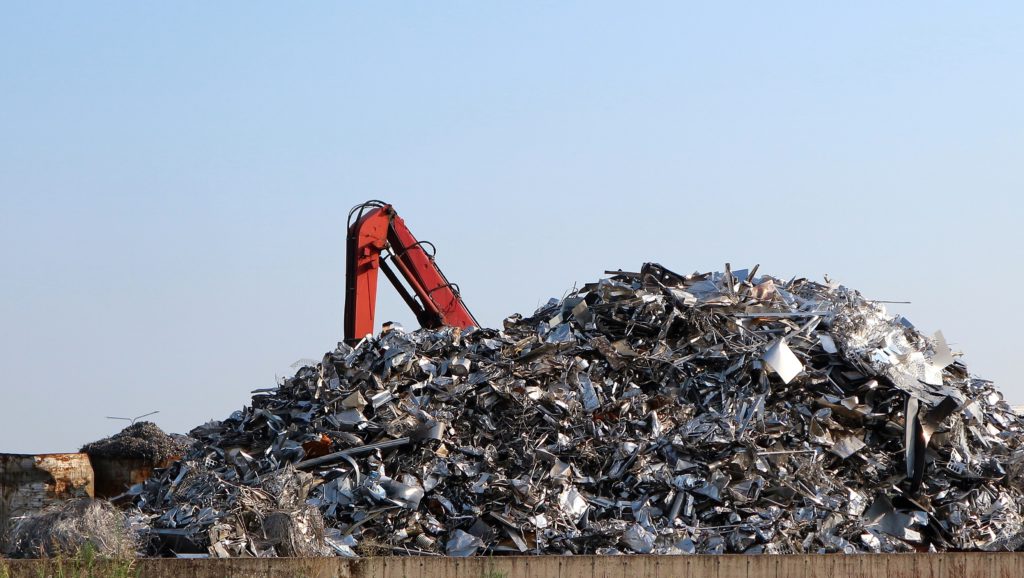
Large stack of aluminum and ferrous materials scrap. Stock image.

The European Commission plans to restrict EU exports of scrap aluminum, to stop the metal flooding out of the bloc and leaving its industry short of an input required to decarbonize, EU trade chief Maros Sefcovic said on Tuesday.

EU exports of aluminum scrap hit a record 1.26 million metric tons in 2024, industry group European Aluminium says, up about 50% from five years ago, with most heading to Asia.

The EU industry says the situation has worsened since, due to US President Donald Trump’s import tariffs of 50% for aluminum but only 15% for scrap.

The levies boosted scrap imports into the United States and reduced exports, pushing Asian buyers to focus more on EU supply.

The EU executive began monitoring exports in July and said it would assess whether action was necessary.

“Today … we are launching the preparatory work on a new measure to address the issue of aluminum scrap leakage,” European Trade Commissioner Sefcovic told a conference hosted by European Aluminium in Brussels.

The measure, set to adopted in spring 2026, would be ‘balanced’, he added, taking into account the interests of producers, recyclers and downstream sectors.

Besides being a resource for domestic producers, scrap has a vital role in the sector’s decarbonization efforts, since recycling aluminum uses 95% less energy than producing metal from mined bauxite.

Recycling industry group EuRIC, which opposes restrictions, has said scrap exports are the result of low domestic demand and insufficient EU capacity to handle mixed scrap, such as from shredded vehicles.

(By Philip Blenkinsop; Editing by Charlotte Van Campenhout and Clarence Fernandez)


Gina Rinehart becomes MP Materials’ top shareholder

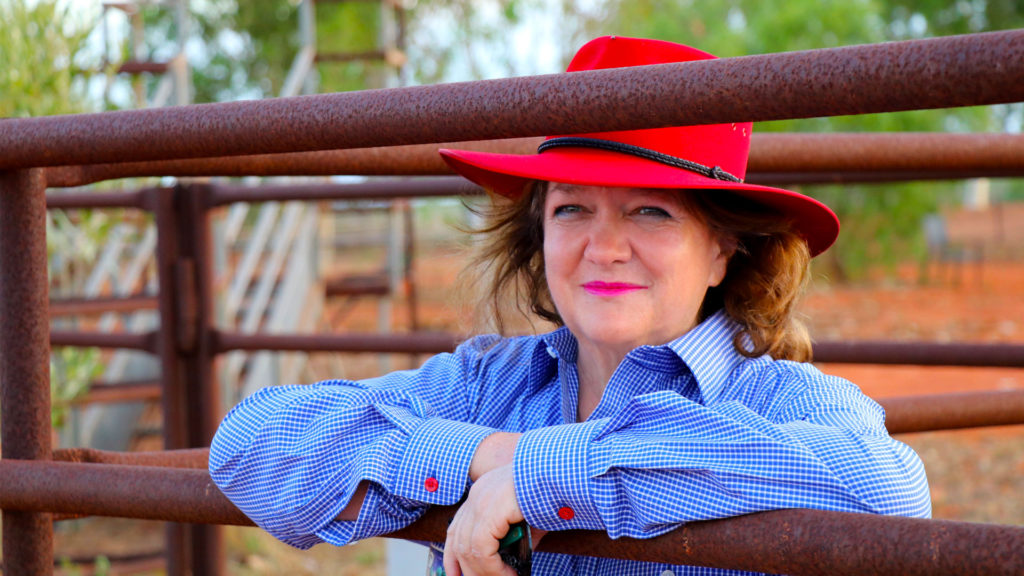
Gina Rinehart is Australia’s richest person. (Image: Gina Rinehart website)

Gina Rinehart, Australia’s richest person, has become the biggest shareholder in US rare earths producer MP Materials Corp., boosting her global bet on strategic minerals.

Her privately held Hancock Prospecting Ltd. held about $3 billion of US-listed stocks and exchange-traded funds as of Sept. 30, according to a new regulatory filing.

Hancock bought an additional 1 million shares in MP Materials during the third quarter, lifting its stake to 8.4% and making it the firm’s biggest shareholder. After the rare earth miner’s share price doubled over the period, the holding was valued at $997 million at the end of September — the biggest position in Hancock’s portfolio, according to Bloomberg calculations.

MP Materials chief executive officer and founder James Litinsky is the company’s second biggest shareholder, with a 7.9% stake, according to data compiled by Bloomberg. The firm — operator of the only rare earths mine in the US — secured a $400 million equity investment from the Pentagon in July, drawing Rinehart’s empire deeper into America’s defense supply chain.

The entrepreneur, who made her fortune from developing massive iron ore deposits in Western Australia, is currently worth $32.3 billion, according to the Bloomberg Billionaires Index.

(By Ainsley Thomson)


Yttrium price surges to record as rally approaches 1,500%


Stock image.

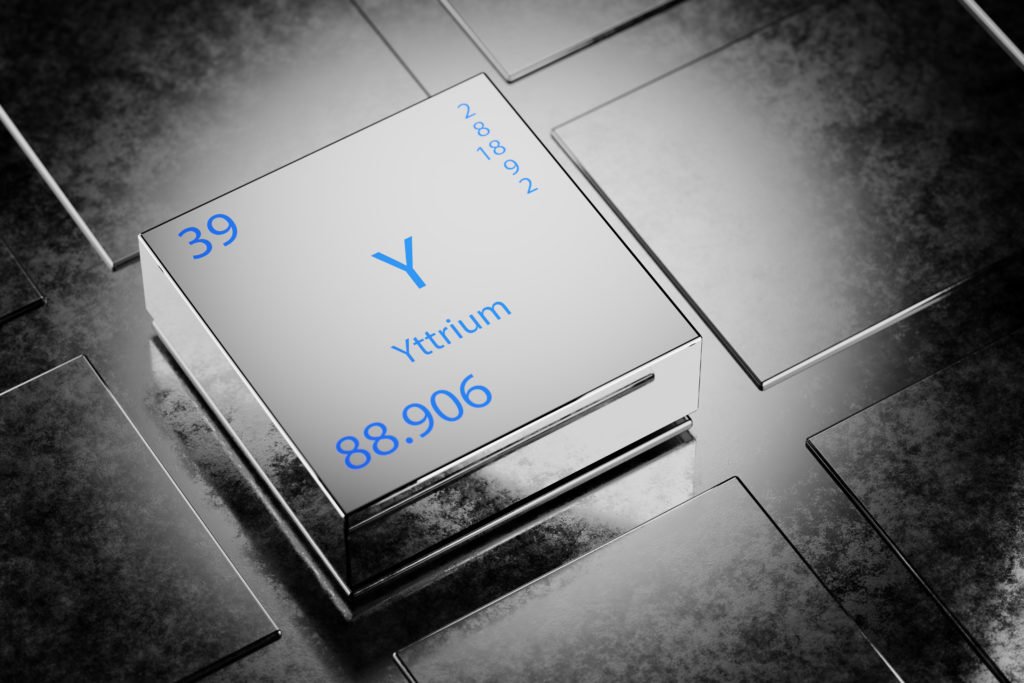
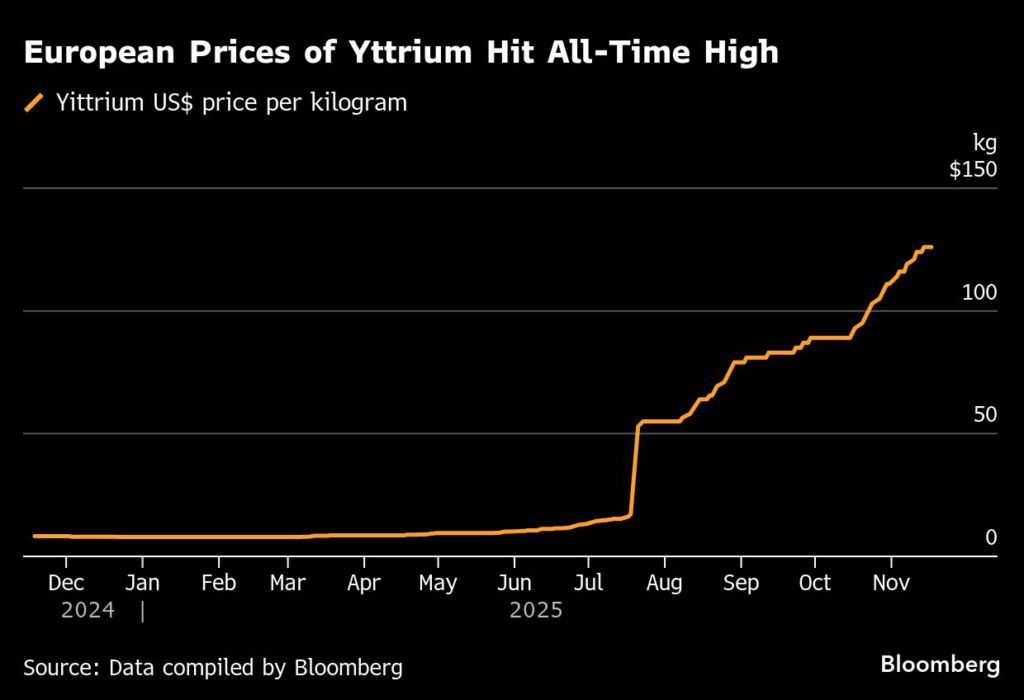
Rare earth element yttrium oxide has hit an all-time high after surging almost 1,500% this year, highlighting the fallout of trade curbs from China.

Prices surged to $126 a kilogram, up from less than $8 at the end of 2024, according Asian Metal Inc. In April, China imposed export curbs on rare earths, including yttrium.

Rare earths — their output, refining, trade, and usage — are at the heart of the drawn-out trade showdown between the world’s two largest economies. At present, China dominates their production, and while Beijing recently agreed to free up sales, the two sides are still negotiating over the details.

Yttrium’s uses include medical technologies, as well as aerospace equipment, ceramics, lasers and superconductors. In the four years to 2023, more than 90% of US imports came from China, according to the US Geological Survey.

In the US, while Pentagon-backed MP Materials Corp. mines yttrium at its Mountain Pass project, the company is stockpiling the material while it plans a downstream expansion.

Elsewhere, Australia’s Lynas Rare Earths Ltd., which produces an array of rare earths, is expanding capacity to produce yttrium from its Mount Weld mine and processing plant in Malaysia.

(By Paul-Alain Hunt)


Freeport plans to restore large-scale production at Grasberg in Q2 2026

View from the Grasberg mine, Papua. Credit: Richard Jones | Flickr

Freeport McMoRan (NYSE: FCX) says it plans to restore large-scale production at Indonesia’s Grasberg minerals district from the second quarter of 2026, following a fatal incident that halted operations earlier this year.

On Sept. 8, a catastrophic mudslide released 800,000 metric tons of wet material into Grasberg’s Block Cave underground mine, resulting in the death of seven workers. Since then, Freeport has declared force majeure and completed an investigation into the incident, the details of which are yet to be disclosed.

Remediation activities are currently being advanced to prepare for a phased restart and ramp-up of the Grasberg Block Cave underground mine beginning in Q2 2026, the US copper mining giant said in a press release on Tuesday.

As previously reported, Freeport has already resumed activities at the Deep Mill Level Zone and Big Gossan underground mines, which it said were not affected by the mud flow. Together with the Block Cave, they form one of the world’s largest copper-gold mine complexes, producing 1.7 billion lb. of copper and 1.4 million oz. of gold annually. The Grasberg district is situated in the remote highlands of the Sudirman Mountains in Central Papua.

Freeport serves as Grasberg’s operator and holds an approximate 49% interest, while the rest is owned by the Indonesia government.

“We have incorporated the learnings from the recent tragic incident into our future plans and are implementing several initiatives to address the conditions that led to the incident,” Freeport’s chief executive Kathleen Quirk said in the Tuesday press release.

Production forecasts

According to Freeport, Grasberg’s in 2026 production will be similar to 2025 at about 1 billion lb. of copper and 900,000 oz. of gold — about 35% lower than its pre-incident estimates following a September revision.

However, the company expects production to rise in the following three years, averaging 1.6 billion lb. of copper and 1.3 million oz. of gold between 2027-2029. The Block Cave mine, which accounts for half of Grasberg’s entire mineral reserves, is set to account for a majority (70%) of that production.

Freeport opened the Tuesday session 5.8% higher at $41.27 a share in New York, for a market capitalization of $56 billion.

CRIMINAL CAPITALI$M

Businessman accused in Trafigura nickel nightmare goes on trial

(Image courtesy of Trafigura.)

More than two years after it emerged that Trafigura Group lost over half a billion dollars in an alleged nickel fraud, a trial began as the trading giant attempts to recover losses from the man it says was behind the scam.

Proceedings kicked off at the High Court in London on Monday in the trial involving Trafigura — one of the world’s top commodities suppliers — and Indian businessman Prateek Gupta. Trafigura brought the claim after shocking the market in 2023 when it announced that almost $600 million of metal in containers that it bought didn’t contain the nickel they were supposed to.

Trafigura took legal action against Gupta and several firms connected to him after saying it spent months uncovering what it believed was a systematic fraud against it. Gupta has previously denied the charges against him.

The trial — set to last more than a month — was nearly delayed after Gupta’s lawyers stepped away from representing him, only to be reappointed at the last minute. Gupta is set to testify by video link from the United Arab Emirates later in the case while Socrates Economou, Trafigura’s former head of nickel, will also appear as a witness.

In opening arguments Monday, Trafigura’s lawyer Nathan Pillow said that the company had realized less than $10 million by selling the contents of around 100 cargoes it was left with when its relationship with Gupta unraveled — stainless steel and aluminum ingots. They would have been worth just over $500 million had they contained the London Metal Exchange-grade nickel as expected. Trafigura still holds some cargoes of “essentially worthless” iron briquettes which it can’t sell.

Pillow described the situation as “a sort of Ponzi scheme,” with Trafigura as the sole victim, and “where the scheme was apparently successful for so long as the music continued to play.”

Meanwhile, Gupta’s lawyers argue in their legal filing that there was a mutually beneficial “arrangement” between the parties, “so long as the circle kept turning.”

The case is among a string of scandals that shook metals markets in recent years and stirred worries about the fragility of warehousing and shipping networks that play a key role in the industrial economy. Other examples include the LME finding some inventories that underpinned nickel contracts were just bags of stones. A trading house was also stung by a metal cargo that turned out to be near-worthless rubble.

For the Trafigura deals — which used financing from Citigroup Inc. — it would buy nickel in the form of cathodes and briquettes from Gupta’s companies with an agreement that it would later be bought back by them, or by an alternative buyer nominated by them, or sold in the open market.

The prices of the sale and the purchase were set so that Trafigura earned a fixed fee on the deal, as if it were simply lending money — typically equivalent to an interest rate of 4% to 6%. Trafigura in legal filings has described the transactions as “transit finance.”

The trade began to unravel when Trafigura investigators arrived at the port of Rotterdam just before Christmas in 2022 to check the contents of a container that was meant to hold nickel. When they cracked it open, it was full of much lower-value materials.

Repercussions of losses

The embarrassing losses have had huge repercussions inside Trafigura itself, intensifying longstanding tensions between the firm’s metals and energy units. Several of its metals trading team involved in the dealings with Gupta left the company in the wake of the scandal, though Trafigura doesn’t believe any of its employees were complicit in the fraud.

Among those who left the firm was Harshdeep Bhatia, who had led Trafigura’s relationship with Gupta. He’s not giving evidence at the trial, something Gupta’s lawyers have complained about, given he was Gupta’s “main point of contact” with Trafigura.

“It appears that he simply got cold feet as the trial approached,” Gupta’s lawyers said.

Bhatia didn’t immediately respond to a request for comment.

Trafigura has said that it was its internal audit following the events that revealed another alleged fraud — this time losing over $1 billion in Mongolian oil.

In late 2023, a judge rejected Gupta’s attempt to lift a court freeze on his assets, saying that he had failed to present convincing evidence that Trafigura staff knew that there was no nickel in the cargoes it was buying — something Trafigura has denied. The businessman has struggled to pay his legal fees, and lost sets of commercial lawyers.

Gupta and his companies have a checkered history in the trading world. Commodities merchant Gunvor Group and trade finance fund TransAsia Private Capital Ltd. lost money in earlier dealings with his firms, public filings show. Others, including banks and counterparties, became uncomfortable at times with the group’s trading activities, Bloomberg has reported.

Meanwhile, Trafigura is coming off the most profitable period in its history, and has a new chief executive officer this year in Richard Holtum.

(By Archie Hunter and Jonathan Browning)


Three Crewmembers Charged with Attempting to Break Captain’s Door with Axe

Busan South Korea
Coast Guard became involved after the crew began swinging axes and sledgehammers to enter the captain's cabin (Busan Coast Guard)

Published Nov 17, 2025 5:35 PM by The Maritime Executive


South Korea’s Busan Coast Guard is recounting the details of a rampage staged by three crewmembers aboard a cargo ship anchored offshore. The local District Court issued an arrest warrant for three Vietnamese nationals working aboard the ship, charged with assault, threatening colleagues, intimidation, and property damage. The Coast Guard reports it acted fearing that the incidents could lead to additional crimes, including potentially a murder.

The incident began on November 9, when the vessel, which was only identified as a cargo ship registered in Panama, was anchored off Gamcheon Port. The ship had 15 Vietnamese crewmembers aboard.

The three individuals, who were identified as a deckmaster, helmsman, and a crew leader, were drinking and singing in the crew mess around midnight. They got into an altercation with a fourth crewmember whom they punched, hit with a chair, and threatened with a weapon.

The captain of the vessel reported the assault to the shipping company. It was determined that three individuals should be forcibly discharged and disembarked in Korea.

Learning their fate, the three crew reportedly were drinking in one of their cabins and plotted to demand that the captain rescind the order. They went to the captain’s cabin at around 0240 armed with fire axes and sledgehammers. They demanded the door be opened, and when the captain refused, they began hitting the doors of the captain’s cabin, first and third mate’s cabins. 

The threesome was also reported to be plotting to take control of the vessel. They reportedly threatened at least one crewmember with a weapon.

The captain notified the ship’s agent, who notified the Coast Guard, which then became involved. They boarded the ship to restore order and detained the three individuals. The authorities said they considered this a “serious crime” that could have escalated. The court agreed, granting the arrest warrants.

 The Coast Guard Division Chief said they will continue to respond strongly when weapons are used, shipboard order is threatened, or port safety is endangered.