Sunday, January 04, 2026

Monroe Doctrine: the Bad Neighbor Returns

 January 3, 2026


The man behind the curtain. Still from Wizard of Oz.

President Trump signaled the Monroe Doctrine’s return from the start of his second term. A volatile mix of geopolitical, hemispheric and local politics was in play. The world’s largest reserves of “Texas Tea” turned the wandering Eye of Sauron in Washington on the birthplace of the Bolivarian Revolution. The Trump Administration intends to juice US and global economic growth by reducing energy costs, as we saw in the 1980s and 1990s when oil prices dropped. Fossil fuels are the Trump Administration’s preferred choice of dirty energy to fuel the AI boom, which the US intends to lead. Oil-laden tankers departing from Venezuela en route to China are not part of the program.

Meanwhile, the Trump Administration treats the American public like turnip truck rubes. While Trump, in Oscar Zoroaster Phadrig Isaac Norman Henkel Emmannuel Ambroise Diggs fashion, blows sulfurous clouds of smoke behind the curtain regarding drugs and DEA arrests, we are expected to ignore that Venezuela’s neighbor, Colombia by several multiples, is the bigger exporter of illicit substances to the United States. Fortunately for Colombia, it has the 34th-largest oil reserves in the world, rather than first, and, unlike Venezuela, is not a supplicant to the United States; ergo, expect none of its leadership to be arrested and dragged off in handcuffs by Uncle Sam’s, ahem, DEA Agents.

Latin America had roughly two decades of reduced attention from its weakening, yet nonetheless still powerful, northern neighbor in the 21st century.  The US partially disengaged from Latin America with Dick Cheney’s 2003 war on Iraq. After all, one can only do so many things. When Cheney wasn’t shooting hunting companions in the face with demands for apologies thereafter, his focus was limited chiefly to two places, Iraq and Russia. Iraq and Russia both became targets of a Molotov-Ribbentrop Pact between liberal interventionist Democrats and neocon Republicans (the dominant factions of both parties) to see US hegemony retained in what neocons called the “Project for a New American Century.”  The Middle East sat on gobsmacking amounts of oil, for which Madame Secretary of State Madeline Albright infamously asserted that the loss of 500k children’s lives was “worth it” to depose Iraq’s leader. And Russia was a veritable piggy bank of natural resources for which Zbigniew Brzezinski’s musings published in 1997 on the possible busting up of Russia into three states would not be unwelcome, certainly were noted in the Kremlin.

“Mission Accomplished” and surrounding Russia with NATO (yes, those states bordering Russia, given their histories of being under Russia’s boot, wanted in) created two winners: US pensioners and Latin Americans. The former were about to see “W” Bush fully or partially privatize Social Security before the Iraq adventure required his administration’s attention. And the latter saw the wandering Eye of Sauron shift off its historical focus on Latin America. For the first time since Franklin Delano Roosevelt’s Good Neighbor Policy, Latin America exercised some autonomy in the 21st century. Latin America’s renewed left turn began with Hugo Chavez’s 1998 election in Venezuela, and arguably only survived thereafter due to US distractions. The same goes for Lula da Silva in Brazil after winning office in 2002.  Others were later elected, notably, such as Bolivia’s Evo Morales, Ecuador’s Rafael Correa and others. Even Cuba, the long-standing object of US-sponsored invasions such as the Bay of Pigs in 1961 and the CIA confirming several assassination attempts on Fidel Castro, saw the hemisphere’s largest island state get a brief respite as the US opened travel to it in 2016, even if the US’s economic war on the Pearl of the Antilles continued.

The Monroe Doctrine is a continuation of the twin movements of conquest and revolt against empire in play from the US’s birth. Americans grew weary of rule from abroad in 1776, which included their demands for ever more seizure of land from indigenous peoples. The Crown disapproved, for settler conquest created no shortage of “Indian Wars” for which they bore the cost. Readers are familiar with the rest, but summarizing quickly, John Quincy Adams as Secretary of State to President James Monroe in 1823, boldly declared the hemisphere belonged to the United States’ sphere of influence. The policy was clear, while the US continued its Manifest Destiny in conquering much of North America, other powers were to check their ambitions in the Western Hemisphere. Dozens of interventions, large and small, ensued in the next century. On the “larger” side of the ledger was President “Jimmy” Polk’s grab of 55% of Mexico in 1848.

Also of note on the bigger side of US Monroe Doctrine actions was the US occupation of Haiti in 1915, which lasted until 1934. Some 50,000 “natives” dying from the consequences of war in Haiti. The US did not so much covet Haiti’s resources as it wished to keep competitors, namely Germany, out of this country whose waters ships traveled through to access the Panama Canal. Still, money mattered. Much of the US occupation of Haiti was directed by the precursor to today’s Citibank’s Vice-President, Roger P. Farnham, whose personal investments and those of his bank were tied up in Haitian infrastructural loans.

FDR turned a page by ending the US occupation of Haiti and announcing a Good Neighbor policy. The title itself announced that the US heretofore was a bad neighbor. FDR’s death brought the return of the US as a bad neighbor until the aforementioned 21st-century reprieve anchored in other US interests. And now, here we are with Maduro hauled off by the United States on January 3, 2026.

What can we expect from the return of the Monroe Doctrine?

+ We can play Taps for International Law that previously was already ill.

+ Cuba’s government likely can’t survive. Mortally wounded and with social pathologies (e.g., street crime formally absent) laid over its poverty, its government likely falls. Marco Rubio and Trump are taking the victory lap with Florida’s substantial Cuban émigré community.

+ Latin American leaders are put on notice. Uncle Sam has returned to its historic norm of exercising dominance over the hemisphere. Latin American leaders will exercise caution in dealings with or joining the BRICS. Meanwhile, much of the rest of the world outside the Americas and Europe will run toward inclusion in the BRICS.

+ China increasingly will see the US as aggressive, if not deranged. The Middle Kingdom will likely further develop its already substantial defensive capacities. If the US decides to force the issue of Taiwan’s future status, China may respond with a blockade of the island.

+ Russia will expect a quid pro quo from Washington on spheres of influence. Yet, Trump’s successful removal of Maduro will leave some in Russia asking if they needlessly endured a 4 year long war of aggression against Ukraine (yes, the Kremlin was endlessly provoked, but, nonetheless, the aggressor).

Jeffrey Sommers is Professor of Political Economy & Public Policy in the Department of African &African Diaspora Studies and a Senior Fellow, Institute of World Affairs, University of Wisconsin-Milwaukee. His book on the Baltics (with Charles Woolfson), is The Contradictions of Austerity: The Socio-economic Costs of the Neoliberal Baltic Model.


EXPLAINER

What is the Monroe Doctrine, which Trump has cited over Venezuela?

US attack on Venezuela evokes the Monroe Doctrine, laid out in 1823 by then-US president to cement Washington’s sphere of influence in Americas.


By Umut Uras
Published On 4 Jan 2026
AL JAZEERA

United States President Donald Trump has set out to justify the attack launched on Venezuela and Washington imposing its will in Latin America by citing a policy from a 19th century president.

Trump on Saturday called the raid that led to Venezuelan President Nicolas Maduro being abducted an update to the Monroe Doctrine, the 1823 declaration by the fifth US president, James Monroe, adding that the US will “run the country” until “a safe, proper and judicious transition” could be carried out.

“The Monroe Doctrine is a big deal, but we’ve superseded it by a lot, by a real lot. They now call it the Donroe document,” Trump said, attaching the first letter of his name to the series of principles.

“American dominance in the Western Hemisphere will never be questioned again,” he added.

Here is what you need to know about the Monroe Doctrine:

What is this 19th century US policy?

The Monroe Doctrine essentially urged the division of the world into spheres of influence overseen by different powers.

Monroe first spoke of the doctrine on December 2, 1823, during his seventh annual State of the Union address to Congress although the doctrine was not named after him until decades later.

He warned European powers not to interfere in the affairs of the Americas, stressing that any action of that sort would be viewed as an attack on the US.

The president stated that the affairs of the Western Hemisphere and Europe should remain separate and should not influence each other.

He promised in return that the US would recognise and not interfere with existing European colonies or the internal affairs of European countries.


However, North and South America would no longer be subject to future colonisation by any European power, Monroe said.

In many aspects, the Monroe Doctrine urged keeping the status quo in the Americas but also dictated a European disengagement from them.

In 1904, President Theodore Roosevelt added the Roosevelt Corollary to the Monroe Doctrine, asserting a US right to intervene in Latin American countries to prevent European interference, especially concerning debt or instability, to maintain stability and protect Washington’s interests in the Western Hemisphere.

That year, when European creditors threatened several Latin American countries, Roosevelt stated the right and responsibility of the US to get involved in line with the doctrine.

The Roosevelt Corollary was articulated in the aftermath of the Venezuelan crisis of 1902-1903 when the country rejected paying its foreign debts.
How has the US imposed this in recent decades?

Over the next decades, the evolved Monroe Doctrine served as justification for US intervention in the Dominican Republic, Haiti and Nicaragua.

In the 1980s, President Ronald Reagan pursued an aggressive approach to the region, branded “imperialist” by his detractors. In Nicaragua, he supported the right-wing Contras against the left-wing government of the Sandinistas and landed the US in the Iran-Contra arms-trafficking scandal. He also supported right-wing governments accused of atrocities in El Salvador and Guatemala.

Cuba has long been under intensive pressure from the US since Fidel Castro’s revolution, both militarily and economically under punishing sanctions that exist to this day.

There have also been reports of attempts to foment coups against Maduro’s predecessor Hugo Chavez before his death in 2013.


Trump Promised Peace, But His Moral-Free Foreign Policy Encourages Militarism

Instead of a values-based foreign policy, what has come out of the Trump White House this past year was a steady drumbeat of aggressive militaristic taunting.
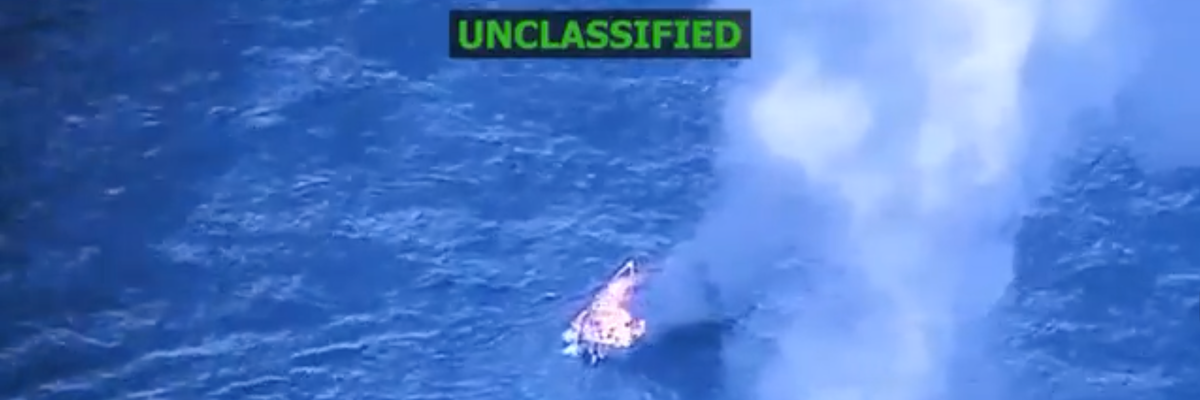

US President Donald Trump and Secretary of Defense Pete Hegseth announced that they bombed another boat in the Caribbean on October 3, 2025.
(Photo: screenshot/Donald Trump/Truth Social)

Gregory Daddis
Jan 04, 2026
Common Dreams

Americans long have wrestled with balancing power politics and moral concerns in their approach to foreign policy. An accounting of the second Trump administration’s first year in office, however, suggests that those leading in Washington today may not be all that concerned with such dynamics. This should cause concern. As US foreign policy became less guided by moral ambitions in 2025, it became, perhaps inevitably so, more militarized.

Secretary of State Marco Rubio, laying out the new administration’s priorities in January 2025, mandated that US foreign policy should answer “three simple questions: Does it make America safer? Does it make America stronger? Does it make America more prosperous?” Nowhere in this guidance did Rubio speak of setting an example based on moral virtues, on values that might favor diplomacy over raw military power within the international arena. Perhaps unsurprisingly, the latest National Security Strategy, published in November, remained equally silent on morality’s role in defining American grand strategy.

Instead of a values-based foreign policy, what has come out of the Trump White House this past year was a steady drumbeat of aggressive militaristic taunting, much of it threatening military violence and economic sanctions while politicizing the nation’s armed forces, both at home and overseas. These actions, of course, sit at odds with the president’s 2025 inaugural address in which President Donald Trump, evoking Richard Nixon, argued that his “proudest legacy will be that of a peacemaker and unifier.”

A chaotic year in, one might question that historical inheritance. Conjuring a near existential threat at the nation’s southern border, for instance, the president began his term by ordering the Pentagon send some 1,500 active-duty troops to assist with border patrolling and “alien” deportation missions.

If the Trump administration spies a dangerous world beyond its shores, then a foreign policy lacking in any moral principles hardly will dispel those threats, as real as they may be.

Equally belligerent language targeted Denmark over the intent to take Greenland, with Trump declining to rule out the use of military force to achieve his aims. Nearly a full year later, the president is still arguing that the world’s largest island is “essential” to US national security, suggesting that forcible annexation of an ally’s territory is warranted as long as the commander-in-chief deems it so.

Closer to home, the administration also set its sights on the Western Hemisphere, claiming the United States’ command of the Panama Canal despite a 1977 treaty guaranteeing its neutrality. Then, with little restraint and less legal authority, the Department of Defense began attacking suspected drug-smuggling craft off the coast of Venezuela, escalating tensions throughout the second half of 2025 that led to a blockade of the South American country and the CIA carrying out drone strikes on its coastal port facilities.

The devaluation of diplomacy also marked Trump’s first year in office, as the State Department abruptly paused all foreign aid and assistance with little to no warning soon after inauguration, with critics lamenting the impact such suspensions have had on global health programs over the course of 2025.

Such breakneck, unprincipled flexing of American power abroad arguably was matched by a similar lack of moral concerns at home. The pardoning of domestic terrorists who attacked the US capitol on January 6, 2020—with far-right extremist groups like the “Proud Boys” vowing revenge for their jail time—and the unlawful militarized policing of American cities were but just two examples of an administration acting with few self-imposed ethical guardrails.

But morals matter, both at home and abroad. They always have, even if the United States historically has not always lived up to its idealistic founding principles. Morality is not irrelevant to a nation’s foreign policy, despite noted State Department diplomat George Kennan once arguing that the “interests of the national society” such as “military security” and “the integrity of its political life…have no moral quality” of their own.

Of course, power matters, too. But power unhinged from ethical reasoning (and restraint) leads to a dark world in which military power becomes the inevitable answer to nearly any foreign policy question. Even a realist like Hans Morgenthau, author of the 1948 Politics Among Nations, counseled that the “aspiration for power” should, in some sense, be “in harmony with the demands of reason, morality, and justice.” As the famed political scientist put it, morality, mores, and law reinforced each other and offered “protection to the life of society and to the lives of the individuals who compose it.”

More recently, Joseph S. Nye, Jr. argued that we should consider the potential benefits of “maintaining an institutional order that encourages moral interests.” In short, the tension between morality and power has been healthy in our past debates over foreign policy. (Even if Morgenthau himself warned against the “intoxication with moral abstractions.”) Historically speaking, moral aims have set examples abroad, highlighted the values of human rights across the globe, and informed critiques against those who support more imperialistic and militaristic policies.

But what happens when the president of the United States, in both rhetoric and deeds, flaunts power and interests above all else? When morals are deemed an inconvenience at best, a threat to rational decision-making at worst? The likely result is the militarization of the nation’s foreign policy.

True, Mr. Trump has boasted that his dealmaking has ended eight wars while complaining that he deserves a Nobel Peace Prize for his efforts. Yet motives matter when it comes to moral concerns. Was the president seeking peace or adulation? Moreover, Mr. Trump has seemed reluctant to wade into the details for achieving lasting peace in the Middle East or for holding Vladimir Putin to task for Russia’s unbridled aggression against Ukraine.

In a world deemed existentially dangerous, then only war and the threat of war, the flawed argument goes, will keep the nation safe when morals no longer matter. Seemingly, Mr. Trump sees the world this way. In his inaugural address, the president stressed his responsibility to “defend our country from threats and invasions… at a level that nobody has ever seen before.” Such martial rhetoric has been reinforced this past year by Secretary of Defense (“War”) Pete Hegseth who, in critics’ eyes, views military morality through the lens of “might makes right.”

In our heated, if not fractured, political moment, debating the value of morals guiding our nation’s foreign policy will be a difficult task. Indeed, even finding consensus today over what we mean by “moral behavior” seems a fraught enterprise. But the discussion is needed. Surely, President Barack Obama’s drone-based “targeted killing program” or Joseph Biden’s “unconditional” support of Israeli Prime Minister Benjamin Netanyahu’s exterminationist policies against the Palestinians warrant examination, if not condemnation. So too the militarized actions of the Trump administration this past year. In short, effective American leadership is moral leadership, both at home and abroad.

Moreover, a nation broken free of its ethical moorings will engender only resentment and retaliation on the world stage. In such a scenario, a reliance on military force likely will grow as fears of America losing its “greatness” feed into themselves. If the Trump administration spies a dangerous world beyond its shores, then a foreign policy lacking in any moral principles hardly will dispel those threats, as real as they may be. Indeed, those threats will likely only escalate.

If we can agree with the proposition that power and morals can—and should—reinforce each other, then the opening weeks of the second Trump administration serve as a warning sign for the coming implications of a nation’s foreign policy bereft of moral criteria. Militarization surely will follow immorality.


Our work is licensed under Creative Commons (CC BY-NC-ND 3.0). Feel free to republish and share widely.


Gregory Daddis
Gregory A. Daddis is a professor in the history department at West Point. His latest book is "Westmoreland's War: Reassessing American Strategy in Vietnam."
Full Bio >



Maduro's 'tiger' with designer fashion tastes: Who is Venezuela's VP Delcy Rodriguez?

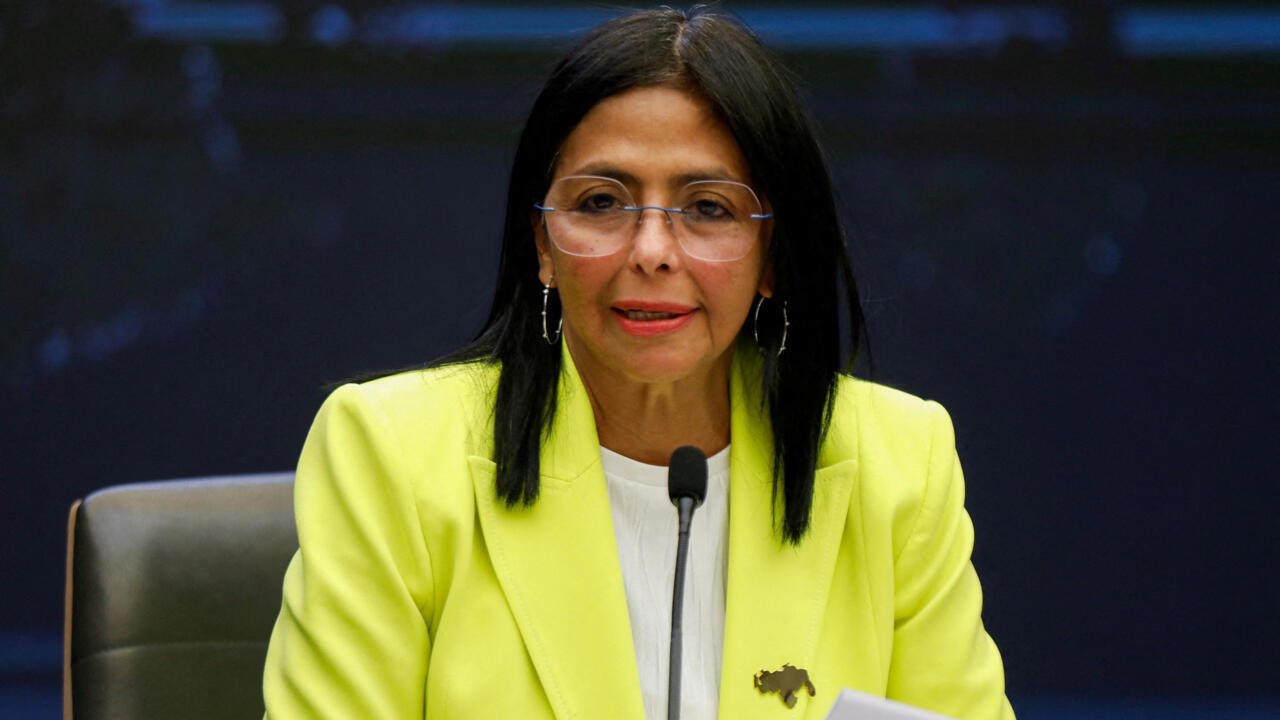
Hours after Venezuelan President Nicolas Maduro was captured in an audacious US raid, Vice President Delcy Rodriguez insisted he remains the Latin American country’s only leader. In a televised speech, Rodriguez, who is also finance and oil minister, called for calm. Rodriguez denounced Maduro's kidnapping and vowed to defend Venezuela's resources.


Issued on: 03/01/2026 -
By:FRANCE 24 

File photo: Venezuela's Vice-President and Oil Minister Delcy Rodriguez addresses the media in Caracas, Venezuela on March 10, 2025. © Leonardo Fernandez Viloria, Reuters

Hours after an audacious US military operation removed Venezuelan President Nicolas Maduro from power early Saturday, President Donald Trump said the United States would temporarily run Venezuela and tap its vast oil reserves to sell to other nations. Maduro and his wife were reportedly aboard a US warship en route to New York to face prosecution on a Justice Department indictment accusing them of participating in a narco-terrorism conspiracy.

In response, Venezuelan Vice President Delcy Rodriguez insisted that Maduro remains the country’s only president, contradicting Trump’s claims that she had been sworn in. She spoke on state television from Caracas alongside her brother, National Assembly head Jorge Rodriguez, Interior Minister Diosdado Cabello, and the country’s foreign and defence ministers.

Rodriguez called for calm and unity to defend Venezuela amid what she described as Maduro’s kidnapping, and vowed to defend the nation's resources.

Maduro has previously called Rodriguez a “tiger” for her staunch defence of his socialist government. She works closely with her brother and has been a central figure in Venezuela’s political and economic management for more than a decade.


Caracas native Rodriguez, 56, was born on May 18, 1969, and is the daughter of left-wing guerrilla fighter Jorge Antonio Rodriguez, founder of the revolutionary Liga Socialista party in the 1970s.

Rodriguez's roles as finance and oil minister, held alongside her vice-presidential post, have made her central to Venezuela’s economic strategy and influential in the private sector. She has implemented orthodox economic policies to combat extreme inflation.

She has also called on the US government to provide proof of life for Maduro and his wife, though her exact whereabouts outside the broadcast were previously uncertain.

An attorney who graduated from Universidad Central de Venezuela, Rodriguez rose quickly through the political ranks, serving as Communication and Information Minister from 2013 to 2014. Known for her designer fashion tastes, she was foreign minister from 2014 to 2017, during which she attempted to attend a Mercosur trade bloc meeting in Buenos Aires after Venezuela was suspended.

In 2017, Rodriguez became head of a pro-government Constituent Assembly, which expanded Maduro’s powers. She was named vice president in June 2018, with Maduro describing her as “a young woman, brave, seasoned, daughter of a martyr, revolutionary and tested in a thousand battles".

In August 2024, Maduro added the oil ministry to her portfolio, tasking her with managing escalating US sanctions on Venezuela’s most important industry.

(FRANCE 24 with Reuters)


What we know about the US attacks on Venezuela


By AFP
January 3, 2026


A plane carrying ousted Venezuelan President Nicolas Maduro lands at Stewart Air National Guard Base in Newburgh, New York - Copyright AFP Leonardo Munoz

After months of threats and pressure tactics, the United States on Saturday bombed Venezuela and toppled authoritarian left-wing leader Nicolas Maduro, who was seized to face trial in New York.

– How did it start? –

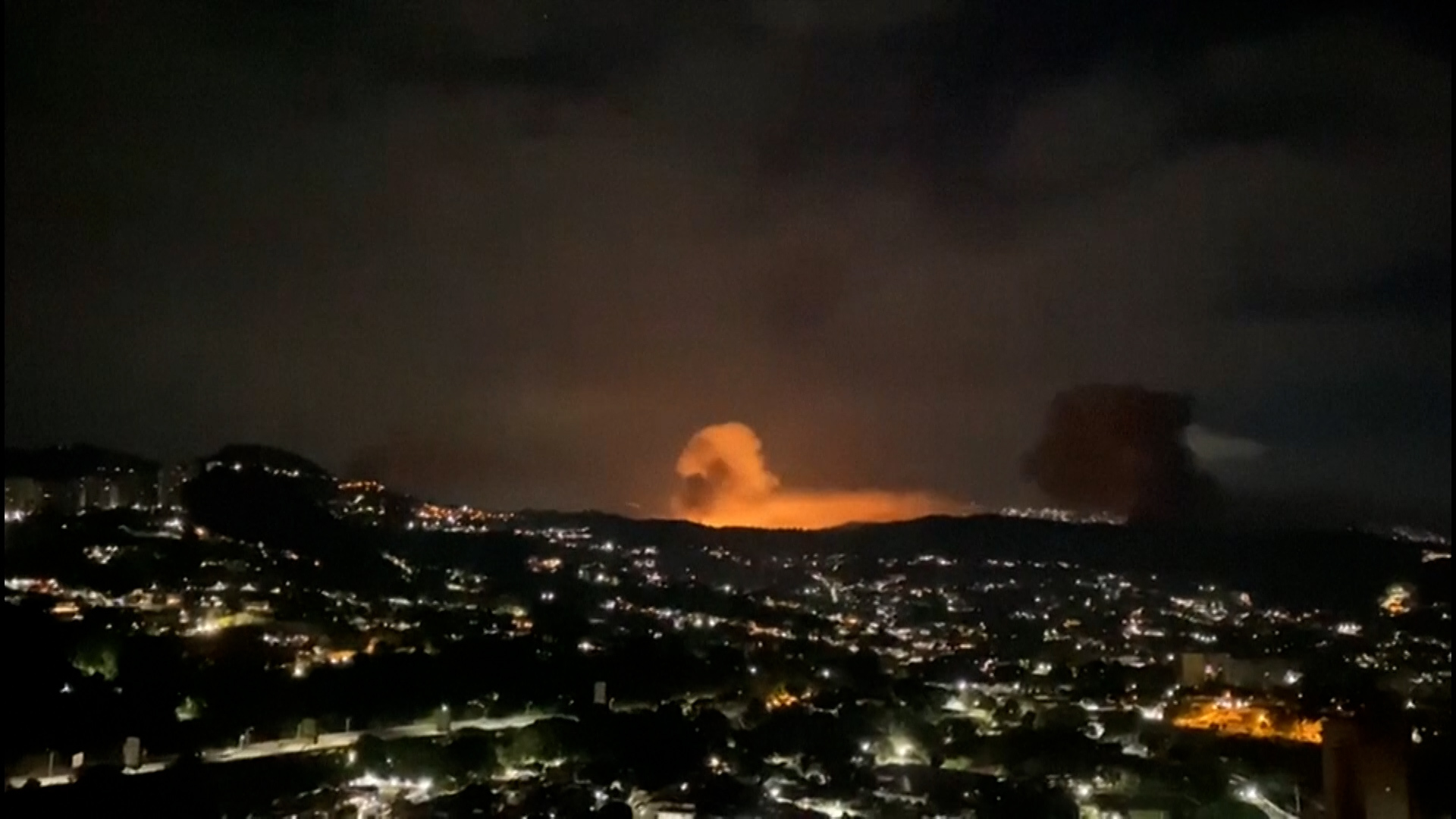
The first explosions were heard in the capital Caracas and surrounding areas shortly before 2:00 am (0600 GMT), continuing until around 3:15 am.

Images on social media showed helicopters silhouetted against the night sky and missiles slamming into targets, creating fireballs and huge plumes of smoke.

Trump said at 0921 GMT on his Truth Social platform that the United States had “successfully carried out a large scale strike against Venezuela” and that Maduro and his wife had been “captured and flown out of the Country.”

Top US General Dan Caine said the goal of “Operation Absolute Resolve” was purely to seize Maduro, with airstrikes clearing the way for helicopters used in the capture raid.

Caine said the operation, involving more than 150 aircraft, followed months of preparation.

– What was hit? –

Fort Tiuna, Venezuela’s largest military complex, was among the targets.

The vast base in southern Caracas is home to the defense ministry, a military academy and housing units for thousands of troops and their families.

AFP reporters saw flames and huge plumes of smoke rising from the complex.

At one of the entrances, which was still guarded, an armored vehicle and a truck were pocked with bullet marks.

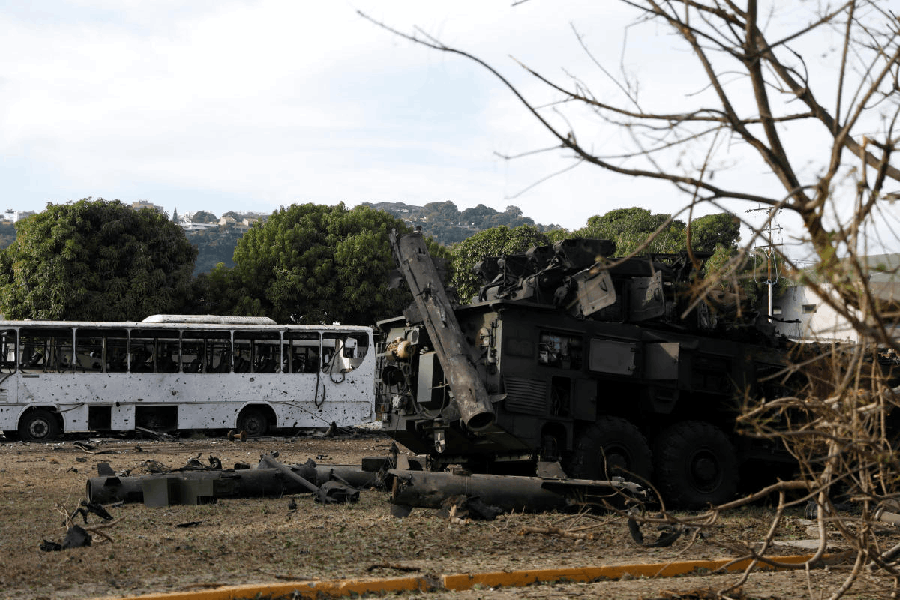
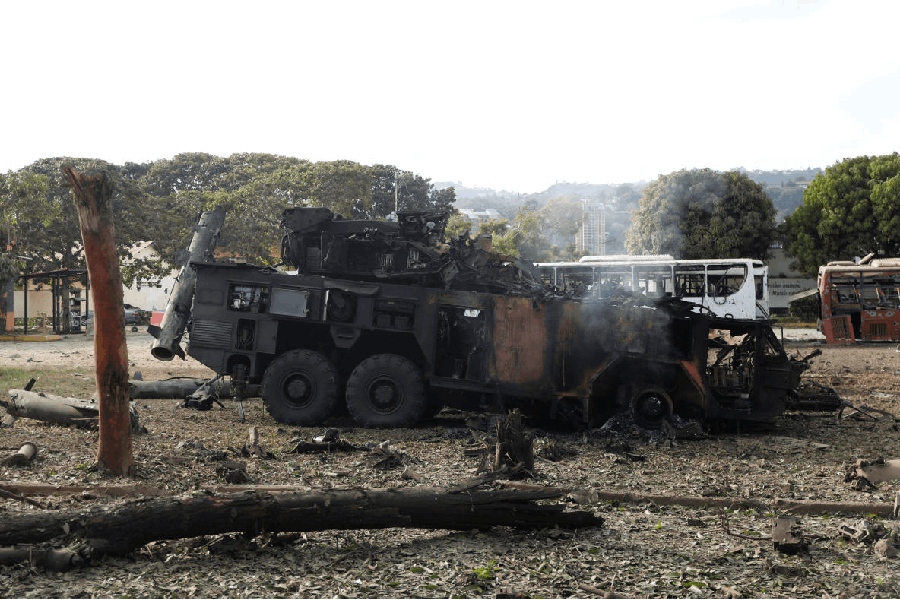
La Carlota airbase east of Caracas was also targeted. AFP reporters saw an armored vehicle at the base in flames and a burned bus.

Explosions were also reported in La Guaira, north of Caracas, home to a port and an international airport; the north-central city of Maracay; and Higuerote on the Caribbean coast — all within 100 kilometers (60 miles) of Caracas.

– Are there casualties? –

Defense Minister Vladimir Padrino Lopez accused US forces of firing missiles and rockets at residential areas.

As of Saturday night, Venezuelan authorities had yet to release casualty figures.

Trump, speaking on Fox News program “Fox and Friends,” boasted that no US soldiers had been killed. He later told the New York Post that “many Cubans” who were protecting Maduro had died, the first indication of casualties from the US strikes.

– What has become of Maduro? –

The operation brought the curtain down on 12 years of increasingly authoritarian rule by Maduro, who had a $50 million US bounty on his head.

Trump posted a picture on Truth Social of the Venezuelan leader handcuffed and blindfolded aboard a US naval ship in the Caribbean.

From there he and his wife Cilia Flores were flown to New York to face drugs and weapons charges.

Trump said he followed the operation to capture Maduro live at his Mar-a-Lago estate “like I was watching a television show.”

“He was in a very highly guarded… like a fortress actually,” he said.

He said Maduro tried in vain to escape to a safe space.

Caine said intelligence agents had spent months studying how Maduro “moved, where he lived, where he traveled, what he ate, what he wore, what were his pets.”

He said the 63-year-old Socialist and his wife surrendered without resistance.

– What next for Venezuela? –

Trump stunned US allies and foes alike by saying the United States would “run” Venezuela during an undetermined transitional period.

He indicated that could involve deploying US troops on the ground.

Venezuela’s opposition leader, Nobel peace laureate Maria Corina Machado, took to social media to proclaim her country’s “hour of freedom has arrived.”

Machado, seen as a hero by many Venezuelans for her dogged resistance to Maduro, called for the opposition’s candidate in the 2024 election to “immediately” assume the presidency.

Trump brushed aside any expectations Machado herself would emerge as leader, claiming she did not have “support or respect” in Venezuela.


Caracas wakes to silence after US strike; shocked Venezuelans unsure what comes next

Streets close to the Miraflores presidential palace were deserted except for checkpoints manned by uniformed gunmen, as residents expressed their shock at a US military strike that left them guessing who was now in charge of the oil-rich nation


Reuters Published 03.01.26, 06:30 PM

Venezuelan security forces patrolled largely empty streets at dawn in the capital, Caracas, on Saturday, hours after loud explosions woke residents to the news that US commandos had bombed the country and captured President Nicolas Maduro.


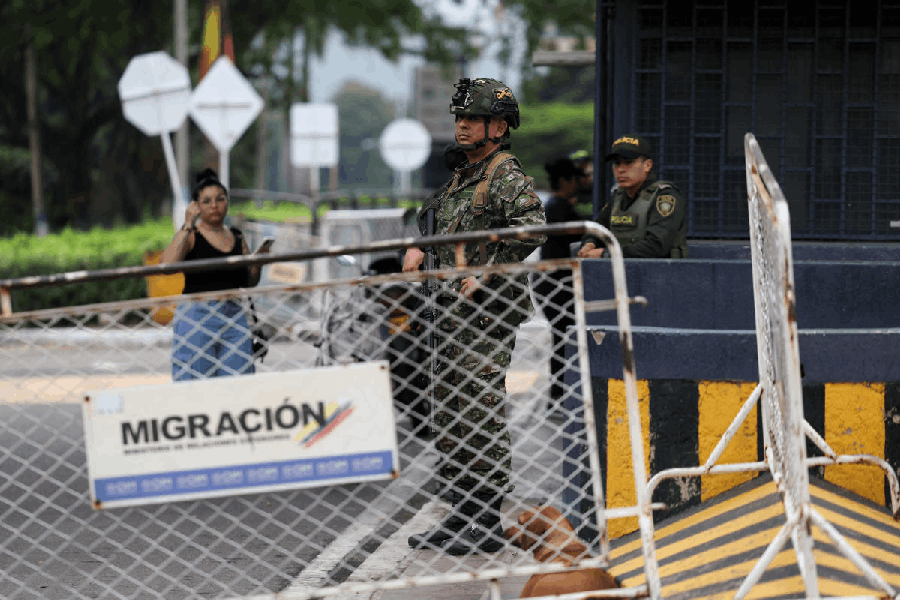
Colombian police and military personnel stand guard at the border between Venezuela and Colombia, after U.S. President Donald Trump said the U.S. has struck Venezuela and captured its President Nicolas Maduro, in Cucuta, Colombia, January 3, 2026. (Reuters)

Streets close to the Miraflores presidential palace were deserted except for checkpoints manned by uniformed gunmen, as residents expressed their shock at a US military strike that left them guessing who was now in charge of the oil-rich nation.

29A destroyed anti-aircraft unit at La Carlota military air base, after U.S. President Donald Trump said the U.S. has struck Venezuela and captured its President Nicolas Maduro, in Caracas, Venezuela, January 3, 2026. (Reuters)


Smoke streaked the sky, with a dark plume still billowing from the direction of the Port of La Guaira to the north, while another was visible near an air base in the capital.

39A Colombian soldier stands guard at the border between Venezuela and Colombia, after U.S. President Donald Trump said the U.S. has struck Venezuela and captured its President Nicolas Maduro, in Cucuta, Colombia, January 3, 2026. (Reuters)


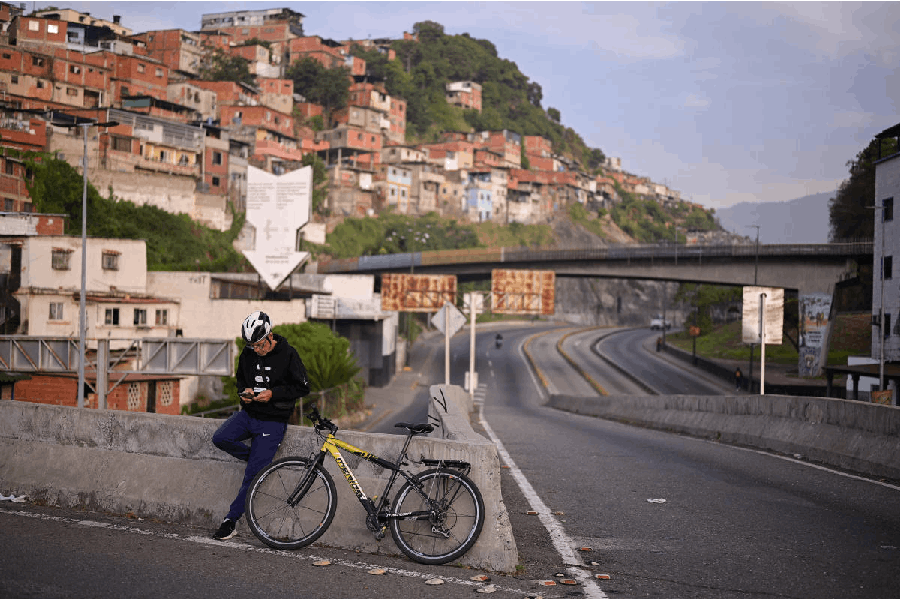
Most residents stayed home, devouring the latest information on their phones, while some went to stock up on groceries in case they need to hunker down for a prolonged period.


For supporters of the opposition, led by Nobel Peace Prize winner Maria Corina Machado, excitement was also in the air.

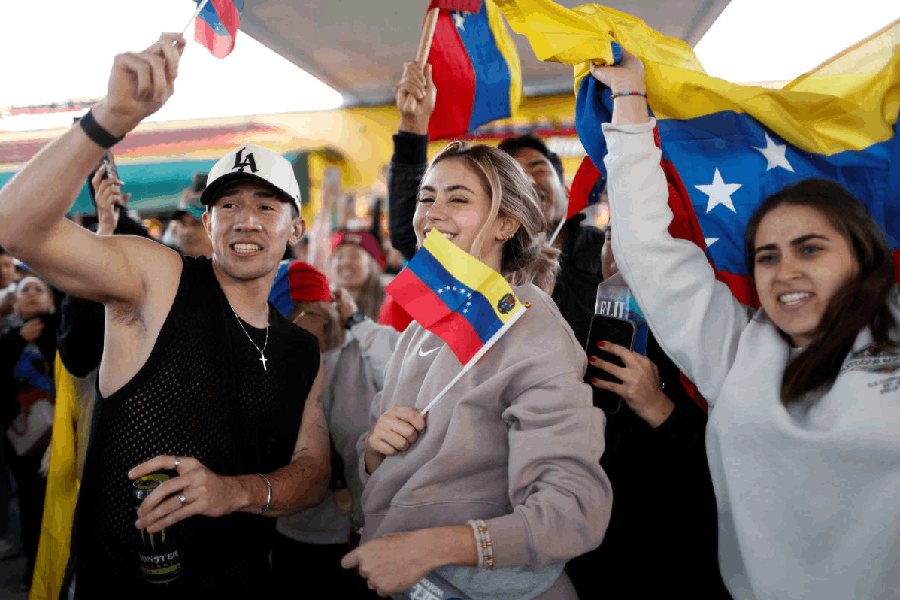
49People holding Venezuelan flags react to the news after U.S. President Donald Trump said the U.S. has struck Venezuela and captured its President Nicolas Maduro, in Doral, Miami, Florida, U.S., January 3, 2026. (Reuters)


"My sister, who is in the United States, woke me up with the news; she was crying. We cried together out of happiness," said Jairo Chacin, 39, a mechanic and workshop owner in oil hub Maracaibo, as he waited in a long line to stock up on groceries.

59A cyclist stops to check their phone, after U.S. President Donald Trump said the U.S. has struck Venezuela and captured its President Nicolas Maduro, in Caracas, Venezuela January 3, 2026. (Reuters)


"I went out to check on my business because I was afraid of looting, but the street is deserted. I wanted to fill up my gas tank, but the service stations are already closed, so I took the opportunity to buy food because we don't know what’s coming. Honestly, I have a mix of fear and joy."

69A destroyed anti-aircraft unit at La Carlota military air base, after U.S. President Donald Trump said the U.S. has struck Venezuela and captured its President Nicolas Maduro, in Caracas, Venezuela, January 3, 2026. (Reuters)


US President Donald Trump confirmed Maduro's capture after months of pressuring him over accusations of drug-running and illegitimacy in power.


It was the first such US military intervention since the invasion of Panama in 1989 to depose military leader Manuel Noriega.

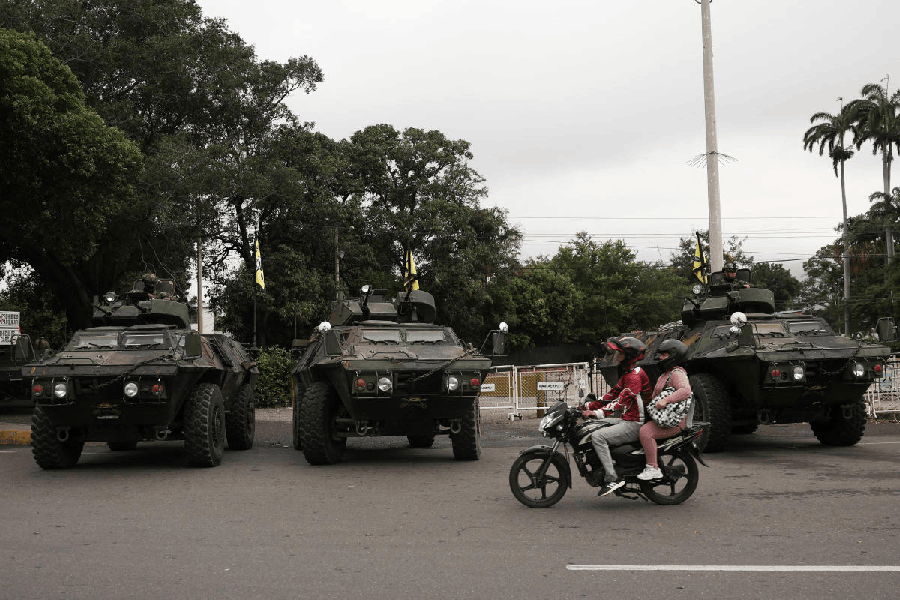
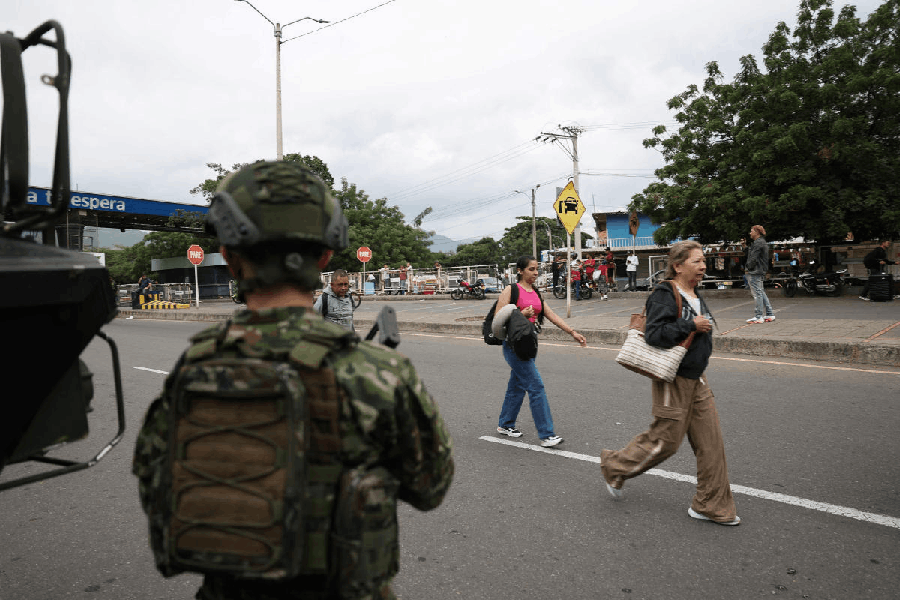
79People ride a motorbike next to military vehicles as Colombian soldiers patrol the border between Venezuela and Colombia, after U.S. President Donald Trump said the U.S. has struck Venezuela and captured its President Nicolas Maduro, in Cucuta, Colombia, January 3, 2026. (Reuters)


Soon after the capture of Maduro, Interior Minister Diosdado Cabello appeared on state TV standing on the street and wearing a helmet and flak jacket, urging Venezuelans not to cooperate with the "terrorist enemy".

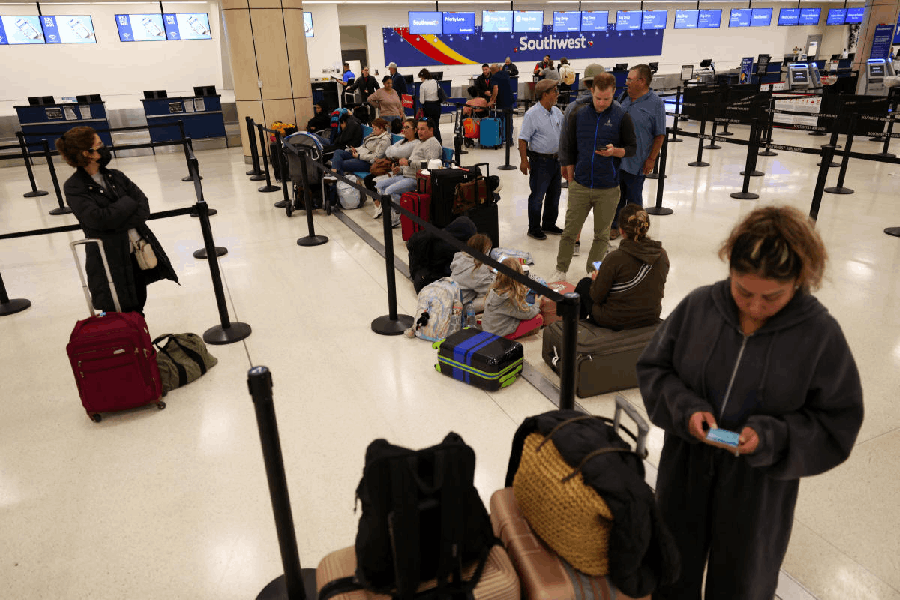
89Passengers wait with their luggage, after flights were delayed and cancelled when the airspace was closed due to U.S. strikes on Venezuela overnight, at Rafael Hernandez International Airport in Aguadilla, Puerto Rico January 3, 2026. (Reuters)


The Venezuelan opposition said in a statement on X that it had no official comment on the events.


The overnight attack began at about 2 a.m. (0600 GMT), according to Reuters witnesses, who saw blasts, aircraft and black smoke across Caracas for roughly 90 minutes.


Video verified by Reuters showed multiple explosions illuminating the night sky, followed by loud blasts. The attack left the southern area of the city, near a major military base, without electricity.


"I couldn’t believe it. I saw it first on social media and then on television. Now, I want to know what will come next," said Nancy Pérez, a 74-year-old woman who went out to a bakery near her home in Valencia, central Venezuela.

One eyewitness video, authenticated by Reuters, captured fire and smoke rising above the Port of La Guaira. The location was confirmed by the port layout, road dividers and buildings, which matched file and satellite imagery.


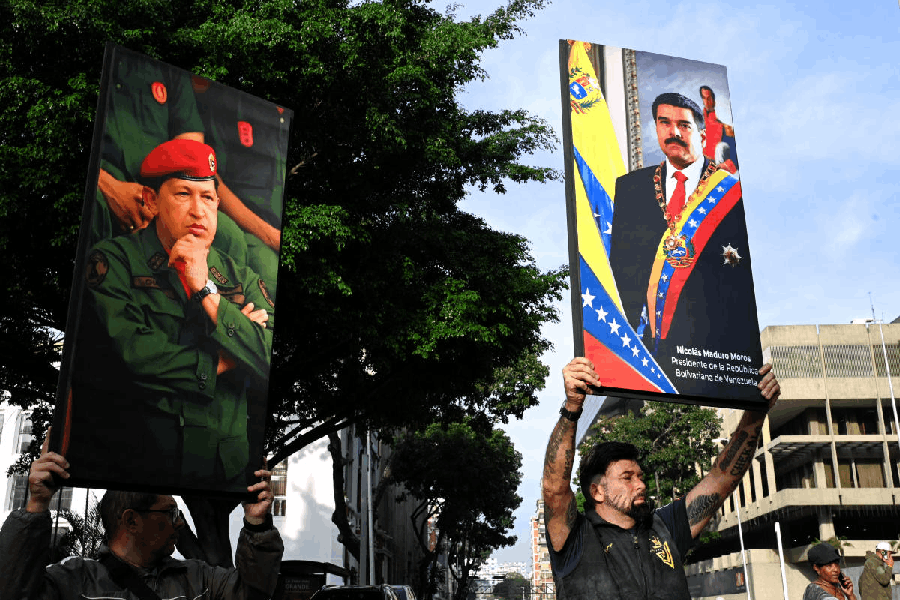
99Government supporters hold photographs of Venezuela's late President Hugo Chavez and President Nicolas Maduro, after U.S. President Donald Trump said the U.S. has struck Venezuela and captured Maduro, in Caracas, Venezuela January 3, 2026. (Reuters)


Other verified videos captured explosions and smoke at the Generalissimo Francisco de Miranda Air Base in eastern Caracas.


Flight radar trackers on Saturday morning showed the airspace over Venezuela was completely empty.


Carmen Marquez, 50, who lives in the east of the capital, said she went to her roof and could hear planes at different altitudes, though she could not see them.


"Flare-like lights were crossing the sky and then explosions could be heard. We're worried about what's coming next. We don't know anything from the government, only what the state television says," she said.

Venezuelan capital quiet, streets empty after US strike

By AFP
January 3, 2026


Supporters of Venezuelan President Nicolas Maduro gather in the streets of Caracas after the strongman was captured by US forces and taken to the United States - Copyright AFP Federico PARRA

A lingering smell of explosives hung over Venezuela’s capital Caracas on Saturday as shocked residents took stock after an early-morning US strike that ousted strongman Nicolas Maduro.

While a few hundred Maduro supporters gathered to clamor for his freedom, the streets were otherwise eerily quiet.

“I felt the explosions lift me out of bed. In that instant I thought: ‘My God, the day has come,’ and I cried,” Maria Eugenia Escobar, a 58-year-old resident of the city of six million people, told AFP.

The strikes started around 2:00 am local time, with dozens of detonations that some people at first mistook for fireworks.

Windows rattled from the shockwaves and residents rushed out onto terraces and balconies as military aircraft zoomed overhead.

“It was horrible, we felt the planes flying over our house,” said a resident of the Coche neighborhood, near the city’s largest military complex, which was targeted in the raid.

Residents saw columns of smoke rising from several parts of the city, which was soon cloaked in a fog-like haze.

Witnesses spoke of bombings in La Guaira, Caracas’s airport and port, in Maracay to the west, and in Higuerote to the east.


– ‘Absurd! –


In the aftermath, Venezuelans soon learned their long-ruling leader Maduro was out.

US special forces seized Maduro and took him to face trial in New York.

A few hundred supporters gathered in Caracas to demand news of their leader’s fate.

“Long live Nicolas Maduro,” echoed a rally cry from a hastily erected stage with speakers blaring revolutionary music.

“Long live!” responded the crowd.

Katia Briceno, a 54-year-old university professor, came out to protest against what she described as US “barbarism.”

“How is it that a foreign government comes into the country and removes the president? It’s absurd!” she told AFP.

Apart from the protesters, there were few Venezuelans out, and just occasional cars on the usually bustling streets.

Those who did venture out did so under the watchful eye of black-clad agents patrolling the center with long guns.

Many stores were closed after the attack, while queues formed at others that were letting people in a few at a time.

Damage from the explosions was mostly limited to military installations, where vehicles stood riddled by bullets, others smouldering and charred.

Defense Minister General Vladimir Padrino Lopez accused the US forces of attacking civilian areas with missiles and rockets fired from combat helicopters.

President Donald Trump said no US soldiers died in Saturday’s strikes, but the toll on the Venezuelan side remained unknown.

For residents of Caracas, the future is uncertain.

Trump said he was “not afraid of boots on the ground” and mooted the possibility of a “much bigger” second wave of strikes if necessary.

He also said the United States will “run” Venezuela until a political transition occurs.

Opposition leader Maria Corina Machado insists Edmundo Gonzalez Urrutia, whom the opposition says won elections in July 2024 in which Maduro claimed victory, “must immediately assume his constitutional mandate” as president.

Trump appeared to scotch any expectation that Machado herself might emerge as Venezuela’s new leader. She does not have “support or respect” there, he said.

Trump indicated he could instead work with Maduro’s deputy, Delcy Rodriguez, saying “she’s essentially willing to do what we think is necessary to make Venezuela great again.”

Neighboring Colombia was reinforcing its border with Venezuela, using tanks and armed soldiers who normally fight guerrillas to secure the frontier.

Colombian security forces deployed at the main border crossings on the orders of leftist President Gustavo Petro, who has clashed with Trump over his months-long military buildup in the region.

Petro’s government has warned of a potential humanitarian crisis with migrants pouring over the border from Venezuela.

However, on the Simon Bolivar bridge in Villa del Rosaria, the main crossing point, the number of people walking across on Saturday was far below normal.

Shock, disbelief in bombed Venezuelan port

By AFP
January 3, 2026


The port of La Guaira was one of several areas in or near Caracas struck by jets during a stealth US mission to seize Venezuelan President Nicolas Maduro - Copyright AFP Pedro MATTEY
Patrick FORT

Twelve hours after the United States bombed Venezuela during an operation to oust President Nicolas Maduro, the smoke continued to seep from hangars in the port of La Guaira north of Caracas.

La Guaira was one of several areas in or near Caracas struck by jets during a stealth mission to snatch Maduro and whisk him out of the country.

Deformed shipping containers, their contents spilling onto the docks, bore testimony to the force of the strikes that US officials said were designed to clear the way for helicopters to swoop in on Maduro’s hiding place.

There were no reports of casualties in the area.

Firefighters used an excavator to remove broken glass and gnarled metal strewn across the site as policemen with pump-action rifles patrolled on motorbike to prevent looting.

Curious onlookers filmed the scene on their smartphones, many still incredulous at the speed and magnitude of the day’s events. In a little over an hour, US forces removed an authoritarian leader who had stubbornly clung to power through years of US sanctions and coup plots.

The blasts blew out the windows of public buildings on La Guaira’s seafront and ripped the roofs off several houses.

“Psssh, first we saw the flash and then the explosion,” said Alpidio Lovera, a 47-year-old resident, who ran to a hill with his pregnant wife and other residents to escape the strikes.

His sister Linda Unamuno, 39, burst into sobs as she recalled a nightmarish night.

“The blast smashed the entire roof of my house,” she said.

Unamuno’s first thoughts were that La Guaira was experiencing another natural disaster, 26 years ago after a landslide of biblical proportions swept away 10,000 people, many of them washed out to sea.

“I went out, that’s when I saw what was happening. I saw the fire from the airstrikes. It was traumatizing,” she sobbed, adding she “wished it on no-one.”

Alirio Elista, a pensioner whose water tank was damaged in the strikes, said those who cheered the US intervention for bringing down the unpopular Maduro “don’t know what they’re talking about.”

He said he believed news of Maduro’s capture was “fake” — despite US President Donald Trump having posted a picture of him blindfolded and handcuffed on a US warship.

Like many in Venezuela, the 68-year-old expressed nostalgia for the heyday of the Caribbean country between the 1950s and 1970s, when it was flush with oil riches.

In the past decade Maduro ran the economy into the ground, causing rampant inflation and widespread shortages of fuel, medicine and some basic foodstuffs.

Elista’s pension of under half a dollar a week “doesn’t pay for anything,” he complained.

“We’re hungry,” he said.

But unlike Trump, he had few illusions of a quick fix for the country’s ills.

The Republican leader outlined his vision Saturday of US oil companies pouring into Venezuela to repair crumbling infrastructure — and reap the rewards with surging oil revenues.

Venezuela has the world’s largest proven oil reserves but its output has tanked in recent years due to a US oil embargo and chronic underinvestment.

“We’ll need at least 15 years to get back to where we were,” Elista predicted.

Key Trump quotes about US operation in Venezuela


By AFP
January 3, 2026


US President Donald Trump has said Washington will "run" Venezuela until a "safe" political transition can take place - Copyright AFP Jim WATSON

In a wide-ranging press conference on Saturday, US President Donald Trump on Saturday explained the operation to extract Venezuelan leader Nicolas Maduro from Caracas, said Washington would temporarily “run” the country, and warned neighboring Colombia to be wary.

Here are the highlights of the press conference, in Trump’s own words:


– On what comes next for Venezuela –


“We’re going to run the country until such time as we can do a safe, proper and judicious transition.”


“The people that are standing right behind me, we’re going to be running it. We’re going to be bringing it back.” (Behind him were Secretary of State Marco Rubio, Defense Secretary Pete Hegseth, senior aide Stephen Miller, CIA Director John Ratcliffe, and top US General Dan Caine)


– On working with Venezuelan Vice President Delcy Rodriguez –


“She’s essentially willing to do what we think is necessary to make Venezuela great again, very simple.”


– On Venezuelan opposition leader Maria Corina Machado –


“I think it would be very tough for her to be the leader. She doesn’t have the support within or the respect within the country. She’s a very nice woman, but she doesn’t have the respect.”


– On Venezuela’s oil industry –


“We’re going to have our very large United States oil companies, the biggest anywhere in the world, go in, spend billions of dollars, fix the badly broken infrastructure, the oil infrastructure, and start making money for the country.”


“Very importantly, the embargo on all Venezuelan oil remains in full effect. The American armada remains poised in position, and the United States retains all military options until United States demands have been fully met and fully satisfied.”


– On further US military action in Venezuela –


“We are ready to stage a second and much larger attack if we need to do so.”


“We’re not afraid of boots on the ground if we have to have. We had boots on the ground last night at a very high level, actually.”


– On wider US plans in Latin America –


“Under our new national security strategy, American dominance in the Western Hemisphere will never be questioned again.”


“We want to surround ourselves with good neighbors. We want to surround ourselves with stability. We want to surround ourselves with energy. We have tremendous energy in that country. It’s very important that we protect it. We need that for ourselves.”


– On Colombian President Gustavo Petro –


“He’s making cocaine and they’re sending it into the United States, so he does have to watch his ass.”


Pets, planes and a ‘fortress’: inside Trump’s raid on Maduro

By AFP
January 3, 2026


US President Donald Trump watched "Operation Absolute Resolve" unfold from a makeshift situation room at his Mar-a-Lago resort in Florida - Copyright US President Donald Trump's TRUTH Social account/AFP HANDOUT

Danny KEMP

President Donald Trump watched a live feed of US forces dramatically seizing Venezuelan leader Nicolas Maduro, the climax of a meticulous, months-long operation.

From American spies in Caracas to a picture of the leftist leader blindfolded and handcuffed, here is a blow-by-blow account of how “Operation Absolute Resolve” stunned the world.


– ‘What he ate’ –


US intelligence agents had been secretly monitoring leftist Maduro’s every movement since August, despite his widely reported efforts to regularly change locations as tensions mounted with Washington.

“How he moved, where he lived, where he traveled, what he ate, what he wore — what were his pets,” Joint Chiefs Chairman General Dan Caine said Saturday as he described the surveillance.

The mission also involved months of “pinpoint” planning and rehearsal. Trump said US forces built a replica house identical to the one where Maduro was staying.

The US military was ready by early December but waited for a window of “aligned events,” including the weather. Trump said he initially ordered the mission four days ago, but held off for the right conditions.


– ‘Good luck and Godspeed’ –


At 10:46 pm Washington time on Friday (0346 GMT Saturday), Trump gave the order to go.

“He said to us — and we appreciate it Mr President — ‘Good luck and Godspeed.’ And those words were transmitted to the entire joint force,” said Caine.

More than 150 US military aircraft then took off from land and sea, including fighter jets, reconnaissance planes, drones — and the helicopters that would form the crucial core of the mission.

The helicopters carrying the “extraction force” for Maduro took off into the darkness, flying at just 100 feet (33 meters) above the surface of the ocean, said Caine.

Fighter jets provided air cover while US satellite and cyber capabilities blocked Venezuelan radars.


– ‘Knew we were coming’ –


The first explosions began to rock Caracas just before 2 am (0600 GMT), according to AFP correspondents.

As the world wondered if it was the start of a widespread bombing campaign of Venezuelan targets, US aircraft were in fact only striking Venezuelan air defenses to allow the helicopters to get to their target.

“They knew we were coming,” Trump told a press conference, referring to the tensions that had been building for months. “But they were completely overwhelmed and very quickly incapacitated” as US aircraft returned fire.

One US chopper was hit but remained operational and made it home afterwards.

The helicopters finally popped over the hills surrounding Caracas, and believing that the extraction team had maintained the element of surprise, landed at Maduro’s compound at 2:01 am Caracas time (0601 GMT).


– ‘Like a fortress’ –


Trump said he watched the climax of the operation on a live feed.

Pictures released by the White House showed him sitting in a makeshift situation room at his Mar-a-Lago resort with Pentagon chief Pete Hegseth, Secretary of State Marco Rubio, CIA chief John Ratcliffe, Caine and other officials.

“I watched it, literally, like I was watching a television show,” Trump told Fox and Friends.

The US president described Maduro’s compound as “a fortress.”

“It had steel doors, it had what they call a safety space where it’s solid steel all around. He didn’t get that space closed, he was trying to get into it, but he got bum-rushed so fast that he didn’t get into that,” he told Fox.

“We were prepared with massive blowtorches to get through the steel, but we didn’t need them.”

Trump said no US personnel were killed — but said Maduro “could have been” had he or Venezuelan forces tried to resist.


– ‘Gave up’ –


Caine said Maduro and his wife “gave up” and were taken into custody by law enforcement officers on the mission. The pair face US drugs and terrorism charges.

The US helicopters crossed the Venezuelan coastline at 3:29 am and the couple were taken aboard the USS Iwo Jima.

Trump then broke the news in a post on Truth Social at 4:21 am Washington time.

Minutes later, a senior White House official sent an AFP reporter a message consisting of emojis for a muscled arm, a fist and fire.

The first the world would see of Maduro — blindfolded, cuffed, wearing ear protectors and a Nike tracksuit — came in a later Trump social media update, posted without comment.


Cuba denounces 'state terrorism' against Venezuela as US warns Havana could be next

Cuban President Miguel Diaz-Canel denounced the US capture of Venezuela’s Nicolas Maduro as "state terrorism" on Saturday, warning the loss of Venezuelan oil would hit Cuba’s fragile economy. Meanwhile, Secretary of State Marco Rubio implied that Havana could be the Trump administration's next target.


Issued on: 04/01/2026
By: FRANCE 24

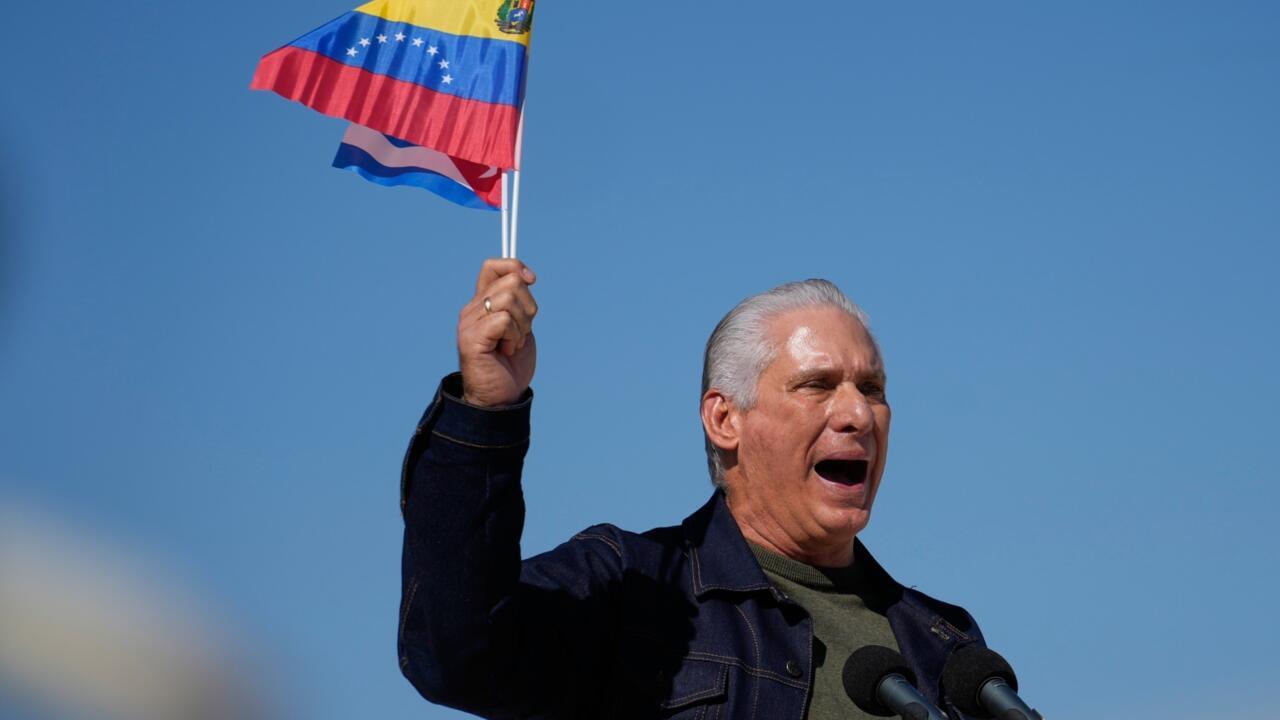
Cuban President Miguel Diaz-Canel attends a rally in Havana, Cuba, on January 3, 2026, in solidarity with Venezuela after the US captured President Nicolas Maduro. 
© Ramon Espinosa, AP


Cuban President Miguel Diaz-Canel on Saturday condemned the United States for attacking Venezuela and capturing its president Nicolas Maduro at a rally of thousands of Havana residents in front of the US Embassy in the Cuban capital.

"Cuba condemns and denounces these actions as an act of state terrorism," Diaz-Canel said.

"It is a shocking violation of the norms of international law – the military aggression against a peaceful nation that poses no threat to the United States," he added.

Venezuela supplies around 30% of Cuba's already scarce oil imports in exchange for thousands of medical personnel who work in the South American country.

Analysts agree the loss of the oil would be a devastating blow to Cuba's already shaky power grid and energy supplies.

© France 24
01:47


Secretary of State Marco Rubio hinted that Cuba could be the next target of the Trump administration’s push to restore American dominance in the Western Hemisphere.

Rubio said he would be a bit concerned if he were a Cuban government official following the overnight US military operation in Venezuela. “If I lived in Havana and I was in the government, I’d be concerned at least a little bit,” said Rubio, who has had a long preoccupation with both Venezuela and Cuba.

The US has had a long history of military interventions in Latin America, including its tacit support for the unsuccessful 1961 Bay of Pigs invasion led by Cuban exiles aimed at toppling Fidel Castro.

Meanwhile, thousands of Cubans are worried over the fate of relatives and friends working in Venezuela. Cuba's health ministry tweeted on Saturday they were "well protected".

In an interview US President Donald Trump gave to the New York Post on Saturday, he said he is not considering additional military action against Cuba.

“No, Cuba is going to fall of its own volition. Cuba is doing very poorly,” Trump said.

“Cuba was always very reliant on Venezuela. That’s where they got their money, and they protected Venezuela, but that didn’t work out too well in this case,” the president said.

Cuba is suffering through a six-year crisis which has seen economic growth fall at least 15%, according to the government, causing shortages of basic goods, soaring inflation, crumbling services and widespread power outages.

The government largely blames tougher US sanctions imposed during the first Trump administration, on top of the decades-old trade embargo, for the crisis.

(FRANCE 24 with Reuters, AP)


Colombia braces with alarm after Maduro’s removal in Venezuela by US


Venezuela’s neighbour Colombia could face spillover turmoil from the stunning turn of events both in violence and a mass influx of refugees.


Venezuelans leaving their country arrive at the border crossing in Cucuta, Colombia, after US forces had captured Venezuelan leader Nicolas Maduro after launching a 'large scale strike' on the South American country on January 3, 2026 [Schneyder Mendoza/AFP]


By Alfie PannellandJim Glade
Published On 3 Jan 2026
AL JAZEERA


Medellin, Colombia – The shock removal of Venezuelan leader Nicolas Maduro by the United States military has triggered alarm in bordering Colombia, where analysts warn of the possibility of far-reaching repercussions.

The Colombian government condemned Washington’s early Saturday morning attacks on Venezuela – which included strikes on military targets and Maduro’s capture – and announced plans to fortify its 2,219-kilometre (1,378-mile) eastern land border, a historic hotbed of rebellion and cocaine production.


Security analysts also say Maduro’s deposition could aggravate an already deteriorating security situation in Colombia, while refugee advocacy groups warn the country would bear the brunt of possible migration waves triggered by the fallout from the intervention.

The Colombian government held an emergency national security meeting at 3am (09:00GMT), according to President Gustavo Petro.

“The Colombian government condemns the attack on the sovereignty of Venezuela and Latin America,” wrote the president in an X post, announcing the mobilisation of state forces to secure the border.


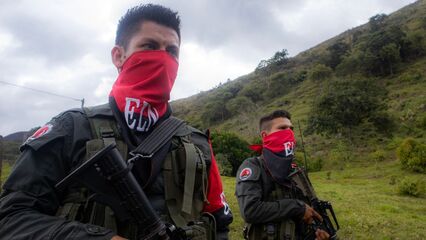
Inside Colombia’s ELN: Rebels face US threats amid push for peace talks

The ELN factor

The National Liberation Army (ELN), a left-wing group and the largest remaining rebel force in the country, have been vocal as recently as December in its preparations to defend the country against “imperialist intervention”.

Security analysts say the primary national security risk to Colombia following the attacks stems from ELN, which controls nearly the entire border with Venezuela.


“I think there is a high risk now that the ELN will consider retaliation, including here in Colombia, against Western targets,” said Elizabeth Dickinson, deputy director for Latin America at Crisis Group International.

The rebel group is heavily involved in cocaine trafficking and operates on both sides of the border; it has benefited from ties with the Maduro government, and US intervention threatens the group’s transnational operations, according to analysts.

The ELN, which positions itself as a bastion against US imperialism in the region, had already stepped up violence in response to the White House’s threats against Colombia and Venezuela. In December, it ordered Colombians to stay home and bombed state installations across the country, an action it described as a response to US aggression.

The Colombian government has ramped up security measures in anticipation of possible retaliatory action by the ELN following Maduro’s removal.

“All capabilities of the security forces have been activated to protect the population, strategic assets, embassies, military and police units, among others, as well as to prevent any attempted terrorist action by transnational criminal organisations, such as the ELN cartel,” read a statement on Saturday morning issued by Colombia’s Ministry of Defence.


Venezuelan journalist describes moment of 'targeted airstrikes'

‘Mass influx of refugees’

In addition to fears of increased violence, Colombia also stands to bear the brunt of any migration crisis initiated by a conflict in Venezuela.

In an X post on Saturday morning, Petro said the government had bolstered humanitarian provisions on its eastern border, writing, “all the assistance resources at our disposal have been deployed in case of a mass influx of refugees.”

To date, Colombia has received the highest number of Venezuelan refugees worldwide, with nearly 3 million of the approximately 8 million people who have left the country settling in Colombia.

The previous wave of mass migration in 2019 – which followed opposition leader Juan Guaido’s failed attempt to overthrow Maduro – required a massive humanitarian operation to house, feed, and provide medical attention to refugees.

Such an operation is likely to prove even more challenging now, with Colombia losing roughly 70 percent of all humanitarian funds after the Trump administration shuttered its USAID programmes in the country last year.

“There is a real possibility of short-term population movement, both precautionary and forced, especially if instability, reprisals, or power vacuums emerge,” said Juan Carlos Viloria, a leader of the Venezuelan diaspora in Colombia.

“Colombia must prepare proactively by activating protection mechanisms, humanitarian corridors, and asylum systems, not only to respond to potential arrivals, but to prevent chaos and human rights violations at the border,” added Viloria.
A further collapse in US-Colombia relations

Analysts say Maduro’s removal raises difficult questions for Petro, who has been engaged in a war of words with Trump since the US president assumed office last year.

The Colombian leader drew Trump’s ire in recent months when he condemned Washington’s military buildup in the Caribbean and alleged a Colombian fisherman had been killed in territorial waters. In response, the White House sanctioned Petro, with Trump calling him a “thug” and “an illegal drug dealer”.

“Petro is irascible at the moment because he sees Trump and his threats no longer as empty, but as real possibilities,” said Sergio Guzman, Director at Colombia Risk Analysis, a Bogota-based security consultancy.

Indeed, Trump has on multiple occasions floated military strikes against drug production sites in Colombia. However, experts say it is unlikely the White House would take unilateral action given their historic cooperation with Colombian security forces.

Despite Petro condemning Washington’s intervention in Venezuela, he previously called Maduro a “dictator” and joined the US and other nations in refusing to recognise the strongman’s fraudulent re-election as president in 2024.

Rather than supporting Maduro, the Colombian leader has positioned himself as a defender of national sovereignty and international law.

On Saturday, Petro called for an emergency meeting of the United Nations Security Council, which Colombia joined as a temporary member just days ago.

“Colombia reaffirms its unconditional commitment to the principles enshrined in the Charter of the United Nations,” wrote the president in an X post.

Is Colombian President Gustavo Pedro next? Trump’s warning stokes fears of a US military intervention in Bogota

The Trump-Petro conflict has reached a critical point following a direct warning from the US leader to his Colombian counterpart

Updated: January 04, 2026

As the US capture of Venezuelan head of state Nicolás Maduro and his wife Cilia Flores continues to send shockwaves across the world, US President Donald Trump has sent Colombian President Gustavo Petro a sharp warning, saying he should “watch his ass”.

Trump’s words have brought the spotlight to Colombia as Petro, a prominent Latin American leader who aligns with the Left ideology and maintains an openly critical stance toward Washington. Petro famously launched an attack on Trump on US soil last September when he openly called on US soldiers to disobey President Donald Trump. “Disobey Trump’s orders. Obey the order of humanity,” he proclaimed during a demonstration in the streets of New York, linked to protests over the war in Gaza and held in the context of the UN General Assembly.

This strained relations between Washington and Bogota as the United States announced it would cancel the visa of Colombia’s President Gustavo Petro.

Petro’s statement was also considered by many in the US as a comeback to conservative US Senator Lindsay Graham’s statement that Trump was planning attacks on Colombia and Venezuela. “Trump sees Venezuela and Colombia as direct threats to our country because they house narco-terrorists,” Lindsay told CBS News.

In response, President Gustavo Petro warned the United States not to attack Colombia, stating that the Colombians won’t take it well. In a post on social media platform X, Petro said that “the Colombian people, every time they are attacked anywhere, en masse head to the mountains and arm themselves” to become “invisible like the jaguar with passionate stealth.”

“Don’t try it, that’s the only advice I give,” said the president, “because I know the history of my people and I am… the legitimate son of my people.”

Trump, too, issued a direct warning to Petro. On October 19, he called Petro “a leader with low approval ratings and very unpopular” and issued a warning: “He'd better close these 'killing camps' immediately, or the United States will close them for him .” In early December, he doubled down on the message: “He’s producing cocaine… so he needs to watch his ass .”

Why Colombia is not an easy target

Colombia is experiencing a period of high political volatility, with criticism of economic reforms, accusations of corruption and insecurity, and a tense social climate. For Washington, the country is also strategic: it possesses energy and mineral resources, a key geographic position between the Caribbean and the Amazon, and plays a central role in regional stability.

Despite the heated atmosphere, the likelihood of a direct US military intervention in Colombia is low. The White House seems to favor gradual political and institutional pressure: economic conditions, media strategies, and—according to analysts— indirect interference in the upcoming electoral cycle.
on is much less costly than deploying military machinery in a country with decades of experience in internal armed conflict. Trump also acts as both a politician and a businessman. From this perspective, the cost-benefit analysis favors electoral and economic influence over overt intervention.

There are other reasons too. In the new political landscape, Colombia is a point of equilibrium between Washington's interests and the resistance of the Latin American progressive bloc. The last thing Washington wants now is a wave in favour of the left and wouldn’t risk acts that could help the political pendulum swing to the left.

US allies, foes alarmed by capture of Venezuela’s Maduro

By AFP
January 3, 2026


Maduro's capture sparked concern across the world 
- Copyright AFP/File Federico PARRA,  SAUL LOEB


Stuart WILLIAMS

The US military operation that led to the capture of Venezuelan President Nicolas Madruo on Saturday sparked alarm across the international community, with allies and foes of Washington and Caracas expressing disquiet.

US President Donald Trump said Nicolas Maduro and his wife would be taken to New York to face federal charges after military strikes and an operation which he described as looking like a “television show”.

The Venezuelan government decried what it termed a “extremely serious military aggression” by Washington and declared a state of emergency.

Countries such as Russia and Iran, which had longstanding ties with Maduro’s government, were quick to condemn the operation but their alarm was also shared by Washington’s allies including France and the EU.

Here is a rundown of the main reaction.


– Russia –


Russia demanded the US leadership “reconsider its position and release the legally elected president of the sovereign country and his wife”.


– China –


Beijing said “China is deeply shocked and strongly condemns the US’s blatant use of force against a sovereign state and its action against its president”.


– Iran –


Iran, which Trump bombed last year, said it “strongly condemns the US military attack on Venezuela and a flagrant violation of the country’s national sovereignty and territorial integrity”.


– Mexico –


Mexico, which Trump has also threatened with military force over drug trafficking, strongly condemned the US military action in Venezuela, saying it “seriously jeopardises regional stability.”


– Colombia –


Colombian President Gustavo Petro — whose country neighbours Venezuela — called the US action an “assault on the sovereignty” of Latin America which would lead to a humanitarian crisis.


– Brazil –


Brazilian President Luiz Inacio Lula da Silva slammed the US attacks as a “serious affront” to Venezuela’s sovereignty.


– Cuba –


Cuba, a strong ally of Venezuela’s, denounced “state terrorism against the brave Venezuelan people”.


– Spain –


Spain offered to mediate in the crisis to find a way to a peaceful solution, while calling for “de-escalation and restraint”.

– France –


France condemned the US operation, saying it undermined international law and no solution to Venezuela’s crisis can be imposed from the outside.

– EU –


The EU more generally expressed concern at the developments and urged respect for international law, even as it noted that Maduro “lacks legitimacy”.


-UK –


British Prime Minister Keir Starmer said all countries should “uphold international law” and added that “the UK was not involved in any way in this operation” as he urged patience in order to “establish the facts”.


– Italy –


In a rare expression of support for the US operation by a major European country, far-right Italian Prime Minister Giorgia Meloni — a Trump ally — argued the US military action in Venezuela was “legitimate” and “defensive”.


– UN –


UN Secretary-General Antonio Guterres was “deeply alarmed” by the US strikes, with his spokesman quoting him as saying it could “constitute a dangerous precedent”.