Oil Companies Are Key Partners in Trump’s Imperial Plans for Latin America
Stocks in ExxonMobil, Halliburton, and ConocoPhillips surged the day after Trump’s illegal attack on Venezuela.
By Derek Seidman ,
Truthout
January 8, 2026
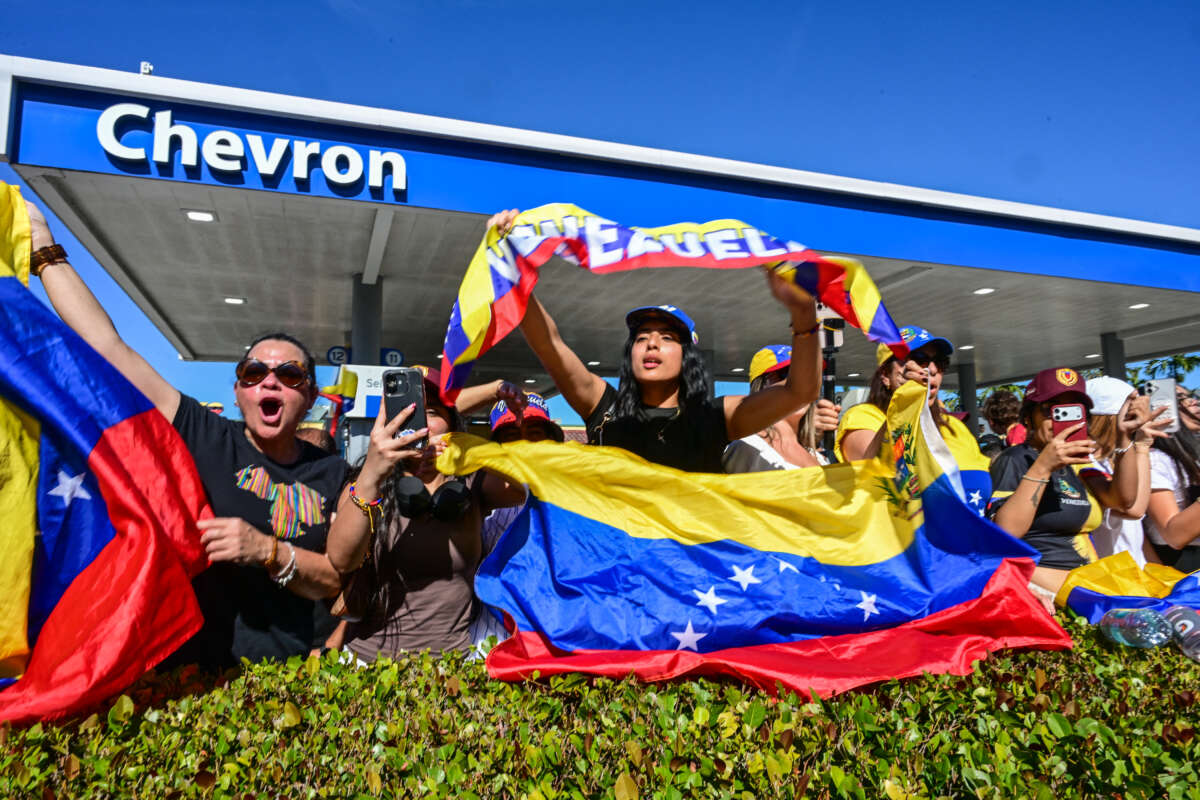
People react to the news of the US's capture of Venezuelan President Nicolas Maduro, in Doral, Florida, on January 3, 2026.GIORGIO VIERA / AFP via Getty Images
For months, U.S. President Donald Trump proclaimed that his pressure campaign against the government of Venezuelan President Nicolás Maduro, backed by dozens of illegal killings through drone strikes, was about fighting drugs and cartels. But at his press conference after the U.S. abduction of Maduro, Trump couldn’t stop talking about oil.
“We’re gonna take back the oil,” Trump brazenly said. “Very large United States oil companies” will “go in” and “spend billions of dollars,” he promised. “We’re gonna be taking out a tremendous amount of wealth out of the ground.”
All told, Trump uttered the word “oil” at least 20 times during the press conference. Oil company stocks — ExxonMobil, Halliburton, ConocoPhillips, Valero, Phillips 66 — surged the following day, with Chevron, the only major U.S. oil corporation with a current foothold in Venezuela, seeing its share value jump more than 5 percent.
Further demonstrating the administration’s drug accusations to be mere propaganda, the Justice Department recently dropped its longstanding claim that Maduro was the head of “Cartel de los Soles,” implicitly conceding that it is indeed not a drug cartel but a slang term referring to political officials who have become corrupted by drug money.
The Trump administration’s barefaced imperial grab for Venezuela’s oil is fraught with challenges, and it’s far too early to predict what will happen. But its abduction of Maduro and effort to gain control over Venezuela’s oil industry aligns with the administration’s openly stated vision of reasserting undisputed political and economic hegemony across the Americas and the Caribbean, including control over natural resources and trade routes, through gunboat diplomacy backed by military threats. In doing so, Trump is looking to corporate allies like Chevron, which could stand to benefit handsomely from his administration’s action — though this is far from guaranteed.
“We’re seeing the confluence of two trends here,” Michael Klare, energy expert and defense correspondent for The Nation, told Truthout. “The first is Trump’s reassertion of U.S. dominance over the Western Hemisphere, and the second is an explicit focus on the acquisition of strategic raw materials as a key aspect of national security — and their denial to strategic competitors, like China.”
The “Trump Corollary”
While Trump has a reputation for acting erratically, the administration’s National Security Strategy report to the U.S. Congress, published in December 2025, suggests how the abduction of Maduro fits its wider imperial agenda.
The report calls for a shift from “permanent American domination of the entire world” to a new emphasis on “global and regional balances of power to prevent the emergence of dominant adversaries.”
Venezuela is home to around 17 percent of the world’s known oil reserves but currently accounts for less than 1 percent of global crude oil production.
Notably, the report advocates the naked and expanded assertion of U.S. hegemony across the Americas and Caribbean and the revival of the Monroe Doctrine — a two-century-old U.S. policy that has come to represent the U.S. assertion of the Western Hemisphere as its sphere of influence — through a new “Trump Corollary.”
The Trump Corollary posits that “the United States will reassert and enforce the Monroe Doctrine to restore American preeminence in the Western Hemisphere” and aims to cultivate a U.S.-dominated network of compliant regimes — “enlist established friends” and “expand by cultivating and strengthening new partners” — across the region.
In his press conference, Trump was blunt. “Under our new national security strategy,” he said, “American dominance in the Western hemisphere will never be questioned again.”
Klare notes that “the assertion of U.S. dominance over the Western Hemisphere is hardly a new theme in American politics, but it’s been neglected in recent decades as the U.S. focused more on Europe, Asia, and the Middle East.”
“What Trump is saying is that we are going to refocus on the Western Hemisphere while downgrading our involvement in Europe, Asia, and the Middle East,” said Klare.
The U.S. abduction of Maduro sends an intimidating signal across the region. Administration officials have ramped up threats against Colombia and Cuba — sites of hemispheric opposition to U.S. power — and Greenland, with its geostrategic value and natural resources.
Venezuela — with the world’s largest known oil reserves, close ties to China and Russia, and avid opposition to U.S. empire — is a key target in the Trump administration’s imperial vision for the Americas and Caribbean.
“Venezuela and its oil lie at the nexus of two of Mr. Trump’s stated national security priorities: dominance of energy resources and control of the Western Hemisphere,” noted The New York Times.
Imperial Rivalry With China
Trump’s national security strategy states that his administration is openly pursuing “a Hemisphere that remains free of hostile foreign incursion or ownership of key assets” and alliances “contingent on winding down adversarial outside influence — from control of military installations, ports, and key infrastructure to the purchase of strategic assets broadly defined.”
This is a clear reference to China, the U.S.’s major global rival for markets, resources, and influence. China is South America’s top trading partner and has cultivated diplomatic ties and backed major infrastructure projects across the region.
As Truthout previously reported, the U.S. power struggle with China was a driving factor in Trump’s early 2025 effort to secure U.S. influence over two critical ports on the Panama Canal.
China is one of Venezuela’s top economic partners and has provided billions in financing for Venezuela in exchange for oil. China purchases around 80 percent of Venezuela’s oil exports.
“Control over Venezuelan [oil] supply would also allow Washington to squeeze China, currently Caracas’s largest buyer,” said the Financial Times.
U.S. Empire and Corporate Power
From artificial intelligence to resource extraction to projecting imperial power, Trump has looked to a core partner: U.S. corporations and the executives and owners who run the
Stocks in ExxonMobil, Halliburton, and ConocoPhillips surged the day after Trump’s illegal attack on Venezuela.
By Derek Seidman ,
Truthout
January 8, 2026
People react to the news of the US's capture of Venezuelan President Nicolas Maduro, in Doral, Florida, on January 3, 2026.GIORGIO VIERA / AFP via Getty Images
For months, U.S. President Donald Trump proclaimed that his pressure campaign against the government of Venezuelan President Nicolás Maduro, backed by dozens of illegal killings through drone strikes, was about fighting drugs and cartels. But at his press conference after the U.S. abduction of Maduro, Trump couldn’t stop talking about oil.
“We’re gonna take back the oil,” Trump brazenly said. “Very large United States oil companies” will “go in” and “spend billions of dollars,” he promised. “We’re gonna be taking out a tremendous amount of wealth out of the ground.”
All told, Trump uttered the word “oil” at least 20 times during the press conference. Oil company stocks — ExxonMobil, Halliburton, ConocoPhillips, Valero, Phillips 66 — surged the following day, with Chevron, the only major U.S. oil corporation with a current foothold in Venezuela, seeing its share value jump more than 5 percent.
Further demonstrating the administration’s drug accusations to be mere propaganda, the Justice Department recently dropped its longstanding claim that Maduro was the head of “Cartel de los Soles,” implicitly conceding that it is indeed not a drug cartel but a slang term referring to political officials who have become corrupted by drug money.
The Trump administration’s barefaced imperial grab for Venezuela’s oil is fraught with challenges, and it’s far too early to predict what will happen. But its abduction of Maduro and effort to gain control over Venezuela’s oil industry aligns with the administration’s openly stated vision of reasserting undisputed political and economic hegemony across the Americas and the Caribbean, including control over natural resources and trade routes, through gunboat diplomacy backed by military threats. In doing so, Trump is looking to corporate allies like Chevron, which could stand to benefit handsomely from his administration’s action — though this is far from guaranteed.
“We’re seeing the confluence of two trends here,” Michael Klare, energy expert and defense correspondent for The Nation, told Truthout. “The first is Trump’s reassertion of U.S. dominance over the Western Hemisphere, and the second is an explicit focus on the acquisition of strategic raw materials as a key aspect of national security — and their denial to strategic competitors, like China.”
The “Trump Corollary”
While Trump has a reputation for acting erratically, the administration’s National Security Strategy report to the U.S. Congress, published in December 2025, suggests how the abduction of Maduro fits its wider imperial agenda.
The report calls for a shift from “permanent American domination of the entire world” to a new emphasis on “global and regional balances of power to prevent the emergence of dominant adversaries.”
Venezuela is home to around 17 percent of the world’s known oil reserves but currently accounts for less than 1 percent of global crude oil production.
Notably, the report advocates the naked and expanded assertion of U.S. hegemony across the Americas and Caribbean and the revival of the Monroe Doctrine — a two-century-old U.S. policy that has come to represent the U.S. assertion of the Western Hemisphere as its sphere of influence — through a new “Trump Corollary.”
The Trump Corollary posits that “the United States will reassert and enforce the Monroe Doctrine to restore American preeminence in the Western Hemisphere” and aims to cultivate a U.S.-dominated network of compliant regimes — “enlist established friends” and “expand by cultivating and strengthening new partners” — across the region.
In his press conference, Trump was blunt. “Under our new national security strategy,” he said, “American dominance in the Western hemisphere will never be questioned again.”
Klare notes that “the assertion of U.S. dominance over the Western Hemisphere is hardly a new theme in American politics, but it’s been neglected in recent decades as the U.S. focused more on Europe, Asia, and the Middle East.”
“What Trump is saying is that we are going to refocus on the Western Hemisphere while downgrading our involvement in Europe, Asia, and the Middle East,” said Klare.
The U.S. abduction of Maduro sends an intimidating signal across the region. Administration officials have ramped up threats against Colombia and Cuba — sites of hemispheric opposition to U.S. power — and Greenland, with its geostrategic value and natural resources.
Venezuela — with the world’s largest known oil reserves, close ties to China and Russia, and avid opposition to U.S. empire — is a key target in the Trump administration’s imperial vision for the Americas and Caribbean.
“Venezuela and its oil lie at the nexus of two of Mr. Trump’s stated national security priorities: dominance of energy resources and control of the Western Hemisphere,” noted The New York Times.
Imperial Rivalry With China
Trump’s national security strategy states that his administration is openly pursuing “a Hemisphere that remains free of hostile foreign incursion or ownership of key assets” and alliances “contingent on winding down adversarial outside influence — from control of military installations, ports, and key infrastructure to the purchase of strategic assets broadly defined.”
This is a clear reference to China, the U.S.’s major global rival for markets, resources, and influence. China is South America’s top trading partner and has cultivated diplomatic ties and backed major infrastructure projects across the region.
As Truthout previously reported, the U.S. power struggle with China was a driving factor in Trump’s early 2025 effort to secure U.S. influence over two critical ports on the Panama Canal.
China is one of Venezuela’s top economic partners and has provided billions in financing for Venezuela in exchange for oil. China purchases around 80 percent of Venezuela’s oil exports.
“Control over Venezuelan [oil] supply would also allow Washington to squeeze China, currently Caracas’s largest buyer,” said the Financial Times.
U.S. Empire and Corporate Power
From artificial intelligence to resource extraction to projecting imperial power, Trump has looked to a core partner: U.S. corporations and the executives and owners who run the
In his effort to secure U.S. ownership over key Panama Canal ports, he turned to BlackRock, the world’s largest asset manager, and its billionaire CEO Larry Fink, strong-arming the sale of a portfolio of 43 global ports owned by Hong Kong-based CK Hutchison.
Trump’s national security policy bluntly promotes U.S. corporations as arms for hemispheric hegemony. “Successfully protecting our Hemisphere,” it states, “requires closer collaboration between the U.S. Government and the American private sector.”
“The U.S. Government will identify strategic acquisition and investment opportunities for American companies in the region,” it adds. All U.S. embassies must “be aware of major business opportunities in their country” and all U.S. foreign officials “should understand that part of their job is to help American companies compete and succeed,” it asserts.
Fossil fuels are central to Trump’s imperial vision. “Restoring American energy dominance (in oil, gas, coal, and nuclear) and reshoring the necessary key energy components is a top strategic priority,” states Trump’s natural security strategy.
One of Trump’s most loyal factions within the U.S. ruling class is composed of oil billionaires and fossil fuel companies, who splurged on his 2024 reelection campaign.
Fracking billionaire Harold Hamm, Trump’s top fossil fuel industry ally, has said “his company Continental Resources would consider investing in Venezuela under the right circumstances,” reported the Financial Times.
Chevron’s “Long Game”
“We’re going to have our very large United States oil companies, the biggest anywhere in the world, go in, spend billions of dollars, fix the badly broken infrastructure, the oil infrastructure, and start making money for the country,” Trump declared at his press conference announcing Maduro’s kidnapping.
Venezuela is home to around 17 percent of the world’s known oil reserves but currently accounts for less than 1 percent of global crude oil production.
“The appeal is clear: Venezuela’s reserves are large, mapped and carry no exploration risk,” said the Financial Times, adding that “advances in technology have lowered the cost of producing heavy crude,” the kind of viscous oil in Venezuela that can be difficult to refine.
Chevron, which has a checkered human rights record in Latin America, is Venezuela’s top foreign investor.
Today, Chevron, which has a checkered human rights record in Latin America, is Venezuela’s top foreign investor and the only U.S. oil corporation with major operations in the country. Two other oil powerhouses, ExxonMobil and ConocoPhillips, left Venezuela in 2007 after former Venezuelan President Hugo Chávez nationalized foreign-owned oil fields.
Trump is a big fan of Chevron CEO Mike Wirth, who has praised the president on Fox News. Chevron was the top fossil fuel donor to Trump’s 2025 inauguration, shelling out $2 million. In January 2025, the company quickly recognized Trump’s attempt to rename the Gulf of Mexico as the Gulf of America.
“Wirth and Trump are known to be tight,” said the Wall Street Journal, adding that “the men chat about Venezuela and other topics” and that “Trump and Wirth appear to agree that opportunity abounds in Venezuela.”
Wirth lobbied Trump throughout 2025 to renew Chevron’s license to operate in Venezuela, which Trump approved after initially opposing. The New York Times has called Chevron’s permission to operate in Venezuela “a unique prize in the American corporate world.”
Now, with Trump’s promise that “oil companies are gonna go in” and “take back” Venezuela’s oil, Chevron stands to benefit from its more established placement in the country.
“Chevron is betting it is in prime position to unlock some of the world’s richest oil reserves,” said the Wall Street Journal, adding that Wirth “has calculated his company has the means and resilience to outlast changing governments.”
“We play a long game,” Wirth said at a recent U.S.-Saudi investment summit.
Roadblocks for the “Donroe Doctrine”
Chevron’s former head of Latin American operations, Ali Moshiri, who now runs an energy investment fund, told the Financial Times he’s raising $2 billion for Venezuelan oil projects.
“I’ve had a dozen calls over the past 24 hours from potential investors,” he said in the days following Maduro’s kidnapping. “Interest in Venezuela has gone from zero to 99 percent.”
But some experts are skeptical of Moshiri’s bullishness, noting that Trump’s desire to take over Venezuela’s oil industry faces major challenges.
Venezuela’s oil fields are in a decayed state because of “mismanagement, lack of investment and sanctions,” according to Reuters, and U.S. oil corporations would have to commit long-term to revitalize and profit from them amid current uncertainty and instability. Moreover, global demand for crude oil is shaky while oil prices are relatively low.
“Any companies seeking to extract more oil from Venezuela must invest tens of billions of dollars in infrastructure repair and replacement,” Klare told Truthout. “This might not be an obstacle if oil prices were high and the major oil companies expect an ever-increasing demand for oil, but neither is true.”
Trump has suggested the U.S. could reimburse oil companies that invest in Venezuela, and one former Trump energy advisor told Politico that U.S. agencies could offer to underwrite investments.
Media reports offer mixed messages from oil companies. The Wall Street Journal reported that Trump hinted at Maduro’s ouster to oil executives a month ago, telling them to “get ready,” and Trump confirmed he tipped them off “before and after,” though the Financial Times claims that oil companies were “blindsided” by the action. Companies like ConocoPhillips and ExxonMobil have yet to indicate any plans to reenter Venezuela.
Trump has said he expects “the United States would be running Venezuela and extracting oil from its huge reserves for years,” and that “the United States would obtain 30 to 50 million barrels of heavy Venezuelan crude oil,” though he “offered no time period for that process” and “acknowledged it would take years to revive the country’s neglected oil sector,” according to the New York Times.
As of November 2025, Venezuela was exporting 921,000 barrels of oil per day. The U.S. imported 6.48 million barrels of crude oil per day in 2023, according to government data.
Trump and members of his Cabinet are meeting with U.S. oil executives Friday at the White House “to discuss plans for them to enter Venezuela and drill,” reports Politico.
But Klare remains skeptical, saying: “I do not expect a rush by the large U.S. oil companies to undertake major operations in Venezuela, except by Chevron, which is already operating there.”
Trump’s national security policy bluntly promotes U.S. corporations as arms for hemispheric hegemony. “Successfully protecting our Hemisphere,” it states, “requires closer collaboration between the U.S. Government and the American private sector.”
“The U.S. Government will identify strategic acquisition and investment opportunities for American companies in the region,” it adds. All U.S. embassies must “be aware of major business opportunities in their country” and all U.S. foreign officials “should understand that part of their job is to help American companies compete and succeed,” it asserts.
Fossil fuels are central to Trump’s imperial vision. “Restoring American energy dominance (in oil, gas, coal, and nuclear) and reshoring the necessary key energy components is a top strategic priority,” states Trump’s natural security strategy.
One of Trump’s most loyal factions within the U.S. ruling class is composed of oil billionaires and fossil fuel companies, who splurged on his 2024 reelection campaign.
Fracking billionaire Harold Hamm, Trump’s top fossil fuel industry ally, has said “his company Continental Resources would consider investing in Venezuela under the right circumstances,” reported the Financial Times.
Chevron’s “Long Game”
“We’re going to have our very large United States oil companies, the biggest anywhere in the world, go in, spend billions of dollars, fix the badly broken infrastructure, the oil infrastructure, and start making money for the country,” Trump declared at his press conference announcing Maduro’s kidnapping.
Venezuela is home to around 17 percent of the world’s known oil reserves but currently accounts for less than 1 percent of global crude oil production.
“The appeal is clear: Venezuela’s reserves are large, mapped and carry no exploration risk,” said the Financial Times, adding that “advances in technology have lowered the cost of producing heavy crude,” the kind of viscous oil in Venezuela that can be difficult to refine.
Chevron, which has a checkered human rights record in Latin America, is Venezuela’s top foreign investor.
Today, Chevron, which has a checkered human rights record in Latin America, is Venezuela’s top foreign investor and the only U.S. oil corporation with major operations in the country. Two other oil powerhouses, ExxonMobil and ConocoPhillips, left Venezuela in 2007 after former Venezuelan President Hugo Chávez nationalized foreign-owned oil fields.
Trump is a big fan of Chevron CEO Mike Wirth, who has praised the president on Fox News. Chevron was the top fossil fuel donor to Trump’s 2025 inauguration, shelling out $2 million. In January 2025, the company quickly recognized Trump’s attempt to rename the Gulf of Mexico as the Gulf of America.
“Wirth and Trump are known to be tight,” said the Wall Street Journal, adding that “the men chat about Venezuela and other topics” and that “Trump and Wirth appear to agree that opportunity abounds in Venezuela.”
Wirth lobbied Trump throughout 2025 to renew Chevron’s license to operate in Venezuela, which Trump approved after initially opposing. The New York Times has called Chevron’s permission to operate in Venezuela “a unique prize in the American corporate world.”
Now, with Trump’s promise that “oil companies are gonna go in” and “take back” Venezuela’s oil, Chevron stands to benefit from its more established placement in the country.
“Chevron is betting it is in prime position to unlock some of the world’s richest oil reserves,” said the Wall Street Journal, adding that Wirth “has calculated his company has the means and resilience to outlast changing governments.”
“We play a long game,” Wirth said at a recent U.S.-Saudi investment summit.
Roadblocks for the “Donroe Doctrine”
Chevron’s former head of Latin American operations, Ali Moshiri, who now runs an energy investment fund, told the Financial Times he’s raising $2 billion for Venezuelan oil projects.
“I’ve had a dozen calls over the past 24 hours from potential investors,” he said in the days following Maduro’s kidnapping. “Interest in Venezuela has gone from zero to 99 percent.”
But some experts are skeptical of Moshiri’s bullishness, noting that Trump’s desire to take over Venezuela’s oil industry faces major challenges.
Venezuela’s oil fields are in a decayed state because of “mismanagement, lack of investment and sanctions,” according to Reuters, and U.S. oil corporations would have to commit long-term to revitalize and profit from them amid current uncertainty and instability. Moreover, global demand for crude oil is shaky while oil prices are relatively low.
“Any companies seeking to extract more oil from Venezuela must invest tens of billions of dollars in infrastructure repair and replacement,” Klare told Truthout. “This might not be an obstacle if oil prices were high and the major oil companies expect an ever-increasing demand for oil, but neither is true.”
Trump has suggested the U.S. could reimburse oil companies that invest in Venezuela, and one former Trump energy advisor told Politico that U.S. agencies could offer to underwrite investments.
Media reports offer mixed messages from oil companies. The Wall Street Journal reported that Trump hinted at Maduro’s ouster to oil executives a month ago, telling them to “get ready,” and Trump confirmed he tipped them off “before and after,” though the Financial Times claims that oil companies were “blindsided” by the action. Companies like ConocoPhillips and ExxonMobil have yet to indicate any plans to reenter Venezuela.
Trump has said he expects “the United States would be running Venezuela and extracting oil from its huge reserves for years,” and that “the United States would obtain 30 to 50 million barrels of heavy Venezuelan crude oil,” though he “offered no time period for that process” and “acknowledged it would take years to revive the country’s neglected oil sector,” according to the New York Times.
As of November 2025, Venezuela was exporting 921,000 barrels of oil per day. The U.S. imported 6.48 million barrels of crude oil per day in 2023, according to government data.
Trump and members of his Cabinet are meeting with U.S. oil executives Friday at the White House “to discuss plans for them to enter Venezuela and drill,” reports Politico.
But Klare remains skeptical, saying: “I do not expect a rush by the large U.S. oil companies to undertake major operations in Venezuela, except by Chevron, which is already operating there.”
January 08, 2026
ALTERNET
Politico reports giant energy companies are worried about President Donald Trump pressuring them to invest resources in Venezuela and are quietly planning to ignore him.
Trump is reportedly now pressing American oil giants to spend “billions of dollars reopening Venezuela,” after he sent troops to arrest Venezuelan leader Nicolás Maduro. However, Politico reported Thursday that the companies with the most resources and experience to drill in the South American nation are on the fence about the project, according to six anonymous oil company executives and industry lobbyists.
According to Politico, Trump is planning a White House meeting Friday that may include executives from companies with experience in Venezuela, including U.S.-based Exxon Mobil, Chevron and ConocoPhillips. But executives tell Politico that the assembly could turn into an arm-twisting session.
“Some of the CEOs fear that Trump will use the meeting — and invite television cameras — to pressure them to make public commitments sooner than they would like,” Politico reports.
Executives want to know who will guarantee their companies’ security and property in a country still run by the same corrupt politicians who stole millions of dollars’ worth of their oil exploration and drilling equipment two decades ago. In addition to who will pay company bills and in what currency, Politico reports there remains the question of how much information the White House is sharing with acting President Delcy Rodriguez’s interim government. Industry insiders are still unsure whether the White House has even told Venezuelan officials that the it has given some companies licenses to sell 50 million barrels of oil that Trump claims the nation was “turning over” to U.S invading forces.
In addition to questions of safety, companies are wondering why they should invest in hard-to-process heavy Venezuelan crude oil given the nation’s busted infrastructure and uncertain political environment, only to dump more oil on a global market and hurt their bottom line with the resulting cheaper oil prices.
With so many reasons not to invest, Politico reports oil executives may simply string Trump along with big promises while delivering nothing.
“Companies may follow the playbook of promising the White House they are interested in investing in Venezuela just to stay on Trump’s good side but ultimately not following through,” one business lobbyist told Politico. This tactic — called “Everyone Makes Promises And Never Actually Does Anything” — is so common for dealing with the distracted president that it’s got its own acronym.
“My impression is it’s EMPANADA all over again,” an anonymous executive told Politico.
Read the Politico report at this link.

No comments:
Post a Comment