Sunday, January 18, 2026


How America Plans to Refill Its Emergency Oil Stockpile Using Venezuelan Crude

The Trump administration is exploring a workaround to America’s Strategic Petroleum Reserve problem: swapping heavy Venezuelan crude for U.S. medium sour barrels that can actually go straight into SPR caverns.

According to Reuters, the Department of Energy is considering moving Venezuelan heavy crude into commercial storage at the Louisiana Offshore Oil Port, while U.S. producers deliver medium sour crude into the SPR in exchange. It’s a crude-for-crude swap designed to solve a very practical issue that Washington rarely likes to admit exists.

Not all oil belongs in the SPR.


The reserve was built to hold mostly medium and heavy sour barrels. This is inconvenient because the US has an abundance of light, sweet shale crude. That mismatch has quietly complicated every refill effort since the reserve was drained during the 2022 price spike. As of the latest EIA data, SPR inventories sit just under 400 million barrels, barely more than half of capacity.

Venezuelan heavy crude fits into the SPR better than much of what the U.S. pumps today—on paper. But in practice, it’s not that simple. Heavy Venezuelan oil often needs blending, specialized handling, and infrastructure that the SPR itself doesn’t provide. Solution? Park the Venezuelan barrels elsewhere and backfill the reserve with U.S. medium sour crude.

This isn’t quite an SPR refill either. It’s a logistical sleight of hand that highlights how boxed-in the refill strategy has become. Buying hundreds of millions of barrels outright would cost tens of billions of dollars. Slow-walking purchases risks turning the SPR into a permanent half-empty museum exhibit.

The irony is that the U.S. doesn’t lack oil. It lacks the right oil in the right place at the right time. Net imports are negative, production is near record highs, and yet Washington is still improvising to make the reserve work as designed in the 1970s.

By Julianne Geiger for Oilprice.com


Oil Majors Tell Washington They Want PDVSA Out of the Way

International oil companies are wasting no time testing how serious Washington and Caracas really are about reviving Venezuela’s oil industry. And their opening demand is refreshingly blunt: if we’re going to invest, we need to control our barrels.

According to Reuters sources, international oil executives and lawyers are pushing for fast, targeted changes to Venezuela’s hydrocarbons law that would allow foreign partners to export the oil they produce directly, rather than handing it over to state oil company PDVSA to sell on their behalf. The ask is narrow by design. Leave PDVSA as majority owner, they say, but let international partners control their share of production, access export terminals, and—most importantly—get paid quickly.

Oil companies are likely to be sticklers on the last point. Under the current framework, PDVSA controls sales and deposits proceeds into joint venture accounts. That system collapsed under U.S. sanctions, leaving billions of dollars owed to partners including Chevron, ENI, and Repsol. For oil companies with long memories, Venezuela isn’t short on geology—it’s short on trust.


The industry is also pushing to roll back extra taxes layered onto the law in 2021, which pushed Venezuela’s government take to some of the highest levels in Latin America. Companies are signaling they can live with royalties and income tax. Extra taxes, opaque fees, PDVSA-controlled sales, delayed payments, or contracts open to interpretation, not so much.

This legal pressure campaign dovetails neatly with the Trump administration’s broader strategy. According to a Friday interview with Axios, Energy Secretary Chris Wright said the U.S. is pursuing oil and critical minerals deals with Venezuela as part of a plan to stabilize the country economically and redirect exports away from China. The goal, Wright said, is higher production, cleaner flows, and a more predictable business environment—without U.S. government subsidies.

What’s emerging is a pragmatic alignment. Washington wants oil flowing under U.S. supervision. Oil companies want export control and legal clarity. Caracas wants cash flow and investment yesterday.

By Julianne Geiger for Oilprice.com

Oil’s Problem Isn’t Iran or Russia — It’s Too Much Oil

  • Oil prices are retreating after a geopolitics-driven spike, as the glut narrative regains control.

  • Rising inventories, sanctioned crude weighing on tanker data, and new Venezuelan barrels reinforce oversupply fears.

  • Geopolitical risks still lurk, from Iranian unrest to drone attacks near key export routes, but so far they have failed to override expectations of ample supply and weaker price support.

Crude oil prices are in retreat after rising on the possibility of U.S. strikes on Iran. Before the retreat, however, Brent crude and WTI had jumped to the highest in months, countering bearish forecasts for the year—and tearing traders between geopolitics and fundamentals.

In fundamentals, the majority of observers and forecasters are unanimous that the supply of crude oil is substantially higher than demand. In fact, Goldman Sachs recently revised its price predictions for 2026, saying it now expected Brent crude to go even lower after shedding about a fifth of its value last year.

“Rising global oil stocks and our forecast of a 2.3mb/d surplus in 2026 suggest that rebalancing the market likely requires lower oil prices in 2026 to slow down non-OPEC supply growth and support solid demand growth, barring large supply disruptions or OPEC production cuts,” Goldman said earlier this week—even though protests in Iran were already making headlines and pushing the benchmarks higher.


On the other hand, the effective takeover by the United States of Venezuela’s oil industry has had an understandably bearish effect on prices. This week, a Washington official told media that the U.S. has sold the first batch of Venezuelan crude for $500 million, and more sales would follow. In terms of fundamentals, this strengthens the case for a bearish mood. However, statements by oil industry executives urging caution about the possibility of a quick turnaround in Venezuelan oil production have had a restraining effect on that mood.

Meanwhile, drone strikes on three tankers in the Black Sea fueled a new bout of supply disruption concern, to add to expectations of possible disruption in Iranian oil flows abroad. A Reuters report cited an unnamed source as saying Kazakhstan had suffered a 35% drop in its oil output over the first two weeks of January because of attacks that also included strikes on the Caspian Pipeline Consortium by Ukrainian forces. Kazakhstan has called on the United States and the European Union to help secure oil transport in the Black Sea.

Speaking of the European Union, reports emerged this week saying Brussels was planning a further cut in its price cap for Russian oil in a bid to reduce Russia’s oil revenues by tying Western insurance coverage to the price cap. The new level of the price cap will be set at $44.10 per barrel from next month. So far, the price caps have failed to cause much pain to the Russian budget, but the EU considers them a working mechanism to hurt Russia’s economy in a bid to make it withdraw from Ukraine.

Perhaps the most bullish development for oil from the past few days was the signal, from President Donald Trump, that he was not excluding the possibility of a military strike against Iran. That signal, however, has been quite quickly replaced by observations by the U.S. president that the Iranian government was easing its crackdown on the protesters, reducing the likelihood of a military strike. That’s when oil’s retreat began and continues today, in evidence that the glut narrative holds sway over the oil market.

Expectations of further growth in oil production remain dominant on that market, with forecasters such as the U.S. Energy Information Administration and the International Energy Agency both predicting further supply growth, even as OPEC pauses its unwinding of production cuts implemented back in 2022 to prop up prices. Even so, shale drillers are signaling they would not be happy with WTI closer to $50 than to $60, and production growth is slowing. Indeed, the EIA forecast in its latest Short-Term Energy Outlook that U.S. oil production will flatten this year, even inch down and extend that decline into 2027.

This has been ignored by the oil market so far, even though U.S. oil production has been the main driver behind bearish market predictions thanks to its fast and significant growth. That growth is now gone but everyone seems to be ignoring the fact in the firm belief there is already too much oil in the world—and the data seems to support this, with media citing a Kpler calculation there were some 1.3 billion barrels of crude on water in December, which was the highest since 2020 and the pandemic lockdowns.

Reuters’ Ron Bousso, however, noted in a recent column that a quarter of that oil comes from Russia, Iran, and Venezuela—the sanctioned producers. That oil takes longer to find buyers because of the sanctions but it does find buyers, Bousso pointed out. This suggests the number of barrels on tankers is not necessarily the most accurate indication of a physical glut, especially in light of recently released Chinese import data, showing oil imports into the country hit a record both in December and in 2025 as a whole. Predicting oil prices is notoriously unreliable. These days it is even more unreliable than usual, it seems, as conflicting narratives and agendas keep clashing, making the oil market a confusing place to be.

By Irina Slav for Oilprice.com


Venezuela: Epitaph for a revolution?

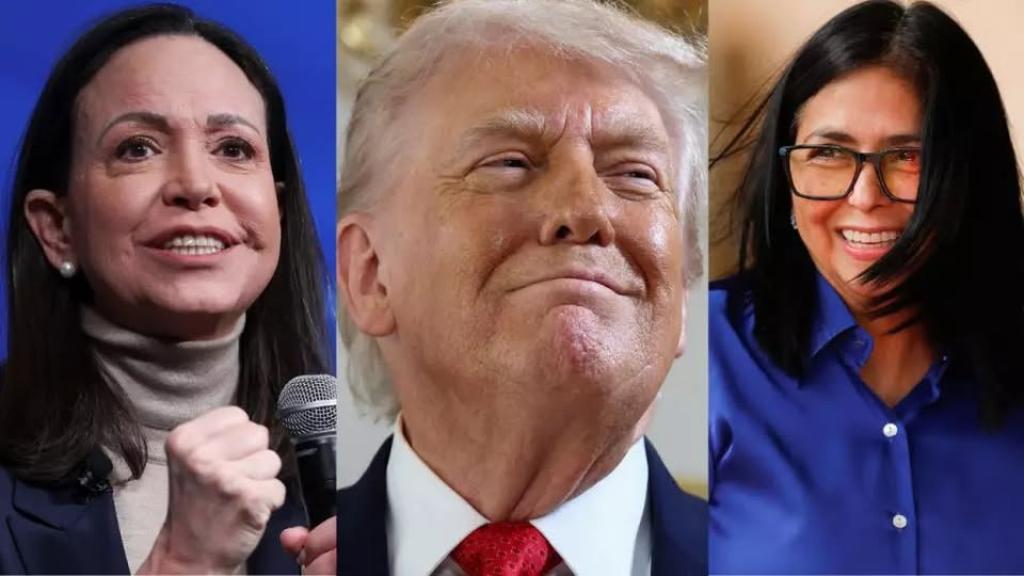
Machado Trump Rodriguez

First published at Luís Bonilla-Molina's blog. Translated by LINKS International Journal of Socialist Renewal.

“We are in a new political moment.” This is how [Acting President] Delcy Rodríguez concisely summed up the situation in Venezuela. The United States intervention in Venezuela, involving two-hours of relentless bombing of Caracas, La Guaira and elsewhere, along with the most shameful event in the national Armed Forces’ history, seem a distant memory. The events of January 3 have quickly become a historical event, worthy of commemorating in activist-packed halls, and for international audiences who prefer to live in Narnia in order to prop up their national political projects.

Anti-imperialism is conspicuously absent from contemporary Venezuelan public discourse. Although [former president Hugo] Chávez's cry, “Fucking Yankees, go to hell!” still echoes outside Miraflores Palace, for the past two weeks, the presidential palace microphones have, in a measured manner, indicated that any complaints about the events of January 3 [including the kidnapping of President Nicolas Maduro and First Lady Cilia Flores] will be made exclusively through diplomatic channels, in an attempt to overcome the stain left on US-Venezuelan relations.

Bewilderment still pervades Madurismo’s social base, where there are few meetings in which activists speak ill of the gringos — though, of course, always careful not to mention the orange man in the White House — a kind of consolation for those just beginning to awaken from the grief of their loss.

[US President Donald] Trump’s assertion on the afternoon of January 3 — as the cries of humble mothers for the deaths of a hundred sons reverberated across the besieged homeland — cannot be refuted by the facts: Rodríguez has pledged to cooperate and not repeat Maduro’s mistakes. The mistake Trump referred to appears to have been made by Maduro himself.

Between 2014-25 Maduro dismantled the national-popular program — not to mention so-called 21st-century socialism — that Chávez had embodied, but failed to fully implement the political, legal, and institutional measures needed to transform Venezuela into a new US colony.

Maduro’s error was not one of principles, but political calculation: he believed he could negotiate his continued hold on power in exchange for selling off the country’s wealth to the US. Maduro successfully dismantled a frustrated revolution, but did not know how to present its demise without losing his base. None of this stops us from denouncing his kidnapping on January 3 and demanding his release, because Venezuela is a republic that must resolve its affairs without the intervention of any empire.

The Fantastic Four and Wonder Woman

On January 15, Trump, who enjoys the spectacle of professional wrestling so much that he appointed wrestling entrepreneur Linda McMahon to head the Department of Education, decided to use terms from the Marvel and DC Universes to describe his political options in Venezuela.

He said that he had a long telephone conversation that morning with Rodríguez, whom he described as “fantastic” and with whom, he said, they were working very well. That afternoon, he met with right-wing opposition leader María Corina Machado behind closed doors. He had brushed Machado aside on January 3 as a potential option to lead Venezuela, but now referred to her as “wonderful” — after, of course, she presented him with her Nobel Peace Prize medal.

Perhaps Trump wanted to replace the “Super moustache” and “Cilita” saga — action figures Venezuela’s government created to represent Maduro and Flores, which were given as Christmas gifts to poor children — with his own rhetorical imagery.

But, in fairness, the term “fantastic” is shared by three other figures who, along with Rodríguez, are at the helm of the Venezuelan administration: Jorge Rodríguez (National Assembly president), Diosdado Cabello (Minister of the Interior and Justice), and [Vladimir] Padrino López (Minister of Defense). They are the “Fantastic Four” of this “new political moment,” who must avoid angering the Lex Luthor in the White House.

The “Wonder Woman” moniker, however, is clearly for Machado, who seems to have distanced herself from the rest of the Venezuelan opposition, which is more inclined to reach agreements with Maduro and now Delcy Rodríguez. As Bifo Berardi would say, these are merely reflections of the mental health problems surrounding power in the 21st century.

Dismantling the remnants of the Bolivarian revolution

The Bolivarian process reached January 3 like a zombie feeding on rhetoric devoid of any basis in reality — a terrible caricature of the promises enshrined in the 1999 Constitution. The decline began before the Unilateral Coercive Measures (US sanctions), but these clearly accelerated the transition from entropy to counterrevolutionary dissolution, most starkly expressed in the 2018 package of economic measures. This package shifted the burden of the crisis onto the working class while protecting circuits of capital accumulation.

The Maduro government became authoritarian, dismantling even the most basic democratic freedoms and ruthlessly creating the worst material conditions any Venezuelan worker alive today has experienced. The “Fantastic Four” were structural components of this decline; they did just inherit this situation, but were co-participants.

The question everyone asked was whether the January 3 imperialist attack on Venezuela could trigger an internal revolutionary response, with the ruling quartet at its head, that could resume the path outlined in the 1999 Constitution. Subsequent events have shattered that illusion. Not only are diplomatic relations between Caracas and Washington being normalised within the framework of an illiberal and colonialist agenda, but the needed counter-reforms are solidifying the new status of US-Venezuelan relations.

At Delcy Rodríguez’s request, the National Assembly has simplified trade regulations to remove restrictions on foreign investment, while initiating reforms to the Hydrocarbons Law to legitimise the plundering of Venezuela’s oil and re-entry of transnational corporations ousted by the Chávez revolution. These rapid restoration measures seek to align Venezuela with Trump’s aims, which were presented to the 16 oil magnates gathered to establish a $100 billion investment fund. This fund will allow the US to increase its current control of nearly one million barrels of Venezuelan oil to more than four million within a couple of years.

Venezuela is rejoining the SWIFT banking system, allowing local financial transactions to be routed through the US. Four private banks (BNC, BBVA Provincial, Banesco, and Mercantil) have already been authorised by the Trump administration to receive a portion of the foreign currency transferred to the country from oil sales. It appears these private banks will sell the foreign currency, while the Central Bank of Venezuela will only receive Bolivars generated from this auction, less the respective intermediary fees.

Delcy Rodríguez promotes this mechanism as a form of “energy cooperation with the US, which will allow any incoming currency to be allocated to two funds: the first for social protection to improve workers’ wages and strengthen areas such as health, education, food, and housing; the second for infrastructure and services.” A quick calculation of the impact of the first US$300 million to be transferred shows how ineffective the 30% of the revenue from oil sales that the US plans to send to Venezuela through the colonial form of intermediation will be in improving the working class’s living conditions.

On January 9, the White House made public its executive order, “Safeguarding Venezuelan oil revenue for the Good of the American and Venezuelan people,” the embodiment of the colonial relationship when it comes to managing resources derived from oil sales. The US assumed for itself the role of “custodian” of Venezuela’s funds, whose use and circulation depends on the US Secretary of State. This was tested with the 50 million barrels of oil the US announced it had confiscated for this purpose.

The Delcy Rodríguez government responded by initiating legislative and institutional reforms to facilitate this. On January 15, the same day as the phone conversation between Delcy Rodríguez and Trump, the reform of Venezuela's Hydrocarbons Law was announced. It was like witnessing a competition to see who could present themselves as the most obedient to the White House occupant: Machado presented Trump with the Nobel Prize medal while Delcy Rodríguez introduced the Hydrocarbon Law reform.

As a smokescreen, the Trump administration ordered the closure of Venezuela’s El Helicoide detention centre, which had been denounced as a torture site, and the release of political prisoners held there. The National Assembly president went from claiming Venezuela had no political prisoners to reporting that more than 400 had been released, with the remaining cases being reviewed. Human rights advocates have previously said the number of political prisoners could be more than 1000. It is important to emphasise that these releases are the result of the struggle waged by the families of political prisoners and human rights organisations that have supported them, and are not an imperial handout.

All this is occurring while Article 5 of Venezuela's State of Emergency decree continues to allow the arrest of anyone who criticises the government. Today, it is common to see police and military personnel in Venezuelan cities checking phones and arresting anyone with information against the government. Most people now leave their homes without a phone, or with a device incapable of receiving WhatsApp messages or accessing social media.

As if this was not enough, on January 15 it was announced that the executive and legislative branches, together with the bureaucratic and employer-oriented Bolivarian Socialist Workers' Central (whose key architect was Maduro), would fast-track a labour legislation reform, creating a new Labor Code adjusted to the new political moment.

The reaction of the capitalist class and business leaders remains to be seen. However, Delcy Rodríguez is very adept at moving in business, financial and banking circles. In fact, between 2018–25, she was tasked by Maduro with finding common ground with the traditional business sector, something she accomplished efficiently.

[The main big business chamber] Fedecamaras had participated in the 2002 coup against Chávez and severed all ties with the government. But Delcy Rodríguez successfully achieved the seemingly impossible: not only was she the star guest at national business meetings starting from 2021, but she managed to break them away from Machado’s calls for confrontation. This experience could prove useful for Delcy Rodríguez in achieving what Maduro could not: an agreement among the various capitalist factions for an orderly transition, where all the wealthy win and no particular sector loses. Of course, in such agreements, those at the bottom always lose.

Changes are happening at breakneck speed while any anti-imperialist perspective seems to further fade.

The great absentee

Internationally, people are asking: Where is the popular response? The truth is that there have been no spontaneous mass mobilisations and autonomous responses to what occurred. The small marches that have taken place have been called by the government, mobilising mainly public employees and the social base it still maintains, which, although diminished, is nonetheless important for these purposes.

How can we explain this? Maduro’s regime has created such a disaster for workers’ living conditions that large segments of the population see his departure as the only chance for change. Citizens seem to have reached a point where they are willing to see if the new circumstances leads to improved wages, allows for the return of the 8 million migrants whose exit fractured Venezuelan families, restore the regular and stable functioning of public services (water and electricity), and establish institutions to address the healthcare, food and housing needs of the vast majority.

However, the colonial-style administration is unlikely to meet these aspirations. A mobilised social movement will only return to the extent that this becomes evident.

In the land of the blind…

Now everyone in politics is talking about transition and solving problems in the short term. But this cannot be done with good intentions alone; it demands a comprehensive understanding of the structural causes of the current situation.

From our perspective, Venezuela’s current crisis originated in February 1983 with the collapse of the rentier model of capitalist accumulation, class collaborationism and political representation. It deepened with the disappearance of the “people” as a unifying element of the nation-state, beginning with the Caracazo uprising of 1989.

This was further exacerbated by the crisis within the military, manifested in the February 4 and November 27 uprisings in 1992. To this we should add the profound crisis of credibility in democracy, a phenomenon that became undeniable with the 1993 election results, and intensified with each subsequent election.

The 1999 Constituent Assembly garnered majority support, but failed to reconstitute the people as the subject of state consensus; on the contrary, chaos deepened, punctuated by periods of apparent stability. The emergence of a new capitalist class in 2002, following the military-backed coup against Chávez, sparked a struggle for wealth accumulation that nearly erupted into civil war between 2014–17.

This inter-capitalist conflict remains unresolved and, worse still, reveals a tendency in both sides to reject class collaboration; that is, they seek to dismantle even the minimum basis for a reformist social agenda that could keep the seeds of radical revolution at bay. We also must now add the trauma of the loss of sovereignty inflicted with the January 3 imperialist attack and the shameful role of the armed forces.

This represents 43 years of unresolved structural crisis in the model of accumulation and political representation. A transition conceived from the perspective of the working class must be capable of addressing each and every component of this crisis. Machado has stated that her approach is different, and the Delcy Rodríguez government seems more interested in clinging to power than resolving this structural crisis. The coming months will be key to understanding and determining the course of events in the country.

So much swimming only to die on the shore

Cuban writer Leonardo Padura recently published a novel that could easily include a chapter about Venezuela. Morir en la arena (To Die on the Shore) tells the story of a disillusioned generation that criticised capitalism as a result of the political, economic, social, cultural and technological problems; that embraced socialism as an alternative; and now seems to accept that the only solution to its problems is a return to a savage, free-market capitalism of competition and labour exploitation, but with a decent wage.

Explaining that what happened in Venezuela was not a socialist experiment, but rather an appropriation by dispossession of the narrative of radical transformation, is not easy. Certainly, the Chávez government had some redeeming qualities, as did the Fourth Republic, but both ultimately became attempts to resolve the capitalist crisis without changing the rentier model of production and accumulation.

More than creating formulas, relaunching future projects today means listening to the people, because a revolution is only possible and sustainable when it resonates with the expectations, needs and requirements of the humble. It is about swimming against the current to avoid drowning on the shore.

The difficult task of revolutionaries

Given this situation, there is no doubt about the priorities. The central task is defending national sovereignty from an anti-imperialist working class perspective; that is, every step in defence of the republic must be accompanied by the demand to re-democratise Venezuelan society and for wage justice. There is no territorial sovereignty without political sovereignty.

It is very difficult to cohere a defence of Venezuelan sovereignty that omits the need to resolve inequality and lack of freedoms in Venezuela. Correctly combining these demands is the challenge of anti-imperialism today.

Therefore, the call for a global anti-imperialist front, based on solidarity with Venezuela, must include the demand to fully restore political, labour and civil freedoms in Venezuela. This will require tact and creativity, commitment and a clear vision.

In this spirit, and with this orientation, we raise our voice as part of the call to organise a global platform, which began to take shape with the online meeting on January 17, bringing together diverse and pluralistic voices that continue to believe that another world and another Venezuela are possible.


Trump’s Christian Nationalist Pseudo-Historians Attack the Smithsonian

Photograph, Alice Paul with Suffrage Banner. 1991.3016.042.

If you’re planning a visit to the Smithsonian, you may want to go sooner rather than later — before the nation’s most important public history institution becomes another casualty of Trump-era historical revisionism.

For example, on January 10, People magazine’s Charlotte Phillipp reported that Trump complained that his portrait in the Smithsonian Institution’s Portrait Gallery pointed out that he was “impeached twice, on charges of abuse of power and incitement of insurrection.” The White House provided an updated portrait, “along with a new caption that has omitted text that mentioned his impeachments and the Jan. 6 insurrection.”

According to January 8 report by the New York Times’ Graham Bowley and Robin Pogrebin, “After a months long lull in tensions, the Smithsonian is facing an ultimatum from the White House to comply next week with a comprehensive review of the institution’s content and plans — or risk potential cuts to its budget. … [Secretary Lonnie Bunch III ] noted that it would be impossible to turn over the full volume of records sought in the time frame, and he reiterated that the institution is autonomous.”

The Smithsonian is one of the largest and most respected cultural institutions in the U.S., and its exhibits influence public understanding of American history. Efforts to politically pressure or intervene in how it presents history raise serious questions about academic independence, historical accuracy, and the role of ideology in public education.

In a recent story titled “Father-Son Christian Nationalist Pseudo-Historians David And Tim Barton Are Shaping The Trump Administration’s War On The Smithsonian,” Right Wing Watch points out how the pseudo historian David Barton and his apple-not-falling-far-from-the-tree son Tim, are on assignment by the Trump administration “to control how American history is presented at the federal level.”

David Barton, and now his son, have built their careers “spread[ing] demonstrably false claims about the Founding Fathers, the Founding Era, and the founding of the United States to bolster their modern-day Christian nationalist political agenda,” Right Wing Watch’s Kyle Mantyla reported in mid-April of last year. Barton has even gone so far as to attempt to make a biblical case for Trump’s tariffs, Mantyla noted in an early April story.

David Barton, who has no formal academic credentials in history, has long been the go-to guy for the Religious Right and Christian nationalists’ maintaining that the Founding Fathers intended to establish America to be a Christian nation that operates according to the laws of God as set out in the Bible.

Tim Barton has taken over as president of the WallBuilders organization, serving as co-host of the daily “WallBuilders Live” radio program, and traveling the nation delivering presentations filled with Christian nationalist disinformation.

Right wing Watch reported that on their WallBuilders radio program “Tim and his father celebrated the news that the White House is now threatening to withhold funding from the Smithsonian if the institution does not submit additional documentation amid the administration’s review of its content and displays.”

The Christian nationalist Bartons, claim they were integral in bringing this about.

“This is one that is dear to our heart,” Tim Barton said. “The White House warned the Smithsonian that if the museum did not submit more documentation to the administration to enable a review of its contents, funds may be withheld from the institution.”

“What they said is, ‘We want to know [the] chain of command. Who approved all this?'” he continued. “What they’re asking is, who is accountable? Who’s going to be responsible? Who gets held accountable for all of the nonsense. This is not a crazy request. Museums are supposed to keep record of who approved what, what areas, what displays, what wall mounts.”

“The Smithsonian failed to tell them who put up some of the crazy stuff that is there,” Tim Barton said. “And dad, you and I have gone through and reviewed several of the Smithsonians and there’s some crazy stuff there.”

“Yeah, I was going to point out that earlier in the year, the White House asked us to look at some of that,” David Barton responded. “At that point, you were leading a tour of legislators in Washington, D.C. … By the way, we love the American History Museum, the Smithsonian because of the artifacts, but not because of the way they present them. The way they present them is terrible. And so as the legislators went through, Tim, they came back to you and said, ‘Oh man, this is terrible and this is bad.’ And so you turned that over to the White House on how bad the stuff was, how misleading it was.”

“You were right in the middle of that story,” David celebrated.

“This is so encouraging that we actually have an administration saying, ‘Let’s tell the truth, let’s stop this woke propaganda nonsense, let’s tell the truth,'” Tim responded. “This is such good news and I’m so excited for what this could mean for the 250th celebration because this is part of what they’re gearing it for; they want to make sure we’re telling good stories for the 250th.”

The Smithsonian exists so Americans can confront their past honestly, in all its achievement, cruelty, contradiction, and struggle. The Bartons are not defending history, they are prosecuting it. And in the Trump administration, they have found a willing partner. They would eagerly replace historical inquiry with ideological loyalty; reshaping the public memory with Christian nationalist myths.

The Smithsonian was never meant to serve any administration’s political narrative — let alone the theological agenda of Christian nationalist activists who reject mainstream scholarship. If Trump succeeds in bending the institution to his will, the loss will not belong to historians alone. It will belong to every American who believes history should be examined, not edited.

Bill Berkowitz is a longtime observer of the conservative movement. Read other articles by Bill.


My Dream for BRICS and its Critics


Orientation

With the recent kidnapping of President Maduro by Yankee imperialists, I wonder about how BRICS nations and other countries sympathetic to them such as North Korea and Iran will respond. Venezuela has made an attempt to join BRICS and clearly they are in the socialist camp so I would expect it would be especially important to China. Were BRICS countries and their allies aware of the build-up for the kidnaping and what kind of help did they offer?

Some of my Facebook friends with an especially deep appreciation of geopolitics think I am naïve in my hopes that BRICS can be an operative to intervene politically in these events or other coups by a desperate United States. After all, BRICS is a formidable economic organization with infrastructural commitments like China’s Belt and Road Initiative to name just one economic commitment. Also, like the Shanghai Cooperation Organization to name another. However, they are not just international political organization. BRICS, after all has a wide variation of political orientation within its countries. There is a socialist country (China), Hindu fundamentalist (India) and capitalist nationalist (Russia) not to mention two Islamic allies, Saudi Arabia (Sunni) and Iran (Shia). Can all these countries muster enough unity to stand up to the United States now and in the future? Time will tell. Let me provide a world historical perspective as to the uniqueness of BRICS in the overview of the history of capitalism.

A World-Systems Theory of the History of Capitalism
Capitalism gets around. In his great book The Long Twentieth Century Giovanni Arrighi claimed capitalism has gone through four stages, including:

  • commercial capitalism of the Italians trading cities in the high Middle Ages;
  • commercial seafaring Dutch in the 17th century;
  • industrial manufacturing of the British in the 19th century and
  • industrial manufacturing, financial and military capitalism US in the 20th century.

Another world systems theorists, Immanuel Wallerstein writes that each of these countries has gone through 5 phase of capitalism:

  • commercial;
  • slave;
  • industrial;
  • financial and
  • military.

Arrighi points out that the speed through which the four hegemons go through the cycles speeds up so that their risk and decline accelerates. It ranges from 220 years for the Italians to 100 years for the United States (1870-1970). Why did they collapse? It was because of wars and financial ruin. What we have is the rise and fall of four hegemons having gone through the five phases of capitalism. This is all laid out in detail in my articles: “Beyond Socialist Purity” and “The Cycles  and Spirals of Capitalism.”

If the United States has been in decline for 55 years. Where will the world economy go? These days it is easy to say it is China. Both Andre Gunder Frank, in ReOrient: Global Economy in the Asian Age and Giovanni Arrighi Adam Smith in Beijing put their money on China and did so over 25 years ago.

However, today there is something new that neither Arrighi nor Gunder Frank predicted. In the whole history of capitalism over the last 500 years it is only individual political entities that have risen and fallen. Today we have a regional configuration on the rise, BRICS and a regional confederation in decline, the United States and Western Europe. So, if economics was the only thing that matters, BRICS with China in the lead will be the new hegemon. But as most radicals know it is not economics on one hand and political science on the other. There is only political economy. The attack on Venezuela was an international political act in the service of economics (oil, gold and other natural resources). Can or will BRICS countries respond to this politically, either individually or as a collectively?

Can My Dream Come True?
How much do the Russian and Chinese leaders understand this world historical picture of the history of capitalism? My hope is that they do. My hope is they act not just as single nation-states within a region but rather as a regional consciousness within the national policies. Secondly, my wish is that they operate under the following political and economic values:

  • nationalism as a political force that fights against the globalization of capitalism;
  • nationalization that fights imperialism and colonialism;
  • support of industrial capitalism as opposed to finance capitalism whether that system is socialist or capitalist;
  • support of surplus value for technological innovation as opposed to investment in military aggression, and
  • a new concept of the political spectrum which unites left and right against political centrism.

It seems to me that China, Russia and Iran have the most potential to come closest to this dream. India and Brazil seem to still want to imagine deals can be made with the West.

Skeptical Leftist Responds:
No Illusions about China and Russia
This is from my friend Raul:

“I am sorry, my left-leaning ideologue camaradas, but after many disappointments and fiascos from Syria, to Libya, to Palestine, to Venezuela and beyond, I no longer believe in the illusion of Russia and China representing a multipolar option to the empire. I used to believe in that illusion, but the well documented arguments presented by a couple of friends and easily verifiable historical facts broke the spell (and I am glad about it.)

While not exercising the same form of brutal gangster-like form of imperialism as the U.S. or Israel, Russia and China are certainly not going to put their hands on the fire for no one but themselves, and I hope Iran is taking notes of the Syria and Venezuela fiascos before they deposit their trust blindly in Russia and China as allies not willing to do a damn thing when they are attacked by the sick satanic Zionist forces.

Just look at Russia welcoming with open arms the illegitimate terrorist government of Ahmed al-Sharaa former leader of Al Qaeda/Daesh in Syria. Not making any unfounded accusations here, but literally the last meeting Maduro had before his abduction was with China’s Qiu Xiaoqi, special representative of the Chinese government on Latin American affairs, at the Miraflores Palace a day before the U.S. attacks. Again, I am not accusing them of participating in these crimes, but at the very least, they decided to remain passive and limit their response to issuing a few toothless platitudes condemning the war crimes in Venezuela and criminal abduction of the leader of a sovereign nation which was supposed to be their ally.

Now, let us discuss Russia and China’s backstabbing of  Palestine. On the 15th of November Putin initiated a phone call with Netanyahu to discuss Middle East affairs which included discussions on both Syria and Gaza. Just two days later a Russian military delegation showed up in Damascus and was filmed touring Southern Syria just before Russia’s abstention at the UN allowing Trump’s colonial plans to proceed while giving the green light to Israel to bomb a Palestinian refugee camp in Lebanon.

Israeli military claimed that the attack targeted a Hamas training compound where militants were preparing to carry out terrorist operations. In fact it was a sports field within the refugee camp – 15 civilians were killed, many of them young teenagers who were playing football at the time

As we speak, Russian and China are enabling and endorsing war criminal Trump’s ethnic cleansing project in Gaza. So seriously, from now on pro-Russia/China ideologues should spare us any multipolar world rhetoric and stop at once with the foolish notion suggesting that Russia and China are moral models of reference, because evidently they are not. Blind ideology is wrong on the right side of the political spectrum and blind ideology also happens to be wrong on the left side of the political spectrum…”

In the Name of Marxist Leninism
Here is another comment by a friend that Ismael passed on.

Just quick thoughts: China does not practice romantic anti-imperialism. It practices historical materialism under conditions of uneven power. It just cannot come rescue you and trigger a full-fledged confrontation. All socialist states understand the need to avoid actions that collapse contradictions too early, especially when such actions can allow Washington the opportunity to reframe the conflict as “democracy vs authoritarianism”.

In fact, this is what distinguishes Chinese anti-imperialism based on dialectics from isolationist, “civilizational” or elite-led selective populist anti-imperialism  that avoid the real battlefield of global capitalism itself, its circuits of rent, debt, logistics and surplus. Venezuela (even as I understand real constraints it faced under severe sanctions) could be cited as one such example with some nuance.

I thought we knew this as Marxist Leninists. China will not die on someone else’s barricade… It expects states to manage their own internal contradictions. Solidarity means keeping the system open for future autonomy, not rushing in with gunboats to prove ideological virtue.

I know this is exactly what is frustrating inqilab types (not saying history doesn’t favor them when time is ripe and they did make sense in Vietnam, Cuba, Algeria). And I can actually sympathize with them. But premature showdown with empire (from Hungary 1956 to Chile 1970s) tends to end in obliteration. China as a really existing socialism knows these lessons deeply and avoids fetishizing “the moment” that seduces the weak into fatal confrontations, taking away its weapon of time in asymmetric equations. It is this very strategic patience and peace that makes China more “violent” and revolutionary in the most radical sense.

So when China refuses dramatic confrontation over Venezuela, it’s protecting this hard-won positional advantage. Rescue is a liberal fantasy! Trump would LOVE China to break the Western Hemisphere taboo (the Monroe Doctrine). We don’t want that. If China were practicing “dirty realpolitik” we would be seeing it perform coercive “protector” politics, not otherwise. And this makes the BRICS alliance all the more important!

It would be a dirty realpolitik if China was trying to win imperialism’s game. Realpolitik has no concept of negation of the negation. It only knows adjustment. The ethical structure is “immanent”, not performative. This is the key historical point. China’s ethics are expressed through rules of engagement with history. Do we want China to win imperialism’s game or outlive the dirty game itself?

I’m not being a cynic. This is class calculus at the level of the world-system. We are communists, we drag down the heaven from clouds and nail it to the material history. Keep marching, it is always obvious only as an “after the fact”.

Lastly, I would like to show you a 17-minute video by a geopolitical analysis which claims that far from “deciding” to invade Venezuela, the CIA, the Neocons and Trump were trapped by a strategic plan laid out by Russia and China that was three years in the making. While the United States in a case of imperial overstretch will be preoccupied with Venezuela, the Chinese will consolidate their power in the Pacific region, including Taiwan and North Korea. Here is the video:

Conclusion

I began this article with the kidnapping of Nicholas Maduro as a way to take stock of the power and limitations of BRICS as an alternative to Western imperialism. Then I placed Western imperialism in the world-historical context of the history of capitalism to show:

  • the collapse of the United States as the latest capitalist hegemon and
  • the rise of China.

Then I suggested that in today’s world the regional federation of BRICS expresses a transference of the world economy from the West to the East and that BRICS might be the future of the world economy. My dream for BRICS included the following:

  • nationalism as a political force that fights against economic globalization;
  • nationalization that fights political imperialism;
  • support of industrial capitalism as opposed to finance capitalism whether that system is socialist or capitalist;
  • support of surplus value invested in technological innovation as opposed investment in military aggression and
  • a new concept of the political spectrum which unites left and right against political centrism.

I closed my article with three skeptical arguments about BRICS. One is the failure of Russia and China in the past and present to come to the aid of Syria, Palestine, Libya and Venezuela. The other defends Chinese anti-imperialism against a romantic kind of anti-imperialism and says China cannot jeopardize it gains and that other states, even socialist ones have to fight their own domestic battles. The last video presents the power of two countries within BRICS: China and Russia. They have developed a political and economic strategy to trap the United States and limit its capacity to undermine their BRICS projects.

I am sure there are many other international dynamics between the East and the West that are not covered in my three examples. So what else needs to be said? Are there more cynical arguments against the power and reach of BRICS? Are there even more optimistic outlooks based on facts that are about BRICS than my dream? Your comments are most welcome. Reply at Socialist Planning Beyond Capitalism.

Bruce Lerro has taught for 25 years as an adjunct college professor of psychology at Golden Gate University, Dominican University and Diablo Valley College in the San Francisco Bay Area. He has applied a Vygotskian socio-historical perspective to his three books found on Amazon. He is a co-founder, organizer and writer for Socialist Planning Beyond Capitalism. Read other articles by Bruce, or visit Bruce's website.