Tuesday, January 20, 2026

 Russian intelligence targets Orthodox Christianity's worldwide leader as 'antichrist in a cassock'

ISTANBUL (RNS) — The Ecumenical Patriarchate in Istanbul appears intent on capitalizing on the Russian attack, keeping up a media blitz about the SVR statement for more than a week.

ISTANBUL (RNS) — “Antichrist in a Cassock,” “Antichrist of Constantinople,” and “Devil Incarnate” were among the terms Russia’s foreign intelligence service used to attack the spiritual leader of Eastern Orthodox Christianity, Bartholomew I, accusing him of meddling in Ukraine and trying to push the Russian Orthodox Church out of the Baltic states.

In a statement released January 12, the agency, known by its Russian initials SRV, wrote, “Patriarch Bartholomew of Constantinople, who dismembered Orthodox Ukraine, continues his schismatic activities within the Orthodox Church. Now he has set his dark eye on the Baltic states. This “devil incarnate” is obsessed with ousting Russian Orthodoxy from the Baltic states, establishing in its place church structures completely under the control of the Phanar,” referring to the Istanbul neighborhood where Bartholomew is headquartered.

Bartholomew, the Ecumenical Patriarch of Constantinople, is considered “first among equals” of the world’s Orthodox Christian patriarchs. But in recent years Moscow has bitterly objected to his support for Orthodox national churches in Eastern Europe who have broken with the Russian church, overturning long established spheres of influence. 


Moscow declared itself in schism with Constantinople in 2018 after Bartholomew recognized an independent Ukrainian Orthodox Church untethered from the Russian Orthodox Church and its patriarch, Kirill. The Russian church leader has closely allied himself with Russian President Vladimir Putin, and has provided a religious justification for the war in Ukraine, calling it a “holy war.”

While the antipathy between the Russian church and Bartholomew is not new, the latest attack is  unique it coming directly from an organ of the Russian state, bolstering accusations that the church is acting at the behest of the Kremlin. The Russian Orthodox Church has not itself made any statements acknowledging the SVR statement since its release.

Bartholomew responded in a communique, saying, “The Mother Church of Constantinople – Mother of this Church of Russia – expresses its deepest sorrow for the new Russian attack against the person of His Holiness the Ecumenical Patriarch Bartholomew, which was launched, this time, by state services of the country.” The patriarch dismissed the attack as an extension of Russian complaints about Bartholomew’s recognition of an independent Ukrainian church. 

“The imaginative scenarios, fake news, insults and fabricated information of all kinds of propagandists do not discourage the Ecumenical Patriarchate from continuing its ministry and ecumenical mission,” he said. 

The SVR’s statement said that Bartholomew was acting under the sway of British intelligence, which it accused of fueling “Russophobic sentiments in European countries.” Bartholomew, “mired in the mortal sin of schism, has found common ground with the authorities of the Baltic states in an effort to sow discord in the Russian Orthodox world,” it said. 

“The “Constantinople Antichrist”‘s aggressive ambitions are not limited to Ukraine and the Baltics,” the statement continued, “his treachery is gradually spreading to the lands of Eastern Europe. In order to strike a blow against the “particularly obstinate” Serbian Orthodox Church, he intends to grant (independence) to the unrecognized ‘Montenegrin Orthodox Church.'”


The Ecumenical Patriarchate in Constantinople has backed establishment of Orthodox Church structures independent of Moscow in Lithuania and Latvia in recent years, and in Estonia since the 1990s, but the mention of Montenegro left Orthodox church scholars scratching their heads. 

“The point where it first came to my attention because people started saying, ‘What, is there something going in Montenegro?” said Samuel Noble, a scholar of Orthodox Christianity at Belgium’s University of Liège. “Complaining about the Ecumunical Patriarchate in the Baltics is a longstanding thing and nothing new, but it seems like the bit about Montenegro was just entirely made up to get attention from Serbs.”

Some 71% of Montenegrans identify as Orthodox Christians and 90% of those consider themselves under the auspices of the Serbian Orthodox Church. However, a small portion are affiliated with the breakaway Montenegrin Orthodox Church, which has historically been opposed by both Belgrade and Constantinople. 

“I’ll say it plainly: we have never had anything to do with this issue,” Metropolitan Emmanuel of Chalcedon, a high ranking bishop and deputy of the Ecumenical Patriarchate, told Greek media.” It is not even a church structure — just some kind of group that cannot even be called schismatic. We have never had any contact with this group in Montenegro. This is simply informational noise on their part.” 

Nonetheless, the Ecumenical Patriarchate in Istanbul appears intent on capitalizing on the Russian attack, keeping up a media blitz about the SVR statement for more than a week.

“The very mention of Russia’s Foreign Intelligence Service ultimately constitutes the most revealing “moment of truth” for the Patriarchate of Moscow, as the ecclesiastical façade has completely collapsed, Metropolitan Emmanuel told the Greek Daily, Kathimerini. “It dangerously legitimizes the fact that synodal decisions, sacred canons, and authentic ecclesial ethos have been set aside and replaced by ‘services’ and secular mechanisms, thus demonstrating the absolute secularization and complete alienation of the ecclesiastical mindset.”


Emanuel also noted that the specific  language of the statement might have more to say about Russia’s relationship with the west, than church disputes. 

“In the narration of their imaginary storyline, an operation is being attempted that may escape the attention of many: whereas until recently responsibility was attributed to the Americans, now, quite suddenly, British intelligence services appear in their place.” He told Kathimerini.  It seems that the Russian leadership is attempting to test its relations with the new administration in Washington and is searching for another party to blame for the hardships it itself has caused, thus revealing a profound spiritual impoverishment.

The Russian church’s purported ties to Russian intelligence have affected Orthodox communities around the region and world. In 2023, the highest ranking Russian Church leaders were expelled from Bulgaria on accusations of espionage, while religious freedom advocates have expressed concern over crackdowns on Russian Parishes in Ukraine and the Baltic states. 

“The Russian church is such a big organization and you can find anything in it,” Noble noted. “You can still very much find the people who are widely opposed to what the state’s doing, and you can also find people that want to make Rasputin a saint — you can find all kinds of stuff.”

“Real connections between the Moscow Patriarchate and the state notwithstanding, I would be hard pressed to think that anyone in the church would have wanted that statement to be made,” he added.


 Opinion

After ceasefire, travel restrictions still haunt Palestinians
(RNS) — The time has come to end arbitrary Israeli travel restrictions and the overused excuse of security to allow for the most basic Palestinian human rights.
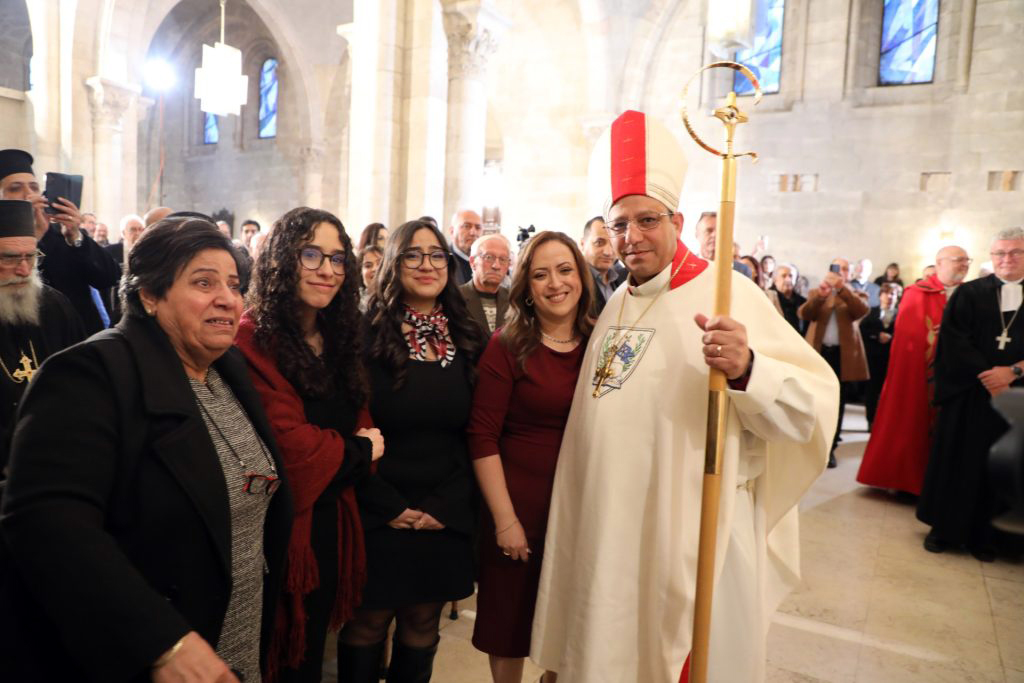
The Rev. Dr. Imad Haddad, Bishop of the Evangelical Lutheran Church in Jordan and the Holy Land, right, with his mother, from left, daughters and wife at his installation ceremony, Sunday, Jan. 11, 2026, in Jerusalem. (Photo by Michael Younan)

(RNS) — Restricting the movement of people and goods has been a consistent, troubling violation of Palestinians’ human rights under Israeli occupation. While these restrictions have escalated in a big way since Oct. 7, 2023, and the ensuing war in Gaza, many expected they would loosen up now that a ceasefire has been declared. We are now on the eve of the second phase of the ceasefire, to begin with the reopening of the Rafah crossing point between Gaza and Egypt.

A lack of enough Israeli staff at the King Hussein Bridge between the West Bank and Jordan has resulted in more suffering. I have crossed the bridge in the West Bank monthly for the past 27 years. This year, Palestinians returning from spending their winter holidays with loved ones in Jordan had to set up tents as they waited for their turn to return. The bridge crossing is supposed to be open 24 hours a day, at the initiative of the former U.S. ambassador to Israel, Tom Nides, but has not been restored to that schedule. Bridge crossings to Jordan are closed on Saturdays, although the Israeli airports continue to operate 24 hours daily without any restrictions on Friday afternoons and Saturdays, when religious Jews observe Shabbat.

And for the people of Jerusalem, there are few signs of change. Israeli checkpoints continue to have long lines, especially for travelers from Ramallah and Bethlehem to Jerusalem.


Israeli Prime Minister Benjamin Netanyahu has said publicly that Israel gives priority to supporting and easing the lives of Christians. That has been debunked by several experts, and the weekend of Jan. 9 to 11 saw further evidence of the false promises made by the Israeli prime minister to U.S. television audiences.

This past weekend, the new bishop of the Evangelical Lutheran Church in Jordan and the Holy Land was inaugurated in the Old City of Jerusalem, but the event was marred by the absence of many Palestinian Christian parishioners — especially from the Bethlehem area, where the Lutheran church has numerous congregations — amid travel challenges.

The new bishop, Imad Musa Haddad, himself a resident of Bethlehem, was given a six-month temporary permit to travel to Jerusalem. While the permit has no time limit, it states that he is not allowed to stay overnight in the Holy City, where traditionally, Lutheran bishops have enjoyed housing at the church headquarters, meters away from the Church of the Holy Sepulchre.


The mother of the bishop almost missed the happy event, as she had been denied a travel permit due to unknown security reasons. She finally received a short-term permit that stated she was allowed to spend the needed hours at the inauguration, despite an alleged security restriction on her. We don’t know what these security reasons were, but some speculated she might have previously received a permit and failed to register her return in time, which is seen in Israel as a major security violation. 

The inauguration took place with many foreign church leaders who were ushered into the church by the two Lutheran-based scout bands in the Bethlehem area. However, the director of the band, Elias Gharib, from Beit Sahour in the West Bank, was not provided a travel permit, also due to unknown security reasons. Twelve members of the Talitha Kumi School scouts also were denied travel permits. 

At the same time, Christian schools in Jerusalem have gone on strike, objecting to the Israeli authorities’ refusal to grant their teachers from the Bethlehem and Ramallah areas permission to travel to their schools. A statement from the Christian Educational Institutions in Jerusalem said 171 teachers and administrative staff lacked sufficient travel permits, with some given permits for certain days that exclude Saturday — a school day for Christian schools in Jerusalem. And local teachers say that Israel wants to force Christian schools to work on Sundays — a business day for Jewish Israelis — despite a tradition that goes back decades, if not centuries.


The ability of people and goods to move is a basic right guaranteed in the United Nations’ Universal Human Rights Charter and by the Fourth Geneva Convention, which deals with the actions of military powers in the case of a prolonged military occupation. But movement to and from Jerusalem is further compounded by Israel’s unilateral 1967 decision to annex East Jerusalem. Almost all the world powers and UN member states have refused to recognize the Israeli annexation of East Jerusalem, which they still consider Israeli-occupied Palestinian territories.

While Palestinians are striving for freedom from occupation and the ability to determine their own future in their own state, the very minimum they need today is to be treated with respect and dignity. Denying Palestinians, including Palestinian Christians, the ability to travel without restriction to the Holy City of Jerusalem and other locations is not only a violation of a basic right, but a show of lack of respect and dignity. The time has come to end arbitrary Israeli travel restrictions and the overused excuse of security to allow for the most basic Palestinian human rights.

(Daoud Kuttab is the publisher of Milhilard.org, a news site focused on Christians in Palestine, Israel and Jordan. The views expressed in this commentary do not necessarily reflect those of Religion News Service.)

US Catholic cardinals urge Trump administration to embrace a moral compass in foreign policy

ROME (AP) — 'Our country’s moral role in confronting evil around the world, sustaining the right to life and human dignity, and supporting religious liberty are all under examination,' they warned.


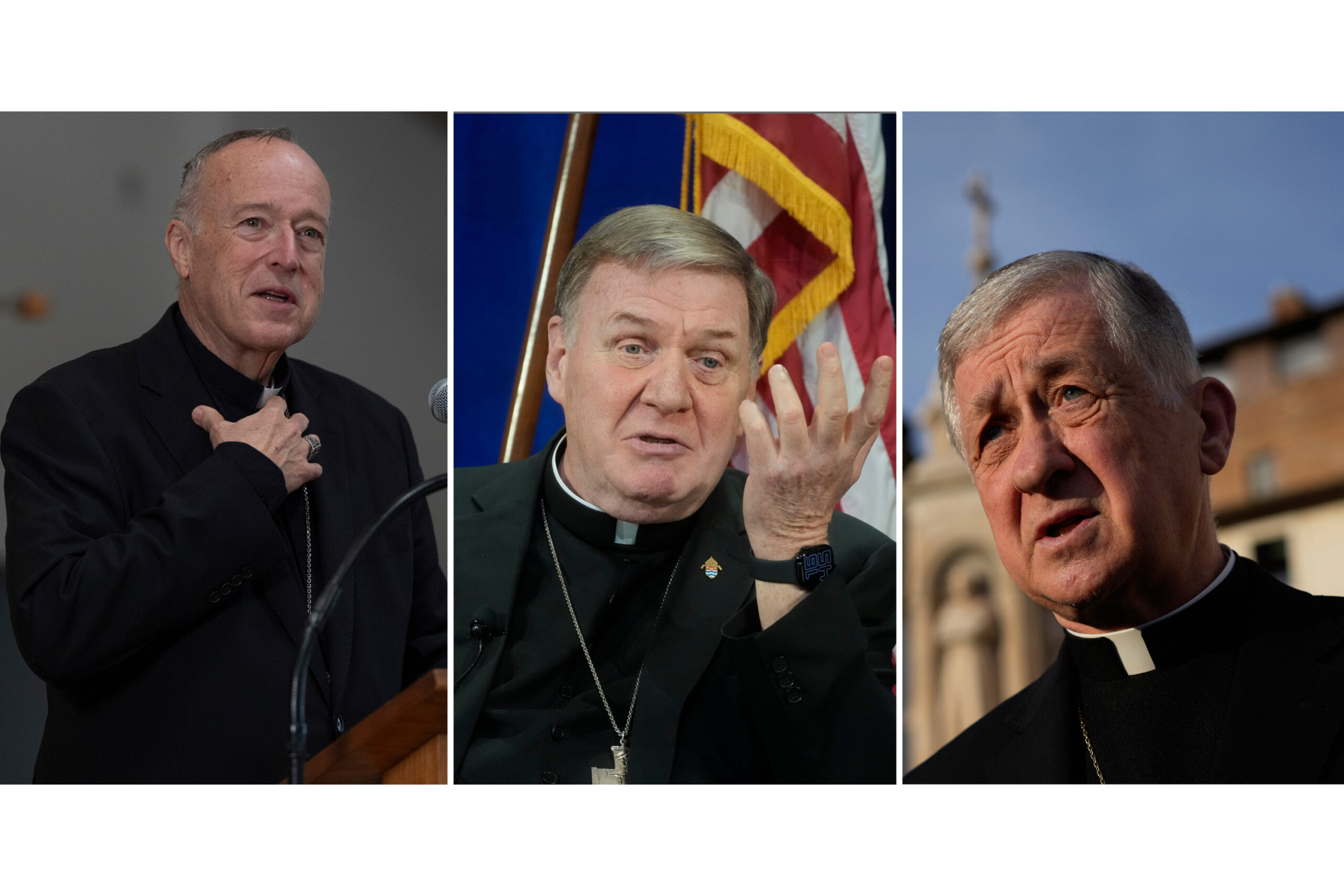
This combo shows, from left, cardinal Robert McElroy, cardinal Joseph Tobin and cardinal Blase Cupich. (AP Photo/File)

Nicole Winfield and Giovanna Dell’Orto
January 19, 2026


ROME (AP) — Three U.S. Catholic cardinals urged the Trump administration on Monday to use a moral compass in pursuing its foreign policy, saying U.S. military action in Venezuela, threats of acquiring Greenland and cuts in foreign aid risk bringing vast suffering instead of promoting peace.

In a joint statement, Cardinals Blase Cupich of Chicago, Robert McElroy of Washington and Joseph Tobin of Newark, N.J., warned that without a moral vision, the current debate over Washington’s foreign policy was mired in “polarization, partisanship, and narrow economic and social interests.”

“Most of the United States and the world are adrift morally in terms of foreign policy,” McElroy told The Associated Press. “I still believe the United States has a tremendous impact upon the world.”

The statement was unusual and marked the second time in as many months that members of the U.S. Catholic hierarchy have asserted their voice against a Trump administration many believe isn’t upholding the basic tenets of human dignity. In November, the entire U.S. conference of Catholic bishops condemned the administration’s mass deportation of migrants and “vilification” of them in the public discourse.

The three cardinals, who are prominent figures in the more progressive wing of the U.S. church, took as a starting point a major foreign policy address that Pope Leo XIV delivered Jan. 9 to ambassadors accredited to the Holy See.

The speech, delivered almost entirely in English, amounted to Leo’s most substantial critique of U.S. foreign policy. History’s first U.S.-born pope denounced how nations were using force to assert their dominion worldwide, “completely undermining” peace and the post-World War II international legal order.

Leo didn’t name individual countries, but his speech came against the backdrop of the then-recent U.S. military operation in Venezuela to remove Nicolás Maduro from power, U.S. threats to take Greenland as well as Russia’s ongoing war in Ukraine.

The three cardinals cited Venezuela, Greenland and Ukraine in their statement — saying they “raised basic questions about the use of military force and the meaning of peace” — as well as the cuts to foreign aid that U.S. President Donald Trump’s administration initiated last year.

“Our country’s moral role in confronting evil around the world, sustaining the right to life and human dignity, and supporting religious liberty are all under examination,” they warned.

“We renounce war as an instrument for narrow national interests and proclaim that military action must be seen only as a last resort in extreme situations, not a normal instrument of national policy,” they wrote. “We seek a foreign policy that respects and advances the right to human life, religious liberty, and the enhancement of human dignity throughout the world, especially through economic assistance.”

Tobin described the moral compass the cardinals wish the U.S. would use globally.

“It can’t be that my prosperity is predicated on inhuman treatment of others,” he told the AP. “The real argument isn’t just my right or individual rights, but what is the common good.”

In interviews, Cupich and McElroy said the signatories were inspired to issue a statement after hearing from several fellow cardinals during a Jan. 7-8 meeting at the Vatican. These other cardinals expressed alarm about the U.S. action in Venezuela, its cuts in foreign aid and its threats to acquire Greenland, Cupich said.

A day later, Leo’s nearly 45-minute-long speech to the diplomatic corps gave the Americans the language they needed, allowing them to “piggyback on” the pope’s words, Cupich said.

Cupich acknowledged that Maduro’s prosecution could be seen positively, but not the way it was done via a U.S. military incursion into a sovereign country.

“When we go ahead and do it in such a way that is portrayed as saying, ‘Because we can do it, we’re going to do it, that might makes right’ — that’s a troublesome development,” he said. “There’s the rule of law that should be followed.”

Trump has insisted that capturing Maduro was legal. On Greenland, Trump has argued repeatedly that the U.S. needs control of the resource-rich island, a semiautonomous region of NATO ally Denmark. for its national security.

The Trump administration last year significantly gutted the U.S. Agency for International Development, saying its projects advance a liberal agenda and were a waste of money.

Tobin, who ministered in more than 70 countries as a Redemptorist priest and the order’s superior general, lamented the retreat in USAID assistance, saying U.S. philanthropy makes a big difference in everything from hunger to health.

The three cardinals said their key aim wasn’t to criticize the administration, but rather to encourage the U.S. to regain is moral standing in the world by pursuing a foreign policy that is ethically guided and seeks the common good.

“We’re not endorsing a political party or a political movement,” Tobin said. The faithful in the pews and all people of good will have a role to play, he said.

“They can make an argument of basic human decency,” he said.

Dell’Orto reported from Minneapolis.