It’s possible that I shall make an ass of myself. But in that case one can always get out of it with a little dialectic. I have, of course, so worded my proposition as to be right either way (K.Marx, Letter to F.Engels on the Indian Mutiny)
Sunday, February 01, 2026
Italian Coast Guard Coordinates Rescues of Two Ships in Two Days
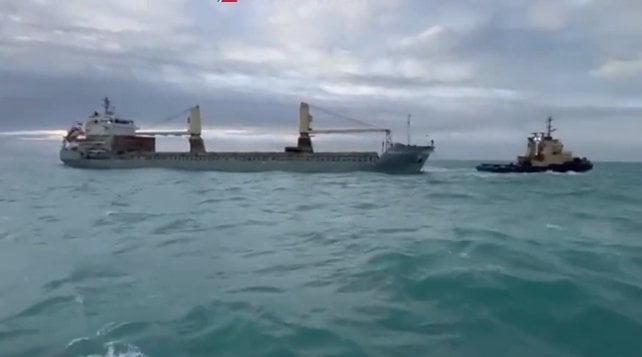
Merchant ship being towed after engine failure (Guardia Cositeria)
The Italian Coast Guard oversaw the rescue operations for two merchant ships in the course of two days from the same region of the Mediterranean. Although the report said there was a “night of apprehension,” the operations were both successful in getting the ships safely into port.
The towing operation of the livestock carrier Blue Ocean A got underway on January 29, after the Coast Guard and tugs had struggled to keep the vessel off the rocks on the coast of Sardinia. The ship had lost propulsion late on January 28 in a winter storm that was pushing it toward the shoreline. The Coast Guard reported the Italian Navy was unable to airlift the crew from the vessel due to the strong winds.
The operation was successful in positioning the ship into the weather and keeping it off the rocks. Yesterday, January 29, a towing operation got underway. The ship has a crew of 33 aboard, made up of individuals from Syria, Sudan, Egypt, and India. It appears there was no livestock aboard.
The Blue Ocean A arrived at the Porto Canale of Cagliari escorted by the Coast Guard. The livestock carrier has not been berthed, and according to the reports, navigation and safety checks are underway.
While the towing operation for the livestock carrier was getting underway, on the afternoon of January 29, another foreign-flag cargo ship also called for assistance. According to the report, the ship was suffering from engine failure approximately seven nautical miles south of the port of Pozzallo on the southern coast of Sicily.
The Coast Guard reports its operations center was closely monitoring the movement of the ship into the night to ensure that it was not at risk of drifting toward the coast or spilling into the sea. They watched the weather and sea conditions.
Working with the Maritime Directorate in Catania, emergency procedures were activated. A Coast Guard boat was sent to the unnamed vessel, which was only described as being 120 meters (394 feet) in length. It was bound for Portugal with a non-hazardous cargo.
It was determined that the vessel would require the assistance of a tugboat. The two got underway on January 30, and the Coast Guard accompanied the ship. It was also safely brought to port.
Urgent Alert After Chinese Bulker Issues Distress Signal
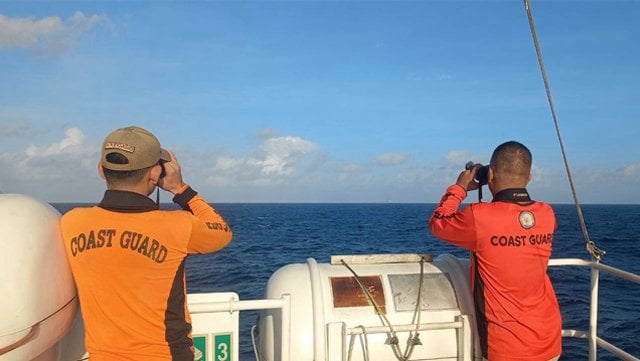
Philippine Coast Guard requested vessels to keep a lookout after a Chinese cargo ship issued a distress call (PCG file photo)
The Philippine Coast Guard issued an urgent alert to all vessels on Friday, January 30, after it received a distress call from a Chinese-owned bulker. Few details were issued, but it appears contact has been lost with the ship in the waters near Eastern Samar.
The alert requested all vessels transiting the area to “keep a sharp lookout” for the distressed ship. They were instructed to report all findings to the nearest Coast Guard office or radio station.
The distress call was issued by the Xing Guang 11, a dry bulk carrier registered in Panama. The ship was built in 2008 and is owned by a Chinese company. It is 18,000 dwt and 150 meters (492 feet) in length. In the ship's last Port State inspection in November in Vietnam, it was cited with deficiencies related to the operational readiness of its lifesaving appliances. The ship, however, was not detained.
The last known position was approximately 54 nautical miles east-northeast of the vicinity of Siluan Island. It is in the Eastern Samar region of the Philippines.
The report did not indicate how many crew were aboard the vessel or the nature of the distress and details received from the ship. The AIS signal indicates the ship had departed Nakhodka, Russia, on January 21 and was bound for Bahudopi in Central Sulawesi, Indonesia. The area is known as a hub for nickel mining and processing.
Today’s alert comes just a week after another bulker, Devon Bay, sank after loading a cargo of nickel ore. Yesterday, January 29, insurer Guard issued a warning about the dangers of transporting nickel ore. It wrote that “Gard once again alerts members and clients to the significant risks involved in the carriage of nickel ore, particularly loaded from the Philippines.”
It is unclear if the missing vessel was making runs with nickel ore and heading back to take another load. The Philippine Coast Guard has not issued follow-up statements at this point regarding the search.
Italian Coast Guard Rescues Disabled Livestock Carrier Being Drive Ashore
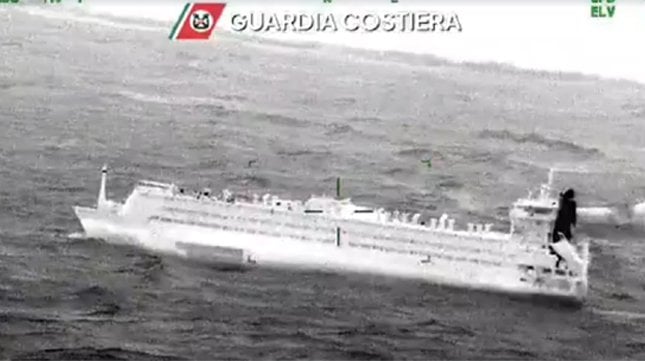
The Italian Coast Guard prevented the disabled livestock carrier from being driven on the rocky shore (Guardia Cositeria)
In what is being termed a particularly complex rescue operation, the Italian Coast Guard, aided by the Air Force and private tugs, was able to prevent a disabled livestock carrier from being driven ashore in a fierce winter storm. The Coast Guard reports it was battling high winds and waves, and as the stern of the vessel neared the rocks, the captain had requested an emergency evacuation.
The livestock carrier Blue Ocean A (4,780 dwt) reported a loss of its engine as it was sailing south of the island of Sardinia and near the small fishing and resort town of Carloforte on Isola di San Pietro. Typical of ships in this business, the Blue Ocean A was built in 1992 as a containership. The 34-year-old vessel, which is registered in St. Kitts & Nevis, was converted in 2013 to become a livestock carrier. It is 117 meters (384 feet) in length and owned by a company in Turkey.
It was sailing from the Middle East and, having transited the Suez Canal, was bound for Cartagena, Spain. The ship had a crew of 33 aboard, but it is unclear if it had livestock aboard.
During the afternoon of January 28, the captain reported the engine failure and said they were attempting to anchor. Weather conditions were winds of over 50 mph and waves running at 5 meters (over 16 feet).
The Coast Guard from Carloforte and Cagliari reached the vessel along with a harbor tug. Attempts to attach a tow line were unsuccessful, with four reportedly breaking due to the weather.
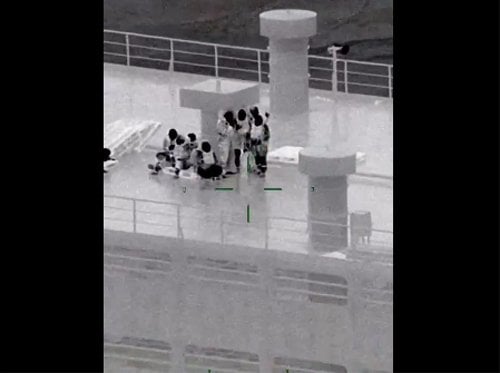
Crew huddled on the deck but, due to the weather, could not be airlifted off the disabled ship
As the stern of the vessel was nearing the rocky coastline, the captain ordered an evacuation. Pictures show the crew assembled on the top deck, and an Italian Air Force helicopter attempted to remove the crew. However, due to high winds, the evacuation could not proceed.
A second, larger tugboat reached the livestock carrier and was able to position the ship into the weather and stop it from drifting. With the anchors, they were able to hold the vessel overnight in position.
At daylight, the rescue mission resumed, and the vessel is now positioned in the Golfo di Palmas on the southwest coast of Sardinia.
Italy’s Deputy Minister of Infrastructure and Transport, Edward Rixi, congratulated the Italian forces in coordination with the Port Authority for their efforts. He highlighted how a breakdown on the open sea can turn into an emergency in a matter of minutes.
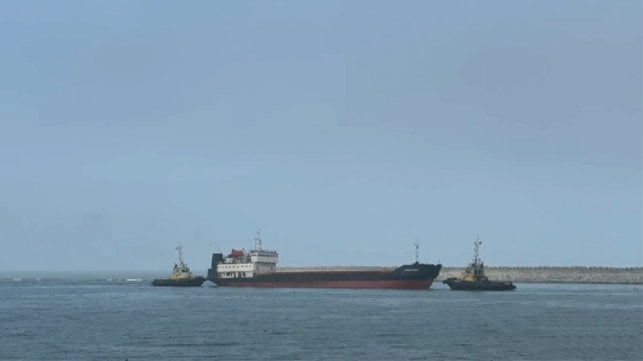
Russians Rescue Iranian Cargo Ship After Distress Call in the Caspian Sea
Iranian-flagged cargo ship was brought into port by the Russian tugboats (Port of Makhachkala)
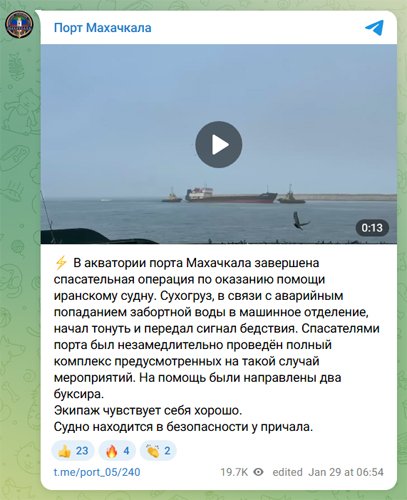
Officials in the Caspian Sea port of Makhachkala are reporting that the crew of an Iranian-flagged cargo ship has been saved after the vessel issued a distress call. It was the second incident this month involving an Iranian vessel in the Caspian Sea.
The Caspian Shiva (3,344 dwt) was built in 1986 and, since July 2024, has been sailing under the Iranian flag. It started its life in the Soviet era as a Russian-flagged ship and later sailed under flags including Togo, Mongolia, Moldova, and Belize. The ship is 116 meters (380 feet) in length. Its last recorded inspection was in Georgia in 2023, and that inspection found 10 deficiencies.
Media reports are saying the vessel sustained an unknown hull breach after sailing from Amirabad, Iran. It was reported to be taking on water in the engine room and the hold. Further, the media is saying the ship later ran aground. Conditions in the Caspian were reported with waves at two meters (6.5 feet).
Officials at the port of Makhachkala on the western shore of the Caspian Sea reported that two tugs from Rosmorport had been dispatched to aid the vessel. They escorted the ship into port.
The vessel was brought into Makhachkala with the reports saying the 10 crewmembers aboard were uninjured. The port says the ship is now safely at a berth.
Ukrainian outlets reported the incident while noting that its forces have become more active in targeting assets in the Caspian. However, Ukraine has not taken credit for this incident or the prior one, which took place two weeks ago.
The Iranian freighter Rona (3,262 dwt) was pictured sinking in the Caspian on January 14. Turkmen responders reached the ship and rescued the 14 crewmembers. The ship is thought to have sunk.
Both vessels were operating on a regular route between Iran and Russia. The Ukrainian online media outlet Crimean Wind calls the Caspian Sea “the main route for maritime supplies of weapons and sanctioned goods from Iran to Russia.”
Tugs Rush to Aid Cargo Ship That Touched Bottom and Lost Rudder
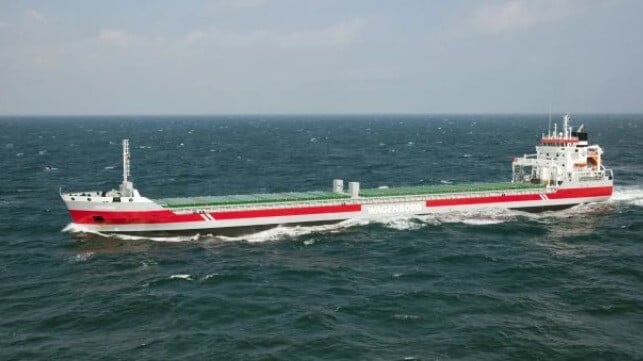
Port officials blamed a failed dredging for putting sand in the ship channel and causing the problems (Royal Wagenborg file photo)
A drama is playing out along the central Portuguese coast as a cargo ship reportedly lost its rudder as it departed and is now awaiting assistance off the coast. Portuguese officials ordered the port closed and warned of the dangers while also citing a failed dredging effort in the entrance channel to the Figueira da Foz port.
According to the briefing, the Dutch-flagged cargo ship Eikborg (3,592 dwt) operated by Royal Wagenborg touched bottom as it was departing the port on January 26. The ship got only a few miles off the coast before reporting it had lost the function of its rudder. The general cargo ship is 89 meters (292 feet) in length and was carrying a cargo of pulp to Germany.
Paulo Mariano of the port authority told reporters, “It is trying to maintain some course by sailing backwards,” writes the Lusa news agency. He said it was “counterproductive,” but the only solution as the captain tries to control the ship and position against rough seas.
Adding to the concern is bad weather off the coast. The reports Monday afternoon placed the ship about four nautical miles offshore and southwest of the entrance to the port.
The captain is holding position waiting for a tug which has been dispatched from Leixoes. They expect the Eikborg will be towed to either Lisbon or Setubal.
Port officials, however, are emphasizing that they believe the incident was caused by a failed dredging job at the port’s entrance instead of the heavy weather. They said that €28 million was spent to transfer three million cubic meters of sand, and since the work was completed, there have been problems with the sandbar.
The port was ordered closed to all large vessel traffic as of 2:00 p.m. local time on January 26 while they investigate the incident. The pilots are reported to be refusing traffic in and out of the port due to the problem with the sand. Port officials said it was the second incident this month and that some ships had already begun to divert to other ports.
PIRACY AND CONSPIRACY ON THE HIGH SEAS
Captain of Seized Tanker Rushed Out of UK by USCG Ahead of Court Hearing
Scottish authorities had not acted to protect the crew and let the U.S. remove the crew without observing the laws.
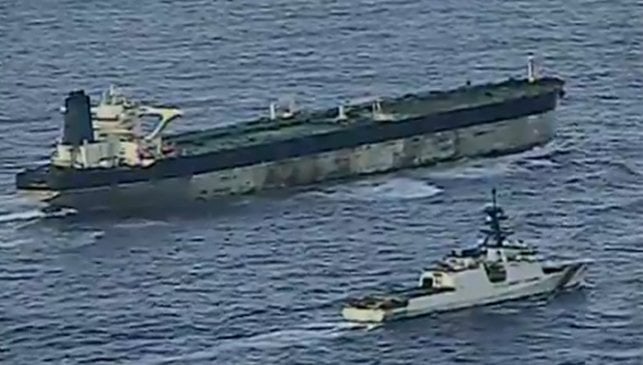
USCG cutter alongside the tanker during the pursuit across the Atlantic (USCG)
Officials in Scotland are confirming that they were advised that the U.S. Coast Guard removed the captain and first officer of the seized tanker Marinera (Bella 1) from Scotland overnight as court hearings were underway for an injunction to prevent their extradition. It is the latest step in the weeks-long effort pursuing the tanker across the Atlantic on allegations it was violating sanctions against the export of Venezuelan oil.
The tanker has been held in Scotland since early January. It remains at anchor in Moray Firth, a sheltered area near the village of Burghead, Scotland. The BBC reports the crew had been removed from the ship and placed in a hotel held by UK immigration officials.
The United States had requested mutual legal assistance as the first step toward extradition. However, a human rights lawyer reporting he was representing the wife of the vessel’s captain, Avtandil Kalandadze, filed with the Scottish courts on Monday for an injunction to prevent the crew and tanker from leaving Scotland.
U.S. authorities told the court that the departure was imminent, but the court went ahead issuing an order late on Monday restricting Scottish and UK officials from aiding in the removal of the crew. At 3:04 a.m., the U.S. Department of Justice emailed Scotland’s prosecution service, reporting the captain and the first officer of the tanker had been removed from Scotland. Reports are that they were placed aboard the U.S. Coast Guard cutter Munro for removal from UK territory. Separately, the U.S. withdrew its request for mutual legal assistance.
The court ended the hearing scheduled for Tuesday and withdrew the order preventing Scottish and British officials from aiding with the removal of the crew. According to the reports, the U.S. has said it plans to send five of the crewmembers to the U.S., likely for prosecution on the charges of sanctions violations.
The other crewmembers from the tanker are reportedly being processed for return to their home countries. Russian officials have complained that the U.S. promised to release the Russian crewmembers but had not followed through on the release.
The lawyer for the wife of the captain asserted that the U.S. has “abducted” the crewmembers, raising “serious constitutional and legal concerns.” They had earlier complained that Scottish authorities had not acted to protect the crew and let the U.S. remove the crew without observing the laws.
Scotland’s First MinisterJohn Swinney had said he was “deeply concerned” over the seizure of the tanker and its unannounced arrival in Scottish waters. He said he learned the tanker was in Moray Firth from media reports. He said he expected to have been told in advance.
The U.S. had said the vessel had been brought into Scotland to be resupplied. The UK’s Minister of Defence confirmed that it had aided in the seizure of the vessel. Support came from RFA Tidewater and RAF surveillance aircraft.
DEFYING TRUMP
Dominion Energy and Vineyard Wind Reach Milestones as Work Resumes
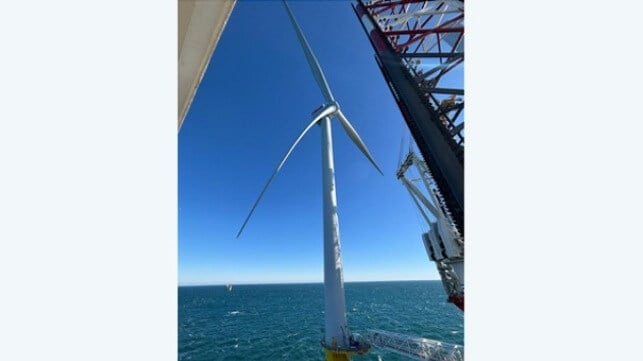
Coastal Virginia Offshore Wind's first turbine is is in place (Dominion Energy)
Within days of resuming work at Dominion Energy’s Coastal Virginia Offshore Wind project and Avangrid’s Vineyard Wind 1, both projects have marked key milestones. The projects argued they were at critical stages of construction in court and received preliminary injunctions to prevent the Trump administration from enforcing a stop-work order.
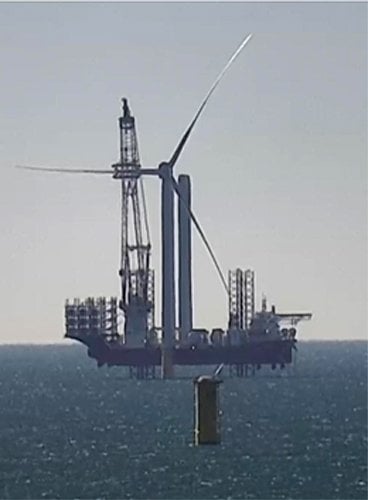
Dominion Energy provided a detailed update on the status of its project, reporting it has reached 71 percent completion and, critically, the first wind turbine generation was installed in January. The company’s massive wind turbine installation vessel, Charybdis (the only U.S.-flagged WTIV vessel), also began loading in December after a lengthy commissioning process and is deployed for the installations.
The presentation outlines that the project remains on track to generate its first power this quarter. Although after the delays due to the stop-work order from the Bureau of Ocean Energy Management, they have rescheduled completion to early 2027.
The company reports that 54 towers, 30 nacelles, and 26 blade sets are all on site at the Portsmouth Marine Terminal, which is being used for staging. Also, the third offshore substation has arrived at the terminal.
The month-long delay while it was fighting the stop-work order, however, was costly to the project. Dominion Energy sets the costs related to the BOEM action at $228 million. In addition, it says the Trump tariffs are estimated to add $580 million to the cost of the project. It now sets the total capital budget at $11.5 billion for the project, reporting that $9.3 billion was already invested as of the end of 2025. Dominion Energy has partnered with Stonepeak as an investor in the project, which is also sharing the costs.
Dominion Energy continues to assert that the offshore wind project “represents the fastest and most economical way to deliver nearly 3 GW to Virginia’s grid." In its filings, it emphasized the region’s critical need for power, noting it is home to key military installations, naval shipbuilding, and the U.S.’s growing AI and cyber capabilities.
Charybdis has begun the installations (Dominion Energy)
The New England-based Vineyard Wind 1 project also resumed work this week. Local media reports on Wednesday, the 62nd and final turbine tower was sent out from the staging point in New Bedford, Massachusetts. The media story said that there were 10 blade sets, 30 blades total, still at the staging site as the construction nears completion. The installation vessel working on the project is scheduled to depart by the end of March.
Coastal Virginia Offshore Wind and Vineyard Wind 1 were two of the four projects that received preliminary injunctions against the stop-work order. Equinor’s Empire Wind and Ørsted’s Revolution Wind were also permitted to resume work, while the court today scheduled a hearing on February 2 for another Ørsted project, Sunrise Wind, which is the last of the projects seeking an injunction.
Wind turbines stand in the water off Block Island, R.I., on Aug. 15, 2016.
THE CANADIAN PRESS/AP - Michael Dwyer (Michael Dwyer)
HALIFAX — A French firm and its partner in South Korea are eyeing plans to develop wind projects off Nova Scotia’s coast.
Affiliated companies Q Energy France and Hanwha Ocean said Wednesday they have jointly participated in an early phase of the Canada-Nova Scotia Offshore Energy Regulator process that could lead to formal bids for seabed licenses to develop offshore wind.
The offshore regulator says its purpose at this stage is to review and identify eligible companies that can participate in the next call for bids. Companies had a 90-day window to submit their applications, which ended Tuesday.
The early interest of companies is feeding into an ambitious plan by the provincial government to significantly expand renewable energy production.
Junu Lee, CEO of Q Energy, said in an interview Wednesday the company hopes to contribute to Canada and Nova Scotia’s transition to clean energy through large-scale and sustainable offshore wind development.
“From our understanding, this offshore project would be a very important initiative in Nova Scotia... we believe this initiative would be helpful to the economic growth in Nova Scotia as well as Canada,” Lee said, adding that this application represents an early step in the process.
Ken Ilaqua, the company’s head of offshore development, said that if they are pre-qualified through this process, an estimated timeline for commissioning an offshore wind project would be sometime in 2035.
“Because there is a need for the construction for sure... but also for the transmission line and the export of the electricity generated, that will take some time. So basically I think we are talking about 2035,” Ilaqua said.
Lee noted this was just an estimate and that the company would follow the regulator’s timeline.
Colleen Fiske, a spokesperson for Canada-Nova Scotia Offshore Energy Regulator, said the regulator will not be sharing the number of applications received through the pre-qualification process nor names of companies that applied.
“To pre-qualify, companies were required to meet certain financial, technical, and legal and social criteria,” Fiske said in an email Wednesday. Interested companies were required to submit an application that demonstrates how they can meet this criteria in order to develop a project.
In June, Premier Tim Houston said the province’s plan to license enough offshore wind farms to produce five gigawatts of electricity would be increased eightfold to 40 gigawatts, well beyond the 2.4 gigawatts Nova Scotia needs.
He called on Ottawa to help cover the costs of his new Wind West project, saying the excess electricity could be used to supply 27 per cent of Canada’s total demand.
“Nova Scotia is on the edge of a clean energy breakthrough,” the Progressive Conservative premier said in an online video, adding the province is poised to become an “energy superpower.”
Earlier this month, the offshore energy regulator announced that it will begin studying areas of the ocean that could be home to the first turbines for the Wind West project. The Canada-Nova Scotia Offshore Energy Regulator said it is looking for a company to conduct a regional assessment of the studies and preliminary work needed on four patches of ocean earmarked for potential offshore wind development.
The first phase of Wind West is estimated to cost about $60 billion and would produce about five gigawatts of power by 2030. About $40 billion would be for turbine infrastructure, with another $20 billion for new transmission lines. The province has not indicated who would pay for these costs and how they would be divided. However, the provincial government has said it expects to get a four per cent royalty on the project.
If additional phases are fully constructed, the province says the project could generate more than 62 gigawatts, about a quarter of Canada’s total energy capacity.
The areas under consideration for the first phase include Sydney Bight, northeast of Cape Breton, and three more parcels off the Eastern Shore. The project envisions connecting those parcels -- French Bank, Middle Bank and Sable Island Bank -- to the mainland along an abandoned gas pipeline corridor. Sydney Bight would come ashore separately. By Lyndsay Armstrong This report by The Canadian Press was first published Jan. 14, 2026.
Tanzania Builds Ro-Pax Vessel to Boost Regional Trade on Lake Victoria
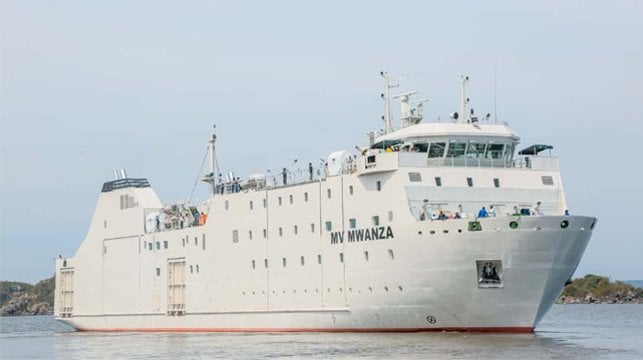
Mwanza is billed as Africa's largest freshwater vessel (Government of Tanzania)
After eight years of construction, Tanzania has finally launched an inland passenger and cargo freshwater vessel that is touted as the largest in Africa and one that was built domestically. The East African nation is hailing the launch of MV New Mwanza as a significant milestone in efforts to boost maritime transport in Lake Victoria.
Built at a cost of $51.8 million, construction of the vessel commenced in 2019, spearheaded by two South Korean companies, Gas Entec and KangNam Corporation, with local input from Tanzanian construction firm Songoro Marine Transport. Failure by the government to release funding on time resulted in significant delays in its completion despite the vessel having been floated back in 2023.
Having undergone trial voyages last year, Tanzania is now celebrating the commissioning of New Mwanza as a major achievement in efforts to strengthen regional trade, transport connectivity, and economic cooperation across the East African nations that share the Lake Victoria waters.
As Africa’s largest freshwater lake, Lake Victoria borders Tanzania, Uganda, and Kenya. Though the lake sustains millions through fishing, passenger transport, and trade, governments in the region have long cited maritime capacity and safety as major constraints in deepening economic integration.
With the launch of New Mwanza, Tanzania is upbeat that the vessel will play an important role in supporting cross-border commerce. Measuring 92.6 meters (304 feet) in length, 17 meters (56 feet) wide, and weighing 3,500 tonnes, the ship has a capacity to carry 1,200 passengers and 400 tonnes of cargo, including heavy trucks and light vehicles. Apart from significantly expanding capacity for both commercial logistics and passenger transport, the vessel is expected to reduce the travel time connecting Kenya’s Kisumu port and the Ugandan ports of Port Bell and Jinja, owing to its speed of 16 knots.
Besides trade, the vessel is also expected to boost tourism and improve safety on one of Africa’s busiest inland waterways, thus reinforcing Lake Victoria’s role as a key economic corridor for East Africa.
“Lake Victoria connects our economies. This vessel should support trade, promote economic diplomacy, and strengthen cooperation with our neighbors,” said Mwigulu Nchemba, Tanzania's Prime Minister. He added that the construction of the vessel in the country is a symbol of Tanzania’s industrial and technical capability.
Tanzania contends that the skills gained during the construction of New Mwanza will be applied to other shipbuilding projects, including vessels earmarked to serve on Lake Tanganyika linking the country with the Democratic Republic of Congo, Burundi, and Zambia.
BIG DADDY WARBUCKS HEGEMONY
Survival of Chagos Sovereignty Deal Hinges on U.S. Review
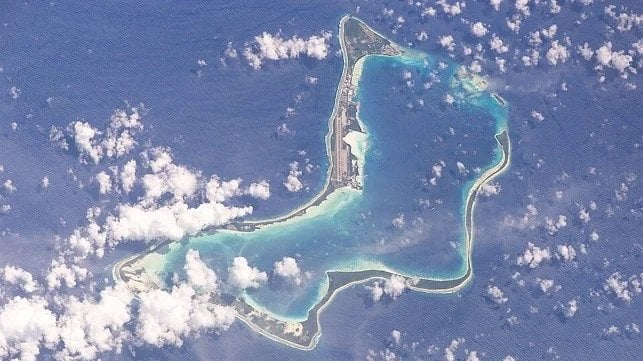
The survival of the deal the UK has agreed with the government of Mauritius, involving the UK’s surrender of sovereignty and a lease-back arrangement to provide for continued American use of the Naval Support facility on Diego Garcia, now appears to depend on a U.S. review of its initial support for the arrangement.
The progress of the enabling legislation through the British Houses of Parliament encountered stormy waters on January 20, when the House of Lords passed a number of amendments to the bill, the most difficult of which was that the Chagos islanders should be consulted on whether or not they wished to lose British citizenship and be transferred to Mauritius instead. These amendments were rejected by the UK Government, but the bill still has to return to the House of Lords to be voted on.
At the same time, the UK Government acknowledged that the Chagos bill cannot make progress until the United States has given formal approval for the necessary amendments to be made to the 1965 Treaty, which guarantees U.S. use of the base. Such approval has not been obtained as yet, which is a problem since President Trump is now describing the handover to Mauritius as an act of “GREAT STUPIDITY.” In the meantime, the UK government has withdrawn the Chagos bill from further parliamentary scrutiny, and opposition is growing to the handover, even from the government’s own members of parliament.
From a U.S. perspective, there are three major difficulties with the deal as currently tabled.
Once sovereignty of the Chagos Archipelago is transferred to Mauritius, there is no mechanism for recovering sovereignty and rights should Mauritius renege on aspects of the agreement at some time in the future. As the UK discovered in Hong Kong, even when safeguards are codified in an international treaty, the sovereign power can, in effect, do what it wants. In this regard, Mauritius’ close relationship with China poses a real threat, so there is a substantive risk that Mauritius could grant another nation basing rights on one of the other islands of the Archipelago, rendering the utility of the base on Diego Garcia much reduced.
Secondly, even without bad faith on the part of the Mauritian government, it is unlikely to be able to effectively police the 58 islands and 250,000 square miles of territorial waters making up the Chagos Archipelago, when it has no navy and lies more than 1,300 miles from Mauritius. While the British Indian Ocean Territory remains in being, this is a responsibility shouldered effectively by British vessels and Royal Marines.
Thirdly, Mauritian government sources have said that once sovereignty is transferred, they will impose the 1996 Pelindaba Treaty on Diego Garcia, which bans nuclear weapons from the African continent.
The UK government has based its negotiations with Mauritius on the need to follow international law, even though international bodies have only issued advice rather than any ruling on the matter. But conversely, to not obtain U.S. consent for the switch in sovereignty would be a material breach of international law, which the UK government has been so keen to observe. Even if U.S. consent is forthcoming, however, opposition to the transfer of sovereignty is now so strong domestically that the legislation is unlikely to progress. Moreover, should the present agreement with Mauritius collapse, there are alternative arrangements that could well satisfy all parties.
In the meantime, observers are keeping a careful watch on the apron of the airfield on Diego Garcia itself, to see if strike aircraft are arriving from the United States, as they did during the run-up to American attacks on Iran last year. At present, there are no additional aircraft to be seen, albeit U.S. aircraft have arrived at other U.S. bases in the Middle East. The USS Abraham Lincoln (CVN-72) and its carrier support group have now been reinforced by U.S. Central Command and may have need of the facilities on Diego Garcia should their deployment to the region be prolonged.
A recent video showing a Quran that survived the devastating fire at Karachi’s Gul Plaza has reignited a centuries-old conversation. Throughout history, accounts of Bibles, Qurans or Buddhist sutras emerging unscathed from catastrophic floods and fires have been celebrated as Divine interventions. While these events offer profound spiritual solace, a closer look reveals a fascinating intersection of material physics and psychological bias.
From a physical standpoint, Dougal Drysdale, Professor Emeritus at the University of Edinburgh, suggests that a hardbound book’s survival is often due to the ‘Closed Book Effect.’ When shut, a book functions as a dense, oxygen-starved block of cellulose. Because fire requires a steady flow of oxygen to consume fuel, the tightly packed pages resist ignition by preventing airflow from reaching the interior.
In the event of a flood, the surface tension of water against tightly pressed pages creates a natural barrier. This prevents deep seepage for a significant period, often leaving the heart of the book perfectly dry.
American psychologist Thomas Gilovich explains that when a sacred text survives a disaster, it often becomes more than just a book. It is elevated to a sacred relic. This transformation, according to Gilovich, can significantly redefine a community’s cultural path. In the aftermath of the 2011 Joplin tornado in Missouri, US, survivors and news outlets frequently highlighted the ‘miraculous’ discovery of intact Bibles among the rubble of flattened homes.
The survival of holy texts in the aftermath of natural catastrophes is often termed ‘Divine protection’, revealing the cultural and spiritual narratives people love to attach to such instances
While hardbound dictionaries and cookbooks likely survived in the same ruins due to their similar physical construction, these secular items were ignored by the media as mere debris. The surviving Bibles were immediately elevated from functional reading material to sacred relics, often being framed and displayed as symbols of Divine protection.
By focusing on these specific books, the media triggered a cognitive bias that led people to view the event through a supernatural lens rather than recognising the simple physical durability of bound paper.
British scholar Susan Whitfield, in her 2004 work The Silk Road: Trade, Travel, War and Faith, details the discovery of the Mogao Caves in China. In that instance, the sealing of the Buddhist text the Diamond Sutra (868 CE) within a dry, walled-up chamber created a “natural vault” that protected the world’s oldest-dated printed book from the degrading effects of humidity and oxygen for nearly a millennium. The perception of such objects often shifts from the literary to the ‘miraculous’.
During World War I, pocket Bibles carried by soldiers occasionally stopped shrapnel due to the high density of their compressed paper. This led many soldiers to treat the Bibles as protective talismans.
The Codex Amiatinus, frequently referred to as the ‘Grandfather’ of Latin Bibles, has survived for over 1,300 years due to its immense physical durability. According to Drysdale, this enormous volume, created around 700 CE in Northumbria, England, weighs over 34 kilogrammes and was crafted from the skins of more than 500 calves.
The use of high-quality parchment makes the Bible significantly more resistant to fire and decay, as organic animal skins lack the highly flammable, oxygen-trapping fibres found in wood-pulp paper. This Bible remained virtually untouched for a millennium, preserved by the stable environment of an Italian abbey that served as a ‘natural vault.’
In West Africa, the Desert Manuscripts of Timbuktu offer a compelling example of texts surviving environmental factors, a story often framed as miraculous. When Islamist militants set fire to the Ahmed Baba Institute in 2013, there was widespread global concern over the potential loss of thousands of ancient Islamic manuscripts. However, according to the researcher Mauro Nobili, the extreme aridity of the Sahara desert was critical in aiding their preservation for centuries.
The persistently low humidity prevented mould growth and kept the delicate ink stable, allowing for their long-term survival, which many viewed as a modern miracle. However, the more vulnerable manuscripts were secretly shifted to safer locations before the militants set fire to the Ahmed Baba Institute.
During the Viking raid on Lindisfarne — a tidal island off the northeast coast of England — in 793 CE, a legend emerged concerning a sacred book, Lindisfarne Gospels, which was said to have been dropped into the sea by fleeing priests. Three days later, it washed up perfectly dry. While this specific account is often considered apocryphal, the physical survival of such ancient texts is frequently due to their durable leather and metal bindings, which act as a protective shell for the internal vellum.
Gilovich would point to stories such as this ‘dry’ recovery of a Bible as prime examples of how the media and oral tradition prioritise miraculous narratives over the mundane reality of material science, thereby reinforcing spiritual beliefs.
According to the prominent professor of psychological sciences J. Park, communities frequently transform these survival stories into powerful symbols of “Divine protection” as a means of processing the profound trauma of disasters. This phenomenon ultimately highlights a dynamic intersection, where material science meets deep human sentiment.
While the inherent fire-resistant properties of vellum offer logical, scientific explanations for the physical survival of many books, the human psychological element remains paramount. The inherent human need to find order, meaning and hope within chaos is what elevates these surviving sacred objects from mere material items to vital spiritual anchors for a community’s recovery and continuity.
The endurance of these texts represents a profound intersection between material science and human psychology. It is not merely the density of vellum, the chemical stability of ancient inks or the aridity of a desert that ensures survival. Rather, it is the way these physical realities interact with our inherent drive to find order in the wake of destruction.
Gilovich’s research posits that when a community witnesses the survival of a sacred text, they are not simply observing a quirk of physics. They are engaging in what Park describes as “meaning-making”, using the survived sacred object to process trauma and reclaim a sense of ‘Divine protection.’ Whether through the preservation of the Diamond Sutra in caves, or a Bible or a Quran found amidst the ruins of a modern disaster, these serve as a bridge between the tangible and the transcendent. Their survival is a testament to the fact that, while fire and time may consume the material, the cultural and spiritual narratives we attach to them remain indestructible.
Yet, it is equally important that we recognise the physical realities of their endurance, acknowledging that the science of material durability does not diminish the ‘miracle’, but rather provides a rational foundation for understanding how the written word survives the very elements meant to destroy it.
Published in Dawn, EOS, February 1st, 2026
Nadeem F. Paracha is a researcher and senior columnist for Dawn Newspaper and Dawn.com. He is also the author of ten books on the social and political history of Pakistan.
Construction work on a few commercial buildings is underway on the G-8/G-9 section of the Blue Area. — Photo by Tanveer Shahzad/File
ISLAMABAD: Capital Development Authority (CDA) on Tuesday revealed majority of buildings in Islamabad have not obtained fire safety certificates.
In the wake of the Karachi Gul Plaza inferno, the CDA recently decided to get survey of buildings of Islamabad to ensure fire and safety system.
“CDA has completed the survey regarding Fire Safety & Hazard Control in the Federal Capital, Islamabad. A total of 6,500 buildings were surveyed in this regard.
During the survey, it was observed that most buildings had not obtained approval for their fire safety plans, and the completion/fire safety certificates for these buildings had also not been issued. During the survey, 300 government buildings were also inspected, read an official handout issued by CDA.
This information was shared in a meeting held here at CDA headquarters with Chairman CDA Mohammad Ali Randhawa in the chair and attended by members administration and planning, DC Islamabad and other officers concerned.
“Federal Minister for Interior Mohsin Naqvi had taken notice and directed the CDA to conduct a survey of all buildings in Islamabad regarding Fire Safety and Hazard Control at the earliest. In light of the direction all relevant departments, including the Capital Emergency Services and the Building and Housing Control Wing were directed to complete the survey immediately,” the official statement said.
The meeting that building owners and occupants would be directed to submit their Fire Safety and Hazard Control Certificates to the relevant offices of CDA’s Building & Housing Control Wing within fifteen days. Otherwise, legal action will be initiated against those not complying with the direction under the CDA Ordinance and the Islamabad Capital Territory Building Control Regulations 2020 (Amended 2023).
“This will entail fines and other enforcement measures. In this context, if an accident occurs in a building due to non-submission of the required certificates, the responsibility will lie with the concerned owners and the building management,” read the statement.
It said that building owners and their management are further requested to immediately ensure the safety status of their buildings and submit the necessary documents on time so that public safety standards can be maintained in the Capital.
The meeting decided that all building owners and occupants will have their buildings inspected on an annual basis and submit certificates regarding fire safety measures in accordance with the Pakistan Engineering Council codes to the CDA. Furthermore, regular fire safety drills will also be arranged in all buildings.
Published in Dawn, February 1st, 2026
Kashif Ali Abbasi is an Islamabad-based reporter for Dawn with 17 years of experience in journalism. He covers sports, the education sector, and civic issues. He can be found on X at @AbbasiKashif833.
Fire accidents in Karachi are not new, yet we treat each incident as an isolated tragedy rather than a symptom of systemic infrastructure failure. The Gul Plaza fire, which led to a structural collapse, tragic loss of life, and huge financial losses to the economic system, is just another accident to join the list of disasters such as Bolton Market, Cooperative Market, Timber Market, etc, and many more.
The poor emergency response, lack of institutional capacity, non-existent safety measures for fire workers, and, most importantly, the absence of enforced fire safety standards in buildings were brought to the attention of the entire city, as Gul Plaza was a market visited by all segments of society.
The heart of this problem lies in the dangerous balance between building use and building capacity. Buildings that were designed decades ago for limited commercial activity are now used as high-traffic shopping malls with shops, warehouses, eateries, and vehicular parking. The electrical systems are overloaded, escape routes are blocked, staircases are narrowed by encroachment, and firefighting is nearly impossible in these buildings due to congestion.
Cities in developing nations face similar problems, such as aging infrastructure, informality in development, and rapid urbanisation, but have learned from their mistakes and demonstrated that fire safety can be improved on an ad hoc basis as well. For example, in Brazil, nightclub and high-rise fires prompted the government to implement regulatory reforms to strengthen evacuation procedures and fire safety audits, contributing to safer buildings.
Real resilience will only come in the form of active preventive measures to ensure the safety of our homes and workplaces
Similarly, Argentina’s adoption of international fire codes aligned with local testing standards for alarms, exits, and suppression systems is another example from the developing world. In Singapore, the country’s strict fire safety regime is ensured through routine inspections, certifications, and public accountability. This has led to a measurable reduction in fire incidents across residential and industrial zones.
Moreover, Indonesia has a national-provincial partnership in this regard, which has resulted in a major decline in commercial fires. These instances clearly indicate that progress does not depend on wealth but on good governance, prioritisation, and strict enforcement.
By contrast, Karachi continues to host a varied stock of unsafe buildings that are still occupied despite lacking any fire safety provisions. This is very clear in the congested markets, where buildings serve as pseudo-malls for the middle class. Areas such as Saddar, Tariq Road, Hyderi market, Liaquatabad, and Karimabad are visited by thousands of shoppers daily, in buildings and streets not designed for such heavy usage, not to mention the lack of accessibility for a fire truck.
Narrow stairwells, sealed shopfronts, grilled openings, illegal mezzanines, and locked exits are common. These markets are now used like high-end modern malls but lack modern safety compliance regimes or systems built into the design of new malls, and a small electric spark can escalate into a mass-casualty event.
While the fire safety infrastructure on the city level is the state’s responsibility, occupants need to look out for themselves. We hire security guards for our homes, shops, and streets, despite there being police stations and chowkis in every area. Unfortunately, this is just another aspect of urban life that we need to control on our own.
Karachi’s citizens are opening their hearts and wallets for the affectees of the recent tragedy, which is being labelled as a display of resilience, but real resilience will only come in the form of active preventive measures to ensure the safety of our homes and workplaces.
Warning signs are very clear; too many bunched-up exposed wiring, illegal connections or kundas, absence of alarms or smoke detectors, poor ventilation, fixed grilles in openings, unsafe storage for flammable materials, lack of fire-extinguishers, blocked exits with illegal commercial encroachment, and poor ventilation are very common sightings in a regular market for Karachi’s middle class.
Retrofitting the buildings for fire safety does not always involve structural intervention. Existing buildings must also be encouraged to add external or internal fire-exit staircases as retrofitted features that exit on the pavement, and these escape routes should be foldable or well-integrated in the street design, not treated as violations or as an afterthought, but should serve the building and the city.
Along with fire-resistant doors on staircases, emergency lighting, and clear signage, these measures can significantly improve human safety in the event of a fire. In congested markets and apartment blocks, corridors should be cleared, spaces should be compartmentalised to slow fire spread, existing stairwells should be enclosed, and fire drills should be conducted regularly in markets, schools, and even large apartment complexes.
Market associations need to enforce this as a mandatory activity, as they can differentiate between safe escape and fatal entrapment. Security measures to deter theft often create fatal bottlenecks, fixed grilles on windows, staircase openings, and side entrances block escape routes and trap occupants inside. While grilles are necessary to prevent theft and burglary, they should have quick-release mechanisms and collapsible systems that preserve life safety while ensuring security.
While individual residents and shopkeepers lack resources for meaningful upgrades, pooled private investment can support shared alarm systems, professional audits, and basic firefighting infrastructure. However, this ‘apni madad aap’ cannot substitute the role of the government, which continues to give excuses.
The writer is an architect and an urban planner currently leading her own practise, “Beyond Facades”.
Published in Dawn, The Business and Finance Weekly, January 25th, 2026