Showing posts sorted by relevance for query ALBERTA 51ST STATE. Sort by date Show all posts

Wednesday, June 18, 2025

G7 protests hit Calgary with leaders far away


By AFP
June 15, 2025


A protester holds a sign during a demonstration in front of Calgary City Hall on June 15, 2025, as world leaders converge in Canada for the G7 Summit 
- Copyright GETTY IMAGES NORTH AMERICA/AFP JUSTIN SULLIVAN


Alex PIGMAN

Hundreds of protesters supporting various causes assembled peacefully in downtown Calgary on Sunday as the Group of Seven summit began a long drive away in the mountain resort of Kananaskis.

In recent years, G7 protests have become tightly controlled affairs. Demonstrators are confined to designated spaces, often more than 100 kilometers (62 miles) from where world leaders meet.

The 2025 edition is no different, with protesters voicing their anger in Alberta’s largest city.

Canadian officials promised a livestream of their messages to the isolated mountain town of Kananaskis where leaders of the seven industrialized nations are meeting.

The crisis in Gaza was a dominant theme for the crowd of about 500 gathered in front of Calgary’s main municipal building — one of several areas in the city designated as protest zones.

Police said no protesters were present at the other two local demonstration zones, including one near the Calgary airport where the leaders began arriving.

“I’m here because I’m an Indigenous person,” said Emrys Peacock, who came by bus from British Columbia’s Okanagan region.

“As an Indigenous person, I can’t ignore a fellow Indigenous nation being bombed, murdered and starved at the hands of an occupation, (something) my people have been through since colonization,” she added.

Dozens of other protesters also railed against Israel’s war campaign in Gaza, which was triggered by the October 7, 2023 attack on Israel by Hamas.

Calgary student Terrence, who declined to give his last name, seemed surprised by the calm atmosphere.

“I’m a little underwhelmed. I thought there would be a lot more confrontation because last year’s Gaza protest was quite tense,” he said.


– Not a ’51st state’ –

Unsurprisingly, hostility toward US President Donald Trump emerged as another major theme, particularly regarding his suggestions that Canada should become America’s 51st state.

Calgary native Diane Houston carried a sign calling the US leader an “abomination” and a “sociopath.” She said she wanted “to make sure he’s under no illusion that Canadians want to be a 51st state.”

Tracy Osterland from nearby Canmore echoed this sentiment: “Trump is a wannabe dictator, and he definitely needs to be stopped. Enough of the 51st state stuff already. We’re not at all interested.”

Capturing the potpourri of themes at the protest, her double-sided poster had biting criticism of Trump on one side and a colorful welcome sign for Ukrainian President Volodymyr Zelensky on the other.

“I’m really hoping that they can do something for him,” she said of the Ukrainian leader, who will be attending the G7 summit along with other invitees.

Another attendee beyond the seven leaders of the industrialized countries is Indian Prime Minister Narendra Modi, who launched strikes on Pakistan last month after an attack on civilians in divided Kashmir.

The G7 leaders “are the world’s peacekeepers,” said Asif Nazir of the Jammu Kashmir National Awami Party.

“We give our message to Modi and all the G7 summit participants to come forward and solve this issue, as per the Kashmiris’ wishes,” he said.

Environmental concerns also featured prominently, with activists highlighting Canada’s vast freshwater resources.

Ila Dame from the group Protect Alberta’s Rockies and Headwaters suggested Trump’s interest in Canadian annexation stems from coveting resources.

“We have 20 percent of the world’s fresh water. Trump wants our water and our resources. It has nothing to do with wanting our people,” she said.

Despite being relegated far from the actual summit, most protesters took the strict rules surrounding the G7 in stride.

“I do think it would be more effective if we were closer, if we could actually get the attention of the people who attend the G7,” Peacock said.

“However, we will have an effect anywhere,” she added, not regretting her long ride to Calgary.

Tuesday, January 07, 2025

Trudeau says 'not a snowball's chance in hell' Canada joins U.S.


CBC
Tue, January 7, 2025 

U.S. president-elect Donald Trump on Tuesday continued to threaten significant tariffs and said he would be willing to use 'economic,' rather than military force, to join Canada and the United States. (Carlos Barria/Reuters - image credit)

Prime Minister Justin Trudeau on Tuesday dismissed U.S. president-elect Donald Trump's willingness to use "economic force" to absorb Canada into the United States by reiterating what his Canadian government has said for some time: merging countries is not in the realm of possibility.

"There isn't a snowball's chance in hell that Canada would become part of the United States," Trudeau wrote on X.

"Workers and communities in both our countries benefit from being each other's biggest trading and security partner."

At a news conference earlier Tuesday, a bombastic Trump said he would consider using "economic force" to join Canada and the United States together.

"That would really be something," he said in Palm Beach, Fla.

"You get rid of the artificially drawn line and you take a look at what that looks like and it would also be much better national security. Don't forget: We basically protect Canada."

WATCH | 'We don't need anything they have,' Trump says of Canada:

When pressed on the issue, Trump later acknowledged he has no "right" to absorb the country into his own. Criticizing American spending on Canadian goods, he said the United States is still not obligated to support its closest neighbour economically.

Canada and the U.S. have a trillion-dollar trade relationship.

In his answer, Trump pointed to several key imports he felt Americans didn't need: including the automotive, lumber and dairy sectors. The United States imported $614.3 billion Cdn worth of goods from Canada in 2022, according to the Office of the United States Trade Representative, and is Canada's best customer when it comes to oil and petroleum.

In only his second news conference since his election victory in November, Trump reiterated his intent to impose "substantial" tariffs on Canada and Mexico when he returns to the White House in less than two weeks.

Trump previously threatened to impose a 25 per cent tariff on all imports from the two neighbouring nations unless they do more to address border security.

He did not campaign on a plan to annex Canada but has spoken repeatedly in favour about Canada becoming "the 51st state."

Prime Minister Justin Trudeau makes an announcement outside Rideau Cottage in Ottawa on Monday, Jan.6, 2025.

Prime Minister Justin Trudeau announces his resignation outside Rideau Cottage in Ottawa on Monday. He will step down once the Liberals choose a new party leader. (Adrian Wyld/The Canadian Press)

Gordon Giffin, a former U.S. ambassador to Canada, said Trump's blustering about absorbing his northern neighbour is only a negotiating strategy to add urgency to his long-standing economic grievances.

"Threatening Canada? I guess it sounded like that, but in the final analysis I think it's all about economics and I think he's had economic frustrations with respect to the North American economic experience since his first term," Giffin told CBC News Network on Tuesday.

"Whether he means some 'acquisition' of Canada by the United States by any means? I actually don't believe that."

In his own statement, Conservative Leader Pierre Poilievre said "Canada will never be the 51st state. Period."

On X, NDP Leader Jagmeet Singh made his own threat against Trump.

"No Canadian wants to join you. We are proud Canadians. Proud of the way we take care of each other and defend our nation. Your attacks will hurt jobs on both sides of the border," he wrote.

"You come for Canadians' jobs, Americans will pay a price."

Trump also eyeing Panama Canal, Greenland

Though he said he was not considering military force on Canada, he remarkably did not rule out that option to have the U.S. take back control of the Panama Canal and acquire the Danish territory of Greenland.

"No, I can't assure you on either of those two. But I can say this: we need them for economic security," he said of the latter.

He said he would "tariff Denmark at a very high level" if it does not give Greenland to the U.S.

Mexican, Danish and Panamanian authorities did not immediately comment. Panamanian President José Raúl Mulino has previously rejected the notion of turning the canal back to the U.S., which had owned it before handing over control to Panama in 1999.

Not a 'snowball's chance in hell' of Canada becoming 51st state: Trudeau

Kelly Geraldine Malone
Tue, January 7, 2025 
CANADIAN PRESS


WASHINGTON — Prime Minister Justin Trudeau clapped back Tuesday at Donald Trump's escalating claims that Canada would be better off if it became the 51st state, and has called for an in-person meeting with premiers in Ottawa next week to address this country's relationship with the United States.

Trudeau and the premiers have met virtually twice since November to negotiate a response to Trump's threat to slap Canada and Mexico with 25 per cent import tariffs the day he takes office. That threat is now imminent, with inauguration day less than two weeks away and Trump insisting Tuesday in a news conference that he will follow through with the tariffs.

The Prime Minister's Office said late Tuesday Trudeau and premiers will meet in person Wednesday in Ottawa, days before that would happen.

Trump on Tuesday also repeated his insistence that Canada should join the U.S. While he suggested he would not rule out the use of military force to seize control of the Panama Canal and Greenland, saying they were vital to American security, he did not go that far with Canada. Instead he said he would rely on "economic force" to merge the two countries.

"You get rid of that artificially drawn line and you take a look at what that looks like, and it would also be much better for national security," Trump said, referring to the border between Canada and the U.S.

"And don't forget, we basically protect Canada."

Trudeau, who has until now not directly commented on Trump's repeated and escalating comments about annexing Canada, appeared to have had enough.

"There isn’t a snowball’s chance in hell that Canada would become part of the United States," Trudeau said in a statement posted to social media.

"Workers and communities in both our countries benefit from being each other’s biggest trading and security partners."

Trump first quipped about Canada becoming the 51st state in November, when the prime minister and Finance Minister Dominic LeBlanc dined with the president-elect at Mar-a-Lago in Florida to discuss his tariff threats.

LeBlanc has repeatedly dismissed the idea as "a joke" but the government is not laughing now.

Foreign Affairs Minister Mélanie Joly posted on X that his comments "show a complete lack of understanding of what makes Canada a strong country."

The Liberal Party posted a map of North America on X labelling the United States and Canada as "Not the United States," with the caption: "For anyone who may be confused."

NDP Leader Jagmeet Singh told Trump to "cut the crap."

"Your attacks will hurt jobs on both sides of the border," Singh posted on X. "You come for Canadians' jobs, Americans will pay a price."

Conservative Leader Pierre Poilievre did not mention Trump by name but said "Canada will never be the 51st state. Period." In a post on X, Poilievre said Canada is an independent country and the United States' best friend.

In a wide-ranging news conference at Trump's Mar-a-Lago estate in Florida, the president-elect said he will impose "substantial" tariffs on Canada and Mexico when he returns to the White House in less than two weeks.

Trump said previously he’ll slap 25 per cent duties on imports from America’s closest neighbours unless they stop the flow of illegal drugs and migrants across the border.

Trudeau and LeBlanc made a quick trip to Florida late last year to discuss the threat. A few weeks later, LeBlanc announced a series of measures to beef up border security with a $1.3-billion package. Trump has indicated he still intends to proceed with his tariff plan.

Trump mused about that meeting with Trudeau during Tuesday's news conference and claimed repeatedly that Canada is subsidized by the U.S. He said the U.S. doesn't need Canadian imports like milk, lumber and automobiles.

The president-elect also criticized Canada’s level of military funding and said he told hockey legend Wayne Gretzky to run for prime minister.

Matthew Lebo, a specialist in U.S. politics at Western University in London, Ont., said he doesn't think Trump will infringe on Canada's sovereignty by somehow forcing the two countries to merge. But the president-elect's comments show an unwillingness to understand the bilateral relationship, he added.

"Canada should be incredibly nervous that our economic health is in the hands of somebody who doesn't understand how things work," he said.

Canada is in a particularly difficult diplomatic situation after Trudeau announced Monday that he will resign his post as soon as a new Liberal leader is chosen, Lebo said.

The date for a Liberal leadership race hasn't been set. Trudeau also prorogued Parliament until March 24 and a federal election will take place later this year.

Earlier Tuesday, Conservative House leader Andrew Scheer said Trudeau had been "weak" in dealing with subsequent U.S. administrations. Singh challenged anyone running for prime minister to commit to retaliatory tariffs if Trump acts on his promises.

Ontario Premier Doug Ford has warned he will retaliate if Trump follows through, suggesting the province could cut energy exports to the U.S. Alberta Premier Danielle Smith has said her province would not impose retaliatory tariffs on oil and gas. 

SHE CAN'T  ANYWAYS TARIFFS ARE FEDERAL JURISDICTION NOT PROVINCIAL.

In a statement late Tuesday afternoon, Smith did not directly address Trump's latest threatening comments but reiterated that Canada buys more products and services from the U.S. than any other country.

“Canada is a strong, independent nation with the ninth largest economy in the world, and our southern neighbour benefits from this economic strength," she said.

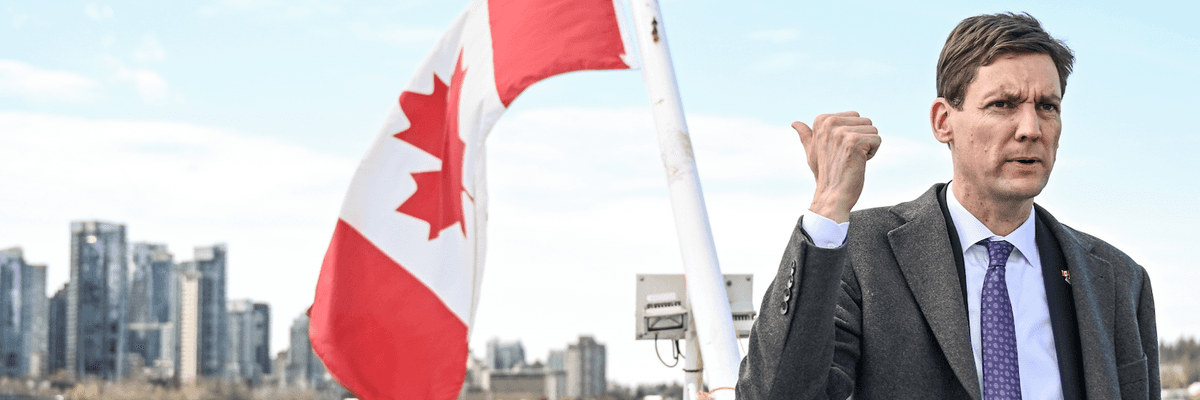
British Columbia Premier David Eby said Tuesday that the burden of confronting the tariff threat has now fallen to the premiers. He said he and his counterparts from across Canada will travel to Washington in an effort to convince the president-elect to back away from the tariff plan.

"It makes no sense to punish both Americans and Canadians to address that issue," he said. "We can do it together."

This report by The Canadian Press was first published Jan. 7, 2025.

— With files from David Baxter and Kyle Duggan in Ottawa, Brenna Owen in Vancouver and The Associated Press

Kelly Geraldine Malone, The Canadian Press


‘A snowball’s chance in hell’: Trudeau rejects Trump threat to annex Canada

Leyland Cecco in Toronto and Oliver Holmes
Tue, January 7, 2025 
THE GUARDIAN


The prime minister of Canada, Justin Trudeau, announced his resignation on Monday.Photograph: Canadian Press/Rex/Shutterstock


Justin Trudeau has rejected threats from Donald Trump that the US could use “economic force” to annex its closest ally, saying: “There isn’t a snowball’s chance in hell that Canada would become part of the United States.

“Workers and communities in both our countries benefit from being each other’s biggest trading and security partner,” Canada’s prime minister wrote on social media.

Trump’s musings on Tuesday came as he doubled down on threats to impose protectionist tariffs on one of the US’s biggest trading partners.

“Canada and the United States: that would be really something,” he said from Florida, but warned his incoming administration was getting frustrated over what the president-elected called “subsidies” for Canada.

“We’ve been good neighbours, but we can’t do it forever, and it’s a tremendous amount of money,” he said.

Canada’s foreign minister, Mélanie Joly, also pushed back, writing on social media that Trump’s comments showed a “complete lack of understanding of what makes Canada a strong country”. She said Canada “will never back down in the face of threats”.

The remarks are likely to further fuel political turmoil in Canada after the resignation of its prime minister, Justin Trudeau, and the suspension of parliament until late March.

The US president-elect made his comments in a meandering press conference in which he also refused to rule out using military force to retake the Panama Canal and seize Greenland, and promised to rename the Gulf of Mexico as the “Gulf of America”.

He once again mulled a union between Canada and the US, describing their shared border, established more than 230 years ago, as an “artificially drawn line”.

Related: Trump refuses to rule out using military to take Panama Canal and Greenland

Asked if he would use military force, Trump said: “No, economic force.” He repeated his baseless claim that the US “subsidizes” Canada and said the country spends too much to defend its neighbour.

Trudeau announced on Monday he would step down after nearly 10 years in power as soon as his ruling Liberal party chooses a new leader.

Hours later, Trump revived his running jibe on social media about persuading Canada to seek US statehood.

“Many people in Canada LOVE being the 51st State. The United States can no longer suffer the massive Trade Deficits and Subsidies that Canada needs to stay afloat,” the incoming president wrote.

In a stark contrast to Trump’s trolling, Joe Biden expressed his appreciation for Trudeau in a phone call late on Monday.

“Over the last decade, Prime Minister Trudeau has led with commitment, optimism, and strategic vision. The US-Canada alliance is stronger because of him. The American and Canadian people are safer because of him. And the world is better off because of him,” Biden said in a statement on Tuesday.

But the latest developments are likely to further deepen worries that a suspended parliament, a lame-duck prime minister, a Liberal leadership race and a federal election will all unfold at a time when Canada’s largest trading partner is at its most unpredictable.

Trudeau’s decision to resign has thrown open the doors to a fierce party race before a general election later this year.

Late on Monday, the former Bank of England governor Mark Carney announced that he was considering entering the race to replace Trudeau.

Related: Who could replace Justin Trudeau as leader of Canada’s Liberal party?

Carney, a climate-focused economist who became the first non-Briton to run the Bank of England, said in a statement that he would be “considering this decision closely with my family over the coming days”. A longtime and prominent member of the Liberal party, Carney said he was “encouraged” by the support of Liberal lawmakers and people “who want us to move forward with positive change and a winning economic plan”.

Speculation that Carney, who ran the Bank of Canada from 2008 to 2013 and the Bank of England from 2013 to 2020, could be seeking high office has grown over the past few months as Trudeau’s popularity plummeted amid record inflation, an acute housing crisis, high food prices and voter fatigue.

It has been more than a decade since the party last ran a federal leadership contest, with Trudeau securing a dominant win in 2013 and rebuilding the party in the years since.

The Liberal caucus will meet on Wednesday to discuss the procedure for selecting Trudeau’s replacement. The party’s constitution has a process for selecting a leader that typically takes months but there are now fewer than 80 days until parliament returns. Party brass are hopeful for a new leader by the end of January.

“It’s unfathomable to me that we can’t choose a leader of the Liberal party in a 30- to 60-day period, whereas we can choose the prime minister of Canada or the leader of the country according to the Elections Act in a 30- to 60-day period,” the immigration minister, Marc Miller, told CBC News.

Still, there are unanswered questions about who may be casting a ballot for the new leader. Trudeau’s 2013 win came after the party allowed people who had not paid for memberships to vote.

The Liberal party is in a tough position, with the opposition Conservatives expected to win a majority government under current polling. The Conservative party leader, Pierre Poilievre, has dismissed the former central banker as “Carbon Tax Carney”, a reference to a levy on consumer fuel Trudeau brought in. The Conservatives are also weighing using the tagline “Just like Justin” as an attack on the next Liberal leader in the hopes of tying any successor to the unpopularity of the prime minister.

Last week, Trudeau’s close friend and former principal secretary Gerald Butts wrote in a Substack post that allowing “a handful of apparatchiks [to] choose their prime minister” would harm the party.

“Competitions create better competitors. In politics, leadership campaigns make for better general election campaign teams. They train people, test ideas, build resilience,” he wrote.

Butts said the party’s future was at risk if it held a limited race bound by tight rules. “If Liberals arrogate that right to a few hundred people in Ottawa, I hope they’re alert to the risk that they could be selecting the party’s last leader.”

A poll by the Angus Reid Institute on Friday, before Trudeau’s announcement, found Carney was in second place among candidates likely to replace Trudeau as Liberal leader. The former deputy prime minister Chrystia Freeland, whose resignation last month increased calls for Trudeau to go, was top.

If he were to win the leadership race, Carney would be in the unusual situation of becoming prime minister without holding a seat in the House of Commons. Party leaders are not required to be members of parliament when they win, but convention requires they run for a seat as quickly as possible. It took Jagmeet Singh 16 months to become an MP after winning the leadership of the New Democratic party.

With a spring election widely expected, the new Liberal leader will only hold the post of prime minister for a handful of months before the country votes.


Tuesday, May 06, 2025

MAKE ALBERTA GREAT AGAIN

Tasha Kheiriddin: Carney has no choice but to listen to Danielle Smith

Opinion by Tasha Kheiriddin


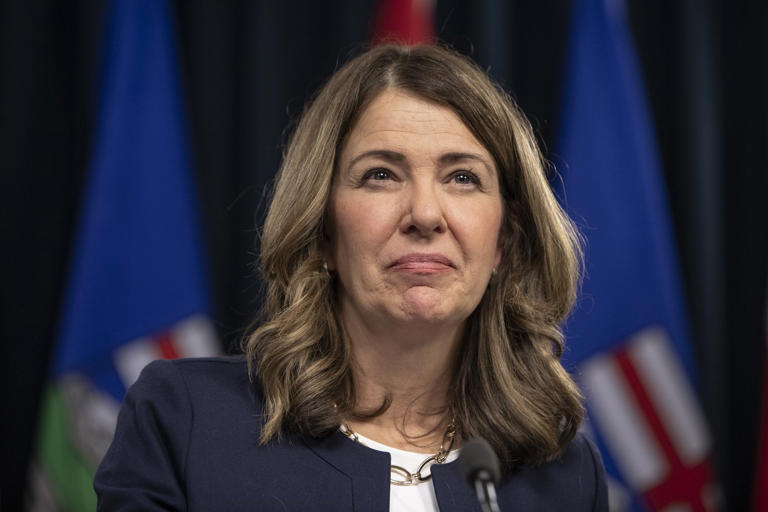
Alberta Premier Danielle Smith on Monday May 5, 2025. Gavin Young/Postmedia

On the eve of Prime Minister Mark Carney’s critical trip to Washington to meet U.S. President Donald Trump, Alberta Premier Danielle Smith stole the spotlight and turned it firmly on herself. In a twenty-minute “address to Albertans,” she aired grievances against the federal Liberal government, from carbon taxes to Justin Trudeau’s infamous “no more pipelines bill,” C-69. Smith also presented a list of demands, from resource corridor development to greater provincial control over energy and immigration. And she pledged to hold a referendum on Alberta independence should “enough” citizens demand one — while insisting multiple times that she doesn’t support secession herself

The timing was no accident. Smith wanted to be a topic of conversation in the White House. Perhaps she’s angling for another interview on Fox News. Or perhaps she is trying to stay in power, pacifying the same angry base that ousted her predecessor, Jason Kenney, in 2022 after he won only 51.4 per cent in a leadership review.

Whatever the reason, Smith is seizing the moment to make Alberta’s case, to the detriment of Canada’s. If Carney has trouble at home, it will be harder for him to stand strong abroad. And it’s hard to see how that helps Alberta — unless Smith has another agenda in mind. And for that, she has a model: Quebec.

Albertans often point to the success of Quebec in dominating the national conversation — and extracting concessions from Ottawa — by threatening separation. But Quebec’s grievance is cultural, not economic — rooted in preserving a French-speaking enclave in an English continent. Alberta’s complaint by contrast, is financial. The province sees itself as the country’s cash cow, milked for equalization payments and dismissed by Laurentian elites for decades — and on this, Smith is not wrong.


Related video: Graham Thomson joins CBC to unpack the strategy behind Danielle Smith’s sovereignty talk (cbc.ca)

Alberta was created as a province in 1905, but the federal government retained Crown lands until the Natural Resources Transfer Agreement and directly controlled its resources until 1930. The province has a particularly bitter history with Liberal governments: Pierre Elliott Trudeau enacted the National Energy Policy in the 1980’s, while son Justin brought in carbon taxes, emissions caps, and the aforementioned Bill C-69 in the 2010’s.

So what could satisfy Alberta? Smith has a list: an LNG corridor, approval of new oil pipelines, and repeal or serious amendment of C-69, also known as the Impact Assessment Act. Carney has already said he would amend — but not repeal — the law, and during the campaign , he promised to cut wait times for the approval of major resource projects from five years to two. He also pledged to create trade and energy corridors for transport, energy, critical minerals and digital connectivity.

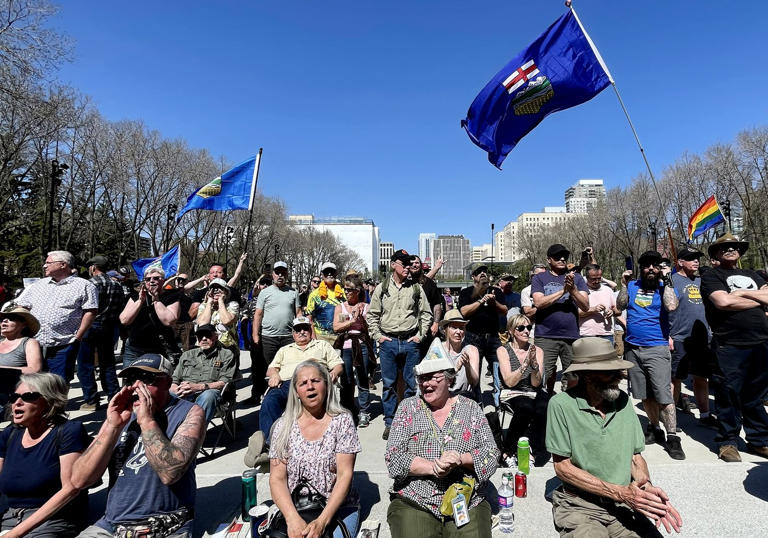
But will that be enough in the current climate? Protesters who took to the legislature on the weekend are disappointed in the election result – and don’t trust Liberals to have their back. Polls show that 15 per cent of the province would vote to join the US, while 29 per cent would vote for independence.

Smith may indeed be playing with fire. While Trump denies interest in a military invasion of Canada, Trump’s interest in making us the “51 st State” is not idle conversation. He has mused about annexing the west first: could he twist history to make it Canada’s “Donbas”? Americans played a key role in Alberta’s early development: by 1916, nearly 19 per cent of its population hailed from the US, though it has been diluted by waves of immigration since then.

Carney must tread carefully — and act quickly. A referendum in 2026, as Smith threatens to hold, would weaken Canada’s position during crucial negotiations with the United States. To stave this off, Carney will have to shed some of his green mantle and expedite resource development projects that benefit the west — projects that will also benefit the rest of the country through job creation and economic activity. A fair deal for Alberta is now essential for Canada, in more ways than one.

Postmedia News IS A CONSERVATIVE NEWS PAPER

Tasha Kheiriddin is Postmedia’s national politics columnist.


Parti Québécois leader stands with Alberta Premier Danielle Smith and her ‘strong hand’

LES SEPERATISTE; BIRDS OF A FEATHER


Story by Antoine Trépanier


Parti Quebecois Leader Paul St-Pierre Plamondon during question period Tuesday, November 19, 2024 at the legislature in Quebec City.

OTTAWA — Alberta Premier Danielle Smith has an ally in Quebec and his name is Paul St-Pierre Plamondon, the Parti Québécois leader.

A day after Smith threatened the federal government of including a referendum question on separation in 2026 if her province didn’t have the Accord, she thinks it deserves with Ottawa, St-Pierre Plamondon said Smith made a “striking gesture” for the “autonomy and defence of her own province.”

“It doesn’t matter what referendum they hold, because obviously it’s under construction. But I totally agree with provinces that stand up, that are loyal to their own Parliament, that are capable of showing a strong hand. And that’s the key word, strong hand,” said St-Pierre Plamondon, who is often called PSPP in Quebec.

In a in a livestreamed address Monday , Premier Smith called on Prime Minister Mark Carney to negotiate a new deal between Ottawa and Alberta guaranteeing more pipelines and changes to equalization.

“We hope this will result in a binding agreement that Albertans can have confidence in. Call it an ‘Alberta accord’,” said Smith who then called Alberta’s separation “the elephant in the room.”

“The vast majority of (separatists) are not fringe voices… They are loyal Albertans,” she said. “They’re … our friends and neighbours who’ve just had enough of having their livelihoods and prosperity attacked by a hostile federal government.”

Related video: Alta. premier says she'll work with Carney 'in good faith' to repair relations (Global News)  Duration 1:53

At a press conference at Quebec’s National Assembly, St-Pierre Plamondon said it was a “good thing” if other provinces are able to “stand up to the federal government”.

He added that “other provinces are showing” that Canada has issues that affect all provinces in terms of “abuse of power”.

St-Pierre Plamondon then went on the offensive against the province’s journalists for not covering the rebound in support of Quebec secession .

A recent Postmedia-Leger poll revealed that support for Quebec independence, which had fallen below 30 per cent in recent month, sits back at nearly 40 per cent.


Even though Canada is engaged in a tariff war with its closest ally, support for Quebec independence has reached 36 per cent according to new data.

“The most recent and most precise information is the independence of Quebec at 40 per cent, it is the increase in independence in Alberta,” he said.

Léger also polled Canadians from all provinces about their opinion about their province’s independence. The result was that 29 per cent of Albertans supported Alberta sovereignty while an overwhelming majority of the 2,309 respondents (71 per cent) were opposed.


National Post

atrepanier@postmedia.com


LA REVUE GAUCHE - Left Comment: Search results for SOCRED 


Tuesday, April 29, 2025

'Hockey and nostalgia' won't keep us together: SOME Albertans say they're serious about separation after Liberal win

THE MAJORITY OF ALBERTANS OPPOSE THE SMITH/MANNING SEPARATISTS
Polls show as many as three in 10 Albertans would vote to leave the federation if the Liberals continue to hold power in Ottawa.


Alberta Premier Danielle Smith takes part in a panel on Canada-U.S. relations at a Calgary Chamber of Commerce luncheon on Thursday April 3, 2025.

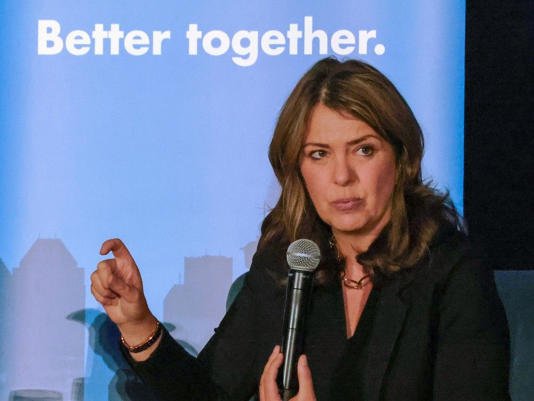
'BETTER TOETHER' IS NOT NATIONAL UNITY 
BUT AS THE 51ST STATE, SMITHS WET DREAM

OTTAWA — Alberta Premier Danielle Smith didn’t immediately issue a statement when the networks called the federal election for Mark Carney’s Liberals at 10:15 PM EST, but it’s safe to say that not all is calm on the western front.

The Liberals’ fourth straight federal election win keeps Alberta and Ottawa on a collision course, raising the once unthinkable prospect of a referendum on the Prairie province’s separation from Canada

At the time of the election call, the Liberals were leading in just two of Alberta’s 37 ridings .

Cameron Davies, an ex-UCP organizer who supports Alberta independence, said he was disgusted by the Liberal campaign’s use of tired national cliches, which he said made light of the serious issues facing the federation.

“Hockey and nostalgia doesn’t pay the bills… that hockey and nostalgia, it’s not going to keep Canada together,” said Davies.

“Without a reimagined confederation, there will be a strong separatist movement in Alberta,” said Davies.

Davies, who tendered his resignation to the UCP on Thursday, says he plans to spend the next few weeks having “honest, difficult conversations” with likeminded Albertans.


Related video: Premier Danielle Smith reacts to federal election results (cbc.ca)


Smith had warned heading into the election that a Liberal win could lead to an “unprecedented national unity crisis,” if Carney didn’t, within his first six months, undo a handful of Liberal policies that she said unfairly hampered Alberta’s oil and gas sector.

“ Albertans will no longer tolerate the way we’ve been treated by the federal Liberals over the past 10 years,” Smith said in a social media post.

Reform Party founder Preston Manning soon upped the ante, calling Carney himself a “ threat to national unity ” in a widely circulated op-ed.

Manning wrote that “large numbers of Westerners simply will not stand for another four years of Liberal government, no matter who leads it.”

He predicted that, if Carney were to emerge victorious from Monday’s election, he “would then be identified in the history books, tragically and needlessly, as the last prime minister of a united Canada.”

Smith has already announced she’ll launch a post-mortem election panel to give Albertans the chance to weigh in on issues they might want put to a referendum.

Polls show as many as three in 10 Albertans would vote to leave the federation if the Liberals continue to hold power in Ottawa.

Carney needs to seize the chance to reset relations with Alberta, said Martha Hall Findlay, the director of the University of Calgary’s School of Public Policy.

“I think the opportunity to move forward is absolutely there… I have every confidence that the prime minister of Canada and premier of Alberta will realize they can accomplish a lot more working together than by being at each other’s throats,” said Findlay.

Hall Findlay said that Carney could build immediate goodwill by dropping the existing targets for the federal emissions cap, set by Trudeau-era environment minister Steven Guilbeault.

“My hope is that (Carney) shows a pragmatism with respect to the West. Perfect example: he stops being coy about an emissions cap, even if he says we still believe in a cap on emissions but the time frames need to be revisited,” said Hall Findlay.

Hall Findlay was a Liberal MP from 2008 to 2011, holding a Toronto-area seat, before moving to Alberta to work in the oil and gas sector.

Rachel Parker, an independent journalist who travels in independentist circles, said she wasn’t as sanguine about the election’s outcome.

“You know, frustrations in Western Canada have grown quite high. They’ve always sort of been there bubbling underneath the surface, this put things into overdrive,” said Parker.


Parker said that Alberta’s independence movement had been organizing in the weeks leading up to Monday’s federal election and she expected to see this activity pick up in the weeks to come.

She added she doesn’t think much will come out of Smith’s post-election panel.

“Panels are really a government’s way of saying ‘we’re doing something, we’re doing something,’ when it’s really just kicking an issue down the road.”

Smith’s predecessor Jason Kenney launched the Alberta Fair Deal Panel shortly after becoming premier in 2019, citing the province’s growing frustration with Ottawa.

The panel generated 25 recommendations, paving the way for a fall 2021 referendum on Alberta’s participation in the federal equalization program .

Kenney’s panel came with a steep price tag of $650,000

Jack Jedwab, the head of the Association for Canadian Studies, says that Alberta sovereigntism differs from the more well-known Quebec variant in several important ways.

“I’d describe it as a form of economic nationalism which is driven by a sense of grievance wherein many Albertans feel they give more than they receive from the federal government,” said Jedwab.

“Albertans strongly identify as Canadian and do not feel emotionally detached from Canada which is something that more likely characterizes Quebec’s expression of nationalism,” he said.

With files from the Canadian Press

National Post
rmohamed@postmedia.com


Monday, March 03, 2025

 KING OF CANADA

Trudeau to discuss Trump’s annexation threats with King Charles

Canada Prime Minister Justin Trudeau holds a press conference at Canada House in London, 2 March 2025.
Copyright Sean Kilpatrick/The Canadian Press via AP
By Oman Al Yahyai with AP
Published on 

The British monarch, who is Canada's head of state, has been criticised for his silence on the issue.

Canadian Prime Minister Justin Trudeau is expected to bring up US President Donald Trump’s recent threats to annex Canada when he meets King Charles III on Monday.

Their meeting comes after some Canadians criticised the British monarch, who is Canada's head of state, for failing to publicly respond to Trump's comments.

Speaking in London on Sunday, Trudeau said the pair would discuss topics that Canadians deem important.

“Nothing seems more important to Canadians right now than standing up for our sovereignty and our independence as a nation,” he said.

Former Alberta Premier Jason Kenney defended the king over his public silence, noting that the monarch acts solely on the advice of Canada’s prime minister.

“The government of Canada should ask the head of state to underscore Canadian sovereignty,” he wrote on X.

Meanwhile, constitutional lawyer Lyle Skinner expressed his hope that Monday's discussion would lead to "the king making a statement regarding his Canadian realm".

However, experts remain divided on whether Trudeau will formally ask Charles to make a public statement. 

Daniel Béland, a political scientist at McGill University, warned that it was a "highly delicate diplomatic matter".

Not only could Trump be angered but a mistake could also "hurt the image and political legitimacy of the monarchy", he added.

Béland suggested that Trudeau should speak with UK Prime Minister Keir Starmer first about Trump’s threats to make Canada the US' 51st state. 

Some have questioned the king's role in Canada as a result of the issue.

“Canadians will need to decide what purpose King Charles III serves as King of Canada if he can’t even speak up for our sovereignty," former Canadian public servant Artur Wilczynski said.

Abolishing the monarchy would require a constitutional amendment, a process fraught with challenges.

Monday, January 13, 2025

Canada’s Trudeau urges US consumers to consider the harm of Trump’s tariff threats


President Donald Trump and Canadian Prime Minister Justin Trudeau pose for a photo as Trudeau arrives at the White House in Washington, on Oct. 11, 2017.
 (AP Photo/Carolyn Kaster, File)

BY JIM MORRIS
January 12, 2025

VANCOUVER, British Columbia (AP) — Canada’s outgoing Prime Minister Justin Trudeau on Sunday suggested that President-elect Donald Trump’s remarks about Canada becoming America’s “51st state” has distracted attention from the harm that steep tariffs would inflict on U.S. consumers.

Trump has threatened to impose 25% tariffs on all Canadian imports.

“The 51st state, that’s not going to happen,” Trudeau said in an interview with MSNBC. “But people are talking about that, as opposed to talking about what impact 25% tariffs (has) on steel and aluminum coming into the United States.”

Trudeau told MSNBC: “No American wants to pay 25% more for electricity or oil and gas coming in from Canada. That’s something I think people need to pay a little more attention to.”

Trump has also said that if Canada merged with the U.S., taxes would decrease and there would be no tariffs.


“I know that as a successful negotiator he likes to keep people off balance,” Trudeau said of Trump’s threats to use economic force to turn Canada into the 51st state. Trump has also erroneously cast the U.S. trade deficit with Canada — a natural resource-rich nation that provides the U.S. with commodities like oil — as a subsidy.


RELATED COVERAGE

Canada’s Liberal Party to decide on March 9 who will succeed Trudeau as prime minister

US orange juice and steel will be on Canada’s list for retaliation if Trump imposes tariffs

Trump, the ‘America First’ candidate, has a new preoccupation: Imperialism

Canadian officials say that if Trump follows through with his threat of punishing tariffs, Canada would consider slapping retaliatory tariffs on American orange juice, toilets and some steel products. Already during Trump’s first term in the White House, Canada responded to Trump’s tariffs on Canadian steel and aluminum with its own on American products like bourbon, Harley Davidson motorcycles and playing cards

“He got elected to try and make life easier for all Americans, to support American workers,” Trudeau said of Trump. “These (tariffs) are things that are going to hurt them.”

Trump said last week that the U.S doesn’t need oil, or anything else, from Canada. But almost a quarter of the oil that the U.S. consumes each day comes from Canada. The energy-rich western province of Alberta exports 4.3 million barrels of oil a day to the U.S.

Data from the United States Energy Information Administration shows that the U.S. consumes 20 million barrels a day, and produces about 13.2 million barrels a day.

Canada, a founding partner of NATO and home to more than 40 million people, is also the top export destination for 36 U.S. states. Nearly $2.7 billion worth of goods and services cross the border each day.

Trump has said that he would reconsider his tariff threat if Canada made improvements in managing security at the Canada-U.S. border, which he and his advisers see as a potential entry point for undocumented migrants.

Trudeau has said that less than 1% of illegal immigrants and fentanyl cross into the U.S. from Canada.

But after a meeting last November with Trump at Mar-a-Lago, the president-elect’s private club and residence in Florida, Trudeau announced an increase in spending on border security, expressing willingness to address Trump’s concerns in hopes that he would reconsider his tariff threat.

With the challenge of Trump’s second administration looming and Trudeau’s party trailing badly in the polls, the beleaguered Canadian prime minister announced his resignation last Monday. He will be replaced on March 9, when his Liberal party is set to pick a new leader.


Trump’s Tariffs Mean Taxes at Temu


Facebook

Donald Trump seems confused about how tariffs work, but that doesn’t mean the rest of us need to be also. It actually is fairly simple, let’s take the case where we are shopping at Temu.

Temu advertises this neat icemaker for $52.62. Trump says he wants to place a 100 percent tariff on the goods we import from China.

This 100 percent tariff (tax) would be applied to the icemaker at the point where it was brought into the country. Let’s say the cost when the icemaker is unloaded at the port is $35.00, the rest of the price is shipping costs and Temu’s profits.

In this story, the 100 percent Trump tax would be $35.00, the price of the good imported. That would mean that $35.00 would be added to the price of the neat icemaker that you wanted to buy. Instead of paying $52.62 for the icemaker you would be paying $87.62.

Now, it is likely that the price will end up being slightly lower than this, but not by much. The whole point of a retailer like Temu is to sell a large volume at a low profit for each item. This means that they don’t have much room to lower the price, before it is not worth making the sale.

So maybe the price they end up charging us in Trump Tariff World would be $87.00 instead of the $87.62 price if the tax was passed in full.

That’s the real world story of Trump’s tariffs. We aren’t sure what story is in Donald Trump’s head.

This first appeared on Dean Baker’s Beat the Press blog.

Dean Baker is the senior economist at the Center for Economic and Policy Research in Washington, DC.