Showing posts sorted by relevance for query COLOMBIA. Sort by date Show all posts

Friday, October 20, 2023

Colombian president's statements on Gaza jeopardize close military ties with Israel

MANUEL RUEDA and ASTRID SUAREZ
Thu, October 19, 2023 


People attend a vigil coined "Palestine Lives," to show support for the Palestinians in the latest Israel-Hamas war, in Bogota, Colombia, Tuesday, Oct. 17, 2023. 
(AP Photo/Ivan Valencia)

BOGOTA, Colombia (AP) — Escalating tensions between Colombia and Israel over the Gaza war could undo decades of close military ties between them and hamper Colombia’s ability to fight drug traffickers and rebels, security analysts say.

Israel has been one of Colombia’s main suppliers of war planes, surveillance equipment and assault rifles since the 1990s. But on Sunday its foreign ministry announced a suspension of defense exports to Colombia, after President Gustavo Petro refused to condemn Hamas’ attack on Israel and compared Israel's actions in Gaza to those of Nazi Germany.

Analysts in Bogota say that the suspension could jeopardize several contracts, including a $5 million deal between Colombia’s Defense Ministry and Israeli company IAI to maintain Colombia’s ageing fleet of Kfir fighter jets.

Colombia’s government also recently hired an Israeli company to outfit two Boeing 737’s with electronic warfare equipment and intelligence tools that can help the military jam communications of the nation’s remaining rebel groups and monitor their movements.

Israel’s embassy in Bogota declined to answer questions about the export ban and whether it applies to contracts that have already been signed.

Security analysts in Bogota said that if the ban is sustained, it could seriously affect Colombia’s armed forces due to their reliance on Israeli hardware and technology.

“It will be debilitating and extremely costly,” said Jorge Restrepo, the director of CERAC, a security think tank in Bogota. “It can take months or years to find new providers and to train personnel to use and trust new equipment.”

Colombia deepened its military ties with Israel in the late 80’s by purchasing a group of Kfir fighter jets. The war planes, whose name translates to young lion, are able to launch laser-guided bombs.

They were used by Colombia’s air force in numerous attacks on remote guerrilla camps that debilitated the Revolutionary Armed Forces of Colombia and helped push the group into peace talks that resulted in its disarmament in 2016.

But as Colombia’s fleet of 22 Kfir fighter jets becomes older it also relies more frequently on maintenance from its Israeli manufacturers, said Erich Saumeth Cadavid, a Colombian defense analyst.

Cadavid noted that one potential result of the export ban could be less sorties for the Kfir planes, which are Colombia’s only fighter jets and also the only planes in the nation’s arsenal that are capable of launching bombs with precision.

Colombian officials have been slow to replace the fleet despite offers from manufacturers in France, Sweden and the United States, as Petro’s administration prioritizes spending in other areas.

Israel’s military export ban comes as Colombia’s government continues to face the threat of rebel groups that did not join the 2016 peace deal with the FARC, and have grown stronger in some rural parts of the country following the FARC’s withdrawal from these areas.

Petro’s administration recently signed cease-fires with two of these groups — the ELN and the EMC -- that will expire early next year, while it is fighting against the drug trafficking group known as the Gulf Clan, which is the nation’s second largest armed group.

Wilder Alejandro Sánchez, a military analyst and president of Second Floor Strategies, a consulting firm based in Washington, said that the effects of Israel’s export ban will take some months to be felt by Colombia’s armed forces.

He said that while Colombia has a “diverse” set of weapons in its arsenal, including Brazilian made Super Tucano planes that can attack enemies on the ground, the nation relies heavily on Israel for the maintenance of surveillance equipment, including drones.

“Colombia continues to face a plethora of internal security challenges, and they need a strong military with various capabilities” Sánchez said. “So this ban, if it really does come through, comes at a really bad time.”

Another contract that could be jeopardized by the ban, Sánchez said, is a license through which Colombia’s state owned military factory, Indumil, produces Israeli designed Galil assault rifles, which have become the principal weapon used on the ground by Colombian troops.

Following Israel’s announcement of its intent to suspend military exports, Colombia's leftist president threatened to cut diplomatic relations with Israel and blamed the country for the growth of paramilitary groups in Colombia, though he didn't provide evidence for that claim.

“If we must suspend relations with Israel, then that is what we will do,” Petro wrote on the social media platform X. “From the people of Israel I demand help for the construction of peace in Colombia, in Palestine and in the world.”

Petro, who was once a member of a left-wing rebel group that made peace with Colombia's government in the 1990s, has written dozens of messages on X about the war in Gaza since the conflict began on October 7.

In some, he has compared the conditions in the Gaza strip to those of a concentration camp, and in other messages he has written that Israel’s bombardment of Gaza is equivalent to “genocide.”

But the president has refused to condemn Hamas' attack on Israel, despite numerous calls by Colombian politicians and intellectuals for him to do so.

While Petro’s supporters commend him for speaking forcefully about the plight of Palestinians, critics are worried that his brand of online diplomacy could eventually lead to a complete rupture of relations with Israel, and undermine Colombia's relations with other countries.

“By not condemning the terrorist attack, he is drifting away from Colombia's strategic allies and putting Colombia next to the nations that support terrorism,” said Diego Molano, a former Colombian defense minister.

“Petro is impulsive and he sees in the Palestinian cause something that he can become a vocal supporter of that aligns with his ideology and his passion for anti-colonialism,” said Sergio Guzmán, a political risk analyst in Bogota. “But he is not taking Colombia’s interests into consideration, and it puts Colombia in a difficult position.”

On Thursday afternoon Petro held separate meetings with the ambassadors of Israel and Palestine and posted photos on X. He announced Colombia would send humanitarian aid to the residents of the Gaza strip and wrote on his account that he had told both ambassadors about his desire to help set up an “international peace conference that opens the path for two free and independent states.”

Israel suspends defense sales to Colombia

José Higuera
Wed, October 18, 2023 


RAUL ARBOLEDA

SANTIAGO, Chile — The Israeli government has suspended all sales and supplies of defense and security hardware and related services to Colombia.

The move followed a heated exchange on X, formerly known as Twitter, between Colombian President Gustavo Petro and Israeli Ambassador in Bogota Gali Dagan about the ongoing conflict in the Gaza Strip.

Petro had refused to condemn the Hamas raid. When Dagan urged Petro to speak about the attack on Israel, Colombia’s president replied with a message that “terrorism is killing innocent children in Palestine” and followed up with messages in which he accused Israel of turning Gaza into a “concentration camp.”

Petro doubled down on his criticism of Israel over the weekend, describing its military campaign in Gaza as “genocide” and threatening to break off relations with the Jewish state.

“If we must suspend diplomatic relations with Israel, then that is what we will do,” he wrote on X on Sunday. “You cannot insult the president of Colombia.”

Ultimately, Israel called Colombia’s ambassador to a meeting in which she was informed that defense cooperation between the countries would be suspended, the Israeli Foreign Affairs Ministry said in a news release.

Colombia’s Defense Ministry did not reply to Defense News’ request for comment.
Defense relations

Colombia has had a close relationship with Israel, with the former having acquired military hardware and security equipment from the latter for decades. But relations chilled after Preto became president in August 2022.

Emilio Meneses, an independent security analyst based in Santiago, told Defense News the president’s “outburst of criticism against Israel, which could have been expressed in a more appropriate language and through proper diplomatic channels, is helping neither the Palestine people nor Colombia. Quite the opposite.”

Colombia has plans to acquire the Barak MX air defense system, made by Israel Aerospace Industries, to meet a requirement for protecting deployed personnel and strategic facilities.

The Colombian Air Force’s primary fighter jet and only high-performance combat aircraft is also made by IAI. The service has an estimated 24 Kfir fighters. Technical problems involving their General Electric J79 turbojet engines led to the Air Force grounding its Kfir entire fleet in 2015.

Restoring the fleet required involvement from IAI, which has historically provided extensive maintenance services, in both Colombia and Israel. In January 2023, the parties renewed the contract for these services until 2025.

The Kfir jets are also armed with weapons acquired from Israel, including the Derby BVR medium-range air-to-air missiles from Rafael Advanced Defense Systems and Griffin laser-guided-bombs from IAI.

And the Kfirs use Python III and Python IV all-aspect, heat-seeking, close-range air-to-air missiles, made by Rafael. Those weapons are also used for the service’s A-29 Super Tucano turboprop aircraft.

The main infantry rifles in use with the Colombian military are the Israel Weapons Industries-made 5.56mm Galil automatic rifle machine gun and 7.62mm Galil sniper rifle. Since the 1980s, they were produced in Colombia under license by the state-owned concern INDUMIL, which has exported these weapons to other countries in South and Central America. Colombia has started to replace the Galil weapons with the newer Galil ACE infantry rifle, made locally by INDUMIL under license from IWI.

The Spike weapon from Rafael is the main anti-tank missile in the Colombian Army’s inventory, while the Sikorsky UH-60 Arpia IV ground-fire support helicopters from the Air Force are armed with ER, LR and NLOS versions of the same weapon.

The Associated Press contributed to this report.

Thursday, December 30, 2021

Cocaine, Guns And Gushers: Colombia’s Oil Industry Struggles To Reactivate

  • Rising security risk and rural violence, which is mostly fueled by the vast profits generated by the cocaine trade, is a key deterrent to attracting onshore oil investment in Colombia.

  • According to the UN, Colombia’s cocaine production during 2020 increased by 8% compared to a year earlier, despite a 7% decrease in the volume of land used for coca cropping. 

  • Despite the risks associated with operating in onshore Colombia, the Andean country’s 2021 bid round found some success.

Despite the groundbreaking 2016 peace deal between the Colombian government and the largest guerilla group the Revolutionary Armed Forces of Colombia (FARC – Spanish initials) there are fears that conflict is escalating once again. Colombia, which is Latin America’s third-largest petroleum producer and the world’s largest manufacturer of cocaine for nearly a century, has been caught in a simmering low-intensity asymmetric conflict that reached boiling point during the 1980s. The primary flashpoint for the civil conflict, which currently engulfs Colombia and failed to end with the 2016 FARC peace accord was the April 1948 assassination of Liberal Party leader Jorge Gaitan in Bogota. That sparked the Bogotazo, days of violent rioting that swept across Bogota resulting in up to 3,000 deaths, which eventually evolved into a vicious 10-year civil war between the Colombian Liberal and Conservative parties known as La Violencia. While that brutal struggle ended in a 1958 power-sharing agreement between Colombia’s leading political parties, it sowed the seeds for the current low-intensity multiparty asymmetric conflict.  In 1964 the Colombian Communist Party formed the Revolutionary Armed Forces of Colombia (FARC – Spanish initials) after a military attack on the community of Marquetalia, a Communist peasant enclave established during the of La Violencia. That event saw the communist FARC emerge as the most powerful left-wing anti-government armed group during the conflict. The guerillas eventually cut ties with the Colombian Communist Party and increasingly relied upon kidnapping, extortion, and cocaine trafficking to fund their operations. Prior to these events, which cast Colombia into what appears to be a never-ending low-intensity asymmetric multiparty civil conflict, oil was discovered in 1918 at the La Cira-Infantas field in the Middle Magdalena Basin near the city of Barrancabermeja. Even after additional petroleum discoveries in the Middle Magdalena Basin, it was not until the giant Caño Limon, Cusiana, and Cupiagua oilfields were discovered between 1983 and 1993 that Colombia embarked on becoming a major oil producer. Those mega discoveries and a notable increase in foreign energy investment, as well as petroleum production, occurred despite violence surging because of the tremendous influx of profits from the booming cocaine trade.

Even the tremendous escalation of violence, homicides, kidnappings, and attacks on energy infrastructure which escalated in the late-1980s, lasting well into the early 21st century, had little material impact on Colombia’s hydrocarbon sector. By 1991 Colombia was pumping over 400,000 barrels per day, more than double its output in 1985, despite becoming the world’s murder capital with a homicide rate of 84 intentional killings per 100,000 people. That was more than eight times greater than the U.S. which reported 9.8 homicides per 100,000 head of population, 7-times higher than neighboring Venezuela’s murder rate of 12 and 8-times larger than Ecuador’s 11 homicides per 100,000 people.

Heightened insecurity and violence remained a persistent problem in Colombia, even after the collapse of the Medellin and Cali cartels, as the FARC and National Liberation Army ELN (Spanish initials) ramped-up operations as vast revenue flowed in from the drug trade. By 2000, after President Andres Pastrana’s peace negotiations with the FARC had failed, the leftist guerillas controlled a 42,000 square mile territory in southeastern Colombia and kidnappings had surged to a record high of 3,500 for the year. Even those events failed to have any material impact on Colombia’s oil boom. A combination of soaring oil prices and rapidly improving internal security during the early 2000s, because of Plan Colombia and President Alvaro Uribe’s military campaign against the FARC, saw foreign energy investment and hence crude oil production growth.

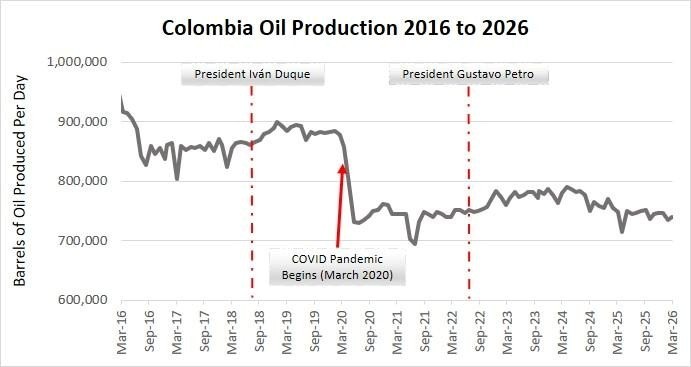
During 2003 when Brent averaged $28.83 per barrel, a 15% increase over 2002, Colombia pumped an average of 550,000 barrels of crude oil per day. When Brent had soared to over $140 per barrel during 2008, annual petroleum production averaged 600,000 barrels daily and kept growing to peak at a yearly record of just over 1 million barrels per day by 2013. Since 2016 Colombia’s petroleum output has been in terminal decline impacted at first by the late-2014 oil price crash, sharply rising violence, and finally because of the fallout from the COVID-19 pandemic. Even the 2017 demobilization of the largest leftist guerilla group the FARC, after a 2016 peace agreement was struck with the government of President Juan Manuel Santos, has done little if anything to arrest Colombia’s production decline. That in part can be blamed on current President Ivan Duque’s reluctance to fully implement the peace deal, contributing to an increase in violence and civil unrest in regional Colombia.

Related: Southeast Asia’s Oil And Gas Output May Never Recover To Pre-COVID Levels

During 2020, the crisis-driven Andean nation only pumped on average 781,300 barrels of crude oil per day as the COVID-19 pandemic, related national quarantine lockdown and sharply weaker oil prices impacted investment as well as production. More worrying, is that despite the pandemic lockdown ending by September 2020 and energy investment increasing, average petroleum output only reached 734,231 barrels per day for the first 10 months of 2021 which is 6% less than the full year 2020. That disappointing decline occurred because of heightened civil unrest with anti-government protests sweeping across Colombia during late- April 2021 lasting into May and early-June 2021. Falling crude oil output can also be attributed to rising insecurity in regional areas, where petroleum industry operations are concentrated, fueled by a marked uptick in violence related to the activities of illegal armed groups and cocaine production.

It is the cocaine trade that is an enduring problem for Colombia. The tremendous profits that the trade generates are responsible for fueling what is a near-perpetual low-level asymmetric conflict where only the illegal armed actors change as the various groups fragment and reform. Estimates vary, but Colombia’s government believes the civil conflict has claimed up to 260,000 lives and displaced at least 9 million people. According to the UN Colombia’s cocaine production during 2020 increased by 8% compared to a year earlier, despite a 7% decrease in the volume of land used for coca cropping and an 18% increase in seizures. The scale of massive profits generated by cocaine is highlighted by former finance minister Juan Carlos Echeverry’s estimate (Spanish) that the drug trade generates $8 to $12 billion annually, which is equivalent to 5 to 4% of Colombia’s gross domestic product. Using Echeverry’s numbers the cocaine trade is contributing the same amount, if not more, to Colombia’s GDP than the oil industry which based on DANE data (Spanish) for the first 3 quarters of 2021 was responsible for 3% of GDP.

Rising security risk and rural violence, which is mostly fueled by the vast profits generated by the cocaine trade, is a key deterrent to attracting onshore oil investment in Colombia. A combination of security risks and mature assets saw Occidental Petroleum, in October 2020, sell its Colombian onshore petroleum assets in an $825 million deal, although the company retained its offshore exploration blocks. Despite the risks associated with operating in onshore Colombia, the Andean country’s 2021 bid round found some success. Seven companies made offers for 30 of the 53 blocks (Spanish) on offer with initial investment expected to exceed $148 million. Five of the offers came from national oil company Ecopetrol or its subsidiaries and 21 from intermediate energy companies with existing operational presence in Colombia, Parex Resources, Frontera Energy, and Canacol Energy. This indicates that Colombia is struggling to attract foreign onshore energy investment because of the heightened security risks coupled with high breakeven prices and elevated carbon content of the sour heavy crude oil produced.

By Matthew Smith for Oilprice.com

Friday, October 10, 2025

Dwindling Gas Reserves Threaten Colombia's Economy and Power Grid

  • Colombia is experiencing a severe energy crisis driven by a significant decline in natural gas production, which has reached its lowest level in over a decade, and rapidly depleting proven natural gas reserves.

  • The country's reliance on natural gas for electricity generation, coupled with climatic events like the El Niño phenomenon impacting hydroelectric power, has led to increased pressure on the power grid and a surge in liquefied natural gas imports.

  • President Gustavo Petro's policies, including a ban on new hydrocarbon exploration contracts, are contributing to the worsening shortfall in domestic natural gas supply, making Colombia increasingly dependent on foreign sources.

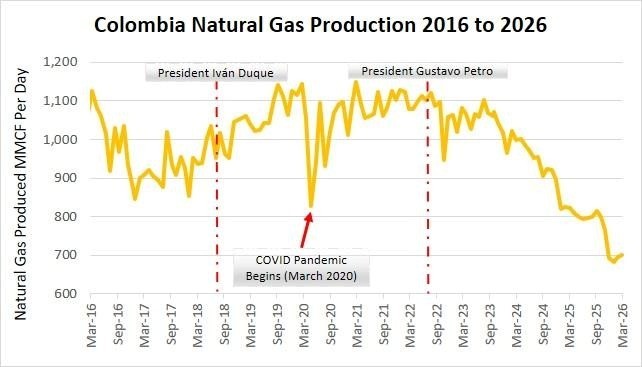
Strife-torn South American country Colombia is not only suffering from a new wave of violence but is also facing an energy crisis. Dwindling oil and natural gas production is crimping domestic energy supplies and impacting Colombia’s troubled economy. There is a grave threat of a serious natural gas shortage. A lack of exploration drilling, diminishing reserves and plummeting production are weighing on economically crucial natural gas supplies. The shortage of fossil fuel is exacerbated by rising consumption and natural gas’s increasingly vital role in Colombia’s energy mix.

Government data shows Colombia’s natural gas production for August 2025 plunged 16% year over year to 800 million cubic feet per day. The severity of this sharp decline is highlighted by Colombia’s current natural gas production being at its lowest level in over a decade and around 33% less than 2013 natural gas output, as shown below.

Source: Colombia’s National Hydrocarbons Agency (ANH).

Indeed, industry insiders, government officials and economists have long stressed Colombia’s pressing need to produce more natural gas, particularly with consumption soaring higher. Over a decade ago, those pundits opined that production of one billion cubic feet of natural gas per day was the minimum economically viable volume. 

Colombia’s natural gas reserves are also failing to keep pace with domestic demand. Data from the National Hydrocarbons Agency (ANH) shows that at the end of 2024, Colombia’s proven natural gas reserves stood at just under 2.1 billion cubic feet. This represents a whopping 13% decrease compared to a year earlier. It is the lowest level in over a decade, with those reserves forecast to only last another 5.9 years at the current rate of production. ANH data, set out in the graph below, shows natural gas reserves have declined every year, except for 2021, since 2012. 

Source: Colombia National Hydrocarbons Agency (ANH).

Colombia’s proven natural gas reserves will continue to decline at an accelerated rate due to rapidly growing consumption and a lack of hydrocarbon exploration and discoveries in the country. In fact, according to El Colombiano, Colombia has consumed 4,628 billion cubic feet of natural gas over the last decade but only replaced 824 billion cubic feet of the natural gas reserves consumed. The reserve replacement ratio will continue to fall due to the lack of exploration drilling and major discoveries.

Most natural gas produced in Colombia is associated gas derived from oil production. Drillers capture this natural gas, which is a byproduct of lifting petroleum, and reinject it into oil wells to boost reservoir pressure, thereby enhancing recovery. This is an increasingly important oil extraction technique in Colombia because of the rising number of mature oilfields where production has peaked and entered a steady decline. The number of mature wells and decline rates will only increase because President Gustavo Petro has decided to ban exploration drilling by not awarding new contracts.

Those developments underscore the urgency with which Bogota needs to implement initiatives to boost hydrocarbon exploration, expand proven reserves and increase production. Yet, Colombia’s leftwing President Petro, after taking office in August 2022, not only ceased to award new oil contracts but also implemented various policies designed to reduce the country’s dependence on fossil fuels and extractive industries. President Petro made this decision despite natural gas being recognized globally as the fossil fuel of choice due to its low carbon emissions, in order to support the clean energy transition.

Sharp declines in natural gas reserves and production pose a significant threat to Colombia’s power grid. The Andean country, while generating 58% of its electricity from hydroelectric plants, is highly reliant upon natural gas-fired power stations. Regular fluctuations in water levels, caused by climatic events and consequently affecting electricity production, place considerable pressure on an electricity grid already stretched beyond capacity. Indeed, brownouts and blackouts are commonplace across many parts of Colombia’s stretched electric grid, particularly during periods of limited rainfall. 

Until early 2025, a severe two-year-long drought, caused by the El Niño climate phenomenon, led to a sharp reduction in electricity production due to plummeting water flows at Colombia's hydro plants. This drought was so severe that the Mayor of Bogota, Carlos Galán, was forced to introduce water rationing. This pushed the national government to seek other sources of natural gas, as local production was incapable of meeting the additional demand. 

The sharp decline in natural gas production is so severe that after decades of self-sufficiency, Colombia no longer extracts enough of the fossil fuel to meet its needs. By 2016, Bogota was forced to start importing liquified natural gas (LNG). Cargoes of the fuel that year, according to the IEA, totaled 429 million cubic feet. LNG imports continue to soar higher, with data from S&P Global showing cargoes hit a record high of 94 billion cubic feet in 2024, almost triple the 36 billion cubic feet imported a year earlier. That means the imported fossil fuel now accounts for around a fifth of all natural gas consumed in Colombia.

It was Colombia’s harsh two-year drought, from 2023 to early 2025, that drove the massive increase in LNG imports during 2024. This severe weather event, triggered by the El Niño climate phenomenon, caused water levels at Colombia’s hydro-plants to plummet sharply, impacting electricity supply. That forced the government to increase the importation of LNG to fuel three gas-fired power plants in Colombia’s north, boosting electricity generation at a crucial moment as hydro power fell significantly. 

While the drought ended some months ago, the main industry trade body, The Colombian Natural Gas Association (Naturgas), believes LNG imports will keep climbing. The industry association projects that by 2029, Colombia will be forced to import 56% of all natural gas consumed domestically. According to Naturgas, it is plummeting supply and not rising demand, which is responsible for the widening shortfall. This is due to a lack of exploration drilling to identify new reservoirs, which, along with falling investment, will prevent the development of the new natural gas fields required to boost production.

By Matthew Smith for Oilprice.com

Saturday, November 01, 2025


Colombia’s Oil Industry Faces an Existential Crisis

  • Colombia’s proven oil reserves have fallen by over 400 million barrels since 2013, leaving fewer than eight years of production at current rates.

  • President Petro’s bans on fracking and new exploration, combined with heavy taxation, have driven away foreign investment and weakened output.

  • Without new discoveries or major policy shifts, Colombia risks losing its top export revenue source and destabilizing its economy within the decade.

A lack of oil discoveries is causing Colombia’s economically crucial petroleum reserves and production to deteriorate, sparking speculation that the industry is trapped in a death spiral. President Gustavo Petro’s bid to reduce dependence on fossil fuels by banning oil exploration and hydraulic fracturing is only accelerating the industry’s demise. This is severely impacting government income, exports, and the economy at a time when Bogota is particularly exposed to financial and geopolitical risks. Time is fast running out for Colombia to find more oil reserves while creating an economically sustainable plan to reduce dependence on hydrocarbons.

After peaking at just over 2.4 billion barrels in 2013, the highest level since 1998, Colombia’s proven oil reserves have fallen sharply since then. For 2024, those reserves were calculated to total just over two billion barrels with a relatively short production life of 7.2 years.

Colombia
Source: 
Colombia National Hydrocarbon Agency (ANH). 

This marks a steep reduction of more than 400 million barrels since 2013, reflecting Colombia's limited exploration success. You see, over the last twenty years, major oil discoveries have been rare, with only two significant finds exceeding 200 million barrels during that period. The risks this poses to Colombia’s oil-dependent economy are exacerbated by the short production life of the country’s proven reserves, with them poised to run out in less than a decade if no new major discoveries are made.

These developments underscore the considerable risks facing Colombia’s hydrocarbon-dependent economy, especially with petroleum being the country’s top export, earning $15 billion during 2024 and generating roughly a tenth of fiscal revenue. Time is running out for Colombia to make the multiple major oil and natural gas discoveries needed to boost reserves and bolster declining fiscal revenues. Although there is significant optimism regarding Colombia’s hydrocarbon potential, the country has experienced limited significant oil discoveries over the past 25 years, which poses ongoing challenges for increasing reserves. 

Colombia has not seen any world-class 500 million barrel-plus oil discoveries since the early 1990s. The last was Occidental Petroleum’s 1983 discovery of the 1.1-billion-barrel Caño Limón oilfield. This is the strife-torn nation’s largest ever oil discovery, not only leading to hydrocarbon self-sufficiency but triggering a massive petroleum boom that became what is known as Colombia’s golden age of oil that lasted into the late 1990s. The Andean country’s last world-class discoveries were the 750-million-barrel Cusiana and 510-million-barrel Cupiagua oilfields found by BP in the Orinoquía foothills in 1989 and 1993, respectively. 

There has been a dearth of world-class finds ever since. All crude oil discoveries have failed to break the 100-million-barrel mark, with only two exceeding 200 million barrels of recoverable oil resources. These are the 250-million-barrel Akacia and 250-million-barrel Lorito heavy oil discoveries made by Ecopetrol in its 100% owned and operated CPO-09 Block during 2010 and 2018, respectively. The CPO-09 Block, where Ecopetrol acquired the remaining 45% from Spanish energy company Repsol in February 2025 for $452 million, is believed to contain over two billion barrels of crude oil. Although questions linger over whether it is commercially exploitable.

President Petro’s attempts to reduce Colombia’s dependence on petroleum and hike taxes for extractive industries are responsible for falling energy investment. On taking office in August 2022, Petro banned hydraulic fracturing, known as fracking, and ceased awarding new oil exploration contracts. Those policy decisions are among the key reasons for Colombia’s inability to bolster proven oil reserves and declining production, with drillers slashing spending on their operations in the strife-torn country. Indeed, the lack of exploration success over the last 20 years sparked considerable speculation that the future of Colombia’s oil patch rested with fracking. 

There are several geological bodies in the Andean country, notably the Cretaceous La Luna formation, a carbonaceous-bituminous limestone and calcareous shale rich in organic matter, which possesses considerable unconventional oil potential. This formation was targeted by Ecopetrol and partner ExxonMobil with the Kale and Platero fracking pilots near the municipality of Puerto Wilches in the Middle Magdalena Valley. Both operations were hugely controversial, with local communities opposed to the projects over fears of environmental damage. It was Petro’s fracking ban that caused those pilots to be scrapped and Exxon to exit Colombia.

Those regulatory changes were followed by tax hikes for extractive industries, including the economically vital oil industry. During November 2022, Petro imposed a levy on oil sales when the international Brent price hit specific thresholds, with oil companies paying an additional 5% tax when prices are $67.30 to $75 per barrel. The levy rises to 10% when prices fall between $75 and $82.20 per barrel and climbs to 15% if the price rises further. In February 2025, Bogota imposed a 1% surcharge on crude oil exports, which was extended beyond the initial 90 days to be in place for a year, with plans to make it permanent, adding to the immense tax burden weighing on oil companies.

As a result, many foreign oil companies, including Big Oil, have downsized their operations in Colombia, or, like Exxon, chose to exit altogether. This is responsible for a sharp decline in foreign direct investment (FDI). According to central bank data, foreign investment has plummeted over the last decade, as the chart shows. Colombia’s FDI inflows for 2024 totaled $14.1 billion, a sharp decline from the $16.8 billion received a year earlier and 13% less than the $16.2 billion received 10 years earlier.

Col
Source: 
Central Bank of Colombia.

A key reason for the sharp decline in foreign spending on businesses in Colombia is the drop in energy investment. For 2024, Colombia received $2.3 billion of offshore capital, which was invested in the strife-torn country’s energy patch. This was significantly lower than the $3.1 billion of foreign investment directed to the petroleum industry during 2023. 

Col
Source: 
Central Bank of Colombia.

While full-year data for 2025 is yet to be made available, there are signs of an uptick in foreign investment in Colombia’s oil industry. For the first six months of the year $1.5 billion was invested in the hydrocarbon sector compared to $1.3 billion for the same period a year earlier. Whether that trend will continue is questionable because of the headwinds impacting Colombia which are deterring foreign investment. This includes U.S. President Donald Trump’s decision to decertify the strife-torn country as a counter-narcotics partner and his escalating feud with President Petro

These developments, coupled with sharply weaker oil prices and the growing global push to phase out fossil fuels in favor of electric vehicles and renewable sources of energy, mean time is running short for Colombia to discover more oil. Indeed, it will take considerable amounts of capital to fund the tremendous amount of drilling activity required to make the required petroleum discoveries. It is incredibly difficult to attract the required investment, with Bogota refusing to award new exploration contracts while increasing the tax burden faced by oil companies. Surging violence and cocaine production, particularly in the remote regions where Colombia’s oil industry operates, are further deterring foreign energy investment. 

By Matthew Smith for Oilprice.com