Showing posts sorted by relevance for query K-POP. Sort by date Show all posts

Wednesday, August 24, 2022

K-pop: The wave of success that won't stop

K-pop has become South Korea's export hit, and the music has found a decent — and growing — fan base in Germany. What's the hype about?
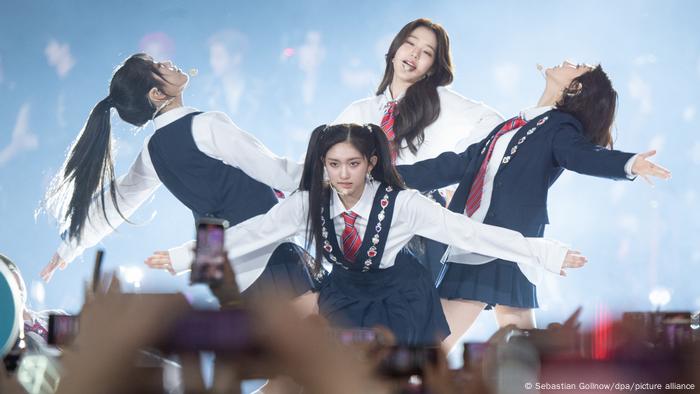


Europe's first major K-pop festival was held in Frankfurt in 2022


South Korea is one of the fastest-growing music markets in the world. The reason for this: K-pop. The international spread of the music genre earns the country several billion euros a year. The fact that South Korean pop music has become so successful is thanks in no small part to social media and a networked fan community, including in Germany.

But the hype doesn't stop there: People in more and more countries are getting excited about South Korean pop music. But why are they so fascinated with it?

A mix of fun and community


"K-pop is just something that brings me joy," says Melissa Ndugwa. The 21-year-old is the co-founder of K-Fusion Entertainment, the largest K-pop fan gathering in Germany. What excites Ndugwa about K-pop?

"Listening to the music, practicing the choreography and then dancing together with others is so much fun," says Ndugwa. Dancing together is not only a popular activity among fans but a central part of K-Pop. The performance of the idols, as the Korean pop stars are called, is as important as the music. The recipe for success is catchy melodies, sophisticated choreography and slick performers.


Members of the Frankfurt K-pop fan group K-Fusion Entertainment practice their moves

K-pop metropolis: Frankfurt

The K-pop stars are role models for many of their fans in terms of beauty ideals, as well. For some years now, Korean beauty and care products have been booming in Germany. There are salons offering Korean cosmetics and skin care in several German cities, including Frankfurt. This is where Germany's largest Korean community lives, and the city has now become Germany's K-pop metropolis.

In May 2022, Europe's first major K-pop festival was held in the central German city, with 70,000 spectators. Titled KPop.Flex, it was attended by stars such as Monsta X, Mamamoo and NCT Dream. The Seoul Broadcasting System (SBS), a private television and radio station from South Korea, was also involved in organizing the event. Apparently, they suspected that Germany could turn out to be a lucrative market.


Tens of thousands of people flocked to Frankfurt for the KPop.Flex festival


"Actually, the K-pop community in Germany is still small compared to the US, Asian and other European countries. But, this year, we've noticed a big change. There have been many more concerts by Korean artists. And there has never been a festival in Europe like the one in Frankfurt," says Kocky B, the leader of the K-pop dance group Shapgang. The 12-member group from Frankfurt performs at competitions and on TikTok, where they dance the choreographies of popular K-pop bands, but also perform their own choreographies.

The standard: Perfection

Kocky B says her fascination with K-pop comes from the focus on the visual elements, dance and the colorful, in-your-face, fun production, which she has not seen in the Western music industry.

"When we started, there were few people who even knew what K-pop was. It tended to be laughed at in the dancing scene," she says. "That has changed tremendously, because the K-pop industry offers many job opportunities for dancers. People now realize how significant this market is. Many Western dancers are hired by K-pop labels to develop choreography."

In K-pop choreographies, the stars dance in flawless synchronicity, and they do so in groups of up to 20 members. It's all about synchrony, community — and perfection. This also applies to the music, as Isabelle Opitz, editorial director of the German pop culture magazine K*bang Magazin explains.

"The music itself is produced to a very high standard, and songwriters from the European region are often involved. A label will bring a huge team to Korea. There's not much that can go wrong. As a fan, you know what you're getting right from the start," says Opitz.

K-POP AS A ROUTE TO JAPAN-SOUTH KOREA RECONCILIATION?
It's time for K-pop
Yuuka Hasumi (17) is one of the Japanese youth who joined ACOPIA School in Seoul. It is a dance/vocal academy run under the ACOPIA Entertainment division. This division offers not only lessons on how to sing and dance like their favorite stars, but also on the Korean language and culture.

Social media takes on a central role

K-pop also works so well because it offers a huge package of interaction opportunities, Opitz says. Fans watch every music video, every interview appearance and are well informed about the individual group members.

In addition, many idols star in series or movies, and communication via social media is perfectly coordinated. "Through platforms like Spotify and YouTube and social networks such as Twitter, K-pop has become more accessible; the community is more connected," Opitz says. "Even if you have nothing to do with K-pop at all, YouTube suggests content to you." Today, there is someone in every German school class who listens to K-Pop, Opitz says.

K-pop idols: Role models?

This success should not obscure the fact that there are also downsides. K-pop is a hard-hitting industrial product; the bands are put together by entertainment corporations. Young people are signed up and trained in a targeted manner — in sometimes exhausting and somewhat dubious programs. Those who are convincing get a place in a group.

The price of success is high: Time and again there is talk of gagging contracts that forbid the idols to have a relationship in public. There have been reports of eating disorders and even suicides among K-pop stars.

"Compared to the past, the community has become more attentive to the reality of the industry," says Melissa Ndugwa. Idols are still role models, she says, but are no longer glorified as much. "In K-pop, it's already a scandal if an idol dates anyone. There are stars who were ostracized for it and had to end their careers. At the same time, they are only human."

This article has been translated from German.


K-POP: THE SCANDALS AND TRAGEDIES OF 2019
More and more deaths
Cha In-ha, a popular South Korean actor-singer, was found dead at his home on December 3, 2019. A police official told media that the cause of Cha's death was not immediately known. The 27-year-old celebrity made his film debut in 2017 and was part of the Surprise U band, which released two albums. There were no reports to suggest that Cha had been a target of personal attacks or cyberbullying.
Date 18.08.2022

Monday, November 02, 2020

K-pop's social media power spurs Thailand's youth protests

By Patpicha Tanakasempipat
© Reuters/CHALINEE THIRASUPA A woman takes a picture of a billboard whishing happy birthday to a K-pop singer Jimin at the subway in Bangkok

BANGKOK (Reuters) - From raising hundreds of thousands of dollars for Thai protesters to inspiring the youths who join demonstrations through dances and social media, K-pop fans have emerged as a potent political force in Thailand's anti-government movement.

Earlier this year, K-pop fans in the United States surprised many people by using their social media power to raise funds for Black Lives Matter and to sabotage a re-election rally for President Donald Trump.

But in Thailand they have been part of the youth culture for a long time, and their support for the protest movement reflects the frustrations of a generation that is unhappy with the government using the power of the state to stifle dissent.
© Reuters/CHALINEE THIRASUPA 
A woman walks past a billboard promoting a K-pop singer at the subway in Bangkok, Thailand

"K-pop fans would love to just fangirl over our 'oppas' and care about nothing else, but with our country like this, we as citizens have to call for better things," said Suphinchaya, 23, using the term of endearment for male K-pop artists.

Like many Thai protesters she declined to give her full name because of the sensitivity of the issue.

Young, mostly female, and social media-savvy, the profile of K-pop fans matches that of many protesters, said Chayanit Choedthammatorn, a Thai researcher of Korean studies.

"Although they are K-pop fans, they are Thai citizens first," she said.

The greatest spur to action was an Oct. 16 crackdown when police used water cannon to disperse protesters who had defied a ban aimed at ending protests against Prime Minister Prayuth Chan-ocha, a former army chief, and to demand curbs on the monarchy's power
.
© Reuters/CHALINEE THIRASUPA 
A woman takes a picture of a billboard whishing happy birthday to a K-pop singer Jimin at the subway in Bangkok

Far from the scene, Areeya started a Twitter poll from her Girls' Generation fanbase account with over 17,500 followers to see if they would help fund the cause.

Results were overwhelmingly positive, she said, as K-pop fans were no stranger to lightning fundraising campaigns - previously using them to buy billboard ads in public spaces to celebrate their beloved artists' birthdays or album releases.

"Many people were angered by the crackdown and police violence against unarmed protesters that day. They turned that anger into donation money," Areeya, 23, told Reuters.

In just nine hours, Thai fans of the girl group, who called themselves SONEs, raised more than 780,000 baht ($25,000), along with other Thai K-pop fandoms that collectively raised more than 4 million baht ($128,000) that week.

Areeya and her team coordinated purchases of protective equipment such as helmets and goggles, organising deliveries to protest sites, and recording everything for transparency.

The largest chunk of the donation went to Thai Lawyers for Human Rights, a non-profit group that provided pro bono legal assistance to more than 90 protesters arrested since mid-October.

Thai fans of K-pop's biggest names such as BTS, Super Junior, EXO, Blackpink and SHINee also mobilised. The artists' labels, SM Entertainment, Big Hit Entertainment, and YG Entertainment, did not immediately respond to Reuters' requests for comment.

"We're proud to support the cause we believe in, in the name of someone we love," said Jan, 27, who raised more than 700,000 baht ($22,500) with Super Junior's fandom E.L.F. in 22 hours.

Thai Lawyers for Human Rights told Reuters donations soared.

"We suddenly have more than 10 million baht ($321,440) in our bank account," said director Yaowalak Anuphan. "I'm amazed by the K-pop fans."

On social media, K-pop fan accounts that used to focus on news about their favourite artists have turned political - promoting protest-related hashtags and undermining pro-monarchy hashtags with sarcastic messages and K-pop slang.

The presence of K-pop fans is visible at protests, as activists wave LED signs and light sticks, as they would at K-pop concerts, and hold gold-framed pictures of music idols that parody portraits of Thai royals.

The fans' knowledge of South Korea's history and the part pop culture played in recent protests was also a source for inspiration.

Natchapol Chaloeykul, 24, danced at recent protests to the sounds of "Into the New World" by Girls' Generation - the song sung at student rallies that led to the impeachment of former South Korean president Park Geun-hye in 2017.

"K-pop fans read up about South Korea, and when we look back on our country, we wonder why we can't be where they are," said Natchapol.

"Like in the song, we want new things for our country too."

($1 = 31.1100 baht)

(Reporting by Patpicha Tanakasempipat; Editing by Matthew Tostevin & Simon Cameron-Moore)

Saturday, September 11, 2021

CHINA DOES TOO 
Turkish government sees K-pop as a threat


Turkey's K-pop fan community is very active. But for religious conservatives, the South Korean music has a bad influence on youth. Is it about to be censored?


BTS: Turkish critics denounce the K-pop band's androgynous style
GOSH SO DOES XI

BTS, Blackpink, EXO, TXT and TWICE have become idols for an entire generation across the globe.

The digital strategy of the music labels behind the carefully cast androgynous girl and boy groups has given the K-pop hype a boost during the coronavirus pandemic. Some of their videos have more than a billion views, and their online community is one of the most active in the world. Twitter just celebrated its 10-year #kpop hashtag anniversary.
New hashtag: 'K-pop should not be banned'

Young people in Turkey are part of the global fan community, where they rank 12th in terms of the number of K-pop tweets posted.

One hashtag in particular is trending: #kpopyasaklanmasın — #KPopshouldnotbebanned.

Dismayed fans claim to have heard from a reliable source that K-pop will be banned in Turkey as of mid-September. Is that true, just scaremongering or perhaps an attempt to get people riled up against the government?

The origins of the rumor are vague, including an article about three girls who, inspired by a Korean movie, allegedly wanted to run away to South Korea. Later, the father of one of the girls said his daughter liked to watch Korean videos, but she never wanted to go there.

Another article said Turkey's Family Affairs Ministry was investigating the extent to which K-pop was removing young people from their families and encouraging them to live a gender-free lifestyle.

Debate shows split Turkish society under Erdogan


Dismissing the rumors as "agitation," Family Minister Derya Yanik told Turkish NTV broadcaster the government is investigating everything that is produced in the field of popular culture that "might interest children and that might influence them negatively."

She said the government can't ban anything but could at most check content and, if necessary, set certain legal mechanisms in motion, such as banning individual images.

Since then, a fierce verbal battle has raged between the camps, sparked by vague statements and rumors.

It shows two sides of a society that have drifted further apart than ever before in the 20 years of President Erdogan's rule. There is no sign of a social consensus.

'Gender-free lifestyle'


Yeni Safak (New Dawn), an Islamist, pro-government daily known for its hate speech against the opposition and minorities posted a video warning of the dangers of K-pop. "Muslim children are exposed to a bombardment of music and series called K-pop. Especially children who are neglected by their parents listen to this music to avoid feeling lonely," the paper wrote. The video quotes experts who see the main problem with K-pop bands is that they portray gender neutrality.

Role models who cannot be clearly identified as men or women are not good for the development of young people, says Hatice Kübra Tongar, a Turkish woman who runs a YouTube channel with almost 300,000 subscribers and describes herself as an education expert.

Then she goes one step further: "The soul, human nature, is bothered by something like that. If human nature had wanted that, God almighty would not have given us the people of Lot as an example of a corrupt people. It is not normal, and therefore we cannot consider it normal."

Turkish fans unimpressed


K-pop fans are not impressed by such rhetoric. They know websites can be blocked, and they know how to get around the blocks, too. "If they ban it, I'll change my settings and keep watching," a user writes under a K-pop music video. "As if Turkey doesn't have other problems, now you're targeting K-pop," says another user.

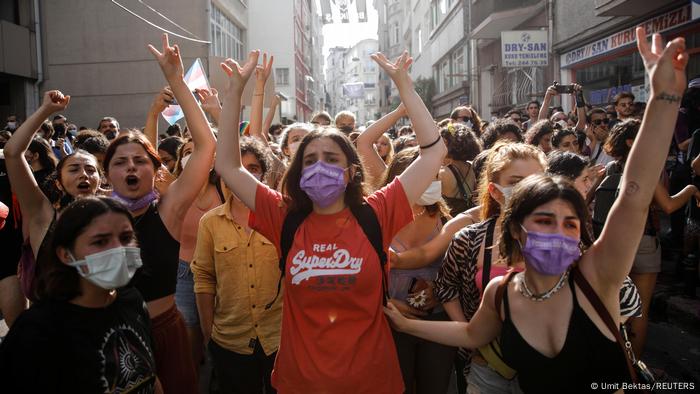
Critical of conservative gender views: Young demonstrators gathered for a Pride Parade that was banned in Istanbul in 2021

"I think Korean society is similarly conservative as ours," argues Gunes, a 23-year-old Turkish student and huge K-pop fan, adding that she can't understand the current fuss. It's absurd to claim that the stars are calling for gender neutrality or homosexuality, she says.

The fact that the male singers use makeup, paint their nails, dye their hair and wear colored contact lenses for their performances is part of their musical culture and not unusual these days, Gunes says, adding, "It's part of the process of setting oneself apart and making an impression."

Gunes doesn't think K-pop can be silenced in Turkey. "In Korea, being an idol is a huge thing. People work very hard for it. And the fan culture is also very big. It's now established in Turkey as well. Maybe we're even one of the biggest fan bases. You can't get rid of these bands."

Generation Z wants freedom, equality and justice


The Korean stars sing about the pressure to perform and the desire for self-determination — issues young people in Turkey share.

In parliamentary and presidential elections in 2023, more than 11% of the vote will be in the hands of Turkey's Gen Z, a generation President Erdogan would have preferred to see become a "religious youth."

A hashtag currently trending in Turkey, however, is #oymoyyok — #NoVoteForYou.

In a survey, young people indicated the values most important to them: Freedom, equality and justice — none of which are not compatible with censorship.

Tuesday, October 12, 2021

K-pop fans vs Duterte’s Philippines: Why young voters want change

Purple Romero
10 Oct 2021
Just as Filipino K-pop fans mobilise to vote in contests for their favourite artists, they have organised for typhoon relief efforts and can mobilise for voter education
 [File: AFP/Ted Aljibe]

Filipino K-pop fans are more politically discerning than you might think.

Our capacity to mobilise, strategise and mount campaigns are crucial for sparking voter education and triggering discussions to help young people realise how much power they hold in influencing not just the outcome of the 2022 presidential election, but also the future of the Philippines.

Just as K-pop stans (super fans) like myself mobilise to vote for our favourite idols – be they solo artists or members of a group – to win music contests, we can also marshal other stans to register and vote.

As one 22-year-old Filipino graphic artist and K-pop fan tweeted in early September: “If you can vote for your idols, you should also vote for your country too.”

She had participated in an online voter education session which I co-organised to discuss with young people why they should vote and convince others to vote in the May 2022 election.

Mayora, my co-organiser, and I call these sessions #Eleksyonisms, a term which combines the Filipino word for elections (eleksyon) and the suffix -isms, used by Filipino millennials as a playful way to describe a state of mind, circumstance or situation.

We believe that it makes sense to enlist fans in voter education. Today, more than half of registered voters are young and K-pop stans tend to be young.

The online presence of Filipino stans is significant – the Philippines ranked fifth for unique users discussing K-pop on Twitter in 2020 and fourth when it came to tweet volume, after Indonesia, South Korea, Japan and the United States, where K-pop stans claimed to have hijacked a Donald Trump campaign rally in 2020 to engineer a low turnout.

If fans in the US were able to do that, then in the Philippines, fury and discontent with the poor response of Philippine President Rodrigo Duterte’s government to the coronavirus pandemic and the brutal crackdown against his critics in different sectors should push K-pop fans and young people to vote.

It was in November last year when I first saw the potential of K-pop fandoms to generate real change on the ground.

At that time, Typhoon Vamco had wreaked havoc in the Philippines. As a journalist who reports on natural and man-made disasters as well as climate change, I was glued to Twitter for updates – I monitored the number of casualties, the extent of the damage, announcements by government officials.

But then something unusual on my timeline caught my eye.

It was a callout by Reveluvs, fans of the K-pop girl group Red Velvet, for donations. It wasn’t only Reveluvs who were doing this – other K-pop fan communities such as ARMY, fans of the most famous K-pop group BTS, and Blinks, Blackpink stans, were also doing their own donation drives.

More recently, in April, K-pop fandoms organised community pantries to help people who lost their sources of income during the pandemic.

They did this even as they risked being red-tagged – suspected by the authorities as well as Duterte’s supporters of being members of the New People’s Army, the armed wing of the Communist Party of the Philippines.

These displays of civic mobilisation made me see K-pop fandoms in a different light – as communities aware of society’s problems and doing something about them. K-pop fans in different parts of the world have conducted similar activities, but for Filipino stans, there is a common, general sentiment that in the absence of government support, they must step in instead.

Seeing how they were able to translate online callouts to assistance on the ground, with money and donations collected and delivered, made me realise the capacity of fandoms to move in a very strategic manner for causes they believe in. It showed their potential to catalyse voter education for the 2022 elections.

When Twitter Spaces for live conversations started and became a hit this May among K-pop fans, I floated the idea to other stan accounts. That is how I met Mayora, a pseudonym, which means female mayor in Filipino.

She got the name among stans because she conducted online activities for Sones, fans of the group Girls’ Generation.

But Mayora, who requested anonymity for safety reasons, is also an angry Filipina. She is on a mission – she wants a government that will uphold the rule of law.

Unlike other stans I’ve interacted with in our voter discussions, close friends of hers were killed during Oplan Tokhang, Duterte’s state-funded “war on drugs” that led to the killing of more than 6,000 people, according to the numbers provided by the government, although human rights groups say the deaths could be closer to 30,000. This crackdown is now the subject of an investigation authorised by the International Criminal Court into alleged crimes against humanity.

I, on the other hand, have experienced how journalists have been dismissed as enemies of the state. Reports, including mine, that were critical of the current government have been labelled by online netizens as “fake news,” a term that authoritarians have bandied around, contributing to an environment of distrust towards mainstream media.

My search for other ways to inform the Filipino audience – especially young people – about political issues, and Mayora’s anger at the Tokhang operations, led us to start #Eleksyonisms.

On September 12, Mayora and I held the first #Eleksyonisms. The discussion, which lasted for more than two hours, centred on the importance of registering as a voter and concerns about the election itself – how can it be conducted when COVID-19 cases continue to be high in the Philippines and social distancing should be observed? There are also fears that cheating could take place. Some also asked what qualities they should look for in candidates.

One listener told us they needed discussions like this especially because of the shrinking sources of information on mainstream media following the decision of Congress in July 2020 not to renew the franchise of ABS-CBN and force the closure of the country’s biggest broadcast network.

Different K-pop fan Twitter accounts have also started their own voter education campaigns.

ARMY BAYANIHAN⁷, for example, which has more than 6,000 followers, first posted a campaign earlier this year on voter registration in partnership with iUplift Philippines, a student-led humanitarian response initiative. Project 0613PH, which helps ARMYs understand or navigate the mobile voter registration app, started in June.

Both accounts share details about voter registration and help fellow ARMYs who need guidance about the process. They plan to conduct online discussions.

Neither will endorse any particular candidate or political group. The same goes for Mayora and me.

The filing of candidacies ran until October 8, and Duterte, who retracted an earlier statement that he will run for vice president, is now retiring from politics. His longtime personal assistant, Christopher “Bong” Go, filed his candidacy for the same post instead.

Mayora and I want to help voters know more about the weight of their vote. We will help them understand how the government works – the president’s powers, the lawmaking processes, and the priorities for fund allocation in relation to the pandemic response.

While we do not plan to hijack campaign rallies, spurring Filipino K-pop stans to go out and vote is our way of disrupting the status quo and empowering voters. Our anger counts – and we can turn our anger into action.

The views expressed in this article are the author’s own and do not necessarily reflect Al Jazeera’s editorial stance.


Purple Romero is a Filipina multimedia journalist who has written about climate change, gender issues, foreign affairs and labour rights for local and international news organisations.

Tuesday, December 10, 2024

GEN Z DEFENDS DEMOCRACY

K-pop light sticks fire up impeachment protests in South Korea


Protesters take part in a rally calling for the impeachment of South Korean President Yoon Suk-yeol, who declared martial law, which was reversed hours later, near the National Assembly in Seoul, South Korea, Dec 8, 2024.

REUTERS
December 09, 2024 11:30 PM


SEOUL — While South Korean protesters have long employed songs, dances and chants, customised light sticks popular with K-pop fans have emerged as an effective new tool for demonstrators calling for the impeachment of President Yoon Suk-yeol.

Tens of thousands of protesters have braved near sub-zero temperatures and gathered outside the National Assembly in the capital of Seoul since Yoon's failed martial law attempt last week.

"Impeach, impeach. Impeach Yoon Suk-yeol," protesters chanted to the beat of K-pop group aespa's latest techno track "Whiplash."

Videos of synchronised chanting and light stick movements in unison at the protests have gone viral on social media along with flags carrying messages and memes from mainly younger demonstrators.

"Give us geeks the freedom to only worry about geek things," one meme flag carried on a flagpole at Saturday's protest read, capturing the mood among young people amid deepening political turmoil.

One of the advantages of the light sticks is how sturdy they are, said Kim Do Heon, a Seoul-based music critic.

"It also shines very bright and comes in a size that is easy to carry around."

South Koreans are playing the long game, said Shin Jae-yun who came out to protest against Yoon with a light stick for K-pop boy band TREASURE, because protests are a "very painful act" yet there is no guarantee things will improve right away.


"To endure such pain, you have to have something to enjoy in it so that people can stay hopeful for a long time even when it drags on," Shin said.

Playlists of popular K-pop protest songs are also being shared on X. Kim Byung-joo, a lawmaker from the main opposition Democratic Party, jumped on the trend on Monday and posted a playlist on the platform: "Impeach Yoon Suk Yeol, ringleader of treason!...from folk songs to K-pop."

South Korea has a rich history of protest since democracy took root in the 1980s after a series of military interventions. Demonstrations over worker rights, threats from neighbouring North Korea and perceived government failings have sometimes turned violent in the past.

Lee Seul-gi, a 36-year-old woman who is a fan of K-pop boyband ATEEZ, said the impeachment protests this time around have become more accessible.

"Previous rallies might have been a bit violent and scary. But the light sticks and K-pop have lowered the barrier," Lee said.

Protesters holding K-pop idol sticks attend a rally calling for the impeachment of South Korean President Yoon Suk Yeol, who declared martial law, which was reversed hours later, near the National Assembly in Seoul, South Korea, Dec 8, 2024.
PHOTO: Reuters


Candle upgrade

Until 2016, candles were prominent at many protests and played a central role in the rallies that led to the impeachment of former President Park Geun-hye.

Park was ousted over a graft scandal and was later jailed over the scandal that exposed webs of corruption between political leaders and the country's conglomerates.

"So many people were holding candles, putting paper cups over them and carrying them out so they wouldn't go out. But now the age of the light sticks is here, not candles," music critic Kim said.

Stephanie Choi, a researcher at the State University of New York at Buffalo, said the light sticks still reflect the "power of solidarity while maintaining the original meaning of non-violence."

While men and women from all age groups are gathering and calling on parliament to impeach Yoon, young women are outnumbering their male peers at the protests.


Yoon vowed to abolish the gender equality ministry before taking office and was an unpopular candidate with women voters in their 20s in the 2022 presidential election.

He won office in 2022 by the slimmest margin in South Korean history but his party suffered a landslide defeat in parliamentary elections earlier this year.

The K-pop industry is notoriously apolitical and so are the lyrics of many K-pop songs playing at the impeachment protests. In South Korea, celebrities expressing political opinions are often frowned upon.

But experts say fans are conscious of K-pop's power and the underlying messages of female empowerment it carries.

"K-pop is a female-dominant space...and their feminist demands have shaped K-pop's aesthetics and performances today," Choi said.


Kim Da-in, a 19-year-old fan of virtual idol group Plave, said the impeachment protests are uniting all K-pop fandoms.

"Here, I feel that we are citizens of South Korea first before we are idol fans."


After Yoon's martial law order, South Korean protester recalls strongman military rule

Source: Reuters

Tuesday, November 07, 2023

K-pop seduces youth in communist Cuba, birthplace of salsa


By AFP
Published November 6, 2023

Many Cuban K-pop fans have dreams of traveling to Seoul - 
Copyright POOL/AFP JONATHAN ERNST

Jordane BERTRAND

In Cuba, the home of salsa, young people are being seduced by a music phenomenon from a place that could hardly be more geographically — or ideologically — remote.

K-pop, the South Korean sensation that has already swept over much of the rest of the world, has made it to the shores of a communist isle that once banned the music of the Beatles.

“I am myself (with) K-pop. I can free myself,” said afficionado Mikel Caballero, a 17-year-old who like many of his peers, spends hours each week perfecting the carefully choreographed paces of South Korean sensations like BTS and Blackpink.

Since Cubans gained access to the mobile internet just five years ago, much has changed in a nation where the one-party state nevertheless retains a firm grip on many aspects of life.

There are ride and food-delivery apps, social media, and access to some entertainment sites such as YouTube.

Some Cubans now celebrate Halloween, one of the most quintessential festivals of the United States — which has held sanctions against Caribbean nation for more than six decades.


– ‘I like everything’ –


Caballero’s friend Samyla Trujillo has been a K-pop devotee for the last four of her 14 years on Earth.

“When I saw BTS… I told myself: ‘I want to dance like them,” Trujillo told AFP, her hair dyed bright red in homage to the fashion of her idols.

“And then, when they showed me Blackpink, I thought: ‘Ooh, they’re girls, I want to be like them!”

She has posters and T-shirts plastered with K-pop artists’ faces, and watches K-dramas with subtitles.

In the house she shares with her grandmother in the capital Havana, Trujillo regularly transforms the lounge into a dance floor for her and Caballero to practice the steps for their K-pop routines.

It is serious business: one day, Trujillo — who was in a traditional Caribbean dance troupe as a child — hopes to become Cuba’s first home-grown K-pop idol.

For Trujillo and Caballero both the dream is to go to Seoul one day. “I like everything from there,” the 17-year-old told AFP with bright eyes.

Cuba has diplomatic ties with fellow-communist nation North Korea, but not with its democratic neighbor to the south.

– ‘Completely new’ –

Alejandro Achin, 21, said K-pop “is a completely new experience” for Cubans, who are “used to always the same rhythm, the same routine” of salsa and Reggaeton.

In 2019, Achin realized a personal dream of performing in Seoul after winning an amateur K-pop competition with his group in Havana.

For Hohyun Joung, who teaches at a South Korean cultural and language center which opened its doors in the Cuban capital last year, K-pop has a universal appeal that transcends politics.

“In Korean songs… most of them express the concerns of young people, what they think, their concern about the future,” the South Korean national told AFP.

The center where she teaches with four Cubans has 150 students and not enough space to admit more as the appetite for everything South Korean just keeps growing.

Student Ia Gonzalez, 20, has been learning Korean at the center for several months and gets excited every time she recognizes a word in some of her favorite K-pop songs.

“Korean is not difficult. There are difficult parts, but when you really love what you’re doing, you invest impetus and passion and you can learn,” she told AFP.

Sunday, September 28, 2025

K-POP

How East Asia, by way of BLACKPINK, BTS et al, has redefined global pop culture


How East Asia, by way of BLACKPINK, BTS et al, has redefined global pop culture
BLACKPINK members (L-R) Lisa, Rose, Jisoo and Jennie with their honorary MBEs / royal.uk
By Mark Buckton - Taipei September 29, 2025

Twenty-five years ago, the notion that the centre of gravity in global pop music might shift away from Los Angeles, London or any of a number of Western capitals might have sounded far-fetched.

Yet today, the evidence is unmistakable: first Japanese pop, then Korean pop, has turned East Asia into the most potent cultural export engine of the early twenty-first century. In terms of reach, fan loyalty and the all-important concept of soft power, neither the United States nor Europe has produced anything to match it in decades.

Japan

In the late 1990s and early 2000s, J-pop emerged as a formidable force across the region. Groups such as the all-girl group Morning Musume and five loveable but somewhat zany lads in SMAP dominated Japan’s highly choreographed entertainment industry while also finding enthusiastic audiences across East and Southeast Asia.

At the same time, solo artists like Ayumi Hamasaki and even the US-based Utada Hikaru topped charts in Japan and overseas, with Utada’s English-language debut Exodus perhaps the earliest indication of Japanese ambitions to one day cross over to Western markets.

The magic lay in a combination of flair and formula. The Japanese idol system perfected model training, branding and relentless media exposure on TV shows, by way of manga tie-ins, and through merchandising that turned performers into household names long before social media ever existed.

For a brief period just after the turn of the century, Tokyo rivalled London and New York in shaping the pop world. In the eyes of Asia – Tokyo led by a length or more.

Yet J-pop remained curiously inward-looking. Regional sales across Asia were strong, but language barriers coupled to conservative management practices and what seemed like a fear of overseas touring meant Japanese acts never truly broke into Western consciousness.

As many in the entertainment industry predicted though – it was only a matter of time. The blueprint had been produced and, somewhat ironically, it would be acts from Japan’s biggest rival - South Korea – that would pick up the baton and run with it onto the global stage.

South Korea

To this end, by the mid-2000s, Seoul’s entertainment companies had not only learnt from Japan, they had refined the way things were being done in Tokyo.

The ‘idol system’ as it existed, and as it still does in Seoul, operated with near-military precision by adding a sharper global outlook. Trainees were selected with the stamina of athletes and groomed intensively in dance, vocals, and multiple languages.

The result was K-pop, a meticulously engineered cultural product tailor-made for the YouTube, Twitter and more recently, TikTok era.

Girls’ Generation’s Gee (2009) was an early breakthrough, smashing Korean chart records and catching attention across Asia – including back in Japan where the idol-turned-singer / entertainer industry started.

But it was PSY’s Gangnam Style in 2012 that truly exploded worldwide, becoming the first YouTube video to surpass a billion views and introducing Western audiences to the phenomenon that is – and remains - Korean pop.

From there, a succession of acts built empires across Asia and increasingly into the Western world that J-pop could only dream of. The boy-band BIGBANG and girl-band 2NE1 commanded stadiums across continents. EXO and TWICE became household names across Asia. BTS – all boys – were up next and all but redefined the global pop culture landscape.

BTS and the mainstream

Where J-pop hinted at East Asia’s potential, BTS made it undeniable. Formed by Big Hit Entertainment (now HYBE), BTS started with modest expectations but quickly grew into the biggest boy band in the world, eclipsing even the heights of the Backstreet Boys or One Direction.

Hits like DNABoy With Luv, and Dynamite racked up billions of streams. BTS topped the Billboard Hot 100, sold out Wembley Stadium in London, and even addressed the United Nations.

Their fandom - ARMY (meaning "Adorable Representative M.C. for Youth") - became a global movement in its own right, organising online in ways that blurred the line between fan club and political force.

During the 2020 US presidential election campaign, ARMY’s coordinated hashtag campaigns and playful interventions drew attention even from analysts.

No Western pop act in the past 25 years has commanded such sustained global devotion, and while The Beatles may for all time remain the benchmark for influence, in terms of scale, infrastructure and digital reach, BTS in Asia and much of the rest of the world at least, surpasses the Fab Four.

BLACKPINK

Then came Lisa, Jennie, Rose and Jisoo – BLACKPINK.

While BTS rewrote the rules for boy bands, BLACKPINK reshaped girl group dynamics and have since taken the world by storm – routinely selling out stadiums across the US and Europe including Citi Field in New York, Wembley in London and Stade de France in Paris. Their 2019 Coachella performance, the first by a K-pop girl group, was a watershed moment, cementing their place in Western festival culture.

In the meantime, the world still has stars produced in the West - Taylor Swift remains a global powerhouse, commanding sold-out tours as do Billie Eilish, Harry Styles, and Dua Lipa.

But K-pop, built on the foundations of J-pop, sets itself apart in the scale and intensity of its fan ecosystems. No American or European act has a global, multilingual fanbase mobilised with the devotion of ARMY or BLINKs (BLACKPINK’s fans).

No Western artist gets close to combining the music, choreography, fashion collaborations, and constant digital engagement to the degree K-pop groups do. Behind the scenes, K-pop operations resemble Silicon Valley start-ups more than traditional record labels. Data-driven marketing, global auditions, multilingual strategies and perfectly timed release schedules make Western models look sluggish by comparison.

It is something even governments have noticed. South Korea’s government openly embraces K-pop as a cornerstone of its national brand, integrating it into cultural diplomacy. The “Korean Wave” (Hallyu) encompasses not only music, but also TV dramas, film and even cosmetics, amplifying Seoul’s soft power far beyond its size.

Japan, despite inventing the idol system, never leveraged pop culture in quite the same way. Its anime industry remains influential, but in music, it is South Korea that now leads.

Geopolitics

And the geopolitical stakes are real. When BTS visited the White House in 2022 to speak on anti-Asian hate crimes, it both made headlines around the world while at the same time highlighting how a pop act can double as a diplomatic envoy.

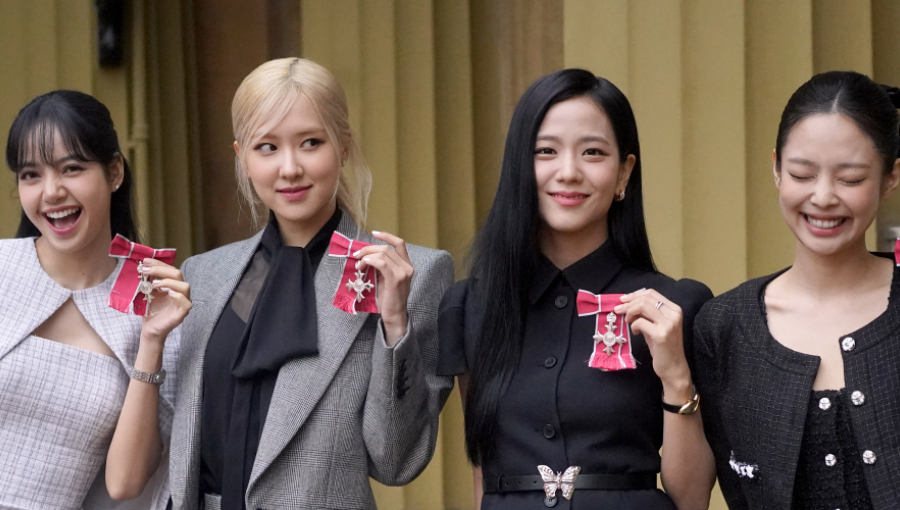
This was followed in an even more renowned setting by BLACKPINK when they were invited to Buckingham Palace in November 2023, to receive an honorary MBE – see pic above – an event marked by a post on X by the UK’s Royal Family account stating: “The King, joined by The President and First Lady of the Republic of Korea, has welcomed @BLACKPINK to Buckingham Palace, as they are awarded Honorary MBEs,” continuing “The K-pop band have been awarded the honours in recognition of their role as Advocates for the COP26 Summit in Glasgow.”

Beyond Korea

The only big question now is whether K-pop’s dominance will endure, or if others will catch up. China has experimented with idol groups, though censorship and restrictions on fan culture have limited their global impact. Other countries in Asia are dabbling but nothing yet compares to the efforts and levels of success reached first by Japan, and later Korea.

What is clear is that the US and Europe no longer control global pop culture. In the streaming age – viral choreography, visuals, and digital content comes from the East.

Tuesday, September 10, 2024

K-pop fans in Havana -
 
Copyright © africanewsRamon Espinosa/Copyright 2024 
The AP. All rights reserved
By Rédaction Africanews

Even socialist Cuba, the birthplace of salsa and many other rhythms that conquered the world, has surrendered to the invasion of South Korean pop music.

Thirteen-thousand kilometres separate the Asian nation and the Caribbean island, as well as their completely different languages and cultures.

However, all of these differences vanish in a second for the young people who attended "discorea", a dancing place for K-pop enthusiasts.

Twenty-four-year-old Francisco Piedra, who adopted the artistic name 'Ken,' never misses an event and rehearses every day.

He aspires to be a K-pop choreographer.

"K-pop has given me happiness, it has given me a world where I can be myself. I can enjoy laughing, singing, dancing, and expressing myself as I really am,” he said.

Dedicated fans gather in the capital, Havana, almost every weekend to show their moves and exchange the latest gossip on their favourite K-pop artists.

Earlier this year, Cuba and South Korea re-established diplomatic relations that had been severed after the Cuban revolution in 1959.

However, K-Pop made its way to the island around four years ago when mobile internet service for cell phones finally became available.

The K-pop tribe, as they like to call themselves, uses their phones to stay updated on the latest K-pop songs and dance moves.

Tania Abreu is an electronic engineer by profession and the leader of the Macrocosmos cultural project specialising in this genre.

She said K-pop has become popular not only because of the quality of the music but also because the songs touch on social issues that are common in Cuba.

“When the kids found out that it is a beautiful music, very beautiful music, that has nice lyrics, they started to download them and identified with that world,” she said.

There is no exact number of people participating in this mostly youthful K-pop movement, but she said several thousand people are involved and are very visible in Havana and Santiago de Cuba.

Friday, October 06, 2023


K-pop fans helped COVID-19 public health messaging go viral


Tweets that mentioned the Korean group BTS, spurred record levels of global engagement

Peer-Reviewed Publication

DARTMOUTH COLLEGE

U.S. map illustrating percentage of increased viral boosts of COVID-19 public health tweets mentioning BTS, by state. 

IMAGE: 

U.S. MAP ILLUSTRATING PERCENTAGE OF INCREASED VIRAL BOOSTS OF COVID-19 PUBLIC HEALTH TWEETS MENTIONING BTS, BY STATE. 

view more 

CREDIT: MAP BY HO-CHUN HERBERT CHANG.


Three years ago, as part of the public health messaging in response to the COVID-19 pandemic, the World Health Organization launched the "Wear A Mask" campaign on social media.

However, despite their benefits to public health, mask-wearing quickly became a highly politicized and divisive issue across the globe.

But the campaign gained impressive traction after World Health Organization Director-General Tedros Adhanom Ghebreyesus issued the following tweet on X, the social media platform known at the time as Twitter, on August 21, 2020, thanking BTS, a South Korean K-pop group, for supporting the mask-wearing public health practice as part of the release of their new single, "Dynamite":

     "Thank you, #BTS for the uplifting #BTS_Dynamite and for reminding the #BTSARMY and the rest of us to #WearAMask and take care        of our health and well-being during this #COVID19 pandemic."

K-pop fans with different ideologies and from throughout the globe retweeted Tedros' message making it the most shared mask-wearing tweet.

When health officials and agencies such as Tedros leveraged entertainment groups like "#BTS" into their public health messages on COVID-19, this generated 111 times more virality or retweets, according to a new Dartmouth-led study.

The results are published in Online Social Networks and Media.

"With the COVID-19 pandemic, government health agencies often became targets of partisan politics that challenged public health messages," says lead author Ho-Chun Herbert Chang, an assistant professor of Quantitative Social Science at Dartmouth. "If government officials and opinion leaders can leverage entertainers who are perceived as neutral third-parties, this creates a powerful driving force for getting a public message out."

"Through our study, we wanted to determine if social media still has the power to serve as a democratizing force as it did in 2010," says Chang.

Social media was perceived as such during the Arab uprisings in 2010 and 2011 when pro-democracy protestors took to social media to speak out against the authoritarian regimes in Tunisia and Egypt.

"But after Brexit in 2016, when the United Kingdom officially voted to leave the European Union and the Cambridge Analytica data breach in 2018, people became quite pessimistic towards social media and its lightning speed spread of misinformation as studies reported on how social media can undermine democracy," says Chang.

The researchers focused on one simple question: Who was the biggest voice on social media driving public health practices, particularly, mask-wearing?

Using the largest and most comprehensive public COVID-19 dataset on Twitter, the researchers analyzed 7 million tweets on mask-wearing. The team applied natural language processing to extract the tweets from a dataset of 3.5 billion tweets and then conducted a social network analysis to figure out how the tweets travel through the social network. They also looked at the use of K-pop specific hashtags: #BTS and #BTSArmy, as well as BlackPink and Twice, the two other most popular K-pop groups on Twitter.

The findings show that leveraging the popularity of BTS was part of the WHO's communications strategy on COVID-19 public health messaging.

The 16 unique tweets by health officials containing BTS, most of which were tweets by Tedros, generated nearly 234,600 retweets. In comparison, Dr. Tedros' 2,140 other tweets that did not mention BTS yielded 282,650 retweets. The 16 tweets mentioning BTS packed nearly the same punch (84% of the retweet value) as that of the 2,140 tweets without K-pop. So, tweets mentioning BTS garnered 111 times more virality or retweets.

The team also investigated the rates of mask-wearing tweets with and without BTS in all countries that use Twitter, which included assessing the rate of tweets in a country relative to its population.

Tweets with K-pop saw a huge uptake in Western countries with the U.S. at the top. However, the increase of virality between retweets with K-pop over those without K-pop was largest in the global south, including in Southeast Asia and South America, which as the researchers explain, are regions that are typically underserved by Western-based global organizations, while the West had a modest increase. The retweet data showed Vietnam had a 3,840% increase (38.4 times more virality), South Korea had a 3,190% increase, Philippines had a 1,290% increase, Peru had a 1,080% increase, and Argentina had an 845% increase. In contrast, the U.S. had just a 56% increase and the United Kingdom had a 28% increase. 

For BTS-related tweets in the U.S., the biggest viral boosts by percentage were observed in South Dakota (52%), North Dakota (41%), Mississippi (39%), Missouri (39%), Utah (37%), Louisiana (37%), Wisconsin (36%), and Nebraska (33%), most of which are heartland states. 

As part of the analysis, the researchers examined users' political diets (left, center, and right) and the timelines of users, which enabled them to plot a retweet network of users before and after the Aug. 21, 2020, tweet by Tedros over a four-month span.

While left-leaning users dominated the network, the results showed that use of the #WearAMask hashtag by right-leaning users increased significantly after BTS' appearance at the United Nations General Assembly

Apart from K-pop, tweets mentioning Eric Ding, chief of the COVID Response Task Force at the New England Institute and Grey's Anatomy, the American medical drama, were the two other most popular drivers of mask-wearing messaging.

"There is a lot of criticism over hashtag activism; however, to support South Korea's COVID-19 relief efforts, BTS fans donated money and ticket refunds from BTS concerts cancelled due to the pandemic, showing that the organizing potential of fandoms should not be underestimated," says Chang.

"Fandoms can act as powerful catalysts for online and offline collective action," says Chang. "They can generate interventions at a global scale."

Chang is available for comment at: herbert.chang@dartmouth.edu. Becky Pham and Emilio Ferrara at the University of Southern California, Los Angeles, also contributed to the study.

Sunday, May 29, 2022

‘We want Filipinos to hug themselves’: the P-pop stars reconnecting with their culture

Alamat are aiming to bring their music to the world – by singing in their local languages


Filipino boy group Alamat at Viva Studios in Quezon City. 
Photograph: Alecs Ongcal
WITH TRADITIONAL FILIPINO MARTIAL ARTS FIGHTING STICKS

Rebecca Ratcliffe and Lorna Bayani
Sun 29 May 2022

Vocal coach Zebedee Zuñiga twists his hand in the air, and the melody of a tender, haunting lullaby, Ili Ili Tulog Anay, begins. “Little one, little one, sleep now/ Your mother is not here / She went to buy some bread,” sing the six members of Alamat, sitting in a circle. Then hip-hop beats kick in; the traditional Philippine lullaby, known as oyayi, is merged with more contemporary sounds.

It’s a Monday afternoon at Viva records’ studios, and Alamat, one of the label’s rising acts, are rehearsing their next single. They’re part of a new wave of bands, often referred to as P-pop, flourishing in the Philippines.

Over past decades in Japan and South Korea, J-pop and later K-pop, emerged as huge cultural exports. K-pop is now a multibillion-dollar industry; last year Korean band BTS were the bestselling act globally, for the second year running. In the Philippines, record labels are hoping the country’s music scene could get a share of that global success.

P-pop bands are influenced by K-pop, but there is also a growing willingness to experiment with the Philippines’ own diverse languages and culture, which are sidelined by the country’s mainstream pop culture.

Such music has developed loyal fanbases at home, and is beginning to find success abroad too. Alamat’s debut single, Kbye, debuted at No 2 on Billboard’s Next Big Sound chart, while fellow P-pop band SB19 were nominated for Billboard’s top social artist category last year.
A member of Alamat. Each is from a different part of the country and sings in his own ethnic language. Photograph: Alecs Ongcal/The Observer

Korean and Filipino entertainment companies are investing in the trend in the hope of finding the next global stars, says Ian Urrutia, music writer and founder of Nyou Philippines, a Manila-based music and entertainment PR agency. “In terms of production and music-making process, a lot of entertainment companies have hired top K-pop producers to kickstart their talents,” he said.
Advertisement

Jason Paul Laxamana, Alamat’s creative director, says he hopes to adopt the coaching and discipline that has shaped Korea’s pop industry – “and the fact that K-pop was able to dominate the world without having to drop Korean”.

For Alamat, language is especially important. Each member of the group comes from a different part of the country and sings in their own ethnic language. As well as Tagalog, the Philippines’ main language – these include Ilocano, Kapampangan, Bicolano, Waray-Waray, Bisaya and Sambal.

It’s highly unusual for mainstream pop. “There’s a notion that one language is superior to others,” says band member Taneo. “It’s part of our mission to have especially the younger generations be proud of their own roots.”

Laxamana remembers being a student and wondering why he never heard songs in his ethnic language, Kapampangan, played on the radio. Little has changed since then. “All I heard was songs in English, Tagalog, and eventually Korean,” he says. Shopping malls are reluctant to play songs in other Philippine languages, believing that they are less glamorous. So too are some radio stations, he adds.
Alamat rehearse a dance routine.
 Photograph: Alecs Ongcal/The Observer


Philippine languages – there are as many as 182 – are often wrongly downgraded as dialects, says Dr Ruanni Tupas of University College London, who has researched the role of Philippine languages in P-pop. “This is how colonial education was formed in favour of, for example, the English language. English was taught as a language but the rest of the Philippine languages as dialects.”


Speaking Philippine languages is associated “with coming from the provinces, with the lower class. It’s associated with being uneducated,” Tupas adds. “It has always been attached to Filipinos losing their own confidence in themselves.” Bands such as Alamat and SB19 have helped change this perception, he says.

Much of Alamat’s performance is rooted in Philippine culture. Their outfits blend modern streetwear with references to traditions from across the country – from Tayum, the indigo clothes worn by Kapampangan men, to the tattoos of Kalinga warriors and the colourful sails of the Vinta (small boats) of Zamboanga.

Choreography and melodies also reflect the country’s musical heritage – from Kundiman, a Philippine serenade, to folk music.


Indigenous languages project urges Cop26 leaders to rethink ties to the land


Ili Ili Tulog Anay is a Hiligaynon lullaby, traditionally sung by a nanny or sibling to a baby while their mother is away. Alamat’s version uses the song to explore the emotions of children whose parents work for long stretches overseas – 1.77 million Filipinos did so in 2020.

“I think it will resonate with a lot of Filipinos,” says Laxamana, whose father has worked abroad since he was a child. “The big brother tries to comfort the siblings, telling them that our parents will be home some day. But right now, you know, we are poor. So we need to work, we need to sacrifice,” he says of the lyrics. Other songs touch on social issues such as the legacy of colonialism and racism – with music videos referencing the oppression of the first Filipino Americans, and continued colourism with Philippine society.

Alamat’s supporters believe the group’s distinctive style could help them to stand out internationally. But the band members say that, for now, their focus is on growing, and shaping attitudes at home. “We want fellow Filipinos to dance and sing to our music and to make them proud of our own cultural diversity and our multilingualism,” says band member Jao.

“We want them to hug themselves.”