Showing posts sorted by relevance for query SEA SERPENTS. Sort by date Show all posts

Thursday, December 30, 2021

‘This thing meant business’: 1976 sea creature encounter off southwestern NS revisited

Kathy Johnson | Posted: July 7, 2021


CAPE SABLE ISLAND, NS – It was 45 years ago, between July 5 and 9, 1976, that five Cape Sable Island fishermen fishing off southwestern Nova Scotia on three different boats, on three different days, had encounters on the same fishing grounds with a sea creature unlike anything they'd seen before.

It’s certainly an experience 69-year-old Rodney Ross has never forgotten.

He's the only fishermen of the five still alive.

1976 story in the Yarmouth Vanguard. - File Photo


The encounters


The late Eisner Penney was the first to have an encounter – on July 5, 1976 – when fishing on Pollock Shoal, about eight to nine miles off the southern coast of Cape Sable Island, recalls Ross.

“Eisner seen it on a Monday,” Ross says. “When he got done fishing he was headed home and noticed this thing chasing him was out of the water, probably 10 to 15 feet out of the water and it chased him three, four miles or more and kept picking up steam. He didn’t lose it until he got into real shoal water – what we call the horse race – and it went under.”

When Ross set sail with his father Keith for Pollock Shoal two days later, they were unaware of Penney’s encounter.

“We went there Wednesday," he says. "We were fishing, doing pretty good, the tide started to go, so dad went down in the cud to get something to eat.”

Ross continued fishing on the deck. Back then they hauled by hand. No machines. He was getting one or two fish every sound.

But then, he says, it was like everything died.

"The gulls disappeared. The hags disappeared. I made three or four sounds, but nothing," he says.

"I could hear this noise like a swishing noise. It was thick fog . . . I seen this black thing coming through the water. It was like a hump, three or four feet out of water – this hump with two big eyes."

South Side fisherman Rodney Ross looks through his collection of memorabilia about the sea creature he and four other fishermen including his father Keith seen between July 5 and 9, 1976, on the Pollock Shoal off Cape Sable Island’s southern coast. 
KATHY JOHNSON

What is that?


At first he thought it was a sunfish and called to his dad to come out and see what he thought it was. He peeked out and said, "sunfish," but when the thing came back seconds later, his father didn't know what to think.

"He realized it wasn’t a sunfish. We watched this thing 15, 20 minutes. It would swim down by, pretty near go out of sight, swim back up to the westward and not one time would it look at us. It never went under. A whale, you can hear them a mile away. Not once did this thing blow."

"It was like it was ignoring us except for this one time. He turned and was looking right at me.”

Ross estimated it was about 70 to 80 yards from the boat.

“Dad went up and started the engine. We knew something was going to take place. It started coming for the boat. It kept coming, rising out of water. The last of it – it was about 15 feet out of water and opened his mouth. He was coming aboard. He was after me," says Ross.

"Dad waited until it was about 15, 20 yards away and opened it wide open and we shot ahead. I ran up underneath the house, turned and looked and could see this big body come out of water. He just clipped the stern of the boat."

"This thing meant business. If we had sat there, we would have been gone. He would have been half way on to the boat.”

Ross says the sea creature “looked liked a giant sculpin with big eyes, bigger than the rest of its body."

"It was full of barnacles, coral and had these rows of teeth – tusk looking things in his mouth. It didn’t have a whales tail, sort of like a cod tail.”
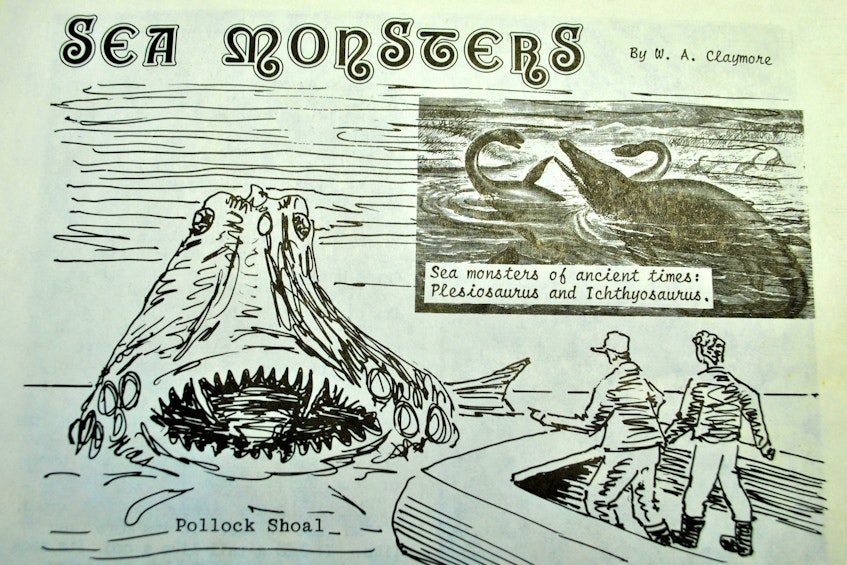

A drawing by the late Keith Ross of what the South Side Sea Monster looked like.
 “My father was no artist, but it did look something like that,” said Rodney Ross.

Their getaway

If it wasn’t for his father’s quick thinking to start the engine and wait until it got just close enough that it couldn’t turn, Ross shudders to think what would have happened.

“If people would have found wreckage of our boat, they would have thought we were run over by a steamer. Who would have thought we got ate by a sea monster?”

At the time of the encounter Ross says the boat was weighted to an anchor.

“We just shot up over the anchor and we could hear it hit the stern of the boat. It kept coming and kept raising out of water probably 10 to 15 feet out of water with its mouth wide open. If it had kept coming the top of his mouth would have been over my head.”

Dumfounded, the two fishermen sat there for about an hour and never spoke.

But "by and by," he says, they heard it again.

The swishing noise.

"We didn’t press our luck. We hauled anchor and took off. We seen this boat on our radar, so we steamed down to the boat. It was Eisner Penney, the guy that seen it Monday. I said to him, 'Eisner you want to get out of here if you see what we just seen,' and I remember him saying just as plain, ‘You don’t have to tell me what you seen because I seen it Monday.'"

That was enough fishing for everyone.

Penney threw everything in the middle of his platform and they all headed in.

As reported in the 1976 Yarmouth Vanguard. - FIle photo


"If there's a devil, that was it"


When fellow fisherman Edgar Nickerson initially heard about the sea creature encounter, he had laughed, according to an interview and story in the July 14, 1976, Yarmouth Vanguard newspaper.

“I thought it was funny. As a matter of fact, on Friday I bragged on my radio that I had Pollock Shoal all by myself,” he had said in the interview.

Only they weren't alone.

Nickerson and his 15-year-old son Robert were pulling gear when the sea creature appeared.

“It kept coming up. I thought it was a whale and I kidded to my son that it was coming after him," he had told Vanguard journalists Fred Hatfield and Alain Meuse 45 years ago.

"I turned on my sounder. That usually scare whales away. But not this thing. It kept coming and coming."

"It was a horrible looking thing I tell you. If there’s a devil, that was it.”

Photos of four of the fishermen from the 1976 Yarmouth Vanguard: Keith Ross, Rodney Ross, Edgar Nickerson and Eisner Phinney. 
PHOTOS BY FRED HATFIELD AND ALAIN MEUSE - File photo

After the encounters, nobody went fishing for a few weeks, Ross says.

“We didn’t go back there that year. When three different boats on three different days seen this creature in the same area, something was there.”

Ross remembers coming home the day after seeing the sea creature and going to visit his neighbours Weldon Cox and Seaton Nickerson, who were retired fishermen that had made a living on the water all their lives.

“They always waved for me to come over, so I went over and told my story. They looked at me and said back in 1930s . . . they told me the names of two fishermen who had an encounter with a creature off here, much the same as what we seen," says Ross, who can’t remember the names he was given.

Ross notes all of the sightings were two days apart and all of the fishermen who saw the sea creature were on fishing boats that were green.

Over the years, he's collected clippings and mementos about the encounter, and about other sea creature encounters that people have sent to him.
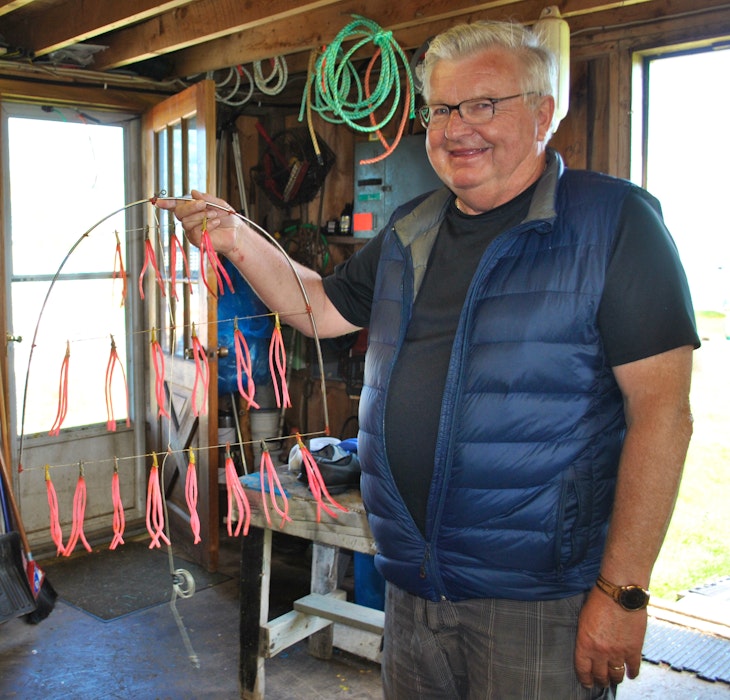
South Side fisherman Rodney Ross still has the handline fishing gear he was using the day he and his father Keith encountered a sea creature on the Pollock Shoal off Cape Sable Island’s southern coast. “This is the actual one that I was using back in 1976. We called it a Christmas tree. My father-in-law made it for me.” 
KATHY JOHNSON - Saltwire network

Ongoing interest


Back in the 1970s or 1980s, Ross gave a talk to the students at the Barrington Municipal High School about the encounter. He still has all the thank you letters and pictures drawn by the students of what they thought it looked like. Whatever they had seen was dubbed the South Side Sea Monster.

“When my father was living, people used to call him all the time,” says Ross. “We had a guy come from Florida one time; he was telling us about how many different things they discover every year. It could be ants, could be anything. Wartime they used to dump stuff in really deep water … it could have been something got into that,” he says, and was deformed.

Or something that was in an underwater cave had gotten out, or some sort of prehistoric thing, speculates Ross.

“Who knows what’s out there? It’s a big ocean,” he says.

Ross says he's usually contacted several times a year from someone wanting to know about the encounter.

Last fall Ross he was contacted by award winning author Max Hawthorne of New York who wanted to include Ross’s experience in a book he was writing. The book, 'Monsters and Marine Mysteries,' was just released several months ago. “I’m one of the chapters," says Ross.

Ross has only publicly spoke about his encounter a few times over the years. One of his presentations made in 2017 – South Side Sea Monster Story – is available on YouTube.
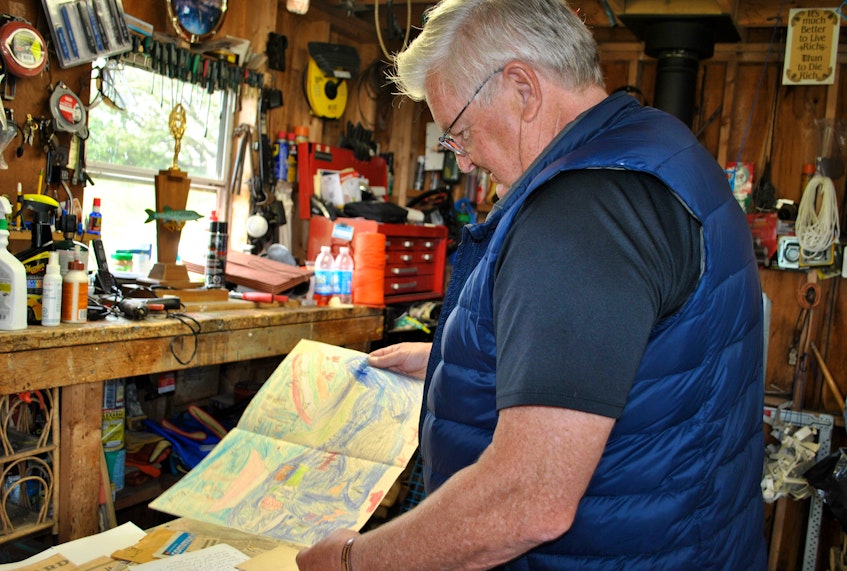
Thank you letters and drawings by students from the Barrington Municipal High School are among the keepsakes in Rodney Ross’s collection about the sea creature he seen in 1976 that was dubbed the South Side Sea Monster.
 KATHY JOHNSON


What's in the ocean? Sea serpent stories


Throughout the years there have been numerous documented sightings of sea serpents, mermaids, mermen, giant lizards and squid, monstrous fish, and a great sea monster in waters off Nova Scotia’s coastline.

The Serpent Chronologies, Sea Serpents and other Marine Creatures from Nova Scotia’s History, published by the Nova Scotia Museum in 2015, “is an annotated, systematic, account of reports of sightings of large serpents and other mysterious creatures recorded in Nova Scotia waters.” It includes Mi’kmaw petroglyphs, elements of captured oral history and documents excerpted from both the popular press as well as the scientific literature over the centuries, reads the abstract.

“Where appropriate, these are discussed in terms of the culture of the times, as well our current understanding of natural history. Illustrations have been created where there was sufficient information recorded, and based on these and the descriptions provided, these drawings reflect the nature of the creatures described in a modern context." it reads. "It becomes evident that the chronology of such reports is a reflection, to a great part, of the state and development of both popular and scientific cultures of Nova Scotia throughout these times.”

The book, available to download as a PDF, chronicles documented sightings from the 1600s up to 2003, when there was an encounter with a sea serpent in Alder Point, Cape Breton.

Written by Andrew J Hebda, the author concludes by saying, “As was pointed out in the beginning: Some of these are true accounts of events while others may be exercises in creativity in writing. In some cases, it is not obvious which is which.

"We should keep in mind what the late Dr. Fred Aldrich was reported to have said when commenting on marine marvels in the North-West Atlantic Ocean: 'We know more about the backside of the moon than the bottom of the sea.'”
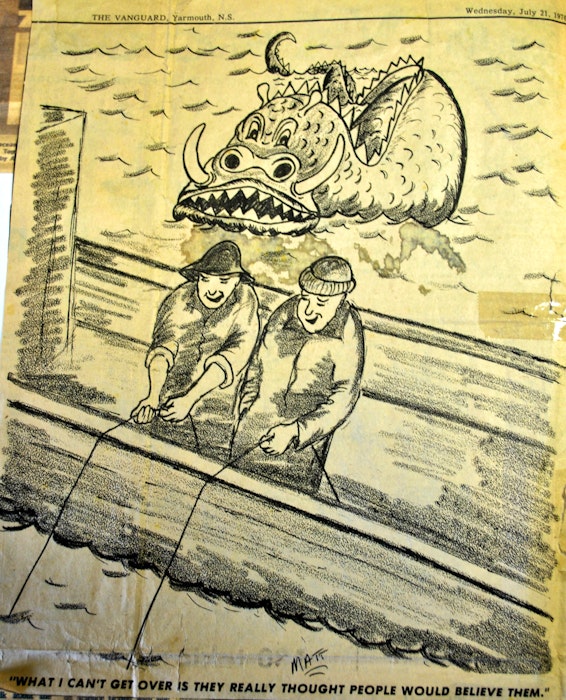
An editorial cartoon in the July 21 1976, Vanguard.

Wednesday, January 24, 2007

Nessie?

Could this mysterious prehistoric dinosaur shark be the creature behind the Nessie mythos? That is the idea of sea serpents even if they are in fresh water.

It certainly qualifies as a 'sea serpent' , and proves that factual experiences underlie the sea serpent mythos.

Another living dinosaur like the Sturgeon and the
Coelacanth , and another entry for my cryptozoology files.

Japanese marine park captures rare 'living fossil' shark

A species of shark rarely seen alive because its natural habitat is 600 meters or more under the sea was captured on film by staff at a Japanese marine park this week.

The Awashima Marine Park in Shizuoka, south of Tokyo, was alerted by a fisherman at a nearby port on Sunday that he had spotted an odd-looking eel-like creature with a mouthful of needle-sharp teeth.

Marine park staff caught the 1.6 meter long creature, which they identified as a female frilled shark, sometimes referred to as a "living fossil" because it is a primitive species that has changed little since prehistoric times.

Frilled sharks, which feed on other sharks and sea creatures, are sometimes caught in the nets of trawlers but are rarely seen alive.

Prehistoric Frilled Shark

Frilled sharks can grow to a length of nearly 6.5 feet and eat deep-sea squids and other soft-bodied preys.


See

Nessie was an Elephant?


They Walk Among Us


Shark

Cryptozology Part 1

Cryptozoology Part 2

Dinosaurs

Fossils


Monsters


Find blog posts, photos, events and more off-site about:
, , , , , , , , ,,
, , , , , , , , , , , , ,

Wednesday, January 15, 2020

CRYPTOZOOLOGY

Taxonomania: An Incomplete Catalog of Invented Species, From the Pop-Eyed Frog to the Loch Ness Monster


Every now and then fantastical species make their way into the scientific literature, taking the scientific community for a ride.
A jumble of old labels from the mammal collection. Museum für Naturkunde Berlin. 
Photo: Michael Ohl By: Michael Ohl

From time to time, sandwiched between the more comprehensive real articles, brief fictional descriptions will find their way into scientific journals. The motivation for doing so varies, but it’s usually with humorous intent. The problem that scientific journals face in publishing such entries is their scientific nature — that is, their responsibility to publish only articles that make verifiable claims about the natural world. Because the journals expect this of their authors, readers expect the same of the journal and rely on the belief that every article will meet general scientific standards. Unless directly obvious, fantastical works not based on scientific methods can quickly and often irreparably damage the reputation of a journal.
This article is excerpted from Michael Ohl’s book “The Art of Naming.”

Austrian entomologist Hans Malicky used this to his advantage. Malicky is known outside Austria as a prominent expert on caddisflies. In the late 1960s, he chaired the Entomological Society of Austria; in this position, he also published the society newsletter, the Entomologische Nachrichtenblatt. The bulletin primarily published anecdotal and not infrequently irrelevant articles on a range of insect-related news items. As its editor, Malicky pushed for raising the scientific standard. The society saw things a bit differently, it has been said, and Malicky was summarily relieved of his post. A short time later, Malicky submitted an article to the society’s other publication, the Zeitschrift der Arbeitsgemeinschaft Österreichischer Entomologen, using the pseudonym Otto Suteminn. The focus of the piece, which appeared in 1969, was two new flea species from Nepal, Ctenophthalmus nepalensis and Amalareus fossorius.

At first glance, nothing jumped out as peculiar about the article: two new species names, complete with morphological descriptions, location of discovery, and author. At first glance, no one could tell that it was all completely fabricated, and because none of the manuscripts submitted to either of the society’s journals went through a process of peer review — something Malicky had wanted to change as editor — the new editor didn’t notice anything was amiss either. The article was published. While insiders close to Malicky saw what was happening, it wasn’t until 1972 that a short article was printed in the Entomologische Nachrichtenblatt by F. G. A. M. Smit, a well-known flea researcher at the Natural History Museum in London. Its title was “Notes on Two Fictitious Fleas from Nepal.” Smit went through the original article line by line, showing that most of the information was invented. Not only the fleas, but also their mammal hosts, Canis fossor (literally, the “canine gravedigger”) and Apodemus roseus (the “pink wood mouse”), are both fictitious, although some of the flea species used for comparison are real. With a little imagination (and linguistic access), a number of the discovery locations provided reveal themselves to be thinly concealed expressions in Austrian dialect. Thanks to an Austrian colleague, Smit was able to provide an explanation for these names: “‘Khanshnid Khaib’ probably stands for ‘Kann’s nit geiba’ (cannot exist)” and “‘leg. Z. Minař’ can sound like a very vulgar (unprintable) expression.” Whether this form of humor is actually funny must be left to the reader to decide. Despite their debunking, Malicky’s two flea descriptions remain in effect to this day, and Ctenophthalmus nepalensis — the fictitious flea hosted by the fictitious “pink wood mouse” — even has its own Wikipedia page. As for Otto Suteminn — supposedly stationed at a regional museum in Košice, Czechoslovakia — he remained a mystery to Smit. The latter had even sent a letter to Suteminn’s address, requesting to borrow the fleas, but he received no reply, nor had the letter been returned. “Suteminn” itself was a pseudonym for Otto von Moltke, a fictitious knight from the region of Mecklenburg in a book by Karl May — a 19th-century adventure writer treasured by Germans and best known for his tales of the American Wild West. At times, the knight secretly retreats to a magical house, where he performs all manner of scientific experiments under the alias “Suteminn.”


Malicky’s two flea descriptions remain in effect to this day, and Ctenophthalmus nepalensis — the fictitious flea hosted by the fictitious “pink wood mouse” — even has its own Wikipedia page.

In 1978, the Journal of the Herpetological Association of Africa, a journal dedicated to the scientific study of reptiles and amphibians, published the description of Rana magnaocularis, the “pop-eyed frog.” The fictitious author is Rank Fross of the Loyal Ontario Museum, a malapropism of the Royal Ontario Museum in Toronto. It’s a short article, little more than a page in length, composed with the structure and style of a legitimate species description. It opens as follows: “Night collecting along roads in Ontario has revealed a new species of frog strikingly characterized by enormous eyes and a flattened body. The species is described below and the adaptive significance of its diagnostic features are discussed.” The diagnosis: “Eyes enormous, protruding tongue usually extended, body and limbs highly flattened dorso ventrally. Dorso lateral fold absent. Otherwise resembles Rana pipiens.” The species could regularly be found in or alongside busy paved roads, especially in the spring. The discussion section is particularly amusing:


Three questions require attention. Of what significance is the peculiar morphology, why is it restricted to a single habitat and how does it move?

Why is the body so flattened and why are the eyes so large? We believe that these are adaptations to the peculiar habitat. Normally frogs are at least partially hidden from potential predators by reeds, grass or bushes. On the road they are completely exposed, however. In evolving a two-dimensional body, the pop-eyed frog is enabled to escape the attention of all predators excepting those immediately overhead. […]

We were at first puzzled as to how it moved from one place to another, observations on live specimens being lacking. Initially we found the tread-like markings found on the upper surface puzzling. Of what use were the treads in locomotion when they were not in contact with the ground? Analogy with the hoop snake offered a hypothesis; the frogs roll themselves into a ring, insert the extruded tongue in the posterior, and roll themselves neatly along, thereby engaging the treads with the road surface.

The description includes a cartoonish sketch of a frog lying in the street with bulging eyes, its tongue fully extended.

It’s clear that this is a description of the many leopard frogs (Rana pipiens) that are squashed in the road each spring. What’s less clear is whether the name can be considered available, according to the nomenclature rules. There certainly aren’t any amphibian taxonomists who would want to include the name in their species lists. If one used the zoological nomenclature rules as the yardstick, surely it would be possible to find an article violated by this species description, thus rendering the name formally unavailable. Many of the basic requirements appear to have been fulfilled: the description is properly published, and it has a scientific name, diagnosis, description, and explicit designation of type material. It’s highly likely that this flat frog hasn’t really been inventoried as a holotype in the collections of the Royal (or Loyal) Ontario Museum. But it isn’t the purpose of the nomenclature rules to assess the credibility of statements made. Even with serious species descriptions, it’s only in exceptional cases that the inventory number and existence of type material are reviewed.


Even with serious species descriptions, it’s only in exceptional cases that the inventory number and existence of type material are reviewed.

All that remains, then, is the disqualifying factor used in Girault’s case, namely, that regarding hypothetical concepts. Nowhere does the publication state that Rana magnaocularis is a hypothetical concept, and what makes the situation even stickier is the fact that the description is based — at least potentially — on a real, physical animal. Reading between the lines, one must therefore conclude that the author’s explicit intent was to publish a name for a hypothetical concept, which would thus preclude him from the responsibility of adhering to the nomenclature rules. It’s safe to assume that the scientists affected by this case (i.e., amphibian taxonomists) would welcome this opportunity to banish Rana magnaocularis to the group of unavailable frog names, and it’s likely the author would agree.

It’s no accident that when considering whether Rana magnaocularis is nomenclaturally relevant, the intent of the author should be emphasized so strongly. If the consensus were that the author was naming a hypothetical concept, it’s unlikely that anyone would argue that the name signified a tangible biological entity and was therefore made available through its publication. The question as to the author’s intent becomes tricky in cases where it’s not immediately clear. But what’s even trickier is when the author’s explicit intent is to name a species he or she believes is real but whose existence other scientists doubt or view as totally hypothetical.

These two criteria — the author’s intent and the physical existence of a biological basis — could actually be enough to separate the wheat from chaff. When it comes down to it, however, it’s anything but easy, and the Loch Ness Monster will show us why.

Since the sixth century, there have been reports of a large animal — or even a group of large animals — in Loch Ness, a deep freshwater lake in the Scottish Highlands. Along with the Yeti and Bigfoot, the monster known as Nessie is one of the best-known zoological mysteries studied by cryptozoologists. The field of cryptozoology examines legends and myths about large animals for their substance, guided by the belief that a significant number of folktales worldwide are based on truly existent but well-hidden animal species. As one of these mysterious mythical creatures, Nessie has grown enormously popular and plays a huge role in the Scottish tourism industry. Alleged sightings are reported to this day, but even systematic searches using sonar and automatic cameras (a necessary strategy, given the unfathomable depth of Loch Ness, which consequently contains by far the most water of all Scottish lakes) have failed to turn up indisputable proof of the existence of an unusually large animal inhabiting the loch.

One of the most widely circulated theories about Nessie is the suggestion that it’s a surviving plesiosaur — part of a group of sea reptiles that otherwise went extinct at the end of the Cretaceous Period, itself the final chapter of the Mesozoic, or the planet’s Middle Age. Plesiosaurs are characterized by an oblong body, long neck with a small head, and four large, paddle-like swimming extremities. The long neck, in particular, is a regularly recurring motif in popular representations of Nessie. And while there are plenty of scientific reasons that speak against the possible existence of a Plesiosaurus or plesiosaur-type creature in Loch Ness (such as the lake’s geological history or its having too little water and too few nutritional resources, even for a small population), the image of the aquatic dinosaur seems to have become permanently fixed to Nessie.

Many images allegedly show that the Loch Ness Monster exists. The first was taken in 1934 by R. K. Wilson, a respected surgeon, and laid the foundation for the plesiosaur myth. It depicts a large, long-necked creature gliding through the water. The photo was printed in the Daily Mail in 1934 and considered by some to constitute conclusive evidence for the existence of Nessie. However, in 1994, a rigorous study of the image revealed that Wilson had faked the photograph with the help of some accomplices.


Many images allegedly show that the Loch Ness Monster exists. The first was taken in 1934 by R. K. Wilson, a respected surgeon, and laid the foundation for the plesiosaur myth.

The best-known images of Nessie in recent decades were automatic underwater photos taken by patent judge Robert Rines and team. The group produced around 2,000 photos, which were taken in brief, regular intervals during an expedition in 1972 and another in 1975. Six of the photos contained noticeable forms, and of the six, two supposedly showed Nessie. The photos — which are rather grainy, despite their having been extensively retouched using the computer technology of the day — show what the authors were convinced were rhomboidal fins, as well as part of the body of a large animal. Using the camera’s magnification, it was calculated that the back right fin was approximately two meters in length.
The first photo allegedly showing the existence of the Loch Ness monster was taken in 1934 by R. K. Wilson, a respected surgeon, and published in the Daily Mail.

Based on some of these underwater photos, as well as sonar diagrams created around the same time, Rines and Sir Peter Scott — a photographer and conservationist — decided to formally describe and name the monster of Loch Ness. They published the description in Nature, one of the world’s most respected scientific journals, which guaranteed them international attention. The scientific name they selected was Nessiteras rhombopteryx, which is derived as follows: the first part of Nessiteras is obvious, referring to Nessie and thus the name of its home, Loch Ness. The second part ostensibly derives from the Greek teras; the authors write that since Homer, this term has been used to mean “a marvel or wonder, and in a concrete sense for a range of monsters which arouse awe, amazement and often fear.” The specific epithet is a combination of the Greek rhombos, for rhomboidal, and pteryx, for fins or wings. Scott and Rines write that, literally translated, Nessiteras rhombopteryx means “the Ness wonder with a diamond fin.”

The existence of the Loch Ness Monster is anything but obvious, but Scott and Rines substantiate their comprehensive description with information from their photos and other sightings to date. Granted, at first glance there’s not much to see in the photos: a few shadowy and light fields bleed into each other, making any discernible forms hard to interpret. A larger photo shows a white structure that seems almost to suggest a horned head, despite the image’s flaws. Scott and Rines draw what they can from the photos: they describe the approximately two-meter-long fin (the right rear?), areas of the back and belly displaying rough skin texture, and maybe a few ribs. These two small photos, which the authors believe exhibit these structures, represent the actual basis for the Nessiteras rhombopteryx description. All other information provided is guesswork. Based on a fin length of two meters, and with the help of the calibrated photographs, Nessie is said to be 15 to 20 meters in length, with a neck three to four meters long and a small head, which might feature a few horn-like protrusions. The spotty description is completed by two reconstructions that depict a plesiosaurus-type animal, whose body is rather fat and ungainly around the front extremities. The authors pointedly avoid the question as to which animal group Nessie would belong to. The existence of the rhomboidal fins means it would be a vertebrate, no question. According to Scott and Rines, there are no living whale species with even remotely similar fins. D’accord. All that leaves us with is a reptile of some sort, but as the authors concede, any more precise definition would be pure speculation.


Literally translated, Nessiteras rhombopteryx means “the Ness wonder with a diamond fin.”

Scott and Rines could easily foresee that the description of Nessiteras rhombopteryx would be met with criticism. They point out that the nomenclature rules allow species descriptions based on photographs, and that they had to rely on this allowance because unfortunately there wasn’t any type material for Nessie. This isn’t entirely true because technically speaking all that’s missing is the physically available holotype. There was, however, most certainly a type specimen from August 8, 1972, onward because they took a picture of it.

At the end of the description, Scott and Rines state that it “had been calculated” that the biomass available in Loch Ness was sufficient to sustain animals of this size, given the ample populations of salmon, sea trout, and large eels at their disposal. They also believe it possible that 12,000 years ago, at which point Loch Ness was an estuary, it was cut off from the ocean by an encroaching isthmus. A small population of Nessiteras rhombopteryx could thus have been isolated and contained within Loch Ness, where they’ve been living ever since.

It’s worth noting that Scott and Rines open their article with an explanation as to why they want to name the Loch Ness Monster in the first place. Schedule 1 of the Conservation of Wild Creatures and Wild Plants Act, passed by the UK Parliament in 1975, extends full protection to any animal whose survival in nature is threatened. To fall into this category, the organisms must have both a scientific and a colloquial name. Although Scott and Rines grant that Nessie’s existence remains controversial among specialists, they propose to operate under the principle of “better safe than sorry.” Accordingly, if lawmakers are to undertake measures to protect this species of no more than a few individuals (at best) — should its existence ever actually be proven — then it should be acknowledged, they reason, that its inclusion in Schedule 1 has already been cemented through its formal naming.
Anthropologist and Bigfoot researcher Grover Krantz impersonating Bigfoot on TV. Source: UC Berkeley, Cal Alumni Association

It’s not unprecedented for a possibly fictitious organism to fall under official protection. In 1969, Skamania County in Washington State put Bigfoot on the list of protected species. Bigfoot (also known in Canada as Sasquatch) is the legendary ape-man of the Rockies and Appalachians; alleged sightings continue to this day, but its existence has yet to be proven through indisputable evidence. Various theories regarding Bigfoot’s systematic assignment have been discussed. One of the most popular ideas is that Bigfoot is a descendant of Gigantopithecus, an extinct genus of giant ape from Southeast Asia known to us only through fossils. The Yeti, or Abominable Snowman, is also thought to be related to Gigantopithecus and, thus, to Bigfoot. In his book “Big Foot-Prints,” anthropologist and Bigfoot researcher Grover S. Krantz, who died in 2002, discusses the plausibility of the Bigfoot and Sasquatch legends and suggests a few vague possibilities for scientific names. Should Bigfoot be proven to belong to Gigantopithecus, then Gigantopithecus canadensis would suggest itself as an appropriate choice. Should Bigfoot ultimately require its own genus, then it should be called Gigantanthropus, presumably with the same specific epithet, canadensis. Krantz also considers a possible connection between Bigfoot and Australopithecus, an extinct genus of early humans found in Africa, which would lead to the name Australopithecus canadensis. Gordon Strasenburgh, another Bigfoot expert, had already published in 1971 on potential family ties between Bigfoot and another genus of hominids, resulting in an altogether different name: Paranthropus eldurrelli.


It’s not unprecedented for a possibly fictitious organism to fall under official protection. In 1969, Skamania County in Washington State put Bigfoot on the list of protected species.

But let’s return to the question of whether Nessiteras rhombopteryx is nomenclaturally available, which remains unanswered. Is it a valid name, according to the zoological nomenclature rules? Description, diagnosis, name, publication — check, check, check, check. The discussion is therefore focused instead on whether Nessiteras rhombopteryx names a hypothetical concept, in which case it wouldn’t fall under the purview of zoological nomenclature. Many people would surely assert that Nessie is a creature of myth and legend, lacking a biological manifestation in Loch Ness or anyplace else on Earth, which would therefore indicate a hypothetical concept. However, an important tenet of taxonomy is that, first and foremost, what is published is valid. Based on the publication, there’s no doubt that both Scott and Rines are thoroughly convinced that Nessie exists. In other words, the description of Nessiteras rhombopteryx was not published explicitly for a hypothetical concept, and it’s doubtful that the opinion held by many, if not most, scientists—that is, that Nessie is not real—could be reason enough to strike the name from the list of animal species in Great Britain. So there’s a lot to suggest that Nessiteras rhombopteryx can be accepted as a real, earnest, and, yes, valid name.

Interestingly, Scott and Rines compare their new species Nessiteras rhombopteryx with other mythical sea serpents, but specifically those that have also been formally named. The oldest is the Massachusetts Sea Serpent, named Megophias monstrosus in 1817 by naturalist Constantine Samuel Rafinesque-Schmaltz. It wasn’t until 1958 that Bernard Heuvelmans — the founder of cryptozoology and one of its most colorful characters — described Megalotaria longicollis, another fabled species with the appearance of a plesiosaur said to live in North American waters. After comparing their photos to the other species’ descriptions, however, Scott and Rines conclude that the older names aren’t applicable to the “owner of the hind flipper in the photographs.”
The Gloucester Sea Serpent of 1817, via Wikimedia Commons.

Bernard Heuvelmans did more than just provide an American sea serpent with a name. Following the Second World War, Heuvelmans — who was born in Normandy in 1916 and was torn for many years between his two great passions, jazz and biology — began to systematically study enigmatic, mythical animal species. His two-volume “Sur la Piste des Bêtes Ignorées”(On the Track of Unknown Animals) from 1955 was a bestseller and made him famous overnight. The book provided the cornerstone of modern cryptozoology.


Bernard Heuvelmans’ two-volume “Sur la Piste des Bêtes Ignorées”(On the Track of Unknown Animals) was a bestseller and made him famous overnight. The book provided the cornerstone of modern cryptozoology.

In this work and others, Heuvelmans published scientific names for a host of mythical creatures whose existence is disputed. In 1969, for instance, he described Homo pongoides based on the so-called Minnesota Iceman, a humanoid body frozen in a block of ice that was exhibited in malls and state fairs throughout the United States and Canada in the 1960s and 1970s. Heuvelmans believed that Homo pongoides represented a human species closely related to the Neanderthals that had presumably gone undetected until somehow being shot in the Vietnam War. There’s a lot to suggest that the Minnesota Iceman was a hoax.

Like the Minnesota Iceman, the Yeti also has Heuvelmans to thank for its scientific name: Dinanthropoides nivalis. Heuvelmans translated the name as the “terrible anthropoid of the snows.” If the Yeti, like Bigfoot, potentially represented a survivor of the extinct giant ape genus Gigantopithecus, then Dinanthropoides would be its younger synonym because the former name was published in 1935 by Gustav von Koenigswald. If this were the case, Heuvelmans concludes, then the Yeti’s scientific name would be adjusted accordingly to Gigantopithecus nivalis.

In this fashion, Heuvelmans works his way through the world of cryptids — the world of marvelous animals that so determinedly elude human detection. Not all are as popular as the Yeti, but Heuvelmans wants to use proper scientific names as the key to acknowledging their existence: the long-necked sea cow, 18 meters in length and quite possibly a sea lion (Megalotaria longicollis); the merhorse, an 18-meter-long, whiskered sea monster (Halshippus olaimagni); and the “Super Otter” (Hyperhydra egedei), a sea serpent 20 to 30 meters in length resembling an otter.

Whether Heuvelmans’s names would pass the test of the zoological nomenclature rules is questionable. But there is as little possibility here to oppose the status of a hypothetical concept as there was for Nessie. Even if Heuvelmans were the only person worldwide to believe the cryptids he named actually exist — which he isn’t, by the way — one would have to accept that the names were published for biological entities believed to truly exist. Whether parts of the Code beyond this stipulation were violated would have to be tested for each individual case.

Let us return to a central theme of this book: The Code is a convention developed over many years and by many minds, meant to standardize and thus simplify the management of droves of taxonomic data. How taxonomy — the science of recognition, description, and naming — relates to nomenclature — the rules for creating and managing names — is a regular topic of debate. In most cases of species description, the entities addressed by taxonomy and nomenclature coincide so elegantly that it can be difficult to tell the difference between them in everyday scientific work. The taxonomic process of species recognition and description is so closely intertwined with the naming process that it doesn’t seem necessary to differentiate between the two. Both taxonomy and naming are trained on the same object: a species or other biological entity waiting to be both described and named. As for “naming nothing,” however, the difference is especially striking. In these cases of cryptozoology, the object range for taxonomy is empty because most systematic scientists would agree that the species being described do not exist. The process of naming, however, continues as it always has and as it always should. It’s a linguistic process not an empirical one — it needn’t be bound to reality. Empirically oriented taxonomy and linguistic naming finally overlap when it comes to the range of validity determined by the zoological nomenclature rules. The Code applies only to those names intended for tangible biological entities. By excluding names for hypothetical concepts, the verdict has been issued for most of the names mentioned in this chapter. They don’t fall under the purview of the nomenclature rules and therefore don’t belong in the catalog of life. Were a bureaucratic taxonomist to adopt the view that some or even all of these names were formally relevant to the nomenclature, the question would remain as to what could be gained from this stripe of formalism. Whether the list of all organism names includes a few dozen cryptids — which could turn out to be either fairytale creatures or actual species — is mostly irrelevant to the big questions surrounding the inventory of global species diversity. Considered within this context, names like these are merely the stuff of academic jest, humor notwithstanding.

The publication of Nessiteras rhombopteryx in Nature, one of the best-known and most highly regarded scientific journals in the world, would ultimately prove to be its Disaster of the Year in 1975. The publication, which came out in early December, was followed by a global media response: The whole world was talking about Nessie and its new name. It was precisely the type of media presence a scientific journal like Nature had always dreamed of — and all because of a single scientific article. Before the year was out, however, Scottish parliamentarian Nicholas Fairbairn made a surprising discovery. He had played around with the letters of Nessiteras rhombopteryx and found it was an anagram of “monster hoax by Sir Peter S.” He informed the New York Times by letter, and by December 18, the Times had printed a brief note on the matter, citing the anagram as proof that Nessiteras rhombopteryx was a canard. For Nature, although Rines had countered that the letters could also be rearranged to spell “Yes, both pix are monsters. R.,” it was reason enough to realize it had been given the runaround. We’ll never know whether Robert Rines and Peter Scott had intentionally planted this anagram or it was merely a happy accident. Certainly, that a name formed with such serious scientific intent should contain within itself an admission of deceit constitutes a particularly beautiful example of the art of naming.

Michael Ohl is a biologist at the Natural History Museum of Berlin and an Associate Professor at Humboldt University in Berlin. He is the author of “The Art of Naming,” from which this article is excerpted.


Sunday, April 05, 2020

What Is Cryptozoology and How Do You Become a Cryptozoologist?

Luther Urswick
Updated on June 17, 2019

With interests in science, nature, history and the paranormal, Luther explores topics from a unique and sometimes controversial perspective.


Legends of strange creatures have been with us since the beginning of time. Cryptozoologists study these animals, and sort of out fact from fiction. | Source

What Is Cryptozoology?

The word cryptozoology means literally the "study of hidden animals”, those which some people believe are out there but science has yet to officially acknowledge.

Think of Bigfoot or the Loch Ness Monster. You know, those creatures that make your friends smile, nod and slowly move away from you whenever you bring them up in conversation. These mystery creatures (the animals, not your friends) are known as cryptids.

Cryptozoology has unfortunately earned a reputation with the mainstream public as a kooky diversion, practiced by the same guys who contact UFOs using modified CB radios while wearing hats made from tin foil. However, the good cryptozoologists are more about science than silliness, and have hatched some compelling theories over the years to explain sightings of unusual animals.

But even the best cryptozoologists have a lot working against them. A serious biologist or zoologist who spends their time and money in the pursuit of some mythical creature is risking career suicide. There is little grant money to be had for a researcher who decides to take a year away from teaching at the University and treks off to the Himalayas in hopes of meeting a Yeti.

Along with financial struggles and losing the respect of your mainstream peers comes the frustration of limited results for your efforts. Progress moves slowly in cryptozoology, and new discoveries and evidence are hard to come by. A researcher may spend a lifetime searching in vain.

So why do they do it? What makes these people tick? And do they ever really come up with any evidence aside from footprints and blurry pictures?

What Do Cryptozoologists Study?

If cryptozoology is the study of unknown animals than one could argue that by going into your backyard and turning up rocks in the hopes of finding some undiscovered bug you are indeed a cryptozoologist. You’re searching for unknown animals, and it’s a lot less expensive and time consuming than a month-long trip to Africa.

In fact, there are likely thousands if not millions of undiscovered insect species in the world, most of them in deep jungles. So why aren’t more cryptozoologists creeping around in the rainforest with a magnifying glass?

It’s not so simple. There is no debate that there are countless undiscovered animals in the world. However, there is a great deal of debate regarding the remaining species of large fauna yet to be discovered.

Cryptozoology is about finding the big animals, those creatures that many of us believe can’t possibly have gone undiscovered for so long. Some are so bizarre that there must be a supernatural component to their existence. Some are believed to be real animals, yet to be discovered by science.

Others are creatures that we know once roamed the Earth, but science tells us they went extinct long ago. Some say there are fascinating prehistoric beasts still lurking in far corners of the world, even living dinosaurs.

This is the part that separates cryptozoology from mainstream science. Logically, it makes little sense for many of these creatures to have eluded human detection, and we often dismiss the idea of their existence as borderline absurd.

Still, many of us are intrigued. Wouldn’t it be interesting if some of these fantastic tales of bizarre animals proved to be true? And that’s what makes a cryptozoologist get out of bed in the morning. We’re all interested in the possibility of the unknown, but they get out there and look for it.


How to Become a Cryptozoologist

If you’re considering a career in cryptozoology it’s probably a good idea to take a step back and think things through. While there are a handful of researchers who make a living writing books, lecturing and even hosting TV shows or radio programs, for most cryptozoologists it is a labor of love.

That’s an artistic way of saying you probably aren’t going to make much money doing it. In fact, you’ll spend a lot of money in the process. That doesn't mean cryptozoology isn’t a worthwhile pursuit, but you do need to be realistic about it.

There are no real qualifications to becoming a cryptozoologist, no degree programs and no governing body. You simply need to have an interest, and get out and do it. However, it is important to note that earning the respect of your peers (other serious researchers) will serve as a kind of credentialing process.

There are all kinds of monster hunters out there, and those who give cryptozoology a bad name are no help to the emerging science.

If you believe you want to pursue cryptozoology in your spare time, or even see if you can somehow make a career out of it, it’s a good idea to look at comparable mainstream sciences as your main area of study.

You may go to school and earn a degree in anthropology, zoology, marine biology or some other natural science, with the eventual goal of become a professor. Teachers get lots of time off, and at least you’d have a glimmer of hope for snagging some grant money for your studies.

Or you may wish to pursue another totally unrelated field. Cryptozoolgists come from every profession, and have taken many diverse paths. You may wish to choose something where you can make tons of money to fund your yearly expeditions in search of the Megalodon shark!

What Would You Do?

You're looking out your kitchen window into your backyard one morning and you spot Bigfoot! You get a clear view, and you're sure it is him. You even snap a couple of pictures. What do you do next?
Find a buyer for the pictures and cash in. Cha ching!
Get on the phone and tell everyone I know. This is so cool!
Tell only a few people I can trust to keep a secret.
Tell nobody and keep the pictures safe. It's a private experience between me and nature.
Check myself into the hospital. Hopefully this delusion was just caused by something I ate.See results


Where It All Began

No doubt humans have been telling tall tales about strange animals since the invention of language, but what we think of as modern cryptozoology is likely only a bit older than a century. In 1892 a Dutch zoologist named Anthonie Cornelis Oudemans published the manuscript called The Great Sea Serpent.

Here, Oudemans contends that sighting of sea serpents may be attributed to an as-yet-unknown species of giant, elongated seal. Oudemans was a respected scientist, the director of the Dutch Royal Zoological Gardens, but few took his book seriously. And they still haven’t found the giant seal.

Explorer and researcher Bernard Heuvelmans is another notable figure in early cryptozoology. In 1955 Heuvelmans published On theTrack of Unknown Animals, a book that earned him the title of Father of Cryptozoology . Heuvelmans’s book laid out a detailed account of cryptids from around the world, and inspired many a young mind to take up their pursuit.

Nowadays, you can hardly click on the television without coming across a show on cryptozoology. Finding Bigfoot, which airs on Animal Planet, is perhaps the most noteworthy. Destination Truth (Syfy Channel), and Beast Hunter (National Geographic Channel) are other shows which have delved heavily into the search for unknown creatures.

So if all these people are out there looking why don’t we have crystal-clear photos of a smiling Sasquatch with his arm around a researcher by now? What exactly are these people looking for, and what are the chances of finding it?


Oudemans's search for the legendary sea serpent led him to suggest sightings were due to a strange, rare seal. | Source

Strange and Elusive Creatures

Below you'll read about a few of the more famous creatures in the world of cryptozoology. None of these animals have been proven my mainstream science, but nevertheless there is plenty of anecdotal evidence to suggest they are out there. As a cryptozoologist you may specialize in the study of one or more of these creatures.

Bigfoot

He’s the star of the cryptozoology world, known to deftly elude researchers but then reveal himself to anyone with a camera incapable of shooting a clear picture.

Called Sasquatch in the Pacific Northwest, Skunk Ape in the South and Yeti in the Himalayas, Bigfoot is believed to be a species of undiscovered ape, possibly evolved from the extinct Gigantopithecus Blacki.

Sightings date back to Native American times, and in modern days Bigfoot is spotted in just about every inch of the United States and Canada, so it seems your chances of spotting him are better than they are for most creatures on this list.

Amazing Evidence from the Show "Finding Bigfoot"


Loch Ness Monster

Second only to the big, hairy guy listed above, Nessie is said to inhabit Loch Ness of Scotland.

It’s a huge lake and extremely deep. The lake is connected to the ocean by waterways, leading some to believe Nessie could be a sea creature of some kind, or at least travel that route to and from the ocean.

Furthering that theory is the debate of whether or not Loch Ness contains the food necessary to support a population of such large creatures. Like other lake monsters such as Ogo Pogo and Champ, Nessie is thought by some to be a Plesiosaur, a species of aquatic reptile long gone extinct.

Orang Pendek

Translated to “Short Person” in Indonesian, Orang Pendek is a small, hairy, bipedal humanoid creature spotted in the jungles of Sumatra.

Like a tiny Bigfoot, Orang Pendek may be an undiscovered species of ape or other primitive hominid. But it may also share a much closer relation to humans.

The discovery of the bones of a species of small, prehistoric human dubbed Homo floresiensis on the Indonesian island of Flores sparked the theory that Orang Pendek may be a related species, hidden in the jungles and rarely seen.

Mapinguari

It’s a giant beast that terrorizes locals in the South American jungles, with a mouth on its stomach, backward-facing feet, huge claws and a horrible stench.

It might sounds crazy, but some researchers think the Mapinguari may be a species of giant ground sloth thought to have gone extinct thousands of years ago.

Megatherium was a species of massive sloth that some researchers think may have existed as recently as 15,000 years ago. Could it be that this beasty that terrorizes natives in the jungle is actually a living Megatherium? Until somebody finds one, we just don’t know.

Megalodon Shark

Thousands of years ago a massive shark over 50 feet in length stalked the world’s oceans and some say it is still around.

Like a monstrous great white it fed on marine mammals, in this case enormous whales and other large creatures. It was called Carcharodon Megalodon, and it was the apex predator of its day and the largest carnivore ever to exist on this planet.

While modern science says it went extinct thousands of years in the past, some say Meg is still around today, lurking deep in the ocean. Strange creatures once thought extinct have resurfaced before, and we still have a huge percentage of the ocean left to explore. Could Megalodon still be out there?

Mokele Mbembe

Is it possible that there are isolated places in the world where dinosaurs still exist, undocumented by modern science and lost to history?

Mokele Mbembe is a beast known to local tribes in the African Congo. It is described as having the body of an elephant with a long neck and small head. To some brave researchers, this sounds like a sauropod dinosaur.

But Mokele Mbeme isn’t the only dino still plodding around in Africa. Several different types of creatures have been spotted in and around the Congo River basin, leading some researchers to think a small remnant population of dinosaurs may well exist in Africa.

It makes absolutely no sense based on what we know of the history of the planet, but there is no denying that people are spotting strange things in Africa, and they describe them as dinosaurs.


Could some dinosaurs have survived extinction and still live today? | Source

Do You Believe in Strange Creatures?

“Do you believe” is really the wrong question to ask in cryptozoology. Because we’re talking about animals that may be real, belief is irrelevant. Science can and should bear out the existence of these creatures over time, if they exist. Any interest in exploring unknown cryptids should spur from the facts available, not some mystical belief in the wonders of the universe.

Most of these creatures, by way of sightings and other evidence, merit at least some level of scientific investigation. We’ve all heard the old cliché about the remaining unexplored parts of our globe, and what a shame it would be to ignore our curiosity for amazing discoveries. It would be an incredible thing to validate a legend.

Or would it? What if a population of Bigfoot were discovered and documented by mainstream science? True, it would amaze and shock the world, and the name of the researcher who found them would go down in history.

But what next? Do we put them in a zoo? Dissect and analyze them? While we all would like to see the mysteries of the world revealed? Would the final result of such a discovery be worth it? Perhaps some mysteries are better left alone.

No matter what is eventually discovered, it’s hard to imagine that mankind’s of the unknown will ever be satisfied. There will never be a shortage of stories of strange creatures or people willing to go out and look for them. There will always be a place in the world for Cryptozoology .

Is Finding Bigfoot a Good Idea?

What would happen if a population of Sasquatch were discovered?
They'd be tagged, bagged and carted off to some research facility.

On the surface it would seem like a good thing, but they'd be exploited soon enough.
Laws would be passed and they would be protected.

It would be awesome, and we're evolved enough to treat them right.See results

Thursday, February 20, 2020

What Is Cryptozoology and How Do You Become a Cryptozoologist?


Luther Urswick
With interests in science, nature, history and the paranormal, Luther explores topics from a unique and sometimes controversial perspective.

Updated on June 17, 2019
 
Legends of strange creatures have been with us since the beginning of time. Cryptozoologists study these animals, and sort of out fact from fiction. | Source

What Is Cryptozoology?


The word cryptozoology means literally the "study of hidden animals”, those which some people believe are out there but science has yet to officially acknowledge.

Think of Bigfoot or the Loch Ness Monster. You know, those creatures that make your friends smile, nod and slowly move away from you whenever you bring them up in conversation. These mystery creatures (the animals, not your friends) are known as cryptids.

Cryptozoology has unfortunately earned a reputation with the mainstream public as a kooky diversion, practiced by the same guys who contact UFOs using modified CB radios while wearing hats made from tin foil. However, the good cryptozoologists are more about science than silliness, and have hatched some compelling theories over the years to explain sightings of unusual animals.

But even the best cryptozoologists have a lot working against them. A serious biologist or zoologist who spends their time and money in the pursuit of some mythical creature is risking career suicide. There is little grant money to be had for a researcher who decides to take a year away from teaching at the University and treks off to the Himalayas in hopes of meeting a Yeti.

Along with financial struggles and losing the respect of your mainstream peers comes the frustration of limited results for your efforts. Progress moves slowly in cryptozoology, and new discoveries and evidence are hard to come by. A researcher may spend a lifetime searching in vain.

So why do they do it? What makes these people tick? And do they ever really come up with any evidence aside from footprints and blurry pictures?

What Do Cryptozoologists Study?


If cryptozoology is the study of unknown animals than one could argue that by going into your backyard and turning up rocks in the hopes of finding some undiscovered bug you are indeed a cryptozoologist. You’re searching for unknown animals, and it’s a lot less expensive and time consuming than a month-long trip to Africa.

In fact, there are likely thousands if not millions of undiscovered insect species in the world, most of them in deep jungles. So why aren’t more cryptozoologists creeping around in the rainforest with a magnifying glass?

It’s not so simple. There is no debate that there are countless undiscovered animals in the world. However, there is a great deal of debate regarding the remaining species of large fauna yet to be discovered.

Cryptozoology is about finding the big animals, those creatures that many of us believe can’t possibly have gone undiscovered for so long. Some are so bizarre that there must be a supernatural component to their existence. Some are believed to be real animals, yet to be discovered by science.

Others are creatures that we know once roamed the Earth, but science tells us they went extinct long ago. Some say there are fascinating prehistoric beasts still lurking in far corners of the world, even living dinosaurs.

This is the part that separates cryptozoology from mainstream science. Logically, it makes little sense for many of these creatures to have eluded human detection, and we often dismiss the idea of their existence as borderline absurd.

Still, many of us are intrigued. Wouldn’t it be interesting if some of these fantastic tales of bizarre animals proved to be true? And that’s what makes a cryptozoologist get out of bed in the morning. We’re all interested in the possibility of the unknown, but they get out there and look for it.


How to Become a Cryptozoologist


If you’re considering a career in cryptozoology it’s probably a good idea to take a step back and think things through. While there are a handful of researchers who make a living writing books, lecturing and even hosting TV shows or radio programs, for most cryptozoologists it is a labor of love.

That’s an artistic way of saying you probably aren’t going to make much money doing it. In fact, you’ll spend a lot of money in the process. That doesn't mean cryptozoology isn’t a worthwhile pursuit, but you do need to be realistic about it.

There are no real qualifications to becoming a cryptozoologist, no degree programs and no governing body. You simply need to have an interest, and get out and do it. However, it is important to note that earning the respect of your peers (other serious researchers) will serve as a kind of credentialing process.

There are all kinds of monster hunters out there, and those who give cryptozoology a bad name are no help to the emerging science.

If you believe you want to pursue cryptozoology in your spare time, or even see if you can somehow make a career out of it, it’s a good idea to look at comparable mainstream sciences as your main area of study.

You may go to school and earn a degree in anthropology, zoology, marine biology or some other natural science, with the eventual goal of become a professor. Teachers get lots of time off, and at least you’d have a glimmer of hope for snagging some grant money for your studies.

Or you may wish to pursue another totally unrelated field. Cryptozoolgists come from every profession, and have taken many diverse paths. You may wish to choose something where you can make tons of money to fund your yearly expeditions in search of the Megalodon shark!

What Would You Do?

You're looking out your kitchen window into your backyard one morning and you spot Bigfoot! You get a clear view, and you're sure it is him. You even snap a couple of pictures. What do you do next?
Find a buyer for the pictures and cash in. Cha ching!
Get on the phone and tell everyone I know. This is so cool!
Tell only a few people I can trust to keep a secret.
Tell nobody and keep the pictures safe. It's a private experience between me and nature.
Check myself into the hospital. Hopefully this delusion was just caused by something I ate.See results


Where It All Began


No doubt humans have been telling tall tales about strange animals since the invention of language, but what we think of as modern cryptozoology is likely only a bit older than a century. In 1892 a Dutch zoologist named Anthonie Cornelis Oudemans published the manuscript called The Great Sea Serpent.

Here, Oudemans contends that sighting of sea serpents may be attributed to an as-yet-unknown species of giant, elongated seal. Oudemans was a respected scientist, the director of the Dutch Royal Zoological Gardens, but few took his book seriously. And they still haven’t found the giant seal.

Explorer and researcher Bernard Heuvelmans is another notable figure in early cryptozoology. In 1955 Heuvelmans published On theTrack of Unknown Animals, a book that earned him the title of Father of Cryptozoology . Heuvelmans’s book laid out a detailed account of cryptids from around the world, and inspired many a young mind to take up their pursuit.

Nowadays, you can hardly click on the television without coming across a show on cryptozoology. Finding Bigfoot, which airs on Animal Planet, is perhaps the most noteworthy. Destination Truth (Syfy Channel), and Beast Hunter (National Geographic Channel) are other shows which have delved heavily into the search for unknown creatures.

So if all these people are out there looking why don’t we have crystal-clear photos of a smiling Sasquatch with his arm around a researcher by now? What exactly are these people looking for, and what are the chances of finding it?

  
Oudemans's search for the legendary sea serpent led him to suggest sightings were due to a strange, rare seal. | Source

Strange and Elusive Creatures


Below you'll read about a few of the more famous creatures in the world of cryptozoology. None of these animals have been proven my mainstream science, but nevertheless there is plenty of anecdotal evidence to suggest they are out there. As a cryptozoologist you may specialize in the study of one or more of these creatures.

Bigfoot


He’s the star of the cryptozoology world, known to deftly elude researchers but then reveal himself to anyone with a camera incapable of shooting a clear picture.

Called Sasquatch in the Pacific Northwest, Skunk Ape in the South and Yeti in the Himalayas, Bigfoot is believed to be a species of undiscovered ape, possibly evolved from the extinct Gigantopithecus Blacki.

Sightings date back to Native American times, and in modern days Bigfoot is spotted in just about every inch of the United States and Canada, so it seems your chances of spotting him are better than they are for most creatures on this list.

Amazing Evidence from the Show "Finding Bigfoot"


Loch Ness Monster


Second only to the big, hairy guy listed above, Nessie is said to inhabit Loch Ness of Scotland.

It’s a huge lake and extremely deep. The lake is connected to the ocean by waterways, leading some to believe Nessie could be a sea creature of some kind, or at least travel that route to and from the ocean.

Furthering that theory is the debate of whether or not Loch Ness contains the food necessary to support a population of such large creatures. Like other lake monsters such as Ogo Pogo and Champ, Nessie is thought by some to be a Plesiosaur, a species of aquatic reptile long gone extinct.

Orang Pendek


Translated to “Short Person” in Indonesian, Orang Pendek is a small, hairy, bipedal humanoid creature spotted in the jungles of Sumatra.

Like a tiny Bigfoot, Orang Pendek may be an undiscovered species of ape or other primitive hominid. But it may also share a much closer relation to humans.

The discovery of the bones of a species of small, prehistoric human dubbed Homo floresiensis on the Indonesian island of Flores sparked the theory that Orang Pendek may be a related species, hidden in the jungles and rarely seen.

Mapinguari


It’s a giant beast that terrorizes locals in the South American jungles, with a mouth on its stomach, backward-facing feet, huge claws and a horrible stench.

It might sounds crazy, but some researchers think the Mapinguari may be a species of giant ground sloth thought to have gone extinct thousands of years ago.

Megatherium was a species of massive sloth that some researchers think may have existed as recently as 15,000 years ago. Could it be that this beasty that terrorizes natives in the jungle is actually a living Megatherium? Until somebody finds one, we just don’t know.

Megalodon Shark


Thousands of years ago a massive shark over 50 feet in length stalked the world’s oceans and some say it is still around.

Like a monstrous great white it fed on marine mammals, in this case enormous whales and other large creatures. It was called Carcharodon Megalodon, and it was the apex predator of its day and the largest carnivore ever to exist on this planet.

While modern science says it went extinct thousands of years in the past, some say Meg is still around today, lurking deep in the ocean. Strange creatures once thought extinct have resurfaced before, and we still have a huge percentage of the ocean left to explore. Could Megalodon still be out there?

Mokele Mbembe


Is it possible that there are isolated places in the world where dinosaurs still exist, undocumented by modern science and lost to history?

Mokele Mbembe is a beast known to local tribes in the African Congo. It is described as having the body of an elephant with a long neck and small head. To some brave researchers, this sounds like a sauropod dinosaur.

But Mokele Mbeme isn’t the only dino still plodding around in Africa. Several different types of creatures have been spotted in and around the Congo River basin, leading some researchers to think a small remnant population of dinosaurs may well exist in Africa.

It makes absolutely no sense based on what we know of the history of the planet, but there is no denying that people are spotting strange things in Africa, and they describe them as dinosaurs.


Could some dinosaurs have survived extinction and still live today? | Source

Do You Believe in Strange Creatures?

“Do you believe” is really the wrong question to ask in cryptozoology. Because we’re talking about animals that may be real, belief is irrelevant. Science can and should bear out the existence of these creatures over time, if they exist. Any interest in exploring unknown cryptids should spur from the facts available, not some mystical belief in the wonders of the universe.

Most of these creatures, by way of sightings and other evidence, merit at least some level of scientific investigation. We’ve all heard the old cliché about the remaining unexplored parts of our globe, and what a shame it would be to ignore our curiosity for amazing discoveries. It would be an incredible thing to validate a legend.

Or would it? What if a population of Bigfoot were discovered and documented by mainstream science? True, it would amaze and shock the world, and the name of the researcher who found them would go down in history.

But what next? Do we put them in a zoo? Dissect and analyze them? While we all would like to see the mysteries of the world revealed? Would the final result of such a discovery be worth it? Perhaps some mysteries are better left alone.

No matter what is eventually discovered, it’s hard to imagine that mankind’s of the unknown will ever be satisfied. There will never be a shortage of stories of strange creatures or people willing to go out and look for them. There will always be a place in the world for Cryptozoology .

Is Finding Bigfoot a Good Idea?

What would happen if a population of Sasquatch were discovered?
They'd be tagged, bagged and carted off to some research facility.
On the surface it would seem like a good thing, but they'd be exploited soon enough.
Laws would be passed and they would be protected.
It would be awesome, and we're evolved enough to treat them right.See results

RELATED


BIGFOOT
10 Names for Bigfoot and Bigfoot Relatives Around the World

by Luther Urswick22

CRYPTIDS
Orang Pendek Sightings, Evidence, and Theories

by Luther Urswick5

BIGFOOT
Bigfoot Facts and Theories for Skeptics

by Luther Urswick24

CRYPTIDS
11 Mysterious Monsters of South America

by Lori Gross1

BIGFOOT
Bigfoot Sightings in Ohio: The Grassman

by Eric Dockett69


POPULAR


CRYPTIDS
Megalodon Sightings: Is the Megalodon Shark Still Alive?

by Luther Urswick392