Here’s How We Pressured an Airline to End Its Contract With ICE
ICE is not invulnerable. The Avelo Airlines win proves what happens when we refuse inevitability and fight together.
Op-Ed
By Umme Hoque & Daniel Hunter ,
The campaign did not begin as a national strategy. It began the way many effective movements do: with people noticing something meant to remain unnoticed.
In Connecticut, word got out in March that Avelo — a commercial airline branded as a local carrier — had quietly signed a contract with the Department of Homeland Security and was scheduled to begin ICE deportation flights in May 2025. Avelo was headquartered in the state, received public subsidies, and now stood to profit from deportation — all without public debate, disclosure, or consent.
Related Stor
Activists Are Fighting Tax Subsidies for Airline Running ICE Deportation Flights
Connecticut activists are making big gains in their campaign against the airlines ICE is using to abduct people. By Umme Hoque , Truthout May 15, 2025
“Avelo used to call itself New Haven’s hometown airline,” Anne Watkins, an organizer with the New Haven Immigrants Coalition, explained. “We don’t want a company that is profiting directly off of [deportation and detention] to be here in New Haven.”
Experts on civil resistance explain that defeating an authoritarian requires removing a regime’s “pillars of support.” An authoritarian leader can give orders — but they are only enacted if multiple institutions implement them. As noted in The Nation, “even the most despotic of regimes can’t rule without the backing or consent of powerful external institutions. Businesses are society’s most important non-state institutions, and most of the biggest ones in America are collaborating with Trump, making themselves a very steady pillar of support for his rule.”
This understanding led the campaign. It wasn’t a symbolic protest; it was built on the understanding that without the logistical support of Avelo, ICE deportations would be materially hampered.
Before flights started, the New Haven Immigrants Coalition launched a local campaign: protests, a demand for an end to public subsidies, and a boycott petition. Within days, tens of thousands had signed the petition, many outside the state.
Small, decentralized actions emerged, including protests in other cities, alongside social media pressure. The flight attendants’ union raised alarms about safety, stating: “Having an entire flight of people handcuffed and shackled would hinder any evacuation and risk injury or death.… We cannot do our jobs in these conditions.”
These efforts weren’t centrally coordinated. They didn’t yet add up to enough significant pressure to win. But they did the most important thing at that moment: raise awareness of a vulnerable target and begin assembling the people needed to win.
Identifying the Target’s Weaknesses
Deportation flights are rarely debated in city councils or mentioned in glossy corporate reports. They are subcontracted, routed through regional airports, and handled by companies designed to be forgettable — mostly private charter firms insulated from scrutiny. Deportation infrastructure depends on that invisibility.
Nikki Marín Baena — co-director of Siembra NC, a Latino base-building organization leading efforts to protect community members from ICE and build power in North Carolina, where Avelo also had multiple bases — told us: “These flights are purposely hidden and purposely in the shadows. It’s despicable that any U.S. corporation would seek to profit off our government’s immoral actions, and we needed to bring what they were doing — and why — more visibly into the light.” (We are connected to Baena because Umme Hoque leads national campaigns and trainings at Siembra NC.)
With Avelo now a target, campaigners began to home in on its vulnerabilities. Matthew Boulay, an activist in Oregon, put together a website and an ad hoc coalition (involving calls and shared spaces) for groups working to Stop Avelo. Siembra NC added this campaign to its many ICE defense campaigns and strategies, including leaning on the research firm LittleSis to identify Avelo’s weaknesses.
Avelo proved unique: a commercial airline with a recognizable brand dependent on ticket sales. Like many airlines, Avelo needed state and municipal subsidies and struggled to raise capital in a tight market.
That made it vulnerable to public pressure — even as it hoped deportation flights would, as CEO Andrew Levy explained, “provide us with the stability to continue expanding our core scheduled passenger service.”
Working with Mijente and the Coalition to Stop Avelo, Siembra NC’s national immigration defense network, Defend and Recruit, called on more groups around the country to join the campaign and take action. In this fast-moving phase, research, tactics, and approaches began to be shared across the movement.
Local demands were tailored based on how that location or group intersected with Avelo. In cities on flight routes — including Mesa, Arizona; Burbank, California; Baltimore, Maryland — the focus was airport and airport authorities. And if Avelo didn’t fly into a city, protests were held to make it clear it never could.
Deportation infrastructure is not sustained by ideology alone. It is sustained by contracts, zoning decisions, labor, reputational cover, and silence. Those can be undone.
Subsidies, previously framed as an economic opportunity, were recast as citizen investments in state violence and to be opposed in places like Delaware. Activists pushed elected officials to pass resolutions and legislation to refuse to fly the airline, their own form of boycott, and won in California. Connecticut moved from stopping subsidies to severing partnerships. In New York, pressure targeted both state policy and Jefferies Group, an investment firm raising money for Avelo.
The tactics varied but were based on a consistent theory: Deportation infrastructure is not sustained by ideology alone. It is sustained by contracts, zoning decisions, labor, reputational cover, and silence. Those can be undone.
Scale Without Flattening
Things started bubbling: Activists pulled together a nationwide week of protests in late May, with actions across 22 states. First-time activists joined with seasoned labor organizers. Faith leaders, activists, and frequent flyers played central roles.
Rev. Cathy Rion Starr from the Unitarian Universalists Association, which mobilized congregations nationwide, shared why: “As people of faith, we know that safety is created through care, not punishment — and that transformation happens in the community.”
An elected official in New Hampshire paid for protest billboards himself. Attorneys general released letters.
More national organizations began to join the campaign. Tristan Call, an international committee member of the Democratic Socialists of America (DSA), saw opportunities to get involved. “We had DSA chapters in 44 of Avelo’s 51 key cities, many of whom were already looking for ways to get involved in defending their immigrant members and neighbors,” Call told Truthout. “So we saw the Avelo campaign as a tremendous opportunity both to bring the leverage of tens of thousands of DSA members to the fight against ICE’s corporate profiteers, and to train our members in how to run effective corporate boycott campaigns.”
By July, the fight notched its first win: Avelo stopped its West Coast flights. Nationwide, this small win barely registered outside of the movement. But it promoted momentum inside the movement’s orbit.
How national groups showed up really mattered. They amplified local fights, shared research and tools, and helped grow local pressure from everywhere at once. Groups like Jobs with Justice, the SEIU, and other worker bodies grew more involved with local leaders and workers. Pilot whistleblowers sharing inside intel and responses from the company and stakeholders helped all groups understand whether tactics were having an impact inside the company.
Rolling weeks of action augmented local pressure and strategies. While Indivisible chapters across the country had already been active, nationally it, too, joined the effort — adding to what was now a stampede of hundreds of cities finding ways to pressure and cause economic pain to Avelo.
No group controlled a brand, created a singular identity, or created a singular national approach; instead, they allowed multiple strategies and shared resources across the movement to pressure the target. Over a few months, at least 40 groups took action across the country, with hundreds of people joining protests. Tens of thousands boycotted Avelo.
Similar to the Tesla Takedown campaign, it was a generative combination of centralization and decentralization. The pressure proved too great for the airline.
In early January, Avelo quietly announced that it would shutter its operations at Mesa Gateway Airport in Phoenix, Arizona. It was getting out of the deportation business.
Why We Won
This was the mosquito strategy: many tiny bites until it was too painful to continue. Some city bites were quite painful, forcing Avelo to leave the West Coast entirely or to re-evaluate its own “hometown” brand. Others were less successful — but still part of the overall effect.
“From the tarmac to the ticket counter, our organizing created a sustained pressure campaign that Avelo could no longer ignore.”
This was a victory — and it should be named as one. As Boulay explained, “At a time when immigrant communities are under relentless attack, [this campaign] offers proof that resistance works. From the tarmac to the ticket counter, our organizing created a sustained pressure campaign that Avelo could no longer ignore.”
But no one mistakes this victory for an ending to our organizing. ICE’s aggression is escalating. People continue to be harmed and killed by immigration enforcement and policing.
Still, removing one company from ICE’s chain weakens the overall system. It adds to the win of the Spotify boycott: Spotify is no longer airing ICE recruitment ads, likely in part due to collective pressure.
The networks formed through this Avelo fight are now turning to new contractors, other state and municipal policies, and toward a national story that we can do better. One key strategy to reduce ICE’s power is to target ICE collaborators.
Organizers in Minneapolis have called for residents to stop giving ICE and other federal occupation forces food, shelter, and transportation. These include companies like Signature Aviation, Hilton, and Enterprise. Their first victory — coupled with — was getting a local Hilton to refuse service to the Department of Homeland Security and ICE.
As Adam Shah, director of national policy for Jobs with Justice, has stated, now is a choice point for these pillars:
From Avelo to Amazon, all corporations must weigh their options. Democracy or authoritarianism. Community or violence. If you are profiting from a partnership with ICE, then you are in opposition to democracy and will face an organized coalition of working people determined to win a future free from the exploitation of the deportation machine.
More than anything, this campaign proves the fragility of the system. ICE and the security forces of this current government are not invulnerable. This win proves what happens when we refuse inevitability and fight together. That lesson is dangerous to any system that survives on our silence and our resignation to the idea that we can’t change anything. Because we can and did — and there’s more to come.
This article is licensed under Creative Commons (CC BY-NC-ND 4.0), and you are free to share and republish under the terms of the license.

Umme Hoque
Umme is a writer, editor, and organizer leading campaigns and trainings at Defend and Recruit, a national network supporting the movement for immigrant defense. A Bangladeshi-Texan, she’s spent the past two decades fighting local and global campaigns with trade unions and worker bodies, immigrant rights and racial justice organizations, climate justice groups, and debtor unions. Her writing has appeared in Prism, In These Times, Filter, The Guardian, and The Progressive.
ICE is not invulnerable. The Avelo Airlines win proves what happens when we refuse inevitability and fight together.
Op-Ed
By Umme Hoque & Daniel Hunter ,
January 14, 2026
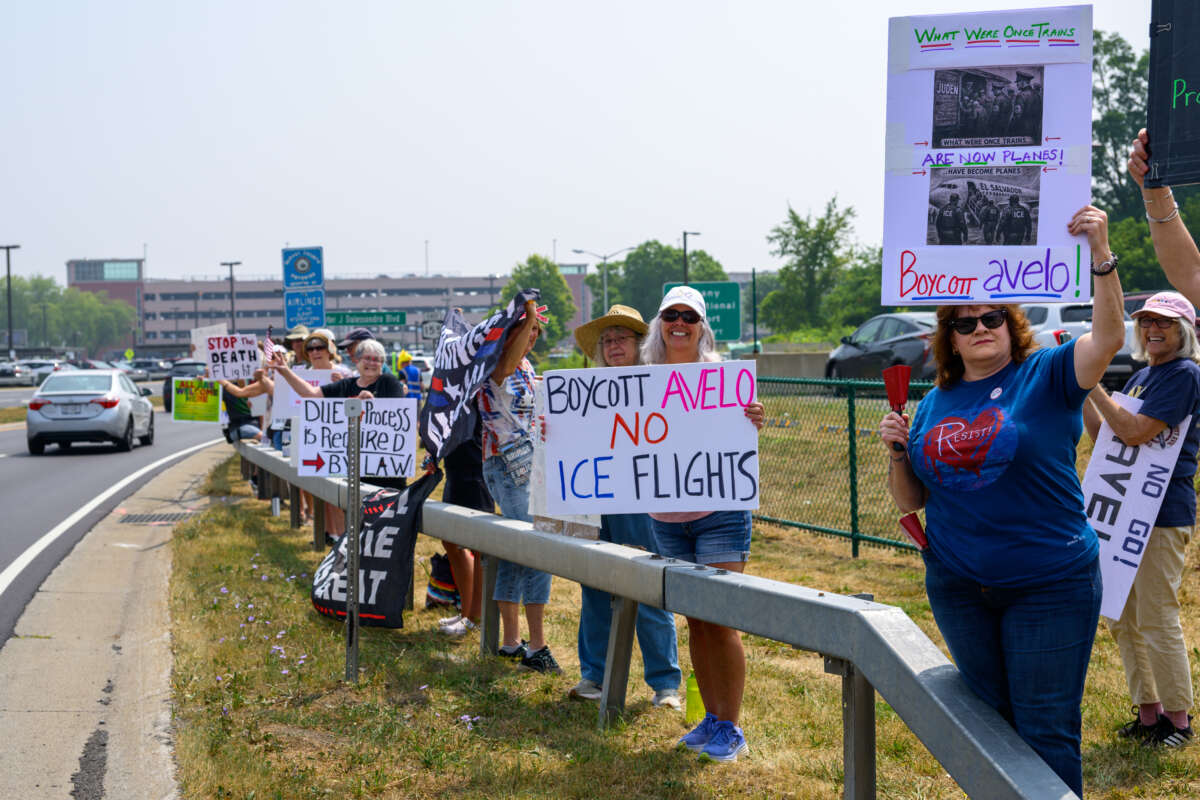
A rally near the Albany International Airport along Albany Shaker Road on July 26, 2025, in Colonie, New York. Protesters called on Albany County to drop Avelo Airlines from the airport roster because of its participation in ICE deportation flights.
Jim Franco / Albany Times Union via Getty Images
The same day that Immigration and Customs Enforcement (ICE) agent Jonathan Ross killed 37-year-old Renee Nicole Good, a little-known airline named Avelo announced that it would no longer fly deportation flights. Though the announcement was overshadowed by the news in Minneapolis, it is a major victory: The biggest commercial carrier of kidnapped and detained souls is ending its estimated $150 million contract with ICE.
The campaign targeting Avelo was more than just a boycott. Like the historic grape boycott or the more recent Tesla Takedown movement, it required a mix of local and national organizing, direct action, and political pressure alongside the better-known boycott. Organizers targeted an ICE-enabling contractor with a public-facing brand, financial fragility, and political dependencies. This was not a symbolic protest — it was leverage. It sent a definitive signal to other commercial airlines to keep distance from ICE deportations and opened space for pressure on other ICE enablers.
Exposing a Hidden Pillar of Support
The same day that Immigration and Customs Enforcement (ICE) agent Jonathan Ross killed 37-year-old Renee Nicole Good, a little-known airline named Avelo announced that it would no longer fly deportation flights. Though the announcement was overshadowed by the news in Minneapolis, it is a major victory: The biggest commercial carrier of kidnapped and detained souls is ending its estimated $150 million contract with ICE.
The campaign targeting Avelo was more than just a boycott. Like the historic grape boycott or the more recent Tesla Takedown movement, it required a mix of local and national organizing, direct action, and political pressure alongside the better-known boycott. Organizers targeted an ICE-enabling contractor with a public-facing brand, financial fragility, and political dependencies. This was not a symbolic protest — it was leverage. It sent a definitive signal to other commercial airlines to keep distance from ICE deportations and opened space for pressure on other ICE enablers.
Exposing a Hidden Pillar of Support
The campaign did not begin as a national strategy. It began the way many effective movements do: with people noticing something meant to remain unnoticed.
In Connecticut, word got out in March that Avelo — a commercial airline branded as a local carrier — had quietly signed a contract with the Department of Homeland Security and was scheduled to begin ICE deportation flights in May 2025. Avelo was headquartered in the state, received public subsidies, and now stood to profit from deportation — all without public debate, disclosure, or consent.
Related Stor
Activists Are Fighting Tax Subsidies for Airline Running ICE Deportation Flights
Connecticut activists are making big gains in their campaign against the airlines ICE is using to abduct people. By Umme Hoque , Truthout May 15, 2025
“Avelo used to call itself New Haven’s hometown airline,” Anne Watkins, an organizer with the New Haven Immigrants Coalition, explained. “We don’t want a company that is profiting directly off of [deportation and detention] to be here in New Haven.”
Experts on civil resistance explain that defeating an authoritarian requires removing a regime’s “pillars of support.” An authoritarian leader can give orders — but they are only enacted if multiple institutions implement them. As noted in The Nation, “even the most despotic of regimes can’t rule without the backing or consent of powerful external institutions. Businesses are society’s most important non-state institutions, and most of the biggest ones in America are collaborating with Trump, making themselves a very steady pillar of support for his rule.”
This understanding led the campaign. It wasn’t a symbolic protest; it was built on the understanding that without the logistical support of Avelo, ICE deportations would be materially hampered.
Before flights started, the New Haven Immigrants Coalition launched a local campaign: protests, a demand for an end to public subsidies, and a boycott petition. Within days, tens of thousands had signed the petition, many outside the state.
Small, decentralized actions emerged, including protests in other cities, alongside social media pressure. The flight attendants’ union raised alarms about safety, stating: “Having an entire flight of people handcuffed and shackled would hinder any evacuation and risk injury or death.… We cannot do our jobs in these conditions.”
These efforts weren’t centrally coordinated. They didn’t yet add up to enough significant pressure to win. But they did the most important thing at that moment: raise awareness of a vulnerable target and begin assembling the people needed to win.
Identifying the Target’s Weaknesses
Deportation flights are rarely debated in city councils or mentioned in glossy corporate reports. They are subcontracted, routed through regional airports, and handled by companies designed to be forgettable — mostly private charter firms insulated from scrutiny. Deportation infrastructure depends on that invisibility.
Nikki Marín Baena — co-director of Siembra NC, a Latino base-building organization leading efforts to protect community members from ICE and build power in North Carolina, where Avelo also had multiple bases — told us: “These flights are purposely hidden and purposely in the shadows. It’s despicable that any U.S. corporation would seek to profit off our government’s immoral actions, and we needed to bring what they were doing — and why — more visibly into the light.” (We are connected to Baena because Umme Hoque leads national campaigns and trainings at Siembra NC.)
With Avelo now a target, campaigners began to home in on its vulnerabilities. Matthew Boulay, an activist in Oregon, put together a website and an ad hoc coalition (involving calls and shared spaces) for groups working to Stop Avelo. Siembra NC added this campaign to its many ICE defense campaigns and strategies, including leaning on the research firm LittleSis to identify Avelo’s weaknesses.
Avelo proved unique: a commercial airline with a recognizable brand dependent on ticket sales. Like many airlines, Avelo needed state and municipal subsidies and struggled to raise capital in a tight market.
That made it vulnerable to public pressure — even as it hoped deportation flights would, as CEO Andrew Levy explained, “provide us with the stability to continue expanding our core scheduled passenger service.”
Working with Mijente and the Coalition to Stop Avelo, Siembra NC’s national immigration defense network, Defend and Recruit, called on more groups around the country to join the campaign and take action. In this fast-moving phase, research, tactics, and approaches began to be shared across the movement.
Local demands were tailored based on how that location or group intersected with Avelo. In cities on flight routes — including Mesa, Arizona; Burbank, California; Baltimore, Maryland — the focus was airport and airport authorities. And if Avelo didn’t fly into a city, protests were held to make it clear it never could.
Deportation infrastructure is not sustained by ideology alone. It is sustained by contracts, zoning decisions, labor, reputational cover, and silence. Those can be undone.
Subsidies, previously framed as an economic opportunity, were recast as citizen investments in state violence and to be opposed in places like Delaware. Activists pushed elected officials to pass resolutions and legislation to refuse to fly the airline, their own form of boycott, and won in California. Connecticut moved from stopping subsidies to severing partnerships. In New York, pressure targeted both state policy and Jefferies Group, an investment firm raising money for Avelo.
The tactics varied but were based on a consistent theory: Deportation infrastructure is not sustained by ideology alone. It is sustained by contracts, zoning decisions, labor, reputational cover, and silence. Those can be undone.
Scale Without Flattening
Things started bubbling: Activists pulled together a nationwide week of protests in late May, with actions across 22 states. First-time activists joined with seasoned labor organizers. Faith leaders, activists, and frequent flyers played central roles.
Rev. Cathy Rion Starr from the Unitarian Universalists Association, which mobilized congregations nationwide, shared why: “As people of faith, we know that safety is created through care, not punishment — and that transformation happens in the community.”
An elected official in New Hampshire paid for protest billboards himself. Attorneys general released letters.
More national organizations began to join the campaign. Tristan Call, an international committee member of the Democratic Socialists of America (DSA), saw opportunities to get involved. “We had DSA chapters in 44 of Avelo’s 51 key cities, many of whom were already looking for ways to get involved in defending their immigrant members and neighbors,” Call told Truthout. “So we saw the Avelo campaign as a tremendous opportunity both to bring the leverage of tens of thousands of DSA members to the fight against ICE’s corporate profiteers, and to train our members in how to run effective corporate boycott campaigns.”
By July, the fight notched its first win: Avelo stopped its West Coast flights. Nationwide, this small win barely registered outside of the movement. But it promoted momentum inside the movement’s orbit.
How national groups showed up really mattered. They amplified local fights, shared research and tools, and helped grow local pressure from everywhere at once. Groups like Jobs with Justice, the SEIU, and other worker bodies grew more involved with local leaders and workers. Pilot whistleblowers sharing inside intel and responses from the company and stakeholders helped all groups understand whether tactics were having an impact inside the company.
Rolling weeks of action augmented local pressure and strategies. While Indivisible chapters across the country had already been active, nationally it, too, joined the effort — adding to what was now a stampede of hundreds of cities finding ways to pressure and cause economic pain to Avelo.
No group controlled a brand, created a singular identity, or created a singular national approach; instead, they allowed multiple strategies and shared resources across the movement to pressure the target. Over a few months, at least 40 groups took action across the country, with hundreds of people joining protests. Tens of thousands boycotted Avelo.
Similar to the Tesla Takedown campaign, it was a generative combination of centralization and decentralization. The pressure proved too great for the airline.
In early January, Avelo quietly announced that it would shutter its operations at Mesa Gateway Airport in Phoenix, Arizona. It was getting out of the deportation business.
Why We Won
This was the mosquito strategy: many tiny bites until it was too painful to continue. Some city bites were quite painful, forcing Avelo to leave the West Coast entirely or to re-evaluate its own “hometown” brand. Others were less successful — but still part of the overall effect.
“From the tarmac to the ticket counter, our organizing created a sustained pressure campaign that Avelo could no longer ignore.”
This was a victory — and it should be named as one. As Boulay explained, “At a time when immigrant communities are under relentless attack, [this campaign] offers proof that resistance works. From the tarmac to the ticket counter, our organizing created a sustained pressure campaign that Avelo could no longer ignore.”
But no one mistakes this victory for an ending to our organizing. ICE’s aggression is escalating. People continue to be harmed and killed by immigration enforcement and policing.
Still, removing one company from ICE’s chain weakens the overall system. It adds to the win of the Spotify boycott: Spotify is no longer airing ICE recruitment ads, likely in part due to collective pressure.
The networks formed through this Avelo fight are now turning to new contractors, other state and municipal policies, and toward a national story that we can do better. One key strategy to reduce ICE’s power is to target ICE collaborators.
Organizers in Minneapolis have called for residents to stop giving ICE and other federal occupation forces food, shelter, and transportation. These include companies like Signature Aviation, Hilton, and Enterprise. Their first victory — coupled with — was getting a local Hilton to refuse service to the Department of Homeland Security and ICE.
As Adam Shah, director of national policy for Jobs with Justice, has stated, now is a choice point for these pillars:
From Avelo to Amazon, all corporations must weigh their options. Democracy or authoritarianism. Community or violence. If you are profiting from a partnership with ICE, then you are in opposition to democracy and will face an organized coalition of working people determined to win a future free from the exploitation of the deportation machine.
More than anything, this campaign proves the fragility of the system. ICE and the security forces of this current government are not invulnerable. This win proves what happens when we refuse inevitability and fight together. That lesson is dangerous to any system that survives on our silence and our resignation to the idea that we can’t change anything. Because we can and did — and there’s more to come.
This article is licensed under Creative Commons (CC BY-NC-ND 4.0), and you are free to share and republish under the terms of the license.
Umme Hoque
Umme is a writer, editor, and organizer leading campaigns and trainings at Defend and Recruit, a national network supporting the movement for immigrant defense. A Bangladeshi-Texan, she’s spent the past two decades fighting local and global campaigns with trade unions and worker bodies, immigrant rights and racial justice organizations, climate justice groups, and debtor unions. Her writing has appeared in Prism, In These Times, Filter, The Guardian, and The Progressive.

No comments:
Post a Comment