Showing posts sorted by relevance for query SLAVE REVOLT. Sort by date Show all posts

Friday, December 03, 2021

'Spirit of resistance': Marking 500 years since the first slave revolt in the Americas

Kynala Phillips

Five hundred years ago this month, the Americas saw its first revolt of enslaved people, when Black Africans rose up against colonial powers in the Caribbean.

Historians believe the Santo Domingo Slave Revolt took place on Dec. 26, 1521, starting at a sugar plantation owned by Diego Columbus, son of Christopher Columbus. He was governor of La Española, the present-day Dominican Republic and Haiti, according to a monograph on the revolt published by the CUNY Dominican Studies Institute (DSI) at the City College of New York.

The enslaved people marched 62 miles from the plantation to a village in an attempt to reach other Black Africans seeking freedom. The uprising was strategically planned during the Christmas season, because the enslaved knew that the white Spaniards would be distracted and deep in prayer, according to the monograph.

“This was so well planned, which is also very interesting to me as a sociologist, that they came from different places in Africa," said scholar Ramona Hernandez, director of CUNY DSI and a professor of sociology at City College. "So they spoke different languages yet they found ways of putting together an insurrection."


“It reveals this spirit of resistance, and not taking on oppression passively," Hernandez said.


The Spanish soon sent in military reinforcements that effectively halted the revolt. But the legacy of the rebellion, which is considered the first recorded revolt in the Americas, reverberated throughout the region.


© Provided by NBC NewsSlaves Attempt To Overcome Their Spanish Owners 
(Theodor de Bry / Heritage Images/Getty Images)

The start of 'Black Codes'


The year after the revolt, La Española introduced laws targeting Black people that were set in place to restrict the rights and movements of any person who was Black, whether they were free or not. This was one of the first versions of “Black Codes” seen in the Americas, according to Hernandez.

“These are the first laws that are going to tell masters and others that were a part of the power structure in La Española how the black enslaved people are going to be treated,” Hernandez said.

She noted that many enslaved people did manage to escape after arriving on the island in the late 1400s. But the Santo Domingo Revolt was the first time Black Africans were combating authorities head-on, which led to strict and punitive treatment.

Overall, there is a lot that is still unknown about how the enslaved people of La Española managed to attempt such a bold insurrection. To further the conversation and unpack the significance of this history, CUNY DSI and the Black Studies Program at City College is hosting a two-day conference titled “The Struggle for Freedom in La Española.”

In collaboration with nearly 13 other schools and institutions, including the Eduardo León Jiménes Cultural Center in the Dominican Republic, the multidisciplinary conference looks at how this uprising confronted the Spanish colonials and defied the status quo.

“We need to commemorate this, that this happened 500 years ago, that the civil rights movement that we saw here [in the U.S.] was simply a continuation of something that our ancestors have done, so that our people continue to think that it is their job to combat what is evil in humanity," Hernandez said.

Although the conference is set to engage well-known scholars and voices on the subject, Hernandez expects to tap younger generations who can benefit from understanding and exploring the history of liberation in the Americas.

“Any action that one of our people have taken anywhere, anytime to undermine what has been done to us, we need to remember it," said Hernandez, "and we need to acknowledge it so that the younger generation doesn't forget."


Sunday, October 20, 2024

BOOK REVIEW

Explaining slavery in the era of industrial capitalism

Robin Blackburn, the premier chronicler of capitalism and the slave trade, returns with third volume
(Wikimedia Commons)

Robin Blackburn
Published by Verso, £29.99


By Ken Olende
Thursday 17 October 2024
SOCIALIST WORKER Issue 2927


Chattel slavery—the buying and selling of black people as property—was a key part of capitalism’s development in the first half of the 19th century. Historian Robin Blackburn argues in his new book, The Reckoning, that the rise of industrial capitalism did not end slavery.

In fact, he points out, it “generated a more thoroughgoing slavery in the New World.” Blackburn calls this period the Second Slavery, “a turbo-charged and financialised version of servitude.”

In the earlier phase of the Atlantic slave trade, slaveowners could work the enslaved to death and replace them with people captured in Africa. But, by the 19th century this was no longer practical, and slavers had to rely on “breeding” new generations. And this in turn forced plantation owners to become more efficient.

These shifts meant that in the Southern United States cotton output per slave increased fourfold in the first half of the 19th century. In the early decades of the 19th century international exports from the US slave states were $34 million, while those from non-slave states were $17 million.

Blackburn does not argue that capitalism rose out of the slave trade, as banking and mercantile trade were already in existence. Instead, he says that slavery was a key part of the system’s early development.

However, Blackburn does show that for the system as a whole, slavery was not the most efficient way of making money and exploiting labour. That meant that its dominance became a problem in the future—and that its spread was uneven.

He comments that in South America, “slaves numbered only around 3-6 percent of the population in most of Spanish America at any point in the eighteenth century. However, in Cuba, slaves were about a third of the total population in 1770, rising to a half over the next 50 years.”

But slave owners everywhere faced constant resistance. Slaves would push to gain more time to grow food and be with their families, they would escape and they would lead armed rebellions.

The whole period exists in the shadow of the successful slave revolt in Sant-Domingue, in what is today Haiti. Led by Toussaint Louverture and later Jean-Jacques Dessalines, slave armies defeated the major powers of the day—France, Spain and Britain—to win independence.

Britain banned the slave trade in 1807 —though not in plantations across its empire. It then tried to suppress other traders, to stop them making profits that Britons could not.

Blackburn points out that despite this British companies continued to manufacture the shackles used in 19th century slave ships.

As well as describing these developments, Blackburn shows the people who fought slavery. He details those who led uprisings and the organisers of the Underground Railroad escape routes.

And he talks of the growing movement of “ultras”, militant abolitionists who believed in “uncompromising direct action” to end slavery. He adds that there is no hard and fast divide between “fugitive slave politics” and “revolutionary abolitionism” and the two strands often merged and radicalized one another.

The white revolutionary abolitionist John Brown led an assault on the military armoury at Harper’s Ferry hoping to inspire a slave insurrection. He and ten of his men were captured, put on trial and executed. The great black emancipator Frederick Douglass had warned him that “a slave insurrection could not be detonated by the exemplary actions of a small group of outsiders”.

Yet Brown became a hero to the radical wing of the anti-slavery movement and as the civil war broke out volunteer troops made John Brown’s Body their marching song.

After Abraham Lincoln won the 1860 presidential election, slave states left the Union, wrongly believing that his Republican party planned to free slaves. One slaver wailed, “If things go on as they are it is certain that slavery is to be abolished … we will have black governors, black legislatures, black juries, black everything…”

Unfortunately, the Union generals’ plans were nowhere near so radical.

It was only as the Civil War that followed turned into a stalemate that the more radical leaders on the Union side came to the fore. They argued that the one section of society that would fight uncompromisingly for the Union were the enslaved—on condition that it promised an end to slavery.

Once the word got out that President Lincoln had said this in the Emancipation Proclamation, tens of thousands of enslaved people stopped working, ran away from the plantations and showed readiness to join the War.

The South collapsed.

In Charleston, victorious Union troops marched into town headed by two black regiments. One was “led by a soldier carrying a banner with the inscription ‘Liberty’, while Black infantrymen were singing John Brown’s Body to the enthusiastic cheers of the Black population, most of whom had been slaves the day before.”

This long, and sometimes academic book, is a vital to our understanding of how slavery and racism grew alongside capitalism, and the reasons why the system ended.

Thursday, October 31, 2024

UK treads fine line on slavery legacy, while ruling out reparations

By AFP
October 31, 2024

The Commonwealth's 56 members agreed the 'time has come' for talks about the legacy of the 'abhorrent' transatlantic slave trade in a landmark summit declaration - Copyright POOL/AFP William WEST


Alexandra DEL PERAL

Commonwealth countries want talks on slavery reparations but the United Kingdom — engaged in soul-searching over its former empire for several years now — is not open to financial compensation, officials and analysts say.

“I think segments of British society might be ready to talk about reparation but you have other sectors, the majority really, that strongly oppose it,” Sascha Auerbach, director of the Institute for the Study of Slavery at Nottingham University, told AFP.

Meeting last week at a summit in Samoa, the Commonwealth’s 56 members said the “time has come” for talks about the legacy of the transatlantic slave trade, in a landmark declaration that raised the prospect of future reparations.

African, Caribbean and Pacific nations want Britain — and other colonial powers — to apologise for slavery and other ills of colonisation, and to start talks about compensation.

Labour Prime Minister Keir Starmer, a former human rights lawyer, has rejected both requests, arguing that he wants to “look forward” rather than have “very long endless discussions about reparations” involving the past.

“I think he is concerned that the country is not ready to have this conversation,” said Alan Lester, a historian at the University of Sussex, noting that any talk of restorative justice a few months after far-right riots rocked England is seen as politically risky.

The issue is divisive. Figures in centre-left Labour — which came to power in July — have long been open to the debate, but the Conservatives reject it outright.

Robert Jenrick, one of the candidates to be the new Tory leader, has said that criticising the British Empire is anti-patriotic.

He wrote recently that “the territories colonised by our empire were not advanced democracies”.

“Many had been cruel, slave-trading powers. Some had never been independent. The British empire broke the long chain of violent tyranny as we came to introduce — gradually and imperfectly — Christian values,” he added.

While Britain has expressed remorse for slavery in broad terms, London has baulked at the idea of paying financial reparations, which would likely come with a hefty price tag.

A 2023 report co-authored by a United Nations judge, Patrick Robinson, concluded that the UK likely owed more than £18 trillion (or 21 trillion euros) for its involvement in slavery in 14 countries.

This figure took into account the unpaid wages of slaves, trauma caused, and damages owed to their descendants.

So far, the Commonwealth countries have not put forward any figures of their own.

“It’s very unlikely that countries would ask for that figure,” Lester, the historian, told AFP.

Auerbach suspects that money is not the countries’ “main goal”.

“What they want is recognition and accountability,” he said.

Opponents in Britain point out that a public apology could open the doors to legal action against the country. Auerbach notes that the Netherlands’ government and king apologised last year for slavery and has not yet been sued.

For its part, the British royal family has so far stopped short of apologising.


King Charles III did, however, on a visit to Kenya last year, express his “greatest sorrow and deepest regret” over the “abhorrent and unjustifiable acts of violence committed against Kenyans” during colonial rule.

“It’s a delicate subject. I would say that the monarchy has navigated this debate very skillfully,” Professor Pauline Maclaran at Royal Holloway, University of London, told AFP.

Other British institutions have issued apologies or owned up to mistakes, including the Church of England which officially said sorry in 2020.

The National Trust, which protects heritage sites, published a report the same year detailing links between dozens of properties it runs and the slave trade.

Earlier this year, the esteemed Royal Academy of Arts held an exhibition about how British art was implicated by slavery — a first in its more than two centuries of existence.

“At least we’re having the conversation in the Anglo-Saxon world, which is not the case in Spain or France,” said Auerbach.


Tory Robert Jenrick condemned after claiming former British colonies owe ‘debt of gratitude’


“These comments are deeply offensive and an obnoxious distortion of history."


Robert Jenrick continues to show just how far-right he is during the Tory leadership contest, this time claiming that ‘former British colonies owe us a debt of gratitude’, comments which have resulted in condemnation.

Jenrick made the remarks in a column for the Daily Mail, in which he claimed that British colonies should be grateful for the legacy of empire.

He wrote: “Many of our former colonies — amid the complex realities of empire — owe us a debt of gratitude for the inheritance we left them.”

Jenrick made his disgraceful comments after Commonwealth leaders agreed at the weekend that the “time has come” for a conversation about reparations for the slave trade.

The Tory leadership hopeful was condemned by Labour MP Bell Ribeiro-Addy, who chairs the All-Party Parliamentary Group on Afrikan reparations. She told the Independent that Jenrick’s remarks were deeply offensive.

She said: “These comments are deeply offensive and an obnoxious distortion of history.

“Enslavement and colonialism were not ‘gifts’ but imposed systems that brutally exploited people, extracted wealth, and dismantled societies, all for the benefit of Britain.

“To suggest that former colonies should be ‘grateful’ for such unimaginable harm disregards the legacy of these injustices and the long-term impact they still have on many nations today.”

Dr Shola Mos-Shogbamimu, lawyer and activist posted on X: “The ingratitude of this political illiterate @RobertJenrick. Britain would be nothing without colonised African & Asian nations. It’s Industrial Revolution & Capitalist Wealth were built on the blood, sweat, forced labour & lives of our forebears.

“The ‘inheritance’ it left were the resources it stole, lands it pillaged, genocides committed, division of nations, systemic rape & collective punishment committed in the name of its racist British empire – a genocidal & thieving empire that still profits off former colonies to date.”

Historian William Dalrymple described Jenrick as a ‘Tory moron’ in reaction to his comments.

Basit Mahmood is editor of Left Foot Forward


Why Robert Jenrick is wrong about the British Empire

Tory MP Robert Jenrick has absurdly claimed that former British colonies 'owe us a debt of gratitude for the inheritance we left them'


Robert Jenrick at a Tory leadership hustings (Picture: The Conservative Party)


By John Newsinger
Wednesday 30 October 2024
 SOCIALIST WORKER Issue 2929
Comment

The Tory leadership contender Robert Jenrick’s shamelessly declared in the Daily Mail newspaper that the victims of British imperialism should be grateful to the British Empire.

To be fair, this was very much the view of New Labour, of the likes of Tony Blair and Gordon Brown and there is every reason to think that Keir Starmer shares this view today. His response to the demand for reparations for slavery has been little better, and makes this pretty clear.

The claim is, of course, absolutely outrageous. Nothing better demonstrates this than the history of slavery.

The horrors of British involvement in the slave trade and the appalling exploitation of slaves in Britain’s Caribbean colonies—men, women and children worked to death for profit—are not the focus of Jenrick’s attention.

Instead, it is the British abolition of slavery that is celebrated as showing the Empire’s humanitarian side. This is a gigantic distortion of history.

Slavery was not abolished out of any humanitarian concerns, but because the British government had become convinced that the slaves could no longer be kept in chains. Successive slave revolts, culminating in the great Jamaican revolt that broke out on 27 December 1831, doomed British slavery.

The revolt began as a general strike involving over 60,000 slaves, but the British unleashed bloody repression and it turned into a rebellion. One slave woman, shot for her part in burning down her owner’s sugar works, defiantly told her executioners, “I know I shall die for it, but my children shall be free.”

Troops killed over 400 slaves and executed another 326 in the aftermath of the revolt.

The last to die was the leader of the revolt, Samuel Sharpe, hanged on 23 May 1832, who made it clear that he “would rather die on yonder gallows than live in slavery”.

The military brutally flogged hundreds more, with some being flogged to death.

What worried the British government, however, was that this bloody repression did not appear to intimidate the slaves. According to one minister they seemed to be “burning for revenge for the fate of their friends and relations” with many of them “regarding death as infinitely preferable to slavery”.

He was convinced that if slavery was not abolished, then the slaves would free themselves. The minister was worried that news might arrive at any time that “Jamaica is in the possession of the negroes”.

It was this fear of slave revolt that led to the abolition of slavery, not any humanitarian concerns on the part of the British ruling class. The slaves would continue revolting until they had overthrown their masters and the only way to pre-empt this was abolition.

There was a powerful mass movement in Britain demanding abolition at this time, a movement rooted in the working class, with petitions signed by more than 1.3 million people.

Establishment historians reduce this movement to the respectable figure of politician William Wilberforce. They present persuasion, appealing to the conscience of our rulers, as the way forward rather than struggle and revolt.

What about the question of reparations? The British government has already paid reparations—but to the slave owners, not to the slaves. The government borrowed some £20 million to compensate the slave owners, an unprecedented sum.

In today’s money it would amount to £300 billion. But the people being compensated were rich and influential so it was accepted.

The £20 million loan was not finally paid off until 2015. This means that the descendants of Caribbean slaves living in Britain, the Windrush generation, would have been paying taxes that went towards the cost of their ancestors’ emancipation.

This is what the British Empire was all about.


-- -- -

colonial world without an engagement with Eric Williams's Capitalism and ... tion of the Slave Trade', was published as Capitalism and Slavery in 1944,.


- -- -


Monday, July 06, 2020

THE SLAVE TRADE IS THE ORIGIN OF CAPITALISM
Some Facts About London’s Role in Insuring the Slave Trade

By Guy Faulconbridge | June 19, 2020 INSURANCE JOURNAL


London is facing up to its role in insuring the slave trade as part of a sweeping global reassessment of history and racism.

This reappraisal was triggered by the death of George Floyd, a black man who died after a Minneapolis police officer knelt on his neck for nearly nine minutes while detaining him.

For centuries, London has maintained a pre-eminent role in financing global trade and on Thursday the Lloyd’s of London insurance market apologized for its “shameful” role in the 18th and 19th Century Atlantic slave trade.

About 17 million African men, women and children were torn from their homes and shackled into one of the world’s most brutal globalized trades between the 15th and 19th centuries. Many died in merciless conditions.

By the late 18th Century, Britain was the leading slaver nation, carrying about 40% of Africans transported between 1761 and the abolition of the trade in 1807.

Update: Lloyd’s of London Apologizes for Its ‘Shameful’ Role in Atlantic Slave Trade

Lloyd’s grew to dominate the shipping insurance market, a key element of Europe’s global scramble for empire, treasure and slaves, who were usually in the 18th Century included in insurance policies in the general rate for ship cargo.


Other major traders were Portugal/Brazil, with about 32% of the market, and France, with about 17%. American and Dutch ships were also involved, with around 6% and 3% respectively.


How important was slavery to British maritime insurance?

There is a lack of documentary evidence from the time, but historians have estimated that the slave and West India trades combined accounted for 41% of British marine insurance in the 1790s.

(For more information: Insuring the Transatlantic Slave Trade.)

“Between a third and 40 percent of London marine insurance in the 18th Century was accounted for by the slave trade and by the movement of slave grown produce across the Atlantic,” said Nick Draper, former director of the Centre for the Study of the Legacies of British Slave-ownership.

“Those ships bringing sugar to Britain had a valuable cargo and the ships themselves were valuable and often coming through enemy waters because Britain was at war for long periods.”


Who were the big players?

There were three main marine insurers in the 18th Century: London Assurance, Royal Exchange and Lloyd’s of London.

“Lloyd’s had the dominant insurance business – probably had 80-90 percent of the market,” said Draper.

“By 1807 when the slave-trade was abolished, it was relatively unimportant to marine insurance and by the 1830s when slavery was abolished the sugar economy in turn had become less important. We were shipping then huge amounts of raw slave-grown cotton, for example, back to the UK from the American south.”
How did it work?

Slaves were seen as cargo by the insurance market of the time and generally included in the general insurance rate.

Often slaves were termed as a “parcel” whose value was determined by ethnicity, size, height, age, gender and health.

Slaves were also classified by underwriters as “perishable goods,” alongside cattle. Underwriters and courts dealt with slave losses arising from revolt as the equivalent of damage and losses caused by livestock panicking during a tempest.

“Most insurance policies for the slave trade excluded the death of enslaved people from disease or insurrection – they were insuring the ship against the perils of the sea,” said Draper. “But they were not insuring so that people were disembarked at the other end in a healthy condition.”

(Reporting by Guy Faulconbridge; editing by Alexander Smith)

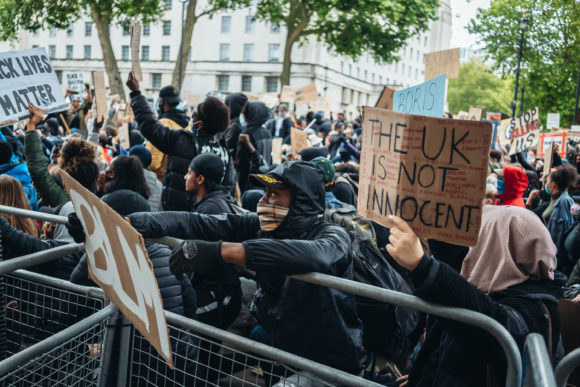
Photograph: Black Lives Matter protest in London on June 6, 2020 during the coronavirus lockdown.

Related:
Update: Lloyd’s of London Apologizes for Its ‘Shameful’ Role in Atlantic Slave Trade


Copyright 2020 Reuters. Click for restrictions.

Friday, February 07, 2025

While Hollywood ignored stories of Black resistance, Cuban filmmakers celebrated Black power


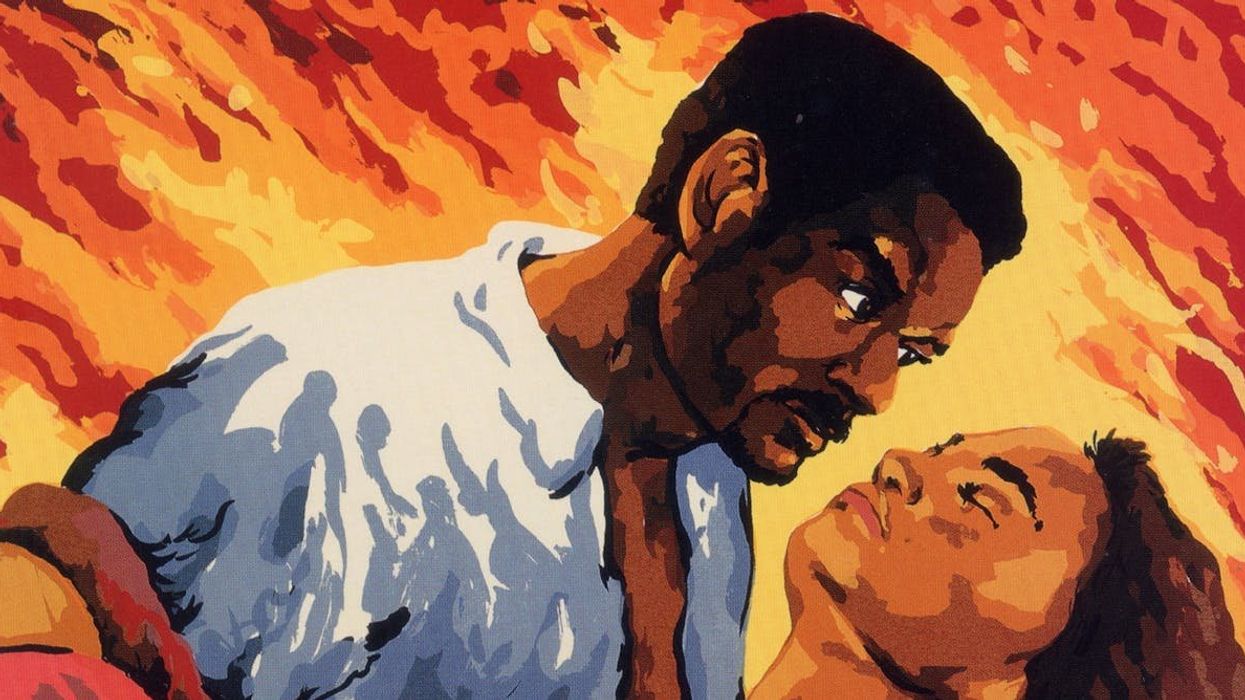
‘Gone with the Macho’ print by Elio Rodriguez. Contemporary debates over slavery, race and racism continue to take place in a public sphere that has been shaped in part by cinematic films. 
(Elio Rodriguez/532 Gallery) , Author provided (no reuse)


The Conversation
February 06, 2025

In recent years, there has been an increased push for more diversity and representation on our entertainment screens. The #OscarsSoWhite campaign of 2015 and the enduring social justice movement it generated increased public awareness of the longstanding problematic issues of discrimination and exclusion in Hollywood.

The movement drew needed attention to Hollywood as an insular industry characterized by institutionalized racism and entrenched disparities. Nearly a decade later some progress has been made, but race, class and gender remain sources of inequality in Hollywood.

Hollywood’s depictions of slavery are emblematic of the persistence of this problem. Although Hollywood has produced several notable films on slavery, more often than not, these films reveal partial and biased views.

For example, one of the world’s first slavery films dating from 1903, is an adaptation of Harriet Beecher Stowe’s 1852 anti-slavery novel, Uncle Tom’s Cabin. In that film, Black people are portrayed by white actors in blackface and slaves are seen dancing at a slave auction.

In general, Black points of view, Black voices and Black historical achievement have been marginalized or overlooked in Hollywood. And in particular, there is a notable lack of films that centre Black resistance to slavery. From overt anti-Black racism in slavery films dating from the earlier part of the 20th century, to a deep-seated and enduring aversion to depicting Black resistance, Hollywood has always lived in a fantasyland when it comes to Black history.

While conducting research into the history of the representation of slavery in cinematic history, I learned that, in contrast to films coming out of the United States, Cuban cinema depicted a very different Black history and culture. Starting in the 1970s, Cuban filmmakers told stories to revalorize Black history and culture.


Black representation in Cuban cinema

Following the Cuban Revolution of 1953–1959, a film industry grew that sought to construct an assertive and representative picture of Black Cuban history and culture, including the history of Black resistance to slavery, which had long been overlooked and misrepresented.

Initially, this work took the form of documentary films that profiled the African roots of Cuban music, a form of cultural expression saturated with a sensibility of resistance. Then, in the 1970s, this work blossomed into a series of feature-length films.

Some examples include the 1976 film La última cena (The Last Supper) by Cuba’s most feted filmmaker, Tomás Gutiérrez Alea. The film is an ironic historical drama of slave revolt and religious hypocrisy set in 1780s Cuba.


A still from the film La última cena (1976), by Tomás Gutiérrez Alea.(Instituto Cubano del Arte e Industria Cinematográficos)

An aristocratic Havana plantation owner decides one Easter week, in imitation of Christ, to invite 12 of his slaves to sup with him at his dinner table. However, far from mollifying the enslaved workers or reconciling them to their status, the count’s 12 chosen slaves respond to their master’s antics by organizing an uprising and burning down the sugarcane mill, thereby demonstrating their selfhood and asserting their agency.

A trilogy of films by one of Cuba’s most underappreciated filmmakers, Afro-Cuban director, Sergio Giral: El otro Francisco (The Other Francisco, 1974), Rancheador (The Slave Hunter, 1976), and Maluala (1979) are also worthy of note. Giral’s trilogy has been regarded as a “welcome tonic to the cloying melodrama of American period films like Gone with the Wind” that erased Black agency as part of their romantic sanitization of slavery.

In El otro Francisco, sentimental, bourgeois perspectives of slavery and abolition are turned upside down. In Rancheador, the perspectives of various poorer whites — smallholder farmers and slave catchers — are brought to the fore to emphasize the insufficiency of race, when taken in isolation, as an explanation for the social dynamics of oppression in slave holding societies.

In Maluala, the strategic and political dilemmas faced by the leaders of Cuba’s maroon communities are emphasized as part of the film’s depiction of the growth of Afro-Cuban consciousness. By foregrounding perspectives that had been sidelined, Giral’s trilogy recovers the history of slave resistance and narrates a counter-history of Cuban slavery and abolition.

Hollywood’s historical inaccuracies


Meanwhile, in the U.S., slavery films have established a popular historiography of slavery for a global audience and have also exerted influence on those in positions of power. One of the most notorious slavery films of all time, D.W. Griffith’s grotesquely racist The Birth of a Nation of 1915, was the first film to be screened in the White House as well as the first film to be projected for the justices of the U.S. Supreme Court and the members of the United States Congress.

It projected flagrant historical inaccuracies, including the perception that the slave-holding American South had been a rural idyll where a noble, chivalrous and pious culture had flourished. The U.S. president of the day, Woodrow Wilson, was among the many millions duped by the film’s depictions; on viewing the film he remarked, “It is like writing history with lightning, and my only regret is that it is all so terribly true.”

The regressive impact of Griffith’s film on American and global public conversations about race should not be underestimated.
Adaptation of a slave narrative

Since The Birth of a Nation, Hollywood has produced several acclaimed movies about slavery in the U.S., but it took nearly a century before the first cinematic adaptation of a slave narrative would appear — Steve McQueen’s celebrated triple Oscar winner 12 Years a Slave of 2013.

Lauded by some critics as “the greatest feature film ever made about American slavery,” 12 Years a Slave received a special screening at the United Nations’ New York headquarters and undeniably represents a significant moment in the history of slavery on screen.


A trailer for ‘12 Years a Slave.’


Nevertheless, and notwithstanding the film’s progressive aspirations, McQueen’s adaptation inadvertently gave new life to sentimental ways of apprehending the history of slavery. The accounts of Black resistance that are present in the source material on which the film was based, Solomon Northup’s 1853 narrative, Twelve Years a Slave, are omitted and the film overlooks the attention paid in the original to slavery as a social and economic system.

For example, the 1853 narrative carefully noted the inadequacy of explaining the evil of slavery by leveling blame at individuals: “It is not the fault of the slaveholder that he is cruel, so much as it is the fault of the system under which he lives.” However, as I argue in my book, McQueen’s adaptation emphasizes the cruelty of individuals. With this focus, the film could be seen as tracing the atrocities of slavery to individuals’ cruelty.

Contemporary debates over slavery, race and racism continue to take place in a public sphere that has been shaped in part by cinematic films produced in Hollywood that have always perpetuated potent fantasies and misunderstandings about slavery.

Cuban cinematic treatments of slavery have sought to correct the record. They celebrate Black power and remind us of the extraordinary efforts of countless Black men and women throughout the history of transatlantic slavery to resist their enslavement.

Philip Kaisary, 2023–2025 Ruth and Mark Phillips Professor of Cultural Mediations, Carleton University

This article is republished from The Conversation under a Creative Commons license. Read the original article.


Sunday, January 08, 2023

How two men shaped Haiti’s bloody revolutionary history

Paul Lay
Sat, January 7, 2023 

In this article:

Toussaint Louverture
Haitian general and revolutionary

Henri Christophe
President and King of Haiti (1767-1820)

Jean-Jacques Dessalines
Leader of Haitian Revolution and first ruler of independent Haiti (1758-1806)


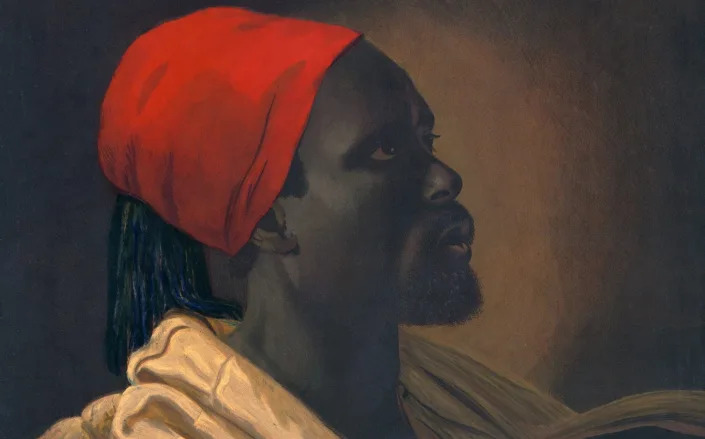
'Black Spartacus': Toussaint Louverture, leader of the Haitian Revolution by de Baptiste (1875) - Photo 12/ Universal Images Group via Getty Images

By the time of the French Revolution, France’s colony of Saint-Domingue, the western portion of the Caribbean island of Hispaniola (now Haiti), was the most valuable plot of land on Earth. The wealth of the “Pearl of the Antilles” came from the new-found European taste for sugar and coffee – it produced half the world’s supply of both and was responsible for one third of French maritime trade.

But the economy of Saint-Domingue was underpinned by the violence and suffering inflicted on almost half a million enslaved Africans, who vastly outnumbered the white population of 40,000, and the slightly smaller – and free – mixed-race population. More than 300 Africans arrived in chains every week to be “fed into the slave machine”.

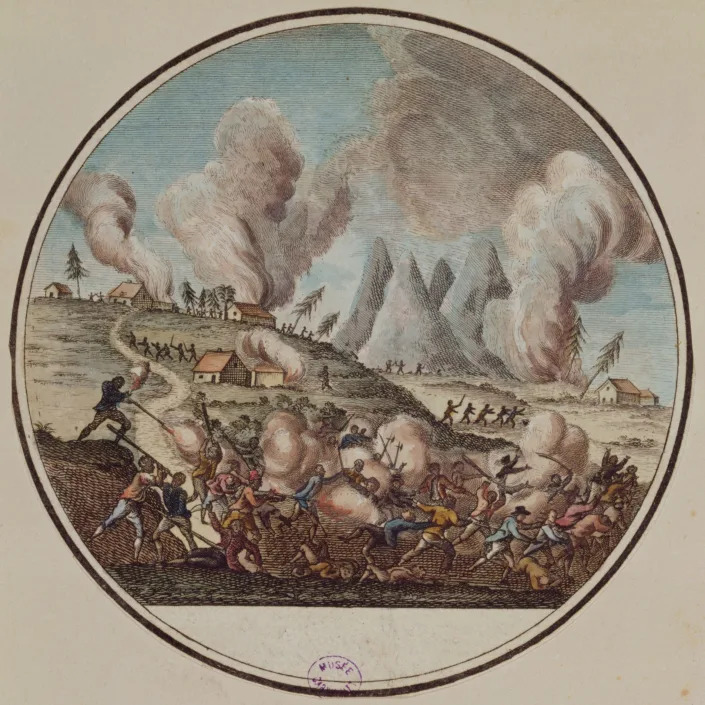
A slave revolt had long been feared, and brute force was the plantation-owning class’s way of maintaining order. Memories remained fresh of the fate of François Makandal, a Maroon – an escapee from slavery – who had been taken to the bustling, metropolitan city of Cap-Français to be burned at the stake in 1758 for inciting rebellion. The fear was finally realised in August 1791, amid tensions between the ruling classes exacerbated by the French Republic’s declaration of the Rights of Man and its opposition to slavery. Hundreds of plantations in the fertile north were ravaged, and both white and mixed-race settlers were massacred on a horrendous scale.

The aftermath of these tumultuous events is now the subject of two very different books. Sudhir Hazareesingh’s Black Spartacus (★★★☆☆), an “epic life” of François-Dominique Toussaint Louverture, the leader of the Haitian Revolution, has already won high praise and the 2021 Wolfson History Prize. Scholarly and highly readable, it is occasionally too much of a love letter to its subject: “Great Man” history, long disparaged among academics, is still acceptable, it seems, with a change of cast. Paul Clammer’s Black Crown (★★★★☆), however, a life of the less well-known Henry Christophe, who became King Henry I of Haiti in the years after the revolution, grasps the essential tragedy of history, in all its ambiguity and contingency.

Christophe, born into slavery on Grenada, would become a lieutenant of the much-feted Toussaint Louverture, a former coachman who became a free man in his 30s. Louverture subsequently owned slaves of his own, as a coffee-planter.

The Rebellion of the Slaves in Santo Domingo by the French School, an 18th century coloured engraving of the 1791 insurrection - Archives Charmet

Where historical fact is sparse, mythology flourishes, and there is uncertainty about what role Louverture actually played in the 1791 slave revolt. The plot appears to have been hatched on August 14, and unleashed a week later, when the Colonial Assembly was due to meet in Cap-Français. Its leader was Boukman Dutty, another coachman but also a priest.

The violence, according to one witness, “would make Nero blush”, and panicked whites fled to the cities and towns. It can be said with some certainty, however, that Louverture saved the wife of his former master by escorting her to safety from their plantation. Louverture, unlike many of his fellow revolutionaries, was open to white allies and believed to the end that the plantation system – albeit one manned by free labourers – was essential to future prosperity.

The embattled white colonists invested their hopes of restoring the old order in the British, who arrived to do just that in 1793; they failed when their forces were devastated by yellow fever. France, desperate to keep Saint-Domingue within its orbit, endorsed its commissioners’ decision to abolish slavery there in 1794.

By then, Louverture’s star was in the ascendant, though dependent upon the support of his army of former slaves and a strong relationship with the governor, Etienne Laveaux, who was the first to proclaim him “Black Spartacus”. He was faithful to France, sending his two sons to be educated there, but with Laveux’s departure, the metropole became ambivalent in its commitment to the freedom of Saint-Domingue’s black population – a red line for Louverture.

Napoleon, now similarly ascendant, had no such uncertainty and, having made peace with Britain in 1802, he launched an expedition to Saint-Domingue, led by his brother-in-law, Charles Victor Emmanuel Leclerc. Louverture was outlawed and cracks appeared in his already fractious alliance. Then he made a fatal mistake. He sought a truce with the French, but was arrested, transported to France – on a ship called The Hero – imprisoned in a medieval castle in the Jura mountains, and died within eight months.

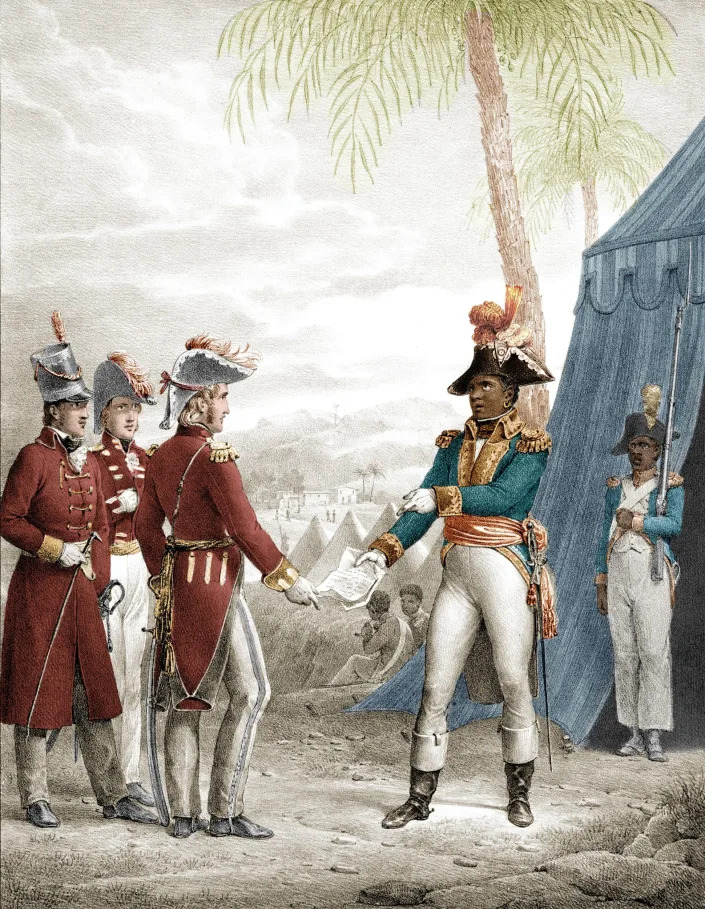
An illustration of English General Thomas Maitland and Haitian revolutionary Toussaint L'Ouverture as they sign a treaty in March 1798 - Science Source/Photo Researchers History/Getty Images


The fate of his cause was now in the hands of two men, once his deputies, who may have conspired against him: Jean-Jacques Dessalines and Henri Christophe. Learning from the errors of Louverture, they sought to eliminate all rivals, press labourers back to work on the plantations, and indulge the French forces on Saint-Domingue just long enough that they would succumb to yellow fever, just as the British had done and Leclerc would do.

Their plan worked, and at the Battle of Vertières they defeated the weakened French. Soon the last of the colonial forces would be shepherded into captivity on Jamaica courtesy of the Royal Navy. On December 5 1803 – the same day that, 311 years before, Columbus had made landfall on the island – a new free nation was born: Haiti.

A Declaration of Independence was signed on January 1 1804, first by Dessalines, then by Christophe. Dessalines’s secretary observed that the ideal arrangement would be for “the skin of a white to serve as parchment, his skull as an inkwell, his blood for ink, and a bayonet for a pen”.

The slaughter of French residents followed, as did war against the French garrison that remained in Santo Domingo, the Spanish, eastern side of the island. It was clear that power rested on military strength and the regime commissioned the vast Citadelle fortress, designed by Henry Barré, which was to tower over northern Haiti. Restrictions were placed on labour and movement, and Dessalines became Emperor Jacques I. He would soon fall victim, in the southern city of Port-au-Prince, to an alliance of northern Maroons and the southern free mixed-race population crushed by Louverture. “Cruel poetry,” observes Clammer.

Civil war followed between north and south, with former ally Alexandre Pétion president of the southern Republic of Haiti. After Dessalines’s death in 1806, Christophe declared himself King Henry I. Apologists argued that the institution of monarchy was a link to Africa’s own dynasties: “Are there not in Africa an infinity of empires, kingdoms, and independent states?” And did the Taino, Haiti’s original inhabitants, not have their own hereditary chiefs, the caciques?

‘Destroyer of tyranny’: King Henry I of Haiti (formerly Henri Christophe); - Chronicle / Alamy Stock Photo

Whatever the reasoning, Christophe enjoyed the trappings. He took the additional titles of “Destroyer of Tyranny, Regenerator and Benefactor of the Haitian Nation…” and so on. He expanded the aristocracy, threw banquets, and built a palace, Sans Souci (named, probably, after a celebrated Maroon rather than Frederick the Great’s Potsdam residence). It was decorated with Greek gods and heroes depicted as Africans.

More productively, his navy intercepted slaving vessels, freeing those aboard to make a new life in Haiti. On one occasion, rescued Hausa children danced before him at court. His actions caught the attention of Joseph Banks, president of the Royal Society, who wrote: “To see a set of human beings emerging from slavery, and making rapid strides towards the perfection of civilisation, must I think be the most delightful of food for contemplation.” The abolitionist William Wilberforce paid for the passage to Haiti of Prince Saunders, a teacher in Boston’s African school, who introduced smallpox inoculation and played a key role in education policy.

But amid the progress, there was capricious brutality. Typical of this was the fate of a merchant, Vilton, a godfather of Christophe’s daughters, who in 1802 had tried to persuade him to surrender to Leclerc. He was put to death in 1819 for an alleged affair. An adulterous countess, meanwhile, was “obliged to ride through the streets of Sans Souci in a state of perfect nudity, at noon-day, on the back of a donkey, with her face toward the tail”.

It all came crashing down when, on August 15 1820, the king had a stroke while attending mass, just as a huge fire swept through Port-au-Prince. Knowing both the south and the French were empowered, King Henry committed suicide with a shot to the heart. Amid scenes of more brutality, his male heirs were butchered and his wife and daughters sent into exile. While Toussaint Louverture’s story is a heroic one, it is Henry’s tragedy that is the more compelling.

Black Spartacus by Sudhir Hazareesingh is published by Penguin at £10.99. To order your copy, call 0844 871 1514 or visit Telegraph Books

Black Crown by Paul Clammer is published by Hurst at £25. To order your copy for £19.99. call 0844 871 1514 or visit Telegraph Books

Tuesday, May 30, 2006

Direct Action


This is Part Two from the pamphlet The Anarchist Revolution. by George Barrett, London: Freedom Press, 1920.

It's on the Anarchist idea of Direct Action. Like the wildcat strike yesterday in Toronto against the TTC.


I thought this text was particularly appropriate in light of that wildcat strike and the reactionary response from the Blogging Tories and the so called progressive liberals at Progressive Bloggers.

Both showed their reactionary nature, not unexpected from either really, it's always easier to attack the workers rather than the bosses. And of course it all had to do with the selfish idea that they were some how inconvenienced by the strike, and how dare the workers strike against public transit, their transit. We the public own it.

So how come we abdicate the management of it to the State and its appointed bosses? Better that transit be under worker and community control and then workers would not revolt against a heavy handed manangement.

They should have cheered the TTC workers rather than jeered them,
seeing this as an opportunity to resist work, and to ignite a general strike, or at least sit in their backyards, relax with a beer and avoid being exploited for a day.

III. DIRECT ACTION.

To make it quite clear what is meant by the expression Direct Action, let us take an illustration. Not very many years ago, if there was a great national calanmity, such as an outbreak of plague, the religious people used to declare that the only remedy was for us as a nation to pray that God might remove his curse. These good people were very much shocked when scientists came along and began taking merely sanitary precautions to stamp out the disease. The first was the indir'ct method: prayers were sent up to heaven so that God might send down his good influence on the plague. This was a very indirect route to reach a disease which was, so to speak, next door. The scientist attended to the disease itself, studied its nature, and tried to find a means of stamping it out. This was direct action.

To-day in very much the same way the people are divided with two methods. In their factories and homes they find themselves discontented, and some of them propose to influence the chief of society-the Parliament-so that it will exefcise its power to put things right. These in their turn are shocked when advanced thinkers come along and declare that the way to get a remedy is to study the nature of the trouble and apply the cure directly to it. The former believe in the indirect or legislative method, for it is a long way from home to Westminster and back home again. The latter are the direct actionists, aind they recognise that if any one is going to put the factories in order, it will be the workers who spend their lives in them, and iot the politicians. Imagine the utter absurdity of a group of politicians sitting in the House of Commons earnestly discussing the welfare of the people. While they are doing so, are there not countless bakers, builders, and tailors walking about the streets, unemployed, and cut off, by the laws which these same politicians have passed, from the means of production, machinery, and tools with which they might produce what they need. To break down the laws and allow these people to produce what is necessary for their welfare, on equal terms with the other workers, is the way to ablish poverty.

It is clear that, if we are to rid ourselves of the troubles that bestet us at present, we must organise an entirely new system of wealth distribution. I do not mean by this that we must divide up, but I mean that the wealth which is produced must be stopped from flowing to the rich man who produces nothing; the stream must be diverted so that it will come to the producer. But who is it that distributes the wealth? Is it the - politician Certainly not; as a matter of fact, it is the transport workers. If, then, the workers who produce want an alteration in the present distribution, to whom must they apply? To their comrades, the transport workers, and not to the politicians, who have nothing to do with the matter. Similarly when better conditions are needed in the factories-larger sheds, better floors, and more efficient lighting and ventilation-who are the only people capable of doing this? It is the workers who need these reforms, and the workers who can "carry them out.

The task before the worker to-day is as it has been in the past: the slave class must rid itself of the dictating class-i.e., of those in authority. Such is the simple logic of the Direct Actionist, and it is already clear how it necessarily leads to the Anarchist Revolution. We must, however, be careful how we follow this principle-not that we fear being taken too far, but lest it does not take us far enough. The expression has been used so much in contradistinction to legislation, that any one who throws a brick through a window is generally supposed to be a Direct Actionist. He may be and he may not.

To be logical and true to the real meaning of the term, every act should, of course, be on the direct road towards the desired end-in our case, the Social Revolution. Sometimes it is difficult to be entirely consistent, but it is nevertlhless of the utmost importance that there should be at least a minority of the workers who understand what is the direct road, so that every skirmish may be made by them a step towards the final overthrow of Capitalism. At the risk of repeating myself, then, let me try to state the position very clearly. We have two classes-the governing, ruling, and possessing people on the one hand, and those governed and without property on the other; in a word, a master class and a slave class. "When this slave class becomes discontented and restive, it has several courses to consider before deciding which will give better conditions.

It may be argued:(1) That since the present masters do not give enough of the good things of life, these must be turned out and a new set selected from among the slave class; or (2) That since the slave class is composed of the producers, and the master class is, therefore, dependent on it, the former is clearly in a position to force the masters to give them more food and everything that may be desired; or (3) That since the slave class is the producer of all that is necessary for life, there is no need to either ask or demand anything from the master class. The slave class need simply to cut off supplies to the masters and start feeding themselves. The first of these arguments, it will be seen, is that of the politicians; and it may be dismissed without further comment, since, as will be understood after what has been already said, it obviously misses the point. It is not a question of who shall be master, but it is a matter of the essential relationship between master and slave, quite irrespective of who either of them may be. The second argument is that of the non-Parliamentary but non-Revolutionary Trade Unionist. It is right in that it recognises. where lies the true power of the workers in their fight against the capitalists, but it is wrong in that it proposes no change in the relationship between these two.

If the slave class is to be better housed, fed, and clothed from the masters' store, it means that the slaves will become more and mIIre completely owned by the masters. It is riot revolutionary, because it proposes to retain master and slave, and merely attempts to better the conditions of the latter. The third argument is, of course, that of the revolutionist. It agrees with the second as to the weapon to be used, bur. it says that the task before the workers is to feed, house, clothe, and educate themselves, and not to spend their energies in making better masters of the capitalists. rTo cut off supplies to the capitalist and to retain what is pr'odulced for the workers are the main points of the revolutionary fight. In every industrial dispute there are really two, and only two, essentials. On the one hand are the factories, warehouses, railways, mines, etc., which may be termed industrial proparty; on the other, the workers. To unite these two is to accomplish the revolution; for with them will be built the new society. The capitalist and master class in general can hold their position only so long as they can keep the workers outside the warehouses and factories, for within are the means of life, and the common people must be allowed to use these only on the strict understanding that they make profit and submit to the conditions dictated. To come out on strike, then, is merely rebellion, and is essentially not the revolution, however thoroughly it is done; to stay in and work in the condition of equality, free from the dictates of a useless master class, is the real object of the revolutionist. Direct action, therefore, in this strictly revolutionary sense would mean the taking possession of the means of production and the necessities of life by the workers who have produced them, an.I the reorganisation of industry a cording to the principles of freedom. The doctrine of Direct Action does not boast of bringing the workers easy salvation. It is, indeed, a recognition of the terribly simple fact that nothing can save us except our own intelligence and power. We, the workers, are the creative force, for is it not we who have produced all the food, clothing, and houses Assuredly it is we who need them. What, then, has the politician to do with this? Nothing, absolutely nothing! What use is it to hand over to the master class all that we produce, and then keep up a continuous quarrel as to how much we shall be allowed back?

Instead of this we have to stop supplies, reorganise our industries, not from above but from their source below, and see that in future all that is produced goes to the producer and not to the dominant class. This is the meaning of direct action, and it is Anarchism. But, alas! it is easier to accomplish a revolution on paper with cold logic than it is to bring it about in industrial life. We have to fight the lack of understafding on the part of the worker and the craft of the politician ever at work to increase this; and in addition we have the certainty that the class in power will attempt to resist the change, with the only argument that remains on their side-brute force. While, therefore, it is important to understand that direct action properly applied means the actual "conquest of bread " and the taking possession of the factories, we must be content probably for some little while longer to use our weapon of direct action simply according to the second of the three arguments given above-that is, to demand better conditions from the capitalist class. It is not, however, too much to hope that in the very near future the Anarchists will form a militant section of the workers, which will give to every great industrial rebellion the revolutionary character which is its true meaning. Worker as well as capitalist is beginning to recognise that a well-planned scheme for feeding the strikers is more than possible. Such a scheme would entail the captuiing of the bakeries, and this is surely the first step of the revolution. Beside this real problem, simple but great, how hollow and grotesque are the promises of the politicians. How absurd the idea of gaining liberty through the ballot-box. These hopeless government men, who talk with such sublime imbecility of feeding, housing, and clothing, only add insult to injury. The House they stand in to make their senseless speeches was built and furnished by the workers, and it is the workers who house and feed them. And beyond our own doubt and liesitation, what, after all, stands in our way? Let us gain inspiration from the hopeless position of our foes. How helpless they are! Is not the policeman's baton shaped by the worker, and his absurd uniform stitched by inderpaid women? The soldier's rifle is certainly not made by the master class-in every particular they are hopelessly our dependents. Every instrument of oppression is supplied to them by us, and we keep them alive by feeding them day by day. Surely, then, it is apparent that this change must come. Those above are powerless for goo, or for evil; the revolution can be brought only by an upheaval from below-from the one vital section of society, the workers


Find blog posts, photos, events and more off-site about:
, , , , , , , , , , ,

Tags


Saturday, July 29, 2023

THE WEIRDEST POLITICAL CONSPIRACY THEORIES IN 19TH CENTURY AMERICA

THE GRUNGE

Though it may seem like a modern plague, conspiracies have been with us for quite a long time. Generations of humans have been worrying about mysterious cabals and shadowy yet powerful figures for ages. In fact, strange conspiracy theories have been bubbling in the human consciousness for millennia, stretching back to ancient Romans fretting over who started the fire that burned much of their capital city in A.D. 64 (via Memory Studies). And, as Lapham's Quarterly notes, Jewish people in medieval Europe could be killed by mobs fueled by false rumors of a well-poisoning conspiracy, all supposedly put in place to eliminate the Gentiles. Around the same time, many also fretted about the specter of a secret yet immensely powerful network commanded by the Knights Templar, while others were constantly on the lookout for an as-yet-unrevealed Antichrist whose appearance had been prophesied in the Bible (per USC News).

When it comes to American history, conspiracies had a serious heyday in the 19th century. It makes sense given the nation was rocked by political parties constantly jockeying for power and increasingly dire tensions over the issue of slavery. Even after the nation had begun its recovery from the Civil War, conspiracies still lingered, pointing to hidden actors in the nation's political system. As so often happens with unfettered speculation over time, things could get pretty strange. These are some of the weirdest conspiracy theories in 19th-century American politics.

19TH CENTURY POLITICAL CONSPIRACIES DIDN'T COME OUT OF NOWHERE


American politics have nearly always been mired in some sort of conspiracy theory. Less than a decade after the American Revolution drew to a close in 1783, political parties were already volleying claims of backroom deals at one another.

The trouble began in the last decade of the 18th century. According to TIME, Massachusetts minister Jedidiah Morse seemed to be the source of the trouble, at least on American soil. In his sermons, Morse began to claim that the "Bavarian Illuminati" had infiltrated American society with the aim to upend both the newly-formed government and Christianity itself. He pointed to the revolution that was at the time tearing France apart, taking particular note of the atheistic Jacobins who were busy closing French churches and promoting a secular way of life. The Illuminati, he claimed, was also ready to promote a lurid way of life that laughed at notions of fidelity, chastity, and social order.

Morse went even further to tie in the future president Thomas Jefferson and his Democratic-Republican party. Morse was a devoted Federalist, counting himself among the political opponents of the Democratic-Republicans. Soon enough, others fell in line with Morse's alarmist thinking, including the president of Yale. As the new century dawned, the conspiracy fell out of favor but never fully went away. Even today, some Americans still fear that the mysterious Illuminati are running things toward evil, despite a considerable lack of evidence.

CATHOLICISM BECAME LINKED TO POLITICAL CONSPIRACY


In the early decades of the 19th century, American nativists were fighting for their rights against the invaders. Only these nativists were not American Indians indigenous to North America. Instead, as Smithsonian Magazine reports, they were members of a quasi-secret society who purported to be of "pure" Anglo-Saxon heritage. And the invaders? Well, Catholics, of course.

The society in question would eventually come to be known as the "Know Nothing" party, so called for its members' habit of feigning ignorance of the group when questioned. Though the political party would grow in power, its main fears centered on the notion that immigrants from majority Catholic nations, such as Ireland, were undermining the fabric of American society.

The United States in the 1840s was indeed accepting a wave of Irish Catholic immigrants, as Politico reports. According to this conspiracy theory, these Catholics were not true Americans, instead holding allegiance only to the Pope, who was set on destroying Protestant America. To that end, Catholic representatives were said to be guilty of lurid misdeeds, such as murdering infants and kidnapping young women. Never mind that no evidence of such crimes was ever uncovered. In response to the accusations, the Know Nothings and other nativist political groups helped pass laws that limited alcohol consumption and restricted immigration. This made it all the more difficult for new arrivals to participate in civic life or even find employment in their new home.


THE KNOW NOTHING PARTY THRIVED ON CONSPIRACY

The Know Nothing party first took shape as a secret society, originally called the Order of United Americans, then the Order of the Star Spangled Banner. According to Smithsonian Magazine, the order eventually became an organization of powerful players, established its own political party, and reached its apex of influence in the 1850s. Know Nothings became governors and legislators throughout the nation, briefly becoming a serious force in American politics. They were elected largely because of their conspiratorial view toward immigrants, who they argued were intentionally destroying the American way of life. It wasn't just Irish Catholics who loomed unnaturally large in the political imagination. The Know Nothings positioned German immigrants and women's rights suffragists as equally nefarious groups. People became so riled up by these opportunistic political conspiracies that they burned churches and formed violent gangs.

The Know Nothings rose to prominence by playing on the fear and rage of their fellow Americans. But this was not a strong enough foundation and the group soon crumbled. As time wore on, it became more and more difficult for the party to ignore the issue of slavery, which it had tried to avoid. Furthermore, devotees of the party may have also realized that its vision of a United States peopled only by "pure" white Protestants was ridiculously unattainable.

ANTEBELLUM SLAVEHOLDERS FEARED A BLACK REPUBLICAN CONSPIRACY


In the lead-up to the American Civil War, political conspiracies became widespread and widely believed, according to "Plots, Designs, and Schemes." They also became more and more focused on what was surely the most divisive issue at that point in American history: slavery.

In the South, slave owners became convinced that agents from the North were infiltrating their communities and wreaking havoc to undermine their way of life. During the 1830s, one of the prevailing theories was that abolitionists were actually being directed by the British, who were intent on destroying rebellious American democracy (and economic competition). Others argued that the call was coming from inside the house and that bigwigs in the Republican Party were engaged in a conspiracy to outlaw slavery. They became known as "Black Republicans."

Some kernels of truth inflamed these conspiracies further. As The Guardian reports, Abraham Lincoln (himself a Republican), referred to the "ultimate extinction" of slavery in 1858. Although the party did work to limit the expansion of slavery, pre-Civil War Republicans did little to actually stop the practice or roll back the institution of slavery as it had been entrenched in the South. For some Southern leaders, those details didn't matter. William Harris, who advocated for the secession of Mississippi, wrote that his state "will never submit to the principles and policy of this black Republican administration." Though it wasn't true, the conspiracy clearly had some very real effects.


ABOLITIONISTS HELD THEIR OWN CONSPIRACY THEORIES

While Southern slave owners were becoming alarmed at the idea of outsiders actively working to disassemble their culture and economy, anti-slavery abolitionists had their own suspicions. The "slave power" conspiracy alleged that slave owners had already infiltrated all levels of the government and were working to make their way of life the norm for all (via "Plots, Designs, and Schemes").

Though abolitionists on their own may not have been able to make it all the way to the Emancipation Proclamation, "Plots, Designs, and Schemes" notes that they were given a boost by the "slave power" conspiracies and similar suspicions. Northerners who were previously indifferent to slavery or who even held some seriously racist beliefs began to believe that maybe, just maybe, the Southerners really were worming their way into too much power. Some even alleged that it went all the way to the top, with the president himself either one of them or too weak to resist the "slave power" conspirators.

Though there was no evidence ever uncovered to support this — in fact, that would have been diametrically opposed to the conspiracies popular in the South — the "slave power" suspicions seem to have united many disparate groups in the buildup to the Civil War. Scholars even argue that, strange as it may have sounded to some, this particular conspiracy led to the rise of the Republican Party in the 19th century.

SOME STATES SECEDED BECAUSE OF CONSPIRACY

While some American political conspiracies may have seemed laughable in the first decades of the 19th century, they became harder to ignore as time went on. Tensions over the issue of slavery grew, as did fights over just how states were supposed to handle the issue. Eventually, things reached a breaking point. On December 20, 1860, South Carolina became the first state to secede from the Union. According to the National Park Service, this and the following secessions were touched off by the 1860 election of Republican Abraham Lincoln. Yet a closer look at secession declarations shows that conspiracies played their role in the breakup, too.

In its declaration of secession, Texas was convinced the North had sent emissaries to wreak havoc in its territory. This didn't just involve undermining the culture of the South or spreading fear and doubt in the minds of Southerners. The purported misdeed also included more obvious crimes, including such nefarious acts as poisoning the water supply of communities and committing arson in towns throughout the state. According to The Atlantic, other states made similar claims, arguing that Lincoln and his allies wanted not only to upend their way of life but to simply kill Southerners. Given Lincoln's recorded intent to reconcile with the South after the Civil War ended — to the point where even his allies thought he was being too soft on the rebels (via History) — this seems all the more unbelievable.

REAL SLAVE REBELLIONS WERE WARPED INTO FEAR-MONGERING CONSPIRACIES

In the 19th century, American slave owners thought the threat of a slave rebellion loomed largely. Could enslaved people have grown so tired of their inhumane treatment that they were planning a large-scale revolt? The idea makes sense. According to Britannica, the Haitian Revolution concluded in 1804 after a rebellion ousted the French and established the first country to be run by former slaves. Was it such a stretch to imagine that a similar thing might happen on U.S. soil?

As The Atlantic points out, slave rebellion did occur in the U.S. So too did conspiracy theories abound of organized slaves on the threshold of revolution, perhaps helped along by the abolitionists. It didn't help that John Brown actually did attempt to encourage an armed uprising amongst slaves in 1859 Virginia. Never mind that his attack fizzled and Brown himself was executed later that year. For some, this was enough evidence to confirm a widespread slave rebellion plot, with a few indulging in fantastical tales of vicious, well-organized people who wanted nothing more than bloody revenge. It was only a short step from that to believe that emancipation would be nothing less than the end of all white people. However, as the rest of United States history after the 1863 Emancipation Proclamation has made clear, no such thing ever happened.

NEWSPAPERS TIED LINCOLN ASSASSINS TO A LARGER PLOT


On April 14, 1865, President Abraham Lincoln's outing at Ford's Theater ended in his assassination by actor John Wilkes Booth. According to History, Booth had assembled a small group of conspirators to first kidnap Lincoln. When that plan failed, they decided instead to murder the president.

But was the assassination really the work of only a few people? As Ford's Theatre reports, some thought that the plot was beyond the abilities of some second-rate actor and his friends. Almost immediately after Lincoln's death, newspapers began hinting that the president's demise was the work of a larger, more organized group of Southern rebels.

The roster of potential masterminds behind the supposed plot included Confederate President Jefferson Davis and Confederate Secretary of State Judah P. Benjamin. Old religious prejudices came into play, with some arguing that Benjamin (who was Jewish) was influenced by a larger network of anti-Lincoln European bankers. Or was it the Catholics? After all, weren't some of the Booth conspirators devout followers of the Pope? Could Irish-Americans, who had largely opposed the war and rioted against a Union draft, be behind it? Heck, the murder might even have been ordered by Union officials who weren't keen on Lincoln's soft approach to the former Confederacy. However, Ford's Theatre points out that none of these conspiracies were ever proven true. Instead, the consensus remains that the assassination was in fact the work of Booth and a few of his associates.


SOME CONSPIRACISTS LIED TO THE PRESIDENT HIMSELF

When it comes to conspiracies, one of their reliable throughlines is that they're usually bunk. For many, most conspiracy theories are utterly ridiculous, like the idea that we are ruled by lizards or that the Earth is flat. Yet, every once in a while, conspiracy theories turn out to be true, like when the Iran-Contra affair really was a conspiracy to sell weapons and fun a Nicaraguan rebellion, as reported by NewScientist.

In the 19th century, one conspiracy theory fooled even the president. But those involved believed they were doing it for a good reason, given that the president was dying. According to The Washington Post, it all began with an assassination attempt. On July 2, 1881, Charles Guiteau — himself the victim of a conspiratorial thought that had him believing he was a political force and not a mentally ill nobody — shot President James Garfield at a train station. Garfield's doctor attempted to find the bullet lodged in his body by digging around in the wound with unsterilized equipment and hands. The president lingered for weeks before dying of a massive infection on September 19. Before that, his doctors issued cheerful reports to the newspapers, saying that he was "sleeping sweetly" or that "his eyes have regained their old-time sparkle." This was apparently an attempt to bolster the confidence of both the American public and Garfield himself, though eventually even the doctors had to admit their lie when the president finally died.


THE CHINESE EXCLUSION ACT WAS BASED ON CONSPIRATORIAL THINKING


By now, it's probably painfully clear to everyone that, wild as they may be, conspiracy theories can have some very serious consequences in the real world. They've been used as excuses to start wars, gain power, and sell newspapers. Even when a conspiracy isn't quite poised to tear a nation to pieces, it can be used to alienate an entire group of people for no reason other than the fact that they are "different."

In the post-Civil War world of American politics, that concept may have reached its zenith with the Chinese Exclusion Act of 1882, which seriously restricted immigrants based on Chinese racial background. According to History, the act didn't come out of nowhere. It followed years of increasing worries that Chinese workers, who entered the country to work in the mining and construction booms of the mid-19th century, were going to bring society and the economy down. Real economic downturns, increasing labor competition, and concerns about "racial purity" led to the passage of the act.

Proponents of the act, such as San Francisco mayor James D. Phelan, alleged that Chinese immigrants weren't just somehow simultaneously barbaric and "cunning", but part of a larger force that would devastate America through disease and erosion of the much-beloved, vaguely-defined American way of life. This anti-Chinese sentiment, tinged with hints of conspiracy, sadly came to light again in the U.S. with the rise of the COVID-19 pandemic .

BY SARAH CROCKER
OCT. 4, 2022 

FOR PICTURES  & GRAPHICS


SEE