Unlike the CAFO era, rural communities are asking questions before the statutes are locked in. The ultimate question will be: Do rural residents have the power to say no?
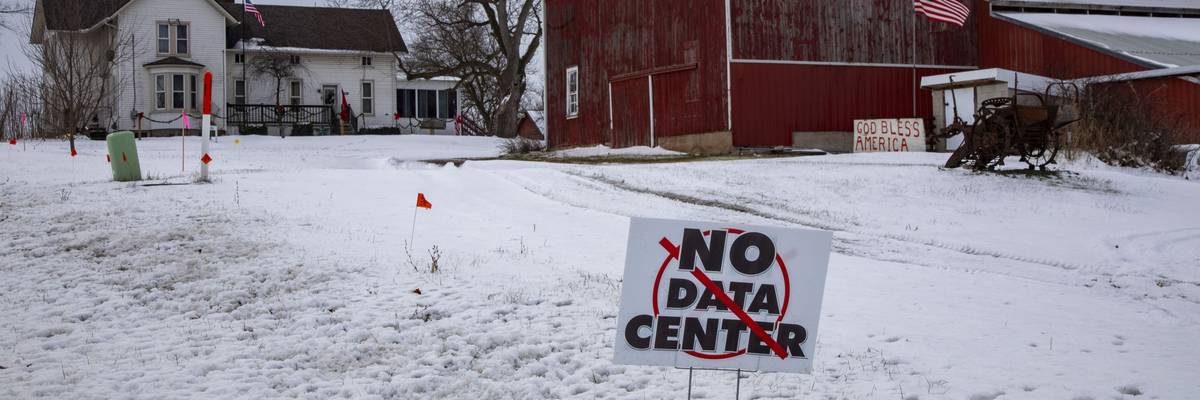
A sign on a rural Michigan road opposes a planned $7 billion data center on southeast Michigan farm land.
(Photo by Jim West/UCG/Universal Images Group via Getty Images)
Jim Goodman
Sep 03, 2026
Sep 03, 2026
Barn Raiser
Today’s data center proponents argue such projects bring needed jobs and a boost to local economies. Rural America has heard confident pitches like these before. Nearly 40 years ago, concentrated animal feeding operations, or CAFOs, arrived one barn at a time with bold promises of jobs and a county tax base.
By the time neighbors organized, right-to-farm laws and state preemption had severed the ground from under them. All the while, manure lagoons leached into the groundwater and fouled the air, shortening the life expectancy of the farmworkers and downwind neighbors.
Organizing still won real things, to be sure, from North Carolina’s CAFO moratorium in 1997 to Chris Jones’s clean-water campaign for agriculture secretary in Iowa today. When it comes to CAFOs, the lessons came late, but in the age of artificial intelligence, those same lessons can give rural communities a leg up.
While CAFOs crept into rural America, data centers are arriving as a land rush. This speed is both terrifying and an advantage. Texas alone has some 248 proposed data center projects, even though 56% of Texans tell pollsters they do not want one nearby, which means that, unlike the CAFO era, rural communities are asking questions before the statutes are locked in. And rural people need their voices to be heard. According to Pew Research Center, of the more than 1,500 data centers proposed or under development, 67% are in rural communities.
Everything CAFO country learned, it learned too late, after the wells were ruined, after the smell lowered adjacent property values and health outcomes, after the statutes were written.
The ultimate question will be: Do rural residents have the power to say no?
The answer is playing out across the country. In November 2025, 800 people filled a board meeting to oppose a billion-dollar Meta-linked project in Howell Township, Michigan, and the developer withdrew. In February, the city council of San Marcos, Texas, rejected a $1.5 billion campus after nearly nine hours of public comment, then became the first Texas city to ban data centers through its zoning code. Fort Worth, Texas, is drafting data center zoning rules of its own.
Nationally, the poorest census tracts resist data center projects at five times the rate of the richest. Projects that meet resistance are cancelled at several times the rate of those that do not. One tracker counts tens of billions of dollars in blocked or delayed projects.
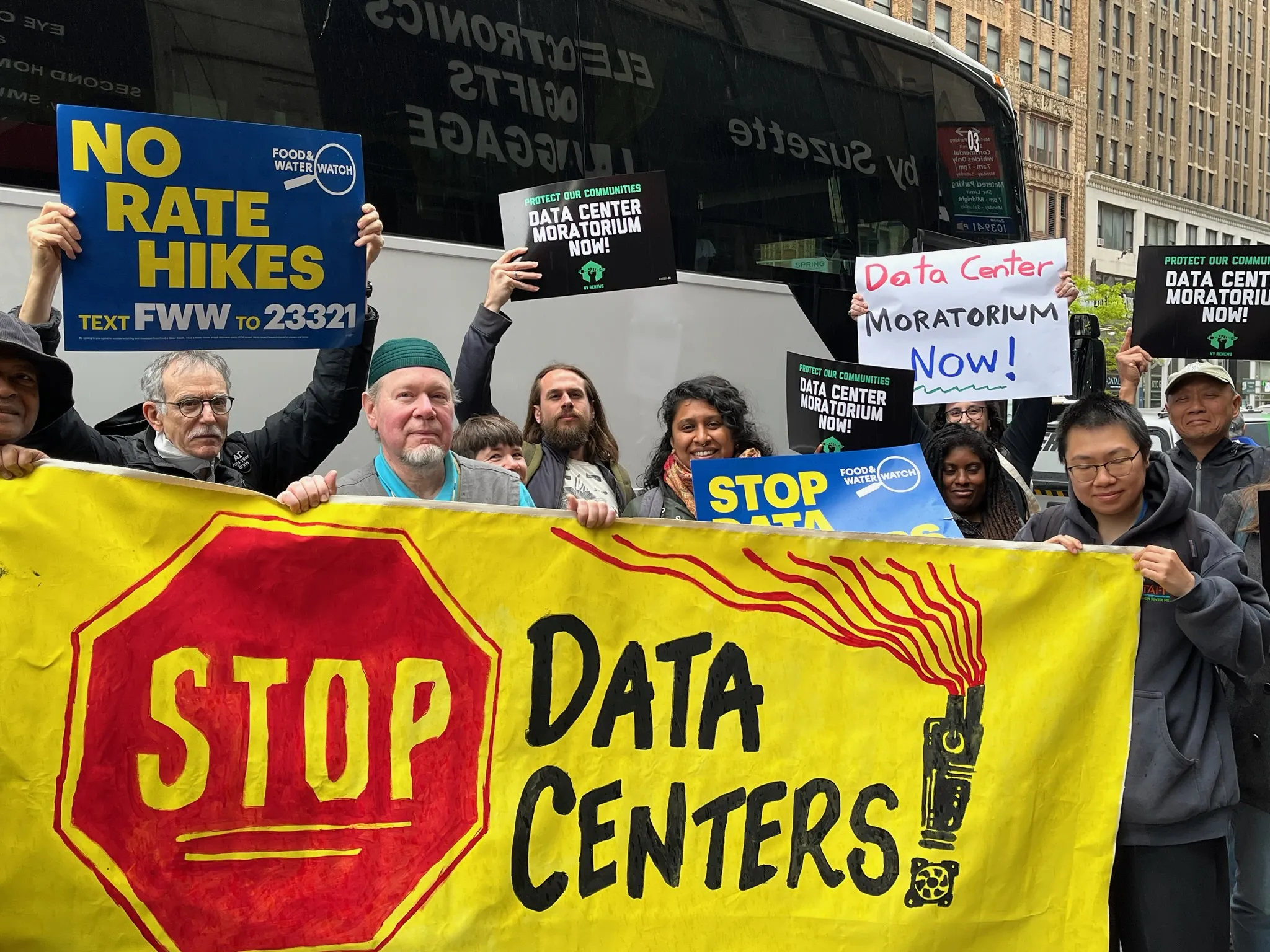
Opposition to data center projects is one of the few issues that many Americans agree on. A June Reuters/Ipsos poll found that only 14% of respondents would support a data center being built in their community. On July 18, organizers held 142 protests across 42 states in the first nationwide protest against data centers and artificial intelligence.
Data center hyperscalers are copying the CAFO playbook as best they can. West Virginia has stripped its counties and towns of the power to regulate data centers; similarly, the state’s right-to-farm law prohibits local governments from bringing civil or criminal action against an agricultural operation as long as it meets state and federal laws, permits, and regulations. When Hill County, Texas, passed the state’s first county moratorium in May, a developer sued for $100 million and the county rescinded within a week, because Texas counties can zone against neither a data center nor a feedlot. Hood County pulled its own moratorium after state Sen. Paul Bettencourt (R-7) asked whether counties even hold that power; the same senator calls the San Marcos ban illegal.
Right-wing organizations like the American Legislative Exchange Council (ALEC), behind the pro-CAFO model legislation of right-to-farm laws since the 1990s, likewise appear intent on denying local control in the data center buildout. At its annual meeting in July, ALEC considered a model legislative framework that would undercut local bans and moratoriums and give data centers the “clear authority to secure power… subject only to objective safety and interconnection standards,” as the Center for Media and Democracy reported. The meeting featured speakers from Google and Nvidia, along with a Meta sponsorship.
The outburst of anti-data center sentiment ahead of the midterms has forced political leaders to reckon with the issue of local control. This is where data centers and CAFOs diverge. In June, Texas Republican Gov. Greg Abbott, who once hailed Texas as “the epicenter of AI development,” called for a ban on AI data centers in rural neighborhoods and a cut to their billion-dollar-a-year tax exemption after facing rare bipartisan pressure. Florida Republican Gov. Ron DeSantis signed a law to preserve local control over data centers. Michigan’s candidates for governor are split over the server halls sprouting between Lansing and Detroit. Illinois recently reversed course on its data center policy, reeling in the subsidies it had rolled out in 2019. And in July, New York became the first state in the nation to enact a one-year moratorium.
So, who hasn’t been able to say no? We pulled the locations of CAFOs and data centers in North Carolina and Texas, where the data is easily available, and—yes—got Claude to plot it for us against demographic and county boundaries.
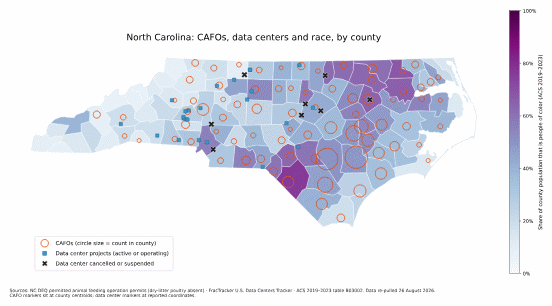
In North Carolina the answer is pretty clear. The state’s 2,482 permitted animal operations cluster in the Black Belt coastal plain where the epidemiologist Steve Wing found hog lagoons a generation ago. Weighted by the number of permits each county holds, those counties are 46% people of color, against 34% across North Carolina’s hundred counties as a whole. Duplin County alone holds over 500 permits and 2.2 million allowable hogs in a county where almost half the population of 49,000 are people of color.
Data centers are the inverse of CAFOs. The state’s data centers sit in counties whiter than the state average, in the Piedmont towns that lost their historic furniture and textile businesses as well as in wealthy Wake and Mecklenburg counties (respectively home to large cities Raleigh and Charlotte). Two of the state’s suspended projects are in adjacent Edgecombe County and Pitt County, where residents informed their resistance based on their history fighting CAFOs.
In 1995, residents of predominantly Black Kingsboro, in Edgecombe County, successfully blocked a major meatpacker from building a 300-acre slaughterhouse in their backyard through efforts to rezone land. When a $19 billion, 400-acre data center came knocking three decades later, residents opposed it en masse. The developer Energy Storage Solutions withdrew its proposal in July and by August, Edgecombe County enacted a two-year moratorium.
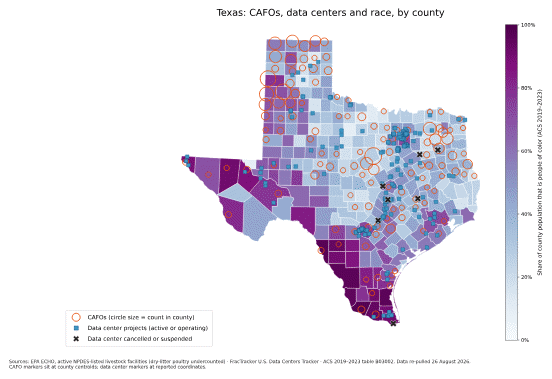
In Texas the pattern is a little more complex. Rural Texas tends to be whiter than a state average balanced by majority-Hispanic cities. Yet the feedlot Panhandle is majority-Hispanic meatpacking country, with counties like Deaf Smith and Castro where the workforce lives beside the feedyards it staffs. The rural counties now hosting data centers likewise run less white than rural Texas as a whole.
Other outlier cases in the US: The world’s densest data center cluster is outside Washington, DC, in Loudoun County, Virginia, among the wealthiest counties in America, while xAI’s Colossus runs beside Boxtown, a majority-Black neighborhood in Memphis.
The patterning and the possibilities for asking questions about data centers are very different. CAFOs were put next to the disempowered by history. In most of the counties with proposed data centers, there’s no local billionaire hyperscaler whose family has been on the land for generations to champion the project, with the historical ability to make people of color, in particular, suffer the consequences in the ways that CAFOs had.
In contrast, data centers are being aimed by site selectors in a hurry, looking for cheap land and water, cheap power and thin resistance. But they don’t have their local defenders and hands on the levers of power in the ways that CAFOs do.
At this intersection of race and class is the oldest American proxy for who can, and who can’t, say no.
Here are the questions that constituents should ask their local governments about new data center projects:
1. About Water
Does the permit say the cooling loop is closed, with maximum gallons per day, public metering, and penalties? We have yet to find a binding closed-loop commitment in any permit. Who owns the aquifer data, and who pays for the test wells?
2. About Power
Electric cooperatives, unique to rural America, have long been a way for farmers and rural people to claw back some power over their destiny. These cooperatives were established with a “duty to serve” the areas that investor-owned utilities refused to serve because the load factors were low. By pooling their demand, cooperatives could connect their members to a grid and lower their prices.
In the age of artificial intelligence, public utilities—rural electric cooperatives included—face a dilemma. The more a cooperative buys from its wholesale supplier, the greater its load factor and therefore the lower the cooperative’s average cost of power. When a data center project fields new requests for power, it can be life changing. Having a client with a reliable 24-7 demand for electricity means a predictable increase in the co-op’s load factor. All that new volume could, in principle, make every member’s bill cheaper and bring new system upgrades. It’s tempting to shut up and take the deal.
But as with any gift horse, every farmer knows to check the teeth. Data centers often have greater access to capital than their would-be electric cooperative providers, and their rise as buyers means a shift in the balance of bargaining power in the marketplace. Will attitudes toward universal service obligations remain in place? Will consumer protection policies evolve? And which regulator should be responsible for developing and overseeing new industry guardrails?
Who pays for the substation and the lines? Port Washington, Wisconsin found itself on the hook for a $90 million substation it did not need. Is there a curtailment agreement cutting the data center first in a grid emergency, as Texas now requires of loads over 75 megawatts? Are residential rates fenced off in a separate rate class? And for rural electric cooperative members: Does the all-requirements wholesale contract cap the solar and wind members may build, and would a giant new load deepen that dependence? Why do big loads get lower per kilowatt prices as they increase their usage while conservation earns nothing? Will data centers inherit the same pricing structure?
3. About Money
What does each abatement cost per permanent job, when a hyperscale facility employs a few dozen people? Will advance payments be required to pay for infrastructure upgrades? Will they accept provisions for interruptible power during times of peak demand to prevent rolling blackouts? Are there clawbacks? Is there a decommissioning bond for the day the hardware is scrap, as we now demand of wind farms?
4. About Democracy
Did any utility or government official sign a Non-Disclosure Agreement (NDA)? Can our county or township legally say no, and if not, which law took the power and who voted for it?
Everything CAFO country learned, it learned too late, after the wells were ruined, after the smell lowered adjacent property values and health outcomes, after the statutes were written. Data centers are arriving early enough that the questions can still be asked in time, even as the hyperscalers find friends in Washington DC, and in statehouses around the country, who’ll say yes to them so that local communities won’t be able to say no.
If we want to stop Amazon, Meta, and OpenAI riding roughshod over our communities and land, it will be because average people, urban and rural alike, will have joined forces to stop the trillionaire class from building their wealth off our backs.
Copyright 2024 by Barn Raising Media
Raj Patel
Raj Patel is a research professor at the Lyndon B. Johnson School of Public Affairs, and a member of the International Panel of Experts on Sustainable Food Systems. He is the author of Stuffed and Starved: The Hidden Battle for the World Food System and The Value of Nothing, and co-author of Inflamed: Deep Medicine and the Anatomy of Injustice and A History of the World in Seven Cheap Things, and co-director of the documentary The Ants and The Grasshopper. He writes at newsletter.rajpatel.org
Today’s data center proponents argue such projects bring needed jobs and a boost to local economies. Rural America has heard confident pitches like these before. Nearly 40 years ago, concentrated animal feeding operations, or CAFOs, arrived one barn at a time with bold promises of jobs and a county tax base.
By the time neighbors organized, right-to-farm laws and state preemption had severed the ground from under them. All the while, manure lagoons leached into the groundwater and fouled the air, shortening the life expectancy of the farmworkers and downwind neighbors.
Organizing still won real things, to be sure, from North Carolina’s CAFO moratorium in 1997 to Chris Jones’s clean-water campaign for agriculture secretary in Iowa today. When it comes to CAFOs, the lessons came late, but in the age of artificial intelligence, those same lessons can give rural communities a leg up.
While CAFOs crept into rural America, data centers are arriving as a land rush. This speed is both terrifying and an advantage. Texas alone has some 248 proposed data center projects, even though 56% of Texans tell pollsters they do not want one nearby, which means that, unlike the CAFO era, rural communities are asking questions before the statutes are locked in. And rural people need their voices to be heard. According to Pew Research Center, of the more than 1,500 data centers proposed or under development, 67% are in rural communities.
Everything CAFO country learned, it learned too late, after the wells were ruined, after the smell lowered adjacent property values and health outcomes, after the statutes were written.
The ultimate question will be: Do rural residents have the power to say no?
The answer is playing out across the country. In November 2025, 800 people filled a board meeting to oppose a billion-dollar Meta-linked project in Howell Township, Michigan, and the developer withdrew. In February, the city council of San Marcos, Texas, rejected a $1.5 billion campus after nearly nine hours of public comment, then became the first Texas city to ban data centers through its zoning code. Fort Worth, Texas, is drafting data center zoning rules of its own.
Nationally, the poorest census tracts resist data center projects at five times the rate of the richest. Projects that meet resistance are cancelled at several times the rate of those that do not. One tracker counts tens of billions of dollars in blocked or delayed projects.
Opposition to data center projects is one of the few issues that many Americans agree on. A June Reuters/Ipsos poll found that only 14% of respondents would support a data center being built in their community. On July 18, organizers held 142 protests across 42 states in the first nationwide protest against data centers and artificial intelligence.
Data center hyperscalers are copying the CAFO playbook as best they can. West Virginia has stripped its counties and towns of the power to regulate data centers; similarly, the state’s right-to-farm law prohibits local governments from bringing civil or criminal action against an agricultural operation as long as it meets state and federal laws, permits, and regulations. When Hill County, Texas, passed the state’s first county moratorium in May, a developer sued for $100 million and the county rescinded within a week, because Texas counties can zone against neither a data center nor a feedlot. Hood County pulled its own moratorium after state Sen. Paul Bettencourt (R-7) asked whether counties even hold that power; the same senator calls the San Marcos ban illegal.
Right-wing organizations like the American Legislative Exchange Council (ALEC), behind the pro-CAFO model legislation of right-to-farm laws since the 1990s, likewise appear intent on denying local control in the data center buildout. At its annual meeting in July, ALEC considered a model legislative framework that would undercut local bans and moratoriums and give data centers the “clear authority to secure power… subject only to objective safety and interconnection standards,” as the Center for Media and Democracy reported. The meeting featured speakers from Google and Nvidia, along with a Meta sponsorship.
The outburst of anti-data center sentiment ahead of the midterms has forced political leaders to reckon with the issue of local control. This is where data centers and CAFOs diverge. In June, Texas Republican Gov. Greg Abbott, who once hailed Texas as “the epicenter of AI development,” called for a ban on AI data centers in rural neighborhoods and a cut to their billion-dollar-a-year tax exemption after facing rare bipartisan pressure. Florida Republican Gov. Ron DeSantis signed a law to preserve local control over data centers. Michigan’s candidates for governor are split over the server halls sprouting between Lansing and Detroit. Illinois recently reversed course on its data center policy, reeling in the subsidies it had rolled out in 2019. And in July, New York became the first state in the nation to enact a one-year moratorium.
So, who hasn’t been able to say no? We pulled the locations of CAFOs and data centers in North Carolina and Texas, where the data is easily available, and—yes—got Claude to plot it for us against demographic and county boundaries.
In North Carolina the answer is pretty clear. The state’s 2,482 permitted animal operations cluster in the Black Belt coastal plain where the epidemiologist Steve Wing found hog lagoons a generation ago. Weighted by the number of permits each county holds, those counties are 46% people of color, against 34% across North Carolina’s hundred counties as a whole. Duplin County alone holds over 500 permits and 2.2 million allowable hogs in a county where almost half the population of 49,000 are people of color.
Data centers are the inverse of CAFOs. The state’s data centers sit in counties whiter than the state average, in the Piedmont towns that lost their historic furniture and textile businesses as well as in wealthy Wake and Mecklenburg counties (respectively home to large cities Raleigh and Charlotte). Two of the state’s suspended projects are in adjacent Edgecombe County and Pitt County, where residents informed their resistance based on their history fighting CAFOs.
In 1995, residents of predominantly Black Kingsboro, in Edgecombe County, successfully blocked a major meatpacker from building a 300-acre slaughterhouse in their backyard through efforts to rezone land. When a $19 billion, 400-acre data center came knocking three decades later, residents opposed it en masse. The developer Energy Storage Solutions withdrew its proposal in July and by August, Edgecombe County enacted a two-year moratorium.
In Texas the pattern is a little more complex. Rural Texas tends to be whiter than a state average balanced by majority-Hispanic cities. Yet the feedlot Panhandle is majority-Hispanic meatpacking country, with counties like Deaf Smith and Castro where the workforce lives beside the feedyards it staffs. The rural counties now hosting data centers likewise run less white than rural Texas as a whole.
Other outlier cases in the US: The world’s densest data center cluster is outside Washington, DC, in Loudoun County, Virginia, among the wealthiest counties in America, while xAI’s Colossus runs beside Boxtown, a majority-Black neighborhood in Memphis.
The patterning and the possibilities for asking questions about data centers are very different. CAFOs were put next to the disempowered by history. In most of the counties with proposed data centers, there’s no local billionaire hyperscaler whose family has been on the land for generations to champion the project, with the historical ability to make people of color, in particular, suffer the consequences in the ways that CAFOs had.
In contrast, data centers are being aimed by site selectors in a hurry, looking for cheap land and water, cheap power and thin resistance. But they don’t have their local defenders and hands on the levers of power in the ways that CAFOs do.
At this intersection of race and class is the oldest American proxy for who can, and who can’t, say no.
Here are the questions that constituents should ask their local governments about new data center projects:
1. About Water
Does the permit say the cooling loop is closed, with maximum gallons per day, public metering, and penalties? We have yet to find a binding closed-loop commitment in any permit. Who owns the aquifer data, and who pays for the test wells?
2. About Power
Electric cooperatives, unique to rural America, have long been a way for farmers and rural people to claw back some power over their destiny. These cooperatives were established with a “duty to serve” the areas that investor-owned utilities refused to serve because the load factors were low. By pooling their demand, cooperatives could connect their members to a grid and lower their prices.
In the age of artificial intelligence, public utilities—rural electric cooperatives included—face a dilemma. The more a cooperative buys from its wholesale supplier, the greater its load factor and therefore the lower the cooperative’s average cost of power. When a data center project fields new requests for power, it can be life changing. Having a client with a reliable 24-7 demand for electricity means a predictable increase in the co-op’s load factor. All that new volume could, in principle, make every member’s bill cheaper and bring new system upgrades. It’s tempting to shut up and take the deal.
But as with any gift horse, every farmer knows to check the teeth. Data centers often have greater access to capital than their would-be electric cooperative providers, and their rise as buyers means a shift in the balance of bargaining power in the marketplace. Will attitudes toward universal service obligations remain in place? Will consumer protection policies evolve? And which regulator should be responsible for developing and overseeing new industry guardrails?
Who pays for the substation and the lines? Port Washington, Wisconsin found itself on the hook for a $90 million substation it did not need. Is there a curtailment agreement cutting the data center first in a grid emergency, as Texas now requires of loads over 75 megawatts? Are residential rates fenced off in a separate rate class? And for rural electric cooperative members: Does the all-requirements wholesale contract cap the solar and wind members may build, and would a giant new load deepen that dependence? Why do big loads get lower per kilowatt prices as they increase their usage while conservation earns nothing? Will data centers inherit the same pricing structure?
3. About Money
What does each abatement cost per permanent job, when a hyperscale facility employs a few dozen people? Will advance payments be required to pay for infrastructure upgrades? Will they accept provisions for interruptible power during times of peak demand to prevent rolling blackouts? Are there clawbacks? Is there a decommissioning bond for the day the hardware is scrap, as we now demand of wind farms?
4. About Democracy
Did any utility or government official sign a Non-Disclosure Agreement (NDA)? Can our county or township legally say no, and if not, which law took the power and who voted for it?
Everything CAFO country learned, it learned too late, after the wells were ruined, after the smell lowered adjacent property values and health outcomes, after the statutes were written. Data centers are arriving early enough that the questions can still be asked in time, even as the hyperscalers find friends in Washington DC, and in statehouses around the country, who’ll say yes to them so that local communities won’t be able to say no.
If we want to stop Amazon, Meta, and OpenAI riding roughshod over our communities and land, it will be because average people, urban and rural alike, will have joined forces to stop the trillionaire class from building their wealth off our backs.
Copyright 2024 by Barn Raising Media
Raj Patel
Raj Patel is a research professor at the Lyndon B. Johnson School of Public Affairs, and a member of the International Panel of Experts on Sustainable Food Systems. He is the author of Stuffed and Starved: The Hidden Battle for the World Food System and The Value of Nothing, and co-author of Inflamed: Deep Medicine and the Anatomy of Injustice and A History of the World in Seven Cheap Things, and co-director of the documentary The Ants and The Grasshopper. He writes at newsletter.rajpatel.org
Full Bio >
Jim Goodman
Jim Goodman is a retired third-generation dairy farmer from Wonewoc, Wisconsin and a member of Family Farm Defenders.
Full Bio >
Trump enrages MAGA voters after 'backwards and poor' threat backfires
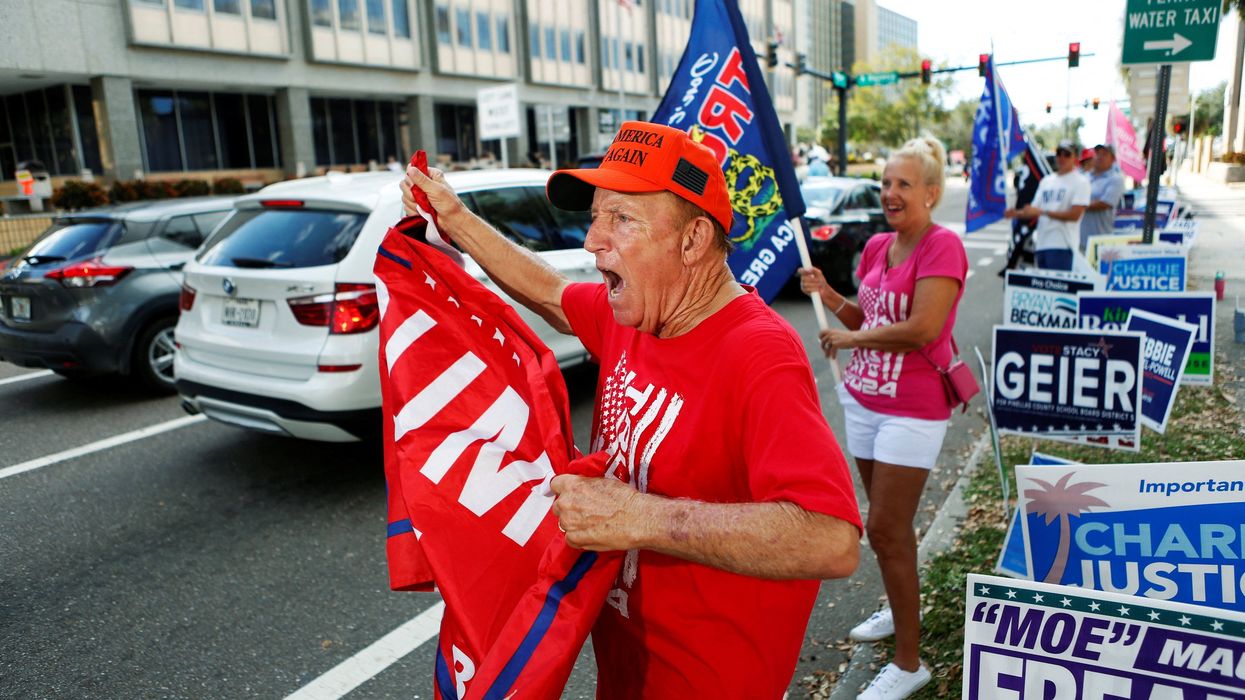
A supporter of Donald Trump rallies outside an early polling precinct as voters cast their ballots in local, state, and national elections, in Clearwater, Florida, U.S., November 3, 2024. REUTERS/Octavio Jones
A supporter of Donald Trump rallies outside an early polling precinct as voters cast their ballots in local, state, and national elections, in Clearwater, Florida, U.S., November 3, 2024. REUTERS/Octavio Jones
August 31, 2026
ALTERNET
While President Donald Trump's second term has for the most part been marked by unprecedented partisan polarization, conservatives and liberals tend to unite around one issue — opposition to data centers.
A series of posts on X, highlighted by HQ News Now, shares Trump supporters' reactions to the president's recent statement about data centers. In that Truth Social post, Trump declared that "the only reason that communities throughout the U.S.A. should not want Data Centers is if they want to end up being backwards and poor. If they want to be successful and rich, with far lower taxes and jobs all over the place, let Data Reign,. The good news is that there are plenty of other places that want them. If we kill the Golden Goose, you will only have yourselves to blame. China could not be happier with this anti Data Center movement. Actually, they can’t believe it is happening!”
In the HQ News Now post, the account highlighted one three-time Trump voter who wrote they "absolutely disagree" with the president. "I don't know who is telling you this garbage but please visit some communities that have been ravaged by data centers," the poster wrote. "There have no water pressure their electric bills are out of control, the incessant humming is intolerable and the ground water is poisoned. No on data centers!"
Similarly an account dubbed "Lefty Lies" write, "the only thing these data centers are gonna do is drive up our energy rates just like they have done throughout the country. We don't need this bulls——." In a similar vein, on user who wrote they "love" Trump noted, "if you are concerned about the windmills destroying birds [and] the constant humming, then you need to go visit a neighborhood with a data center right beside it. In Florida, especially, where our aquifer is so fragile [and] water is so expensive, data centers are a real threat. And, I'm MAGA!"
The MAGA account "VaccinesCauseSIDS" wrote "[I]'d rather have clean water and less surveillance," while another user declared, "I regret ever supporting you." An account from "Misty Collier" offered a lengthier reply, writing that "no one agrees with this sir. Data centers are a gateway for the market of the beast and total control. We love you. I am a MAGA Republican that has always supported you and hates communism. I understand they have convinced you this is right. That is a lie. We the people want to be free and have freedom and trust God and the constitution. We do not want control and surveillance. Those things promote communism. The people are to awake to be convinced otherwise."
Far right influencer Alex Jones wrote that Trump's vice president, JD Vance, went into "damage control" for Trump over data canters after Vance told reporters, "I don't think data centers are that controversial."
The Quartering ("@TheQuartering"), who is also conservative, wrote that "data centers are a reality, they are not going away. But ... they are as unpopular as illegal immigration in small towns like here in my state in Port Washington, we fought tooth and nail against it, and I'm pretty sure I don't know anyone who 'wants to be poor.'"
By contrast, former CNBC financial commentator Jim Cramer was sympathetic to Trump's position, writing on his account, "While the president seems to be inclined to slow things down, the border states would welcome them ... It will happen. They get the win. They have the cards." Newsman's Nick Sorter argued that "X just revealed they discovered a network of 200,000 Chinese influence bot accounts. Many of them posing as Americans to shape AI, energy and data center policies. President Trump warned about this just last month: 'Other nations are trying to get us to slow down and they are spending a lot of money on propaganda, on press PR, trying to convince everybody that this isn't a positive thing[.]' Looks like he was right."
While President Donald Trump's second term has for the most part been marked by unprecedented partisan polarization, conservatives and liberals tend to unite around one issue — opposition to data centers.
A series of posts on X, highlighted by HQ News Now, shares Trump supporters' reactions to the president's recent statement about data centers. In that Truth Social post, Trump declared that "the only reason that communities throughout the U.S.A. should not want Data Centers is if they want to end up being backwards and poor. If they want to be successful and rich, with far lower taxes and jobs all over the place, let Data Reign,. The good news is that there are plenty of other places that want them. If we kill the Golden Goose, you will only have yourselves to blame. China could not be happier with this anti Data Center movement. Actually, they can’t believe it is happening!”
In the HQ News Now post, the account highlighted one three-time Trump voter who wrote they "absolutely disagree" with the president. "I don't know who is telling you this garbage but please visit some communities that have been ravaged by data centers," the poster wrote. "There have no water pressure their electric bills are out of control, the incessant humming is intolerable and the ground water is poisoned. No on data centers!"
Similarly an account dubbed "Lefty Lies" write, "the only thing these data centers are gonna do is drive up our energy rates just like they have done throughout the country. We don't need this bulls——." In a similar vein, on user who wrote they "love" Trump noted, "if you are concerned about the windmills destroying birds [and] the constant humming, then you need to go visit a neighborhood with a data center right beside it. In Florida, especially, where our aquifer is so fragile [and] water is so expensive, data centers are a real threat. And, I'm MAGA!"
The MAGA account "VaccinesCauseSIDS" wrote "[I]'d rather have clean water and less surveillance," while another user declared, "I regret ever supporting you." An account from "Misty Collier" offered a lengthier reply, writing that "no one agrees with this sir. Data centers are a gateway for the market of the beast and total control. We love you. I am a MAGA Republican that has always supported you and hates communism. I understand they have convinced you this is right. That is a lie. We the people want to be free and have freedom and trust God and the constitution. We do not want control and surveillance. Those things promote communism. The people are to awake to be convinced otherwise."
Far right influencer Alex Jones wrote that Trump's vice president, JD Vance, went into "damage control" for Trump over data canters after Vance told reporters, "I don't think data centers are that controversial."
The Quartering ("@TheQuartering"), who is also conservative, wrote that "data centers are a reality, they are not going away. But ... they are as unpopular as illegal immigration in small towns like here in my state in Port Washington, we fought tooth and nail against it, and I'm pretty sure I don't know anyone who 'wants to be poor.'"
By contrast, former CNBC financial commentator Jim Cramer was sympathetic to Trump's position, writing on his account, "While the president seems to be inclined to slow things down, the border states would welcome them ... It will happen. They get the win. They have the cards." Newsman's Nick Sorter argued that "X just revealed they discovered a network of 200,000 Chinese influence bot accounts. Many of them posing as Americans to shape AI, energy and data center policies. President Trump warned about this just last month: 'Other nations are trying to get us to slow down and they are spending a lot of money on propaganda, on press PR, trying to convince everybody that this isn't a positive thing[.]' Looks like he was right."





.jpg)