Sunday, July 12, 2026


Russia has a desertion problem. Ukraine has a manpower crisis

Russia has a desertion problem. Ukraine has a manpower crisis
Russia is taking losses that are five to eight times higher than Ukraine, but thanks to the differences in the size of their populations, it is Ukraine that is proportionally losing men faster. The manpower crisis is made worse as desertion from the AFU is ten-times higher than Russia's. / bne IntelliNewsFacebook
By Ben Aris in Berlin July 12, 2026

The armies fighting Europe's biggest land war since 1945 are both losing soldiers without firing a shot. But while Russia has a growing desertion problem, Ukraine is in the midst of a growing manpower crisis.

Russian authorities have convicted an estimated 28,000 cases of soldiers abandoning their units since the Kremlin launched its full-scale invasion, Meduza reports in an investigation into desertion from the Russian army. The total number of Russian deserters is unclear, but according to analysis by the military intelligence group Frontelligence that if current trends continue, up to 70,000 Russian soldiers could desert during 2026.Yet, the losses are being largely offset by a steady flow of highly paid volunteers signing military contracts every month.

Ukraine, by contrast, has opened hundreds of thousands of criminal investigations into soldiers desertions or failing to return from leave, NV reported in November.

Since the start of Russia’s full-scale invasion, Ukrainian law enforcement has registered more than 310,000 criminal cases related to “unauthorized absence from a military unit or place of service” (AWOL) and desertion — most of them in the first 10 months of 2025, NV reported. Between January 2022 and October 2025, 255,000 cases were opened for AWOL and another 56,200 for desertion, totalling 311,327 criminal proceedings, the Prosecutor General’s Office told NV in a written response.

The stark difference reflects the contrasting recruitment models adopted by the two countries more than three years into the war.

Russia hunts deserters — and sends them back

According to Meduza, more than 28,000 Russian servicemen had been convicted of going AWOL by May 2025, with the total now believed to exceed 30,000. The report describes a military justice system that increasingly seeks not to imprison deserters but to return them to combat. Even sending them to prison means most convicts will end up back on the front line as Russia has emptied its prisons in its search for combat soldiers.

Beginning in the summer of 2022, the Wagner Group headed by the late Evgeny Prigozhin, recruited tens of thousands of convicts directly from Russian prisons, promising pardons after six months at the front. Following Prigozhin's failed mutiny and death in 2023, the Ministry of Defence took over the programme. By most estimates, well over 150,000 prisoners have been recruited since the invasion began, sharply reducing Russia's prison population. According to Russia's Federal Penitentiary Service (FSIN), the number of inmates has fallen from around 420,000 before the war to below 300,000, the lowest level in modern Russian history. Officials have acknowledged that many penal colonies have been left with only a fraction of their previous populations. Having largely exhausted the prison pool, the Kremlin has continued to offer enormously generous signing bonuses and high military salaries to attract civilian volunteers, but according to recent reports it is now failing to recruit enough fresh troops to cover losses at the frontline.

That has refocused the military authorities on cracking down on deserters. Soldiers who disappear from their units — known colloquially as sochintsy, after the Russian military abbreviation SOCh for unauthorised absence — face a growing nationwide manhunt. Recent cases included authorities in Russia's Belgorod region declaring 13 soldiers wanted after they fled almost simultaneously.

While going AWOL can theoretically carry prison sentences of up to 10 years, or 15 years in aggravated desertion cases, Meduza reports that the military's preferred solution is often simply to recapture soldiers and send them back to the front, increasingly into assault units where casualties are highest.

Rights organisation Peace Plea, which advises Russian soldiers seeking to avoid combat, says forced redeployment has increased significantly since 2024. Many soldiers now regard imprisonment as preferable to another deployment into some of the war's bloodiest sectors.

Ukraine's numbers are vastly larger

The scale of Ukraine's desertion problem is substantially greater. Before the figures were classified late last year, Ukrainian prosecutors had opened approximately 311,000 criminal cases for desertion and unauthorised absence since the start of the invasion, with more than half of those cases opened since the beginning of 2025.

Official court statistics indicate that well over 100,000 AWOL cases have already reached the judicial system, while Ukrainian MPs had previously disclosed that desertions had exceeded 100,000 by late 2024.

Famously, the problem was best illustrated by the collapse of Ukraine's elite 155th Mechanised Brigade, who were sent to France for advanced training and equipment, receiving some of the most advanced Western weapons supplied to Kyiv. This is an elite battalion and were used to spearhead the Kursk incursion in 2024. Embarrassingly, hundreds of them deserted as soon as they arrived in France. Up to 1,700 soldiers from the brigade eventually went AWOL before the unit had fired a shot. Around 50 disappeared during training in France, while hundreds more vanished on their way back to Ukraine, despite receiving extensive Nato instruction and modern equipment. The brigade was eventually broken up and its surviving personnel redistributed among other formations.

Volunteers versus conscripts

The contrast largely reflects how each army recruits. Russians volunteer and are well paid for their commitment. Ukrainians are violently pressganged into service against their will.

Russia offers signing bonuses that in some regions exceed the equivalent of $40,000 – multiples of the average annual salary –

alongside monthly salaries several times the national average. As IntelliNews reported, a Siberian bus driver can earn double his usual salary just driving a truck behind the lines. Western intelligence estimates Russia continues to recruit roughly 25,000 to 35,000 volunteers every month, broadly enough to replace, though not necessarily exceed, its exceptionally heavy battlefield losses.

Ukraine closed the borders to the exit of military aged men as soon as the year started and introduced compulsory service. Unable to attract sufficient volunteers, Kyiv increasingly relies on the “busification” of eligible men enforced by the much-hated Territorial Recruitment and Social Support Centres (TCKs).

Videos circulating daily on Ukrainian social media show recruitment officers forcibly detaining military-aged men in the streets before loading them into minibuses. The policy has become one of the country's most divisive wartime issues.

Last week tensions came to a head in Lviv, traditionally one of Ukraine's most patriotic cities, when an anti-mobilisation protest escalated into a riot after recruitment officers allegedly assaulted a civilian. Protesters overturned and then smashed a TCK vehicle before police restored order. Embarrassingly, it later emerged that several of the rioters were active duty servicemen that had deserted and were hiding in Lviv, as far from the frontline as it is possible to be inside Ukraine.

A shrinking pool of manpower

The Armed Forces of Ukraine (AFU) is facing a growing manpower crisis. While the Armed Forces of Russia (AFR) is currently losing a reported 1,000 men a day as it tries to capture the town of Kostiantynivka and the remain parts of Donbas it doesn’t’ already control, as IntelliNews estimated, the AFU is losing somewhere between 100 and 300 men a day.

The absolute number of Ukraine’s losses is less, but proportionally Ukraine is losing more than Russia. Russia has roughly five-times more people than Ukraine, assuming a Ukrainian population of 29mn, which many experts say is on the high side.

However, this ratio is made worse by the fact that more than 5.7mn Ukrainians remain abroad after fleeing the war. According to expert estimates, of the pool of people left in Ukraine, half of them are now pensioners. Others are exempt due to health reasons and single parents or parents with more than three children are also exempt. In addition, large numbers of eligible men still in the country have gone into hiding to avoid serving. In real terms that suggests that Ukraine’s pool of possible recruits could be a tenth of Russia’s.

Russia is also facing a manpower shortage and as IntelliNews reported, tensions between the doves and the hawks in the Kremlin to end the war soon is growing. The doves want to call it a day here and freeze the conflict on the current line of contact. The hawks want Russian President Vladimir Putin to call a second general mobilisation and flood the Donbas with hundreds of thousands of fresh recruits to bring the war to a speedy end. Rumours are currently swirling that a new mobilisation will be called after this September’s parliamentary election. Previously, Putin held a partial mobilisation in September 2022, recruiting some 300,000 men to meet a manpower shortage then.

Russian forces continue making slow but persistent advances across the Donetsk region while Ukraine struggles to rotate exhausted frontline units that, in many cases, have been fighting continuously for months. Despite the recent talk of a “turning point” in the war, more sober Ukrainian reports admit that the AFR continues to make slow but consistent progress.

As the war enters its fifth year, battlefield success may depend less on who possesses the better weapons than on which country can continue persuading its citizens to keep fighting.


South Korean military cyber attacks hit record 19,000 cases in 2025

South Korean military cyber attacks hit record 19,000 cases in 2025
/ Max Bender - UnsplashFacebook
By IntelliNews July 13, 2026

South Korea’s military recorded a record 19,000 cyber attack attempts last year, with activity linked to increasingly sophisticated North Korean hacking operations, The Chosun Daily reports.

Website intrusion attempts targeting administrator access accounted for the vast majority, with 18,792 cases.

The Cyber Operations Command said identifying attackers remains difficult because of techniques including IP spoofing and the use of overseas infrastructure. It assessed that North Korea’s cyber capabilities are becoming more advanced.

Authorities estimate that North Korea’s cyber warfare operations are led by the Reconnaissance General Bureau, an organisation under the General Staff Department responsible for intelligence gathering and operations targeting South Korea and overseas.

North Korea expanded and reorganised the bureau into the Reconnaissance Information General Bureau last year. At an expanded meeting of the Central Military Commission of the Workers’ Party on July 9, chaired by leader Kim Jong-un, officials proposed a major strengthening of the agency’s capabilities.

Meanwhile, South Korea’s military is facing challenges in retaining cybersecurity specialists.

The government supports tuition for students selected for designated university programmes, who are commissioned as cybersecurity officers after graduation and required to serve for seven years but many leave early.

Of 104 cybersecurity officers commissioned between 2016 and 2019, 89, or 85%, chose not to continue with long-term military service, according to data from lawmaker Yu Yong-weon’s office.

The office said cybersecurity expertise requires years of accumulated experience and cannot be developed quickly. It called for a more systematic personnel management system covering recruitment, training and long-term retention of specialists.


Erdogan's revolvr diplomacy left NATO leaders with a loaded problem

Erdogan's revolver diplomacy left Nato leaders with a loaded problem
Personalised Turkish-made handguns and live ammunition presented by President Recep Tayyip Erdogan at the Ankara summit prompted a mixture of amusement, logistical headaches and museum plans / bne IntelliNews


By Ben Aris in Berlin July 10, 2026

Most Nato summits end with a communiqué. This one ended with customs problems. As leaders prepared to leave Ankara this week, Turkish President Recep Tayyip Erdogan presented each visiting head of state with an engraved Turkish-made revolver complete with ammunition and cleaning kit — prompting a flurry of questions not about geopolitics, but about firearms licences, diplomatic protocol and how to get a loaded handgun through airport security.

The gift — a vintage Gümüşay .357 Magnum revolver bearing each recipient's name — was presented in a wooden display case carrying the Turkish flag and Nato logo, together with a cleaning kit, live ammo and export paperwork.

Intended as a showcase for Turkey's expanding arms industry, the personalised firearms left many leaders wondering how they could get a gun into their home countries. Most of the Nato bigwigs gave up their pistols at the border and said it would be blanked. Others sent it to embassies, armouries, or said it would be donated to a museum. It appears none of them intend to take the pistol home and put it on the wall over the mantelpiece.

Erdogan’s gift quickly became a diplomatic gaffe. It left Nato leaders scratching their heads, not wanting to offend the Turkish strongman, but uncomfortable about carrying firearms with live ammunition over the border and into their home countries.

Belgium: Prime Minister Bart De Wever handed his revolver directly to police at Brussels Airport on arrival so it could be secured in a safe while officials determine how to handle the diplomatic gift.

Britain: Prime Minister Keir Starmer received one of the more elaborate gift sets, including 500 rounds of ammunition. British officials said the revolver would remain in Turkey until it could be decommissioned before being brought to the UK under Britain's strict firearms regulations.

Canada: Prime Minister Mark Carney is reportedly looking for a military museum that could eventually house the revolver after it has been rendered incapable of firing.

European Commission: Commission President Ursula von der Leyen also intends to donate her engraved revolver to a military museum after it has been blanked.

Germany: Chancellor Friedrich Merz didn’t even try to take his back to Germany, handing the revolver over to the German embassy in Ankara so it could be imported and inventoried under the normal procedures governing official state gifts. Under German diplomatic rules, normally civil servants are not allowed to accept any gift – even flowers are problematic.

Italy: Prime Minister Giorgia Meloni's revolver has already been placed in storage at Palazzo Chigi alongside other diplomatic gifts received by the Italian government.

Netherlands: Dutch Prime Minister Rob Jetten's revolver was taken to the Dutch embassy in Ankara, where officials said it would be permanently disabled before being transported home.

Poland: President Karol Nawrocki's office said the revolver remained at Warsaw Airport awaiting customs clearance and would be stored "in an appropriate place so that it is firstly safe and secondly respected as a gift." An aide added: "Certainly no one will be shooting it."

Spain: Prime Minister Pedro Sánchez's office confirmed that all leaders had received identical revolvers, each engraved with the recipient's own name, but didn’t say what has happened to his pistol.

Sweden: Prime Minister Ulf Kristersson's revolver was transferred to Sweden's embassy in Ankara while officials completed the paperwork required for legal importation.

Turkey has the largest army in Europe and with Europe in the midst of von der Leyen’s ReArm military modernisation programme that is going to cost billions of euros, you can see why Erdogan was keen to demonstrate Turkey’s arms-making prowess. But at end of the day, the idea of handing out guns to top Nato leaders seems to have backfired.


PKK commemorates anniversary of weapon-destruction ceremony

PKK commemorates anniversary of weapon-destruction ceremony
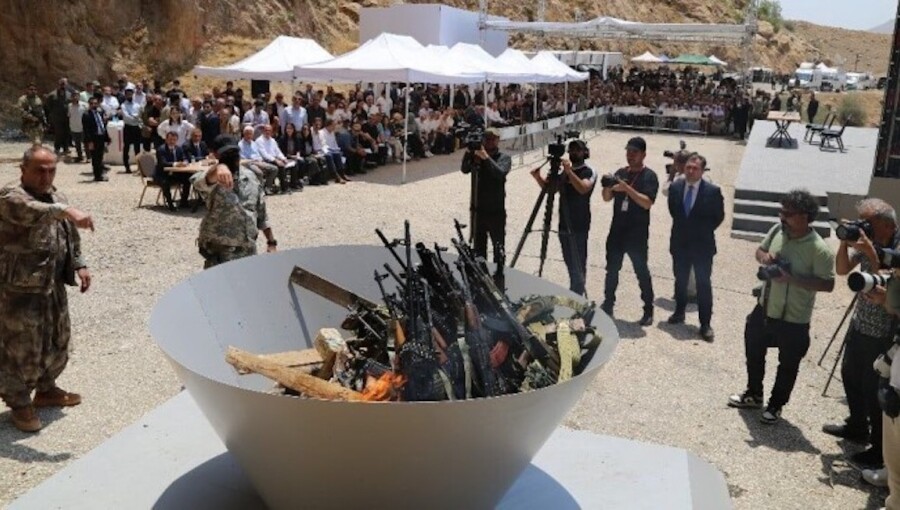
Trademark PKK Kalashnikov rifles were melted down in a furnace on July 11, 2025. / Mezopotamja AjansiFacebook
By Akin Nazli in Belgrade July 12, 2026

Kurdistan Communities Union (KCK) executive council co-chair Bese Hozat and 29 of her associates on July 10 recalled the melting down of weapons that took place one year ago in front of the historic Cesena Cave near Sulaymaniyah in Iraq’s Kurdistan Region, the Hareket Yonetimi (Movement Management) said  in a written statement.

“The weapon-destruction ceremony held on July 11, 2025, symbolised a strategic transformation,” another KCK member told ANF, the news service of the Kurdistan Workers’ Party, or PKK, on July 12.

In May, the Apocu Hareket Yonetimi (Apoist Movement Management), held a press meeting to commemorate the one-year anniversary of the latest self-dissolution declaration by the PKK, which remains in talks with Turkey’s Erdogan administration on finding a lasting peace.

At the media conference, the PKK, which does-not-but-does exist, for the first time referred to itself as Apocu Hareket Yonetimi.

The July 10 statement showed that the name has since become Hareket Yonetimi.

Since 2005, the name KCK has also been used as the name of the umbrella organisation of the Kurdish political movement that is dominated by imprisoned leader Abdullah Ocalan.

Since its 1978 launch, the PKK has utilised a sophisticated “umbrella” strategy, frequently changing names to adapt to shifting legal and geopolitical dynamics. There are dozens of combinations of various sets of three letters that operate under the umbrella in question.

LA REVUE GAUCHE - Left Comment: Search results for OCALAN


Mayor of Ankara addresses angry crowd after more regime detentions of opposition officials

Mayor of Ankara addresses angry crowd after more regime detentions of opposition officials
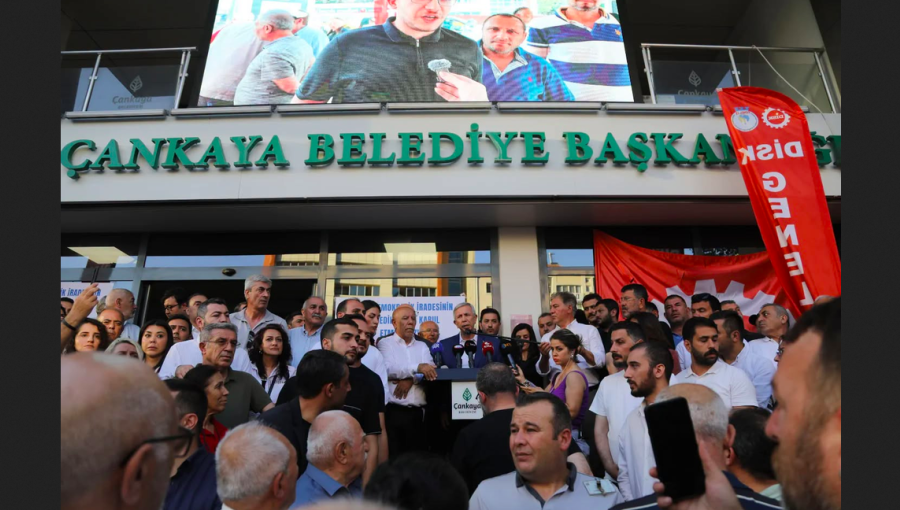
Yavas spoke to a crowd that gathered at the Cankaya Municipality HQ. / Cankaya Belediyesi, FacebookFacebookTwitter
By Akin Nazli in Belgrade July 12, 2026

Turkish police on July 11 detained Huseyin Can Guner, mayor of Ankara’s central Cankaya district, at Esenboga Airport as he returned from an overseas vacation.

The detention of Guner, as well as the taking into custody of another 35 municipal officials, marks a dramatic escalation of the ongoing legal operations targeting the main opposition Republican People’s Party (CHP).

Addressing an angry crowd of supporters outside the Cankaya municipality offices, CHP Mayor of Ankara Mansur Yavas accused the government of bypassing established legal safeguards to orchestrate a "trial by media".

Social media lynching, TV ‘court’ trials

"Some lynch our mayors on social media, others convict them in courts they have set up on television," Yavas said.

“When they are acquitted tomorrow, there is absolutely no way to compensate for this. But the day will surely come when these people, too, will be held accountable. We want justice for everyone; we want equal justice for everyone,” he added.

"Have you ever heard of anyone being summoned and not answering the summons? What is there for us to fear? We have absolutely nothing to fear. My declaration of assets is published everywhere. We share it transparently with the public. We have nothing to flee from, nothing to fear. Only the people of Ankara can judge us,” Yavas also said.

"Instead of a ‘law for the enemy’, it is seen how there are bureaucrats from the previous administration [prior to my coming to office] who have been put on trial because of the criminal complaints I've filed since taking office in 2019. Not a single one of them was detained or arrested; their trials are simply proceeding. And that is exactly how it should be,” Yavas, who is also a lawyer, said.

39th operation against CHP mayors

“Yet, what is actually happening? This operation is the 39th operation carried out against our [CHP] mayors [nationwide]. As a result of unjust arrests, certain slanderers are accusing others under the guise of 'confessions.' We want equal application of the law. They started talking about mayor Huseyin Can on television a week ago. They said he would be detained. How do they have access to this information?" Yavas asked.

Transferred from Istanbul

Judicial operations targeting main opposition municipalities expanded into the capital less than a month after the city’s new chief public prosecutor was appointed on June 12.

Aykut Celik previously worked in Istanbul alongside justice minister Akin Gurlek, who was serving as Istanbul chief public prosecutor at the time. He was also among the prosecutors who led the investigation into the case popularly known as the “Aziz Ihsan Aktas trial,” which involved allegations of bribery and corruption in various municipalities, primarily Besiktas Municipality.

Building an Economy That Works for Working Americans

Source: Originally published by Z. Feel free to share widely.

The United States is a plutocracy. Its economy works for the wealthy and powerful at the expense of working people. It is a broken politico-economic system in need of major repairs, but as leading progressive economist Gerald Epstein points out in the interview that follows, there is indeed an arsenal of bold policies to “defeat fascism, preserve democracy, and help create a greener, stronger and fairer economy for American workers.” Epstein is professor of  economics and a founding co-director of the Political Economy Research Institute (PERI) at the University of Massachusetts Amherst.

C. J. Polychroniou: It’s often been said that progressives are good in offering stinging critiques of the status quo and even making appealing policy proposals, but there is still a short supply of game changing strategies. I take it that this is the aim of Game Changers: Economic Polices for a Working America, an exciting new project from the Political Economy Research Institute (PERI) at the University of Massachusetts Amherst. You conceived of the project and serve as its director, so tell us more about it. Why now the launching of such a project, what are the major issues covered, and what do you  hope will be achieved? 

Gerald Epstein: I launched the Game Changers project, along with my colleagues James Boyce of the University of Massachusetts Amherst and Juliet Schor of Boston College, because of the emerging perception that progressives in the United States could not gain political power and defeat the fascists and MAGA simply by leveling criticisms and epithets against Trump and his associates. Working people in the United States are hurting and angry after decades of neoliberal economic policies  implemented, with some exceptions, by both Republican and Democratic administrations. Looking for answers to their legitimate problems, many American voters either simply sit out elections, or pull the lever for extreme candidates that seek to manipulate them by identifying scapegoats — such as immigrants — as the source of their problems.

So, we launched Game Changers to be a positive source of real answers to real problems facing working Americans. The idea is to offer activists, political candidates, and government officials with policy ideas that bridge the gulf between the transformative and the practical, ideas that can envisage the way to an economy that is fairer, greener, more productive and more democratic. These are ideas, we believe, that are also practical enough to offer hope to those who want to  help to mobilize the political forces that can help bring them into fruition.

Importantly, though, we are not intending to offer a comprehensive program for the American left. We felt that would be presumptuous for us to do and beyond our competence and standing. Ours is more of a menu of ideas that can be picked up by those who need them and who want to mobilize on their behalf. 

We geared the timing of this project so that the policy ideas would be ready by the Congressional elections in November of 2026. In fact, we are launching policy proposals this month of July 2026. They can be found at https://gamechangerspolicy.org . Some of these ideas might be taken up by candidates. If they win, they might be taken up when they serve in Congress. Some of these ideas may percolate and emerge in future campaigns and legislative actions, as well as be taken up by progressive organizations. That is our hope, anyway.

The Game Changers project consists of 9 teams of experts and practitioners, (about 45 people in total) working on a range of subjects: Care, Finance and Financial Regulation, Health Care, Housing, Immigration, Macroeconomics, Trade and Labor, and Work and Jobs. All in all, these teams have developed about 25 different policy proposals.

The range of policies is striking. They include: “The Wealth of Welcome: Immigration Reform that Works for America”; “America’s Workers Deserve a Four Day Week”; A Universal Basic Income for Children”; “Medicare for All”; “Polluters Pay – The Extreme Weather Superfund”; “Democratize North American Trade”; “Housing as a Human Right”; “National Rent Control”; “Public Banking”; “No More Bailouts”. (For the whole list, see GameChangersPolicy.org).

C. J. Polychroniou: Since the project is about advancing progressive economic alternatives to the problems and challenges facing the US economy, one would assume that the economists invited to be part of the project represent a common tradition in the discipline. If so, how would you define this tradition, and is it important that there is a consensus among them as to what constitutes  progressive economic policies over key issues? We know that the Left has always been divided over ideology and policymaking. It is divided over the scope of government intervention in capitalist economies, and there is even disagreement over several specific issues, such as the Universal Basic Income, how to reduce inequality, and how to combat the climate crisis.

Gerald Epstein: What unites the economists and other experts involved in Game Changers is a commitment to defeat fascism, preserve democracy, and help create a greener, stronger and fairer economy for American workers. We did not invite experts based on a theoretical, methodological or ideological litmus test. Indeed, I would say that is one of the strengths of our project. The left often has great difficulties uniting sufficiently to engage in practical tasks like winning elections, or even achieving small practical goals, because they are riven by ideological, theoretical or methodological differences. We are not subject to that problem. Big egos are also a problem in politics -left, right and center and, for sure, in academia. Thankfully, we have avoided that problem as well. For us, the litmus test was a commitment to the ideals of Game Changers, expertise in their subject areas, and, for the most part, a willingness to volunteer their time.

C. J. Polychroniou: The 1930s posed the biggest and most severe challenge in US economic history. The New Deal was a response to the calamity of the Great Depression and reshaped the United States in a major and profound way. But the New Deal ultimately gave way to the neoliberal order and the results have been nothing but catastrophic for working-class people. Is the US today in a similar state of affairs as it was in the 1930s in the sense that the system is badly broken? Is this the message behind the launching of Game Changers? If so, can different issues still be addressed separately, or does the entire system need restructuring before anything meaningful can be done?   

Gerald Epstein: You are certainly correct that the neoliberal order wreaked havoc on America’s workers, but now things are even worse. In the US, we are facing a particularly pernicious form of capitalism, an authoritarian, and profoundly corrupt version that is dominated by a self-seeking Presidential family and a lethal coalition of techno-fossil-fuel-financialized capitalists. While our specific issues and policy proposals stand on their own terms, we see them as part of a broader vision of what our economy needs to overcome this lethal form of capitalism. The antidote is to recognize the equal dignity of every human being and work to guarantee their right to economic security, the opportunity to thrive, a livable planet, a world free of racism, and democratic governance of our lives, societies, and economies. 

More specifically, Game Changers is posing a set of policies to help defeat this form of capitalism by “changing the game,” based on three principles.

Changing the game means (1) investing in each other through public provisioning of care, healthcare and other critical services; (2) securing our future by, for example, breaking the power of the fossil fuel capitalists and addressing climate change; and (3) righting the rules, by ending reckless and predatory financial practices, changing tax policies so that the super-rich have less wealth and contribute a bigger share for the operations of our government, preventing capitalists from firing workers arbitrarily and without just cause.

At one level, these, of course, are not revolutionary demands in a traditional sense. But if widely implemented, they would bring about a revolutionary improvement in the lives of working people, not only in the short term but in the longer term as well.

C. J. Polychroniou: In your view, what are the most pressing issues facing today the US economy and working-class people? 

Gerald Epstein: While the US economy’s productivity has grown significantly over the last forty years, the standard of living of American workers has, for the most part, barely budged. This is especially true if one includes American workers’ ability to acquire many of the most important basics of life: housing, time and the wherewithal to care for children, family members and their communities; a sustainable environment in the face of climate change and degradation; quality health care and education; and dignity, respect, and a voice in their workplace. American capitalists, especially but not exclusively those on Wall Street, engage in speculative and extractive activities rather than investing in socially productive assets for the future. Even when a new technology is developed that could improve workers’ lives, such as AI, these are weaponized by big capitalists in their efforts to control and extract wealth from American workers. We have a bailout economy, whereby Wall Street financiers undertake highly risky investments, grab the rewards and when these threaten themselves and the economy, they get bailed out by the government. All of this has led to an obscene level of income and wealth inequality. And we have a politico-economic system where those at the top use xenophobia, and racial and ethnic baiting and oppression to try to divide and conquer America’s workers in order to stay in control.

At Game Changers, we are trying to do our small part to help overturn this immoral and destructive system. Email

Professor Gerald Epstein is professor of economics and co-director of the Political Economy Research Institute at the University Massachusetts Amherst. He is a world-leading authority on banking, finance, and financial crises.

Srebrenica and the Hierarchy of Horror: Between Legal Classification and the Agony of Human Suffering

Source: Originally published by Z. Feel free to share widely.

Every year on 11 July, the public sphere across the former Yugoslavia becomes, almost without fail, the arena for the same long-predictable argument. On that date in 1995, forces of the Army of Republika Srpska entered Srebrenica, a predominantly Bosniak enclave in eastern Bosnia that had been declared a United Nations “safe area.” In the days that followed, Bosniak women, children and elderly people were forcibly removed, while thousands of captured men and boys were separated, detained and executed at a series of locations in the surrounding region. Their bodies were buried in mass graves, many of which were later reopened and the remains dispersed in an effort to conceal the crime.

One side repeats that genocide was committed in Srebrenica; the other rejects that legal classification outright. It is as though the entire tragedy of more than eight thousand lives cut short, thousands of bereaved families and a society scarred to its core could be reduced to a single answer: “yes” or “no.”

Yet the most serious scholarship in international law teaches us that the matter is far more complex. Not because it disputes the scale or horror of the crimes, but because legal scholarship itself does not claim that a single word, even the gravest word in its vocabulary, can exhaust the full meaning of a human catastrophe.

The 2001 judgment of the Trial Chamber of the International Criminal Tribunal for the former Yugoslavia in the case against Radislav Krstić marked a turning point in the development of international criminal law. For the first time, an international court concluded that the crimes committed in Srebrenica in July 1995 constituted genocide within the meaning of the 1948 Convention on the Prevention and Punishment of the Crime of Genocide.

In 2004, the Appeals Chamber upheld that legal classification, although it revised the form of Krstić’s individual criminal responsibility. Later judgments in the cases of Popović et al., Tolimir, Karadžić and Mladić essentially endorsed and further developed the legal standards first established in the Krstić case. The judgment thus became the foundation upon which the entire subsequent body of jurisprudence concerning Srebrenica was built.

What, Then, Is the Essence of the Hague Judgments?

Among the best-known defenders of the legal reasoning that emerged from the Krstić judgment are Payam Akhavan, professor of international law at McGill University and a former legal adviser to the Office of the Prosecutor at the ICTY; Antonio Cassese, the first president of the International Criminal Tribunal for the former Yugoslavia and one of the most influential modern scholars of international criminal law; and Larry May, an American philosopher of law who, in his writings on genocide and crimes against humanity, defended the Tribunal’s legal reasoning. Their arguments were subsequently embraced in numerous commentaries on the Genocide Convention and international criminal law, and have significantly shaped the way the crime of genocide is interpreted in international jurisprudence today.

What these authors share is the conviction that genocide need not be directed towards the physical annihilation of an entire people. Rather, the 1948 Convention allows the “substantial part” of a protected group to consist of a segment that is geographically concentrated or symbolically vital. Building on this interpretation, Antonio Cassese argued that genocidal intent may be directed at destroying a part of a group whose survival is crucial to the group’s continued existence in a particular territory. Payam Akhavan, for his part, stressed that the Convention was created not only to punish genocide, but also to prevent the destruction of human communities, and that its interpretation must therefore remain sufficiently dynamic to address contemporary forms of mass atrocity.

From the perspective of moral philosophy, Larry May defended the view that the systematic elimination of an essential part of a protected group constitutes an assault on the group’s collective identity itself, even when not every one of its members is physically destroyed. This understanding also underpins the conclusion that the execution of most military-aged men in Srebrenica, combined with the forcible removal of women, children and the elderly, could reasonably be taken as evidence of an intent to destroy the local Bosniak community permanently, as an essential part of the broader protected group.

At the same time, precisely because the Krstić judgment set a precedent in the interpretation of one of the most narrowly defined crimes in international law, it provoked a powerful scholarly response that went almost entirely unnoticed in the public life of the former Yugoslav republics. For that reason, it deserves rather more attention than the settled positions usually allow. Significantly, some of the most serious criticism came from leading international authorities on criminal law and genocide studies. Among them were William Schabas, one of the world’s most widely cited scholars of the Genocide Convention; Claus Kreß, professor of international criminal law at the University of Cologne and one of the foremost theorists of the International Criminal Court; Katherine Southwick, a Yale-trained legal scholar whose analysis of the Krstić case appeared in the Yale Human Rights and Development Law Journal; and the French historian and physician Yves Ternon, one of the pioneers of modern comparative genocide studies. Although they approached the subject from different intellectual traditions and did not always reach identical conclusions, all agreed that the judgment raised important questions deserving serious scholarly debate.

What all these authors had in common was that none of them disputed either the fact that mass atrocities had been committed in Srebrenica or the immense scale of Bosniak suffering. Their criticism was directed solely at the legal reasoning by which the Tribunal arrived at the classification of genocide. In their view, the judgment expanded the meaning of certain elements of the 1948 Convention far beyond its original text and the intentions of its drafters, particularly with regard to proof of specific genocidal intent, or dolus specialis; the interpretation of the phrase “destruction of a substantial part of the group”; and the gradual narrowing of the legal distinction between genocide and ethnic cleansing. What followed, therefore, was not merely a political quarrel, but a broad academic debate over whether judicial practice had remained within the boundaries of the Convention or had, through interpretation, created a new understanding of the crime of genocide.

Schabas was among the first to stress that the 1948 Genocide Convention had been conceived as a deliberately limited legal instrument. Its drafters consciously rejected the concept of cultural genocide, restricted the categories of protected groups and insisted that the essence of the crime lay in the physical or biological destruction of a national, ethnic, racial or religious group. He therefore warned that ICTY jurisprudence, and the Krstić judgment in particular, had gradually expanded the meaning of the Convention without formally amending it. In his view, the embrace of an ever-broader interpretation of destruction, an increasingly subjective definition of the protected group and an ever less distinct boundary between genocide and ethnic cleansing marked a significant departure from the original conception of Raphael Lemkin and the drafters of the Convention. At the same time, Schabas argued that even after the first ICTY judgments, the most important question had not been definitively resolved: whether there had truly existed an organised plan to destroy the Bosnian Muslims as a group within the meaning of the Convention.

Claus Kreß directed his criticism primarily at the manner in which the International Court of Justice accepted the ICTY’s conclusions in 2007. Although he welcomed some of the Court’s clarifications concerning the protected group and the relationship between ethnic cleansing and genocide, he believed that the Court had failed to provide a sufficiently coherent explanation of why it accepted that genocide had been committed in Srebrenica. In his view, it was not enough simply to invoke the Tribunal’s earlier jurisprudence. The Court was required to address independently the serious legal objections that had already arisen in the scholarly literature. Kreß also emphasised that genocide, by its historical and legal nature, was inconceivable without an organised and coordinated plan of destruction, since it was precisely this context that distinguished genocide from all other forms of mass violence.

In her extensive analysis of the Krstić judgment, published in the Yale Human Rights and Development Law Journal, Katherine Southwick accepted the Tribunal’s factual findings concerning the mass executions and forcible transfer of the Bosniak population from Srebrenica. She nevertheless questioned the legal reasoning by which the Chamber concluded that specific genocidal intent, dolus specialis, had been established, even though such intent is the defining element of the crime of genocide. In her view, the Trial Chamber had not seriously enough considered the possibility that the immediate motive for killing military-aged Muslim men was to eliminate a military threat, secure control over the territory and prevent future armed resistance, rather than to destroy the Bosnian Muslims as a protected ethnic group. Southwick argued that the Court could not simply disregard the question of motive, because the distinction between motive and specific intent is essential to the proper application of the Genocide Convention. If the objective was military or territorial, then, in her interpretation, that fact had to be carefully weighed when determining whether an intent to destroy the group as such had truly existed.

She was equally critical of the way in which the Tribunal interpreted the Convention’s central concepts. In particular, she challenged the conclusion that the killing of military-aged men, combined with the organised removal of women, children and the elderly, could amount to the “destruction of a substantial part” of the protected group. In her view, the Court had stretched the meanings of “destroy” and “in part” too far, relying more heavily on the assumption that the local community would no longer be able to survive than on proof of an intention physically to destroy that community. She pointed out that the organised transfer of women, children and elderly people to territory controlled by the Army of Bosnia and Herzegovina was a circumstance requiring careful legal analysis, since it could support the conclusion that the objective had been expulsion and the permanent removal of a population from a particular territory, which is characteristic of ethnic cleansing, but not necessarily of genocide. In her reading, the Court had effectively accepted that the destruction of a local community could be equated with the destruction of part of an entire ethnic group, although such an interpretation did not clearly follow either from the text of the Convention or from its previous application.

Southwick warned that such an interpretation carried consequences far beyond the Krstić case itself. By expanding the concept of genocide too aggressively, she argued, the law risked gradually erasing the distinction between genocide, ethnic cleansing and crimes against humanity, thereby undermining the consistency and universal application of international criminal law. It was precisely for this reason that she concluded that the legal classification of crimes against humanity would have been more consistent with the Genocide Convention in this case, without in any way diminishing the gravity of the crimes committed, the moral condemnation of their perpetrators or the international community’s duty to respond to mass suffering. Indeed, she proposed the opposite approach: rather than expanding the definition of genocide, international law should broaden the obligation to prevent and punish all mass atrocities, including those in which specific genocidal intent cannot be proven.

Yves Ternon followed a similar line of reasoning, though from the perspective of genocide history. He accepted that Srebrenica was the gravest single atrocity committed during the wars in the former Yugoslavia and spoke of a “genocidal act,” while maintaining that the historical concept of genocide could not be reduced to a single localised massacre, however appalling. In his interpretation, genocide entails the systematic and planned destruction of a substantial part of an entire protected group across a broader territory, irrespective of the victims’ sex or age, as in the cases of the Armenians, the Jews or the Tutsi. It was for this reason that he warned that classifying Srebrenica as genocide had opened a “Pandora’s box”: it could gradually blur the boundary between genocide, ethnic cleansing and crimes against humanity and thereby, in his view, weaken the long-term legal precision of the concept of genocide itself.

Peoples and Humanity

A distinctive turn in this debate comes from Madeline Morris, one of America’s most respected scholars of international criminal law. She no longer frames the issue primarily as a question of how the Genocide Convention should be interpreted, but approaches it, from a somewhat different angle, at the level of the moral philosophy underpinning international law itself.

In her view, it is by no means self-evident, either morally or normatively, that a crime committed with the intent to destroy a group defined by race, ethnicity, nationality or religion is necessarily more horrifying than a crime aimed at destroying some other group of human beings, even one selected on entirely arbitrary grounds. Crimes against humanity, Morris argues, already carry the strongest possible moral condemnation and fully express the gravity of such acts.

The attempt to establish a hierarchy of horror among mass atrocities, with genocide elevated above every other category, conceals more than it reveals about the true scale of human tragedy. By placing genocide on a separate and supposedly higher plane, it indirectly diminishes the gravity of crimes against humanity. Morris therefore goes further than most scholars and advances the provocative argument that she would prefer genocide not to exist as a separate criminal offence at all, but to remain within the broader category of crimes against humanity.

It is precisely this perspective that dismantles the seemingly mitigating formula that the Bosniaks killed in Srebrenica were “only” men capable of bearing arms. The ability to carry a weapon is not a crime, nor does it turn a person into a legitimate target once he has been captured, disarmed and placed under another’s control. At the moment of execution, these men were no longer a “military threat.” They were prisoners, stripped of every possibility of resistance.

The phrase “military-aged men” therefore does not explain the crime. It distances us linguistically from what actually occurred. Thousands of individual human lives were reduced to a single abstract category and then destroyed.

Morris’s argument reminds us that the moral weight of a crime does not depend on the legal or sociological category into which its victims are placed. Even had the perpetrators regarded every one of these men as a possible future combatant, deliberately executing prisoners on the basis of such a blanket assumption would still amount to the mass destruction of human beings because of a characteristic collectively attributed to them.

The expression “capable of bearing arms” cannot erase the fact that among them were sons, fathers, minors, elderly men and civilians. Nor can it transform the organised execution of defenceless people into a military operation. It merely demonstrates how easily political language can become an instrument for stripping victims of their humanity.

For precisely this reason, the debate over legal classifications must never become a substitute for confronting human suffering. Madeline Morris is right to warn that the law, in attempting to construct a hierarchy among the gravest crimes, sometimes risks obscuring the sheer magnitude of human devastation. Within that warning lies an essential truth.

Srebrenica in the Context of Twentieth-Century Serbian Culture and History

The word genocide, formed from the Greek genos, meaning people or kin, and the Latin caedere, meaning to kill, is not merely a legal term in Serbian or Bosnian. Its most literal equivalent is the killing of a people. It speaks not only of numbers, statistics or legal categories. It speaks of a decision that a people should be deprived of its own human beings.

That is precisely why the word is more than a legal concept. It is among the most terrifying expressions the human mind has ever devised. Before this Greco-Latin coinage entered courtrooms and legal commentaries, Serbian and Bosnian words such as pokolj (slaughter), massacre, and phrases such as the killing of a people had already entered the human conscience as attempts to name an evil exceeding ordinary notions of crime. Yet no word, however grave, can by itself contain the full depth of what occurs when one human being consciously sets about destroying another. At that point, the matter no longer belongs to law alone. It becomes a question of history, anthropology, theology and, ultimately, of our own conscience.

For the Serbian people, Srebrenica, regardless of its legal classification and of the differing views expressed by international lawyers, remains the gravest crime committed in its name in modern history. Precisely because the twentieth century was, for the Serbs, a century of unimaginable suffering, from the Albanian Golgotha and the First World War to Jasenovac, Jadovno, Prebilovci and countless other places where Serbs learned what it means for a people to be slaughtered, Srebrenica represents a terrible defeat at the very end of that same century, not merely a political defeat, but one spiritual in its deepest essence.

A people that had so often wept over its own pits and graveyards should have understood better than most what it means for a mother to lose her son, for a child to lose his father, and for the earth to conceal for years the bones of those who will never return. This is why Srebrenica is not merely a historical event, but a moral one. It concerns not only the Bosniak victims and their families, but the collective Serbian conscience as well.

Orthodox tradition teaches that every human being is an icon of God. Mass murder, therefore, is never merely the destruction of life. It is an attempt to erase the sacred image of God from the material world. In that sense, the killing of a people signifies not only the destruction of one community, but a wound inflicted upon humanity as a whole. For this reason, no judgment or legal interpretation, whatever its conclusion, can be the final word on Srebrenica. The final word must belong to truth, compassion and repentance.

Only a community capable of recognising in the tears of the “other” the same sorrow that has flowed through its own history, and of silencing every excuse and every hatred before the dead of another people, becomes truly worthy of having its own wounds received with the sincere love and understanding of ordinary human beings. That is worth infinitely more than any global contest over genocide claims and counterclaims.

None of this has anything to do with the political trade in genocide, in which the dead, grief and memory are converted into diplomatic capital, instruments of pressure and weapons against the living. Genuine remembrance does not ask what advantage may be extracted from a victim. It asks how one may stand before the victim without fury, falsehood, self-interest or hatred.Email
Vuk Bačanović is a Sarajevo-based historian and a long-time journalist and editor. He is the author of numerous scholarly and journalistic articles. He generally advocates a historical-anthropological approach to the study of the past, particularly the phenomenon of ethnic identities. He is currently a doctoral candidate at the Faculty of Philosophy, University of Belgrade, and serves as an editor of the Podgorica-based political portal Žurnal.me.