Saturday, August 08, 2026


Iran Is a Wake-Up Call for the Defense Establishment


by | Aug 6, 2026

As the war in Iran has reached its fifth month, progress fails to be made and opposition continues to mount. And while President Donald Trump certainly deserves his fair share of the blame, the playbook he’s using is in no way his own.

Since the Cold War, the United States has become the preeminent world power, utilizing its heavily budgeted and expansive military to enforce its hegemony across the globe. During the later years of the 20th century especially, this has primarily taken the form of strategic bombing and overwhelming air power.

From the Gulf War to Iran, US defense leaders have made use of this strategy extensively, and besides serving as a destructive show of force, many claim it is the future of human warfare, and that high tech aircraft and weapons systems can and will be able to secure victory without deploying troops on the ground.

Dan Grazier, who is a Senior Fellow and Director of the National Security Reform Program at the Stimson Center, published a recent report disputing this very notion, claiming the limits of air power – which have been obvious in the current Iran war – are being largely ignored by the defense establishment in favor of plans for an expensive and high tech Air Force.

As such, DoD officials have been pushing extensively for new contracts and programs that aim to create next generation air power, featuring expensive fighters, stealth bombers, and various drone models. President Donald Trump launched the Iran War with this paradigm in mind, demonstrated by the ferocity of strikes carried out in the country by US and Israeli forces.

“But these plans, especially with regard to traditional methods, ignore hard-earned historical lessons. In some cases, proposals are based on historical myths and imagined outcomes,” Grazier said in his report, entitled “The Future of American Airpower.” “The force that will result from the current plans, even if the contractors manage to deliver aircraft that perform as promised, will not meet the nation’s security needs because the assumptions about warfare on which the plans are based are fundamentally wrong.”

The Iran War not only illustrated the defense establishment’s affinity for aerial bombardment, but it also greatly exposed the problematic nature of this framework as official DoD strategy.

Since the end of WW1, military theorists across the world have devised strategies that would supposedly  win wars using aircraft alone, with much of the emphasis placed on the role of bomber fleets and the wholesale destruction they wrought. These ideas were put to the test in a slew of conflicts during the 20th century, notably WW2 and the Gulf War, and given its destructive capabilities many began to hold air power as a military priority – which, according to Grazier, is a dangerous fallacy.

“Both of these much-touted examples of airpower failed completely. Allied soldiers stormed the beaches of Normandy on June 6, 1944. General Schwartzkopf resorted to ordering his forces to execute the famous ‘Left Hook’ that ended the Gulf War after 100 hours of fighting on the ground,” Grazier said in his report. “If either of these bombing campaigns worked as their designers intended, the enemy would have surrendered before any ground troops began to move.”

Grazier argues not only that current air power theory is rife with misconceptions, but that it is largely outdated and out of touch with 21st century warfare. “Today, there are many ways to deliver munitions to any point on the globe. With the advent of long-range rocket artillery, cruise and ballistic missiles, and uncrewed aircraft, the centrality and even relevance of manned strike fighters and bombers diminish by the day.”

“In the 21st century, there is no need for fleets of bombers to be escorted by swarms of fighters to fly over the enemy’s capital. Put another way, there is no longer a need to establish general theater air superiority.”

Besides the declining utility of traditional aircraft, Grazier also points out that the long held notions of air power theory touted by the defense establishment are both obsolete and risky. Especially in the past two decades, administrations have been increasingly starting and waging conflicts almost exclusively using airstrikes, which according to Grazier “lowers the threshold for war initiation, but does not deliver war conclusion.”

“This creates a potential dilemma for a politician,” says Grazier. If the airstrikes fail to deliver the promised results, an all-too-common occurrence, the politician then must decide to admit defeat or escalate the situation with other military means. Escalation may include deploying ground troops to achieve a political goal that was not originally deemed worthy of such a sacrifice.”

Grazier argues that the so-called “Normandy Threshold” should be the standard for foreign policy: if the potential conflict is not deemed dire enough to deploy ground forces, then no military action should be taken at all.

While the US military excels in destruction, it erroneously sets it as the metric for strategic success. The belief that simply bombing an enemy nation into oblivion will ensure victory has emboldened the defense establishment to launch and pursue wars with reckless abandon, leaving behind costly and unpopular failures in their wake.

The Iran War has exemplified this problem tremendously. Besides having the lowest popular support of any conflict in American history, over-reliance on air supremacy has achieved none of the war’s stated objectives. Iran continues to successfully withstand Israeli-American strikes while causing significant disruption to regional bases and shipping in the Strait of Hormuz.

“Because the US has no way of controlling outcomes on the ground, the Iranians will continue to put into power the people they want” Grazier tells Antiwar.com in an interview. “When those people realize the Americans aren’t crashing across the shore, the Iranian leaders almost certainly won’t give any significant concessions because they don’t have to. It would seem cowardly for them to do so because the United States isn’t willing to fully commit to the conflict.”

Notwithstanding the dubious motives for entering Iran, like Josef Stalin’s Winter War, the conflict has resulted in viral embarrassment for the United States military and has showcased its glaring weaknesses. Dr. Jennifer Kavanagh, senior fellow and director of military analysis at Defense Priorities, claims that depleted munitions, the vulnerability of forward bases and air defense equipment and the failure to completely eliminate Iranian missile fire has raised serious questions about the state of the US military and its effectiveness in future conflicts, especially one with China.

“The bottom line is that the Iran war has cast a spotlight on the flaws and weaknesses in U.S. military strategy, both in general and specifically as it pertains to contingencies in Asia” Kavanagh said in her article. “The United States has for decades assumed that its forward bases will be defensible and that power projection assets such as bombers, aircraft carriers, and fighter jets will allow the United States to prevail in military contests even far from home.”

“If these things were ever true, they are not anymore” she continues. “Money and time can fix munitions shortages in the medium term, but they cannot solve these more serious and, in many ways, intractable strategic shortcomings. In an increasingly multipolar world where access to military power has been democratized and the United States has a smaller advantage than in the past, what the United States can achieve with military force will be more limited. U.S. strategic aims and ambitions will need to adjust accordingly.”

Grazier plans to publish a report later this year detailing his proposed reforms, which would consist of reverting the military to its pre-1947 organization with the Army and the Navy. As for the Air Force, Grazier says that it “should be broken up into its useful parts by military function”; this essentially means delegating a reduced force of fighters and bombers to the Army Air Defense and Field Artillery branches, respectively. He also proposes integrating fixed-wing cargo aircraft into the Army’s Transportation Corps, whose logistics officers could then “integrate them into a cohesive operational concept.”

America’s military is not weak, but has to this day operated on strategies and ideas that have become ineffectual in modern warfare. Investing in the hottest and priciest tech doesn’t translate into battlefield success. Until it can reform and adapt for national defense, the military establishment may want to rethink waging wars that most Americans never wanted in the first place.

Ioannis Vlahos is an editorial assistant and writer for AntiWar.com. He studies history and journalism at George Mason University. Contact: ivlahos93@gmail.com.


Iran Says Hormuz Stays Closed Until U.S. Meets Six Sweeping Demands

Iran has effectively rejected expectations of an imminent reopening of the Strait of Hormuz, laying out sweeping conditions that would require the United States to fundamentally change its policy toward Tehran.

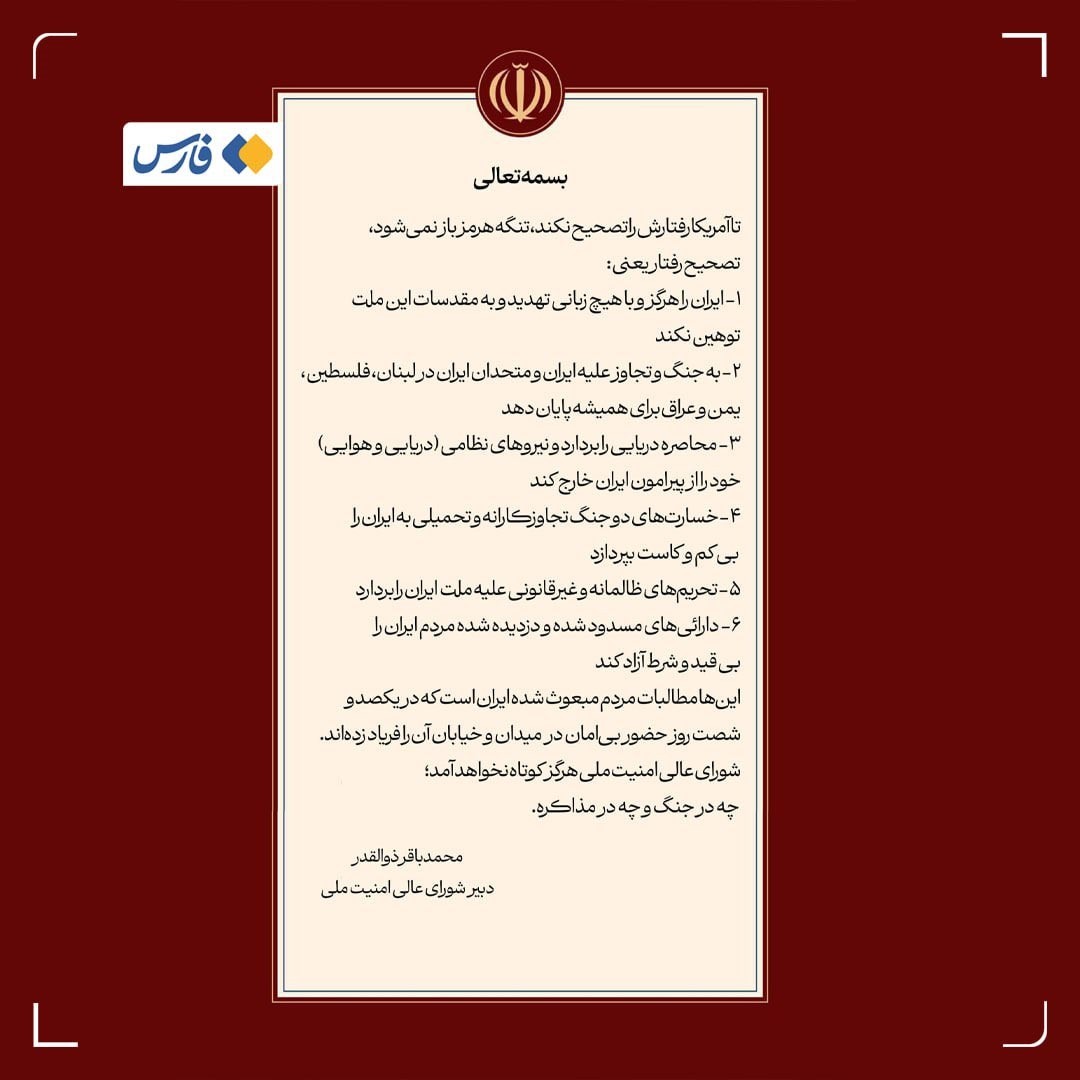
In a statement issued by Mohammad Baqer Zolghadr, secretary of Iran's Supreme National Security Council, Tehran said the strait would remain closed until Washington ends what Iran described as its hostile behavior. The six demands include an end to U.S. threats and military action, a permanent end to the war, withdrawal of U.S. naval and air forces from around Iran, compensation for war damages, sanctions relief and the release of frozen Iranian assets.

Image: Official statement from the Supreme National Council of the Islamic Republic of Iran

The statement is significant because it indicates that the much-discussed U.S.-Iran draft agreement does not, at least from Tehran's perspective, amount to a deal to reopen Hormuz. Any agreement would ultimately require approval from Iran's Supreme National Security Council.

The shipping data also points to continued disruption. Just 33 vessels transited Hormuz from Monday through Thursday, down from 50 during the same period the previous week, while only six crude tankers have reportedly cleared the strait outbound so far this week. The decline comes despite expectations that Iran and Oman were close to an arrangement governing a shipping corridor.

That uncertainty has kept the energy market on edge. Iran has also been considering restrictions on U.S. and Israeli vessels, while previous proposals for transit fees have added another layer of uncertainty. The European Union has already accused Iran's IRGC Navy of enforcing a screening and toll system for vessels using the strait.

Washington, however, is presenting a considerably more optimistic picture. Vice President JD Vance said the U.S. expects oil and gas flows from the Gulf to eventually return to pre-war levels. He also said Iran had told Washington it had no plans to impose tolls, although the U.S. does not fully trust Tehran's assurances.

That leaves the market facing two very different interpretations of the same negotiations. Washington is talking about restoring normal energy flows. Tehran is demanding major political, military and financial concessions before reopening Hormuz.

For oil traders, the key question is therefore no longer simply whether talks are taking place, but whether the two sides are actually negotiating the same outcome.

By Tom Kool for Oilprice.com

Is Iran Preparing to Permanently Block the Strait of Hormuz?

Conflicting signals from Washington and Tehran keep oil markets on edge as Iran weighs a permanent Hormuz shipping ban while Trump insists a deal is within reach.

Friday, August 07, 2026

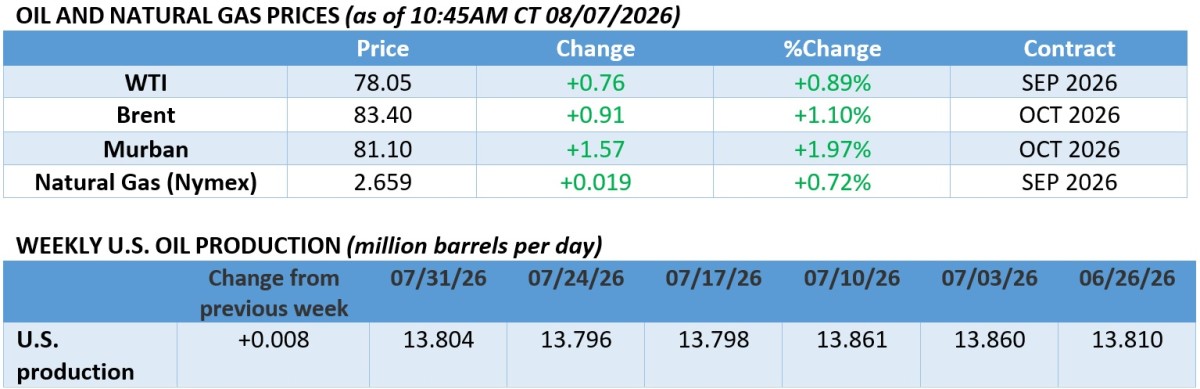
The oil market’s very own schizophrenia – trying to read into the contradicting claims of US President Trump and Iranian officials seeking to escalate the blockade of Hormuz even further – continues to puzzle industry analysts and traders. Iran’s Parliament is reviewing a bill to permanently ban US, Israeli and other hostile vessels from the Hormuz, backed up by a flurry of drone and missile strikes in the Strait, just as Trump claimed a final deal is ‘close’. ICE Brent is set to close the week at $83 per barrel.

Iran and Oman Draw the Lines Through Hormuz. Tehran and Muscat have agreed on the coordinates of a proposed shipping corridor giving Iran control over Gulf-bound vessels, but Iranian officials cautioned that key details remain unresolved, and the new deal alone would not guarantee security in the strait.

Aramco Splits Its September Pricing Strategy. Saudi national oil firm Saudi Aramco (TADAWUL:2222) cut its flagship grade Arab Light for Asia by 50 cents to a $2/barrel discount against Oman/Dubai but raised scarce Arab Medium and Heavy grades by $1.25/barrel, suggesting it could boost Gulf output soon.

Court Blocks Trump’s $20 Billion Climate Clawback. A US federal appeals court ruled that the EPA could not cancel Biden-era clean-energy grants solely over policy disagreements, restoring an injunction protecting $20 billion in funds for nonprofit lenders such as the Climate United Fund or CGC. 

US Major Changes Guard After 14 Years. Ryan Lance, CEO of ConocoPhillips (NYSE:COP), will retire next month and hand the reins to CFO Andy O’Brien after transforming the company into the world’s largest independent oil producer, having bought Concho Resources, Shell’s Permian assets and Marathon Oil.

China Opens Its Fuel Export Taps Wider. Beijing has relaxed restrictions on refined product exports for a second month, allowing August transportation fuel shipments of up to 3.6–3.7 million tonnes—well above last year’s monthly average—as refinery runs recover, reaching 13 million b/d last month.

Mexico Bans Fracking Despite US Gas Dependence. Mexico’s President Claudia Sheinbaum has ruled out pilot fracking projects in Coahuila and Tamaulipas despite rumours claiming the contrary, even though falling conventional gas output leaves Mexico reliant on the US for 75% of its gas needs.

Rhine Shipping Costs Explode as Water Hits Record Low. Navigable depth at Kaub fell to just 17 cm this week, forcing vessels to carry barely 20% of normal loads and tripling inland German tanker freight to €160 per tonne, however light precipitation on Friday has halted the past weeks’ continuous declines.

US Natural Gas Sinks Despite the Summer Heat. Henry Hub futures fell to a 14-week low of $2.64 per MMBtu after gas inventories jumped by 33 Bcf—well above the 5-year average—as near-record production and weaker LNG feedgas flows outweighed higher cooling demand across the country.

China Pushes the Yuan into Iron Ore Pricing. China’s main steel association CISA called for yuan-denominated benchmarks based on its vast port-side market, seeking to boost its clout in a market dominated by Australian and Brazilian miners and pushing for more yuan term deals for state buyers.Related: ADNOC Reports 15 Vessel Attacks as Hormuz Risks Mount

Britain Tightens the Screws on Russia’s Shadow Fleet. London sanctioned 6 Russian banks, 6 newly acquired tankers and 4 companies importing weapons-grade tantalum and niobium, expanding a pressure campaign that has now targeted more than 3,400 Russian individuals and entities since 2022.

Russia Drops Fuel Standards as Refineries Burn. Moscow has extended its waiver allowing refiners to produce lower-grade (Euro-2,3 and 4 standard) gasoline until July 2027 as Ukrainian attacks leave roughly 40% of refining capacity offline and pushed the country’s crude runs to a 21-year low in July.

Trump Puts a Price Floor Under US Solar. The White House will impose a 15% tariff and minimum import prices on polysilicon, wafers, cells and panels from December 4, seeking to shield domestic solar from Chinese competition and kick-start domestic polysilicon output, having only 2 factories currently.

China’s Rare-Earth Exports Hit a Summer Slump. Chinese exports of rare earths fell 17.3% month-on-month in July to a four-month low of 4,224 tonnes, down 30% from a year ago, as slower approvals from Beijing and seasonally weakening buying patterns from overseas customers led to a drying up of flows.

Congo Slams the Door on Raw Copper and Cobalt Exports. The Democratic Republic of Congo has banned copper (#2 globally) and cobalt (#1 globally) concentrate exports with immediate effect to force more domestic processing and boost mining revenue as the 0.5 mtpa Kamoa-Kakula smelter ramps up.

Iraq and Syria Dust Off a Hormuz Bypass.
Baghdad and Damascus aim to rebuild the Kirkuk–Baniyas pipeline by 2029, potentially carrying 1.5–2 million b/d to the Mediterranean and giving Iraq a much-needed alternative after the Hormuz closure exposed its near-total dependence on Gulf export routes.

By Tom Kool for Oilprice.com

Before Hormuz, There Was Suez: What Trump Can Learn From Eisenhower

An emerging Oman-Iran deal may offend Washington’s instincts, but America’s real interest has never been control. It has always been keeping the world’s most important waterways open.

by | Aug 6, 2026

Reprinted with permission from Trita Parsi’s Substack.

Oman and Iran appear close to a temporary arrangement to reopen the Strait of Hormuz, potentially providing both an exit from the current round of fighting and the foundation for a more durable maritime order. Washington should welcome such an agreement – even if it acknowledges a degree of Iranian authority in administering traffic through the strait – because US interest dictates that open and non-discriminatory passage must be given priority over control.

The emerging formula would reportedly divide responsibility for the shipping lanes. Vessels entering the Persian Gulf would travel through waters administered by Iran, while outbound traffic would pass through an Omani-administered route. Iran would be notified of departing vessels and, while this has not yet been discussed, Tehran appears open to also ensuring that Oman would be notified of incoming traffic. Tehran and Muscat may collect and share fees for specified security and environmental services, although this sensitive issue has not yet been settled. The negotiations remain fluid, and any agreement is reportedly linked to the lifting of the American blockade on Iranian ports.

The arrangement would represent a slight climbdown by Tehran. Iran’s earlier position would have required traffic in both directions to pass through some portion of Iranian waters as well as Omani waters. That would have brought even ships already inside the Persian Gulf under an Iranian-administered transit system. The emerging division of lanes would give Oman primary responsibility for outbound shipping and limit the universe of vessels requiring Iranian approval or coordination.

If successful – and if Washington accepts it – the agreement could help end the present fighting. It remains unclear whether that would restore the previous American-Iranian memorandum of understanding or require a new framework. Nor does it in and of itself move the needle on two other major stumbling blocks: Iran’s demand for a regional ceasefire and Washington’s demands on Iran’s nuclear activities.

The Trump administration will likely receive strong pushback from hawkish elements in Washington and Israel who will complain over the arrangement’s de facto acceptance and legitimization of Iran (and Oman’s) management of the Strait.

But this critique is borne out of a confusion of what the US’s actual core interest in the Strait is: The free and predictable flow of commerce or preventing the ability of a hostile power to assert control.

The Trump administration has increasingly framed the objective as preventing Iran from “controlling” the strait. Yet the central American interest in strategic waterways has historically been less about who administers them than about whether ships can pass through them freely, predictably and without discrimination. Preventing a hostile state from acquiring coercive leverage has generally been a means of preserving passage, not an end that supersedes passage itself.

That hierarchy of interests matters. If reopening the strait requires acknowledging that Iran possesses some capacity to regulate traffic in waters along its coast, Washington should not reject an agreement merely because it fails to preserve the appearance of unqualified American dominance.

The Suez crisis provides the clearest example. In 1956, Egypt’s president, Gamal Abdel Nasser, nationalized the Suez Canal Company, displacing the British- and French-controlled corporation that had operated one of the world’s most important commercial arteries. Britain and France regarded nationalization not merely as an economic injury but as a strategic humiliation and, together with Israel, invaded Egypt.

President Dwight Eisenhower refused to support them. After rejecting the Anglo-French invasion, Eisenhower’s administration did not make restoration of British or international ownership a condition for accepting Egypt’s continued administration of the canal. Instead, Washington opposed the invasion and pressed for a diplomatic arrangement that would preserve international access. The applicable legal regime emphasized the canal’s free use by ships of all countries on equal terms, while leaving Egypt responsible for administering and defending the waterway.

Egyptian control was not the same as unrestricted Egyptian discretion. The distinction was crucial. Washington could accept Egyptian sovereignty over the canal while insisting that sovereignty be exercised within rules guaranteeing nondiscriminatory passage. The overriding American interest was not which flag flew over the canal authority, but whether the canal remained open under internationally accepted rules.

A crucial detail that should not be overlooked: Egypt at the time was not an American ally, whereas France and the UK were. Indeed, Egypt was at the time closely aligned with the Soviet Union though not formally allied with Moscow. Washington nevertheless accepted continued Egyptian administration of the canal rather than seeking to reverse nationalization, provided freedom of navigation was preserved.

The Turkish Straits offer another instructive precedent. Under the 1936 Montreux Convention, Turkey recovered control over the Bosporus and Dardanelles, including the right to remilitarize and defend them. Yet commercial vessels retained freedom of passage under an internationally recognized regime. The United States has lived for decades with a strategically important NATO ally exercising extensive authority over a waterway connecting the Black Sea with the Mediterranean – even though Turkey can regulate warship access and, in wartime, exercise additional powers.

The South China Sea makes the same point from another direction. The United States does not claim territory there and formally takes no position on sovereignty over most disputed features. It objects instead to excessive maritime claims, coercion and unlawful restrictions on navigation and overflight. American naval operations are designed to demonstrate that ships and aircraft may exercise rights recognized by international law regardless of which government claims nearby rocks, reefs or waters.

Washington certainly cares about China’s growing regional power. Its legal position, however, is not that the United States must control the South China Sea. It is that no coastal power may transform contested waters into an exclusive domain or condition lawful passage on political obedience. Once again, the preservation of navigational rights lies at the heart of the U.S. legal position. Strategically, Washington’s concern about control extends beyond navigation alone, but it is precisely because control creates the capacity to restrict those rights – and to alter the regional balance of power – that it commands such attention.

Iran, of course, is viewed in Washington as a hostile power. Few American officials would be comfortable with an arrangement that left Tehran able to close the Strait of Hormuz at will. Any agreement must therefore contain credible safeguards: passage should be nondiscriminatory; notification procedures should not become a discretionary licensing system; service charges should be limited to reasonable fees for services rendered rather than function as political tolls; and disputes should be subject to an agreed international mechanism.

But Washington must also acknowledge the strategic reality the war has exposed. The conflict did not give Iran the capacity to close the strait. It revealed a capacity Iran already possessed – perhaps to a greater extent than either Washington or Tehran had fully appreciated.

Crucially, a diplomatic agreement recognizing that reality would not expand Iran’s military power. Rather, it would seek to limit that ability through a legally and politically binding agreement that can be sustained for the simple reason that it meets the core interests of all relevant parties.

The alternative is to insist that even the symbolism of Iranian control is intolerable. But unless the United States can reliably eliminate Iran’s ability to threaten shipping – a goal it has thus far failed to achieve and appears increasingly incapable of achieving – that position offers no practical path to reopening the waterway. Instead, it creates the conditions for an endless war: a militarily unattainable objective coupled with a political dynamic that makes pursuing it indefinitely more acceptable than abandoning it.

If President Trump concludes that keeping the strait open is more important than denying Iran all visible administrative authority, an agreement appears possible. If he decides that American primacy requires rejecting any arrangement that acknowledges Iranian leverage, the likely result will be renewed military action—even though military action has so far failed to guarantee passage.

Incidentally, the elevation of control over access is closely associated with the postwar American pursuit of global primacy – the very same grand strategy that has led to America almost always being at war.

A settlement that subjects Iranian and Omani administration to predictable, nondiscriminatory international standards may not appear attractive, but would meet America’s core interest of free commerce in a region with fast diminishing strategic significance. Washington should judge it by whether ships can pass—not by whether the agreement preserves the illusion that Iran lacks leverage over waters along its own coast that we now know it always enjoyed.

Trita Parsi is the Executive VP of the Quincy Institute for Responsible Statecraft and an award-winning author. Washingtonian Magazine has named him one of the 25 most influential voices on foreign policy. Noam Chomsky calls him “one of the most distinguished scholars on Iran”

Visit Trita Paris’s Substack and subscribe.


ADNOC Reports 15 Vessel Attacks as Hormuz Risks Mount

Abu Dhabi National Oil Company said attacks on its vessels and employees are having a significant impact on operations as the company tries to keep crude, gas and refined products moving through the Strait of Hormuz.

Fifteen ADNOC vessels have been hit by missiles or drones since the war began, including three this week, the company said Friday. One crew member has been killed and 20 others injured.

The Strait of Hormuz carried roughly one-fifth of global oil consumption before the U.S.-Israeli war against Iran expanded into a broader regional conflict. Repeated attacks on commercial vessels have disrupted traffic through the waterway, driven freight costs sharply higher, and made some shipowners reluctant to enter the Persian Gulf.

ADNOC said it is working with authorities to protect personnel and assets while meeting customer requirements “as much as possible” in what it called an exceptionally challenging operating environment.

The attacks are hitting one of the few Gulf producers that has managed to restore exports close to pre-war levels. The UAE has relied on crude loading points outside Hormuz, including Fujairah, while continuing to move some barrels through the strait despite the security risk.

ADNOC is expanding its own shipping capacity even as those risks increase. Its logistics arm announced Friday that it had acquired six very large crude carriers and five very large gas carriers for about $1.3 billion.

Nine of those vessels are scheduled to enter service this quarter, with two newbuild gas carriers due in the fourth quarter. ADNOC Logistics & Services already owns more than 340 vessels and operates another 600 chartered ships.

The fleet additions are intended to support higher crude and LNG exports as ADNOC expands production and trading volumes. The company also ordered four new LNG carriers last month in a $900 million deal.

“Freedom of navigation and the safe, uninterrupted passage of commercial shipping through international waterways must be respected and protected,” ADNOC said Friday.

By Julianne Geiger for Oilprice.com


ADNOC Buys 11 Supertankers for $1.3 Billion to Expand Export Fleet

ADNOC has bought 11 very large crude and gas carriers for $1.3 billion as the national oil company of Abu Dhabi continues to expand its fleet of supertankers to boost crude and LNG exports.

ADNOC’s unit ADNOC Logistics & Services plc on Friday announced it had acquired five modern Very Large Gas Carriers (VLGCs) and six Very Large Crude Carriers (VLCCs) for a combined investment of about $1.3 billion.

Nine of the vessels, six VLCCs and three VLGCs, were acquired on the secondary market. They are scheduled for delivery this quarter and will enter service with ADNOC immediately following delivery.

The remaining two VLGCs are newbuild vessels acquired through a resale transaction from a Chinese shipyard, with delivery scheduled for the fourth quarter of 2026.

The fleet expansion will support ADNOC L&S’ gas and crude oil shipping capacity and support ADNOC Group’s integrated value chain and continued growth in production, trading and export volumes, the company said in a statement.

The latest acquisition follows ADNOC’s order for newbuild LNG carriers from last month.

ADNOC L&S currently owns over 340 vessels and operates 600 chartered ships.

The UAE has sought to adapt to the closure of the Strait of Hormuz by sneaking tankers in dark mode through the Strait and increasingly offering to sell many of its crude grades for loading offshore Fujairah and at Sohar in Oman, outside the Strait.

The United Arab Emirates has managed to boost its oil exports to pre-crisis levels as early as June, as it has kept pushing crude through the Strait of Hormuz and outside it.

ADNOC is also boosting its LNG carrier fleet to grow its international gas business.

Last month, ADNOC Logistics and Services placed a $900-million order for four newbuild LNG carriers to expand its fleet as Abu Dhabi’s national oil company seeks to boost gas exports to capitalize on the global rise in LNG demand.

By Michael Kern for Oilprice.com