Tuesday, September 08, 2026

The Anchor And The Scale: Germany, India, And Applied AI – Analysis

Key Takeaways:

Mark Carney’s line—middle powers must sit at the table or they are on the menu—is tested on AI. The U.S. and China own frontier models (2024: 40 notable U.S. models, 15 Chinese, 3 European). The opening, the author says, is downstream: cheap open-weight models have closed much of the mid-range gap (one cited gap 8% → 1.7% in a year; GPT-3.5-level inference cost down ~280×). MIT and McKinsey figures are used to argue the bottleneck is integration, not the next GPT.

Pairing: Germany as anchor (proprietary factory data, Mittelstand processes, EU standards, high robot density) and India as scale (AI talent, low-cost engineering, Aadhaar/UPI deployment instinct, IndiaAI Mission, a billion-person market). 

Neither owns leading chips, Japanese robot gears, or Chinese magnets—but that is not where applied-AI value is made.

Four frictions: India’s one-size public rails vs Germany’s bespoke plants; who owns the high-value work (not German IP + Indian outsourcing); EU AI Act/data rules vs Indian localisation; diplomacy in years vs models in weeks. Suggested vehicle: the 150+ German GCCs already in India (~130,000 staff), which move at company speed. The bet is wire the physical world and keep that value—not beat OpenAI or DeepSeek.


Introduction: Is There a Middle-Power Play in AI?

Canadian Prime Minister Mark Carney has lately done more than anyone to make the idea of the middle power fashionable. These are states with real weight that nonetheless fall short of superpower status. At the World Economic Forum’s annual meeting in Switzerland in January 2026, he told attendees that the world had entered an era of rupture rather than an orderly transition, and that “middle powers must act together because if we’re not at the table, we’re on the menu.”[1]

The idea of middle powers is appealing because it offers such states a sense of purpose and a promising role. It is also intellectually convenient, since, in theory, it can be applied to almost anything. However, few fields suit it as well as AI. It is an area where the notion of rupture is truly applicable: the two current superpowers, the US and China, have taken such a leading role that smaller nations are left wondering how they can secure a place at the table.


For all its appeal and hype, the idea has to hold in reality: is there really a ‘middle power play’ for AI? To answer this, it must be put to the test across two propositions. Firstly, that there is room to act outside the American and Chinese duopoly, whose dominance rests on frontier models, and to a lesser extent on compute capacity. Secondly, that middle powers can occupy that terrain by combining complementary strengths, in theory and in practice—as tested here with Germany and India, an established and a rising middle power respectively.

The first proposition, that room exists beyond the American and Chinese duopoly, begins with what that duopoly rests on, namely frontier models—the most advanced general-purpose systems, such as those behind America’s ChatGPT, Claude and Gemini, and China’s DeepSeek and Kimi. The US and China dominate their production: in 2024, American institutions produced 40 notable models, China 15 and Europe three, with few elsewhere.[2] Many middle powers have tried to build their own, but only a few, notably France’s Mistral, have stayed relevant. From this perspective, competing appears to be a losing game.

This reading assumes that the frontier model is where the contest is decided. It may well be at the very top level of complex, agentic tasks; the gap between the leading labs like OpenAI or Anthropic and the rest may even be widening.[3] Winning there, however, might no longer matter.


Models have started being commoditised in the middle of the performance range, which will be sufficient for many tasks. As AI is used to automate a wide range of repetitive, specific assignments, there is pressure to move away from the most advanced closed models, which are still better suited to very challenging work, and towards open models. These are models whose underlying weights are published, so they can be downloaded, run, and adapted freely, unlike closed models reachable only through a provider’s interface.

Such models can potentially run many times faster and at a fraction of the cost,[4] as the following numbers bear out: open-weight models reduced the performance difference with closed ones from 8 percent to just 1.7 percent on some benchmarks within a single year.[5] The inference cost—the price of running a system performing at the level of GPT-3.5—fell more than 280-fold between November 2022 and October 2024.

In short, the US and China continue to dominate the frontier model landscape, and any hype surrounding open models catching up with the absolute cutting-edge can be distracting. The real structural shift, and the precise opportunity for middle powers, lies in growing and channelling demand towards the high-volume, lower-complexity workflows in industry and government that specialised open models can meet. Economically speaking, the further the market moves away from a single dominant model architecture, the better the position of every nation unable to build a frontier model.

This suggests that the value of AI might be moving downstream. If upstream is where frontier models are developed and trained, downstream is where AI is put to use: the unglamorous, complex work of embedding it into existing operations and services, or, in other words, applied AI. For many of these real-world use cases, specialised open models may be sufficient and sometimes the better choice, particularly where cost, control, and integration are the most important factors. Take a narrow, high-volume task such as classifying maintenance records or standardising supplier documents: a small, fine-tuned open model can potentially match a frontier one at a fraction of the cost.


Admittedly, this is an emerging trend, but there is some early evidence to support it. The widely cited 2025 study by the Massachusetts Institute of Technology (MIT) found that around 95 percent of enterprise generative AI pilots had no measurable effect on profit.[6] The figure is sometimes contested, resting on a single study with a narrow definition of failure, but it does not stand alone. A 2025 McKinsey survey of almost 2,000 enterprises found that while 39 percent of respondents could attribute some enterprise-level earnings before interest and taxes (EBIT) impact to AI, only around 6 percent cleared the bar of both material earnings impact and significant value.[7] Both studies point in the same direction: the bottleneck is not model performance, but rather workflow redesign, data readiness, and integration into existing systems—the organisational work that determines whether a deployment can withstand contact with real processes.
Where the Anchor Meets the Scale

With the first proposition established, that room exists for nations beyond the two superpowers, the second follows: that two middle powers, acting together, can take that room and amount to more than the sum of their parts. This claim is best tested on Germany and India.


A concession comes first. The commanding positions in AI’s hardware sit elsewhere, with the most advanced processors being designed in the US and fabricated in Taiwan; the precision gears in a robot’s joints being dominated by a few Japanese firms;[8] and the high-grade magnets in its motors are around 90 percent Chinese-made.[9] Neither Germany nor India plays a decisive role in any of these areas.

Yet while the above can be choke points in global value chains, none of these are where value in applied AI is directly created. The important contest is downstream, requiring four things: proprietary data from a real domain; the ability to embed a model in live operations; a means of deploying and distributing it on a large scale; and the trust and standards that enable it to operate in the real world.

Germany holds one part. It owns valuable industrial processes and the proprietary data associated with them. This data, spanning decades and covering the automotive, chemicals, and machinery industries, lies outside the public internet and cannot be scraped or copied. It has the engineering expertise to determine which problems are worth solving, as well as the German and European certification and standards regime that decides what can operate at all. Its factories are among the most automated in the world, ranking third globally by robot density.[10]

India holds much of the rest. It has a very large AI talent base and was ranked among the first in AI skill penetration in Stanford University’s latest index.[11] It has the engineering scale to build and run applications at low cost—and it has a deployment instinct Germany lacks: a public-technology tradition, proven at scale by Aadhaar, its digital identity system, and the Unified Payments Interface (UPI), its instant payment rails, that knows how to carry a single service to more than a billion people. It is now turning that tradition to AI through the IndiaAI Mission, currently under way.[12] Its vast domestic and rapidly growing market offers a proving ground for applied AI at a scale no single European economy can match.


This is why the pairing can be greater than the sum of its two parts: Germany is the anchor and India is the scale. The anchor comprises the proprietary data, high-value problems, and standards that make applied AI tangible and difficult to replicate. The scale comprises the talent, engineering expertise and reach that transform these concepts into functioning systems and facilitate their adoption by a billion-strong market. Without scale, an anchor is inert; without an anchor, scale is underused. Each supplies what the other lacks.
Four Frictions to Overcome

That is the theory, and it is straightforward. The reality is not. Every middle-power play encounters the same discrepancy between ambition and reality, and this one is no exception. The political momentum is real enough: the same month Carney spoke in Davos, the European Union and India finalised a long-delayed trade agreement, and their leaders shared podiums at successive summits.[13] Moving from words to a functioning AI partnership, however, requires solving concrete, systemic problems. It is not only a question of whether these nations have the political will to work together; it is a question of whether their economies can actually mesh.

Four big challenges stand between the idea and a working partnership. Naming them plainly is the first step to meeting them, and the more squarely each is faced, the better the chance of building something that actually holds.

The first is to fit two different shapes together. India’s success in public technology rests on a high degree of homogeneity. Aadhaar and UPI work because they impose a single, standardised interface on the whole population. In contrast, German industrial strength is based on fragmentation and bespoke solutions, with value locked in the proprietary setups of the Mittelstand, Germany’s dense base of specialised, often family-owned small and mid-sized manufacturers. Specialised chemical plants in Ludwigshafen and premium assembly lines in Stuttgart run on custom legacy systems and idiosyncratic data structures. A population-scale, UPI-style distribution model cannot simply be dropped onto that. The scale engine does not, by itself, fit the anchor’s geometry. The job is thus to build tools that adapt to each setup instead of forcing one template on all of them.

The second is to find a working compromise on the division of labour. The question is where the high-value work in applied AI sits, and how to design the cooperation around it so both sides share in it, and both have reason to make it work. Germany and India come at this from different starting points, so their instincts might naturally pull them apart. Germany would be inclined to treat India as a mere implementation partner; a role India is working to climb out of. If it were left as German IP and Indian delivery, the arrangement would just be outsourcing in a new form, which India has good reason to refuse. Getting the split right is not a detail for later. It is the condition on which the partnership stands or falls.

The third is to agree to a regime for regulatory compliance both sides can live with. Applied AI only works if a domain expert in Germany and a deployment engineer in India can exchange factory data and machine logs, and here the two sides can pull in opposite directions. European rules lean towards caution: data-protection law limits what can cross borders, and the AI Act, the EU’s 2024 law that grades AI systems by risk, adds compliance duties on higher-risk systems. India, meanwhile, brings its own views on sovereignty and localisation. Since the way AI is regulated sets the limits of what can be built from the data, the task is to settle a shared framework up front, one that says what can cross and what must stay.


The fourth is a clash of clocks. State-to-state cooperation, bilateral training schemes, semiconductor memoranda, and joint standards bodies operate within a diplomatic timeframe measured in years. Meanwhile, the underlying technology evolves in weeks. By the time Berlin and Delhi set up a joint framework or certified training pipeline, the problem it was designed to solve is often already outdated. The instruments risk becoming obsolete as soon as they arrive. This is not a failure of will, but of instrument: the classical political cycle, with its summits, communiqués and multi-year programmes, simply does not operate quickly enough for AI. This raises the question of who, if not governments, can establish a partnership at the speed demanded by the field.

Rather than marking a dead end, the four challenges set out exactly what must be targeted, and where institutional creativity is required from both nations.

The answer to who could carry this out is already visible, and it cannot be just another summit. It could fall on so-called global capability centres, in-house offshore units that companies run for their own engineering, and R&D. German companies operate over 150 such centres in India, employing more than 130,000 professionals, with engineering the single largest area of work.[14] German industrial expertise and Indian talent are housed in the same buildings, operating at the speed of business rather than the pace of diplomacy. The anchor and the scale are already present there without the need for a treaty.

It is within these corporate ecosystems—where commercial survival naturally outpaces political scheduling—that the four challenges of shape, division of labour, regulatory compatibility, and clocks can be solved. If these challenges are treated as a practical agenda for co-investment rather than as permanent geopolitical barriers, Germany and India could establish a working model for collective leverage.


For now, the middle-power approach remains a bet, but the direction is clear. Neither nation needs to outrun the superpowers at the frontier; rather, they need to focus on the unglamorous, downstream work of wiring the physical world into code and retaining the value that follows.


Endnotes

Mark Carney, “Special Address by Mark Carney, Prime Minister of Canada” (speech, World Economic Forum, Davos, 20 January 2026), https://www.weforum.org/stories/2026/01/davos-2026-special-address-by-mark-carney-prime-minister-of-canada/.

Stanford Institute for Human-Centered Artificial Intelligence, “The 2025 AI Index Report” (Stanford, CA: Stanford University, 2025), https://hai.stanford.edu/ai-index/2025-ai-index-report.

Nathan Lambert, “The Next Phase of Open Models,” Interconnects, March 2026, https://www.interconnects.ai/p/the-next-phase-of-open-models.
Lambert, “The Next Phase of Open Models.”

Stanford Institute for Human-Centered Artificial Intelligence, The 2025 AI Index Report.
Aditya Challapally et al., “The GenAI Divide: State of AI in Business 2025” (Cambridge, MA: MIT Project NANDA, July 2025), https://mlq.ai/media/quarterly_decks/v0.1_State_of_AI_in_Business_2025_Report.pdf.

McKinsey & Company, “The State of AI in 2025: Agents, Innovation, and Transformation” (New York: McKinsey & Company, November 2025), https://www.mckinsey.com/capabilities/quantumblack/our-insights/the-state-of-ai.

Intel Market Research, “Industrial Robot Precision Reduction Gears Market,” 2026, https://www.intelmarketresearch.com/industrial-robot-precision-reduction-gears-market-43406.

International Energy Agency, “With New Export Controls on Critical Minerals, Supply Concentration Risks Become Reality,” 2025, https://www.iea.org/commentaries/with-new-export-controls-on-critical-minerals-supply-concentration-risks-become-reality

International Federation of Robotics, “Robot Density Surges in Europe, Asia and Americas,” 8 April 2026, https://ifr.org/ifr-press-releases/news/robot-density-surges-in-europe-asia-and-americas.

Stanford Institute for Human-Centered Artificial Intelligence, The 2025 AI Index Report.
Press Information Bureau, Government of India, “IndiaAI Mission,” 2025, https://www.pib.gov.in/PressNoteDetails.aspx?NoteId=156786&ModuleId=3&reg=3&lang=1.

“The ‘Middle Powers’ Are Having a Moment, but Can They Stand Up to Trump?” CNBC, 27 January 2026, https://www.cnbc.com/2026/01/27/middle-powers-countries-alliances-trump-superpowers.html.

Indo-German Chamber of Commerce (AHK) and Zinnov, “Germany’s India Advantage: Leveraging India Hubs for Innovation and Growth” (September 2025), https://zinnov.com/centers-of-excellence/germanys-india-advantage-leveraging-india-hubs-for-innovation-and-growth-report/.


About the author: Manuel Kilian is the co-founder of The Agentic State. His work stands at the intersection of government and technology. He founded and sold the GovTech platform GovMind, built the Global Government Technology Centre Berlin, and advises Germany’s Federal Ministry for Digital Transformation on international affairs and the UAE Prime Minister’s Office on adopting agentic AI at scale.

Source: This article was published by Observer Research Foundation


About Observer Research Foundation
ORF was established on 5 September 1990 as a private, not for profit, ’think tank’ to influence public policy formulation. The Foundation brought together, for the first time, leading Indian economists and policymakers to present An Agenda for Economic Reforms in India. The idea was to help develop a consensus in favour of economic reforms.
View all posts by Observer Research Foundation →
Treat Education As Infrastructure During Wartime, Say Researchers In Ukraine


Image from one of the classes on microscopy being taught in the summer school CREDIT: UBDS3

September 7, 2026

By Eurasia Review


Key Takeaways:

A Nature Genetics Comment (including CRG’s Roderic Guigó) argues that in war, training is infrastructure. Labs and gear can be rebuilt; broken mentorship is harder. The Ukrainian Biological Data Science Summer School (UBDS3) has run in person at Uzhhorod National University since 2023 (this year’s session: 11–25 July 2026). Martial law keeps most men from leaving, so the school brings faculty in—free, bilingual, travel and board covered.

Biological data science was not an organized field in Ukraine before this. Taras Oleksyk (Uzhhorod / Oakland University) wants Uzhhorod as a “Cambridge of Ukraine”; a new genomics lab there has already fixed diagnoses of a rare, treatable diabetes. Fyodor Kondrashov (OIST; CRG alumnus), the Zimin Foundation, and EMBO helped build the school.

Three design rules: cloud computing that survives blackouts and air raids; alumni who return as teachers; partnerships that teach without permanently recruiting people out of the country. The authors say the same model applies to climate shocks, cyberattacks, and funding collapse—not only Ukraine. Five Barcelona early-career researchers joined this year via CRG networks.


War destroys laboratories and instruments. It also severs the human networks through which science reproduces itself. It disrupts mentorship, collaborations and informal ties that turn students into researchers.

In a new Comment in Nature Genetics, an international team including Centre for Genomic Regulation (CRG) researcher Roderic Guigó argues that protecting science under the systemic stress of wartime means treating education and training itself as infrastructure, rather than as a series of one-off events.

The authors draw on the experience of running the Ukrainian Biological Data Science Summer School (UBDS3), held in person at Uzhhorod National University in western Ukraine since 2023, which is in session again this month from 11 to 25 July 2026.


Because martial law prevents most male students and early-career researchers from leaving the country, any model that depends on travelling abroad excludes them entirely. BDS³ inverts this by bringing world-class researchers into Ukraine, giving participants a point of contact with the international scientific community they would otherwise have no easy way to directly interact with.

What started as a two-week pilot that drew more than a hundred students to Uzhhorod, Ukraine’s westernmost city, UBDS3 has run every summer since, offered free of charge, with travel, room and board covered, and taught bilingually in Ukrainian and English by faculty from leading research institutions across Europe, North America and Asia, including the CRG.

The school is one half of a larger effort centred on Uzhhorod. A new genomics research facility in the city’s university has already begun to deliver clinical dividends, including corrected diagnoses for patients with a rare, treatable form of diabetes, a reminder that research depends entirely on the trained people the school exists to produce.


“Biological data science did not exist as an organised field in Ukraine before this initiative. My objective is to bring as much expertise to Uzhhorod as I can in whatever time I have left and turn it into the Cambridge of Ukraine,” says Taras Oleksyk, corresponding author from Uzhhorod National University and Oakland University in the United States and one of the main instigators of the school.

From this experience the authors set out three design principles for resilient scientific capacity. The first is a decentralised, cloud-based computing that does not depend on any single facility. Research institutes face infrastructure damage, energy instability and power cuts, so decentralised workflows can keep running even when local conditions are disrupted by events like air raids.

The second is a “train-the-trainer” structure in which former students return as instructors. Alumni now regularly return to teach the next cohort of BDS³, a self-renewing pipeline that has turned a series of courses into lasting institutional memory.

“It is an irreplaceable experience for the trainers. It is a sobering reminder of both how privileged we are and how fragile the stability of the world we live in is,” says Dr. Guigó.

Finally, the authors call for a non-extractive type of international collaboration, in which partners contribute expertise and access without recruiting participants permanently away so that internationalisation strengthens local science rather than draining it.

The school’s scientific leadership also includes CRG alumnus Fyodor Kondrashov, a former group leader now at the Okinawa Institute of Science and Technology, where directs the School of Molecular and Theoretical Biology. Working with Oleksyk and thanks to the support of the Zimin Foundation and the European Molecular Biology Organization (EMBO), he has helped establish the school. The CRG’s Roderic Guigó has also helped in the organization of BDS³ and has taught at past editions in person.


The lesson, the authors argue, is not confined to Ukraine. Climate disasters, energy failures, cyberattacks and funding shocks increasingly disrupt research systems everywhere, and the same distributed, people-centred model applies wherever infrastructure or mobility cannot be taken for granted.

Five early-career researchers from Barcelona’s community took part in this year’s edition, all connected to the school through CRG’s networks: Julia Rühle and Iseult Leahy, both at the CRG; Max Ticó, of the University of Barcelona; Guillem Guigó-Corominas, of the University of Girona and the University of Vic; and Helena Crowell, of CNAG. Many other CRG researchers have participated in previous editions.
The Atlantic–Pacific Bridge: From Magellan To Panama And The Return Of Multimodal Connectivity – Analysis


The Panama Canal


September 8, 2026

By Heather Katharine McRobie

Key Takeaways:

Panama turned geography into strategy by linking the Atlantic and Pacific—but a chokepoint concentrates risk. Drought, accidents, geopolitics, plus shocks from Ukraine and the Red Sea/Suez, show one route is not enough. UNCLOS only works if rules are applied evenly; otherwise risk shows up in insurance and supply chains.

The author (GAFG/GMGF “Connectivity Doctrine”) wants a network, not another Panama-vs-Nicaragua canal race: ships, rail, roads, and ports that can swap cargo when one path jams. A Nicaraguan “speedway” would add optionality, not copy the canal. Food and fertilizer need that flexibility as much as containers.

Magellan showed the obstacle; Panama showed infrastructure can rewrite it; unused Arctic and other routes show neglect is a kind of weakness. Climate and water must be designed in from the start. The isthmus’s job is a system of bridges—modes, routes, and governance together—not one bigger corridor.


For centuries, the Atlantic and Pacific Oceans were separated not only by distance but by geography. Before the construction of the Panama Canal, ships travelling between the two oceans had to make the long journey around Cape Horn, following the route associated with Ferdinand Magellan’s expedition and the southern tip of the Americas. Geography imposed the route; infrastructure later began to rewrite it.

The opening of the Panama Canal transformed this relationship. It did not merely shorten a maritime journey. It changed the geography of global trade by turning the narrowest practical connection between two enormous ocean systems into one of the world’s most consequential pieces of infrastructure. Panama demonstrated a principle that has become increasingly important in the twenty-first century: connectivity can change the strategic value of geography.

Panama and the Intermodal Panorama

Yet Panama also illustrates the limits of the chokepoint model. A canal creates efficiency precisely because it concentrates flows. The same concentration can create vulnerability. Congestion, accidents, geopolitical disruption, drought and changing patterns of global trade can transform an advantage into systemic exposure. The question for the future is therefore not simply how to move more vessels through Panama, but how to build an Atlantic–Pacific system capable of remaining functional when one route is constrained.

Geopolitical uncertainty and the return of disruption are increasingly central to GAFG’s research and policy work.

This question has become more urgent because the global connectivity system is being tested simultaneously by environmental and geopolitical pressures. Climate change and water availability are long-term structural concerns for canal infrastructure, but they are not the only—or necessarily the most immediate—sources of disruption. The war in Eastern Europe has constrained important segments of the Eurasian land-transport architecture, while conflict and insecurity in the wider MENA region have disrupted normal shipping patterns through the Red Sea and Suez corridor. Together, these developments demonstrate how quickly geopolitical shocks can turn established trade routes into constrained or commercially uncertain pathways. The lesson for Panama and the wider Atlantic–Pacific connection is therefore not simply that more capacity is needed, but that alternative, interoperable routes are becoming a strategic necessity.


There is, however, another vulnerability beneath the physical and geopolitical ones: the uneven universality of the rules governing the maritime domain. The United Nations Convention on the Law of the Sea (UNCLOS) provides the principal legal framework for the oceans, but not all states are parties to the Convention. More importantly, the existence of international rules does not automatically guarantee their equal application. This raises an uncomfortable but increasingly important question for global connectivity: do international norms constrain power, or do they constrain primarily those states that are willing or able to comply with them? If rules are predictable for smaller and weaker actors but negotiable for the most powerful, the credibility of the entire connectivity system is weakened.

For the GMGF, this is not a peripheral legal question. Maritime trade depends on predictability: predictable passage, predictable jurisdiction, predictable liability, predictable insurance and predictable dispute resolution. Where the application of international law becomes dependent on relative power, risk is transferred from the political sphere into shipping costs, insurance premiums, investment decisions and ultimately supply chains. The challenge, therefore, is not only to build alternative routes but to ensure that the rules connecting those routes are credible, interoperable and applied consistently. Otherwise, the world may succeed in creating a network of corridors while failing to create a network of governance.


Intermodality, Supply Chains and Food Security

This is where the idea of the multimodal bridge becomes important.


The nineteenth- and twentieth-century model largely sought to overcome geography by constructing a single decisive infrastructure link: a canal, a tunnel, a railway or a major port. The emerging model is different. It combines maritime and land-based modes so that cargo can move through a network rather than depend entirely on one passage.

Central America is particularly suited to this way of thinking. Its geography offers several potential interfaces between the Atlantic and Pacific, including maritime routes, railways, highways, ports and intermodal logistics platforms. The long-discussed idea of a Nicaraguan interoceanic canal is normally presented as a competitor or alternative to Panama. A more contemporary perspective would ask a different question: could Nicaragua become part of a broader interoceanic multimodal system rather than simply another canal project?

A Nicaraguan “speedway” of combined transport could, in principle, connect Atlantic and Pacific gateways through a coordinated system of rail, road, ports and maritime services. Such a model would not necessarily attempt to reproduce Panama. Its purpose would be to diversify the ways in which cargo crosses the isthmus, allowing containers or other high-value freight to shift between maritime and land transport according to capacity, cost, time, security and environmental conditions.


This is precisely the logic of the GAFG/GMGF Connectivity Doctrine: systems over projects, complementarity over competition and interoperability over isolated infrastructure efficiency. The Atlantic–Pacific question should therefore not be framed as Panama versus Nicaragua, canal versus railway, or maritime versus land transport. The strategic objective is to create an interoperable network in which maritime, rail, road and port infrastructure can reinforce one another. In this sense, resilience is not a property of a single corridor; it is an ecosystem property.

The importance of such an approach extends well beyond the movement of containers. Intermodality is becoming a strategic instrument for managing global supply chains. A resilient Atlantic–Pacific system would allow cargo to shift between ships, railways, roads and ports according to changing circumstances. A vessel delayed on one side of the isthmus would not necessarily bring the entire supply chain to a halt: high-value or time-sensitive cargo could move by rail, bulk commodities could remain on maritime routes, while road and inland logistics networks could support regional distribution. The objective is not to make every mode equally important, but to make them interoperable. Recent disruptions—from the pandemic and the war in Ukraine to instability around the Red Sea—have demonstrated how quickly a disruption at one chokepoint can propagate across continents. Redundancy is therefore no longer simply additional capacity; it is strategic optionality.

The same logic applies to food security. Grain, fertiliser, animal feed, vegetable oils and other essential commodities depend on predictable and affordable transport, and disruptions to maritime routes can rapidly translate into higher prices and shortages far from the original point of disruption. An Atlantic–Pacific intermodal network could provide additional options for connecting agricultural and commodity-producing regions with consumer markets in Europe, Asia and the Americas. Central America’s geographical position makes this particularly significant: a diversified interoceanic system could strengthen the resilience of food and commodity supply chains by allowing cargo to move through different combinations of maritime, rail and road infrastructure.

This reinforces the GAFG/GMGF proposition that infrastructure should be understood as an ecosystem rather than a collection of individual projects. Ports, canals, railways, roads, warehouses, customs authorities, insurers, financial institutions and digital logistics platforms all form part of the same connectivity chain. A canal can move a ship, but only an integrated system can reliably move the supply chain. The strategic value of Panama—and potentially of Nicaragua and other intermodal alternatives—should therefore be measured not only by capacity, but by how effectively each adds redundancy, flexibility and resilience to the global network.

From Ni-Ni to ‘In-In-Inclusive’


The distinction, therefore, is between corridor competition and network resilience—a principle repeatedly advanced in GAFG’s connectivity work.

Panama will remain a uniquely important maritime gateway; the question is how its role can be complemented rather than challenged by other modes and routes.The route around Magellan remains a geographical reminder of the enormous distances that infrastructure seeks to overcome. Nicaragua represents a different possibility: not necessarily replacing the canal model, but demonstrating how multimodal connectivity could create redundancy around a highly concentrated maritime system.

Climate change makes this discussion even more urgent, but it should not be understood as the only source of vulnerability. Panama has demonstrated that water availability can become a strategic variable in maritime connectivity. A canal depends not only on engineering capacity but also on the ecological system that supplies its operating water. Future interoceanic connectivity therefore has to incorporate climate resilience into infrastructure planning from the beginning.

The lesson from Magellan, Panama and the potential Nicaraguan connection is therefore not that one route replaces another. It is that the history of global connectivity is a story of progressively reducing dependence on geography without ever eliminating geography itself:

Magellan revealed the scale of the obstacle, hence the force of geography. Panama demonstrated the power of infrastructure to transform it. Nicaragua reminds us of the value of alternatives. The underutilised Arctic inter-oceanic connection reminds us that neglect can itself become a form of strategic (donw-)power—by leaving options unused. The disruptions of the present demonstrate the limits of concentrated connectivity. The next generation must therefore combine modes, routes and governance into resilient networks, crossing the continental bridge. Exceptional times leave little room for holidays from history. They require broader perspectives—including those that do not come from the traditional centres of thought. Hesitation is a currency of loss.

The Atlantic and Pacific do not need one bridge. They need a network of bridges.

That is the deeper significance of the Central American isthmus for the future of global trade: not another race to construct the biggest corridor, but an opportunity to demonstrate how maritime routes, railways, ports, logistics systems and governance institutions can operate together as one resilient connectivity ecosystem.


About Heather Katharine McRobie
Heather Katharine McRobie is a British-Australian writer and academic. She studied at the University of Cambridge and completed her PhD in Human Rights and Constitutional Law at the Oxford Law School. McRobie-Allansdottir serves as Assistant Director-General (Assistant DG) of the Global Academy for Future Governance (GAFG).
View all posts by Heather Katharine McRobie →
Bridging BRICS And The Asia Pacific: Vietnam’s Partner Role And The Future Of Multipolarity – Analysis


September 8, 2026

By Dr. Reena Marwah


Key Takeaways:

Vietnam joined BRICS as a partner country after Brazil backed its June 2025 bid. It crossed World Bank upper-middle-income status in July 2026 (GNI per capita $4,970 in 2025) and is now a China+1 factory hub with CSPs to 14 states plus the EU.

May 2026: ties with India rose to an Enhanced Comprehensive Strategic Partnership (13 deals, $25bn trade target by 2030). India chairs the 18th BRICS Summit on supply chains, digital payments, AI, and climate finance. Vietnam hosts APEC 2027.

Hanoi should bank early India wins (defence, ports, green tech), use BRICS for finance without dropping ASEAN, and stay multi-aligned. India’s job as chair: a useful New Delhi Declaration, not a quarrel club.


When Brazil welcomed the decision of the Vietnamese government on June 13, 2025 to join BRICS, it acknowledged its relevance to the interests of the grouping. “Vietnam stands out as a relevant actor in Asia. Its efforts in favor of South-South cooperation and sustainable development reinforce its convergence with the interests of the group,” stated the government of Brazil. Founded in 2009 and soon expanded to add South Africa, the group included Egypt, Ethiopia, Indonesia, Iran and the United Arab Emirates, making it a growing diplomatic counterweight to traditional Western powers.

Vietnam’s strategic geography and sustained economic dynamism make it a substantive addition to BRICS. Having transformed from a nation scarred by colonialism and prolonged conflict into a reformoriented economy focused on growth and poverty alleviation, Vietnam, crossed the World Bank’s uppermiddleincome threshold in July 2026, with GNI per capita rising to US$4,970 in 2025.

Forty years after the Đổi Mới reforms redirected Vietnam from central planning toward marketoriented policies, the country has integrated key elements of the East Asian development model, particularly its focus on exportled industrialisation. This transformation—driven by rising inward foreign direct investment and a structural shift from agriculture to manufacturing—has positioned Vietnam as an effective alternative manufacturing hub to China. Moreover, it is now a key node in global supply chains. Vietnam’s low labor costs, political stability, and manufacturing incentives have driven a massive wave of foreign investment in export factories. This momentum is accelerated by strategic proximity to Asian suppliers, key global trade pacts, and a growing push by multinationals to diversify their supply chains outside of China.


By 2026, Vietnam had pursued an extensive diversification of its external relations, trading with more than 50 countries and establishing Comprehensive Strategic Partnerships with 14 states and the European Union. This network bridges the Global North and Global South, encompassing major powers such as the United States, China, Russia, India, Japan, and South Korea; advanced middle powers including Australia, France, the United Kingdom, and New Zealand; and key ASEAN partners—Malaysia, Indonesia, Singapore, and Thailand.
BRICS Summit 2026: India’s focus on Resilience, Innovation, Cooperation and Sustainability

Although 2026 marks India’s third tenure as BRICS Chair since the grouping’s inception, this chairship of the 18th Summit unfolds amid structural realignments in geopolitics, trade, technology, energy, and supply chains that are diluting the dominance of Western-led institutions and amplifying the strategic weight of emerging economies.


Under its chairship, India is advancing an agenda focused on resilient supply chains, digital public infrastructure, local-currency settlement, AI and innovation cooperation, climate finance, and reforms to global governance—priorities that collectively seek to reposition BRICS as a platform for Global South agency rather than merely an alternative forum. The bloc’s institutional expansion—now encompassing 11 full members and a new “partner country” format that includes Vietnam—further underscores BRICS’ evolving role as a multi-speed coalition shaping norms and resources in a fragmenting global order.

For Vietnam, 2026 is a strategic inflection point that combines a qualitative upgrade in ties with India and a new institutional foothold in BRICS, offering concrete levers to diversify partnerships, de-risk supply chains, and amplify Hanoi’s voice in emerging economic and technological governance.

The context is important. Following General Secretary and President Tô Lâm’s state visit to India in May 2026, Vietnam and India elevated their relationship to an Enhanced Comprehensive Strategic Partnership (ECSP), framed around “shared vision, strategic convergence, substantive cooperation.” The upgrade—supported by 13 cooperation agreements and a $25 billion bilateral trade target by 2030—signals a shift from broad-based engagement to prioritized, outcome-oriented collaboration in defence and maritime security, connectivity and logistics, green transition, and technology. In parallel, Vietnam’s inclusion as a BRICS Partner Country creates an additional institutional channel to access development finance, deepen South–South cooperation, and engage on supply-chain resilience, local-currency settlement, digital public infrastructure, and climate adaptation—complementing its ASEAN-centric diplomacy and upcoming 21-member Asia-Pacific Economic Cooperation (APEC) Summit in 2027, which Vietnam will host. Moreover, it places Vietnam within a structured track in emerging-economy coalitions.

Together, the Enhanced Comprehensive Strategic Partnership (ECSP) with India, Vietnam’s regional influence within ASEAN, its upcoming role as host of APEC 2027, and its status as a BRICS Partner Country collectively expand Hanoi’s strategic optionality. These overlapping frameworks reduce over-reliance on any single great-power corridor by diversifying security, technology, and infrastructure partners across multiple minilateral and plurilateral platforms. They also create bargaining leverage in negotiating technology transfer, standards, and financing terms, allowing Vietnam to extract better conditions from both traditional and emerging partners. Most importantly, they enable Hanoi to help shape, rather than merely adapt to, evolving rules on trade, cross-border payments, and technology governance in the Indo-Pacific, positioning Vietnam as a rule-shaper in critical domains of economic and digital statecraft.

The way forward for Vietnam

To operationalise the ECSP with India, Vietnam should prioritise early-win projects in defence co-production, port and logistics connectivity, renewable energy, and digital/AI cooperation. Concrete deliverables in these areas will convert the upgraded political framework into measurable outcomes, build domestic and international confidence in the partnership, and generate momentum for deeper integration in high-value sectors.

To leverage its BRICS partner status, Vietnam should actively engage BRICS working groups on trade, finance, and technology. This includes seeking access to development finance instruments, local-currency payment mechanisms, and supply-chain resilience initiatives that align with Vietnam’s industrial strategy and reduce exposure to external shocks and currency volatility.

Finally, Vietnam must carefully calibrate its multi-alignment strategy by using the India–BRICS track to balance ASEAN priorities and major-power dynamics. The objective should be to ensure that diversification across India, BRICS, ASEAN, and other partners enhances, rather than fragments, Vietnam’s core strategic posture in the region, preserving strategic autonomy while maximising economic and security benefits.

Hence, while members, partners, and non-members alike will scrutinise the final outcomes of the 2026 BRICS Summit—codified in the New Delhi Declaration—prospective partners will be watching closely for tangible deliverables and economic benefits that could accrue to them. The imperative for India’s chairmanship is clear: BRICS must avoid being drawn into bilateral disputes or narrow national agendas, and instead demonstrate that it can function as a resilient, issue-based coalition that offers a complementary—not confrontational—alternative to the existing global order.


About Dr. Reena Marwah
Dr. Reena Marwah has published over 20 books; she is the author of Reimagining India-Thailand Relations, published in 2020; World Scientific Publishers, Singapore. She is a Professor at Jesus and Mary College, University of Delhi and Former Senior Fellow, and Senior Academic Consultant, Indian Council for Social Science Research Ministry of Human Resource Development, Govt. of India Founding Editor, Millennial Asia- A Sage Publication (A biannual Journal of Asian studies).
View all posts by Dr. Reena Marwah →
Rearmed And Reckless: How Sudan’s New Arsenal Is Dragging Chad And Ethiopia Into Its War – OpEd


September 8, 2026


Key Takeaways:

After three years, Sudan’s war is crossing borders. On 20 August, aircraft and drones chased a convoy more than 100 km into Chad’s Ennedi-Est—the deepest recorded hit on Chadian airspace. Days later the SAF said it downed a third drone in five days coming from Ethiopia into Blue Nile. The author says the aircraft were not built—or mostly not paid for—in Sudan.

Iran once supplied the army (Mohajer-6s for a Red Sea foothold); that track cooled as Tehran fought Israel and Port Sudan eyed U.S. diplomacy. Turkey, Egypt, and Pakistan filled the gap, with Saudi money and gold smuggled from army areas into Egypt. That pipeline helped the SAF retake Khartoum, el-Gezira, and North Kordofan—and lengthened the army’s strike reach.

Neighbors are paying. Chad: March Adre strike (13 dead), Mabrouka Iftar strike (at least 16), April Adukong (aid workers wounded); Deby sealed the 1,300 km border, put the army on max alert, and sent armor and jammers. Ethiopia: SAF claims Bahir Dar-linked drones; RSF/SPLM-N used the border to take Kurmuk; an April strike near Kurmuk killed at least eight on the Ethiopian side. Cairo’s gold window and a reported $1.5bn Pakistani drone/vehicle package have no border clause. If Deby hits back, the piece says, this stops being only Sudan’s civil war.

Sudan’s civil war has spent three years burning. That containment ended this summer.

On August 20, Chadian forces watched aircraft and drones pursue and bomb a military convoy more than 100 kilometers inside their own territory, in the remote Ennedi-Est province — one of the deepest incursions yet recorded into Chadian airspace. Days later, on the opposite side of the country, the Sudanese army shot down a third drone in five days, crossing into Blue Nile State from the direction of Ethiopia.

Two borders, two governments, one common denominator: the weapons now doing the damage were not built in Sudan, and increasingly they were not paid for in Sudan either.

For much of the war, Iran covertly kept the Sudanese Armed Forces (SAF) flying, trading Mohajer-6drones for a foothold on the Red Sea. That relationship, however, has cooled as Tehran’s own conflict with Israel drained its stockpiles and Port Sudan moved to distance itself from Iranian purchases ahead of ceasefire diplomacy with Washington.

Into the gap stepped Turkey, Egypt and Pakistan, funded largely by Saudi Arabia and by goldsmuggled out of army-held Sudanese territory into Egyptian markets. That arms pipeline has done what it was built to do: it helped the SAF retake Khartoum, el-Gezira and North Kordofan. It has also given the army a strike range and tempo that its own neighbors are now absorbing.

Chad has taken the harder hits.

A March strike near the Adre crossing killed 13 people, including Chadian nationals, after Sudanese drones targeted what the army called fuel-smuggling convoys feeding the Rapid Support Forces (RSF). Days later, a strike on the border town of Mabrouka killed at least 16 civilians gathered for an Iftar meal, prompting President Mahamat Idriss Deby to order his military to retaliate against any further Sudanese incursions and to seal the 1,300-kilometer frontier.

By April, a fifth strike in weeks had hit the Adukong crossing, wounding dozens of mostly Chadian aid workers. On August 20, Sudanese aircraft went further than they ever had — more than 100 kilometers into Chad’s Ennedi-Est province. N’Djamena put its army on maximum alert and sentroughly 100 armored vehicles and signal-jamming trucks toward the border.

When Washington’s Africa adviser, Massad Boulos, publicly blamed the Sudanese military for the strikes, Khartoum did not deny conducting cross-border operations so much as demand an independent inquiry, while pivoting almost immediately to accuse a second neighbor of doing the same thing to Sudan.

That neighbor is Ethiopia. Since May, the SAF has reported repeatedly intercepting drones crossing into Blue Nile State from Ethiopian territory, including a hostile aircraft downed near Ed Damazinafter Khartoum alleged Addis Ababa had allocated runway space at Bahir Dar airport for strikes on Khartoum, al-Gezira, White Nile and North Kordofan. The RSF and its allied SPLM-N faction have used the porous Ethiopian border to seize Kurmuk and press toward Ed Damazin, prompting the Sudanese army to intensify its own drone campaign against the town — a campaign that itself produced a strike killing at least eight civilians, including an aid worker, on the Ethiopian side of the frontier near Kurmuk in April.

By late August, Sudan’s military said it shot down a third drone in five days. The relationship with Ethiopia was already strained — the Fashaga border dispute has dragged on for decades, and the two countries are still fighting over the Grand Ethiopian Renaissance Dam.


The throughline across both fronts is the same: a war that Egypt, Turkey and Pakistan armed to help Khartoum win inside Sudan is now generating strikes the SAF cannot, or will not, keep inside Sudan’s own lines.

Cairo’s central bank keeps absorbing Sudanese gold that bankrolls the purchases; Riyadh keeps underwriting the hardware, including the reported $1.5 billion Pakistani package of Shahpar drones and Mohafiz vehicles. None of that financing carries a border restriction. Chad, already hosting hundreds of thousands of refugees fleeing Darfur, and Ethiopia, still recovering from its own Tigray war and locked in a Nile dispute with Khartoum, are now the ones absorbing the consequences of an arms race built to settle a war that was supposed to be someone else’s.

Whether either government answers with force of its own — Deby has already threatened retaliation — will determine whether Sudan’s civil war stays a civil war much longer.


About Hollie McKay
Hollie McKay is a war and humanitarian-focused international correspondent and author of 'Only Cry for the Living: Memos from Inside the ISIS Battlefield,' 'Afghanistan: The End of the US Footprint and Rise of the Taliban Rule,' and 'The Dictator's Wife.'
View all posts by Hollie McKay →

Philippines poverty hits record low as critics attack ‘poverty line’

Philippines poverty hits record low as critics attack ‘poverty line’
/ Yanni Panesa - UnsplashFacebook
By IntelliNews - Jakarta Bureau September 8, 2026

Philippine poverty fell to its lowest level on record last year, with the national poverty rate dropping to 9.7% in 2025 from 15.5% in 2023, the Philippine Statistics Authority (PSA) reported on August 21, according to Manila Bulletin.

The result marks the first time the official poverty rate has fallen below 10%. It also puts the Philippines ahead of the Philippine Development Plan’s target for a single-digit poverty rate, which had originally been set for 2028. The figures were released by the PSA and highlighted by the Department of Economy, Planning, and Development (DEPDev).

DEPDev Secretary Arsenio M. Balisacan said the improvement showed that economic opportunities and social protection were making a difference. He attributed the decline to economic growth, lower inflation and relatively strong employment conditions, in a statement issued on August 21.

The Philippine economy grew by an average 5.1% in real terms in 2024 and 2025. Inflation averaged 2.5%, while unemployment averaged 4%. Nominal household incomes rose by about 22% across income deciles between 2023 and 2025. That was well above the 5% cumulative inflation rate recorded over the same period.

The government says the income gains were broad-based. Balisacan said lower- and middle-income households recorded stronger purchasing power, rather than the improvement being concentrated among higher earners.

Government support also helped. Cash transfers and emergency employment programmes provided additional income to vulnerable households. Michael L. Ricafort, chief economist at Rizal Commercial Banking Corp, said targeted assistance helped poorer Filipinos manage higher prices. He also pointed to subsidies for transport workers, farmers and fisherfolk during periods of higher oil prices.

Healthcare support was another factor. Ricafort said government programmes such as zero billing may have prevented some households from falling into poverty by reducing the impact of large medical expenses.

According to Manila Bulletin, the government is now facing a different challenge: keeping households above the poverty line. Balisacan warned that weaker global and domestic conditions could slow the pace of improvement. He said policy should focus on workforce skills, targeted investment and social protection that can respond when households face economic shocks.

Ricafort also warned about the cost of relying heavily on government assistance. Large support programmes can increase the budget deficit and add to public debt. He argued that longer-term gains require better education, nutrition, job creation and investment.

Poverty line draws criticism

The government’s interpretation has faced strong criticism from Rigoberto D. Tiglao, a columnist for The Manila Times. Tiglao questioned whether the 6.5mn people counted as having moved out of poverty had actually experienced a significant improvement in living standards.

His criticism focuses on the level of the official poverty threshold. The PSA’s per-capita poverty threshold rose only slightly, from about PHP91 ($1.45) a day in 2023 to PHP96 ($1.53) in 2025. For a family of five, the 2025 threshold was PHP14,634 a month. Tiglao argues that this creates a large gap between being officially classified as non-poor and being financially secure.

The income distribution data illustrate the problem. The poorest 10% of Filipinos had an average daily income of PHP85 in 2025. The second income decile averaged PHP123. Since the second group’s average was above the official poverty line, a large number of people could move out of the official poverty category without seeing a major change in their living conditions.

Tiglao estimates that around 5.8mn people in the second income decile could account for a large part of the 6.5mn decline reported by the PSA. He argues that moving from an income of PHP85 per day to just above PHP96 does not amount to a meaningful escape from poverty.

Other measures also produce much higher poverty estimates. The IBON research group estimates that around 70mn Filipinos, or roughly 62% of the population, live on PHP22,000 ($352) a month or less. Its threshold is substantially higher than the PSA’s official poverty benchmark.

Social Weather Stations, an independent social research institution in the Philippines, provide another measure. Its June 2026 survey found that 49% of Filipino families rated themselves as poor, up from 47% in 2023. Self-rated poverty is not directly comparable with the PSA’s income-based measure, but the difference is large enough to raise questions about what the official figure captures.

According to The Manila Times, minimum wages provide another reality check. Tiglao cited labour department figures showing 4.7mn minimum-wage workers earning PHP695 per day. He argues that 6.5mn fewer Filipinos were classified as poor under the PSA's official poverty measure.

Ateneo de Manila University economist Leonardo Lanzona has raised a similar concern about the poverty threshold. He said the PSA’s food budget was already considered too low to meet basic nutritional needs. A promised revision had still not been implemented by late 2025.

The debate is therefore not simply about whether poverty fell. Under the PSA’s methodology, it clearly did. The larger question is how much the official number says about living standards.

The government has evidence of progress: stronger household incomes, 5.1% average real GDP growth, 2.5% average inflation and continued employment gains. Social programmes also helped households absorb economic shocks.

But the criticism highlights a key weakness in relying on one threshold. A household can move above PHP96 per person per day and still have little protection against food inflation, healthcare costs, unstable employment or other shocks.

The Philippines therefore enters the final years of its current development plan with a strong official poverty figure but a harder policy test. Keeping the rate below 10% will require more than moving households marginally above the poverty line. Sustainable progress will depend on higher incomes, productive employment and stronger economic security for households that remain close to the threshold.

How Realistic Are Plans To Bypass The Strait Of Hormuz With New Oil Pipelines? – Analysis


A satellite photo shows the strategically important shipping route of the Strait of Hormuz. Photo Credit: NASA

September 8, 2026
Arab News
By Jonathan Gornall


Key Takeaways:

Trump and Treasury Secretary Bessent say Hormuz could be “worthless” in about two years as oil moves by land—pipelines and, for now, thousands of trucks on a 1,500 km Iraq–Syria run to Baniyas. Analysts call that rhetoric. Energy Aspects’ Richard Bronze and former NSC official Robert McNally: extra pipes help crude; they will not retire the strait or the other cargo that uses it.

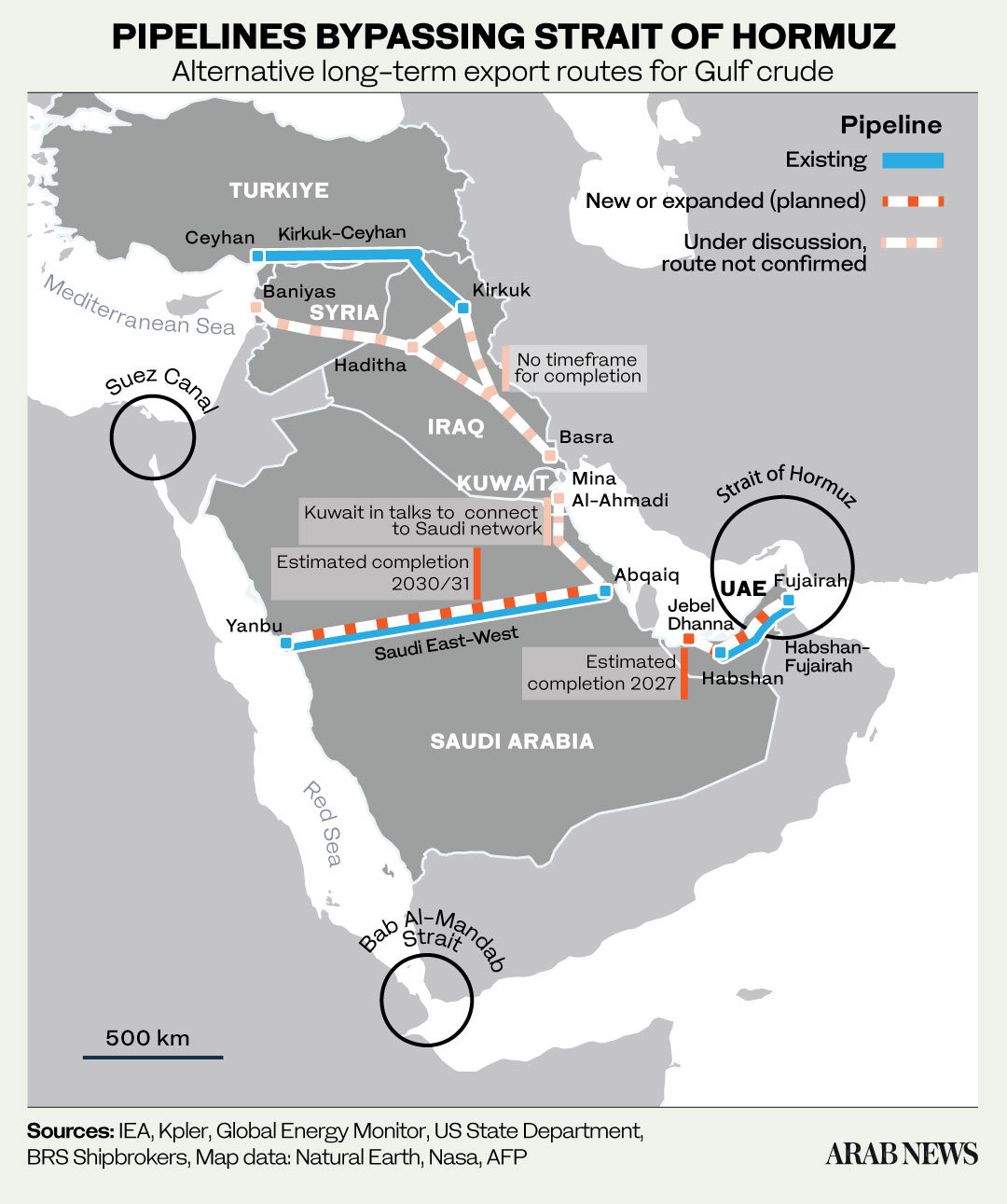
Existing pipes were already near full before the February war: Saudi Petroline up to 7 million bpd (5 million for export; +2 million under study); UAE Habshan–Fujairah 1.5 million, a doubling targeted by 2027. On the table: revive Kirkuk–Baniyas (~300,000 bpd), keep Kirkuk–Ceyhan (~1.5 million, now ~half used), Basra–Aqaba (up to 2.5 million), mothballed Kirkuk–Tripoli, and expensive Kuwait routes to Yanbu or Fujairah. Trucks and rail are crisis workarounds, not a fleet replacement.

Scale gap: more than 20 million bpd of crude and products went through Hormuz in 2025. Pipes do little for diesel/refined products or Qatari LNG (~one-fifth of world supply; the Dolphin line is only ~20 bcm vs ~110 bcm exported). UNCTAD: 30 million+ TEU and mixed daily traffic (tankers, boxes, bulk grain and fertilizer). Even a full land net would not empty the waterway.

In the past few days, US President Donald Trump and Scott Bessent, his treasury secretary, have both suggested that within as little as two years it will no longer be necessary to ship oil through the Strait of Hormuz chokepoint.

“The oil will be going on pipelines across the land,” Bessent told the G20 meeting in North Carolina last week. “In two years, the Straits of Hormuz will be a worthless piece of water.”


On Friday, Trump echoed Bessent’s optimism. “Many oil pipelines are being built in the Middle East,” he told reporters at the White House.

He also welcomed reports that convoys of thousands of trucks are daily carrying oil by road over 1,500 km from southern Iraq to Syria’s Mediterranean port of Baniyas.

It is certainly true that some pipelines that were in place before the current war are up and running at capacity, and that plans are being laid for the construction of several more in the region.

But analysts are expressing doubts about whether such networks can come online in time to have any impact on the current crisis, whether the capacity of such pipelines could ever match that of the tanker fleet, and even whether the oil companies currently considering investing in them will pull out if Hormuz is freed up again before work begins.

“I think the idea that the strait will stop mattering or become worthless is pure rhetoric,” energy analyst Richard Bronze, co-founder and executive director of market intelligence analysts Energy Aspects, told Arab News.

“There are pipeline projects that can provide more capacity that avoids the Strait of Hormuz, particularly for crude oil. Many of these are still at the planning stage.


“But even if all of these projects go through, it’s just not realistic from a purely energy flows point of view to think the strait won’t matter, let alone all the other types of goods that move through that waterway.”

Trucking oil by road is also no long-term solution, said Bronze.

“We have started to see pretty large-scale use of trucks, mostly for Iraqi fuel oil and some crude through Syria.

“But this is a very expensive alternative to pipelines. It’s much less efficient, it’s slower, it costs a lot more for every barrel that you move, and you’re constrained by the capacity and number of trucks you have.

“So this is a way to work in a crisis, but it’s not a desirable long-term option. You can also see rail as an option — I think Iran is exploring this at the moment because of the US blockade — but these are workarounds when a producer is facing real difficulties.

“They’re not the desirable or the preferred, which is always going to be seaborne tankers or pipelines.”

To say the Strait of Hormuz could soon become irrelevant “is way too strong and overstated,” analyst Robert McNally told NPR recently.

McNally, who was senior director for international energy on President George W. Bush’s National Security Council, added: “When we talk about energy flows, the Strait of Hormuz is the most relevant chokepoint on the planet.

“Even if regional producers are able to build pipelines and options to direct flows around Hormuz, the benefit, and there will be a benefit to that, will not make Hormuz irrelevant.”


There are currently two major established and operational pipelines, but both were operating at or near capacity before the start of the war in February.


Petroline, Saudi Arabia’s East-West pipeline, which runs from the Gulf coast to the Red Sea terminal of Yanbu, was built in the 1980s as a hedge against the Iraq-Iran war. It is capable of handling up to 7 million barrels per day of crude oil, of which a maximum of 5 million are earmarked for export.

In July, it was reported that the Kingdom was considering boosting the capacity of Petroline by another 2 million bpd.

Abu Dhabi’s 360 km Crude Oil Pipeline, which was built in 2012 and runs between its onshore Habshan oil field and the port of Fujairah on the Gulf of Oman, can carry only 1.5 million bpd. In May, the Abu Dhabi National Oil Company (ADNOC) announced it was speeding up efforts to double the capacity of the pipeline by 2027.

A network of other pipelines is being considered by Iraq, which is in talks with countries, including Syria and Jordan.

During a visit to Washington in July by Iraqi Prime Minister Ali Al-Zaidi, US oil companies including Chevron signed a series of memoranda of understanding linked to plans to revive a 74-year-old, 850 km-long oil pipeline that was built in 1952 and runs from Kirkuk in northern Iraq to the Syrian port of Baniyas.

Capable of carrying about 300,000 bpd, tensions between Syria and Iraq shut it down in 1982. It was reopened briefly in 2000, but in 2003 it fell victim to another war, when it was damaged by US airstrikes during the US-led invasion of Iraq.

The success of the Kirkuk-Baniyas pipeline project also hangs in large part on improving relations between Baghdad and the Kurdistan Regional Government in Irbil.

Since 1976, Iraq has exported some of its oil 970 km overland to the Mediterranean through Turkiye. The twin Kirkuk-Ceyhan pipelines have a capacity of about 1.5 million bpd, but again the line has been frequently compromised by conflicts in the region.

The decades-old operating agreement between the two countries was due to lapse at the end of this month, but on August 1, Ankara and Baghdad signed a one-year extension, announcing work was underway on a new long-term agreement for the use of the pipeline.

Currently, the Kirkuk-Ceyhan pipeline is operating at about 50 percent of its capacity, but Ankara is in talks with Baghdad to extend it to Iraq’s southern oil fields.


Last year, work began on a new 1,700 km pipeline from Iraq’s southern oil fields around Basra to the Jordanian Red Sea port of Aqaba. When complete, the Basra-Aqaba Oil Pipeline Project will carry up to 2.5 million bpd of crude.

There has also been talk of reopening a historic Iraqi oil pipeline. The Kirkuk-Tripoli pipeline, which carried oil over 928 km to the Lebanese port via Syria, was built in the early 1930s. It has been mothballed since 1984.

Other countries are exploring the possibilities.

Exports of oil from Kuwait have virtually dried up, and last month it emerged that it was in talks with neighboring countries to explore the possibility of building a crude oil pipeline to bypass the Strait of Hormuz.

“We are currently looking for the best and most cost-effective option,” Kuwait’s oil minister Tariq Sulaiman Al-Roumi said last month. Any such project, he added, would be “huge” — and vastly expensive.

Two possible routes have been discussed, but both would be very long and challenging to construct within a timeframe to play any part in countering the current crisis.

One proposed route would connect Kuwait to the Red Sea through Saudi Arabia.

A pipeline from Kuwait to the Saudi port of Yanbu, a straight-line distance of more than 1,000 km, would need to go over or through the Sarawat mountain range, which runs from the Jordanian border in the north to Yemen in the south.

Requiring either massive tunneling operations or a series of pumping stations to carry the oil up and over the mountains, this would be far more expensive than a project covering a similar distance over flat desert terrain.

Another possible pipeline could run all the way to the UAE’s port of Fujairah on the Gulf of Oman.

The overland distance from Kuwait to Fujairah is over 1,200 km and, as this would have to pass through both Saudi and UAE territory, this would require a three-way agreement.

Even when complete, tankers loading at Fujairah would still be potentially exposed to Iranian drone and missile attacks.

But even if all these new and expanded pipelines came on stream, said energy analyst Bronze, they would still not match the capacity of seaborne routes to markets.

In 2025, more than 20 million bpd of crude and petroleum liquids passed through the Strait of Hormuz.

And there are, he said, other issues.

“That doesn’t take account of refined products, which are really critical. Much of the crisis for energy markets at the moment is in diesel, in refined products rather than crude supply. It also doesn’t provide any assistance for moving liquified natural gas.”

Qatar is one of the biggest exporters of LNG in the world, shipping about one-fifth of global supplies on specialist tankers via its Ras Laffan industrial complex, and “there’s no pipeline proposals that are going to solve the problem for getting Qatari LNG out without relying on the strait.”


Some of Qatar’s LNG does currently go via undersea pipeline to Abu Dhabi for distribution to customers in the UAE and Oman.

The 364 km pipeline carries just 20 billion cubic meters (bcm) of natural gas a year, a fraction of Qatar’s usual exports of 110 bcm.

But building pipelines with sufficient capacity to replace the specialist LNG tankers would be a daunting task.

Before natural gas can be loaded onto tankers, it has to be extensively treated and converted into liquid form.

If LNG was to be transported via newly built pipelines for transfer to tankers and wider distribution, doing so would require the construction throughout the supply chain of cryogenic storage infrastructure and dedicated “regasification” terminals.

But even if all the oil and gas produced in the Gulf found routes to market that bypassed the Strait of Hormuz, energy is not the only commodity that flows in and out of the Gulf.

According to a 2025 review of maritime transport carried out by UN Trade and Development, more than 30 million TEU (20-foot equivalent unit) containers passed in and out of the Strait of Hormuz, bound for ports such as Dubai’s Jebel Ali.

In June 2025, for example, of the average of 144 ships per day passing through the strait, 48 were oil tankers, but 24 were container ships carrying everything from iPhones, clothing and manufacturing equipment to white goods, furniture and cars.

Meanwhile, 18 were bulk carriers carrying non-packaged cargoes, such as grain, aluminum, methanol and fertilizer — an important export from the oil-producing Gulf states.


About Arab News
Arab News is Saudi Arabia's first English-language newspaper. It was founded in 1975 by Hisham and Mohammed Ali Hafiz. Today, it is one of 29 publications produced by Saudi Research & Publishing Company (SRPC), a subsidiary of Saudi Research & Marketing Group (SRMG).
View all posts by Arab News →
Pakistan: Tormenting Baloch Women – Analysis


September 8, 2026
SATP
By Tushar Ranjan Mohanty


Key Takeaways:

On 27 August 2026 Balochistan put 1–1.5 million-rupee bounties on nine named women from Gwadar, Jiwani, and Turbat, alleged to be linked to Baloch insurgents (“Fitna al Hindustan”). The SATP piece treats the posters as a distraction from a rise in alleged enforced disappearances of women.

Cited cases: 
Safia Baloch, 20, taken in Quetta on 23 August; Aqsa, 17, taken with her father in Khuzdar on 5 August; Rafia Bibi, Tania, and Javeria held at Lak Pass on 30 July and then unaccounted for.
 HRCB: 23 women disappeared January–July 2026; BYC listed at least 12 in 2025. Groups say women are held without charge, then sometimes shown in “confession” videos (Mahal Baloch, 2023, is the template cited). Wider tallies: BYC 1,223 disappearances/killings in 2025; PAANK 556 disappeared and 227 killings in H1 2026; VBMP 6,207 days of protest and 7,000+ missing since the insurgency began.
The state points to women in BLA Majeed Brigade suicide attacks (Karachi Confucius Institute 2022; Turbat 2023; Mastung 2024; Kalat and Nokundi 2025).

 Rights groups say most women are in non-violent protest—Mahrang Baloch’s BYC, the Turbat-to-Islamabad march—and that treating that as a security problem widens repression instead of answering the grievance.

On August 27, 2026, the Balochistan Government announced bounties, ranging from 1 million to 1.5 million rupees, on nine Baloch women, for their alleged linkages to Fitna al Hindustan (A state term for Baloch insurgents. These women hail from Gwadar, Jiwani and Turbat. The announcement was made by Babar Yousafzai, Adviser on Media Affairs to the Balochistan Interior Minister, who said the Government considered the women highly wanted and urged members of the public to provide information to the authorities. Officials added that the identities of informants would be kept confidential. A poster published by the Government identified the suspects as Hanifa Bibi, daughter of Sher Muhammad; Ayesha, daughter of Abdul Rasheed; Iqra, daughter of Ali; Ruqayya, daughter of Waleed; Hafsa, daughter of Iqbal; Zahra, daughter of Malik Muhammad; Amina, daughter of Abdul Rashid; Zareena, daughter of Wahid Baksh; and Aziza, daughter of Ibrahim.

This announcement came at the heels of recent cases of “enforced disappearances” of Baloch women, and appeared to be intended to distract attention from these state atrocities.


On August 23, 2026, a 20-year-old woman, Safia Baloch, the daughter of Abdul Khaliq, a student and resident of the Killi Zayak area of Basima in the Washuk District of Balochistan, was “forcibly disappeared” by personnel of the Counter Terrorism Department (CTD) and Inter-Services Intelligence (ISI) from provincial capital Quetta at approximately 1:00 a.m.

On August 5, 2026, a 17-year-old woman, Aqsa, was “forcibly disappeared” along with her father, Abdul Qudoos Zarakzai, by Security Forces (SFs) during a raid on a residential quarter in the Civil Colony of Khuzdar District in Balochistan. At approximately 10 p.m. in the night, personnel from CTD and plainclothes officials carried out a joint raid and took away Abdul Qudoos Zarakzai and Aqsa.

On July 30, 2026, three Baloch women, identified as Rafia Bibi, Tania and Javeria, who belong to the Nechari tribe, were reportedly detained at the Lak Pass FC checkpoint near Quetta and later “forcibly disappeared”. Their family said no information had been provided about their whereabouts and that they had not been informed of the reasons for their detention.

In a statement citing the “enforced disappearance” of Safia Baloch, Dr. Shalee Baloch, an organizer of the Baloch Women’s Forum (BWF), stated on August 26, 2026, that the continued abduction and enforced disappearance of Baloch women had reached an “alarming and intolerable” level. In her statement, Dr. Shalee named several women, Habiba, Mahjabeen, Nasreena, Humaira, Najma and now Safia Baloch, who represented a growing pattern of Baloch women being forcibly disappeared. Dr Shalee added that the targeting of Baloch women reflected a “colonial logic of domination”, alleging that militarisation, arbitrary detention, surveillance, collective punishment and intimidation have historically been used to subjugate colonized peoples.


Organisations including the Voice for Baloch Missing Persons (VBMP) and the Human Rights Council of Balochistan (HRCB) have repeatedly raised concerns over women who they say were detained by SFs and intelligence agencies and subsequently remained unaccounted for, with some later being presented before the media as suicide bombers after months of detention. In recent years, the Baloch Yakjehti Committee (BYC) and other Baloch human-rights groups have documented what they described as an increase in enforced disappearances involving women, and have repeatedly called for detainees to be produced before courts if there are criminal charges against them.

According to an HRCB report released on August 27, 2026, 23 women have been “forcibly disappeared” by SFs between January and July 2026. According to rights organizations, these incidents mark a critical and dangerous escalation in the region, where enforced disappearances historically targeted men, but have increasingly targeted women directly. HRCB and other human rights organizations have raised an alarm over these abductions, which targeted women from diverse backgrounds, including human rights activists, healthcare workers, students, and housewives.

Earlier, on January 13, 2026, BYC released a report highlighting the pattern of enforced disappearances of Baloch women and girls across Balochistan during 2025, emphasising the use of collective punishment and gender-based human rights violations. Titled Enforced Disappearances of Baloch Women in 2025: Collective Punishment and Gender-Based Human Rights Violations in Balochistan, the report noted that at least 12 women and girls were forcibly disappeared across different Districts of Balochistan over the course of the year. BYC underlined that these cases did not represent isolated incidents but pointed to a systematic practice in which enforced disappearance is used as a tool of repression. The report states that the victims included female students, woman health workers, minor girls, and an eight-month pregnant woman. In several instances, multiple members of the same family were targeted during single operations, causing long-term psychological, social, and economic harm to entire families and communities.


Over the years, enforced disappearances in Balochistan have predominantly targeted men, leaving women to bear the social, economic, and psychological consequences within their families and communities. Since 2025, however, the pattern appears to have shifted, with women increasingly emerging as direct targets of state action. This development marks a significant expansion in the nature and scope of alleged State repression in Balochistan.

Forced confessions have become a recurring practice used by the state in Pakistan to shape public narratives around dissent in Balochistan. Women are first subjected to enforced disappearance, held in custody for prolonged periods without due process, and exposed to coercion and abuse. After weeks or months in detention, they are suddenly brought before the public, often through staged appearances or recorded videos, to “confess” to acts they have consistently denied. The case of Mahal Baloch was one of the earliest examples of this pattern. In February 2023, Mahal Baloch was taken into custody by CTD during a late-night raid on her home in the Satellite Town of Quetta, without a warrant. Authorities later claimed she had been arrested with explosives and accused her of links to militant activity, including involvement in a suicide attack, allegations her family strongly denied. Despite being kept on physical remand for fifty-five days, authorities failed to present any substantial evidence against her. Instead, a video later surfaced in which she appeared to “confess” to militant involvement. This statement was made while she remained in police custody, not before a court of law.


The participation of some Baloch women in insurgent groups, including female fidayeen (suicide) attacks on SFs and state establishments, has forced to government to resort to its ‘regular’ method of disappearances targeting women, which it has been following with Baloch men since decades. The first use of female suicide bombers by the Baloch insurgent groups was reported in April 26, 2022, when the Baloch Liberation Army (BLA) carried out a suicide attack at the Confucius Institute at the University of Karachi, which resulted in the deaths of five persons, including three Chinese nationals, their Pakistani driver and a security guard. While claiming responsibility for the attack, BLA released the image and name of the attacker, female suicide bomber Shaari Baloch aka Bramsh, who was a member of BLA’s Majeed Brigade, a suicide squad. She had joined Majeed Brigade two earlier ago.

The second woman suicide attack came on June 24, 2023, when a BLA-Majeed Brigade bomber, Sumaiya Qalandrani Baloch, attacked a VIP Army convoy that was going from Turbat Airport to the Inter-Services Intelligence (ISI) headquarters in the Turbat city of Kech District. The attack resulted in the death of one FC trooper and injuries to another five.

On August 26, 2024, a third female suicide attack was reported when BLA-Majeed Brigade suicide bomber Mahal Baloch carried out a car-bomb attack at the gate of an FC camp in the Bela area of Mastung District.

The fourth female suicide attack was reported on March 3, 2025, when Majeed Brigade suicide bomber Mihikan Baloch attacked a military convoy on the national highway near the Mughalzai area of Kalat District, resulting in the death of FC trooper Attaullah, and injuries to four others.


The last female suicide attack in this series was on November 30, 2025, when Majeed Brigade suicide bomber Zareena Rafiq aka Tarang Maho attacked the FC Headquarters in the Nokundi area of Panjgur District, resulting in the death of one FC trooper and injuries to another seven.

While the participation of a small number of Baloch women in insurgent attacks has drawn attention, women in Balochistan have also become increasingly visible in non-violent political activism over the past decade, particularly around the issue of enforced disappearances and extra-judicial killing. They have led prolonged protests over “missing family members,” relatives they accuse security agencies of forcibly disappearing. Hundreds of women and family members undertook a massive march covering roughly 1,000 miles from Turbat town (Kech District) in Balochistan to Islamabad, and staged sit-ins outside the Islamabad Press Club, demanding the recovery of missing persons, drawing national attention. BYC, a civil rights movement founded by Dr. Mahrang Baloch, was led the effort. Protesters faced Police blockades, tear gas, water cannons, and temporary detentions upon reaching the capital. Despite of state atrocities, Dr. Mahrang Baloch and Sammi Deen Baloch organized and spearheaded these non-violent demonstrations.

Mahrang Baloch founded BYC in July 2018, as a grassroots movement advocating the rights of the Baloch community, with a particular emphasis on mobilising women and the families of individuals allegedly subjected to forcible disappearances. In its annual report released on February 3, 2026, BYC documented 1,223 cases of forcible disappearances and extrajudicial killings across Balochistan and adjoining regions during 2025, including affected areas in Sindh and Punjab. On August 26, 2026, the Baloch National Movement’s (BNM) human rights wing, PAANK (Tr: Shield or Protection), reported at least 556 people were forcibly disappeared and 227 others were subjected to extrajudicial or custodial killings across Balochistan between January and June 2026. A PAANK statement added that a further 171 individuals were released during the same six-month period, describing the figures as amounting to an average of roughly 93 enforced disappearances and 38 killings every month. The Human Rights Council of Balochistan (HRCB) recorded 1,455 disappearances, with 1,052 persons remaining missing. The Voice for Baloch Missing Persons (VBMP) estimates that more than 7,000 persons have disappeared since the insurgency began, even as its continuous protest against enforced disappearances in Quetta had reached 6,207 consecutive days by June 26, 2026.

While describing the growing involvement of Baloch women in the Baloch resistance movement, BYC leader Sammi Deen Baloch told Arab News in an interview on February 25, 2025: “We see that our men, our brothers and sons, were systematically taken from their homes, from educational institutions, dragged away while they slept at night. In such circumstances, the only option left for Baloch women was to take this fight into their own hands, to step forward and lead the battle for justice themselves.”

This shift among Baloch women, from the quiet grief to active resistance, has significantly altered the nature of the state’s response. Rather than addressing the underlying drivers of Baloch resentment, the SFs have increasingly sought to suppress dissenting voices among women, treating their growing mobilisation as a security challenge rather than a manifestation of longstanding political and social grievances.


About the author: Tushar Ranjan Mohanty, Research Associate, Institute for Conflict Management

Source: This article was published by SATP


About SATP
SATP, or the South Asia Terrorism Portal (SATP) publishes the South Asia Intelligence Review, and is a product of The Institute for Conflict Management, a non-Profit Society set up in 1997 in New Delhi, and which is committed to the continuous evaluation and resolution of problems of internal security in South Asia. The Institute was set up on the initiative of, and is presently headed by, its President, Mr. K.P.S. Gill, IPS (Retd).
View all posts by SATP →