Sunday, October 04, 2026

France struggles to fund farm climate adaptation as losses mount

Farmers in France are expecting their first payments shortly under the government's billion-euro emergency aid package to support farmers affected by severe summer heatwaves, droughts and wildfires. As the effects of climate change worsen, experts say compensation alone will not be enough to protect French agriculture in the long term.


Issued on: 04/10/2026 - RFI

Record high temperatures during the summer in France produced scorched fields and led to livestock losses. © AFP - GABRIEL BOUYS

Mathieu Courgeau, who runs a mid-sized dairy farm in Vendée, western France, says his thermometer recorded 45C this summer.

"On my farm, the drought caused about €40,000 in losses," he told RFI.

"I chose to insure my corn so I will get about €10,000 in compensation for that, but I had to buy feed and I lost a lot of milk."

He called 2026 a "particularly difficult year" for farmers, with crisis coming on top of crisis.

Three heatwaves, coupled with widespread water restrictions, turned fields yellow and scorched crops. The conditions wiped out harvests, killed livestock and drained farmers' cash reserves.

As preparations for the next growing season get underway, French agriculture has been left depleted by a summer that is unlikely to remain a one-off.

"The crisis affects all types of production and all parts of the country," said Maxime Buizard-Blondeau, a farmer in the Loiret region and president of the Centre-Val de Loire regional chamber of agriculture. He also serves as vice-president of the Young Farmers organisation, which has ties to France's biggest agricultural union, the FNSEA.

This summer, he said, has been "a wake-up call for many agricultural leaders about the lack of resilience of our systems and farms in the face of climate change".
Compensation falls short

The government announced its emergency Climate, Adaptation, Drought and Wildfire Plan (Plan Casi) at the beginning of September, with a budget of some €1.3 billion.

Around two-thirds of the funds will go to compensation, while the remainder has been allocated to helping farms purchase the supplies they need to resume production.

The first payments are expected in early October.

Agriculture Minister Annie Genevard warned that the government could not compensate in full for losses that the FNSEA estimates at around €10 billion.

"The €1 billion in the plan is roughly the amount of compensation paid to sectors affected by avian flu in 2021-22," said Lucile Rogissart, an agricultural economist at the Institute for Climate Economics, a think tank in Paris.

"The big difference is that, in that case, it covered almost all the costs of the crisis. Here, we are no longer talking about the same scale of compensation."

Courgeau said he expects to receive €2,000 from the emergency package, in the form of a property-tax rebate.

"This aid is essential, but it satisfies neither farmers, who would like to make a living from their work, nor public budgets, which are under considerable pressure," said Rogissart.

French farmers dip into winter fodder as drought leaves pastures bare
Solutions before problems

Instead, Rogissart argues the government should be helping farmers to limit climate-related damage in the first place.

"We can reduce our vulnerability to hazards by building resilient and sustainable systems," she said – noting that the predominant model, centred on intensive monoculture, is no longer such a system.

Courgeau said he feared farmers would turn to technological fixes, such as air conditioning and irrigation, that do not address underlying vulnerabilities.

"That is a major concern," said the dairy farmer, who co-chairs the Nourrir collective, which brings together 54 farming, environmental and civil society organisations campaigning to reform agricultural and food systems.

Not all farms suffered equally this summer, he said.

"Farms that are more self-sufficient, based on grassland and grass-fed livestock, which are diversified, which have worked to improve soil organic matter, which have developed hedgerows or practised agroforestry, and which have not incurred excessively high levels of investment – overall, these farms will weather the crisis better."

In contrast, Courgeau said: "My neighbour, who grows non-irrigated corn and soybeans all year round, isn't sleeping because he can't see any way out or any model for change."

A French farmer harvests his field of wheat in Haynecourt, northern France, on 19 July 2020. © REUTERS - PASCAL ROSSIGNOL

French cereal farmers experiment with African sorghum to beat the heat
Range of crops

Experts say farmers can build resilience by diversifying their crops.

"Diversification ticks all the boxes," said Rogissart. "It reduces vulnerability to climate hazards by spreading risk. It reduces dependence on imported fertiliser and soybean meal, and protects the climate, water and biodiversity, all of which are crucial to the long-term viability of agricultural production."

While wheat, barley and corn largely dominate French fields, growing legumes such as peas, fava beans, alfalfa and lentils has the benefits of capturing nitrogen from the air and reducing the need for fertiliser. They are also alternative sources of protein to red meat.

"But as long as the price of protein, such as soy imported on a massive scale from South America, remains so low, Europeans will have no incentive to grow it," said Courgeau. "There is no way round it: the price has to be increased."

Alternatively, Rogissart suggests, the government pay higher subsidies for legumes.

Corn, widely used for animal feed, typically offers farmers the highest returns, said Buizard-Blondeau. "Many farms don't have the money to make the transition and are stuck in a cycle of dependence on state aid."


Rethinking subsidies


France spent around €54 billion of public funding on the farming and food sectors in 2024, according to Rogissart. "Yet less than 10 percent went to helping these sectors move towards more resilient systems."

She calls for a smarter use of state support. "It is hardly surprising that our system lacks resilience to withstand unforeseen events, given that public support does not help to build it."

Climate-proofing French agriculture means reconfiguring the entire value chain, including infrastructure, she said, something that can only be achieved with serious planning and major investment in the public sector.

"The coming years will be crucial in shaping the direction of public support."

A dairy farmer on his farm in Coutras, south-western France, on 22 September 2026. 
© AFP - PHILIPPE LOPEZ

Next year in particular could be decisive. Negotiations are taking place in Brussels on the European Union's 2028-2034 Common Agricultural Policy (CAP), its shared system of farming subsidies and programmes.

The CAP is the EU's biggest area of spending, distributing around €56 billion a year among the 27 member states – including €9.4 billion for France, the bloc's leading agricultural producer by volume.

"We need to create room for manoeuvre at European level, both to adapt systems and to manage crises," said Courgeau. His collective is also calling on the EU to better target its subsidies to farmers who need them most, as well as to regulate markets to ensure prices reflect the cost of agricultural production.

The new CAP is expected to give national governments greater freedom of action, but could also erode environmental safeguards.

The European Environmental Bureau, a network of NGOs, says it is concerned the new policy will not ring-fence funding for the green transition, help farmers reduce the number of livestock they keep, or revise a payment system that results in most CAP funds going to the largest farms.

Extra taxes

Some argue that France needs a more creative approach to funding agricultural adaptation.

The Young Farmers organisation wants consumers to contribute via a tax on "meals served outside the home – in supermarkets, traditional restaurants, collective catering and takeaway outlets", said Buizard-Blondeau.

His group has proposed adding a 10 cent charge per meal sold by businesses that fail to comply with French legislation that requires 50 percent of products to be local or quality-certified. It estimates the measure has the potential to generate around €1 billion.

"The drawback of a food tax is that it would fall on poorer households, which we know spend a larger share of their income on food," commented Carl Gaigné, a senior researcher at France's National Research Institute for Agriculture, Food and Environment (INRAE).

He proposes a more radical option: taxing wealthy urban property owners, and specifically the heirs of the tens of thousands of "baby boomers" expected to pass on an estimated €7-10 trillion over the next 15 years.

Without proposing a specific rate, Gaigné said there was a moral justification for an inheritance tax.

"It is all the previous generations who produced the emissions that are leading to climate change. We know there is a very strong correlation between income levels, wealth and the impact on the climate.

"It would make sense to recover part of these wealth transfers to finance adaptation, particularly in agriculture."

This article has been adapted from the original in French by Géraud Bosman-Delzons.

The popularity of the pill in France, once the most widely used method of contraception, has declined in recent years. © Unsplash / Reproductive Health Supplies Coalition

"What seemed to us to be a tremendous liberation – and which was a tremendous liberation – is clearly no longer seen in the same light."

At 79, gynaecologist Danielle Hassoun remembers a generation that started having sex at a time when abortion was still illegal. “So we didn’t weigh up the same factors,” she says.

Fully legalised in France in 1967, for decades the pill symbolised a major advance in women's health: the ability to separate sexuality from motherhood, and to choose when or whether to have a child.

For many women it became the norm, as part of an established contraceptive pathway: condoms at the start of one’s sex life, the pill once in a stable relationship and then an intrauterine device (IUD) – more commonly known as a coil – after having children.


Until recently, the pill was still the most common method of contraception for women in France.

Those days are gone. Whilst 55.8 percent of women aged 18 to 49 who used contraception were taking the pill in 2005, by 2023 this figure had fallen to 26.8 percent. The IUD has taken the lead, at 27.7 percent.

"This is a general trend," according to Caroline Moreau, a researcher at the French National Institute of Health and Medical Research (Inserm) and a professor at the Johns Hopkins Bloomberg School of Public Health in the United States.

In Germany, for example, 43 percent of women under the age of 22 were taking the pill in 2015 – compared with 22 percent in 2024. According to one survey, condoms are now the preferred method there.

This decline in popularity, notable since the mid-2000s, can be explained primarily by a generational shift, says Moreau. "Women have [now] grown up with the pill, so it is no longer seen as something liberating."
The pill: from symbol of women's liberation to subject of growing mistrust

Initially a symbol of liberation, the pill went on to become an almost inevitable part of a woman’s contraceptive journey. But today its use in France is in decline, the drop in popularity fuelled by health warnings, mistrust and a changing attitude towards contraception.


Issued on: 04/10/2026 - RFI

Balancing risk

For the first generation of users there were few alternatives, and the fear of an unwanted pregnancy loomed much larger at a time when abortion was by necessity clandestine. Since the advent of the pill the range of contraceptive options has widened, making side effects and constraints less acceptable to users.

The decline accelerated following a crisis surrounding third- and fourth-generation contraceptive pills in 2012, when media coverage of the increased risk of thrombosis led to a sharp drop in use. More broadly, this fuelled mistrust of hormonal contraception.

A new warning has recently added to the debate. On 10 September, the French National Agency for Medicines and Health Products Safety announced it would be sending a letter to users of desogestrel-based contraceptives to warn them of an increased risk of meningioma – tumours of the meninges, membranes that cover the brain and spinal cord.

While the absolute risk remains very low – approximately one additional case per 67,300 users of desogestrel- or etonogestrel-based contraceptives – Hassoun says: "It’s understandable that people don’t want to take risks for the sake of prevention. It’s not the same as taking medication as part of a course of treatment."

Jennifer Saint-Martin Denys works in Montpellier as a midwife – authorised to prescribe contraception in France since 2009 – and reports that since this latest warning, some women on hormonal contraception have come in saying they want to stop taking it.

In terms of the broader picture, she added: "Patients no longer want the pill."

Laure is in her forties and started taking the pill at the age of 14 to regulate her periods. She continued taking it for almost 15 years, "even during long periods when I wasn’t in a relationship and when I could undoubtedly have done things differently," she says.

"When I think about it now, it seems a bit strange to have carried on taking hormones every day when there were other solutions."

Moreau believes presenting the pill as "a given" rather than one of several options has also paradoxically contributed to declining use.

"We put people on the pill without asking any questions," she says. While she points out that the risk-benefit ratio of the pill remains favourable for many women, she adds: "But it is the woman’s choice, not the doctor's choice, and they must be informed of all the methods on offer."

'Reclaiming' the body


Social media posts too reflect a growing mistrust of hormonal contraception. In Germany, where the use of the contraceptive pill is declining sharply amongst young women, hashtags such as #pilleabsetzen ("stop taking the pill") and #hormonfrei ("hormone-free") have become common in recent years.

A study carried out in Germany and Denmark shows that shared testimonials are shifting the conversation beyond medical risks, with discussions increasingly centred on wellbeing, mood, libido and women's relationships with their bodies.

"The main priority for the majority of patients we see today is: I want to reduce my mental load," notes Saint-Martin Denys.

Free contraception extended to French women up to the age of 25

Clémence, aged 25, recalls that when she chose her first form of contraception at a family planning clinic at the age of 16, she was presented with several options: the pill, an IUD, an implant or a patch. At the time, the pill seemed the simplest solution to her – an IUD meant having to make an appointment with a gynaecologist.

But after two years on the pill, a few missed doses and the resulting pregnancy tests prompted her to make a change. A friend who had switched to an IUD – now the most widely used method of contraception in France – reassured her about the insertion, and she opted for a copper coil.

"I didn’t want the mental burden of the pill any more," she explains. "And I also wanted to avoid hormones and use something more natural."

Saint-Martin Denys is hearing this request from patients more and more. Some want to get their regular menstrual cycle back, track their ovulation or simply gain a better understanding of what is happening in their bodies.

"There is a real desire to reclaim [these things]," she explains.

Kiara, aged 34, used the pill, followed by a hormonal IUD and then a copper IUD, which she found uncomfortable.

Three years ago, she decided "to stop using contraception altogether". Single at the time, she used condoms. Now in a relationship, she tracks her cycle using an app and uses condoms during her fertile periods. She knows this strategy is less reliable but says she is willing to accept that level of pregnancy risk.

For a long time, taking control of one’s body meant being able to regulate one’s cycle using medication, explains Thomé. Today, for some women, this sense of control now comes more from "understanding and accepting the menstrual cycle".


'An extraordinary revolution'


The decline in the popularity of the pill does not discredit it, however, says Moreau, who is concerned that its benefits are sometimes overlooked in favour of focusing solely on its risks, and that the warning about desogestrel might trigger a new "pill crisis".

"The pill is an extraordinary revolution," she says emphatically.

Saint-Martin Denys highlighted that some hormonal contraceptives may offer medical benefits in addition to their contraceptive effect – particularly in cases of very heavy periods, adenomyosis and endometriosis.

Additionally, hormone-free methods are not suitable for everyone. A copper IUD, for example, may be suitable for a woman who wishes to avoid hormones but may not be recommended for another who suffers from very heavy periods.

For many though, the dilemma remains seemingly insurmountable. With a family history of thrombosis and menstrual problems, Émilie has been taking Optimizette, a contraceptive pill which contains desogestrel, for several years. The warning over the risk of meningioma worries her, but the alternatives are limited.

"I’m pretty much left with no choice but to take something that’s not great just to avoid other problems," she concludes.

Hassoun emphasises the individual nature of the risk-benefit ratio – and the importance as a result of healthcare professionals tailoring contraception to each woman.

Saint-Martin Denys too stresses the need to take the time to explain the benefits and risks of each option. "The best form of contraception is, after all, one a woman has chosen."

This article has been adapted from the original version in French by Aurore Lartigue.
Ethiopia captures Tigray capital as its regional rivals meet in Egypt

Ethiopian federal forces have regained control of the Tigray rebels' regional capital, local sources said on Sunday, while Ethiopia's regional rivals gathered in Egypt to discuss the risk of a wider war.


Issued on: 04/10/2026 - RFI

Mekelle, the capital of Ethiopia's Tigray region, on 24 September 2026. Federal government forces have recaptured the city from opposition fighters. © AP Photo/STR


The capture of Mekelle, capital of Tigray, deals a major blow to the opposition alliance that rules the northern region.

The Tigray People's Liberation Front (TPLF), which leads the alliance, said in a statement posted on Facebook it had retreated from the capital and that the regional government would be "temporarily moved out of Mekelle and operate from somewhere else".

The TPLF launched a fresh offensive against the federal government last month, drawing counterattacks and sparking fears of a return to the devastating civil war of 2020-2022.

As concerns grow that the violence could spread beyond Ethiopia's borders, the presidents of Egypt, Somalia, Sudan and Eritrea were set to meet in the Egyptian city of Alamein on Sunday to discuss the conflict.

Ethiopia has accused Eritrea of directly backing the Tigray rebels, with the support of Sudan and Egypt, which all three countries deny.
Rebels flee

A source close to a pro-government militia, the Tigray Peace Forces, told Reuters its fighters entered the centre of Mekelle on Saturday afternoon, followed by the Ethiopian military.

Federal troops were patrolling Mekelle and manning key institutions on Sunday, a local journalist told French news agency AFP, as communications were restored for the first time in more than a week.

"We have taken control of Mekelle and we are marching forward," a commander with a pro-government militia said.

Businesses and shops remained closed, with owners moving stock to safer locations ahead of time, fearing looting and vandalism.

"There are no police. Last night, we had to organise ourselves and take care of security," one resident told AFP.

A local business owner, Filmon Equar Hailu, told the Associated Press civilians looted government offices and hauled away equipment from police headquarters as rebel fighters withdrew.

He said he heard celebratory gunfire overnight into Sunday morning as small groups of pro-government fighters entered the city.


Egypt talks


The TPLF has long been the dominant force in Tigray, ousting a government-appointed administration earlier this year. It was also the dominant group in a coalition that ruled Ethiopia between 1991 and 2018.

Since it launched its campaign against the federal government of Prime Minister Abiy Ahmed on 23 September, a counteroffensive has seen Ethiopian forces push deep into rebel-held territory.

Analysts say the fighting threatens to escalate into a wider regional conflict.

Sunday's mini-summit in Alamein – taking place on the sidelines of an African Business Forum – was set to bring together Egyptian President Abdel Fattah al-Sisi, Eritrean President Isaias Afwerki, Somalian President Hassan Sheikh Mohamud and Sudanese Armed Forces head Abdel Fattah al-Burhan.

Before the talks, Sisi urged "dialogue, not confrontation".

Eritrea, which shares a long border with the Tigray region, is most directly involved in the conflict.

It accuses landlocked Ethiopia of planning to invade and seize access to its coastline. Analysts say it has backed the rebels in Ethiopia in a bid to keep the conflict away from its border.

The African Union has urged restraint, warning that renewed tensions threaten the 2022 peace agreement that ended the previous hostilities in Tigray.

The TPLF's war with the federal government killed some 600,000 people between 2020 and 2022, according to AU estimates.

The TPLF also pulled out of Mekelle during that conflict, apparently to spare the city from destruction.

The rebels' leader Debretsion Gebremichael implied this week that the group would continue guerrilla-style attacks, as they did last time Mekelle fell. "We operate under a strategy to strike the enemy wherever we choose," he said.


“We don't feel a sense of worry” in Europe, says the head of the Muslim World League


Euronews
By Gregoire Lory
Published on


While in Brussels to meet with political and religious leaders, Sheikh Dr Mohammad bin Abdulkarim Al-Issa stressed the need to deepen dialogue in order to confront the turmoil facing the world and that Europe's "civilised constitutions" will prevent political excesses.

Dialogue. That was the word repeated by the Secretary-General of the Muslim World League, Sheikh Dr Mohammad bin Abdulkarim Al-Issa, during his visit to Brussels on Friday.

During his stay in the Belgian capital, the Saudi religious leader met political figures and representatives of the country’s religious communities and civil society who gathered for a high-level meeting on dialogue and social cohesion.

Al-Issa stressed the importance of dialogue in resolving conflicts, saying it needed sincere intentions and effective leadership.

“Of course, we always believe in dialogue and place great faith in it,” he said, adding that “dialogue is the language of reason and wisdom.”

Established in 1962, the Muslim World League is a Mecca-based Islamic organisation that describes its mission as promoting Islam, tolerance and friendship among peoples.

Europe’s far-right rise and containing its dangers

His visit came after the far-right Alternative for Germany, or AfD, finished first in state elections in both Saxony-Anhalt and Mecklenburg-Western Pomerania in September.

France is due to hold a presidential election in 2027, while parliamentary elections are expected in Italy, Poland and Greece.

Despite the rise of the hardline right in some European countries, Al-Issa expressed confidence in national constitutions, European institutions and societal values.

“As for talk of a hardline right emerging in some European countries, we are generally not worried. Each European country has a civilised constitution that no one can override. There are also societal values that everyone must respect,” he explained.

“Any departure from the constitution and these civilised societal values will prompt society to speak out and put things right,” he said.

He also pointed to the possibility of challenging legislation before constitutional courts.

Al-Issa said similar questions had arisen in other countries because of certain governments. Things had turned out as he had hoped, he said, where there was constitutional oversight and an active public conscience.

Religious freedom is protected by national constitutions

He also called for respect for religious practices within the framework of national constitutions.

The issue comes amid debate over restrictions on religious clothing in Europe. Italy’s government has approved a decree banning face coverings during school activities, with exceptions for certified medical reasons and educational activities.

The decree does not explicitly mention the burqa or niqab, although Prime Minister Giorgia Meloni referred to both when announcing the measure, saying that in Italy “no one should force a girl to hide herself”.

“We always call for respect for each religion’s distinctive practices, provided they do not conflict with the constitution,” Al-Issa said.

“There is no doubt that civilised constitutions, particularly European ones, respect those practices and the observance of religious rituals.”


Latvia's pro-European ruling party wins election as populists gain ground


By Jeremiah Fisayo-Bambi
Published on

With more than 99.9 per cent of votes counted, Prime Minister Andris Kulbergs' United List party was in the lead with 35.4 percent, according to state TV.

Latvia's Prime Minister Andris Kulbergs' centre-right United List party has won the Baltic state's parliamentary election, preliminary results showed Sunday.

With more than 99.9 percent of votes counted, the United List led with 35.4 percent, according to state television.

In the 100-seat parliament, Kulbergs' United List party secured 42 seats, a record for the post-independence history of the former Soviet republic, local media reports.

The results point to a continued pro-European and pro-Ukrainian course for Latvia.

Kulbergs, who became prime minister only in May, said the result was higher than expected and matched the lead shown in exit polls. "That means people truly want change," he said, adding that this meant "economic growth" and "a future for (Latvia's) children."

His coalition, which pre-election polls had suggested would weaken, will not survive in its current form. One member looked set to lose its seats, and others fared worse than they had hoped.

Populist parties, however, also performed strongly, helped by support from Latvia's Russian-speaking minority, after a campaign dominated by fears over neighbouring Russia and the cost of living.

Security at the centre of the debate

More than four years after Russia's invasion of Ukraine, security remains central to Latvian politics. A member of NATO and the European Union since 2004, this small Balkan state sees Russia as its main security threat and has sharply raised defence spending in response.

"Because we are the external border of Europe, we must have a strong economy... a strong border region," Kulbergs said. "That is the main task."

Rising living costs, low wages, a strained healthcare system and long-term population decline also featured prominently in campaign debates.

Most parties expected to enter parliament support both high military spending and continued aid to Kyiv. The exception is the Sovereign Power party, which opposes military aid to Ukraine and further increases in defence spending. Having campaigned on cost-of-living issues, it looked set to finish third.

However, it has been criticised as pro-Russian by its detractors, and most major parties have ruled out working with it.

Latvia First, a conservative party run by a property magnate often compared with US President Donald Trump, looked set for second place.

Both populist parties were seen as benefiting from changes in voting patterns among the Russian-speaking minority who make up a third of the population.

They had long rallied around the Harmony party, which is broadly seen as pro-Russia and was at one time the country's biggest party.

However, Harmony's support collapsed dramatically in the last election, held shortly after Russia's full-scale invasion of Ukraine, and it lost its parliamentary representation.


Seventeen EU leaders press Irish presidency to protect farm funding in next budget

Wheat field
Copyright AP Photo

By Fortunato Pinto
Published on


With Giorgia Meloni and Nicușor Dan as first signatories, the group also wants cohesion funding preserved, national rebates scrapped and NextGenerationEU loan repaid more slowly to free up fiscal space.

The leaders of 17 European Union countries have sent a letter to Taoiseach Micheál Martin, in his capacity as current president-in-office of the Council of the European Union, calling for agriculture to be given priority ahead of the revision of the Negotiating Box, the document drawn up by the presidency to steer and progressively narrow down negotiations on the EU's long-term budget.

As negotiations on the 2028-2034 Multiannual Financial Framework (MFF) enter a decisive phase, the leaders of Bulgaria, Cyprus, Croatia, Estonia, Greece, Italy, Latvia, Lithuania, Malta, Poland, Portugal, the Czech Republic, Romania, Slovakia, Slovenia, Spain and Hungary have sent "some reflections ahead of the forthcoming revision of the Negotiating Box".

"We fully recognise that the European Union is facing an evolving strategic environment, which brings with it new challenges but also new opportunities for joint European action," reads the letter, whose first signatories are Italian Prime Minister Giorgia Meloni and Romanian President Nicușor Dan.

"The next MFF must enable Europe to seize these opportunities while at the same time responding to growing challenges, including security and defence, competitiveness, connectivity, energy security and resilience. At the same time, this must not come at the expense of treaty-based policies, which remain the backbone of European integration and themselves help to address these new challenges," the European leaders write.

"Therefore, the overall volume set out in the Negotiating Box of the Cypriot presidency remains the relevant basis for dealing effectively with all these financing needs. This is not the time for Europe to lower its ambitions," the heads of state and government add.

The leaders go on to stress that cohesion policy and the Common Agricultural Policy (CAP) are long-standing policies, but that their objectives are more relevant than ever. "They promote convergence between member states and regions, strengthen the single market and support rural and less developed areas. They also contribute to Europe's competitiveness and food security, while providing tangible support to millions of European citizens and demonstrating the added value of common European spending."

In their view, both policies have repeatedly adapted to new economic and social realities while remaining true to their treaty objectives. They also generate direct and indirect benefits for the economies of the entire European Union.

"We therefore believe that overall funding for cohesion policy and the CAP should be preserved in the next MFF. As underlined in our Joint Declaration of 26 May, these policies are already facing real-terms cuts under the Commission's proposal, despite the overall increase in the size of the MFF. A further reduction would not modernise the EU budget; it would merely weaken it and risk undermining public support for the European project. Moreover, the new MFF already entails a fundamental transformation of its structure, programming and spending approach," they explain.

The leaders also argue that Europe's new priorities require appropriate additional resources, while funding for agriculture and cohesion must be safeguarded.

They also say they are ready to work constructively on the revenue side, including on proposals for new own resources that would ease the direct pressure on national budgets. "Such resources should be genuine, fair, simple and non-regressive, in line with our May declaration. We will carefully assess the adjustments to the proposals that the Commission has committed to present," the letter continues.

According to the leaders of the 17 signatory countries, options that should be considered include a more gradual repayment of NextGenerationEU, which could create additional fiscal space in the next MFF, subject to an assessment of its impact on the overall cost of repayment, as well as limited and targeted European debt instruments for clearly identified strategic priorities, in line with the May declaration.

For the leaders, the current system of rebates should have no place in the next MFF. The rebates were intended to address an excessive burden on the contributions of certain member states. The circumstances that originally justified these corrections, they argue, have fundamentally changed. When assessing national contributions, account should be taken not only of their absolute level but also of the differing levels of prosperity of the member states and the relative effort required of each of them, the leaders conclude, saying they remain open to working with the Council presidency.


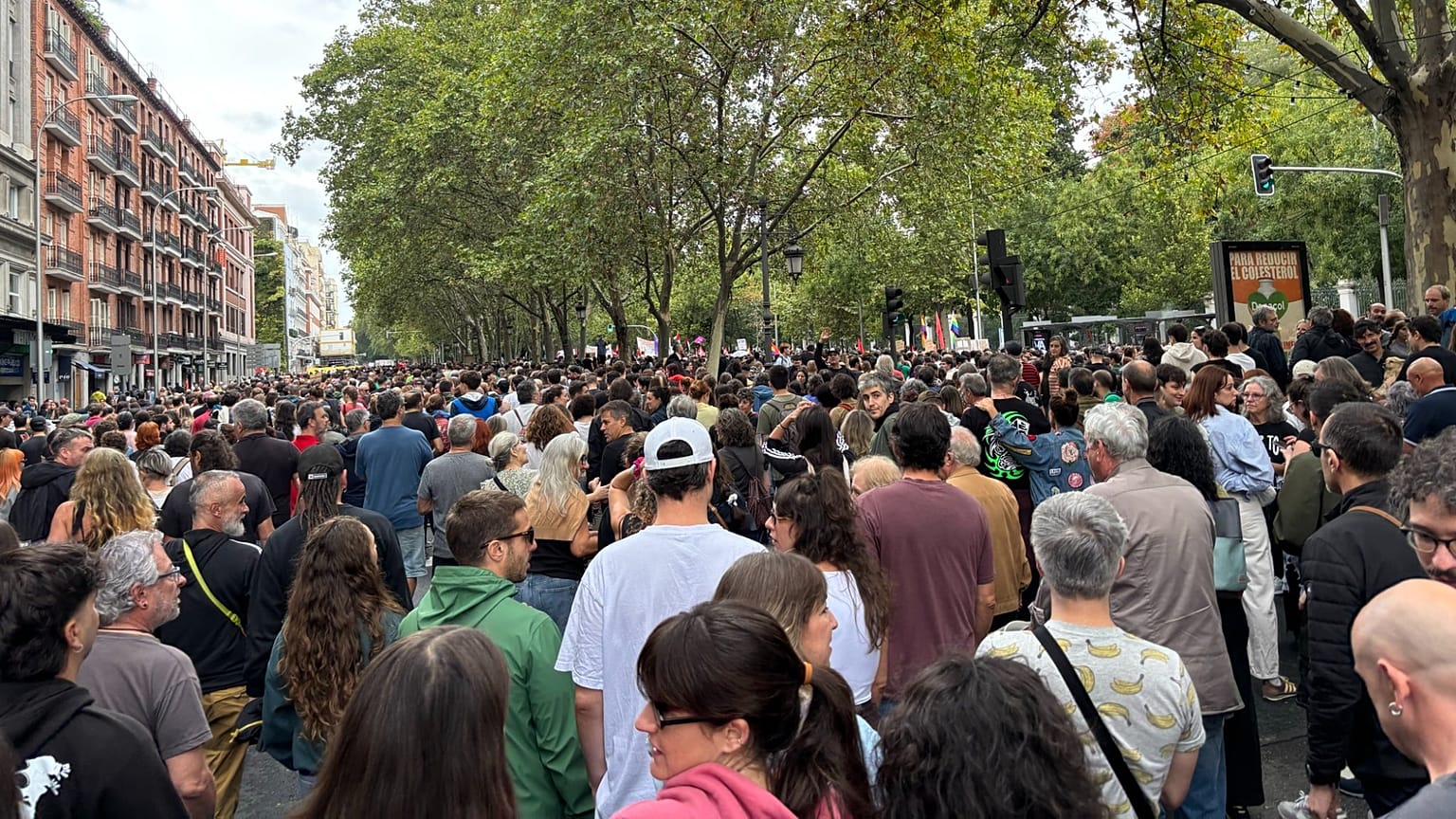
Nearly 500,000 people protest in Madrid over Spain's housing crisis

Spain takes to the streets to protest the housing crisis, 3 October 2026
Copyright x.com MorenoGagustin


By Jesús Maturana
Published on

Thousands take to the streets across Spain as protesters call for a general strike after parliament rejects two government housing decrees.

Demonstrators are marching in several Spanish cities on Saturday, a day after parliament voted down two government decrees aimed at giving tenants stronger protection.

In Madrid, according to the organisers, around 500,000 people took part in the demonstrations, while the authorities put the number at around 70,000. Activists have been camped for about a week in Puerta del Sol, one of the capital's main tourist squares.

Participants could be seen carrying placards reading "General strike" and chanting slogans such as "Down with rentierism".

The protest remained peaceful, under a visible police presence. The president of the employers' confederation CEOE, Antonio Garamendi, says he respects the protests but warns that he will take action if a general strike is called, as he considers it "illegal".

The Tenants' Union, which is coordinating the protests, says in a statement, "There is an irreparable disconnect between what the people want and what the parties vote for."

The Tenants' Union is demanding a 50% cut in rents, open-ended contracts and the expropriation of homes from vulture funds. Its spokesperson, Valeria Racu, says there is still no date for the general strike, which is being negotiated with other organisations and which they want to be "historic".

Tensions in Valencia and protests across the rest of the country

In Valencia, protesters marched towards the Palau de les Arts Reina Sofía, where the Valencia Real Estate Summit 2026 property investment conference is taking place, with former Citizens leader Albert Rivera among the speakers.

Some protesters removed barriers and the police cordon and threw objects at officers. Police responded with rubber bullets and tear gas. Several people managed to reach the upper part of the building. The march had been called by four organisations, including the Tenants' Union and the Housing Union.

There were also demonstrations in many other cities. In San Sebastian, the protest entered its second consecutive day, called by the LAB union with the backing of the Tenants' Union. In Cádiz, where according to organisers the average rent is about 900 euros and buying a home reaches 200,000, the march ended at City Hall with the reading of a manifesto.

There were also marches in Las Palmas de Gran Canaria, with further rallies in Lanzarote, Fuerteventura and Tenerife. In Barcelona, Luana Rocha, a member of the camp, told 'TVE' that the intention is to stay indefinitely, "We are heading towards a general strike". Teruel will join in on Sunday with a demonstration at 18:30 starting from Plaza del Torico.

Sánchez begins a period of reflection as parties trade blame

On Friday, Congress rejected the government's two housing decrees, with votes against from PP, Vox and UPN and Junts refusing to support them. The first falls by 172 votes in favour to 178 against, and the second by 166 in favour to 184 against.

Sánchez ended his speech with a warning, "History will judge you sooner than you think and more harshly than you imagine". He now enters a period of reflection over whether to call early elections, a decision that rests solely with him. The opposition is again calling for elections, and some PSOE leaders and ministers now think so too, according to the original report.

Junts urges the PSOE to sit down and negotiate. Its spokesperson, Míriam Nogueras, described the decrees as "a poorly drafted law", and its secretary general, Jordi Turull, argues that they would have "discouraged" property sales. The PSOE replies that the texts already include Junts' proposals, "What more do they want?"

Vice-President Yolanda Díaz says that responsibility for evictions “has three names”: Feijóo, Abascal and Nogueras. Alberto Núñez Feijóo, for his part, pledges to look for a legal formula so that there is no further term without a budget.

Meanwhile, the camp in Sol reaches its seventh night, with around 2,000 people.

The protests begun after the eviction of Maricarmen Abascal, an 87-year-old woman who was carried out on a stretcher and is now recovering in hospital.

Housing campaigners say an investment company has bought the property where she lived for around seven decades and sought to raise her rent by 275 percent. After the backlash, the new owners have agreed to let her return at a low rent.

Tens of thousands of people take to streets of Paris to march for Pride


By Lucy Davalou
Published on

Paris Mayor Emmanuel Grégoire, who leaded the march through the capital, highlighted some of the threats that the LGBTQ+ community is still facing, saying, "LGBTQIA+ venues are still being threatened, attacked, discriminated against, and subjected to violence and intimidation."

Thousands of people took to the streets of Paris to take part in Paris Pride, defending the rights of LGBTQ+ people against a backdrop of growing popularity of the far right.

As the march set off, Alexandre Schon, co-president of Inter-LGBT, which organises the march, said: “We are just a few months away from the presidential election, so we are calling on LGBT+ people and allies to mobilize for a future based on solidarity.”

Adding: “We must stand up against the far right.”

The event, which began at Place d'Italie in the south of Paris and ended at Place de la Bastille in eastern Paris, where a concert will take place, brought together around 50 associations.

Schon expressed worry about the future of LGBTQ+ people's rights. “We could be the next targets,” Schon added, noting that abroad, including in the United States and Senegal, the rights of LGBT+ people are “under attack.”

Sexual orientation or the sense of belonging to a gender are not choices. As long as one hasn't understood that, one is not a fully realized human being. Rights must follow. Gender freedom must be declarative. The process must be simplified

Multiple left-wing political figures were seen marching, including the leader of France Unbowed (LFI), Jean-Luc Mélenchon, and Green MP Sandrine Rousseau.

Mélenchon later took to X to call for understanding and acceptance: “Sexual orientation or the sense of belonging to a gender are not choices. As long as one hasn't understood that, one is not a fully realized human being. Rights must follow. Gender freedom must be declarative. The process must be simplified.”

As the march continued, Paris Mayor Emmanuel Grégoire highlighted the threats the LGBTQ+ community is still facing, saying: “LGBTQIA+ venues are still being threatened, attacked, discriminated against, subjected to violence and intimidation.”

Meanwhile, in a post on X, Grégoire urged the protection of LGBTQ+ spaces as well as bolstering the “resources of associations”.

Paris Pride, which usually takes place in June, was postponed until now due to France's June heatwave. However, its original date is connected with the Stonewall riots, a founding mobilisation of the LGBT+ movement that took place in New York on the night of 27–28 June 1969.

Last year, the march drew 500,000 participants, according to organisers, while police reported fewer than 100,000.

 Hundreds of schools to shut Monday as France braces for more student protests


France's education minister said lessons would be "totally or partly suspended" at up to 500 high schools on Monday after several days of sometimes violent protests against teacher shortages, dilapidated school buildings and overcrowding in classrooms. The minister said 24 schools had been "burned or ransacked" since the start of the protest movement.


Issued on: 04/10/2026 - 
By: FRANCE 24

The sometimes violent protests at schools across France have shaken the country. © Fred Tanneau, AFP

Up to 500 schools across France will be totally or partly closed on Monday due to the protests by teenage pupils that have shaken the country, the education minister said.

Lessons will be "totally or partly suspended" in some "400-500" high schools as the security conditions "have not been fulfilled", said Education Minister Edouard Geffray on Sunday, adding that 24 schools had been "burned or ransacked" since the start of the movement.

The teens at French high schools, known as lycées, say that their studies are being ruined by high teacher absences, overlong school days and dilapidated facilities, as well as other grievances

Geffray said the number of schools affected on Monday would be comparable to the figure from Friday but vowed there would be a "partial, progressive return to lessons".

More than a third of the 468 schools in the wider Ile-de-France region surrounding the capital will be shut on Monday as a result of the protests, Valerie Pecresse, the right-wing president of the region, told broadcaster Franceinfo.

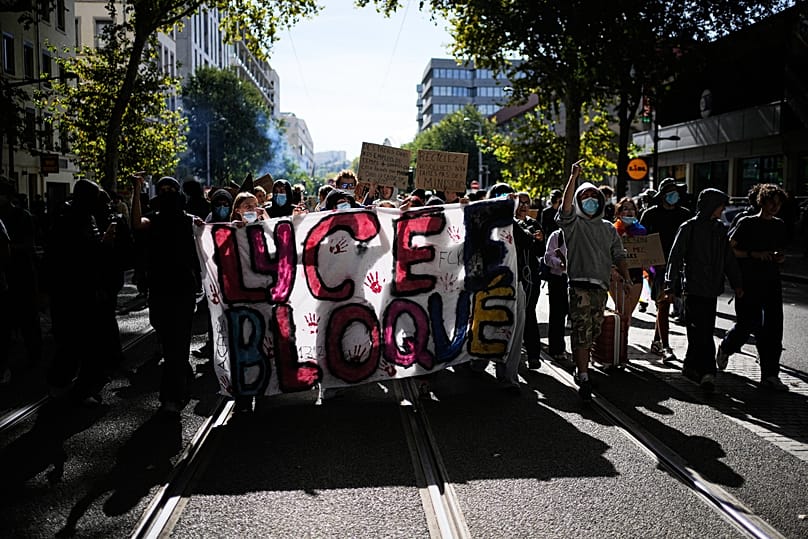
Demonstrators hold a banner reading "high school blocked" during protests in Lyon, eastern France, on October 2, 2026. © Alex Martin, AFP

The movement began at a Paris school on September 17 but grew last week into nationwide protests marked in places by outbursts of violence involving teenagers and security forces, which sometimes used tear gas and batons to disperse the children.


'Deliberately targeted'

At Saint-Denis, just north of Paris, students took turns expressing their grievances at an open-air meeting Sunday.

When you are a student from one of the deprived districts, said one student, "The violence is unleashed."

She referred in particular to one student who had lost his teeth to a police rubber bullet and another who had been hit in the eye.

One 16-year-old boy, Campion, held a placard that read: "They say they are listening to us but prefer to gas us".

"I don't understand why the government deploys so much force against a case that is valid: our education, our future," he told AFP.

A masked protester attempts to kick a tear gas canister amid clashes with police near the Lycée Berthelot high school in Pantin, near Paris, on October 2, 2026. © Sarah Meyssonnier, Reuters

Geffray, in his statement, spoke of far-left infiltrators who had "hijacked' the movement "and engaged in extreme violence".

"Clearly, this poses a risk to both our staff and our students," he alleged, adding that 78 education staff members had been wounded – "something we have never seen before".

"They were deliberately targeted because they were employees of the national education system," Geffray claimed.

Organisers have called for the protests to continue on Tuesday, citing a lack of "concrete measures" from the government.

In a bid to address the protesters' concerns, Prime Minister Sébastien Lecornu set out a timetable on Sunday urging local authorities to prioritise filling gaps left by long-term absences and unfilled posts.

He also called a meeting for Tuesday with regional presidents to discuss overhauling the country's often-dilapidated school buildings.
Violent incidents

More than 5,000 people, 85 percent of them minors, have been arrested since the start of the movement.

A 16-year-old was detained on Sunday over the assault of a teacher in the southern town of La Ciotat. The teacher, 59, was struck and doused with gasoline on the sidelines of a high school student protest on Friday.

A group of youths were last week filmed beating and kicking a policeman on the ground in Belfort in eastern France in images that caused an outcry among officials.

Two youths, Bulgarian nationals aged 15 and 17, have been arrested and investigated for suspected aggravated violence, the prosecutor said.

One of the youths, whom the policeman had tried to arrest before being beaten, has now filed his own attempted murder complaint, his lawyer said.

Cover image: © France 24
04:55


The France branch of Amnesty last week slammed "disproportionate police violence" in tackling the demonstrations and said students must be allowed to express their grievances.

"Authorities must allow young people to exercise these rights without fear of being hit by tear gas grenades or batons, or being arbitrarily taken into police custody," said Amnesty France president Anne Savinel-Barras.

But Interior Minister Laurent Nunez stated that security forces "are not cracking down on young people" but rather "protecting" school and university students wishing to "peacefully voice their demands".

(FRANCE 24 with AFP)


As students call for 'act three', can France's school protests keep momentum?


Student protests that began in and around Paris last week have since reached secondary schools across France. Talks with the education minister haven't satisfied pupils' demands to tackle teacher shortages, neglected facilities and overcrowded classrooms. As student unions call for a fresh round of protests next week, whether the movement spreads to universities could prove decisive.


Issued on: 03/10/2026 - RFI

Pupils protest outside Buffon high school in Paris on 2 October 2026. Student unions are calling for another day of demonstrations on 6 October. © AFP - THOMAS SAMSON


"We're quite disappointed," said Marius Mesnil, co-secretary-general of the High School Student Union, after talks at the Education Ministry on Friday.

He and representatives of other student unions, parents' associations and teachers unions met Education Minister Édouard Geffray as hundreds of schools remained closed or blockaded amid protests that have become increasingly violent.

Some 170 students have been injured since the start of the movement, Geffray said on Friday evening, while more than 100 secondary schools have suffered "severe damage".

At least 65 staff members – including 40 head teachers – have also been injured. Police have arrested more than 5,000 people since protests began, most of them minors.

While Geffray said the student movement was being "held hostage" by violent instigators, the minister assured pupils he was listening to their demands. He announced a new platform to allow them to share their grievances with policy-makers, and promised to follow up on calls for absent teachers to be replaced, school buildings to be renovated and timetables reviewed.

"Dear high schoolers, I can assure you that you are being listened to, you are being heard and you are being taken seriously," Geffray said.

Mesnil acknowledged the minister had listened, but said he hadn't committed to concrete measures to ease the protests.

"We're pleased we were finally received, after protesting for 10 days and getting no response," he told RFI. "However, we received very few answers."

Student unions are urging pupils across France to turn out on Tuesday for what they have dubbed "act three" of the movement.

"The government is promising things, but we need to be sure that they're actually implemented and that they aren't just empty promises designed to silence the movement and let it run out of steam," said Mesnil. "So we’re keeping up the pressure on 6 October – everyone out on the streets."

Student solidarity

Whether the high school movement will maintain momentum depends largely on whether it finds common ground with the higher education sector, according to Stéphane Sirot, a historian specialising in strikes and trade unionism.

"Will the movement take off significantly in universities? If they come together, it would mean trade unions would inevitably have to take a stance, even offer some form of support," he told RFI.

Sirot pointed to the example of 2006, when hundreds of thousands of young people took part in protests against government proposals to make it easier to fire employees under 26 in a bid to encourage hiring.

The movement, which began in high schools before being joined by university students and trade unions, eventually forced the government to scrap the reform.

The current protests could follow a similar trajectory, Sirot suggested, "although there is one major difference: this time there is a multitude of demands, and some of them could contribute to the search for a compromise".


'We share the same demands'


While protests have taken place at some French universities, for now the movement remains strongest in high schools.

On Thursday, the biggest day of action so far, some 30 university campuses were blockaded compared to 222 secondary schools. Another 800 schools reported disruptions.

Eloïse Lefebvre Milon, one of the leaders of the Student Union which represents people in higher education, told RFI her group was calling on university students to stand with high schoolers.

"We share the same demands, namely a bigger budget for young people, because today they represent the future of the country and we cannot leave them in such a state of underfunding," she said.

"Young people at secondary school and university are the ones who will be working tomorrow, the ones who will have to tackle the climate crisis and the social crisis... We have to give them an education that is equal to these challenges."

Several university student unions, as well as France's largest federation of parents' associations for public schools and at least six trade unions in the education sector, say they will join the demonstrations on 6 October.

Mesnil said students were seeking to join forces with teachers to draw attention to chronic underfunding for public education.

"We're trying to bring about this convergence of struggles between teachers and secondary school pupils because, ultimately, we face the same issues: namely, we don't have enough resources and the government treats us with contempt... We are trying to unite our fights as much as possible to make our position even stronger."


Student protests in France: 400–500 schools fully or partially closed Monday


By Nina Borowski & Alexander Kazakevich
Published on

Another day of mobilisation is planned for Tuesday. By then, 400 to 500 secondary schools are expected to remain fully or partially closed, including 24 that have been “burned or vandalised”. The ministry also reports that 78 education staff have been injured since the movement began.

Up to 500 secondary schools in France are expected to be fully or partially closed on Monday as a new day of mobilisation by pupils gets under way, following several days of protests marked by clashes with police, damage to schools and street violence.

The demonstrations, which have spread across several major cities, have seen rubbish bins and other objects set on fire, projectiles thrown at security forces and damage to school buildings and street furniture.

The Ministry of Education said on Sunday that classes would be "totally or partially" suspended in 400 to 500 secondary schools where security conditions "are not met".

There were "between 400 and 500 suspended classes" on Friday, and "there will probably be just as many on Monday, but with a gradual, partial resumption of classes", Education Minister Édouard Geffray said in interviews with TV channel France 2 and radio station France Inter.

Twenty-four of the 735 schools affected by the protests have been "set on fire or ransacked", the minister said. Geffray also said that "78 staff members" from the Ministry of Education have been injured "since the start of the events".

Interior Minister denies any disproportionate intervention

The Interior Ministry said that the unrest has led to nearly 5,000 arrests since Monday.

Rubbish bins and other objects have been set on fire, while projectiles have been thrown at security forces. Police have intervened to disperse some demonstrators, using tear gas, rubber bullets and defensive ball launchers (LBDs), as well as batons

On Sunday morning, Interior Minister Laurent Nuñez defended the actions of the security forces, rejecting claims that the response was "disproportionate".

Nuñez insisted that "the police do not repress young people", but "protect" pupils and students who wish to "advance their demands peacefully". He nonetheless warned that they intervene "firmly and without delay" to put an end to "damage, violence [and] abuses" committed by troublemakers.

He also denied that the security forces are specifically targeting "racialised young people from working-class neighbourhoods", condemning what he called a "blaming narrative totally disconnected from the real world".

Unsafe buildings, overcrowded classes and absent teachers

The movement began two weeks ago at the Saint-Exupéry secondary school in Créteil, in the Paris suburbs, in support of striking teachers who were denouncing a lack of staff and resources.

It then gathered pace and gradually spread across the country over the past week.

Pupils are denouncing, among other things, unsafe and insanitary buildings, overcrowded classes, timetables they say are impossible to cope with and a shortage of staff, with teacher absences that are not systematically covered. Some are also challenging the ban on mobile phones in schools.

On Friday morning, the Minister of Education, Édouard Geffray, met representatives of the pupils. After the meeting, they said they had not obtained any "concrete measures" and called for the movement to continue next week.

Pupils hold up a banner reading
Pupils hold up a banner reading AP Photo/Laurent Cipriani

An "act III" planned for Tuesday

After two nationwide days of mobilisation, on 29 September and 1 October, an "act III" is planned for Tuesday.

All the teachers' unions said on Sunday that they would join the pupils' protest. "Their demands are legitimate, and we support them all the more because they are at the heart of our own mobilisations denouncing the lack of resources for several years now," they stated in a press release.

The unions also criticise a government response to the mobilisation that they say has been limited to the intervention of the security forces. "Reports from pupils who have been injured, assaulted and threatened are increasing by the day. This is unacceptable," they argue.

A mobilisation marked by several serious incidents

Several serious incidents have also been recorded on the fringes of the mobilisation.

In Tours, in central France, a young man who was injured lost sight in his right eye after clashes between pupils and police on Wednesday, according to the local prosecutor.

In La Ciotat, in Provence, a 59-year-old teacher was doused in petrol and beaten during a pupils' demonstration. A 16-year-old boy, suspected of carrying out the attack, was arrested in Marseille on Sunday morning and taken into police custody.

Police officers have also been targeted. In Belfort, in the east of the country, one officer was chased, beaten and repeatedly kicked by a group of young people. Two people were taken into custody following this attack.

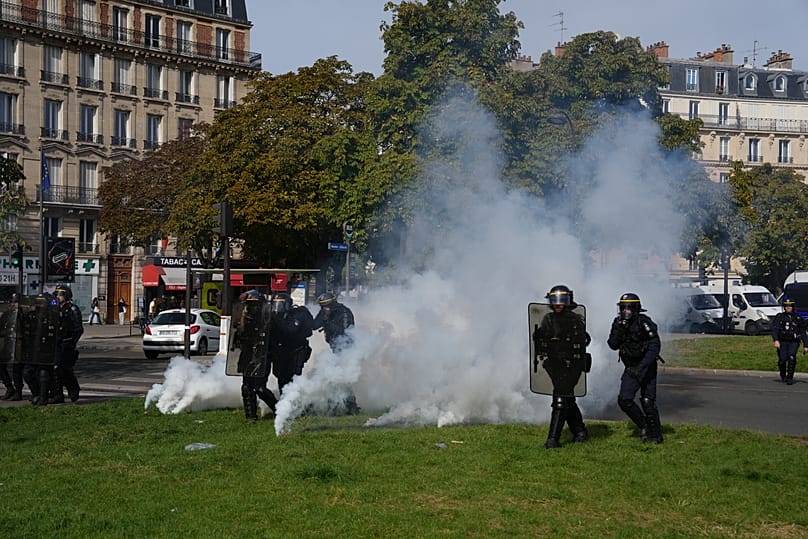
Police officers advance through tear gas facing pupils during a protest over a lack of resources, on Friday 2 October 2026 in Paris.
Police officers advance through tear gas facing pupils during a protest over a lack of resources, on Friday 2 October 2026 in Paris. AP Photo/Aurelien Morissard

According to information from Le Parisien, faced with the widespread damage around schools and in public spaces, the government intends to bring forward the timetable for the "casseurs-payeurs" bill. The aim is to make people who take part in violent gatherings contribute to the cost of repairs, even when they are not directly responsible for the damage.

The Senate is due to examine the bill at the end of October