Monday, October 05, 2026

The Horn Of Africa States: The New Gulf Empire Of Ports, Mines And Money – OpEd


The Port of Bosaso, Somalia. Photo by Siphon, Wikipedia Commons.

October 5, 2026

By Dr. Suleiman Walhad

Key Takeaways:


The essay says Gulf port, mine, and energy pledges in Africa can recycle value from informal gold leaving Sudan, Congo, Somalia, and Ethiopia into Gulf refining and back as “investment,” with Sudan’s war gold the sharpest case.

Somalia port deals with regional authorities, Ethiopia as a Red Sea pressure point, and a Gulf stake in Zambia’s Mopani copper are cited as commerce that also buys routes and political access; Mogadishu has objected to subnational contracts.

The author does not call all Gulf capital predatory, but warns states need terms that build capacity rather than blend financier, trader, operator, and patron.


Official announcements routinely feature billion-dollar commitments to ports, renewable energy, logistics and mining, presenting Gulf capital as a catalyst for economies that have long struggled to attract investment.

The reality is more complicated. Behind the headline figures lies a system in which trade, resource extraction, sovereign investment and geopolitical influence increasingly reinforce one another. The question is not simply how much Gulf capital is entering Africa, but where it comes from, who captures the resulting value and what African states concede in return.

Gold provides the clearest illustration.


Across conflict-affected and poorly governed parts of Africa, including Sudan, the Democratic Republic of Congo, Somalia, and Ethiopia, large quantities of gold leave the formal economy through smuggling and informal trading networks. Much of it ultimately reaches Gulf markets, where sophisticated trading and refining infrastructure can transform opaque supplies into internationally tradable bullion.

The economic significance is considerable. Gold provides liquidity in countries where conventional financial systems are weak, currencies are under pressure and state institutions have limited reach. But the same networks can also allow armed groups, politically connected intermediaries and foreign buyers to profit while governments lose tax revenue and oversight.

This creates a striking asymmetry. African states can lose control of valuable natural resources at the point of extraction, while Gulf-based traders and investors capture value further along the chain. The resulting capital can then be redeployed in Africa as investment, in ports, mines, logistics networks or infrastructure, giving the appearance of a straightforward flow of foreign capital when the underlying relationship is considerably more circular.


Sudan offers the most troubling example.

The country’s war has devastated the formal economy, but its gold trade has proved remarkably resilient. Gold has become an important source of financing for rival power centres and an object of intense competition among domestic and foreign actors. Gulf commercial interests have consequently attracted scrutiny over their role in Sudan’s gold trade and their broader relationships with the country’s competing political and military factions.

The distinction between commerce and geopolitics becomes difficult to sustain in such an environment. A port concession, mining investment or commodity purchase can generate not only commercial returns but also strategic access, political relationships and influence over critical infrastructure.

The same logic is visible around the Horn of Africa States.

Somalia’s fragmented political structure has created opportunities for Gulf states and companies to cultivate relationships with regional authorities as well as the federal government in Mogadishu. Port agreements and commercial arrangements some of the Somali states have given Gulf actors access to strategically important positions along some of the world’s most valuable maritime routes.

For Gulf investors, this can make commercial sense. The Red Sea, Gulf of Aden and western Indian Ocean are critical arteries linking Asian manufacturing with European markets. Control or influence over ports is, therefore, about more than cranes, containers and concession fees. It can provide strategic leverage over trade routes that have become increasingly important to global commerce.

For Somalia, however, the arrangements carry a political cost. Mogadishu has repeatedly objected when foreign governments or companies negotiate directly with subnational authorities, arguing that such agreements undermine the sovereignty of the federal government. The dispute is not merely constitutional. Every external relationship that strengthens a regional administration can alter the balance of power within an already fragile state.


That is why the language of investment can be misleading. A port concession may simultaneously be a commercial transaction, a geopolitical foothold and a mechanism for reshaping the political economy of the country in which it is located.

Ethiopia adds another dimension to the Gulf’s strategy in the Horn. Its position between Sudan and Somalia gives Gulf investors a strategic pressure point across the region, while close ties with Addis Ababa provide several Gulf states with political and logistical reach far beyond Ethiopia’s borders. Gulf capital therefore does more than finance Ethiopian infrastructure and commerce: it embeds Gulf interests in the strategic geography linking the Red Sea, Sudan and Somalia, turning investment into an instrument of regional influence.

Mining presents another version of the same tension.

In Zambia, the acquisition of a controlling interest in Mopani Copper Mines by a Gulf business partner was presented as an important new chapter for one of the country’s most significant copper assets. The investment was intended to support a substantial increase in production and capital expenditure.

Butt the subsequent performance has highlighted the gap that can emerge between the ambitions attached to major Gulf-backed investments and their execution. Production targets, financing commitments and contractual obligations have become matters of public dispute, underscoring a familiar problem in African resource deals: headline investment figures are easier to announce than to translate into sustained production, employment and fiscal revenues.

None of this means that Gulf investment in Africa is inherently predatory, nor that every project is simply a mechanism for resource extraction. Gulf capital can provide something Africa badly needs such as large pools of financing, infrastructure expertise, trading networks and the ability to execute projects at a scale that many Western investors have been unwilling or unable to match.

But it does mean that the traditional distinction between foreign investment and resource extraction is becoming increasingly blurred.

The Gulf states are not merely investors seeking financial returns. They are sovereign actors pursuing strategic interests through commercially structured vehicles. Ports provide access to maritime corridors. Mining assets secure supplies of strategically important commodities. Agricultural investments can strengthen food-security positions. Commodity trading creates relationships with governments and politically influential intermediaries. And sovereign wealth can provide the financial capacity to sustain these strategies over decades rather than electoral cycles.

Africa, meanwhile, is negotiating from a position of considerable need. Governments require capital for infrastructure, energy and industrialisation, while many face high borrowing costs and limited access to Western finance. Gulf investors can therefore offer an attractive alternative, but one that can come with long concessions, preferential access to resources and political relationships that are difficult to unwind.

The central issue, then, is not whether Gulf money is technically “new” or “old”. Capital is fungible, making it virtually impossible to follow individual dollars from an African mine into a sovereign wealth fund and back into an infrastructure project. Yet that does not make the underlying connection meaningless: ownership, trade flows and political influence can still form a continuous economic chain.


The more important question is who controls the value chain.

If gold leaves Africa through opaque channels, is refined and traded in Gulf markets, and the resulting financial power is later deployed to secure African mines, ports or logistics assets, the relationship cannot be understood simply as foreign direct investment flowing into a capital-starved continent. It is a vertically integrated system of commerce and influence, in which control over commodities, finance and infrastructure increasingly sits in the same hands.

That is the strategic wager behind the Gulf’s expanding presence in Africa.

The brochures may describe a partnership for development. The more consequential story is about who controls the ports through which commodities move, the mines from which they originate, the financial networks through which they are monetised and the political relationships that protect them.

For African governments, the challenge is not to reject Gulf capital. It is to negotiate with it from a position strong enough to ensure that investment produces productive capacity rather than merely changing the ownership of extraction.

The danger is not that the Gulf will invest too much in Africa.

It is that Africa will become increasingly dependent on a form of investment in which the distinction between financier, trader, infrastructure operator and geopolitical patron becomes impossible to see.

About Dr. Suleiman Walhad

Dr. Suleiman Walhad writes on the Horn of Africa economies and politics. He can be reached at suleimanwalhad@yahoo.com.

View all posts by Dr. Suleiman Walhad →

China Becomes More Aggressive In The South China Sea – OpEd

This screengrab taken from a handout video filmed on June 17, 2024, and released by Armed Forces of the Philippines shows Chinese coast guard personnel aboard their inflatable boats blocking Philippine navy boats during a confrontation at the Second Thomas Shoal in the South China Sea. Phoot Credit: Armed Forces of the Philippines video, X

October 5, 2026

By Veeramalla Anjaiah


Key Takeaways:


The piece says China is building and militarizing features and entering the EEZs of the Philippines, Malaysia, Vietnam, and Indonesia under a nine- then ten-dash line the 2016 arbitral award rejected, which Beijing still calls null.

It reports a PLA drill at Scarborough Shoal and a China Coast Guard block of the Philippine resupply ship M/V Lapu-Lapu at Second Thomas Shoal, with no collision or injuries; the U.S. embassy condemned the maneuvers and China called the mission provocative.

India is said to have delivered about $330 million of BrahMos to the Philippines, with talks of further sales to Vietnam and Indonesia and interest from Malaysia; the author treats missiles as insufficient without pressure to honor UNCLOS.


In the South China Sea (SCS), China is expanding its presence in disputed waters and adopting increasingly dangerous tactics against neighboring Southeast Asian states.

China has been building artificial islands and converting some of them into military bases in the SCS. As part of its grey-zone tactics, China has intruded into the exclusive economic zones (EEZs) of the Philippines, Malaysia, Vietnam and Indonesia several times.

China claims more that 80 percent of the SCS based on the controversial and illegal Nine-Dash Line (now 10-Dash) map. It has overlapping claims with Vietnam, Malaysia, the Philippines and Brunei Darussalam.


China also claims a part of Indonesia’s EEZ in the North Natuna Sea. Indonesia is not a claimant state in the SCS dispute. Chinese vessels several times intruded into Indonesia’s EEZ and its fishing boats stolen the fish from there.

An expansionist and aggressive China is challenging the centrality of the United Nations Convention on the Law of the Sea (UNCLOS) as the foundation of global order at sea, a decade after the Permanent Court of Arbitration (PCA) rejected Beijing’s sweeping maritime claims and declared the Nine-Dash Line map and China’s claims were illegal.

Who will stop mighty China and its aggression in the SCS?

The U.S. offered to supply weapons to the Philippines but it is not enough. To stop China’s navy, India offered to sell its BrahMos supersonic cruise missiles to Southeast Asian countries.

BrahMos missiles are long-ranged and ramjet powered and they can be launched from submarines, ships, fighter jets or transporter erector launchers.

BrahMos is a joint venture between India’s Defence Research and Development (DRDO) and the Russian NPO Mashinostroyeniya. The missile is based on P-800 Oniks.


BrahMos is a benchmark for India’s emerging export story with exports to cross US$600 million to the Philippines, Indonesia and the Philippines, the ANI news agency reported.

The missile also has an air-launched version and it is a great success on Sukhoi fighter jets. BrahMos missile system to the tune of about $330 million has been delivered to Philippines.

India said that exports should be about $100 million to start with for Vietnam, and for Indonesia, it should be around $200 million.

India’s Defense Minister Rajnath Singh had described that BrahMos is not just a missile, but a symbol of the growing indigenous capabilities of India.

The missile features a traditional warhead and an advanced guided system and possesses the capability to strike long distances at supersonic speeds. This combination of speed, accuracy, and power makes BrahMos one of the best systems in the world.

Malaysia is also currently considering to purchase BrahMos missiles from India. China claims a part of Malaysia’s Sabah and Sarawak areas and Chinese ships regularly intrudes into Malaysia’s EEZ.

Recently, China’s military conducted a ​joint naval and air training exercise around ‌a disputed shoal and in the waters and airspace around the disputed Scarborough Shoal in the SCS, the Reuters news agency reported.

The Shoal is located in the Philippines, where it is known as Bajo de Masinloc. It is also claimed by China based on its controversial Nine-Dash line map and call it Huangyan Dao.

The People’s ​Liberation Army (PLA) Southern Theater Command, in a statement on WeChat social media app, described the operation as a necessary response ​to actions by “certain countries” it said had ​undermined regional peace and stability.


It that said that the training “aims to test and enhance combat capabilities in safeguarding China’s territorial sovereignty and maritime rights and interests”.

The China Coast Guard (CCG) announced separately that the exercises focused on “maritime rights-protection, law enforcement, and management and control” in the waters around Scarborough Shoal.

The exercise came just after two days after the Philippines accused China of obstructing a resupply mission to its troops stationed at Second Thomas Shoal in the Spratly Islands, prompting a strong rebuke from the Chinese government.

The Philippines Coast Guard (PCG) said in a statement that “temporarily suspended after a CCG vessel carried out dangerous maneuvers” against the Philippine resupply vessel M/V Lapu-Lapu. The maneuvers “put Filipino personnel at risk” and prevented the mission from being completed.

According to The Diplomat magazine, the Shoal located around 200 kilometers to the west of the Philippines’ Luzon Island and 874 kilometers from China’s Hainan Island, Scarborough Shoal has been a persistent flashpoint in the maritime disputes between the Philippines and China.

The Shoal has been under Chinese control since 2012, when the two nations engaged in a tense 10-week stand-off that concluded with China occupying the feature, despite an agreement for mutual withdrawal from the Shoal.

Finally, the Philippines took China to the Permanent Court of Arbitration (PCA) and won the case. But China boycotted the PCA’s proceedings and rejected the PCA’s ruling.

Since then, China Coast Guard (CCG) vessels have surrounded the Shoal and made repeated attempts to restrict Filipino fishermen from accessing the rich fishing grounds inside the atoll’s central lagoon.

There was ​no collision, and no one was injured, but the ​dangerous maneuvers of the China Coast Guard created a serious ⁠risk of collision.

For its own part, CCG spokesperson Jiang Lue accused the PCG of engaging in “provocative” acts at Second Thomas Shoal, restating its position that the BRP Sierra Madre was illegally grounded on the shoal in 1999.

“China Coast Guard, in accordance with the law, took measures including on-site monitoring and following, as well as issuing verbal warnings to the Philippine resupply vessel,” it stated.

In a statement, the U.S. embassy in Manila condemned the Chinese action and lauded its Philippine allies’ “professionalism and restraint.”

“The United States strongly condemns the use of dangerous blocking and other irresponsible maneuvers by the China Coast Guard and the People’s Liberation Army Navy (PLAN) that threatened a collision with a Philippine vessel and prevented a lawful and routine resupply mission to Second Thomas Shoal,” it said.

China criticized the U.S. for supporting the Philippines provocative actions.


“China urges the U.S. side to stop fanning the flames and refrain from actions that undermine regional peace and stability,” it said.

China and the Philippines clashed many times over the Shoal during the 2023 and 2026 period.

The two sides finally agreed to de-escalate the situation at Second Thomas Shoal, reaching a “provisional understanding” that allowed the Philippines to resupply the grounded warship.

China’s attempt to interrupt the Philippines resupply mission suggests that the “provisional understanding” between Manila and Beijing has broken down, potentially ushering in a new period of tension at Second Thomas Shoal.

This year, the Philippines is marking the 10th anniversary of the 2016 PCA’s Arbitral Award. The Award, which declared that China’s claims were illegal in the SCS, was final and legally binding but China remains adamant and tensions remain increasing. It continues to say that the Award is “illegal, null and void”.

China has been using its trade and investments as tools to influence countries like Indonesia and Malaysia to adopt a soft approach towards its aggressive policies in the SCS.

Indonesian Deputy Foreign Minister Arif Havas Oegroseno stressed the importance of maintaining a habit of cooperation to sustain communication and prevent tensions in the South China Sea.

He urged all the countries to abide by the Treaty of Amity and Cooperation in Southeast Asia (TAC) as the primary framework for peaceful dispute resolution.

The international community must put pressure on China to stop its excessive and respect the international law. It is very strange China, which signed and ratified the UNCLOS, refuses to follow international maritime laws.


About Veeramalla Anjaiah
Veeramalla Anjaiah is a Jakarta-based senior journalist and the author of the book “Azerbaijan Seen from Indonesia
View all posts by Veeramalla Anjaiah →
Afghanistan And The Terrorism Question Before The United Nations – OpEd

Photo Credit: Zarif Amir, Pexels

October 5, 2026

By Dr. Sahibzada Muhammad Usman


Key Takeaways:


A closed Security Council meeting on Sept. 16, 2026, days before the General Debate, was briefed that terrorist groups in Afghanistan still threaten the region; France pressed the Taliban on security as well as rights, and Afghanistan’s own envoy called terrorism a serious threat.

The piece says the worry is wider than Pakistan’s TTP-sanctuary claims, which Kabul denies, and points to the February Monitoring Team report, the secretary-general’s reporting, and the Sept. 11 counterterrorism session.

The author’s ask is measurable checks on movement, recruitment, finance, and training, plus Pakistani intelligence through U.N. channels, not isolation of Afghans.


At a highly significant diplomatic juncture, Afghanistan is back at the heart of international security issues. The United Nations Security Council held a closed-door meeting on the situation in Afghanistan on 16 September 2026, just days before world leaders will arrive in New York for the 81st United Nations General Assembly’s General Debate. The timing matters. No longer is Afghanistan only talked of as a humanitarian crisis or uneventful political transition. Terrorist groups have become a recurring theme in debates on security in the region and indeed in the international community. The Security Council meeting record shows that the Council was briefed separately on Afghanistan and the UNAMA briefing explicitly stated that Afghanistan remains the victim of the threats of terrorist groups and the situation in the region and international peace and security is at threat.

That is the wording which needs to be watched as it takes the dialogue beyond bilateral Pakistan Afghanistan blame game. Islamabad has also repeatedly alleged the presence of armed groups, especially the Tehrik e Taliban Pakistan, in Afghanistan, which it alleges provide them with sanctuaries and/or operational networks. Kabul has denied Pakistan’s charges and said that the Afghan land was not being used to strike other nations. But the worry over the terror activity within Afghanistan is not restricted to Pakistan. There is institutional support for international monitoring of the security situation through the most recent reporting schedule of the SG, the Monitoring Team in August, and the Taliban sanctions monitoring report.
A Concern That Extends Beyond Pakistan

France has added important diplomatic weight to this discussion. During earlier The position can be reviewed in the official Security Council transcript. At the 16 September meeting, France again pressed the Afghan authorities to demonstrate credible action on security concerns, alongside human rights and political commitments. The wider Council discussion therefore illustrates something significant. Concern about terrorism linked with Afghanistan is not merely a Pakistani talking point. It has entered the vocabulary of permanent and elected Security Council members.


This distinction should shape the international discussion. It is built through convergence between national evidence and independent international assessments. The February Monitoring Team report and the earlier Secretary General report on Afghanistan show that the United Nations has continued to track extremist networks and security risks. Even Afghanistan’s representative at the United Nations stated during the September meeting that terrorism remained a serious threat and referred to Monitoring Team findings concerning numerous terrorist organisations. His Security Council statement also argued that counterterrorism concerns must be addressed through accountable governance and respect for international law.

There is also a larger lesson emerging from the Council’s recent counterterrorism discussions. On 11 September, France convened a Security Council meeting marking twenty five years since the attacks of 2001. The Council terrorism debate addressed changing terrorist methods, recruitment, financing and the exploitation of new technologies. The accompanying Council briefing analysis recorded negotiations in which the continued presence of terrorist groups in Afghanistan became part of the discussion. This places Afghanistan within a much wider security problem involving cross border networks, digital recruitment, terrorist financing, foreign fighters and increasingly decentralised extremist organisations.

Why UNGA 81 Creates a Diplomatic Opening

The coming General Assembly week gives this issue additional importance. The 81st session formally opened on 8 September and its General Debate begins on 22 September, according to the United Nations UNGA guide. The UNGA high level program confirms that heads of state, governments and senior delegations will converge in New York during the same week. Other international institutions are organising their priorities around this diplomatic gathering, including the World Health Organization program and the European Union UNGA agenda. Afghanistan therefore enters the high level week with its security situation already fresh in diplomats’ minds.

For Pakistan, this creates an opportunity to internationalise the discussion without turning it into a campaign against Afghanistan or the Afghan people. The distinction is essential. Pakistan’s argument should remain focused on specific terrorist organisations, their leadership structures, financing, movement, recruitment and alleged operational facilities rather than treating Afghanistan itself as the adversary. Evidence presented through multilateral institutions carries greater credibility than sweeping political allegations. The Security Council September forecast already identified cross border militancy as an important regional security issue and noted Pakistani allegations regarding TTP activity as well as the Taliban’s rejection of them. The UN Web TV record also provides a public record of the September Afghanistan discussion.
From Diplomatic Attention to Measurable Action

What ultimately matters is verification. The international community should seek measurable indicators showing whether organisations operating within Afghanistan are losing freedom of movement, recruitment capacity, financing, training infrastructure and the ability to plan external attacks. Afghanistan’s authorities, for their part, have an opportunity to demonstrate through verifiable measures that their territory will not be used against neighbouring states. Pakistan should similarly continue sharing actionable intelligence through appropriate international and bilateral mechanisms rather than expecting political statements alone to resolve the problem.


The diplomatic environment is therefore becoming more consequential. France holds the Security Council presidency during September, as reflected in the Council program of work, and its recent interventions have placed terrorism in Afghanistan within a broader international security framework. The Security Council’s monitoring architecture, UNAMA reporting, sanctions mechanisms and the political visibility of UNGA 81 together create a moment when evidence can be translated into sustained diplomatic attention. The purpose should not be isolation for its own sake. It should be accountability and measurable counterterrorism action capable of protecting Afghans, Pakistanis and the wider region.

As the Security Council declared years ago, international terrorism represents a challenge to all states and all humanity. That principle remains highly relevant today.

“Acts of international terrorism constitute a challenge to all States and to all of humanity.”
RecommendationsPakistan should present verifiable intelligence through established United Nations mechanisms consistently.

Regional states should strengthen intelligence sharing and coordinated border security arrangements.

UN monitoring bodies should regularly assess terrorist mobility recruitment and financing.
Afghan authorities should demonstrate measurable action against every designated terrorist organisation.

International engagement should connect diplomatic normalization with verifiable counterterrorism commitments.


About Dr. Sahibzada Muhammad Usman
Dr. Sahibzada Muhammad Usman holds a PhD (Italy) in geopolitics and is currently doing a Postdoctoral Fellowship at Shandong University, China. Dr. Usman is the author of a book titled ‘Different Approaches on Central Asia: Economic, Security, and Energy’, published by Lexington, USA.
View all posts by Dr. Sahibzada Muhammad Usman →
Balochistan: The Female Face Of Insurgency – Analysis


Baluchistan, Pakistan. Credit: VOA


October 3, 2026
SATP

By Ruchika Kakkar


Key Takeaways:

SATP reports that the banned Balochistan Liberation Front claimed its new all-female Karima Armed Assault Division’s first operation on Sept. 22, 2026, an ambush on an Action Task Force convoy near Jusak on the CPEC highway in Kech; no independent casualty figures were released, and the group also posted training footage.

The piece reads KAAD, named for activist Karima Baloch, as a 2025–26 shift after the BLF’s first claimed female suicide attack at Nokundi on Nov. 30, 2025, catching up with the BLA’s Majeed Brigade, which has publicized female attackers since the April 26, 2022 Karachi Confucius Institute bombing.

Claims about a mixed-gender Saddo battalion, a May 22, 2026 BLA women’s wing, and named attackers in Herof operations are group statements, not verified battlefield facts; the author treats the trend as recruitment and branding under pressure, not proof of a wider social mandate.


On 22 September 2026, the Balochistan Liberation Front (BLF) – a banned Baloch ethno-nationalist separatist group in Pakistan, waging an insurgency in Balochistan, allegedly from bases in Afghanistan – claimed that its newly formed all-female unit, the Karima Armed Assault Division (KAAD), carried out its first armed operation near Jusak in the Turbat tehsil (revenue unit) of Kech District in Balochistan. According to BLF spokesperson ‘major’ Gwahram Baloch, KAAD fighters ambushed a Pakistani military Action Task Force (ATF) convoy on the China-Pakistan Economic Corridor (CPEC) Highway. The group stated that the attack damaged military vehicles and left several ATF personnel dead or injured, though it did not release specific casualty figures. At the same time, the BLF’s media wing Aashob released training footage showing more than 20 uniformed women handling heavy weapons in mountainous terrain.

In a subsequent statement demarcating KAAD’s objectives, the BLF declared that its female fighters would operate on dual fronts: militarily against the Pakistani Army, intelligence agencies and military infrastructure, and socially against patriarchy, class exploitation and what the organisation terms regressive traditions within Baloch society. The statement positions KAAD as both an operational combat formation and a deliberate ideological project. BLF portrays its female members as predominantly highly educated and politically conscious, leveraging their involvement to frame insurgency as an intellectual and political movement rather than a purely armed or tribal uprising. It further contends that women’s participation bolsters the movement’s legitimacy and helps transcend regional, tribal and sectarian divides. KAAD, named after the prominent Baloch activist Karima Baloch, a former chairperson of the Baloch Students Organisation (BSO-Azad), whose death in suspicious circumstances in Toronto, Canada, in December 2020 became a significant rallying point, is presented by the BLF as an organised unit that combines armed, political, ideological and organisational roles.


The formation of KAAD forms part of a wider strategic and political shift within the BLF in 2025-2026. For years, the group had largely avoided both suicide operations and the systematic recruitment of female fighters. This stood in contrast to the Balochistan Liberation Army (BLA), another Baloch ethnonationalist militant organisation, whose Majeed Brigade had first popularised high-visibility suicide attacks from 2022 onward, as well as the use of female operatives in those missions. The BLF only began employing female suicide operatives later, with its first confirmed case on November 30, 2025, and subsequently formalised this change by creating KAAD as a competitive response to BLA’s tactics. BLA’s methods had generated significant media attention, prompting the BLF leadership under Allah Nazar Baloch to adjust its approach, while also seeking to expand the group’s operational scope.

In 2025, on November 30, Zareena Rafiq, aka Tarang Maho/Trang Mahoo, associated with the BLF-formed Saddo Operational Battalion (SOB), carried out a suicide attack on the Frontier Corps (FC) headquarters in Nokundi, Chagai District of Balochistan. BLF presented this as its first use of a female suicide bomber. The attack resulted in the death of at least one FC trooper and injuries to several others, though casualty figures remain contested. The involvement of a relatively small number of Baloch women in armed and suicide operations has drawn significant attention. SOB is named after Commander Waja Sado aka Saadat Marri / Sado Marri, a veteran Baloch fighter born in 1927 who participated in earlier phases of Baloch resistance during the 1960s, 1970s and later years. He was killed on December 3, 2007, during an attack on an FC post in Kech. BLF messaging describes SOB recruits as highly motivated volunteers selected for discipline and a willingness to undertake high-risk operations. It is labelled as an evolutionary step that moves the BLF beyond traditional guerrilla tactics toward more professional, high-intensity special operations.


Although KAAD and SOB are operational units within BLF, they feature distinctly different structural frameworks and roles. Unlike KAAD, which is an exclusively female unit, SOB is not restricted to women. It includes male members and functions as an elite mixed-gender formation designed for complex, high-intensity missions.

As the South Asia Intelligence Review (SAIR) noted earlier, the participation of Baloch women in insurgent groups, including as female fidayeen (suicide) attackers, has become increasingly prominent in recent years. Women in Balochistan have been prominent in non-violent political activism over the past decade. Much of this activism has centred on issues of enforced disappearances and extrajudicial killings, reflecting a parallel but distinct form of mobilisation within Baloch society. The first confirmed use of a female suicide bomber by a Baloch insurgent group occurred on April 26, 2022, when BLA attacked the Confucius Institute at the University of Karachi. The bombing killed five people, including three Chinese nationals, their Pakistani driver, and a security guard. In claiming responsibility, the BLA released the image and identity of the attacker, Shaari Hayat Baloch aka Bramsh, a member of the group’s Majeed Brigade suicide squad. She had joined the Majeed Brigade two years earlier.

Significantly, BLA is also actively expanding its women’s wing. On May 22, 2026, BLA publicly announced the creation of its women’s wing and released a video via its media wing, Hakkal, featuring Shaynaz Baloch as its ‘commander’. In the approximately 11-minute video, Shaynaz Baloch appears in combat gear alongside other armed women, states that she joined the organisation about seven years earlier as an ordinary member, and appeals to Baloch women and youth to join the struggle. She frames women’s participation as equal and rooted in historical Baloch tradition.

During Operation Herof 2.0, a large-scale, multi-district offensive launched by BLA across Balochistan in January-February 2026, the group heavily publicised the front-line involvement of its female cadres. In February 2026, Asifa Mengal, a 24-year-old Majeed Brigade operative, carried out a vehicle-borne suicide attack on the Inter-Services Intelligence (ISI) headquarters in the Nushki District of Balochistan.


Similarly, in February 2026, Hawa Baloch, a fighter on the Gwadar front in Gwadar District, recorded a final propaganda video against the Pakistani state hours before dying in combat; and Dur Jan Baloch, a militant within BLA’s specialised Fateh squad, featured in BLA media carrying weapons alongside male fighters during attacks in Nushki.

In recent years, BLA has strategically deployed highly educated women for high-impact suicide missions, exemplified by the actions of Summiya Qalandarani and Mahal Baloch. On June 24, 2023, Qalandarani, a 25-year-old Computer Science student and BLA media propagandist, executed a suicide bombing targeting a Pakistani military convoy near Chakar Azam Chowk in Turbat, killing a police constable and prompting the BLA to officially declare the “era of women’s active participation in the armed struggle.”

Building on this tactical shift, law student Mahal Baloch aka Zilan Kurd, participated in BLA’s coordinated “Operation Herof” on August 26, 2024, driving a vehicle-borne improvised explosive device (VBIED) directly into the gates of the FC Headquarters at Bela in Lasbela district to breach the military infrastructure.

The emergence of female suicide bombers marks a departure from traditional patterns in the Baloch insurgency. Using women enhances operational effectiveness by exploiting gendered assumptions in security protocols while expanding the recruitment base available to insurgent organisations. Sustained military operations, arrests, and targeted killings often shrink the pool of available male recruits, prompting groups to seek alternative sources of manpower. The present shift combines tactical innovation, ideological rebranding, and gendered symbolism in an effort to reposition the organisation within the increasingly competitive landscape of Baloch militancy.

KAAD is significant primarily because it may signal a tactical shift from the occasional participation of women in Baloch militancy toward a more institutionalised female combat structure. It reflects an organisational strategy shaped by the pressures of prolonged conflict. The growing presence of women in militant violence highlights the capacity of these groups to adapt, innovate, and reshape social norms to ensure their own survival.


Ruchika Kakkar, Research Assistant, Institute for Conflict Management

Source: This article was published by SATP


About SATP
SATP, or the South Asia Terrorism Portal (SATP) publishes the South Asia Intelligence Review, and is a product of The Institute for Conflict Management, a non-Profit Society set up in 1997 in New Delhi, and which is committed to the continuous evaluation and resolution of problems of internal security in South Asia. The Institute was set up on the initiative of, and is presently headed by, its President, Mr. K.P.S. Gill, IPS (Retd).
View all posts by SATP →


‘No Response Yet’: Silence From Pakistan On Grave Human Rights Violations Surrounding Forced Religious Conversions And Child Marriage Of Minority Girls – OpEd


October 5, 2026
By Kashif Nawab


Three UN Special Rapporteurs join UN Human Rights Council side-event to remind Pakistan of its international human rights and domestic law obligations to protect its children against slavery and sexual violence, and uphold human rights.

“We don’t know where they are keeping her […] We have terrible thoughts about what is happening to her,” the mother of Maria Shahbaz pleads in the video playing in the Human Rights Council side-event room Concordia 1; “Help us bring our daughters back,” is the appeal that echoes from the families of girls abducted and forcibly converted by their Muslim neighbours.

Professor Nicolas Levrat, UN Special Rapporteur on minority issues provides the keynote statement. His position is clear, the impunity surrounding forced religious conversions will, “not be solved by new laws or legislation.” He notes that Pakistan has ratified the Convention on the Rights of the Child and that the rights of children are explicitly stated there; the practice of forced religious conversion and child marriage violate Pakistan’s international and domestic law commitments. Prof. Levrat, UN Special Rapporteur on minority issues expresses opposition to legislation banning forced religious conversion noting during the event noting that – internationally – such legislation is always applied discriminatorily by the majority religion against minority religions. Prof. Levrat instead appeals to the Pakistani authorities to ensure better access to justice for minorities, noting the opening testimonies of the families where the father of Maria Shahbaz described how the family went from court to court and “nothing happened.” Professor Levrat calls for training and technical cooperation of law enforcement and legal authorities. He does not disregard legal appeals, but emphasises that there are several hurdles to protecting the rights of the child that need to be tackled in tandem – the law but also education to counter the societal pressure against minorities. “This has to be worked on,” he says, noting there is a widespread bias in favour of the dominant group, “the authorities need to seriously consider the complaints – issue justice,” Prof. Levrat concludes.

Joining online Dr. Katarina Schwarz, an international and comparative legal scholar with extensive experience on contemporary forms of slavery, human trafficking, and related forms of exploitation and the newly appointed Special Rapporteur on contemporary forms of slavery and trafficking in persons, raises how child marriage falls under the category of slavery. She clearly describes how slavery does not occur in a vacuum but often foments in an environment of discrimination and often targets women and girls. She adamantly defends the legal position that responsibility to protect the girls rests with the state. She urges Pakistan to work preventatively and implement “Robust and effective protection to fulfil their obligation.”


Joining online as well, the Special rapporteur on violence against women and girls, its causes and consequences, Reem Alsalem, opens her statement with a clear outline of the legal frameworks for the protection of women and girls in Pakistan. She is positive to the passing of the Child Marriage Restraint Bill 2026 which passed in Punjab and came into force in May 2026, setting 18 years as the minimum legal age for marriage for both boys and girls and declaring underage marriage a non-bailable offence. Section 5 of the law also made cohabitation with a child resulting from such a marriage as child abuse, regardless of the child’s consent. The passing of this bill in Punjab is significant, as Punjab is the state where the majority of abductions and forced religious conversions of Christian girls occur, as noted in Jubilee Campaign’s report “Stolen Girls.” She notes with concern the inconsistent application of these laws however, where accountability often was dependent on which court and the level of engagement by the lawyers. She also describes how lack of accountability is exacerbated due to pressure on victims and families to withdraw complaints by the abductors and sometimes even law enforcement.

Christophe Foltzenlogel, advocacy officer with the European Centre for Law and Justice, expounds on the backdrop of discrimination of minorities, particularly against Christian minorities, in Pakistan. He describes the slow justice system, specifically in an anti-blasphemy law case: “Consider Shahzad Masih. He was just 16 years old when [authorities] arrested [him] in 2017 simply for repeating a conversation.” He says that even though the police commissioner testified that Shahzad’s words were not insulting because of immense pressure from fundamentalist groups who pack the courtrooms to intimidate judges, the court refused to try him as a minor and sentenced him to death in November 2022. Shahzad Masih recently told his lawyers: “They should just hang me. I cannot bear this suffering of waiting every single day.”


Christophe Foltzenlogel joins his co-panelists in emphasising that Pakistan has the laws but is not implementing them. He spotlights the mishandling of justice in forced religious conversion cases and woefully notes that there is more care given to intangible objects that have been stolen than the abduction of a human life. In cases of theft the object is sought out and placed under police custody or returned to its owner but even now, 13-year old Maria Shahbaz – abducted by a 30 year old man – remains under the control of her abductor, “the thief.”

Joseph Janssen, Pakistani human rights advocate and advocacy officer with Jubilee Campaign, has met with survivors of forced religious conversion and abductions. He outlines the extent of the problem drawing from Jubilee Campaign’s report “Stolen Girls.” He describes what took place in the court during one of the most recent cases of a minor who was forcibly converted and married off to an older Muslim man, Amber Nadeem. He says, “I personally witnessed lawyers arguing that because she had converted to Islam, she could not return to her Christian parents, as this would constitute apostasy. Her status as a child was being pushed aside.”

This speaks to the societal pressure described by Professor Nicolas Levrat, noting that there are injustices that need to be confronted in tandem with the legislative and other advocacy to secure sustainable protection for minorities today and tomorrow, recognising minorities as equals in dignity and rights.

“Maria Shahbaz’s case has been raised locally and internationally, including at the European Parliament and the United Nations,” Joseph Janssen concludes, “Yet she remains in the custody of her alleged abductor and purported husband. Why has she still not been placed in government protective custody, away from those accused of harming her?”


He echoes the plea of the families: Pakistan needs to rescue the girls from their abductors while they wait for justice and heed the international and domestic calls for implementation of existing laws and not just lip service, Maria Shahbaz and others need to be returned to their parents.

“No response yet,” Prof. Nicolas Levrat says in response to a question about what has happened to the the UN Special Procedures’ communication which raised concern the impunity surrounding forced religious conversions and abductions of women and girls in Pakistan and other countries. The communication was followed up several times with press releases including most recently in April 2026, noting that the scale and persistence of these human rights violations, “point to systemic discrimination against non-Muslim women and girls who are forced or compelled to convert to Islam in order to marry Muslim men.” The Special Procedures in that release called on the government of Pakistan to: “intensify efforts to eradicate forced conversions, to raise the minimum age for marriage to 18 in all provinces and territories, to criminalise forced religious conversion as a distinct offence and to enforce applicable laws pertaining to human trafficking and sexual violence.” The implementation of the recommendations is yet to be seen but the panelists’ hopes are that this side-event will be a reminder to Pakistan to put the plight of Pakistan’s daughters on the top of their agenda, to bring them back to safety and rescue them from the grasp of their rapists and captors.


About Kashif Nawab
Kashif Nawab is a Director with Social Action Transformation of Humanity (SATH) in Pakistan.

ORTHODOX FASCISM

Serb separatist politician Milorad Dodik thanks Trump, Putin as he declares victory in contested Bosnia vote

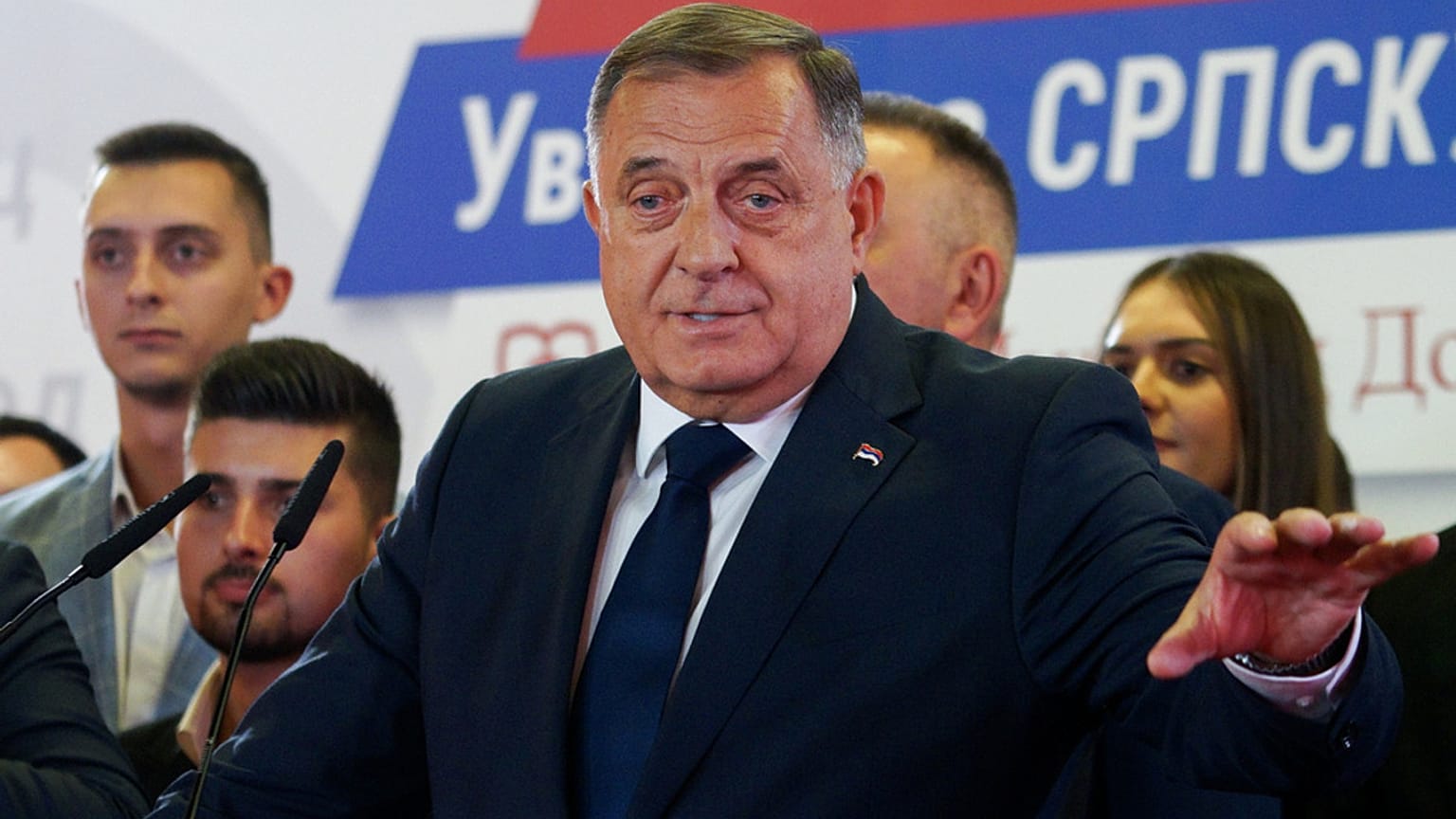
Milorad Dodik of the Alliance of Independent Social Democrats (SNSD), speaks after the publication of general election results, in Banja Luka, Bosnia, Sunday, Oct. 4, 2026
Copyright AP Photo

By Malek Fouda
Published on

Pro-Russia Serb nationalist politician Milorad Dodik – who is serving a six-year ban from holding public office for defying rulings of Bosnia’s international envoy and Constitutional Court, claimed victory on Sunday, saying his party would hold a “vast majority”.

The former president of Bosnia's Serb statelet, Milorad Dodik, said his party had retained power in the entity and its seat on the shared presidency, as preliminary results showed a drop in turnout for Bosnia's general elections.

Dodik led the declarations for a dizzying number of posts to be decided in the general elections in a complex system that has held the partitioned Balkan country together since the 1995 peace deal.

The key race was for the tripartite presidency, split between Bosnian Muslims or Bosniaks, and the Serb and Croat ethnic groups. Dodik's Serb nationalists ran on a platform of greater autonomy and secessionist rhetoric.

"If it had not been for (US President) Donald Trump's magnificent victory, we would probably be political corpses today," he told supporters in Banja Luka, in a speech that also thanked his close ally, Russian President Vladimir Putin.


"But now, thanks to the new environment, we are political winners," he added.

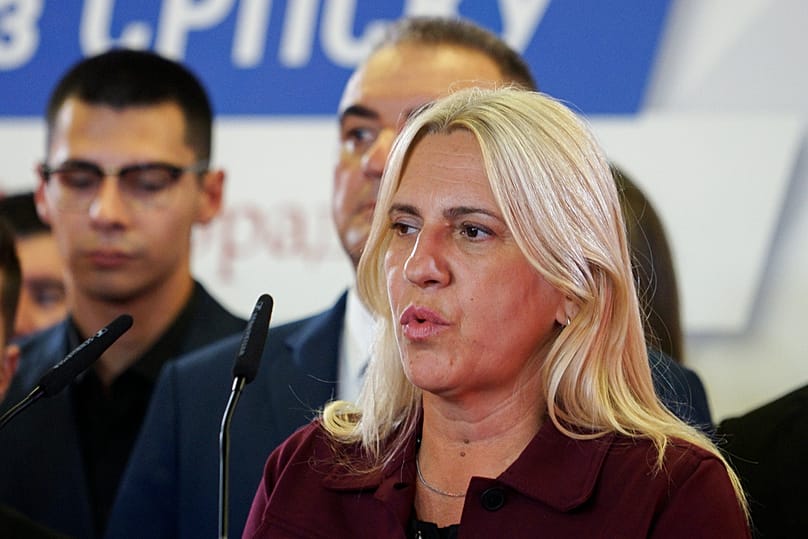
Zeljka Cvijanovic of the Alliance of Independent Social Democrats (SNSD) speaks after the publication of general election results, in Banja Luka, Bosnia, Sunday, Oct. 4, 2026 Radivoje Pavicic/Copyright 2026 The AP. All rights reserved

The 67-year-old was not on the ballot after being convicted of overstepping his powers and banned from the presidency for six years.

But he remains a central figure in the Bosnian-Serb Republika Srpska entity.

With 95% of the ballots counted, according to electoral officials, his candidate, Zeljka Cvijanovic, was firmly on track to retain her spot in the presidency.

Meanwhile, Bosniak presidential incumbent Denis Becirovic also claimed victory after results showed him leading a tighter race for his seat.

"A freedom-loving, anti-fascist and civic Bosnia and Herzegovina is alive," Becirovic, from the Social Democrats party, told supporters in Sarajevo.

Denis Becirovic (SDP) poses for a photo with his wife after declaring himself winner of the Bosniak seat of the tripartite Bosnian Presidency in Sarajevo, Sunday, Oct. 4, 2026 Armin Durgut/Copyright 2026 The AP. 

Bosnian Croat nationalist candidate Darijana Filipovic also claimed victory in her bid for the Croat presidential seat.

Dodik's party was also projected to retain power in the Serb entity's parliament and local presidency by a large margin.

The US-brokered ‘Dayton agreement’ ended the 1992-95 conflict but entrenched divisions that often paralyse decision-making.

It divided Bosnia into two semi-autonomous entities –s the Serb-run RS and a Muslim-Croat federation – linked by a weak central government.

Turnout dropped nearly 10% from the last election in 2022, to around 42% on Sunday, according to official figures.

A man places his ballot into an electronic ballot box during the general election in Sarajevo, Bosnia, Sunday, Oct. 4, 2026 Armin Durgut/Copyright 2026 The AP. All rights reserved

In the Muslim-Croat federation, Becirovic advocates a path toward the European Union and NATO

But if Dodik's party returns to the presidency, it would almost certainly mean the political deadlock that has blocked the necessary reforms for years would remain.

After two decades in power, Dodik and his party have repeatedly clashed with the country's central authorities and vocally oppose EU membership.

Croat nationalist parties are also pushing for electoral reform. They want a greater say in choosing the Croat member of the presidency in the entity they share with the more numerous Bosniaks.


Russia And Ukraine’s New Theories Of Victory? – Analysis


October 3, 2026

By Patial RC


Key Takeaways:

The essay says the war’s “victory” test is endurance, not the next village: Russia hits Ukrainian energy, transport, and industry to break daily life; Ukraine hits Russian refineries, logistics, and defence plants to raise the cost of fighting.

It notes Russia held parliamentary elections in September 2026 while Ukraine’s October 2023 parliamentary and May 2024 presidential votes remain postponed, a gap Moscow uses on legitimacy, and that each side hopes the other’s public will tire first.

Neither is said to have a classical win; the cycle is strike, repair, adapt, and regenerate, so the outcome depends on which economy, industry, and political system wears out sooner.


The Russia-Ukraine war may be entering a new and more consequential phase—not because either side has found a way to win the war on the battlefield, but because the definition of victory itself is changing. The central question is no longer simply who can capture more territory, destroy more tanks or hold the next line of defence. Increasingly, it is becoming a contest over something more fundamental:Which side can destroy the other’s capacity to sustain a prolonged war before its own capacity is exhausted? This is pushing the conflict far beyond the trenches of close combat at the front lines.

Russia is increasingly targeting the foundations that allow Ukraine to function as a state to fight this war: energy, infrastructure, transport, industry, communications, economic activity and, ultimately, public resilience. Ukraine, unable to match Russia’s manpower and missile resources symmetrically, is increasingly targeting the foundations that allow Russia to wage war: refineries, energy infrastructure, logistics, military facilities and defence-industrial capacity. The emerging strategic equation is therefore stark:

Russia wants to make Ukraine unable to continue; Ukraine wants to make Russia unable to continue. Neither strategy requires the complete destruction of the opponent.Each requires only sufficient degradation to make continued war increasingly costly, politically difficult and strategically unsustainable. That is why the next decisive battles may take place hundreds of kilometres behind the front—at refineries, power stations, logistics hubs, defence factories, data centres and economic centres rather than in the trenches. The war is evolving from a contest of territorial attrition into a contest of national endurance.

Ukraine’s Theory: Make War Unaffordable to Russia

Unable to match Russia’s enormous missile and manpower resources symmetrically, Ukraine was the first to increasingly exploit its comparative advantages in drones, with precision strikes in depth, intelligence, electronic warfare and technological innovation. Its objective is to attack the war waging machinery in Russia’s depth areas.

Ukrainian strikes have increasingly targeted oil refineries, energy infrastructure, logistics, military facilities and defence-industrial assets deep inside Russia. Recent reporting indicates that attacks on Russian refineries have reduced fuel-processing capacity and contributed to shortages in some regions. Kyiv’s broader objective is to raise the economic cost of sustaining the war.


The logic is straight forward. If Ukraine cannot match the Russian army on the battlefield which is near impossible, it can attempt to make the Russian war effort more expensive. It requires Ukraine to degrade enough of the Russian system that maintaining the war becomes increasingly difficult and costly.This amounts to a form of strategic neutralization by the gradual erosion of the economic and industrial foundations supporting its military objectives. The underlying message is simple:

“Make the war unaffordable to Russia.”
Russia’s Counter-Theory

For much of the war, Russia’s strategy appeared centred on territorial conquest and attrition. Moscow expected sustained pressure along the front eventually to exhaust Ukrainian manpower and weaken Western support. But the campaign has acquired another dimension.

Russian missile and drone attacks reach deep into Ukraine, including Kyiv and other major urban and economic centres. Their consequences increasingly extend beyond immediate military targets to energy, transport, industry and economic activity.

The objective, therefore, is not simply to destroy Ukraine’s armed forces but to disrupt the wider system that enables Ukrainian society to function and the state to sustain a prolonged war. Moscow may not need to capture every important Ukrainian city if it can make those cities increasingly difficult to live and work in. A city repeatedly deprived of electricity, transport and communications becomes less productive. Businesses hesitate to invest. Workers leave. Infrastructure requires constant repair. Government expenditure rises while revenues decline.

Economic exhaustion. Population displacement. Infrastructure degradation. Declining morale. Political pressure. Russia may therefore be seeking to erode not merely Ukraine’s military strength but its capacity to function as a modern state under wartime conditions.


“Break Ukraine’s ability to function and fight.”


Russia is attacking Ukraine’s ability to live and function normally. Ukraine is attacking Russia’s ability to wage war economically.

Both are betting that the people will eventually ask: How long can this continue and how much longer can we afford to continue?

The war is increasingly becoming a contest of National Resilience.
The Psychological Battlefield

There is another dimension: Morale. Repeated Russian attacks appear intended not only to destroy infrastructure but also to demonstrate to Ukrainians that nowhere is completely safe.

That psychological effect becomes particularly significant when electricity, heating, transport and communications are repeatedly threatened. If Ukrainians begin to expect another cycle of blackouts, attacks and economic disruption every winter, Moscow may hope that the cumulative burden eventually produces pressure for a settlement.


The same dynamic is increasingly visible inside Russia. Ukrainian long-range drone attacks have brought the war closer to Russian cities and disrupted parts of everyday economic life. The psychological barrier separating the Russian population from the war has consequently become thinner.

The more each side attempts to make the other population feel the cost of war, the greater the possibility that the target population adapts rather than capitulates. The psychological battlefield is therefore becoming reciprocal. Each side is attempting to convince the other that the costs of continuing the war are becoming greater than the benefits.
The Political Battlefield: Elections and Legitimacy

Russia has demonstrated that it can conduct elections while the war continues. Its parliamentary elections were held in September 2026 despite the continuing conflict and Ukrainian drone attacks.For Moscow, holding elections provides an opportunity to demonstrate institutional continuity and project the image of a state capable of maintaining its political machinery despite the war.

Ukraine’s parliamentary election, due in October 2023, and presidential election, due in May 2024, have not been held. This creates an important political asymmetry: Russia is conducting elections while the war is going on and Ukraine is postponing elections. For Ukraine, the continued postponement creates an issue that Moscow can exploit politically and diplomatically.


Russia has incorporated Ukraine’s deferred elections into its narrative concerning the legitimacy of the Ukrainian leadership.
The Race Against Time

For both sides, time has become a weapon. Russia needs its military, economic and psychological pressure to accumulate faster than Ukraine and its Western partners can adapt.

Ukraine needs its long-range strike capabilities and domestic defence production to grow faster than Russia can regenerate its military capabilities. The financial dimension is critical.

Russia is devoting enormous resources to sustaining its war effort, while Ukraine remains heavily dependent on external financial and military assistance. Both sides therefore face the same fundamental calculation: how long can their economic systems continue absorbing wartime expenditure?

The answer will depend not only on the size of their economies but also on their ability to regenerate military equipment, maintain industrial production, repair damaged infrastructure and preserve political support.
From Victory to Coercion

This explains why the meaning of “Victory” has become increasingly complicated. Neither side has an easy path to a classical military victory. Russia has not achieved all of its maximal objectives. Ukraine has not restored all its territory through military force.

The central question is therefore ;Which side can create enough pressure on the other to make a negotiated settlement preferable to continued war?

Russian strikes provoke Ukrainian retaliation. Ukrainian deep strikes provoke Russian escalation. Each side presents the other’s attacks as justification for its own both imposing pain without becoming capable of imposing a decisive settlement.
The Emergence of a Prolonged War

This may be the most important evolution in the character of the conflict. The war is increasingly becoming a prolonged war of targeting infrastructure. The objective is no longer necessarily to destroy the enemy’s armed forces in one decisive campaign. It is to progressively weaken the economic, industrial, infrastructural and psychological foundations that allow those armed forces to continue fighting.


The central question now is: Not how much territory has been captured? But, how much national capacity remains available to sustain the conflict? This changes the meaning of strategic success.

A country can suffer extensive infrastructure damage yet continue fighting if it possesses sufficient external support, domestic resilience and the ability to regenerate its military capacity. The war is therefore increasingly becoming a contest between destruction and regeneration.
The Risk of Strategic Exhaustion

This creates a dangerous possibility: Strategic Exhaustionwithout political resolution. Neither side may need to defeat the other’s armed forces completely. It may be enough to make the cumulative cost of war increasingly difficult to sustain.

The cycle becomes: strike → retaliation → escalation → adaptation → regeneration → another strike.

New air defences appear. New drones are developed. Production is dispersed. Infrastructure is repaired. Alternative supply routes are established.
The Real Endgame

The coming phase may therefore be less about who captures the next village and more about whether either theory can alter the opponent’s strategic calculation.

If Russia succeeds in turning Ukrainian winters into prolonged crises of energy, mobility, employment and displacement, Moscow may conclude that time is working in its favour.

If Ukraine can expand its ability to strike Russia’s energy and defence-industrial infrastructure while maintaining external financial and military support, Kyiv may conclude that time is becoming a burden for Moscow.

The war has consequently entered a race of Strategic Exhaustion:

Russia seeks to exhaust Ukraine’s capacity to function. Ukraine seeks to exhaust Russia’s capacity to sustain the war. Both sides are becoming increasingly capable of imposing costs while remaining unable to impose a decisive settlement.

The decisive battle is therefore no longer taking place on the battlefield alone but is dangerously becoming a prolonged war of infrastructure targeting. It is being fought across energy networks, refineries, defence factories, logistics systems, financial resources, cities, political institutions and public resilience.

The Russia-Ukraine conflict is thus evolving into something broader than a conventional war of territorial attrition. It is becoming a struggle to degrade the opponent’s capacity to function, fight and endure.


The new theories of victory are not simply theories of capturing territory but are theories of making the opponent’s war unsustainable.

And the battle that determines the eventual outcome may be fought not at the front, but in the economic, industrial, infrastructural and political depth of both nations.


About Patial RC
is a retired Infantry officer of the Indian Army and possesses unique experience of serving in active CI Ops across the country and in Sri Lanka. Patial RC is a regular writer on military and travel matters in military professional journals. The veteran is a keen mountaineer and a trekker.
View all posts by Patial RC →

North Korea, Russia Evade U.N. Sanctions To Buttress Moscow’s Drone Program

Drone factory in Russian Republic of Tatarstan. Photo Credit: Screenshot of Russian media


The Multilateral Sanctions Monitoring Team’s September 2026 report says about 100,000 North Korean workers remain abroad, mostly in China and Russia, earning $450–800 million in 2025 for nuclear and missile programs, in breach of the requirement to repatriate them by the end of 2019.

It estimates 15,000–30,000 in Russia, including a group assembling drones at Alabuga, which CSIS says grew to a complex of up to 116 buildings producing more than 5,500 drones a month; Russia issued more than 36,000 visas to North Koreans in 2025, four times 2024.

Workers are said to average $7,500 a year, with the regime taking up to 90%; the 11-country team was formed in October 2024 after Russia vetoed and China abstained on renewing the U.N. sanctions panel.


North Korea has sent workers to Russia to manufacture military drones, violating United Nations Security Council resolutions, an international monitoring team reported, noting the number of North Koreans working in Russia has sharply increased since Moscow’s war with Ukraine began in 2022.

Overall, an estimated 100,000 North Korean laborers are deployed overseas, mostly to China and Russia, the Multilateral Sanctions Monitoring Team (MSMT) reported.

“At least 17 countries are suspected of continuing to host labourers, generating between $450 million and $800 million in 2025 to fund [North Korea’s] unlawful nuclear weapons and ballistic missile programs,” the September 2026 report said.


An estimated 15,000 to 30,000 North Koreans work in Russia, including a contingent deployed in the Alabuga Special Economic Zone facilities assembling uncrewed aerial vehicles (UAV) for Russian armed forces to use against Ukraine, the report said.

Since late 2021, the UAV factory and associated facilities in the zone have expanded from two buildings to a 17-facility complex of up to 116 buildings, producing more than 5,500 drones monthly for the war in Ukraine, the Center for Strategic and International Studies (CSIS), a United States-based think tank, reported.

The number of imported workers began increasing in 2020, when Russia allowed student visa-holders to work, creating a scheme to camouflage North Korean laborers as students. The deployments violate a U.N. Security Council resolution requiring U.N. members to repatriate income-earning North Korean nationals by the end of 2019.

North Korea and Russia “have built an extensive ecosystem of state-led sanctions evasion,” the report said. Russia issued more than 36,000 visas to North Koreans in 2025, four times the 2024 total, The Wall Street Journal newspaper reported.

North Korean dictator Kim Jong Un, who has supplied missiles and armed forces to Moscow to fight Ukraine, exports workers to fund his illegal weapons programs and reinforce his alliance with Russian President Vladimir Putin. Kim’s actions illustrate his willingness to expose North Korea’s people to danger to serve his objectives, analysts say.


“Kim’s major concern isn’t North Korean workers getting killed,” Peter Ward, a research fellow at the Sejong Institute, a think tank in the Republic of Korea (ROK), told the newspaper. “His motivations are financial.”

Each North Korean laborer in Russia generates $7,500 in average annual wages, the MSMT estimated, but the North Korean regime confiscates up to 90% of those earnings. In some cases, the amount exceeds earnings, leaving workers indebted to Pyongyang.

“The regime is selling the labor of its citizens under a state-to-state arrangement, controlling whether they may leave and collecting most of their wages,” Victor Cha, president of the Geopolitics and Foreign Policy Department and Korea chair at the CSIS, told U.S. lawmakers in September 2026.

An estimated 20,000 to 70,000 North Korean laborers are deployed in China. Despite a temporary repatriation of as many as 20,000 workers from 2023-25, about 10,000 new North Korean workers arrived in China between January 2025 and January 2026, the MSMT report found.

The MSMT comprises Australia, Canada, France, Germany, Italy, Japan, the Netherlands, New Zealand, the ROK, the United Kingdom and the U.S. It launched in October 2024 to monitor U.N. sanctions against North Korea after Russia and China scrapped a previous Security Council enforcement tool. Russia vetoed and China abstained from renewing the prior U.N. panel that had enforced sanctions over North Korea’s nuclear and missile programs for 15 years.


About Indo-Pacific Defense Forum
Indo-Pacific Defense Forum is sponsored by the United States Indo-Pacific Command (USINDOPACOM) and publishes daily online articles, daily social media updates and a quarterly magazine to provide timely updates on the Indo-Pacific security environment.
View all posts by Indo-Pacific Defense Forum →