Tuesday, May 06, 2025

After tough talk on social media, Trump radiates warmth in person for Canada's new prime minister

Story by Rob Gillies And Josh Boak


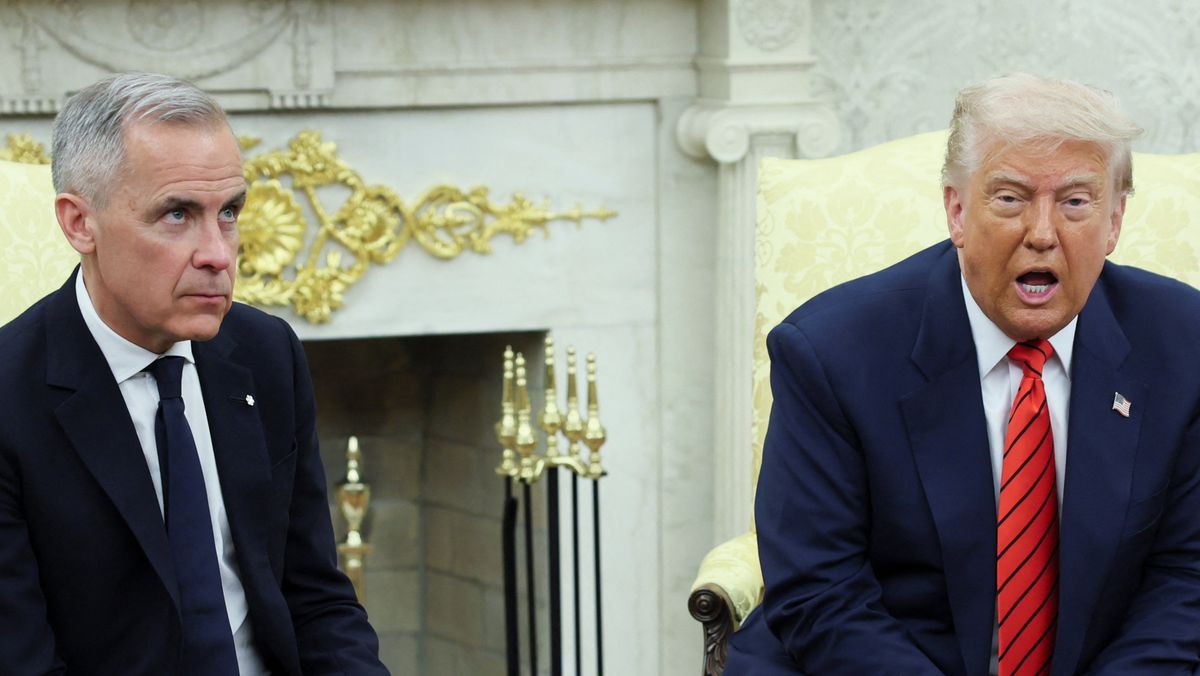
President Donald Trump meets Canadian Prime Minister Mark Carney in the Oval Office of the White House, Tuesday, May 6, 2025, in Washington. (AP Photo/Evan Vucci)© The Associated Press

WASHINGTON (AP) — President Donald Trump welcomed Canada's new prime minister, Mark Carney, with a bit of menace on social media, only to then turn on the charm and hospitality once the two leaders were sitting together in the Oval Office on Tuesday.

“I just want to congratulate you," Trump told Carney on his election win as they met in front of reporters. "Ran a really great race. I watched the debate. I thought you were excellent.”

As the two countries struggle over a trade war sparked by Trump's tariff hikes, the U.S. president gave a full display of his unique mix of graciousness and aggression. Shortly before Carney's arrival, Trump said on social media that the United States didn't need “ANYTHING” from its northern neighbor, a contrast to his public warmth in the Oval Office.


Canadian Prime Minister Mark Carney is greeted by President Donald Trump as he arrives at the West Wing of the White House, Tuesday, May 6, 2025, in Washington. (AP Photo/Mark Schiefelbein)© The Associated Press

“I very much want to work with him, but cannot understand one simple TRUTH — Why is America subsidizing Canada by $200 Billion Dollars a year, in addition to giving them FREE Military Protection, and many other things?” Trump wrote on Truth Social. “We don’t need their Cars, we don’t need their Energy, we don’t need their Lumber, we don’t need ANYTHING they have, other than their friendship, which hopefully we will always maintain.”


President Donald Trump meets Canadian Prime Minister Mark Carney in the Oval Office of the White House, Tuesday, May 6, 2025, in Washington. (AP Photo/Evan Vucci)© The Associated Press

Trump's claim defies the underlying economic data as the United States depends on oil produced in Canada, in addition to an array of other goods that cross border trade have helped to make more affordable in ways that benefit growth. The United States also runs a trade deficit in goods with Canada of $63 billion, much lower than the figure cited by Trump.

Related video: 'You know who I’m talking about:' Trump takes veiled shot at 'terrible' Chrystia Freeland during Carney meeting (Global News)

But once in the Oval Office, Trump showered his counterpart with compliments and radiated warmth, saying that “Canada chose a very talented person, a very good person.”

Carney won the job of prime minister by promising to confront the increased aggression shown by Trump, even as he has preserved the calm demeanor of an economist who has led the central banks of both Canada and the United Kingdom.

Trump has splintered a decades-old alliance by saying he wants to make Canada the 51st U.S. state and levying steep tariffs against an essential partner in the manufacturing of autos and the supply of oil, electricity and other goods. The outrage provoked by Trump enabled Carney’s Liberal Party to score a stunning comeback victory last month as the ongoing trade war and attacks on Canadian sovereignty have outraged voters.

The Republican president has repeatedly threatened that he intends to make Canada the “51st state.” He said in an interview with NBC’s “Meet the Press” that aired Sunday that the border is an “artificial line” that prevents the two territories from forming a “beautiful country.”

Trump's openly adversarial approach has raised questions for Carney and other world leaders on how to manage relations with the U.S. Some world leaders, such as U.K. Prime Minister Keir Starmerengaged in a charm offensive. Others, such as Ukrainian President Volodymyr Zelenskyy, were met by Trump with anger for not being sufficiently deferential.

Robert Bothwell, a professor of Canadian history and international relations at the University of Toronto, said Carney shouldn’t meet with Trump.

“We’ve seen what he does. We saw what he did with Zelenskyy,” Bothwell said. “And he would sure as hell try to do the same with Carney. It’s not in Carney’s interest. It’s not in Canada’s interest.”

Trump and Carney will meet in the Oval Office and have lunch. Carney has stressed that he was elected to specifically “stand up” to the U.S. president and that Canada is “in a once-in-a-lifetime crisis.” Carney said he expects “difficult” but “constructive” conversations with his U.S. counterpart.

Trump told reporters on Monday that he wasn't quite sure why Carney was visiting.

“I’m not sure what he wants to see me about,” Trump said. “But I guess he wants to make a deal.”

U.S. Commerce Secretary Howard Lutnick further stoked doubts about their interest in repairing the relationship with Canada in a Monday interview on Fox Business Network's “Kudlow” show.

Asked if the U.S. could make a deal with Canada, Lutnick called the country a “socialist regime” that has been “basically feeding off America." Lutnick said Tuesday's meeting would be “fascinating.”

Carney, at a Friday news conference ahead of his trip, said the talks would focus on immediate trade pressures and the broader economic and national security relationships. He said his “government would fight to get the best deal for Canada” and “take all the time necessary” to do so, even as Canada pursues a parallel set of talks to deepen relations with other allies and lessen its commitments with the U.S.

Trump has maintained that the U.S. doesn’t need anything from Canada. He is actively going after a Canadian auto sector built largely by U.S. companies, saying, “They’re stopping work in Mexico, and they’re stopping work in Canada, and they’re all moving here.” He also said the U.S. doesn’t need Canada’s energy — though nearly one-fourth of the oil that the U.S. consumes daily comes from the province of Alberta.

The president has also disparaged Canada's military commitments despite a partnership that ranges from the beaches of Normandy in World War II to remote stretches of Afghanistan.

Trump has said that Canada spends “less money on military than practically any nation in the world."

“They pay NATO less than any nation,” he said. "They think we are subsidizing. They think we are going to protect them, and, really, we are. But the truth is, they don’t carry their full share, and it’s unfair to the United States and our taxpayers.”

Bothwell noted that Carney might be under little pressure to reach a quick deal as Trump has at times reversed, delayed or defanged his tariffs, such that over time Trump might be in a weaker position if talks are prolonged.

“It may not matter as much in the summer as it does today because every time he’s made one of these announcements, next week it's, ‘Oh, I had my fingers crossed. I didn’t mean it,’" he said of Trump.

Daniel Béland, a political science professor at McGill University, said Carney needed the quickly scheduled meeting with Trump to address the trade war started by the U.S. Trump has imposed 25% tariffs on steel and aluminum and tariffs on other products outside the United States-Mexico-Canada Agreement, in some cases ostensibly to address relatively low volumes of fentanyl intercepted at the border between the two countries.

“Carney wants to show that he’s doing everything he can, including taking political risks to protect Canadian jobs in areas such as the auto industry," Béland said. ”If he had postponed his first meeting with President Trump for months and months, opposition parties and commentators could have accused him of being overly shy and doing a disservice to Canada because of that.”

Canada is the top export destination for 36 U.S. states. Nearly $3.6 billion Canadian (US$2.7 billion) worth of goods and services cross the border each day. About 60% of U.S. crude oil imports are from Canada, and 85% of U.S. electricity imports are from Canada.

Canada is also the largest foreign supplier of steel, aluminum and uranium to the U.S. and has 34 critical minerals and metals that the Pentagon is eager for and investing in for national security. Canada is one of the most trade-dependent countries in the world, and 77% of Canada’s exports go to the U.S.

Rob Gillies And Josh Boak, The Associated Press

He was not happy': Analyst says Canadian PM's body language sent Trump clear message

Krystina Alarcon Carroll
May 6, 2025 
RAW STOTY
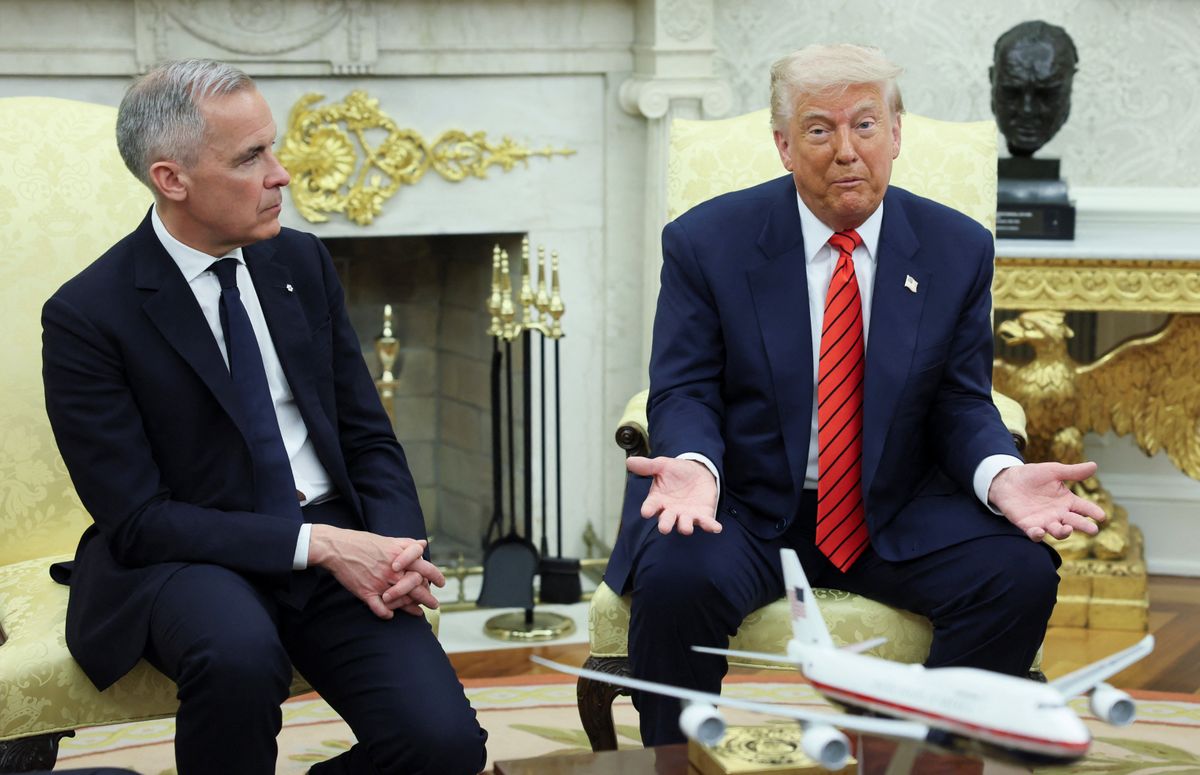
U.S. President Donald Trump and Canadian Prime Minister Mark Carney meet in the Oval Office at the White House in Washington, D.C., U.S., May 6, 2025. REUTERS/Leah Millis TPX IMAGES OF THE DAY


President Donald Trump and Canadian Prime Minister Mark Carney met on Tuesday to speak about making a trade deal, among other issues facing the two countries.

After watching the interaction between the two world leaders, CNN anchor Dana Bash read between the lines.

“It was extremely cordial, really, almost throughout the entire thing. Then at the end, you did see and hear President Trump start to get and give more jabs. Talking about the fact that the United States doesn't need Canadian goods, doesn't need to have cars from Canada, and if you can see right there the body language from and by the Canadian Prime Minister, he was not happy, and then the president ended the session.”


Bash then brought in Senior White House Reporter Kevin Liptak and Correspondent Paula Newton to get their thoughts on the interaction.

“You hit it right on the head there,” Newton agreed. “The issue is here in terms of tone. Look, this was completely different, not just from what President Trump had been saying, really for months.”

Newton additionally fact-checked Trump, saying, “Just fact-checking a couple of things in terms of the ripping off of Canada. It is true Canada gets a lot from the relationship with the United States, but Prime Minister Carney tried to interject there and say point blank, Canada is the largest purchaser of American goods. period. Full stop."

"That's why not too far from here on Capitol Hill. I know what you know all too well, there have been both Democratic and Republican politicians saying that to the White House loud and clear,” the correspondent said.

“If this president is sticking to what he thinks about these trade deals, he said okay, sure. We've got this trade deal with Canada and Mexico. We may renegotiate it. We 5may abandon the trade deal. He is leaving everything on the table and from that point of view, when you see Mark Carney there really trying to say what he could with the body language,” Newton said.

She later added that she believes Carney and Trump do respect each other.

Bash then turned it over to Liptak, who added, “You did note his body language. I was noting, particularly when the president was going after, he didn't name her. But Chrystia Freeland, the former finance minister, said that she was a terrible negotiator, talking about this experience, negotiating the USMCA.”

Watch the video below or at this link.


'Humiliated again!' Critics take aim at 'embarrassing' Trump-Carney meeting

Jennifer Bowers Bahney
May 6, 2025
RAW STORY


Canadian Prime Minister Mark Carney reacts while U.S. President Donald Trump speaks as they meet in the Oval Office at the White House in Washington, D.C., U.S., May 6, 2025. REUTERS/Leah Millis

President Donald Trump set the stage for his Oval Office meeting with Canada's new Prime Minister Mark Carney Tuesday with a bombastic social media post stating, "We don’t need ANYTHING they have...They, on the other hand, need EVERYTHING from us!"

Trump repeated this sentiment to Carney's face minutes later, which raised eyebrows across social media.

"Holy sh--. Mark Carney’s brain just rebooted on live tv after Trump’s stupid comment that we don't do much business with Canada. Canada is the largest importer of U.S. goods. Look at his face!" a post on the X account CALL TO ACTIVISM stated.

Trump also proclaimed to Carney that Canada would be the 51st U.S. state, which drew a lion's share of comments.

Anti-MAGA Trump Lie Tracker wrote, "Canadian Prime Minister Mark Carney tells Trump TO HIS FACE that Canada will never be America’s 51st state."

"HOLY S--T! Canadian PM Mark Carney just told Trump to his face that Canada will NEVER be for sale," posted grassroots political org Really American. 'Having met with the owners of Canada over the course of the campaign, it's not for sale. It won't be for sale, ever.' Incredible!"

Democratic Wins Media wrote, "In a stunning moment, Mark Carney, the Prime Minister of Canada, just told Donald Trump to his face that Canada will never be a part of the U.S. Donald Trump is getting humiliated again."

Journalist Ed Krassenstein: "Canadian Prime Minister Mark Carney claps back hard at Trump’s idea about Canada becoming the 51st state. Trump: 'As a real estate developer, when you get rid of that artificial line, when you look at that beautiful formation together, I said, ‘that’s the way it was meant to be.’”


Trending Politics's Colin Rugg wrote, "A nervous Canadian Prime Minister Mark Carney says Canada will never be for sale, prompting President Trump to say, "Never say never." Lmao."

MSNBC commentator Barry McCaffrey expressed his dismay at the entire Oval Office situation."Trump dealing with PM Carney is an embarrassing and sad situation," McCaffrey wrote. "Trump ego. Narcissism. Ignorance. Insulting. PM Carney dignified. Intelligent restrained."


'Stains, rips and tears': Alberta government defends $280K carpet in Smith's office

48 YEARS OF CONSERVATIVE RULE

Story by Jack Farrell


The Alberta Legislature is seen in Edmonton, Thursday, Oct. 31, 2024. Alberta's government is defending a hefty bill to replace the carpet in Premier Danielle Smith's office. THE CANADIAN PRESS/Jason Franson© The Canadian Press

EDMONTON — Alberta's government is defending a hefty bill to replace the carpet in Premier Danielle Smith's office, after it became a point of attack in question period.

The provincial infrastructure ministry said Friday in a statement that the previous carpet in the 6,500-square-foot legislature space was in poor condition, riddled with "stains, rips and tears" and more than 20 years old.

It said the province recently spent about $280,000 to purchase and install new red carpet. The cost also included abatement work and removal of the old one.

"The legislature is an important part of Alberta’s history, and renewal work ensures it remains in good condition to serve Albertans for generations to come," the statement said.

Independent legislature member Scott Sinclair said this week that government spending is "out of control" and out of touch, considering Alberta is staring down a forecasted $5-billion deficit. Sinclair was kicked out of the United Conservative Party caucus earlier this year for threatening to vote against the budget.

"To the premier: Do you think spending a quarter-million dollars to roll yourself out on a red carpet every day is a responsible way of spending taxpayers’ money when you run Trudeau-style deficits?" Sinclair asked in question period Thursday.

He added that the price tag would even make former premier Alison Redford blush. Redford resigned in 2014 following a series of spending controversies.

Finance Minister Nate Horner stood up to respond in place of the premier and said the government's income tax cut would address affordability concerns.

Sinclair said it's a "tale as old as time" to see a premier spend on wants not needs.

"Don’t you think this kind of luxurious spending sends the wrong message to everyday Albertans when we can’t get highways and health care?"

"You know, the member is not wrong," said Horner. "Highways, hospitals, schools: these are all our fundamental, principal concerns.

"We need to ensure that dollars go further now than ever, and we have to do that in a time of great inflation, of trade uncertainty, of logistical challenges."

Sinclair proceeded to quote Smith when she was leader of the now-defunct Wildrose Party and criticized Redford's spending as "duplicitous, entitled, secretive, wasteful and completely out of touch with the priorities of everyday Albertans."


Sinclair also claimed Thursday that the province is spending $300,000 on china for Government House in Edmonton, which hosts government functions and ceremonies.

The Infrastructure ministry said that's not true. The prestigious venue's inventory of dinnerware, dating back to the 1990s, is set to be replaced.

"Breakage, wear and tear has resulted in low inventory of tableware resulting in the inability to properly serve meetings and events," it said, adding that a procurement process is underway.

"Alberta’s Protocol Office has recommended any purchase be of basic tableware due to limited budget."

This report by The Canadian Press was first published May 2, 2025.

Jack Farrell, The Canadian Press
MAKE ALBERTA GREAT AGAIN

Tasha Kheiriddin: Carney has no choice but to listen to Danielle Smith

Opinion by Tasha Kheiriddin


Alberta Premier Danielle Smith on Monday May 5, 2025. Gavin Young/Postmedia

On the eve of Prime Minister Mark Carney’s critical trip to Washington to meet U.S. President Donald Trump, Alberta Premier Danielle Smith stole the spotlight and turned it firmly on herself. In a twenty-minute “address to Albertans,” she aired grievances against the federal Liberal government, from carbon taxes to Justin Trudeau’s infamous “no more pipelines bill,” C-69. Smith also presented a list of demands, from resource corridor development to greater provincial control over energy and immigration. And she pledged to hold a referendum on Alberta independence should “enough” citizens demand one — while insisting multiple times that she doesn’t support secession herself

The timing was no accident. Smith wanted to be a topic of conversation in the White House. Perhaps she’s angling for another interview on Fox News. Or perhaps she is trying to stay in power, pacifying the same angry base that ousted her predecessor, Jason Kenney, in 2022 after he won only 51.4 per cent in a leadership review.

Whatever the reason, Smith is seizing the moment to make Alberta’s case, to the detriment of Canada’s. If Carney has trouble at home, it will be harder for him to stand strong abroad. And it’s hard to see how that helps Alberta — unless Smith has another agenda in mind. And for that, she has a model: Quebec.

Albertans often point to the success of Quebec in dominating the national conversation — and extracting concessions from Ottawa — by threatening separation. But Quebec’s grievance is cultural, not economic — rooted in preserving a French-speaking enclave in an English continent. Alberta’s complaint by contrast, is financial. The province sees itself as the country’s cash cow, milked for equalization payments and dismissed by Laurentian elites for decades — and on this, Smith is not wrong.


Related video: Graham Thomson joins CBC to unpack the strategy behind Danielle Smith’s sovereignty talk (cbc.ca)


Alberta was created as a province in 1905, but the federal government retained Crown lands until the Natural Resources Transfer Agreement and directly controlled its resources until 1930. The province has a particularly bitter history with Liberal governments: Pierre Elliott Trudeau enacted the National Energy Policy in the 1980’s, while son Justin brought in carbon taxes, emissions caps, and the aforementioned Bill C-69 in the 2010’s.

So what could satisfy Alberta? Smith has a list: an LNG corridor, approval of new oil pipelines, and repeal or serious amendment of C-69, also known as the Impact Assessment Act. Carney has already said he would amend — but not repeal — the law, and during the campaign , he promised to cut wait times for the approval of major resource projects from five years to two. He also pledged to create trade and energy corridors for transport, energy, critical minerals and digital connectivity.

But will that be enough in the current climate? Protesters who took to the legislature on the weekend are disappointed in the election result – and don’t trust Liberals to have their back. Polls show that 15 per cent of the province would vote to join the US, while 29 per cent would vote for independence.

Smith may indeed be playing with fire. While Trump denies interest in a military invasion of Canada, Trump’s interest in making us the “51 st State” is not idle conversation. He has mused about annexing the west first: could he twist history to make it Canada’s “Donbas”? Americans played a key role in Alberta’s early development: by 1916, nearly 19 per cent of its population hailed from the US, though it has been diluted by waves of immigration since then.

Carney must tread carefully — and act quickly. A referendum in 2026, as Smith threatens to hold, would weaken Canada’s position during crucial negotiations with the United States. To stave this off, Carney will have to shed some of his green mantle and expedite resource development projects that benefit the west — projects that will also benefit the rest of the country through job creation and economic activity. A fair deal for Alberta is now essential for Canada, in more ways than one.

Postmedia News IS A CONSERVATIVE NEWS PAPER

Tasha Kheiriddin is Postmedia’s national politics columnist.


Parti Québécois leader stands with Alberta Premier Danielle Smith and her ‘strong hand’

LES SEPERATISTE; BIRDS OF A FEATHER


Story by Antoine Trépanier


Parti Quebecois Leader Paul St-Pierre Plamondon during question period Tuesday, November 19, 2024 at the legislature in Quebec City.

OTTAWA — Alberta Premier Danielle Smith has an ally in Quebec and his name is Paul St-Pierre Plamondon, the Parti Québécois leader.

A day after Smith threatened the federal government of including a referendum question on separation in 2026 if her province didn’t have the Accord, she thinks it deserves with Ottawa, St-Pierre Plamondon said Smith made a “striking gesture” for the “autonomy and defence of her own province.”

“It doesn’t matter what referendum they hold, because obviously it’s under construction. But I totally agree with provinces that stand up, that are loyal to their own Parliament, that are capable of showing a strong hand. And that’s the key word, strong hand,” said St-Pierre Plamondon, who is often called PSPP in Quebec.

In a in a livestreamed address Monday , Premier Smith called on Prime Minister Mark Carney to negotiate a new deal between Ottawa and Alberta guaranteeing more pipelines and changes to equalization.

“We hope this will result in a binding agreement that Albertans can have confidence in. Call it an ‘Alberta accord’,” said Smith who then called Alberta’s separation “the elephant in the room.”

“The vast majority of (separatists) are not fringe voices… They are loyal Albertans,” she said. “They’re … our friends and neighbours who’ve just had enough of having their livelihoods and prosperity attacked by a hostile federal government.”

Related video: Alta. premier says she'll work with Carney 'in good faith' to repair relations (Global News)  Duration 1:53

At a press conference at Quebec’s National Assembly, St-Pierre Plamondon said it was a “good thing” if other provinces are able to “stand up to the federal government”.

He added that “other provinces are showing” that Canada has issues that affect all provinces in terms of “abuse of power”.

St-Pierre Plamondon then went on the offensive against the province’s journalists for not covering the rebound in support of Quebec secession .

A recent Postmedia-Leger poll revealed that support for Quebec independence, which had fallen below 30 per cent in recent month, sits back at nearly 40 per cent.


Even though Canada is engaged in a tariff war with its closest ally, support for Quebec independence has reached 36 per cent according to new data.

“The most recent and most precise information is the independence of Quebec at 40 per cent, it is the increase in independence in Alberta,” he said.

Léger also polled Canadians from all provinces about their opinion about their province’s independence. The result was that 29 per cent of Albertans supported Alberta sovereignty while an overwhelming majority of the 2,309 respondents (71 per cent) were opposed.


National Post

atrepanier@postmedia.com


LA REVUE GAUCHE - Left Comment: Search results for SOCRED 


After Francis: what if they elect a pope under the banner “Make Church Great Again”?

by MAJMUREK Jakub

After Pope Francis’s relatively “open” and “reformist” pontificate, will the Catholic Church face a traditionalist backlash, like American democracy in Trump’s second term?


The Catholic Church is, of course, an institution much older than modern divisions of right-left, liberalism-conservatism, and even traditionalism-progressivism. Nevertheless, global public opinion, at least in Western democracies, will await the results of the conclave, essentially asking themselves just one question: will the new pope be more “liberal” or “conservative”? Will the Church, after Francis’s relatively “open” and “reformist” pontificate, face a traditionalist backlash, the same fate as American democracy in Trump’s second term? Or, to put it in different terms: will the cardinals elect a pope under the banner of Make Church Great Again?

Conclave or The Young Pope
Referencing pop culture, we’ll soon find out whether we’ll see a scenario straight out of the film “Conclave” or rather from Paolo Sorrentino’s series “The Young Pope”.

In the first production, the dispute between liberals and conservatives paralyses the conclave, full of multi-layered intrigues and 5D political chess moves. Ultimately, a cardinal unknown to anyone, serving in Afghanistan, is elected, reminding the politicised purpurates of the “true meaning of Christianity” as a religion of radical love for one’s neighbour. At the same time, how the film—an adaptation of Richard Harris’s novel—understands the “true meaning of Christianity” is definitely closer to the more “liberal”, “open” currents of contemporary Catholicism than to the conservative ones. As we learn in a final plot twist, the new pope, due to his very identity, is someone suitable for the banners of woke Catholicism and a figure from the worst nightmares of groups like Ordo Iuris.

In Sorrentino’s series, the Church elects a young, telegenic American cardinal who perfectly understands contemporary media and pop culture. The new head of the Church takes the name Pius XIII and pushes the institution on a radically reactionary course. He dons the papal tiara again—a crown symbolising the monarchical nature of papal power—and also retrieves liturgical garments from church storage that were sent there over half a century ago, when after the Second Vatican Council, the Church attempted to adapt to the realities of the 20th century and modern industrial society.

The serial does not intend to adapt to anything. It is not the Church that must adapt to the world, but the world to the Church. For it is the Church that possesses the deposit of revealed, divine truth and has the right to demand that the world accept it: in thought, word, and deed. In the series, Pius XIII assumes the role of a severe prophet, a king-high priest at war against the modern world, waged with the help of the most modern means of communication, with pop-cultural and media proficiency that many a spin doctor might envy.

The Pope of Backlash
Of course, one could wonder whether it makes sense to speak of a backlash at all in the case of an institution as conservative and traditionalist as the Catholic Church. Contrary to the fears of conservative Catholics and the hopes of liberal-leftist public opinion, Francis has not fundamentally changed Catholic doctrine in its most problematic areas from the perspective of contemporary liberal values.

At the same time, in the case of institutions like the Catholic Church, seemingly small shifts in emphasis and priorities are significant. And here, credit must be given to Francis that the Church under his leadership was far less engaged in culture wars—on issues of “gender ideology”, “defence of life”, fighting “LGBT ideology”—than that of John Paul II and Benedict XVI, even if doctrinally nothing changed, and the former pope’s personal views were not particularly more progressive than his predecessors’.

Francis focused his message not on fighting the “liberal civilisation of death” but on issues such as climate change, ecology, migration, tensions between the global North and South. He spoke up for marginalised individuals, social groups, and areas of the globe—although his sensibility, shaped in the context of the Global South, led him to extremely naive, and sometimes simply outrageous, judgements on the war in Ukraine.

With all the limitations of Francis’s pontificate, we may miss him. Because it cannot be ruled out that soon we will see a pope who, instead of reminding us of the humanity of refugees, will call on Christian nations to defend themselves against “Muslim invasion”, and in domestic policy, instead of multiculturalism or reasonable tolerance towards different lifestyles, will focus on identity-Christian politics, forcing citizens who do not share Christian values to assimilate forcefully or reemigrate. Someone who will amplify the Church’s message hostile to the rights of women or LGBT+ people. A pope who will stop talking about poverty or inequalities, and will mention nature only in the context that people are to subdue it.

There is no shortage of candidates to push the papacy in this direction. The right-wing portal X is already conducting something like an online election campaign for several of them. Particularly popular—also among the most radical politicians of PiS and Konfederacja—is the cardinal from Guinea, Robert Sarah. The first pope from Africa, the first black pope, pushing the Church towards a reactionary backlash, to the sound of praise from the European radical right, who otherwise are convinced that “blacks have on average lower IQ than whites” and frighten their supporters with an “invasion from Africa.”It would perfectly fit into the era of applied political postmodernism. As pope, Sarah would express the spirit of the times. The US president, supported by the American religious right, is a multiple divorcee known for an affair with a porn star, the British Tories are led by Nigerian-raised Kemi Badenoch, convinced of the superiority of Western culture, while the extremely anti-immigrant German radical right AfD co-leader is led by a lesbian financier living with her Sri Lankan born partner.

The Vatican-Washington Axis
Cardinal Sarah will turn 80 in June. He was seriously marginalised in the Church during Francis’s time, and is not a favourite for the election. However, there is no shortage of candidates similar to him, such as the Hungarian Primate Péter Erdő, close to Orbán’s government. When, in 2017, Erdő was asked in a television interview whether the language used by Orbán’s government about migrants and refugees is in line with Church teaching, principles of Christian compassion, and love for one’s neighbour, he interrupted the conversation, refusing to answer.

Any backlash pope would have an ally not only in Budapest but also in Washington. Francis’s pontificate divided American Catholics, leading to open opposition from some of the more traditionalist circles. The conflict was so sharp that the former pope directly accused American Catholics who were in conflict with him of a “reactionary approach”.

This group, although a minority of American Catholics, has gained significant political influence in the country thanks to Trump’s presidency. The current president, even in his first term, reached for traditionalist—and at the same time strongly pro-market—Catholics in his judicial nominations, including to the Supreme Court. Thanks to these nominations, it was possible to reverse the precedent in Roe vs. Wade and deprive American women of the right to abortion as a constitutional right.

Finally, Steve Bannon—one of the key ideologues of the MAGA movement—and Vice President Vance are associated with this group. As the Financial Times writes, conservative Catholics in the United States are now eagerly awaiting the results of the conclave and a pope who will “make the Church great again”.

What could a backlash bring?
What would be the political consequences of electing a pope under the MCGA (Make Church Great Again) banner? It would certainly bring great psychological reinforcement to the radical right across the Euro-Atlantic world, including Poland. This reinforcement would most likely not be strong enough to significantly influence election results in Poland—outside a small niche, figures such as Cardinal Sarah and other conservative pope candidates do not evoke any real social emotion. However, a pope under the MCGA banner would give the right hope that, even despite defeat in the presidential elections, global trends favour them and that they may soon return to power.

Traditionalist Catholics are convinced that the West is declining because it is losing its Christian character, and that it is losing its Christian character partly because the Catholic Church has become too “liberal”. Because instead of warning against sin and fall, and also standing guard over eternal, revealed laws, it has unnecessarily been trying to adapt to the contemporary world for several decades. Being unable to offer a real alternative to its spiritual “diseases” of late modernity—this argument continues—the Church condemns itself to irrelevance and loss of the faithful.

If a traditionalist wins in the conclave, the belief that a pope thundering against the sins of modern civilisation will convert the West and attract the faithful back to the Church would most likely soon be subjected to a rather painful empirical verification. A pope under the MCGA banner would accelerate the divorce from the Church of further groups of faithful in Europe. At the same time, it would integrate around the Church a determined, modernity-hostile group, often openly reactionary and ready to use political power to impose its values on the entire society. That may turn out to be a more problematic scenario than a socially broader but lukewarm Church.

Jakub Majmurek is a publicist and film critic


Indonesia’s national identity was built by the left in the anticolonial struggle


by DE JONG Alex


    Members and sympathizers of the Indonesian Communist Party gather in a sports stadium in Jakarta on May 23, 1965, to celebrate the party’s forty-fifth anniversary. (Bettmann via Getty Images)

    Indonesian communists played a crucial role in developing national consciousness among workers and peasants, against Dutch colonial rule. After the bloody repression of the Indonesian left in the 1960s, Suharto’s regime wrote the left out of the history books.

    In Communication against Capital, Rianne Subijanto tells the story of how socialists in 1920s Indonesia mobilized against colonialism. With rallies and journals, strikes and education, their movement introduced new ways of looking at the world and helped to bring the Indonesian nation into being.

    Communication against Capital focuses on the first half of the 1920s and what Subijanto calls the pergerakan merah, the “red movement” that spread across what was then called the Dutch East Indies. After the military coup of 1965, the crucial role of the Indonesian left was suppressed and declared taboo. Subijanto’s book sheds new light on the extent of left-wing organizing, not only against Dutch colonialism but also against restrictive customs and traditional forms of exploitation.

    Red Enlightenment

    Key to this is what Subijanto calls a process of “red enlightenment.” The participants in the pergerakan merah viewed emancipation as “coming not from the transcendental — God or mystical spirits — but rather from something that was immanent: believing in the human capacity to both understand the world and to change it.”

    Theirs was an enlightenment aiming at universal emancipation — communism. A red thread running through the book is the interplay between the particular situation the pergerakan merah found itself in as members of a newly emerging Indonesian nation opposing Dutch colonialism and the global inspiration for their struggle.

    Capitalism will create its own gravediggers, Karl Marx said. The development of capitalism creates both the possibility and the desire to overcome an economic system based on private ownership of the means of production and exploitation. Subijanto describes how, in a comparable way, Dutch colonialism helped bring about the conditions for its own demise.

    Dutch colonialism in what is now Indonesia dates back to the 1600s, but it was not until the end of the nineteenth century that most of the archipelago was under the actual control of the Netherlands. In the early twentieth century, the Netherlands introduced the so-called ethical policy in the Dutch East Indies. This was essentially the Dutch version of the “white man’s burden”: the idea that as a white, Western nation, it was the task of the Netherlands to “uplift” the colonized people.

    One consequence of this was that the Dutch state exercised more direct control over the Indonesian people, rather than working through local representatives. Educating medical doctors and the bloody war in Aceh around the turn of the century both formed part of the “ethical policy.”

    Dutch and international industrial capital also required resources such as rubber and oil. To extract such resources from the colony, new infrastructures were constructed and workers trained. Inadvertently, Dutch colonialism tied the archipelago together in what was becoming a nation and created the circuits along which new ideas circulated and were given new content and new meaning.

    From Darkness to Light

    Surprisingly perhaps in a book about Indonesian communists, Subijanto early on discusses a Dutch novel and a Javanese princess. Drawing on his experiences as a colonial official and writing under his pseudonym Multatuli, in 1859 Edward Douwes Dekker published Max Havelaar, a novel condemning the misery brought about by colonialism.

    Multatuli was a contradictory figure, an elitist who felt empathy with the downtrodden. He was also an enlightenment opponent of superstition and suffocating traditions. Max Havelaar became standard reading for socialists in the Netherlands.

    It also inspired the young Javanese princess Kartini. Isolated from the world during her pingit (“seclusion”), the tradition of Javanese nobles to keep girls at home from the age of twelve until their marriage, Kartini was passionately curious about the world. She devoured books and journals and wrote letters to Dutch and Indonesian contacts.

    After her early death, a collection of those letters was published in 1911 in the original Dutch with the title Door duisternis tot licht (“From Darkness to Light”). “We wish to equal the Europeans in education and enlightenment, and the rights which we demand for ourselves, we must also give to others,” Kartini wrote.

    For Subijanto, her cosmopolitan influences and future-oriented global vision show the inadequacy of counterposing “indigenous” to “Western” or “foreign” ways of thought: “It is more accurate to think of the native’s lives as global; they had been impacted by international influences for over the past century and this broader view had accelerated in the last decades of the nineteenth century.”

    In the 1910s, the first anti-colonial organizations were being formed. Resistance against Dutch colonialism was changing its form, shifting from the military struggle led by traditional authority-figures such as the nineteenth-century prince Diponegoro to become a mass movement.

    The Dutch socialist and labor leader Henk Sneevliet played an important role in spreading revolutionary socialist ideas through labor movement bodies such as the Union for Railway and Tram Workers (VSTP). The radicals were active in the emerging anti-colonial movement as well. Semaoen, a leading VSTP activist, also had a leading position in the anti-colonial mass organization Sarekat Islam.

    In May 1920, the Perserikatan Komunis di Hindia (the Communist Union of the Indies) was founded, later changing its name to Partai Komunis Indonesia (PKI). Semaoen became chair of the party. Subijanto refers to the whole complex of radical trade unions and mass organizations allied with the PKI as the “red movement” to emphasize its character as distinct from the general anti-colonial movement.

    The early twenties saw the emergence of anti-colonial nationalism on a mass scale, but accounts of this development often neglect the important role of socialist organizations amid the wider picture. Standing apart from movements that were often led by middle-class figures, the pergerakan merah brought into being a new vocabulary to express a more radical struggle for liberation from colonialism and capitalism.

    A Culture of Resistance

    Often counterposed to prijaji, a term referring to educated and middle-class Javanese, the movement adopted the word kromo, referring to the common people and invoking the large population of landless peasants, as its unifying identity. The new forms of struggle meant new forms of organizing.

    In place of roving guerrilla bands came public meetings, newspapers, books, and schools popularizing communist ideas about the shared interest of the kromo in a struggle against colonialism and capitalism. As Djoeinah, the first female editor of the communist newspaper Api (“Fire”) wrote, “The organization of our class is the weapon to fight the enemy.”

    Unionized workers in transport and communication played a crucial part in the pergeraken merah. Semarang, a trade and port hub in Central Java, was an important center of the early socialist movement. Their education and work brought such workers into contact with each other and gave them the chance to convince others.

    Similarly, sailors had an essential role in transmitting information and ideas, establishing international networks that reached into the Soviet Union, often via China and Mecca. When the movement was repressed in the late 1920s, sailors and international travelers such as pilgrims attempted to keep it alive. Quite a few works of the legendary Indonesian revolutionary Tan Malaka literally went to Mecca before being brought into Indonesia by hajjis, Muslim pilgrims.

    This combination of Islam and communism occurred across the whole pergerakan merah but seems to have been especially pronounced in the wing led by Tan Malaka. As Subijanto points out, this was not a matter of “Islamic communism” — it was Islam and communism, the two being compatible in the struggle of the kromo. The two international movements came together in the ideas of people like Haji Misbach. Not caring for others was a sin, and those working for capitalism were “devils.”

    Public meetings, openbare vergaderingen (OVs) in Dutch, were central to the movement. Such meetings had different functions. They were opportunities for education, with speakers discussing national and international events and explaining the meaning of communism. But they were also opportunities to debate the meaning of religion and family roles.

    The OVs changed practically how people related to another. Rather than traditional gatherings in which authority figures addressed the crowd, the OVs were opportunities for discussion and exchange. The fact that women could chair the meetings was another break with tradition. The festive character of larger OVs, with decorations and songs, brought people together, creating a sense of collective identity.

    Newspapers such as Api complemented the OVs. Subijanto shows how, despite possessing limited means and facing repression, writers carried on what they called “the war of pens and words.” Papers were more influential than mere subscription numbers would indicate. People read newspapers aloud to groups of listeners and articles served as a basis of discussion in the OVs.

    While the public meetings served as educational events, the movement also arranged for education on a more permanent basis. By 1926, thousands of people had completed a ten-month course on communism that the PKI organized.

    Nor was it simply a question of circulating political ideas. Despite the claims of the “ethical policy” about uplifting the Indonesian population, some three-quarters of children remained without any education in the late ’20s. Activists set up people’s schools in which children received a basic education in reading, writing, and math, while also being introduced to socialist ideas.

    Repression

    The spread of communist ideas and organization led to a mushrooming of trade unions in the early ’20s. Not much later, the number of strikes started to increase dramatically. Faced with rising resistance, the colonial authorities drew back from the “liberal” rhetoric of the ethical policy.

    It was one thing to talk about freedom and progress as something to be handed down by the colonial authorities to the colonized people at some point in the future. But when the colonized began to mobilize and fight for such goals, the Netherlands cracked down.

    A 1922 strike by pawnshop workers led to the arrest and exiling of Asser Baars, a Dutch socialist, and Tan Malaka. In response to a 1923 strike of railway workers, Semaoen was exiled. Dutch colonial policy became increasingly repressive in the 1920s. Public meetings were banned, and limitations were placed on the movement’s “wild schools.”

    By the middle of the decade, repression had made it impossible for the pergerakan merah to continue as before. With important leaders in exile and a ban on public meetings, anger and frustration led to a series of PKI-led revolts in 1926 and 1927. The uprisings took place months after repression had effectively stopped the pergarakan merah and did not involve the mass of the population. Consequently, the colonial authorities were able to crush them quickly.

    In the aftermath of the revolts, the Dutch authorities deported thousands of alleged communists and pergerakan merah activists to Digoel, a concentration camp in a remote area in Papoea. The uprisings were not unanimously supported by PKI leaders — the exiled Tan Malaka had rejected the plans as premature and broke with the party.

    Historians usually consider the 1926–27 revolts to mark the end of significant PKI activity in this period. Subijanto shows how, even after the revolts and subsequent repression, supporters of the PKI and Tan Malaka’s PARI (Partai Republik Indonesia) tried to maintain international networks. However, their efforts to rebuild the movement had little success.

    Although defeated, the pergerakan merah left an important legacy. Strategies oriented to the formation of mass movements and left-wing ideas would continue to have a strong influence on the anti-colonial movement. Indonesian communism, both in the form of the PKI and among the followers of Tan Malaka, would reemerge as a mass movement years later, during the independence struggle after 1945.

    The history of Indonesian communism in the early twenties has been the topic of several other books, such as Ruth T. McVey’s magisterial The Rise of Indonesian Communism, originally published in 1965. Communication against Capital adds to this literature by focusing on how the movement spread its ideas. By discussing the functioning of meetings, schools, and journals, Subijanto shows not only what the movement thought but also what it concretely did to realize its goals.

    This perspective draws attention to the rank-and-file leaders of the movement. Coming from the ranks of the kromo, they emerged as the activists who chaired meetings, wrote, edited journals, and challenged colonialism and capitalism. For them, the struggle for a free Indonesia was part of a struggle for global emancipation. The best way to remember them is to continue their work for red enlightenment.


    Alex de Jong

    Click here to subscribe to ESSF newsletters in English and or French.


    May Day: Line Up, United for Working-Class Power in Sri Lanka!

    On May 4th, 1896, workers in Chicago held a protest at Haymarket Square demanding an eight hour workday. However, faced with brutal police attacks, these workers sacrificed their lives to make the eight hour workday a reality. In Sri Lanka and around the world, all workers enjoy the eight hour workday today as a result of the struggles and sacrifices made by those pioneers. Yet today, we are completing a vicious circle of time, as the Sri Lankan government and employers, under the guise of a single labour law, are in the process of drafting new labour legislation amid at cutting back of labour rights won with sacrifices, including the eight hour workday.

    Further, prevailing international and local conditions have forced the working class and the oppressed to commemorate international labour day 2025 united.

    Trump taxes on one hand has pushed the globe into a trade world war. This policy has led the US by self for heavy job cuts and a social crisis imploding. These policies may lead to a global economic contraction or a recession.

    Also over 40% impact on SLs biggest export (apparels). Further, the impact on tea, Rubber, Fisheries products and many other small scale exports would be immensely affected. Contrary to these direct effects, indirect effects may escalate uncountable. This may cause a situation of sharpening exploitation to reduce production cost or some may even withdraw from the production process.

    Genocide wars of Middle east (especially Gaza) and Ukraine has already pulled the world to a brink of another World War. A third world war with nukes involved, would make the Earth unbearable to stand as the two previous wars which brought extinction to production forces. Further, the prevailing wars have created and injected a new category of oppressed in the form of the Displaced to the global population.

    Locally, the newly elected government with the blessing of the working class and the oppressed is still bound as a victim of the IMF economic trap. IMF has prescribed wrong remedy to the debt crisis of Sri Lanka to sustain an economic condition with higher capacity to borrow and to achieve such conditions to increase government revenue by putting the burden of unbearable direct and indirect taxes on the public. This will create a situation of the working class being exposed to a double exploitation. These circumstances have created a need that the working class be united locally and globally inone bundle. Since, as Trade Unions who propose class politics over popular power politics, we emphasize that it is high time to be united as working class of both Sri Lanka and world tocommemorate 2025 International Labour Day.

    • Establish a national labor policy!
    • Assure workers’ right to be trade unionized! Establish a world of work, free from violence and harassment!
    • Withdraw the privatization of state-owned enterprises, the Single Labor Law Amendment, the Economic Transformation Act, and the Public Debt Management Act, persuaded under IMF conditions, which exploit and force extra burden on the working class!Stop looting social security funds, including ETF and EPF, as a component of the domestic debt restructuring!
    • Abolish the Public Debt Management Act, the Economic Transformation Act, and the Labour Law Amendment immediately! Enforced under IMF guidelines, which exploit and pressurize the working public!
    • Enforce the proposed amendments for the Advanced Personal Income Tax on the working community!Establish a national minimum wage of Rs. 65,000 for workers in the public, private, and estate sectors.
    • Assure the sick leave entitlement right!
    • Increase the prerequisite minimum paid leave to 35 days per year!
    • Ensure all bank employees’ pension rights. Improve the current retirement pension benefit systems!
    • Stop cutting allowances, and recruit more employees for the public sector, including the postal service!
    • Establish land rights for estate workers!Implement policies aimed at fostering ethnic unity.
    • Introduce all the regulations required to safeguard the environment!
    • Labor justice is climate justice! Big polluters, be accountable!
    • Restore the wealth that was unjustly expatriated from Sri Lanka!
    • Introduce legislation pertaining to financial control. Tax extra assets. Recover all business taxes evaded!
    • Implement prompt solutions to the micro financial loans that have caused public distress! Properly regulate microfinance institutions!
    • Repeal the ATA and the proposed broadcasting legislation immediately, and abolish all oppressive laws, such as the OSA and PTA!
    • Remove all indirect taxes on essential goods, educational material, health services, and farming and fishing equipment!
    • Stop privatization of free education and free health!Expand opportunities in education, health, and transport!
    • Put an end to all wars being fought for imperialism and economic gain, especially the genocide of Palestinian people!
    • Repeal security accords that compromise national and peoples’ sovereignty!
    • Protect migrant workers’ rights both domestically and overseas!
    • Make workers in the informal sector, including domestic workers, protected by labor laws.
    • Reverse trade and economic agreements that exploit states, deviating from an accepted national trade policy!
    • Intervene to protect the rights of media employees and journalists in general, especially on wage and provident funds!
    • Abolish all oppressive laws that impede the public’s and journalists’ freedom of speech and access to information!
    • Government, protect the jobs of workers affected by import/export turbulences.
    • Call for a national committee of representatives from all stakeholders initiated and established by the Parliament to derive a strategy to counter President Trump’s tariff threat successfully!

    Let’s line up united for a world workers’ power! Our fight does not end within our State’s boarders. We fight with working peoples worldwide to bring about a world order in which we, the creators of our wealth, will be in power, deciding for all of us for a more equitable, sustainable and compassionate future.

    Power to the working people!

    Declaration of a coalition of Trade Unions and Mass Movements
    1. Ceylon Bank Employees’ Union
    2. Union of Post and Telecommunication Officers
    3. Sri Lanka Janaraja Health Services Union
    4. Free Trade Zones & General Services Employees’ Union
    5. United Federation of Labour
    6. Ceylon Estate Staff’s Union
    7. Sri Lanka All Telecommunication Employees’ Union
    8. CEB Technical Engineers & Superintendents Union
    9. Standup Movement
    10. Fisheries Solidarity Movement
    11. Greenpeace
    12. Commercial & Industrial Workers’ Union
    13. PROTECT Union
    14. Insurance General Employees’ Union
    15. Inter University Trade Union Federation
    16. Free Media Movement Trade Unions
    17. Federation of Media Employees’ Trade Union
    18. United General Workers Union
    19. Professionals National Front
    20. Voice of the Plantation People Organization
    21. Independent Dock Yard Workers’ Union
    22. Movement for Defending Democratic Rights
    23. Ceylon Plantation Workers’ Union
    24. Professional Teachers’ Union
    25. Pragathi Teachers’ Union
    26. Sri Lanka National Teachers’ Union
    27.Sri Lanka Independent Teachers’ Services Union
    28. Peoples’ Leasing Employees’ Union