Thursday, May 08, 2025

US is pushing Starlink on nations facing tariffs as Musk stands to benefit from trade deals: report

Gustaf Kilander
Wed, May 7, 2025 
THE INDEPENDET


People stand at Griffith Observatory in LA as they view a SpaceX Falcon 9 rocket carrying a payload of 22 Starlink internet satellites into space, after launching from Vandenberg Space Force Base, on March 18, 2024. Some countries have fast-tracked regulatory approvals for Starlink as they may enter trade negotiations with the U.S. (Getty Images)


The Trump administration is pushing nations facing steep tariffs to adopt Elon Musk’s Starlink satellite system, according to The Washington Post.

Two weeks after President Donald Trump announced 50 percent tariffs on products from the small African country of Lesotho, its communications regulator met with people from Starlink, which SpaceX owns.

Starlink had been looking to get access to customers from the country; however, the company was only handed a 10-year internet service license in Lesotho after Trump revealed the tariffs and called for trade negotiations.

“As the government of Lesotho negotiates a trade deal with the United States, it hopes that licensing Starlink demonstrates goodwill and intent to welcome U.S. businesses,” an internal State Department memo said, according to The Post.

Musk’s company also signed distribution agreements with two Indian providers in March, and it has been at least partially accommodated in Somalia, the Democratic Republic of Congo, Bangladesh, Pakistan, and Vietnam.

The paper obtained a number of internal government messages that outline how U.S. embassies and the State Department have urged countries to remove obstacles for American satellite companies, and they often mention Starlink by name.

However, the documents do not show that the White House has been asking for favors for the satellite company in exchange for tariff relief. They suggest that Secretary of State Marco Rubio has told officials that they should urge countries to enact regulatory approvals for the satellite company. This comes as the White House is arguing for trade talks.

The Biden administration also urged embassies to adopt Starlink and other satellite internet services, cables obtained by The Post reveal.

However, no deals have been struck since the Trump tariffs were announced.

Even so, Indian officials have fast-tracked Starlink approvals with the idea that it would help them get trade deals with the U.S.

“It’s not likely to be an explicit element of the trade negotiations with the U.S., but the Indian side sees this as an important lubricant that facilitates a deal,” one person briefed by Indian leadership told The Post.

The State Department told the paper in a statement that “Starlink is an American-made product that has been game-changing in helping remote areas around the world gain internet connectivity. Any patriotic American should want to see an American company’s success on the global stage, especially over compromised Chinese competitors.”

“The only consideration in the Trump administration’s trade negotiations with other countries is what’s best for the American people — which includes American companies succeeding at home and abroad,” White House spokesperson Kush Desai told The Post. “President Trump will not tolerate any conflicts of interest, and every administration official is following ethical guidelines set by their respective agencies.”

However, some experts who spoke to the paper said the actions make sense as the U.S. competes with China in the area of worldwide telecommunications, and Starlink is the top actor in satellite internet connectivity both in the U.S. and globally.

Foundation for American Innovation senior fellow Evan Swarztrauber told The Post, "When Elon’s name is attached to anything, there’s all sorts of feelings. But if he weren’t the CEO of SpaceX, I don’t think most people would have a problem with the U.S. government advocating for American companies to get international market access.”

He added: “We want American satellite companies to do well abroad, especially as our main competition is China. The U.S. has a lead in space, and we should double down on getting other countries to grant regulatory approvals for our companies. Otherwise, it will be Chinese companies that benefit from market access.”

Bill Gates to give away $200 billion by 2045, says Musk is 'killing' world's poorest children

Bill Gates   Reuters


Thu, May 8, 2025 
By Jennifer Rigby

LONDON (Reuters) -Bill Gates pledged on Thursday to give away $200 billion via his charitable foundation by 2045 and lashed out at Elon Musk, accusing the world's richest man of "killing the world's poorest children" through huge cuts to the U.S. foreign aid budget.


The 69-year-old billionaire co-founder of Microsoft said he was speeding up his plans to divest almost all of his fortune and would close the foundation on December 31, 2045, earlier than previously planned. Gates said he hoped the money would help eradicate diseases like polio and malaria, end preventable deaths among women and children, and reduce global poverty.

His announcement follows moves by governments, including President Donald Trump's administration, to slash international aid budgets. The U.S. cuts have been overseen by the Musk-led Department of Government Efficiency (DOGE).

"The picture of the world's richest man killing the world's poorest children is not a pretty one," Gates told the Financial Times. In an interview with Reuters, Gates warned of a stark reversal to decades of progress in reducing mortality in the next four to six years due to the funding cuts.

"The number of deaths will start going up for the first time ... it's going to be millions more deaths because of the resources," Gates told Reuters.


"I think governments will come back to caring about children surviving" over the next 20-year period though, he said.

Gates and Musk, the CEO of Tesla and SpaceX, once agreed over the role of the wealthy in giving away money to help others, but have since clashed several times.

"People will say a lot of things about me when I die, but I am determined that 'he died rich' will not be one of them," Gates wrote in a post on his website.

"There are too many urgent problems to solve for me to hold onto resources that could be used to help people."

He added: "It's unclear whether the world's richest countries will continue to stand up for its poorest people," noting cuts from major donors including Britain and France alongside the U.S., the world's biggest donor.

Gates said that despite the foundation's deep pockets, progress would not be possible without government support.

He praised the response to aid cuts in Africa, where some governments have reallocated budgets, but said that as an example polio would not be eradicated without U.S. funding.

Gates made the announcement on the foundation's 25th anniversary. He set up the organization with his then-wife Melinda French Gates in 2000, and they were later joined by billionaire investor Warren Buffett.


"I have come a long way since I was just a kid starting a software company with my friend from middle school," Gates said.

'PROFOUNDLY IMPACTFUL'

Since inception, the foundation has given away $100 billion, helping to save millions of lives and backing initiatives like the vaccine group Gavi and the Global Fund to Fight AIDS, Tuberculosis and Malaria.

It will close after it spends around 99% of Gates' personal fortune, he said. The founders originally expected the foundation to wrap up in the decades after their deaths.


Gates, who is valued at around $108 billion today, expects the foundation to spend around $200 billion by 2045, with the final figure dependent on markets and inflation.

The foundation is already a huge player in global health, with an annual budget that will reach $9 billion by 2026.

It has faced criticism for its outsized power and influence in the field without the requisite accountability, including at the World Health Organization.

Gates himself was also subject to conspiracy theories, particularly during the COVID-19 pandemic.

He has spoken to Trump several times in recent months, and twice since the president took office on January 20, he told Reuters on Thursday, on the importance of continued investment in global health.

"I hope other wealthy people consider how much they can accelerate progress for the world's poorest if they increased the pace and scale of their giving, because it is such a profoundly impactful way to give back to society," Gates wrote in the statement.

(Reporting by Jennifer Rigby; Editing by Andrew Cawthorne, Howard Goller and Paul Simao)


DEPT OF ED DEBT COLLECTOR

Trump administration says 5.3 million student loan borrowers will have wages garnished this summer

Alicia Adamczyk
Wed, May 7, 2025 


The Education Department began sending notices to 195,000 defaulted borrowers to notify them that they will be subject to wage garnishment.

The Department of Education under President Donald Trump began sending notices to the first of millions of Americans with past-due federal student loans that they will see their wages garnished in just a few months. The news comes the week that the Trump administration begins to send millions of defaulted borrowers into collections.

The garnishments will happen in waves, with the first borrowers seeing the pay deductions in early June. Monday, the Education Department started sending 30-day notices to around 195,000 defaulted borrowers to notify them that they will be subject to the Treasury Offset Program, which collects past-due debts owed to state and federal agencies. Under this program, Treasury can withhold money including tax refunds, wages, Social Security payments, and disability benefits to pay delinquent debt.

Later this summer, "all 5.3 million defaulted borrowers will receive a notice from Treasury that their earnings will be subject to administrative wage garnishment," the department says in its first timeline of the enforcement action.

The Education Department has not collected on defaulted loans since the start of the COVID-19 pandemic. Now that it plans to restart the actions, millions could see their financial situation worsen at a time of profound economic uncertainty. According to a report released Monday from credit bureau TransUnion, more than one in five borrowers are at risk of defaulting on their loans, a higher share than pre-pandemic.

Some 20.5% of borrowers have a payment 90 days or more past due, compared with just 11.5% of borrowers in February 2020, per the report. "The current rate of delinquency represents the highest figure ever recorded," it reads. And it could be more widespread than it looks.

When defaulted debt is sent to collections, borrowers can experience less money to cover their bills—leading to even more debt accrual—and "significant drops" in credit score. Social Security beneficiaries, in particular, are vulnerable to destructive financial and health outcomes when their benefits are garnished, according to the Consumer Financial Protection Bureau.

Sen. Kirsten Gillibrand (D-N.Y.) sent a letter to Education Secretary Linda MacMahon earlier this week, noting the precarious economic environment and asking the Cabinet official to detail an outreach program and other steps the department is taking to mitigate negative financial repercussions on everyday Americans.

"Withholding income from borrowers will unnecessarily exacerbate economic strains in local economies while New Yorkers worry about a tenuous economy and potential recession," Gillibrand wrote. "I’m concerned that the timing could not be worse for any changes in student loan repayment policies."

To get out of default, borrowers need to repay their loan in full, which the department acknowledges is "not a practical option for most borrowers." They can also rehabilitate their loans or consolidate them. The loan rehabilitation process depends on the type of loan the borrower has and their servicer, and typically takes a few months to complete. Wage garnishment may continue until the loan is no longer in default or the borrower has made at least five of the rehabilitation payments. Consolidation is quicker, but could lead to paying more in interest. Additionally, borrowers cannot consolidate their loan unless the wage garnishment order has been lifted.

"To avoid the consequences of default, borrowers in delinquency and default should begin repaying their loans," says Ellen Keast, a Department of Education spokeswoman. "A borrower with loans in default can stop Treasury Offset and wage garnishment by entering a rehabilitation agreement and making the first five of the nine required payments."

The Education Department is encouraging borrowers to make a payment, enroll in an income-driven repayment plan, or sign up for loan rehabilitation before they default. Though the Trump administration has fired Education Department workers and moved to dismantle it completely, the agency says it has increased customer service capacity to help borrowers.

This story has been updated with comment from the Department of Education.

This story was originally featured on Fortune.com
Uber CEO says employees will have to make a choice after staff were called out for ‘unprofessional and disrespectful’ response to RTO mandate

YOU CAN KINDLY FUCK OFF

Return-to-office rules are generally unpopular with workers.

Uber CEO Dara Khosrowshahi is standing by the company's recent changes to employee benefits despite backlash from workers. · Fortune · Photo by ANTHONY WALLACE/AFP via Getty Images

Beatrice Nolan
Thu, May 8, 2025 


Uber’s mandate for three in‑office days and tighter sabbatical rules have ignited fierce employee pushback. In an interview with CNBC, Uber CEO Dara Khosrowshahi acknowledged the tensions, saying workers who want to keep working remotely will have "to make a choice."

Uber CEO Dara Khosrowshahi is standing by the company's recent changes to employee benefits despite backlash from workers.


The ride-hailing company recently told workers they needed to return to the office to work in person three days a week and changed the eligibility for its month-long paid sabbatical benefit.

Starting in June, employees must work from the office three days a week—up from two—and eligibility for a month-long paid sabbatical was raised from five to eight years. Some previously approved remote workers were also asked to return to the office.

In an interview with CNBC following Uber's Q1 earnings, Khosrowshahi said the company wanted people back in the office.

"We think it's a great policy and it's the right mix of giving your employees flexibility but also getting them to the office for those all-important teamwork tasks," he said. "We want people in the office, we want them working hard."

When pressed about workers who took the job with the remote work option, Khosrowshahi said they would have "to make a choice."

"They've got to make their own choice, do they want to come to the office, or is working remotely really important for them? The good news is the economy is still really strong, the job market is strong," he said. "People who work at Uber, they have lots of opportunities everywhere."

"We want them, obviously, to take the opportunity with us, to take the opportunity to learn," Khosrowshahi added. "But this is a company where you have to work hard, we're not going to make excuses for that, and you have to work hard together."
Uber employees reprimanded for being 'unprofessional and disrespectful'

Employees have taken the new mandate badly, criticizing the move on internal forums, citing burnout, and logistical issues like a lack of workspace.

Last week, in a heated all-hands meeting, employees also peppered Khosrowshahi with questions and criticism about the changes, per an audio recording reviewed by CNBC.

Khosrowshahi dismissed the concerns during the call, telling employees "it is what it is."

“We recognize some of these changes are going to be unpopular with folks,” Khosrowshahi said of the changes. “This is a risk we decided to take.”


Following the tense all-hands meeting, Uber's Chief People Officer, Nikki Krishnamurthy, issued a memo stating that certain employee comments made during the broadcast were "unprofessional and disrespectful" and had crossed an acceptable line.

Representatives for Uber did not immediately respond to a request for comment from Fortune, made outside normal working hours.
Return-to-office push

Tech companies have been enforcing RTO mandates across the board, reigniting tensions between executives and their workforces.

Google recently told some remote employees living within 50 miles of an office to return three days weekly or risk losing their roles, a move that blindsided staff who had been granted prior remote approvals.

Over at Amazon, employees are being asked to return to the office five days per week.

Amazon's CEO Andy Jassy has argued that consistent office presence strengthens company culture, boosts collaboration, and fuels innovation.

Return-to-office rules are generally unpopular with workers.

For example, a recent survey of 2,500 Amazon employees by Blind, an online forum of verified tech workers, found that 91% of Amazon employees were unhappy with the new policy.

Employees in the Amazon Web Services division took their concerns straight to the top, writing an open letter to chief executive Matt Garman detailing their frustration with the new policy.

“Our time working remotely during the height of the COVID-19 pandemic proved that we are effective, creative, and successful without being primarily in-person, and to take no lessons from that experience would be extremely disappointing because Amazon is and always will be a global company,” the open letter reads.

Are you an Uber employee with information to share? Contact this reporter from a non-work device at bea.nolan@fortune.com or securely via Signal at beatricenolan.08

This story was originally featured on Fortune.com
China resumes Brazilian soy imports from 5 suspended firms ahead of Lula visit, source says

Soybean harvest in Rio Grande do Sul state, Brazil · Reuters

Thu, May 8, 2025 
By Laurie Chen and Ella Cao

BEIJING (Reuters) -China, the world's largest soybean buyer, has resumed Brazilian soybean shipments from five firms previously suspended over phytosanitary concerns, according to a source familiar with the matter and Chinese customs data.

Brazil is the world's largest soybean producer and exporter, and the top supplier to China as the trade war drives Beijing to diversify away from the United States, its second-largest supplier.

The source confirmed that the resumption of supplies began on April 25, weeks ahead of a planned state visit to China by Brazilian President Luiz Inacio Lula da Silva and at a time when China is trying to marshal a global coalition against the U.S. trade war.

Reuters reported in January that China had suspended imports from related entities of Terra Roxa Comercio de Cereais, Olam Brasil, C.Vale Cooperativa Agroindustrial, Cargill Agricola S.A., and ADM do Brasil. Global giants like Cargill have many subsidiaries licensed to export to China.

Brazil said at the time it intended to raise the issue with Beijing and its agriculture ministry last month provided officials there with information about the suspended firms.

According to a Chinese customs database, all entities with the exact names of the five firms currently hold "normal" registration status.

The database does not specify the resumption date, and Reuters was unable to verify their prior status.

ADM do Brasil parent Archer-Daniels-Midland Co, Cargill Inc - the privately-held U.S. grain trading giant and parent of Cargill Agricola SA - Terra Roxa Comercio de Cereais and the parent firms of the other two affected companies did not immediately respond to requests for comment.

China's GACC and the Brazilian Embassy also did not respond to requests for comment.

China, which purchases more than 60% of globally traded soybeans, sources over 70% of its imports from Brazil -further eroding U.S. market share.

In 2024, China imported a record 105.03 million metric tons of soybeans, with more than 74 million tons coming from Brazil. Brazil's bumper harvest is expected to bolster China's soybean imports to a record high in the second quarter.

(Reporting by Laurie Chen and Ella Cao; Editing by Kirsten Donovan)
‘Just the way it is.’ Trump says Canada’s prime minister can do nothing to reduce tariffs today

Elisabeth Buchwald and David Goldman, CNN
Tue, May 6, 2025


President Donald Trump meets with Canadian Prime Minister Mark Carney in the Oval Office at the White House on May 6. - Anna Moneymaker/Getty Images

President Donald Trump, in his first Oval Office meeting with new Canadian Prime Minister Mark Carney, said there was nothing Carney could say to him Tuesday that would convince the president to reduce tariffs on Canadian goods.

“No,” Trump said. “Just the way it is.”

Trump complained that Canada has treated the United States unfairly. In a Truth Social post before he met with Carney, the president repeated some of his previous grievances about the country.

“Why is America subsidizing Canada by $200 Billion Dollars a year, in addition to giving them FREE Military Protection, and many other things?” Trump posted, citing a baseless claim. “We don’t need their Cars, we don’t need their Energy, we don’t need their Lumber, we don’t need ANYTHING they have, other than their friendship.”

Trump’s “$200 billion” claim is not even close to true. Official US statistics show the 2024 deficit with Canada in goods and services trade was $35.7 billion.

Meanwhile, Canada was the top buyer of American goods last year.

Carney acknowledged that saying Canada is “the largest client of the United States,” so it would benefit the United States to restore free trade with its northern neighbor. But he agreed with Trump that a trade deal likely wouldn’t be announced Tuesday as a result of their discussions.

Even though the United States imports more from Canada than it exports, the two countries have found mutual benefits from trading with one another – in particular, sourcing raw materials and produce that are not native to both countries.

By contrast, Trump’s tariffs on Canada are poised to hurt both countries. Currently, most Canadian goods exported to the US are subject to a 25% tariff if they aren’t compliant with the United States-Mexico-Canada Agreement, a trade deal Trump inked during his first term. There are also 25% tariffs in place on steel, aluminum, cars and auto parts.

Canada, meanwhile, is taxing roughly $43 billion worth of US goods, including whiskey, sporting gear and household appliances.

Despite Trump saying it would be “much better for Canada” to become an American state, Carney told Trump, “Canada is not for sale.” The prime minister said that was not up for negotiation — but urged the president to work with him on negotiating lower tariffs.

“Respectfully, Canadians’ view on this is not going to change on the 51st state,” Carney said. “Is there one thing (I can say)? No, this is a bigger discussion. There are much bigger forces involved, and this will take some time and some discussions, and that’s why we’re here — to have those discussions.”

Trump acknowledged that a deal to bring Canada under the United States’ fold would not happen Tuesday.

“This is not necessarily a one-day deal,” Trump said. “This is over a period of time they have to make that decision.”

But Trump had said earlier in the Oval Office meeting that he was open to a negotiation with Canada that could result in a trade deal.

“Something could happen,” Trump said. “Something could happen. Yeah.”

This story has been updated with additional developments and context.

CNN.com
Fact check: Trump claimed the US doesn’t do ‘much business with Canada.’ Canada is the world’s top buyer of US exports

Daniel Dale, CNN
Tue, May 6, 2025 


President Donald Trump meets with Canadian Prime Minister Mark Carney in the Oval Office at the White House on May 6 in Washington, DC. - Anna Moneymaker/Getty Images

During his Tuesday meeting with Canadian Prime Minister Mark Carney, President Donald Trump falsely minimized the importance of the US trade relationship with Canada.

“We don’t do much business with Canada from our standpoint. They do a lot of business with us. We’re at like 4%,” Trump said.

That “4%” figure is wrong. Official US data shows that Canada bought about 17% of US goods exports in February and March, the last month for which data is available – more than any other country. Canada bought about 16% of US goods exports in January, second only to Mexico.

Trump’s “we don’t do much business with Canada from our standpoint” claim is too subjective to render a definitive fact-check verdict, but Carney’s remark that “we are the largest client of the United States” is confirmed by the US government itself. Official US data shows that Canada bought about $440 billion worth of US goods and services in 2024, more than any other country, and the Office of the US Trade Representative notes on its website that “in 2024, Canada was the top destination for U.S. exports” as well as “the third-largest source of U.S. imports.”

Trump also repeated his frequent claim that the US is “subsidizing Canada to the tune of maybe $200 billion per year.” Trump has previously made clear that he is speaking about the US trade deficit with Canada, but that is not even close to $200 billion. Official US statistics show the 2024 deficit with Canada in goods and services trade was about $36 billion.

Even if you only count trade in goods and ignore the services trade at which the US excels, the deficit was about $71 billion. And even if he was this time using the word “subsidizing” to describe unspecified other things in addition to the trade deficit, there is no basis for the claim.

'Nonsense math': Fact checker busts Trump commerce secretary's 'incoherent' claims

Story by Travis Gettys
RAW STORY
MAY 8, 2025


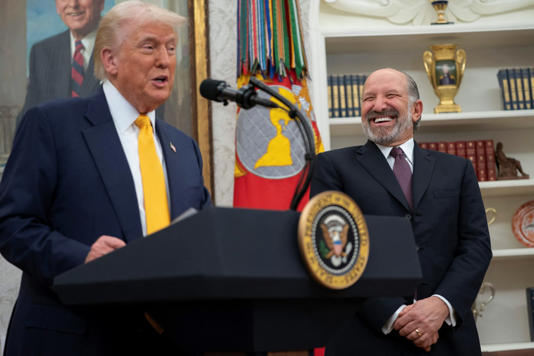
U.S. President Donald Trump speaks alongside Howard Lutnick in the Oval Office of the White House on the day Lutnick is sworn in as U.S. Commerce Secretary by Vice President JD Vance, in Washington, DC, U.S., February 21, 2025. REUTERS/Nathan Howard© provided by RawStory

Donald Trump's commerce secretary Howard Lutnick has been all over television in recent weeks defending the president's trade wars, but a new fact check of his claims found that "much of what he says is economically incoherent and contradictory."

The billionaire former Wall Street executive claims that Trump's tariffs don't do much to "change virtually any price" on most goods and products, including iPhones, but Washington Post fact-checker Glenn Kessler examined the accuracy of those comments.

"This flies in the face of basic economics," Kessler wrote. "Economists agree that tariffs — essentially a tax on domestic consumption — are paid by importers, such as U.S. companies, which in turn pass on most or all of the costs to consumers or producers who may use imported materials in their products. As a matter of demand and supply elasticities, overseas producers will pay part of the tax if there are fewer goods sold to the United States. Moreover, because imported goods are more expensive, domestic producers will raise their prices to the level imposed on importers."

Lutnick argues that companies can avoid tariffs by making their products in the U.S., and Kessler found that many of the high-value parts for an iPhone, which the commerce secretary regularly cites as an example, are already created domestically, but its low-value parts are primarily made overseas to prevent the cell phone from becoming prohibitively expensive.

"By one estimate, an iPhone 16 Pro — currently priced at $1,199 — would cost as much as $3,500 if made in the United States," Kessler wrote. "Other estimates are lower, but all say the price would increase substantially. Besides higher labor costs, the iPhone has many imported parts — from 43 countries — that would be subject to tariffs."

Some of Lutnick's figures are simply "nonsense math," Kessler wrote, such as his claims about a $1.2 trillion trade deficit and how that could be cut by 25 percent to boost GDP by 1 percent.

"The total trade deficit was $918 billion, though the goods deficit was $1.2 trillion," Kessler wrote. "A component of the GDP is net exports (exports minus imports, including services) so a decrease in net exports can lower GDP growth but — and this is complicated — more demand from overseas or even increased consumer spending can boost the GDP."

Trade deficits are shaped by a network of underlying factors, including economic growth – the more money people have, the more they can spend on imports – and a strong currency means foreign goods are comparatively cheaper.

"Lutnick ignores all that nuance with a simpleminded calculation, Kessler wrote. "Since the GDP is nearly $30 trillion, he says that a $300 billion decline in the trade deficit would add one percent to the GDP. But retaliatory tariffs on U.S. products can make it more difficult to export — and, given currency fluctuations and changes in consumer spending, there’s no guarantee that a $300 billion decline in the trade deficit would be in place forever."
‘Outdated and unjust’: can we reform global capitalism?


President Trump’s tariffs have plunged the world economy into chaos. But history counsels against despair – and the left should seize on capitalism’s crisis of legitimacy


By John Cassidy
Thu 8  2025 
THE GUARDIAN

Since Donald Trump launched his chaotic trade war earlier this year, it has become a truism to say he has plunged the world economy into crisis. At last month’s spring meetings of the World Bank and International Monetary Fund in Washington, where policymakers and finance ministers from all over congregated, the attenders were “shellshocked”, the economist Eswar Prasad, a former senior IMF official who now teaches at Cornell, told me. “The sense is that the world has changed fundamentally in ways that cannot easily be put back together. Every country has to figure out its own place in this new world order and how to protect its own interests.”

Trump’s assault on the old global order is real. But in taking its measure, it’s necessary to look beyond the daily headlines and acknowledge that being in a state of crisis is nothing new to capitalism. It’s also important to note that, as Karl Marx wrote in The Eighteenth Brumaire of Louis Napoleon: “Men make their own history, but they do not make it as they please.” Even would-be authoritarians who occupy the Oval Office have to operate in the social, economic and political environment that is bequeathed to them. In Trump’s case, the inheritance was one in which global capitalism was already suffering from a crisis of legitimacy.


Consider the decade before he was re-elected. In 2014, the global financial crisis and the Occupy Wall Street movement were fresh in the memory. The French economist Thomas Piketty appeared on bestseller lists around the world with his tome Capital in the Twenty-First Century, which highlighted income and wealth inequality. Bankers, billionaires and defenders of free market capitalism appeared to be on the defensive. “Nobody believes any more in a moral revival of capitalism,” wrote the German sociologist Wolfgang Streeck in the New Left Review. The “attempt to prevent it from being confounded with greed has finally failed, as it has more than ever become synonymous with corruption.”

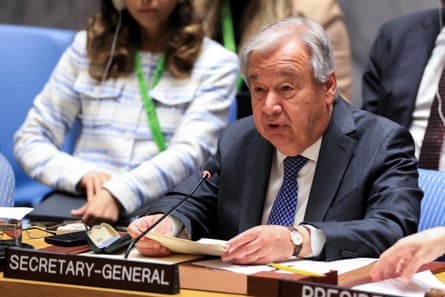
UN secretary general Antonio Guterres in April. Photograph: Charly Triballeau/AFP/Getty Images

Move forward nine years to September 2023, and the 78th general assembly of the United Nations. “Our world is becoming unhinged,” António Guterres, the UN’s secretary general, declared. “Geopolitical tensions are rising. Global challenges are mounting. And we seem incapable of coming together to respond.” Guterres, a former prime minister of Portugal, mentioned the war in Ukraine and military coups in the Sahel, but the core challenges he cited were more systemic: inequality, rising debt levels, authoritarianism, financial architecture that was “dysfunctional, outdated and unjust”, and “the most immediate threat to our future: our overheating planet”. If the world didn’t tackle these issues quickly, Guterres warned, it faced the prospect of “a great fracture in economic systems and financial systems and trade relations.”


Declarations that global capitalism is in crisis are nothing new, of course. Ever since Marx and Engels’ Communist Manifesto, which appeared in 1848, critics have been predicting the system’s demise. In the 1940s, two of capitalism’s biggest champions – the Austrian free market economists Friedrich Hayek and Joseph Schumpeter – also argued that it was doomed. (To them, the fatal threats were socialism and bureaucracy.) During the post-second world war decades, many western countries moved in the direction of Keynesian social democracy, which was based on a social bargain between labour and capital, with restraints on the movement of financial capital. In the 1970s, this form of managed capitalism succumbed to what’s known as stagflation, the combination of high inflation and stagnant economic growth. This was replaced with the neoliberal experiment in unrestricted financialisation and globalisation that met its nemesis in the global financial crisis of 2008-09.

Since then, we have been in an interregnum characterised by the dominance of big tech, an intensifying climate crisis, a global pandemic and efforts across the political spectrum to imagine a new economic paradigm.

Even in the United States, where the mythology of private enterprise runs deep and movements hostile to capitalism have long struggled to attract mass support, public attitudes have been changed. A 2023 opinion poll found that “almost half of Americans, regardless of generation and race, say that capitalism is headed on the wrong path”. In the same year, American Compass, a new conservative thinktank based in Washington DC, published a long report entitled Rebuilding American Capitalism: A Handbook for Conservative Policymakers.

“What has happened to capitalism in America?” Oren Cass, a Republican policy analyst who worked on Mitt Romney’s 2008 and 2012 presidential campaigns, wrote in the introduction. “Businesses still pursue profit, yes, but not in ways that advance the public interest … Globalisation crushed domestic industry and employment, leaving collapsed communities in its wake. Financialisation shifted the economy’s centre of gravity from Main Street to Wall Street, fuelling an explosion in corporate profits alongside stagnating wages and declining investment.”

Also in 2023, a report from another conservative American thinktank, the Edmund Burke Foundation, said that “transnational corporations showing little loyalty to any nation damage public life by censoring political speech, flooding the country with dangerous and addictive substances and pornography and promoting obsessive, destructive personal habits”.

In some ways, these conservative criticisms echoed what leftists had been saying for generations. In others, they evoked the writings of the 19th-century arch-conservative Thomas Carlyle, who lamented the social degradations of industrial capitalism and described the pursuit of profit at any cost as: “One of the shabbiest gospels ever preached on earth.”

Jeff Bezos’s superyacht, Flying Fox, off the coast of Turkey in 2021. Photograph: Anadolu Agency/Getty Images

Conservatives were also having difficulty justifying the emergence of a new plutocracy whose conspicuous consumption evoked the Gilded Age “captains of industry”. Amazon’s Jeff Bezos took possession of a custom-built 417ft-long superyacht that came with a helipad-equipped support vessel and was rumoured to have cost $500m. Meta’s Mark Zuckerberg was building a 560-hectare compound in Hawaii that reportedly included a blast-proof underground bunker. It didn’t take great observational powers to realise that Bezos, Zuckerberg and other tech barons were milking vast monopolies that were largely oblivious to competition, and, in the US at least, government oversight.

The Covid shutdowns dealt another blow to champions of globalised capitalism by highlighting the dangers of relying on the profit motive to organise the production of vital goods. When the global supply chain froze up, many western countries were left short of items like respiratory masks, diagnostic testing kits, computer chips and baby formula. “The industries at the centre of the supply chain – from shipping and rail to meat processing – had liberated themselves from rules imposed to limit their dominance,” wrote the New York Times journalist Peter S Goodman in his illuminating 2024 book How the World Ran Out of Everything. “They had reprised the era of the robber barons in achieving monopoly status. This had delivered stupendous profits to shareholders while yielding danger and dysfunction for society at large.”

Before the start of the pandemic, Trump had spent three years in office sounding off against the “globalists”. Although the trade restrictions he introduced during his first term were small beer compared with what he has unleashed in 2025, the difference can largely be ascribed to the fact that he was less sure of himself back then, and he took more notice of his advisers. But his political brand was built on a rejection of globalisation and free trade, and the institutions that underpinned them. During his 2016 presidential campaign, he labelled Nafta and the World Trade Organization a “disaster” and pledged to withdraw the United States from the Trans-Pacific Partnership, a trade deal that the Obama administration had negotiated with 11 Pacific Rim countries.

This message resonated with voters who lived in manufacturing areas that had been exposed to cheap foreign competition, particularly from China. In a paper published after the 2016 election, the economists David H Autor, David Dorn, Gordon H Hanson and Kaveh Majlesi said they had identified a link between trade shocks and voting patterns in presidential elections going back to 2000. In areas of the US where there had been rising competition from imports, the Republican candidate gained more votes.
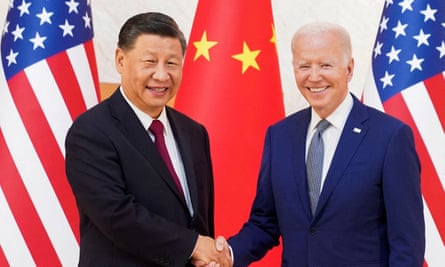
China president Xi Jinping with Joe Biden at the G20 summit in Bali, 2022. Photograph: Kevin Lamarque/Reuters

The suggestion that trade and globalisation may have cost the Democrats the 2016 election was hotly disputed. Other studies found that race, religion and other cultural factors played a bigger role than economics in Trump’s victory. But many Democrats interpreted his success as a rebuke of the pro-free trade policies that the party had adopted since the 1990s. When Joe Biden entered the White House in 2021, he left some of Trump’s tariffs in place and introduced an ambitious industrial policy designed to boost US manufacturing and “onshore” production that had moved abroad. In 2024, before he left office, Biden raised some tariffs on Chinese goods to a rate of 100%. Biden’s levies were much more targeted than the blanket tariffs Trump has introduced in recent months. But they demonstrated that, at least as far as relations with China went, Washington’s abandonment of the open-trade model of global capitalism reflected a bipartisan consensus.

Trump 2.0 represents a melange of populist economic nationalism, Silicon Valley accelerationism and feed-the-rich tax policies that can be traced back to Ronald Reagan. Each of these elements is supported by different interests with different goals, so it was predictable that the administration would be characterised by policy clashes and cognitive dissonance. Still, Trump himself has some clear goals. One of them, obviously, is enriching himself and his family, as evidenced by his embrace of crypto. (According to a recent report by a watchdog group that tracks Trump’s activities, the family’s net worth has risen by $2.9bn during the past six months based on the market value of its various crypto investments.) On a broader horizon, he is intent on reshaping global capitalism into a system of national or regional blocs, each protected by largely closed borders and high tariff walls.

Efforts on the left to construct a new economic model are still very much a work in progress. To some environmentalist activists, climate breakdown demands that we abandon a central tenet of capitalism: the notion that it can keep growing for ever. “We are in the beginning of a mass extinction, and all you can talk about is money and fairytales of eternal economic growth. How dare you,” Greta Thunberg, the young Swedish activist, said at a UN climate change summit in 2019.

Thunberg has associated herself with degrowth, an international movement whose intellectual origins lie in the Limits to Growth debate of the 1970s. The modern degrowth movement encompasses some different viewpoints, but they all reject maximising GDP growth as the primary goal of economic policy. “The faster we produce and consume goods, the more we damage the environment,” Giorgos Kallis, an ecological economist at the Autonomous University of Barcelona, wrote in his 2018 book Degrowth. “If humanity is not to destroy the planet’s life support systems, the global economy should slow down.”

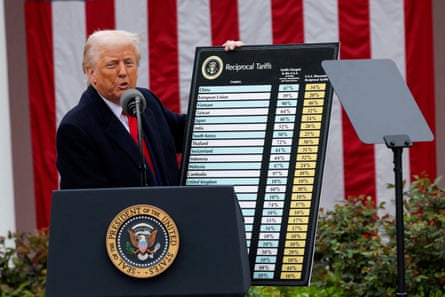
President Trump unveiling showcasing his reciprocal tariffs at the White House, 2 April. Photograph: Carlos Barría/Reuters

Some western governments, and the World Bank, have endorsed “green growth” – the idea that the development of renewable energy sources and the spread of electronic vehicles, heat pumps and other clean technologies will allow rising GDP to “decouple” from higher emissions. Some green growth enthusiasts point to the United Kingdom, which cut its carbon emissions in half between 1990 and 2022, even as its inflation-adjusted GDP rose by about 80%. This reduction was achieved largely by eliminating coal-fired power stations and replacing them with a combination of renewable energy sources and natural gas. In April 2024, 59% of Britain’s electricity came from renewables.

Sceptics of green growth point out that most rich countries haven’t matched the UK’s performance and that the developed world, taken as a whole, had failed abjectly to meet the commitments it made in the 2015 Paris agreement, which were designed to limit the global temperature increase to 1.5C above preindustrial levels. “At the achieved mitigation rates, these countries would on average take more than 220 years to reduce their emissions by 95%, emitting 27 times their remaining 1.5C fair-shares in the process,” Jason Hickel, an anthropologist at the Autonomous University of Barcelona, and Jefim Vogel, a PhD student at the University of Leeds, wrote in a study published in The Lancet Planetary Health in 2023.

The degrowth movement isn’t just about tackling the climate crisis. It draws on an intellectual tradition of scepticism towards industrial capitalism and mass production that dates back to Carlyle, John Ruskin, the Indian economist JC Kumarappa, who advised Gandhi, and EF Schumacher, the author of the 1973 book, Small is Beautiful. In his 2017 book Prosperity Without Growth, Tim Jackson, an ecological economist at the University of Surrey, called on advanced countries to shift their economies towards local services, such as nursing and teaching, and the development of more rewarding and less resource intensive professions like handicrafts. “People can flourish without endlessly accumulating more stuff,” Jackson wrote. “Another world is possible.”

Yet proposals to abandon economic growth have also been met with scepticism. As the Oxford economist Wilfred Beckerman pointed out in the 1970s, strong growth during the postwar era helped raise wages and keep distributional conflicts in check: the subsequent slowdown coincided with rising political polarisation. At the global level, the key issue is whether degrowth would impose intolerable burdens on the world’s poorest countries, which would love to follow the growth paths that China and India have trodden in recent decades. And it isn’t just the poorest countries that want to grow faster. On a global basis, according to the World Bank, the median household income in 2022 was just $7.75 a day.

In a 2021 blogpost, Branko Milanović, an economist specialising in inequality, explored two options for keeping global GDP constant, which is the most literal definition of degrowth. The first involved freezing world income distribution, so that everybody kept their current incomes. In this scenario, Milanović pointed out, about half the world’s population would be forced to live permanently on seven dollars a day or less, which surely wouldn’t be acceptable. The second option involved reducing the living standards of people with incomes above the global average and raising the living standards of those below the average. According to Milanović’s calculations, this policy would affect anyone living on more than 16 dollars a day. In western countries that’s about 86% of the population. The degrowthers “cannot condemn to perpetual poverty people in developing countries who are just seeing the glimpses of a better life, nor can they reasonably argue that incomes of 9 out of 10 westerners ought to be reduced,” Milanović wrote. “The way out of the impasse is to engage in semi-magical and then outright magical thinking.”

Degrowthers contest this, of course. But on much of the left the focus is on making growth greener rather than abandoning it, and on trying to address other enduring problems, including poverty, stagnant wages, monopoly power and tax avoidance by the rich. In a 2019 essay, Economics After Neoliberalism, the Harvard economist Dani Rodrik, Columbia’s Suresh Naidu and Berkeley’s Gabriel Zucman presented an extensive list of policy ideas, including establishing wage boards in low-wage industries to rein in employers’ market power; expanding early childhood education programmes as a means of raising the lifetime incomes of children from poor families; tackling tax avoidance by taxing multinational corporations where they make their sales; reforming the patent system to reduce the monopoly power of big pharma and other intellectual property holders; beefing up international financial regulation; and including labour standards in trade agreements.

The assumption underlying this expansive agenda is that there is no quick fix for 21st-century capitalism: the entire system needs a makeover. Referring to the work of Karl Polanyi, the Austro-Hungarian economic historian who regarded the “free market” as a utopian pipe dream, Rodrik, Naidu and Zucman wrote: “These proposals take Polanyi’s words to heart. To work well, crucial markets (including markets for labour, land and capital) must be embedded in nonmarket institutions, and the ‘rules of the game’ must be supplied by government.”

The mention of Polanyi was a reminder of what is at stake in these policy debates. In containing capitalism within a new set of rules and social norms, postwar Keynesian social democracy seemingly refuted Polanyi’s argument, which he made during the 1930s, that socialism or fascism was the logical end point of the system. Keynesianism established a middle ground. But when neoliberalism supplanted it, capitalism again broke free of its bounds, with disastrous results.

John Maynard Keynes in 1940. Photograph: Tim Gidal/Getty Images

The challenge now facing the centre-left is to construct a new managed capitalism for a globalised, tech-dominated and finance-driven world in which the labour movement is nowhere near as powerful as it was in the middle of the 20th century. In a paper published in 2021, the economists Samuel Bowles, of the Santa Fe Institute, and Wendy Carlin, of University College London, argued that efforts to build a new economic paradigm should be organised around “shrinking capitalism” to a “diminished space” where it could do less damage, and its strengths, such as its capacity to spur innovation, would serve the community. Political and economic forces were aligning with this new paradigm, the two economists argued. Concerns about the climate emergency and inequality were undermining support for capitalism in general terms, while the rise of AI and robotics was undermining the traditional hierarchical capitalist firm, in which workers carried out routine, preassigned tasks for a set wage or salary. More flexible forms of economic organisation were emerging, such as open-source collaborations and the gig economy, in which many workers were nominally self-employed.

Bowles and Carlin weren’t endorsing the practices of platform companies, like Uber and Lyft, that rely on gig workers. They were arguing that technology-driven capitalism was, to some extent, eating itself, and that this cannibalisation was creating space for alternative economic models, including some that have long existed but could in the future have broader appeal, such as not-for-profits, worker-owned cooperatives and community-organised public commons. “This is a confluence that could propel a new paradigm in political economy to dominance,” the article concluded.

Perhaps a new economic paradigm will emerge, but Trump’s re-election and the rising support for rightwing populism in other western countries, including Britain, raises the question of what sort of paradigm it will be. When the Italian Marxist Antonio Gramsci was languishing in Mussolini’s prisons during the 1920s and 30s, he thought deeply about the relationship between broad economic forces and economic ideologies. In the prison notebooks he kept, he remarked how in certain circumstances the forces and ideologies come together in a “historical bloc” that can exercise political power through consent rather than force, a phenomenon he referred to as “hegemony”.

The managed capitalism of the postwar era was based on a bloc that combined blue-collar workers and their liberal-minded allies from the professional classes, domestically focused businesses, long-term capital and Keynesian/social democratic policy ideas. The globalised hypercapitalism of the post-cold war era was based on internationally minded businesses, educated workers whose jobs couldn’t be displaced by low-wage foreign competition, footloose capital and free market ideology. As we enter the second quarter of the 21st century, the question is what sort of bloc can exercise power in a world shrunken by digital technology but splintered by nationalism.

Chinese state capitalism arguably represents one candidate, but its undemocratic nature has blunted its appeal to other countries. So has the slowdown in the Chinese economy since Xi Jinping took over in 2012. Trumpian economic nationalism is another contender. His return to the White House on a platform of tariffs and mass deportation of undocumented immigrants, which appeals to nativist voters and domestically oriented businesses, demonstrated that his victory in 2016 wasn’t a fluke.

To be sure, the presence in Trump’s circle of Elon Musk and various Wall Street tycoons who have benefited enormously from globalisation and financialisation highlights the glaring contradictions in the Maga movement, as does Trump’s commitment to preserving the regressive tax cuts that Congress passed during his first term. But none of this has prevented him and his allies from positioning themselves as outsiders attacking a corrupt establishment. This political confidence trick is embodied in the figure of JD Vance, Trump’s vice-president, who once worked for a venture capital firm and defended globalisation but now positions himself as an ersatz philosopher of the new right. At the 2024 Republican National Convention, Vance stated blithely, “We’re done … catering to Wall Street. We’ll commit to the working man.”

Silvia Federici and Judy Ramirez of Wages for Housework campaign in London, 1975. Photograph: Keystone/Getty Images

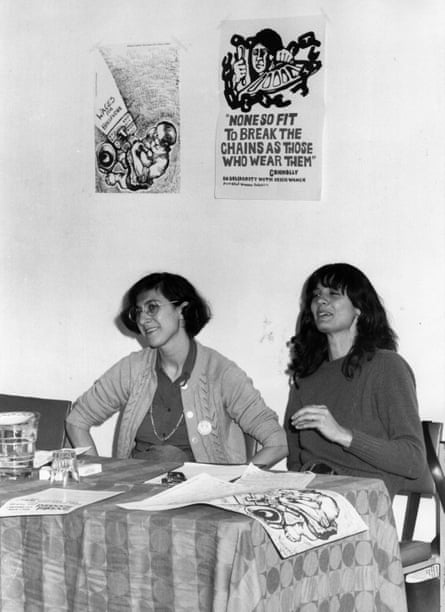
On the far left, replacing capitalism remains the ultimate goal. But with the exception of a few places, such as depressed parts of East Germany, there is little popular enthusiasm for reviving the communist model of state ownership and central planning. Many leftists are more interested in creating new institutions and communities that operate independently of the monolithic capitalist economy and the state, such as protest encampments, bartering and recycling networks, communal farms, and small-scale artisanal enterprises. Even though early 19th century figures like Robert Owen, William Thompson and Charles Fourier no longer figure prominently on the left, the goal of creating communities and subeconomies that operate beyond the cash nexus goes back to their efforts to create new cooperative communities. Two centuries on, their descendants have yet to demonstrate how they would overcome the practical problems that plagued their predecessors, especially if their ideas were applied at the national or global level. But the lure of what Silvia Federici, the co-creator of the Wages for Housework movement, has described as a “new commons” is a timeless one. “For what the commons in essence stands for,” Federici wrote, “is the recognition that life in a Hobbesian world, where one competes against all and prosperity is gained at the expense of others, is not worth living and is a sure recipe for defeat.”

The idea of shrinking capitalism seems like one that a broad range of people on the left and centre-left could unite around, from Federici to Bowles and Carlin to Joseph Stiglitz, the American liberal economist. In his 2024 book The Road to Freedom: Economics and the Good Society, Stiglitz called for a “decentralised economy with a rich ecology of institutions.” Noting the many encroachments that capitalism had made in recent decades, he wrote, “There must be large parts of the economy that are not and cannot be driven by profits. These include much of the health, education and care sectors, in which the narrow pursuit of profits often leads to perverse results.”

Stiglitz also called for restrictions on the activities of platform monopolies, particularly social media companies, arguing that their algorithms had “enabled the incitement of violence and the spread of hate speech and induced antisocial behaviour”.

Some of Stiglitz’s criticisms chimed with those of Federici, others with elements of the Edmund Burke Foundation’s report. This was a hopeful sign for efforts to create a broad coalition to rein in hypercapitalism. But no one should underestimate the opposition that such a project would face from big businesses that, in the US especially, can spend unlimited sums of money to influence the political system, and from longstanding defenders of the free market. In July 2023, dozens of the latter – including Jeb Bush, Karl Rove, and representatives of the Mont Pelerin Society, the American Enterprise Institute and the Capitalist League – issued a statement of principles proclaiming: “The free enterprise system is the foundation of prosperity.”

During the 1930s, American conservatives issued similar arguments in opposing FDR’s New Deal. In the early 1940s, Hayek issued his warning that the shift toward collectivism could lead to serfdom. More recently, many American conservatives have criticised the government response to the Covid 19 pandemic, which included large stimulus programmes. It wasn’t perfect, but it headed off a lengthy slump, and, in some of its particulars, it was highly illuminating. The American Rescue Plan Act of 2021 converted an existing programme of tax credits for low-paid workers with children into a monthly universal cash benefit of $300 per child. In the year after this policy was introduced, the rate of child poverty, as measured by the Census Bureau’s Supplemental Policy Measure, fell from 9.7% to 5.2%. In 2022, when the expanded tax credits were eliminated, the child poverty rate shot back up to 12.4% – the biggest one-year increase on record.


The planet’s economist: has Kate Raworth found a model for sustainable living?


The lesson was clear: it is perfectly possible to reduce child poverty, just as it was possible in the 20th century to reduce old-age poverty by introducing state pensions. Capitalism can be reformed: the challenge is to summon the will and the means to do it. With the rise of rightwing populism, AI, and a tech/finance oligarchy that is openly exerting its political influence, the task can seem more formidable than ever.

But history counsels against despair. For more than 200 years, industrial capitalism has evolved in waves and counterwaves, some of which are driven by its inner conflicts, some by technological developments and others by political mobilisation. At any moment, it’s difficult (if not impossible) to tell how long the current configuration will survive, or what will succeed it. But the capitalist system isn’t handed down from the heavens and it cannot rest. This has been true throughout its existence. It will remain true until the critics who predict capitalism’s demise are eventually proved right.

Adapted from Capitalism and Its Critics: A Battle of Ideas in the Modern World by John Cassidy, which will be published by Allen Lane on 13 May. 

The Naked Ape at 50: ‘Its central claim has surely stood the test of time ‘

In October 1967, Desmond Morris published his landmark study of human behaviour and evolution. Here four experts assess what he got right – and wrong


Robin DunbarAngela SainiBen GarrodAdam Rutherford
Sun 24 Sep 2017 
THE GUARDIAN


Robin Dunbar: ‘He gave us a picture of who we really are’

Professor of evolutionary psychology at the University of Oxford


We were all gearing up for the summer of love when, in 1967, Desmond Morris’s The Naked Ape took us by storm. Its pitch was that humans really were just apes, and much of our behaviour could be understood in terms of animal behaviour and its evolution. Yes, we were naked and bipedal, but beneath the veneer of culture lurked an ancestral avatar. With his zoologist’s training (he had had a distinguished career studying the behaviour of fishes and birds at Oxford University as part of the leading international group in this field), he gave us a picture of who we really are. In the laid-back, blue-smoke atmosphere of the hippy era, the book struck a chord with the wider public – if for no other reason than that, in the decade of free love, it asserted that humans had the largest penis for body size of all the primates.


The early 1960s had seen the first field studies of monkeys and apes, and a corresponding interest in human evolution and the biology of contemporary hunter-gatherers. Morris latched on to the fact that the sexual division of labour (the men away hunting, the women at home gathering) necessitated some mechanism to ensure the sexual loyalty of one’s mate – this was the era of free love, after all. He suggested that becoming naked and developing new erogenous zones (notably, ear lobes and breasts), not to mention face-to-face copulation (all but unknown among animals), helped to maintain the couple’s loyalty to each other.

Morris’s central claim, that much of our behaviour can be understood in the context of animal behaviour, has surely stood the test of time, even if some of the details haven’t. Our hairlessness (at around 2m years ago) long predates the rise of pair bonds (a mere 200,000 years ago). It owes its origins to the capacity to sweat copiously (another uniquely human trait) in order to allow us to travel longer distances across sunny savannahs. But he is probably still right that those bits of human behaviour that enhance sexual experience function to promote pair bonds – even if pair bonds are not lifelong in the way that many then assumed. Humans are unusual in the attention they pay to other people’s eyes – for almost all other animals, staring is a threat (as, of course, it can also be for us under certain circumstances).


I can’t honestly say if the book influenced my decision to study the behaviour of wild monkeys and, later, human ethology. Having been immersed in the same ethological tradition out of which Morris had come, viewing humans this way was no controversial claim. Older zoologists, however, were a great deal more sceptical, often viewing the book as facile. What it might well have done for me was to create an environment in which the funding agencies were more willing to fund the kinds of fieldwork on animals and humans that I later did.
Angela Saini: ‘His arrogance has done untold damage’

Science journalist, broadcaster and author

From the moment The Naked Ape was published, female scientists and feminists rolled their eyes. For good reason. Desmond Morris credited hunting by males (and only males) as the one thing that drove up human intelligence and social cooperation. In a 1976 paper, American anthropologists Adrienne Zihlman and Nancy Tanner laughed at his implication that females had “little or no part in the evolutionary saga except to bear the next generation of hunters”.

His problem with women ran through every chapter. Let’s start with what females were doing while males were evolving. Morris answered: “The females found themselves almost perpetually confined to the home base.” But by his own admission, hunters would sometimes be away for weeks at a time chasing a kill. So how exactly were the womenfolk managing to feed their families in the interim?

His deliberate choice to ignore hunter-gatherers – the only people on Earth who live anything like the way our distant ancestors might have – blinded him to the fact that women are rarely housebound. We know, for example, that women gathering plants, roots and tubers and killing small animals tend to bring back more reliable calories than men do. What’s more, in many hunter-gather communities, including the Nanadukan Agta of the Philippines and the aboriginal Martu of Western Australia, women hunt. Martu women do it for sport.
An early paperback edition of The Naked Ape.

What about the rest of us, who no longer hunt and gather, but live in towns and cities? “Work has replaced hunting… It is a predominantly male pursuit,” he wrote. Oh, Desmond, seriously? Anthropologists are fairly unanimous that in our distant past, men and women shared almost all work, including sourcing food and setting up shelter. That’s the harsh reality of subsistence living. Throughout history, there have always been working women.


His consistent failure to understand the impact of patriarchy and female repression bordered on the bizarre. He claimed that humans developed the loving pair bond to assure males their partners wouldn’t stray while they were off hunting. Females evolved to be faithful. But a few pages later he mentioned chastity belts and female genital mutilation as means of forcibly keeping women virginal.

“A case has been recorded of a male boring holes in his mate’s labia and then padlocking her genitals after each copulation,” he wrote, with the pathological detachment of a scientist observing flies in a jar. He never asked himself the obvious question: If women evolved to be faithful to one man, why did men resort to such brutal measures?

On other points of fact, time has simply proven him wrong. “Clearly, the naked ape is the sexiest primate alive,” he stated. Nope. That honour goes to the bonobo. Which incidentally happens to be a female-dominated species.

For 50 years, Morris’s arrogance (large chunks of his slim list of references were to his own work) has done untold damage to people’s understanding of our evolutionary past. We might forgive him for being a man of his time. But as a scientist, for choosing to overlook evidence right in front of his eyes, The Naked Ape still deserves as little respect as he showed half the human species.

Angela Saini’s latest book, Inferior: How Science Got Women Wrong and the New Research That’s Rewriting the Story, is published by Fourth Estate
Ben Garrod: ‘He made me stop dead in my tracks’

Broadcaster, primatologist and teaching fellow at Anglia Ruskin University, Cambridge

Like many zoologists, biologists and naturalists before me, I was drawn to the thrill of exploration and tracking animals. But as a 12-year-old living in a seaside town in Norfolk, there wasn’t much to explore and limited species to stalk. Instead, my quarry was old books about nature, anthropology and evolution, and my territory was the dusty shelves of old bookshops. I still vividly remember chancing upon a slim volume one winter weekend. I slid the book from the shelf, mainly prompted by the title. I was fascinated by apes, and the word “naked” had a definite (if slightly intangible) appeal to my 12-year-old self.

I don’t think I’ve ever read a book quite so slowly. Partly because I needed a copy of the Oxford English Dictionary to help me comprehend each paragraph. I didn’t want to miss a beat in what became an intoxicating series of revelations about not only my species but apparently about me, too. I’d never experienced a book that reached out to the reader in such a way and even now, this still holds true for The Naked Ape in that you can’t help but examine where (or even if) you fit in with Morris’s observations.


I brushed over the sections covering the evolutionary achievements of the penis, the covert mission of breasts and the untold benefits of being naked, but stopped dead in my tracks when I read how, despite our few millennia as a species relishing in the glow of civilisation, our long lineage from our great ape precursors and hominid ancestors had left its indelible mark not only on our anatomy but upon our behaviour, also.

This idea that we are simply the by-product of millions of years of evolutionary tinkering and are not alone as the pinnacle of some benevolent creation was such a revelation that when the book was released it shocked many. Yes, this had been written before but never quite so eloquently and never in a way that was aimed at a non-expert audience. At long last, they were being invited to share in some of the biggest, best-kept secrets of our somewhat extended family.

As a scientist, there’s a lot more I could say… of course, some of its ideas are now dated and wrong but it was 50 years ago and science does move inexorably onwards. The thing about reading The Naked Ape is that it can do one of two things. It can either set light to the kindling of an inquiring mind, or – if it causes your eye to twitch in consternation at, for example, outdated views on the sexes – make you take stock of what you actually know. It sends you on an academic exercise, sieving through persuasive argument in order to pick out the tantalising glimmer of empirical evidence. I’ve gone from one to the other. I fondly still have my copy tucked between a book on baboons and a treatise on skeletal pathology.

The Naked Ape is like an old friend I’ve grown up with, realised that they’re not quite as perfect as I once thought – but have decided that they’re still cool enough to hang out with anyway.
Adam Rutherford: ‘Did anyone take this seriously in the 60s?’

Author and presenter of Radio 4’s Inside Science

I spent rather too much time in the last couple of weeks arguing with men about breasts. I forget how it began, but there was a phenomenal volume of Twitter correspondence asserting one of two statements as scientific fact: the first was that the permanently visible breasts in female humans (compared to all other apes, whose breasts only enlarge during lactation or estrus) are signals to attract males. The second was that the primary function of breasts is to attract males.

The latter seems trivial to dispel: a baby that starves to death is a greater evolutionary pressure than whether an adult male is turned on – breasts exist to feed babies. The first argument is trickier to contest. In nature, there are wondrous variants of what we call “secondary sexual traits” – those bodily parts or behaviours evolved to aid mate choice – the peacock’s tail, the bowerbird’s bower, lekking stags. For humans, it might seem obvious that breasts fall into that category, and in my online debates, in all cases, the evidence presented found its evolutionary origins in The Naked Ape: “The enlarged female breasts are usually thought of primarily as maternal rather than sexual developments, but there seems to be little evidence for this.”


The question of why we are different to other apes is valid. Aside from the definitional function of mammary glands in mammals, the reasons for our morphological differences are certainly worthy of study. Morris goes on: “The answer stands out as clearly as the female bosom itself. The protuberant, hemispherical breasts of the female must surely be copies of the fleshy buttocks, and the sharply defined red lips around the mouth must be copies of the red labia.”

Did anyone take this seriously in the 1960s? To me, this is little more than salacious guesswork, erotic fantasy science. And this is the fundamental problem with The Naked Ape: it is a book full of exciting ideas that have little scientific validity. The attractiveness of an idea in science has no bearing on its veracity. Sometimes they are presented as “common sense” arguments – it’s obvious, innit? But common sense is the opposite of science – our senses deceive us all the time, our profoundly limited experience skewers us with bias. In the case of the attractiveness function of breasts, this idea is almost entirely untested. The data simply does not exist. Maybe visible breasts are a secondary sexual trait in humans. It would be unusual, as in nature most of these types of traits are on males, and not all cultures regard breasts as erotic. Did boobs replace bums as a sexual signal when we became upright? I don’t know, but the point is that no one does. We could test this today with genetics, by establishing genes involved in breast development and searching the genome for the signatures of selection. But this has not been done.

In my experience, much of the academic field that The Naked Ape is emblematic of – evolutionary psychology – falls victim to similar scientific crimes. We call it “adaptationism”, or “panglossianism”, after Dr Pangloss from Voltaire’s Candide. An eternal optimist, he suggested there was a reason for everything, and everything had a reason. Hence our noses had evolved to balance spectacles on; we have two legs because that suits the dimensions of a tailored trouser. For Morris, and millions of men on the internet, breasts are attractive, therefore their purpose is to attract.

There is plenty to like about this book. Its descriptions of the physiology on show during various human activities are accurate, detailed and genial. To position us as animals and under the auspices of natural selection is happily Darwinian. The Naked Ape was colossally successful – 20m copies have been sold, which is an astonishing number for a book ostensibly about human evolution. Supporters have argued that its real value is in popularising science. The problem is, and has always been, that it is not science. It is a book of just so stories.

Adam Rutherford’s latest book, A Brief History of Everyone Who Ever Lived, is published by Weidenfeld & Nicholson
Desmond Morris: life and work


1928
Born in the village of Purton, near Swindon.


1941


Attends boarding school in Wiltshire. Growing up during the second world war, he later claims that he pursued surrealism and zoology as a retreat from the human race. He tells the Bookseller in 2013: “If you are at all sensitive as a child and you see adults killing one another – and not in a criminal way, but an accepted way – that is a strange learning process. I thought, ‘This is the species I belong to?’”

1948
Following national service, enrols as an undergraduate in zoology at Birmingham university.

1950
Exhibits his surrealist art work with Joan Miró in London.

1954
Publishes his doctoral thesis, entitled The Reproductive Behaviour of the Ten-Spined Stickleback.

1956
Is appointed head of the Granada TV and film unit at the Zoological Society, making programmes including Zoo Time for ITV; David Attenborough presented the rival show Zoo Quest for the BBC. Presents approximately 500 episodes of the show.

1957
Organises a exhibition called Paintings by Chimpanzees at the Institute of Contemporary Arts.

1959
Becomes the Zoological Society’s curator of mammals.

1966
Writes The Naked Ape over four weeks. “People think I deliberately wrote it to make a shocking bestseller, but it wasn’t like that,” he tells the Guardian in 2007.

1967
Appointed director of the ICA, where he encountered figures such as Henry Moore, Francis Bacon, Salvador DalÍ, Pablo Picasso and Barbara Hepworth. Supervises the institute’s move to the Mall. The first edition of The Naked Ape is published on 12 October and is serialised in the Daily Mirror.

1968
Following the success of The Naked Ape, he leaves his ICA post and moves to Malta with his wife.

1973
Returns to the UK to take up a research fellowship at Wolfson College, Oxford.

1977
Publishes his book Manwatching, which developed the concept of “body language”. It is one of more than 40 books Morris has written, including The Human Zoo, Intimate Behaviour, Babywatching, Dogwatching and Christmas Watching.


1978
Is elected vice-chairman of Oxford United football club.

1986
Begins work on The Animals Roadshow, co-presented with Sarah Kennedy.

2016
An updated edition of his 1981 book, The Soccer Tribe, is published with a foreword by José Mourinho.

2017
The BBC makes a documentary about his artistic career entitled The Secret Surrealist. The Express describes his artwork as “very obviously zoological… full of fantastical life forms resembling cells and gene maps and creatures of the deep, yet also possessing the friendly charm of The Clangers”.
Ian Tucker

Desmond Morris at his home in Oxford in 2007. Photograph: Eamonn McCabe/The Guardian

This is the archive of The Observer up until 21/04/2025. The Observer is now owned and operated by Tortoise Media.

Oct 3, 2018 — Topics: Morris, Desmond The Naked Ape: A Zoologist's Study of the Human Animal PDF ; Collection: opensource ; Language: English ; Item Size: 365.9M ...