US 'signals imminent Iran strike to allies' but traders don't believe war coming, claims expert
The United States has informed Iraq, Jordan, Saudi Arabia and the United Arab Emirates of an impending attack on Iran, according to Russian analyst Evgeny Ogorodnikov, though oil markets remain sanguine about the prospect of major escalation despite the risk to approximately 5% of global production.
"The Americans have notified Iraq, Jordan, Saudi Arabia, and the UAE about the imminent start of an attack on Iran," Ogorodnikov wrote on his Grafonomika channel on January 25, without providing details on the timing or scope of potential military action.
Despite what he described as "looming clouds over Iran," global oil markets do not anticipate serious escalation, the collapse of the clerical regime, or subsequent civil war in the Islamic Republic. Prices remain well below $100 per barrel despite the potential disappearance of Iran's 3.5mn barrels per day of exports, representing approximately 5% of global production, or perhaps even more according to some estimates.
"Otherwise, oil prices would be much higher - closer to the coveted price of $100 per barrel," Ogorodnikov wrote. "After all, the risk of 3.5mn barrels per day, or 5% of global production, disappearing from the market is significant. This is roughly the same share of Iran's global oil exports, perhaps even more."
The analyst noted that armed conflict in Iran would create oil production problems in neighbouring Iraq as well. Iran supplies fuel oil and gas for local power generation in Iraq. In the worst-case scenario of the closure of the Strait of Hormuz, drones could also attack oil and gas fields in Qatar, Saudi Arabia, the UAE and other Gulf states.
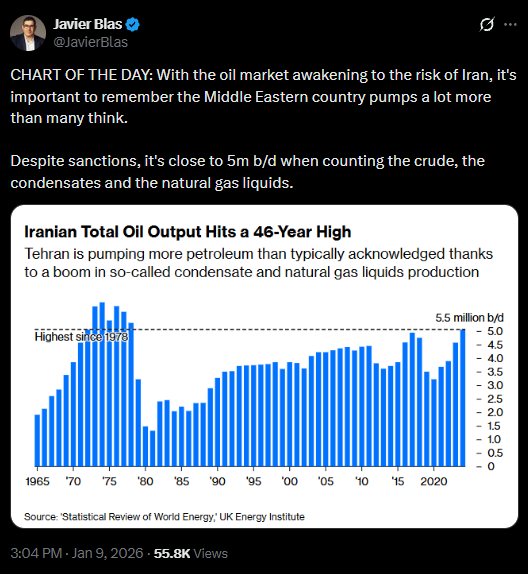
Ogorodnikov described the oil production data for Iran from the Energy Institute, also shared by Bloomberg writer Javier Blas above, which he characterised as revealing about Washington's motivations. Blas himself raised eyebrows with the January 9 X social media post, writing, "It's important to remember the Middle Eastern country pumps a lot more than many think."
The Russian analyst said of the data: "Judging by the volumes of oil produced in the country, Iran was able to bypass not only US and European sanctions, but also those of the UN Security Council, reaching a new record in 2024 in almost half a century," he wrote. Iran has, in the past decade, used a fleet of shadow tankers across the world to shift the black stuff, most recently coming into the headlines with the US seizure of the freshly reflagged Russian tanker running away from Venezuela. Those in the industry understood the tanker to actually be one of Iran's large shadow fleet.
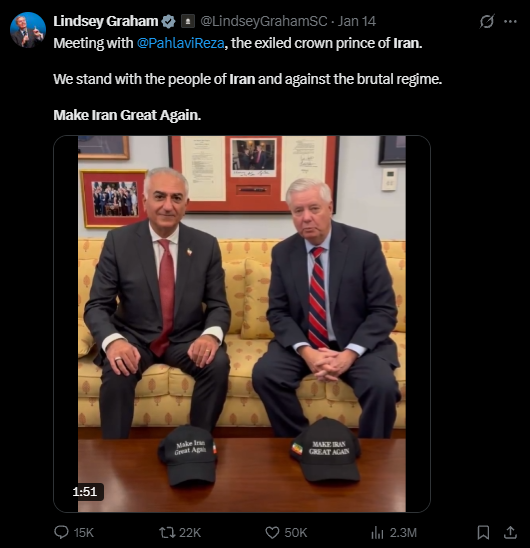
The analyst suggested this success explains "why Uncle Sam suddenly decided to 'make Iran great again'," with previous neocon warhawks like Lindsey Graham becoming recently obsessed with the former crown prince of Iran's push to topple the Islamic Republic (see tweet below). Also, note the baseball caps.
The Russian analyst appeared to sweep under the rug thousands of deaths in recent protests across Iran, with the exact figure currently unknown from two weeks of battles between security agents belonging to the state and protestors. The Pezeshkian administration said more than 3,000 souls had perished in recent clashes, while exiled organisations have placed the death toll above 20,000.
He noted that record-breaking oil production in Iran benefits multiple parties: the Islamic Revolutionary Guard Corps (IRGC), "the ayatollahs", Emirati Arabs, Malaysian oil traders, and even the Chinese. "But not American oil and gas companies," he wrote. "The latter are suffering losses on their shale, Canadian sands, and soon also on Venezuelan asphalts."
"And if you look at this situation from across the Atlantic, it seems extremely unfair. And any injustice in the world needs to be corrected," Ogorodnikov added.
The analyst highlighted a paradox in Iran's situation, noting that record oil production coincided with the country's most acute economic crisis, marked by double-digit inflation and a sharp devaluation of the rial. "And it seems that this is illogical, which means that all the money was stolen by the bloody Iranian regime of the Ayatollahs," he wrote with a strikethrough.
However, Ogorodnikov provided calculations showing structural economic constraints regardless of governance. Iran is a densely populated country of more than 90mn people. Its record production last year of 3.5mn barrels per day (bpd) equals only 22 barrels per resident annually. At an average Brent oil price of $69 per barrel, this translates to $1,500 of oil revenue per Iranian per year.
"Part of the oil is consumed in Iran, and part goes for export. From the export, we need to subtract the sanctions discounts, the services of the 'shadow fleet', the intermediary UAE and Malaysia," he wrote. "And in the end, if one Iranian gets $50 of export revenue per month, this is an excellent result."
The analyst drew comparisons to demonstrate Iran's relative position. Less oil is produced per Iranian than per Russian, at 26 barrels per Russian resident annually. "To understand the scale of the lag between Iran and Russia: in Saudi Arabia, 96 barrels of oil are produced per resident per year," Ogorodnikov wrote.
"In other words, even the record Iranian oil production does not allow locals to live off the oil rent, no matter who is in power: the Ayatollahs, Iranian Shahs, American curators, etc," he concluded.
Ogorodnikov's claims about the US notification to Persian Gulf allies could not be independently verified by bne IntelliNews. Neither the Pentagon nor Persian Gulf Arab governments have publicly confirmed receiving such notifications about imminent military action against Iran. Intelligence reports of military activity in the Gulf and across the Middle East confirm the largest military build-up since the Iraq War in 2003.
The United States has informed Iraq, Jordan, Saudi Arabia and the United Arab Emirates of an impending attack on Iran, according to Russian analyst Evgeny Ogorodnikov, though oil markets remain sanguine about the prospect of major escalation despite the risk to approximately 5% of global production.
"The Americans have notified Iraq, Jordan, Saudi Arabia, and the UAE about the imminent start of an attack on Iran," Ogorodnikov wrote on his Grafonomika channel on January 25, without providing details on the timing or scope of potential military action.
Despite what he described as "looming clouds over Iran," global oil markets do not anticipate serious escalation, the collapse of the clerical regime, or subsequent civil war in the Islamic Republic. Prices remain well below $100 per barrel despite the potential disappearance of Iran's 3.5mn barrels per day of exports, representing approximately 5% of global production, or perhaps even more according to some estimates.
"Otherwise, oil prices would be much higher - closer to the coveted price of $100 per barrel," Ogorodnikov wrote. "After all, the risk of 3.5mn barrels per day, or 5% of global production, disappearing from the market is significant. This is roughly the same share of Iran's global oil exports, perhaps even more."
The analyst noted that armed conflict in Iran would create oil production problems in neighbouring Iraq as well. Iran supplies fuel oil and gas for local power generation in Iraq. In the worst-case scenario of the closure of the Strait of Hormuz, drones could also attack oil and gas fields in Qatar, Saudi Arabia, the UAE and other Gulf states.
Ogorodnikov described the oil production data for Iran from the Energy Institute, also shared by Bloomberg writer Javier Blas above, which he characterised as revealing about Washington's motivations. Blas himself raised eyebrows with the January 9 X social media post, writing, "It's important to remember the Middle Eastern country pumps a lot more than many think."
The Russian analyst said of the data: "Judging by the volumes of oil produced in the country, Iran was able to bypass not only US and European sanctions, but also those of the UN Security Council, reaching a new record in 2024 in almost half a century," he wrote. Iran has, in the past decade, used a fleet of shadow tankers across the world to shift the black stuff, most recently coming into the headlines with the US seizure of the freshly reflagged Russian tanker running away from Venezuela. Those in the industry understood the tanker to actually be one of Iran's large shadow fleet.
The analyst suggested this success explains "why Uncle Sam suddenly decided to 'make Iran great again'," with previous neocon warhawks like Lindsey Graham becoming recently obsessed with the former crown prince of Iran's push to topple the Islamic Republic (see tweet below). Also, note the baseball caps.
The Russian analyst appeared to sweep under the rug thousands of deaths in recent protests across Iran, with the exact figure currently unknown from two weeks of battles between security agents belonging to the state and protestors. The Pezeshkian administration said more than 3,000 souls had perished in recent clashes, while exiled organisations have placed the death toll above 20,000.
He noted that record-breaking oil production in Iran benefits multiple parties: the Islamic Revolutionary Guard Corps (IRGC), "the ayatollahs", Emirati Arabs, Malaysian oil traders, and even the Chinese. "But not American oil and gas companies," he wrote. "The latter are suffering losses on their shale, Canadian sands, and soon also on Venezuelan asphalts."
"And if you look at this situation from across the Atlantic, it seems extremely unfair. And any injustice in the world needs to be corrected," Ogorodnikov added.
The analyst highlighted a paradox in Iran's situation, noting that record oil production coincided with the country's most acute economic crisis, marked by double-digit inflation and a sharp devaluation of the rial. "And it seems that this is illogical, which means that all the money was stolen by the bloody Iranian regime of the Ayatollahs," he wrote with a strikethrough.
However, Ogorodnikov provided calculations showing structural economic constraints regardless of governance. Iran is a densely populated country of more than 90mn people. Its record production last year of 3.5mn barrels per day (bpd) equals only 22 barrels per resident annually. At an average Brent oil price of $69 per barrel, this translates to $1,500 of oil revenue per Iranian per year.
"Part of the oil is consumed in Iran, and part goes for export. From the export, we need to subtract the sanctions discounts, the services of the 'shadow fleet', the intermediary UAE and Malaysia," he wrote. "And in the end, if one Iranian gets $50 of export revenue per month, this is an excellent result."
The analyst drew comparisons to demonstrate Iran's relative position. Less oil is produced per Iranian than per Russian, at 26 barrels per Russian resident annually. "To understand the scale of the lag between Iran and Russia: in Saudi Arabia, 96 barrels of oil are produced per resident per year," Ogorodnikov wrote.
"In other words, even the record Iranian oil production does not allow locals to live off the oil rent, no matter who is in power: the Ayatollahs, Iranian Shahs, American curators, etc," he concluded.
Ogorodnikov's claims about the US notification to Persian Gulf allies could not be independently verified by bne IntelliNews. Neither the Pentagon nor Persian Gulf Arab governments have publicly confirmed receiving such notifications about imminent military action against Iran. Intelligence reports of military activity in the Gulf and across the Middle East confirm the largest military build-up since the Iraq War in 2003.
Op-Ed: Carrier Deployments Prompt Speculation About a U.S. Attack on Iran
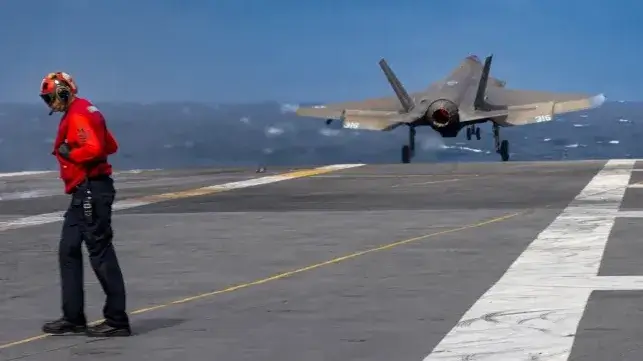
Open source intelligence sleuths posting on social media are closely monitoring US force deployments into the Middle East region, like the movements of the supercarriers USS George H.W. Bush and USS Abraham Lincoln, and some are concluding that a window is opening up for an attack on Iran towards the end of January.
The situation is extremely difficult for those without operational planning experience and access to classified information to read. Surprise is still a highly important ingredient of offensive activity, and those charged with maintaining operational security demonstrated in the run-up to US and Israeli attacks on Iran in June last year that they were well aware of their vulnerability to open source speculation.
Both Israel and the United States managed last year to mask their tactical intentions, despite close open source oversight. This was achieved by executing a sophisticated deception plan, part of which involved feeding the open source intelligence community plausible, expected but diversionary narratives. The best practice deception plan which still inspires operational planners dates to 1944 - the ruse that persuaded the Germans that the Allied invasion was heading for the Pas de Calais, which the Germans were still convinced was the case several days after the landings had commenced in Normandy.
Politically there is little doubt that the United States would like to effect regime change in Iran. Moreover, President Donald Trump has threatened military action, and is probably committed personally with following through with his promise to the Iranian people that ‘help is coming’. Multiple factors - the Iranian nuclear threat, the threat from their still substantial ballistic missile force and the IRGC unwillingness to row back from regional expansionism and destabilization - all suggest further years of regional instability.
The difficulty which military planners and neighboring regional states have impressed upon President Trump is that while a military strike could decapitate the Iranian leadership, it would not immediately collapse the regime. There also needs to be a post-attack constitutional plan for government – otherwise the organs of state will remain in the hands of those still loyal to the concept of Velayat-e Faqih religious rule. Without a credible post-attack plan, chaos for the entire region could ensue.
The attitude of Israel is also particularly important, especially as it has unique operational capabilities which would greatly enhance the effectiveness of any American attack. Whatever might be on its wish-list, Israel has a well-established practice of launching military offensive action only when its national security is directly and immediately threatened. There is no such immediate threat at the moment – although without regime change, one can be expected to emerge sometime in the future.
If the dangers of post-attack chaos are to be averted, then one of two options must be achieved. The first would be an initial attack so massive as to neutralize the Islamic Revolutionary Guard Corps' huge capability. There is no indication yet that a capability to deliver such a massive blow is being assembled.
The second option would be an attack launched in support of a widespread resumption of street protests, or protests in areas with substantial concentrations of ethnic minorities, which would stretch the IRGC’s internal security apparatus and put the regime on the back foot.
After the brutality which the IRGC’s Basij internal security forces have meted out, with reliable estimate of between 10,000 and 16,500 street fatalities - such that every family in Iran knows of someone killed - the regime has no legitimacy left and anger is at peak; a resumption of protests is more likely than not. The USS Abraham Lincoln (CVN-72) and its carrier strike group may be in the region for some time in anticipation of this contingency.
Current US deployments moving to the region appear to be more a contingency to support a resumption of street protest when they occur, rather than preparations to initiate an imminent massive attack.
The opinions expressed herein are the author's and not necessarily those of The Maritime Executive.
US Treasury Sanctions Tankers in the Name of Helping Iranian Protestors
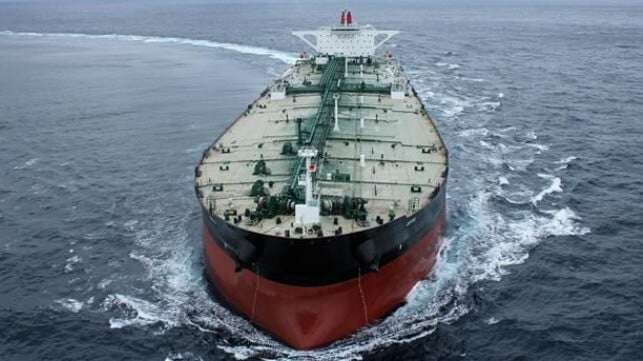
The U.S. Department of the Treasury’s Office of Foreign Assets Control (OFAC) announced on Friday, January 23, that it is increasing pressure on Iran by sanctioning nine additional tankers and their respective owners. In announcing the action, Treasury Secretary Scott Bessent said it was going after Iran’s funding to increase pressure as the regime is killing peaceful protestors.
The announcement said the actions were to support the protestors, citing the crackdown by the Iranian regime and the shutdown of the Internet. Treasury asserted that the Iranian government is diverting the funds from the oil to fund regional terrorism, weapons programs, and security services instead of basic economic services for the Iranian people.
Critics, however, were quick to say the actions would do little to help the people of Iran who took to the streets weeks ago. Current estimates by human rights groups say that at least 3,100 people have been killed, with many estimates much higher.
Donald Trump, on January 3, first posted a warning saying that if Iran killed the protestors, the United States would come to their rescue. On January 13, he added in a social media posting that “Help Is On Its Way” and called on the people of Iran to “Take Over Your Institutions!!!” He later said he had stopped planned strikes after Iran canceled the execution of protestors and sought meetings with the U.S. Yesterday, January 22, Trump told reporters "We have an armada heading that direction and maybe we won't have to use it." He was referencing the USS Abraham Lincoln and the carrier strike that has been repositioned to the region.
Treasury said today’s action was targeting vessels and their owners/managers that have collectively transported hundreds of millions of dollars' worth of Iranian oil and petroleum products to foreign markets. The sanctions targeted one notorious vessel that the U.S. said has been in the trade going on six years, as well as ships registered in Palau, Comoros, and one in Panama. The front companies range from the Seychelles and Marshall Islands to Liberia, Oman, India, and the UAE.
Among the tankers sanctioned today is the Longevity 7, a 46,362-dwt product tanker, which the U.S. contends has been in the trade since 2020. Last registered in Palau, its flag is listed as unknown since October 2025, and Equasis lists the ship’s last inspection in March 2025 in Russia.
The U.S. says the vessels (Sea Bird, Avon, Al Diab II, Cesaria, Eastern Hero, Aqua Spirit, Chiron 5, and Keel) have been transporting LPG to Pakistan and Somalia, crude oil to East Asia, petrochemicals to East Asia, high sulfur oil, and naphtha.
At the end of 2025, the well-known NGO UANI (United Against Nuclear Iran) reported that it had identified 83 new vessels engaged in smuggling Iranian oil, bringing the total number of tankers tracked to 560 vessels. Out of the 180 tankers sanctioned in 2025, it said 108 were previously identified by UANI.
Despite that, UANI calculated a 13.5 percent increase in the total number of barrels of Iranian oil exported in 2025. It said the exports topped 666 million barrels last year, with China by far and away taking most of the oil.
Carrier USS Abraham Lincoln Faces Open Water in the Gulf of Oman
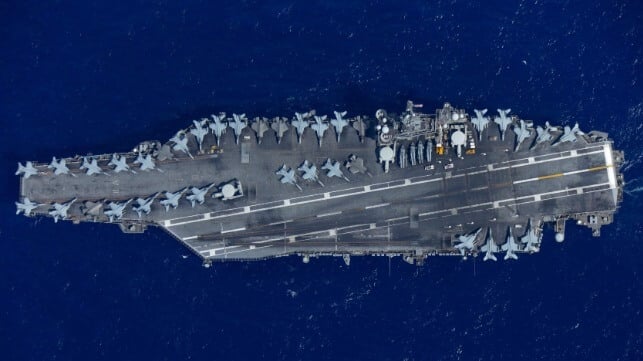
USS Abraham Lincoln (CVN-72) and her carrier strike group (CSG) should shortly be arriving in the Gulf of Oman sea area, adding to the military options available to the US Central Command in handling the ongoing situation in Iran.
Positional data tracking has now clearly demonstrated that the Abraham Lincoln CSG was on the same course as the Iranian bulk carrier Arvin (IMO 9193202), and overtook the Iranian vessel as both were traveling westwards through the Straits of Malacca. The CSG, traveling at a much faster cruising speed than the Alvin, soon left the Iranian vessel well behind.
In terms of competing forces which the Abraham Lincoln CSG might encounter in the Gulf of Oman, the Chinese 48th Flotilla is still split, with the Type 054A guided-missile frigate Daqing (F576) watching over the Red Sea and Gulf of Aden while the two other ships of the flotilla make their way back to their home base at the Project 141 Overseas Support Base in Djibouti after completing their participation in Exercise Will for Peace 2026 off South Africa. The 48th Flotilla probably needs some regeneration time in Djibouti before resuming operations, at which time, with the Red Sea relatively quiet, their highest operational priority is likely to be keeping an eye on the Abraham Lincoln CSG.
The Russian Pacific Fleet flotilla - which conducted Exercise Marumex-2025 with Myanmar's Navy in mid-November in the Andaman Sea - has now dispersed. In the Gulf after a spell in the Red Sea is the Russian Udaloy Class frigate RFS Marshal Shaposhnikov (F543), having been a visiting ship to the DIMDEX 2026 defense exhibition held January 19-20 in Port Hamad, Qatar. The Marshal Shaposhnikov is probably being supported by the Boris Chilikin Class oiler Boris Butoma (IMO 8842557). These two vessels set off with the Gremyashchiy Class corvette RFS Gremyashchiy (F337) from Vladivostok in October, and together made port calls Da Nang (Vietnam), Sattahip Naval Base in Thailand and at Sabang (Indonesia). The Gremyashchiy then spilt off to make port visits alone to Chittagong and then Colombo to mark the 75th anniversary of Sri Lanka’s Navy. Having reversed course and headed eastwards, the Gremyashchiy made a visited Brunei Darussalam from December 9-12, so the corvette now appears to be returning back to Vladivostok alone.
It is also possible that the Russian Steregushchiy Class corvette Stoykiy (F545), also having participated in Exercise Will for Peace 2026 off Cape Town, will continue her circumnavigation of Africa by cruising up the east coast towards the Arabian Sea area in which the Abraham Lincoln CSG is likely to operate.
Russian and Chinese naval vessels often make a number of port visits in the Gulf area at this time of year prior to participating with Iranian naval forces in the annual trilateral Exercise Maritime Security Belt. It would be a surprise if the Marshal Shaposhnikov and the corvette Stoykiy joined forces with Chinese PLAN ships from the 48th Flotilla and linger to take part in another iteration of the Maritime Security Belt exercise this year. The Russians and Chinese will probably be wary of becoming entangled with any potential conflict between Iran and the United States, and will leave the Iranians to face the Americans alone, as is the established pattern.
As for the Iranians, the 103rd Flotilla has recently completed its controversial participation in the BRICS Exercise Will for Peace 2026 maneuvers off the Simon’s Town Naval Base. The 103rd Flotilla is made up of the regular Iranian Navy (Nedaja)’s forward base ship IRINS Makran (K441) and the Bayandor Class corvette IRINS Naghdi (F82), plus the IRGC (Nedsa)’s converted oil tanker, IRIS Shahid Mahdavi (L110-3).
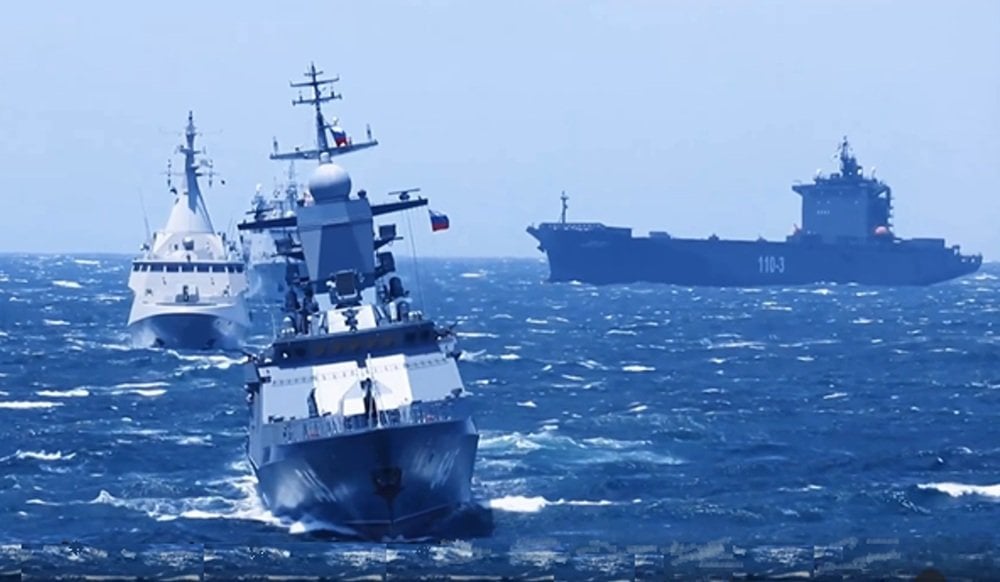
Russian corvette Stoykiy (F545), Emirati corvette Bani Yas (P110) and Nedsa IRIS Shahid Mahdavi (L110-3) take part in the sea-going phase of Exercise Will for Peace 2026 (PLA Navy video)
While a Board of Inquiry is meeting to uncover why President Cyril Ramaphosa’s instructions that Iran was not to participate were ignored, the Chinese PLA Navy published video of the sea-going part of the exercise, which clearly showed that both IRINS Naghdi (F82) and the Nedsa’s IRIS Shahid Mahdavi (L110-3) were active participants rather than mere observers.
The 103rd Flotilla should now be making its way home to Bandar Abbas, but had not arrived in normal home berths in the naval harbor as of January 22. The Nedaja claims that a 104th Flotilla has also been at sea, but it is unclear what vessels this flotilla is comprised of, or where they might be. The Bandar Abbas Naval Harbor as of January 22 appears to be quite full, with four of the six active frigates tied up alongside.
EU Targets Senior Iranian Officials as Evidence Mounts of Protest Killings
- The E.U. is seeking asset freezes and visa bans against senior Iranian officials and entities tied to lethal force, censorship, and surveillance during nationwide protests.
- Despite mounting pressure, the bloc is unlikely to designate the IRGC as a terrorist organization due to opposition from several member states.
- Separate E.U. measures target Iranian individuals and firms accused of supplying drones and missiles to Russia for use in Ukraine.
The European Union has proposed sanctions against Iran's interior minister and 14 other senior officials for their role in a violent crackdown on nationwide protests that erupted in late December, documents obtained by RFE/RL show.
Protests erupted on December 28 over economic woes, including currency collapse, but morphed into anti-regime demonstrations that were met with lethal force.
The bloc's foreign ministers could adopt the measures, which include asset freezes and visa bans, when they meet in Brussels on January 29. All member states must vote in favor of the sanctions to be adopted
The proposal, dated January 20 and circulated within the EU Council, targets Interior Minister Eskandar Momeni, who oversees Iran's Law Enforcement Forces (LEF), and security units of the Islamic Revolutionary Guards Corps (IRGC) that are blamed for hundreds of protester deaths.
Prosecutor-General Mohammad Movahedi-Azad faces designation for threatening demonstrators with death penalties on charges of "enmity against God" during the unrest.
Momeni, also deputy commander-in-chief, commanded forces that "suppressed street protests," which saw thousands of casualties, according to the EU document.
Regional IRGC commanders, including Heydar Olfati in Ilam Province and Ahmad Ali Feyzollahi of the IRGC Ground Forces elite Saberin Brigade, are accused of ordering troops to open fire on peaceful crowds.
The town of Malekshahi in the western Ilam Province experienced some of the deadliest clashes, with video footage documenting security forces firing at protesters in broad daylight.
The US-based Human Rights Activists News Agency (HRANA) says that as of January 22, it had verified 4,902 deaths, including 201 security forces, with more than 9,300 deaths still under investigation.
The proposed EU measures also hit six entities enabling repression, from the Iranian Audio-Visual Media Regulatory Authority (SATRA) for censoring dissent to tech firms Yaftar and Douran developing VPN blockers and facial recognition tools. The Working Group for Determining Instances of Criminal Content (WGDICC), a judicial body filtering and censoring Internet access, is also being targeted.
Iranians have been cut off from the outside world since January 8, when the authorities imposed a near-total nationwide Internet shutdown as the crackdown on protests intensified. It remains unclear when services will resume, but even when they do, experts fear the authorities will force Iranians to use a domestically designed "intranet" that works independently from the world's Internet.
IRGC Designation Unlikely
The proposed asset freezes and visa bans come as the bloc has been under pressure for years -- both externally and internally -- to designate the IRGC as a terrorist organization. However, no such measure will likely be adopted next week.
Unanimity is needed to blacklist the elite force, which is deeply embedded in Iran's economy and drives the Islamic republic's regional policies. However, Italy, France, and Spain are the three countries in the 27-member bloc opposed to the designation and there is no indication they will shift their position.
Sanctions For Helping Russia
A separate proposal dated January 16 targets four individuals and six firms tied to Iran's ballistic missile and drone programs supplying Moscow.
The entities include Sahara Thunder and Khojir Missile Development and Production Complex.
The document describes Sahara Thunder as a Defense Ministry front company acting as an import-export cover to ship drones, components, and technology to Russia, receiving payments in return.
The Khojir complex, meanwhile, is involved in the production of Fath-360 close-range ballistic missiles allegedly sent to Russia, where troops are being trained to use them. It is managed jointly by the IRGC and Defense Ministry and builds solid-propellant missiles used against Ukrainian targets, according to the document.
By RFE/RL


No comments:
Post a Comment